Published online: 29.09.2013 --- © jbm 2013
--- S. Nenonen
Hanken School of Economics, Department of Marketing, Helsinki, Finland
University of Auckland Business School, Graduate School of Management, Auckland, New Zealand e-mail: [email protected]
K. Storbacka
University of Auckland Business School, Department of Marketing, Auckland, New Zealand e-mail: [email protected]
Finding market focus for solution business development
Suvi Nenonen · Kaj Storbacka
Abstract: Firms wanting to move towards solution business models increasingly focus on their customers’ value-in-use, and often end up redefining their market around what the solution makes possible for the customer. However, all customers do not accept a value-in-use based approach. Hence, a key determinant of success in solution business relates to a firm’s ability to identify segments and customers that are best suited for solution business, i.e., to find market focus. In this paper we develop a framework that assists firms to choose the right markets to focus on, and illustrate the use of the framework with two action research case studies. The framework consists of a market picture, describing the broad ambit of a market actor, and market arenas within the market picture, selected based on morphological analysis. The case studies illustrate how the framework helped managers to escape the market myopia experienced by firms with established market definitions.
Keywords: Solution Business · Market · Market Definition · Morphological Analysis
Introduction
There are several research streams that investigate solution business from various perspectives: the servitization literature (e.g., Baines et al., 2009; Mathieu, 2001), the solution marketing and sales literature (e.g., Anderson, Narus & Rossum, 2006; Tuli, Kohli, & Bharadwaj, 2007), the solution strategy and management literature (e.g., Brady, Davies & Gann, 2005; Galbraight, 2002), and the operations management oriented product/service systems literature (e.g., Meier, Roy & Seliger, 2010). Using a business model lens, Storbacka et al. (2013) argue that when firms attempt to transition towards solution business, they inherently end up making central business model changes that incorporate many of the suggestions provided by the above research streams into a systemic change process. These changes may be of fundamental nature, such as applying new earnings logics, taking new positions in the value network, and often result in altered business and market definitions.
Solution business aims to identify business opportunities by understanding the customer’s value-creating process and focuses on the co-creation of value (Vargo & Lusch, 2008). Hence, Storbacka et al. (2013) defines solutions as “longitudinal, relational processes that comprise the joint identification and definition of value creation opportunities, the integration and customization of solution elements, the deployment of these elements into the customer’s process, and various forms of customer support during the delivery of the solution”. This approach puts emphasis on value-in-use, instead of value-in-exchange (Vargo & Lusch, 2008). Consequently, as firms wanting to move towards solution business increasingly focus on their customers’ value-in-use, they often end up redefining their market. Firms tend to define their market around what their solution makes possible for the customer, instead of using product-based market definitions. Hence, we see firms move from selling products to selling ‘performance’, or from selling engines to selling ‘power-by-the-hour’.
It has, however, been shown that all customers are not willing to accept a value-in-use based approach (Kowalkowski, 2011). Hence, a key determinant of success in solution business relates to a firm’s ability to find market focus, i.e., identify market segments and customers that are best suited for solution business. However,
surprisingly little research addresses the challenges in finding market focus for solution business.
In this paper we assume that firms wanting to transform towards a solution business model will need to make subjective market definitions by identifying the market or network(s) to participate in. This resonates with another stream of research within marketing, namely the need to reconnect marketing to a theory of markets (e.g., Peñaloza & Venkatesh, 2006; Araujo, Finch & Kjellberg, 2010). Kjellberg et al. (2012) conclude that markets are malleable and subject to multiple change efforts. Markets are always in the making, or paraphrasing Vargo and Lusch (2004): markets are not – they become. This opens up questions about how market actors join in and influence this process of becoming in practice.
There is already a body of research discussing market making and shaping. Existing studies discuss the overall process of market scripting (Storbacka & Nenonen 2011) as well as the roles of market practices (Kjellberg & Helgeson, 2006; Andersson, Aspenberg & Kjellberg, 2008), performativity (Hall, 2000; Callon, 2007; Hagberg & Kjellberg, 2010), and market objects (Finch & Geiger, 2011) in the market scripting process. Kjellberg et al. (2012, p. 221), however, calls for “a wider
perspective on whose activities and which activities make and shape markets”.
This paper addresses the above-identified gaps by generating a better understanding of how firms systematically and purposefully define market focus for their solution business. More precisely, the purpose of the research is: (1) to develop a framework that assists firms wishing to design solution business models to analyse and choose the right markets (or sub-markets) to focus on, and (2) to illustrate the use of the framework with two action research case studies.
The paper is organized as follows. First, we describe the research process. Second, we discuss different perspectives on creating market focus, concentrating on literature on market definitions, market pictures, market segmentation, competitive arenas and morphological analysis. Third, we propose a framework for defining market focus. Fourth, we present two case studies to illustrate the practical implications of the framework. Finally, we discuss the theoretical and managerial conclusions and identify avenues for further research.
Research process
We build on the notion brought forward by Reibstein, Day and Wind (2009), who suggest that it is valuable for marketing academics to engage with practitioners who are experimenting with difficult problems. The research process described in this paper continues the qualitative action research tradition that can be labelled ‘clinical research’, as described by Normann (1977) and Schein (1987, 1995).
Action research can be distinguished from other social research forms by active participation and collaboration between the researchers and the organization, the aim for holistic and systemic understanding, a focus on change and goals, the use of multiple types of data gathering methods, and a systematic dialogue between action and reflection (Dickens & Watkins, 1999; Gummesson, 2000; Coughlan & Coghlan, 2002). The key differences between consulting and clinical research are the systematic critical reflection and the more deliberate pursuit of new understanding. Based on the experience gathered from the interventions (e.g., interviews, reporting sessions, workshops, definition and implementation of new practices), the researchers spend time and energy on reflecting on the tensions between the initial framework (i.e., pre-understanding) and empirical reality, between researchers and representatives of the client organization. Reflection is a non-linear, non-sequential, iterative process of systematic combination that aims at matching theory with reality (Dubois & Gadde, 2002). In reflection, the key word is ‘combining’: the aim is to
combine data gathering with data analysis, compare the evolving framework with existing literature-based theory, and match up the evidence and experiences from many simultaneous interventions in order to determine emergent patterns, and sharpen the constructs used to describe reality (Eisenhardt, 1989).
According to Schein (1987, p. 39) clinical research focuses on the dynamics of change and improvement: “it is therefore normative in its orientation and requires underlying theories that provide normative direction - concepts of health, effectiveness, growth, innovation, integration, and the like”. The key intervention tools of a clinician include language, typologies and metaphors development, by which the clinician tries to open new aspects of reasoning and to facilitate change.
The action research process described in this paper was carried out over a period of thirteen months between March 2011 and April 2012, and involved interventions with two major international firms: an investment equipment provider and a financial services provider. The firms were selected to participate in the action research based on four criteria. First, the involved firms had a deliberate aim to develop their solution business. Second, they had expressed their interest in re-defining their markets during the research period. Third, an effort was made to identify firms from differing industrial contexts. Fourth, the selection of the firms was limited by access concerns: market re-definitions are usually considered as being sensitive topics and are thus not freely disclosed to external researchers. Therefore, the research process had to be limited to those firms that were willing to participate in the action research and provide sufficient disclosure.
The narrative in the paper is a combination of findings from the dealings with the practitioners and results from the frequent reflections the researchers engaged in. Due to the sensitivity of the researched issues, we have been forced to protect the case study firms by making the presentations anonymous. This is particularly evident in the description of the firms and in the presentation of some of the end-results of the interventions. Due to the richness of the data, we present the final results of the research, instead of the intermediary results or direct quotes or comments by the case firm representatives.
Defining markets
In this section, we discuss extant literature from two perspectives: (1) how firms develop higher level market definitions, and (2) how firms increase the granularity of their market definition.
Higher level market definition: demand view, supply view and network pictures
Somewhat surprisingly, the term ‘market definition’ is not very often used in marketing or management; in fact the term is much more often cited in antitrust literature than in marketing or management literature.
In one of the classic writings in management, Abell and Hammond (1979) argue that although market definition acts as a foundation for business strategy development, it is often neglected. Many companies rely on intuitive, cursory, or incomplete analyses when selecting and defining markets. As a result, businesses are frequently defined by accident rather than purposeful designed. The product-geography matrix has been the most commonly used way for firms to define themselves and their market (Boardman & Vining, 1976). Rothschild (1984) argues against this approach, stating that the product-geography matrices tend to hinder firms from identifying opportunities in the adjacencies.
Abell (1980) proposes that firms should use more dimensions when creating their individual business definitions, and suggests three particular dimensions, including customer groups served, customer functions served and alternative technologies utilized. Buzzell (1978, p. 3), on the other hand, proposes that “there is no single correct way to define the market for a given business unit […] a market not only can but should be defined in several different ways”. This is in line with Day’s (1981) view that a firm is not limited to single views of the market; instead firms can benefit from accepting multiple market definitions suitable for particular strategic situations.
The task of defining one’s market can be approached either from the supply-side or the demand-side perspective. Most of the marketing literature has adopted a demand-oriented view, i.e., by taking customers as the focal point of analysis (see, e.g., Shapiro & Bonoma, 1984; Sausen, Tomczak & Herrmann, 2005; Clarke & Freytag 2008). Jenkins and MacDonald (1997) critique this approach by proposing that market definition should be linked to supply-side characteristics, such as capabilities and the nature of the organization. Geroski (1998) concurs with these notions: according to him supply-side market definitions end up in ‘industry’ definitions, which have certain obvious benefits such as the ability to assist in identifying competitors and in helping to develop new technologies. Geroski (1998) also argues that market definitions focused solely on customers are incomplete as markets reflect the supply side as much as they reflect demand side factors. To conclude our review of the market definition literature, we draw on Datta (1996) who argues for integrative viewpoint combining both demand and supply-side characteristics.
Another interesting concept related to the higher level market definition is ‘market pictures’. When discussing the networked markets, one is easily drawn into a discussion on ‘where the network starts and ends’. According to Prenkert and Hallén (2006) business networks are best described from the viewpoint of a single market actor by analysing this actor’s relationships. This approach makes it possible to draw a “delimited and palpable business network” that has a “specific centre and borders in
terms of the network horizon” viewed from the network centre populated by the focal actor (ibid, p. 385).
‘Network pictures’ (Henneberg, Mouzas & Naudé, 2006) is a concept developed in the IMP Group in order to generate and analyse subjective representations of the actors’ networks. Building on this we suggest that market pictures are managers’ subjective mental representations of their market. Even though market pictures are subjective, they are also to a certain extent inter-subjectively constructed, i.e., other market actors contribute to and interrelate to them. The market pictures “form the backbone of managers’ understanding of relationships, interactions and interdependencies, and therefore constitute an important component of their individual decision-making processes” (Henneberg et al., 2006, p. 409). Drawing on Henneberg
et al. (2006), market pictures usually contain some of the subsequent elements: network boundaries, network centre/periphery, network’s actors/activities/resources, ontological focus, external environment, time/task horizon, actors’ power, and directionality of interactions.
Granularity of market definition: market segmentation, competitive arenas and morphological analysis
In addition to the higher level market definition, authors such as Viguerie, Smit, and Baghai (2008), advocate for increased granularity in describing markets. Viguerie et al.
(2008) propose that firms should develop more fine-grained understanding of their markets in order to secure active presence in fast-growing areas (i.e. ‘growth pockets’) where the firm has capabilities to compete effectively.
Within marketing literature, one of the most extensively discussed method of increasing the granularity of market definition is market segmentation. The majority of the industrial market segmentation models, drawing on the heritage of Wind and Cardozo (1974) and Bonoma and Shapiro (1983), are built using a break-down process, starting with the entire macro market and moving down towards more company specific micro information (Clarke, 2009). Some researchers, however, argue for a build-up process starting with information about individual customers (e.g., buying behaviours) and building segments of customers who share certain similarities (Freytag & Clarke, 2001; Clarke, 2009). The availability of customer data and the development of improved analytical techniques make this a suitable process in many industries today.
Both these processes are based on linear thinking aimed at defining a distinct number of customers as belonging to a particular segment. For instance, the idea by Wind and Cardozo (1974) to move from macro-segmentation (i.e., focusing on company-specific characteristics such as size, geography, type of institution, etc.) to micro-segmentation (i.e., focusing on purchase decision criteria, attitudes, perceived importance of supplied product, etc.); or Bonoma and Shapiro’s (1983) nested approach, which proposes movement though a nested hierarchy of segmentation criteria, including demographics (e.g., industry, company size, customer location),
operating variables (e.g., company technology, product/brand use status, customer capabilities), purchasing approaches (e.g., purchasing function, power structure, buyer-seller relationships, purchasing policies, purchasing criteria), situational factors (e.g., urgency of order, product application, size of order), and buyers’ personal characteristics (e.g., character, approach).
Another interesting concept related to bringing more granular view into the market is competitive arenas. The competitive arena construct has been used in the literature with various meanings. Birkinshaw, Hood, and Young (2004, p. 228) describe a competitive arena as “a set of customers, suppliers, competitors and other actors that collectively shape the [firm’s] strategy”. Partridge and Perren (1994) argue that any competitive arena will contain firms that are fighting to satisfy the same customer needs and propose, based on Abell (1980, p. 24) who suggests that competitive arena can be viewed as a “series of overlays of differently defined businesses intersecting with one another but not necessarily congruent with one another”. According to Kay (1990, p. 3), competitive arenas can be viewed as “the smallest area within which it is possible to be a viable competitor”. Rothschild (1984) proposes arena mapping as a tool to understand the competitive environment, while Coman (2008) develops an arena tool to map the business environment. Storbacka and Nenonen (2012, p. 186) define competitive arenas as “potentially overlapping sub-markets subjectively defined by the focal actor” and use competitive arena mapping to facilitate the identification of viable market adjacencies and to enable subjective market definitions.
There are various methods to create market segments or competitive arenas. However, in this research we have searched for an approach that circumvents the most common challenges associated with market segmentation models’ hierarchies of causal and/or quasi-causal relationships, such as the exponential growth in a number of segments with each new variable modelled (Ritchey 2006). In particular, we pursued models that are built on assumptions of non-hierarchical and multi-dimensional connections between variables and enable combining both demand and supply characteristics as well as macro and micro levels.
Morphological methods, which are based on identifying parameter spaces linked by way of logical relationships (e.g., Ritchey, 2006), fulfil all the above-defined criteria for suitable approaches for increasing the granularity of the market definitions. Zwicky (1969) was the pioneer in the morphological analysis (MA), which represents a method for structuring socio-technical systems. Specifically, he used MA for investigating the entirety of relationships contained in multi-dimensional, usually non-quantifiable, complex problems.
MA is first and foremost an ordered way of looking at things (Zwicky 1969). In particular, the MA process involves identifying and defining the most important dimensions relevant to a specific situation or problem. After the relevant dimensions have been identified, each dimension is categorized into possible and relevant categories, values or conditions. Combined, the dimensions and their categories create the parameters that are used to structure the problem. The dimensions are
placed against each other in a multi-dimensional matrix, creating a ‘morphological field’ or ‘morphological box’ (Ritchey, 2006). Each dimension forms a parallel column, and each column contains all possible categories identified within this dimension. Selecting suitable categories from each relevant dimension creates a ‘morphotype’, which is a particular solution alternative to the issue under investigation.
Multiplying the number of categories under each dimension generates the theoretical maximum number of available morphotypes. The resulting number can be very large, thus a key part of MA is to increase the overall understanding of the morphological field and to select only the viable morphotypes for further investigation. The reduction of number of morphotypes to be investigated is mainly done via a cross-consistency assessment that purges out the contradictory and inconsistent morphotypes. The inconsistencies can be (a) logical, i.e. a certain morphotype is not logically possible; (b) empirical, i.e. a certain morphotype is deemed too improbable based on the empirical experience; or (c) normative, i.e. a certain morphotype is not permitted due to e.g. firm’s strategy or values (Ritchey, 2006; Yoon, Phaal & Probert, 2008). In order to execute the cross-consistency analysis, considerable knowledge on the issue at hand, patience and managerial judgment is needed
Over the years, MA has been used mainly as a problem-solving and idea generation technique (e.g., Higgins, 1996). Recent studies using MA cover vast array of application areas, ranging from virtual organizations (Shankar & Ganesh, 2007), technology road mapping (Yoon et al., 2008), handling of temporal data (Knolmayer & Borean, 2010), to delineating store trade areas (Baray & Cliquet, 2007). In marketing, new product development and innovation (Hsiao & Chou, 2004) and market innovation (Storbacka & Nenonen, 2012) have utilized MA as a method.
A framework for finding market focus
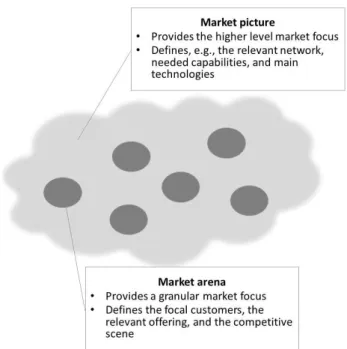
Building on the above literature review, we propose a two-tier framework consisting of the definition of a market picture and selected market arenas (described in Figure 1). A market picture describes the broad ambit of an market actor’s market and
answers to questions such as: which other actors belong or should belong to the market actor’s network, what kind of relationships does the market actor have with them, in which line of business the market actor is, what are the main capabilities needed, and what are the main technologies utilized. Market pictures are subjective: each market actor can draw their own market picture. Market pictures should also be inter-subjective within the market actor’s organization: the overall notions of the market picture should be shared among the persons working in the same organization. However, market pictures are not necessarily entirely clearly defined in terms of market boundaries due to the fact that drawing crystal-clear and permanent boundaries to subjectively defined and constantly changing markets can be difficult.
Market arena is a development of the competitive arena idea, but puts emphasis on value creation instead of competition. The aim of strategy is not ‘winning’ a
zero-sum game, defined as a product market. Nor should the focus be on ‘competing’, but rather on how the firm can engage in co-creation of value with customers, suppliers and partners in order to improve the performance for several actors at the same time (Storbacka & Nenonen, 2011). Whereas competitive strategy builds barriers, value-creating strategy builds a deep understanding of the ecosystem in which a firm chooses to operate and how the firm can co-create value with other organizations in the ecosystem.
In this paper, we define market arenas as logically viable morphotypes that reside within a market actor’s market picture and are selected by the market actor. Market arenas complement the market definition outlined by the market actor’s market picture by describing more clearly those areas in which the market actor either has or aims to have operations. Market arenas are subjectively defined by the market actor and they bring granularity into the overall market definition. Market arenas answer to questions such as: who are the relevant customers for the market actor, how should the offering be configures, and who are the market actor’s main competitors. We propose that the market arenas are to be defined through non-hierarchical, non-causal and multi-dimensional morphological analysis as the traditional hierarchical and causal or quasi-causal market segmentation methods can be difficult to operationalize especially when the market actor seeks to re-configure its market into a new, and currently to a certain extent unknown, configuration.
Fig. 1:Market focus framework
In the context of market re-definitions, the market pictures should enable sufficient flexibility for the market actor to find new market adjacencies and to accommodate for the plasticity of the evolving market configuration (Kjellberg et al., 2012). The market arenas are needed as the market pictures often provide insufficient guidelines for marketers to conduct effective and efficient market shaping in practice by e.g. actively
influencing or creating market practices, altering the market object, or by acquiring new actors into the network.
Market focus in practice
In this section we illustrate the proposed framework with two action research case studies: Alpha, a firm offering investment equipment solutions, and Beta, a firm offering financial services solutions.
Alpha: re-configuring the market towards integrated solutions
Alpha is a global firm having operations in over 150 countries and generating an annual turnover of several billion dollars. One of Alpha’s main business areas (from this point onwards called Alpha) is focused on a specific industry, to which Alpha provides sophisticated investment equipment, services and solutions. Even though Alpha has been successful both in terms of growth and profitability, in late 2010 Alpha made a conscious decision to take a more proactive role in re-defining their relevant solution business market. The objective of the definition was to develop the market towards more integrated solutions, which would enable Alpha take a more strategic role towards their main customers, and to design and deliver even more energy-efficient and environmentally friendly solutions.
The market picture part of Alpha’s market definition was envisioned in late 2010, before the actual action research period started. The term ‘lifecycle solutions’ was chosen to describe the new market picture, as Alpha felt that this term communicated effectively both internally and externally their ideas about the ‘new’ market. The new market picture necessitated some minor development steps in Alpha’s capabilities and technologies, but the most considerable changes compared to the current state were detected in Alpha’s network. The new ‘lifecycle solutions’ market picture required Alpha to create entirely new relationships and to change their existing ones. Interestingly, Alpha initiated considerable internal and external marketing campaigns already at this stage of their market re-definition process in order to start educating both their employees and external partners about their new market picture and its benefits to the entire industry.
In order to operationalize the ‘lifecycle solutions’ market picture, Alpha formed a specialist task force of five persons to identify, assess and to prioritize Alpha’s lifecycle solutions market arenas. Over a period of seven months, six task force meetings were organized.
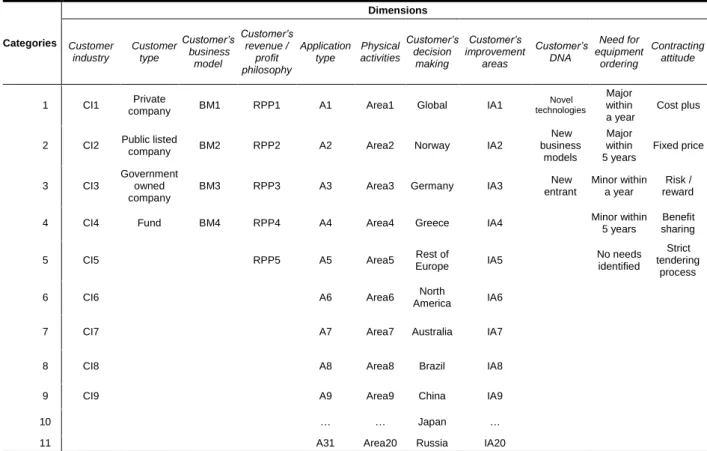
In the beginning of the process, the task force utilized a morphological analysis to create a morphological field representing Alpha’s lifecycle solutions market picture. Alpha’s morphological field is depicted in Figure 2.
Theoretically, it would be possible to generate 7,365,600,000 different morphotypes from Alpha’s lifecycle solutions morphological field. Therefore, the next step was to conduct the cross-consistency assessment and to identify viable market. After the cross-consistency analysis, the task force selected 27 market arenas for further analysis. During the analysis phase, data was collected for each market arena on their size, growth rate, profitability, Alpha’s current business volume, Alpha’s future business potential, strategic importance to Alpha, competitors’ competitive strength, Alpha’s competitive strength, and the existence of certain market practices.
Fig. 2:Alpha’s lifecycle solutions morphological field
Categories Dimensions Customer industry Customer type Customer’s business model Customer’s revenue / profit philosophy Application type Physical activities Customer’s decision making Customer’s improvement areas Customer’s DNA Need for equipment ordering Contracting attitude
1 CI1 Private
company BM1 RPP1 A1 Area1 Global IA1
Novel technologies Major within a year Cost plus
2 CI2 Public listed
company BM2 RPP2 A2 Area2 Norway IA2
New business models Major within 5 years Fixed price
3 CI3
Government owned company
BM3 RPP3 A3 Area3 Germany IA3 New
entrant
Minor within a year
Risk / reward
4 CI4 Fund BM4 RPP4 A4 Area4 Greece IA4 Minor within
5 years
Benefit sharing
5 CI5 RPP5 A5 Area5 Rest of
Europe IA5
No needs identified
Strict tendering
process
6 CI6 A6 Area6 North
America IA6
7 CI7 A7 Area7 Australia IA7
8 CI8 A8 Area8 Brazil IA8
9 CI9 A9 Area9 China IA9
10 … … Japan …
11 A31 Area20 Russia IA20
After the needed data was collected, the task force members convened into a task force meeting together with five additional experts within Alpha and prioritized the market arenas from various viewpoints such as competitive intensity, arena attractiveness and market development degree. Based on these managerial prioritizations, the 27 market arenas were placed into three market portfolios: (1) “quick wins” that enabled Alpha to leverage its existing strengths and relationships, (2) “2015 business” that ensures growth for Alpha in 3-4 years’ time, and (3) “future projects” that are true future market arenas with little or no current business.
For each of the identified 27 market arenas, Alpha also created arena-specific market plans. In these plans Alpha described its target state for the market arena, identified the main actors in the arena, and listed the main actions it plans to conduct in order to proactively drive the market arena into a direction that is compatible with their overall market picture.
Alpha has been conducting the activities aimed at re-defining the market for seven months and for the majority of these activities it is too soon to tell how effective Alpha has been. However, the top executives of Alpha are very satisfied with the new market definition and proclaim that they ‘will execute a similar process to create a common market view every time they seek to shape existing or enter new markets in the future’.
Beta: re-configuring the market from price driven to solutions and value driven
Beta is an international financial services provider with over 1,000 branches and total assets of over 500 billion dollars. One of Beta’s business areas focuses on asset-based finance and sales finance. Regardless of the turmoil that has impacted the financial markets ever since 2008, Beta has been a growing and profitable firm; characteristics that are also shared by its asset and sales finance division. In 2011 Beta decided to start driving the asset and sales finance market away from the margin (i.e., price) focus towards a solution and customer value creation focus. The main objectives behind the market re-definition initiative were the aim to stop the commoditization of the asset and sales finance market and to ensure Beta’s financial strength also during the coming years of increased financial regulations (e.g. Basel III).
The market picture for Beta’s asset and sales finance unit (from this point onwards called Beta) was created in mid-2011 during Beta’s strategy process. The renewed market picture was named ‘asset and sales finance solutions’. Judging by the mere words, the change from the previous market picture ‘asset and sales finance’ was not a major one, but the one new word brought with itself considerable changes to Beta. The overall network of Beta expanded significantly as Beta had to identify and acquire external partners that could help it to deliver value-added solutions. Technologically the transition towards integrated solutions posed considerable development needs for Beta’s IT systems, and the overall capabilities related to solution business (e.g. value quantification & communication, solution delivery industrialization) had to be improved dramatically.
In order to create a clearer view of the ‘asset and sales finance solutions’ market picture, Beta gathered a task force of eight internal specialist to identify, assess and to prioritize Beta’s solution market arenas. Over a period of four months, five task force meetings were organized.
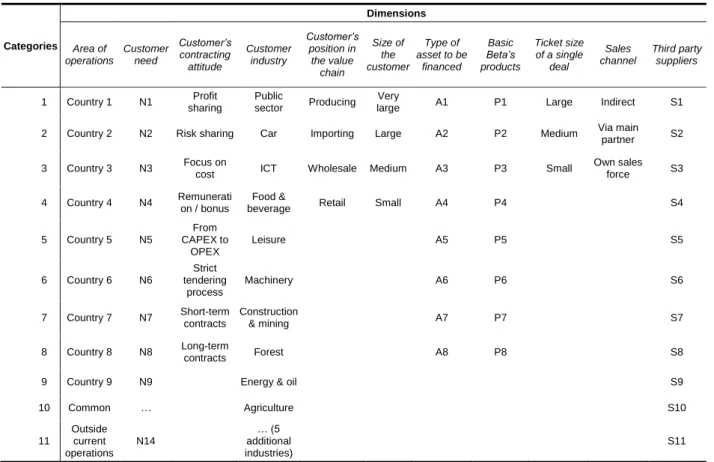
In the beginning of the process, the task force utilized a morphological analysis to create a morphological field representing Beta’s solution market picture. Beta’s morphological field is depicted in Figure 3.
It is possible to compute 1,998,323,712 different morphotypes from Beta’s asset and sales finance solutions morphological field. Thus, after the morphological field was created, the task force focused on the cross-consistency analysis, leading to 24 market arenas to be analysed. For each of the analysed market arenas, Beta collected information regarding the arena’s size and growth, typical assets to be financed, main trends affecting the arena, customers’ readiness to move from individual products to
integrated solutions, main influencers in the arena, main competitors in the arena, Beta’s business potential in the arena, Beta’s competitive position in the arena, Beta’s current top customers in the arena, and Beta’s strengths and weaknesses in the arena.
Fig. 3:Beta’s asset and sales finance solutions morphological field
Categories Dimensions Area of operations Customer need Customer’s contracting attitude Customer industry Customer’s position in the value chain Size of the customer Type of asset to be
financed
Basic Beta’s products
Ticket size of a single
deal
Sales channel
Third party suppliers
1 Country 1 N1 Profit sharing
Public
sector Producing Very
large A1 P1 Large Indirect S1
2 Country 2 N2 Risk sharing Car Importing Large A2 P2 Medium Via main partner S2
3 Country 3 N3 Focus on
cost ICT Wholesale Medium A3 P3 Small
Own sales
force S3
4 Country 4 N4 Remunerati on / bonus
Food &
beverage Retail Small A4 P4 S4
5 Country 5 N5
From CAPEX to
OPEX
Leisure A5 P5 S5
6 Country 6 N6
Strict tendering
process
Machinery A6 P6 S6
7 Country 7 N7 Short-term contracts
Construction
& mining A7 P7 S7
8 Country 8 N8 Long-term
contracts Forest A8 P8 S8
9 Country 9 N9 Energy & oil S9
10 Common … Agriculture S10
11 Outside current operations N14 … (5 additional industries) S11
At the present, the action research period with Beta is still ongoing and during the next two months Beta will prioritize the identified market arenas and create market re-configuration plans for the most influential market arenas. Therefore it is still too early to tell what kind of impacts the renewed market definition has had within Beta. Nevertheless, the process so far has already generated a profound change in Beta’s mindset: today the vast majority of Beta’s top executives believe that they actually can proactively influence how their markets develop. In early 2011 such mindset was limited to only a handful of Beta’s executives.
Discussion
In this section we summarize the empirical analysis, discuss the theoretical contributions of the research process, identify further research avenues and point to some important managerial implications
Summary of findings from the empirical studies
When comparing the two case study firms and their business contexts, it is easy to detect several similarities between Alpha and Beta: both firms are established players with very long track records in their respective industries, both are market leaders in their selected geographical or application areas, both are multinational firms, both are independent business divisions within large multi-division corporations, both are financially sound, and neither of them is operating under entrepreneurial or visionary leadership. However, there are also some notable differences between the case study firms: the firms represent different industries, and Alpha is a pure-B2B player with truly global reach whereas Beta is a regional player who serves both B2B and B2C customers.
The framework illustrated in Figure 1 was created through interplay between the literature review and the findings of the action research processes with Alpha and Beta. During the action research process we sought to identify ‘reflective practitioners’ (Schön, 1983) from both organizations who expressed interest and ability in contributing to the development of the market focus framework. The feedback regarding the process that the practitioners provided can be viewed as a process of ‘member checks’, which increased trustworthiness of the results (Wallendorf & Belk, 1989; Lincoln & Guba, 1985). The comments given by these reflective practitioners can be categorized into three main groups. First, the reflective practitioners considered that the analytical approach with “the creative twist brought by the morphological analysis” to creating the market definition was compatible with their organizations’ processes and culture. Second, they thought that both parts of the market focus framework are needed: the market picture alone is not concrete enough to guide the market re-configuration activities in practice, but without an explicit new market picture for market re-configuration it would be very difficult to identify market arenas - or the identified market arenas would remain too close to the previous, often implicit, market picture to enable effective market re-configuration. Third, the reflective practitioners both from Alpha and Beta felt that the market pictures were created somewhat intuitively, at least compared to the rigor applied in identifying the market arenas. Thus, they suggested that they could have benefited from a more structured approach to arriving at the market picture as well.
Theoretical contributions
Our work responds to calls for providing specific guidelines and tools to improve firms’ capabilities to co-create complex business solutions (Marketing Science Institute, 2010), and calls for a wider perspective on the activities that make and shape markets (Kjellberg et al., 2012).
This paper contributes both to the solution business literature and to the literature on markets and marketing. First, our research increases awareness of market definitions as a key determinant of success in solutions business. The importance of market re-definitions has been discussed earlier by Storbacka (2011) and Storbacka et
al. (2013), but in this paper we develop a framework that support firms to define markets or sub-markets that are likely to be favourable for the solution approach.
Second, we provide a new language and concepts for defining, describing and discussing markets, which sheds additional light on how market actors perceive their markets and identify market re-definition opportunities. Specifically, our research contributes to the literature about network pictures (Henneberg et al., 2006). Market pictures can be viewed as an extension of the previous research and in combination with the market arenas this way of reasoning becomes considerably more managerially applicable.
Third, we demonstrate how market actors – as they abandon the idea of objective, given markets – realize that the objective of the firm is not to learn ‘about the market’. Instead, actors wanting to influence the becoming of markets are more likely to focus on learning ‘with the market’. Market actors seeking to re-define their markets benefit from adaptive learning processes and the ability to involve also other actors in creating new interpretations of the market. This resonates with Day’s (2011) view on the need for new marketing capabilities, and adds to our understanding of marketing’s boundary spanning (Hult, 2011) role as a driver of markets or a creator of value creating opportunities, rather than as an interpreter of market trends or an identifier of market opportunities as precursor to strategy.
Finally, our research illustrates how morphological analysis can be used for increasing the granularity of the market definition in a novel way that differs from the established market segmentation methods by its non-hierarchical, non-causal and multi-dimensional approach to finding market arenas. Further, we provide empirical illustrations from two firms that have applied the method in a solution business context. Market arena mapping is shown to allow firms to identify and investigate a large set of possible market arena configurations, thus enabling a systematic and purposeful design of where to compete in the context of a value creation network.
Further research avenues
As the present research is exploratory in nature, it leaves various areas in a need for further research. First, more comprehensive empirical research in a variety of different industrial contexts is needed to support the conclusions from the case research illustrated in this paper and to further develop the proposed market focus framework. It would be especially important to involve firms that are not market leaders in order to better understand how various actors can influence the becoming of markets. Fligstein (2001), for instance, argues that market actors have different habitus (Bourdieu 1977), and some ‘skilled actors’ manage to stabilize certain networks by getting others to agree with their definition of a market.
Second, a particularly interesting avenue for further research relates to the possible rigidity or inertia of markets. Sull (1999) argues that there is ‘active inertia’, which makes it difficult even for very successful firms to break established conceptions
in markets. Inertia has been found to have cultural (Fligstein, 2001), industry recipe (Spender, 1989), cognitive (Levinthal and March, 1993; Prahalad, 2004), and industry clockspeed (Fines, 1998) connotations.
Third, more research is needed on the actual process of discussing and defining both market pictures and market arenas. The empirical data described in this paper covers only a short time period. A longitudinal study, analysing the impact of market shaping activities over time, would provide better starting points for more normative and managerially relevant conclusions. It would also make it possible to further delineate and operationalize market learning processes. Market learning is likely to be different in various industries and market situations. Therefore, such studies should cover different contexts and, for instance, compare firms operating in established, mature markets with firms in emerging and dynamic markets.
Managerial implications
Based on the research, we argue that it is likely that firms moving towards solution business models are faced with the challenge of re-defining their market. A key question to consider is whether the market is ready to buy solutions, and to what extent solutions even expected. A high level of readiness means the solution market is relatively mature with several firms providing solutions and with customers who are willing and able to buy them, and that solution business has become a norm that is both understood and measured.
In many cases market readiness is low and firms are faced with the need to engage in market shaping activities. Managerially, the proposed framework seems to be an effective way to escape the market myopia experienced by many firms with established market definitions. As with all human activity, also markets are artefacts, fabricated by the human mind. There is no objective market - all actors in the market can and should have their own view on the market. Firms may need to adopt a more pro-active stance towards markets - markets can be designed. It is not only a question of identifying opportunities in the market and adapting to them, but also a question of engaging in market shaping activities in order to increase market readiness and to fabricate market conditions that work in the firm's favor.
The morphological analysis introduced in the paper can be viewed as a tool that can help firms to envision new market arenas that might not emerge from other market analysis approaches. However, the effective and efficient use of the morphological analysis requires a great deal of managerial judgment when reducing the number of potential morphotypes. Thus, paraphrasing Ritchey (2006), morphological analysis should not be attempted without strong experienced facilitation, an engaged group of subject specialists, and a good deal of patience.
References
Abell, D. F. (1980), Defining the Business: The Starting Point of Strategic Planning. Englewood Cliffs: Prentice-Hall.
Abell, D. F., and J. S. Hammond (1979), Strategic Market Planning: Problems and Analytical Approaches. Englewood Cliffs: Prentice-Hall.
Andersson, P., K. Aspenberg, and H. Kjellberg (2008), “The Configuration of Actors in Market Practice”, Marketing Theory, 8 (1), 67-80.
Anderson, J. C., J. A. Narus, and W. van Rossum (2006), “Customer Value Propositions in Business Markets”, Harvard Business Review, 84 (3), 91-9.
Araujo, L., J. Finch, and H. Kjellberg (eds.) (2010), Reconnecting Marketing to Markets. Oxford: Oxford University Press.
Baines, T., H. Lightfoot, O. Benedettini, and J. M. Kay (2009), “The Servitization of Manufacturing. A Review of Literature and Reflection on Future Challenges”, Journal of Manufacturing Technology Management, 20 (5), 547-67.
Baray, J. and G. Cliquet (2007), “Delineating Store Trade Areas through Morphological Analysis”, European Journal of Operational Research, 182 (2), 886-98.
Birkinshaw, J. M., N. Hood, and S. Young (2005), “Subsidiary Entrepreneurship, Internal and External Competitive Forces, and Subsidiary Performance”, International Business Review, 14 (2), 227-48.
Boardman, A.E. and A. R. Vining (1976), “Defining Your Business Using Product-Customer Matrices”, Long Range Planning, 29 (1), 38–49.
Bonoma, T.V. and B. P. Shapiro (1983), “Industrial Market Segmentation: A Nested Approach”, Marketing Science Institute, Report No 83-100.
Bourdieu, P. (1977), Outline of a Theory of Practice. Cambridge: Cambridge University Press.
Brady, T., A. Davies, and D. Gann (2005), “Creating Value by Delivering Integrated Solutions”, International Journal of Project Management, 23, 360-65.
Buzzell, R. (1978), ”A Note on Market Definition and Segmentation”, HBS Casenotes, 579-083.
Callon, M. (2007), “What Does It Mean to Say That Economics Is Performative?”, in Do Economists Make Markets? On the Performativity of Economics, D. MacKenzie, F. Muniesa, and L. Siu, eds. Princeton: Princeton University Press, 311-57.
Clarke, A. H. (2009), “Bridging Industrial Segmentation Theory and Practice”, Journal of Business-to-Business Marketing, 16 (4), 343-73.
Clarke, A. H. and P. V. Freytag (2008), “An Intra- and Inter-Organisational Perspective on Industrial Segmentation: A Segmentation Classification Framework”, European Journal of Marketing, 42 (9/10), 1023-38.
Coman, A. (2008), “ARENA Mapping: An Effective Strategy Focusing Tool”, Human Systems Management, 27 (4), 305-12.
Coughlan, P. and D. Coghlan (2002), “Action Research for Operations Management”, International Journal of Operations & Production Management, 22 (2), 220-40. Datta Y. (1996), “Market Segmentation: An Integrated Framework”, Long Range
Planning, 29 (6), 797-811.
Day, G. S. (1981), “Strategic Market Analysis and Definition: An Integrated Approach”, Strategic Management Journal, 2 (3), 281-99.
Day, G. S. (2011), “Closing the Marketing Capabilities Gap”, Journal of Marketing, 75 (4), 183-95.
Dickens, L. and K. Watkins (1999), ”Action Research: Rethinking Lewin”, Management Learning, 30 (2), 127-40.
Dubois, A. and L.-E. Gadde (2002), “Systematic Combining: An Abductive Approach to Case Research”, Journal of Business Research, 55 (7), 553-60.
Eisenhardt, K. M. (1989), “Building Theories from Case Study Research”, Academy of Management Review, 14 (4), 532-51.
Finch, J. and S. Geiger (2011), “Constructing and Contesting Markets through the Market Object”, Industrial Marketing Management, 40 (6), 899-906.
Fines, C.H. (1998), Clockspeed: Winning Industry Control in the Age of Temporary Advantage. Reading: Perseus.
Fligstein, N. (2001), The Architecture of Markets: An Economic Sociology of Twenty-First-Century Capitalist Societies. Princeton: Princeton University Press.
Galbraith, J. R. (2002), “Organizing to Deliver Solutions”, Organizational Dynamics, 31, 194–207.
Geroski, P. A. (1998), “Thinking Creatively about Markets”, International Journal of Industrial Organization, 16 (6), 677-95.
Gummesson, E. (2000), Qualitative Methods in Management Research, 2nd edition. Thousand Oaks: Sage Publications.
Hagberg, J. and H. Kjellberg (2010). “Who Performs Marketing? Dimensions of Agential Variations in Market Practice”, Industrial Marketing Management, 39 (4), 477-501.
Hall, K. (2000), “Performativity”, Journal of Linguistic Anthropology, 9 (1/2), 184-87. Henneberg, S.C., S. Mouzas, and P. Naudé (2006), “Network Pictures: Concepts and
Representations”, European Journal of Marketing, 40 (3/4), 408-29.
Higgins, J. M. (1996), “Innovate or Evaporate: Creative Techniques for Strategists”, Long Range Planning, 29 (3), 370-80.
Hsiao, S.W. and J. Chou (2004), “A Creativity-Based Design Process for Innovative Product Design”, International Journal of Industrial Ergonomics, 34 (5), 421-43. Hult, G. T. M. (2011), “Toward a Theory of the Boundary-Spanning Marketing
Organization and Insights from 31 Organization Theories”, Journal of the Academy of Marketing Science, 39 (4), 509-36.
Jenkins, M. and M. MacDonald (1997), “Market Segmentation: Organizational Archetypes and Research Agendas”, European Journal of Marketing, 31 (1), 17-32.
Kay, J. (1990), “Identifying the Strategic Market”, Business Strategy Review, 1 (1): 1– 24.
Kjellberg, H. and C.-F. Helgesson (2006), “Multiple Versions of Markets: Multiplicity and Performativity in Market Practice”, Industrial Marketing Management, 35 (7), 839−55.
Kjellberg, H., K. Storbacka, M. Akaka, J. Chandler, J. Finch, S. Lindeman, H. Löbler, K. Mason, J. McColl-Kennedy, and S. Nenonen (2012), “Market Futures/Future Markets: Commentary on Future Research Directions in the Study of Markets”, Marketing Theory, 12 (2), 219-23.
Knolmayer, G. F. and A. Borean (2010), “A Morphological Box for Handling Temporal Data in B2C Systems”, Working paper No. 233, Institute of Information Systems, University of Bern.
Kowalkowski, C. (2011), “Dynamics of Value Propositions: Insights from Service-Dominant Logic”, European Journal of Marketing, 45 (1/2), 277-94.
Levinthal, D. A. and J. G. March (1993), “The Myopia of Learning”, Strategic Management Journal, 14 (Winter Special Issue), 95-112.
Lincoln, Y.S. and E.G. Guba (1985), Naturalistic Inquiry. California: Sage.
Marketing Science Institute (2010), MSI Research Priorities 2010-2012. Boston: Marketing Science Institute.
Mathieu, V. (2001), “Product Services: From a Service Supporting the Product to a Service Supporting the Client”, Journal of Business & Industrial Marketing, 16 (1), 39-58.
Meier, H., R. Roy, and G. Seliger (2010), “Industrial Product-Service Systems - IPS2”, CIRP Annals –Manufacturing Technology, (2010), doi:10.1016/j.cirp.2010.05.004. Normann, R. (1977), Management for Growth. New York: John Wiley & Sons Inc. Partridge, M. and L. Perren (1994), “Defining the Competitive Arena”, Management
Accounting, 72 (4), 42-44.
Peñaloza, L. and A. Venkatesh (2006), “Further Evolving the New Dominant Logic of Marketing: From Services to the Social Construction of Markets”, Marketing Theory, 6 (3), 299-316.
Prahalad, C.K. (2004), “The Blinders of Dominant Logic”, Long Range Planning, 37 (2), 171-9.
Prenkert, F. and L. Hallén (2006), “Conceptualising, Delineating and Analysing Business Networks”, European Journal of Marketing, 40 (3/4). 384-407.
Reibstein, D. J., G. S. Day and J. Wind (2009), “Guest Editorial: Is Marketing Academia Losing Its Way?”, Journal of Marketing, 73 (4), 1-4.
Ritchey, T. (2006), “Problem Structuring Using Computer-Aided Morphological Analysis”, Journal of the Operational Research Society, 57 (7), 792-801.
Rothschild, W. E. (1984), “Surprise and the Competitive Advantage”, Journal of Business Strategy, 4 (3), 10-8.
Sausen, K., T. Tomczak, and A. Herrmann (2005), “Development of a Taxonomy of Strategic Market Segmentation: A Framework for Bridging the Implementation Gap between Normative Segmentation and Business Practice”, Journal of Strategic Marketing, 13 (3), 151-73.
Schein, E. H. (1987), The Clinical Perspective in Fieldwork. Newbury Park: Sage. Schein, E. H. (1995), “Process Consultation, Action Research and Clinical Inquiry: Are
They the Same?”, Journal of Managerial Psychology, 10 (6), 14-9.
Schön, D. (1983), The Reflective Practitioner: How Professionals Think in Action. New York: Basic Books.
Shankar, S. and L.S. Ganesh (2007), “A Morphological Framework for Virtual Organizations”, IIMB Management Review, 2007 (December), 355-64.
Shapiro, B. P. and T. V. Bonoma (1984), “How to Segment Industrial Markets”, Harvard Business Review, 62 (3), 104–10.
Spender, J.-C. (1989), An Inquiry into the Nature and Sources of Managerial Judgment. Oxford: Blackwell Publishing.
Storbacka, K. and S. Nenonen (2012), “Competitive Arena Mapping: Market Innovation Using Morphological Approach”, Journal of Business-to-Business Marketing, 19 (3), 183-215.
Storbacka, K. (2011), “A Solution Business Model: Capabilities and Management Practices for Integrated Solutions”, Industrial Marketing Management, 40, 699– 711.
Storbacka, K. and S. Nenonen (2011), “Scripting Markets: From Value Propositions to Market Propositions”, Industrial Marketing Management, 40(2), 255-66.
Storbacka, K., C. Windahl, S. Nenonen, and A. Salonen (2013), “Solution Business Models: Transformation along Four Continua”, Industrial Marketing Management, , 42, 705-716..
Sull, D.N. (1999), “Why Good Companies Go Bad?”, Harvard Business Review, 77 (7), 42–52.
Tuli, K. R., A .K. Kohli, and S. G. Bharadwaj (2007), “Rethinking Customer Solutions: From Product Bundles to Relational Processes”, Journal of Marketing, 71 (3), 1– 17.
Vargo, S.L. and R.F. Lusch (2004), “Evolving to a New Dominant Logic for Marketing”, Journal of Marketing, 68(1), 1-17.
Vargo, S. L. and R. F. Lusch (2008), “Service-Dominant Logic: Continuing the Evolution”, Journal of the Academy of Marketing Science, 36 (1), 1-10.
Viguerie, P., S. Smit, and M. Baghai (2008), The Granularity of Growth: How to Identify the Sources of Growth and Drive Enduring Company Performance. Hoboken: John Wiley & Sons, Inc.
Wallendorf, M. and R. W. Belk (1989), “Assessing Trustworthiness in Naturalistic Consumer Research”, In Interpretive Consumer Research, E. Hirschman, ed. Provo: Association for Consumer Research, 69–84.
Wind Y. and R. Cardozo (1974), “Industrial Market Segmentation”, Industrial Marketing Management, 3(3), 153–66.
Yoon, B., P. Phaal, and D. Probert (2008), “Morphology Analysis for Technology Roadmapping: Application of Text Mining”, R&D Management, 38 (1), 51-68. Zwicky, F. (1969), Discovery, Invention, Research through the Morphological