ISSN 1479-4403 173 ©ACPIL Reference this paper: Minoi, J.L., et al., 2019A Participatory Co-creation Model to Drive Community Engagement in Rural Indigenous Schools: A Case Study in Sarawak. The Electronic Journal of e-Learning, 17(3), pp. 173-183, available online at
in Rural Indigenous Schools: A Case Study in Sarawak
Jacey-Lynn Minoi
1, Fitri Mohamad
1, Sylvester Arnab
2, John Phoa, L. Morini
2, J. Beaufoy
2, T.
Lim
1, and S. Clarke
21
Social Informatics and Technological Innovations, Universiti Malaysia Sarawak, Malaysia 2
Coventry University, UK
[email protected] [email protected] [email protected] [email protected] [email protected] [email protected] [email protected] [email protected]
DOI: 10.34190/JEL.17.3.001
Abstract: T
-to-incorporates factors in cultural protocols and game design thinking. The hybrid model of the participatory co-creation model was formulated in the study that had been rolled out in two rural primary schools in West Borneo. These schools are located in remote villages, away from urban amenities, and technological affordances and resources are limited. There are more than twenty culturally-diversed indigenous tribes in Borneo. Although it is a known fact that indigenous cultures, including those in Borneo, have many cultural protocols and distinctive custom practices, it is still a challenge for researchers who work with such communities to understand, adhere to and follow the cultural protocols. The model looks at incorporating gameplay and culture protocols to drive community engagement. Since play is universal, the creation of a trustworthy partnership between the community and researchers was established through the use of play during the engagement process. Narratives captured in the study represented reflection, problem solving and creativity in the interactions with the indigenous communities, based on the developed -to- .
Keywords: play-to-engage, participatory co-creation, indigenous community engagement, culture
1.
Introduction
Social research and intervention associated to the communities in Asia, in particular the indigenous rural communities, pose a challenge in terms of the need to be more empathetic and aware of the cultures that are very diverse, especially when the research and intervention approach is based on Western contexts. There is a need to be a more holistic and pragmatic pathway for ensuring that we are sensitive to the context of the communities in order to build trust and positive partnership.
One methodology to address the social inequity outsider researchers and indigenous peoples communities is the participatory action research (PAR). The participatory action research approach to community issues is a culturally relevant and empowering method for indigenous people in Canada and worldwide as it critiques the ongoing impact of colonisation, neocolonialism and the force of marginalisation (Severtson, Bauman, & Will, 2002). Participatory action research gives a voice to the oppressed and marginalised, and the methods and processes promote empowerment, inclusivity, and respect (Dickson & Green, 2001). Most importantly, this approach serves to deconstruct the Western positivist research paradigm that is, and has always been, antithetical to indigenous ways of coming to knowledge on many levels; theoretically, cognitively, practically, and spiritually (Haig-Brown & Dannenmann, 2000). PAR can, therefore, be quite significant to the inclusion of indigenous epistemology in the discourse of research.
M
two bodies of critical scholarship - E W M H K
they emphasised that community involvement requires new skills, new knowledge and new approaches to interpret narratives and situations within an indigenous community. There have been many undocumented cases where external actors often do not understand the indigenous community's customary protocols and governance systems because they are codified in ways specific to each community, culture, and location.
Failing to respect community protocols and customs, whether intentional or not, can lead to conflict, deterioration of otherwise constructive relations, and consequently negative impacts on the environment.
The article, therefore, provides insights into an action research, which was conducted around the engagement with such rural communities, centred around the use of playful approaches. Acknowledging that play is
-to-
of design thinking taking into account the specific cultural protocols and incorporating community empowerment indicators for indigenous schools and their respective villages. The direct output from the
model is a participatory co- -to-
engagement to guide researchers who are unfamiliar with indigenous communities and their unique cultural protocols.
As part of the co-creative process, the model integrates elements of game design and design thinking into an
approach (i.e. in A G D T
solving of complex problems. The benefit of design thinking for community engagement allows people to think and design their future, using their ingenuity and locally available resources (Burkett, 2016). Once the community is onboarded, practice building based on this co-creativity approach can be carried out. This model is relevant for other researchers and developers that will ensure positive engagement is achieved before any intervention can be implemented.
The art lay-to-engage model, discussing its engagement pathway from onboarding through to co-creativity that supports learning. The onboarding process demonstrates the cultural protocol that involves getting the community onboard prior to engaging with the young people at the local schools. Section 3 discusses the constructed and identified indicators, and the outcomes of the engagement based on the indicators are analysed and presented in section 4. Finally, the results are concluded in section 5.
2.
Play-to-Engage model method and materials
This section discussed the engagem lay-to-engage model implemented by the team associated to the Newton Funded CreativeCulture project (http://mycapsule.my) a project that is aiming to introduce creative and playful pedagogy for teachers and learners in the rural Borneo. This project acknowledges the fact that rural communities around the world are marginalised due to lack of access to quality and also aligns with the emphasis on play as a key instrument for equipping young people with the skills to address and embrace the new realities of tomorrow (Brodin et al., 2019). Brodin et al. has also identified an alarming gap in play by gender and socio-economic factors for children across 70 countries, highlighting a strong link between play and the development of a range of skills children will need to flourish in the realities posed by Globalisation 4.0.
With these perpectives and contexts, the lay-to-engage model is informed by the playful Game Design Thinking, the communities themselves and their cultural protocols associated to the indigeneous communities.
2.1 Game Design Thinking
Game design thinking is based on design thinking, where it involves the use of play and gameplay (Arnab et al. 2017) in the design process. We adopted game design thinking in the study to test how game elements can be integrated to enhance community engagement. Games use strategies and mechanics (how to play the game), teamwork (working together as a team) and problem management (how to solve the problems and to find
A
point of view, and in the case of the study, the indigenous community.
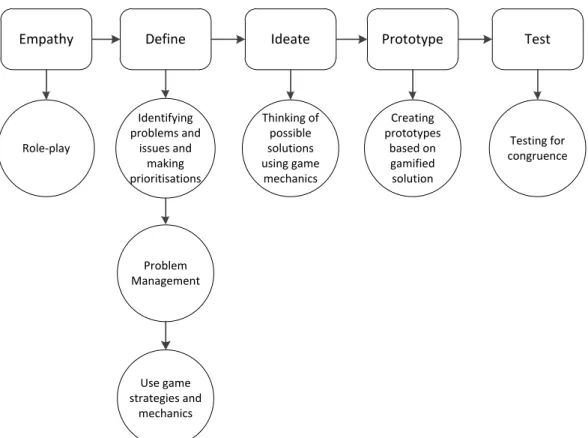
Figure 1 presents game design thinking with play and games inspirations that consists of five main steps, namely Empathise, Define, Ideate, Prototype, and Test.
Empathy Define Ideate Prototype Test
Role-play
Identifying problems and
issues and making prioritisations
Problem Management
Use game strategies and
mechanics
Thinking of possible solutions using game
mechanics
Creating prototypes
based on gamified solution
Testing for congruence
Figure 1: Game design thinking approach with play-based and game inspirations
Exercising empathy means listening without any judgemental feeling to how others explain their problems. We added in the element of role-playing to engage, inform and build understanding, build relationship and teamwork and break the ice. Once the thoughts of the problems have been collected, the team defines the problems by thinking about the insights of the problems and issues and prioritising the problems. The problem management phase uses game strategies and mechanics to achieve a common goal (e.g. in-game on how to win or how to survive). Next step is to ideate the possible solutions by selecting some strategies and the mechanics of games. From one insight and choosing from the many possible solutions, prototyping the solution (as games) commences with the same team to create a tangible output. Finally, the output is tested and shared with others in the community.
2.2 The indigenous community and their Cultural Protocols
T -to- ng for community engagement with primary
schools at Telok Melano and Long Lamai in Borneo Malaysia. These two rural schools are selected for their distinct differences, geographically and culturally. From the onset, the research team recognised that as part of the protocol, the need to communicate with the village dwellers the intentions of the study first, before pursuing the project location, which was the local school. The two communities are:
Telok Melano is a traditional fishing village separated from the mainland of Sarawak by dense wildlife reserved forest and can be reached by boats over the South China Sea or at least eight-hour hike in the forest. The majority of Telok Melano residents are ethnic Malay. Since the Kalimantan
Indonesia border is T M
the Indonesian side, and several villagers also live across the border. The Telok Melano community is dependent on small scale fishing and farming for its livelihood. Only recently in late 2018, Telok Melano is connected by road to major towns in the state of Sarawak.
Long Lamai is situated on the highlands, surrounded by dense rainforest, which is only accessible via a motorised canoe (or longboat) upriver or a few hours hike up a hill from the nearest village with a remote airfield. The Penan are the nomadic indigenous people settled in Long Lamai village, who survive by a rich culture of hunting and gathering. Long Lamai village was one of the earlier settlements, and due to its isolation geographically, the community of Long Lamai has established
an egalitarian system, i.e. a culture of deciding community consensus. Unity and solidarity have been mostly practised values among the Penan.
In both locations, the local primary schools are established within the villages. These primary schools are SK Telok Melano and SK Long Lamei. SK Telok Melano has 39 students, and SK Long Lamei has 65 students. The local children attend primary school from the ages of seven to twelve. Typically they would enrol in secondary schools away from their villages; however, there are cases of parents reluctant to send off their children to another location, hence depriving their children to access to higher education. School teachers at these schools are mainly from other townships and other parts of the country, often unfamiliar with the culture and needs of the community in the villages.
Researchers applied the cultural protocol in both schools in Long Lamai and Telok Melano. This cultural protocol was initially discussed and developed in Long Lamai by the community and UNIMAS researchers. The cultural protocols comprises of guidelines for community and researchers and are based the United Nations Declarations of Rights of Indigenous Peoples (UNDRIP). Most notable that was used the Free, Prior and Informed Consent Principles (FPIC).
2.3 The Model
Using Participatory Action Research (PAR) guidelines developed by Phoa (2009), we identified the elements of -to- . Narratives from meetings and informal discussions with community members and the schools enabled a constructive consolidation of local perspectives from the community in alignment with Community engagement is a dedicated process that requires a strong motivation to establish a mutual trust (Murphy, 2012), and such guidelines are useful to provide practical opportunities to all parties to articulate their needs. It is an important phase to determine onboarding, perceivable success and sustainability of the study within the indigenous communities.
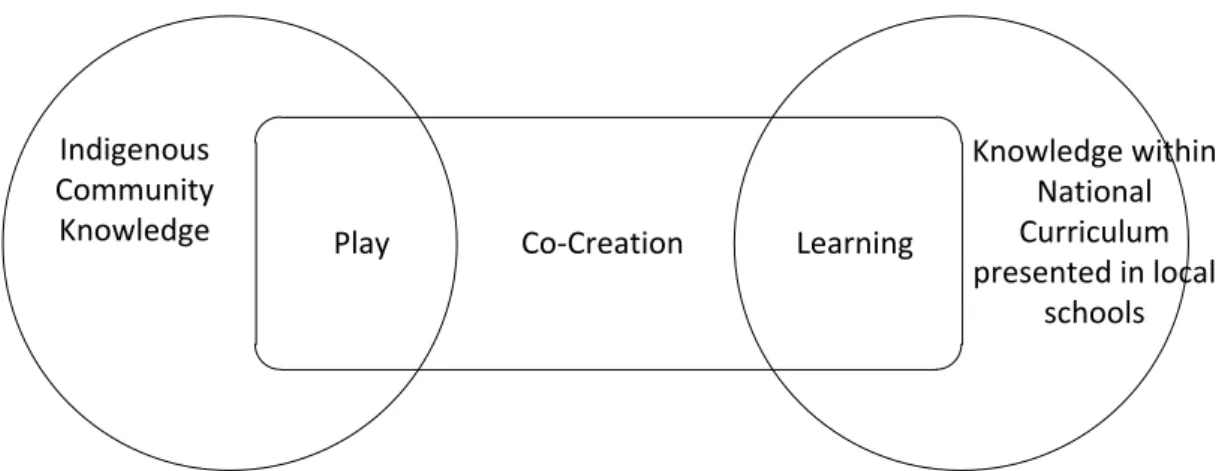
I play-to-engage model, we incorporated elements of action research, participatory evaluation and co-creation within the game design thinking to build a trustworthy partnership with the indigenous communities. There are two types of knowledge sets that we identified; one represents the knowledge owned and unique to the indigenous community, and one that is prescribed by the national curriculum, and presented to the children of the community through their local school. Within the communities, knowledge is shared through story-telling, demonstrations and play. Many games have been constructed to pass on knowledge of the elders to the young, and often the games are played in teams. At the local school, the national curricula are determined by mainstream philosophies and concepts, and there have been instances lamented by the children, teachers and their parents where the topic or idea presented is alien to them. In school, learning is designed by teachers to match the prescribed syllabus. The local teachers described how they occasionally use games in learning to break the usual tempo of the class. I play-to-engage , we attempt to create a cohesive environment whereby it allows the researchers to shift from leading the study to also be a participant. Simultaneously researchers can help teachers to evolve from passive recipients into a continuum of andragogy and ultimately higher order heutagogical dimensions, where they were able to identify gaps in their learning and source methods conducive to their learning style to meet their learning needs (Smith, 2015). The playful approach is seen as an opportunity to enable co-creativity to occur deliberately, integrating knowledge from the community with those from the prescribed syllabus.
Figure 2 illustrates the co-creation approach in learning and how it fits together for productive playful learning in schools and outside school curricula. We proposed play as it is a universal language. Games could invoke positive emotional experiences (Lazarro, 2004), such as joy, optimism and pride in a person (McGonigal, 2011).
Games could also help to shift a community from negative to positive emotional experiences and to maintain a positive relationship. Gamification in school could also motivate students to participate more and change their concept as learners (Leblanc, 2006).
Indigenous Community Knowledge
Knowledge within National Curriculum presented in local
schools
Co-Creation Learning
Play
Figure 2: Co-creation in game design thinking for learning in indigenous communities in Sarawak
The idea of co-creation in game design thinking is the process of selecting ideas from the participants, in this case, they are the students and teachers, and then implementing the idea by building a prototype and testing the prototype. We also include the exploration of the creative practices, i.e. in problem-solving, and cooperative learning mechanisms, such as building trust within a group in the co-creation process.
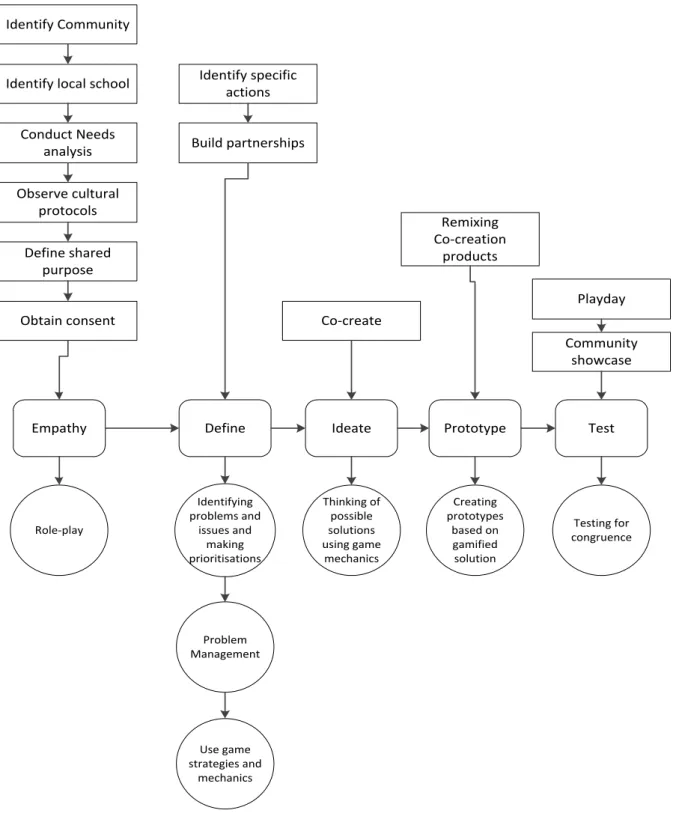
Interestingly, in this study, we found that combining creativity, thinking and collaboration in co-creation have always been a challenge; however, in game design thinking, these processes flowed coherently. Figure 3 -to- for schools. In the empathising stage, researchers are to identify schools and its community; conduct needs analysis, understand their custom, culture and protocols, share aims and purposes of the project, and get consents from the schools and community to conduct the project. A play day activity is conducted to gain access to the schools and also to identify champions. Understanding the students and teachers is vital before the define stage. Activities and specific actions are -to- as a team with the schools, and the students and teachers could learn from the researchers to further understand the shared purpose of the project. In the play day activities, we mixed the different core mechanics and strategies of local, commercial and traditional games into their learning. It is also known as the co-creation process. In the ideate stage, we then get the teachers and students to create and explore the remixed game-based learning content and the hybrid toolbox. Prototypes are developed for final showcase or re-remixed for further improvisation.
The model illustrates the stages to approach community onboarding. Typically in design thinking, engagement
D H t with the
community and school continues to flourish even after the thinking cycle is completed. The iteration of co-creativity is developed through a series of planned interventions with the teachers and the communities.
2.4 How to Create Community Engagemen
-to-We created several toolkits for engagement sessions with teachers and members of the community, to
T
From the onset, we maintained the same common language to talk and discuss elements of co-creativity. For example, we listed the types of games commonly played, and we brainstormed with teachers and local community members on the mechanics and strategies of the games. The narrative in these sessions and the co-creativity element to be understood, developed and deployed in the schools. A collection of remixed games are compiled online for future use and reference (further details in Playbox1). In general, games can be used for multiple purposes, especially for breaking the ice between people and energise bored participants.
1
Empathy Define Ideate Prototype Test
Role-play
Identifying problems and
issues and making prioritisations
Problem Management
Use game strategies and
mechanics
Thinking of possible solutions using game
mechanics
Creating prototypes
based on gamified solution
Testing for congruence Identify Community
Identify local school
Conduct Needs analysis
Observe cultural protocols
Define shared purpose
Obtain consent
Identify specific actions
Build partnerships
Playday Co-create
Remixing Co-creation
products
Community showcase
Figure 3:T -to- model
Remixed games add in an extra dimension to the participant engagement as these games include collaborative problem solving and learning. The -to- model can involve facilitators and participants in design discussions. Here, the researchers play the role as facilitators. The engagement experience is shared through
the design construction process. P
strategies of the games, and sharing with others, recreating new games from the different game mechanics, building prototypes and testing them with other participants, were illustrating the value of engagement.
3.
Evaluation methods
3.1 Indicators of the C E -to- M
Community engagement in schools consists of both behavioural and emotional engagement dimensions. Behaviour engagement is defined as observable behavioural characteristics based on the effort dedicated to an activity or learning and the level of achievements. Emotional engagement can be captured based on their cultural values, interest and enthusiasm. Behavioural factor (also known as participation) is an active attitude towards learning activities. Emotional factor (co-creation) is the involvements of students and teachers, and the sense of belonging to the learning community. Here, participants will invest their thoughts, mental efforts and learning strategies to achieve learning tasks by solving problems, collaborating and cooperating. These behavioural factors and emotional factors make the participatory co-creation model. In this model, we employ
-to-
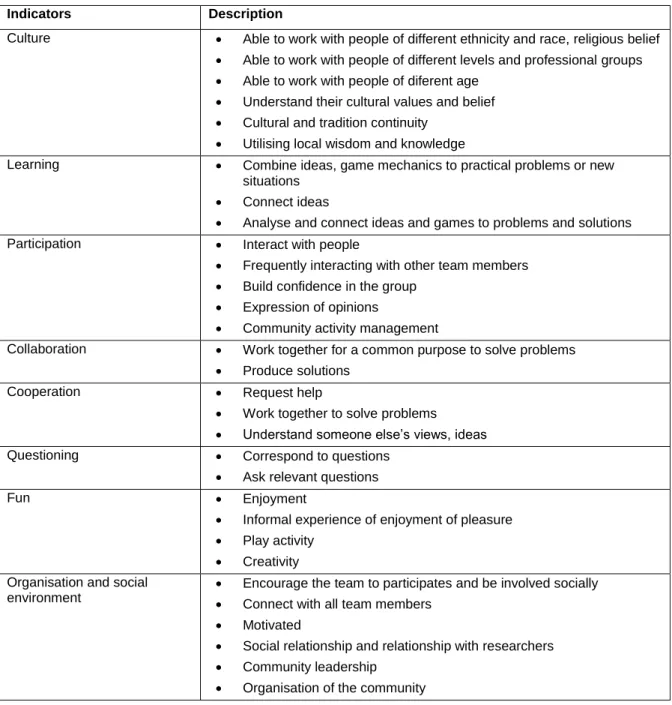
The indicators -to- through narratives captured and formulated during community engagement are presented in Table 1.
Table 1: The Developed Indicators for Community Engagement in Indigenous Communities and Their Schools
Indicators Description
Culture Able to work with people of different ethnicity and race, religious belief Able to work with people of different levels and professional groups Able to work with people of diferent age
Understand their cultural values and belief Cultural and tradition continuity
Utilising local wisdom and knowledge
Learning Combine ideas, game mechanics to practical problems or new situations
Connect ideas
Analyse and connect ideas and games to problems and solutions Participation Interact with people
Frequently interacting with other team members Build confidence in the group
Expression of opinions
Community activity management
Collaboration Work together for a common purpose to solve problems Produce solutions
Cooperation Request help
Work together to solve problems Understand someone else’s views, ideas Questioning Correspond to questions
Ask relevant questions
Fun Enjoyment
Informal experience of enjoyment of pleasure Play activity
Creativity Organisation and social
environment
Encourage the team to participates and be involved socially Connect with all team members
Motivated
Social relationship and relationship with researchers Community leadership
These engagement indicators are identified from the observation of actions, non-verbal communication, feedbacks and evidence of emotions. They were also analysed and formulated from the existing student engagement (Helme and Clarke, 2001) and the community empowerment indicators. The outcomes and feedback from the engagement sessions are recorded and categorised accordingly.
3.2 Measurements of the Community Engagement in the Participatory Co-Creation Workshops It is important to highlight that community engagement is a process, as well as, an outcome (Palmer-Wackerly et al., 2014), meaning that it produces results and ideas that are emergent and co-owned by the community (schools) and therefore sustainable over time. At present, there is no way to measure the design thinking outcome (Schmiedgen et al., 2016), which we used as the basis for community engagement. However, several criteria can be used to build a measurement framework. The mix of measures that is useful, including:
Feedback: the feedback from the participants to determine the level of satisfaction based on their testimonials after each of the workshops.
Co-creation activities: the number of co-creation activities and participants in it.
Remixed play tangible games and products: the number of created remixed play tangible products from the co-creation activities.
Working culture: the impact of co-creation measured factors such as motivation, change of behaviours, team collaboration and engagement.
Reflective measurements: questionnaires, surveys, interview internally by participants.
Relationship and communication: is there a continuous communication between the schools and researchers during and after the project? The trustworthy partnership between the community and the researchers.
Replicability: can this play-to-engage approach be used and implemented to other projects?
The use of the Free, Prior and Informed Consent certificate helped researchers to understand their roles and responsibilities from the start of the project. Using game design thinking, we organised remixed play activities with both the communities and their local schools. As community engagement is seen as a continuum of community involvement, the continuous engagement aims to collect local knowledge, issues and motivations from the local schools and communities.
4.
Findings and Discussions
4.1 Engagement with the Communities
The aim of the engagement is to present the CreativeCulture project to the communities. The findings
presented here are based on the
partnership with the communities. The playday was run for approximately 4-5 hours together with these indigenous communities, to get people in an open, playful, and moderately risk-taking frame of mind, psychically warm them up. In addition to the activity, the research team has collect and better understand the core mechanics and strategies in their local games, and stories behind each game.
In looking at the participation during the play day activities, all the indicators in Table 1 are exemplified during the play day activity with the village head and community of elders during community engagement. The community, including the elders and the village head, organised and each of them came and participated the Playday (indicator: organisation and social environment). Both groups, the research team and the community, were learning from one another to understand the culture, community, their local games, the story behind the games, and we also challenged them to think of ways that we can use the games for learning in schools (indicator: learning, culture, questioning). There was a positive interaction and good bond during the participation (indicator: participation). We collaborated and cooperate to win the game, and to improve the strategies to winning the game (indicator: collaborate, cooperate, questioning). Everyone had a good laugh and fun during the Playday (indicator: fun).
The Playday has indeed strengthened a positive relationship between the researchers and the indigenous communities and their local school communities.
4.2 Indicators of Engagement in Schools
We conducted engagement with the two rural schools to present the CreativeCulture project. We have applied participatory co-creation. In the beginning, we showcased some of the games that were remixed, created and developed by the Computer-Supported Collaborative Learning (CSCL) students from the previous activities for the teachers and students to play (details of the remixed games can be found in Mohamad et al. (2018)). The next session on different days, -to-engage' approach with the teachers and students.
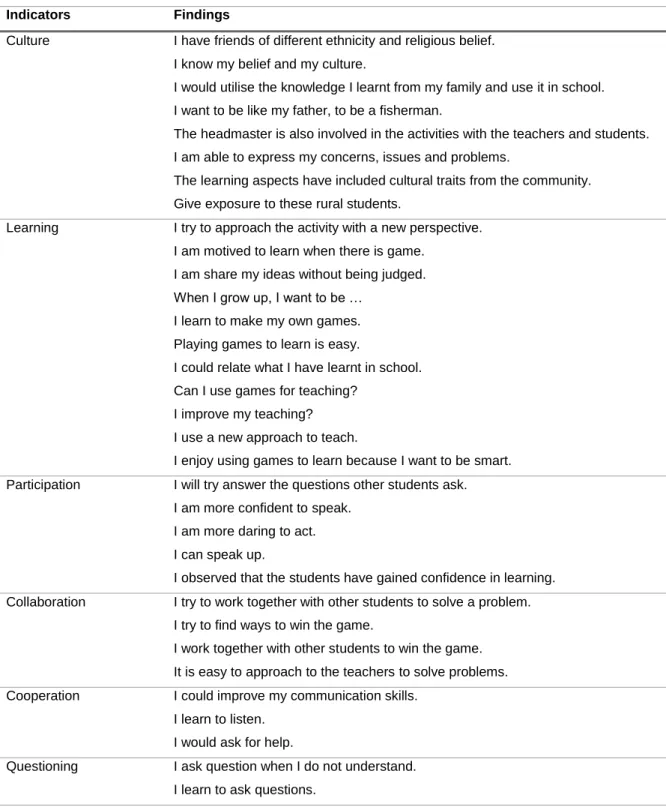
The teachers also shared and discussed their concerns and interest, and these indicators correspond to the developed indicators. Each of the indicator will be further described and the findings from the engagement activites are exemplified in Table 2.
Table 2: Indicators and Findings from the Participatory Co-creation Engagement
Indicators Findings
Culture I have friends of different ethnicity and religious belief. I know my belief and my culture.
I would utilise the knowledge I learnt from my family and use it in school. I want to be like my father, to be a fisherman.
The headmaster is also involved in the activities with the teachers and students. I am able to express my concerns, issues and problems.
The learning aspects have included cultural traits from the community. Give exposure to these rural students.
Learning I try to approach the activity with a new perspective. I am motived to learn when there is game.
I am share my ideas without being judged. When I grow up, I want to be …
I learn to make my own games. Playing games to learn is easy.
I could relate what I have learnt in school. Can I use games for teaching?
I improve my teaching? I use a new approach to teach.
I enjoy using games to learn because I want to be smart. Participation I will try answer the questions other students ask.
I am more confident to speak. I am more daring to act. I can speak up.
I observed that the students have gained confidence in learning. Collaboration I try to work together with other students to solve a problem.
I try to find ways to win the game.
I work together with other students to win the game. It is easy to approach to the teachers to solve problems. Cooperation I could improve my communication skills.
I learn to listen. I would ask for help.
Questioning I ask question when I do not understand. I learn to ask questions.
Indicators Findings
Fun I have fun playing games with other students.
It is not too stressful, and I am allowed to make mistakes. Students and teachers are creative.
Can we do this again? Organisation and Social
Environment
I feel there is connection with other sudents and teachers. I belong to this community.
I respect my teachers and school. I will get other students to be involved. I share what I have with other students.
The research teams are easy going and approachable. 4.3 Reflection on the Approach: Participatory Co-creation in Rural Schools
Applying the participatory co-creation approach in rural schools gave us the following insights.
A major success factor in the implementation of rural projects is the process of community engagement where community leaders and members of the community, including parents and teachers become in partnerships
I -to-
invoke positive emotional experiences, and we have built strong relationship with the schools and the communities. In addition, teachers are more motivated to create learning games that they can use in their classrooms and the students were having fun while learning.
One of the comment from the teacher after the activity - I -creation activity is tremendously helpful in brainstorming ideas to design and create game activities which are suitable for our students. Besides that, we as teachers can share those ideas in creating activities which are fun and yet meaningful. From my observation, our senior teachers, who are usually passive in contributing ideas, had eagerly participated to come up with ideas for the new games and even tested it with students. Also, I witnessed how some usually passive students in the class had become leaders in their groups by coming up with ideas and implementing them in the game creation. These playful game activities seem to trigger their passion and feelings towards knowledge, which is not normally seen in a classical classroom setting. As a teacher, I want to thank all of your team members, who came to our school and helped to share new ideas and technologies with our students and teachers as well. The CreativeCulture initiative has successfully refreshed and renewed the student's interest in gaining knowledge via game- teacher from SK Long Lamei.
This comment reaffirm the importance of gameplay in engagement and indeed, it could invoke positive emotional experiences and could motivate teachers and students to participate more and change their concept as learners.
5.
Conclusion
The need for a playful protocol to aid engagement that is sympathetic to the local context has led to the -to-engage model that was inspired by game design thinking that formulates the engagement pathway and processes with the indigenous community. The approach facilitated the engagement process between the communities and researchers.
One of the main strengths of game design thinking is the element of empathy. Empathy involves observing, engaging and empathising with stakeholders to better understand their experiences, issues or problems, needs and cultural protocols or customs in a community. Indigenous peoples have unique customs, protocols, procedures, rules, and regulations that regulate their everyday interactions within and between communities and with the resources and the natural surroundings.
From the onset, the research team recognised the need to communicate with the village dwellers the intentions of the study first, before pursuing the project location, which was the local school. Acknowledging that play is universal, gameplaying were used in the initial engagement process with the community. The
approach helped ease partnership brokering between the researchers and community members, as well as the introduction of the project to the community.
In summary, the presented novel indicators f -to- the
qualitative results were presented. The potential venues for future works will be utilising content analysis to explore the indicators used in this method, and to measure the correlation of the indicators.
Acknowledgements
The study was funded by the Newton-Ungku Omar Fund (ref no. GL/F07/NOUF/02/2017)and Arts and Humanities Research Council UK(ref no. EP/P017037/1). The study would not have been possible without the commitment and collaboration between members of local communities, teachers and students from SK Long Lamei and SK Telok Melano, and Learning Sciences postgraduates. The study was also supported by the management and research teams at the Institute of Social Informatics and Technology Innovation, UNIMAS.
References
Arnab, S., Morini, L., Green, K., Masters, A. and Bellamy-Woods, T., 2017. We are the Game Changers: An Open Gaming Literacy Programme, International Journal of Game-Based Learning (IJGBL), Vol. 7 No. 3, pp. 51 62.
Bala, P., 2012. Needs Analysis in Developing Telecentre Among Orang Asli West Malaysia, Final Research Report.
Brodin, J., Goodwin, J., Knell, G. and Kruythoff, K., 2019. What the global 'play gap' means for our children's futures. World Economic Forum. website <https://www.weforum.org/agenda/2019/01/play-gap-hurting-childrens-skills-futures/> [Accessed 20 April 2019].
Burkett, T., 2006. So what is social design?. website <http://www.design4socialinno_vation.com.au/news/so-what-social-design-ingrid-burkett/> [Accessed 11 May 2018].
Dickson, G., & Green, K. L., 2001. Participatory action research: Lessons learned with Aboriginal grandmothers. Health Care for Women International 22(5), 471-82.
Haig-Brown, C., Dannenmann/Kaamatweyaashiik, K., 2002. To Be in Good Relation: The search for community. Amsterdam: International Society for Cultural Research and Activity Theory.
Hancock, T., 1997. Ecosystem Health, Ecological Iatrogenesis, and Sustainable Human Development, Ecohealth Perspective, Vol 3, No 4.
Helme, S., and Clarke, D., 2001. Identifying Cognitive Engagement in the Mathematics Classroom. Mathematics Education Research Journal, 13(2), pp 133-153.
Lazzaro, N., 2004. Why we play games: Four keys to more emotion without story. website <http://www.xeodesign.com/xeodesign_whyweplaygames.pdf> [Accessed 11 May 2018].
Leblanc, G., 2004. Enhancing Intrinsic Motivation Through the Use of a Token Economy. Essays in Education, 11(1). Madden, B., Higgins, M., & Korteweg, L., 2013. Role Models Can't Just Be on Posters: Remembering Barriers to Indigenous
Community Engagement. Canadian Journal of Education, 36(2), 212-247.
McGonical, J., 2011. Reality is Broken: Why Games Make Us Better and How They Can Change the World. Penguin Press. New York, NY.
Mikkelsen, B., 1995. Methods for Development Work and Research. A Guide for Practitioners. London, New Delhi: Sage Publications, Thousand Oaks.
Mohamad, F., Morini, L., Arnab, S., Minoi, J., 2018. Engaging Primary Schools in Rural Malaysia with Game-based Learning: Culture, Pedagogy, Technology. ECGBL 2018.
Murphy F., 2012. Community Engagement, Organization, and Development for Public Health Practice. Springer Publishing. New York, NY.
Palmer-Wackerly, A. L., Krok, J. L., Dailey, P. M., Kight, L., & Krieger, J. L., 2014. Community engagement as a process and an outcome of developing culturally grounded health communication interventions: An example from the DECIDE project. American Journal of Community Psychology, 53, 261-274.
Phoa, J., Bala, P., 2009. From the Kelabit Highlands to the world: Replicating the e-Bario Model. A paper presented at the National Seminar of e-Community 2009.
Schmiedgen, J., Spille L., Koppen E., Rhinow H., and Meinel. C., 2016. Measuring the Impact of Design Thinking. In H. Plattner at al. (Ed.), Design Thinking Research: Making Design Thinking Foundational (pp. 157-170). Switzerland: Springer International Publishing.
Severtson, D. J., Baumann, L. C., & Will, J. A., 2002. A participatory assessment of environmental health concerns in an Ojibwa community. Public Health Nursing 19(1), 47-58.
Smith, S., 2015. Playing to engage: Fostering engagement for children and teachers in low socioeconomic regions through science and mathematics play-based learning (Doctor of Philosophy (College of Education)). University of Notre Dame Australia. website<https://researchonline.nd.edu.au/theses/116> [Accessed 21 September 2018].
Zaman, T., 2013. Indigenous Knowledge Governance Framework: A Holistic Model for Indigenous Knowledge Management, PhD. Universiti Malaysia Sarawak.
Co-Creativity through Play and Game Design Thinking
Sylvester Arnab, Samantha Clarke and Luca Morini
Disruptive Media Learning Lab, Coventry University, UK
[email protected] [email protected] [email protected]
DOI: 10.34190/JEL.17.3.002
Abstract: This article discusses the application of game design thinking as a learning process for scaffolding co-creativity in Higher Education based on the GameChangers initiative (gamify.org.uk) part-funded by the Higher Education Funding Council of England (HEFCE). Taking into account the relationship between play, technology and learning, the game design thinking approach fully embraces and accommodates for the creation and development of games of any typology (board games, card games, digital games, etc.) and playful solutions (gamified products) as freely chosen by the learners, aligning with the importance of autonomy, relatedness and purpose in motivating learners to be deeply engaged in the process. Through this process, learners are expected to gain valuable knowledge in creative and collaborative problem solving and experience game design and development process towards addressing real challenges and opportunities in their communities. The focus of the process is on the creative process rather than the end products/solutions produced by the learners. The paper will specifically discuss the methodology and findings from an experimental module developed based on the approach involving four cohorts of Level two undergraduate students (n=122, 2017-2019). The students came from the different schools and faculties at Coventry University, UK. Based on the qualitative feedback and reflections collected through the Module Evaluation Questionnaire (MEQ) and the final reflection pieces, the co-creative process inspired by play and games demonstrates that through the process, students discover the importance of elements such as empathy, purpose, meaning, art, creativity and teamwork in their learning regardless of the specific disciplines they are pursuing. Keywords: co-creativity, playful learning, game-based learning, game design, higher education
1.
Introduction
Games, digital or analogue, are increasingly applied for educational, training, and research purposes. Since the mid-1980s, various applied games have been developed, and the application of digital games to support pedagogical goals often seeks to capitalise on growing trends amongst a wide range of target audiences to engage with digital media recreationally. There is also a huge potential for a gameful design to drive social participation and action in the community. The use of game thinking in this sense is expanding the potential for game-based approaches for impacting the society through its very design to engage individuals in serious topics and challenges in their community.
Games are an increasingly culturally relevant form of aesthetic and artistic expression, where they are creative systems that enable play and exploration. Engaging in the creation of a playful system can literate citizenship to not only achieve a higher understanding of complex dynamics across science and society, but to envision, design and act upon creative alternatives. As game designer and scholar Zimmerman (2008) suggests, able to successfully understand, navigate, modify, and design systems will become more and more inextricably linked with how we learn, work, play, and live as engaged (pp. 25)
Creativity, problem solving, critical thinking and team working have been highlighted as skills for employment expected in 2020 (World Economic Forum, 2016). Designing and creating gameful systems, as an activity on the edge of the diverse fields of Art, Design, Science, Computation and Engineering can be a fertile ground to cultivate such competencies through multi-disciplinary collaboration, providing a playful (engaging), creative and innovative space for people to meet and learn how to fruitfully cooperate.
Inspired by the opportunities for innovative practices enabled by playful co-creativity, this paper specifically focuses on the GameChangers programme (http://gamify.org.uk) that is promoting the application of game design thinking (Arnab, et al. 2017) as an instrument for encouraging learners to understand, apply, test and reflect knowledge in higher education. Findings and insights from an experimental module developed under the GameChangers programme involving three cohorts of Level two undergraduate students (n=90) from the different schools and faculties at Coventry University, UK are discussed. Section 2 will briefly touch on related background in co-creativity and game design thinking, followed by a description of the GameChangers
approach and the research methodology in Section 3. Section 4 will discuss the findings from the experimental module developed under the GameChangers programme and the article is concluded in section 5.
2.
Background
While the formal context of a classroom is considered to be a primary location of learning, a majority of student learning activity takes place outside the classroom, where social interaction is a growing part of learning. With this perspective, pedagogy is also shifting, emphasising on active, creative and collaborative
learning. Relying more on hands- -world work and social
environments that foster organic interactions and cross-disciplinary problem- NMC H ‘ 2018 page 4).
To support the shift in pedagogy, there is value in exploiting a design process as a non-linear, iterative and incremental process, which is generative and creative, allowing us to take a complex problem, understand what the problem is and develop possible solutions. Design thinking (Plattner, 2011) as an approach has
man needs and creating new solutions using the tools
K K 24-25).
Design thinking is a way to structure an iterative design process, and demonstrates how it is possible to frame a problem so that it is understandable and easy to confront. It uses the idea of creating a product, with an explicit process of brainstorming, finding out the needs of the audience, design, development, testing, sharing, and more. Such a creative and hands-on process can help students and educators break out of the typical classroom model and showcase what learners can achieve. It is a place for students to use different problem-solving styles, to add their own flair to assignments, and to think about the impact they could have on the world.
Capitalising on core motivational drivers, such as autonomy, relatedness, purpose and competence (Ryan & Deci, 2017), the holistic approach of solving problems by using the design thinking approach could motivating learners to engage with the creative and co-creative process through self-discovery (Reiss, 2002). Learners will be able to discover different solutions in a creative way, which can open up new opportunities for them to engage with meaningful learning experiences that can translate into more sustainable practices in the real world. Purpose can be seen as our need for there to be meaning to our actions. Autonomy refers to
self-organising and regulation of toward inner coherence and
(Deci & Ryan, 2000; p. 252). ‘
connected to others, to caring for and being cared for by those others, to having a sense of belongingness both with other individuals (Deci & Ryan, 2004; p. 7). Competence in this case refers to seeking the pleasure of being effective in what they engage themselves into. The need for competence would
lead individuals ir capacities and to persistently attempt to
maintain and enhance those skills a D ‘ .
Education and industry have only very recently started tapping into such huge wells of creativity and cooperation expressed by the diverse manifestations of informal learning spaces which are built around cooperation and design thinking. A key factor in this shift toward a more democratic appropriation of design and computation is the potential for cooperative, community based learning of FabLabs, Hackerspaces and
M E C G A D al Social Innovation
Ecosystem f E (EU Comission, 2015a), can become hotbeds of innovation. The report goes on suggesting how cities and governments could further increase the potential for digital and social innovation by investing in some of the spaces and developer communities from where innovation often emerges, such as makerspaces, FabLabs and hackerspaces.
There are also a massive number and growing cultural relevance G J M
others; studies carried out by Fowler et al. (2013) about the opportunities game jams offer for rethinking
teaching and learning and Locke et al. (2015) for the M
being only one of the examples, where almost seven thousand games developed in 48 hours during the 2016 edition of the Global Game Jam, or the 15 Jams organised by the JamToday network to promote healthier lifestyles.
Games (digital, analogue or hybrid), given their inherently systems-based nature, constitute a powerful path toward actively experiencing systems science and thinking, and creating games or creating solutions inspired by game elements constitutes an invaluable opportunity to get acquainted in a proactive way with the fundamentals of this paradigm (among others: feedback, causal loops, synergy, homeostasis emergence). Game design and making is emphasised as pathway to STEM learning by existing initiatives, such as the Annual National STEM Video Game Challenge in NYC (http://stemchallenge.org) aiming at combining creativity and STEM Skills through video game design. Chiarello and Castellano (2017) also exploit the process of game design for promoting STEM education.
Games Design has also been emphasised as an extremely useful context for developing digital creativity (Nesta, 2013), where designing systems and understanding human behaviour that draws on concepts fundamental to computing (Wing, 2006; Mozelius & Olsson, 2017). Games present worlds with defined rules, clear objectives and often more than one possible solution to a problem, which enhances the context of both design and computational thinking. Designing, developing and playing games deepen content knowledge, strengthen collaborative skills, combine arts and technology, and build appreciation for the talents of others. The critical thinking skills developed through the process of game design become internalized (Lippl, 2015),
B .
"Innovative new ideas and creative solutions often emerge at the interface between disciplines and involve
differen L
mathematics brings the scientist, engineer, entrepreneur, artist and designer into dialogue to offer the widest
range of opportunity and academic and societal insi (EU
commission, 2015b, p. 20). Successful learning in the 21st century, depends both on networked, horizontal connectedness across a plurality of areas of knowledge and on the communities, which embody this knowledge, be it on a local or a global level.
Moreover, there is a huge potential for a co-creative process through play and games design to drive social innovation in the community. Existing initiatives, such as the Playable City (https://www.playablecity.com/) engages the community towards repurposing existing infrastructures in the city and designing playful activities that addresses urban challenges. Uncharted Power (https://www.u-pwr.co/), a social enterprise is founded based on the Uncharted Play initiative that explored and exploited play and games for developing energy
solutions. G formal and
G “
Through the process of game design and design thinking, we can link the arts and humanities with science, technology, engineering and mathematics, which will bring the scientist, engineer, entrepreneur, artist and designer into dialogue to offer the widest range of opportunity and academic and societal insight for experimentation and innovation. This opens up opportunity for such a a process to be adopted and adapted in education that will enhance and enrich the creative and collaborative learning agenda.
3.
Methods and materials
Inspired by the game design and design thinking approaches as a means for scaffolding multi-disciplinarity, creativity and collaboration, the research has been designed based on the GameChangers programme (Arnab et al., 2017). The programme is an experiential learning programme grounded in constructionist pedagogy (see Ackermann, 2004) that facilitates new models of teaching and learning, and new practice in cross-context learning (in/formal) through the use of game design thinking for creative problem solving - highlighting the importance of activity based approaches and hybrid spaces. Figure 1 illustrates the design thinking process as adapted by the GameChangers programme with a focus on game design.
T M
M1 Set the stage and unpack (What do we care about?) - understanding the problems or topics to be addressed during the programme. (Onboarding and Discovery stage)
M2 Ideation and innovation sketches (What can we do?) - designing possible solutions to a problem
M3 Enabling technologies and solution selection (How can we do it?) - exploring options in enabling tools and technologies, test the tools and consolidate ideas in an iterative way to select the best solution to develop in the programme. (Enthuse stage)
M4 Mock-ups and Prototyping (How can we make it work?) - developing ideas into working products and mock-ups. (Enthuse stage)
M5 Testing and reflection (Where do we go now?)- testing the prototypes, iterating on the design and reflecting on the learning process and the potential of the outcomes for further development. (Mastery Stage)
Figure 1:G C Game Design Thinking approach
A formal undergraduate module on game design thinking (Level 2, 100 study hours, 10 CATS points) has been developed as a research instrument, part of the GameChangers programme and supported by the Higher Education Funding Council for England (HEFCE). This module, which is formally called Playful Design Thinking guides students to apply a playful approach to design thinking inspired by a game design process, which involves solving real world problems with practical, fun and engaging solutions for example, building a reward/feedback-based game into the act of recycling to encourage sustainable behaviours, redesigning football that could harness energy from rotation, using posters to collect responses on humorous quizzes across the city to encourage the general public to place their chewing gums on the poster instead of throwing them on the floor, etc.
Students reflect on and apply playful design thinking mind-sets, skills and processes to problem-solving and creative thinking for the 21st Century workplace. At the end of the module, students come up with their own playful solutions (e.g. digital or non-digital game-based products) to the selected problems/opportunities and reflect on the design process. Students complete a presentation and submit the reflection on their experiences of the playful design process and the solution they have designed. The design thinking process as illustrated in figure 1 was spread across the 10 weeks, with a focus on M4 and M5 from week 8 to week 10.
One hundred and Twenty Two (n=122) participants at Undergraduate level 2, have been involved in the Playful Design Thinking module that has so far run over the course of four academic terms consisting of four cohorts (with roughly 30 students each to a cohort Cohorts 1A, 1B, 2A and 2B). These modules ran between September 2017 to April 2019 and took place for 2 hours every Tuesday evening for a maximum of 10 weeks.
Being an elective module offered as an open option to s U
participants were found to be from different disciplinary backgrounds, such as Engineering, Computing, Arts and Humanities, Business and Law, and the Health and Life Sciences. In each cohort, there was a good mix of different disciplines. Participants were tasked to work in teams and produce a digital and/or non-digital
application which were to be playful and/or gameful in nature and to respond to the challenges that they identify as a group (see Figures 2, 3 and 5).
Figure 2: Lights out a gamified product for managing noise pollution
Figure 3: Shutoff Showdown- Board game concept for teaching children about energy consumption around the house
Figure 4: Tappo Concept - To increase activity levels at University for Staff and Students
Figure 5: Heights - Concept to encourage Staff and Students at University to walk up and down the stairs. The interdisciplinary aspect of the module is particularly relevant, in that it made it both harder and much more interesting for people to generate ideas and prototypes across disciplines. An emphasis on co-creation in the course, that is on the necessity of working together across sectors and with intended users, was therefore at the core of the activities, of the theoretical contents and of the ethos. Students were encouraged to come together in groups to select a relevant issue (e.g. sustainability, health, inclusion), ideate a basic solution,
prototype it and actively engage with prospective users outside of the classroom to iterate a final, co-designed product.
Qualitative data from the official Module Evaluation Questionnaires (MEQ) and Week 10 reflective piece (written submission) were collected. The MEQ for the first cohort was collected in Week 5. Based on the findings of the first cohort, the module decided to collect the MEQ in week 10 at the same time as the reflective pieces. The MEQ for the later cohorts matched the reflective pieces; therefore, the findings from the first cohort will be considered to be signification as part of the discussions in this article. Aside from this structured data gathering, module tutors were, throughout the module, attentive to the climate and discussions in the classroom, complementing the aforementioned questionnaires with qualitative observations. This second layer of data gathering and discussion enabled us to contextualise the outcomes of the questionnaires, and explore their implications and the emerging theme informally but with greater depth. The qualitative feedback was analysed and categorised into themes and they are discussed in the following sections.
4.
Discussions
4.1 From confusion to light bulb moments
When the module was first run, we discovered that divergent thinking related to innovative practices was observed to be a huge challenge for the participants who were not familiar with the concept of game design thinking as an approach. Based on classroom observations and discussions, and on the MEQ feedback taken in Week 5 of the first cohort term, the majority of the students found that the module was interesting
owever, assessment was a key barrier for their understanding. Students particularly displayed concerns on how assessment would be conducted.
A I g, unsure about what the end
- Cohort 1A Student A
I I Cohort 1A Student B
C Cohort 1A Student C
It was clear from the feedback that further refinement and guidance was needed, particularly to support those students who were not from traditional design and arts-based disciplines, around what was expected from them for the modules assessment criteria.
Another issue that was observed in this first cohort was that some students focussed mainly on developing the end product rather than engaging in the learning process itself. It was clear that they were not able to quickly
or easily -of-the- , and this proved challenging for a large number
of the cohort. However, as a whole, the students in the first cohort (1A) recognised that the module was
different from what they were with some students even
feeding back that they enjoyed the challenging aspect of the course.
Cohort 1A Student D
Cohort 1A Student E
To address and dispel student confusion and misunderstanding over assessment and the learning materials, the module was refined to coincide with the new term and Cohort 1B. This included a strip-back of some of the learning content to match expectations and align more effectively with a 10-credit module taken at
U T B (as well as the later
) MEQ feedback, in which we saw a shift from confusion about the course to students requesting more supporting materials in an online capacity.
4.2 Serious fun
Whilst play is often seen as a non-serious endeavour and without greater purpose in higher education, the module actively sought to challenge this assumption by engaging students in playful activities to push
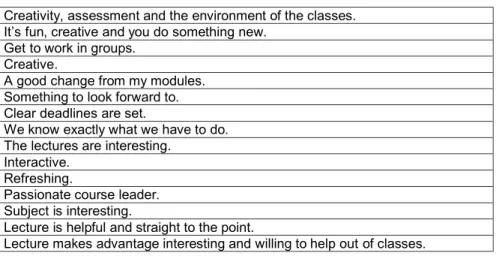
boundaries in how they conceptualised fun and play in the world. Through the playful design thinking process, the students discovered that fun can have serious and positive consequences and were challenged to innovate on how we deal with real world problems through a playful approach. The students acknowledged through their feedback that getting inspirations from playful activities helped the learning to be more engaging and contextualised.
I W Cohort 1A Student E
An interesting element that was found from the feedback, was that students felt that this module was where
they had experienc
rare for them to feel this way. This has led to deeper questioning about why they had not experienced at other points in their learning at University and if so, then why not? Following on from this, another student recognised that;
I Cohort 1B Student A
The student connects the idea that memory of ideas can come from play, and that play has been a key element to help retention of new knowledge. This allows us to summarise that the importance of play is not just theorised on as a part of the process of design thinking as a concept, but is utilised as a practical element of the learning about design thinking itself. The module was designed to be experimental in its approach, putting play at the forefront of the approach and delivery of the module which has been shown through student feedback across the four cohorts to have been a popular engagement tactic.
I reative and a good change from my modules. Something to look forward to Cohort 2B Student D
4.3 Empathy
One of the most frequently commented on aspects of the module across all four cohorts was the use of E ign process. Using play and games as inspirations for achieving social innovation was fundamental in allowing students to engage with real challenges/topics and the needs of their target audience. This was reflected upon and designed into the modules core learning activities. Students were first exposed to existing examples of how social innovation can change behaviour/ impact knowledge & awareness in a more intrinsic way, so that they could identify how play and games could be used at the heart of the design process. The students were shown through play and games on how we can exploit this to foster intrinsic motivation in intended stakeholders for developing positive and intended outcomes. The process allowed them to discover
everything that they do.
“ that
they gained directly from the module and was a skill that they could use and apply elsewhere.
f it will be another useful skill to have in not only the line of work I want to
Cohort 2B Student B
- Cohort 2B Student C
Some students also linked and identified these skills as ones that had not been practised or gained from their main course work.
what I Cohort 1A Student C
As the study did not track the individual background disciplines that the students came from in regards to feedback, it is difficult to say from which area this was felt to be missed. Although one student indicated that
W I is that when thinking about gamifying a problem such our case (concerning stairs), we need to be able to emphasise with our core audience and see from their perspective. As someone who is a computer science student, we, approach things very technically
- Cohort 2A Student C
B this,
designing new learning experiences, where the focus is being imaginative and empathetic would
I Cohort 2B Student B
Future work will look to track this information to provide a better understanding on any discrepancies
Further student feedback In relation to empathy, indicated that the students seemed to really engage with the process of speaking to, and receiving feedback from end users and stakeholder groups as part of their design and development process.
T W
classmates and lecturers as our client, therefo
consideration. We basically solved the puzzles with the help of many others thus without them, we
- Cohort 2B Student A
I us as designers and particularly for design thinkers
because it allows us to uncover and truly understand the latent needs and emotions of the people we are designing for. This allows us to really emotionally understand just why and how the product needs
t C B “ F
T I C
although the curriculum does begin to cover the topics of energy consumption and the effects on the environment, it is not as effective as it could be, as the children learning about the topic find it
Cohort 2B Student B
Students also linked this process back to understanding that initial pre-conceived ideas and thoughts about an issue without end-user input, can be limiting as a creator.
I
the crea C B “ D
T
Cohort 2B Student C
E issue I found opens your mind to more potential outcomes as you
have already had relative insight on your problem and a greater desire to fix the issue now because of
D - Cohort 2B
Student C
Whilst this step of the playful design thinking process was fed back upon as a positive experience for the
I I I
lazy point of view making this one of the more difficult stages for me, it has awoken perspective
Cohort 2A Student B
Ensuring that students are supported through this step is key to helping guide them through the understanding of its importance to the design process. In the module, a range of playful techniques were employed, including that of Lego Serious Play (LSP), so that students could practice opening up and sharing in front of each other. Further work following this feedback will look to grow this area, so that students are given
the correct support to feel confident in approaching, and working with stakeholder user groups in the
4.4 Purpose and meaning
Students recognised in their feedback that fun empathising with the target
audience can play an important role in creating meaningful outcomes. Through the creation of playful activities, the students recognised opportunities to carefully develop experiences that stakeholders could engage with. Most importantly what has come through the feedback across the four cohorts, is that the students recognise that they need to consider purpose and meaning in their creations and designs moving forward for their future careers and endeavours.
I
experience rather Cohort 1B Student F
I
Cohort 2A Student E
thical, or change a real-world issue to be
Cohort 1A Student B
Cohort 2B Student C
It is this realisation from the students that we believe the module has provided a successful example of how teaching playful design thinking can lead to a deeper understanding of meaningful design taught at University Undergraduate level.
4.5 The Creative Process and Games as an Art Form
Throughout the module, students are actively taken through the creative process of formulating new ideas and concepts, and are actively encouraged to play around and push boundaries of what they know and believe. Creativity is a top desirable skill in prospective employees, and is a relative skill that can be applied to any discipline. Some students reflections indicated that they saw the benefit of experimenting with creativity as a way to develop new ideas, but also that they saw how their ideas connected to multiple pathways in the learning process. This understanding was another core area that the module wanted to foster, in helping students to understand that multi-disciplinary thinking and working, would equip them well for future roles in the workplace.
-set can be just as valuable in a Cohort 1B Student A
O
I
intertwine Cohort 2B Student E
I I
of multiple ideas with vast possibilities to achieve the best d Cohort 2B Student C Through the playful design thinking process, students are allowed to discover that the value of understanding and applying a creative process, is also connected to the understanding that not all ideas are right the first time around. It is in the mistakes and iteration process in which they are allowed to learn from unsuccessful design considerations T and used as part of the learning process, in which
students were encouraged that it just meant they
needed to try another way of thinking about their design choices. This was used as a positive experience, with
Cohort 1A