Sharif University of Technology
Scientia IranicaTransactions B: Mechanical Engineering www.scientiairanica.com
Airow patterns in a 3D model of the human acinus
M.A. Eslami Saray
a, M.S. Saidi
aand G. Ahmadi
ba. Department of Mechanical Engineering, Sharif University of Technology, Tehran, Iran.
b. Department of Mechanical and Aeronautical Engineering, Clarkson University, New York, USA. Received 22 October 2014; received in revised form 31 July 2015; accepted 10 June 2017
KEYWORDS Acinar region; Alveoli;
Airow pattern; Computational uid dynamics;
Dynamic mesh.
Abstract. Based on the recent photographs of microstructures of an acinus, a novel 3D computational model for airow and particle transport and deposition was developed. To model the entire acinar region simultaneously, an approach was proposed to reduce the computational space. The airow was solved using numerical simulations for the cases of expanding and contracting the acinus wall. The volume change of the lung was imposed based on the normal breathing condition with 15% volumetric expansion ratio. Since the entire acinar region was modeled, realistic pressure type boundary conditions were used and the use of earlier unrealistic boundary conditions was avoided. The simulation results showed that the ow patterns in an acinus with moving walls were signicantly dierent from those in the rigid wall case. Furthermore, due to the asymmetric conguration, the ow patterns were not quite symmetric. It was shown that the ratio of alveolar ow to ductal ow rate controlled the dominant ow regime in each generation. Ratios below 0.005 led to recirculation regime, where ow separation occurred, while values above this threshold led to ows with radial streamlines. In summary, while the ow in the primary generations was characterized by the formation of recirculation regions in the alveoli, the terminal generations were characterized by radial streamlines, which moved towards the alveolar wall. Both ow regimes had substantial eects on particle deposition in the acinus. © 2017 Sharif University of Technology. All rights reserved.
1. Introduction
The complex nature of airow in lung as a vital organ in human body has attracted the attention of applied mathematicians and biomedical engineers in addition to pulmonary physiologists. The main function of the lung is to exchange oxygen and carbon dioxide between the ambient air and capillaries surrounding the pulmonary passageways. An area of more recent concern has been the transport of the polluter into the airways and particle deposition on lung walls, which has many medical implications.
The rst step to investigate the details of airow
*. Corresponding author. Tel.: +98 21 66165558 E-mail address: [email protected] (M.S. Saidi) doi: 10.24200/sci.2017.4304
in lung is to develop a realistic geometry and, then, develop a computational model for ow analysis. While the model geometry should be based on the anatomy of the lung, it should not be overly complex to allow for numerical solution with reasonable computational resources. Due to the intricate geometry of the lung and its dierences among individuals, presenting one conguration for all human beings is impossible. Dierences may stem from diameter and length in generations, or spatial angle of the branches in each bifurcation. As a result, the reported earlier studies are generally restricted to a particular region of the lung.
Human and mammalian lung resemble branching trees in which each generation (called mother) divides into two distinct branches (called daughters) consec-utively for many generations ending in alveoli, which are the gas exchange units of the lung. The alveoli
may be divided into two regions: upper airways and lower airways. There is no gas exchange in the upper airways, but these conducting airways play a major role in the ventilation of lung. Geometric modeling of these airways is done using CT-scan data, human lung casts, or geometrical data proposed by primary physiological models [1-5].
Due to the small dimension of the lower airways, presenting a realistic model of this region is more challenging and needs advanced micro CT scan equip-ment for imaging. Considering morphologic data, lower airways begin from the sixteenth generation and last to the end of the lung. Although the total number of lung generations in each individual can vary from 18 to 30, on average, it is about 23 generations [6]. Unlike the conducting airways, which are similar to smooth-walled tubes, in the lower generations, alveoli are arranged as a foam-like sleeve on the surface of the peripheral airways. This region is also called alveolar region. Due to the existence of capillaries around the alveolar tissue, gas exchange occurs in this region. Recent studies estimate the mean number of alveoli about 480 million, with an average radius of about 100 m [7].
Many geometric models for acinar region of human lung have been reported in the literature. Earlier models were limited to two dimensions and rather simple conguration, but over time, as more advanced imaging equipment became available, more realistic models were developed. To investigate the aerosol transport and deposition in the alveolar region of the human lung, Darquenne [8] has presented a 2D model of 6 consecutive generations of identical alveolated airways that were formed by dichotomous branching. The surface of the lumen was fully surrounded by alveoli in this model. Tippe and Tsuda [9] experimentally studied low Reynolds number ow patterns in acinar region. The geometry of their model consisted of a convective channel surrounded by a torus. The torus was an axisymmetric representation of a spherical alveolus, which was able to expand and contract, and captured the essential characteristics of the acinar structures. Harington et al. [10] used a model similar to that of Darquenne and Paiva [11], but considered the 3D geometry of each branch modeled as a cylindrical lumen surrounded by an annulus divided into discrete segments by axial and radial planes. These discrete segments represented the alveoli located on the main duct and entirely covered the duct. Harington et al. [10] also modeled a bifurcation and studied the particle deposition. Unlike other studies, which used Navier-Stokes equations or Monte Carlo method to study the acinar ow, Li and Kleinstreuer [12] employed the Lattice-Boltzmann method for numerical investigation of airow patterns in this region. Using 2D alveolar geometries and imposing pressure inlet condition, they
analyzed vortex propagation as well as the impact of alveolus expansion on airow patterns, and pressure distributions for low inlet Reynolds number ranges.
Recently, Sznitman et al. [13] studied respiratory convective ows in the acinar region using an idealized 3D model based on Fung [14] description of the acinar ventilatory unit. Kumar et al. [15] considered dierent generations of an acinus individually to examine the acinar ow under imposed rhythmic breathing at varying Reynolds number. They attempted to highlight the role of geometries on the uid exchange and the duct-cavity interactions.
The presented literature survey shows that the earlier papers investigated 2D or 3D models of a single generation or a bifurcation, and a model of the entire acinar region has not been developed yet. In the present paper, a 3D model of an entire acinus is proposed based on the respiratory dichotomous tree pattern. The model is based on the most recent geometry of a single alveolus and keeps the space-lling characteristic if possible. Unsteady simulation of airow for the whole acinus, which consists of approximately 4600 alveoli, is desired. Numerical modeling and the novel idea, which makes it possible to simulate the uid ow in this vast computational space, are presented in Section 3. Due to the comprehensive modeling, there is no need for unrealistic boundary conditions. All applied boundary conditions are de-scribed in Section 3.1. The magnitude and method of lung geometry change are other related issues in alveolar region modeling; thus, Section 3.2 is dedicated to the geometry change of the region. In order to check the accuracy of the proposed method, it is imposed and validated over smaller geometries in Section 3.3. Finally, results and the concluding remarks are made. 2. Model geometry
Fung [1988] recognized that alveoli were densely packed hollow polyhedral and suggested the truncated octahe-dron (or tetrakaidecaheoctahe-dron) for numerical simulation. The main reason for this selection is that the alveolar walls are predominantly hexagons and rectangles [14]. It also has the maximum ratio of surface area to volume among all space-lling polyhedrons. Using the truncated octahedron, one generation of the acinar region is modeled as shown in Figure 1. The geometry includes a main duct with three polyhedral models for the alveoli. Air inlet and outlet are on opposite sides of the main duct. The polyhedral sequence, representing alveoli, is placed around the main duct. There are three alveoli in the longitudinal direction and six in the radial direction; thus, there are 18 alveoli in each generation. Dimensions of all sides of each polyhedron are identical and the polyhedron is specied by only one characteristic length. This characteristic length is the
Figure 1. Geometric model for one generation of a human acinus.
Figure 2. Geometric model for a bifurcation in the acinar region.
mean diameter of each generation, which was reported by Weible et al. [6].
By putting several generations together, a full model of acinar region is obtained. Earlier studies on bifurcations in the acinar region typically assumed that the two consecutive generations had the same diameter. As the diameters of the proximal and terminal genera-tions of the acinus have signicant dierences, this as-sumption cannot be correct for the whole acinus model. The proposed model in this article has the ability to change the diameter in each bifurcation. The geometric model of a bifurcation is depicted in Figure 2. There is a small part between two consecutive generations, which has dierent diameters on each side. Thus, with the aid of this reduction part, the diameter of consec-utive generations can decrease to desired proportions.
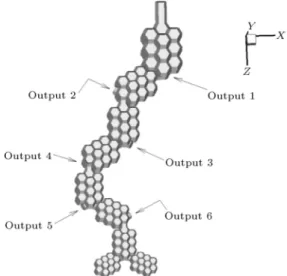
The full model of an acinus is obtained by extend-ing the consecutive bifurcations as described above. This model would have about 28generations, which is a
vast computational space. In order to reduce the com-putational space, at the end of each generation, only one of the branches is continued and the other branch is truncated at the end of the reduction part. This way, the entire acinus can be represented by 9 main ducts along with their alveoli. The symmetry condition is applied at the truncated surfaces, which is described in Section 3. Figure 3 shows the proposed model for the entire acinar region. The boundaries where symmetry condition is applied are also illustrated. This model will be called \condensed model" in the text.
Figure 3. The condensed model representative of the entire acinus.
3. Numerical modeling
Due to the low airow velocities in acinar region, the ow is in laminar regime. The airow eld is solved using the unsteady, incompressible Navier-Stokes equa-tions with a commercial CFD code (Fluent 6.3). The continuity and Navier-Stokes equations in a moving mesh are expressed as:
r:v = 0; (1)
@v
@t + (v vg):rv = 1
rp + r2v; (2) where v is the uid velocity vector eld, vgis the mesh
velocity, p is the uid pressure, and and are the density and kinematic viscosity of air, respectively.
After grid and time step sensitivity studies, an unstructured mesh with a total number of 1,900,000 tetrahedral volume cells and a time step of 0.005 sec was used in the simulations. At each time step, a maximum residual of 10 3 was enforced for continuity
and momentum balance equations. The Reynolds number, Re=vD= was evaluated for each generation, where D was the eective diameter of the duct.
As noted above, modeling of the entire 8 gener-ations of the acinar region is not feasible. Therefore, numerical solution of airow in the condensed model should be evaluated in such a way that it correctly represents the ow patterns in the full acinar model. To achieve this goal, the symmetry boundary condition between continued branches and their counterparts, which are not continued (truncated branches), is im-posed. This boundary condition is pressure type, similar to inlet/outlet boundary conditions. For this purpose, in each iteration, the magnitude of the total pressure on the continued Section is evaluated and this value is set on the truncated Section. Thus, the
magnitudes of the total pressures on both continued and truncated surfaces are identical.
3.1. Boundary conditions
Respiration and pulmonary ventilation occur due to the pressure dierence between inside and outside of the lung. Therefore, in the study of the ow within the lung, all boundary conditions should be pressure type. In most studies, however, velocity or volumetric ow inlet boundary is used, which is not quite realistic. As the end of our model is closed, only one boundary condition is needed on the inlet/outlet boundary. Therefore, a constant pressure is imposed. The value of the gauge pressure on this boundary is set arbitrarily to zero.
Other boundary conditions are the magnitudes of velocities on walls. Acinar region is the main location for gas exchange in the lung and, hence, there is gas diusion from the lung parenchyma to the blood capillaries. Due to the small amount of gas diusion compared to the main airow within the region, the gas penetration velocity on walls is ignored. Presence or absence of slip is determined by Knudsen number, which is dened as:
Kn =2
l ; (3)
where l is the characteristic length and is the air mean free path. Magnitude of depends on the air temperature and pressure and is given as:
=
p0
p T T0
0; (4)
where 0 = 0.066 m is the mean free path at the
standard conditions. Hence, the mean free path at the lung temperature is 0.06866 m. The characteristic length of the problem is the main duct diameter; thus, Eq. [3] implies that the Knudsen number has the largest value at distal regions and terminal sacs. According to Weible et al. [6], the diameter of the last generation of acinus is 0.29 mm and the corresponding Knudsen number is 0.00046. Therefore, the Knudsen number even at terminal generation is quite small, the ow in the acinar region is in continuum regime, and no-slip boundary condition can be used. The last boundary condition is the symmetry condition on truncated branches, which is described above.
3.2. Wall motion
Air entry and exit during inspiration and expiration processes occur due to the volume change of the acinar region. Therefore, motion of the lung walls over time is the key mechanism for respiration. There are a number of models for volume change of acinar region [16]. These models typically depend on each
individual condition such as rest, exercise, pulmonary health, or illness. The motion considered here is such that the model volume expands and contracts uniformly towards the volume centroid. All walls for ducts and/or alveoli remain parallel after the volume contraction or expansion and the topological shape of the region is invariant. That is, the scaling of length in all three Cartesian axes is the same.
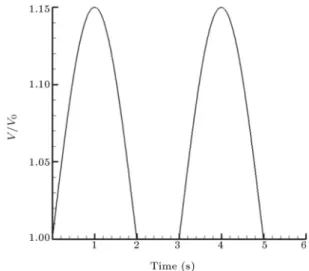
Volume change of the acinar region plays the key role in the hydrodynamics of this region. The present model assumes 15% volumetric expansion ratio, which is identical to that proposed by Tippe and Tsuda [9]. Each ventilatory pattern consists of three characteristic parameters: [1] the tidal volume, [2] the ventilatory rate, and [3] the time relationship between Inhalation and Exhalation (I:E ratio). In normal breathing condition, which is considered for a healthy adult at rest, the tidal volume is about 7 to 9 mL/kg of ideal body weight and the breathing period is 3 sec with the I:E ratio of about 1:2 [16]. That is, in this respiratory pattern, 1 sec is for inhalation, 1 sec is for exhalation, and the remaining 1 sec pertains to the pause. As noted before, the wall motion is considered isotropic in all three axes of Cartesian coordinates. Due to the acinus geometry and its changes during the time, a dynamic mesh with spring based smoothing method is used. At each time step, the position of mesh nodes is evaluated using Eq. [5]:
xi= xi0[1 + sin(!t)] ; 0 < t < 2
xi= xi0; 2 t 3 ; (5)
where xi0 is the initial position of all mesh nodes;
is the expansion ratio in each direction, which is equal to 4.8%; and ! = =2 is the breathing frequency. The ratio of model volume to its primary volume (V=V0) for
two consecutive cycles is illustrated in Figure 4.
Figure 4. Ratio of model volume to its primary volume (V=V0) during the respiration.
3.3. Validation
A full model of an acinus has not been investigated yet; thus, there is no detailed accurate data for model validation. The use of the truncated branches and the symmetry boundary condition for pressures used in the present simulations may cause uncertainties about the validity of the resulting airow eld. To validate the present approach, the ow in the alveolar region is solved for the three terminal generations. Due to the small computational space, in this case, it is possible to solve the ow in the entire conguration as well and, then, compare the results with the proposed method. Figure 5 shows both full and condensed models for the last three generations of the acinar region.
Boundary conditions and wall motion are iden-tical to those described in Sections 3.1 and 3.2. The condensed model needs smaller time step and ner mesh than the full model. Figure 6(a) and (b), respectively, show the volumetric airow rate at inlet and the rst outlet/output (Output 1 in Figure 5(b)) as a function of the time of breathing. In the full model, the output is an interior surface while, in the condensed model, the outputs are outlets. It is seen that the volumetric ows of dierent sections of both models are almost identical, which indicates that the proposed approach is quite accurate. Table 1 is presented for more detailed comparison of the model prediction for volumetric ow at t = 0:5 sec. Results show the maximum dierence of 0.3%.
Figure 5. 3D models of the last three consecutive generations of the lung: (a) Full model, and (b) condensed model.
Figure 6. Volumetric ow rate for both models: (a) Inlet, and (b) rst outlet.
Table 1. Exact values of volumetric ow rate at inlet and the rst outlets of both models at t = 0:5 sec
. Model Flow at inlet
(m3/sec)10 9
Flow at rst outlet (m3/sec)10 10
Full 1.8518 6.8299
Condensed 1.8468 6.8124
4. Results and discussion
Figure 7 shows the normalized volumetric ow rate of the inlet/outlet boundary versus time. It is seen that the ow rate does not follow a completely sinusoidal pattern. The ow rate reaches its maximum value as the inhalation begins. Then, it decreases as the inhalation is continued and, at the end of inhalation, it becomes zero. As the exhalation begins, the air ows in a reverse direction and leaves the acinus. In earlier phase of exhalation, the ow rate is small and it reaches its maximum rate near the end of the exhalation cycle. Finally, at the end of exhalation, the volumetric ow again becomes zero, which persists until the end of pause time. The maximum volumetric ow rate (Qmax)
is 5.7710 8m3/sec.
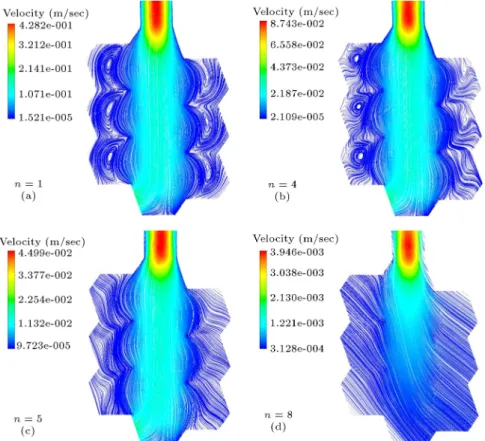
Figure 8 shows the ow streamline at the mid-sections for dierent generations of an acinus. In the rst generation Figure 8(a), the shear layer in the alveolar mouth openings causes the uid to recirculate within the cavity. This shear layer is the result of the strong ductal ow, which is an order of magnitude larger than that in the alveoli. Due to the dichotomous structure of the tracheobronchial tree, the ductal ow rate decreases in the distal generations. Therefore, the shear layer and the recirculation become weaker in these generations. Figure 8(b) shows the streamlines for the fourth generation. It is seen that the stagnation saddle point approaches the proximal corner in each alveolus and decreases in size. Although the dominant
Figure 8. Streamline patterns at the mid-section of dierent generations: (a) First, (b) fourth, (c) fth and (d) last.
pattern of this generation is the presence of the re-circulation regions, there is also an imposed radial ow pattern. These radial streamlines are formed as a result of the geometry change. As the alveolar wall expands during inhalation, the alveoli play the role of ow sinks and stretch the streamlines towards their walls. This causes the formation of an entrainment region in the alveolar mouth opening, which itself results in a convective exchange between ductal ow and the ow in alveoli. It is also noteworthy that the asymmetry of the model causes the ow patterns in alveoli to be slightly dierent from one another. As the uid gets further from inlet, the eect of expansion overcomes the shear layer and, nally, from the fth generation Figure 8(c), the dominant ow pattern is the radial ow streamlines. In the last generation Figure 8(d), there is no open boundary and the entire ductal ow enters the alveoli. Therefore, no recirculation region forms.
If the walls are assumed to be rigid, there would be no radial ow streamline and, hence, no net alveolar ow rate. Figure 9 shows the streamlines for the rigid wall case. The streamlines are plotted for the rst generation of an acinus for which the inlet bound-ary condition is a constant pressure and the outlet boundary condition is a sinusoidal ow rate. This gure shows that there is no radial ow streamline and all alveoli have regions with strong recirculation.
Figure 9. Streamlines for the rigid wall case.
Furthermore, the streamlines formed in the alveolar mouth opening separate the ductal ow from that in the alveoli. This ow pattern was also observed by Tippe and Tsuda [9].
With the above observations, it is concluded that the ow pattern in the alveolar region depends on two mechanisms. The rst mechanism is the shear
Figure 10. Alveolar to ductal ow ratio for dierent generations of an acinus.
layer, which is a function of the ductal ow rate, and the second one is the geometry change. In proximal generations, the ductal ow controls the ow pattern, while in distal generations, the eect of geometry change is more dominant. Hence, the alveolar to ductal ow rate ratio would be a good criterion to identify the dominant ow pattern in the alveolar region as was also reported earlier [13,15,17]. The alveolar ow rate is dened as the portion of the ow that enters the alveoli. Figure 10 compares the present model predictions for the alveolar to ductal ow rate ratio for dierent generations of the acinar region with the earlier works. It is estimated that the conversion of ow regime would happen between the fourth and the fth generations. That is, the alveolar to ductal ow ratios less than 0.005 correspond to the recirculatory regime, while ratios greater than this threshold correspond to radial ow streamlines. It is also noteworthy that predictions of the present model are in reasonable agreement with the earlier report studies of [13,15,17]. The dierences between present results and the earlier works perhaps originate from the variations in geometries and breathing conditions. 5. Conclusions
A novel 3D model of the acinus has been proposed based on the Fung's description of the acinar venti-latory unit and the dichotomous tree pattern. The details of the airow have been evaluated under im-posed rhythmic breathing, where the geometric shape of the model remains unchanged while its volume varies. Although the model has been truncated at each bifurcation, the airow solution shows the ow patterns in the full model of an acinus. All boundary
conditions have been pressure type, a constant pressure at inlet/outlet, and symmetry boundary condition at the truncated branches.
Despite the low Reynolds number ows in acinar region, complex airow patterns have been observed. The simulation results show that airow structures in proximal generations are roughly similar to those observed for a rigid wall model. Due to the strong ductal ow rate, separation may occur and the ow is characterized by the presence of recirculation regions, with only a small portion of the main ow entering the alveoli. In distal generations, in contrast, the relative importance of ow induced by the wall motion increases, which leads to a strong convective exchange between duct and the alveoli. This convective exchange was referred to as entrainment by Kumar et al. [15]. Hence, distal generations are mostly characterized by the radial ow streamlines. Both recirculating and radial ow streamlines signicantly aect the particle deposition in the acinar region of the lung. The present simulation results also conrm that the alveolar to ductal ow ratio identies the dominant ow regime. As the distal generations are approached, the alveolar to ductal ow ratio increases and the ow pattern changes from recirculating to radial. Simulation of the particle transport and deposition in the acinar region is left for a future study.
References
1. Liu, Y., So, R.M.C. and Zhang, C.H. \Modeling the bifurcating ow in a human lung airway", Journal of Biomechanics, 35, pp. 465-473 (2002).
2. Rainhill, K., Freitas, R.K. and Schroder, W. \Numer-ical investigation of the three-dimensional ow in a human lung model", Journal of Biomechanics, 41, pp. 2446-2457 (2008).
3. Calay, R.K., Kurujareon, J. and Hold, A.E. \Numeri-cal simulation of respiratory ow patterns within hu-man lung", Respiratory Physiology and Neurobiology, 130, pp. 201-221 (2002).
4. Li, Z., Kleinstreuer, C. and Zhang, Z. \Simulation of airow elds and microparticle deposition in realistic human lung airway models. Part I: Airow patterns", European Journal of Mechanics B/Fluids, 26, pp. 632-649 (2007).
5. Fresconi, F.E., Wexler, A.S. and Prasad, A.K. \Trans-port proles in the conducting airways of the human lung", International Journal of Heat and Mass Trans-fer, 51, pp. 5552-5561 (2008).
6. Weibel, E.R., Sapoval, B. and Filoche, M. \Design of peripheral airways for ecient gas exchange", Res-piratory Physiology and Neurobiology, 148, pp. 3-21 (2005).
7. Ochs, M., Nyengaard, J.R., Jung, A., Knudsen, L., Voigt, M., Wahlers, T., Richter, J. and Gundersen,
H.J.G. \The number of alveoli in the human lung", The American Journal of Respiratory and Critical Care Medicine, 169, pp. 120-124 (2004).
8. Darquenne, C. \A realistic two{dimensional model of aerosol transport and deposition in the alveolar zone of the human lung", Journal of Aerosol Science, 32, pp. 1161-1174 (2001).
9. Tippe, A. and Tsuda, A.\ Recirculating ow in an expanding alveolar model: Experimental evidence of ow-induced mixing of aerosol in the pulmonary acinus", Journal of Aerosol Science, 31, pp. 979-986 (1999).
10. Harrington, L., Prisk, G.K. and Darquenne, C. \Im-portance of the bifurcation zone and branch orientation in simulated aerosol deposition in the alveolar zone of the human lung", Journal of Aerosol Science, 37, pp. 37-62 (2006).
11. Darquenne, C., and Paiva, M. \Two{and three{ dimensional simulations of aerosol transport and de-position in alveolar zone of the human lung", Journal of Applied Physiology, 80, pp. 1401-1414 (1996).
12. Li, Z. and Kleinstreuer, C. \Airow analysis in the alveolar region using the lattice-Boltzmann method", Medical and Biological Engineering and Computing, 49, pp. 441-451 (2011).
13. Sznitman, J., Schmuki, S., Sutter, R., Tsuda, A. and Ro, T. \Sgen, CFD investigation of respiratory ows in a space-lling pulmonary acinus model", Modelling in Medicine and Biology VII, WIT Transactions on Biomedicine and Health, 12, pp. 147-156 (2007).
14. Fung, Y.C. \A model of the lung structure and its validation", Journal of Applied Physiology, 64, pp. 2132-2141 (1988).
15. Kumar, H., Tawhai, M.H., Homan, E.A. and Lin, C.L. \The eects of geometry on airow in the acinar region of the human lung", Journal of Biomechanics 42, pp. 1635-1642 (2009).
16. Jardins, T.D. \Cardiopulmonary Anatomy and Phys-iology: Essentials for Respiratory Care", Delmar, 4th Ed. (2002).
17. Henry, F.S., Butler, J.P. and Tsuda, A.\ Kinematically irreversible acinar ow: A departure from classical dis-persive aerosol transport theories", Journal of Applied Physiology, 92, pp. 835-845 (2002).
Biographies
Mohammad Ali Eslami Saray received his MSc de-gree in Mechanical Engineering from Sharif University of Technology (SUT). He received his BSc degree from Iran University of Science and Technology. His research interests are biouids, modeling of particle transport and respiratory systems, and aerosol dynamics. Mohammad Said Saidi is Professor of Mechanical Engineering at Sharif University of Technology. His research interests are modeling and numerical analysis of transport and deposition of aerosol particles, model-ing and numerical analysis of biouids, and respiratory system.
Goodarz Ahmadi is Professor of Mechanical and Aeronautical Engineering at Clarkson University. His research interests are aerosol transport, pollutant transport, and dispersion and turbulent ows of dense and dilute solid-gas or liquid mixture.