Security Guidance
for
Critical Areas of Focus
in
Cloud Computing V2.1
Prepared by the
Cloud Security Alliance
Security Guidance for Critical Areas of Focus in Cloud Computing V2.1
Introduction
The guidance provided herein is the second version of the Cloud Security Alliance document,
“Security Guidance for Critical Areas of Focus in Cloud Computing”, which was originally released in April 2009. The permanent archive locations for these documents are:
http://www.cloudsecurityalliance.org/guidance/csaguide.v2.1.pdf
(this document)http://www.cloudsecurityalliance.org/guidance/csaguide.v1.0.pdf
(version 1 guidance)In a departure from the first version of our guidance, a decision was made to separate the key guidance from the core domain research. Each domain’s core research is being released as its own white paper. These white papers and their release schedule are located at:
http://www.cloudsecurityalliance.org/guidance/domains/
In another change from the first version, Domain 3: Legal and Domain 4: Electronic Discovery
were combined into a single domain. Additionally, Domain 6: Information Lifecycle Management and Domain 14: Storage were combined into a single domain, renamed Data Lifecycle Management. This has caused a renumbering of our (now 13) domains.
© 2009 Cloud Security Alliance.
All rights reserved. You may download, store, display on your computer, view, print, and link to the Cloud Security Alliance Guidance at
www.cloudsecurityalliance.org/guidance/csaguide.v2.1.pdf
subject to the following: (a) theGuidance may be used solely for your personal, informational, non-commercial use; (b) the Guidance may not be modified or altered in any way; (c) the Guidance may not be redistributed; and (d) the trademark, copyright or other notices may not be removed. You may quote portions of the Guidance as permitted by the Fair Use provisions of the United States Copyright Act,
provided that you attribute the portions to the Cloud Security Alliance Guidance Version 2.1 (2009).
Security Guidance for Critical Areas of Focus in Cloud Computing V2.1
Table of Contents
Introduction
... 2
Foreword
... 4
Letter from the Editors
... 7
An Editorial Note on Risk
... 9
Section I. Cloud Architecture
... 12
Domain 1: Cloud Computing Architectural Framework ... 13
Section II. Governing in the Cloud
... 30
Domain 2: Governance and Enterprise Risk Management... 31
Domain 3: Legal and Electronic Discovery... 35
Domain 4: Compliance and Audit ... 37
Domain 5: Information Lifecycle Management ... 40
Domain 6: Portability and Interoperability... 46
Section III. Operating in the Cloud
... 49
Domain 7: Traditional Security, Business Continuity, and Disaster Recovery... 50
Domain 8: Data Center Operations... 52
Domain 9: Incident Response, Notification, and Remediation ... 54
Domain 10: Application Security ... 57
Domain 11: Encryption and Key Management ... 60
Domain 12: Identity and Access Management ... 63
Domain 13: Virtualization ... 68
Foreword
Welcome to the second version of the Cloud Security Alliance’s “Security Guidance for Critical Areas of Focus in Cloud Computing”. As the march of Cloud Computing continues, it brings both new opportunities and new security challenges. We humbly hope to provide you with both guidance and inspiration to support your business needs while managing new risks.
While the Cloud Security Alliance might be best known for this guidance, over the course of the next several months you will see a wide range of activities, including international chapters, partnerships, new research, and conference activities geared towards furthering our mission. You can follow our activities at
www.cloudsecurityalliance.org
.The path to secure cloud computing is surely a long one, requiring the participation of a broad set of stakeholders on a global basis. However, we should happily recognize the progress we are seeing: new cloud security solutions are regularly appearing, enterprises are using our guidance to engage with cloud providers, and a healthy public dialogue over compliance and trust issues has erupted around the world. The most important victory we have achieved is that security
professionals are vigorously engaged in securing the future, rather than simply protecting the present.
Please stay engaged on this topic, and continue to work with us to complete this important mission. Best Regards, Jerry Archer Alan Boehme Dave Cullinane Paul Kurtz Nils Puhlmann Jim Reavis The Cloud Security Alliance Board of Directors
Acknowledgments
Editors
Glenn Brunette
Rich Mogull
Contributors
Adrian Seccombe
Alex Hutton
Alexander Meisel
Alexander Windel
Anish Mohammed
Anthony Licciardi
Anton Chuvakin
Aradhna Chetal
Arthur J. Hedge III
Beau Monday
Beth Cohen
Bikram Barman
Brian O’Higgins
Carlo Espiritu
Christofer Hoff
Colin Watson
David Jackson
David Lingenfelter
David Mortman
David Sherry
David Tyson
Dennis Hurst
Don Blumenthal
Dov Yoran
Erick Dahan
Erik Peterson
Ernie Hayden
Francoise Gilbert
Geir Arild Engh-Hellesvik
Georg Hess
Gerhard Eschelbeck
Girish Bhat
Glenn Brunette
Greg Kane
Greg Tipps
Hadass Harel
James Tiller
Jean Pawluk
Jeff Reich
Jeff Spivey
Jeffrey Ritter
Jens Laundrup
Jesus Luna Garcia
Jim Arlen
Jim Hietala
Joe Cupano
Joe McDonald
Joe Stein
Joe Wallace
Joel Weise
John Arnold
Jon Callas
Joseph Stein
Justin Foster
Kathleen Lossau
Karen Worstell
Lee Newcombe
Luis Morales
M S Prasad
Michael Johnson
Michael Reiter
Michael Sutton
Mike Kavis
Nadeem Bukhari
Pam Fusco
Patrick Sullivan
Peter Gregory
Peter McLaughlin
Philip Cox
Ralph Broom
Randolph Barr
Rich Mogull
Richard Austin
Richard Zhao
Sarabjeet Chugh
Scott Giordano
Scott Matsumoto
Scott Morrison
Sean Catlett
Sergio Loureiro
Shail Khiyara
Shawn Chaput
Sitaraman Lakshminarayanan
Srijith K. Nair
Subra Kumaraswamy
Tajeshwar Singh
Tanya Forsheit
Vern Williams
Warren Axelrod
Wayne Pauley
Werner Streitberger
Wing Ko
Yvonne Wilson
Letter from the Editors
It is hard to believe that just seven short months ago, we pulled together a diverse group of individuals from all corners of the technology industry to publish the first “Security Guidance for Critical Areas in Cloud Computing.” Since its launch, this seminal publication has continued to exceed our expectations for helping organizations around the world make informed decisions regarding if, when, and how they will adopt Cloud Computing services and technologies. But over those seven months our knowledge, and cloud computing technologies, have evolved at an astounding rate. This second version is designed to provide both new knowledge and greater depth to support these challenging decisions.
Adopting cloud computing is a complex decision involving many factors. It is our hope that the guidance contained in this work will help you better understand what questions to ask, the current recommended practices, and potential pitfalls to avoid. Through our focus on the central issues of Cloud Computing security, we have attempted to bring greater clarity to an otherwise complicated landscape, which is often filled with incomplete and oversimplified information. Our focus on the original 15 domains (now consolidated into 13) serves to bring context and specificity to the Cloud Computing security discussion: enabling us to go beyond gross generalizations to deliver more insightful and targeted recommendations.
On our journey, we have been joined by a growing list of industry organizations, corporations, and individuals who believe in our mission to develop and promote best practices for security assurance within Cloud Computing. Their perspectives and insights have been essential in creating a well-balanced, unbiased work that continues to serve as an excellent foundation upon which we can continue to build.
Cloud Computing is still a rapidly evolving landscape; and one that requires us to stay current or fall behind. In this release of version two of our guidance, we drew upon the collective
experience and expertise of our large and diverse volunteer community to create a more complete work with greater detail and improved accuracy. Still, we must not be complacent. Just as security professionals have done for ages, we must continue to evolve our processes, methods, and techniques in light of the opportunities that Cloud Computing brings to our industries. This evolution is critical to our long-term success as we find new ways to improve the efficacy and efficiency of our security enforcement and monitoring capabilities.
Cloud Computing isn’t necessarily more or less secure than your current environment. As with any new technology, it creates new risks and new opportunities. In some cases moving to the cloud provides an opportunity to re-architect older applications and infrastructure to meet or exceed modern security requirements. At other times the risk of moving sensitive data and applications to an emerging infrastructure might exceed your tolerance. Our goal in this Guidance isn’t to tell you exactly what, where, or how to move into the cloud, but to provide you with practical recommendations and key questions to make that transition as securely as possible, on your own terms.
Finally, on behalf of the Cloud Security Alliance and the Editorial Working Group, we would like to thank each and every volunteer for all of their time and effort that was put into the
development of this new guidance document. We were consistently inspired by the dedication of the teams to extend and improve their respective areas, and we believe that their efforts have
significantly added real value to this body of work. This document would not be what it is without their contributions.
As always, we are eager to hear your feedback regarding this updated guidance. If you found this guidance helpful or would like to see it improved, please consider joining the Cloud Security Alliance as a member or contributor.
Glenn Brunette Rich Mogull Editors
An Editorial Note on Risk: Deciding What, When, and How to Move to
the Cloud
Throughout this Guidance we make extensive recommendations on reducing your risk when adopting cloud computing, but not all the recommendations are necessary or even realistic for all cloud deployments. As we compiled information from the different working groups during the editorial process, we quickly realized there simply wasn’t enough space to provide fully nuanced recommendations for all possible risk scenarios. Just as a critical application might be too
important to move to a public cloud provider, there might be little or no reason to apply extensive security controls to low-value data migrating to cloud-based storage.
With so many different cloud deployment options — including the SPI service models (SPI refers to Software as a Service, Platform as a Service, or Infrastructure as a Service, explained in depth in Domain 1); public vs. private deployments, internal vs. external hosting, and various hybrid permutations — no list of security controls can cover all circumstances. As with any security area, organizations should adopt a risk-based approach to moving to the cloud and selecting security options. The following is a simple framework to help evaluate initial cloud risks and inform security decisions.
This process is not a full risk assessment framework, nor a methodology for determining all your security requirements. It’s a quick method for evaluating your tolerance for moving an asset to various cloud computing models.
Identify the asset for the cloud deployment
At the simplest, assets supported by the cloud fall into two general buckets: 1. Data
2. Applications/Functions/Processes
We are either moving information into the cloud, or transactions/processing (from partial functions all the way up to full applications).
With cloud computing our data and applications don’t need to reside in the same location, and we can even shift only parts of functions to the cloud. For example, we can host our application and data in our own data center, while still outsourcing a portion of its functionality to the cloud through a Platform as a Service.
The first step in evaluating risk for the cloud is to determine exactly what data or function is being considered for the cloud. This should include potential uses of the asset once it moves to the cloud to account for scope creep. Data and transaction volumes are often higher than expected.
Evaluate the asset
The next step is to determine how important the data or function is to the organization. You don’t need to perform a detailed valuation exercise unless your organization has a process for that, but you do need at least a rough assessment of how sensitive an asset is, and how important an application/function/process is.
For each asset, ask the following questions:
1. How would we be harmed if the asset became widely public and widely distributed? 2. How would we be harmed if an employee of our cloud provider accessed the asset? 3. How would we be harmed if the process or function were manipulated by an outsider? 4. How would we be harmed if the process or function failed to provide expected results? 5. How would we be harmed if the information/data were unexpectedly changed?
6. How would we be harmed if the asset were unavailable for a period of time?
Essentially we are assessing confidentiality, integrity, and availability requirements for the asset; and how those are affected if all or part of the asset is handled in the cloud. It’s very similar to assessing a potential outsourcing project, except that with cloud computing we have a wider array of deployment options, including internal models.
Map the asset to potential cloud deployment models
Now we should have an understanding of the asset’s importance. Our next step is to determine which deployment models we are comfortable with. Before we start looking at potential
providers, we should know if we can accept the risks implicit to the various deployment models: private, public, community, or hybrid; and hosting scenarios: internal, external, or combined. For the asset, determine if you are willing to accept the following options:
1. Public.
2. Private, internal/on-premises.
3. Private, external (including dedicated or shared infrastructure).
4. Community; taking into account the hosting location, potential service provider, and identification of other community members.
5. Hybrid. To effectively evaluate a potential hybrid deployment, you must have in mind at least a rough architecture of where components, functions, and data will reside.
At this stage you should have a good idea of your comfort level for transitioning to the cloud, and which deployment models and locations fit your security and risk requirements.
Evaluate potential cloud service models and providers
In this step focus on the degree of control you’ll have at each SPI tier to implement any required risk management. If you are evaluating a specific offering, at this point you might switch to a fuller risk assessment.
Your focus will be on the degree of control you have to implement risk mitigations in the
different SPI tiers. If you already have specific requirements (e.g., for handling of regulated data) you can include them in the evaluation.
Sketch the potential data flow
If you are evaluating a specific deployment option, map out the data flow between your organization, the cloud service, and any customers/other nodes. While most of these steps have been high-level, before making a final decision it’s absolutely essential to understand whether, and how, data can move in and out of the cloud.
If you have yet to decide on a particular offering, you’ll want to sketch out the rough data flow for any options on your acceptable list. This is to insure that as you make final decisions, you’ll be able to identify risk exposure points.
Conclusions
You should now understand the importance of what you are considering moving to the cloud, your risk tolerance (at least at a high level), and which combinations of deployment and service models are acceptable. You’ll also have a rough idea of potential exposure points for sensitive information and operations.
These together should give you sufficient context to evaluate any other security controls in this Guidance. For low-value assets you don’t need the same level of security controls and can skip many of the recommendations — such as on-site inspections, discoverability, and complex encryption schemes. A high-value regulated asset might entail audit and data retention
requirements. For another high-value asset not subject to regulatory restrictions, you might focus more on technical security controls.
Due to our limited space, as well as the depth and breadth of material to cover, this document contains extensive lists of security recommendations. Not all cloud deployments need every possible security and risk control. Spending a little time up front evaluating your risk tolerance and potential exposures will provide the context you need to pick and choose the best options for your organization and deployment.
Domain 1: Cloud Computing Architectural Framework
This domain, the Cloud Computing Architectural Framework, provides a conceptual framework for the rest of the Cloud Security Alliance’s guidance. The contents of this domain focus on a description of Cloud Computing that is specifically tailored to the unique perspective of IT network and security professionals. The following three sections define this perspective in terms of:
• The terminology used throughout the guidance, to provide a consistent lexicon. • The architectural requirements and challenges for securing cloud applications and
services.
• A reference model that describes a taxonomy of cloud services and architectures.
The final section of this domain provides a brief introduction to each of the other domains in the guidance.
Understanding the architectural framework described in this domain is an important first step in understanding the remainder of the Cloud Security Alliance guidance. The framework defines many of the concepts and terms used throughout the other domains.
What Is Cloud Computing?
Cloud computing (‘cloud’) is an evolving term that describes the development of many existing technologies and approaches to computing into something different. Cloud separates application and information resources from the underlying infrastructure, and the mechanisms used to deliver them.
Cloud enhances collaboration, agility, scaling, and availability, and provides the potential for cost reduction through optimized and efficient computing.
More specifically, cloud describes the use of a collection of services, applications, information, and infrastructure comprised of pools of compute, network, information, and storage resources. These components can be rapidly orchestrated, provisioned, implemented and decommissioned, and scaled up or down; providing for an on-demand utility-like model of allocation and
consumption.
From an architectural perspective; there is much confusion surrounding how cloud is both similar to and different from existing models of computing; and how these similarities and differences impact the organizational, operational, and technological approaches to network and information security practices.
There are many definitions today which attempt to address cloud from the perspective of academicians, architects, engineers, developers, managers, and consumers. This document focuses on a definition that is specifically tailored to the unique perspectives of IT network and security professionals.
The keys to understanding how cloud architecture impacts security architecture are a common and concise lexicon, coupled with a consistent taxonomy of offerings by which cloud services and architecture can be deconstructed, mapped to a model of compensating security and
operational controls, risk assessment and management frameworks, and in turn to compliance standards.
What Comprises Cloud Computing?
The earlier version of the Cloud Security Alliance’s guidance featured definitions that were written prior to the published work of the scientists at the U.S. National Institute of Standards and Technology (NIST) and their efforts around defining cloud computing.
NIST’s publication is generally well accepted, and we have chosen to align with the NIST Working Definition of cloud computing (version 15 as of this writing) to bring coherence and consensus around a common language so we can focus on use cases rather than semantic nuance. It is important to note that this guide is intended to be broadly usable and applicable to
organizations globally. While NIST is a U.S. government organization, the selection of this reference model should not be interpreted to suggest the exclusion of other points of view or geographies.
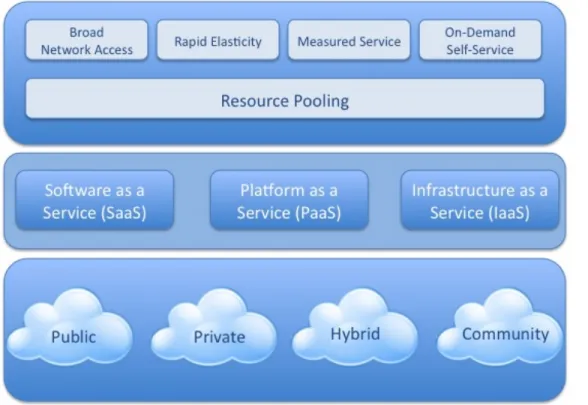
NIST defines cloud computing by describing five essential characteristics, three cloud service models, and four cloud deployment models. They are summarized in visual form in figure 1 and explained in detail below.
Essential Characteristics of Cloud Computing
Cloud services exhibit five essential characteristics that demonstrate their relation to, and differences from, traditional computing approaches:
• On-demand self-service. A consumer can unilaterally provision computing capabilities
such as server time and network storage as needed automatically, without requiring human interaction with a service provider.
• Broad network access. Capabilities are available over the network and accessed
through standard mechanisms that promote use by heterogeneous thin or thick client platforms (e.g., mobile phones, laptops, and PDAs) as well as other traditional or cloud-based software services.
• Resource pooling. The provider’s computing resources are pooled to serve multiple
consumers using a multi-tenant model, with different physical and virtual resources dynamically assigned and reassigned according to consumer demand. There is a degree of location independence in that the customer generally has no control or knowledge over the exact location of the provided resources, but may be able to specify location at a higher level of abstraction (e.g., country, state, or datacenter). Examples of resources include storage, processing, memory, network bandwidth, and virtual machines. Even private clouds tend to pool resources between different parts of the same organization.
• Rapid elasticity. Capabilities can be rapidly and elastically provisioned — in some cases
automatically — to quickly scale out; and rapidly released to quickly scale in. To the consumer, the capabilities available for provisioning often appear to be unlimited and can be purchased in any quantity at any time.
• Measured service. Cloud systems automatically control and optimize resource usage by
leveraging a metering capability at some level of abstraction appropriate to the type of service (e.g., storage, processing, bandwidth, or active user accounts). Resource usage can be monitored, controlled, and reported — providing transparency for both the provider and consumer of the service.
It is important to recognize that cloud services are often but not always utilized in conjunction with, and enabled by, virtualization technologies. There is no requirement, however, that ties the abstraction of resources to virtualization technologies and in many offerings virtualization by hypervisor or operating system container is not utilized.
Further, it should be noted that multi-tenancy is not called out as an essential cloud characteristic by NIST but is often discussed as such. Please refer to the section on multi-tenancy featured after the cloud deployment model description below for further details.
Cloud Service Models
Cloud service delivery is divided among three archetypal models and various derivative combinations. The three fundamental classifications are often referred to as the “SPI Model,” where ‘SPI’ refers to Software, Platform or Infrastructure (as a Service), respectively — defined thus:
• Cloud Software as a Service (SaaS). The capability provided to the consumer is to use
the provider’s applications running on a cloud infrastructure. The applications are accessible from various client devices through a thin client interface such as a web browser (e.g., web-based email). The consumer does not manage or control the
even individual application capabilities, with the possible exception of limited user-specific application configuration settings.
• Cloud Platform as a Service (PaaS). The capability provided to the consumer is to
deploy onto the cloud infrastructure consumer-created or acquired applications created using programming languages and tools supported by the provider. The consumer does not manage or control the underlying cloud infrastructure including network, servers, operating systems, or storage, but has control over the deployed applications and possibly application hosting environment configurations.
• Cloud Infrastructure as a Service (IaaS). The capability provided to the consumer is
to provision processing, storage, networks, and other fundamental computing resources where the consumer is able to deploy and run arbitrary software, which can include operating systems and applications. The consumer does not manage or control the underlying cloud infrastructure but has control over operating systems, storage, deployed applications, and possibly limited control of select networking components (e.g., host firewalls).
The NIST model and this document do not directly address the emerging service model definitions associated with cloud service brokers, those providers that offer intermediation, monitoring, transformation/portability, governance, provisioning, and integration services and negotiate relationships between various cloud providers and consumers.
In the short term, as innovation drives rapid solution development, consumers and providers of cloud services will enjoy varied methods of interacting with cloud services in the form of developing APIs and interfaces and so cloud service brokers will emerge as an important component in the overall cloud ecosystem.
Cloud service brokers will abstract these possibly incompatible capabilities and interfaces on behalf of consumers to provide proxy in advance of the arrival of common, open and standardized ways of solving the problem longer term with a semantic capability that allows fluidity and agility in a consumer being able to take advantage of the model that works best for their particular needs.
It is also important to note the emergence of many efforts centered around the development of both open and proprietary APIs which seek to enable things such as management, security and interoperability for cloud. Some of these efforts include the Open Cloud Computing Interface Working Group, Amazon EC2 API, VMware’s DMTF-submitted vCloud API, Sun’s Open Cloud API, Rackspace API, and GoGrid’s API, to name just a few. Open, standard APIs will play a key role in cloud portability and interoperability as well as common container formats such as the DMTF’s Open Virtualization Format (OVF.)
While there are many working groups, draft and published specifications under consideration at this time, it is natural that consolidation will take effect as market forces, consumer demand and economics pare down this landscape to a more manageable and interoperable set of players.
Cloud Deployment Models
Regardless of the service model utilized (SaaS, PaaS, or IaaS) there are four deployment models for cloud services, with derivative variations that address specific requirements:
• Public Cloud. The cloud infrastructure is made available to the general public or a large
industry group and is owned by an organization selling cloud services.
• Private Cloud. The cloud infrastructure is operated solely for a single organization. It
may be managed by the organization or a third party, and may exist on-premises or off-premises.
• Community Cloud. The cloud infrastructure is shared by several organizations and
supports a specific community that has shared concerns (e.g., mission, security requirements, policy, or compliance considerations). It may be managed by the organizations or a third party and may exist on-premises or off-premises.
• Hybrid Cloud. The cloud infrastructure is a composition of two or more clouds (private,
community, or public) that remain unique entities but are bound together by standardized or proprietary technology that enables data and application portability (e.g., cloud bursting for load-balancing between clouds).
It is important to note that there are derivative cloud deployment models emerging due to the maturation of market offerings and customer demand. An example of such is virtual private clouds — a way of utilizing public cloud infrastructure in a private or semi-private manner and interconnecting these resources to the internal resources of a consumers’ datacenter, usually via virtual private network (VPN) connectivity.
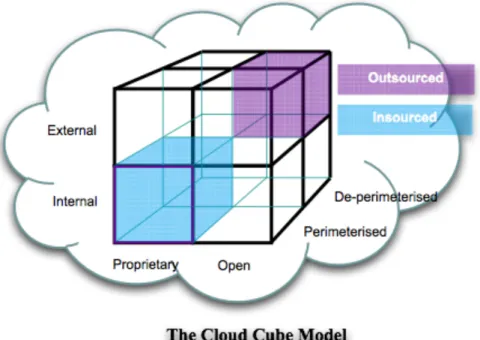
The architectural mindset used when designing “ solutions has clear implications on the future flexibility, security, and mobility of the resultant solution, as well as its collaborative capabilities. As a rule of thumb, perimeterized solutions are less effective than de-perimeterized solutions in each of the four areas. Careful consideration should also be given to the choice between
proprietary and open solutions for similar reasons.
Multi-Tenancy
Although not an essential characteristic of Cloud Computing in NIST’s model, CSA has identified multi-tenancy as an important element of cloud.
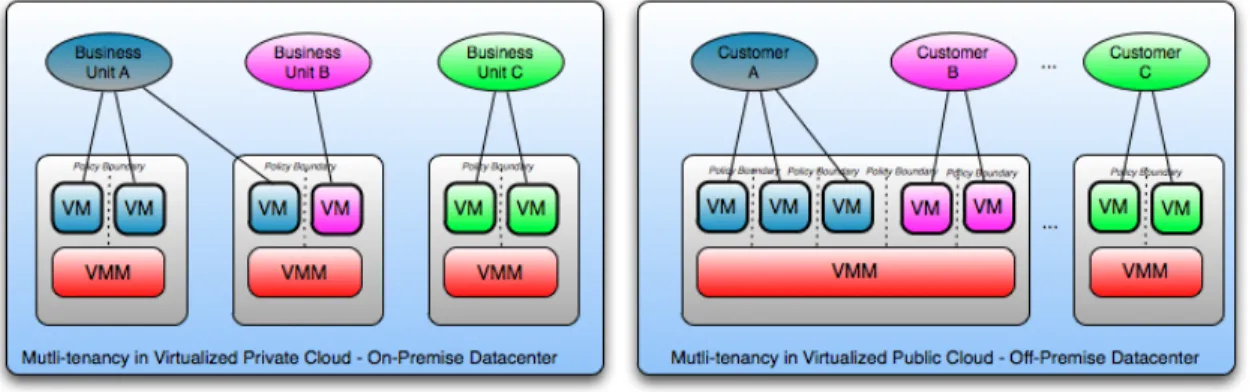
Multi-tenancy in cloud service models implies a need for policy-driven enforcement,
segmentation, isolation, governance, service levels, and chargeback/billing models for different consumer constituencies. Consumers might utilize a public cloud provider’s service offerings or actually be from the same organization, such as different business units rather than distinct organizational entities, but would still share infrastructure.
Figure 2 - Multi-Tenancy
From a provider’s perspective, multi-tenancy suggests an architectural and design approach to enable economies of scale, availability, management, segmentation, isolation, and operational efficiency; leveraging shared infrastructure, data, metadata, services, and applications across many different consumers.
Multi-tenancy can also take on different definitions depending upon the cloud service model of the provider; inasmuch as it may entail enabling the capabilities described above at the infrastructure, database, or application levels. An example would be the difference between an IaaS and SaaS multi-tenant implementation.
Cloud deployment models place different importance on multi-tenancy. However, even in the case of a private cloud, a single
organization may have a multitude of third party consultants and contractors, as well as a desire for a high degree of logical separation between business units. Thus multi-tenancy concerns should always be considered.
Cloud Reference Model
Understanding the relationships and dependencies between Cloud Computing models is critical to understanding Cloud Computing security risks. IaaS is the foundation of all cloud services, with PaaS building upon IaaS, and SaaS in turn building upon PaaS as described in the Cloud Reference Model diagram. In this way, just as capabilities are inherited, so are information security issues and risk. It is important to note that
commercial cloud providers may not neatly fit into the layered service models. Nevertheless, the reference model is important for relating real-world services to an architectural framework and understanding the resources and services requiring security analysis.
IaaS includes the entire infrastructure resource stack from the facilities to the hardware platforms that reside in them. It incorporates the capability to abstract resources (or not), as well as deliver physical and logical connectivity to those resources. Ultimately, IaaS provides a set of APIs which allow management and other forms of interaction with the infrastructure by consumers.
PaaS sits atop IaaS and adds an additional layer of integration with application development frameworks; middleware capabilities; and functions such as database, messaging, and queuing; which allow developers to build applications upon to the platform; and whose programming languages and tools are supported by the stack.
SaaS in turn is built upon the underlying IaaS and PaaS stacks; and provides a self-contained operating environment used to deliver the entire user experience including the content, its presentation, the application(s), and management capabilities.
It should therefore be clear that there are significant trade-offs to each model in terms of
integrated features, complexity vs. openness (extensibility), and security. Trade-offs between the three cloud deployment models include:
• Generally, SaaS provides the most integrated functionality built directly into the offering,
with the least consumer extensibility, and a relatively high level of integrated security (at least the provider bears a responsibility for security).
• PaaS is intended to enable developers to build their own applications on top of the
platform. As a result it tends to be more extensible than SaaS, at the expense of customer-ready features. This tradeoff extends to security features and capabilities, where the built-in capabilities are less complete, but there is more flexibility to layer on additional security.
• IaaS provides few if any application-like features, but enormous extensibility. This
generally means less integrated security capabilities and functionality beyond protecting the infrastructure itself. This model requires that operating systems, applications, and content be managed and secured by the cloud consumer.
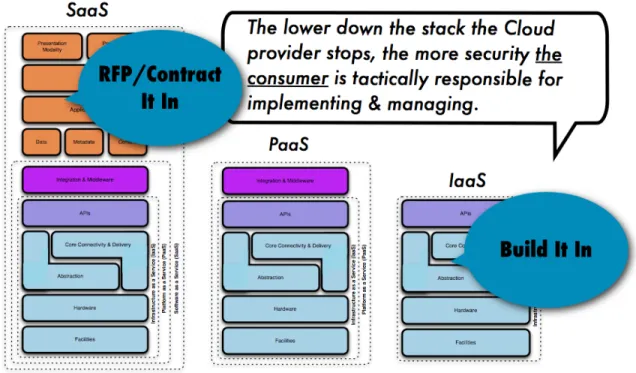
The key takeaway for security architecture is that the lower down the stack the cloud service provider stops, the more security capabilities and management consumers are responsible for implementing and managing themselves.
In the case of SaaS, this means that service levels, security, governance, compliance, and liability expectations of the service and provider are contractually stipulated; managed to; and enforced. In the case of PaaS or IaaS it is the responsibility of the consumer’s system administrators to
effectively manage the same, with some offset expected by the provider for securing the underlying platform and infrastructure components to ensure basic service availability and security. It should be clear in either case that one can assign/transfer responsibility but not necessarily accountability.
Narrowing the scope or specific capabilities and functionality within each of the cloud delivery models, or employing the functional coupling of services and capabilities across them, may yield derivative classifications. For example “Storage as a Service” is a specific sub-offering within the IaaS ‘family’.
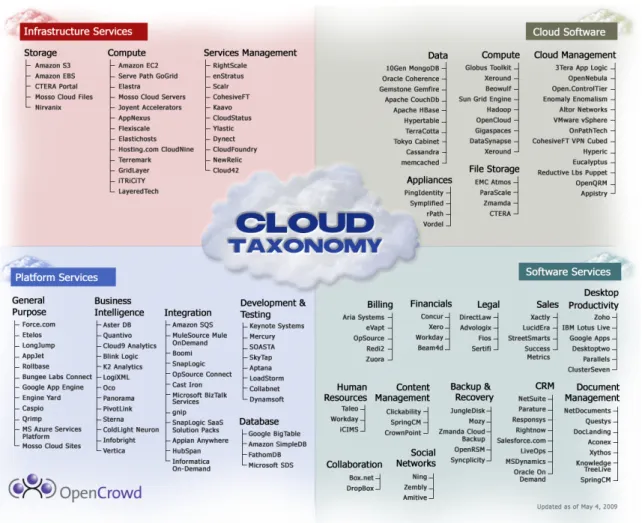
While a broader review of the growing set of cloud computing solutions is outside the scope of this document, the OpenCrowd Cloud Solutions taxonomy in the figure below provides an excellent starting point. The OpenCrowd taxonomy demonstrates the swelling ranks of solutions available today across each of the previously defined models.
It should be noted that the CSA does not specifically endorse any of the solutions or companies shown below, but provides the diagram to demonstrate the diversity of offerings available today.
Figure 4 – OpenCrowd Taxonomy
For an excellent overview of the many cloud computing use cases, the Cloud Computing Use Case Group produced a collaborative work to describe and define common cases and demonstrate the benefits of cloud, with their goal being to “...bring together cloud consumers and cloud vendors to define common use cases for cloud computing...and highlight the capabilities and requirements that need to be standardized in a cloud environment to ensure interoperability, ease of integration, and portability.”
Cloud Security Reference Model
The cloud security reference model addresses the relationships of these classes and places them in context with their relevant security controls and concerns. For organizations and individuals
grappling with cloud computing for the first time, it is important to note the following to avoid potential pitfalls and confusion:
1. The notion of how cloud services are deployed is often used interchangeably with
where they are provided, which can lead to confusion. For example, public or private clouds may be described as external or internal clouds, which may or may not be accurate in all situations.
2. The manner in which cloud services are consumed is often described relative to the location of an organization’s management or security perimeter (usually defined by the presence of a firewall). While it is important to understand where security boundaries lie in terms of cloud computing, the notion of a well-demarcated perimeter is an
anachronistic concept.
3. The re-perimeterization and the erosion of trust boundaries already happening in the enterprise is amplified and accelerated by cloud computing. Ubiquitous connectivity, the amorphous nature of information interchange, and the ineffectiveness of traditional static security controls which cannot deal with the dynamic nature of cloud services, all require new thinking with regard to cloud computing. The Jericho Forum has produced a
considerable amount of material on the re-perimeterization of enterprise networks, including many case studies.
The deployment and consumption modalities of cloud should be thought of not only within the context of ‘internal’ vs. ‘external’ as they relate to the physical location of assets, resources, and information; but also by whom they are being consumed by; and who is responsible for their governance, security, and compliance with policies and standards.
This is not to suggest that the on- or off-premise location of an asset, a resource, or information does not affect the security and risk posture of an organization because they do — but to underscore that risk also depends upon:
• The types of assets, resources, and information being managed • Who manages them and how
• Which controls are selected and how they are integrated • Compliance issues
For example a LAMP stack deployed on Amazon’s AWS EC2 would be classified as a public, off-premise, third-party managed-IaaS solution; even if the instances and applications/data contained within them were managed by the consumer or a third party. A custom application stack serving multiple business units; deployed on Eucalyptus under a corporation’s control, management, and ownership; could be described as a private, on-premise, self-managed SaaS solution. Both examples utilize the elastic scaling and self-service capabilities of cloud. The following table summarizes these points:
Table - Cloud Computing Deployment Models
Another way of visualizing how combinations of cloud service models, deployment models, physical locations of resources, and attribution of management and ownership, is the Jericho Forum’s (www.jerichoforum.org) Cloud Cube Model, shown in the figure below:
The Cloud Cube Model illustrates the many permutations available in cloud offerings today and presents four criteria/dimensions in order to differentiate cloud ‘formations’ from one another and the manner of their provision, in order to understand how cloud computing affects the way in which security might be approached.
The Cloud Cube Model also highlights the challenges of understanding and mapping cloud models to control frameworks and standards such as ISO/IEC 27002, which provides “...a series of guidelines and general principles for initiating, implementing, maintaining, and improving information security management within an organization.”
The ISO/IEC 27002, section 6.2, “External Parties” control objective states: “…the security of the organization’s information and information processing facilities should not be reduced by the introduction of external party products or services…”
As such, the differences in methods and responsibility for securing the three cloud service models mean that consumers of cloud services are faced with a challenging endeavor. Unless cloud providers can readily disclose their security controls and the extent to which they are
implemented to the consumer, and the consumer knows which controls are needed to maintain the security of their information, there is tremendous potential for misguided decisions and
detrimental outcomes.
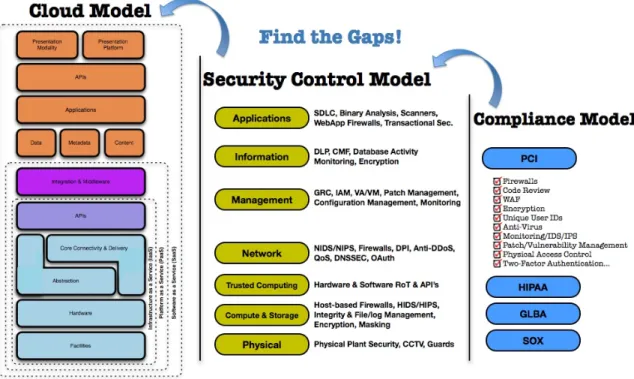
This is critical. First one classifies a cloud service against the cloud architecture model. Then it is possible to map its security architecture; as well as business, regulatory, and other compliance requirements; against it as a gap-analysis exercise. The result determines the general “security” posture of a service and how it relates to an asset’s assurance and protection requirements. The figure below shows an example of how a cloud service mapping can be compared against a catalogue of compensating controls to determine which controls exist and which do not — as provided by the consumer, the cloud service provider, or a third party. This can in turn be compared to a compliance framework or set of requirements such as PCI DSS, as shown.
Figure 6 - Mapping the Cloud Model to the Security Control & Compliance Model
Once this gap analysis is complete, per the requirements of any regulatory or other compliance mandates, it becomes much easier to determine what needs to be done in order to feed back into a risk assessment framework; this, in turn, helps to determine how the gaps and ultimately risk should be addressed: accepted, transferred, or mitigated.
It is important to note that the use of cloud computing as an operational model does not inherently provide for or prevent achieving compliance. The ability to comply with any requirement is a direct result of the service and deployment model utilized and the design, deployment, and management of the resources in scope.
For an excellent overview of control frameworks which provides good illustrations of the generic control framework alluded to above, see the Open Security Architecture Group’s‘landscape’ of security architecture patterns documentation, or the always useful and recently updated NIST 800-53 revision 3 Recommended Security Controls for Federal Information Systems and Organizations security control catalogue.
What Is Security for Cloud Computing?
Security controls in cloud computing are, for the most part, no different than security controls in any IT environment. However, because of the cloud service models employed, the operational models, and the technologies used to enable cloud services, cloud computing may present different risks to an organization than traditional IT solutions.
Cloud computing is about gracefully losing control while maintaining accountability even if the operational responsibility falls upon one or more third parties.
An organization’s security posture is characterized by the maturity, effectiveness, and
completeness of the risk-adjusted security controls implemented. These controls are implemented in one or more layers ranging from the facilities (physical security), to the network infrastructure (network security), to the IT systems (system security), all the way to the information and applications (application security). Additionally controls are implemented at the people and process levels, such as separation of duties and change management, respectively.
As described earlier in this document, the security responsibilities of both the provider and the consumer greatly differ between cloud service models. Amazon’s AWS EC2 infrastructure as a service offering, as an example, includes vendor responsibility for security up to the hypervisor, meaning they can only address security controls such as physical security, environmental security, and virtualization security. The consumer, in turn, is responsible for security controls that relate to the IT system (instance) including the operating system, applications, and data. The inverse is true for Salesforce.com’s customer resource management (CRM) SaaS offering. Because the entire ‘stack’ is provided by Salesforce.com, the provider is not only responsible for the physical and environmental security controls, but it must also address the security controls on the infrastructure, the applications, and the data. This alleviates much of the consumer’s direct operational responsibility.
One of the attractions of cloud computing is the cost efficiencies afforded by economies of scale, reuse, and standardization. To bring these efficiencies to bear, cloud providers have to provide services that are flexible enough to serve the largest customer base possible, maximizing their addressable market. Unfortunately, integrating security into these solutions is often perceived as making them more rigid.
This rigidity often manifests in the inability to gain parity in security control deployment in cloud environments compared to traditional IT. This stems mostly from the abstraction of
infrastructure, and the lack of visibility and capability to integrate many familiar security controls — especially at the network layer.
The figure below illustrates these issues: in SaaS environments the security controls and their scope are negotiated into the contracts for service; service levels, privacy, and compliance are all issues to be dealt with legally in contracts. In an IaaS offering, while the responsibility for securing the underlying infrastructure and abstraction layers belongs to the provider, the remainder of the stack is the consumer’s responsibility. PaaS offers a balance somewhere in between, where securing the platform itself falls onto the provider, but securing the applications developed against the platform and developing them securely, both belong to the consumer.
Figure 7 - How Security Gets Integrated
Understanding the impact of these differences between service models and how they are deployed is critical to managing the risk posture of an organization.
Beyond Architecture: The Areas Of Critical Focus
The twelve other domains which comprise the remainder of the CSA guidance highlight areas of concern for cloud computing and are tuned to address both the strategic and tactical security ‘pain points’ within a cloud environment, and can be applied to any combination of cloud service and deployment model.
The domains are divided into two broad categories: governance and operations. The governance domains are broad and address strategic and policy issues within a cloud computing environment, while the operational domains focus on more tactical security concerns and implementation within the architecture.
Governance Domains
Domain Guidance dealing with ...
Governance and Enterprise Risk Management
The ability of an organization to govern and measure enterprise risk introduced by Cloud Computing. Items such as legal precedence for agreement breaches, ability of user
organizations to adequately assess risk of a cloud provider, responsibility to protect
sensitive data when both user and provider may be at fault, and how international boundaries may affect these issues, are some of the items
discussed. Legal and Electronic Discovery
Potential legal issues when using Cloud Computing. Issues touched on in this section include protection requirements for information and computer systems, security breach
disclosure laws, regulatory requirements, privacy requirements, international laws, etc.
Compliance and Audit
Maintaining and proving compliance when using Cloud Computing. Issues dealing with evaluating how Cloud Computing affects compliance with internal security policies, as well as various compliance requirements (regulatory, legislative, and otherwise) are discussed here. This domain includes some direction on proving compliance during an audit.
Information Lifecycle Management
Managing data that is placed in the cloud. Items surrounding the identification and control of data in the cloud, as well as compensating controls which can be used to deal with the loss of physical control when moving data to the cloud, are discussed here. Other items, such as who is responsible for data confidentiality, integrity, and availability are mentioned. Portability and Interoperability
The ability to move data/services from one provider to another, or bring it entirely back in-house. Issues surrounding interoperability between providers are also discussed.
Operational Domains
Traditional Security, Business Continuity and Disaster Recovery
How Cloud Computing affects the operational processes and procedures currently use to implement security, business continuity, and disaster recovery. The focus is to discuss and examine possible risks of Cloud Computing, in hopes of increasing dialogue and debate on the overwhelming demand for better enterprise risk management models. Further, the section touches on helping people to identify where Cloud Computing may assist in diminishing certain security risks, or entails increases in other areas.
Data Center Operations
How to evaluate a provider’s data center architecture and operations. This is primarily focused on helping users identify common data center characteristics that could be detrimental to on-going services, as well as characteristics
that are fundamental to long-term stability.
Incident Response, Notification and Remediation
Proper and adequate incident detection, response, notification, and remediation. This attempts to address items that should be in place at both provider and user levels to enable proper incident handling and forensics. This domain will help you understand the complexities the cloud brings to your current incident handling program.
Application Security
Securing application software that is running on or being developed in the cloud. This includes items such as whether it’s appropriate to migrate or design an application to run in the cloud, and if so, what type of cloud platform is most appropriate (SaaS, PaaS, or IaaS). Some specific security issues related to the cloud are also discussed.
Encryption and Key Management
Identifying proper encryption usage and scalable key management. This section is not prescriptive, but is more informational is discussing why they are needed and identifying issues that arise in use, both for protecting access to resources as well as for protecting data.
Identity and Access Management
Managing identities and leveraging directory services to provide access control. The focus is on issues encountered when extending an organization’s identity into the cloud. This section provides insight into assessing an organization’s readiness to conduct cloud-based Identity and Access Management (IAM).
Virtualization
The use of virtualization technology in Cloud Computing. The domain addresses items such as risks associated with multi-tenancy, VM isolation, VM co-residence, hypervisor
vulnerabilities, etc. This domain focuses on the security issues surrounding system/hardware virtualization, rather than a more general survey of all forms of virtualization.
Summary
The keys to understanding how cloud architecture impacts security architecture are a common and concise lexicon; coupled with a consistent taxonomy of offerings by which cloud services and architecture can be deconstructed, mapped to a model of compensating security and
operational controls, risk assessment frameworks, and management frameworks; and in turn to compliance standards.
Understanding how architecture, technology, process, and human capital requirements change or remain the same when deploying Cloud Computing services is critical. Without a clear
understanding of the higher-level architectural implications, it is impossible to address more detailed issues rationally.
This architectural overview, along with the twelve other areas of critical focus, will provide the reader with a solid foundation for assessing, operationalizing, managing, and governing security in Cloud Computing environments.
Contributors: Glenn Brunette, Phil Cox, Carlo Espiritu, Christofer Hoff, Mike Kavis, Sitaraman Lakshminarayanan, Kathleen Lossau, Erik Peterson, Scott Matsumoto, Adrian Seccombe, Vern Williams, Richard Zhou
Domain 2: Governance and Enterprise Risk Management
Effective governance and enterprise risk management in Cloud Computing environments follows from well-developed information security governance processes, as part of the organization’s overall corporate governance obligations of due care. Well-developed information security governance processes should result in information security management programs that are scalable with the business, repeatable across the organization, measurable, sustainable, defensible, continually improving, and cost-effective on an ongoing basis.
The fundamental issues of governance and enterprise risk management in Cloud Computing concern the identification and implementation of the appropriate organizational structures, processes, and controls to maintain effective information security governance, risk management, and compliance. Organizations should also assure reasonable information security across the information supply chain, encompassing providers and customers of Cloud Computing services and their supporting third party vendors, in any cloud deployment model.
Governance Recommendations
√ A portion of the cost savings obtained by Cloud Computing services must be invested
into increased scrutiny of the security capabilities of the provider, application of security controls, and ongoing detailed assessments and audits, to ensure requirements are continuously met.
√
Both Cloud Computing service customers and providers should develop robust information security governance, regardless of the service or deployment model. Information security governance should be a collaboration between customers and providers to achieve agreed-upon goals which support the business mission and information security program. The service model may adjust the defined roles and responsibilities in collaborative information security governance and risk management (based on the respective scope of control for user and provider), while the deployment model may define accountability and expectations (based on risk assessment).√ User organizations should include review of specific information security governance
structure and processes, as well as specific security controls, as part of their due diligence for prospective provider organizations. The provider’s security governance processes and capabilities should be assessed for sufficiency, maturity, and consistency with the user’s information security management processes. The provider’s
information security controls should be demonstrably risk-based and clearly support these management processes.
√ Collaborative governance structures and processes between customers and providers
should be identified as necessary, both as part of the design and development of service delivery, and as service risk assessment and risk management protocols, and then incorporated into service agreements.
√ Security departments should be engaged during the establishment of Service Level
Agreements and contractual obligations, to ensure that security requirements are contractually enforceable.
√ Metrics and standards for measuring performance and effectiveness of information
security management should be established prior to moving into the cloud. At a
minimum, organizations should understand and document their current metrics and how they will change when operations are moved into the cloud, where a provider may use different (potentially incompatible) metrics.
√ Wherever possible, security metrics and standards (particularly those relating to legal
and compliance requirements) should be included in any Service Level Agreements and contracts. These standards and metrics should be documented and demonstrable
(auditable).
Enterprise Risk Management Recommendations
As with any new business process, it’s important to follow best practices for risk management. The practices should be proportionate to your particular usages of cloud services, which may range from innocuous and transient data processing up through mission critical business processes dealing with highly sensitive information. A full discussion of enterprise risk
management and information risk management is beyond the scope of this guidance, but here are some cloud-specific recommendations you can incorporate into your existing risk management processes.
√ Due to the lack of physical control over infrastructure in many Cloud Computing
deployments; Service Level Agreements, contract requirements, and provider documentation play a larger role in risk management than with traditional, enterprise-owned infrastructure.
√ Due to the on-demand provisioning and multi-tenant aspects of Cloud Computing,
traditional forms of audit and assessment may not be available, or may be modified. For example, some providers restrict vulnerability assessments and penetration testing, while others limit availability of audit logs and activity monitoring. If these are required per your internal policies, you may need to seek alternative assessment options, specific contractual exceptions, or an alternative provider better aligned with your risk
management requirements.
√ Relating to the use of cloud services for functions critical to the organization, the risk
management approach should include identification and valuation of assets,
identification and analysis of threats and vulnerabilities and their potential impact on assets (risk and incident scenarios), analysis of the likelihoods of events/scenarios, management-approved risk acceptance levels and criteria, and the development of risk treatment plans with multiple options (control, avoid, transfer, accept). The outcomes of risk treatment plans should be incorporated into service agreements.
√ Risk assessment approaches between provider and user should be consistent, with
consistency in impact analysis criteria and definition of likelihood. The user and provider should jointly develop risk scenarios for the cloud service; this should be intrinsic to the provider’s design of service for the user, and to the user’s assessment of cloud service risk.
√ Asset inventories should account for assets supporting cloud services and under the
control of the provider. Asset classification and valuation schemes should be consistent between user and provider.
√ The service, and not just the vendor, should be the subject of risk assessment. The use
of cloud services, and the particular service and deployment models to be utilized, should be consistent with the risk management objectives of the organization, as well as with its business objectives.
√ Where a provider cannot demonstrate comprehensive and effective risk management
processes in association with its services, customers should carefully evaluate use of the vendor as well as the user’s own abilities to compensate for the potential risk
management gaps.
√ Customers of cloud services should ask whether their own management has defined risk
tolerances with respect to cloud services and accepted any residual risk of utilizing cloud services.
Information Risk Management Recommendations
Information Risk Management is the act of aligning exposure to risk and capability of managing it with the risk tolerance of the data owner. In this manner, it is the primary means of decision support for information technology resources designed to protect the confidentiality, integrity, and availability of information assets.
√
Adopt a risk management framework model to evaluate IRM, and a maturity model to assess the effectiveness of your IRM model.√
Establish appropriate contractual requirements and technology controls to collect necessary data to inform information risk decisions (e.g., information usage, access controls, security controls, location, etc.).√
Adopt a process for determining risk exposure before developing requirements for a Cloud Computing project. Although the categories of information required to understand exposure and management capability are general, the actual evidential metrics gathered are specific to the nature of the cloud computing SPI model and what can be feasibly gathered in terms of the service.√ When utilizing SaaS, the overwhelming majority of information will have to be
provided by the service provider. Organizations should structure analytical information gathering processes into contractual obligations of the SaaS service.
√
When utilizing PaaS, build in information gathering as per SaaS above, but where possible include the ability to deploy and gather information from controls as well as creating contractual provisions to test the effectiveness of those controls.√
When utilizing an IaaS service provider, build information transparency into contract language for information required by risk analysis.√ Cloud service providers should include metrics and controls to assist customers in
Third Party Management Recommendations
√ Customers should view cloud services and security as supply chain security issues.
This means examining and assessing the provider’s supply chain (service provider relationships and dependencies), to the extent possible. This also means examining the provider’s own third party management.
√ Assessment of third party service providers should specifically target the provider’s
incident management, business continuity and disaster recovery policies, and processes and procedures; and should include review of co-location and back-up facilities. This should include review of the provider’s internal assessments of conformance to its own policies and procedures, and assessment of the provider’s metrics to provide reasonable information regarding the performance and effectiveness of its controls in these areas.
√ The user’s business continuity and disaster recovery plan should include scenarios for
loss of the provider’s services, and for the provider’s loss of third party services and third party-dependent capabilities. Testing of this part of the plan should be
coordinated with the cloud provider.
√ The provider’s information security governance, risk management, and compliance
structures and processes should be comprehensively assessed:
o Request clear documentation on how the facility and services are assessed for risk and audited for control weaknesses, the frequency of assessments, and how control weaknesses are mitigated in a timely manner.
o Require definition of what the provider considers critical service and information security success factors, key performance indicators, and how these are measured relative to IT Service and Information Security Management.
o Review the provider’s legal, regulatory, industry, and contractual requirements capture, assessment, and communication processes for comprehensiveness.
o Perform full contract or terms-of-use due diligence to determine roles,
responsibilities, and accountability. Ensure legal review, including an assessment of the enforceability of local contract provisions and laws in foreign or out-of-state jurisdictions.
o Determine whether due diligence requirements encompass all material aspects of the cloud provider relationship, such as the provider’s financial condition, reputation (e.g., reference checks), controls, key personnel, disaster recovery plans and tests, insurance, communications capabilities, and use of subcontractors.
Contributors: Jim Arlen, Don Blumenthal, Nadeem Bukhari, Alex Hutton, Michael Johnson, M S Prasad, Patrick Sullivan
Domain 3: Legal and Electronic Discovery
Cloud Computing creates new dynamics in the relationship between an organization and its information, involving the presence of a third party: the cloud provider. This creates new challenges in understanding how laws apply to a wide variety of information management scenarios.
A complete analysis of Cloud Computing-related legal issues requires consideration of functional, jurisdictional, and contractual dimensions.
• The functional dimension involves determining which functions and services in Cloud
Computing have legal implications for participants and stakeholders.
• The jurisdictional dimension involves the way in which governments administer laws and
regulations impacting Cloud Computing services, the stakeholders, and the data assets involved.
• The contractual dimension involves the contract structures, terms and conditions, and
enforcement mechanisms through which stakeholders in Cloud Computing environments can address and manage the legal and security issues.
Cloud Computing in general can be distinguished from traditional outsourcing in three ways: the time of service (on-demand and intermittent), the anonymity of identity of the service provider(s) and anonymity of the location of the server(s) involved. When considering IaaS and PaaS specifically, a great deal of orchestration, configuration, and software development is performed by the customer — so much of the responsibility cannot be transferred to the cloud provider. Compliance with recent legislative and administrative requirements around the world forces stronger collaboration among lawyers and technology professionals. This is especially true in Cloud Computing, due to the potential for new areas of legal risk created by the distributed nature of the cloud, compared to traditional internal or outsourced infrastructure.
Numerous compliance laws and regulations in the United States and the European Union either impute liability to “ subcontractors or require business entities to impose liability upon them via contract.
Courts now are realizing that information security management services are critical to making decisions as to whether digital information may be accepted as evidence. While this is an issue for traditional IT infrastructure, it is especially concerning in Cloud Computing due to the lack of established legal history with the cloud.
Recommendations
√ Customers and cloud providers must have a mutual understanding of each other’s roles
and responsibilities related to electronic discovery, including such activities as litigation hold, discovery searches, who provides expert testimony, etc.
√ Cloud providers are advised to assure their information security systems are responsive
to customer requirements to preserve data as authentic and reliable, including both primary and secondary information such as metadata and log files.
√ Data in the custody of cloud service providers must receive equivalent guardianship as
in the hands of their original owner or custodian.
√ Plan for both expected and unexpected termination of the relationship in the contract
negotiations, and for an orderly return or secure disposal of assets.
√ Pre-contract due diligence, contract term negotiation, post-contract monitoring, and
contract termination, and the transition of data custodianship are components of the duty of care required of a cloud services client.
√ Knowing where the cloud service provider will host the data is a prerequisite to
implementing the required measures to ensure compliance with local laws that restrict the cross-border flow of data.
√ As the custodian of the personal data of its employees or clients, and of the company’s
other intellectual property assets, a company that uses Cloud Computing services should ensure that it retains ownership of its data in its original and authenticable format.
√ Numerous security issues, such as suspected data breaches, must be addressed in
specific provisions of the service agreement that clarify the respective commitments of the cloud service provider and the client.
√ The cloud service provider and the client should have a unified process for responding
to subpoenas, service of process, and other legal requests.
√ The cloud services agreement must allow the cloud services client or designated third
party to monitor the service provider’s performance and test for vulnerabilities in the system.
√ The parties to a cloud services agreement should ensure that the agreement anticipates
problems relating to recovery of the client’s data after their contractual relationship terminates.
Contributors: Tanya Forsheit, Scott Giordano, Francoise Gilbert, David Jackson, Peter McLaughlin, Jean Pawluk, Jeffrey Ritter