Generic Medication Prices
By David Belk MDWe’ve often heard that the cost of generic prescription medications have been rising dramatically in the US; far more than the average rate of inflation. But that’s not even close to being the whole story. In reality, generic medication prices have been extremely chaotic in recent years, with some medications skyrocketing rather suddenly in price while others haven’t changed much or have even gone down substantially in price. In order to clarify exactly what has been happening to generic medication prices, I did a survey comparing quarterly NADAC prices (the average price all retail pharmacies pay for each medication) of the majority of generic prescription medications since October 2012. I surveyed the prices of 1,240 generic listings (including different doses and preparations) of over 400 separate medications. I tracked these prices each quarter from October 4, 2012 through January 7, 2015 to show how the price of each
medication listing changed from the previous quarter and in total. What I found was a complex and highly chaotic pattern of price changes.
In summary:
Nearly half of the generic listings (604 in total) actually went down in price during this time. Among these, 349 listings went down 10% or more, 38 went down 50% or more and 14 of them decreased by at least 90% in price.
That’s the good news.
On the other hand, nearly half of the generic listings (607 in total) went up in price- many way up. Among these, 314 of the listings went up at least 50% in price, 240 of the listings (20%) at least doubled in price, 87 went up at least five times in price and 42 of them went up ten or more times in price since October 2012.
But even that summary doesn’t tell the whole story. Far from it in fact.
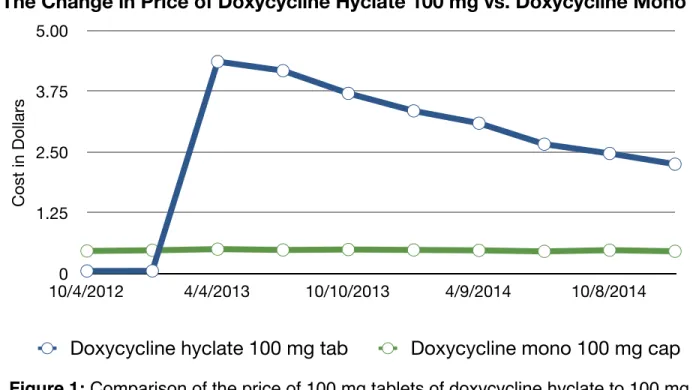
For example, let’s look at what happened to the price of a single dose of the antibiotic doxycycline. Prior to April 2013, pharmacies in the US bought 100 mg tablets of
doxycycline hydrochloride (doxycycline hyclate) for about 6¢ each. Then, suddenly and unexpectedly, the price of doxycycline hyclate 100 mg tablets shot up more than 70 times in price to $4.37 a pill!
This price increase happened in the course of only a couple of weeks throughout the US. But what’s even more bizarre is that the price of a slightly different preparation of the same dose of the same antibiotic didn’t change at all. Throughout the entire time of the survey, the price of 100 mg capsules of doxycycline monohydrate (doxycycline mono) barely budged.
I need to emphasize here that these two drugs are nearly identical. In clinical
indications, effect, side effects, etc... they can be easily substituted for one another and often are. The only major difference between them is the price. Prior to April 2013, doxycycline hyclate was the cheaper of the two so pharmacies bought far more of it. After April of that year, things changed. Here’s a graph showing exactly what happened:
Figure 1: Comparison of the price of 100 mg tablets of doxycycline hyclate to 100 mg capsules of doxycycline mono each quarter from October 2012 until January 2015. Was doxycycline a unique example? Far from it. In fact, the example of doxycycline is pretty much the rule for what’s been happening to generic medication prices for more than two years. Each and every quarter anywhere from 10 to 50 listings of the generic medications surveyed shot up two, five or even ten times or more in price. In nearly every case these price increases were random and without warning or any apparent reason. Here’s another graph to show how many medication listings at least doubled in price each quarter from the previous quarter of the survey:
0 1.25 2.50 3.75 5.00 10/4/2012 4/4/2013 10/10/2013 4/9/2014 10/8/2014
The Change in Price of Doxycycline Hyclate 100 mg vs. Doxycycline Mono 100 mg
Cost in Dollars
Figure 2: Between October 2012 and January 2015 anywhere from 10-50 different pharmaceutical listings at least doubled in price each quarter with many of the listings going up five or more times in 3 months.
Here are some more examples:
Pravastatin is a commonly prescribed cholesterol lowering medication. Between July of 2013 and January of 2014, the price of all doses of pravastatin more than quadrupled. In July 2013 the average price for all doses of pravastatin was about 11¢ a pill. By January 2014 that price had gone up to over 56¢ a pill!
During this same time, other members of the same class of medications (statins) didn’t go up at all. The prices of simvastatin and lovastatin didn’t change much and
atorvastatin (generic Lipitor) actually went down 30% in price: 0 13 26 39 52 1st-2nd 2nd-3rd 3rd-4th 4th-5th 5th-6th 6th-7th 7th-8th 8th-9th 9th-10th Number of Medications that at Least Doubled in Price Each Quarter
Number of Medications
Figure 3
The same thing happened with a class of generic blood pressure medications called ACE inhibitors Figure 4 0 0.15 0.30 0.45 0.60 10/4/2012 4/4/2013 10/10/2013 4/9/2014 10/8/2014 Comparing the Change in Price for Different Statins
Cost in Dollars
Average Price for All Doses of Pravastatin Average Price for all Doses of Atorvastatin Average Price for All Doses of Simvastatin Average Price for all Doses of Lovastatin
0 0.08 0.16 0.24 0.32 10/4/2012 4/4/2013 10/10/2013 4/9/2014 10/8/2014 Comparing the Change in Price for Different ACE Inhibitors
Cost in Dollars
Average Price for All Doses of Enalapril Average Price for All Doses of Benazepril Average Price for all Doses of Lisinopril
As figure 4 shows, the average price of all doses of enalapril increased roughly ten times, this time over two separate quarters while the prices of benazepril and lisinopril (two other ACE inhibitors that are every bit as good as enalapril) didn’t change at all. I should emphasize (again) that each of these medications control blood pressure in exactly the same way and all are equally effective.
Other notable examples include:
- Amitriptyline, which is an antidepressant that has been around since 1961. Between July and October 2014 the average price of all doses of amitriptyline increased about 20 times.
-Digoxin, which is a form of a medication that’s been used to treat heart disease since the time of Hippocrates. Between October 2013 and January 2014 the price of digoxin increased eight times.
-The average price of fluconazole (an anti-fungal) went up nine times in 2013. The average price of doxazosin (a blood pressure medication that’s also used to treat prostate problems) increased nine times in 2013. The average price for all topical clobetasol preparations (creams, lotions, gels, etc... used to treat certain rashes) increased 12 times in price in 2014.
There are many more examples. As Figure 2 above indicates, over 200 generic listings have at least doubled in price and nearly every price increase was sudden, random and without warning or an apparent reason.
Why this is happening? Well, the answer for why individual pharmaceutical companies keep raising the prices of generic medications this way is: Because they can. There’s nothing to stop them so, why wouldn’t they?
Most people in the US pay for prescription medications indirectly. People in the US use their insurance to purchase nearly every prescription they buy even if that prescription costs only a few pennies a pill. This means that consumers are largely shielded from these price increases since their insurance copay won’t change when the price of a medication shoots up suddenly.
Insurance companies are also shielded from these prices. Insurance reimbursement rates are negotiated annually so the amount an insurance company pays a pharmacy for a medication (if they pay anything at all) doesn’t change just because the cost of the medication suddenly increases. If the price of a generic medication stays up for too long, an insurance company can just take that medication off its list of “approved” medications so they may never be burdened by these prices.
Doctors are largely oblivious to medication costs so a doctor won’t stop prescribing a medication simply because the price of that medication went up. Doctors aren’t likely to
stop prescribing a medication until that medication starts being rejected frequently by the insurance companies.
In reality, the only parties immediately affected by these price increases are pharmacies and people who buy their medications directly rather than using insurance. But even pharmacies might not notice if the price of a few generic medications go up by several hundred percent.
Pharmacies purchase most of their medications in large batches. When they buy several hundred medications at a time, they’re not likely to notice if only a couple of the medications in a batch cost a few hundred dollars more than expected. A pharmacist will only realize these price increases if they take the time to go over each individual invoice with each batch of medications they buy, and they’re not likely to do that very often.
So in reality, very few people are likely to notice right away when a pharmaceutical company plays this game. Add to that the fact that there are absolutely no laws regulating how much a pharmaceutical company can charge for a drug. Why, then, wouldn’t a pharmaceutical company arbitrarily raise its prices as often as it wishes? I’m sure that’s a question many of these companies were asking themselves just a few years ago and now we’re seeing their answer.