DEPARTMENT OF HEALTH & HUMAN SERVICES Centers for Medicare & Medicaid Services
7500 Security Boulevard, Mail Stop S2-01-16 Baltimore, Maryland 21244-1850
State Demonstrations Group
September 30, 2015
Jason Helgerson Director
Office of Health Insurance Programs New York State Department of Health Empire State Plaza
Corning Tower (OCP – 1211) Albany, NY 12237
Dear Mr. Helgerson:
This letter is to inform you that the Centers for Medicare & Medicaid Services (CMS) is granting a temporary extension of New York’s Partnership Plan section 1115 demonstration (Project No. 11-W-00114/2). The temporary extension is effective through December 31, 2015.
The extension period will give CMS and New York the opportunity to have more detailed discussions of the issues involved in the longer extension of the demonstration, including discussions related to CMS’ review of New York’s budget neutrality.
The demonstration will continue to operate under all other current Special Terms and Conditions (STCs) and waiver and expenditure authorities. The per-member-per month (PMPM) costs approved for the last demonstration year will be used to determine budget neutrality through this temporary extension period. Your project officer, Deborah Steinbach, will contact you to facilitate these discussions. Ms. Steinbach can be reached by phone at (410) 786-7404, or by e-mail at [email protected], should you need to contact her. We look forward to continuing to work with you and your staff on your 1115 demonstration extension.
Sincerely, /s/
Eliot Fishman Director
DEPARTMENT OF HEALTH & HUMAN SERVICES
Mr. Jason Helgerson Director
Office of Health Insurance Programs New York State Department ofHealth Empire State Plaza
Coming Tower (OCP- 1211) Albany, NY 12237
Dear Mr. Helgerson:
JUL 2 9 2015
Centers for Medicare & Medicaid Services
Administrator Washington, DC 20201
The Centers for Medicare & Medicaid Services (CMS) is approving New York's request to amend its Medicaid demonstration, entitled New York Partnership Plan, Project Number 11-W-00114/2, originally approved by CMS on July 15, 1997.
This amendment provides a waiver of section 1902(a)(10)(B) of the Social Security Act (the Act) for New York to establish Health and Recovery Plans (HARPs) and provide an option for
coordinated care and additional home and community based services (HCBS) for populations diagnosed with severe mental illness and substance use disorders. Effective August 1, 2015, and once fee for service rates for the HARPs HCBS services are approved, New York will be
permitted to commence enrollment into HARPs. Current enrollees in New York's Mainstream Medicaid Managed Care program will be reviewed for HARPs eligibility, and if eligible, will be passively enrolled. Individuals may opt out within 90 days of passive enrollment. New
enrollees, upon being determined eligible for Medicaid, will be given an assessment for severe mental illness or substance use disorder. When individuals are no longer eligible, they will be offered a choice of Mainstream Medicaid Managed Care plan to continue receiving Medicaid benefits.
With this amendment, CMS is also revising current waivers of 1902(a)(1) and 1902(a)(23)(A) of the Act. These revised authorities will permit New York to geographically phase in HARPs enrollment and restrict choice of provider to those who furnish services under HARPs plans. CMS is also approving new expenditure authorities to effectuate eligibility flexibilities for the Adult Group. New York is permitted to implement the following features:
• Seamless enrollment of adults who receive Temporary Assistance for Needy Families (T ANF) into Medicaid,
• Extension of continuous eligibility for members of the Adult Group who tum 65 during their coverage period and
• Extension of temporary coverage for members of the Adult Group who experience a coverage gap before entering the health insurance Marketplace.
Page 2- Mr. Jason Helgerson
Also, CMS is granting the state's request to extend its expenditure authority for its Advance Premium Tax Credit program that provides support to individuals who have transitioned from Medicaid under the demonstration to the health insurance Marketplace.
At this time, CMS is not approving a waiver of section 1902(a)(27) and 1902(a)(32) to allow individuals to self-direct their HCBS expenditures to providers who do not have a provider agreement with the state Medicaid agency. CMS will continue to work with New York on its pilot proposal that necessitates these new waiver authorities and may approve under a subsequent amendment to the 1115 demonstration.
CMS' approval of this amendment is conditioned upon compliance with the enclosed list of waiver and expenditure authorities and Special Terms and Conditions (STCs) defining the nature, character and extent of anticipated federal involvement in the project. The award is subject to our receiving your written acknowledgement of the award and acceptance of these STCs within 30 days of the date of this letter.
Your project officer for this demonstration is Ms. Jessica Woodard. She is available to answer any questions concerning your section 1115 demonstration. Ms. Woodard's contact information is as follows:
Centers for Medicare & Medicaid Services Center for Medicaid & CHIP Services Mail Stop: S2-01-16
7500 Security Boulevard Baltimore, MD 21244-1850 Telephone: ( 41 0) 786-9249 Facsimile: (410) 786-8534
Email: Jessica. [email protected]
Official communications regarding program matters should be sent simultaneously to Ms. Woodard and to Mr. Michael Melendez, Associate Regional Administrator for the Division of Medicaid and Children's Health Operations. Mr. Melendez's contact information is as follows:
Mr. Michael Melendez
Associate Regional Administrator
Division of Medicaid and Children's Health Operations 26 Federal Plaza
New York, NY 10278 Telephone: (212) 616-2430
Page 3- Mr. Jason Helgerson
If you have questions regarding this approval, please contact Mr. Eliot Fishman, Director, State Demonstrations Group, Center for Medicaid & CHIP Services, at (410) 786-5647.
Enclosures
Sincerely,
Andrew M. Slavitt Acting Administrator
CENTERS FOR MEDICARE & MEDICAID SERVICES
SECTION 1115 OF THE SOCIAL SECURITY ACT MEDICAID DEMONSTRATION NEW YORK PARTNERSHIP PLAN
CENTERS FOR MEDICARE & MEDICAID SERVICES WAIVER AUTHORITY
NUMBER: 11-W-00114/2
TITLE: Partnership Plan Medicaid Section 1115 Demonstration AWARDEE: New York State Department of Health
All requirements of the Medicaid program expressed in law, regulation, and policy statement, not expressly waived in this list, shall apply to the demonstration, beginning April 14, 2014.
The following waivers shall enable New York to implement the approved Special Terms and Conditions (STCs) for the New York Partnership Plan Medicaid section 1115 demonstration.
1. Statewideness Section 1902(a)(1)
To permit New York to geographically phase in the Managed Long Term Care (MLTC) program and the Health and Recovery Plans (HARPs) and to phase in behavioral health (BH) home and community based services (HCBS) into HIV Special Needs Plans(SNPs). To permit New York to geographically phase in long term nursing home benefits into managed care.
2. Income Comparability Section 1902(a)(17)
To enable New York to apply a more liberal income standard for individuals who are deinstitutionalized and receive home and community-based services (HCBS) through the managed long term care program than for other individuals receiving community-based long term care.
3. Service Comparability (Amount, Duration & Scope) Section 1902(a)(10)(B) To enable New York to provide HCBS behavioral health services, whether furnished as a state plan benefit or as a demonstration benefit, to targeted populations that may not be consistent with the targeting authorized under the approved state plan, in amount, duration and scope that
exceeds those available to eligible individuals not in those targeted populations.
4. Freedom of Choice Section 1902(a)(23)(A)
To the extent necessary to enable New York to require beneficiaries to enroll in managed care plans, including the Mainstream Medicaid Managed Care (MMMC), and MLTC and HARPs programs in order to obtain benefits offered by those plans. Beneficiaries shall retain freedom of choice of family planning providers.
5. Payments to Providers Under the State Plan Sections 1902(a)(13)(A) and 1902(a)(30)(A)
To the extent necessary to permit the state to elect to reduce supplemental payments to
institutional providers otherwise authorized under the approved state plan in order to prioritize funding for delivery system reform incentive payments.
CENTERS FOR MEDICARE & MEDICAID SERVICES EXPENDITURE AUTHORITY LIST
NUMBER: 11-W-00114/2
TITLE: Partnership Plan Medicaid Section 1115 Demonstration AWARDEE: New York State Department of Health
Under the authority of section 1115(a)(2) of the Social Security Act (the Act), expenditures made by New York for the items identified below, which are not otherwise included as expenditures under section 1903 of the Act shall, for the period beginning April 14, 2014, until the ending date specified for each authority, be regarded as expenditures under the state’s title XIX plan.
The following expenditure authorities shall enable New York to implement the approved Special Terms and Conditions (STCs) for the New York Partnership Plan Medicaid section 1115
demonstration. The authorities also promote the objectives of title XIX in the following ways: • Expenditure authorities 1, 2, 4, 5, 6, 9 and 10 help increase efficiency and quality of care
through initiatives to transform service delivery networks;
• Expenditure authorities 1, 2, 3, 4 and 8 help increase overall coverage of low-income individuals in the state;
• Expenditure authorities 2, 6 and 7 help improve health outcomes for Medicaid and other low-income populations in the state; and,
• Expenditure authorities 9 and 10 help stabilize, strengthen, and increase access to
providers and provider network availability to serve Medicaid low-income populations in the state.
1. Demonstration-Eligible Populations. Expenditures for healthcare related costs for the following populations that are not otherwise eligible under the Medicaid state plan.
a. Demonstration Population 9 (HCBS Expansion). Medically needy individuals who are receiving HCBS, and who are medically needy after application of community spouse and spousal impoverishment eligibility and post-eligibility rules consistent with section 1924 of the Act.
b. Demonstration Population 10 (Individuals Moved from Institutional Settings to Community Settings for Long Term Care Services). Expenditures for health care related costs for individuals moved from institutional nursing facility settings to community settings for long term services and supports who would not otherwise be eligible based on income, but whose income does not exceed a more liberal income standard, and who receive services through the managed long term care program under the demonstration.
c. Demonstration Population 11 (Temporary Assistance for Needy Families (TANF) Recipients). Expenditures for health care related costs for low-income adults enrolled
in TANF. These individuals are exempt from receiving a MAGI determination in accordance with §1902(e)(14)(D)(i)(I) of the Act.
2. Twelve-Month Continuous Eligibility Period. Expenditures for health care related costs for individuals who have been determined eligible under groups specified in Table 1 of STC 4 in Section IV for continued benefits during any periods within a twelve month eligibility period when these individuals would be found ineligible if subject to
redetermination. This authority includes providing continuous coverage for the Adult Group determined financially eligible using Modified Adjusted Gross Income (MAGI) based eligibility methods. For expenditures related to the Adult Group, specifically, the state shall make a downward adjustment of 2.6 percent in claimed expenditures for federal matching at the enhanced federal matching rate and will instead claim those expenditures at the regular matching rate.
3. Transitional Coverage for Members of the Adult Group Turning 65. Expenditures for health care related costs for individuals under the state plan who are in the Adult Group upon turning 65. Coverage for these individuals will continue until the end of their respective continuous eligibility period. Expenditures for individuals receiving continued coverage will be claimed at the regular match rate. (End Date: January 1, 2016)
4. Transitional Coverage to the Marketplace. Expenditures for health care related costs for individuals under the state plan who experience a coverage gap before a file transfer is completed from the Medicaid agency to the Marketplace. This population will receive continued benefits for no longer than 30 days until coverage under the Marketplace is
effective. Expenditures for individuals receiving this coverage will be claimed at the regular matching rate. (End Date: June 30, 2016)
5. Facilitated Enrollment Services. Expenditures for enrollment assistance services provided by managed care organizations (MCOs), the costs for which are included in the claimed MCO capitation rates.
6. Demonstration Services for Behavioral Health Provided under MMMC. Expenditures for provision of residential and outpatient addiction services, crisis intervention and licensed behavioral health practitioner services to MMMC enrollees only and are not provided under the state plan.
7. Targeted HCBS Behavioral Health Services. Expenditures for the provision of HCBS behavioral health services under Health and Recovery Plans (HARPs) and HIV SNPs that are not otherwise available under the approved state plan.
8. Designated State Health Programs Funding. Expenditures for the designated state health program specified in STC 12 in Section VII which provides premium subsidies to FHPlus individuals and new applicants between 133 percent and 150 percent FPL who have coverage through the Marketplace. (End Date: December 31, 2015)
9. Designated State Health Programs Funding. Expenditures for the designated state health program specified in STC 15 in Section VIII of the STCs, not to exceed $345.4 million in FFP through March 31, 2016.
10. Delivery System Reform Incentive Payment (DSRIP) Program. Expenditures for
incentive payments and planning grant payments for the DSRIP program specified in STC 1 – 40 in Section VIII of the STCs, not to exceed $1,007.8 million of FFP through March 31, 2016.
1
CENTERS FOR MEDICARE & MEDICAID SERVICES SPECIAL TERMS AND CONDITIONS
NUMBER: 11-W-00114/2
TITLE: Partnership Plan Medicaid Section 1115 Demonstration AWARDEE: New York State Department of Health
I. PREFACE
The STCs have been arranged into the following subject areas: I. Preface
II. Program Description and Objectives III. General Program Requirements
IV. Populations Affected by and Eligible Under the Demonstration V. Demonstration Benefits and Enrollment
VI. Delivery Systems
VII. Delivery System Reform Program Description and Objectives VIII. General Reporting Requirements
IX. General Financial Requirements X. Monitoring Budget Neutrality XI. Evaluation of the Demonstration
Additionally, attachments have been included to provide supplementary information and guidance for specific STCs.
II. PROGRAM DESCRIPTION AND OBJECTIVES
The state’s goal in implementing the Partnership Plan section 1115(a) demonstration is to improve access to health services and outcomes for low-income New Yorkers by:
• Improving access to health care for the Medicaid population; • Improving the quality of health services delivered;
• Expanding access to family planning services; and
• Expanding coverage with resources generated through managed care efficiencies to additional low-income New Yorkers.
The demonstration is designed to permit New York to use a managed care delivery system to deliver benefits to Medicaid recipients, create efficiencies in the Medicaid program, and enable the extension of coverage to certain individuals who would otherwise be without health insurance. It was approved in 1997 to enroll most Medicaid recipients into managed care organizations (MCOs) (Medicaid managed care program). As part of the
2
enroll in mandatory managed care was transferred to a new demonstration, the Federal-State Health Reform Partnership (F-SHRP). Effective April 1, 2014, this authority was restored to this demonstration as F-SHRP was phased out.
In 2001 the Family Health Plus (FHPlus) program was implemented as an amendment to the demonstration, providing comprehensive health coverage to low-income uninsured adults, with and without dependent children, who have income greater than Medicaid state plan eligibility standards. FHPlus was further amended in 2007 to implement an employer-sponsored health insurance (ESHI) component. Individuals eligible for FHPlus who have access to cost-effective ESHI are required to enroll in that coverage, with FHPlus providing any wrap-around services necessary to ensure that enrollees get all FHPlus benefits. FHPlus expires on December 31, 2013 and will become a state-only program, but federal matching funding for state expenditures for FHPlus will continue to be available as a designated state health program through December 31, 2014.
In 2002 the demonstration was expanded to incorporate a family planning benefit under which family planning and family planning-related services are provided to women losing Medicaid eligibility and to certain other adults of childbearing age (family planning
expansion program). The family planning expansion program expires on December 31, 2013 and becomes a state plan benefit.
In 2010 the Home and Community Based Services Expansion program (HCBS expansion program) was added to the demonstration. It provides cost-effective home and community based services to certain adults with significant medical needs as an alternative to
institutional care in a nursing facility. The benefits and program structure mirrors those of existing section 1915(c) waiver programs, and strives to provide quality services for individuals in the community, ensure the well-being and safety of the participants and increase opportunities for self-advocacy and self-reliance.
As part of the 2011 extension, the state was authorized to develop and implement two new initiatives designed to improve the quality of care rendered to Partnership Plan recipients. The first, the Hospital-Medical Home (H-MH) project, will provide funding and performance incentives to hospital teaching programs in order to improve the coordination, continuity and quality of care for individuals receiving primary care in outpatient hospital settings. By the end of the demonstration extension period, the hospital teaching programs which receive grants under the H-MH project will have received certification by the National Committee for Quality Assurance as patient-centered medical homes and implemented additional improvements in patient safety and quality outcomes.
The second 2011 initiative was intended to reduce the rate of preventable readmissions within the Medicaid population, with the related longer-term goal of developing
reimbursement policies that provide incentives to help people stay out of the hospital. Under the Potentially Preventable Readmissions (PPR) project, the state will provide funding, on a competitive basis, to hospitals and/or collaborations or hospitals and other providers for the purpose of developing and implementing strategies to reduce the rate of PPRs for the Medicaid population. Projects will target readmissions related to both medical and
3
behavioral health conditions.
Finally, in 2011 CMS began providing matching funding for the state’s program to address clinic uncompensated care through its Indigent Care Pool. Prior to this extension period, the state funded (with state dollars only) this program which provides formula-based grants to voluntary, non-profit and publicly-sponsored Diagnostic and Treatment Centers (D&TCs) for services delivered to the uninsured throughout the state.
In 2012, New York added to the demonstration an initiative to improve service delivery and coordination of long term care services and supports for individuals through a managed care model. Under the Managed Long Term Care (MLTC) program, eligible individuals in need of more than 120 days of community-based long term care are enrolled with managed care providers to receive long term services and supports as well as other ancillary services. Other covered services are available on a fee-for-service basis to the extent that New York has not exercised its option to include the individual in the Mainstream Medicaid Managed Care Program (MMMC). Enrollment in MLTC was phased in geographically and by group.
The state’s goal specific to managed long term care (MLTC) are as follows:
• Expanding access to managed long term care for Medicaid enrollees who are in need of long term services and supports (LTSS);
• Improving patient safety and quality of care for enrollees in MLTC plans; • Reduce preventable inpatient and nursing home admissions; and
• Improve satisfaction, safety and quality of life.
In April 2013 New York had three amendments approved. The first amendment was a continuation of the state’s goal for transitioning more Medicaid beneficiaries into managed care. Under this amendment, the Long Term Home Health Care Program (LTHHCP) participants began transitioning, on a geographic basis, from New York’s 1915(c) waiver into the 1115 demonstration and into managed care. Second, this amendment eliminated the exclusion from MMMC of, both foster care children placed by local social service agencies and individuals participating in the Medicaid buy-in program for the working disabled. Additionally the April 2013 amendment approved expenditure authority for New York to claim FFP for expenditures made for certain designated state health program beginning April 1, 2013 through March 31, 2014. During this period, the state was also required to submit several deliverables to demonstrate that the state was successful in its efforts to transform its health system for individuals with developmental disabilities.
A December 2013 amendment was approved to ensure that the demonstration made changes that were necessary in order to coordinate its programs with the Medicaid expansion and other changes made under the Affordable Care Act (ACA) implementation beginning January 1, 2014.
Effective April 1, 2014 CMS approved an amendment to extend several authorities that expired in calendar year 2014. As part of the amendment CMS extended authorities related
4
to the transitioning of parents into state plan coverage and other authorities that provide administrative ease to the state’s programs and continuing to provide services to vulnerable population, i.e. HCBS Expansion program and individuals moved from institutional settings into community based settings.
Also effective April 1, 2014, the Federal-State Health Reform Partnership (F-SHRP) demonstration phased out and populations receiving managed care of managed long term care in the 14 counties that encompassed the F-SHRP demonstration were moved into the Partnership Plan demonstration.
The amendment approved on April 14, 2014 allows New York to take the first steps toward a major delivery system reform to be supported by a Delivery System Reform Incentive
Payment (DSRIP) program. We have reached agreement on the basic structure of Medicaid funding for New York State’s longer-term transformation efforts, which aim to significantly improve care, change how public and safety net providers are organized, and reform how Medicaid pays for health services. This amendment to the Partnership Plan demonstration will provide for an Interim Access Assurance Fund (IAAF) to ensure that sufficient numbers and types of providers are available in the community to participate in the transformation activities contemplated by the DSRIP Program. The DSRIP program will incentivize providers through additional payments beginning contingent on the 5-year renewal of the demonstration in 2015.
On December 31, 2014, CMS amended Partnership Plan to enable New York to extend long term nursing facility services to enrollees of New York’s MMMC and MLTC populations, thereby removing patients in residential health care facilities (RHCF) at the time of
enrollment into MMMC who are classified as permanent and recent residents of RHCF at time of enrollment into MLTC. As part of the agreement, the state also instituted an independent long term services and support (LTSS) assessment process via an enrollment broker and implemented its Independent Consumer Support Program in areas of the state where services and enrollment were being instituted. The demonstration was also
temporarily extended until March 31, 2015.
In August 2015 CMS approved New York’s request to implement Health and Recovery Plans (HARPs) to integrate physical, behavioral health and HCBS for Medicaid enrollees with diagnosed severe mental illness (SMI) and/or substance use disorder (SUD) to receive services in their own homes and communities. Under the demonstration, HARPs are a separate coverage product that is targeted to Medicaid enrollees that meet need-based criteria for SMI and/or SUD established by the state. HIV SNP plans under MMMC will also offer BH HCBS services to eligible individuals meeting targeting, risk, and functional needs criteria. All MMMC plans will offer BH benefits in integrated plans including four new demonstration services.
The demonstration is also amended to effectuate eligibility flexibilities for the Adult Group, including allowing adults enrolled in TANF to be enrolled as a demonstration population, without a MAGI determination, extension of continuous eligibility for members of the Adult Group who turn 65 during their continuous eligibility period and temporary coverage for
5
members of the Adult Group who are determined eligible to receive coverage through the Marketplace.
III.GENERAL PROGRAM REQUIREMENTS
1. Compliance with Federal Non-Discrimination Statues. The state must comply with all applicable federal statues relating to non-discrimination. These include, but are not limited to, the Americans with Disabilities Act of 1990, title VI of the Civil Rights Act of 1964, section 504 of the Rehabilitation Act of 1973 and the Age Discrimination Act of 1975. 2. Compliance with Medicaid Law, Regulation and Policy. All requirements of the
Medicaid program expressed in law, regulation and policy statement, not expressly waived or identified as not applicable in the waiver and expenditure authority documents (of which these terms and conditions are part), must apply to the demonstration.
3. Changes in Medicaid Law, Regulation and Policy. The state must, within the timeframes specified in law, regulation or policy statement, come into compliance with any changes in federal law, regulation or policy affecting the Medicaid program that occur during this demonstration approval period, unless the provision being changed is expressly waived or identified as not applicable.
4. Impact on Demonstration of Changes in Federal Law, Regulation and Policy.
a. To the extent that a change in federal law, regulation or policy requires either a reduction or an increase in federal financial participation (FFP) for expenditures made under this demonstration, the state must adopt, subject to CMS approval, a modified budget neutrality agreement for the demonstration as necessary to comply with such change. The modified agreement will be effective upon the implementation of the change. The modified agreement will be effective upon the implementation of the change. The trend rates for the budget neutrality agreement are not subject to change under this
subparagraph.
b. If mandated changes in the federal law require state legislation, the changes must take effect on the day such state legislation becomes effective, or on the last day such legislation was required to be in effect under the law.
5. State Plan Amendments. The state will not be required to submit title XIX state plan amendments for changes affecting any populations made eligible solely through the demonstration. If a population eligible through the Medicaid state plan is affected by a change to the demonstration, a conforming amendment to the state plan may be required, except as otherwise noted in these STCs. The state is required to submit new or revised title XIX state plan amendments for state plan services received by demonstration participants except for services provided through waiver or expenditure authority.
6
6. Changes Subject to the Amendment Process. Changes related to program design, eligibility, enrollment, expansion of program benefits, sources of non-federal share of funding and budget neutrality must be submitted to CMS as amendments to the
demonstration. All amendments require are subject to approval at the discretion of the Secretary in accordance with section 1115 of the Social Security Act (the Act). The state must not implement changes to these elements without prior approval by CMS.
Amendments to the demonstration are not retroactive, and FFP will not be available for changes to the demonstration that have not been approved through the amendment process outlined in STC 7 of this section.
7. Amendment Process. Requests to amend the demonstration must be submitted to CMS for approval no later than 120 days prior to the planned date of implementation of the change and may not be implemented until approved. Amendment requests must include, but are not limited to, the following:
a. An explanation of the public process used by the state, consistent with the requirements of STC 14 of this section, to reach a decision regarding the requested amendment; b. A data analysis which identifies the specific “with waiver” impact of the proposed amendment on the current budget neutrality agreement. Such analysis shall include current total computable “with waiver” and “without waiver” status on both a summary and detailed level through the current approval period using the most recent actual expenditures, as well as summary and detailed projections of the change in the “with waiver” expenditure total as a result of the proposed amendment, which isolates (by eligibility group/EG) the impact of the amendment;
c. A detailed description of the amendment, including impact on beneficiaries, with sufficient supporting documentation; and
d. If applicable, a description of how the evaluation design will be modified to incorporate the amendment provisions.
8. Extension of the Demonstration.
a. Should the state intend to request an extension of the demonstration under section 1115(a), 1115(e), or 1115(f), the state must submit an extension request no later than 6 months prior to the expiration date of the demonstration. The chief executive officer of the state must submit to CMS either a demonstration extension request or a phase-out plan consistent with the requirements of STC 9 of this section.
b. Compliance with Transparency Requirements of 42 CFR 431.412. Effective April 27, 2012, as part of the demonstration extension requests, the state must provide
documentation of compliance with the transparency requirements of 42 CFR 431.412 and the public notice and tribal consultation requirements outlined in STC 14 of this section regarding Public Notice, Tribal Consultation and Consultation with Interested Parties.
7
9. Demonstration Phase-Out. The state may suspend or terminate this demonstration in whole, or in part, consistent with the following requirements:
a. Notification of Suspension or Termination: The state must promptly notify CMS in writing of the reason(s) for the suspension or termination, together with the effective date and phase-out plan. The state must submit its notification letter and a draft phase-out plan to CMS no less than 4 months before the effective date of the demonstration’s suspension or termination. Prior to submitting the draft phase-out plan to CMS, the state must publish on its website the draft phase-out plan for 30 day public comment period. In addition, the state must conduct tribal consultation in accordance with its approved tribal consultation state plan amendment. Once the 30 day public comment period has ended, the state must provide a summary of each public comment received, the state’s response to the comment, and the way the state incorporated the received comment into a revised phase-out plan.
CMS must approve the phase-out plan prior to the implementation of the phase-out activities. There must be a 14 day period between CMS approval and the phase-out plan implementation of phase-out activities.
b. Phase-Out Plan Requirements: The state must include, at a minimum, in its phase out plan its process by which it will notify affected beneficiaries, the content of said notices (including information on the beneficiary’s appeal rights), the process by which the state will conduct administrative reviews of Medicaid eligibility for the affected beneficiaries, and any community outreach activities.
c. Phase-Out Procedures: The state must comply with all notice requirements found in 42 CFR § 431.206, § 431. 210 and § 431.213. In addition, the state must ensure all appeal and hearing rights afforded to demonstration participants as outlined in 42 CFR §
431.220 and § 431.221. If a demonstration participant requests a hearing before the date of action, the state must maintain benefits as required in 42 CFR § 431.230. In addition, the state must conduct administrative renewals for all affected beneficiaries in order to determine whether they qualify for Medicaid eligibility under a different eligibility category as discussed in the October 1, 2011 State Health Official Letter #10-008. d. Federal Financial Participation (FFP): If the project is terminated or any relevant
waivers suspended by the state, FFP shall be limited to normal closeout costs associated with terminating the demonstration including services and administrative costs of disenrolling participants.
10.CMS Right to Terminate or Suspend. CMS may suspend or terminate the demonstration, subject to adequate public notice, (in whole or in part) at any time before the date of
expiration, whenever it determines following a hearing that the state has materially failed to comply with the terms of the project. CMS will promptly notify the state in writing of the determination and the reasons for the suspension or termination, together with the effective date.
8
11.Finding of Non-Compliance. The state does not relinquish its rights to challenge CMS findings that the state materially failed to comply.
12.Withdrawal of Waiver Authority. CMS reserves the right to withdraw waivers or
expenditure authorities at any time it determines that continuing the waivers or expenditure authorities would no longer be in the public interest or promote the objectives of title XIX of the Act. CMS will promptly notify the state in writing of the determination and the reasons for the withdrawal, together with the effective date and afford the state an opportunity to request a hearing to challenge CMS’ determination prior to the effective date. If a waiver or expenditure authority is withdrawn, FFP is limited to normal closeout costs associated with terminating the waiver of expenditure authority, including services and administrative costs of disenrolling participants.
13.Adequacy of Infrastructure. The state must ensure the availability of adequate resources for implementation and monitoring of the demonstration, including education, outreach and enrollment; maintaining eligibility systems; compliance with cost sharing requirements; monitoring and oversight of managed care plans providing long term services and supports and HCBS, including quality and enrollment processes; and reporting on financial and other demonstration components.
14.Public Notice, Tribal Consultation and Consultation with Interested Parties. The state must comply with the state Notice Procedures set forth in 59 Fed. Reg. 49249 (September 27, 1994). The state must also comply with the tribal consultation requirements in section
1902(a)(73) of the Act as amended by section 5006(e) of the American Recovery and Reinvestment Act (ARRA) of 2009 and the tribal consultation requirements contained in the state’s approved state plan, when the state proposes any program changes to the
demonstration, including (but not limited to) those referenced in STC 6 of this section. In states with federally recognized Indian tribes, consultation must be conducted in accordance with the consultation process outlined in the July 17, 2001 letter or the
consultation process in the state approved Medicaid state plan, if that process is specifically applicable to consulting with tribal governments on waivers (42 CFR § 431.408(b)(2)). 15.Transformed Medicaid Statistical Information Systems (T-MSIS) Requirements. The
state shall comply with all data reporting requirements under Section 1903(r) of the Act, including but not limited to Transformed Medicaid Statistical Information Systems Requirements. More information on T-MSIS is available in the August 23, 2013 State Medicaid Director Letter. On August 23, 2013, a State Medicaid Director Letter entitled, “Transformed Medicaid Statistical Information System (T-MSIS) Data”, was released. It states that all States are expected to demonstrate operational readiness to submit T-MSIS files, transition to T-MSIS, and submit timely T-MSIS data by July 1, 2014. Among other purposes, these data can support monitoring and evaluation of the Medicaid program in New York against which the premium assistance demonstration will be compared.
Should the MMIS fail to maintain and produce all federally required program management data and information, including the required T-MSIS, eligibility, provider, and managed care
9
encounter data, in accordance with requirements in the State Medicaid Manual Part 11, FFP may be suspended or disallowed as provided for in federal regulations at 42 CFR 433 Subpart C, and 45 CFR Part 95.
16.The state must have processes in place to ensure that there is no duplication of federal funding for any aspect of the demonstration.
IV.POPULATIONS AFFECTED BY AND ELIGIBILITY UNDER THE DEMONSTRATION
1. Demonstration Components. The Partnership Plan includes four distinct components, each of which affects different populations, some of which are eligible under the state plan and some of which are eligible only as an expansion population under the demonstration. a. Mainstream Medicaid Managed Care Program (MMMC). This component provides
Medicaid state plan and demonstration benefits through a managed care delivery system comprised of managed care organizations (MCOs) and primary care case management (PCCM) arrangements to most recipients eligible under the state plan. (See Attachment A for a listing of MMMC benefits) All state plan eligibility determination rules apply to these individuals.
Specifically the state has authority to expand mandatory enrollment in mainstream managed care to all individuals identified in Table 2 (except those otherwise excluded or exempted as outlined in STC 9 of this section. When the state intends to expand
mandatory managed care enrollment to additional counties, it must notify CMS 90 days prior to the effective date of the expansion and submit a revised assessment of the demonstration’s budget neutrality agreement, which reflects the projected impact of the expansion for the remainder of the demonstration approval period.
b. Managed Long Term Care (MLTC). This component provides a limited set of Medicaid state plan benefits including long term services and supports through a managed care delivery system to individuals eligible through the state plan who require more than 120 days of community based long term care services. See Attachment B for a listing of MLTC services.
Services not provided through the MLTC program are provided on a fee-for-service basis. The state has authority to expand mandatory enrollment into MLTC to all individuals identified in Table 3 (except those otherwise excluded or exempted as outlined in STC 10 of this section) with initial mandatory enrollment starting in any county in New York city and then expanding statewide based on the enrollment plan outlined in Attachment F. When the state intends to expand into a new county outside of New York City, it must notify CMS 90 days prior to the effective date of the expansion and submit a revised assessment of the demonstration’s budget neutrality agreement along with all other required materials as outlined in STC 6 in Section V.
10
c. Home and Community Based Services Expansion Program (HCBS Expansion). This component provides home and community based services similar to those provided under the state’s section 1915(c) HCBS waivers (Long Term Home Health Care
Program/LTHHCP, Nursing Home Transition and Diversion Program/NHTD, and Traumatic Brain Injury Program/TBI) to certain medically needy individuals. These services enable these individuals to live at home with appropriate supports rather than in a nursing facility. See Attachment C for HCBS Expansion services.
d. Health and Recovery Plans (HARPs): This component provides integrated Medicaid covered services for, and includes, services specifically to address the needs of
individuals with a serious mental illness (SMI) and substance use disorder (SUDs) conditions under the demonstration. Members enrolled in the Health and Recovery Plans described below will not be enrolled in mainstream MCOs (they are distinct lines of business) but the same entity may offer both products. Within the HARPs, a benefit package of behavioral health home and community based services (BH HCBS) is
provided, in addition to the existing mainstream benefit package. See attachment D for a listing of BH HCBS services.
2. Individuals Eligible under the Medicaid State Plan (State Plan Eligibles). Mandatory and optional Medicaid state plan populations derive their eligibility through the Medicaid state plan and are subject to all applicable Medicaid laws and regulations in accordance with the Medicaid state plan, except as expressly waived and as further described in these STCs. 3. Individuals Not Otherwise Eligible under the Medicaid State Plan. Individuals made
eligible under this demonstration by virtue of the expenditure authorities expressly granted include those in the HCBS Expansion component of the demonstration and are subject to all applicable Medicaid laws and regulations in accordance with the Medicaid state plan, except as specified as not applicable in the expenditure authorities for this demonstration.
4. Continuous Eligibility Period.
a. Duration. The state is authorized to provide a 12 month continuous eligibility period to the groups of individuals specified in Table 1, regardless of the delivery system through which they receive Medicaid benefits. Once the state begins exercising this authority, each newly eligible individual’s 12 month period shall begin at the initial determination of eligibility; for those individuals who are re-determined eligible consistent with Medicaid state plan rules, the 12-month period begins at that point. At each annual eligibility redetermination thereafter, if an individual is re-determined eligible under the Medicaid state plan the individual is guaranteed a subsequent 12 month continuous eligibility period. 12 month continuous eligibility is also authorized for the new adult group under section
1902(a)(10)(A)(i)(VIII) of the Act.
b. Exceptions. Notwithstanding subparagraph (a), if any other following circumstances occur during an individual’s 12 month continuous eligibility period, the individual’s Medicaid eligibility shall be terminated, suspended or re-determined:
11
i. The individual cannot be located.
ii. The individual is no longer a New York State resident. iii. The individual requests termination of eligibility. iv. The individual dies.
v. The individual fails to provide, or cooperate in obtaining a Social Security Number, if otherwise required.
vi. The individual provided an incorrect or fraudulent Social Security Number. vii. The individual was determined eligible for Medicaid in error.
viii. The individual is receiving treatment in a setting where Medicaid eligibility is not available (e.g. institution for mental disease).
ix. The individual is receiving care, services or other supplies under a section 1915 waiver.
x. The individual was previously otherwise qualified for emergency medical assistance benefits only, based on immigration status, but is no longer qualified because the emergency has been resolved.
xi. The individual fails to provide the documentation of citizenship or immigration status required under federal law.
xii. The individual is incarcerated.
xiii. The individual turns 65 years of age and is no longer eligible for the Adult Group (beginning January 1, 2016)1.
Table 1: Groups Eligible for a 12 Month Continuous Eligibility Period State Plan Mandatory and Optional Groups Statutory or Regulatory Reference
Reference
Pregnant Women 42 CFR 435.116
Adult Group 42 CFR 435.119
Parents or other caretaker relatives 42 CFR 435.110 Members of low income families, except for
children 1931 and 1925
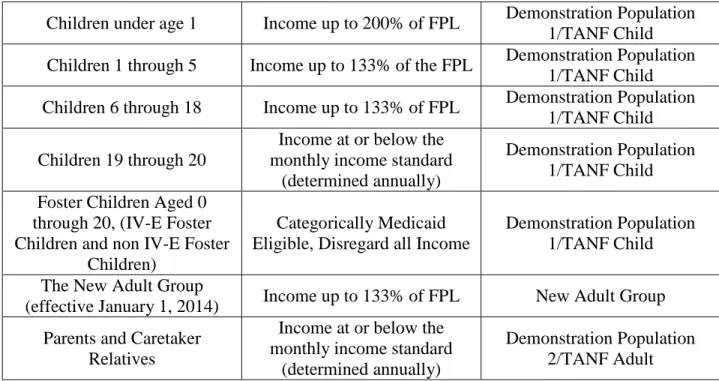
5. Individuals enrolled in MMMC. Table 2 below lists the groups of individuals who receive Medicaid benefits through the mainstream Medicaid managed care component of the
demonstration, as well as the relevant expenditure reporting category (demonstration population) for each.
Table 2: Mainstream Medicaid Managed Care Program State Plan Mandatory and
Optional Groups CFR Reference
Expenditure and Eligibility Group Reporting Pregnant Women 42 CFR 435.116 Demonstration Population 2 Infants and Children under age
19 42 CFR 435.118 Demonstration Population 1
Adult Group 42 CFR 435.119
1Individuals enrolled in Medicaid under the Adult Group who turn 65 years of age, upon receipt of Medicare, will
be seamlessly disenrolled from MMMC and continue receiving Medicaid on a fee for service basis. MMIS will indicate that Medicaid is last payer of any fee for service claims for these individuals.
12
Children with adoption assistance, foster care or guardianship under title IV-E
42 CFR 435.145 Demonstration Population 1 Parents and other Caretaker
Relatives 42 CFR 435.110 Demonstration Population 2 6. Individuals enrolled in MLTC. Table 3 below lists the groups of individuals who may be
enrolled in the Managed Long Term Care component of the demonstration as well as the relevant expenditure reporting category (demonstration population) for each. To be eligible, all individuals in this program must need more than 120 days of community based long term care services and for MAP and PACE have a nursing home level of care.
Table 3: Managed Long Term Care Program State Plan Mandatory and
Optional Groups
FPL and/or Other Qualifying Criteria
Expenditure and Eligibility Group Reporting Optional Adults aged 65 or
older 42 CFR 435.210
Demonstration Population 11/MLTC Adults 65 and
above – Duals Optional Adults/children blind
or disabled 42 CFR 435.230
Demonstration Population 10/MLTC Adults 18 through
64 – Duals
Optional Adults
Income at or below the monthly income standard, or with spend down to monthly
income standard
Demonstration Population 11/MLTC Adults 65 and
above - Duals
Adults/children aged 18 through 64 blind and disabled
Income at or below the monthly income standard, or with spend down to monthly
income standard
Demonstration Population 10/MLTC Adults 18 through
64 – Duals Aged 18 through 64 Medicaid
Buy In for Working People with Disabilities
Income up to 250% of FPL
Demonstration Population 10/MLTC Adults 18 through
64 – Duals Parents and Caretaker
Relatives 21 through 64
Income at or below the monthly income standard, or with spend down to monthly
income standard
Demonstration Population 10/MLTC Adults 18 through
64 – Duals Children aged 18 through 20
Income at or below the monthly income standard or
with spend down
Demonstration Population 10/MLTC Adults 18 through
64 – Duals Pregnant Women Income up to 200% of FPL
Demonstration Population 10/MLTC Adults 18 through
64 – Duals Poverty Level Children Aged
18 through 20 Income up to 133% of FPL
Demonstration Population 10/MLTC Adults 18 through
64 – Duals
13
through 20 18th birthday 10/MLTC Adults 18 through 64 – Duals
Individuals Moved from Institutional Settings to Community Settings for Long
Term Care Services
Income based on higher income standard to community settings for long
term services and supports pursuant to STC 8 of this
section
Demonstration Population 10 and 11/MLTC Adults 18 through 64 and MLTC Adults
65 and above
7. Individuals enrolled in HCBS Expansion Program. This group, identified as Demonstration Population 9/HCBS Expansion, includes married medically needy individuals:
a. Who meet a nursing home level of care; b. Whose spouse lives in the community; and
c. Who would be income-eligible for Medicaid services in the community but for the application of the spousal impoverishment eligibility and post-eligibility rules of section 1924 of the Act.
8. Individuals Moved from Institutional Settings to Community Settings for Long Term Services and Supports. Individuals discharged from a nursing facility who enroll into the MLTC program in order to receive community based long term services and supports or who move from an adult home as defined in subdivision twenty-five of section two of the social services law, to the community and, if applicable, enroll into the MLTC program, are eligible based on a special income standard. Spousal impoverishment rules shall not apply to this population. The special income standard will be determined by utilizing the average Housing and Urban Development (HUD) Fair Market Rent (FMR) dollar amounts for each of the seven regions in the state, and subtracting from that average, 30 percent of the Medicaid income level (as calculated for a household of one) that is considered available for housing. The seven regions of the state include: Central, Northeastern, Western, Northern
Metropolitan, New York City, Long Island and Rochester.
The state shall work with Nursing Home Administrators, nursing home discharge planning staff, family members and the MLTC health plans to identify individuals who may qualify for the housing disregard as they are able to be discharged from a nursing facility back into the community and enrolled into the MLTC program. Spousal impoverishment rules shall apply to individuals who have a spouse living in the community who enroll into the MLTC program.
Enrollees receiving community based long term services and supports must be provided with nursing facility coverage through managed care, if nursing facility care is needed for 120 days or less and there is an expectation that the enrollee will return to community based settings. During the short term nursing facility stay, the state must retain the enrollees’ community maintenance needs allowance. In addition, the state will ensure that the MLTC
14
Managed Care Organizations (MCOs) work with individuals, their families, nursing home administrators, and discharge planners to help plan for the individual’s move back into the community, as well as to help plan for the individual’s medical care once he/she has
successfully moved into his/her home. For dually eligible enrollees, the MCO is responsible for implementing and monitoring the plan of care between Medicare and Medicaid. The MCO must assure the services are available to the enrollee.
9. Individuals eligible to be enrolled in HARPs. Medicaid adult beneficiaries age 21 or over eligible for Medicaid furnished in MMMC under the demonstration who are diagnosed with SMI and/or serious SUD and meet risk factors specified by:
a. a review of current MMMC utilization,
b. a diagnosis specified by New York’s Office of Mental Health (OMH),
c. an SUD diagnosis by New Yrok’s Office of Alcoholism and Substance Abuse Services (OASAS), and includes but is not limited to, receiving a “moderate” score of the Community Mental Health Assessment Suite of the International Resident Assessment Instrument (interRAI).
10.Exclusions and Exemptions from MMMC. Notwithstanding the eligibility criteria in STC 1 of this section, certain individuals cannot receive benefits through the MMMC program (i.e. excluded), while others may request an exemption from receiving benefits through the MMMC program (i.e. exempted). Tables 4 and 5 list those individuals either excluded or exempted from MMMC.
Table 4: Individuals Excluded from MMMC
Individuals who become eligible for Medicaid only after spending down a portion of their income
Residents of state psychiatric facilities and residents of Residential Treatment Facilities for Children and Youth
Participants in capitated long term care demonstration projects Medicaid eligible infants living with incarcerated mothers
Individuals with access to comprehensive private health insurance if cost effective Foster care children in the placement of a voluntary agency
Certified blind or disabled children living or expected to live separate and apart from their parents for 30 days or more
Individuals expected to be Medicaid eligible for less than 6 months (except for pregnant women) Individuals receiving hospice services (at time of enrollment)
Individuals with a “county of fiscal responsibility” code of 97, except for individuals in OMH family care who other than their residence in district 97 would be eligible to enroll in MMMC. Individuals with a “county of responsibility” code of 98 (Individuals in an Office for People with Developmental Disabilities/OPWDD facility or treatment center)
Youth in the care and custody of the commissioner of the Office of Family & Children Services Individuals who are under 65 years of age (screened and require treatment) in the Centers for Disease Control and Prevention breast, cervical, colorectal or prostate cancer, and who are not
15
otherwise covered under creditable health coverage Individuals who are eligible for Emergency Medicaid
Table 5: Individuals who may be exempted from MMMC
Individuals with chronic medical conditions who have been under active treatment for at least 6 months with a sub-specialist who is not a network provider for any Medicaid MCO in the service area or whose request has been approved by the New York State Department of Health Medical Director because of unusually severe chronic care needs. Exemption is limited to six months Individuals designated as participating in OPWDD-sponsored programs
Individuals already scheduled for a major surgical procedure (within 30 days of scheduled enrollment) with a provider who is not a participant in the network of any Medicaid MCO in the service area. Exemption is limited to six months
Individuals with a developmental or physical disability receiving services through a Medicaid home and community based services (HCBS) waiver authorized under section 1915(c) of the Act Child and Youth residents of alcohol/substance abuse long term residential treatment programs Native Americans
Individuals with a “county of fiscal responsibility code of 98” (OPWDD) in Medicaid
Management Information System/MMIS) in counties where program features are approved by the state and operational at the local district level to permit these individuals to voluntarily enroll 11.Exclusions and Exemptions from MLTC. Notwithstanding the eligibility criteria in STC 1
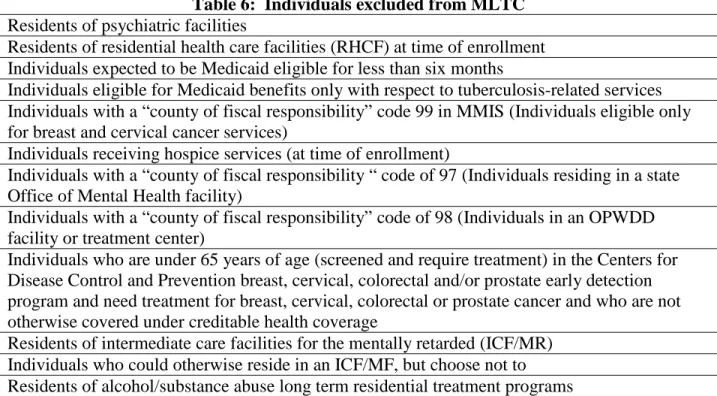
of this section, certain individuals cannot receive benefits through the MLTC program (i.e. excluded while others may request an exemption from receiving benefits through the MLTC program (i.e. exempted). Tables 6 and 7 list those individuals either excluded or exempted from MLTC.
Table 6: Individuals excluded from MLTC Residents of psychiatric facilities
Individuals expected to be Medicaid eligible for less than six months
Individuals eligible for Medicaid benefits only with respect to tuberculosis-related services Individuals with a “county of fiscal responsibility” code 99 in MMIS (Individuals eligible only for breast and cervical cancer services)
Individuals receiving hospice services (at time of enrollment)
Individuals with a “county of fiscal responsibility “ code of 97 (Individuals residing in a state Office of Mental Health facility)
Individuals with a “county of fiscal responsibility” code of 98 (Individuals in an OPWDD facility or treatment center)
Individuals who are under 65 years of age (screened and require treatment) in the Centers for Disease Control and Prevention breast, cervical, colorectal and/or prostate early detection program and need treatment for breast, cervical, colorectal or prostate cancer and who are not otherwise covered under creditable health coverage
Residents of intermediate care facilities for the mentally retarded (ICF/MR) Individuals who could otherwise reside in an ICF/MF, but choose not to Residents of alcohol/substance abuse long term residential treatment programs Individuals eligible for Emergency Medicaid
16
Based Services (OPWDD HCBS) section 1915(c) waiver program
Individuals in the following section 1915(c) waiver programs: Traumatic Brain Injury (TBI), Nursing Home Transition & Diversion (NHTD), and Long Term Home Health Care Program (LTHHCP) in certain counties2 (see Attachment F)
Residents of Assisted Living Programs
Individuals in receipt of Limited Licensed Home Care Services Individuals in the Foster Family Care Demonstration
Table 7: Individuals who may be exempted from MLTC
Individuals aged 18 through 20 who are nursing home certifiable and require more than 120 days of community based long term care services
Native Americans
Individuals who are eligible for the Medicaid buy in for the working disabled and are nursing home certifiable
Aliessa Court Ordered Individuals
12.Exclusions from HARPs3. Individuals who are in other delivery systems including FFS, dual eligibles, FIDA, and MLTC will not be eligible for HARP enrollment.
13.Population-Specific Program Requirements.
a. MMMC Enrollment of Individuals Living with HIV. The state is authorized to require individuals living with HIV to receive benefits through MMMC. Once the state begins implementing MMMC enrollment in a particular district, individuals living with HIV will have 30 days in which to select a health plan. If no selection is made, the individual will be auto-assigned to an MCO. Individuals living with HIV who are enrolled in an MCO (voluntarily or by default) may request transfer to an HIV Special Needs Plan (SNP) at any time if one or more HIV SNPs are in operation in the
individual’s district. Further, transfers between HIV SNPs will be permitted at any time. Individuals in HIV SNPs will be eligible for BH HCBS services if meeting the targeting, risk and functional needs requirements for BH HCBS services. HIV SNPs will meet all requirements of MMMC plans providing LTSS as well as HARP plans relating to HCBS service delivery.
b. Restricted Recipient Programs. The state may require individuals participating in a restricted recipient program administered under 42 CFR §431.54(e) to enroll in MMMC. Furthermore, MCOs may establish and administer restricted recipient programs, through which they identify individuals that have utilized Medicaid services at a frequency or amount that is not medically necessary, as determined in accordance with utilization guidelines established by the state, and restrict them for a reasonable period of time to
2 New York is using a phased in approach to transition LTHHCP individuals into the MLTC program. There are six phases (see Attachment F).
3Upon implementation of DISCOs, individuals enrolled in Medicaid under a DISCO will be excluded from HARP
17
obtain Medicaid services from designated providers only. The state must adhere to the following terms and conditions in this regard.
i. Restricted recipient programs operated by MCOs must adhere to the requirements in 42 CFR §431.54(e)(1) through (3), including the right to a hearing conducted by the state.
ii. The state must require MCOs to report to the state whenever they want to place a new person in a restricted recipient program. The state must maintain summary statistics on the numbers of individuals placed in restricted recipient programs, and the reasons for those placements, and must provide the information to CMS upon request.
c. Managed care enrollment of individuals using long term services and supports under the Demonstration. The state is authorized to require certain individuals using long term services and supports to enroll in either mainstream managed care or managed long term care as identified in STC 1 of this section. Enrollment in HARPs is optional. In addition, the populations that are exempted from mandatory enrollment, based on the exemption lists in STCs 10 and 11 of this section may also elect to enroll in managed care plans. Once these individuals begin to enroll in managed care, the state will be required to provide the following protections for the population4.
i. Person Centered Service Planning. The state, through its contracts with its MCOs and/or Prepaid Inpatient Health Plans (PIHPs), will require that all individuals utilizing long term services and supports will have a person centered individual service plan maintained at the MCO or PIHP. Person centered planning includes consideration of the current and unique psycho-social and medical needs and history of the enrollee, as well as the person’s functional level, and support systems.
A. The state must establish minimum guidelines regarding the person centered plan (PCP) that will be reflected in MCO/PIHP contracts. These must include at a minimum, a description of:
1. The qualification for individuals who will develop the PCP; 2. Types of assessments;
3. How enrollees are informed of the services available to them; and 4. The MCOs’ responsibilities for implementing and monitoring the PCP. B. The MCO/PIHP contract shall require the use of a person centered and directed
planning process intended to identify the strengths, capacities and preferences of the enrollee, as well as to identify an enrollee’s long term care needs and the resources available to meet those needs, and to provide access to additional care
18
options as specified by the contract. The person centered plan is developed by the participant with the assistance of the MCO/PIHP, provider and those individuals the participant chooses to include. The plan includes the services and supports that the participant needs.
C. The MCO/PIHP contract shall require that service plans must address all enrollees’ assessed needs (including health and safety risk factors) and personal goals, taking into account an emphasis on services begin delivered in home and community based settings.
D. The MCO/PIHP contract shall require that a process is in place that permits the participants to request a change to the person centered plan if the participant’s circumstances necessitate a change. The MCO contract shall require that all service plans are updated and/or revised at least annually or when warranted by changes in the enrollee’s needs.
E. The MCO/PIHP shall ensure that meetings related to the enrollee’s person centered plan will be held at a location, date and time convenient to the enrollee and his/her invited participants.
F. The MCO/PIHP contract shall require development of a backup plan to ensure that needed assistance will be provided in the event that the regular services and supports identified in the individual service plan are temporarily unavailable. The backup plan may include other individual assistance or services.
G. The MCO/PIHP contract shall require that services be delivered in accordance with the service plan, including the type, scope, amount, duration, and frequency. H. The MCO/PIHP contract shall require that enrollees receiving long term services
and supports have a choice of provider, where applicable, which has the capacity to serve that individual within the network. The MCO/PIHP must contract with at least two providers in each county in its service area for each covered service in the benefit package unless the county has an insufficient number of providers licensed, certified, or available in that county.
I. The MCO/PIHP contract shall require policies and procedures for the MCO/PIHP to monitor appropriate implementation of the individual service plans, including the qualifications of individuals developing service plans, types of assessments conducted and the method for how enrollees are notified of available services. ii. Verification of MLTC Plan Enrollment. The state shall implement a process for
MLTC plans, network and non-network providers for the state to confirm enrollment of enrollees who do not have a card or go to the wrong provider before developing a person-centered service plan.
19
iii. Health and Welfare of Enrollees. The state through its contracts with its MCOs/PIHPs shall ensure a system is in place to identify, address, and seek to prevent instances of abuse, neglect, and exploitation of its enrollees on a continuous basis. This should include provisions such as critical incident monitoring and reporting to the state, investigations of any incident including, but not limited to, wrongful death, restraints, or medication errors that resulted in an injury. In each quarterly report, the state will provide information regarding any such incidents by plan. The state will also ensure that children and adults receiving MLTC are afforded linkages to child and/or adult protective services through all service entities, including the MCOs/PIHPs.
iv. Maintaining Accurate Beneficiary Address. New York will complete return mail tracking for enrollment notification mailings. The state will use information gained from returned mail to make additional outreach attempt through other methods (phone, email, analysis of prior claims, etc.).
v. Network of Qualified Providers. The provider credentialing criteria described at 42 CFR § 438.214 must apply to providers of long-term services and supports. If the MCO’s/PIHP’s credentialing policies and procedures do not address
non-licensed/non-certified providers, the MCO/PIHP shall create alternative mechanisms to ensure the health and safety of its enrollees. To the extent possible, the
MCO/PIHP shall incorporate criminal background checks, reviewing abuse registries as well as any other mechanism the state includes within the MCO/PIHP contract. d. MLTC enrollment. Including the protections afforded individuals in subparagraph (c)
of STC 11 of this section, the following requirements apply to MLTC plan enrollment: i. Transition of Care Period: Initial transition into MLTC from fee-for-service. Each
enrollee who is receiving community-based long-term services and supports that qualifies for MLTC must continue to receive services under the enrollee’s pre-existing service plan for at least 90 days after enrollment, or until a care assessment has been completed by the MCO/PIHP, whichever is later. Any reduction,
suspension, denial or termination of previously authorized services shall trigger the required notice under 42 CFR § 438.404 which clearly articulates the enrollee’s right to file an appeal (either expedited, if warranted, or standard), the right to have
authorized service continue pending the appeal, and the right to a fair hearing if the plan renders an adverse determination (either in whole or in part) on the appeal. For initial implementation of the auto-assigned population, the plans must submit data for state review on a monthly basis reporting instances when the plan has issued a notice of action that involves a reduction of split shift or live-in services or when the plan is reducing hours by 25 percent or more. The plan will also report the number of appeals and fair hearings requested regarding these reductions. The state shall ensure through its contracts that if an enrollee is to change from one MCO/PIHP to another, the MCO/PIHPs will communicate with one another to ensure a smooth transition and provide the new MCO/PIHP with the individual’s current service plan.