AC 2007-1190: ENGINEERING, ETHICS AND SOCIETY: PROGRAM
OUTCOMES, ASSESSMENT AND EVALUATION
Legand Burge, Tuskegee University
Dr. L. L. Burge is Dean and Professor of Electrical Engineering in the College of Engineering, Architecture and Physical Sciences.
Heshmat Aglan, Tuskegee University
Dr. Aglan is Associate Dean and Professor of Mechanical Engineering in the College of Engineering, Architecture and Physical Sciences.
Pradosh Ray, Tuskegee University
Dr. Ray is Professor and Head of Mechanical Engineering in the College of Engineering, Architecture and Physical Sciences.
Nader Vahdat, Tuskegee University
Dr. Vahdat is Professor and Head of Chemical Engineering in the College of Engineering, Architecture and Physical Sciences.
Connie Price, Tuskegee University
Dr. Price is Associate Professor and Head of Philosophy in the College of Liberal Arts and Education
Prakash Sharma, Tuskegee University
Dr. Sharma is Professor and Head of Physics in the College of Engineering, Architecture and Physical Sciences.
Stephen Sodeke, Tuskegee University
Dr. Sodeke is an Professor of Allied Health and Associate Director in the Tuskegee University National Center for Bioethics.
Vascar Harris, Tuskegee University
Dr. Harris is Professor and Head of Aerospace Science Engineering in the College of Engineering, Architecture and Physical Sciences.
Gregory Murphy, Tuskegee University
Dr. Murphy is Associate Professor and Head of Electrical Engineering in the College of Engineering, Architecture and Physical Sciences.
Engineering, Ethics and Society: Program Outcomes, Assessment
and Evaluation
Abstract
This paper describes a new course that has been offered to the engineering students at Tuskegee University during the past two years. This course provides the students with an understanding of: 1) the nature of engineering ethics, 2) the engineering activities in a societal context, and 3) the contemporary issues in the engineering profession. Moral complexities in the engineering profession have been highlighted through exposure to historical development, ethical reasoning, risk assessment, effects on environment, and global issues. Workplace responsibilities and professional codes of ethics are discussed. Several case studies are presented as well. Introduction
It has been apparent for some time that engineering education must provide insight for students related to the ethical issues in the engineering profession. Recently, the National Academy of Engineering published The Engineer of 2020: Visions of Engineering in the New Century to predict the roles that engineers will play in the future1. Also, the Accreditation Board for
Engineering and Technology (ABET) gives criteria for engineering programs to follow2. Several of these criteria represent “professional skills” and are considered that they can be taught3. In view of these, the engineering departments at Tuskegee University have jointly developed a 3-credit hour course entitled “Engineering, Ethics and Society” which is required for all
undergraduate engineering students.
This course has three major components: 1) the nature of engineering ethics, 2) the engineering activities in a societal context, and 3) the contemporary issues in the engineering profession. This course satisfies the following four of eleven ABET criteria:
• Criterion f: an understanding of professional and ethical responsibility,
• Criterion g: an ability to communicate effectively,
• Criterion h: the broad education necessary to understand the impact of engineering solutions in a global and societal context, and
• Criterion j: a knowledge of contemporary issues
The uniqueness of this course stems from the fact that, it is taught by a large number of faculty representing many disciplines such as philosophy, bioethics, physics, as well as aerospace, chemical, electrical, and mechanical engineering. We believe that in this way students will be exposed to views of ethics from a variety of perspectives. Besides, many guest lecturers are invited to give lectures on ethical issues that they have experienced in the course of practicing their respective professions. An overarching objective of this course is to motivate students to life-long learning. Students participate in interactive town hall settings and produce major project reports.
Course Description
Our vision for this course is that it will give students an insight to key concepts of engineering ethics, sketch alternative views, and demonstrate examples of failures and successes in decision making processes. The course currently uses Ethics in Engineering by Martin and Schinzinger4 as the reference text for the class. It provides a cogent approach to the issues in engineering ethics using a philosophical framework. It gives the reader an understanding of the social importance of technology and how intellectual challenge should be handled.
In the beginning of the class, students are familiarized with the Engineering Code of Ethics of the National Society of Professional Engineering5. Moral complexities in the engineering profession are highlighted through exposure to historical development, ethical reasoning, risk assessment, effects on environment, and global issues. Students are also referred to A Guide to Writing as an Engineer by David Beer and David McMurrey6 to learn how to write a good report. Subsequently, the course progresses as outlined below.
Background of Ethics
This lecture defines ethics by distinguishing it from aesthetics, religion, and science. At the same time, attention is given to the interaction between ethics and these three other branches of
knowledge. The session includes an introductory-level account of the characteristics of
professional and applied ethics, and of engineering ethics. Rudiments of philosophy of science such as the ethical basis of the scientific method are also reviewed.
International concerns come into considerations of these and similar issues:
• the universality of scientific language and methods
• the need for professionals to take conceptual approaches to questions of tastes, beliefs, and cultural practices
• an engineer’s life-long commitment to serve the disadvantaged
• an engineer’s perseverance in scholarly understanding of global problems and their feasible solutions
Methods and Resources:
The approaches vary. Classroom activities range from open discussion to Socratic questioning to lecture. Citations include but are not limited to:
• references to the history of ideas and to the thought of particular philosophers, especially Kierkegaard, Bergson, Whitehead, Dewey, Langer, and Deleuze,
• case studies; rudiments of how to dissect cases, and
• engineers’ code of ethics: discussion of particular sections’ meaning and significance The Syphilis Study: Lessons for Engineers, Technologists, and Innovators
hindrance to the full participation of African American and others in medical care and scientific research. It is the aim of the Tuskegee University National Center to reverse the burden of this negative legacy. The Tuskegee University National Center for Bioethics in Research and Health Care works with the local, regional, national and international communities in areas addressing ethical and human values issues in science, technology and health as they impact people of color. Engineering is an important and learned profession. As members of this profession, engineers are expected to exhibit the highest standards of honesty and integrity. Engineering has a direct and vital impact on the quality of life for all people. Accordingly, the services provided by engineers require honesty, impartiality, fairness, and equity, and must be dedicated to the protection of the public health, safety, and welfare. Engineers must perform under a standard of professional behavior that requires adherence to the highest principles of ethical conduct. When a solution can be found it is important to contribute the innovation in technology to society.
Engineering as Social Experiment
This lecture is provided to students to emphasize that engineering is an experimental process. At its heart, engineering is an experiment on a social scale involving human subjects. The reason is that any engineering project is carried out in partial ignorance. This ignorance stems from the fact there are uncertainties in a) models used in the design, b) material properties, c) quality control in manufacturing and d) system response to actual use.
It is pointed out to students that engineers have an obligation to protect the safety of human beings. Hence, engineers should be aware of the experimental nature of any project, forecasting possible side effects, and should make an effort to monitor them.
Legal regulations and the existence of many regulatory agencies such as Environmental
Protection Agency (EPA) are explained in this context. The case study of the Titanic disaster is presented to demonstrate the uncertainties experienced by the designers and builder of Titanic and how that contributed to the disaster.
Risk and Product Liability
In this portion of the course, the disasters in chemical industry are discussed. Real life cases such as explosions in refineries and chemical plants are analyzed to show that many of these accidents could have been avoided. One of the examples presented in this course is the Chemical Disaster at Bhopal. In this accident, 40 tons of methyl isocyanate, a very dangerous chemical, released from a storage tank at a Union Carbide pesticide plant in Bhopal India. No immediate action was taken to correct the problem or to inform the people who lived around the plant. A huge cloud of the chemical drifted over the city and by the time the episode had ended, over 3500 people died and tens of thousands were injured. Students study the case in detail to understand the conditions in the plant before the accident, existence of safety training programs for employees, managers’ responsibilities and location of plant (in a residential area). These issues help students find the cause(s) of the disaster.
A Case Study: Chernobyl Nuclear Accident and Related Ethical Issues
The Chernobyl Nuclear Accident is one of the major accidents in engineering. The reason for this accident was that the operators removed all the control rods to keep the reactor operational at low energy level to conduct an unauthorized experiment.
A group discussion on ethical issues is organized with students to learn how to analyze and solve the problems like Chernobyl accident. This case study shows to students that an irresponsible act can lead to an unprecedented catastrophic event. The students analyze the immediate impact, environmental health effects, psychosocial effects, power safety and related ethical issues. The case study helps students to understand the ethical issues related to such an accident.
A Case Study: Importance of Technical Decision Making Process
The ethical lessons learned from two catastrophic shuttle accidents highlight the importance of the technical decision making process. A large system such as the Space Transportation System (STS) draws technical data from thousands of sources and an ethical dilemma often occurs when the mission and image requirements overshadow the safety considerations. The complexity and often marginal safety level of the STS system, space exploration is an inherently dangerous business, exacerbates the need for an effective decision making process. NASA has put in place a new more rigorous process of assessment, evaluation and action as recommended by a blue ribbon panel that reviewed the accidents and provided suggestions for improving the process. Whereas, the STS design has reached its end, it is hoped that future spacecraft missions will benefit from the ethical lessons learned from Space Shuttle.
A Case Study: RFID Tag Technology
Rapid advances in technology have resulted in the development of RFID (radio frequency identification) tag technology. The RFID tag is a passive device that is being attached to products for tracking and inventory information to improve efficiency and reduce cost of operations.
Recently the application of the wireless RFID tag technology has turned to the healthcare industry to improve the quality of patient care. One of the most interesting applications is the embedding of the tiny wireless RFID tag into patients. The benefit of the embedded tag is for instance if an unresponsive patient is brought to the hospital appropriate staff can scan the tag and access a secure database to obtain vital life saving information about the patient’s health. The negative aspect of this technology is that there are great concerns due to the privacy issues. The RFID tag database is susceptible to hacking. This data could then be sold to companies or individuals who profit from knowledge of people’s health or lack of heath. This technology can be further developed for remote tracking of people, and products which can lead to invasion of privacy by the government and/or private or public companies. The question posed to the
Ethics in Engineering Research
Specific areas related to research ethics include plagiarism, ownership of data, cheating, self-deception and manipulation of the working hypothesis, long-term unsuccessful projects, and graduate school issues such as expectation of advisory committees and who decides when a student has completed his/her requirements.
During this lecture students are broken into groups to focus on a case study related to one specific area of research ethics such as ownership of data, research and public welfare, proper data reporting, knowing deception and improper credit for research data. After discussing the issues among themselves and coming up with possible solutions the small group reads a
commentary prepared by an ethicist regarding their specific topic. Finally each group prepares a short presentation covering their case study, including the important issues and possible solutions to the issue to the entire class.
Student Assignments
Assignments are open-ended with solutions that require research, discussion, analysis/synthesis and evaluation. It is expected that all students will participate fully in the various lectures and related projects. Readings for the lessons will be provided throughout the semester.
1. Engineering, Ethics and Society Topic Discussion – In the first assignment students are asked to provide an assessment to an area of interest in the students’ major fields from the topics: a) energy usage in oil production and new technologies, b) support for food sources, c) nuclear technology, d) weapons of mass destruction and terrorist activities, e) preparation for natural disasters, and f) healthcare and related disparities. In particular, students are asked to answer the following questions: a) what should our society’s commitment and/or
responsibility include for sustainable and useful life, b) what responsibility should
researchers include with the risk of your solutions, and c) what are the ramifications of the industrialization of new nation-states?
2. Each student provides a topical subject discussion paper after various lecturers in the course. 3. Each student completes a major Research Project, which is due towards the end of the
semester.
4. Project and Presentations - Each student participates in a team design practicum/research project along with his or her presentations, lectures and seminars. Collaboration is highly encouraged. Project presentations/written report are based on the following: 1) Project title, 2) References (minimum 20), 3) abstract, 4) reference summary (each reference must be summarized with a maximum one paragraph), 5) discussion of issues, supply chain implications, and product lifecycle management, 6) challenges, 7) global implications, 8) values, 9) government considerations, 10) technology challenges, 11) risk management, 12) legal issues and discussion, and 13) ethical discussion.
Course Evaluation
The course outline given to students at the beginning of the class lists several objectives for the course. These objectives indicate several important ideas that students should master at the end of the course. Each course objective is then mapped to one or more program outcomes.
The objectives listed for this course are that at the end of the course students will:
1. Understand the engineering code of ethics and be able to apply them as necessary,
2. Understand moral complexities in many engineering activities and decision-making processes,
3. Understand some of the contemporary issues in the engineering professions, and 4. Effectively communicate their knowledge and understanding of engineering ethics. Each objective is also mapped against one or more ABET program outcomes as shown in Table 1 below.
Table 1: Mapping of course objectives to program outcomes Outcomes a b c d e f g h i j k Objective 1 x Objective 2 x Objective 3 x Objective 4 x
Course objective 1 addresses ABET criterion f: an understanding of professional and ethical responsibility; course objective 2 addresses ABET criterion h: the broad education necessary to understand the impact of engineering solutions in a global, economic, environmental, and societal context; course objective 3 addresses ABET criterion j: knowledge of contemporary issues; and course objective 4 addresses ABET criterion g: an ability to communicate effectively.
Collection of Assessment Data
Throughout the semester, the instructors assess if students are mastering these objectives from tests that are periodically administered and from reports and oral presentations (where
applicable). These assessments are put in a scale of 1 (poor) to 5 (excellent) for each student in each class. At the end of the course, average of student scores for each objective is determined to assess whether the student body in the class was able to master that particular objective.
At the end of the class, students are also asked to evaluate if they feel that they have mastered these objectives on the same 1 to 5 scales. The purpose of this exercise is to find out if there is any serious discrepancy between the assessment of the instructor and the self-assessment of
Evaluation of assessment data
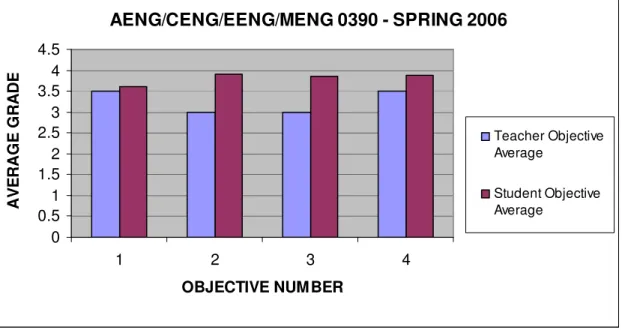
The course assessment results for the course for the Spring 2006 semester are presented in Figure 1. AENG/CENG/EENG/MENG 0390 - SPRING 2006 0 0.5 1 1.5 2 2.5 3 3.5 4 4.5 1 2 3 4
OBJECTIVE NUM BER
A V E R A G E G R A D E Teacher Objective Average Student Objective Average
Figure 1: Faculty and student assessment results for the Engineering, Ethics, and Society course in the Spring 2006 semester
Continuous Improvement of Courses
This type of assessment results is used in two different ways. The first use is in continuous improvement of the course. Three types of information are gathered from these course
assessment data. The first information the instructor looks for is if the students are scoring any objective low. A low score in an objective means that students do not feel that they have
mastered the objective well. The second information is that if the instructor is giving a low score on an objective mastered even though the students themselves are giving a higher score on that particular concept. The third information gathered is if there is a significant mismatch between faculty and student scores. A significant difference between faculty and student scores in any objective indicate that there is a mismatch between what the faculty perceives as learning by students and what the students themselves feel about what they are learning. When any one of these three types of information is observed in the assessment of an objective, faculty members are expected to modify their approach to that particular objective in the next class and see if this deficiency has been reduced.
In analyzing the assessment data it is observed that students tend to indicate that they have mastered the objectives well. However, faculty assessments tend to be more conservative.
Conclusions
A new course entitled Engineering, Ethics, and Society has been developed for undergraduate engineering majors at Tuskegee University to provide information about ethical responsibilities related to the engineering profession. This course is taught by a team of faculty from various engineering disciplines as well as from physics, bioethics, and philosophy. Many guest lectures are also provided in this course. This course satisfies several ABET criteria for engineering outcomes.
Acknowledgements
The authors acknowledge National Center for Bioethics at Tuskegee University and the Deans of all Colleges at Tuskegee University for their cooperation in conducting this course. The authors also acknowledge the guest speakers who have taken time to make presentations to the students.
References
1. The Engineer of 2020: Visions of Engineering in the New Century, National Academy of Engineering, The National Academies Press, Washington, DC, 2004
2. ABET, Criteria for Accrediting Engineering Programs, Baltimore, MD: Engineering Accreditation Commission, November 1, 2004. See http://www.abet.org/criteria_eac.html.
3. Shuman, Larry J., Mary Besterfield-Sacre, and Jack McGourty, “The ABET “Professional Skills” – Can They Be Taught? Can They Be Assessed?” Journal of Engineering Education, Vol. 94, No. 1, pp.41-55.
4. Ethics in Engineering, Fourth Edition, Mike W. Martin and Roland Schinzinger (ISBN 0-07-283115-4),
McGraw-Hill, New York 2005
5. National Society of Professional Engineering (NSPE) Engineering Code of Ethics, January 2006,
www.nspe.org
6. A Guide to Writing As An Engineer, Second Edition, David Beer and David McMurrey, John Wiley and Sons, 2005.