PHYSICAL REVIEW B VOLUME 39, NUMBER 15 15MAY 1989-II
Theory
of
hydrogen
diffusion and
reactions
in
crystalline
silicon
ChrisG.
Van de Walle, *P.
J.
H.
Denteneer,Y.
Bar-Yam, andS.
T.
Pantelides IBMResearch Diuision, ThomasJ.
8'atson Research Center, Yorktomn Heights, Xeu York 10598(Received 21 November 1988)
The behavior ofhydrogen in crystalline silicon isexamined with state-of-the-art theoretical
tech-niques, based on the pseudopotential-density-functional method in a supercell geometry. Stable sites, migration paths, and barriers for different charge states are explored and displayed in
total-energy surfaces that provide immediate insight into these properties. The bond-center site is the global minimum for the neutral and positive charge states; in the negative charge state, the tetrahedral interstitial site ispreferred. The positive charge state isenergetically favorable inp-type material, providing a mechanism for passivation ofshallow acceptors: electrons from the H atoms annihilate the free holes, and formation ofH-acceptor pairs follows compensation. Also addressed are the issues ofmolecule formation and hydrogen-induced damage. Anumber ofdifferent
mecha-nisms for defect formation are examined; hydrogen-assisted vacancy formation is found to be an
exothermic process.
I.
INTRODUCTIONThe topic
of
hydrogen (H) in semiconductors has re-cently attracted a great dealof
interest. From a funda-mental pointof
view, it is attractive to study the interac-tion between H, the most elementary atom, and silicon (Si), the prototypical semiconductor. The roleof
H in crystalline semiconductors has also emerged as an impor-tant technological problem: its effects have recently most dramatically been observed in the passivationof
shallow impurities. In this paper we will concentrate on the be-haviorof
hydrogen itself as it diffuses through a Si crys-tal. The information about stable sites and charge states obtained here is essential for understanding not only iso-lated hydrogen, but also its reactions with other impuri-ties.Hydrogen has been known for a long time to saturate dangling bonds at surfaces, vacancies, and grain boun-daries, and to passivate deep-level defects, such as those due to transition-metal impurities. In cases where deep levels are detrimental for device properties, their elimina-tion by hydrogenation is
of
great benefit. The fact that hydrogen can also passivate shallow impurities has only been appreciated more recently. ' Shallow levels deter-mine the dopingof
the semiconductor, which determines its characteristics in device operation; accidental passiva-tionof
these impurities can cause outright failureof
the device. On the other hand, one can envision applications in which intentional passivationof
certain areasof
a de-vice could be an integral partof
the fabrication process. Since hydrogen is present, intentionally or not, during manyof
the processing steps for fabricating modern semiconductor devices, its potential effects, whether harmful or-beneficial, should be thoroughly understood.There exist indeed a wide variety
of
ways in which H can penetrate Si,a numberof
which are discussed inRef.
10.
They include crystal growth, high-temperature per-meation,"
ion implantation, ' chemomechanical polish-ing,' wet etching, unintentional hydrogenation duringion bombardment, plasma etching, boiling in water, and surface exposure to monatomic
H.
The latter can be achieved by placing the sample in or downstream from a microwave plasma.'
If
the sample is shielded from the plasma, this isthe preferred way forintroducing H under the best controlled conditions, avoiding any additional damage in the material.Passivation
of
the electrical activityof
p-type silicon was first observed in metal-oxide-semiconductor (MOS) capacitors by Sah etal.
, who suggested H as the prob-able cause. Subsequent experiments by Pankove etal.
and by Johnson unambiguously showed the correlation between H and acceptor profiles, and established the ex-istence
of
H-acceptor pairs. Initially, passivationof
shal-low donors was thought to be nonexistent ' or veryweak. Recently, however, conclusive evidence has been provided for passivation
of
samples doped with P, As, and Sb, in which a reductionof
up to80%
was observed in carrier concentrations. This passivation, while dramatic, isstill not as complete as can be obtained in @-type samples.Apart from its role in interacting with existing defects and impurities, hydrogen has recently been shown to in-duce defects as well. ' Extended defects (described as "platelets") in the near-surface region were observed after hydrogenation, and correlated with the presence
of
large concentrationsof H.
A number
of
authors ' ' have offered interpretationsof
the passivation data seeking to unravel the underlying mechanisms. Attempts to explain the observed phenome-na led to a numberof
contradictory assumptions regard-ing the natureof
the charge statesof
H along its diffusion path, and hence about the H-impurity reactions that can occur. Particular models were advanced forthe structureof
the hydrogen-impurity complexes that are a resultof
10 792 VAN de WALLE, DENTENEER, BAR-YAM, AND PANTELIDES 39 the reactions that lead to H-impurity pairing. This
re-quires a description
of
the behaviorof
H as an isolated impurity, an aspect that was first stressed in a paper by oneof
the present authors. ' On the basisof
available data, it was proposed that H has a donor level in the band gap. Accordingly, passivationof
p-type material is due to compensation,i.e.
, the electron from the H annihi-lates a free hole, andH+
is formed. Pairingof
theH+
and the negatively charged acceptor then follows com-pensation. The present calculations will confirm this sug-gestion, but will also show that the behaviorof
H ismore complex, and depends upon the dopingof
the host ma-terial.Brief
accountsof
someof
the major resultsof
this work have been published elsewhere. ''
Until recently, no experimental observations were available for isolated paramagnetic hydrogen centers. However, a large amount
of
experimental effort has been devoted to the studyof
muonium, a pseudoisotopeof H.
The muon-spin-rotation technique allows the measure-ment
of
the hyperfine splittingof
muonium, by studying the spin precession in a magnetic field. ' Two paramag-netic formsof p
have been observed: the so-called"nor-mal" muonium (Mu), with an isotropic hyperfine interac-tion, and "anomalous" muonium (Mu*), with trigonal symmetry and a strong anisotropy
of
its hyperfine tensor. Normal muonium is usually associated with the tetrahedral interstitial site (T).
Recently, anomalousmuonium was shown to be located at the bond center. This site was actually suggested by Cox and Symons, ' based on chemical arguments.
It
has to be noted that the muonium lifetime is only2.
2ps, and its mass is —,thatof
H.
Even though electronic properties do not depend on mass or lifetime, the observed behaviorof
muonium may differ from thatof
H, and conclusions about muonium do not necessarily apply toH.
Nonetheless, we will see that certainof
our results are in good agreement with the ex-perimental observations on muonium. An extensive over-viewof
the fieldof
muonium in semiconductors has re-cently been compiled by Patterson. 'There has been one recent report
of
a paramagnetic hy-drogen state, with indirect evidence that it would be asso-ciated with the bond center. G-ordeev et al. observed byESR
a paramagnetic state due to H in Si, called theAA9 center. They also showed that the characteristics
of
AA9 are similar to those
of
anomalous muonium(Mu*).
Since Mu* is now known to be associated with the bond center (afact not appreciated in
Ref.
22), this provides indirect evidence for the presenceof
a paramagnetic H state at the bond-center site.Over the past ten years a number
of
theoretical studies were carried out that were aimed at determining the loca-tion and propertiesof
H in Si. Manyof
these studies im-plicitly assumed that H would retain its atomic character in its interactions with bulk Si,i.e.
, no strong binding tothe crystalline network would occur, and H would favor interstitial locations where the interaction with the Si charge density would be minimal. This point
of
view led to the neglectof
relaxationof
the network in manyof
the earlier studiesof
the locationof
H in the Sicrystal.It
is now known, and will emerge very clearly from the present study, that relaxationof
the host crystal aroundthe H impurity is an essential feature
of
the interaction; mostof
the essential physics ismissed when relaxation is not allowed.For
instance, the global energy minimum for H in the positive and neutral charge states occurs at the bond-center position, i.e.
, midway between two Si atoms, provided these atoms are allowed to relaxed out-ward over a significant distance in order to accommodate the H atom.If
no relaxation is allowed, H cannot insert into the bond.An overview
of
the literature has been included in a re-cent review by Patterson. ' In the following we will not attempt a complete listing, but rather point out some relevant features and deficienciesof
previous work. Among the first theoretica1 investigations were the extended-Huckel-theory cluster calculationsof
Singh et al. Empirical-pseudopotential Green's-function cal-culations were carried out by Rodriguez etal.
Main-wood and Stoneham, using the semiempiricalHartree-Fock
—based methodof
complete neglectof
differential overlap (CNDO), addressed the possibilityof
different charge states for theH.
This issue was also addressed in the workof
Johnson etal.
, where empirical tight-binding theory was used to derive the stable site for H in pure Si.We also mention the empirical-pseudopotential super-cell calculations
of
Pickett et al., even though they were carried out for H at the tetrahedral interstitial site in Ge, not Si. Their band structures showed a H-induced deep donor state more than 6 eV below the valence-band maximum. In contrast, recent calculations using ab ini-tio norm-conserving pseudopotentials have shown that H atT
in Ge induces a level just below the valence-band maximum, very similar to the situation in Si. The errone-ous resultof
Pickett etal.
can be ascribed to lackof
self-consistency, and/or the useof
empirical pseudopoten-tials. Starting from this result, it was argued that a spin-polarized treatment was necessary, which would intro-duce a shift in the defect levelof
up to0.
5Ry, bringing it closer to the gap region. We will show in Sec.II
E
that this is incorrect, and that spin polarization has only a minor effect on the energy-level structure.Katayama- Yoshida and Shindo actually carried out spin-density-functional calculations for H at the tetrahedral interstitial site in Si. They found a defect state in the upper part
of
the band gap. In our calcula-tions (also including spin polarization) this state is close to and just below the topof
the valence band. The resultof Ref.
28may be due to an insufficiently converged basis set.A wide variety
of
cluster calculations have been ap-plied tothe problem. Besides the CNDO listed above, we mention the MNDO (modified neglectof
diatomic over-lap) method, used by Corbett et al., and minimal-basis-set Hartree-Fock calculations by Sahoo etal.
More recent cluster calculations have included relaxation
39 THEORY OFHYDROGEN DIFFUSION AND REACTIONS
IN.
.. 10 793The results obtained from these cluster calculations display wide variations and inconsistencies, which illus-trates the inadequacy
of
manyof
these methods to treat the problem at hand. The CNDO, MNDO,PRDDO,
and MINDO/3 calculations are based on methods taken from quantum chemistry, which were developed to pro-duce good results for molecules. Their application to solid-state problems, in which the semiconductor host is modeled by a cluster, is usually not justified. Very few cluster calculations test for convergence as a function
of
cluster size, or examine the effect
of
the terminationof
the cluster (usually with H atoms) and possible interac-tions with the defect states. Furthermore, the Hamiltoni-ans used in those calculations contain parameters which are usually fitted tomolecular properties. Certain aspects
of
local bonding may therefore be well reproduced, but there is no guarantee that the specific solid-state aspectsof
the interactionof
the defect with acrystalline environ-ment can be predicted. Systematic studies to investigate these problems in cluster calculations are very rare, and the few accounts that have been published are far from encouraging.For
instance, Deak and Snyder concluded that MNDO, CNDO, and MINDO/3 all have serious diSculty in producing the band structureof
the host lat-tice (Si is found to be metallic in mostof
their cyclic-cluster calculations), and that calculated ground-state properties for defects may be subject to significant errors. One should therefore apply great caution in applying re-sults from such calculations to the analysisof
solid-state properties. The cluster calculationsof
Estreicher ' seem to have been tested most carefully for someof
the poten-tial problems mentioned above.In contrast with most previous approaches, in this study we have used state-of-the-art theoretical methods which were developed with the explicit purpose
of
study-ing a wide varietyof
propertiesof
solid-state materials. These techniques will be described inSec.
II.
SectionIII
contains our results for a single H atom in crystalline Si; they are most clearly displayed in the form
of
total-energy surfaces, which provide immediate insight into stable sites and low-energy paths for different charge states. We will also explore the stabilityof
the different charge states in intrinsic, p-type and n-type material. Section IV deals with interactions between several H atoms, including molecule formation and mechanisms for defect formation. Section Vcontains a brief summary.-
II.
METHODSThe calculational procedure used in this work is based on density-functional theory in the local-density approxi-mation3 (LDA) and ab initio norm-conserving pseudopo-tentials. The total energy is calculated using a momentum-space formalism: wave functions and po-tentials are expanded in plane-wave basis sets, and in-tegrations over the first Brillouin zone are performed us-ing the special-points algorithm. A thorough descrip-tion
of
the theoretical approach can be found inRef.
39.
Here, the properties
of
different charge statesof
H in Si are studied in a supercell geometry. We carried out spin-polarized calculations for a numberof
representativeconfigurations; the major conclusion is that the devia-tions from the spin-averaged calculations are small. Our results for total energies are most clearly displayed in the form
of
total-energy surfaces; we have used a novel tech-nique to generate such surfaces, taking the full symmetryof
the host crystal into account. We now proceed to de-scribe and analyze eachof
these features in more detail.A. Pseudopotentials
For
Siwe use a pseudopotential generated according to the Hamann-Schliiter-Chiang scheme, with cutoff radiiof
0.
99, 1.
49, and 1.11a.
u., respectively, for s,p, and d potentials. The d potential is generated using an ionized configuration: s 'p d.
Test calculations carried out with this pseudopotential for Siin the diamond structure yield a theoretical lattice constantof 5.
41 A, and a bulk modulusof
0.
94 Mbar (to be compared with the experi-mental valuesof
5.43 A and0.
99 Mbar). At an energy cutoffof
(6;12) Ry, at which mostof
our calculations for lattice relaxations are carried out, the theoretical lattice constant is 5.42A. [Thenotation(E„'E2
)Ry means thatplane waves with kinetic energy up to E2 Ry are included in the expansions
of
wave functions and potentials; waves with kinetic energy up toE,
Ry are included in an exact diagonalizationof
the Hamiltonian matrix, while those with kinetic energy betweenE,
andEz
Ry are included in second-order Lowdin perturbation theory. ' We al-ways chooseE2=2E,
.
]
These results indicate the relia-bilityof
the Si pseudopotential for structural studies.The band structure produced by this pseudopotential is in satisfactory agreement with experiment, except for the well-documented problem
of
local-density-functional theory that the band gap is too small. We calculate a conduction-band minimum along theI
—X
direction, at about0.
8 times the distance to theX
point, at0.
48 eV above the topof
the valence band. The implications for our defect calculations will be discussed later.For
H we have simply used the Coulomb potential. Test calculations have shown that no gain in convergence properties is obtained by using a pseudopotential, and that the 1/r divergenceof
the Coulomb potential near the corepresents no difficulties.B.
Plane-wave basis setWe have performed extensive tests to establish the con-vergence as a function
of
the plane-wave basis set which is used for expanding wave functions and potentials. Typical plots showing convergenceof
total-energy differences as a functionof
energy cutoff are shown inFig. 1.
The ordinate shows the energy difference between two reference configurations in an eight-atom cell. (The eight-atom cell size is generally two small for extracting meaningful results, but is adequate for a studyof
the plane-wave convergence. ) Figure 1(a) is for the energy10 794 VAN de WALLE, DENTENEER, BAR-YAM, AND PANTELIDES
0.
55CD
5
050—
CD
CD
~
045—
CD
4J
(o)
0.
40 0I I I
20 40 60
Energy cutoff (Rydberg)
80
1.
5—
CD
c
14
CD
1.
3—
c
1.
2LLJ
20 40 60
Energy cutoff (Rydberg)
80
FIG-. 1. Convergence of total-energy differences between reference configurations in an eight-atom cell, as a function of
energy cutoff. (a) is for the energy difference between H at T
and at H. (b) isfor the energy difference between H at
T
and atB.
level occupations. Indeed, the H atom induces a level near the band gap in the band structure, which has to be left unoccupied (half-occupied) in the positive (neutral) charge state. The occupation for the negative charge state is most easily accomplished, since it only requires filling up all levels with two electrons. Charge states are discussed in more detail in
Sec.
II F.
The abscissaof
both plots inFig.
1 is the energy cutoffE
used in the plane-wave expansions: plane waves with kinetic energy up toE/2
are included in an exact diagonalizationof
the Ham-iltonian matrix, while those with kinetic energy betweenE/2
andE
are included in second-order Lowdin pertur-bation theory. 'In
Fig.
1(a) the energy difference is converged (within0.
01eVof
its final value) at a ento%of
(9;18) Ry. Figure 1(b), for the bond center, shows thai at (9;18) Ry the en-ergy difference is within0.
15 eVof
its final value, which is only reached above (18;36) [note the different scaleof
panels 1(a) and 1(b)]. We thus see that the convergence properties depend on the position
of
the H atom. In fact, as we will see later, one can distinguish two regions in the Si crystal in which the H impurity shows distinctly different behavior. The first region is thatof
high elec-tron density, including the bond-center site(B),
the sites CandC'
(at the centerof
a rhombus formed by three ad-jacent Si and the nearestT), etc.
The locationof
these sites isillustrated inFig. 2.
The second region consistsof
FIG.
2. Schematic illustration ofthe (110)plane through the atoms in the Si crystal, with labels for relevant high-symmetrypositions. Tisthe tetrahedral interstitial site, His the
hexago-nal interstitial site,
B
the bond center, and C(and C') is at the center ofa rhombus formed by three adjacent Si atoms and the nearest Tsite.the low-electron-density "channels" and includes the high-symmetry tetrahedral
(T)
and hexagonal(H)
inter-stitial sites. Energy differences betweenH
positions lo-cated within the same region generally converge quite fast[cf.
Fig. 1(a)], while those between positions in different regions[cf.
8
and T, in Fig. 1(b)) are slower in convergence. Reference configuration (b) was chosen for this test because it presents the extreme "worstcase"
in termsof
convergence properties; energy differences be-tween other configurations have consistently been found to converge faster than presented in Fig. 1(b). We have also carried out test calculations in 16- and 32-atom su-percells up to (12;24) Ry that confirm that the behavior as a functionof
cutoff isthe same forall cell sizes.We have found that inclusion
of
plane waves with ki-netic energy up to (6;12) Ry (i.e.
, waves up to 6 Ry in-cluded in exact diagonalization, between 6 and 12Ry in second-order perturbation theory) is sufficient for obtain-ing the general featuresof
the energy surfaces. Since someof
the configurations (e.g.,the8
site) are particular-ly sensitive to the energy cutoff, allof
the calculations necessary to derive energy differences for those sites were also carried out at the higher cutoffof
(9;18) Ry. This cutoff corresponds to abasis setof
-5500
plane waves in the 32-atom cells. The values for energy differences and barriers that will be quoted all result from these high-cutoff calculations. This may lead to small quantitative differences with values that were quoted in earlier brief accountsof
the present work. ''
Finally, we have also examined the reliability
of
39 THEORY OFHYDROGEN DIFFUSION AND REACTIONS
IN.
.
.
10?95
Ry],
and decreased rapidly to zero when the cutoff was increased [being smaller than0.
01 eV at (15;30)Ry],
showing that the values converge to the same limit at infinite cutoff.
C. Supercells
To
study the atomic and electronic structureof
an im-purity in the crystalline environment, while still preserv-ing the translational symmetryof
the system required for our theoretical formalism, we artificially introduce periodicity by constructing a supercell in which the im-purity is surrounded by a su%ciently large numberof
Si atoms. We typically use supercells containing 32 Si atoms, such that the distance between neighboringde-0
fects
if
9.
4A.
The convergence as a functionof
supercell size was tested by performing calculations on supercells containing 8, 16,and 32Siatoms.For
energy differences between H positions in the same (high- or low-electron-density) region, the 16-atom cell was found to suffice; en-ergy differences between different locations for the same charge state were converged to within0.
1 eV, and differences between different charge states to within0.
2 eV.For
energy differences between H positions in high-versus low-density regions, however, the error bar in a 16-atom cell is larger. Compared with a 32-atom cell, de-viationsof
up to0.
4 eV may occur in the energy differences. These deviations can be attributed to the larger extentof
the defect wave functions, as observed in plotsof
the charge density (seeSec.
III
B),
which causes more significant interactions between neighboring 16-atom supercells for H at the bond center.The 32-atom cells also facilitate the extraction
of
band positions for an isolated defect, since the dispersionof
this level (caused by interactions with defects in neigh-boring supercells) is less than
0.
5eVin this case. The po-sitionof
the level that would correspond to an isolated defect (i.e., without dispersion) was determined by taking a weighted average over the band positions at the special points.It
changed by less than0.
1 eV when the cell size was increased from 16 to 32 atoms.Dispersion
of
the defect levels due to interactions be-tween neighboring supercells places an error bar on the derived position for any defect level. A more important sourceof
uncertainty, however, is due to the intrinsic deficienciesof
the local-density approximation (LDA), particularly the fact that theLDA
predicts conduction bands and hence conduction-band-derived energy 1evels to be too low. We will therefore refrain from quoting specific results for positionsof
energy levels in the band gap. We note, however, that a qualitative distinction be-tween various positionsof
the H-induced 1evel can still be made. We also note that, while the absolute positionof
the defect level is uncertain, its relative motion induced by displacements
of
the impurity or by changes in the charge state is quite reliable. These observations will al-low us to derive conclusions about the deep levels in-duced by hydrogen, as described later in the paper. Only in the section where we discuss the relative stabilityof
various charge states as afunctionof
the Fermi-level po-sition will we be confronted with the limitationsof
theLDA.
For
each positionof
the impurity, we need to let the neighboring Si atoms relax to find the lowest-energy configuration. Relaxationof
two shellsof
Si atoms sur-rounding the H impurity is included in the full calcula-tions. The need to relax two shellsof
Si atoms was another reasonto
carry out the calculations in 32-atom supercells, since 16-atom cells are too smallto
include anything but first-neighbor relaxations in a meaningful way. Second-neighbor relaxations can lower the energy by several tenthsof
an eV,e.
g.,for H at the bond center. Relaxationof
further shells causes less than0.
1 eV change in the total energy, as was checked with a Keat-ing model.D. Special points
Integrations over the first Brillouin zone are performed using the special-points scheme. In the 32-atom cells, two special points in the irreducible part
of
the zone are used for trigonal symmetry situations (e.g., H on the ex-tensionof
a Si-Si bond), and equivalent larger sets for lower-symmetry configurations. We test the convergence asa functionof
the special-point sample as follows:If
we increase the parameter q in the Monkhorst-Pack scheme from 2to 4,the numberof
special points generat-ed in the irreducible partof
the Brillouin zone increases from two to seven for theT
site, and from two to twelve for theB
site. Even though the absolute valueof
the to-tal energy changes significantly when the larger k-point set is used, all energy differences between different sites change by less than0.
05 eV.E.
Spin polarizationIn this work we report local-density-functional results for total energies and defect levels; spin polarization, which affects only the neutral charge state (with an un-paired electron), was not included. We established the validity
of
this approach by carrying out self-consistent spin-density-functional calculations, which are much more time consuming, at selected sites.For
the bond-center position the inclusionof
spin polarization has very minor effects: the total energy goes down by less than0.
02eV, and the defect level is split by only0.
04 eV.The deviation from the spin-averaged results is expect-ed to be largest for H at the
T
site, where the crystal charge density reaches its lowest value sothat the impuri-ty is most "free-atom"-like. (Note that theT
is not a stable site for H in Si, as we will see in the next section.)It
isworthwhile to point out here, for the purposesof
the present study, namely the derivationof
total energies, what the effect isof
neglecting spin polarization in the10796 VAN dcWALLE, DENTENEER, BAR-YAM, AND PANTELIDES 39 found that inclusion
of
spin polarization lowered the totalenergy only by
0.
1 eV. The defect level was split into a spin-up and a spin-down level, which were separated by0.
37 eV. These results are consistent with spin-polarized linearized muffin-tin orbital (LMTO) Green's-function calculations for Hin Si.The overall conclusion is that the effects
of
spin polar-ization on the total energy are very small. They are therefore not included in the calculations that lead to the total-energy surfaces presented in the next section. We will, however, show contour plotsof
spin densities, which provide valuable information about the electronic struc-tureof
the impurity at different sites.F.
Charge statesThe calculation
of
charge states requires careful treat-ment, since theI.
DA pseudopotential expressions for the total energy are all derived assuming charge neutrality in the unit cell. ' Such neutrality is indeed necessary toavoid divergence
of
the long-range Coulomb terms. Tak-en individually, the Cx=
0 termsof
the electron-ion, electron-electron (Hartree), and ion-ion interactions are infinite. A finite result is obtained, however, by appropri-ate combinationof
terms, leading totwo well-defined and finite contributions: (1) the Ewald energy, which is the energyof
a periodic arrayof
positive point ions in a uni-form neutralizing (negative) background, and (2) the so-called o.Z
term, which represents the Fourier com-ponent forG
=0
of
the electron-(pseudo)ion interaction.Our approach for performing the calculations on a charged system isas follows: We define the occupation
of
the electronic energy levels to represent the system that we want to study (i.
e.
, positively or negatively charged, by taking out an electron, or putting in an extra electron with respect to the neutral system). The charge density is then calculated from the wave functionsof
the occupied states, and all summations in the total-energy terms, as well as the generationof
a new potential in the self-consistent process, are carried out with this charge densi-ty. However, the Vx=0 terms (i.e.
, the Ewald andaz
terms) are always calculated for the neutral system (the charge being determined by the ionic charges in the su-percell). Neutrality is essential here, because a non-neutral system would surely lead to diverging terms.It
is also the appropriate approach tothe physics problem, for the following reasons.Since charge neutrality is a fundamental requirement, all calculations should really be set up with a number
of
electrons that exactly equals the number
of
positive charges in the unit cell. Since the latter is determined by the structure, useof
the Ewald andaZ
terms for the neu-tral system is appropriate. The neutrality condition leads, strictly speaking, to the requirementof
the pres-enceof
an additional charge that would compensate the extra charge in our system. Specifically,if
we put an ex-tra electron on adefect, then we should have a hole (com-pensating positive charge, or absenceof
an electron) present in the same unit cell—
and very far removed from the extra electron, so as not to lead to spurious interac-tion terms. This setup is generally impractical, since it leads to a requirementof
very large supercells, and makesseparation
of
the terms in the total energy that are relat-ed to the defect (and not to the compensating charge) very difticult. Nevertheless, it was used by Vanderbilt and Joannopoulos" in a studyof
defects in Se, in con-junction with an elaborate scheme for specifying leveloc-cupations.
Since the compensating charge is not supposed to in-teract with the charge on the defect, and basically only serves to maintain charge neutrality for the calculation
of
Vx=0 terms
—
something which we impose anyway—
we can take the shortcutof
leaving it outof
the calculation altogether. By doing this, we are neglecting a Madelung-type term which would describe the interac-tion between (screened) positive and negative charges, and which would vanish in the limitof
an infinite super-cell. This approach will therefore be justifiedif
the re-sults are shown tobe converged as a functionof
supercell size. In that case, the supercell is large enough to avoid spurious interactions between charged defects in neigh-boring cells. A test as a functionof
supercell size is therefore essential, and has been carried out in this study with satisfactory results.agree-39 THEORY OFHYDROGEN DIFFUSION AND REACTIONS IN ~
. .
10 797ment confirms the validity
of
our prescription for charge states.G. Energy surfaces
To
study the behaviorof
an impurity (in a particular charge state) in a semiconductor, one needs to know the total energyof
many different configurations, in which the impurity is located at different sites in the host crys-tal.For
each positionof
the impurity, the surrounding atoms should be completely relaxed. The resulting ener-gy values as a functionof
the coordinatesof
the impurity define an energy surface:E
=E(R;
). Notice that this function does not depend on the coordinatesof
the host atoms; that is because for each positionR;
„an
energy minimization procedure has been performed (i.e.
,relaxa-tion) that determines what the coordinates
of
the host atoms are. Once the function is known, it immediately provides information about stable sites, migration paths, and energy barriers along these paths.A function such as
E
=E(R;
) that depends on three dimensions isdifficult tovisualize. Symmetriesof
thisob-ject
can play an important role in simplifying both the calculational task and the conceptual understanding. The crucial point here is the realization that the energy surface possesses the full symmetryof
the crystal ~To
make effective use
of
this symmetry, an analytic descrip-tionof
the surface is essential. We achieve this through expansion in a basis set with the appropriate symmetry. A natural choice for abasis set with the full symmetryof
the lattice is a set
of
symmetrized plane waves. Such a description is used, for instance, in self-consistent plane-wave basis-set calcu1ations to represent charge densities; experience indicates that relatively few coefficients suffice to adequately describe the overall featuresof
the func-tion. A progressively better description can be obtained by including more symmetrized plane waves.In order to test the representation, we worked with a large data base
of
energy values (more than 16 locationsof
H in the lattice).For
each test we selected a particular subsetof
these, containing m values, and used this set to determine the expansion coefficients when n basis func-tions (symmetrized plane waves) were included in the ex-pansionof
the energy surface. With m~
n, a least-squares-fitting procedure was used. We found that a minimumof
six basis functions is required to represent the featuresof
the surface; the qualityof
the representa-tion could be judged by taking the predicted energy value at a data point that was not included in the subsetof
rnpoints, and comparing it with the value that was indepen-dently calculated from first principles. Increasing the number
of
basis functions from eight toten led toenergy changes in the relevant areasof
the surfaceof
less than0.
05 eV. (Near the atoms, the surface rises very rapidly; relative variations with the numberof
basis functions may be larger in these regions, but areof
no consequence for the physical behavior). We conclude that eight to ten calculated data points suffice to determine the expansion coefficients.While it is impossible to pictorially represent the ener-gy surface as a function
of
all three dimensions, ourchoice
of
data points and our fitting procedure assure that we take the full three-dimensional character into ac-count.For
visualization, we restrict the coordinatesof
the H impurity to a particular plane
[e.
g.,the(110)
plane through the atomsJ. The energy surface can then be displayed as a contour plot (the curves presenting linesof
constant energy), or as a perspective plot
of
the energy (along the vertical axis) as a functionof
the coordinates in the plane. Both typesof
plot will be used here. Note that the Si relaxations for each positionof
the impurity atom are different but are not displayed in these figures.In Figs. 3—5 we show contour plots and perspective plots for different charge states
of
H in Si, with the im-purity coordinates restricted to the (110)plane through the atoms. In all plots the (arbitrary) zeroof
energy isat theT
site. The contour plots are self-explanatory, high-symmetry sites (cf. Fig. 2)have been included for easy in-spection. The perspective plots have been color-coded to allow straightforward identificationof
the relevant re-gions. Red regions present the lowest-energy values, blue isintermediate, and green isfor the highest energies. The plots should be interpreted as a perspective viewof
a landscape, in which the low-lying regions("
valleys" )represent the most favorable positions for the impurity. The plateaus around the perfect-crystal Si atomic sites are not real: when the H atom approaches any Si atom too closely, the energy rises rapidly; this gives rise to a very steep "mountain" in the surface, which would ob-scure everything behind it in a perspective plot. Wehave therefore cut offthese mountains at a value listed as the upper limit
of
the green regions in the plots. A quantita-tive discussionof
these plots will be given in the next sec-tion.III.
RESULTS FORASINGLE HYDROGEN IMPURITY INCRYSTALLINE SILICONThe energy surfaces for H in the positive, neutral, and negative charge states, as depicted in Figs. 3—5,exhibit a number
of
common features. In all three charge states there are two distinct regions in which the H atoms ex-hibit significantly different behavior. First, there is the regionof
high electron density, which includes theB
(bond-center) site and the C site (at the centerof
a rhombus formed by three adjacent Si and the nearestT).
In this region the nearby Si atoms relax strongly.
For
ex-ample, when the H atom is placed at the bond-center site, the adjacent Si atoms relax out by0.
4 A for a net gain in energyof
more than 4 eV.If
no relaxation were includ-ed, the red low-energy region inFig.
3(b) would com-pletely disappear. Figure 6 shows the energy surface cal-culated for a rigid Si lattice; the bond-center and other positions in the high-density region are indeed high in en-ergy now. Coming back to the casein which relaxation is included, we find that in the high-density region a H-induced defect level occurs in the upper partof
the ener-gy gap, it is identified as a state formed outof
an anti-bonding combinationof
Si orbitals. The second region consistsof
the low-electron-density "channels" and in-cludes the high-symmetry tetrahedral(T)
and hexagonal10 798 VAN de WALLE, DENTENEER, BAR-YAM, AND PANTELIDES 39 H relax very little
if
at all. Furthermore, a H-relatedlev-el now occurs just below the top
of
the valence bands. The precise positionof
the defect levels changes only by-0.
1 eV as a functionof
charge state. We now discussthe various charge states and their relative stability in more detail.
&. Positive charge state
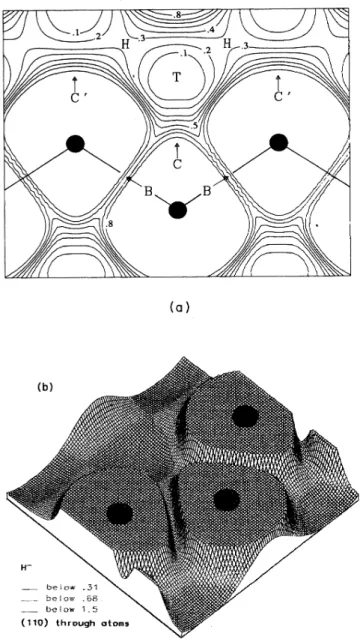
Figure 3shows the energy surface in the (110)plane for a positively charged H (H ). The global minimum is at the bond center
(8)
site, symmetrically located between two Si atoms. In contrast, the energyof H+
in the low-density region is more than0.
5 eV higher (the bond center is 1.2 eV lower in energy than theT
site).Of
course, the state
H+
in the low-density region actually does not occur, because the H-related level which must be kept empty lies inside the valence bands. Note that the positive charge state does not imply that H occurs as a bare proton, at the bond center, the missing charge is actually taken from the region near the Si atoms, corre-sponding to the state occurring in the band gap. In a simplified pictureof
combinationof
orbitals on the H andI
C
B~ ~B
FIG.
3. (a)Contour plot and (b)perspective plot oftheener-gy surface for H+ in a (110)plane through the Si atoms. The zero of energy is arbitrarily chosen at T. The black dots represent Si atoms at their unrelaxed positions; the relaxations
(which are diQ'erent fordi6'erent H positions) are not shown but are taken into account in the total-energy calculations. In (a)
the contour interval is0.1eV. The color coding ofthe perspec-tive plot in (b) isindicated inthe figure: the energy values below
—
1.02 eV are shown in red; between—
1.02and—
0.58 eV inblue; and between
—
0.58and 0.3eVingreen. The surface iscut off atan energy value of 0.3eV.FIG.
4. (a)Contour plot and (b)perspective plot ofthe39 THEORY OFHYDROGEN DIFFUSION AND REACTIONS
IN.
..
10 799 the neighboring Si atoms, this state can be considered tobe formed out
of
an antibonding combinationof
Si orbit-als; viewed as a stateof
the defect complex, it iserat'ectively nonbonding in character, since it has a node through the H atom.
For
H at the bond center, our useof
the notationH+
therefore implies that the actual de-fect is a complex formed by the H and the surrounding Si,the electron being removed from an antibonding com-binationof
Si orbitals rather than from the H itself.A migration path in the (110)plane can be traced be-tween the bond-center positions; the barrier along this path is
-0.
2 eV high. This path can clearly be seen as the red region winding its way around the Si atoms in—.
4FIG.
6. Perspective plot ofthe energy surface for H+ in a (110)plane through the Si atoms. To generate the values for this plot (unlike all others) the Si atoms were kept fixed in their rigid lattice positions. Comparing with Fig. 3,we see that thelow-energy regions have disappeared.
FIG.
5. (a)Contour plot and (b)perspective plot oftheener-gy surface for H in a (110)plane through the Siatoms. See caption ofFig.3.
Fig.
3(b). The saddle point occurs very closeto
the point indicated withC
in the contour plot; the pointsC'
are symmetry-related points along equivalent paths perpen-dicular to the planeof
the figure. At the saddle point in the (110)plane, H islocated1.
25A away from theT
site. The Si atom below it, on the line throughT
and the sad-dle point, relaxes down by0.
16 A to make the Si-H dis-tance equal to1.
63 A. Since we cannot show the energy surface as a functionof
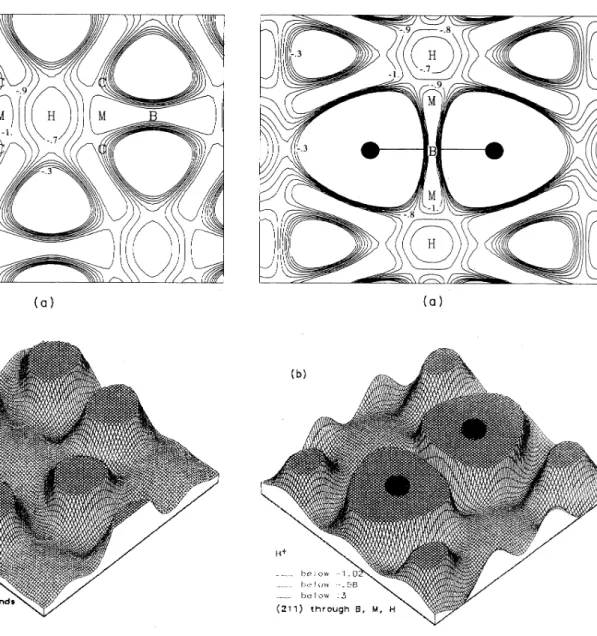
all three dimensions, the (110) plane and the indicated migration path should only be considered as a representative example. We have also studied the behavior in various other planes. Figure 7 shows the energy surface in a (110)plane parallel to the plane inFig.
3 and lying halfway between equivalent planes through the atoms. In particular, we are interest-ed in the behavior around theM
site, which is midway between two C sites [only oneof
which lies in the (110) plane]. Corbett etal.
proposed this site as the minimum-energy location for neutral H in Si. In our en-ergy surfaces forH+,
we find it to be at approximately the same energy as the bond centerB,
with no barrier be-tween the two. Migration along a path involving theM
sites still involves a barrier
of
-0.
2 eV. As can be seen in Fig. 7,theM
point also lies on a line perpendicular to the Si—
Si bond, connecting the bond center with the neighboring hexagonal interstitial site; all points betweenB
andM
on this line have approximately the same ener-gy.For
these"buckled"
configurations, the Si-H dis-tance remains almost constant (equalto 1.
6 A), due to ap-propriate relaxationof
the Siatoms. In all cases, the H prefers to be symmetrically located with respect to two Si atoms.ener-10 800 VAN de WALLE, DENTENEER, BAR-YAM, AND PANTELIDES 39
gy surface rises steeply along the bond direction
([111]).
For
H at the bond center itself, in the positive charge state, the neighboring Si atoms move out over0.
41 A, to make the Si-H distance equal to 1.59A. This distance is slightly larger than the Si—
H bond length in molecules such as SiH4, where it is1.
48 A. This is understandable since H at the bond center is bonded to two Si atoms, forming a three-center0 bond. The second neighbors move by0.
07 A; the distance between first and second neigh-bors is equal to 2.31A.These motions
of
the Si atoms are quite large, and must involve a significant energy cost. To estimate thisraise in energy due to strain, we have performed a calcu-lation
of
the Si atoms in the positions described above, but in the absenceof
the H impurity. The total energy is 1.55 eV higher than for the lattice in equilibrium. This means that the energy gained due to bonding between H and Si must be greater than 1.55 eV, in order for the bond-center configuration to be stable. This"cost of
re-laxation" can also be interpreted in the following fashion:If
a situation could be created in which outward motionof
the Si atoms would levy no energy cost, the bond-center configuration forH+
would bemore stable by1.
55 eV, compared to the situation in crystalline Si. Thisob-(a)
FIG.
7. (a)Contour plot and (b)perspective plot oftheener-gy surface forH+ in a(110)plane through the sites B,C, H,and
M. This plane isparallel to the plane ofFig.3,and midway
be-tween equivalent planes through the atoms. The M point is lo-cated midway between a bond center and the nearest hexagonal interstitial site. The zero ofenergy is arbitrarily chosen at T (not in the plot). See caption ofFig. 3.
FIG.
8. (a)Contour plot and (b)perspective plot oftheener-gy surface for H+ in a (211)plane through the Si atoms,
con-taining the sites B,H, and M. The Mpoint is located midway
39 THEORY OFHYDROGEN DIFFUSION AND REACTIONS
IN.
..
10801 servation might be relevant for amorphous Si, in whichbond distortions are readily allowed.
B.
Neutral charge stateFor
neutral H the same features and relative positionsof
extrema can be recognized as in the caseof H+,
in-cluding a global minimum at the bond center.For
H at the bond center the neighboring Si atoms move out over0.
45 A, to make the Si-H distance equal to 1.63 A,i.e.
, slightly larger than in the positive charge state. The second-neighbor relaxation isthe same as for the positive charge state. The energy cost due to Si motion, as de-scribed at the endof Sec.
III
A, is1.
73 eVfor the caseof
the relaxations appropriate for neutral
H.
As in the caseof
H+,
we have examined carefully whether there is any tendency for H to preferentially bind to oneof
the Si neighbors, leading to an asymmetric configuration, as suggested by DeLeo etal.
In contrast toRef.
46, we find that the symmetric situation is lowest in energy. The saddle pointof
the migration path in the (110)plane is again located on the line betweenC
and T,but closer toT
than in the caseof
H+:
H is0.
60 A away fromT
now. Relaxationof
the Si atoms is negligible for H at this site. The energy is less than0.
2 eV higher than at the bond center. Figure 9(a) shows the charge density in a(110)
plane for neutral H at the bond center. A concentration
of
charge around the impurity is immediately obvious. Mostof
this charge in the bond region is related to H-induced levels buried in the valence band.It
is interest-ing to also examine the spin density which results from a spin-polarized calculation, as described in Sec.II
E.
Fig-ure 9(b) shows the difference between the spin-up and spin-down densities. This figure is remarkably similar to one that would result from plotting the charge density as-sociated with the H-induced defect level in the band gap (this being the level that is occupied with one, e.g., spin-up, electron in the neutral charge state).It
is clear that this density corresponds to an antibonding combinationof
Si orbitals, with mainly p-type character. Notice that virtually no spin density is to be found at the bond center itself. These observations can be relevant for interpreta-tionof
muon-spin-resonance experiments. 'The charge density for neutral H at the
T
site is shown in Fig. 10(a). Note that theT
site is not a stable site for H in Si,but itis educational to inspect Fig. 10and com-pare it withFig.
9.
The difference between spin-up and spin-down densities is displayed in Fig. 10(b). Once again, it corresponds closely to the density associated with the H-induced defect level, which is now below the topof
the valence band. This density is now clearly asso-ciated with an s-like state centered on the impurity.Turning back to the energy surface for
H,
we note that the path through the regionof
high electron density is favored (as forH+),
but the low-density path is only0.
2eV higher. Thus, neutral H seems to be able to move rather freely through the network with very small energy barriers. We note that theT
site is a local maximumof
the energy surface for H
.
Moving fromT
towards a sub-stitutional site, the energy first decreases and thenin-creases in the
[111]
direction. However, the lowest ener-gy in this antibonding direction (less than O.l eV lower than atT)
does not correspond to a local minimum, but toa saddle point,i.e.
, the energy can be lowered by mov-ing the H off the[111]
direction. The same conclusion holds for the hexagonal interstitial(H)
site, which lies inFIG.
9. (a) Contour'plot ofthe charge density in the (110)plane through the atoms for neutral H at the bond center. The Siatoms in their relaxed positions are indicated with black dots
and connected with solid lines. Dashed lines connect the unre-laxed atomic positions. The contour interval is 50; units are electrons per unit cell (for a supercell containing one H and 32 Si atoms). (b) Contour plot ofthe difference between spin-up
and spin-down densities inthe (110)plane through the atoms for neutral H at the bond center. The contour interval is 2.5
10 802 VAN de %ALLE,DENTENEER, BAR-YAM, AND PANTELIDES 39 the
[111]
direction halfway between twoT
sites. The8
site isa local minimum along the
[111]
direction, but only a saddle point when considered in three dimensions. Similar conclusions regarding antibonding and hexagonal sites hold for the positive charge state, where the energy differences are more pronounced.It
is interesting to note(a)
that the instability
of
the antibonding site also occurs for H around a boron acceptor in Si, eliminating this site as a candidate for the structureof 8-H
complexes that re-sult from passivation (see further).C. Negative charge state
The negative charge state distinctly differs from
H+
and H in that it is now the low-electron-density regionsof
the crystal which provide the most stable sites for the impurity. This can be understood by realizing that the energy costof
placing a second electron in the level in the gap (which was the trademarkof
the high-density sites) becomes too high, and it is more favorable tomove the H to locations where the induced defect level occurs at lower energies. TheT
site is now the lowest in energy, with the energy rising sharply outside the low-density re-gions. In particular, the8
site is now more than0.
5 eV higher in energy than theT
site. The barrier for migra-tion along a path through the low-density region andgo-ig.g through the hexagonal interstitial site is
0.
25eV. The negative charge state is thus the only one for which theT
site is a stable site (local and global minimum in the energy surface). The charge density as-sociated with this state is quite similar to that depicted in Fig. 10. This isthe position for which the analysisof
Al-tarelli and Hsu applies, showing why the H level is ex-pected tobe deep and not effective-mass-like.D. Relative stability ofdifferent charge states
(b)
FIG.
10. (a)Contour plot ofthe charge density in the (110)plane through the atoms for neutral H at T. The Si atoms are indicated with black dots; no relaxation occurs. The contour
in-terval is 50;units are electrons per unit cell (for a supercell
con-taining one H and 32 Si atoms). (b) Contour plot of the difference between spin-up and spin-down densities in the (110)
plane through the atoms for neutral H at T. The contour
inter-val is 10 electrons/(unit cell).
We now examine the relative energies
of
the different charge states, in order to determine the lowest-energy state.To
alter the charge state, electrons must be taken from or removed to a reservoir; the Fermi level deter-mines the energyof
electrons in this reservoir. The rela-tive energies therefore depend on the positionof
the Fer-mi level. Figure 11 shows the relative formation energies for different charge states, as a functionof
Fermi-level position.To
simplify the plot, we only show the forma-tion energies for the impurity positions which correspond to the global minimum for a particular charge state,i.
e.,B
for H+ andH,
andT
for H.
Figure 11(a)shows the values directly obtained from theLDA
calculations. As pointed out above, these suffer from an uncertainty in the positionof
the defect level. Rigorous calculational schemes which could eliminate these uncertainties by go-ing beyond theLDA
are presently prohibitively complex and too computationally demanding to apply to defect calculations. We have therefore applied a very simple a posteriori correction, amounting to a rigid shiftof
the de-fect level together with the conduction bands, to bring the band gap into agreement with experiment. The result]0
8O3pv he H atom is Si atoms) v
th Since the P .
at,
on to ards the.
bond lengt
od aPProxin a
1
j e uiljbrlum o
s
jt
is a gpohe time scae h h
S"'
'
o''"''
1 ~
lighter t
Si atoms d
.
f
the host
c
yhant
enot m
cr
sta e that the laxatlon
0
m ositlon.
ssu.me
tpn R-e
h qujljbnu
of
thefi d tp
vibra l '
pf t e e
lations the calcu herefore k P
es obtaine e
t
fixe. d from
w»c
abola, fromt
r differenctted to aP r o
This Pro-The energy
'
ns are fit
termined
'
0
ositlo
n be e
—' for dj fferent P
e uency
ca
d ~945cm
brational
f
—~
fpr H a —
I Fxperlm
ure le~ds
evalues is
—
ving a sing ce u
b ron these v
des invo v
The e
5o5]
f
r stretchg r crysta 1' 'tly rror ar in mo lline tal value '
enated amprp
&
It
has often' le es ' r hpu imp between
h
t
such stre'
&a dangljng been as
ch as fPr H y
howeve~ H bonds ( +
esn&ts show
i)ar freq&e Si
—
h resent resu
ise to slml vacancy
stalline Slg
T
ep
.
i
ivesr
H in crys centered
cies. 39
a error bars in' our p
g o
T
terial is a ir
s
an-LD
ation o
p-t
ep
1 ban
.
m ensation. tween
ddressed in a m this pairing w'
a'
dictHto
result from ' w
lations predic
'
ation.
ur calcu a
Si
se-g.ble state forany
LDA
'
t
i theesthe error a
d ) k
1 ccurrence o
our simp
large tounambigu
AND REACTION
F
HYDRO GENDIFF
USIOf
(~0;20 THEORY0
cutoff
E.
Vib ational freqra ' e uenciessmode for en stretching m r n '
f
the hydrogenncies o
ite are
ca
c
MI-H at the bon -c
H+ andH
aF
DascussxonCD LJ O ~
~
E C)).0—
0.
5—
0.
0—
—0.
5—
—1.
0—
(o)0.
00.
2I I
0.
60.
8e ' I eV)
Fermi Leve
1.
01.
2L CD
LsJ
1.
0 ——
)
0.
5 — (o)0.
0—
0.
5O
E
C)
—
1.
0—
—
1.
5—
—2.
00.
0
(b)
0.
60.
8e I eV)
Fermi Leve
1.
01.
2h s the straight formation
fro
(
re isno scheme to 1 b bitrarily c h
f
qualitative indicaation has been
1 inform
erimenta
rvations o
d ob
A large amou
I
ulltles'h
h lloaccu
b P 1'd
0
tions, as poin
e escrip i i e
hich direc y oherent in e
iments w ' a so results
f
rom expion
of
dress the problem o the Sicrysta1.
urities
a o shal/ow smp
Passiuation o s
of
the passivivation1 result h
I
t
is knowniobserve p o
bllcatlo
e states
reviously
h
db
enmadep
t,
ble data i rlevel in an
to accoun
p only way
aterial was
on has now bbeen ma
e (where
t
thee Fermi 'll 1 h 'h level is
h 1 th
and wi
fhd
tro
ca
aation.
assivation o
direc p
r comp
nln recent exp
3'
o nd Herring.
oulombic
10 804 VAN de WALLE, DENTENEER, BAR-YAM, AND PANTELIDES 39 tion to negatively charged acceptor impurities will
readi-ly lead to the formation
of
acceptor-hydrogen pairs:H++B
~(HB)
(where boron has been chosen as a typ-ical acceptor). The pair formation is therefore a conse quenceof
passivation inp-type material.The term compensation is often presumed to imply that the stable state
of
the system is such that the atoms which act as donors are spatially separated from the ac-ceptors which they compensate. This occurs, for in-stance, in the caseof
compensation by counterdoping,e.
g., adding phosphorus to boron-doped Si. The term compensation, however, in general applies to any situa-tion in which electrons from donor atoms annihilate free holes, and as such correctly describes the hydrogenationof
p-type material ~ Becauseof
the high mobilityof
the Hspecies, the final experimentally observed situation will usually be such that H is paired with acceptors; pairing is only absent during the initial (transient) phase
of
hydro-genation, or at a temperature su%ciently high to dissoci-ate H-acceptor pairs. Under those conditions, compensa-tion is the accurate description for the stateof
the sys-tem. Our major goal in stressing the compensation as-pect is to make clear that pairing is not essential for pas-sivation, and that, indeed, the reactionof
pair formation can only be correctly understoodif
compensation is con-sidered to be the initial step.It
should be clear that cal-culations in which only the structureof
the resulting H-acceptor pairs is addressed cannot have any bearing on the issueof
compensation as the initial step in the pas-sivation mechanism. The statements by Chang and Chadi, claiming that compensation is not involved in the passivation, are therefore unfounded, since they are inferred solely from an analysisof
the already formedH-B
pair.The sequence
of
events in which pair formation follows compensation is essential for understanding a wide varietyof
experimental results, which will be summarized below.(1) Since the diffusing species inp-type material is posi-tively charged, electric fields are expected to significantly influence the diffusion properties. The observed electric field dependence '
of
hydrogen neutralizationof
shallowacceptors follows immediately, without having to invoke participation
of
free holes in the reaction.(2) When the p-type (B-doped) material is counter-doped, making it effectively n type, H diffusion is retard-ed and H-acceptor pairing is suppressed; the final H con-centration is 2 orders
of
magnitude smaller than in p type. Our theory shows indeed thatif
the Fermi level is raised theH+
concentration will decrease. Neutral or negative H will not react withB
the wayH+
does, and the final concentrationof
(BH) pairs will be significantly lower. A thin n-type overlayer was also observed to block the penetrationof
hydrogen. ' Once again, noH+
can be formed in this layer.
If
H is formed, it is kept outof
the p-type substrate by the electric field in the de-pletion region.If
H would be formed, it would not as readily pair up withB
asH+
does.(3) Reverse bias
of
the junction formed by an n +-typeoverlayer on ap-type substrate during hydrogenation re-sults in a suppression
of
neutralization in thespace-charge layer. The actual experiments were carried out with deuterium, an isotope
of
hydrogen which is more readily detectable with secondary-ion mass spec-trometry. The concentrationof
deuterium in the space-charge layer can greatly exceed the boron concentration, without neutralization occurring. These observations are consistent with molecule formation in that region, and a suppressionof
(BH) pairing due to the absenceof
H+.
Similar results from experiments by Tavendale were ex-plained as due to field drift
of
a positively charged species under an electric field. The fact that this positively charged species isH+
(and not free holes) has recently. been unambiguously established by Johnson and Her-ring, ' who carefully analyzed the variationwith depth
of
the H concentration in p-n junctions. Their results show that H must have a deep donor level, not far from mid gap.(4)Recent experiments by Johnson and Herring have also provided direct support for the compensation mech-anism. By carrying out electrical measurements in real time during hydrogenation they were able to directly study the migrating species, rather than having to infer its properties from formation kinetics
of
various H-related complexes. At 300 Ca temperature at which any (HB) complexes should be completely dissociated, they still observed a sharp increase in the resistance upon hy-drogenation. These observations must be due to the indiffusionof H+
and compensation.Johnson and Herring have also analyzed deuterium concentrations in uniformly doped n-type material, as well as epitaxial layers
of
varying n-type doping on a sin-gle substrate. They concluded that H can occur in a neg-ative charge state, with an acceptor level close to the donor level found in the experiments described above. While not as conclusive yet as the results for p-type ma-terials, these observations do lend support to our predic-tion that H is the stable charge state in n-type material. Further experimental work is required totest our predic-tion that H isactually a negative-U impurity.2. Location