Clinical Infectious Diseases
V I E W P O I N T S
Confronting Ebola as a Sexually Transmitted Infection
William A. Fischer II1,aand David A. Wohl2,a1
Division of Pulmonary and Critical Care Medicine, and2
Division of Infectious Diseases, The University of North Carolina at Chapel Hill
The unprecedented Ebola outbreak that devastated West Africa evolved within months from a regional outbreak to a global public health emergency. While the rate of confirmed cases declined dramatically, sporadic clusters of Ebola virus disease (EVD) continue well beyond the double incubation period of 42 days used to declare a nation Ebola-free. At the same time, evidence that the virus persists in genitalfluids and can be sexually transmitted, along with the potential for lingering virus in other body compartments to permit recrudescence of EVD, has shaken our thinking of what it takes to achieve lasting control of an Ebola epidemic. A compre-hensive response to the threat of persistence and sexual transmission of Ebola is required and should build on accessible longitudinal medical care of survivors and accurate genitalfluid testing for Ebola. Control of this and future Ebola outbreaks will depend on our ability to recognize and respond to this persistence of the virus in those who survive.
Keywords. Ebola virus disease; sexually transmitted infection; viral shedding in semen and vaginalfluid; viral compartmental-ization; emerging infectious diseases.
Few modern-era infectious diseases provoke the fear that Ebola elicits. High mortality rates of the acute illness caused by this filovirus are sufficient justification for this fear, but it is also the relative ease by which Ebola is spread from person to person that terrifies. Of the lessons learned during the recent outbreak that devastated West Africa and triggered a global public health emergency, the most ominous has been the recognition that Ebola can persist in compartments of the body well after the symptoms of acute infection abate and virus is cleared from the circulation [1,2]. Immune sanctuaries such as the cerebral spinal and ocularfluids harbor virus and these reservoirs likely serve as a source of recrudescent Ebola virus disease (EVD). However, when Ebola persists in semen it becomes, as we learned in 2015, a sexually transmitted infection [3,4].
EVIDENCE OF THE PRESENCE OF EBOLA IN GENITAL FLUIDS
Five studies conducted during previous outbreaks demonstrated that Ebola could be detected, at least by polymerase chain reaction (PCR), in the semen and vaginalfluid of EVD survivors following clearance of viremia (Table1) [5–9]. In these studies, Ebola virus was detected in 12 of 15 (80%) men and in 1 of approximately 26 (4%) women. Prior to the current outbreak, the longest that virus was detected by PCR in semen was 101 days after the onset of symptoms (80 days after clearance of viremia) and 33 days from
symptom onset (21 days after clearance of viremia) for vaginal fluid [7]. Repeat sampling to document clearance of virus from genitalfluid was not available, and thus the duration of shedding, even in these few survivors, remains unknown. Data regarding the shedding of infectious (ie, cultured) virus is even more limited. Prior to the current epidemic, the longest reported duration that virus was able to be cultured from semen was 82 days from symptom onset, with a subsequent negative culture from a speci-men obtained on day 704 [7].Based on thesefindings, survivors of Ebola were advised to practice safe sex or abstinence for 3 months after discharge from an Ebola treatment unit (ETU) [10].
A better understanding of the prevalence and potential sig-nificance of Ebola virus persistence in urogenital shedding has emerged from the current epidemic and suggests that survivors shed infectious virus for considerably longer than previously thought (Table1). Researchers from the World Health Organi-zation (WHO), US Centers for Disease Control and Prevention, and Ministry of Health in Sierra Leone found that 49% (46/93) of male survivors of EVD in that country who were within 10 months of release from an ETU had Ebola virus detected by PCR in their semen, including 100% (9/9) of samples donated 2 to 3 months after onset of illness [11]. In this cohort virus was detected in 65% (4/6) of survivors at 4 to 6 months and in 26% (11/ 43) 7 to 9 months after recovery from EVD, indicating that absti-nence or safe sex for 3 months after discharge from an ETU is not sufficient to prevent sexual transmission of Ebola virus [11].
SEXUAL TRANSMISSION OF EBOLA
Despite the detection of Ebola virus RNA by sensitive PCR assays in genitalfluids, the risk of sexual transmission was con-sidered theoretical until the current epidemic, when theory be-came reality. On March 20, 2015, a woman in Liberia was diagnosed with EVD 30 days after the last confirmed patient Received 14 January 2016; accepted 17 February 2016; published online 1 March 2016.
a
W. A. F. and D. A. W. contributed equally to this work.
Correspondence: W. A. Fischer II, Assistant Professor of Medicine, Division of Pulmonary and Critical Care Medicine, The University of North Carolina School of Medicine, 104 Mason Farm Rd, Chapel Hill, NC 27599-7310 ([email protected]).
Clinical Infectious Diseases®
2016;62(10):1272–6
in that country, and her only identified risk factor was unpro-tected sexual contact with a male survivor of Ebola, who had repeatedly undetectable Ebola in his blood by PCR 155 days before their sexual encounter [3,4]. PCR testing of the male survivor’s semen after the woman became ill was positive for Ebola virus. Virus was not able to be cultured from this specimen, but the genetic similarity between the isolate in this man’s semen and that from the blood of the infected woman suggest this was a case of sexually transmitted Ebola [3,4].
Although this is the most clearly documented case of sexual transmission of Ebola virus, it is unlikely to represent a“ one-off”occurrence and, instead, indicates that sexual transmission oc-curs but may be difficult to discern from other, more common, modes of acquisition during an outbreak. Under conditions when nonsexual contact with active cases of Ebola is driving trans-mission, acquisition of Ebola virus by sexual intercourse would be subsumed and likely unnoticed. As the outbreak wanes and there are fewer opportunities for infection from nonsexual contact, along with a peak in the number of survivors shedding virus, sex-ual transmission would be revealed—a scenario that may have played out in Liberia. Current recommendations from the WHO and the Liberian Ministry of Health advise indefinite safe sex until semen has been tested negative on 2 occasions or until at least 6 months after the onset of symptoms of EVD [12]. As testing of semen for Ebola was not available in Liberia when the case de-scribed above occurred, adherence to these recommendation would have been unlikely to prevent this infection as the man con-tinued to have evidence of Ebola in his semen 199 days after the onset of EVD [4]. Importantly, there remain no recommendations for women and no studies of vaginal shedding of Ebola virus.
PERSISTENCE OF EBOLA IN OTHER COMPARTMENTS
Accumulating data indicate that the genital tract is not the only site that permits the persistence of Ebola virus beyond the
clearance of virus from the circulation. A case of encephalitis in an Ebola survivor whose cerebral spinalfluid (CSF) with PCR-detected Ebola virus despite clearance of viremia has been described—highlighting the capacity of this virus to pen-etrate and persist in immune privileged compartments and its ability to incite recrudescent disease [2]. More recently, virus has been detected in at least 2 expatriate healthcare workers fol-lowing convalescence from acute EVD including a case of virus cultured from the vitreous of the eye greater than 3 months after clearance of viremia and a case of recrudescence of viremia with high levels of virus detected in the CSF more than 9 months fol-lowing recovery from EVD [1,13]. Both these healthcare work-ers received at least 1 immunotherapeutic intervention when first ill with EVD. It is plausible that these treatments, albeit po-tentially life-saving, blunted host immune responses that then permitted establishment of viral sanctuaries and the recrudes-cence once their effects waned or viral replication was stimulated.
THE CONSEQUENCES OF PERSISTENCE OF EBOLA VIRUS IN SURVIVORS
The persistence of Ebola in different body compartments and the potential for transmission either sexually via shedding or by sexual and other contact with those experiencing recrudes-cence threatens lasting control of the current epidemic. Histor-ically, a country was declared Ebola-free following a period of 42 days, the equivalent of two incubation periods, after the last patient cleared virus from their blood or died. In prior out-breaks, which were significantly smaller and where the high mortality rates meant fewer survivors able to sexually transmit the virus or suffer recrudescent disease remained, this worked well. However, the 42 day rule has been demonstrated in the current epidemic to beflawed.
Liberia has celebrated two“Ebola-free”declarations each of which has been followed by reemergence of EVD. More recent-ly, Sierra Leone suffered a new outbreak 69 days after being declared free of Ebola and only 7 hours after the WHO declared the end to all active chains of transmission in West Africa [14]. These sporadic outbreaks have been limited to a small number of individuals with no reported contact with an active case of Ebola. The potential routes by which these individuals were in-fected arefinite and include a zoonotic source, as is suspected to have triggered this and other outbreaks. However, the clustering of the cases in urban settings and the absence of a consistent history of exposure to bats or other animals thought to carry the virus makes this improbable. Instead, it is more likely, given the evidence of viral persistence, that transmission from a survivor shedding virus is what triggered these small outbreaks.
This persistence of virus in body compartments and the potential for sexual transmission from asymptomatic shedding or recrudescent disease means one of the world’s most feared Table 1. Persistence of Ebola Virus by Polymerase Chain Reaction and
Culture in Semen and Vaginal Fluid Among Ebola Virus Disease Survivors [5–9]
Months After Symptom Onset
Prior to the Current Epidemic
Samples Tested PCR Positive (%)
<2 8 7 (88)
2–3 11 8 (73)
4–6 4 3 (75)
7–9 NA NA
The Current Epidemic
<2 ND ND
2–3 9 9 (100)
4–6 40 26 (65)
7–9 43 11 (26)
virus remains a threat until asymptomatic shedding of infec-tious virus and the possibility of recrudescence ends. Therefore, the point at which the 42 day countdown should begin is not after the last person leaves an ETU but rather 42 days after the last survivor who is shedding infectious virus ceases to do so. At present, we do not know when that happens.
A COMPREHENSIVE APPROACH TO ADDRESSING THE PERSISTENCE OF EBOLA IN SURVIVORS IS ESSENTIAL
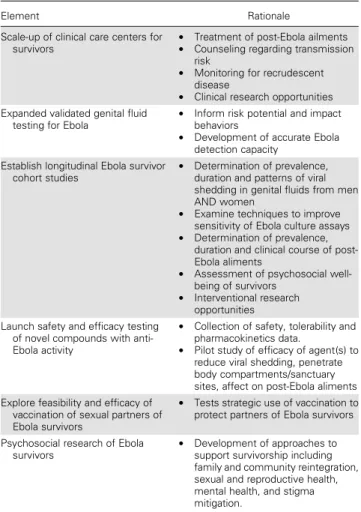
The recognition of a lingering risk of Ebola transmission from some survivors requires a comprehensive mitigation response that encompasses both individual and public health (Table2). Central to such efforts is a much better understanding of Ebola persistence. The scope of the devastation caused by the recent Ebola epidemic is unprecedented, but so too is the opportunity to gain greater insights into Ebola convalescence—including the longer term viral compartment dynamics and its role in post-Ebola illnesses, recrudescence, and transmission. Lessons learned from the intensive study of human immunodeficiency virus (HIV) in compartments, including latently infected cells
and the genital tract, have been integral to developing approach-es to viral eradication and interventions, as well as policiapproach-es, aimed at preventing transmission. This experience provides a guiding framework for future Ebola research.
A lynchpin of this research needs to be the longitudinal study of survivors to better ascertain the prevalence and duration of genital shedding and to understand the phenomenon of recru-descence. These data are necessary to develop informed policies aimed at fully extinguishing outbreaks of Ebola and to empower survivors with the ability to protect their loved ones. Ebola sur-vivor research must be accompanied by Ebola sursur-vivor care. Clinical services for survivors of this epidemic are scant and the care that does exist is delivered in settings with few resourc-es. Provision of medical care to Ebola survivors will improve their quality of life and also allow for monitoring of persistent sequelae from the acute infection and early detection of recrudescence.
An immediate priority is increasing access to validated testing of genitalfluid for men and women who survived Ebola in West Africa. At present, there is extremely limited genitalfluid Ebola PCR testing available in the region, despite public health guide-lines recommending testing prior to engaging in unprotected sex. Transitioning existing molecular Ebola diagnostic laborato-ries, established during the height of the epidemic, from acute diagnostic to longitudinal surveillance would expand testing of genitalfluids and could be leveraged to augment the diagnostic testing available for patient care in the region. Although the meaning of detection of Ebola by PCR in thesefluids remains less than certain, confirmed negative results are reassuring and meet guideline recommendations. For those with detectable virus in genitalfluids, counseling can be provided to make clear that detection of virus by PCR does not necessarily mean infectious virus is present but that extra caution should be taken given the possibility. Infectious virus has historically been confirmed with the detection of replication competent virus in cell culture [7]. On the other hand, it should be ac-knowledged that the failure to grow virus in vitro in cell culture should not be relied on as definitive evidence of noninfectious-ness. For example, the recent case of sexual transmission in Li-beria involved a male survivor whose semen had detectable Ebola virus by PCR but was culture negative [11].
Complementing expanded testing must be an in-depth re-search initiative to improve the sensitivity and specificity of in-fectious virus detection in genital fluids. This can include intracerebral inoculation in newborn mice and/or deep genome sequence to determine if the entire viral genome is present or just fragments. A comprehensive national and/or regional test-ing program would also enable a definitive characterization of the natural history of convalescent urogenital shedding, includ-ing in both semenandvaginalfluid, of infectious Ebola virus so that future public health recommendations can be based on a solid foundation of scientific evidence.
Table 2. Proposed Elements of a Comprehensive Approach to Addressing Risk of Sexual Transmission of Ebola
Element Rationale
Scale-up of clinical care centers for
survivors •
Treatment of post-Ebola ailments • Counseling regarding transmission
risk
• Monitoring for recrudescent disease
• Clinical research opportunities Expanded validated genital fluid
testing for Ebola •
Inform risk potential and impact behaviors
• Development of accurate Ebola detection capacity
Establish longitudinal Ebola survivor cohort studies •
Determination of prevalence, duration and patterns of viral shedding in genital fluids from men AND women
• Examine techniques to improve sensitivity of Ebola culture assays • Determination of prevalence,
duration and clinical course of post-Ebola aliments
• Assessment of psychosocial well-being of survivors
• Interventional research opportunities Launch safety and efficacy testing
of novel compounds with anti-Ebola activity
• Collection of safety, tolerability and pharmacokinetics data.
• Pilot study of efficacy of agent(s) to reduce viral shedding, penetrate body compartments/sanctuary sites, affect on post-Ebola aliments Explore feasibility and efficacy of
vaccination of sexual partners of Ebola survivors
• Tests strategic use of vaccination to protect partners of Ebola survivors
Psychosocial research of Ebola
survivors •
The persistence of Ebola virus in genitalfluids offers an ad-ditional opportunity to evaluate therapeutic interventions for both efficacy and ability to penetrate immune sanctuary sites. During the current epidemic, a number of novel treatment strat-egies were trialed despite limited or no human safety or efficacy data. In addition to collecting safety and tolerability data on potential Ebola therapeutic agents now, the evaluation of such novel compounds in survivors who continue to shed virus or have certain Post-Ebola sequelae could provide important information on the ability of these compounds to reduce or eliminate virus replication and their ability to penetrate immune privileged sites. Vaccination of sexual contacts of survivors is yet another public health strategy that should be evaluated to limit sexual transmission. In contrast to the challenge of conducting clinical research while caring for acutely infected patients with significant clinical needs during an outbreak of Ebola, these studies would be conducted beforehand in a controlled environ-ment that is safer for both provider and participant.
As the recent case of recrudescent EVD in a convalescing healthcare worker demonstrates, there is also a potential that persistence of virus can serve as smoldering embers from which the fires of systemic dissemination can emerge. The lack of clinical care for survivors in a healthcare landscape that has been decimated by the Ebola outbreak means there are too few opportunities to conduct surveillance for recrudes-cent disease. The persistence of virus in the CSF, eye, and genital tract also poses a risk to healthcare providers performing pro-cedural interventions including ocular surgery, lumbar punc-tures, or urogenital evaluations.
Importantly, beyond the personal and public health implica-tions of persistence of Ebola virus in body compartments, the uncertainty surrounding the shedding of virus in genitalfluid of survivors complicates survivor recovery. Stigma and social ostracizing can disrupt quality of life and create barriers to almost all aspects of normal community re-engagement [15]. There are few studies of the psychosocial vestiges of the recent Ebola outbreak but what data are available make clear that Ebola survivors have suffered considerable trauma, and it is probably that fear that these survivors remain infectious that feeds perceived and enacted stigma that impedes their ability to regain pre-Ebola normalcy. Additional research is needed to characterize the psychosocial aspects of survivorship and to develop interventions that will assist survivors as they and their families and communities adjust to a post-Ebola existence that includes considerable uncertainty regarding the personal and public health ramifications of this disease. Again, much can be borrowed from the HIV prevention experience to test evi-dence-based approaches to developing safer sex behaviors for Ebola survivors.
Care must be taken with all these initiatives to ensure preser-vation of dignity, respect, and support for survivors who have suffered greatly. Ignoring these thousands of survivors risks
not only their own physical and mental health but also missing the beginnings of the next outbreak.
BUILDING A ROBUST HEALTHCARE
INFRASTRUCTURE IN WEST AFRICA IS THE NEXT PHASE OF THE GLOBAL EBOLA RESPONSE
Poverty and the absence of a robust healthcare infrastructure contributed to a susceptible state in which an outbreak quickly evolved into a global epidemic. Investment in the creation of a new healthcare infrastructure is not only requisite for the care of survivors and monitoring for ongoing viral shedding but is critical to raise the standard of health among all people in West Africa. We must not forget that many died from treatable illness other than Ebola during this Ebola epidemic. Rebuilding what was present before this epidemic only returns us to that initial susceptible state. A new healthcare system would incorporate epidemiologic training to track diseases and monitor health out-comes, infection control education to limit the spread of diseases especially among medical staff, expand diagnostic testing as many hospitals lack the ability to measure even basic chemistries, and increase access to primary care as a way to prevent illness. Addi-tionally, improved access to clean water would have profound im-plications on health and infection control. A robust healthcare infrastructure would have played a tremendous role in limiting the current Ebola epidemic, but more importantly, it will have an even greater impact on almost every other more common disease in West Africa.
CONCLUSIONS
Notes
Acknowledgments. The authors thank Myron Cohen, MD for his guidance.
Disclaimer. The funders had no role in the design and conduct of the study; collection, management, analysis and interpretation of the data; and preparation, review, or approval of the manuscript.
Financial support. The work was supported by funds from National Institutes of Allergy and Infectious Diseases [grants R03AG045088 and K23AI121516 (W. A. F.)], Infectious Disease Society of America Young Investigator Award in Geriatrics, and a National Institutes of Health grant [grant K24 DA037101 (D. A. W.)].
Potential conflict of interest. Both authors: No reported conflicts. Both authors have submitted the ICMJE Form for Disclosure of Potential
Con-flicts of Interest. Conflicts that the editors consider relevant to the content of the manuscript have been disclosed.
References
1. Varkey JB, Shantha JG, Crozier I, et al. Persistence of Ebola virus in ocularfluid during convalescence. N Engl J Med2015; 372:2423–7.
2. Howlett P, Brown C, Helderman T, et al. Ebola virus disease complicated by late-onset encephalitis and polyarthritis, Sierra Leone [letter]. Emerg Infect Dis2016; 22:150–2. 3. Christie A, Davies-Wayne GJ, Cordier-Lasalle T, et al. Possible sexual transmission of Ebola virus - Liberia, 2015. MMWR Morb Mortal Wkly Rep2015; 64:479–81. 4. Mate SE, Kugelman JR, Nyenswah TG, et al. Molecular evidence of sexual
trans-mission of Ebola virus. N Engl J Med2015; 373:2448–54.
5. Emond RT, Evans B, Bowen ET, Lloyd G. A case of Ebola virus infection. Br Med J
1977; 2:541–4.
6. Richards GA, Murphy S, Jobson R, et al. Unexpected Ebola virus in a tertiary setting: clinical and epidemiologic aspects. Crit Care Med2000; 28:240–4. 7. Rodriguez LL, De Roo A, Guimard Y, et al. Persistence and genetic stability of
Ebola virus during the outbreak in Kikwit, Democratic Republic of the Congo, 1995. J Infect Dis1999; 179(suppl 1):S170–6.
8. Rowe AK, Bertolli J, Khan AS, et al. Clinical, virologic, and immunologic follow-up of convalescent Ebola hemorrhagic fever patients and their household contacts, Kikwit, Democratic Republic of the Congo. Commission de Lutte contre les Epidemies a Kikwit. J Infect Dis1999; 179(suppl 1):S28–35.
9. Bausch DG, Towner JS, Dowell SF, et al. Assessment of the risk of Ebola virus transmission from bodilyfluids and fomites. J Infect Dis2007; 196(suppl 2): S142–7.
10. CDC. Q&As on Transmission. 2015. Available at:http://www.cdc.gov/vhf/ebola/ transmission/qas.html. Accessed 8 February 2015.
11. Deen GF, Knust B, Broutet N, et al. Ebola RNA persistence in semen of Ebola virus disease survivors: preliminary report. N Engl J Med 2015; doi:10.1056/ NEJMoa1511410.
12. World Health Organization. Interim advice on the sexual transmission of Ebola virus disease. 2015. Available at:http://www.who.int/reproductivehealth/topics/ rtis/ebola-virus-semen/en/. Accessed 21 November 2015.
13. BBC. Ebola nurse Pauline Cafferkey“in serious condition”. 2015. Available at: http://www.bbc.com/news/uk-scotland-34483584. Accessed 21 November 2015. 14. Organization WH. Latest Ebola outbreak over in Liberia; West Africa is at zero, but
new flare-ups are likely to occur. 2016. Available at:http://www.who.int/ mediacentre/news/releases/2016/ebola-zero-liberia/en/. Accessed 7 February 2016.
![Table 1. Persistence of Ebola Virus by Polymerase Chain Reaction and Culture in Semen and Vaginal Fluid Among Ebola Virus Disease Survivors [5 – 9]](https://thumb-us.123doks.com/thumbv2/123dok_us/8314024.2202410/2.890.73.433.113.320/table-persistence-polymerase-reaction-culture-vaginal-disease-survivors.webp)