UNDERSTANDING THE ENTANGLEMENTS BETWEEN WEALTH STATUS AND EQUITABLE FOREST BASED LIVELIHOOD OUTCOMES UNDER DIFFERENT DECENTRALIZED CONTEXTS IN TANZANIA; DOES
COMMUNITY BASED FOREST MANAGEMENT HAVE AN EQUALIZING EFFECT?
Hillary Suzanne Smith
A thesis submitted to the faculty at the University of North Carolina at Chapel Hill in partial fulfillment of requirements for the degree of master of art in the department of geography in the
college of arts and sciences
Chapel Hill 2015
Approved by: Lauren Persha Xiaodong Chen
ii © 2015
iii ABSTRACT
Hillary Smith: Understanding the entanglements between wealth status and equitable forest based livelihood outcomes under different decentralized contexts in Tanzania; Does community based forest
management have an equalizing effect? (Under the direction of Dr. Lauren Persha)
iv
v
vi
ACKNOWLEDGEMENTS
vii
TABLE OF CONTENTS
LIST OF TABLES………...x
LIST OF FIGURES………...xi
LIST OF ABBREVIATIONS………xii
CHAPTER 1: LINKS BETWEEN POVERTY AND FOREST SECTOR DECENTRALIZATION IN CONTEXT………1
Introduction………..1
History of Managing Forests as Common Pool Resources………4
Decentralization in Tanzania……….8
Research Questions……….9
CHAPTER 2: THEORY AND EXISTING LITERATURE……….….11
Theoretical Frameworks……….…..11
Existing Literature………..18
CHAPTER 3: Study Area……….24
CHAPTER 4: DATA……….27
Study Design……….……….27
Data……….29
Independent Variables.……….….29
Dependent Variables………30
Control Variables……….32
viii
CHAPTER 5: METHODS………..35
Section 5.1………..………35
Ordinary Least Squares Regression………35
Ordinary Least Squares Regression Models and Hypothesis….……….……….……36
Ordinary Least Squares Regression Dependent Variable.………..……37
Ordinary Least Squares Regression Independent Variable ………..………..…….……37
Ordinary Least Squares Regression Moderator.……….……….……….38
Ordinary Least Squares Regression Controls ……….……….……38
Section 5.2………..………39
Logistic Regression………..………39
Logistic Regression Models and Hypothesis….……….……….……….40
Logistic Regression Dependent Variable.………41
Logistic Regression Independent Variable ………..………..…….……42
Logistic Regression Controls ……….……….……42
Section 5.3………..………43
Qualitative Analysis……….………...……….…43
CHAPTER 6: Results……….44
Section 6.1……….44
Forest Livelihood Outcomes; Relationships between Wealth Status and Decentralized Management on Household Harvest of Fuelwood and Charcoal…………...44
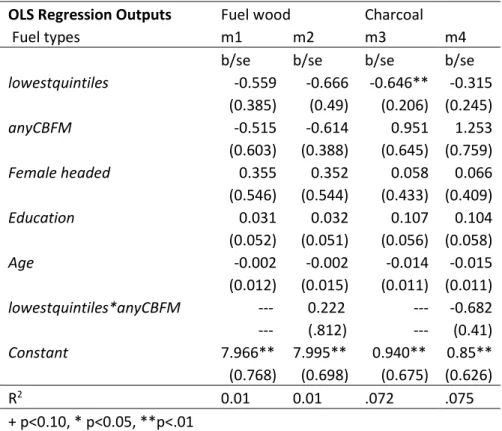
Forest Livelihood Outcomes; Exploring Determinants of Households’ Fuelwood and Charcoal Harvest with Ordinary Least Squares Regression……….………..….48
Section 6.2………..50
ix
Section 6.3………..57
Forest Livelihood Outcomes; Exploring Determinants of Household Access to a Variety of Forest Products with Logistic Regression..………….…….………..57
Section 6.4………..60
Forest Governance Outcomes; Perceptions of Management Functioning and Benefits……….60
CHAPTER 7: Discussion……….……….72
Chapter 8: Conclusion………..….76
APPENDIX 1………79
x
LIST OF TABLES TABLE
1. Rights Framework……….…14
2. Regimes and Rights in Tanzania………..…15
3. Study Sample………...28
4. Descriptive Statistics Summary of Variables.………..……….….31
5. OLS Models 1-4……….……….37
6. Logistic Regression Variety of Forest Products Harvested……….……….….40
7. Logistic Regression Models of Participation in Forest Rule Creation, Monitoring and Harvest……….………41
8. OLS Fuel Type Outputs……….….49
9. Logistic Regression Results on Harvesting >1 Forest Product……….…54
10. Average Marginal Effect of CBFM on Harvesting Greater than 1 Forest Product at Different Levels of Income………..55
11. Logit Results Participation in Monitoring……….……….58
12. Logit Results Participation in Harvesting……….……….……….59
xi
LIST OF FIGURES
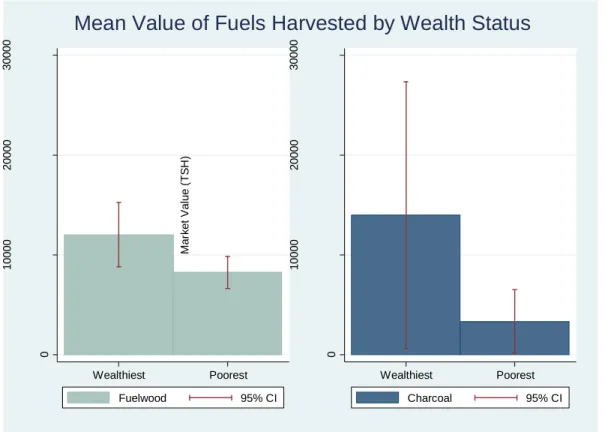
Figure 1 - Fuel Types and Wealth Status……….……….45
Figure 2 - Fuel Types Harvested by Management Regime………..46
Figure 3 - Fuel Types, Household Wealth Status and Presence of CBFM……….…….48
Figure 4 - Variety of Forest Products Gathered by Income Quartiles and CBFM……….………...51
Figure 5 - Proportion of Households Gathering >1 Forest Products by Logged Income Quartiles and CBFM………..53
Figure 6 - Average Marginal Effect of CBFM……….….56
Figure 7 - Predicted Margins Probability of Harvesting……….…57
Figure 8 - Forest Management Outcomes by Regime……….………63/64 Figure 9 - Perceptions of State Forest Management Benefits………66
Figure 10 - Perceptions of Forest Management Benefits JFM………….……….66
Figure 11 - Perceptions of Forest Management Benefits CBFM……….……….67
Figure 12 - State Forest Benefits………...69
Figure 13 - JFM Forest Benefits…….……….………...70
xii
LIST OF ABBREVIATIONS
AME Average Marginal Effect ANOVA Analysis of Variance
CBFM Community Based Forest Management
CBNRM Community Based Natural Resource Management CIFOR Center for International Forestry Research
CPR Common Pool Resource ES Environmental service
IE Impact Evaluation
IFRI International Forestry and Institutions Research JFM Joint Forest Management
JMA Joint management agreement NGO Non-governmental organization NTFP Non-timber forest product OLS Ordinary Least Squares PEN Poverty Environment Network PFM Participatory Forest Management TANAPA Tanzania National Parks
TSH Tanzania Shilling
1
CHAPTER 1: LINKS BETWEEN POVERTY AND FOREST SECTOR DECENTRALIZATION IN CONTEXT Introduction
The spatial overlap between severe poverty and remaining forest cover globally points to critical entanglements between linked human and natural systems which require further exploration (Sunderlin et al. 2008). Globally, forests play a critical role supporting human wellbeing indirectly through their myriad ecosystem services. However for millions of people forests are directly relied upon as a vital component of subsistence life (Sunderlin et al. 2005, Vedeld et al. 2007). Direct reliance on forests is mostly confined to poorer, rural areas within developing countries and is often less visible to those outside these spaces (Sunderlin et al. 2008). Therefore the diversity of resources and true significance of forests to rural livelihoods have often remained obscured as a “hidden harvest” overlooked or
misunderstood among scientific and development communities (Angelsen 2003, Cavendish 2000, Campbell and Luckert 2002, Campbell 2002).
2
a safety net in times of shortfall, as support for current consumption, and as a means of capital accumulation to achieve a path out of poverty (Cavendish 2003, Angelsen 2003). These functions are believed to be particularly important for the severely poor (Sunderlin et al. 2005).
Theoretical advances and the growing body of literature linking poverty, forests and livelihoods have drawn attention to forests’ potential to alleviate rural poverty (Sunderlin et al. 2005, Vedeld et al. 2007). However, others are less certain that forests are affecting global poverty in any meaningful way (Sunderlin et al. 2005). While some are critical that forests as a “path out of poverty” is simply too optimistic (Sunderlin et al. 2005), others point out that the common modes of forest management have long prevented adequate forest access (Angelsen 2003, Vedeld 2004). In order to obtain forest benefits and affect a household’s relative poverty forest resources must first be accessible. A broad set of social factors differentiate the relationships between individuals and their relative access to resources (Ribot and Peluso 2003). Forest access depends on multiple formal and informal processes including both de jure property rights and de facto institutional processes that shape them (Ostrom 1990). These processes can overlap unevenly creating disparities in households’ relative power to derive forest benefits despite the same legal claim to resources (Ribot and Peluso 2003). Attention has been drawn in the last two decades to how institutions of governance can shape human-environment relationships and mediate access to natural resources particularly among poor, resource-dependent people. A better understanding of how these processes regulate household access to forests is especially important given recent global changes in forest conservation policy.
3
hierarchy (Agrawal and Ribot 1999). In the context of the rapid shift towards forest sector
decentralization management rights are typically devolved from centralized forest departments to village government bodies. By transferring management rights and responsibilities to communities decentralization is posited to jointly improve the equity and efficiency of forest conservation, governance and local livelihoods (Ribot 2004). These improvements are anticipated from the
“democratic dividend” effect whereby greater efficiency and equity emerge as positive externalities by the presence of more democratic processes of governance (Ribot 2002). Local institutions of
government are believed to be more responsive and accountable to their constituents enabling greater transparency, information, and popular participation around the processes and therefore thought to be both more responsive and representative of local needs than a centralized body (Ribot 2002).
4
this research aims to unpack the processes by which households gain access to forest benefits and whether “pro poor” decentralized management regimes enable more equitable outcomes in practice. History of Managing Forests as Common Pool Resources
Forests’ potential to contribute to rural livelihoods and poverty reduction has been restricted by the global ascendency of western forest conservation ideology (Hurst 2003, Neumann 1997, Weddell 2002, Kalamandeen and Gillson 2007). Scientific forestry developed in European schools educated a cadre of foresters trained to manage forests for timber production while conserving others to secure sufficient ecosystem services (Hurst 2003). Forested landscapes were separated under this approach into exploitable stands for timber production and reserves chosen for preservation; both designed to accrue particular benefits for the state with disproportionate costs borne by forest adjacent
communities (Schwartzman, Moreira and Nepstad 2000, Hurst 2003). This focus on designating large swaths of pristine forest as strict protected areas is commonly referred to as fortress conservation (Schwartzman et al. 2000). This exclusionary agenda hinged on the belief that human presence and the persistence of biodiverse forests were inherently at odds (Redford 1992, Redford and Stearman 1993, Brandon, Redford and Sanderson 1998). These practices were motivated by simplistic assumptions that human access caused unchecked resource degradation driven by the livelihood practices and inevitable resource overuse by the rural poor (Reardon and Vosti 1995). These assumptions continued to permeate both conservation policy and academic writing for much of the 20th century with a focus on prescriptive tenure solutions particularly in the case of common pool resources.
5
to internalize costs and benefits associated with making long term investments in management and future resource provisioning (Ostrom 1990; 30, Dietz, Ostrom and Stern 2003). CPR systems are likely to suffer from compounding over exploitation if free riders who do not contribute to the costs of resource maintenance cannot be excluded from obtaining the benefits (Hardin 1968). The problem of exclusion from the resource system is exasperated by the subtractability of the resource units. While the resource system as a whole may be jointly owned, individual resource units (such as trees) cannot be
concurrently consumed (Ostrom 1990; 31). Therefore any one user’s consumption subtracts from all others future use.
Garett Hardin’s (1968) infamous essay coined the term the “tragedy of the commons” to describe the cycle of resource over use and subsequent demise observed in some CPR systems. In Hardin’s description users are entrenched in an inevitable trap of unsustainable exploitation bound by the attributes of CPR systems and his assumptions about human behavior. The tragedy of the commons is useful as an abstract metaphor but is often misconstrued as unassailable truth; that all CPRs are destined for system collapse under communal ownership because of innately individualistic human behavior (Hardin 1968, Ostrom 1990; 22). Hardin implored for private or state ownership of CPR systems as the only viable tenure solutions to the commons dilemma. Uncritical acceptance of Hardin’s model ignored a 4th possibility; that individual’s could act collectively to use and maintain a resource system sustainably by devising and enforcing a set of rules (Ostrom 1990). Hardin failed to distinguish between the spectrum of outcomes including at one end an unmanaged open access commons and at the other a group of organized users who follow a set of rules to manage their resource system.
6
trained in the doctrine of European scientific forestry (Neumann 1997). Centralized management remained imbedded in forest department practice post-independence in most former colonies largely unchallenged up to present; subsequent generations of foresters continued to receive training in European universities and replicate the same practices (Hurst 2003).
7
Notwithstanding disagreement about the appropriate level of decentralized rights best suited to deliver on improved outcomes both CBFM and JFM have become increasingly popular; it is estimated that at least 10-12% of the world’s forests are under some form of decentralized management
(Sunderlin et al. 2008, Ribot et al. 2010). Advocacy for forest sector decentralization is bolstered by its potential to deliver on a range of policy-relevant outcomes. The flow of enthusiasm and investment dollars into forest decentralization is fueled by the belief that community inclusion in democratic forms of management will improve forest conservation, local livelihoods and governance outcomes over the status quo state management (Larson, Barry and Ram Dahal 2010, Ribot 2002). Ensuring both secure and sufficient forest rights to communities is thought to structure the appropriate incentives for
sustainable forest use while enabling good governance and improved access to needed forest resources supporting livelihoods (Ostrom 1990, Ribot 2004). By leveraging local institutions and internalizing the costs and benefits of management decentralization should improve the efficiency of forest management and distribute the benefits more equitably (Ribot 2002).
Despite its rapid spread decentralization has failed to live up to unrealistic “panacea”
expectations at solving CPR dilemmas (Ostrom 2007). In light of decentralizations imperfect empirical record questions are emerging as to whether it delivers on improved equity and efficiency outcomes in practice (Ostrom 2007). Many scholars critique the likelihood of parallel success across forest
8
decentralization alters the equity of governance and livelihood outcomes when only community level averages are considered as is the case in most existing quantitative studies. Therefore there is relative a gap in understanding how decentralization affects livelihoods and access to participation in governance institutions at the household level.
Decentralization in Tanzania
This study explores decentralized outcomes in the context of Tanzania’s rapidly decentralizing forest sector. Like many other countries, Tanzania adopted decentralization as a strategy to attain sustainable forest use, improve livelihoods and local governance for rural populations (Wily 2000a, Wily 2002). Despite Tanzania’s relatively long history of forest sector decentralization it still lacks robust comparative studies of PFM performance (Wily 2002). Most existing studies consist of single or comparative case studies based on a handful of purposely selected sites which limits their external validity and ability to make causal claims. Therefore while sentiments abound that Tanzania is a “model for equitable forestry” (Wily 2001) this supposition is supported mostly by qualitative findings and very small sample sizes. Specifically there are no robust studies of governance and livelihood outcomes that dissect the distribution of benefits within communities focusing on issues of access and evaluating the equity of decentralized outcomes.
Tanzania provides a useful context to further explore the effects of decentralization because of the co-occurrence of expanding CBFM processes alongside of existing state managed and JFM forests. The spatial co-occurrence of CBFM forests alongside JFM and state forests enables insight into how a highly decentralized forest management process may alter household level access to and participation in forest governance institutions and forest livelihood benefits. Forest patches or even continuous
9
consider how this might shape forest related governance and livelihood outcomes at the household level. Several studies point to the potential for decentralized management to impart positive spillover effects (Vyamana 2009), but these cases are drawing from individual sites or very small sample sizes limiting the generalizability of their findings. Therefore the potential for democratic processes of forest management under CBFM to positively influence forest use and democratic participation beyond merely CBFM forests and institutions is a further unsubstantiated benefit attributed to decentralization. Yet the possibility of this positive interaction is important to understand as decentralization becomes
increasingly popular. As the global shift away from exclusive state ownership of forests continues a better understanding of the substitution, interaction and spillover effects across different forest tenure arrangements is important for creating complimentary forest policies well positioned to achieve their supposed benefits (Jagger et al. 2014).
Research Questions
10
1. How does household level wealth shape (1) access to and participation in forest governance institutions, and (2) access to forest resources?
2. How does the co-occurrence of CBFM processes alongside centralized or JFM regimes within a village alter household access to institutions of forest governance and forest resources? 3. Is there any relationship between governance and livelihood outcomes and presence of CBFM
processes?
Rather than searching for dichotomous outcomes of failure or success across decentralized programs this research aims to understand how access and related outcomes may differ for households within the same community. This research will address how wealth status influences access to forest governance, resources and related livelihoods and how these outcomes change under different forest tenure arrangements. Unpacking the pathways between wealth status and access to forest livelihoods provides a useful lens to understand the role that more democratic forms of forest management and governance institutions can play in shaping outcomes in decentralized forest management. By focusing on how a household’s wealth status affects access to forest benefits and participation in governance institutions this research will help address whether these “pro-poor” forest policies are improving equitable access and outcomes around forest governance and livelihoods.
11
CHAPTER 2. THEORY AND EXISTING LITERATURE
Theoretical Frameworks
A combination of formal property rights and informal processes shape access and determine the distribution of forest benefits within communities. To understand these processes this research draws upon existing theoretical work around the anticipated benefits of decentralization (Agrawal and Ribot 1999, Ribot 2004) and the theory of access (Ribot and Peluso 2003) to consider the equity of governance and livelihood outcomes, their interrelationships and how they might be shaped under different forest management contexts. While the theory of access has been frequently employed under a political ecology framework and critique of environmental governance it has seldom been applied to rigorous empirical studies of decentralized forest outcomes. The intersection of these bodies of theoretical work help structure the hypothesized outcomes and subsequent interpretations of relationships between wealth and access to forest governance and livelihoods in this study. Drawing on these theories will help disentangle the processes and outcomes around forest governance and livelihoods under different forest management contexts.
Decentralization is thought to improve forest conservation, governance and livelihoods by providing a better institutional fit over a centralized regime (Ribot 2002). Top down forms of management typically apply a one-size fits all approach insensitive to local context which can create inefficiencies in management and inequitable outcomes (Ostrom 1990). Operating through local institutions decentralization should engender efficiency and equity advantages over detached
12
incorporate finer scale environmental and social information increasing efficiency and encourage equitable benefit sharing facilitated by good governance (Ribot 2004). Local users may be more efficient resource managers because of their localized time and place specific knowledge of the resource system and community of forest users (Ostrom 1990). By operating closer to the constituency of users’ local institutions of governance are presumed to exhibit tenants of “good governance” and be more accountable, transparent and responsive to local needs which is presumed to include more equitable distribution of benefits (Ribot 2002). These advantages are thought to emerge as positive externalities from democratic decision making processes (Agrawal and Ribot 1999, Ribot 2002). Two main
requirements are recognized for decentralization to deliver on these improvements; powers transferred must be both sufficient and downwardly accountable (Ribot 2002). When both of these conditions are met more equitable and efficient outcomes are expected under decentralization (Smoke 2003).
Therefore the functioning of local institutions of governance play a key role as linchpins in the expected chain of benefits and anticipated equity and efficiency dividends from decentralization. Important decisions about forest access and use are made in these spaces and knowledge generated which shape the distribution of forest benefits, ideally equitably, among households.
13
community and community members have access to participate in their local institutions of forest governance then more equitable outcomes should emerge (Ribot 2002).
Evidence from the commons literature suggests that security of property rights over forest resources incentivizes sustainable management and decisions imparting coupled livelihood
improvements and forest conservation (Ostrom 1990). Challenging the myth of spiraling overuse and inevitable tragedy of the commons secure property rights can create incentives to forego immediate resource consumption when users feel confident about the return of future benefits (Ostrom 1990). Therefor decentralization is hypothesized to engender good governance, access to livelihood benefits and create incentives for sustainable resource management through secure tenure (Ribot 2002). These outcomes are thought to be achieved in part by a more parsimonious management chain operating closer to actual forest resource and therefore with greater access to sensitive local and temporal information (van Laerhoven 2014).
Moving from theory to implementation, the outcomes of decentralization depend in part on what rights are devolved to communities. Critical and comparative work evaluating the outcomes of community centered forestry initiatives have often failed to distinguish between the extensive range of CBNRM approaches and full decentralization (Ribot et al. 2010, Wily 2002). The former may engage any range of local actors in fleeting or even token participatory processes. By contrast decentralization permanently vests authority in local, downwardly accountable institutions (Ribot et al. 2010). Blurring tenuous CBRM participatory processes and full political decentralization has led to analytic imprecision in some existing work (Tacconi 2007, Ribot et al. 2010).
14
types of rights are transferred and their subsequent authority over resources prior to analysis of
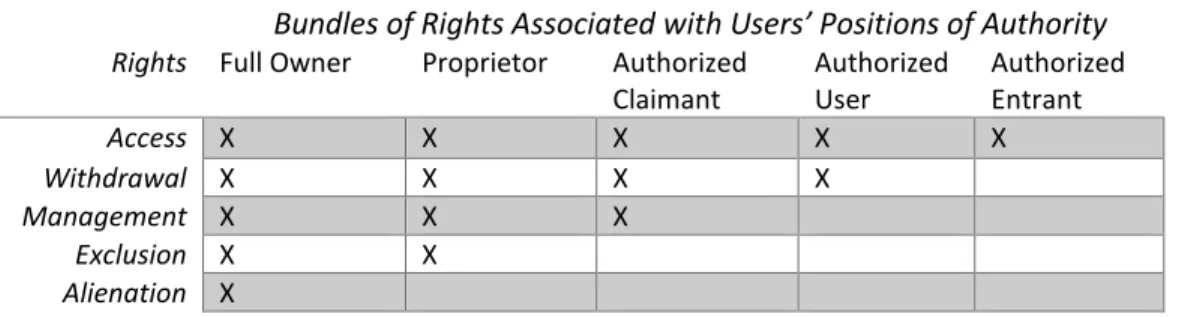
outcomes or judgements of relative success of any decentralized programs. Schlager and Ostrom (1992) provide a framework (see table 1) to disaggregate rights into mutually exclusive types. They distinguish between users’ rights of resource access, withdrawal, management, exclusion and alienation in relation to the resource system. Under different decentralized contexts communities can hold different
individual rights which collectively form an aggregate “bundle of rights” (Schlager and Ostrom 1992). Positions of authority are labeled corresponding to the different bundles of rights a community holds in Schlager and Ostrom’s typology which represent the different tiers of sovereignty communities’ wield. This framework allows for more careful evaluation of decentralization by disaggregating the diverse spectrum of resource related rights potentially transferred to communities. Further, how the individual bundles of rights array across different forest regime types hold implications around community power and outcomes. These differences in rights are used to generate hypothesis around how the presence of a more decentralized regime might shape outcomes.
Bundles of Rights Associated with Users’ Positions of Authority Rights Full Owner Proprietor Authorized
Claimant
Authorized User
Authorized Entrant
Access X X X X X
Withdrawal X X X X
Management X X X
Exclusion X X
Alienation X
Table 1 Rights Framework. Source: Ostrom and Schlager (1996:133)
15
CBFM conferring sole forest proprietorship to the community. Under JFM the same set of rights are conferred but are jointly shared between the community and a state actor. Therefor the authority the community is granted under JFM is not autonomous as it is under CBFM but requires co-determination and collaboration with the state. Under centralized/state management communities may have
restricted rights of access or withdrawal depending on forest designation and the specific management plan devised. Often the forest rules are defined by the state actor and enforced by village government bodies (VEC/VNRC) (Treue et al. 2014).
Forest Management Regimes and Rights Held by the Community in Tanzania
Rights State JFM CBFM
Access X (depends) X (co determined with state) X
Withdrawal X (depends) X (co determined with state) X
Management X (co managed with state) X
Exclusion X (co determined with state) X
Alienation
Table 2 Regimes and Rights in Tanzania
The typology provided by Schlager and Ostrom is a useful starting point to compare forest management regimes by the types of rights devolved to communities. However focusing solely on de jure property misses how rights might be coopted differently among users reproducing or extending existing intracommunity power disparities. Ribot and Peluso (2003) explore these processes further by extending the rights framework to explicitly include these informal processes that transform rights into powers. They draw the distinction between the Schlager and Ostrom’s concept of bundles of rights from their subsequent bundles of power; if rights are a result of rules then powers are the result of how rights and rules are employed (Ribot and Peluso 2003). Ribot and Peluso emphasize that despite equal legal claim to rights a combination of social and institutional processes mean these rights are often not equally accessible or applied in practice. Disentangling how rights are transformed into powers
16
same property rights not all users have equal access i.e. opportunity to mobilize their rights to capture the full range of possible resource benefits from forests (Leach, Mearns and Scoones 1999). Therefor going beyond merely the legal property rights granted considering how preexisting social differences and institutions create or hinder access to forests differently among users is essential to evaluate the equity of forest management outcomes.
Institutions of governance are one arena in which powers are derived from rights (Ribot and Peluso 2003). Processes of forest governance can reproduce existing power dynamics and further marginalize less powerful subgroups or serve as spaces for equitable distribution. If access to
participation in institutions of forest governance is inequitable with disproportionate influence by the already powerful, then elites will disproportionately benefit from the powers created in forest
17
important to consider when comparing decentralized outcomes because institutions can mediate the relationship between preexisting wealth status and access to needed forest resources.
The existing literature presents a tension between decentralization theory which supports that good governance will improve livelihood outcomes and be more equitable than centralized regimes, and the possibility that decentralization increases opportunities to exasperate existing inequalities. How decentralization influences elite control of governance and elite capture of forest benefits is contested. While theory supports that decentralization creates more equitable governance and livelihood
outcomes decentralization may also create access to new resources for elites to control. Elite capture of forests may merely be transferred downwards under decentralization from the forest department to local elites. Therefore, instead of creating more equitable outcomes decentralization could accelerate existing inequalities within communities by providing access to new opportunities to intensify existing power disparities (Persha and Andersson 2014). Lund and Saito-Jensen (2013) point out that processes of elite control over resource governance are often conflated with elite capture of resource benefits. Following on their work I look separately for evidence of elite control of governance, elite capture of forest resources and whether elite control is linked to elite capture and how the presence of CBFM processes might alter these pathways.
18
access less dependent on preexisting wealth status. Therefor in sites with CBFM processes underway in addition to JFM or state forests I anticipate more equitable outcomes than sites with only JFM or state-managed forests. The greater degree and autonomy of rights under CBFM should create more equitable access to participate in institutions of forest governance and improved access to livelihood benefits regardless of wealth status. As less democratic processes, institutions of forest governance under JFM and state regimes are anticipated to be less accessible to poorer households and elite wealth status more influential. Under the status quo state regime and JFM, which is jointly managed with state actors, I anticipate a stronger effect of wealth on participation in governance and capture of forest benefits. Further I predict that the influence of more democratic processes introduced through CBFM will have positive spillover effects onto household participation in JFM and state forest governance activities. Existing Literature
The complex suite of factors that potentially influence forest management outcomes makes empirical evaluation of decentralization inherently challenging. However, a growing body of literature studying outcomes in different contexts has corroborated a set of influential factors related to success (Baland and Platteau 1996, Agrawal and Gibson 1999, Gibson, Williams and Ostrom 2005, Ostrom 1990, Agrawal 2001). These studies are contributing increasing clarity towards collective understanding of the mechanisms and outcomes emerging from decentralization. Within existing work there is growing consensus that decentralization is linked to improved forest conservation (Porter-Bolland et al. 2012, Pagdee et al. 2006) and governance outcomes (Andersson and van Laerhoven 2007, Bartley et al. 2008, Grindle 2004, Persha and Andersson 2014, Persha and Meshack 2015) but there is less clarity on livelihood outcomes (Jagger et al. 2014)
19
Pagdee et al. (2006) found that decentralized management improved forest conservation outcomes over state management. Common indicators linked to success included secure forest tenure, clear ownership, sanctioning and enforcement, and tangible livelihood benefits. While concrete livelihood benefits are emerging as a common indicator and important element of successful forest conservation (Pagdee et al. 2006), they are less studied and understood by comparison. One reason for the relative dearth of information on livelihood outcomes is they are inherently challenging to measure (Jagger 2012, Angelsen et al. 2014). Studies of forest livelihood outcomes are particularly challenging to orchestrate data collection with large, random samples. Due in part to these challenges many existing studies typically draw on a handful of purposefully selected sites limiting the external validity of their findings and interpretation of results to descriptive statistics and qualitative analyses. While these studies have aided in enriching the body of knowledge on key variables linked to processes and outcomes of forest sector decentralization they are limited in generalizability. There are an increasing number of quantitative studies of forest conservation, governance and livelihood outcomes moving towards empirical testing of key relationships identified by more qualitative work. However, most are still limited by problems of method and relatively small sample sizes (Agrawal 2001). Quantitative studies encompassing large sample sizes with multiple countries are less common with some notable exceptions (Agrawal and Chhatre 2006, Jagger et al. 2014, Persha et al. 2011).
20
studies are based on small numbers of purposely selected sites and small sample sizes for their various units of analysis (households, villages and forests). Many of these studies focus on performance of CBFM and or JFM on forest conservation outcomes (Persha and Blomley 2009, Blomley et al. 2008, Treue et al. 2014). Persha and Blomley (2009) found a positive effect of CBFM on forest conservation attributed to stronger more effective institutions. Strong forest tenure and decision making autonomy ensured under CBFM proved important for forest conservation improvements which JFM lacked by comparison. However, the authors were not overly optimistic about the longevity of these programs without greater livelihood benefits. These findings point towards the need for further understanding of the outcomes and limitations of livelihoods access within different approaches to forest sector decentralization.
Studies have also found differences in JFM performance and benefit distribution compared to CBFM. The costs of JFM implementation and enforcement borne by communities can be high relative to the benefits leading to lower levels of buy in and satisfaction (Ribot 2004). Individuals are believed to be more likely to create, monitor and enforce rules when they are engaged in the process and feel that the potential benefits of their effort outweigh the costs (Ostrom 1990). Persha and Blomley (2009) found tenuously successful CBFM sites in the Eastern Arc Mountains of Tanzania. The improved tenure and rights of management under CBFM seemed to provide sufficient incentives to improve forests and governance outcomes despite an unreliable flow of livelihood benefits. They found that JFM faced challenges emerging from power imbalances between community institutions and government forest officials. One serious challenge to the process in their study was forest officials tasked to implement JFM in collaboration with communities may harbor a conflict of interest where they benefited from
21
monitoring and enforcing rules in JFM forests by passing them to community institutions. Yet
community institutions are often not permitted to enact rules that would increase livelihood benefits commensurate with management costs. Similar mistrust and power disparities in the co-management dynamic have also been observed outside Tanzania (Agrawal and Chhatre 2006). Therefore existing work generally supports that livelihood benefits are often negligible under JFM and that the power “sharing” dynamic is prone to issues including inequity, lack of autonomy for communities and corruption.
Existing work generally casts CBFM as outperforming JFM in Tanzania. Several case studies in Tanzania suggest that CBFM improves livelihood benefits over state managed forests, with less
optimistic assessments of JFM (Lund and Treue 2008). Lund and Treue (2008) assess outcomes across all three objectives and find positive evidence of CBFM performance reducing logging but more ambiguous results across livelihood and governance outcomes. They found a mix of livelihood improvements when considering village level outcomes but also harmful restrictions borne particularly on the poorest, forest dependent households. The authors suggest that negative livelihood outcomes could be mediated through more accountable and equitable institutions of governance. The findings from this study would benefit from further empirical testing and a larger sample size; their study considered only one CBFM village and therefor the generalizability of their results is limited. In the largest existing comparative study considering livelihood outcomes from nine villages across all regime types Vyamana (2009) found slight livelihood improvements under CBFM and JFM but indication of elite capture of forest benefits. Despite being one of the largest existing household level studies in Tanzania their study design restricted their analyses to descriptive comparisons limiting the interpretation of their results. These study design issues limit their ability to justify the underlying comparability of chosen study sites or their
22
around CBFM performance in Tanzania is built upon tenuous evidence in need if further empirical corroboration.
Despite relatively positive tentative conclusions about the outcomes of CBFM relative to JFM and state forest management not all findings around CBFM are optimistic. Several case studies exist which compare livelihood and governance outcomes from CBFM across a few communities (Rantala et al. 2012, Rantala and German 2013, Lund and Treue 2008). Rantala and German (2013) and Rantala et al. (2012) studied livelihood and governance outcomes from CBFM in Tanzania and found issues of elite capture, corruption and insufficient livelihood benefits. Benefits from CBFM were marginal and unevenly distributed within communities. Limitations to CBFM were attributed to elite control of institutions of governance and corruption as processes shaping irregular benefit flow. These studies yield interesting insight into interrelated governance and livelihood outcomes but rely exclusively on descriptive,
comparative analyses. Together these studies uncover important potential caveats of CBFM functioning in Tanzania that indicate CBFM may not be creating “pro-poor” equitable outcomes as policy intends and theory has predicted. The authors highlight the important limitations of linked elite control of governance and elite capture of resources, which can constrain access to the potential benefits of decentralization for the poor and other marginalized groups within communities. Further studies of issues of elite control and elite capture linked to decentralized outcomes are needed to further test the possible relationships and outcomes identified in these qualitative studies. Understanding of these processes and defensible determination of their outcomes in the context of Tanzania requires further exploration using rigorous statistical methods.
23
commons at the village level revitalized existing institutions spreading to improvements across village level governance and management of surrounding forests (Alden Wily and Dewees 2001, Vyamana 2009). Vyamana’s (2009) study found widespread improvements in governance that transcended merely the institutions of forest governance. Is appears possible then that the benefits of forest
decentralization under CBFM could improve the governance and livelihood outcomes for households beyond the boundaries of the village forest reserve impacting how surrounding forests are managed. Vyamana’s findings are compelling but again rely on observations and descriptive statistics to support his conclusions. Few existing studies have explored the potential for interaction or spillover effects across different forest management types and none using robust statistical inference.
24
CHAPTER 3. STUDY AREA
To explore these relationships Tanzania provides an excellent context because of its relatively long history of forest decentralization, representative forms of PFM and the relative dearth of empirical evaluation of decentralized outcomes (as discussed above). While decentralized forest management was underway in Nepal and India in the late 70’s and early 80’s, forest decentralization only gained
popularity in Africa in the 1990’s (Wily 2001). Tanzania has one of the longest histories of
decentralization on the continent and widest spread with at least 11% of the country’s forest area under some form of PFM (Blomley et al. 2008). It is estimated that PFM is now underway in 3.6 million ha of forest engaging over 1,800 villages (Blomley et al. 2008). A focus on Tanzania allows for comparison of two common forms of PFM; both JFM and CBFM in Tanzania are representative of approaches to decentralized forest management currently in place and expanding in many less developed countries (Jagger et al. 2014).
25
existing community institutions management decisions are entrusted to the Village Environmental Council (VEC), which is an existing committee in local government elected by the village general assembly.
Under JFM’s co-management arrangement the community and forest department collaborate to manage an existing forest reserve. This process is not self-selecting by the villages themselves but top down driven by the government (Persha and Meshack 2015). JFM covers mostly montane forests at higher altitudes valued for their particularly high rates of biodiversity and crucial role in water
catchment (Persha and Blomley 2009). Management responsibilities are shared between the community and the district forest office. Responsibilities include participating in and reporting on forest monitoring activities, meetings, and accounting. Management powers are vested with the Village Environmental Council (VEC) on behalf of and accountable to the community. JFM by decree includes greater
restrictions on forest use, typically only granting rights to collect dead fuel wood and select non-timber forest products as well as rights to benefit from tourism and research activities (URT 2013). Therefore the role of the community and VEC in management under JFM falls on monitoring and enforcement rather than devising harvest rules. Any profits accrued through non-extractive activities such as research or ecotourism are typically split between the village and the forest department. The specifications and restrictions of JFM are laid out in the contractual joint management agreement (JMA) sign by the community and forest department (Blomley and Ramadhani 2006). Many JFM forests are gazetted but still in process towards gaining full legal recognition (Persha and Blomley 2009).
26
CBFM is typically facilitated with the help of local forest department or NGO’s to navigate the
27
CHAPTER 4. DATA
Study Design
This MA thesis study utilizes a subset of data from a larger impact evaluation (IE) of JFM performance in Tanzania conducted during 2011-2015 by researchers at University of North Carolina Chapel Hill together with the Tanzania Forest Conservation Group (Persha and Meshack 2015). The impact evaluation covered 3,363 households from 110 villages and adjacent forest reserves under different forest management regimes in Tanzania. The full impact evaluation study of JFM’s outcomes across governance, livelihoods and forest conditions was structured as a quasi-experiment, in which sites with JFM management were randomly selected and then matched to comparable sites under centralized management, which serve as approximate control sites which are similar on relevant characteristics to JFM sites. Please refer to Persha and Meshack 2015 for full details of the broader JFM impact evaluation design, sampling and empirical strategies, and results of JFM impacts in Tanzania.
28
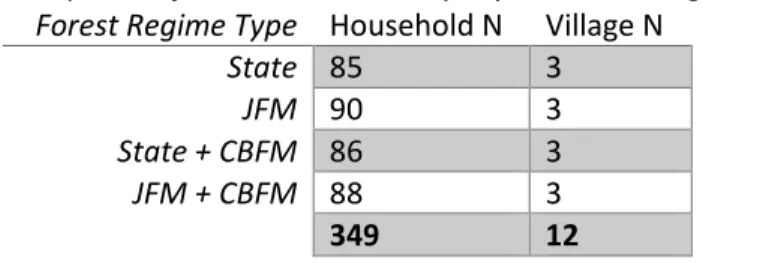
sites on the basis of the site’s propensity to be under JFM implementation (Persha and Meshack015), and then three cases per regime type were randomly selected. Persha and Meshack (2015) calculated the propensity scores from a set of village and forest level characteristics that were determined through their analyses to be determinants of where JFM is implemented in Tanzania relative to sites that remain centralized1. In all the cases used for this MA thesis study, the CBFM process at each site was initiated after JFM. The twelve communities yield a sample of 349 surveyed households.
Sample Size for Household Surveys by Forest Management Type Forest Regime Type Household N Village N
State 85 3
JFM 90 3
State + CBFM 86 3
JFM + CBFM 88 3
349 12
Table 3 Study Sample
Data collection for the full IE study focused on evaluating the performance of JFM across ecological, social and institutional arenas. The study consisted of a set of research tools including household surveys, semi structured interviews with key members of forest governance institutions, focus groups with forest users, and randomized vegetation plots. The household level study drew on well-tested research protocols developed by the International Forestry and Institutions Research (IFRI) research program (www.ifriresearch.net) and CIFOR’s Poverty Environment Network (PEN). These longstanding research programs informed the development of a unique set of survey questionnaires specifically designed for the aims of the IE study. Questionaries’ focused on household forest livelihood activities and participation in governance in addition to basic socioeconomic and demographic
information (Persha and Meshack 2015). Approximately 30 randomly selected households were sampled roughly evenly distributed across low, average and wealthy strata determined by a
participatory exercise at each site (Persha and Meshack 2015). Interviews were conducted by 10 trained
29
enumerators in Kiswahili with the household head covering a range of demographic and socioeconomic household level characteristics as well as information on household participation in aspects of forest governance and harvest.
Data
For this MA thesis study a subset of the larger IE household questionnaire data set were utilized primarily focusing on questions related to household income, demographics, and participation in forest harvesting and governance. Additionally households’ open ended, categorical and ranking responses were included to better understand perceptions of the functioning and benefits attributed to each forest management type. Data were analyzed using the statistical software package STATA version 13.1. Descriptions of each variable from the questionnaire and how certain variables were constructed from the existing data proceeds organized by their function in the modeled relationships2.
Independent Variables
Two focal independent variables were used to approximate households’ wealth status; the natural log of per capita income (loginc) and an asset based wealth indicator (lowestquintile). Income is a ratio level variable constructed from the household survey; household’s self-reported annual income was divided by the number of household members yielding an annual per capita income in local currency (Tanzanian shillings) which was transformed to the natural log. This transformation makes a skewed distribution more compact and roughly normally distributed to enable statistical analyses. To address potential issues with endogeneity in statistical modeling an asset-based measure of household wealth status was also used as a construct of wealth status3. Using a measure of physical assets to capture wealth status is preferable to monetary income in models that include a measure of forest
2 For a full table of variable names and descriptions see appendix
30
income as the dependent variable to avoid correlation among variables within the model. The principal component scores from households’ assets were divided into quintiles and a dummy variable was created to capture the membership in the two poorest quintiles of households. The resulting
dichotomous variable indicates the poorest households based on assets (0 nonmember or 1 member) as a construct of wealth status, which includes 44% of households in this sample (see table 4).
The presence of community based forest management was included in all models. Presence of CBFM was applied site wide (all households in the same site have the same status) and coded as a dummy variable (0= JFM or state-managed forests only or 1= CBFM also present).
Dependent Variables
Dependent variables in this study include several different measures of households’ forest use and participation in institutions of forest governance. Forest use measures covered the variety of forest products a household gathers (prod2cats) and value of fuel wood (fuelwoodvalue) and charcoal
harvested (charcoalvalue). The variety of forest products was measured as a recall of each distinct forest product gathered (as opposed to purchased) from the last month and ranged from 0 to 4 products in the data set. This was summed per household to capture a measure of the variety of forest products
31
household surveys collected each individual’s estimated quantity harvested, their chosen unit of measurement, and estimated local market price per unit for both fuelwood and charcoal. The final variables were constructed by multiplying the quantity harvested, unit and price per unit to yield an estimated market value (in Tanzania shillings) harvested for fuelwood and charcoal per household. Average prices for each product were compared within each village to household’s responses and any responses missing prices were imputed using the village mean price per unit for each product. Each measure was transformed to the natural log as the distributions were highly skewed.
Different household measures of participation in forest activities were also modeled as outcome variables. Household heads recorded their participation in forest harvest, monitoring and rule creation for their activities in their state or JFM forests. Households’ responses were recorded on a likert scale (never, rarely, sometimes, and often) in response to the question, “How often do you participate in each activity (harvest, monitoring, and rule creation)?” Their responses were recoded into dummy variables for those harvesting never/rarely (equal to 0) and sometimes/often (equal to 1). The resulting variables (harvestOther, monitorOther, createOther) have responses from the full set of 349 households.
Variable Name Mean Std. err Min Max N
loginc 11.65 0.08 2.34 15.61 349
lowestquintiles 0.44 0.03 0 1 349
anyCBFM 0.50 0.03 0 1 349
prod2cats 0.25 0.02 0 1 349
fuelwoodvalue 7.58 0.18 0 12.25 349
charcoalvalue 1.00 0.16 0 13.86 349
monitoringOther 0.09 0.02 0 1 349
harvestOther 0.11 0.02 0 1 349
createOther 0.04 0.01 0 1 349
age 48.23 0.87 18 92 349
education 5.00 0.18 0 13 349
femaleheaded 0.15 0.02 0 1 349
32 Control Variables
Other important household level characteristics measured include age and education of the household head (age, education) and if a household is headed by a single female (female headed). Household head’s age and years of education are self-reported in years. Whether or not a single female headed each household is coded as a dummy variable (0= male headed 1= female headed). Other controls considered including land and livestock owned shared a high degree of correlation with the different independent variables measuring wealth status so were left out of the models to avoid issues with collinearity among predictors.
Qualitative Data
33
CHAPTER 5. METHODS
This study employs a sequential mixed methods research design using statistical modeling and supporting qualitative analysis to explore possible pathways underlying quantitative relationships. First descriptive statistics and distributions for the different measures of households’ forest use and
participation forest governance activities are compared organized by forest regime types and different measures of household wealth status. One-way ANOVA tests are used to compare means of two or more groups to see if they differ significantly from one another. The resulting F-test and statistics reveal whether the assumption that the groups share a common mean should be rejected at the chosen alpha level. This method is used to compare the averages for each independent variable across different categorical groupings including wealth status and forest regime type. ANOVA test results are reported including the F statistic, and p value4. Expanding upon these initial ANOVA tests the analysis proceeds utilizing a combination of ordinary least squares regression and logistic regression models.
Models are used to better understand to what extent household wealth is associated with varying access to participation in 1). Institutions of forest governance and 2). Forest livelihood benefits and 3). Whether these relationships differ when CBFM is additionally present. Participation in forest rule making, monitoring and harvesting activities were studied to understand whether increasing wealth is associated with greater access to these forest institutions and benefits and if CBFM creates more equitable outcomes i.e. access less dependent on wealth. If poorer households have less access relative
4 Results of ANOVA tests are reported in the format of; between group degrees of freedom, within group degrees
34
to wealthier households holding other factors fixed this is treated as an indicator of inequitable access.
Multivariate regression models expand upon the focal relationships to explore the partial effects of other relevant variables on each dependent variable and permit testing for interactions. In this study household wealth status is interacted with the presence of CBFM. Interaction models are used to interpret whether CBFM has any equalizing effect -- i.e., whether CBFM affects the direction or the magnitude of any relationship between wealth status and participation in each forest activity. The extent to which CBFM alters any relationship between wealth status and participation is used to infer whether CBFM enables more equitable access. Further, the modeling approach also aims to illuminate potential spillover effects that CBFM has on non-CBFM forest activities. The effect of wealth and the presence of CBFM are modeled as predictors of governance participation and harvesting behavior in JFM or state-managed forests. This additional analysis is used to infer whether the presence of
supposedly more democratic CBFM processes has any spillover effects on participation in institutions of governance and forest use in non-CBFM forests within the same village.
All models are estimated with cluster robust standard errors clustered to account for the nested structure of the data (households sampled within villages). The assumption can be made that
35
which reflect the nested structure of the data. Future work could incorporate a multi-level modelling approach as another method for dealing with the nested structure of the data to account for both household level and village level effects. The OLS regression approach employed here is limited by problems of unobserved heterogeneity in the models errors, which could be correlated with household wealth status. Therefore differences in household wealth status may both be associated with changes in each outcome measure capturing forest use and also be associated with indirect changes in forest use through the errors. In future work a two stage least squares regression with instrumental variables is a potential approach to better address issues of endogeneity. This approach could test for an instrumental variable capturing wealth status which is correlated with direct household income but not correlated among the errors. Given that all observational data are subject to unobserved heterogeneity, OLS is assumed to be a sufficient modeling approach despite potential unobserved or omitted variable bias. However, the results are interpreted cautiously and limitations discussed further in the results chapter.
Qualitative analysis is employed to aid interpretation of observed relationships among key variables derived from each model. Exploring the range and frequency of responses in sites with and without CBFM will provide further insight into any differences in the functioning of forest governance institutions and accessibility of forest benefits by regime. These data will be compared to the modeled outcomes to provide reinforcement or points of contrast with output results. The qualitative analysis provides additional information on how households perceive the functioning of their forest governance institutions and access to livelihood benefits and whether these outcomes are shaped by CBFM.
Section 5.1
Ordinary Least Squares Regression
36
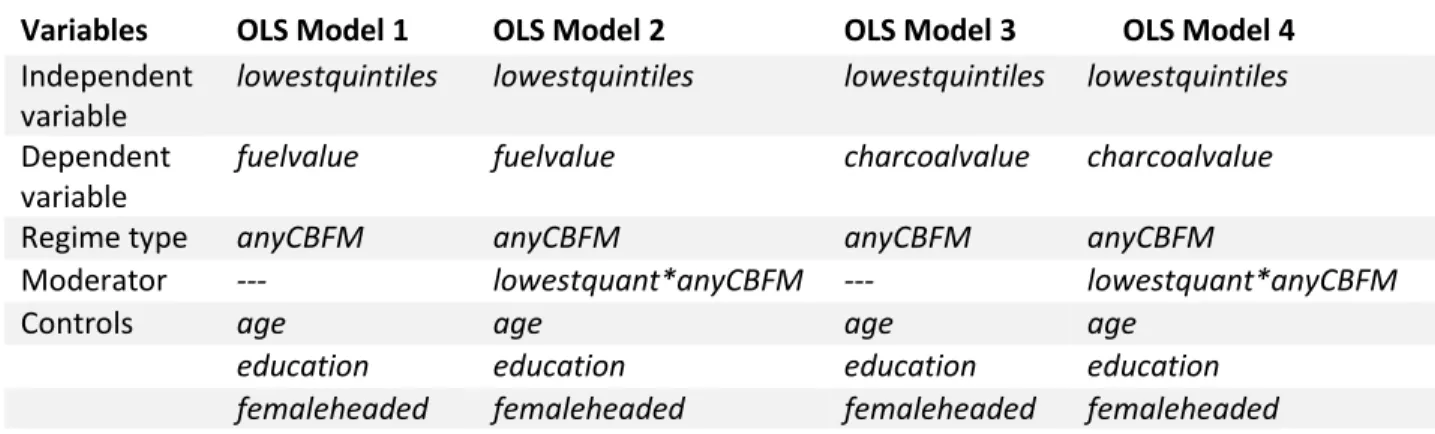
household wealth status might impact the environmental income households’ harvest for fuel types with different relative values. The separate OLS models (see table 5) will tease out any effect of households’ wealth status on harvest of a low value fuel product (fuel wood) and a high value product (charcoal) and how each modeled focal relationship (regression of wealth status on fuelwood and charcoal) changes with the presence of CBFM in a village. Results are reported as marginally significant for test statistics between alpha .10 and .05, significant at p<.05, and highly significant p<.01.
Ordinary Least Squares Models and Hypothesis
Of the two fuel types I anticipate the market value of fuelwood households harvested to be less dependent on wealth status and the presence of CBFM. In the regression of low wealth status on the value of fuelwood harvested (OLS model1) I anticipate a positive effect of low household wealth status on fuel wood harvested. I anticipate poorer households to have a greater reliance on fuel wood, which is a lower value product than charcoal. I do not anticipate any significant effect of CBFM on fuel wood harvest or any significant interaction between CBFM and poverty on harvest (OLS model 2). This low value and abundant fuel source is typically accessible in all forests regardless of management type therefor I do not expect the presence of CBFM to impact the relationship. As a lower value product I do not expect fuel wood to be subject to significant issues of access and elite capture. By contrast charcoal is a more valuable product, which requires greater inputs for extraction and potential barriers (both social and punitive) to access. As a valuable forest product I anticipate poverty to be negatively related to the value of charcoal a household harvested. Charcoaling is typically a restricted activity in
37
harvest (OLS model 3) I anticipate a negative focal relationship, CBFM to have a positive effect on charcoal harvest and a positive moderating effect (OLS model 4).
Variables OLS Model 1 OLS Model 2 OLS Model 3 OLS Model 4 Independent
variable
lowestquintiles lowestquintiles lowestquintiles lowestquintiles
Dependent variable
fuelvalue fuelvalue charcoalvalue charcoalvalue
Regime type anyCBFM anyCBFM anyCBFM anyCBFM
Moderator --- lowestquant*anyCBFM --- lowestquant*anyCBFM
Controls age age age age
education education education education
femaleheaded femaleheaded femaleheaded femaleheaded
Table 5 OLS Models 1-4
Ordinary Least Squares Dependent Variables
The dependent variables modeled with OLS regression were total value estimates for two forest products harvested; fuel wood and charcoal. Separate OLS bivariate models are used to capture the effect of wealth status on households’ estimated market value of fuel wood harvested (fuelwoodvalue), and the estimated market value of charcoal harvested (charcoalvalue). These variables were each transformed to the natural log which is a common and useful transformation for skewed variables5.
OLS Independent Variable
The dummy variable for membership in the lowest asset based wealth quintiles
(lowestquintiles) is used as the independent variable in all OLS models to capture household wealth status. This approach compares differences in the value harvested for each forest product across the poorest and wealthiest households. To deal with potential endogeneity in these models the wealth quintiles derived from households’ assets are used as a proxy for wealth status instead of the log of income to avoid using a measure of monetary income for both independent and dependent variables.
5 The interpretation of log-level regression coefficients for each x
38
This measure was considered more robust to endogeneity because physical assets are not as directly related to forest derived income as a direct liquid asset measure such as reported income. Therefore the asset-based measure of wealth status is less prone to problems with reverse causality brought about by using two income-based measures.
Ordinary Least Squares Moderator
Each bivariate model is elaborated upon to include a dummy variable for presence of CBFM and for any moderating effect of CBFM. The dummy variable for presence of CBFM (anyCBFM) is included to reveal the partial effect of CBFM on the value harvested for each product net of other predictors. Adding forest regime to the models as a dummy regressor illustrates any differences in intercepts for each regression line (outcomes for JFM and centralized management with and without CBFM). The coefficient for the regime dummy reveals if households in CBFM sites are associated with distinct levels of harvest (for each fuel product) holding wealth status and other controls fixed. Any difference in the intercepts is the mean difference in value harvested with the addition of CBFM holding other covariates constant. To test for moderation an interaction term between membership in the lowest wealth
quintiles and presence of CBFM (lowestquintiles*anyCBFM) is added to each model. Moderation reveals whether the effect of wealth status (IV) on the different measures of fuel products harvested (each DV) depends on the value of a third variable (Z), in this case the presence of CBFM.
Ordinary Least Squares Controls
39
older, less educated or female headed are anticipated to participate less in forest governance institutions and harvest activities. Other household level controls were considered including land holding, large livestock and small livestock owned but were not included due to issues with multicollinearity introduced into the models due to overlap in these measure and the different
measures of household wealth status. The larger IE study accounted for different forest and community level factors related to the administrative selection bias for JFM in the study design using a principal component analysis to compare sites with similar scores or propensity for JFM implementation. The subset of sites for this thesis study were drawn randomly within each forest regime after first restricting the sample to those with similar principal component scores (as described in the study design section). Therefore the villages from which this study is drawn are alike on average across the range of covariates known to bias JFM site selection such as forest size and type, community population, and distance to markets, among others6.
Section 5.2
Logistic Regression
Logistic regression models were used to determine the influence of wealth status and regime type on binary measures capturing household participation in different aspects of forest harvest and institutions of governance. Following on the analysis of market value harvested for two specific forest products (fuelwood and charcoal) logistic regression is used to further explore how wealth and regime are related to participation in different aspects of forest harvesting and institutions of governance. The variety of forest products a household gathered (binary capturing those harvesting greater than one product) is modeled to explore whether wealth status and the presence of CBFM are associated with a greater likelihood of harvesting more than one forest product. Additionally an interaction model is used
40
to test whether CBFM has any moderating effect on the relationship between wealth and likelihood of harvesting a greater variety of forest products. Further logistic modeling is also used to identify any spillover effects related to the presence of CBFM. To do so the dummy variable for presence of CBFM is added as a predictor of household participation in forest harvest, monitoring and rule creation in JFM and state-managed forests and institutions. This will reveal whether the presence of CBFM processes in a village is related to any differences in a household’s participation in aspects of their JFM and state-managed forests and institutions of governance. In logistic regression the interpretation of coefficients becomes the effect of each predictor on the log odds of the outcome modeled as a linear combination of the predictor variables. Log odds are reported as odds ratios and predicted probabilities to aid interpretation of key relationships. Results are reported as marginally significant for test statistics between alpha .10 and .05, significant at p<.05, and highly significant p<.01.
Logistic Regression Models and Hypothesis
I anticipate a greater diversity of forest products to typically incorporate higher value forest products and therefor expect a positive relationship between income and the likelihood of harvesting greater than one forest product (see Table 6 for logistic regression model 5 and 6). I anticipate CBFM to have a positive marginal effect on the variety of products gathered and mitigate the positive affect of income on the likelihood of harvesting greater than one product.
Variety of Forest Products Variables
Model 5 Model 6
Independent variable loginc loginc Dependent variable prod2cats prod2cats
Regime type anyCBFM anyCBFM
Moderator --- loginc*anyCBFM
Controls age age
education education
femaleheaded femaleheaded
41
To understand how wealth and CBFM affects participation in monitoring, rule creation and frequency of harvest in state and JFM forests logistic regression models were run (see table 7). I hypothesize that wealth will have a positive effect on each measure of forest use and participation in institutions of forest governance under state and JFM regimes. I anticipate CBFM to have a positive spillover effect increasing the likelihood that a household participates in each activity.
Models of participation in JFM and
state forests Variables Model 7 Model 8 Model 9
Independent variable loginc loginc loginc Dependent variable createOther monitorOther harvestOther
Regime type anyCBFM anyCBFM anyCBFM
Controls age age age
education education education
femaleheaded femaleheaded femaleheaded
Table 7 Logistic Regression Models of Participation in Forest Rule Creation, Monitoring and Harvest
Logistic Regression Dependent Variables
Four aspects of forest participation were modeled with logistic regression; the variety of forest products gathered, participation in rule creation, monitoring, and frequency of forest harvesting.
The variety of forest products a household gathered was grouped into those harvesting zero or just one forest product (equal to 0) and those harvesting greater than one product (equal to 1). Since the majority of households reported gathering just one product (and that product was almost always firewood) this recode enabled testing of whether wealth and presence of CBFM increase the likelihood of gathering a greater variety of forest products, which are also typically higher value forest products.
Households’ responses to their participation in JFM and state forest governance institutions and forest use were categorized into dichotomous average and above average participation for each