ARCHAEOLOGY FOR THE PEOPLE: COMMUNITY-BASED RESEARCH, HANDS-ON EDUCATIHANDS-ON, AND THEIR PLACE IN ARCHAEOLOGY
Cailey D. Mullins
A thesis submitted to the faculty at the University of North Carolina at Chapel Hill in partial fulfillment of the requirements for the degree of Master of Arts in the Department
of Anthropology.
Chapel Hill 2019
ABSTRACT
Cailey D. Mullins: Archaeology for the People: Community-Based Research, Hands-On Education, and Their Place in Archaeology
(Under the direction of Patricia McAnany)
Archaeology has long been in the interest of the public, but archaeologists have not
always been capable of bringing our discipline to the people. There is untapped potential for
archaeology to bridge gaps between communities’ pasts and presents, and to provide practical
assistance in the realm of social change and education. Through a series of online surveys
targeting former participants and coordinators of pre-college archaeological education programs,
this thesis seeks to understand how archaeology can impact students’ ability to learn basic
STEAM (science, technology, engineering, arts, and mathematics) skills and their relationship
with their own communities through community-based educational programs. These educational
youth programs can lead to a better educated – and more interested – citizenry, creating a
community of fierce protectors of the past, and it can lead to a more inclusive field of
ACKNOWLEDGEMENTS
This thesis – and the career to follow – could not have been possible without my
army of supporters. First, the fact that this research was even possible is due to the unfaltering
support of my advisor, Dr. Patricia McAnany, who offered nothing but support and
encouragement, even when others were reluctant to give that. My committee has been ever so
helpful with their gracious dedications of their time and their always useful comments and
directions. Dr. Elaine Franklin was kind enough to open my eyes to an entire world of research
that I never knew existed, and gave me faith that my research questions are relevant and
worthwhile. Dr. Anna Agbe-Davies spurred on my belief in public archaeology, and gave me
invaluable insight into the necessity of working with communities. And finally, without the
relentless questioning of my research’s usefulness from Dr. Vin Steponaitis, I would have never
developed the stubborn audacity required to finish this project.
Perhaps even more important than my academic team, my friends and family offered
endless encouragement and support without which I could have never made it through this – or
any other – project. To my mother, who from the beginning taught me the value of hard work
and fearless determination, I owe everything. To my wonderful partner, Conor, I am deeply
indebted for the patience and understanding he showed me even at my worst. And to my
wonderful friends, I owe my very sanity, for without their constant reminders of my strength, I
TABLE OF CONTENTS
LIST OF FIGURES………iv
CHAPTER 1: INTRODUCTION………...1
CHAPTER 2: AN EXAMINATION OF THE THEORETICAL STATE OF COMMUNITY-BASED AND INDIGENOUS ARCHAEOLOGIES………...8
Community Archaeology: Its Many Names and Forms………...8
Defining Community/Collaborative Archaeology and Exploring Its Roots………..11
Indigenous Archaeology and Its Place in Community-Based Paradigms………...14
Principles of Community-Based, Collaborative Archaeology………..….…18
Questions of Heritage……….………...25
Examples of a Transformed Archaeology in Practice………...26
CHAPTER 3: ARCHAEOLOGY & EDUCATION………...……...29
Introduction………29
How do we teach History? Why does it matter? ………...……29
Interest in an Archaeological Education – Educating the Public, Starting with the Youth………..………..31
Methods of Archaeology Education………..………...33
Real World Cases: Archaeology In and Out of the Classroom………...……37
CHAPTER 4: A SURVEY OF HIGH SCHOOL FIELD SCHOOLS AND THEIR
OUTCOMES……… .46
Introduction………....46
Methods………..47
Results………57
Discussion………..75
CHAPTER 5: CASE STUDY IN COMMUNITY-BASED ARCHAEOLOGICAL EDUCATION: KIDS IN COLLEGE, HOPEWELL CULTURE NATIONAL HISTORICAL PARK………...80
CHAPTER 6: CONCLUSIONS………...…….92
APPENDIX 1: PARTICIPANT SURVEY REPORT……….……..97
APPENDIX 2: COORDINATOR SURVEY REPORT………..134
LIST OF FIGURES
Figure 1.1 - The collaborative and pedagogical continua..………..………....5
Figure 3.1 – The collaborative and pedagogical continua………..……40
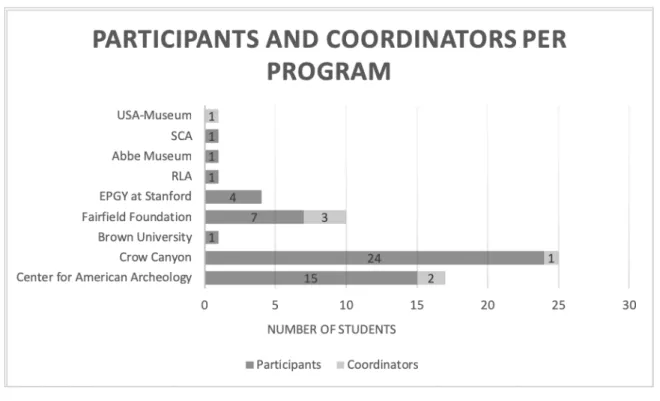
Figure 4.1 – Participants and coordinators per program………59
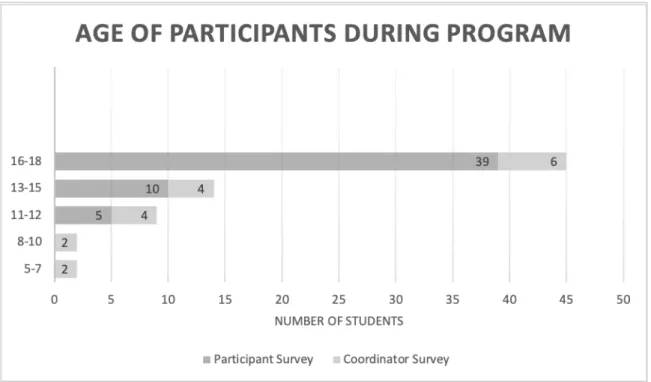
Figure 4.2 – Age of participants during program………...60
Figure 4.3 – Prior interest in archaeology………..61
Figure 4.4 – Ranking of program effectiveness………..63
Figure 4.5 – Participants’ least and most favorite activities………64
Figure 4.6 – Activities favored by coordinators………..65
Figure 4.7 – Interest in archaeology before and after participation………68
Figure 4.8 – Survey participants holding a position in archaeology……….70
Figure 4.9 – Program effect on participants’ career choices……….72
Figure 5.1 – Photo: Day 2 of the Kids in College program at Hopewell Culture NHP………….85
Figure 5.2 – Photo: Day 3 of the Kids in College program at Hopewell Culture NHP…………..86
Figure 5.3. – Photo: Day 5 of the Kids in College program at Hopewell Culture NHP…………88
CHAPTER 1: INTRODUCTION
I remember learning about archaeology only a handful of times growing up in the Ohio
public school system. We were taught Ohio’s “prehistory,” as it was called, in fourth grade; the
class barely skimmed the surface of the thousands of years of pre-European civilizations of
Ohio’s past, and completely skipped out on the fact that any of it had happened in my little,
seemingly insignificant hometown of Portsmouth. I became interested in archaeology almost by
accident some four years later while watching a documentary on Jamestown, and from that
moment on I sunk my free time into researching the field and finding out what I would need to
do to pursue a career in archaeology. A few years later, my mother stumbled upon the Center for
American Archeology’s high school field school in Kampsville, Illinois. It looked like the
perfect opportunity for me to see what archaeology really was, and to decide once and for all if it
was my true calling.
As it turned out, that camp changed my life. It solidified my love of archaeology, and
made me eager to pursue the profession. What that field school ultimately did was win over a
future archaeologist; it recruited not only a citizen newly devoted to preserving and studying the
past, but a future professional. I often wonder what would have happened had I not attended that
field school. More often, I wonder how such an opportunity might affect the students in my
hometown. In this thesis, I present a study of pre-college archaeological education programs and
analyze their impact on the students who participate in them in hopes of discovering what such a
former participants’ likes and dislikes. I also analyze where the field of archaeology stands in
terms of educational and community-based programs, and investigate what might happen when
these two paradigms are blended together. This, I argue, is the best avenue through which
archaeology can serve as a form of education and community service.
In recent years, community-based archaeology has become a hot topic. It is a practice
known by many names – public archaeology, community archaeology, collaborative
archaeology, and on and on. Even its definition seems to be a moving target. Regardless of what
exactly it is called or how exactly it is defined, it is clear that archaeologists have a duty to
interact with the many publics with whom we work and whose past we study. A quick brush
through many archaeological organizations’ code of ethics (e.g. the Society for American
Archaeology, the American Institute of Archaeology, the World Archaeological Congress, and
so on) will demonstrate that the idea of stewardship of the past and a commitment to the public
are inherent to our professional code of ethics. The Society for American Archaeology’s first and
fourth principles address these topics. The first principle, stewardship, states that archaeologists
have the responsibility of “practicing and promoting the stewardship of the archaeological
record” (Society for American Archaeology 1996). Those who fall under the category of
stewards are not solely professional archaeologists, but rather they are “caretakers of and
advocates for the archaeological record for the benefit of all people” (Society for American
Archaeology 1996). The fourth principle, public education and outreach, insists that
“archaeologists should reach out to, and participate in cooperative efforts with others interested
in the archaeological record with the aim of improving the preservation, protection, and
If we are to abide by this code, then it seems some form of the nebulous “community
archaeology” must take an important spot in archaeological work. This fact tends to be
overlooked in the field, and interacting with the public is frequently seen as a hassle or an
annoyance. I have heard countless colleagues refer to the broader impacts sections on grant
proposals as something they “have to do” or something they will just “make up.” Somehow, we
as a field have to get past this toxic way of thinking and realize that without the public we are so
frequently unwilling to serve, we would not be able to conduct our research. They fund us, they
encourage us, and they inspire us.
There are, of course, many shades of “community archaeology.” This term can cover all
manner of programs and can be conceptualized along a continuum that stretches from sheer
mandated consultation (primarily in Indigenous communities) to full collaboration (Colwell and
Ferguson 2008). The two extremes of this spectrum could also be considered in two distinct
terms: outreach and engagement.
Both of these terms indicate at least a minimum effort to involve the public in
archaeological research, but their difference lies in the agency of the community involved.
Outreach tends to have a more passive implication. In public or community outreach, the
archaeologist tends to be the one reaching out to the community. In many cases, this means the
research program has already been established by the archaeologist or the institution the
archaeologist is representing, and the community benefits by learning the results of the program
from the archaeologist themselves. Engagement, in contrast, is a more action-focused paradigm.
When an archaeologist works on engaging with a community, they invite the public’s
participation from step one of the research project, which means community members get a say
an end. These two forms of public involvement are not mutually exclusive; they are merely the
two ends of a spectrum filled with complexities and individual expressions of public
archaeology.
There is a similar methodological spectrum in pedagogical theory in the field of
education. Where in archaeology there is outreach, in education there is the behaviorist
approach, and where there is engagement, there is the constructivist approach (Scheurman 1998).
The behaviorist pedagogical approach takes the “mind as a vessel” model to knowledge
acquisition and tends to favor more passive teaching methods, while the constructivist approach
believes knowledge is made, and therefore should be created through experiential, hands-on
learning. These theories will be addressed in much more detail in Chapter 3.
There is a unique overlap between these two methodological spectra. When archaeology
joins forces with education, students (of all ages) are given the chance to both learn about the
past through the methods of archaeological research and learn critical thinking and cultural
awareness skills. At the same time, when the engagement variety of community archaeology
blends with constructivist pedagogies, archaeologists are given the chance to learn from the
community and from the students participating in the archaeological program. This opens the
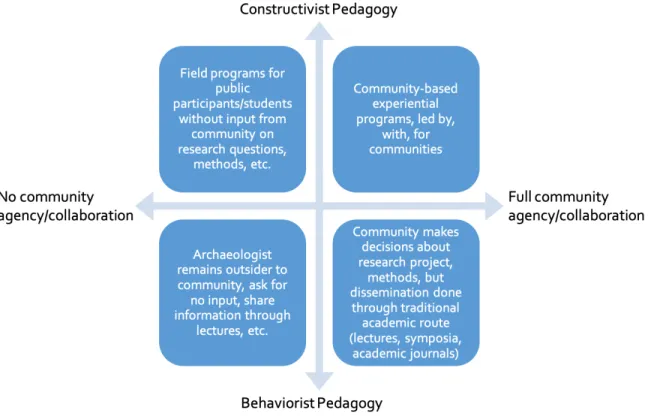
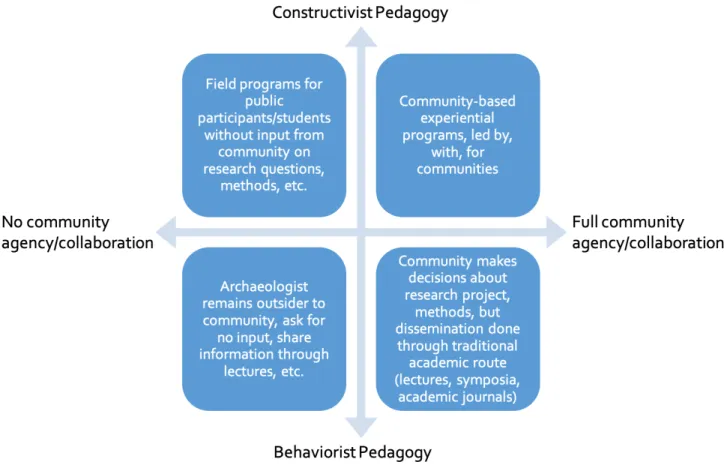
field to numerous liberating practices. Figure 1 below depicts the overlap between these two
continuums and briefly describes examples of archaeological programs on this two-axes matrix.
Figure 1.1. The collaborative and pedagogical continua and their implications for archaeological research.
Despite the obvious benefits, there is still reluctance to incorporate the public into
archaeology. This may be in part due to the fact that working toward a community-based
archaeology is not seen as a genuine research concern in archaeology. In 2014, Kintigh et al.
conducted a survey to identify a set of the most important “grand challenges for archaeology.”
While many of the responses they garnered pertained to methodological deficiencies, these
responses were excluded from the final list (Kintigh et al. 2014:7). Instead, the list includes 25
theoretical, scientific questions we should be addressing. These fit into the following five
categories: “(1) Emergence, Communities, and Complexity; (2) Resilience, Persistence, and
Collapse; (3) Movement, Mobility, and Migration; (4) Cognition, Behavior, and Identity; and (5)
Human-Environment Interactions” (pg. 8). These are all very valuable topics to explore, but why
important? As reviewer Charles Cobb argues in his 2014 response to the article, these “grand
challenges” are fine for what they are, but they do not push nearly far enough to encompass all of
the issues pressing archaeology today – most notably in the political and collaborative arena
(Cobb 2014; McAnany and Rowe 2015). Perhaps the study by Kintigh and colleagues wasn’t the
place to discuss these broader methodological challenges, but it is a topic that needs to be
discussed.
Part of the importance of a move toward a community-based archaeology is that it aids in
an effort to decolonize the field – something that is well past due. It is no secret that
archaeology’s past is filled with uncomfortable colonial histories and motives and incorrigible
power imbalances, but now is the time to start making amends for past mistakes. Many scholars,
in several edited volumes (for example, Atalay 2012; Atalay et al. 2014; Colwell-Chanthaphonh
and Ferguson 2008) have called for an Indigenous, community-based archaeology – not as a new
niche, but as an entire transformation of the field. Our responsibility to our many publics
includes (and should prioritize) the Indigenous communities whose heritage and ancestry we so
often study. Additionally, opening research to all of the communities impacted by our work –
local and descendant – provides a fantastic opportunity for those groups to come together in a
cross-cultural experience. Granted, this may lead to difficulties in weighing opposing desires and
needs of the various groups, but the chance to bring together communities that share heritage
simply by occupying the same space (no matter how problematic that might be) can and will
open up important dialogues.
This serious need for change in the field then begs the question, how do we make it
happen? It is worthwhile to make an effort with the existing generation of archaeologists – it
generation is the most fruitful place to plant the seed. If we change the way we teach
archaeology, then we can change the way it’s done.
The goal of this thesis, then, is threefold: first, to examine the theoretical standing of the
field in terms of collaborative, Indigenous archaeology and their overlaps with archaeological
education; second, to analyze the state of youth field programs to determine their usefulness and
find the best practices for such programs; and finally, to bring forth a set of methods to
successfully combine Indigenous and community-based archaeologies within an educational
field program for kids. In the first chapter of this thesis, I explore the current state of the field,
and how communities – both descendant and local – have been incorporated into archaeological
research, and how the field might improve on this endeavor. Next, I examine the current
relationship between education and archaeology. The goal here is to understand how archaeology
might be used to enhance current educational practices in both social studies and science
subjects, both in the classroom and in the field. Finally, I present a study of former
archaeological education program participants and coordinators in an effort to determine how
these programs impacted the field and the students who participated in them, and what the best
CHAPTER 2: AN EXAMINATION OF THE THEORETICAL STATE OF COMMUNITY-BASED AND INDIGENOUS ARCHAEOLOGIES
Community Archaeology: Its Many Names and Forms
The idea of a community archaeology is not new, but it has gone through an abundance
of name changes and definitions. Community archaeology, public archaeology, collaborative
archaeology, and community-based participatory archaeological research are all terms that
encompass the varying expressions of an archaeology that engages with and/or works with the
community or communities within which the research is based. There are various levels of
involvement inherent to all of these concepts, but at their core, the basic principle is the same: to
move the center of archaeological research away from the Ivory Tower of academia and into the
lives of the everyday people impacted by these studies.
As early as the 1970s, archaeologists were toying with the concept of a “public
archaeology.” Charles McGimsey made a strong argument for this type of archaeology, citing it
as an essential component of the field. In his 1972 book on the topic, he wrote that archaeologists
must “assume a role of positive leadership and public education” if we are to expect help in
cultural preservation from untrained but interested citizens (McGimsey 1972:4). He went so far
as to say that access to knowledge of the past is a human right, and as such, it is the
archaeologist’s responsibility to inform the public of that knowledge and share in the process of
rediscovering it (McGimsey 1972). McGimsey was still on this valiant quest in 2003, when he
the information they receive is accurate and not coming from fringe, sensationalist media sources
(McGimsey 2003). Essentially, public outreach is a critical component of archaeological
endeavors because a great deal of research is funded by the public, and in order to continue
garnering support from that public, we must keep them informed and interested.
By the early 2000s, public archaeology had gotten a bit of a makeover. Scholars began
going beyond the idea of simply informing the public and began thinking about engaging the
public throughout the entire process. These were the first sprouts of community archaeology.
Primarily budding in Australia and New Zealand, the idea of community archaeology focuses on
the concept of community involvement from the very beginning – from producing the research
question, to carrying out the project, to publishing and disseminating results (Marshall 2002).
Community-based research is change-oriented, and engages both researcher and community in
projects that address locally identified needs (Strand et al. 2003).
It is important to take a moment here to define what I truly mean by “community.”
Archaeologists interact with and are responsible to numerous stakeholders, all of whom are
engaged at various levels and have differing desires and needs. While all of these groups could
be defined as communities, this thesis will focus on groups that are most directly impacted by
and invested in the research, leaving out academic institutions, peer groups, and those types of
more academically-focused groups from the definition of “community.” Marshall (2002)
identifies two main types of communities: local and descendant. Sometimes those two types may
overlap, and at other times there may be multiple renditions of each. In many post-colonial
situations, as in my own study area, the descendant community is totally detached from their
ancestral homeland, but still remain acutely interested in the history there, while the local
Indigenous groups in the first place. This and many other issues only help to muddy the waters of
a community-based archaeology.
The benefits of community-based research are plenty. In addition to correcting
archaeology’s colonialist tendencies to swoop and conquer the history of a place, this paradigm
allows for greater educational opportunities, both for the communities in which we are working
and for budding archaeologists. As community outreach became a staple of many American
colleges and universities in the 1990s and early 2000s, it became obvious that the communities
surrounding these institutions were just as much in need of outreach and collaboration as far-off
places. This, combined with a call for more experiential learning for students, led to
community-based research programs in educational settings (Strand et al. 2003). These kinds of programs,
akin to service learning, which has been around for nearly a century (Baugher 2009; Eyler &
Giles 1999; Mooney & Edwards 2001; Nassaney 2009), have many advantages over standard
in-class, reading-based educational paradigms. Students are able to better understand the
community’s needs, which also means becoming more familiar with the politics and social
underpinnings of the area; they gain critical thinking skills; and they generally become more
civically literate (Eyler & Giles 1999; Mooney & Edwards 2001). These advantages would
greatly benefit archaeology students, as all of these skills are desperately needed to do ethical,
responsible archaeology.
Now that I have given a general idea of what community archaeology is, it is important to
trace its roots and influences and understand how it has grown and transformed before digging
into the methods and theory behind the approach. The following section will take a chronological
Defining Community/Collaborative Archaeology and Exploring Its Roots
The earliest kernel of community-based research was action research, or more
specifically, Participatory Action Research (PAR), a paradigm that is still very much integrated
into community-based approaches. In an attempt to find a “science for the common people,”
Fals-Borda produced an early version of action research in 1980, when he laid out core methods
for research that flowed “from the masses to the masses” (Fals-Borda 1980:23). The five
methods he lays out address many of the dynamic issues inherent to conducting this kind of
science – the need to be forthright with the community (“authenticity and commitment”),
avoiding feeding dangerous ideologies (“anti-dogmatism”), effectively communicating research
and results with the affected publics (“systematic restitution”), effectively communicating
research and results with the broader academic community (“feedback to organic intellectuals”),
and finally, the necessity of constant self-reflection (“action-reflection rhythm”: Fals-Borda
1980:20-27).
The essential take-away from Fals-Borda’s work is the notion of democratizing
knowledge. He gets at this from a Marxist framework, viewing scientists and researchers as the
bourgeoise and the impacted communities as the proletariat. The key to overturning this power
dynamic, then, is to follow this action research paradigm in which we are open and honest about
who we are and what our interests are, we communicate our wants and needs to the community
and listen to their own, and we continue to inform our own academic audiences of the work that
can be done in partnership with non-professional communities. Perhaps the most important
factor in working efficiently and honestly with a community is the manner in which we
communicate and reach research decisions. Fals-Borda lists four primary rules for these
First, the “communication differential” calls for scientists to be sure to communicate their
results at an appropriate level for the audience (Fals-Borda 1980:23). Sonya Atalay has
demonstrated this type of communication, called “Level 1 communication” (Fals-Borda
1980:23), through her work at Çatalhöyük, where she worked with the community to create
children’s comics to explain the archaeology of the site (Atalay 2012:233-235). In addition to
finding the proper mode of communication, using the correct language is essential to effective
communication. Fals-Borda calls this “simplicity of communication” (pg. 24); researchers should
use plain, non-jargoned language when presenting ideas to the public. Next, research decisions
and goal-setting should always take place in collaboration with the community – a process
Fals-Borda calls “self investigation and control” (pg. 24). Finally, his last rule addresses the need for
community members to be directly involved in the creation of knowledge with a process he calls
“technical popularization” (pg. 24). Here, it is the researcher’s responsibility to find the simplest
ways to conduct their research and empower community members to do it themselves by
teaching proper methods.
The democratization of knowledge production is not just essential to remove scholars
from their bourgeois pedestals; it is simply a better way to understand the world. As Whyte
writes, “Science is not achieved by distancing oneself from the world; as generations of scientists
know, the greatest conceptual and methodological challenges come from engagement with the
world” (Whyte 1991:21). Working with and in communities provides archaeologists with a
chance to recognize current social patterns and gain inspiration for research questions from the
community’s wants, needs, and interests. In PAR, scientists are able to construct research
frameworks in coordination with the community itself, allowing for projects that address
questions about the past. In this way, researcher and community member become co-learners,
each learning something from the other, and through this process, the community becomes
empowered and allowed to take charge of their own past and their own futures (Elden and Levin
1991).
Out of these PAR roots sprang the general concept of collaborative archaeology, which
can be best described not in dichotomous or rigid terms, but as a continuum
(Colwell-Chanthaphonh and Ferguson 2008). There are all sorts of forms of collaboration along this
spectrum, ranging from mandated consultation through legislative programs like NAGPRA
(Native American Graves Protection and Repatriation Act) to full on community-based
participatory research (CBPR), where the research is designed and carried out by the community
itself, and community members are seen as partners, not just recipients of some previously
acquired knowledge. As the heavyweight of the collaborative spectrum, CBPR combines the old
adages of PAR and a heavy community presence from start to finish to produce a
community-driven, community-run research paradigm. So-called “collaborative archaeology,” then, takes
many shapes and sizes, but for the most part, interested scholars have called for a shift away
from the mere, mandated consultation end of the spectrum and further toward the engaged
community-based participatory research end. In the end, this push toward responsible
collaboration is about archaeological ethics; it is our duty to move beyond our colonial roots and
embrace ways of knowing from other cultures and communities by working hand-in-hand with
Indigenous Archaeology and Its Place in Community-Based Paradigms
The need for an archaeological focus on respecting Indigenous peoples’ wishes and their
sovereignty has been staring archaeology in the face since its inception. Archaeology holds a
blatantly colonialist past, starting as a field of wealthy aristocrats collecting valuable
memorabilia from past societies as a tribute to their own wealth. The field can be held
responsible in many ways for “othering” non-western cultures, placing a greater emphasis on
European arts and cultures and mocking others as primitive or savage (for a history of these
indiscretions, see Trigger 2008). Most archaeologists and anthropologists will cringe while
reading Vine Deloria, Jr.’s stinging criticism of “anthropologists and other friends” in his
landmark text, Custer Died for Your Sins (1969:78-100). Deloria paints a clear picture for us of
the harm brought to Indian communities as they increasingly became the subject of
anthropological study. This manifesto was written nearly 50 years ago, yet makes it clear that
archaeology has long been due a dramatic shake up in the way we conduct business. This, taken
together with the growing civil rights movements, like the American Indian Movement (AIM),
demonstrated decades ago that the way archaeologists have interacted with Native communities
– or rather, they way archaeologists have avoided interaction with Native communities – is not
only bad archaeological practice, but it is immoral and unethical. Continued as it was,
archaeology was only helping erase and claim for the West the history and heritage of
Indigenous peoples.
This problem is not simply a North American problem; archaeology has negatively
affected Native groups all over the world. Notions of an Indigenous archaeology – an
archaeology by, with, and for First Nations communities – developed early on in Australia,
new movement in archaeology called for more constructive collaboration between archaeologists
and Aboriginal peoples and less assumed ownership of the past on the part of archaeologists.
These Indigenous critiques of the field have led to much more sensitive and successful practices
in Australia and New Zealand, where archaeologists have been working hard for over a decade
now to forge respectful partnerships with the communities they study (Greer et al. 2002; Smith
and Jackson 2008).
There are several key components that make Indigenous archaeology properly function to
be more inclusive, respectful, and ethical, as identified by Smith and Jackson (2008). Many of
these overlap with the tenets of CBPR, discussed more in-depth below. First, it is essential that
the researcher acknowledge and accept the differences that may be found in knowledge systems;
this may cause difficulties in some ways, as an archaeologist’s conceptualization of knowledge
may be directly opposite from an Indigenous viewpoint. Second, the archaeologist must learn,
understand, and respect local social and political systems. Third, whoever is in charge of the
research crew must take responsibility for everyone she/he brings into the field – and therefore is
also responsible for teaching the crew how to properly behave. Fourth, the researcher must
remain flexible; it would be unwise to come into a project with a single specific question or goal
in mind, because the point of this kind of archaeology is to work with the community to discover
what they want to learn and how they want to learn it. The researcher must always remain
flexible in their research goals; while their goals and questions might overlap with or even guide
the community’s own goals, it is equally likely that the two parties will have totally different
ideas, meaning the researcher has to be able to loosen his or her grasp on the research agenda.
Similarly, the researcher must share any and all benefits with the community, which includes
think long-term; how will the relationship affect the community now and in the future? Greer et
al. add that community-based Indigenous research must be interactive rather than reactive. This
means responding to what the community wants and needs, and making the effort to allow for as
much engagement as possible by doing such things as conducting research in the native language
and empowering the community to take charge of their own past (Greer et al. 2002).
All of these principles are totally transferrable to Indigenous archaeology in the States,
which has flourished in recent years (Nicholas 2010, 2014). It is important here, as in every other
post-colonial region, that archaeologists drop the notion that they alone are the primary stewards
of the past and recognize the wants and needs of the Indigenous people they study (Bendremer et
al. 2008; Meskell and Van Damme 2008). Of course, the installation of NAGPRA in 1990
steered American archaeology in the right direction, but there is much more work to be done. As
with the community-based archaeology described above, Indigenous archaeology needs to
become standard practice, not another disciplinary niche; archaeologists working with
Indigenous pasts need to make respect for descendant populations their first priority (Nicholas
2010).
Despite the fact that Indigenous archaeology is often considered distinct from CBPR, an
Indigenous-minded archaeology fits well within the parameters of community-based
archaeology. In fact, they are not really at all separable; the only difference is that the community
involved in Indigenous archaeologies are direct descendants of native peoples. This again means
the call for a truly collaborative practice is essential to the field’s future success. Again,
collaboration does not mean consultation; it means a true, reciprocal partnership in which both
researcher and Indigenous community share equal power and are active in decision-making and
archaeologists have a wonderful opportunity to learn different conceptualizations of knowledge,
time, and the past, and these different frameworks can serve to truly benefit archaeology if only
we are willing to learn (Kuwanwisiwma 2008).
For the most part, CBPR projects are situated within Indigenous communities (for
example, see Nicholas et al. 2008; Greer et al. 2002; Kuwanwisiwma 2008; Meskell & Van
Damme 2008; Atalay 2012; McAnany 2014; Parks and McAnany 2011). The goal of all of these
projects, ranging from First Nations field schools in British Columbia (Nicholas et al. 2008) to
cultural heritage rediscovery in the Yucatan (McAnany 2014; Parks and McAnany 2011), was to
bring archaeology into the lives of the descendants of those we study, and to empower these
descendant communities to take control of their own pasts, their own heritage.
The intersection between descendant and local communities creates an interesting – albeit
potentially stressful – situation for community-based archaeology. Of course, as mentioned
above, it is necessary to define community. Chirikure et al. provide a succinct definition of
community that can encompass Marshall’s two types (local and descendant): community is “a
body of people inhabiting the same locality” (Chirikure et al. 2008:468). Commonly, in North
America and other colonized regions of the world, the “body of people inhabiting the same
locality” often have different – and conflicting – pasts. Community-based archaeology has the
responsibility of finding a balance between these two communities, even when the descendant
community no longer dwells within its historically documented – and rightful – homeland. The
archaeologist must work to find benefits for both local and descendant populations, but also
provide an opportunity for the non-descendant community to learn about the descendant
Principles of Community-Based, Collaborative Archaeology
This move toward a more collaborative, community-minded, politically oriented
archaeology should not be seen as just another niche brand of archaeology (Atalay 2014; Clauss
2014; McAnany 2014; McAnany and Rowe 2015; Nicholas 2010). The entire field of
archaeology – its theories, its methods, its questions – needs to be completely transformed in a
way that makes these principles of community, activism, and post-colonialism standard practice
for every archaeologist in every project (Atalay 2014; McAnany 2014; McAnany and Rowe
2015). While it may be called by many different names, the true goal of CBPR, public, or
Indigenous archaeology is to transform the field into a more useful practice. It really is, as
Lamphere (2004) argues, a waste of time arguing over definitions and terminologies within this
new vision of archaeology, because it is an “umbrella effort,” all after the same goal: dynamic
and productive relationships with the communities in which we work and study, and an educated
public that supports, defends, and participates in archaeology. It is essential for the field’s
continued vitality that we begin to involve and aid the public who supports us, and that we work
to improve our relationship with the descendants of those we study. Without moving toward this
more inclusive, goal-oriented paradigm, archaeology will lose its relevance, unnecessarily and
unfortunately in a time when the world critically needs something to bind us together. To
dispense with the terminology tango, for the remainder of this thesis I refer to this type of
transformed archaeology interchangeably as “community-based” or “collaborative” archaeology
or generally as “CBPR.”
In order to truly begin to shift the field in this collaborative direction, we must settle on
some new core tenets of the practice. There has been some general consensus on what this
researcher-community partnership; 2) democratization of knowledge; 3) achievement of social
change and/or social justice; and 4) mutual benefit (Atalay 2012; Atalay et al. 2014; Brighton
2011; Colwell-Chanthaphonh and Ferguson 2008; Ferris and Welch 2014; Kuwanwisiwma 2008;
Lamphere 2004; Little and Shackel 2014; Marshall 2002; McAnany 2014; McAnany and Rowe
2015; Mullins 2011; Nicholas 2014; Smith and Jackson 2008; Strand et al. 2003; Stottman 2014;
Watkins et al. 2000).
1) Researcher-Community Partnership
This first tenet of a CBPR archaeology makes up the foundation of the paradigm. The
entire premise of CBPR is that the researcher enters into a partnership with the community to
address archaeological research questions that interest both researcher and community members,
while simultaneously doing so in a way that provides some social benefit to the public. The key
term here is partnership. It is not a one-sided relationship in which the researcher tells the
community what will be researched and how; nor is it a relationship in which the researcher goes
into a community and does the work on her own, only later dumping the knowledge she learned
onto the community through a public talk or publication. It is in fact an equal partnership that
involves a great deal of give and take from both sides. This type of partnership means that the
research and community members are all co-learners; the archaeologist can share with the
community our methods of knowledge production, and the community can open us up to new
ways of knowing (Atalay 2012; McAnany 2014). The “community-based” part of CBPR means
the research itself is not only physically/geographically based within the community, but the
research comes out of the community. The community is engaged from the very beginning, and
and the dissemination of results at the end of the project. Through every step of the way, the
researcher and the community hold equal footing and get equal say in the process (Strand et al.
2003). CBPR moves beyond the idea of outreach and fully embraces engagement.
This dynamic is especially important when the community in question is an Indigenous
one. By creating an equal partnership, the researcher is working toward reversing traditional
colonizer/colonized power dynamics, so painfully established by generations of archaeologists
who, unwittingly or not, reinforced colonial regimes of power and imposition (Brighton 2011;
Nicholas 2014). Giving equal power to non-professional partners means acknowledging different
ways of knowing and empowering community members to take control of their own stories and
get what they want out of archaeology without being coerced or convinced to go about things in
one way or another. Building a relationship with these communities takes a great deal of trust,
and that means being able to truly listen to our partners to understand what they want out of the
projects we coordinate with them, and how they want to achieve their goals (Little and Shackel
2014; Pyburn 2009). As Sonya Atalay so eloquently wrote, archaeological CBPR programs “start
from a place of asking rather than a mind-set of knowing” (Atalay 2012:189; emphasis added).
This means putting aside research agendas and listening to what communities already know and
what they want to find out. It is no secret that archaeologists can often be reluctant to hand over
the power we have accrued over the archaeological record (Chirikure et al. 2008), but the CBPR
paradigm asks us to put aside our academic egos and become humble learners once again.
2) Democratization of Knowledge
The second major goal of community-based archaeology is to achieve knowledge
Indigenous and non-Indigenous – we have to be open to accepting other methods of
understanding the world around us (Atalay 2012; Atalay et al. 2014; Nicholas 2014; Strand et al.
2003). This means being open to oral traditions and stories we might have labeled as “myths” in
the past. It means being flexible in how we conduct our research and understanding that Western
science is not the end-all, be-all of knowledge production. This element also feeds into the
empowerment of communities. By being able to decide what methods are used – or not used – to
reconstruct the past, communities wield the power to tell their story their way.
When partnering with Indigenous peoples, this process is essential to building trust and
demonstrating respect. It is no secret that archaeologists have a painful history with Aboriginal
peoples. In so many ways, our scholarly ancestors have aided in the justification of racism and
the construction of stereotypes. Now that we as a discipline have become, for lack of a better
term, far more humane, we have the opportunity to begin to correct our wrongdoings. Of course,
no action we take can ever undo the past, and we would be absolutely remiss to assume that
anything we do could completely gain the trust of the peoples we have harmed in the past.
George Nicholas, an archaeologist quite familiar with the process of conducting a responsible
and ethical Indigenous archaeology, has written about how archaeologists can come to a place of
reconciliation with Native peoples. “Reconciliation has to be more than just saying ‘sorry,’” he
writes. “Instead it requires that we change how we do things” (Nicholas 2014:150). We can start
changing how we do things and start working on creating a more responsible and ethical
archaeology than that of the past by opening up our methods to incorporate and utilize a wide
3) Achievement of Social Change and/or Social Justice
Archaeology is an inherently political process (Clauss 2014; Ferris and Welch 2014;
Mullins 2010; Pyburn 2009; Pyburn 2014; Rylko-Bauer et al. 2006; Stottman 2014; Watkins et
al. 2000). Knowledge of the past carries tremendous power, and the process of uncovering it can
often strike chords of tension or harmony. This power is intensified when archaeological projects
are carried out with, for, and by communities. When we are welcomed into a community, we
have the unique opportunity to do archaeology for a cause – “archaeology for activism” rather
than “activism for archaeology” (Clauss 2014:35). We can use our trade to solve real world
problems, whether the answer lies in the results of the archaeology or the process itself. In
communities with multi-layered pasts, archaeology can help fight stereotypes and
institutionalized racism. In regions that have poor educational opportunities, archaeology can
help teach essential life skills, like critical thinking and civic literacy.
In a setting like my hometown of Portsmouth, Ohio, archaeology has the potential to
address many community issues. First, the area’s schools do not have a heavy emphasis on
STEM education. Students often shy away from lucrative careers in STEM-related fields because
they feel that someone from their part of the world could never be smart enough for that.
Introducing the community to a STEM field that has roots in the humanities is a great way to
familiarize both students and teachers with a STEM career, and show students that it is not an
out-of-reach goal. Second, the community knows very little of the Indigenous peoples who
occupied the region long before white settlement. It is safe to say that most children, at the very
least, do not even realize that American Indians are living, breathing people today and not simply
historic figures. Learning the archaeology of the area will demonstrates the complexities of white
in schools, and help bring awareness to American Indian life today. Third, the community
desperately needs some sort of communal project to focus efforts on. The region suffers from a
horrible drug abuse issue, and needs a project that will get folks active and involved in the
community rather than getting into trouble on the streets. Finally, citizens in the area have
steadily lost interest in their own community; they are disappointed by the constant economic
struggles and the seemingly endless degradation of their town. Learning the history of the region
– which is rich and long-spanning – could reinvigorate the town’s liveliness and interest in their
own past.
4) Mutual Benefit
In the same vein as the last principle, the final tenet of this new, transformed archaeology
is that the work must provide benefit to both the archaeologist and the community. This
especially works into the principle of partnership with the community; in order to ensure that the
project is beneficial to both archaeologist and partner, the two must work together to develop
research goals that will address problems relevant to both groups. Working together to find a
project that is mutually beneficial makes clear that the project does not belong only to the
archaeologist, but is in fact a shared endeavor. This also means that the publications that follow
the project should impact both archaeologist and community; more than likely, a typical
academic article in a journal that the wider public does not read won’t be the best solution, even
though this is still what is mandated in the archaeological profession for a successful career. So,
as mentioned in the previous tenet, this new style of archaeology should be both academically
One criticism that is frequently leveled at community-based archaeology is that in
working with non-professionals and attempting to find solutions to societal issues of today, we
sacrifice some amount of scientific rigor in exchange for relevance (for example, Argyris and
Schön 1991). This is simply not true; there is no need to relax the rigor of any project in order to
incorporate a community and/or a social issue into its context (Atalay et al. 2014; McAnany
2014). Perhaps one of the sticking points of this argument is a disagreement over what can
constitute as “science” – and who has the right to produce knowledge. In arguing for an activist
archaeology, Sonya Atalay asserts that activism requires an adjustment of “power (im)balances”
and a reclaiming of positivism. The long history of colonialism tied intimately with archaeology
has led to the territorializing of “science;” Atalay calls for archaeologists, through their activism,
to take back the power of positivism and give it to those with other ways of knowing, creating a
more inclusive, well-rounded science. As she points out, “…activist scholarship is not an
argument against truth or for an anything-goes relativism…But it is an argument for seeing
science as a historical process” (Atalay 2014:55). Thus, activist and community-based
archaeology can be – and is – scientifically rigorous, but in a more equal and reciprocal manner.
The previous sections have laid out the core tenets of community-based, collaborative,
Indigenous-minded archaeology. This kind of archaeology is, of course, not always a bed of
roses, and in fact comes with far more risks, costs, and intricacies than non-collaborative work.
On top of the questions of funding, academic support, and community needs, archaeologists have
to consider how the overall question of heritage might create challenges for CBPR projects. In
Questions of Heritage
Any kind of archaeology will always bring up questions of heritage – particularly when it
is done with and by a community. Heritage is a messy thing, and frustratingly difficult to define
as its meaning is typically dependent on who it belongs to (Little and Shackel 2014). The past
means something different to everyone; some aspects are important to remember, and others are
important to forget. The past can define a culture, a family, or an individual in ways that the
present often cannot. “Heritage” is often seen as something shared by many, or indeed
sometimes by all of humanity, as UNESCO’s World Heritage Sites suggest. But with ideas of
heritage also come notions of power, dominance, and control, often in favor of those who do not
have any true claim to specific instances of heritage. Because of these highly contentious
variables, defining heritage is an arduous task. Little and Shackel (2014) offered their own
definition generic enough to account for all of the moving pieces: heritage is “whatever matters
to people today that provides some connection between past and present” (Little and Shackel
2014:39).
This definition does not mean that the concept of heritage is necessarily inherent to all
societies or all peoples across time. In fact, some suggest that heritage is actually a constructed
concept, a cultural practice, brought about by archaeologists and institutions in an effort to
construct meanings and values of the past (Meskell 2005; Smith 2006). While this is perhaps a
pessimistic look at how archaeologists envision people’s connection with the past, it does not
negate the fact that heritage, ancestry, and tradition are all very important concepts of many
cultures and kin groups. Regardless, if heritage is such a complex idea, and one potentially laced
with heavy overtones of Western ideals and values, how should archaeologists behave when
come into play. One consideration that has come up in the topic of heritage and collaboration is
that of Indigenous intellectual property rights over the past (Nicholas & Bannister 2004). This
view challenges the idea of ownership over the past, and considers the legal rights of Indigenous
peoples in relation to both the tangible and intangible remnants of their heritage.
When interacting with Native histories, whether considering legal property rights,
creating archaeological programs in Indigenous communities, or finding ways to reconcile
archaeology’s colonial past, there is no way to conduct research outside of a collaborative
approach, for archaeology researching others’ heritage “must be collaborative or nothing at all”
(Atalay 2008:133). These principles have been put into action by many scholars in the field of
archaeology already. The following section examines some of these case studies and their
benefits.
Examples of a Transformed Archaeology in Practice
There is no shortage of working examples of the kind of transformed archaeology so
many scholars are championing. Most community-based projects started with a simple insistence
on doing archaeology ethically and responsibly – and that meant partnering with the
communities whose past they were studying. These projects have paved the way for
standardizing community-based, inclusive, ethical archaeology, and have made it possible for
young archaeologists like me to start off on this transformed path.
One example of these foundational projects is the Maya Area Cultural Heritage Initiative
(MACHI/InHerit: Indigenous Passed to Present) at UNC-Chapel Hill (McAnany 2014, 2016;
Parks and McAnany 2011). This project, done in partnership with the Indigenous peoples of the
through school enrichment programs, public archaeological workshops and training, and
conservation programs (McAnany 2014, 2016; Parks and McAnany 2011). A key component in
this program is education – both of students and adults. Through elementary school programs,
like workbooks that combine elements of cultural heritage and present-day identity, and training
programs to familiarize the community with archaeological tools like GPS mapping, the project
has been able to give local peoples the tools they need to preserve their heritage, and has inspired
a passion for and an ownership of the past (McAnany 2014, 2016). The community has not been
the only beneficiary of this project; it has also given archaeologists a chance to “change the terms
of engagement” with communities, and provides an example of how effective community-based
paradigms can be (McAnany 2014:174).
Sonya Atalay has also conducted countless community-based programs that have
demonstrated the true need for the field’s transformation. Her efforts began at the renowned
Çatalhöyük site in Turkey. There, she worked with the local population from six nearby towns to
develop a community-based research paradigm. Although her initial goal was to work with the
community on research design and question development, the collaboration took on many other
forms, including artistic projects, increased local involvement in knowledge production, and
unique methods of knowledge dissemination (i.e. comic books about the site; Atalay 2012).
From there, she moved on to North American projects with Indigenous communities, which
ranged on the collaborative spectrum from full blown research partnerships to repatriation claims
in which Atalay served only as the archaeological consultant in carrying out the community’s
wishes (Atalay 2012). The variety in these projects demonstrates the flexibility that comes with
community-based research. Truly, what the collaboration and the project itself looks like is
Community archaeology can take shape outside of the field and can serve to illustrate
how collaboration should be done in the future. In coordinating the Dynamics of Inclusion in
Public Archaeology Workshop in New York City, Patrice Jeppson and her colleagues took the
opportunity to do something archaeologists have not done in the past: listen. They listened to the
public’s opinions on the African Burial Ground National Monument in New York and gave
non-archaeologists a chance to present their knowledge on the place’s heritage and its meaning to the
community. Jeppson found that an archaeology that engages the public provides another outlet
for community engagement; in other words, public archaeology is “a small part of a larger
process” (Jeppson 2011:653).
Other community-based, Indigenous archaeology projects take on a more educational
role. Those will be discussed later on. The moral of the story here is that the kind of
“transformed archaeology” that Atalay, McAnany, and so many others have argued for is one
that combines what would otherwise be seen as disciplinary “niches” into one archaeological
practice that is responsible, ethical, and inclusive. It is an archaeology that incorporates the
publics that fund the research we do, one that asks rather than tells descendant populations how
their past should be studied, and one that does not keep its results hidden away in an academic
journal but instead conveys research results to the public in ways everyone can understand. It is
the only archaeology that will be sustainable for future generations. It is, simply, a new
archaeology. But to get there, there must be a significant education component – both for the
CHAPTER 3: ARCHAEOLOGY & EDUCATION
Introduction
Education plays a critical role in any research field, and archaeology is no exception. In
order to inspire the next generation of archaeologists and concerned citizens, archaeology needs
to seep into pre-college education. Getting students interested early on might help prevent
common misconceptions, and might entice some to follow a career in the field. Additionally,
archaeological training needs to embrace the fact that archaeologists typically find themselves at
some point or another in an instructional role, whether as a university professor or as a summer
camp leader. This chapter focuses on the ways in which archaeology can find a home within
pre-college education, and the ways in which archaeological education programs can fit within a
community-based archaeological framework. First, I examine the areas of education where
archaeology can aid in student learning. Then, I give an overview of some pedagogical theory
and how it relates to archaeological education programs. Finally, I examine the benefits of
coordinating archaeological education programs through community-based participatory
research.
How do we teach History? Why does it matter?
History matters. But that’s not news to archaeologists; we are all well aware of how the
past can shape the future, how it helps create identities (both individually and collectively), and
Levstik 2000; Nash et al. 1997; Rosenzweig 2000). Social studies and history – history here
meaning all of the events of the past, whether written or unwritten – deeply reflect a society’s
values and cultural upbringings, which frequently makes these subjects targets of political unrest
(Evans 2004; Jeppson 2012; Nash et al. 1997). Which parts of history are taught in schools
reflect what a nation sees – or wants to see – in itself. This can often lead to major gaps in
curricula. When American “history” starts with Christopher Columbus and leaves out the
millennia of culture and civilization that came before European colonization it can lead to
confusion or misconceptions in young minds. Archaeology can help change these
misconceptions.
The parts of history that are frequently left out of the narrative – the stories of
marginalized members of society, like women or immigrants, and the stories of unwritten
history, which encompasses thousands of years of human history in North America alone – get
cast aside as less important than that of the mainstream. Students are done a great disservice by
not learning these histories, particularly those students who come from similar backgrounds as
those whose stories are not being told in history books (Davis 2005). By not learning about these
important moments in history, students fail to conceptualize the importance of all members of
society and all cultures throughout time. Groups who tend to be left out of the written historical
narrative are not always invisible in the archaeological record, which makes archaeology a
powerful tool for teaching tough concepts like racism, sexism, and classism.
Nevertheless, what students are taught in the classroom is often strongly influenced by
national and local governments; in the U.S., there is a set of national and state standards shaping
what is taught in every classroom. These standards, which limit the range of topics and themes
taught math in a silo outside of science; science in a silo outside of social studies; and social
studies in a silo outside of language arts. This doesn’t exactly reflect the way the world works,
and archaeology is a perfect example of that. Archaeology is a discipline that demands
interdisciplinary work. To answer a single research question, archaeologists may rely not only on
the standard scientific method to develop and carry out a research plan, but also on geometry to
determine excavation plans; on chemistry to determine the source location of specific artifacts;
on artistic analysis to understand deeper meanings of works of art; and on writing skills to
disseminate the results to the public. Davis (2000) argues that while archaeology can fit in neatly
with Social Studies standards in the U.S., archaeologists should be wary of bowing to this
disjunction between subjects and attempt to cross interdisciplinary boundaries.
So, how exactly does archaeology fit into an educational standards system? Its uniquely
multi-disciplinary nature makes it a valuable resource for integrating learning across different
subject areas. But beyond that, its specifically hands-on methodology makes it a perfect vehicle
for promoting critical thinking and problem-solving skills, which is desperately needed in the
field of education (Enloe 1991).
Interest in an Archaeological Education – Educating the Public, Starting with the Youth
There is certainly no lack of enthusiasm for archaeology and history among the general
public. In 1994, education researchers Roy Rosenzweig and Dave Thelen conducted a national
telephone survey in which they asked Americans how they use and understand the past
(Rosenzweig 2000). Their findings indicate that the past really does matter to Americans,
particularly when they can find a direct connection to their present lives. Family histories,
suggests that as long as history can be seen as relevant, the public will find it at least somewhat
interesting (Rosenzweig 2000).
More recently, the Society for American Archaeology conducted a nation-wide survey
through Ipsos on American perceptions of archaeology (2018). The findings are telling. Overall,
a majority of Americans are at least somewhat familiar with archaeology (65%), and those who
are familiar are more likely to be interested in the field and believe that archaeological work is
important and worth funding. Over a quarter of those surveyed reported being somewhat
interested in archaeology, with only 22% not at all interested. But what is perhaps more relevant
to this study is the percentage of Americans who believe archaeology should be included in the
core curriculum for schools at some stage – some 87%. What this survey demonstrates is that the
archaeological past is important to Americans, and what’s more, they are eager to see the
discipline introduced at the pre-college level.
While working at Hopewell Culture National Historical Park, I have seen firsthand how
the public responds to what we do; they are always full of lively questions, and the kids are
fascinated with the idea of digging up old stuff. Beyond that, though, children are very receptive
to learning the archaeological process, and when given the opportunity to learn, they truly do
understand what we do. In 1990, the Society for American Archaeology created the Public
Education Committee (PEC) to “proactively promote and support efforts that engage broad
segments of the public in the who, what, when, where, why, and how of archaeology”
(Messenger 1990:1). The PEC argues that archaeologists need to be involved in public education
early on, or else students will turn to more sensationalized accounts of the past, as we see every
day with all of the pseudoscientific displays in popular media, such as the History Channel
can develop an understanding of the field that is not based on misinformation. That of course
applies to individuals of all ages, but grown-ups are harder to pull away from misconceptions, as
they’ve been instilled for a far longer period of time (Messenger 1990).
Given the wide-open space in the methodology of social studies education for something
that is interactive and multi-faceted, it seems that both archaeology and education could benefit
from closer collaboration. The benefits aren’t only limited to social studies and history, either.
Science classrooms can also reap the rewards of learning the archaeological process, both in and
outside of the classroom; archaeology demonstrates a different kind of science, one that still
follows the scientific methods taught in the classroom, but incorporates the ideas and principles
learned in social studies, math, and language arts classes. In the section that follows, I briefly
examine some of the foundations of pedagogical theory and explore how archaeology might fit
within an educational framework.
Methods of Archaeology Education
In order to fully understand how archaeology might fit into a public education setting, it
is important to first explore the foundations of pedagogical theory and understand how students
learn. The major dichotomy in theories of learning exists between behaviorist and constructivist
approaches. These theoretical frameworks differ primarily in their very different
conceptualizations of how knowledge is gained: in a behaviorist point of view, knowledge is
something that exists independent of human thought or action; it is something that simply exists,
and can be poured into the empty vessels that are students’ minds. In a constructivist view,
knowledge is something that is created by individuals and is entirely dependent on past
notion that “history is made” (Davis 2005:1), I explore methodologies that fall under the purview
of constructivist theories of knowledge.
Overall, constructivism holds that knowledge is created and continually shaped and
molded by culture, as well as personally and collectively held values and experiences (Davis
2005). This approach views learning as a process derived from inquiry and critical thinking,
where students piece together an understanding of the world through problem solving and
connecting the dots (Scheurman 1998). There are generally two positions on constructivism –
social and cognitive. Cognitive constructivism, attributed to Jean Piaget, relates to the movement
from disequilibrium in understanding – when students are confronted with ideas contrary to
those they already have on a topic – to equilibrium through cognitive learning (mainly, inquiry,
critical thinking, and problem solving, leading to a new understanding of the topic), (Davis
2005). Social constructivism builds on these ideas but adds an emphasis on the process of
communal knowledge production, in which groups produce knowledge together to create a
public understanding of occurrences (Davis 2005). To reiterate, constructivism is the theory that
knowledge is made in a way that reflects societal beliefs, values, and culture.
These notions of knowledge and knowledge production are not foreign to
anthropologists; the entire post-modern movement rests on these ideas (see, for example,
Haraway 1988’s thoughts on “situated knowledge”). Naturally, these two conceptions of
knowledge production have very real impacts on how teachers teach. The behaviorist approach
favors the read-and-test method that so many American schools implement – an approach that is
not very stimulating or challenging to most students. Meanwhile, the constructivist approach
makes room for teaching in a very hands-on, interactive manner that encourages students to use