Environmental Research and Public Health
Article
Social Interactions as a Source of Information about
E-Cigarettes: A Study of U.S. Adult Smokers
Marissa G. Hall1,2, Jessica K. Pepper1,3, Jennifer C. Morgan1,2and Noel T. Brewer1,2,*
1 Department of Health Behavior, Gillings School of Global Public Health, University of North Carolina,
Rosenau Hall CB7440, Chapel Hill, NC 27599, USA; [email protected] (M.G.H.); [email protected] (J.K.P.); [email protected] (J.C.M.)
2 Lineberger Comprehensive Cancer Center, University of North Carolina, Chapel Hill, NC 27599, USA
3 RTI International, 3040 East Cornwallis Road, Research Triangle Park, NC 27709, USA
* Correspondence: [email protected]; Tel.: +1-919-966-3282
Academic Editor: Mark Wolfson
Received: 12 May 2016; Accepted: 1 August 2016; Published: 5 August 2016
Abstract:The novelty of e-cigarettes and ambiguity about their effects may foster informal sharing of information, such as through social interactions. We aimed to describe smokers’ social interactions about e-cigarettes and their recommendations that others use e-cigarettes. Data were collected from 2149 adult smokers in North Carolina and California who participated in a study of the impact of pictorial cigarette pack warnings. In the previous month, almost half of participants (45%) reported talking to at least one person about e-cigarettes and nearly a third of participants (27%) recommended e-cigarettes to someone else. Smokers recommended e-cigarettes to cut back on smoking (57%), to quit smoking (48%), for health reasons (36%), and for fun (27%). In adjusted analyses, more frequent e-cigarette use, positive views about typical e-cigarette users, and attempting to quit smoking in the past month were associated with recommending e-cigarettes for health reasons (all p< 0.05). Social interactions appear to be a popular method of information-sharing about e-cigarettes among smokers. Health communication campaigns may help to fill in the gaps of smokers’ understanding of e-cigarettes and their long-term effects.
Keywords:social interactions; interpersonal communication; e-cigarettes; electronic nicotine delivery systems (ENDS); tobacco control
1. Introduction
Use of electronic cigarettes (e-cigarettes) has increased rapidly in the U.S., particularly among smokers [1,2]. E-cigarettes likely pose less risk to individuals’ health compared to traditional cigarettes because they typically produce fewer harmful constituents [3]. However, the population-level risks and long-term health effects associated with widespread e-cigarette use are less clear. In particular, the extent to which e-cigarettes may facilitate smoking cessation remains a hotly-debated issue; two reviews have found that e-cigarettes may facilitate quitting smoking [4,5], whereas two reviews have concluded that e-cigarettes hinder smoking cessation [6,7].
Because of the novelty of the product and the lack of clear information about the effects of e-cigarettes, users and non-users may rely on informal methods of sharing information. Social interactions are a common method of information-sharing that are hypothesized to play a key role in shaping attitudes and behavior [8–11]. Smokers are more likely to socialize with other smokers [12], suggesting that social interactions could be an important mechanism for sharing information about e-cigarettes within this population. Indeed, two studies have demonstrated that adults frequently hear about e-cigarettes for the first time through word-of-mouth [13,14]. A nationally
Int. J. Environ. Res. Public Health2016,13, 788 2 of 10
representative study found that word-of-mouth was the largest channel for sharing information about e-cigarettes, followed by Facebook and texting [15].
Past studies have examined social interactions about e-cigarettes, and these studies have largely focused on sources of awareness of and information about e-cigarettes. These studies have not explored the content of e-cigarette-related conversations, nor with whom smokers talk about e-cigarettes. Moreover, we do not know to what extent smokers actively recommend e-cigarettes to members of their social networks. A deeper examination of the nature and content of social interactions about e-cigarettes may shed light on how smokers develop opinions about e-cigarettes. To that end, we aimed to (1) describe the frequency and content of adult smokers’ conversations about e-cigarettes; (2) describe who smokers recommend e-cigarettes to and why they recommend them; and (3) identify factors that influence whether smokers recommend e-cigarettes for health reasons.
2. Materials and Methods
2.1. Participants
Participants were age 18 or older, proficient in English, and current smokers, defined as having smoked at least 100 cigarettes during their lifetime and now smoking every day or some days. Exclusion criteria included pregnancy, concurrent enrollment in a smoking cessation trial, smoking only roll-your-own cigarettes, smoking fewer than 7 cigarettes per week, and living in the same household as another study participant. We recruited participants in North Carolina and California, U.S. from September 2014 to August 2015 through Facebook, Craigslist, e-mail lists, in-person recruitment, referrals from local retailers, flyers, yard signs, bus advertisements, and newspaper advertisements.
2.2. Procedures
We conducted a randomized controlled trial comparing the impact of pictorial versus text-only warnings with adult smokers. Trial arm was not associated with our outcome of recommending e-cigarettes to others (p= 0.25). Details regarding recruitment, design, and methods appear in Brewer et al. [16]. Briefly, participants brought in an eight-day supply of cigarettes weekly for four weeks and were randomly assigned to have pictorial warnings applied to the top half of the front and back panels of their cigarettes packs or text-only warnings applied to the side of their cigarette packs. Participants completed weekly surveys on a computer at the study site and received a cash incentive at the end of each visit, up to a maximum of $185 in North Carolina and $200 in California. The baseline survey included the e-cigarette items used in the current study. At the end of the final follow-up appointment, participants received information about local smoking cessation programs. The University of North Carolina Institutional Review Board approved the study procedures (study number 13-2861).
2.3. Measures
2.4. Data Analysis
Analyses used Stata/SE version 14.1 (StataCorp. LP, College Station, TX, USA) with two-tailed tests and a critical alpha of 0.05. First, we examined the prevalence of talking about e-cigarettes in the past month. Then, among those who had talked about e-cigarettes in the past month, we examined with whom participants talked about e-cigarettes and what they talked about. Next, among participants who had recommended e-cigarettes, we examined to whom people recommended e-cigarettes and why they recommended e-cigarettes. We also examined whether reasons for recommending e-cigarettes varied by type of social contact.
Finally, we examined correlates of recommending e-cigarettes for health reasons, which we dichotomized as yes (recommended e-cigarettes to quit smoking, to cut back on smoking, or for health reasons) or no. We excluded from these analyses 64 participants who recommended e-cigarettes only for fun. We conducted bivariate linear regressions to examine predictors of recommending e-cigarettes for health reasons. We then entered variables withp-values < 0.10 into a single multivariate model. Analyses used listwise deletion for missing data, excluding cases with incomplete data on the variables of interest from the model.
3. Results
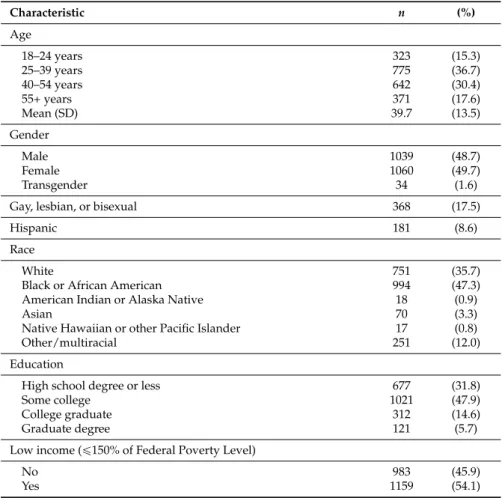
From October 2014 to September 2015, we enrolled 2149 adult current smokers. Study participants were diverse, including a substantial number of African American, sexual minority, low-education, and low-income smokers (Table1). About a third of participants (36%) had tried an e-cigarette but not in the past month, 11% had used an e-cigarette in the past month, and 15% had used an e-cigarette in the past week.
Table 1.Participant characteristics at baseline (n= 2149).
Characteristic n (%)
Age
18–24 years 323 (15.3)
25–39 years 775 (36.7)
40–54 years 642 (30.4)
55+ years 371 (17.6)
Mean (SD) 39.7 (13.5)
Gender
Male 1039 (48.7)
Female 1060 (49.7)
Transgender 34 (1.6)
Gay, lesbian, or bisexual 368 (17.5)
Hispanic 181 (8.6)
Race
White 751 (35.7)
Black or African American 994 (47.3)
American Indian or Alaska Native 18 (0.9)
Asian 70 (3.3)
Native Hawaiian or other Pacific Islander 17 (0.8)
Other/multiracial 251 (12.0)
Education
High school degree or less 677 (31.8)
Some college 1021 (47.9)
College graduate 312 (14.6)
Graduate degree 121 (5.7)
Low income (ď150% of Federal Poverty Level)
No 983 (45.9)
Int. J. Environ. Res. Public Health2016,13, 788 4 of 10
Table 1.Cont.
Characteristic n (%)
Household income, annual
$0–$24,999 1155 (54.5)
$25,000–$49,999 538 (25.4)
$50,000–$74,999 202 (9.5)
$75,000+ 224 (10.6)
Study site
California 1186 (55.2)
North Carolina 963 (44.8)
Cigarettes smoked per day, mean (SD) 8.8 (6.9)
Made quit attempt in past month 545 (26.5)
E-cigarette use
Never used 828 (39.0)
Used but not in past month 750 (35.5)
Used in past month 223 (10.6)
Used in past week 312 (14.8)
Number of times used e-cigarette in past month, mean (SD) 1.38 (4.1)
Talked to someone about e-cigarettes in past month 962 (45.3)
Recommended e-cigarettes for any reason 577 (27.2)
Recommended e-cigarettes for health reasons 513 (24.2) Missing demographic data range from 0.7% to 2.2%.
3.1. Conversations about E-Cigarettes
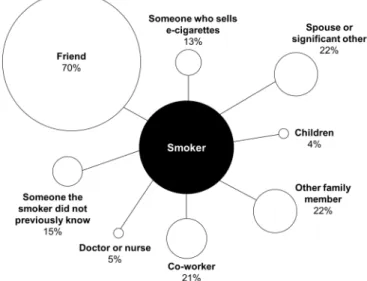
Nearly half of smokers (45%) reported talking to at least one person about e-cigarettes in the past month. These smokers talked to an average of 2.1 people about e-cigarettes during this time period. About two-thirds (69%) talked to an e-cigarette user, and 42% talked to a non-user. Among participants who talked to someone about e-cigarettes in the past month, most (70%) reported talking with a friend (Figure1). Participants most commonly talked about using e-cigarettes to quit or cut back on smoking (58%; Table2), what e-cigarettes are or how they work (43%), and preferences for brand, type, or flavor (41%).
Int. J. Environ. Res. Public Health 2016, 13, 788 4 of 10
Table 1.Cont.
Characteristic n (%)
Low income (≤150% of Federal Poverty Level)
No 983 (45.9)
Yes 1159 (54.1)
Household income, annual
$0–$24,999 1155 (54.5)
$25,000–$49,999 538 (25.4)
$50,000–$74,999 202 (9.5)
$75,000+ 224 (10.6)
Study site
California 1186 (55.2)
North Carolina 963 (44.8)
Cigarettes smoked per day, mean (SD) 8.8 (6.9)
Made quit attempt in past month 545 (26.5)
E-cigarette use
Never used 828 (39.0)
Used but not in past month 750 (35.5)
Used in past month 223 (10.6)
Used in past week 312 (14.8)
Number of times used e-cigarette in past month, mean (SD) 1.38 (4.1)
Talked to someone about e-cigarettes in past month 962 (45.3)
Recommended e-cigarettes for any reason 577 (27.2)
Recommended e-cigarettes for health reasons 513 (24.2)
Missing demographic data range from 0.7% to 2.2%.
3.1. Conversations about E-Cigarettes
Nearly half of smokers (45%) reported talking to at least one person about e-cigarettes in the past month. These smokers talked to an average of 2.1 people about e-cigarettes during this time period. About two-thirds (69%) talked to an e-cigarette user, and 42% talked to a non-user. Among participants who talked to someone about e-cigarettes in the past month, most (70%) reported talking with a friend (Figure 1). Participants most commonly talked about using e-cigarettes to quit or cut back on smoking (58%; Table 2), what e-cigarettes are or how they work (43%), and preferences for brand, type, or flavor (41%).
Int. J. Environ. Res. Public Health2016,13, 788 5 of 10
Table 2.Topics of conversation about e-cigarettes (n= 962).
Topic n(%)
Using them to quit or cut back on smoking 557 (58) What e-cigarettes are or how they work 412 (43) Preferences for brand, type, or flavor 393 (41) Where to buy them or how much they cost 365 (38) How they affect your health 293 (30)
Where I can use them 229 (24)
3.2. Recommending E-Cigarettes
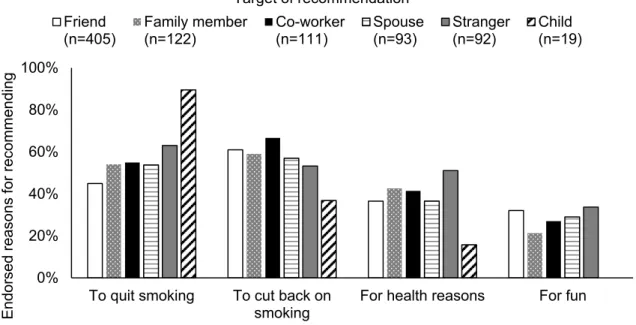
Nearly a third of participants (577/2149, 27%) had recommended e-cigarettes to someone else (Table1). Among these 577 people, the most common recommendation was to friends (71%), but it was also common to recommend to family members (21%), co-workers (19%), spouse or significant other (17%), someone they did not previously know (16%), and their children (3%). Participants recommended e-cigarettes for an average of 1.7 reasons, most commonly recommending them to cut back on smoking (57%), to quit smoking (48%), for health reasons (36%), and for fun (27%). The reasons for recommending e-cigarettes varied somewhat by type of social contact (Figure2). For example, smokers frequently recommended that their children use e-cigarettes to quit smoking, but never for fun. Due to small cell sizes and the exploratory nature of these analyses, we did not test whether differences were statistically significant.
Table 2. Topics of conversation about e-cigarettes (n = 962).
Topic n(%)
Using them to quit or cut back on smoking 557 (58)
What e-cigarettes are or how they work 412 (43)
Preferences for brand, type, or flavor 393 (41)
Where to buy them or how much they cost 365 (38)
How they affect your health 293 (30)
Where I can use them 229 (24)
3.2. Recommending E-Cigarettes
Nearly a third of participants (577/2149, 27%) had recommended e-cigarettes to someone else (Table 1). Among these 577 people, the most common recommendation was to friends (71%), but it was also common to recommend to family members (21%), co-workers (19%), spouse or significant other (17%), someone they did not previously know (16%), and their children (3%). Participants recommended e-cigarettes for an average of 1.7 reasons, most commonly recommending them to cut back on smoking (57%), to quit smoking (48%), for health reasons (36%), and for fun (27%). The reasons for recommending e-cigarettes varied somewhat by type of social contact (Figure 2). For example, smokers frequently recommended that their children use e-cigarettes to quit smoking, but never for fun. Due to small cell sizes and the exploratory nature of these analyses, we did not test whether differences were statistically significant.
Figure 2. Reasons for recommending e-cigarettes to social contacts (n = 577).
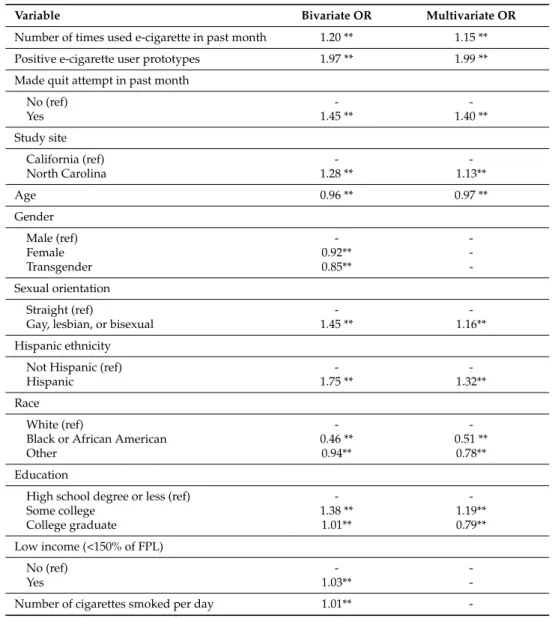
In adjusted analyses, each additional day of e-cigarette use in the past month was associated with 1.15 greater odds of recommending e-cigarettes for health reasons (p < 0.001; Table 3). Positive e-cigarette user prototypes were associated with greater odds of recommending e-cigarettes for health reasons (OR = 1.99, p < 0.001), as was having made a quit attempt in the past month (OR = 1.40, p < 0.05). Older participants and Black or African American participants had lower odds of recommending e-cigarettes for health reasons (OR = 0.97 and OR = 0.51, respectively, both p < 0.001). Variables associated in bivariate but not multivariate analyses were living in North Carolina; being gay, lesbian, or bisexual; Hispanic ethnicity; and having attended some college. The pattern of statistical significance for multivariate regression was identical when restricting analyses to smokers who had tried e-cigarettes.
0% 20% 40% 60% 80% 100%
To quit smoking To cut back on
smoking For health reasons For fun
Endorsed reasons
for
recommendin
g
Target of recommendation Friend
(n=405) Family member(n=122) Co-worker(n=111) Spouse(n=93) Stranger(n=92) Child(n=19)
Figure 2.Reasons for recommending e-cigarettes to social contacts (n= 577).
Int. J. Environ. Res. Public Health2016,13, 788 6 of 10
Table 3.Correlates of recommending e-cigarettes for health reasons (n= 1820).
Variable Bivariate OR Multivariate OR
Number of times used e-cigarette in past month 1.20 ** 1.15 **
Positive e-cigarette user prototypes 1.97 ** 1.99 **
Made quit attempt in past month
No (ref) -
-Yes 1.45 ** 1.40 **
Study site
California (ref) -
-North Carolina 1.28 ** 1.13**
Age 0.96 ** 0.97 **
Gender
Male (ref) -
-Female 0.92**
-Transgender 0.85**
-Sexual orientation
Straight (ref) -
-Gay, lesbian, or bisexual 1.45 ** 1.16**
Hispanic ethnicity
Not Hispanic (ref) -
-Hispanic 1.75 ** 1.32**
Race
White (ref) -
-Black or African American 0.46 ** 0.51 **
Other 0.94** 0.78**
Education
High school degree or less (ref) -
-Some college 1.38 ** 1.19**
College graduate 1.01** 0.79**
Low income (<150% of FPL)
No (ref) -
-Yes 1.03**
-Number of cigarettes smoked per day 1.01**
-Analyses included data from 1820 smokers, a sample that reflects the exclusion of 64 participants who recommended e-cigarettes only for fun and 265 additional participants with missing values for at least one of the predictor variables. The multivariate model included variables withp-values < 0.10 in bivariate analyses. *p< 0.05, **p< 0.001.
4. Discussion
introducing the concept of e-cigarettes to more substantive commentary about how e-cigarettes work and how they affect your health. Indeed, the conversations in our study focused on the health effects of e-cigarettes and whether they can help smokers quit or cut back on smoking. These findings suggest that informal conversations may be filling in the gaps that have resulted from a lack of understanding about the longer-term effects of e-cigarettes.
We also aimed to describe who smokers recommend e-cigarettes to and why they recommend them. Nearly a third of our sample of smokers had recommended e-cigarettes to someone, most commonly to friends, family members, co-workers, and spouses/significant others. Smokers recommended e-cigarettes to cut back on smoking, to quit smoking, for health reasons, and for fun. Although some evidence indicates that e-cigarettes may help people quit smoking [4,5], other studies suggest that e-cigarettes may make it harder to quit [6,7], potentially leading to dual use (i.e., concurrent use) of both cigarettes and e-cigarettes. Dual use of these products, even with the goal of reducing cigarette consumption, is concerning because quitting smoking altogether yields much greater health benefits than reducing smoking [22]. Moreover, gradual reduction in smoking is associated with lower rates of long-term abstinence compared to abrupt quitting [23]. In light of conflicting research on e-cigarettes as a cessation tool, the American Heart Association in the U.S. determined that there is not enough evidence for physicians to recommend e-cigarettes as a primary cessation aid, but that physicians should be prepared to counsel smokers on e-cigarettes and support their use in certain circumstances [24]. Smokers’ recommendations that others use e-cigarettes to quit or cut back on smoking should not take the place of physician counseling. The extent to which smokers’ recommendations promote e-cigarette use and dual use merits attention in future longitudinal studies. Finally, we aimed to identify factors that influenced whether smokers recommend e-cigarettes for health reasons. We found that frequency of e-cigarette use was associated with greater odds of recommending e-cigarettes for health reasons. Frequent users may have positive experiences with and attitudes toward e-cigarettes, which could drive them to recommend use to others. We also found that smokers who had positive perceptions of the typical e-cigarette user (i.e., positive e-cigarette user prototypes) were more likely to recommend e-cigarettes for health reasons. Positive images of e-cigarettes and e-cigarette users prevail in tobacco industry advertising [25–28], which could lead to positive prototypes of e-cigarette users. These prototypes could not only increase willingness to use e-cigarettes as hypothesized in the prototypes/willingness model [20], but could also drive smokers to recommend e-cigarettes to others. Smokers who had made a quit attempt in the past month were more likely to recommend e-cigarettes for health reasons. As trying to quit or reduce smoking is a common reason for continued use of e-cigarettes among smokers [29], those who have attempted to quit smoking may subsequently be more likely to recommend using e-cigarettes for health reasons than other smokers.
Int. J. Environ. Res. Public Health2016,13, 788 8 of 10
e-cigarettes and could shape the nature of these social interactions in order to influence attitudes and behavior about e-cigarettes. However, designing appropriate messages about e-cigarettes will be challenging given the dearth of research on the long-term effects of e-cigarettes.
Strengths of this study include a large sample of smokers and novel, cognitively-tested measures on social interactions about e-cigarettes. However, the generalizability of our results to other populations, such as non-smokers or rural smokers, has yet to be established. These data are largely exploratory, so we are unable to determine how social interactions may influence subsequent e-cigarette-related attitudes and behavior. Relying on self-report may have limited the accuracy of recalled information about social interactions. The data were collected in the context of a randomized controlled trial, but trial arm was not associated with our outcome of recommending e-cigarettes to others.
5. Conclusions
Our study of 2149 U.S. adult smokers described participants’ conversations about e-cigarettes (Aim 1), who they recommend e-cigarettes to and why they recommend them (Aim 2), and which factors influenced whether smokers recommend e-cigarettes for health reasons (Aim 3). We found that conversations about e-cigarettes were prevalent and most frequently focused on using e-cigarettes to quit or cut back on smoking. Nearly a third of smokers recommended e-cigarettes to others, usually for health reasons such as quitting or cutting back on smoking. Frequency of e-cigarette use, positive e-cigarette user prototypes, and making a quit attempt were associated with a greater likelihood of recommending e-cigarettes for health reasons. Conversations about e-cigarettes are a popular source of information-sharing among smokers, highlighting an opportunity for health communication campaigns to shape the nature of these conversations. Future research should examine the extent to which social interactions influence subsequent attitudes, norms, and behaviors about e-cigarettes.
Supplementary Materials: The following are available online at www.mdpi.com/1660-4601/13/8/788/s1, Table S1: Survey items.
Acknowledgments:Research reported in this publication was supported by The National Cancer Institute and FDA Center for Tobacco Products (CTP) under Award Number P30CA016086-38S2. F31CA196037 from the National Cancer Institute of the National Institutes of Health supported Marissa G. Hall’s time writing the paper. The content is solely the responsibility of the authors and does not necessarily represent the official views of the National Institutes of Health or the Food and Drug Administration. The authors thank the research participants for taking part in this study. The authors also thank the Pacific Institute for Research and Evaluation for assistance with participant recruitment and data collection.
Author Contributions:Marissa G. Hall conducted statistical analyses and drafted the manuscript, with guidance from Noel T. Brewer. Jessica K. Pepper developed some of the measures. All authors provided critical feedback on drafts of the manuscript and approved the final manuscript.
Conflicts of Interest:The authors declare no conflict of interest.
References
1. King, B.A.; Patel, R.; Nguyen, K.H.; Dube, S.R. Trends in awareness and use of electronic cigarettes among U.S. adults, 2010–2013.Nicotine Tob. Res.2015,17, 219–227. [CrossRef] [PubMed]
2. Schoenborn, C.A.; Gindi, R.M.Electronic Cigarette Use among Adults: United States, 2014; NCHS Data Brief; National Center for Health Statistics: Hyattsville, MD, USA, 2015; pp. 1–8.
3. Nutt, D.J.; Phillips, L.D.; Balfour, D.; Curran, H.V.; Dockrell, M.; Foulds, J.; Fagerstrom, K.; Letlape, K.; Milton, A.; Polosa, R.; et al. Estimating the harms of nicotine-containing products using the MCDA approach.
Eur. Addict. Res.2014,20, 218–225. [CrossRef] [PubMed]
4. McRobbie, H.; Bullen, C.; Hartmann-Boyce, J.; Hajek, P. Electronic cigarettes for smoking cessation and reduction.Cochrane Database Syst. Rev.2014,12, CD010216. [PubMed]
6. Grana, R.; Benowitz, N.; Glantz, S.A. E-cigarettes: A scientific review. Circulation2014, 129, 1972–1986. [CrossRef] [PubMed]
7. Kalkhoran, S.; Glantz, S.A. E-cigarettes and smoking cessation in real-world and clinical settings: A systematic review and meta-analysis.Lancet Respir. Med.2016,4, 116–128. [CrossRef]
8. Southwell, B.G.; Yzer, M.C. The roles of interpersonal communication in mass media campaigns.Commun. Yearb.2007,31, 420. [CrossRef]
9. Southwell, B.G.; Yzer, M.C. When (and why) interpersonal talk matters for campaigns.Commun. Theory
2009,19, 1–8. [CrossRef]
10. Hall, M.G.; Peebles, K.; Bach, L.E.; Noar, S.M.; Ribisl, K.M.; Brewer, N.T. Social interactions sparked by pictorial warnings on cigarette packs.Int. J. Environ. Res. Public Health2015,12, 13195–13208. [CrossRef] [PubMed]
11. Noar, S.M.; Hall, M.G.; Francis, D.; Ribisl, K.M.; Pepper, J.; Brewer, N.T. Pictorial cigarette pack warnings: A meta-analysis of experimental studies.Tob. Control2015,25, 341–354. [CrossRef] [PubMed]
12. Christakis, N.A.; Fowler, J.H. The collective dynamics of smoking in a large social network.N. Engl. J. Med.
2008,358, 2249–2258. [CrossRef] [PubMed]
13. Pepper, J.K.; Emery, S.L.; Ribisl, K.M.; Brewer, N.T. How U.S. adults find out about electronic cigarettes: Implications for public health messages.Nicotine Tob. Res.2014,16, 1140–1144. [CrossRef] [PubMed] 14. Zhu, S.H.; Gamst, A.; Lee, M.; Cummins, S.; Yin, L.; Zoref, L. The use and perception of electronic cigarettes
and snus among the U.S. population.PLoS ONE2013,8, e79332. [CrossRef] [PubMed]
15. Emery, S.L.; Vera, L.; Huang, J.; Szczypka, G. Wanna know about vaping? Patterns of message exposure, seeking and sharing information about e-cigarettes across media platforms.Tob. Control2014,23, iii17–iii25. [CrossRef] [PubMed]
16. Brewer, N.T.; Hall, M.G.; Noar, S.M.; Parada, H.; Stein-Seroussi, A.; Bach, L.E.; Hanley, S.; Ribisl, K.M. Effect of pictorial cigarette pack warnings on changes in smoking behavior: A randomized clinical trial.
JAMA Intern. Med.2016,176, 905–912. [CrossRef] [PubMed]
17. Willis, G.B.Cognitive Interviewing: A Tool for Improving Questionnaire Design; Sage Publications, Incorporated: Thousand Oaks, CA, USA, 2004.
18. McCool, J.; Cameron, L.; Petrie, K. Stereotyping the smoker: Adolescents’ appraisals of smokers in film.
Tob. Control2004,13, 308–314. [CrossRef] [PubMed]
19. McCool, J.; Cameron, L.D.; Robinson, E. Do parents have any influence over how young people appraise tobacco images in the media?J. Adolesc. Health2011,48, 170–175. [CrossRef] [PubMed]
20. Gerrard, M.; Gibbons, F.X.; Houlihan, A.E.; Stock, M.L.; Pomery, E.A. A dual-process approach to health risk decision making: The prototype willingness model.Dev. Rev.2008,28, 29–61. [CrossRef]
21. Gibbons, F.X.; Gerrard, M. Predicting young adults’ health risk behavior. J. Pers. Soc. Psychol. 1995,69, 505–517. [CrossRef] [PubMed]
22. U.S. Department of Health and Human Services.The Health Consequences of Smoking—50 Years of Progress: A Report of the Surgeon General; U.S. Department of Health and Human Services, Centers for Disease Control and Prevention; Office on Smoking and Health, National Center for Chronic Disease Prevention and Health Promotion: Atlanta, GA, USA, 2014.
23. Lindson-Hawley, N.; Banting, M.; West, R.; Michie, S.; Shinkins, B.; Aveyard, P. Gradual versus abrupt smoking cessation: A randomized, controlled noninferiority trial. Ann. Intern. Med.2016,164, 585–592. [CrossRef] [PubMed]
24. Bhatnagar, A.; Whitsel, L.P.; Ribisl, K.M.; Bullen, C.; Chaloupka, F.; Piano, M.R.; Robertson, R.M.; McAuley, T.; Goff, D.; Benowitz, N. Electronic cigarettes: A policy statement from the american heart association.
Circulation2014,130, 1418–1436. [CrossRef] [PubMed]
25. De Andrade, M.; Hastings, G.; Angus, K.; Dixon, D.; Purves, R.The Marketing of Electronic Cigarettes in the UK; Cancer Research UK: London, UK, 2013; pp. 1–101.
26. Pepper, J.K.; Emery, S.L.; Ribisl, K.M.; Southwell, B.G.; Brewer, N.T. Effects of advertisements on smokers’ interest in trying e-cigarettes: The roles of product comparison and visual cues. Tob. Control2014, 23, iii31–iii36. [CrossRef] [PubMed]
Int. J. Environ. Res. Public Health2016,13, 788 10 of 10
28. Richardson, A.; Ganz, O.; Vallone, D. Tobacco on the web: Surveillance and characterisation of online tobacco and e-cigarette advertising.Tob. Control2015,24, 341–347. [CrossRef] [PubMed]
29. Pepper, J.K.; Ribisl, K.M.; Emery, S.L.; Brewer, N.T. Reasons for starting and stopping electronic cigarette use.
Int. J. Environ. Res. Public Health2014,11, 10345–10361. [CrossRef] [PubMed]
30. McAfee, T.; Davis, K.C.; Alexander, R.L., Jr.; Pechacek, T.F.; Bunnell, R. Effect of the first federally funded U.S. antismoking national media campaign.Lancet2013,382, 2003–2011. [CrossRef]
31. Thrasher, J.F.; Abad-Vivero, E.N.; Huang, L.; O’Connor, R.J.; Hammond, D.; Bansal-Travers, M.; Yong, H.H.; Borland, R.; Markovsky, B.; Hardin, J. Interpersonal communication about pictorial health warnings on cigarette packages: Policy-related influences and relationships with smoking cessation attempts.
Soc. Sci. Med.2015. [CrossRef] [PubMed]
32. White, V.; Webster, B.; Wakefield, M. Do graphic health warning labels have an impact on adolescents’ smoking-related beliefs and behaviours?Addiction2008,103, 1562–1571. [CrossRef] [PubMed]
33. U.S. Food and Drug Administration; Health and Human Services. Deeming tobacco products to be subject to the federal food, drug, and cosmetic act, as amended by the family smoking prevention and tobacco control act; restrictions on the sale and distribution of tobacco products and required warning statements for tobacco products. Final rule.Fed. Register2016,81, 28973–29106.