Scalariform-to-simple transition in vessel perforation plates triggered by
differences in climate during the evolution of Adoxaceae
Frederic Lens1,*, Rutger A. Vos1, Guillaume Charrier2, Timo van der Niet1,3, Vincent Merckx1, Pieter Baas1, Jesus Aguirre Gutierrez1,4, Bart Jacobs5, Larissa Chacon Doria1, Erik Smets1,5, Sylvain Delzon6and
Steven B. Janssens7 1
Naturalis Biodiversity Center, Leiden University, P.O. Box 9517, 2300RA Leiden, The Netherlands, 2INRA, University of Bordeaux, UMR EGFV, F-33450 Talence, France, 3School of Life Sciences, University of Kwazulu-Natal, P. Bag X01, 3209,
Scottsville, South Africa, 4Institute for Biodiversity and Ecosystem Dynamics, Computation Geo-Ecology, University of Amsterdam, Amsterdam, The Netherlands, 5Section Ecology, Evolution and Biodiversity Conservation, KU Leuven, Belgium,
6
INRA, University of Bordeaux, UMR BIOGECO, F-33450 Talence, France and 7Botanic Garden Meise, Nieuwelaan 38, BE-1860 Meise, Belgium
*For correspondence. E-mail [email protected]
Received: 8 June 2016 Returned for revision: 8 June 2016 Accepted: 10 June 2016 Published electronically: 7 August 2016
Background and AimsAngiosperms with simple vessel perforations have evolved many times independently of
species having scalariform perforations, but detailed studies to understand why these transitions in wood evolution have happened are lacking. We focus on the striking difference in wood anatomy between two closely related gen-era of Adoxaceae,ViburnumandSambucus, and link the anatomical divergence with climatic and physiological insights.
MethodsAfter performing wood anatomical observations, we used a molecular phylogenetic framework to
mate divergence times for 127 Adoxaceae species. The conditions under which the genera diversified were esti-mated using ancestral area reconstruction and optimization of ancestral climates, and xylem-specific conductivity measurements were performed.
Key Results Viburnum, characterized by scalariform vessel perforations (ancestral), diversified earlier than
Sambucus, having simple perforations (derived). Ancestral climate reconstruction analyses point to cold temperate preference forViburnumand warm temperate forSambucus. This is reflected in the xylem-specific conductivity rates of the co-occurring species investigated, showing thatViburnum lantanahas rates much lower thanSambucus nigra.
Conclusions The lack of selective pressure for high conductive efficiency during early diversification of
Viburnumand the potentially adaptive value of scalariform perforations in frost-prone cold temperate climates have led to retention of the ancestral vessel perforation type, while higher temperatures during early diversification of
Sambucushave triggered the evolution of simple vessel perforations, allowing more efficient long-distance water transport.
Key words: Adoxaceae, ancestral area and climate reconstruction, Baileyan wood trends, molecular dating,
Sambucus,Viburnum, vessel perforation plate transition, wood anatomy.
INTRODUCTION
Baileyan trends in wood anatomy are arguably one of the most common textbook examples of evolutionary patterns in plant anatomy. This assertion of a set of linear ancestral-to-derived transformation series in wood anatomical features found its ori-gin in a broad comparison of the size of water-conductive cells in woody land plants (Bailey and Tupper, 1918). Later, Bailey’s student Frost (1930a, b) hypothesized that long and slender gymnosperm tracheids lost pit membranes in their scalariform end-wall pitting, and evolved into long, narrow angiosperm ves-sel elements with scalariform perforations including many bars (often>20). These vessel elements, considered ancestral within angiosperms due to their strong resemblance to tracheids of the gymnosperm outgroup, further developed into wider and thus
hydraulically more efficient water conducting cells (Carlquist, 1975; Sperry et al., 2007). In addition, vessel elements also shortened and at the same time the number of bars in the perfor-ation plates reduced to zero, leading to short vessel elements with simple perforations. Interestingly, scalariform perforations were much more abundant in the Cretaceous than in the Tertiary (Wheeler and Baas, 1991), but in-depth palaeobotanical evi-dence fully supporting the Baileyan trends remains weak due to the scarcity of early woody angiosperms in the fossil record. For instance, two of the earliest vessel-bearing wood types are found in taxa with scalariform perforations (Icacinoxylon) or simple perforations (Paraphyllantholoxylon) (Wheeler and Lehman, 2009;Falcon-Langet al., 2012).
The scalariform-to-simple transition was established inde-pendently of any classification system, and was therefore hailed
VC The Author 2016. Published by Oxford University Press on behalf of the Annals of Botany Company.
This is an Open Access article distributed under the terms of the Creative Commons Attribution License (http://creativecommons.org/licenses/ by/4.0/), which permits unrestricted reuse, distribution, and reproduction in any medium, provided the original work is properly cited. doi:10.1093/aob/mcw151, available online at www.aob.oxfordjournals.org
as a basis for identifying phylogenetic relationships among woody angiosperms (Bailey, 1957). However, Bailey and his students realized that vessel characters were prone to conver-gent evolution and that the use of homoplasious characters in the Tree of Life leads to erroneous conclusions (Bailey, 1944, 1957; confirmed in Baas and Wheeler, 1996). However, they never postulated a cause driving the transition, which is one of the major critiques of Bailey’s legacy (exhaustively discussed in Olson, 2012,2014). It was only in the 1960s that Sherwin Carlquist placed the Baileyan trends in an adaptive framework. Carlquist pioneered the idea that evolution towards simple ves-sel perforations was driven by more hydraulic efficiency when plants moved from ever-wet or cold temperate habitats to (sea-sonally) dry habitats (Carlquist, 1966,1975). Later studies con-firmed Carlquist’s view, stating that scalariform perforations are retained in taxa that do not face selective pressure for high conductive efficiency, while a seasonal or permanent demand for great hydraulic efficiency in dry and/or warm areas has trig-gered species to evolve simple perforations, allowing more effi-cient long-distance water transport and thus more carbon fixation (e.g.Baas, 1976;Baaset al., 1983;Jansenet al., 2004). However, this scalariform-to-simple transition in vessel perfor-ation plate morphology has been little tested in an evolutionary and ecophysiological framework (Sperry et al., 2007; Christman and Sperry, 2010).
We assessed the dynamics of these scalariform-to-simple transitions within the large asterid clade (angiosperms), and se-lected the Adoxaceae genera Viburnum (165 species) and
Sambucus(28 species) – two closely related taxa with strik-ingly different wood anatomy (Metcalfe and Chalk, 1950; Schweingruber, 1990) – as a case study in asterids. We first evaluated the direction of perforation plate transition using phylogenetic estimates from existing sequence data for a set of carefully sampled taxa among the asterids. Then, we integrated original wood anatomical observations of Viburnum and
Sambucuswith an updated molecular phylogeny based on exist-ing and original sequence data from five markers (Eriksson and Donoghue, 1997;Clementet al., 2014). A divergence time esti-mation analysis on both genera and analyses unravelling ances-tral areas and ancesances-tral climate preferences were carried out on this combined molecular dataset to find out when and where
Viburnum and Sambucus diverged from each other. Furthermore, we assessed whether present-day precipitation and temperature BIOCLIM variables (Hijmanset al., 2005) can be linked to the wood anatomical variation observed, and we performed hydraulic conductivity measures in both genera to investigate our hypothesis that the scalariform-to-simple perfor-ation plate shift is driven by peak conductive rates.
We set wished to test the following hypotheses: (1) simple-plated species have evolved many times independently within asterids from scalariform-plated relatives, and follow a unidir-ectional pattern; (2) Viburnum with scalariform perforations diversified first in habitats with low evaporative demands, whileSambucus, having simple vessel perforations, developed later, in hydraulically more demanding regions; (3) scalariform-to-simple perforation plate transitions are driven by selection acting on peak conductive rates; and (4) Viburnum and
Sambucusdiffer dramatically in their wood anatomy, assuming a unique ecological niche for each of the genera based on present-day distribution patterns.
MATERIALS AND METHODS
Wood anatomy
Wood descriptions ofSambucusandViburnumare scattered in the literature, and most wood anatomical studies include only a limited number of species from a restricted geographical area (e.g.Moll and Janssonius, 1920;Kanehira, 1921;Metcalfe and Chalk, 1950;Ogata, 1988;Schweingruber, 1990;Benkova and Schweingruber, 2004;InsideWood, 2004onwards). To expand existing data and to achieve a more representative sampling, we performed original wood anatomical observations of both gen-era, covering the entire distribution range and all major sub-clades according to the latest molecular phylogenies (Eriksson and Donoghue, 1997; Clementet al., 2014). In total, 44 wood specimens belonging to 17Sambuusspecies and 17Viburnum
species were investigated using light microscopy and scanning electron microscopy (Fig. 1, Table 1, Supplementary Data Notes S1 and S2). The methodology of wood sectioning and slide preparation is described in Lens et al. (2005, 2007). In short, wood sections 25 lm thick were made using a sledge microtome (Reichert, Germany). After sectioning, the tissues were bleached with sodium hypochlorite and stained with a mixture of safranin and alcian blue (35:65), dehydrated with 50–75–96 % ethanol and mounted in euparal. Slides were observed using a Leica DM2500 light microscope and photo-graphed with a Leica DFC-425C digital camera (Leica Microscopes, Germany). Detailed wood anatomical
descrip-tions for Viburnum and Sambucus are available in
Supplementary Data Note S2 and Table S1, and follow the IAWA list of microscopic features for hardwood identification (IAWA Committee, 1989). For the terminology of the imper-forate elements, we tend to agree with Carlquist (1984), who links the vessel distribution pattern with the presumed water-conducting capacity of the imperforate elements. Therefore, we prefer to name the imperforate elements in the ground tissue of
Viburnum ‘tracheids’ rather than ‘fibres with distinctly bor-dered pits’, although more experimental studies in Viburnum
should be carried out to support this statement.
To assess the polarity of transitions between vessel perfor-ation plates, we applied a Bayesian framework, using estimates of the phylogeny of 152 carefully selected asterid species, tak-ing into account the variation in vessel perforation plate morph-ology across the asterids (Figs 2 and 3). We want to stress that we only intend to provide a realistic (but not final) estimation of the number of shifts in perforation plates in this huge clade, including about 100 000 (woody and herbaceous) species. Therefore, we used the SUPERSMART pipeline v.0.1.22 (Antonelli et al., 2014) to identify commonly sequenced markers and representative species with sufficient published se-quence coverage (matK,n¼133;ndhF,n¼121;rbcL,n¼110 and rps16, n¼71; accession numbers are given in Supplementary Data Table S2). We aligned the markers using MAFFT v. 7.130b (Katohet al., 2002) with default settings and autoselected alignment strategy, which chose FFT-NS-i for
matK,ndhFandrbcL, and L-INS-i forrps16. We concatenated the alignments into a supermatrix and analysed this using ExaBayes v. 1.4.1 under default settings (Abereret al., 2014) to construct a posterior sample of trees, which we rooted on Cornales.
We used our posterior sample of trees to run comparative analyses of transitions between scalariform and simple using BayesTraits v. 2.0 (Meade and Pagel, 2014), which we ran as Markov chain Monte Carlo (MCMC) analyses using an
exponential prior for the transition rates and using a stepping stone sampler (Xieet al., 2011) to obtain estimates of the mar-ginal likelihoods. We did this for different instantaneous transi-tion rate matrices: unconstrained; transitransi-tion rate from simple to FIG. 1. Illustrations of light microscope wood sections (A, B, E, F) and scanning electron microscope surfaces (C, D) showing the marked wood anatomical differ-ence betweenViburnum(A, C, E) andSambucus(B, D, F). (A)V. prunifolium: transverse section, vessels mainly solitary, apotracheal axial parenchyma diffuse in aggregates (arrows). (B)S. glauca: transverse section, vessels in distinct clusters, axial parenchyma scanty paratracheal (arrows). (C)V. furcatum: radial section, sca-lariform vessel perforations with many bars (arrows). (D)S. javanica: radial section, simple vessel perforations (horizontal arrow). (E)V. opulus: tangential section,
long multiseriate rays due to long uniseriate ends (arrows). (F)S. glauca: tangential section, multiseriate rays shorter and wider (arrows).
scalariform set to 0, i.e. no reversals; and forward and reverse rates set to equal. We also ran an MCMC analysis to recon-struct ancestral state distributions for all interior nodes
Taxon sampling phylogenetic analysis
We expanded existing phylogenetic studies for Sambucus
based on original sequence data of five molecular markers that had already been used in several publishedViburnum phyloge-nies (trnK,matK,trnS-G,atpB-rbcL, internal transcribed spacer (ITS). The newly generated Sambucus sequences were com-bined with the published sequences of Viburnum and the re-maining genera of the Adoxaceae (Adoxa, Sinadoxa and
Tetradoxa; Eriksson and Donoghue, 1997; Winkworth and Donoghue, 2005;Clement and Donoghue, 2011,2012;Chatelet
et al., 2013; Schmerleret al., 2012;Clement et al., 2014). In our sampling, Sambucus is represented by 27 species,
Viburnum by 97 species and the small herbaceous genera
Adoxa,SinadoxaandTetradoxaby one species each (seeNote S1 for detailed species list). Members of the sister family Caprifoliaceae s.l., Weigela praecoxandDiervilla sessilifolia, were selected as outgroup.
Species, subspecies and synonyms inSambucus
The number of species inSambucusis still under debate. During his revisions of the genus,von Schwerin (1909,1920)reduced the number ofSambucusspecies from over 100 to 28. A more recent re-vision byBolli (1994)further reduced the number of taxonomically valid species names to nine. However, Bolli’s morphological species concept remains ambiguous and needs to be adjusted, which was later confirmed by molecular phylogenetic studies (Eriksson and Donoghue, 1997;Clarke and Tobutt, 2006). An aim of the present study is to further contribute to clarifying species relationships within
Sambucus, but fully resolving species boundaries is beyond the scope of this paper.
Molecular protocols and sequence analyses
DNA isolation followed the protocol ofJanssenset al.(2006, 2009), whereas amplification of trnK,matK,trnS-G,atpB-rbcL
and ITS was carried out followingYounget al.(1999),Clement
and Donoghue (2011), Manen et al. (1994) and White et al.
(1990), respectively. Contiguous sequences were assembled using Geneious v. 7.0.6 (Biomatters, New Zealand). Automatic alignments were carried with MAFFT (Katohet al., 2002) under an E-INS-i algorithm. Subsequent manual fine-tuning of the aligned dataset was done in Geneious v. 7.0.6. Gaps were treated as missing data, whereas potentially informative insertions and deletions were coded according to the ‘simple indel coding’ method ofSimmons and Ochoterena (2000). Analyses performed without gap coding did not change the topology.
The best-fit nucleotide substitution model for each plastid and nuclear dataset was determined using jModelTest 2.1.4. (Posada, 2008) under the Akaike information criterion (AIC). The GTRþIþG model was found as best fit fortrnS-Gand
trnK, whereas the GTRþG model was calculated as best sub-stitution model formatKand ITS, and F81þI as best substitu-tion model for atpB-rbcL. A mixed-model approach was used in which the combined dataset was partitioned in order to apply a different model of evolution on each DNA region (Ronquist and Huelsenbeck, 2003). Bayesian inference analyses were con-ducted with MrBayes v. 3.1 (Huelsenbeck and Ronquist, 2001) on five individual data partitions and a combined data matrix. Each analysis was run twice for 10 million generations. Trees were sampled every 2500 generations. Inspection of chain con-vergence and effective sample size (ESS) parameters was done with TRACER v. 1.4 (Rambaut and Drummond, 2007). Only Bayesian posterior probabilities (BPPs) above 095 were taken into consideration (Suzukiet al., 2002).
Divergence time analysis
The node ages within the Adoxaceae were estimated based on a calibrated ultrametric phylogenetic tree (Fig. 4). The tree was calibrated using a combination of primary calibration points based on the ages of well-identified fossils available for
SambucusandViburnum, and a secondary calibration point for the age of Adoxaceae from a previous dating analysis (Janssens
et al., 2009). Three calibration points were used for age estima-tion: (1) minimum crown age constrained at 38 million years ago (Ma) forSambucus(crown age) based on fossil endocarps from the late Eocene to Pliocene found in Europe (Reid and Chandler, 1926); (2) crown age of Viburnumconstrained at a minimum age of 478 Ma, corresponding to the report of fossil TABLE1.Overview of wood anatomical characters summarizing the most important differences betweenSambucusandViburnum
Distinguishing wood features Viburnum Sambucus
Vessel perforation type scalariform (often>20 bars) Simple
Vessel element length (mm) 700–1600 300–500
Vessel distribution Vessels solitary: VGI<15 Vessels grouped: 2<VGI<5
Intervessel pits Opposite, scalariform or a mixture of both Alternate
Vascular tracheids – þ
Imperforate tracheary elements in the ground tissue Elements with distinctly bordered pits Elements with simple to minutely bordered pits Axial parenchyma distribution Diffuse apotracheal or diffuse in aggregates Scanty paratracheal
Number of cells per axial parenchyma strand Often 5–8 Often 3 or 4
Vessel-ray pitting Distinct borders Reduced borders
Number of rows of marginal ray cells per multiseriate ray Variable: 1–15 1 or 2
Multiseriate ray height (mm) Often 600–2500 400–600
Uniseriate ray density (mm1) Often 3–10 0–2
VGI, Vessel Grouping Index.
Cornales (n = 7, p = 1·00)
Ericales
Ericaceae
lamiids
campanulids
Dipsacales
Apiales
Araliaceae Viburnum/Sambucus
1·00
1·00
1·00
1·00
1·00
1·00 1·00
1·00
1·00
1·00
0·98
0·53 1·00
1·00
1·00
0·84 1·00
1·00
0·70 1·00
1·00
1·00 1·00
1·00
1·00 1·00
1·00
1·00
Simple perforation plate Scalariform perforation plate
1·00 0·94 0·94
0·95
0·99 0·91 0·61
0·83 1·00
1·00 0·90 0·99
0·85 1·00
1·00 0·77
0·63 0·62
0·96 1·00
0·98
0·59 0·66
0·75 1·00
0·90 1·00
1·00
1·00 1·00
1·00
1·00
1·00
1·00
1·00
balsaminoid Ericales (n = 5, p = 1·00) Clavija domingensis
Diospyros lotus
Fouquieriaceae (n = 2, p = 1·00) Lecythidaceae s.l. (n = 5, p = 1·00) Sapotaceae (n = 2, p = 1·00) Styrax americana
Symplocos caudata Stewartia sinensis Saurauia tristyla Clethra arborea Cyrilla racemiflora Enkianthus campanulatus Erica carnea
Kalmia polifolia Prionotes cerinthoides Dracophyllum strictum Needhamiella pumilio Lyonia ovalifolla Oxydendron arboreum Pieris formosa
Dimorphanthera megacalyx Vaccinium membranaceum Garryales (n = 3, p = 1·00) Lamiales (n = 12, p = 1·00) Solanales (n = 3, p = 0·99) Boraginales (n = 3, p = 1·00) Gentianales (n = 6, p = 1·00) Metteniusaceae (n = 2, p = 0·83) Oneotheca balansae
Cassinopsis ilicifolia Icacina (n = 2, p = 1·00) Aquifoliales (n = 3, p = 1·00) Cardiopteris quinqueloba Discophora guianensis Lasianthera africana Rousseaceae (n = 3, p = 1·00) Pentaphragma ellipticum Alseuosmlaceae (n = 3, p = 1·00) Argophyllaceae (n = 2, p = 1·00) Phelline lucida
early diverging Asteraceae (n = 3, p = 1·00) Escalloniales (n = 3, p = 1·00)
Bruniales (n = 2, p = 1·00) Paracryphiales (n = 3, p = 1·00) Sambucus (n = 3, p = 1·00) Viburnum (n = 3, p = 1·00) Diervilla sessillfolia Diervilla rivularis Weigela (n = 2, p = 1·00) Heptacodium miconioides Lonicera (n = 3, p = 1·00) Leycesteria formosa
Symphortcarpos (n = 2, p = 1·00) Zabelia (n = 3, p = 1·00) Dipelta (n = 2, p = 1·00) Abelia chinensis Diabelia serrata Kolkwitzia amabllis Abelia floribunda Vesalea coriacea
Pennantiaceae (n = 2, p = 1·00) Aralidium pinnatifidum Melanophylla alnifolia Torricellia tiliifolia
Griseliniaceae (n = 2, p = 1·00) Pittosporaceae (n = 3, p = 1·00) Myodocarpus fraxinifolius
early diverging Apiaceae (n = 3, p = 0·90) Mackinlaya confusa
Mackinlaya macrosciadia Aralia stellata
Hedera helix Plerandra insolita Schefflera hypoleucoides Cheirodendron trigynum Tupidanthus calyptratus Macropanax undulatus Kalopanax septolobus Trevesia palmata
FIG. 2. Majority-rule consensus tree topology summarizing the Bayesian comparative analysis of the evolutionary dynamics of transitions between scalariform (green) and simple (red) perforation plate types in asterids. Values on interior nodes are clade posterior probabilities. Pie charts on interior nodes are ancestral state reconstructions proportional to the probability of the respective reconstruction. Clades that are monophyletic as well as uniform in their character state are shown col-lapsed; the number of subtended species and the posterior probability of the root of the clade are given in parentheses. The scalariform plate perforation type is
recon-structed as ancestral, with numerous independent transitions to the simple plate perforation type (at least 10), but note the apparent reversal forLeycesteria.
leaves from the middle Eocene Jijuntun formation (Wanget al., 2010); and (3) Adoxaceae crown node set at 799 Ma, based on the large asterid analysis of Janssens et al. (2009), which matched the dating analysis ofBremer et al.(2004). The two fossil calibration points used in this study were modelled in BEAST v. 1.8.0 under a log-normal distribution (Drummond and Rambaut, 2007), with an offset that equals the age of the fossil calibration point, a mean of 10 and a standard deviation of 10. The third calibration point was given a normal distribu-tion with a mean value and standard deviadistribu-tion of 50 (cf. Janssenset al., 2009).
Av2likelihood ratio test, used to assess rate heterogeneity among lineages (Felsenstein, 1988), indicated that the substitu-tion rates in the combined dataset are not clock-like (P<0001 for all markers). We therefore used a Bayesian approach as im-plemented in BEAST to calculate divergence times. To initiate the Bayesian dating analysis and to cope with the zero likeli-hood issue in BEAST, we used a starting tree that was obtained by carrying out a maximum likelihood analysis on the com-bined dataset in RAxML 7.2.8 (Stamatakiset al., 2008) under a GTRþG model with the rooted likelihood tree as input tree for a penalized likelihood analysis in r8s 170 (Sanderson, 2004), with all calibration points used as described above. Because of differences in substitution models among the indi-vidual chloroplast genes and ITS, we performed a partitioned Bayesian MCMC analysis under the assumption of the Yule speciation model and a relaxed log-normal clock. Partitions were unlinked for the model of DNA sequence evolution. All other priors were kept as defaults. Two runs of 20 million gen-erations were performed, sampling every 2000 gengen-erations. Convergence of the chains (the ESS parameter exceeding 200)
was carried out with TRACER v.1.6 (Rambaut and
Drummond, 2007). The two runs were combined, discarding the initial 2 million generations as burn-in using Logcombiner v. 1.8.0, and a maximum clade credibility tree using a posterior probability limit of 05 was calculated using TreeAnnotator v.1.8.0 (Drummond and Rambaut, 2007).
Ancestral area reconstruction
Reconstruction of ancestral distribution ranges was carried out following the dispersal–extinction–cladogenesis model of Lagrange (Ree et al., 2005; Ree and Smith, 2008; Fig. 4). Lagrange scripts were generated using the online Lagrange con-figurator (www.reelab.net/lagrange/configurator/index). The maximum clade credibility tree obtained from the dating ana-lysis with BEAST v. 1.8.0 was used as input tree. In total, 14 areas were defined based on known distribution ranges of spe-cies within the Adoxaceae and delimited using Takhtajan’s (1986) floristic regions of the world (Fig. 4). Maximum range size was defined at 2 (only three out of 141 taxa investigated in the ancestral area analysis occur in more than one distribution area, and were also set at 2). Dispersal effectiveness was set at ‘symmetric’, but configured between each distribution area. Whereas adjacent regions were set at 10, dispersal effective-ness was set at 07 between non-adjacent regions on the same continent and adjacent regions on different continents. Dispersal effectiveness was set at 02 between non-adjacent re-gions on different continents.
Due to the uncertain phylogenetic position ofV. clemensae
among the earlier-diverging lineages of Viburnum, we ran an alternative ancestral area reconstruction analysis in which V. clemensae was constrained as sister species to all other
Viburnum species (cf.Moore and Donoghue, 2007;Schmerler
et al., 2012). All parameters used were the same as in our ori-ginal analysis.
Ancestral climate preference reconstruction
Bayesian stochastic character mapping (BSCM) as imple-mented in SIMMAP 1.5 was applied to reconstruct the ancestral preference in climate conditions in Adoxaceae (Bollback, 2006; Fig. 4). Climate preference was scored as follows: (1) tropical; (2) warm temperate; and (3) cold temperate. Distribution data from the Global Biodiversity Information Facility (GBIF) were used to assess climate types, after being screened for erroneous localities. The GBIF coordinates obtained from species investi-gated were plotted on the updated Ko¨ppen–Geiger climate clas-sification (Kottek et al., 2006) using DIVA-GIS (Hijmans
et al., 2011). Next, species were scored in one of the broad cli-mate types according to the clicli-mate zone that corresponds to the plotted distribution range of each species analysed. In add-ition, elevation ranges were taken into consideration to assess the exact climate preference for each species. In order to guar-antee a uniform method for evaluating the climate preference for all our Adoxaceae accessions, thereby avoiding putative bias that could affect the results of our overall climate prefer-ence analysis, we ignored the Schmerler et al. (2012) GBIF dataset forViburnumand built our own.
Climate types are regarded as unordered with weight 1. Five thousand randomly sampled Bayesian topologies from the BEAST output file [generated by the ‘sub-sample tree’ function in BayesRate 15 (Silvestroet al., 2011)] were used as topology input. Hyperparameters defining the mean (E) and standard de-viation accommodates the bias rate parameterIand the substitu-tion rate parameter h. A flat prior was used for the bias rate parameterI in all analyses. Due to the significant influence of
E(h) and standard deviation. (h) on the overall outcome of each
200
150
100
50
0
0 5 10
Instantaneous transition rate Forward and reverse rates
Frequency
15
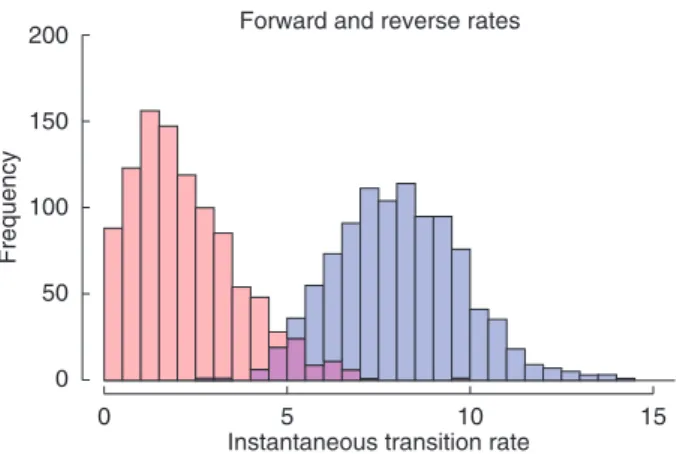
FIG. 3. Distributions of instantaneous transition rates between scalariform and simple vessel perforation plates. Estimates of instantaneous transition rates from scalariform to simple (forward rates, violet) and simple to scalariform (reverse rates, salmon) across 106iterations (less 10 k burn-in) of MCMC ancestral state
reconstruction using BayesTraits on the posterior tree sample (n¼722) for the asterids. Transitions from scalariform to simple occur at significantly higher
rates than reversals, and the latter are not significantly different from zero.
Viburnum adenophorum Viburnum luzonicum Viburnum melanocarpum Viburnum setigerum Viburnum erosum Viburnum japonicum Viburnum wrightii Viburnum parvifolium Viburnum dilatatum Viburnum betulifolium Viburnum brachyandrum Viburnum foetidum Viburnum integrifolium Viburnum hupehense Viburnum flavescens Viburnum ichangense Viburnum lobophyllum Viburnum coriaceum Viburnum cylindricum Viburnum hebanlhum Viburnum kansuense Viburnum orientale Viburnum lernatum Viburnum acerifolium Viburnum koreanum Viburnum edule Viburnum opulus Viburnum Iriphyllum Viburnum ayavacense Viburnum hallii Viburnum pichinchense Viburnum seemanii Viburnum divaricatum Viburnum jamesonii Viburnum toranis Viburnum dentatum Viburnum scabrellum Viburnum costaricanum Viburnum stenocalyx Viburnum ciliatum Viburnum villosum Viburnum hartwegii Viburnum jucundum Viburnum lautum Viburnum sulcatum Viburnum obtusatum Viburnum loeseneri Viburnum caudatum Viburnum discolor Viburnum blandum Viburnum molle Viburnum rafinesquianum Viburnum australe Viburnum ellipticum Viburnum propinquum Viburnum cinnamomifolium Viburnum davidii Viburnum calvum Viburnum atrocyaneum Viburnum rigidum Viburnum tinus Viburnum Ireleasei Viburnum oliganthum Viburnum erubesens Viburnum subalpinum Viburnum farreri Viburnum suspensum Viburnum odoratissimum Viburnum awabuki Viburnum sieboldii Viburnum colebrookeanum Viburnum lutescens Viburnum plicatum Viburnum urceolatum Viburnum laiwanianum Viburnum furcatum Viburnum sympodiale Viburnum lantanoides Viburnum clemensae Viburnum burjaelicum Viburnum lantana Viburnum mongolicum Viburnum buddleifolium Viburnum rhytidophyllum Viburnum veitchii Viburnum macrocephalum Viburnum bitchiuense Viburnum carlesii Viburnum schensianum Viburnum utile Viburnum punctatum Viburnum elatum Viburnum rufidulum Viburnum prunifolium Viburnum lentago Viburnum nudum Viburnum cassinoides I J I I * * * * * * * * * * * * * * * * * * * * * * * * * * * * * * * * * * * * * * * I I I I I I I IJ I I I
I NI
I I I E CI CI E I IJ I I I I IJ IJ N I N I C C B B C C M M C M M M M M M M C CI C C C I C E B B B B B B B B C C M M M M M M M M M M M M M C C C C I I I I I I Cret.
80 55 50 45 40 35 30 25 20 15 10 5 0
Pal. Eocene Oligocene Miocene Plio. Ple.
I I I I CI I I CI CI C C C C I I I I I I I I I I I I I I IN I D D DE D E E E D I I I I I IN IN I N N IJ I I I I I C C J I EF I I I I I I I I I I C C C C C C
Adoxa - Tetradoxa Sinadoxa- Sambucus WT WT WT CT Late Paleocene A B WT PT T T T A A CT A A A T
FIG. 4. Palaeomaps and maximum clade credibility phylogeny forViburnum(A, B) andSambucus(C, D) inferred from combined ITS,trnK,matK,atpB-rbcLand
trnS-Gas obtained from BEAST. (A, C) Palaeomap ofViburnum(A) andSambucus(C) during initial diversification of both genera. The red X marks the putative area(s) of initial diversification. A, Arid; WT, warm temperate; CT, cold temperate; T, tropical; PT, paratropical. (B, D) Maximum clade credibility phylogeny show-ing results from ancestral area reconstruction and ancestral climate reconstruction. Bayesian posterior probabilities (BPPs) are displayed above branches; asterisks in-dicate a BPP value095, whereas BPP values between 05 and 095 are indicated by circles. Ancestral area reconstructions (AARs) with the highest likelihood value are shown as boxes at each node. A single box refers to a specific distribution range, whereas multiple boxes occurring either above or below indicate alterna-tive AARs. The following abbreviations are used: A, South American Central Atlantic; B, South American Andes; C, North America; D, Macaronesia; E, Europe; F, North African Mediterranean and Atlas; G, Montane Eastern Africa; H, Western Himalaya; I, Subtropical-Temperate East Asia; J, Malesia and Indochina; K, Western Australia; L, Northeastern Siberia and Kamchatka; M, Caribbean; N, Western India and Sri Lanka. Pie charts at each node show the posterior probability of each possible climate type for the ancestral climate preference reconstruction (blue, cold temperate climate; green, warm temperate climate; orange,
tropical climate).
analysis, they were independently selected for each character using the ‘number of realizations sampled from priors’ function as implemented in SIMMAP (Couvreur et al., 2008; Janssens
et al., 2012). Once the optimized hyperparameters are estimated, the impact of the standard deviation (h) value becomes insignifi-cant and the meanE(h) value can be optimized for each charac-ter. As a result, the standard deviation (h) is set at 2. We also carried out an alternative climate preference reconstruction in whichV. clemensaewas constrained as sister species to all re-mainingViburnumspecies using the same parameters.
Present climate preference analysis
A phylogenetically broad selection of geographic locations obtained from the GBIF website forViburnum andSambucus
species was analysed using principal components analysis (PCA). This PCA was used as a visualization tool to assess po-tential differences between the ecological niches occupied by the two genera based on present-day distribution data (using the 19 scaled/centred WorldClim bioclimatic variables; Hijmans
et al., 2005). In total, 12 483 geographic locations from 30
Viburnum species were analysed. ForSambucus, 16 746 loca-tions from 14 species were included in the PCA (see Supplementary Data Fig. S1 for species list). For Sambucus nigra, a random set of 1000 geographic locations from its full distribution was taken from the 206 000 that were available, preventing the niche of the genus from being represented by largely one species.
Xylem specific conductivity (Ks) measurements
Six equally sized (>1 m in length, 7–9 mm in diameter), leaf-bearing branches ofViburnum lantanaandSambucus nigra
were sampled in the neighbourhood of Bordeaux in a public park in Gradignan (branches about 4–5 years old) and a more mesic forest in Madirac (branches about 2–3 years old; France), respectively, immediately put in a sealed plastic bag after removing the leaves, and stored in a refrigerator overnight. First, air was injected at one side of the branch at 2 bars to as-sess the maximum vessel length for both species. Then, we trimmed stem segments corresponding to70 % open vessels under water (40 cm forV. lantanaand 10 cm forS. nigra), and
C D Sambucus tigranii Sambucus mandshurica Sambucus racemosa Sambucus kamtschatica Sambucus sieboldiana Sambucus williamsii Sambucus sachalinensis Sambucus microbotrys Sambucus callicarpa Sambucus pubens Sambucus maderensis Sambucus palmensis Sambucus nigra Sambucus canadensis Sambucus peruviana Sambucus glauca Sambucus mexicana Sambucus caerulea Sambucus australis Sambucus gaudichaudiana Sambucus australasica Sambucus javanica Sambucus chinensis Sambucus adnata Sambucus africana Sambucus ebulus Sambucus wightiana Adoxa moschatellina Tetradoxa omeiensis Sinadoxa corydalifolia Viburnum Weigela praecox Diervil/a sessilifolia E E EI CE L L I I I C C C D D E E D C C CI C C K C CI CI Cretaceous
85 80 60 55 50 45 40 35 30 25 20 15 10 5 0
Palaeocene Eocene Oligocene Miocene Plio. Ple.
C C I I I I I
I I I
I I I C C B C C K J I I I I I I H E G E C C C D D E C B C CM C A K K J C HI G EF H CEI I I I I I I I I I WT WT WT CT Late Eocene WT PT T T T A A CT A A A * * * * * * * * * * * * * * * * * * * * * * * * * *
FIG. 4. Continued.
flushed the stems with 2 bars for 15–30 min using a solution of 10 mM KCl and 1 mM CaCl2 with the XYL’em apparatus (Bronkhorst, Montigny-les-Cormeilles, France). The maximum specific conductivity was determined based on the gravity method (Alderet al., 1997) using the software program gravi-flow v. 1.1 with four increasing pressure heads (1–3 kPa for each 10-cm branch, 3–5 kPa for each 40-cm branch). Conductance was calculated as the slope of the relation be-tween flow rate and pressure gradient. After the measurements, cross-sections were made and photographed (according to the method described above in the section Wood anatomy) to cal-culate specific conductivity (Ks), by multiplying by sample length and dividing by xylem area. Feret diameter of each indi-vidual vessel and vessel density was measured by creating a binary image with an adjusted threshold and using the ‘analyze particles’ function of ImageJ software (http://rsb.info.nih.gov/ij) for about 3000 vessels per section (five sections per species).
RESULTS
Wood anatomy ofSambucusandViburnum, and broad
phylogenetic comparative analysis of vessel perforation plates in asterids
The wood anatomical descriptions of Sambucusand Viburnum
are summarized inNotes S1 and S2 and Table 1, and illustrated in Fig. 1. Character coding of the perforation states for the broadly sampled asterids and the accession numbers of sequences used in their phylogenetic analysis are shown inTable S2.
The Bayesian phylogenetic supermatrix analysis for the broadly sampled asterids converged quickly and resulted in a posterior sample (n¼722, after discarding burn-in of 10 %) that implied well-supported clades [mean posterior probability (PP) on nodes under all-compatible consensus, i.e. on a fully resolved tree, 0856026] that conform well to the common understanding of the systematics of this group. The ancestral state reconstructions suggest that the scalariform perforation type is ancestral for the asterids as a whole, as well as within the Paracryphiales–Dipsacales clade, and that there are three shifts in the latter towards simple perforations: one leading to
Sambucus; one leading to Heptacodium and relatives (Caprifoliaceae) and one toZabelia(Fig. 2).
Within Caprifoliaceae there is evidence for one reversal back to scalariform perforations inLeycesteria. However, constrain-ing simple-to-scalariform reversals to a rate of 0 (i.e. no rever-sals, marginal lnL 76079555) is overall statistically indistinguishable from the unconstrained model [marginal lnL 76811068; in a Bayes factor (BF) analysis the test statistic is the absolute difference between these marginal likelihoods, which in this case does not exceed 1, i.e. not significant]. In contrast, scalariform-to-simple transitions far exceed reversals (Fig. 3), such that constraining forward and reverse transitions rates to equal yields a significantly poorer fit (marginal lnL -79150205, BF¼2339137 compared with the unconstrained model).
Molecular phylogenetics of Adoxaceae
Since the phylogenetic relationships within Viburnum and
Sambucusare not the focus of this paper, we list here the main
results briefly, and comment in more detail about the relation-ships inSupplementary Data Note S3.Viburnumis sister to all remaining Adoxaceae genera and Sambucus is sister to the clade containingAdoxa,SinadoxaandTetradoxa(cf. previous papers listed inNote S3; Fig. 4). OurViburnumtopology sup-ports previous work (cf. previous papers listed inNote S3), ex-cept for the position of Viburnum section Valvatotinus sensu
Winkworth and Donoghue (2005), which comes out as the ear-liest-diverging clade in our study. Studies by Donoghue and collaborators fixV. clemensaeas root prior, making this species sister to the remainingViburnumspecies. InSambucus, species of the sectionEbulus sensuHara (1983)are sister to the remain-der of the genus (Fig. 4). The rest of the clade contains the monophyleticSambucussectionBotryosambucusand the para-phyletic sectionSambucus sensuBolli (1994).
Divergence time estimates
After 20 million generations, all parameters and age estima-tions had reached ESS values of >200. Adoxaceae were esti-mated to have a range in crown node age of 751–864 Ma [95 % highest posterior density (HPD), mean age 80.6 Ma, cali-bration point used 799 Ma]. This suggests an origin in the Late Cretaceous (Fig. 4). The range in crown node age forViburnum
was estimated to be 499 – 630 Ma (95 % HPD, mean age 561 Ma, calibration point used 478 Ma; Late Palaeocene), whereas its stem node age is similar to the crown node age of the Adoxaceae. The split of Sambucus and the lineage towards
Adoxa,TetradoxaandSinadoxaoccurred in the Palaeocene, with an estimated mean age of 584 Ma (95 % HPD 488 – 661 Ma). Diversification ofSambucusoccurred in the Late Eocene at an estimated mean age of 409 Ma (95 % HPD 384 – 449 Ma). At the end of the Oligocene,Sinadoxasplit off from the ancestor of
AdoxaandTetradoxa(95 % HPD 134–391 Ma, mean age esti-mate 232 Ma), whereasAdoxadiversified fromTetradoxain the Miocene (95 % HPD 48–247 Ma, mean age estimate 135 Ma). Within Sambucus, most of the diversification occurred be-tween 20 and 4 Ma (Fig. 4). The initial diversification in the genus in the Late Eocene resulted in two major lineages (spe-cies of section Ebulus, and species of sections Sambucusand
Botryosambucus, respectively), which in turn started to diver-sify during the Oligocene (Sambucus, 95 % HPD 136–375 Ma and mean age estimate 243 Ma; Botryosambucus, 95 % HPD 214 – 406 Ma and mean age estimate 317 Ma). The
Sambucusclade that contains species from sectionsSambucus
and Botryosambucus is characterized by two small, early-diverging lineages successively branching off in the Oligocene, and the large split between sectionBotryosambucusand the re-mainder of species from sectionSambucusoccurred during the Late Oligocene (95 % HPD 158–338 Ma, mean age estimate 242 Ma). Divergence of both groups potentially occurred dur-ing the Miocene (Fig. 4).
For Viburnum, we observed an initial split during the Late Palaeocene, which resulted in two major lineages (a clade with species of sectionValvatotinusand a clade with the remaining
Viburnumspecies, respectively;Fig. 4). Whereas the clade con-taining species ofV.sectionValvotinusonly started to diversify in the Oligocene (95 % HPD 216 – 435 Ma, mean age estimate 322 Ma), the latter clade had already diverged earlier during
the Early to Middle Eocene (95 % HPD 412–586 Ma, mean age estimate 486 Ma).
Ancestral area reconstruction
Hardly any ambiguous ancestral area reconstruction was observed, with relative probability values for the nodes of interest nearly always at least 20 % higher than the next ancestral area al-ternative. From the 126 nodes analysed, 111 had a relative prob-ability value for a certain ancestral area above 50 %, whereas 79 nodes had a relative probability value above 90 %. According to our analysis, Adoxaceae as a whole, as well as the ancestral lin-eage towardsSambucus,Adoxa,Sinadoxaand Tetradoxa, have an East Asian (I) origin (Fig. 4). Therefore, stem lineages of both
ViburnumandSambucushave an East Asian (I) origin as well. At the time of initial divergence of Sambucus, a split can be observed into an East Asian (I) and an East Asian (I) or North American (C) lineage. ForViburnum, the earliest split results in an East Asian (I) and an East Asian (I) or combined East Asian– North American (CI) lineage (Fig. 4). The alternative ancestral area reconstruction analysis in which V. clemensae was con-strained as sister species to extantViburnumspecies provided re-sults similar to those of the original analysis, thereby demonstrating that the different position ofV. clemensaedid not have a significant impact on the overall ancestral area analysis of
ViburnumandSambucus.
Ancestral climate preference reconstruction
Plotting climate conditions onto the Adoxaceae phylogeny showed that the majority of lineages within Sambucus have a warm temperate preference, whereas the earliest diversification events within Viburnumshow a cold temperate climate prefer-ence (Fig. 4). Nevertheless, several shifts from warm temperate to tropical or to cold temperate and vice versa have occurred within both genera. Our results reveal that the most recent com-mon ancestor ofSambucushas a PP of 082 to be of warm tem-perate origin (013 cold temperate and 005 tropical origin). In contrast, the ancestor ofViburnumhas a PP of 052 to be of cold temperate origin (036 warm temperate origin and 012 tropical origin). The alternative ancestral climate preference reconstruc-tion analysis with V. clemensae constrained as sister to extant
Viburnum species revealed similar but less pronounced results than in the original analysis:Sambucushas a PP of 080 to be of warm temperate origin (012 cold temperate and 008 tropical origin), whereasViburnumhas a PP of 045 to be of cold temper-ate origin (035 warm temperate and 021 tropical origin).
Present climate preference reconstruction
The climatic niche ofViburnumlargely overlaps with that of
Sambucusbased on present-day distribution data.Viburnumhas a broader climatic niche, while Sambucusis more confined to regions with smaller extremes in precipitation and temperature throughout the year (Fig. S1). More specifically,Sambucus spe-cies occur in regions with less extreme temperatures during the warmest period of the year, with less extreme precipitation dif-ferences throughout the year and lower mean temperatures.
Xylem specific conductivity (Ks) measures
Mean (6s.e.)KsofS. nigrawas three times higher than inV. lantana(5866 13 versus 1926 026 m2s1MPa1104) for the stem segments representing 70 % open vessels. Standardizing sample length based on percentage of open ves-sels is important due to the shorter vesves-sels in Sambucus com-pared withViburnum (maximum vessel length 025 and 09 m, respectively). Mean (6s.e.) vessel diameter of both species was similar (2586 6 040 and 2589 6 027 lm, respectively), while the vessel density inS. nigrawas significantly higher than inV. lantana(327622 and 215612 mm2, respectively).
DISCUSSION
Direction of the scalariform–simple perforation plate shifts within asterids is consistent with Baileyan trends, although reversals may occur
The wood anatomy ofViburnumperfectly fits with that of the Dipsacales outgroup Paracryphiales – characterized by an ex-tremely large number of bars in scalariform perforation plates of up to 100 and more (Patel, 1973;Baas, 1975;Dickison and Baas, 1977) – and agrees with other early-diverging asterid lin-eages, thereby supporting its plesiomorphic nature (Fig. 2). Likewise, the evolution from scalariform towards simple per-foration plates in Adoxaceae confirms the unidirectionality of the Baileyan trends, and represents one of numerous (at least ten) independent scalariform-to-simple transitions within aster-ids (Fig. 2;Baas and Wheeler, 1996;Lenset al., 2007,2008). However, the unidirectionality may not always apply in aster-ids:Fig. 2suggests one reversal from simple to scalariform ves-sel perforations in the caprifoloid Leycesteria, and additional reversals may occur in species having mixed simple and scalari-form perforations that can occur even within the same vessel or vessel element, as in Araliaceae (Oskolski and Jansen, 2009) or Ericaceae (Lenset al., 2003,2004b,c). Nevertheless, the pre-ponderance of the evidence suggests that scalariform-to-simple transitions significantly exceed reversals, and that the paucity of reversals makes them statistically indistinguishable from their complete absence in our present analysis (Fig. 3).
The scalariform-to-simple perforation plate shift in Adoxaceae is driven by peak conductive rates
Our mean age estimates for the Adoxaceae are slightly older than those computed by Moore and Donoghue (2007) and Magallonet al.(2015), probably caused by differences in sam-pling, fossil calibration points and methods of analysis, but there is still an overlap between the 95 % confidence intervals of the two studies. We found that early diversification within
Viburnum, showing scalariform vessel perforations with many (on average >20) bars, happened during the Late Palaeocene, which is about 15 million years earlier than the initial diversifi-cation of the simple-plated Sambucus clade during the Late Eocene (Fig. 4). Most likely, the difference in timing of early divergence between ViburnumandSambucusallowed them to evolve in different niches, as supported by the ancestral climate preference reconstruction for Adoxaceae (Fig. 4): the earliest diversification events withinViburnumlikely happened in cold
temperate regions, while those of Sambucusoccurred in warm temperate conditions. Thus, our analyses suggest that differ-ences in temperature are associated with the scalariform-to-simple perforation plate transition in Adoxaceae.
The temperature scenario underlines our current ecological knowledge of wood anatomy, stating that species with scalari-form perforations such as Viburnum typically occur in cool (and often mesic) regions that are characterized by low evap-orative demands, while simple-plated species are often native to (seasonally) dry habitats (Carlquist, 1975;Baaset al., 1983; Jansenet al., 2004). This trade-off between type of vessel per-foration and environment has been poorly investigated using xylem hydraulics. Based on the single-vessel technique, Christman and Sperry (2010)found experimental evidence that scalariform vessel perforations of diverse morphology double the lumen flow resistance, thereby impeding water flow much more than previously estimated based on models (e.g.Ellerby and Ennos, 1998;Schulte, 1999). Our hydraulic measures ofV. lantanaandS. nigrausing standardized stem segments includ-ing 70 % open vessels and similar vessel diameters support this evidence. We found xylem-specific conductivity values three times higher in the simple-platedS. nigracompared with the scalariform-plated V. lantana, thereby confirming differ-ences in Ks reported in the literature between Sambucus and
Viburnum (25–33 and 13 m2 s1 MPa1 104 respectively; Sperryet al., 2005;Beikircher and Mayr, 2009). In other words, it is plausible to assume that selection for peak conductive rates has triggered scalariform-to-simple perforation plate transitions.
Although there is still controversy about the adaptive role of scalariform perforation plates, freezing temperatures may have been essential during the cold temperate climate in which the earliest divergingViburnumspecies evolved (Fig. 4). Some au-thors claim that the closely spaced bars in the perforations can trap small freezing-induced air bubbles, thereby preventing det-rimental levels of embolism when negative pressures in the transpiration stream increase (Zimmermann, 1983). However, other authors observed similar amounts of winter embolism in scalariform and simple-plated species of similar vessel size (Ewers, 1985;Daviset al., 1999) and many scalariform-plated species occur in tropical montane regions that are frost-free (Jansenet al., 2004).
Increasing vessel diameters may compensate for higher flow resistance in scalariform-plated species (cf. Viburnum, see below), but wider vessels make plants more vulnerable to freezing-induced embolism (Charrier et al., 2013, 2014). As mentioned by Davis et al. (1999) and Zanne et al. (2014), 44 mm is the mean hydraulic diameter above which freezing-induced embolisms are becoming frequent at mild negative pressures, agreeing with the mean diameters observed of the temperate viburnums experiencing frost (32 mm) compared with the tropical lowland species (60mm). In addition to vessel perforation plate morphology and vessel diameter, woody angiosperms have evolved an array of solutions to improve their water flow efficiency. Apart from the increased vessel connectivity inSambucuscompared withViburnum(cf.Loepfe
et al., 2007;Sperryet al., 2007;Lenset al., 2011), other poten-tial characters that could contribute to higher xylem-specific conductivity inSambucusare thinner intervessel pit membranes
(Choat et al., 2008; Lenset al., 2011,2013) and higher ionic concentrations in xylem sap (Jansenet al., 2011).
Viburnum: out of the tropics?
The ancestral environment ofViburnumremains a matter of debate because of ambiguities in the relationships of the early diverging species. Based on our wider sampling within Adoxaceae, we found no evidence at all for a tropical ancestral habitat (PP 012) using our uniform methodology to code cli-mate preferences for the species investigated, even in our ana-lysis where we have constrained the tropicalV. clemensae as root prior (PP 021). But in the latestViburnumphylogeny with
V. clemensaeas root prior (Spriggset al., 2015), tropical low-land forests were favoured as the ancestral state, although with poor support.
Out of165Viburnumspecies, only22 truly lowland trop-ical species exist today that grow up to 10–20 m tall (Kern, 1951), with several of them positioned in deep branches within the tree, suggesting thatViburnumhas been slowly dying off in its potentially ancestral habitat (dying embers hypothesis; Spriggset al., 2015). According to this dying embers scenario, scalariform-plated species with decreased hydraulic efficiency growing in strongly competitive lowland forests would be out-competed by more efficient, simple-plated eudicot lineages like
Inga(Richardsonet al., 2001) and mahoganies (Koenenet al., 2015) that have invaded these forests at a later stage (Sperry
et al., 2007). This would probably also explain the worldwide decrease of species with exclusively scalariform perforations from the Cretaceous (70–50 %) towards the current situation (18 %) (Wheeler and Lehman, 2009). This declining trend is even more pronounced in the modern tropical lowlands, where only a minor fraction of the tree species (<10 %) has exclu-sively scalariform perforations (Baas, 1976; Jansen et al., 2004).
Wood anatomical variation betweenViburnumandSambucusis pronounced, but their ecological niches greatly overlap
AlthoughViburnumandSambucusare undeniably close rela-tives, their wood anatomy can hardly be more different from each other with respect to the variation observed across angio-sperms. The key difference lies in vessel characters, but a whole range of additional anatomical patterns co-evolved with the scalariform-to-simple transition in perforation plates (cf.Frost, 1931;Kribs, 1935,1937;Metcalfe and Chalk, 1950; seeTable 1for a list of anatomical characters that co-evolved with perfor-ation plate morphology). Surprisingly, despite their marked wood anatomical divergence, both genera largely overlap in their climatic niche based on present-day distribution data (Fig. S1). This means that the basic wood anatomical bauplan in
Viburnum and Sambucushad already been established during initial diversification, after which no major evolutionary shifts in wood characters have taken place.
WithinViburnum, we did find fine-scale differences between temperate and tropical species. The mature wood samples of the tropicalViburnumspecies studied, which are scattered into several major subclades (Fig. 4;Spriggset al., 2015), differ sig-nificantly at the 001 level in a number of quantitative features
compared with the mature samples of the temperate relatives: the vessels are wider (on average 60 versus 32 mm) and less abundant (42 versus 110 mm2), vessel elements and imperfor-ate tracheary elements are longer (1310 versus 915 mm and 2120 versus 1340 mm, respectively) and rays are taller (1450 versus 670mm;Table S1). This emphasizes that transitions to different climates within Viburnum have led to minor wood anatomical changes in specific cell types, as has been observed in other genera, such as Symplocos (van den Oever et al., 1981), Cornus (Noshiro and Baas, 2000) or Vaccinium (Lens
et al.,2004a). Surprisingly, even the mean number of bars per scalariform perforation plate remains uniform based on our sampling (36 bars in tropical species versus 34 in temperate species). In other words, more efficient water transport in
Viburnumseems to be caused by evolving wider vessels with more widely spaced bars in the perforation plates (following the Hagen–Poiseuille law) instead of developing fewer bars per plate. In addition to the more demanding hydraulic conditions in the tropics, the greater vessel diameters of tropical compared with temperate viburnums could also relate to the taller stature of the tropical species (Olsonet al., 2014).
Concluding thoughts
In summary, asterids with simple vessel perforations have evolved many times independently from scalariform-plated relatives, although reversals may occasionally occur. Early di-versification withinViburnum, characterized by ancestral sca-lariform perforation plates, occurred about 15 million years earlier than the initial diversification ofSambucushaving sim-ple perforations. The sim-plesiomorphic perforation plates of
Viburnumare in agreement with the frost-prone, cold temperate climates that were hypothesized in our ancestral climate prefer-ence reconstruction during the early diversification in the genus, while higher temperatures during early diversification of
Sambucus may have triggered the evolution of simple vessel perforations, allowing improved long-distance water transport efficiency in the xylem. The much higher xylem-specific con-ductivity values ofS. nigracompared withV. lantanaconfirm that the scalariform-to-simple perforation plate transitions are driven by selection acting on peak conductive rates. However, despite marked differences in wood anatomy and hydraulic conductivity between Viburnumand Sambucus, the ecological niches of the two genera based on present-day species distribu-tion patterns largely overlap. Our study provides a first integra-tive approach to the underlying triggers behind the evolution of the scalariform-to-simple transition in perforation plates, but there is ample scope for further investigations of the convergent transitions within angiosperms. After Bailey’s pioneering work almost 100 years ago, we are starting to unravel the mechanism behind one of the most cited textbook examples in evolutionary plant anatomy.
SUPPLEMENTARY DATA
Supplementary dataare available online at www.aob.oxfordjour nals.org and consist of the following. Note S1: species list of wood and DNA samples studied. Note S2: wood description of
Viburnum and Sambucus. Note S3: phylogenetic relationships
withinViburnumandSambucus. Table S1: overview of selected wood anatomical characters within Sambucus and Viburnum
(Adoxaceae). Table S2: sequence accession numbers and vessel perforation types for asterids. Figure S1: climate niche of
SambucusandViburnum.
ACKNOWLEDGEMENTS
We would like to thank the xylaria of Tervuren (Tw), Madison (MADw), Smithsonian USw, and Tsukuba (TWTw) for send-ing wood samples, and Bertie-Joan van Heuven for her valu-able help with sectioning the wood samples. The Australian National Botanic Garden, Royal Botanic Garden Melbourne, Royal Botanic Garden Edinburgh, Botanic Garden University of Ghent, Arboretum Kalmthout (Belgium), Arboretum Hof ter Saksen (Belgium), and Arboretum Provincial Domain Bokrijk (Belgium) are acknowledged for sending leaf samples of
Sambucus. F.L. received support from the Alberta Mennega Foundation. We are grateful to Andrew Meade for his help in interpreting BayesTraits results.
LITERATURE CITED
Aberer AJ, Kobert K, Stamatakis A. 2014. ExaBayes: massively parallel Bayesian tree inference for the whole-genome era.Molecular Biology and Evolution31: 2553–2556.
Alder NN, Pockman WT, Sperry JS, Nuismer S. 1997.Use of centrifugal force in the study of xylem cavitation.Journal of Experimental Botany48: 665–674.
Antonelli A, Condamine FL, Hettling Het al. 2014.SUPERSMART: ecology and evolution in the era of big data.PeerJ PrePrints2: e501v1.
Baas P. 1975. Vegetative anatomy and the affinities of Aquifoliaceae,
Sphenostemon,Phelline, andOncotheca.Blumea22: 311–407.
Baas P. 1976.Some functional and adaptive aspects of vessel member morph-ology. In: Baas P, Bolton AJ, Catling DM, eds.Wood structure in biological and technological research. Leiden Botanical Series No. 3. The Hague, The Netherlands: Leiden University Press, 157–181.
Baas P, Wheeler EA. 1996.Parallelism and reversibility in xylem evolution: a review.IAWA Journal17: 351–364.
Baas P, Werker E, Fahn A. 1983.Some ecological trends in vessel characters.
IAWA Bulletin4: 141–159.
Bailey IW. 1944.The development of vessels in angiosperms and its significance in morphological research.American Journal of Botany31: 421–428. Bailey IW. 1957.The potentialities and limitations of wood anatomy in the study
of the phylogeny and classification of angiosperms.Journal of the Arnold Arboretum38: 243–254.
Bailey IW, Tupper WW. 1918.Size variation in tracheary cells: I. A compari-son between the secondary xylems of vascular cryptogams, gymnosperms and angiosperms. Proceedings of the American Academy of Arts and Sciences USA54: 147–204.
Beikircher B, Mayr S. 2009.Intraspecific differences in drought tolerance and acclimation in hydraulics ofLigustrum vulgareandViburnum lantana.Tree Physiology29: 765–775.
Benkova VE, Schweingruber FH. 2004. Anatomy of Russian woods. Bern: Haupt.
Bollback JP. 2006.SIMMAP version 1.0: a program for stochastic mapping of molecular and morphological characters. http://www.simmap.com/v1.0/sim map.html.
Bolli R. 1994.Revision of the genus Sambucus.Dissertationes Botanicae. Vol. 223.
Bremer K, Friis EM, Bremer B. 2004.Molecular phylogenetic dating of asterid flowering plants shows early Cretaceous diversification.Systematic Biology
53: 496–505.
Carlquist S. 1966.Wood anatomy of Compositae: a summary, with comments on factors controlling wood evolution.Aliso6: 25–44.
Carlquist S. 1975. Ecological strategies of xylem evolution. Berkeley, CA: University of California Press.
Carlquist S. 1984.Vessel grouping in dicotyledon wood: significance and rela-tionships to imperforate tracheary elements.Aliso10: 505–525.
Charrier G, Cochard H, Ame´glio T. 2013.Evaluation of the impact of frost re-sistances on potential altitudinal limit of trees. Tree Physiology 33: 891–902.
Charrier G, Charra-Vaskou K, Kasuga J, Cochard H, Mayr S, Ame´glio T. 2014.Freeze-thaw stress: effects of temperature on hydraulic conductivity and ultrasonic activity in ten woody angiosperms.Plant Physiology164: 992–998.
Chatelet DS, Clement WL, Sack L, Donoghue MJ, Edwards EJ. 2013.The evolution of photosynthetic anatomy in Viburnum (Adoxaceae).
International Journal of Plant Sciences174: 1277–1291.
Choat B, Cobb A, Jansen S. 2008.Structure and function of bordered pits: new discoveries and impacts on whole plant hydraulic function.New Phytologist
177: 608–626.
Christman MA, Sperry JS. 2010.Single-vessel flow measurements indicate scalariform perforation plates confer higher flow resistance than previously estimated.Plant, Cell & Environment33: 431–443.
Clarke JB, Tobutt KR. 2006.Development of microsatellite primers and two multiplex polymerase chain reactions for the common elder (Sambucus nigra).Molecular Ecology Notes6: 453–455.
Clement WL, Arakaki M, Sweeney PW, Edwards EJ, Donoghue MJ. 2014. A chloroplast tree forViburnum(Adoxaceae) and its implication for phylo-genetic classification and character evolution.American Journal of Botany
101: 1029–1049.
Clement WL, Donoghue MJ. 2011. Dissolution of Viburnum section
Megalotinus(Adoxaceae) of South East Asia and its implications for mor-phological evolution and biogeography. International Journal of Plant Sciences172: 559–573.
Clement WL, Donoghue MJ. 2012.Barcoding success as a function of phylo-genetic relatedness in Viburnum, a clade of woody angiosperms. BMC Evolutionary Biology12: 73.
Couvreur TLP, Richardson JE, Sosef MSM, Erkens RHJ, Chatrou LW. 2008.Evolution of syncarpy and other morphological characters in African Annonaceae: a posterior mapping approach.Molecular Phylogenetics and Evolution47: 302–318.
Davis SD, Sperry JS, Hacke UG. 1999.The relationship between xylem con-duit diameter and cavitation caused by freezing.American Journal of Botany86: 1367–1372.
Dickison WC, Baas P. 1977.The morphology and relationships of Paracryphia (Paracryphiaceae).Blumea23: 417–438.
Drummond AJ, Rambaut A. 2007.BEAST: Bayesian evolutionary analysis by sampling trees.BMC Biology7: 214.
Ellerby D, Ennos A. 1998.Resistances to fluid flow of model xylem vessels with simple and scalariform perforation plates.Journal of Experimental Botany49: 979–985.
Eriksson T, Donoghue MJ. 1997. Phylogenetic analyses ofSambucus and
Adoxa(Adoxoideae, Adoxaceae) based on nuclear ribosomal ITS sequences and preliminary morphological data.Systematic Botany22: 555–573. Ewers F. 1985.Xylem structure and water conduction in conifer trees, dicot
trees, and lianas.IAWA Bulletin6: 309–317.
Falcon-Lang H, Wheeler EA, Baas P, Herendeen PS. 2012.A diverse char-coalified assemblage of Cretaceous (Santonian) angiosperm woods from Upatoi Creek, Georgia, USA. Part 1: wood types with scalariform perfor-ation plates.Review of Palaeobotany and Palynology184: 49–73. Felsenstein J. 1988.Phylogenies inferred from molecular sequences: inference
and reliability.Annual Review of Genetics22: 521–565.
Frost FH. 1930a.Specialization in secondary xylem of dicotyledons I. Origin of vessel.Botanical Gazette89: 67–94.
Frost FH. 1930b. Specialization in secondary xylem of dicotyledons II. Evolution of end wall of vessel segment.Botanical Gazette90: 198–212. Frost FH. 1931. Specialization in secondary xylem of dicotyledons III.
Specialization of lateral wall of vessel segment.Botanical Gazette91: 88–96. Gleason SM, Westoby M, Jansen Set al. 2016.Weak tradeoff between xylem safety and xylem-specific hydraulic efficiency across the world’s woody plant species.New Phytologist209: 123–136.
Hara H. 1983.A revision of the Caprifoliaceae of Japan with reference to allied plants in other districts and the Adoxaceae. Tokyo: Academia Scientific Books.
Hijmans RJ, Cameron SE, Parra JL, Jones PG, Jarvis A. 2005.Very high resolution interpolated climate surfaces for global land areas.International Journal of Climatology25: 1965–1978.
Hijmans RJ, Guarino L, Rojas E. 2011.DIVA-GIS, version 7.5. A geograph-ical information system for the analysis of biodiversity data. http://www. diva-gis.org.
Huelsenbeck JP, Ronquist F. 2001.MrBayes: Bayesian inference of phylogen-etic trees.Bioinformatics17: 754–755.
IAWA Committee. 1989.IAWA list of microscopic features for hardwood iden-tification.IAWA Bulletin New Series10: 219–332.
InsideWood. 2004onwards. Search the InsideWood database. http://insidewood. lib.ncsu.edu/search.
Jansen S, Baas P, Gasson P, Lens F, Smets E. 2004.Variation in xylem struc-ture from tropics to tundra: evidence from vesstruc-tured pits.Proceedings of the National Academy of Sciences of the USA101: 8833–8837.
Jansen S, Gortan E, Lens Fet al. 2011.Do quantitative vessel and pit charac-ters account for ion-mediated changes in the hydraulic conductance of angiosperm xylem?New Phytologist189: 218–228.
Janssens SB, Geuten K, Yuan Y-M, Song Y, Ku¨pfer P, Smets E. 2006. Phylogenetics ofImpatiensandHydrocera(Balsaminaceae) using chloro-plastatpB-rbcLspacer sequences.Systematic Botany31: 171–180. Janssens SB, Knox EB, Huysmans S, Smets EF, Merckx VSFT. 2009.Rapid
ra-diation ofImpatiens(Balsaminaceae) during Pliocene and Pleistocene: result of a global climate change.Molecular Phylogenetics and Evolution52: 806–824. Janssens SB, Song Wilson Y, Yuan Y-M, Nagels A, Smets EF, Huysmans S.
2012.A total evidence approach using palynological characters to infer the complex evolutionary history of the Asian Impatiens (Balsaminaceae).
Taxon61: 392–404.
Kanehira R. 1921.Anatomical characters and identification of Formosan woods with critical remarks from the climatic point of view. Taiwan: Government of Formosa.
Katoh K, Misawa K, Kuma K, Miyata T. 2002.MAFFT: a novel method for rapid multiple sequence alignment based on Fourier transform. Nucleic Acids Research30: 3059–3066.
Kern JH. 1951.The genusViburnum(Caprifoliaceae) in Malaysia.Reinwardtia
1: 107–170.
Koenen EJM, Clarkson JJ, Pennington TD, Chatrou LW. 2015.Recently evolved diversity and convergent radiations of rainforest mahoganies (Meliaceae) shed new light on the origins of rainforest hyperdiversity.New Phytologist207: 327–339.
Kottek M, Grieser J, Beck C, Rudolf B, Rubel F. 2006.World Map of the Ko¨ppen-Geiger climate classification updated.Meteorologische Zeitschrift
15: 259–263.
Kribs DA. 1935.Salient lines of structural specialization in the wood rays of di-cotyledons.Botanical Gazette96: 547–557.
Kribs DA. 1937.Salient lines of structural specialization in the wood paren-chyma of dicotyledons.Bulletin of the Torrey Botanical Club64: 177–187. Lens F, Gasson P, Smets E, Jansen S. 2003.Comparative wood anatomy of
epacrids (Styphelioideae, Ericaceae s.l.).Annals of Botany91: 835–856. Lens F, Luteyn JL, Smets E, Jansen S. 2004a.Ecological wood anatomy of
Vaccinioideae (Ericaceae s.l.).Flora199: 309–319.
Lens F, Smets E, Jansen S. 2004b.Comparative wood anatomy of Andromedeae s.s., Gaultherieae, Lyonieae and Oxydendreae (Vaccinioideae, Ericaceae s.l.).Botanical Journal of the Linnean Society144: 161–179.
Lens F, Kron KA, Luteyn JL, Smets E, Jansen S. 2004c.Comparative wood anatomy of the blueberry tribe (Vaccinieae, Ericaceae s.l.).Annals of the Missouri Botanical Garden91: 566–592.
Lens F, Dressler S, Jansen S, Van Evelghem L, Smets E. 2005.Relationships within balsaminoid Ericales: a wood anatomical approach. American Journal of Botany92: 941–953.
Lens F, Scho¨nenberger J, Baas P, Jansen S, Smets E. 2007.The role of wood anatomy in phylogeny reconstruction of Ericales.Cladistics23: 229–254. Lens F, Ka˚rehed J, Baas Pet al. 2008.The wood anatomy of the polyphyletic
Icacinaceae s.l., and their relationships within asterids.Taxon57: 525–552. Lens F, Sperry JS, Christman MA, Choat B, Rabaey D, Jansen S. 2011.
Testing hypotheses that link wood anatomy to cavitation resistance and hy-draulic conductivity in the genusAcer.New Phytologist190: 709–723. Lens F, Tixier A, Cochard H, Sperry JS, Jansen S, Herbette S. 2013.
Embolism resistance as a key mechanism to understand plant adaptive strat-egies.Current Opinion in Plant Biology16: 287–292.
Loepfe L, Martinez-Vilalta J, Pinol J, Mencuccini M. 2007.~ The relevance of xylem network structure for plant hydraulic efficiency and safety.Journal of Theoretical Biology247: 788–803.
Magallon S, Gomez-Acevedo S, Sanchez-Reyes LL, Hernandez-Hernandez T. 2015.A metacalibrated time-tree documents the early rise of flowering plant phylogenetic diversity.New Phytologist207: 437–453.