Tao Yang, Ralph R. Martin, Ming C. Lin, Jian Chang, and Shi-Min Hu
Abstract—In this paper, we present a novelpairwise-force smoothed particle hydrodynamics (PF-SPH) model to allow modeling of various interactions at interfaces in real time. Realistic capture of interactions at interfaces is a challenging problem for SPH-based simulations, especially for scenarios involving multiple interactions at different interfaces. Our PF-SPH model can readily handle multiple kinds of interactions simultaneously in a single simulation; its basis is to use a larger support radius than that used in standard SPH. We adopt a novel anisotropic filtering term to further improve the performance of interaction forces. The proposed model is stable; furthermore, it avoids the particle clustering problem which commonly occurs at the free surface. We show how our model can be used to capture various interactions. We also consider the close connection between droplets and bubbles, and show how to animate bubbles rising in liquid as well as bubbles in air. Our method is versatile, physically plausible and easy-to-implement. Examples are provided to demonstrate the capabilities and effectiveness of our approach.
Index Terms—Smoothed particle hydrodynamics (SPH), pairwise force, surface tension, bubble animation, fluid simulation.
F
1
Introduction
I
n computer graphics, interactions at interfaces between materials in different phases, or immiscible materials in the same phase, have been extensively investigated during the last decade. In this work, we focus on interfaces involving a liquid; thus commonly observed interfaces can be categorized into three classes, between a liquid and a gas, another liquid, or a solid. The gas is mostly considered as air in this paper unless otherwise specified. The interaction between a liquid and air leads to surface tension, which is the main cause of many well known visual effects, including the water crown formed when a droplet falls into a liquid. When two liquids interact, the result of the interaction depends on whether they are miscible or not. In the miscible case, Yang et al. [1] adopted a reactive stress term to describe the effect. In the immiscible case, researchers have mainly focused on high density ratios [2] and interfacial flows [3], [4], [6]. We avoid complex treatments for miscible flows and concentrate on the interactions between different immiscible flows. The interactions between a liquid and a solid are of two main kinds: fluid-solid coupling and adhesion.• Tao Yang is with the TNList, Department of Computer Science & Technology, Tsinghua University, Beijing.
E-mail: [email protected].
• Ralpha R. Martin is with the School of Computer Science & Informatics, Cardiff University, UK.
E-mail: [email protected].
• Ming C. Lin is with the Department of Computer Science, Uni-versity of North Carolina at Chapel Hill, NC.
E-mail: [email protected].
• Jian Chang is with the National Centre for Computer Animation, Bournemouth University, UK.
E-mail: [email protected].
• Shi-Min Hu is with the Department of Computer Science and Technology, Tsinghua University, Beijing and School of Comput-er Science and Informatics, Cardiff UnivComput-ersity, UK.
E-mail: [email protected].
Manuscript received XXXX, 2017; revised XXXX, 2017.
Fluid-solid coupling contributes to macroscopic movements while adhesion is caused by molecular forces and results in various wetting effects. In the real world, many scenarios involve interactions at multiple interfaces. For instance, when cracking an egg, there are simultaneous interactions between air, egg white, egg yolk, and the shell. To capture such phe-nomena, it is crucial to develop a versatile approach that can uniformly handle all types of inter-component interactions.
Interactions arise due to the force between any pair of particles; they can be divided into two types. If the particles belong to two different phases or components, this is an
interfacial interaction. If the particles are from the same group phase or component, their interaction is called cohesion. In the graphics community, air particles are always ignored for particle-based fluid simulations as the interactions between air and a liquid or a solid are relatively insignificant. Both the in-terfacial interaction and the cohesion need to be considered in most multi-phase real-world scenrios; while only the cohesion is needed when capturing the interaction between a liquid and air, which is actually modeled in terms of a single liquid phase in SPH while it is a two-phase phenomenon.
From a microscopic point of view, liquids, gases and solids are all composed of molecules. Physically, interaction forces exist between any pair of molecules, which are repulsive at short-range and attractive at long-range. It is crucial to accurately calculate these forces when handling interactions. Since standard SPH method simulates fluids at a macroscopic level, microscopic interaction forces are largely ignored. The
pairwise-force smoothed particle hydrodynamics (PF-SPH) model was proposed to solve this problem by adding an extra molecular-like interaction force term between pairs of macroscopic SPH particles [17]. Some works (e.g. [11]) have considered simulating surface tension using this model. How-ever, this approach has been criticized for to its relatively poor performance in computer graphics, and alternatives have been suggested based on surface area minimization [12], or surface energy minization in conjunction with air pressure [13]. The PF-SPH model has been successfully used in the last decade in computational physics to capture surface tension and adhe-sion [17], [18], [19], [20]. However, this PF-SPH model cannot be readily adopted in computer graphics as it fails to readily obtain plausible results as argued by [12], [13], [21].
The PF-SPH model is known for being easy-to-implement, cluster-preventing, momentum-conserving, and physically-plausible. In this paper, we extend our earlier conference pa-per with new techniques, and go further to demonstrate how to use the novel PF-SPH model to simulate multi-interaction scenarios. Unlike previous works in computer graphics such as [11], [12], [21], we calculate pairwise forces using a large
neighborhood of particles in conjunction with an anisotropic filtering term, as explained in Section 3. By doing so, the PF-SPH model can accurately capture surface tension without extra forces or constraints. We go on to show this pairwise view can be readily extended to handle a wide range of interactions. Our model is capable of simulating phenomena involving complex interactions in a versatile way, with the help of the mathematical models derived from the field of computational physics. We also show that the proposed model can further be used to animate bubbles, including bubbles rising in a liquid and bubbles in air.
In the rest of the paper, Section 2 discusses related work, while we describe the details of our modified PF-SPH model in Section 3. Methods for handling various interactions in a unified way are explained in Section 4. We provide illustrative examples in Section 5. Finally, limitations and future work are discussed in Section 6.
2
Related Work
In computer graphics, previous work has considered various interactions including surface tension, adhesion, coupling and interfacial flows, mostly focusing on one or two of these interactions. Most methods rely on grid-based simulators to model interfacial flows [3], [4], [5], [6], surface tension [7], [8], and bubbles [8], [9], [22], [23], [24]. Since we focus on particle-based simulations, we do not discuss such work further. We classify the interactions at interfaces into three most common-ly observed categories, i.e., those between a liquid and a gas, or another liquid, or a solid and provide an overview of the work most relevant to this paper.
2.1 Liquid-Gas Interaction and Bubble Animation
The interaction between a liquid and air has been extensively investigated by previous researchers. Early work focused on the continuum surface force (CSF) method [2], [10], [25], which models surface tension based on its effects, aiming to minimize surface curvature. Unfortunately, this model re-lies on accurate curvature and normal estimates, which are sensitive to particle disorder. Solenthaler and Pajarola [2] adopted a smoothed normal estimate to improve the results. Others [11], [17] instead captured surface tension based on its cause and developed the pairwise interaction force method, which works at the molecular level to overcome the limita-tions of the CSF method. It uses a combination of short-range repulsion and long-short-range attraction forces to capture the physical nature of surface tension, avoiding erroneous estimates of curvatures and normals. However, the pairwise forces used result in relatively poor performance [12], [13], [21]. Akinci et al. [12] criticized the poor performance of previous methods and simulated the surface tension force by combining a cohesion term and a surface area minimization term. This gives plausible results, but requires well-designed kernel functions, which cannot easily be extended to handle a variety of interactions at interfaces. Furthermore, surface area minimization is the result of surface tension, not its cause. Most recently, He et al. [13] drew inspiration from the Cahn-Hilliard equation and modeled surface tension by minimizing surface energy in conjunction with air pressure. However, surface energy minimization cannot be accurately implemented using SPH and leads to unsatisfactory results if extra forces are not taken into account. Air pressure is also not the main cause of surface tension.
We also consider bubble animation which requires simu-lating interaction between a liquid and a gas (or air). Bubbles can be classified into two main categories according to where they are, i.e., bubbles in a liquid, and bubbles in air. The animation of bubbles in liquids using particle-based methods has attracted the attention of many researchers. Th¨urey et al. [26] simulated bubbles and foam within a shallow water framework. This framework simplifies the implementation-s due to itimplementation-s implementation-simplified two-dimenimplementation-sional repreimplementation-sentation of a height field, while at the same time limits the applications of their method. Cleary et al. [27] and Ihmsen et al. [28] investigated the complex interactions when air dissolves in the fluid. However, they used discrete spherical particles to represent bubbles or foam, so their methods cannot capture the deformation of bubbles. This issue was solved by incorpo-rating an Eulerian grid-based framework [22]. With the help of a multiphase model, Ihmsen et al. [29] simulated complex bubble flow, including deformation and merging of bubbles. Ren et al. [31] considered bubbles in liquid using a multi-fluid simulation based on a volume fraction representation. Using particle-based frameworks to simulate bubbles in air, however, has received much less attention [21]. In this paper, bubbles in air are modeled as the gas inside, the air outside, and a thin film of a liquid, and can be simulated as droplets.
2.2 Liquid-Liquid Interaction
(a) (b) (c) (d) (e) (f)
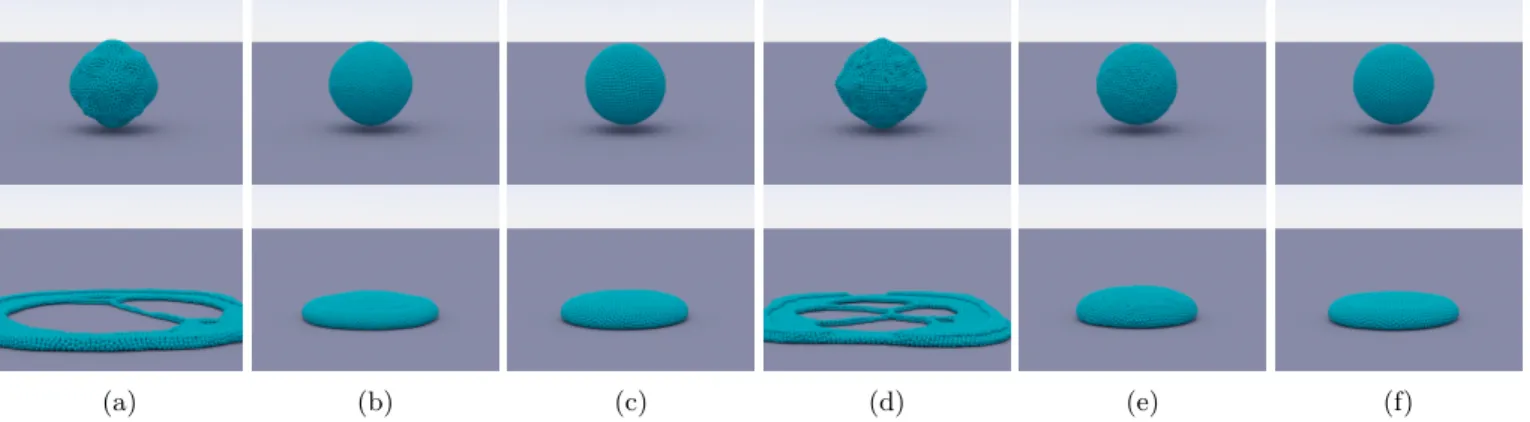
Fig. 1: Results produced by surface tension forces using different modeling approaches; external forces are ignored. Top of each subfigure: configuration reached from a cube. Bottom: result of dropping that configuration onto a plane. Methods used and performances (#P: number of particles, FPS: number of frames per second) are: (a) [17] using a small neighborhood; #P: 6k; FPS: 120, (b) [17] using a large neighborhood (denser particles); #P: 13k; FPS: 60, (c) our refinement of [17]; #P: 6k; FPS: 100, (d) [12] without surface area minimization; #P: 6k; FPS: 120, (e) [12] with surface area minimization; #P: 6k; FPS: 105, (f) our refinement of [12] without surface area minimization; #P: 6k; FPS: 100.
to different fluids. Yang et al. [1] proposed a reactive stress term to capture interactions between miscible phases. Solen-thaler and Pajarola [2] tried to handle fluids with large density differences more precisely by deriving a modified density calculation method. M¨uller et al. [15] noted the significance of liquid-liquid interactions and modeled interfacial forces by combining a number of techniques including continuum surface force and diffusion effects. Macklin et al. [33] simulated immiscible fluids with a density ratio using position-based dynamics, capturing the Rayleigh-Taylor instability.
In this paper, we go further to illustrate the varying patterns of interfacial interactions as shown in Figure 4, which is largely overlooked by previous multi-fluid simulations.
2.3 Liquid-Solid Interaction
The interactions between a liquid and a solid are of two main kinds: fluid-solid coupling and adhesion. Solenthaler et al. [35] used a unified particle model to handle coupling in various fluid-solid interactions including deformable objects; by doing so, they managed to animate the phase change between a fluid and a solid. Ihmsen et al. [36] focused on rigid-fluid couplings and showed that adaptive timesteps are required for boundary handling in a Predictive-Corrective Incompressible SPH (PCISPH) framework. Akinci et al. [16] gave a versatile two-way fluid-solid coupling approach using SPH and per-particle correction of volumes of boundary per-particles. Lately, Shao et al. [37] combined PCISPH and geometric lattice shape matching to achieve two-way fluid-solid coupling with large timesteps.
Turning to adhesion, Clavet et al. [34] modeled the adhe-sion of fluids to solids using a distance-based attractive force. Schechter and Bridson [14] proposed the use of ghost particles for free surface and solid boundary, capturing realistic cohe-sion of liquids to solids. This work was further extended by He et al. [13]; they calculated the air pressure force without sampling ghost air particles, with a significant reduction in memory and computational costs. By using a well-designed kernel function, Akinci et al. [12] managed to capture different wetting effects.
3
Pairwise-Force SPH Model
In this section, we start by introducing the original pairwise-force SPH model [17] in Section 3.1, and then discuss how to improve it for graphical applications based on our earlier conference paper [21] in Section 3.2; the physcial meaning of the pairwise force is also discussed. Finally, we propose an anisotropic filtering term to further refine the improved model in Section 3.3.
3.1 Pairwise Interaction
Physically, neighboring molecules interact with each other, leading to interaction forces, which are the cause of many natural phenomena such as surface tension and adhesion. The basic SPH method simulates fluids at a macroscopic level; therefore, it inevitably ignores inter-molecule forces, lacking the capability to capture various phenomena caused by molecular forces. Since SPH is a particle-based Lagrangian simulator, we may suppose some relationship exists between SPH particles and molecules. Tartakovsky and Meakin [17] proposed the PF-SPH model following this idea. Researchers have attempted to use this model to simulate surface ten-sion [11], [12], adheten-sion [12] in computer graphics. By adding a molecular-force-like pairwise particle-particle interaction term Fint into the conservative SPH approximation of the Navier-Stokes equation, the PF-SPH model states that:
mi
Dui
Dt =Fi+F
int
i , (1)
where mi,ui,Fiint are respectively the mass, velocity, and interaction term for particlei.D/Dtis the substantial deriva-tive corresponding to the Eulerian expression∂/∂t+u·∇. The termFi represents all other forces acting on thei-th particle including pressure force, viscosity force, and body forces.Fint
i can be broken down as:
Fiint=X j
wherefji is the pairwise interaction force with which neigh-boring particle j acts on particle i; note that fji = −fij. Here,
fij=−cijmimjf(rij) rij
rij
, (3) whererij = ri−rj andrij =|rij|.cij(≥0) is a user-tuned coefficient that controls the strength of the interaction force.
f(rij) is a spline function that determines the behavior of the interaction force.
In fluid mechanics, high pressure regions push on lower pressure regions. Pressure plays a key role to keep the fluid incompressible. In basic SPH, the pressure forceFp can be discretized as follows [38]:
Fip=−X j
mimj(
pi+pj
ρiρj
)dW(rij, h)
drij rij
rij
, (4) whereFip, pi, ρiare the pressure force, pressure, and density of particleirespectively.W is a kernel function.
When comparing Eq. (4) with Eqs. (2,3), it turns out that the pressure force and the interaction term share a similar formulation. Tartakovsky and Panchenko [38] noticed this connection and called the interaction term in Eq. (1) thevirial pressure, providing a new view of the pairwise interaction forces.
In computational physics, when each particle has very many neighboring particles in its kernel support domain, the PF-SPH model works well [17], [18], [19]. However, as previously noted, in computer graphics, when using small-er nnumbsmall-er of neighboring particles, this model does not capture plausible interactions at interfaces, such as surface tension [11], [12]. Akinci et al. [12] demonstrated that it is insufficient to produce realistic surface tension effects by applying pairwise cohesion forces using only a finite support radius. Instead, they simulated surface tension by combining a pairwise cohesion force and a surface area minimization term; the former acts to alleviate particle clustering. At the microscopic scale, interaction forces are the only forces acting between molecules. Since a free surface does not have liquid molecules on both sides, and the interaction force between liquid and air molecules is much lower than that between liquid molecules, liquid molecules in such regions are pulled back into the liquid. It is this process that is responsible for minimizing the surface area. Thus, unlike Akinci et al., we consider how to produce surface tension using pairwise interaction forces without additional constraints. To do so, an improved PF-SPH model is given next.
3.2 Improved Pairwise Force
When SPH is used in computational physics, the number of neighboring particles in 3D is typically set to 80 to obtain the desired accuracy [19], while in computer graphics, the number is set to about 30 for 3D simulations [39] in an attempt to bal-ance realism and computational cost. Our experiments have shown that doing so compromises the accuracy of the pairwise forces, which in turn leads to implausible results. This is shown in Figure 1, which presents results produced by surface tension forces using different modeling approaches. The top of each subfigure is the final configuration reached from a cube of particles when external forces are ignored, while the bottom shows the result of dropping that configuration onto
r/h 0.2 0.4 0.6 0.8 1.0 1.2 1.4
-1.0 -0.5 0.5 1.0
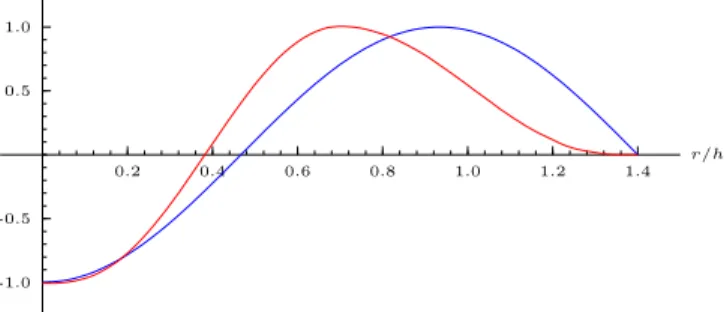
Fig. 2: Dimensionless Interaction force coefficients for sur-face tension, applying our refinement to the models of: Tar-takovsky and Meakin’s (blue) and Akinci et al. (red). The coefficients are scaled to start at the same position.
Fig. 3: Comparison of a selected frame from the water crown experiment using our earlier conference paper (left) and cur-rent model (right). The splashes look sharp and edgy using the method proposed by our earlier conference paper; while spherical droplets are captured using our current model.
a plane. When SPH is used with a small neighborhood, it fails to completely pull the particles together into spheres; the re-sulting configurations generate cobweb-like series of elongated structures when dropped onto the plane (see Figures 1a,1d). In contrast to that, the results are plausible when SPH is used with a larger neighborhood. We obtain almost perfect spheres, without any cobweb-like structures (see Figure 1b).
The PF-SPH model in computational physics achieves de-sired results. However, since much more neighboring particles are taken into account, it requires more computational cost (see Figures 1b), which makes it less attractive for real-time simulations in computer graphics. Our observation presents that the accuracy of the pairwise force is compromised if insufficient neighboring particles are used. To overcome this problem, we attempt to increase the number of neighboring particles considered by enlarging the support radius when cal-culating pairwise forces. And as our implementation demon-strated, we achieve plausible results with relatively little extra computational load by doing so (see Figures 1c,1f).
The required enlargement ratiokfor the original radius of the neighborhoodhcan be estimated to be:
k= (80/30)13 ≈1.4. (5) Tartakovsky and Meakin [17] proposed a cosine function to generate pairwise interaction forces. After applying our refinement, the original spline function is modified to be:
f(rij) =
cos 3π 2khrij
, rij≤kh 0, rij> kh
(a) (b) (c) (d)
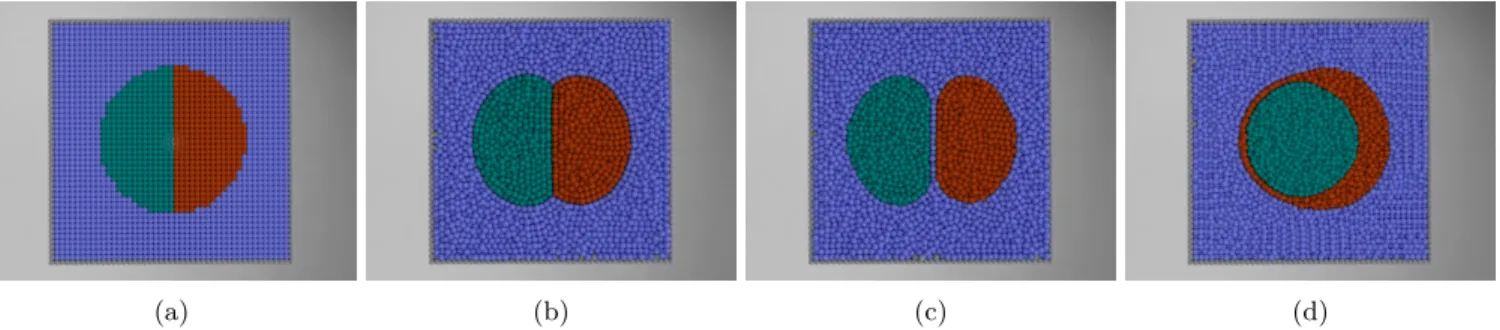
Fig. 4: PF-SPH model for three fluids: 1 (blue), 2 (red), and 3 (green) shown on a cross-sectional plane. (a) initial distribution; (b) the three fluids stay in contact with each other in equilibrium using interaction coefficients:c11 = 6×10³, c22= 1×10⁴, c33=
1.2×10⁴, c
12 = c23 = 0, c13 = 2×10³, (c) fluid 2 separates from fluid 3 using interaction coefficients:c11 = 1×10⁴, c22 =
8×10³, c
33 = 1.4×10⁴, c12 =c23 = 6×10³, c13 = 0, (d) fluid 3 becomes separated from fluid 3 by fluid 2, using interaction
coefficients:c11 = 6×10³, c22= 1.4×10⁴, c33= 1.4×10⁴, c12=c13= 6×10³, c23= 0.
The idea of using a different support radius is not completely new. For instance, He et al. [13] adopted a two-scale pres-sure approximation to robustly estimate internal prespres-sures to capture thin features. Physically, surface tension arises due to interaction between molecules, following the Lennard-Jones potential. For molecules inside the fluid, the attractions cancel one another out. For those near the surface, the asymmetrical distribution of neighbors leads to a non-zero net force towards the fluid domain. The attraction actually exists between any pair of molecules. By adopting an enlarged support radius, more neighboring particles are considered when calculating interaction forces. This brings us closer to the nature of surface tension and leads to more realistic net force differences between interior molecules and those near the free surface. Enlarging the support radius results in additional attractive forces, causing particle clustering in SPH. However, the nature of surface tension is to pull molecules together. The balance between surface tension and particle clustering is a trade-off. In our simulation, the pairwise forces we adopt do not vanish for close neighbors (see Figure 2), which helps to prevent particle clustering. Experimentally, we have observed that the enlargement ratiok used in our examples is capable of capturing accurate surface tension while simultaneously avoiding particle clustering.
Tensile instability which leads to particle clustering has been extensively investigated in SPH [14], [16], [42]. This issue arises due to neighborhood deficiency at the free surface. Using an enlarged support radius to capture interactions means a larger number of neighboring particles is considered. However, our method cannot fix the particle deficiency issue, partly because the enlarged support radius only works for calculating pairwise interaction forces.
3.3 Anisotropic Filtering
The model discussed in Section 3.2 works quite well as illus-trated in our conference paper. However, it still suffers from calculating inaccurate surface tension force (see Figure 3). To cope with this issue, we extend to refine the improved PF-SPH model with an anisotropic filtering term inspried by the work of Yu and Turk [40], Ando et al. [30] and He et al. [13]. For thei-th particle, we compute its anisotropic covarianceCias
Fig. 5: 2D illustration of how anisotropic filtering works. Left: isotropic case. Right: anisotropic case. Green boundaries show the limits of the neighborhoods of the red particles; gray particles are the neighbors. In the anisotropic case, the covariance matrix is used to scale the neighborhood (red oval). Lengths of blue arrows indicate scaling ratios applied to the interaction forces by the anisotropic filtering term. In the isotropic case, the anisotropic filtering term is an identity matrix, leading to uniform interaction forces for all particles within the neighborhood. in the anisotropic case, anisotropic filtering scales interaction forces of different particles accord-ing to the anisotropy.
follows:
Ci=
P
j(xj−xi)(xj−xi)TW(rij, h)
P
jW(rij, h)
, (7) where xi is the position of the i-th particle. (xj − xi)T represents the transpose of vectorxj−xi.
The Singular Value Decomposition (SVD) of the associat-ed Ci yields the directions of stretch or compression for de-forming kernelW, and gives the eigenvectors and eigenvalues: Ci=RΣRT,Σ=diag(1, 2, 3), (8)
where R denotes the eigenvector matrices. 1 ≥ 2 ≥ 3
are the eigenvalues. To avoid singular matrices, we setκ = max(κ, min), whereκ ∈ {1,2,3}, and min is user-defined minimum value of the eigenvalue. We use min = 0.5 in our implementations. A modified covariance matrix Cei is expressed as:
e
whereΣe is the diagonal matrix with modified eigenvalues. In
our experiments,Giwich is the inversion ofCeiis needed, and it is given by:
Gi=RΣe−1RT. (10)
We then propose an anisotropic filtering termTias:
Ti= (1−η)I+η Gi ||Gi||
. (11) whereIis the identity matrix.ηis a user-defined coefficient to determine the degree of anisotropy.In our implementations, we varyη according to k: to achieve comparable results, we compensate a small reduction inkby using a slightly largerη. We useη= 0.2 in our experiments.
With the help of the anisotropic filtering term, the pairwise interaction force Fint
i in Eqs. (1,2) for particle i can be redefined as:
Fint
i :=TiFiint. (12) The anisotropic filtering term is used to scale the interac-tion forces experienced by a given particle from its neighbors. If the neighborhood is symmetric, the anisotropic filtering term is an identity matrix, scaling the interaction forces of all particles within the support domain uniformly. If the neighborhood is asymmetric, the anisotropic filtering term scales the interaction forces of different particles within the domain differently. See Figure 5.
In our experiments, Eq. (12) further improves the perfor-mance of our PF-SPH model (see Figure 3). Since we adopt a large support radius when calculating interaction forces, Eq. (7) should sum over all the particles within the large neighboring domain.
We test our novel PF-SPH model to simulate surface tension using the cosine function. The results are now an almost perfect sphere when starting from a cube and no cobweb-like structures are observed when the configuration drops onto a plane as shown in Figure 1c.
To further examine the utility of enlarging the neighbor-hood in conjunction with the anisotropic filtering, we have tested it using the pairwise force model proposed by Akinci et al. [12]. Again, we obtain an almost perfect sphere, without any cobweb-like structures (see Figure 1f). The results ob-tained in this way are as plausible as those acheived by Akinci et al. with the help of an extra surface area minimization constraint (see Figure 1e).
These experiments show that our novel PF-SPH model is effective and results in more plausible surface tension. The non-spherical configuration and the cobweb-like structures are both caused by inaccurate surface tension forces. As demonstrated in Figures 1a,1d, when SPH is used with a small neighborhood, the original pairwise forces proposed by Tartakovsky and Meakin [17] and Akinci et al. [12] both result in such unrealistic structures. With our refinement, such structures disappear.
4
Multi-Interaction Applications
We introduced our refined PF-SPH model in Section 3, and showed how to apply it to capture the interaction between a liquid and air, i.e. surface tension. Since this approach is based on particle interactions without resorting to artificial consid-erations including surface area minimization or air pressure, it
has the further advantage of allowing us to extend the pairwise view to handle other types of interactions, including fluid-solid and fluid-fluid interactions. In this section, we demonstrate how to use the PF-SPH model to handle phenomena involving multiple interactions in a unified manner. This is one of the biggest advantages of using pairwise interaction forces; it has so far been overlooked in computer graphics. Compared to our conference paper, we go further to show how to handle multiple interfacial flows, and how to capture the intricate deformation details of rising bubbles in liquid. An empirical model is also introduced to simulate various wetting effects when the gravity force is ignored.
When simulating multi-interaction scenarios, a number of interaction coefficients must be determined. Many parameters must be set to achieve the desired results, a problem which we now turn to. Later, we also show how to animate bubbles either in air or in liquids.
4.1 Interaction Coefficients
In fluid simulations, commonly observed interactions at inter-faces can be categorized into three kinds: those between a fluid and air, those between immiscible fluids, and those between a fluid and a solid. We thus discuss how to set interaction coefficients to capture these phenomena respectively.
The parametercijused in Eq. (3) determines the strength of the interaction force between particle i and particle j. This value varies depending on the materials involved, and may be written ascαβ, whereα,βrespectively represent the particular phase or component that particlesi,jrespectively belong to. If α, β belong to the same phase or component,
cαβ is the cohesion coefficient; otherwise, it is the interaction coefficient at the interface.
4.1.1 Surface Tension
To model surface tension, air and fluid both matter. Phys-ically, air is also composed of molecules, so three different interaction forces between molecules must be considered when modeling surface tension: air-air, air-fluid, and fluid-fluid. Since the interaction between fluid and air is insignificant, we may idealize the coefficient as 0. While surface tension is actually a two-phase phenomenon, it can thus be modeled in terms of a single fluid phase. When simulating surface tension, we thus only need to set the cohesion coefficient for the fluid.
4.1.2 Interfacial Flows
When multiple immiscible fluids interact in a single scenario, the results vary according to the parameter values used in the PF-SPH model. In this section, we take a three-fluid system as an example for simplicity, but the general approach here can be applied to fluid systems with a larger number of fluids. For a three-fluid system (fluids 1, 2, 3), a surface tension parameter: σ12, σ13, σ23 is specified for each pair of fluids.
Tartakovsky and Panchenko [20] showed that the relationship between the parameters in the pairwise forces and the surface tension parameters is:
σαβ=λ(¯cαα+ ¯cββ−2¯cαβ), (13) where λ is a constant coefficient. α, β are indexes of fluid phases. ¯cαβis given by:
¯
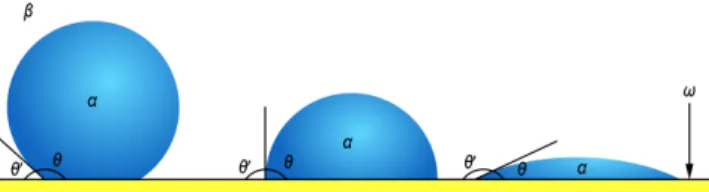
Fig. 6: Different wetting effects and contact angles.
Fig. 7: Liquids form menisci in a graduated cylinder. Left: convex surface due to the obtuse contact angle of mercury with glass. Right: concave surface due to the acute contact angle of water with glass.
where nα is the number density [2] of phase α. Note that
cαβ=cβα
In the PF-SPH model for this three-fluid system, six parameters should be specified, i.e.,c11, c22, c33, c12, c13,and
c23. A commonly used assumption is that:
cαβcαα, α6=β, α, β∈ {1,2,3}. (15) The above assumption may not work in every case; we only consider it a start point of simplfying coefficient tunning.
Substituting Eq. (15) into Eq. (13) gives:
σαβ≈λn2eq(cαα+cββ), (16) where we assumeneq:=nα=nβ.
If the three fluids stay in contact with each other at equilibrium, the surface tension parameters should satisfy the following conditions:
σαβ< σαγ+σβγ, α, β, γ∈ {1,2,3}, (17) whereα6=β6=γ, andσαβ=σβα.
It can be seen that, for any choice of cαα,α ∈ {1,2,3}, the surface tension parameters defined according to Eq. (16) satisfy these conditions, i.e., the three fluids stay in contact with each other at equilibrium as illustrated in Figure 4b. For simulations which should prevent all three fluids from staying in contact with each other, the conditions in Eq. (17) must be violated; thus the three-fluid contact line (point in 2D simulation) cannot be formed. In Figure 4c, we set
c12=c13 =O(cαα) andc23cαα. Fluids 2 and 3 draw apart from each other, and in Figure 4d, we setc12 =c23 =O(cαα) andc13 cαα. Fluid 2 encloses fluid 3, separating the latter from fluid 1.
4.1.3 Adhesion
Bandara et al. [18] focused on the adhesion of fluids to solids using the PF-SPH model. Considering classical theories of
in the presence of fluidβ, as illustrated in Figure 6; note the order ofαandβmatters.
A typical adhesion involves interactions between a fluid, air, and a solid. Since air particles are usually ignored in SPH, there are more coefficients in Eq. (18) than needed. For instance, when simulating the wetting effects of a fluidαon a solidω, we only need to know the coefficients ofcααandcωα. However, Eq. (18) requires coefficients associated with the air phaseβ, which makes Eq. (18) impractical for artistic control. To make Eq. (18) more practical as a way to estimate the coefficients that actually control the simulation, some approximations are needed. Supposeα, β, and ωrepresent a fluid, air, and a solid, respectively. Physical observations make it clear that the interactions between air and a fluid or a solid, i.e.,cαβ, cωα, are significantly smaller than other interactions, so we may setcαβ =cωβ= 0. While we can ignore interactions between air and liquid, interactions between particles in the same phase cannot be ignored, including those between air particles. The ignored air particles can in some ways be treated as ghost particles [14], so it is plausible to assume
nα=nβ andcαα=cββ. This simplifies Eq. (18) to:
cosθ≈c¯ωα/c¯αα. (19) To verify the validity of Eq. (19), we choose α, β in the opposite way, i.e., lettingαrepresent air andβa fluid. Then following the idea above, Eq. (18) gives:
cosθ0≈ −¯cωβ/c¯ββ, (20) where θ0 represents the contact angle of air α with solid ω
in the presence of a fluid β. Sinceθ, θ0 ∈ [0, π], combining Eq. (19) and Eq. (20), we see thatθ+θ0=π, as illustrated in Figure 6.
However, in our model, all interaction coefficients are non-negative. Thus the simplified form of Eq. (18) given in Eqs. (19, 20) cannot capture wetting effects with obtuse or acute contact angles: if cωα is set to 0, the contact angle given by Eq. (19) is 90◦. In our earlier conference paper, the interaction coefficients can be negative and the gravity force is considered; Eq. 19 works. But now, it is problematic. To address this issue, we note the gravity force can be ignored in small scenarios where the surface tension force domainates [12], such as a droplet on a plane. In this case, if cωα = 0, the actual contact angle should be 180◦. Therefore, based on Eq. (19), we can improve upon this by setting:
with the same number densities, thencωα =cαα. The values of the coefficients depend on the properties of the materials as well as the simulators used.
Adhesion is the main cause for many real-world visual phe-nomena, such as different wetting effects shown in Figure 15, and the convex or concave meniscus at a liquid surface in a container as shown in Figure 7.Our method can achieve com-parable results using alternative models for contact angles. With the help of Eqs. (18,21), our PF-SPH model provides an easy-to-handle way to capture those challenging scenarios.
4.1.4 Discussion
We have demonstrated how to use parameters in the PF-SPH model to achieve desired results for different types of interac-tions including surface tension, interfacial flows, and adhesion. When considering interactions at multiple interfaces, it is quite straightforward to sequentially determine appropriate coefficients for all interfaces. For instance, in the example of cracking an egg shown in Figure 12, we need to specify five interaction coefficients:cαα, cββ, cωα, cωβandcαβ, whereα,β, andωrepresent egg white, egg yolk, and the plane respectively (The interactions between the shell and egg white or egg yolk are considered as fluid-solid couplings). We first determine
cαα, cωαandcββ, cωβ to achieve the desired wetting effects of egg white and egg yolk respectively using Eq. (21). We then select coefficients for the interactions between egg white, egg yolk, and air as discussed in Section 4.1.2.
One of the advantages of using pairwise interaction forces is that a uniform approach can be used without needing to design new kernel functions for different interfaces, e.g. as necessary in the approach of Akinci et al. [12]. By setting appropriate values for various coefficients according to the interaction being modeled, our approach is capable of simulat-ing complex phenomena with multiple interactions at different interfaces.
4.2 Bubble Animation
Bubble simulation is an interesting and challenging topic. The shapes of bubbles are dominated by surface tension as demonstrated by many particle- and grid-based methods [8], [22], [24]. Droplets are also dominated by surface tension forces when external forces are absent. Both bubbles and droplets are volume-conserving at a constant temperature. Based on these considerations, we observe that it is possible to animate bubbles either in liquids (e.g. in champagne) or in air (e.g. soap bubbles) by treating them as droplets. A bubble in liquid is full of gas while a droplet is full of liquid; thus simply considering the particles composed of a droplet to be the air particles is sufficient to capture the bubbles in liquid as demonstrated in Section 4.2.1. Turning to bubbles in air, it would be more challenging due to a thin film of liquid on surface. We address this problem by adopting a two-phase model as discussed in Section 4.2.2.
4.2.1 Bubbles in Liquid
SPH approaches have been used to animate the movements of bubbles in liquids [15], [22], [27], [29]; little has been done in computer graphics to capture the intricate details of rising bubbles using SPH solvers. Using the close connection between bubbles and droplets, we solve this problem for the first time in computer graphics using our PF-SPH model.
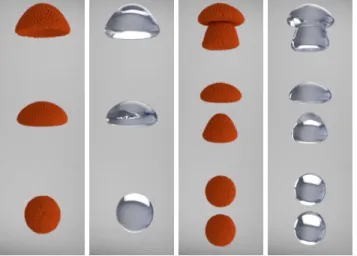
Fig. 8: Bubbles rising in liquids. Bottom to top: three stages of a bubble rising. Left, center left: particle view and rendered view of a single bubble rising; note how the bubble deforms as it rises. Center right, right: particle view and rendered view of two bubbles coalescing as they rise.
One of the problematic issues in doing so lies in the high density ratio between the liquid phase and the gas phase. Using the definition of the particle mass, the density ρ of particleiin standard SPH is given by:
ρi=
X
j
mjW(rij, h). (22) This equation sums over the masses of neighboring particles. The main disadvantage of this formation is the difficulty of representing sharp density discontinuities at interfaces. To overcome this problem, we use the revised formation proposed by Solenthaler and Pajarola [2]:
ρi=mi
X
j
W(rij, h). (23) In this way, the density of a particle is determined only by the spatial distribution of its neighboring particles, but not their masses. Therefore, particles located near an interface but belonging to different fluids may interact without having their density affected by the other phase.
Interpenetration between particles is another problem that occurs when there is a high density ratio between the two phases. To prevent this interpenetration and to maintain the sharpness of interface, an additional term which introduces an extra repulsive force between two phases is used in the work of Hu and Adams [44]. Our model however does not need this term, as the pairwise force we use is short-range repulsive.
For typical applications, this density ratio is close to 103. A high density ratio leads to numerical issues, so very
Fig. 9: Results of surface particle detection. Surface particles can be accurately detected layer by layer (from left to right).
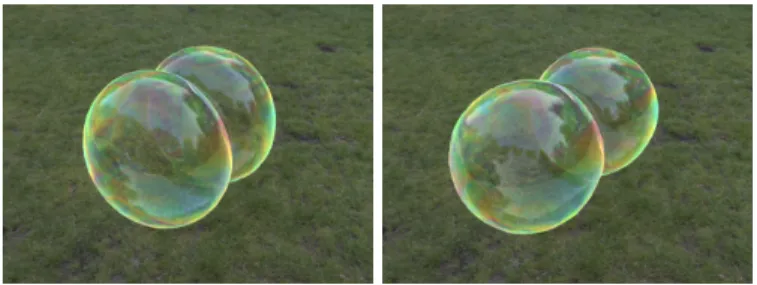
Fig. 10: A double-bubble. Two air bubbles collide with each other, presenting wobbling behaviors.
4.2.2 Bubbles in Air
Unlike bubbles in liquids, little has been done to simulate bubbles in air using the SPH method. The main difficulty lies in the thin structure of such bubbles. He et al. [13] considered how to robustly simulate thin features using SPH, but their method is incapable of handling bubbles in air. We solve this problem by taking a different approach.
Fig. 11: Interaction between two-phase particles
A straightforward way to simulate air bubbles is to sim-ply treat them as droplets. However, we find that this approach makes the resulting bubbles look too rigid due to the different materials con-tained inside a droplet (liquid) and a bubble (gas). In other words, a liquid droplet contain-s only a contain-single liquid phacontain-se
while a bubble in air has two different phases: a liquid phase on the surface and a gas phase inside. These two phases function differently. The gas phase dominates shape changes and conserves the volume of the bubble, while the liquid phase is responsible for various interactions. To simulate air bubbles less rigidly, we instead adopt a two-phase model using the volume fraction [15] to represent the spatial distribution of each phase. Particles in the outermost layer of the droplet are composed of two phases, corresponding to a thin film in a liquid phase and an inner gas phase, while in the interior of the bubble, the liquid volume fraction is considered to be 0. To simplify the implementation, we assume that the thin film of liquid is even over the whole bubble surface, so the volume fraction of every surface particle is the same. As the surface area changes along with the bubble shape, the volume fraction changes accordingly to conserve both liquid and interior gas volumes. A larger surface area leads to a thinner film and more surface particles, requiring a smaller volume fraction for
Strawberry sauce 10k-40k 1 16 ms 63 Wetting effects 9k 2 13 ms 77 Double bubbles 6k 2 12 ms 83 Blowing bubbles 0k-12k 2 36 ms 28 Rising Bubble 295k 4 46 ms 22
the liquid phase in each surface particle. To determine the interaction forces between particles composed of two phases, the following interaction coefficient is used:
˜
cij=abcαα+ a(1−b)+(1−a)b
cαβ+(1−a)(1−b)cββ, (24) where particlesiandjeach contain both phasesαandβ, and
a, andbare the volume fractions of phaseαin particlesiand
jrespectively (see Figure 11).
To dynamically obtain the correct volume fraction, the surface particles are detected at each step using the method of Barecasco et al. [21], [45] (see Figure 9). When simulating bubbles as droplets, the surface particles are composed of a liquid phase and an inner-gas phase, while the others are considered as inner-gas particles. The liquid phase fraction of a surface particle actually varies from particle to particle, and from time to time; in our implementations, we set it to the same value for each surface particle for simplicity.
5
Results
We now give various further illustrations to demonstrate the range of simulations which our method can handle. See the supplementary material for associated videos.We have imple-mented the proposed method using the PCISPH framework, allowing the use of large time steps. We take the interaction forces to be one kind of internal force, and add them to the pressure correction iterations to ensure stable simulation: our experiments show that our model remains stable for long simulation times.
Cracking an egg:Figure 12 illustrates that our method is capable of simulating complex phenomena with multiple types of interface interactions. A number of coefficients associated with interfaces between egg white, egg yolk, air and solid were sequentially set using Eqs. (18,21). The egg white and egg yolk present different wetting effects. Lettingα,βandωrepresent egg white, egg yolk, and solid respectively, we used: cαα = 8.0×10³, c
ββ = 1.6×10⁴, cωα = 6.0×10³, cωβ = 2.0×10³ andcαβ= 1.0×10³.
Water crown:our surface tension model can be used to capture the details of water splashing, generating a crown and the ‘i’ pattern typically captured by photography. See Figure 13. Our refined method achieves similar results to those of Akinci et al. [12] without the need for an extra surface area minimization term. We set the interaction coefficient to 1.4×10⁴.
that our approach can model the adhesion force between a fluid and a solid by setting appropriate coefficients for solid and fluid phases without requiring extra ‘ghost’ air particles or artificial air pressure forces. Here, cωα andcαα are both set to 1.2×10⁴, whereαandωrepresent the fluid and solid
phases respectively.
Wetting effects: our PF-SPH model provides a simple way to capture wetting effects with various contact angles. In this example, the cohesion cofficient is set to 1.4×10⁴; to obtain different wetting effects, we may vary the interac-tion coefficient between the fluid and the solid according to Eqs. (18,21). See Figure 15.
Double bubbles:Figure 10 shows our method for sim-ulating bubbles in air as droplets. Two bubbles collide with each other in air, presenting wobbling behaviors.
Blowing bubbles:there is a strong connection between commonly observed water jets and blowing bubbles; our ap-proach is the first particle-based apap-proach in graphics to be able to simulate blowing bubbles. See Figure 16.
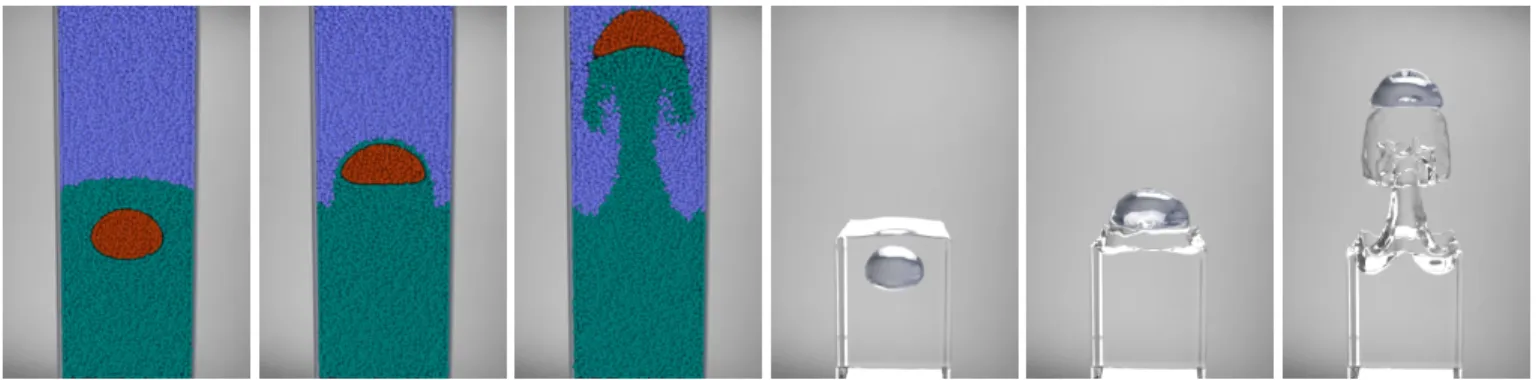
Rising bubbles:Figure 17 shows how our model can be used to capture the intricate details of a single bubble rising in liquid. The rising bubble breaks the interface between two fluids, and then starts to change the shape of the interface by pulling the bottom fluid upward. A mushroom-shaped column of the lower fluid can be seen below the bubble. Figure 8 further demonstrates how our model is capable of simulating the coalescence of two rising bubbles.
We have implemented our algorithm using CUDA on an NVIDIA GeForce GTX1080 GPU using single precision, as it is adequate for graphical simulations and reduces memory requirements. Performance for these examples is given in Table 1. The particle numbers shown include both fluid and boundary particles. Times presented are averages. We achieve real-time performance in all cases.
6
Conclusion
We have shown how a refined pairwise force SPH model can handle multiple interactions in a versatile way. Our method succeeds by adopting a larger support radius than previous works in conjunction with the anisotropic filtering term. It results in more accurate simulations of various interactions in-cluding surface tension, interfacial flows, and adhesion, with-out requiring additional constraints, such as curvature mini-mization, surface area minimini-mization, energy minimini-mization, or air pressure control. For the first time in computer graphics, it is possible to simulate bubbles in air as droplets using SPH, providing an alternative method of bubble simulation. Our approach can uniformly handle multiple types of interactions, and is versatile, physically meaningful, and easy to implement. It also preserves particle clustering. Previous surface tension methods suffer from stiffer timestep restrictions; we achieve more stable simulations by considering more neighboring par-ticles.
We use a fixed number of neighbouring particles, as this leads to simplicity of implementation, convenience in neigh-borhood search, and consistency in numerical evaluation. It would be interesting to try varying this value to provide error control.
Although our approach is capable of capturing adhesion forces and various pinning effects (see the supplementary
video), it cannot handle abrupt, turbulent fluid-solid cou-plings with large time steps; additional boundary pressure terms are needed in those cases.
While we have proposed a two-phase model to simulate bubbles in air, the bubbles still behave somewhat more rigidly than bubbles simulated by mesh-based methods like those in [8], [24]. Furthermore, our particle-based method is inca-pable of capturing certain interesting phenomena, such as thin film structures spanning a circular wire. Resolving these issues is another direction for future research.
Finally, we note that while increasing the support radius works well in simulating surface tension and adhesion, it cannot fix the particle deficiency issue which causes tensile instability in SPH. Some form of normalization is required.
Acknowledgments
This work was supported in part by the Natural Science Foundation of China (Project Number 61521002), Research Grant of Beijing Higher Institution Engineering Research Center, EU project Dr.Inventor (FP7-ICT-2013.8.1 611383), the U.S. National Science Foundation, and an EPSRC, UK travel grant.
References
[1] Tao Yang, Jian Chang, Bo Ren, Ming C. Lin, Jian Jun Zhang, and Shi-Min Hu.Fast Multiple-fluid Simulation Using Helmholtz Free Energy. ACM Transactions on Graphics (Proceedings of SIGGRAPH Asia 2015), v. 34, no. 6, pp. 201:1-201:11, 2015. [2] B. Solenthaler, and R. Pajarola.Density contrast SPH Interfaces.
In Proceedings of SCA ’08, pp. 211-218, 2008.
[3] Frank Losasso, Tamar Shinar, Andrew Selle, and Ronald Fedkiw.
Multiple Interacting Liquids. ACM Transactions on Graphics (Proceedings of SIGGRAPH 2006), v. 25, no. 3, pp. 812-819, July 2006.
[4] Byungmoon Kim.Multi-Phase Fluid Simulations Using Regional Level Sets. ACM Transactions on Graphics (Proceedings of SIG-GRAPH Asia 2010), v. 29, no. 6, pp. 175:1-175:8, Dec. 2010. [5] M.K. Misztal, K. Erleben, A. Bargteil, J. Fursund, B.B.
Chris-tensen, J.A. Barentzen and R. Bridson.Multiphase Flow of Im-miscible Fluids on Unstructured Moving Meshes. In Proceedings of SCA ’12, pp. 97-106, 2012.
[6] Fang Da, Christopher Batty, and Eitan Grinspun.Multimaterial Mesh-Based Surface Tracking. ACM Transactions on Graphics (Proceedings of SIGGRAPH 2014), v. 33, no. 4, pp. 112:1-112:11, 2014.
[7] Nils Thuerey, Chris Wojtan, Markus Gross, and Greg Turk.A Multiscale Approach to Mesh-based Surface Tension Flows. ACM Transactions on Graphics (Proceedings of SIGGRAPH 2010), v. 29, no. 4, pp. 48:1-48:10, 2010.
[8] Fang Da, Christopher Batty, Chris Wojtan, and Eitan Grinspun.
Double Bubbles Sans Toil and Trouble: Discrete Circulation-Preserving Vortex Sheets for Soap Films and Foams. ACM Trans-actions on Graphics (Proceedings of SIGGRAPH 2015), v. 34, no. 4, pp. 149:1-149:9, 2015.
[9] Byungmoon Kim, Yingjie Liu, Ignacia Llamas, Xiangmin Jiao, and Jarek Rossignac.Simulation of Bubbles in Foam With The Volume Control Method. ACM Transactions on Graphics (Pro-ceedings of SIGGRAPH 2007), v. 26, no. 3, July, 2007.
[10] Matthias M¨uller, David Charypar, and Markus Gross. Particle-Based Fluid Simulation for Interactive Application. In Proceed-ings of SCA ’03, pp.154-159, 2003.
[11] Markus Becker, and Matthias Teschner. Weakly compressible SPH for free surface flows. In Proceedings of SCA ’07, pp. 209-217, 2007.
Fig. 12: A simulated egg white and egg yolk flow out of the broken shell of a cracked egg, onto a plane, using our versatile approach to handling interactions at interfaces.
Fig. 13: Water crown. A droplet drops into a pool of liquid. Our model produces a plausible water crown and an ‘i’ pattern. Water in the pool is not completely still or smooth, leading to asymmetric splashes.
Fig. 14: Strawberry sauce on a ball. A stream of strawberry sauce flows over a ball, sticking to it by the adhesion force between fluid and solid.The stream pouring downward is not an entirely symmetric column, resulting in slightly asymmetric simulation.
Fig. 15: Wetting effects. Our method is capable of simulating different wetting effects in a simple way.
[13] Xiaowei He, Huamin Wang, Fengjun Zhang, Hongan Wang, Guoping Wang, and Kun Zhou. Robust Simulation of Small-Scale Thin Features in SPH-based Free Surface Flows. ACM Transactions on Graphics, v. 34, no. 1, pp. 7:1-7:9, 2014. [14] Hagit Schechter, and Robert Bridson.Ghost SPH for Animating
Water. ACM Transactions on Graphics (Proceedings of SIG-GRAPH 2012), v. 31, no. 4, pp. 61:1-61:8, 2012.
[15] Matthias M¨uller, Barbara Solenthaler, Richard Keiser, and Markus Gross.Particle-Based Fluid-Fluid Interaction. In Pro-ceedings of SCA ’05, pp. 237-244, 2005.
[16] Nadir Akinci, Markus Ihmsen, Gizem Akinci, Barbara Solen-thaler, and Matthias Teschner.Versatile Rigid-Fluid Coupling for Incompressible SPH. ACM Transactions on Graphics (Proceed-ings of SIGGRAPH 2012), v. 31, no. 4, pp. 62:1-62:8, 2012. [17] Alexandre Tartakovsky, and Paul Meakin.Modeling of surface
tension and contact angles with smoothed particle hydrodynamics.
Physical Review E, v. 72, no. 2, 2005.
[18] U.C. Bandara, A.M. Tartakovsky, M. Oostrom, B.J. Palmer, J. Grate and C. Zhang.Smoothed particle hydrodynamics pore-scale simulations of unstable immiscible flow in porous media. Advances in Water Resources, v. 62, pp. 356-369, 2013.
[19] A.M. Tartakovsky, N. Trask, K. Pan, B. Jones, W. Pan, and J.R. Williams.Smoothed particle hydrodynamics and its applications for multiphase flow and reactive transport in porous media. Com-put Geosci. pp. 1-28, 2014.
[20] A.M. Tartakovsky, and A. Panchenko.Pairwise Force Smoothed Particle Hydrodynamics model for multiphase flow: Surface ten-sion and contact line dynamics. Journal of Computational Physic-s, v. 305, pp. 1119-1146, 2016.
Fig. 16: Blowing bubbles. Our method is capable of animating bubbles in the air as droplets. There is a close connection between blowing bubbles and water jets. Using this observation, we provide the first particle-based approach to simulate blowing bubbles.
Fig. 17: Particle views, and rendered views, of a single bubble rising through a fluid-fluid interface. The rising bubble changes the interface shape by pulling the bottom fluid upward, and results in a mushroom-shaped column of the lower fluid being dragged upwards by the bubble.
[22] Jeong-Mo Hong, Ho-Young Lee, Jong-Chul Yoon, and Chang-Hun Kim.Bubbles Alive. ACM Transactions on Graphics (Pro-ceedings of SIGGRAPH 2008), v. 27, no. 3, pp. 48:1-48:4, Aug., 2008.
[23] Oleksiy Busaryev, Tamal K. Dey, Huamin Wang, and Zhong Ren. Animating Bubble Interactions in a Liquid Foam. ACM Transactions on Graphics (Proceedings of SIGGRAPH 2012), v. 31, no. 4, pp. 63:1-63:8, July, 2012.
[24] Bo Zhu, Ed Quigley, Matthew Cong, Justin Solomon, and Ronald Fedkiw.Codimensional Surface Tension Flow on Simpli-cial Complexes. ACM Transactions on Graphics (Proceedings of SIGGRAPH 2014), v. 33, no. 4, pp. 111:1-111:11, 2014.
[25] Joseph P. Morris.Simulating surface tension with smoothed par-ticle hydrodynamics. International Journal for Numerical Meth-ods in Fluids, v. 33, no. 3, pp. 333-353, 2000.
[26] N. Th¨urey, F. Sadlo, S. Schirm, M. M¨uller-Fischer, and M. Gross.
Real-time Simulations of Bubbles and Foam within a Shallow Water Framework. In Proceedings of SCA ’07, pp. 191-198, 2007. [27] Paul W. Cleary, Soon Hyoung Pyo, Mahesh Prakash, and Bon Ki Koo.Bubbling and Frothing Liquids. ACM Transactions on Graphics (Proceedings of SIGGRAPH 2008), v. 26, no. 3, 2008. [28] M. Ihmsen, N. Akinci, G. Akinci, and M. Teschner. Unified
Spray, Foam and Bubbles for Particle-based Fluids. The Visual Computer , v. 28, no. 6-8, pp. 669-677, 2012.
[29] M. Ihmsen, J. Bader, G. Akinci, and M. Teschner.Animation of Air Bubbles with SPH. Int. Conf. on Computer Graphics Theory and Applications GRAPP 2011, pp. 225-234, March 5-7, 2011. [30] Ryoichi Ando, Nils Th¨urey, and Reiji Tsuruno.Preserving
Flu-id Sheets with Adaptively Sampled Anisotropic Particles. IEEE Transactions on Visualization and Computer Graphics (TVCG), v. 18, no. 8, pp. 1202-1214, 2012.
[31] Bo Ren, Yuntao Jiang, Chenfeng Li, and Ming C. Lin.A simple approach for bubble modelling from multiphase fluid simulation. Computer Visual Media, v. 2, no. 1, pp. 171-181, 2015.
[32] Shiguang Liu, Qiguang Liu, and Qunsheng Peng.Realistic
sim-ulation of mixing fluids. The Visual Computer, v. 27, no. 3, pp. 241-248, 2011.
[33] M. Macklin, M. M¨uller, N. Chentanez, and T.Y. Kim.Unified particle physics for real-time applications. ACM Transactions on Graphics (Proceedings of SIGGRAPH 2014), v. 33, no. 4, pp. 153:1?C153:12, 2014.
[34] Simon Clavet, Philippe Beaudoin, and Pierre Poulin. Particle-based Viscoelastic Fluid Simulation. In Proceedings of SCA ’05, pp. 219-228, 2005.
[35] B. Solenthaler, J. Schl¨afli, and R. Pajarola. A unified parti-cle model for fluid-solid interactions. Comput. Animat. Virtual Worlds, v. 18, no. 1, pp. 69-C82, 2007.
[36] M. Ihmsen, N. Akinci, M. Gissler, and M. Teschner.Boundary handling and adaptive time-stepping for PCISPH. VRIPHYS. pp. 79-88, 2010.
[37] X. Shao, Z. Zhou, N. Magnenat-Thalmann, and W. Wu.Stable and fast fluid-solid coupling for incompressible SPH. Comput. Graph. Forum. v. 34, no. 1, pp. 191-204, 2015.
[38] A.M. Tartakovsky, and A. Panchenko.Pairwise Force Smoothed Particle Hydrodynamics model for multiphase flow: Surface ten-sion and contact line dynamics. Journal of Computational Physic-s, v. 305, pp. 1119-1146, 2016.
[39] Markus Ihmsen, Jens Orthmann, Barbara Solenthaler, Andreas Kolb, and Matthias Teschner.SPH Fluids in Computer Graphics. In Eurographics 2014 - State of the Art Reports, pp. 21-42, 2014. [40] J. Yu, and G. Turk. Reconstructing surface of particle-based fluids using anisotropic kernels. In Proceedings of SCA ’10, pp. 217-225, 2010.
[41] Moubin Liu, Paul Meakin, and Hai Huang.Dissipative particle dynamics with attractive and repulsive particle-particle interac-tions. Physics of Fluids, v. 18, 2008.
[42] J. J. Monaghan.SPH without a tensile instability. Journal of Computational Physics, v. 159, no. 2, pp. 290-311, 2000. [43] J. Hua, and J. Lou. Numerical simulation of bubble rising in
Tao Yangreceived his B.S. degree from Tsinghua University in 2013. He is currently a Ph.D. candidate in Tsinghua University. His research interests include physically based simulation and rendering.
Ralph R. Martinrecently retired after a long ca-reer in visual computing, and is now an Emeritus Professor of Cardiff University. He is currently enjoying life in the Welsh countryside.
Ming C. Linreceived her B.S., M.S., and Ph.D. degrees in electrical engineering and computer science from the University of California, Berke-ley. She is currently the John R. & Louise S. Parker Distinguished Professor of Comput-er Science at the UnivComput-ersity of North Carolina (UNC) at Chapel Hill, and an honorary Chair Professor (Yangtze Scholar) at Tsinghua Uni-versity in China. She has received several hon-ors and awards, including the IEEE, VGTC, VR Technical Achievement Award 2010 and 9 best paper awards. She is both Fellow of ACM and IEEE. Her research interests include computer graphics, robotics, and human-computer interaction, with focuses on physically based modelling, sound ren-dering, haptics, algorithmic robotics, virtual environments, interactive techniques, geometric computing, and distributed interactive simulation. She has (co-)authored more than 250 refereed scientific publications, co-edited/authored four books. She is a former Editor-inChief of IEEE Transactions on Visualization and Computer Graphics (TVCG) during 2011-2014, the current Chair of the IEEE Computer Society (CS) Transactions Operations Committee, and a member of the IEEE CS Board of Governors.
Jian Changreceived his Ph.D. degrees in com-puter graphics at Bournemouth University in 2007. He is currently an associate professor in computer animation, Bournemouth University, UK. His research has focused on a number of topics relating to deformation and physically-based animation, geometric modelling, virtual surgery, character rigging and skinning (key tech-niques to animate a virtual agent) to address industry needs and create impacts.