PRACTICAL ANALYSIS OF ENCRYPTED NETWORK TRAFFIC
Andrew M. White
A dissertation submitted to the faculty of the University of North Carolina at Chapel Hill in partial fulfillment of the requirements for the degree of Doctor of Philosophy in the Department
of Computer Science.
Chapel Hill 2015
ABSTRACT
Andrew M. White: PRACTICAL ANALYSIS OF ENCRYPTED NETWORK TRAFFIC (Under the direction of Fabian Monrose)
The growing use of encryption in network communications is an undoubted boon for user privacy. However, the limitations of real-world encryption schemes are still not well understood, and new side-channel attacks against encrypted communications are disclosed every year. Furthermore, encrypted network communications, by preventing inspection of packet contents, represent a significant challenge from a network security perspective: our existing infrastructure relies on such inspection for threat detection. Both problems are exacerbated by the increasing prevalence of encrypted traffic: recent estimates suggest that 65% or more of downstream Internet traffic will be encrypted by the end of 2016. This work addresses these problems by expanding our understanding of the properties and characteristics of encrypted network traffic and exploring new, specialized techniques for the handling of encrypted traffic by network monitoring systems.
We first demonstrate that opaque traffic, of which encrypted traffic is a subset, can be
identified in real-time and how this ability can be leveraged to improve the capabilities of existing IDS systems. To do so, we evaluate and compare multiple methods for rapid identification of opaque packets, ultimately pinpointing a simple hypothesis test (which can be implemented on an FPGA) as an efficient and effective detector of such traffic. In our experiments, using this technique to “winnow”, or filter, opaque packets from the traffic load presented to an IDS system significantly increased the throughput of the system, allowing the identification of many more potential threats than the same system without winnowing.
both the potential threat to user privacy which such side channels represent and the degree to which this threat has been underestimated.
ACKNOWLEDGEMENTS
I have been fortunate to receive aid and encouragement from a great number of people over the past seven years. First and foremost, I would like to thank Stephanie Malone, as well as my parents and family, for their support and understanding. Second, I cannot adequately express my gratitude to Prof. Fabian Monrose, who has been a mentor and colleague throughout and who has supported me in too many ways to count since our first days at UNC.
I would also like to thank the remainder of my committee (Prof. Michael Bailey, Prof. Michael Reiter, Prof. Kevin Jeffay, and Phil Porras) for their advice and their time. Special thanks are also due to my colleagues and collaborators at UNC (particularly Prof. Jan-Michael Frahm, Srinivas Krishnan, Austin Matthews, Prof. Elliott Moreton, Nathan Otternes, Rahul Raguram, Katherine Shaw, Kevin Snow, Teryl Taylor, Jan Werner, and Yi Xu); at SRI International (particularly Vinod Yegneswaran); and at IBM Research (particularly Reiner Sailer, Mihai Christodorescu, and Marc Stoecklin). In addition, Murray Anderegg, Jake Czyz, Alex Everett, Jim Gogan, Bil Hays, Jodie Turnbull, and Missy Wood provided invaluable assistance during the course of this work.
Finally, I would like to express my eternal gratitude to Todd Anderson, Brian Collier, and David Fortney, for keeping me off the wrong path, and to Prof. Barry Lawson, Prof. Douglas Szajda, and Prof. Jason Owen, for helping me find the right one.
TABLE OF CONTENTS
LIST OF TABLES . . . xii
LIST OF FIGURES . . . xiii
LIST OF ABBREVIATIONS . . . xv
CHAPTER 1 INTRODUCTION . . . 1
Thesis Statement . . . 4
1.1 Real-time Detection of Opaque Network Traffic . . . 5
1.2 Reconstructing Transcripts of Encrypted VoIP Conversations . . . 6
1.3 Identification of Encrypted Web Resources . . . 7
1.4 Contributions . . . 8
CHAPTER 2 OPAQUE TRAFFIC . . . 10
2.1 Introduction . . . 10
2.2 Approach . . . 13
Likelihood Ratio Test . . . 15
Sequential Probability Ratio Test . . . 15
2.3 Evaluation . . . 16
2.3.1 Offline Analysis . . . 17
File Type Identification . . . 17
Content Type Matching . . . 18
Operator Analysis . . . 23
Operational Impact . . . 30
2.4 Limitations . . . 31
2.5 Related Work . . . 32
2.6 Discussion . . . 34
2.7 Future Work . . . 35
Compressed vs Encrypted . . . 35
Flow-level Analysis . . . 35
2.8 Broader Implications . . . 35
CHAPTER 3 PHONOTACTIC RECONSTRUCTION OF ENCRYPTED VOIP CONVERSA-TIONS . . . 37
3.1 Introduction . . . 37
3.2 Background Information . . . 39
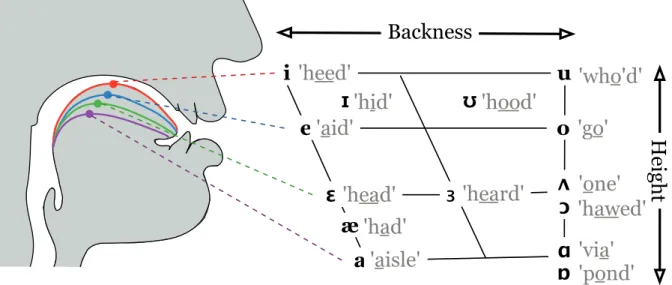
3.2.1 Phonetic Models of Speech . . . 39
3.2.2 Voice over IP . . . 41
3.3 Overview of Our Approach . . . 42
3.3.1 Data and Adversarial Assumptions . . . 44
3.4 Related Work . . . 45
3.5 Methodology . . . 46
3.5.1 Finding Phoneme Boundaries (Stage➊) . . . 47
3.5.2 Methodology . . . 47
3.5.3 Evaluation . . . 50
3.5.4 Classifying Phonemes (Stage➋) . . . 52
3.5.5 Maximum Entropy Discrimination of Phonemes . . . 53
3.5.6 HMM Modeling of Phonemes . . . 54
3.5.8 Enhancing Classification using Language Modeling . . . 55
3.5.9 Evaluation . . . 55
3.5.10 Segmenting Phoneme Streams into Words (Stage➌) . . . 56
3.5.11 Identifying Words via Phonetic Edit Distance (Stage➍) . . . 57
3.5.12 Measuring the Quality of Our Output . . . 61
3.6 Empirical Evaluation . . . 64
3.6.1 An Adversarial Point of View (Measuring Confidence) . . . 66
3.6.2 Discussion & Mitigation . . . 68
3.7 Conclusion . . . 69
3.8 Future Work . . . 70
Skype . . . 70
Conversational Speech . . . 70
3.9 Broader Implications . . . 70
CHAPTER 4 PLAYING HIDE-AND-SEEK . . . 72
4.1 Introduction . . . 72
4.2 Background & Related Work . . . 76
4.2.1 Learning Algorithms . . . 78
4.2.2 Features . . . 78
4.3 Assumptions and Threat Model . . . 79
4.3.1 Networking Model . . . 79
4.3.2 Encryption Model . . . 80
HTTPS model . . . 80
Tunnel Model . . . 81
4.3.3 World Models . . . 82
Closed-world . . . 82
Open-world . . . 82
Binary Open-world . . . 83
Partial Information . . . 83
4.4 Approach . . . 84
4.4.1 Classification Scheme: Multi-label . . . 84
4.4.2 Classifier Model: Random Forest . . . 85
Support Vector Machine Classifiers . . . 85
Naïve Bayes Classifiers . . . 86
Random Forests . . . 87
Suitability for Our Approach . . . 88
4.4.3 Abstention and Thresholding . . . 89
Post-Classification Thresholding . . . 90
Validation and Threshold Selection . . . 91
4.4.4 Hyper-parameter Optimization . . . 91
4.4.5 Epoch Validation . . . 93
4.5 Evaluation . . . 93
4.5.1 Data Collection . . . 93
URLs . . . 94
Scripted Retrievals . . . 95
4.5.2 Evaluation Criteria . . . 96
Multi-class Metrics . . . 96
4.5.3 Experimental Setup . . . 98
World Models . . . 98
Datasets . . . 99
Learning Algorithms . . . 100
Multi-label Classification . . . 100
Feature Sets . . . 101
Validation and Data Selection . . . 101
Hyper-parameter Optimization . . . 101
4.5.4 Implementation . . . 104
4.5.5 Results . . . 104
Multi-class Comparison with Previous Work . . . 104
Multiple URLs per Domain Name . . . 106
Hyper-parameter Optimization . . . 108
Labeling Traces with URL Components . . . 110
Abstaining from Classification . . . 111
Summary of Findings . . . 112
4.5.6 Limitations and Future Work . . . 114
4.6 Broader Implications . . . 115
CHAPTER 5 DISCUSSION & CONCLUSIONS . . . 116
A OPAQUE TRAFFIC . . . 117
A.1 Comparison of Methods . . . 117
A.1.1 Preliminaries . . . 117
Discrete Kolmogorov-Smirnov Test . . . 118
A.1.3 Byte-Entropy Distributions for Smalln. . . 124
Log-likelihoods . . . 125
A.1.4 Theoretical Efficiency . . . 125
A.2 HTTP Labeling Rules . . . 126
B PLAYING HIDE-AND-SEEK . . . 128
B.1 Scripted Retrieval Details . . . 128
B.2 Precision and Recall . . . 129
LIST OF TABLES
2.1 File Type Analysis . . . 18
2.2 Experimental Results (log1andlog2) . . . 21
3.1 Feature templates for phonetic segmentation . . . 49
3.2 Phonetic segmentation performance for each dialect in the TIMIT corpus. . . 51
3.3 Feature templates for phoneme classification . . . 54
3.4 Precision and recall for word break insertion . . . 57
3.5 Phonetic edit distance examples . . . 59
3.6 Top scoring hypotheses from the New England dialect. . . 65
3.7 The five highest scoring hypotheses from the New England dialect under the content-independent model. . . 65
4.1 Values for the multi-label metrics applied to a single instance for which the true label set is {foo,bar,baz} and the predicted label set is {foo,qux}. . . 99
4.2 Hyper-parameters for the models used, along with the values explored for each, in our experiments. . . 103
A.1 Notation . . . 118
A.2 Parameter space explored for each domain . . . 119
A.3 Theoretical efficiency . . . 126
LIST OF FIGURES
2.1 CDF of payload size for the protocols examined in the two campus network logs . . . 20
2.2 HTTP Content-Type Distribution . . . 21
2.3 CDFs of Packet IDs . . . 22
2.4 HTTP Mismatched Content-Types . . . 22
2.5 Byte-value Distributions for Anomalies . . . 24
2.6 Packet duplication using an Endace Data Acquisition and Generation (DAG) card. . . 27
2.7 Number of alerts and number of packets processed by Snort with winnowing and Snort without (in 15-minute windows). . . 28
2.8 CDF of payload size for both opaque and transparent traffic. . . 29
3.1 Vowels in American English . . . 40
3.2 Architecture of approach for encrypted VoIP conversation reconstruction . . . 43
3.3 Example sequence of Speex frame sizes . . . 47
3.4 Illustration of classification features for determining segmentation points . . . 50
3.5 Example feature template instantiation . . . 53
3.6 Comparison of methods for phoneme classification . . . 56
3.7 Illustration of distance between consonants [f], [T], and [w]. . . 58
3.8 Parameter space exploration for phonetic edit distance . . . 60
3.9 Empirical CDF of phonetic edit distance. . . 61
3.10 Example METEOR scores . . . 63
3.11 METEOR scores for each dialect in the TIMIT dataset . . . 64
3.12 METEOR scores under the content-independent assumption . . . 66
3.13 Scatter plot of METEOR scores against our confidence values . . . 67
4.1 The two encryption models considered: HTTPS and web traffic tunneled over encrypted
channels. . . 80
4.2 Collection process overview. . . 95
4.3 Data selection for experiments with thresholding and classesof-no-interest . . . 102
4.4 Multi-class classification applied to two datasets from previous work (LLandHWF). . . 105
4.5 Multiclass classification on datasets comprised of a single URL per domain and multi-ple URLs per domain . . . 107
4.6 Difference in accuracy between multiple URLs per domain vs a single URL per domain (multi-class classification) . . . 108
4.7 Difference in accuracy due to hyper-parameter optimization (multi-class) . . . 109
4.8 Multi-label classification results . . . 110
4.9 Multi-label classification results with abstention and search . . . 113
A.1 Illustration of parameters length (N), offset (T), and block size (n) . . . 120
A.2 ROC plots for the techniques examined in this work. . . 121
A.3 Effects on accuracy when varying sample size and byte offset . . . 122
A.4 Effects on accuracy when varying significance level and alternative hypothesis . . . 123
LIST OF ABBREVIATIONS
AES Advanced Encryption Standard
ARO Army Research Office
ASCII American Standard Code for Information Interchange BDR Bayesian detection rate
BR Binary relevance
BuFLO Buffered Fixed-Length Obfuscator
CBR Constant bit-rate
CDF Cumulative distribution function CELP Code-excited linear prediction CPU Central processing unit
CV Cross-validation
DAG Data Acquisition and Generation DHS Department of Homeland Security
DMA Direct memory access
DNS Domain name system
DPI Deep packet inspection
DT Decision tree
EFF Electronic Frontier Foundation
EFR Enhanced Full Rate
ELF Executable and Linkable Format FLLD Fast Levenshtein-like distance
FP False positive
FPGA Field-programmable gate array GIF Graphics Interchange Format GPU Graphics processing unit
GSM Global System for Mobile Communications
HMM Hidden Markov model
HTML Hypertext markup language HTTP Hypertext transfer protocol HTTPOS HTTPS with Obfuscation
HTTPS HTTP-Secure (HTTP over SSL/TLS) IDS Intrusion detection system
IETF Internet Engineering Task Force
IM Instant messenging
IP Internet protocol
IPA International Phonetic Alphabet IPS Intrusion prevention system IRB Institutional Review Board ISRG Internet Security Research Group JPEG Joint Photographic Experts Group
K-S Kolmogorov-Smirnov
k-NN k-nearest neighbors
k-NN-WL k-nearest neighbors with weight learning
LTE Long Term Evolution
METEOR Metric for Evaluation of Translation with Explicit Ordering MIME Multipurpose Internet Mail Extensions
MNB Multinomial naïve Bayes
MoU Memorandum of understanding
MTU Maximum transmission unit
NB Naïve Bayes
NIDS Network intrusion detection system NLTK Natural Language Toolkit
NSF National Science Foundation OSAD Optimal string alignment distance
OvR One-vs-rest
PBX Private branch exchange
PET Privacy enhancing technology PMF Probability mass function
PRE Precision
RBF Radial basis function
REC Recall
RF Random forest
RFC Request for Comments
ROC Receiver operating characteristic RTMP Real Time Messaging Protocol RTP Real-time transport protocol SIP Session initiation protocol SMTP Simple Mail Transfer Protocol
SOCKS Socket secure
SPRT Sequential probability ratio test SRILM SRI Language Modeling
SRTP Secure RTP
SSH Secure shell
SSL Secure sockets layer TCP Transport control protocol TLS Transport layer security UDP User datagram protocol URI Uniform resource identifier URL Uniform resource locator
UTF Unicode Transformation Format VBR Variable bit-rate
VM Virtual machine
VNG Variable n-gram
VoIP Voice-over-IP
VPN Virtual private network
WER Word error rate
XMPP Extensible messaging and presence protocol
CHAPTER 1: INTRODUCTION
Communications privacy is essential to modern society. Our financial infrastructure relies upon private transactions to operate while protecting our personal data and identities.
Corporations and governments alike rely on the ability to conceal their intentions, while still transmitting those intentions to their agents, to protect their interests at home and abroad. Whistle-blowers are, at times, dependent upon such concealment for their very lives; even otherwise unremarkable people with unpopular beliefs rely on communications privacy to protect themselves from persecution. Our reliance upon private transactions becomes even more apparent when we consider the Internet, which has evolved into a omnipresent factor of
everyday life for many people. As such, it is no surprise that a significant portion of Internet traffic is encrypted to ensure the privacy of the underlying communications: recent estimates suggest 29% of total downstream Internet traffic is encrypted, a proportion expected to increase to at least 65% after Netflix’s transition to HTTPS in 2016 [52].
Public awareness of the need for encryption has heightened due to high-profile leaks of private data (such as the personal information of 70 million users of Sony’s PlayStation Network in April, 2011 [127]) and the continuing increase in identity theft (see, e.g., [69]). We believe that the fraction of encrypted traffic on real networks will only continue to rise, as more web services follow in the footsteps of Google and Facebook in offering encrypted connections (as Netflix plans to do in 2016 [54, 61]), the movement toward ubiquitous end-to-end encryption (see, e.g., [14]) gains steam, and efforts to ease adoption for site operators take effect [e.g., 86]. In particular, private corporate networks, where secure communications are often required, undoubtedly see significantly higher proportions of encrypted traffic. Tools, such as the
Internet traffic (16.5% by some estimates [e.g., 50]), offer connections encrypted at various levels to evade traffic shaping and institutional surveillance. Finally, governments and other
organizations are increasingly mandating the use of encryption to protect the transmission of personal identifying information and other sensitive data.1 These factors all contribute to altering the landscape of network traffic by increasing the prevalence of encrypted communications.
At the same time, encrypted traffic presents problems for network administrators and analysts. Policy, security, and quality-of-service requirements can be difficult to enforce when traffic is encrypted, since identifying characteristics are often obscured. No surprise, then, that the current default reaction to encrypted traffic is a defeatist stance, reflecting the prevailing point of view that encrypted traffic yields little or no information of value to an observer.
We believe this point of view to be misguided: in fact, substantial information regarding the underlying communications can be extracted from encrypted traffic under the right conditions. This is an example of a general problem in engineering secure systems: while the underlying cryptographic primitives may be sound, systems utilizing such primitives face a host of practical considerations which can result information leakage throughside channels, such as the timing of certain cryptographic operations or the observable length of an encrypted message. This
problem often occurs when security and efficiency requirements conflict, particularly when the security implications are not well understood—as has been the case with encrypted network traffic in the past. With respect to network communications, researchers have repeatedly
demonstrated instances of side channels over more than a decade of previous work; for instance, prior work has shown: (a) that individual keystrokes typed during a secure shell (SSH) session can be identified [136], potentially leaking passwords and other sensitive information; (b) that the application protocol (e.g., HTTP) transported over encrypted channels, such as SSH tunnels or virtual private network (VPN) connections, can often be ascertained [e.g., 159]; and (c) that individual movies streamed over a wireless connection can be identified [130]. Our own work shows that encrypted Voice-over-IP (VoIP) calls, under certain conditions, can leak enough information to enable the reconstruction of conversation transcripts [155]. Prior work, and our own preliminary investigations, also indicate that web pages browsed over encrypted
connections can often identified [e.g., 43]. All of these attacks are based on properties (i.e., side channels, such as the sizes, timing, and direction of individual packets), of network traffic which are easily observable despite the use of encryption by the system in question.
Further, we believe that the increasing prevalence of encryption on the network necessitates a paradigm shift in the way we analyze and monitor network traffic. Deep packet inspection (DPI) engines, on which the prevailing intrusion detection/prevention systems (IDS/IPS) heavily rely, are of little use when payloads are encrypted. These engines are notorious for requiring extensive computational resources; encrypted traffic, in particular, imposes a heavy computational burden on DPI-based systems [22, 39]. In addition, IDS systems often utilize port numbers, both for filtering and for signature matching; unfortunately, port numbers are known to be unreliable due to the widespread use of non-standard and randomized ports [95, 105]. Lastly, while DPI systems may be able to apply signature matching to detect and filter some known encrypted protocols, some protocols, such as BitTorrent’s Message Stream Encryption, are specifically designed to avoid signature matching and protocol identification [103]. Furthermore, identifying each new encrypted protocol requires the construction and deployment of a new signature specific to that protocol. Therefore, we argue that the resource constraints of DPI engines and the need to apply fundamentally different analysis techniques to encrypted traffic necessitateencrypted traffic detectiontechniques which are bothport-andprotocol-agnostic, and which can operate on in real-time on high-speed networks. Such techniques enable the rapid filtering of encrypted traffic, which can then be discarded or subjected to further analysis if desired. In Chapter 2, we develop and evaluate techniques forwinnowing, or filtering,opaque(i.e., compressed or encrypted) traffic in real-time, which represent a substantial first step towards this goal.
video traffic tunneled over HTTP), or to provide sanity checking for strongly typed networking [107].
Our investigation into opaque traffic also reveals a startling fact, which underscores the need for specialized analysis: over a 24-hour weekday period (with peak loads of 1.2Gbps), almost 90% of payload-carrying TCP packets—and 86% of payload bytes—observed traversing a major university network were opaque. This staggering figure forces us to consider the challenges opaque, and particularly encrypted, traffic present for network security and forensics. Ultimately, there is a need to both improve our understanding of the properties and characteristics of
encrypted network traffic and to explore new, specialized techniques for the handling of
encrypted traffic by network monitoring systems on high-speed networks. Towards these ends, we examine two additional problems in this area: in Chapter 3, the approximate transcription of encrypted VoIP calls; and in Chapter 4, the large-scale identification of web resources retrieved over encrypted connections. These two problems are representative of major contexts in which encryption is often applied: streaming and request-response protocols. By exploring the practical limits of reconstructing information from leaks in both contexts, we provide a better
understanding of the extent of the privacy threat these leaks represent, the steps necessary to mitigate that threat, and the ability of network and forensic analysts to turn that threat to their advantage.
Thesis Statement
Encrypted network connections can be detected in real-time and side channels exposed by those connections can be leveraged to provide significantly more useful information than previously believed, enabling both the reconstruction of approximate transcripts of encrypted VoIP conversations and the identification of HTTP resources retrieved over encrypted connections.
identifying HTTP resources retrieved over encrypted connections (Chapter 4), which represents both a greatly enhanced threat to user privacy and an opportunity for network monitors and analysts to improve their own capabilities with respect to encrypted traffic.
1.1 Real-time Detection of Opaque Network Traffic
The analysis of encrypted traffic requires that we be able to identify and filter encrypted traffic from the masses of data transmitted across our networks every day. Towards this end, Chapter 2 develops and evaluates methods methods for quickly and accurately determining whether a packet isopaque, i.e., compressed or encrypted, in a port- and protocol-agnostic manner.
Our techniques are based on the fact that, in general, the processes of compression and encryption both impose necessarily high degrees of uniformity in the distribution of output bytes. We leverage this fact by formulating hypothesis tests to identify sequences of bytes which appear to be drawn from a uniformly random distribution. We focus on sequential analysis and small-sample fixed-size hypothesis tests to minimize the number of samples, i.e., the number of bytes, necessary to determine whether a packet isopaqueortransparent. By operating on a minimal number of samples, we in turn minimize the overhead imposed by our techniques.
We evaluated a number of such techniques, including entropy-based tests which might be described as implementing “common wisdom”. Ultimately, two simple tests, the sequential probability ratio and (fixed-size) likelihood ratio tests, provide impressive accuracy rates while examiningn= 16bytes or less per packet payload. In simplest form, both operate by counting the number of bytesmwith value greater than 128, then comparing the likelihood of drawingm
such bytes from a uniform distribution to that when drawn from a non-uniform distribution. The bytes are deemed uniformly distributed if the ratio between the two likelihoods exceeds a
threshold determined by the desired error rates. The sequential test performs this check on a byte-by-byte basis, examining a single byte at a time and checking the ratio for the sequence observed so far, while the fixed-size test examines the full set of samples (e.g., allnbytes) as one batch. The advantage of the sequential test is that decisions can be made, in many cases, before examining allnbytes.
the usefulness of our techniques by identifying anomalous data streams in real-world traffic, including personal data such as account names and instant messenging (IM) conversations transmitted over port 443 (ostensibly reserved for HTTP connections over SSL/TLS). Finally, we show that winnowing opaque packets can increase the packet throughput of the Snort IDS by 147% on our campus network, enabling Snort to handle peak loads of 1.2Gbps with zero percent packet loss.
1.2 Reconstructing Transcripts of Encrypted VoIP Conversations
Chapter 3 shows how current practices for encrypting VoIP calls are insufficient to ensure privacy. In particular, the sizes of the transmitted packets, as observed on the network, are sufficient to reconstruct approximate transcripts of the encrypted conversation. The sizes of the encrypted packets leak information due to an interaction between two common design decisions in VoIP schemes: the use of variable bit-rate (VBR) codecs for compression of the voice signal and of length-preserving stream ciphers for encryption. These two technologies are chosen to
minimize bandwidth consumption and requirements while maintaining call quality; however, this comes at the price of decreased privacy.
Previous work has shown that this information leak is sufficient to determine the language spoken in an encrypted call [157], identify the speakers [5, 92], and determine whetherknown phrases were spoken [156]. However, the previous work has not been considered a significant breach of privacy: the identity of the speakers and the language of a call can often be determined by locating the endpoints of the call (e.g., a call from Mexico to Spain is likely to be in Spanish). Determining the presence or absence of known phrases requiresa prioriidentification of phrases of interest, a significantly limiting factor when considering practical breaches of privacy. Our work surpasses the previous work by constructing approximate transcripts of encrypted conversations withouta prioriknowledge of the contents of the conversation.
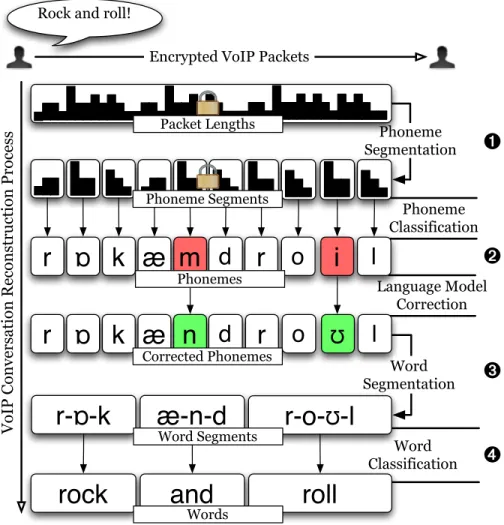
Our approach consists of four primary stages progressing from the identification of individual sounds to words and phrases. In the first stage, the sequence of packet sizes is
phoneme in the input signal corresponds to a sequence of packet sizes. In the second stage, each sequence is classified, using two different classifiers, according to the phoneme represented. The third stage splits the resulting sequence of phonemes into smaller sequences, each representing a single word; the final stage matches those smaller sequences to dictionary words.
1.3 Identification of Encrypted Web Resources
Current network security and forensics platforms have often have little to no access to information about the communications underlying encrypted connections. In order to mitigate this weakness, we propose a data-driven approach to deriving information about HTTP traffic transmitted over encrypted channels. In particular, this information includes the network host to which the HTTP connection is directed (e.g.,www.cs.unc.edu) as well as the path for the specific resource requested (e.g.,~amw/index.html).
Previous work has examined the problem of identifying the front page of web sites accessed over encrypted connections (see, e.g., Dyer et al. [43]). However, previous work has primarily focused on classifying the front pages of a limited number of web sites. Our work examines a significantly more complex space of labels by including both subdomains and the paths of the resource(s) requested in the set of labels to be modeled and predicted. In particular, we employ multi-label classification to predict not only the identity of a previously seen web page retrieved over an encrypted connection, but also to predict partial information (such as the domain name) about previously unseen URLs.
Our experiments demonstrate that the adversary model used in previous work—that each page to be identified is unrelated to the every other—is unrealistic. Furthermore, we demonstrate that the multi-label paradigm is well-suited to the problem at hand as it supports
“out-of-the-box” not only the closed-world and open-world models discussed in prior work, but also a third model—that of partial information via related URLs—not previously examined.
1.4 Contributions
In summary, the primary contributions of this dissertation are as follows:
1. Chapter 2 introduces the concept ofopaque, i.e., compressed or encrypted, data as a distinct class of network traffic which is particularly difficult (in some cases, impossible) for DPI systems to analyze, resulting in substantial wasted effort on the part of such systems. Chapter 2 then develops and evaluates methods for quickly and accurately determining whether a packet isopaque, and demonstrates the accuracy and utility of these techniques in experiments on real-world network traffic (including through live experiments on our campus network). This work was previously published in:
Andrew M. White et al. “Clear and Present Data: Opaque Traffic and its Security Implications for the Future”. In:ISOC Network and Distributed System Security Symposium – NDSS 2013. The Internet Society, Feb. 2013.
2. Chapter 3 demonstrates how side channels in encrypted VoIP connections can be leveraged to reconstruct approximate transcripts of conversations. This work was previously
published in:
Andrew M. White et al. “Phonotactic Reconstruction of Encrypted VoIP Conversations: Hookt on Fon-iks”. In: 2011 IEEE Symposium on Security and Privacy. IEEE Computer Society Press, May 2011, pp. 3–18.
3. Chapter 4 presents a novel approach to identifying HTTP resources retrieved over
CHAPTER 2: OPAQUE TRAFFIC1
2.1 Introduction
As our society becomes increasingly reliant on computer systems, the potential harms resulting from their insecure operation are far reaching—from legal, social, and economic to psychological and even physical (e.g., through cyber-physical systems) harms. Alongside requirements(e.g., confidentiality) andmechanisms(e.g., authentication),policiesthat define what actions are allowed, or disallowed, are a key building block of computer security and an
important factor in minimizing these harms.
The successful monitoring of security policies via intrusion detection systems (IDSs) critically depends on scalable and accurate techniques for inspecting traffic. Deep packet inspection (DPI) is a common method for performing such inspection, especially when security policies require determinations based on information not accurately reflected by network ports, protocols, or hosts. In fact, the market for DPI appliances alone reached almost $1 billion in 2009, and
continues to grow [161]. Since DPI must deal with huge volumes and significant heterogeneity of traffic, DPI designers often trade off accuracy of detection with resource demands [135]. DPI systems cannot generally derive useful information fromopaque(i.e., encrypted or compressed) packets; thus, we propose improving the performance versus quality curve through the quick and accuratewinnowing, i.e., filtering, of opaque traffic, and evaluate a number of techniques for doing so. Such techniques can improve the performance of DPI engines by quickly and accurately separating out low-value packets from the data stream they inspect; this is particularly important in high-performance environments, where the sheer volume of traffic can be staggering.
As previously discussed (Chapter 1), the class of opaque traffic encompasses not only encrypted connections, but also compressed entities, which, in the modern era of streaming
1The work presented in this chapter was previously published in: Andrew M. White et al. “Clear and Present Data:
video, comprise an even more significant fraction of network traffic: some sources indicate that streaming video accounts for 63% of peak network usage [51], a proportion which has nearly doubled over the past three years (from 35% in the fall of 2011 [50]).
In fact, our experiments revealed a surprising preponderance of opaque traffic: in a 24-hour weekday period, nearly 90% of TCP packets traversing a major university network (with peak loads of 1.2Gbps) were found to be opaque. This truly staggering figure suggests a broader issue for the security community moving forward: as more and more payloads become opaque to DPI engines, how can we detect and prevent obscured threats? While content-based signatures will continue to be relevant as a detection mechanism for direct attacks (e.g., those exploiting buffer overflows in networking routines) against networked systems, bypassing current DPI engines can be as simple as encrypting the relevant exploit code, particularly for indirect attack vectors (e.g., exploits embedded in documents). Thus we, as a community, face both an immediate need to separate the wheat from the chaff—to winnow low-value, i.e., opaque, packets to enable our existing detection methods to operate in high-speed environments—and a long-term need to develop methods for coping with attacks embedded in opaque, and particularly encrypted, traffic. This work represents a first step toward solving both problems: our techniques enable the fast and accurate identification of opaque packets, either as chaff to be discarded, or as the inputs to specialized detection engines targeting opaque traffic.
Unfortunately, the identification of opaque network traffic is very challenging. While
signatures can identify many known opaque protocols (e.g., SSL/TLS, SSH), some protocols (e.g., Bittorrent’s Message Stream Encryption [103]) are specifically designed to avoid signature
matching. In addition, signature-based approaches for identifying new opaque protocols require constructing and deploying new signatures for each new protocol. More importantly, existing techniques for identifying opaque data often require examination of a large number of bytes, which can be computationally and memory intensive on high-speed networks [22, 39]. Similarly, inspecting application-layer content-types to determine opacity requires resource-intensive flow reassembly. To compound matters, such detectors cannot rely on HTTP content-types as they are often inaccurate (see Section 2.3).
port-andprotocol-agnostic, allowing for the detection of opaque traffic regardless of the port(s) or protocol(s) involved. We concentrate on efficient techniques which can operate on limited portions of packet payload, such as small-sample fixed-size and sequential hypothesis tests, in order to minimize overhead and allow scarce computational resources to be reserved for high-value analyses.
In the present work, we necessarily evaluate our techniques in isolation, i.e., without
attempting to fully integrate our approach with a particular system or methodology, in order to minimize the number of factors potentially biasing our results. That said, we envision the
identification of opaque traffic not as the relatively standalone system portrayed herein — there is no “silver bullet” for network intrusion detection — but rather as an efficient new tool in the network analyst’s toolbox. In particular, forensic recording systems, such as Time Machine [97], often avoid archiving full connections in order to reserve limited storage space for the
higher-value packets at the beginning of a connection. An admitted weakness of this design decision is that attacks in the discarded portions of these connections go unnoticed. Our techniques mitigate this concern to an extent by providing a means for such a system to detect potentially high-value plaintext packets in lengthy connections. Similarly, our tests are simple and can be implemented on an FPGA, providing a benefit even to systems which make use of a hardware component, such as those followingshuntingapproach proposed by González, Paxson, and Weaver [53].
As a final note, opaque traffic identification has value that extends beyond filtering to policy monitoring and enforcement. For instance, operators may wish to monitor and enforce policies within their network (e.g., flagging encrypted packets tunneled over unencrypted connections, an odd practice used by botmasters to hide command-and-control messages in otherwise mundane HTTP traffic [25]). Similarly, one might wish to flag unencrypted traffic where
encrypted traffic is expected, such as might occur if an SSH connection is subverted [111], or on institutional networks where end-to-end encryption is required. Identifying opaque traffic may also help to discover applications tunneled over other protocols (e.g., video traffic tunneled over HTTP), or to provide sanity checking for strongly typed networking [107].
detecting such traffic (Section 2.2, Section A.1); 3) an operational analysis of modern network traffic with respect to opacity (Section 2.3.1); and 4) an evaluation, at scale, of the potential of our techniques for reducing the load on modern intrusion detection systems (Section 2.3.2).
2.2 Approach
An important requirement of ours is to minimize the amount of a packet’s payload that we must inspect, as doing otherwise is both computationally and memory intensive on high-speed networks [22, 39]. These overheads severely restrict the numbers of samples available to us for any of the tests we explore. Therefore, for the remaining discussion, we proposedetectorsbased on small-sample fixed-size hypothesis tests and sequential hypothesis testing. The latter allows us to make decisions quickly by examining only as many samples as needed to support a given hypothesis.
Our detectors are based on determining whether the bytes examined are drawn from a uniform distribution or some other, unknown, distribution. Our first instinct, when faced with the problem of measuring the uniformity of a set of samples, was to use entropy-based measures. However, as we show later,accurateentropy testing requires significantly more samples than is practical in our setting, and is less efficient than more direct methods based on the samples themselves rather than on a derived statistic such as entropy.
Both encrypted and compressed traffic will exhibit high entropy, i.e., the distribution of bytes will be close to uniform. In this paper, we consider these two cases as belonging to the same equivalence class of “opaque” objects as far as DPI engines are concerned. That is, regardless of whether the packets that belong to a session are compressed versus encrypted, they will be forced to go through the slow path wherein the engine must analyze all packets of these sessions, but will still fail to derive any useful information in the vast majority of cases. Hence, from the perspective of DPI engines, there is little value in attempting to analyze these packets. As Cascarano et al. [22] observed in their experimental evaluations, these slow paths incurred CPU overheads that can beseveral orders of magnitude higherthan the average case for transparent traffic.
generator, and thus assume access to millions of samples (e.g., [101]). These tests are unsuitable in our context because our sample size is extremely limited. We instead evaluate the appropriate fixed-size tests (the likelihood ratio test and the discrete Kolmogorov-Smirnov (K-S) test) and two variants of the sequential probability ratio test. We assess the effectiveness of each test in two scenarios, differentiated by the domain of the underlying distribution. In the first scenario, we directly test the distribution of byte values in the packet; for the second, we instead test the distribution of entropy values overn-byte “blocks” in the packet.
For pedagogical reasons, we leave descriptions of the less successful tests, along with the details of the parameter exploration experiment itself, to Section A.1.2, and discuss only the more effective tests here. In summary, the closely-related likelihood ratio and sequential probability ratio tests, operating directly on the byte values instead of on derived entropy values, consistently outperform the other tests. The poor performance of the entropy tests is related to the birthday problem, in that the (byte-)entropy of anynbytes is the same unless there is a collision (e.g., there are two bytes which share the same value). According to the birthday paradox, thea priori
probability of a collision in 8 bytes, even when choosing only from only the 95 printable ASCII characters, is only about 26%. This means that the entropy of 8 ASCII bytes is indistinguishable from that of 8 unique bytes 74% of the time. Thus entropy-based tests require substantially more than the number of samples available in our context to be effective. However, our parameter exploration experiment (see Section A.1.2) reveals that the the more successful tests require examining only 16 bytes of payload to be effective.
Since our goal is to discard opaque traffic (albeit encrypted or compressed), we let our null hypothesis be that the packet is opaque and our general alternative be that the packet is transparent. Specifically, the null hypothesis is that the values of the bytes in the packet are approximately uniformly distributed (e.g., the packet is compressed or encrypted); the alternative is that the distribution is non-uniform (e.g., ASCII text).
Likelihood Ratio Test
A well-known theorem of hypothesis testing is theNeyman-Pearsonlemma, which states that themost powerfultest, i.e., that with the lowest expectedfalse positive ratefor a givenfalse negative rate, of one simple hypothesis against another is thelikelihood ratio test[147]. For a single sample, the likelihood ratio statistic is simply the ratio of the likelihood of the sample under the
alternative hypothesis to the likelihood of the sample under the null hypothesis. For multiple samples, these likelihoods are replaced with the corresponding joint likelihoods.
Suppose we wish to test the simple null hypothesisH0 :θ=θ0against the simple alternative H1:θ=θ1given a random samplex. Then the Neyman-Pearson lemma [147, Theorem 10.1]
states that the most powerful test ofH0againstH1is that where one rejectsH0ifΛ(x)≥qand
acceptsH0ifΛ(x)< q, whereqis determined by the desired level of statistical significance and
Λ(x)is the ratio of the likelihood ofxunder the alternative to the likelihood ofxunder the null hypothesis.
Sequential Probability Ratio Test
Sequential analysis is often used when there is a desire, such as in our context, to limit the number of samples examined. In fact, Wald and Wolfowitz have shown that, among all tests of two simple hypotheses with fixed error probabilities, the sequential probability ratio test (SPRT) minimizes the expected number of samples required for a decision under either hypothesis [149]. Sequential testing works by examining samples one-by-one, rather than all at once, and
evaluating a decision function at each sample. This allows the test to stop examining samples as soon as it has found enough “evidence” for one hypothesis or the other.
Specifically, letα=P[acceptH1| H0]be the probability of afalse negative, that is, an erroneous
prediction that the population is not uniformly distributed; similarly, defineβ =P[acceptH0| H1]
as the probability of afalse positive. In order to perform the test, we iterate through some
we choose at each iterationmone of three actions: acceptH0,acceptH1, orcontinue, as follows:
acceptH0if Λm(x1, x2, . . . , xm)≤g0(m)
acceptH1if Λm(x1, x2, . . . , xm)≥g1(m)
continue otherwise.
Settingg0(m) = 1−βα andg1(m) = 1−αβ gives the desired probabilities of false positives and false
negatives.
A known drawback of this test is that it may not terminate within an acceptable number of samples. We alleviate this concern by exploring two variants, which we refer to as thetruncated andrestrictedSPRTs. For the truncated SPRT, we specify a maximum number of samples which the test is allowed to examine; if this limit is reached without making a decision, then the
fixed-size likelihood ratio test is applied to the samples examined so far. The restricted SPRT, on the other hand, works by sloping the decision boundaries such that they intercept the axis after the given number of samples. For the restricted case, we follow the approach suggested
by Bussgang and Marcus [20].
Based on the results of the parameter exploration experiment (see Section A.1.2), we use the truncated sequential method (α= 0.005,β = 0.005,δ = 0.85) for the remainder of the
experiments in this work.
2.3 Evaluation
2.3.1 Offline Analysis
File Type Identification
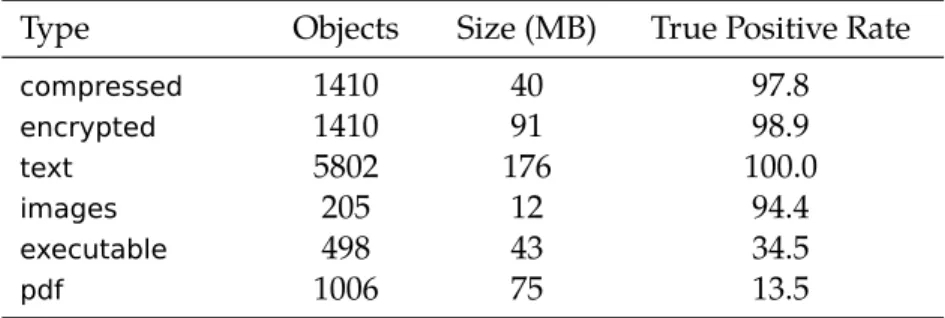
To gain an understanding of how well our techniques were able to label the opacity of various common data types, we collected a set of files with known ground truth, including compressed archives and streams, encrypted files, executable binaries, and text files. We also attempted to cover different sub-types; e.g., we included five different text file encodings. The details of this set, which we believe to be a reasonable cross-section of common file types, are presented in Table 2.1.
We gathered a base set of files from multiple sources, then applied standard compression and encryption algorithms to these files to create the remainder of the dataset. For executables, we used ELF binaries from thebindirectories of a basic Ubuntu Server 10.04.3 installation (that we used for testing Bro and Snort). The files in each directory, including a number of Perl scripts, were then individually compressed usingtar(which in turn usesgzipandbzip2) to providegzip
andbz2files and encrypted usingopensslto provide examples of the RC4 and AES ciphers. The text files are the contents of themanpath directory of the same Ubuntu installation, uncompressed and processed bygroffinto different encodings (ASCII, UTF-8, -16, and -32, and latin1); the PDF files are the archive of proceedings from a major computer security conference. Finally, the images were JPEGs scraped from public websites, including a departmental website andnasa.gov.
To simulate a network environment, we transmitted each object over an individual TCP connection on the loopback device of an Ubuntu virtual machine. We usedncto both send and receive, andtcpdumpto collect the resulting packets. We report the proportion of opaque and transparent packets observed for each type of file in Table 2.1.
Type Objects Size (MB) True Positive Rate
compressed 1410 40 97.8
encrypted 1410 91 98.9
text 5802 176 100.0
images 205 12 94.4
executable 498 43 34.5
pdf 1006 75 13.5
Table 2.1: File Type Analysis
(which amounts to simply checking the high-order bit).
Content Type Matching
To assess the accuracy and performance of the techniques in Section 2.2, we instrumented the Bro IDS (version 1.6-dev-1491) to log packet-level information (with only coarse-grained payload information), providing a form of ground truth. Due to privacy restraints, we were unable to record full packet traces at scale; therefore, the experiments in this section are performed on logs generated by our instrumented version of Bro. For these experiments, we collected two logs (log1
andlog2) from two large university campuses.2 Both logs were collected over several hours during a weekday. For simplicity, we only consider IPv4 TCP traffic. We labeled each packet by protocol using Bro’s dynamic protocol detection [38], and restricted our analysis to two
encrypted protocols (SSL and SSH) and two unencrypted protocols (HTTP and SMTP).
For each packet, we log the source and destination ports, the HTTP message type, the HTTP message encoding, and the payload length; we also store coarse-grained statistics in the form of a binary value for each byte of the payload (indicating whether the byte’s value is less than 128), and the byte-value frequencies for eachn-byte block of the payload. The latter are needed to calculate sample entropy at the block level and for the frequency-based tests (i.e.,χ2 and discrete
Kolmogorov-Smirnov (K-S); see Section A.1). In all cases, we only log information for the first 256 bytes of the payload.
2The researchers and their respective Technology Service Offices have longstanding memorandums of understanding
We labeled each packet as “opaque” or “transparent” according to the expected data type for that packet: SSL and SSH packets are labeled opaque and SMTP packets are labeled transparent. For HTTP, we labeled packets based on the HTTP Content-Type and Content-Encoding header fields (as given by the sender) for the corresponding HTTP message (see Section A.2 for details of the labeling). This allows us to further restrict our attention to only those content-types for which opacity should be predictable and consistent. For instance, the HTTP 1.1 specification states that “HTTP entities with no specified Content-Type should be identified by inspection of the
contents” [45]; we remove any such packets from our analysis because we have no way of
determining ground truth. However, as we discovered during the course of this work, the HTTP Content-Type headers are often inaccurate and misleading (details are given in the following sections).
Unfortunately, Bro suffers from performance problems (see [39]) on high-speed networks, especially when port-based analysis isdisabled(as is necessary to force Bro to determine protocols solely by inspection). Therefore, we discard any HTTP packets which belong to flows in which Bro experienced losses. We do so because the dropped packet(s) could have contained essential labeling information (e.g., a message header) necessary for determining the Content-Type and encoding.
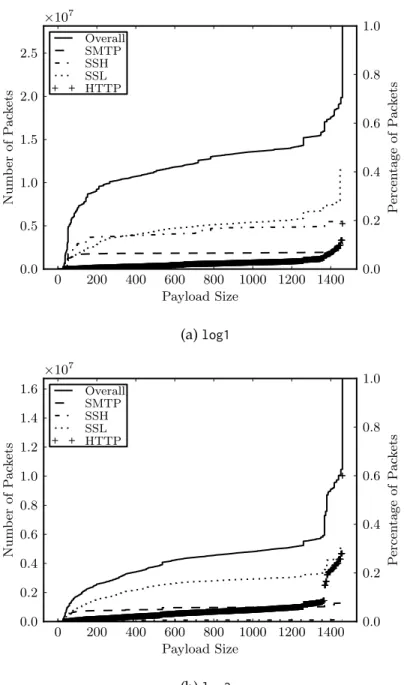
After filtering the logs down to only those packets which met the criteria outlined above, over 39 million packets (across≈3.8million bi-directional flows) remained fromlog1and over 24 million (across≈2.3million bi-directional flows) remained fromlog2. The traffic makeup for both logs is shown in Figure 2.1.
The Content-Type distribution (Figure 2.2) for the top content types in both logs reveals some interesting contrasts between the two. In particular, video types are prevalent inlog2whilelog1
consists mainly of web-browsing traffic (over 80% oflog1HTTP packets have Content-Type image/jpegortext/html, compared to 40% inlog2). The Content-Encoding field is only specified for a small proportion of packets in our logs, and the only significant encoding isgzip, at 4.0% in
0 200 400 600 800 1000 1200 1400 Payload Size
0.0
0.5
1.0
1.5
2.0
2.5
Num b er of P ac k ets
×107
Overall SMTP SSH SSL HTTP
0.0
0.2
0.4
0.6
0.8
1.0
P ercen tage of P ac k ets (a)log1
0 200 400 600 800 1000 1200 1400 Payload Size
0.0
0.2
0.4
0.6
0.8
1.0
1.2
1.4
1.6
Num b er of P ac k ets
×107
Overall SMTP SSH SSL HTTP
0.0
0.2
0.4
0.6
0.8
1.0
P ercen tage of P ac k ets (b)log2
0.0 0.1 0.2 0.3 0.4
Percentage of HTTP Packets text/html
image/jpeg app/pdf video/x-flv text/plain image/png video/mp4 image/gif app/zip
audio/mp4 trace1trace2
Figure 2.2: HTTP Content-Type Distribution
log1 log2
Protocol Match Rate Examples Match Rate Examples
SSH 94% 7.3m 97% 157k
SSL/TLS 96% 16.4m 94% 5.5m
SMTP 86% 3.35m 80% 1.4m
HTTP 91% 9.7m 85% 13.8m
Total 94% 36.7m 96% 20.8m
Table 2.2: Experimental Results (log1andlog2)
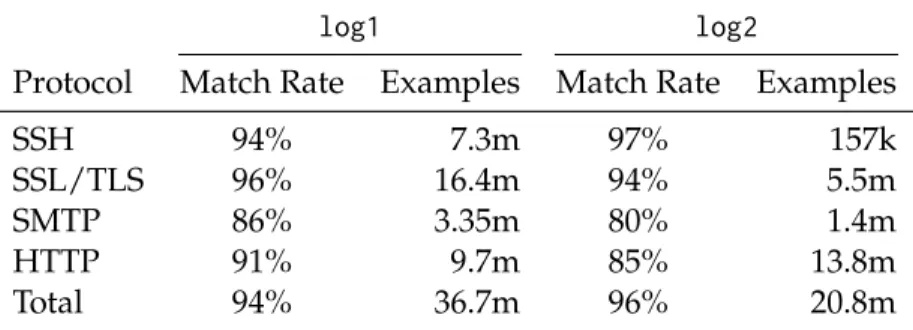
produced the same label as expected from the content type, of 95.1% onlog1and 96.0% onlog2. We refer to “match” rates here, rather than false-positive or false-negative rates, due to the large quantity of mislabeled content-types we encountered.
In the case of encrypted traffic (i.e., TLS/SSL) we accurately classified approximately 95% of the traffic. However, the mismatches are particularly interesting. Figure 2.3 shows the
distribution of packet IDs, where a packet’s ID is its position in the bi-directional flow (i.e., a packet with ID zero is the first packet sent by the originator of the connection). Notice that94.8% of the mismatches for SSL/TLS occur within the first 5 packets, and95% within the first 6 packets for SSH. These packets are all in the connection set-up phase and hence are not, in fact,
encrypted. Moreover, these connection set-up packets, particularly any SSL certificates (typically around ID 2), may be of interest to DPI engines even when the encrypted payload is not.
0 2 4 6 8 10 Packet ID
0.0 0.2 0.4 0.6 0.8 1.0
P
ercen
tage
of
P
ac
k
ets
All
False Negatives
(a) SSL/TLS
0 2 4 6 8 10
Packet ID 0.0
0.2 0.4 0.6 0.8 1.0
P
ercen
tage
of
P
ac
k
ets
All
False Negatives
(b) SSH
Figure 2.3: CDFs of Packet IDs
0.00 0.01 0.02 0.03 0.04 0.05 0.06 0.07 Percentage of HTTP Packets app/pdf
text/plain image/jpeg app/x-shk-flashtext/html
trace1 trace2
mismatches forlog1, and 15% forlog2, are from SMTP traffic, which we surmise includes opaque attachments for which we do not have accurate labeling information. Of the HTTP
transparent-as-opaque mismatches (Figure 2.4), many are PDF and Flash (both of which can serve as a container for many other object types), but a surprising proportion are of typetext/plain.
We investigated thetext/plainmismatches fromlog1further and concluded, based on the observed byte-value distributions, that if these packets are in fact plaintext, the method used for encoding is non-standard. Figure 2.5a depicts the byte-value distribution for the mismatches and for thetext/plainpackets where the encoding was specified explicitly as one of UTF-8, UTF-16, US-ASCII or ISO-8859-1. As expected, the latter distribution has significant mass around the ASCII characters ‘A’-‘z’ (values65−122in Figure 2.5) while the former does not. A similar finding holds for the opaque-as-transparent mismatches in theimage/jpegcase: the distribution (bottom, Figure 2.5b) has striking similarities to that observed for the case of known plaintext encodings (top, Figure 2.5a), and moreover, is quite different from that of the opaque JPEGs (top, Figure 2.5b). Unfortunately, without access to actual payloads for these two traces, we cannot say what was the underlying cause for the peculiar distribution in the content flagged by our
methods, but we believe this underscores the utility of our techniques — i.e., wesuccessfully identified anomalous instances in both cases. We revisit this issue in the next section.
Finally, we examined the number of iterations needed by the truncated test to make a decision regarding each packet. With the maximum sample size set at 16 bytes, 45% of the packets can be classified in 12 bytes or less.
Operator Analysis
0 50 100 150 200 250 Value 1 2 3 4 5 Coun t
×105
0.01
0.02 0.03 0.04
P ercen tage 1 2 3 4 5 Coun t
×105
0.01 0.02 0.03 0.04
P
ercen
tage
(a)text/plain(top: known encodings (transparent), bottom: opaque)
0 50 100 150 200 250 Value
104 105
106
Coun
t 10−
2
10−3 10−4 10−5 10−6 P
ercen tage 104 105 106 Coun t
10−2 10−3 10−4 10−5 10−6 Percen
tage
(b)image/jpeg(log-scaled; top: opaque, bottom: transparent)
We determined the opacity of each packet, saving those entities and connection payloads wherein the first five packets were mismatches. For the HTTP entities, we define a mismatch as having an opacity different from that implied by the Content-Type or Content-Encoding. For the streams on port 443, we consider transparent packets to be mismatches. We also captured relevant metadata, such as the uniform resource identifier (URI), Host, and MIME-type of the resulting file (determined using Bro’slibmagicinterface).
We discovered a number of mismatched HTTP entities in the trace, of both the
transparent-as-opaque and opaque-as-transparent varieties. In the former case, many of these mismatches were HTTP entities labeled with Content-Typetext/plainand no stated encoding; we determined from the metadata that most of these were either images or compressed bundles. These compressed bundles included what appear to be updates to Symantec antivirus,
extensions to the Plex media center, and an installer for the DivX video codec (a.cabfile). The images were identified by MIME-type as JPEGs. One interesting mismatch declared a
Content-Type oftext/javascript, with no encoding, while the MIME-type reported was
application/octet-streamand the filename.gz.
Of the opaque-as-transparent mismatches, a number of entities were labeled as JPEG and GIF images by Content- and MIME-type but were flagged as transparent by our techniques. Many of these contain significant text, which we speculate may be metadata. We also found a large number of streams on port 443 with predominantly transparent packets. According to our network operator, these streams comprised: cleartext Yahoo Voice connection information (including account names), names and email addresses from a social networking chat site, and what appeared to be instant messenging conversations. As an aside, in looking at flagged mismatches while testing, one of the authors discovered his AIM contact list transmitted in the clear over port 443 by Adium!
2.3.2 Online Analysis
rule-matching engine. We positioned our winnowing preprocessor to intercept packets before reaching the stream reassembly module.3 This allows us to drop opaque packets early enough to avoid incurring the overhead (over 30% of Snort’s run-time in some experiments) of stream reassembly and long before reaching the pattern matching engine.
The ruleset used was provided by a major university, which uses Snort primarily for
post-facto forensics, and contains 1606 rules. As a sanity check, and to provide results on a public dataset which could therefore be easily reproduced, we evaluated both stock Snort and Snort with our winnowing preprocessor on the (admittedly controversial) DARPA/MITLL 1999 intrusion detection dataset. Both configurations produced exactly the same set of alerts.
For our online experiments, we made use of an Endace 9.2X2 DAG card to run two Snort (version 2.9.1.2) instances in parallel, one with stock Snort and the other with winnowing enabled, on live traffic. The DAG uses a packet processor to capture and timestamp packets at line rate, and employs an on-board direct memory access (DMA) engine to zero-copy packets into the host’s memory (Figure 2.6). The DMA engine can also be programmed to duplicate traffic over multiple memory buffers (called “streams”), which enables us to simultaneously run multiple experiments, thereby comparing different approaches on the same traffic. We use a 10Gbps DAG connected to a 2.53 Ghz Intel Xeon 6 core host with 16GB of memory. As in our earlier experiments, we only examined traffic on ports 22, 25, 80 and 443; this filtering was performed on the DAG and therefore CPU resources are used exclusively for payload inspection. Beyond the winnowing preprocessor, there were no differences between the two configurations: both used the same ruleset with the default Snort options (including inspection ofgzippedHTTP entities and the bypassing of the detection algorithms by SSL application data packets in
established streams), and each was allocated 2GB of memory on the DAG.
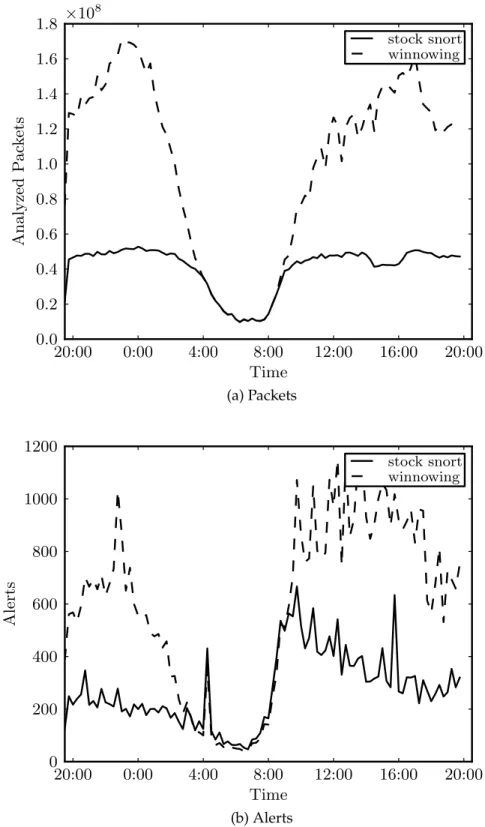
Our primary experiment lasted for 24 hours and encompassed more than 7.6 terabytes of traffic; the load reached 1.2Gbps at peak. Figure 2.7a shows the number of packets which each instance of Snort was able to process in 15-minute intervals. Even at peak load, our winnowing Snort instance is able to handle the full volume with zero percent packet loss. In contrast, the stock Snort instance dropped nearly 60% of the 98.9 billion packets observed during the 24-hour
3Our preprocessor only drops packets with TCP payloads and therefore does not interfere with connection tracking at
Assign Color
Drop
CPU 1,2
Snort w/ Winnowing
CPU 3,4
1 2
Match No Match
TCP, Port 80 TCP, Port 22 TCP, Port 443
No Match Filter Rules
e.g., UDP
Buffers/ Streams
Snort w/o Winnowing e.g., HTTP
DMA Engine
Capture Packet
Extract Header Fields Lookup TCAM
20:00 0:00 4:00 8:00 12:00 16:00 20:00 Time
0.0
0.2
0.4
0.6
0.8
1.0
1.2
1.4
1.6
1.8
Analyzed
P
ac
k
ets
×108
stock snort winnowing
(a) Packets
20:00 0:00 4:00 8:00 12:00 16:00 20:00 Time
0 200 400 600 800 1000 1200
Alerts
stock snort winnowing
(b) Alerts
0 200 400 600 800 1000 1200 1400 Payload Size
107 108 109 1010 1011 1012 1013
Num
b
er
of
P
ac
k
ets
(log-scale)
opaque transparent both
Figure 2.8: CDF of payload size for both opaque and transparent traffic.
window. In fact, the winnowing Snort instance processed 147% more packets, resulting in over 33,000additional alerts(see Figure 2.7b). We note that as the drops suffered by the unmodified Snort are lost when Snort is unable to copy packets out of the network buffer fast enough to avoid old packets being overwritten by the kernel (or the DAG, in this case), and therefore Snort has no control over which packets are dropped [117].
In a second experiment, we partitioned one of the two identical traffic streams at the DAG into four disjoint streams, each of which was passed to a stock Snort instance running on a dedicated core. However, due to traffic bursts, the stock Snort instances still dropped significant numbers of packets despite our attempts to optimize its handling of the traffic. While this underscores the need for techniques like ours, we remind the reader that the advantages of winnowing traffic are not limited to situations of overload: the significant throughput increase allows systems to evaluate more rules than stock configurations under the same traffic conditions.
We stress that, apart from the winnowing preprocessor, the Snort instances in each experiment wereidentically configuredand sawexactly the same traffic. The substantial
as discussed in Section 2.2, incurs high CPU overheads (confirmed in our experiments by an observed 30% increase in average per-packet processing time compared to transparent packets). In total, an astonishing 89% of the payload-carrying TCP packets observed in our primary
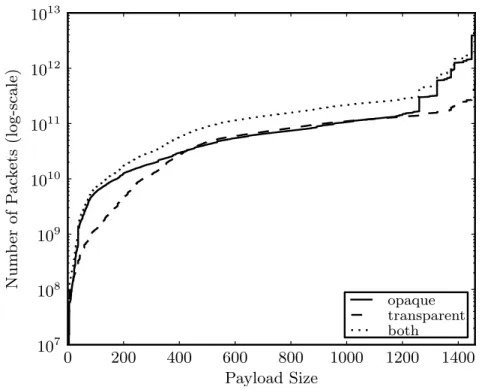
experiment were classified as opaque, representing 86% of the bytes transmitted. We hypothesize that this is due to the prevalence of streaming video services such as Hulu, Netflix, and YouTube operating on port 80. Differences in the packet size distributions (see Figure 2.8) indicate that maximum transmission unit (MTU)-sized packets are far more often opaque than not, which suggests that large, compressed streams (e.g., the aforementioned streaming video), are prevalent. These streams may also account for the bursty nature of traffic observed in the multiple core experiment.
Operational Impact
of HTTP headers is possible even in the presence of missing payload packets, we believe such alerts would be triggered if the IDS was better equipped to recover from such midstream losses. Alternatively, a more mature implementation of the winnowing preprocessor could inform Snort of the dropped packets.
Nevertheless, the instantiation of our prototype on a major campus network has already provided valuable information to its network operators, clearly showing that their network security exposure differs from what they originally thought.
2.4 Limitations
While our focus on minimizing payload inspection suggests a trivial method for an attacker to bypass DPI engines using our technique (by padding the beginning of the packet with ASCII bytes), in current systems an attacker need do nothing more than “encrypt” their exploit code (e.g., a simple XOR may suffice) to bypass content-based signature matching engines.
Furthermore, our techniques comprise a method for flagging the likely presence of such encrypted objects based on nothing more than the ciphertext itself.
At first blush, it may appear that binary protocols present an insurmountable problem for our methodology. However, we point out that the majority of traffic (i.e., 80% on our network) is HTTP, a text protocol. Furthermore, the high-volume binary protocols (SSL, RTMP, and Bittorrent) transport primarily, if not exclusively, opaque data. We believe that a different alternative hypothesis, such as that mentioned earlier in the context of identifying file types, could provide improved accuracy for binary protocols.
Additionally, while it may seem that the flow level, as opposed to the packet-level, is the natural vantage point for identifying opaque traffic, our work concentrates on packet-level analysis. We argue that the presence of tunneled traffic, and container formats such as PDF, mandates identification of opaque traffic on a per-packet basis. In the specific case of encrypted connections, many protocols (e.g., SSH and SSL) begin with unencrypted, connection set-up packets; some protocols (e.g., using STARTTLS) are even designed specifically to enable
stream reassembly engine, significantly reducing overhead. That said, there are benefits to incorporating flow-level analysis. One interesting direction might be to limit packet-level misclassifications by utilizing information from prior and subsequent packets.
We remind the reader that our techniques are not intended to be used in isolation, but rather as components in larger systems. Therefore, the limitations of our techniques can be mitigated by the strengths of the remainder of the system architecture, such as by coordinating flow-level analysis with packet-level opacity checking. This would provide a layered defense against, e.g., attacks embedded in lengthy streams to evade systems usingselective packet discarding[117], which is discussed in the next section, or approaches similar to the afore-mentioned Time Machine (see Section 2.1).
2.5 Related Work
The related problem of forensic file and data type identification has been extensively explored over the past decade. Many of these efforts have focused on analyses ofbyte frequency
distributions, i.e., the frequency of each byte value in the data of interest. For the most part, these approaches work by creating signatures for known file types (i.e., HTML or PDF) based on byte frequency distributions, and then comparing unknown files to pre-existing signatures to
determine the file type (see, e.g., Ahmed et al. [3]). Veenman [146] and Hall [56] examined entropy and compressibility measurements as indicators of file type, while others have explored techniques for directly modeling the structure of files [55, 60, 87, 128]. The closest work to the problem at hand is that of Conti et al. [29], who consider distinguishing between random, encrypted and compressed files usingk-nearest-neighbor classification. Shannon entropy and theχ2statistic, among other measures, are evaluated as distance metrics over sliding windows of 1KB or more. Similar ideas were explored by Shamir and van Someren [132] for identifying cryptographic keys on disk. However, as our empirical analyses showed, the forensics scenario is fundamentally distinct from the setting we explore in this work: for real-time analysis on the network, the amount of data available is constrained and computational resources are scarce.