BECOMING ―URBAN‖:
A CULTURAL-HISTORICAL EXAMINATION OF A COLLEGE OF EDUCATION
Lara Willox
A dissertation submitted to the faculty of the University of North Carolina at Chapel Hill in partial fulfillment of the requirements for the degree of Doctor of Philosophy in the College of Education.
Chapel Hill 2011
ii © 2011 Lara Willox
iii ABSTRACT
LARA WILLOX: Becoming ―Urban‖: A Cultural Historical Examination of a College of Education
(Under the direction of Madeleine Grumet)
This dissertation presents a case study of a College of Education as it began the process of becoming an urban focused organization within an urban institution. This study explores teacher educators‘ conceptions of urban education and the tensions that appear to influence the process of change. Data was drawn from historical background knowledge, on site observations, document reviews, and interviews with teacher educators engaged in the process to answer the following questions: 1) What tensions influence a College of Education going through the process of institutional change with the goal of becoming an urban focused organization within an urban institution? 2) What meanings does the term ―urban‖ have in these programs?
iv
urban, differences between newer and older faculty members, and procedural expectations by outside agencies.
The findings suggest that greater attention needs to be paid to the historical and cultural elements of institutional change processes that are at work but often go
v
ACKNOWLEDGEMENTS
I owe a depth of gratitude to many people for this accomplishment. I would first like to thank all of my students who believed in me. It was with them in mind that I worked through this process.
I would also like to thank Bob Audette and Jeff Passe; without their support I would not have pursued this degree. Dr. Audette provided me opportunities that began my career as a teacher leader. Jeff began mentoring me in my fourth year of teaching and has stood by my side professionally through this entire journey; he continues to provide unwavering support, and for that I am ever grateful. Also, thank you to the faculty at Bloomsburg University for allowing me to participate in their change process.
vi
me; I hope to emulate her professionalism, leadership, and thoughtfulness. I would also like to thank the rest of my committee, Deb Eaker-Rich, Jocelyn Glazier, Janice
Anderson, and Karolyn Tyson for providing unwavering support throughout the process.
The friendships I developed at UNC have also shaped the work I am presenting. Our cohort provided endless laughter, support, (and chocolate chip cookies) while traveling together from class to class. I will be forever connected and indebted to Julie, Liv, and Kim as we completed the final chapters together.
vii
TABLE OF CONTENTS
LIST OF FIGURES ... x
LIST OF TABLES ... xi
CHAPTER ONE: INTRODUCTION ... 12
Research Questions ... 19
CHAPTER 2: HISTORICAL CONTEXT ... 21
The Forming of Bloomsberg ... 22
Civil War and Reconstruction ... 22
Early 20th Century and the Depression ... 24
Civil Rights Era... 27
Integrating Bloomsberg County Schools ... 30
Late 20th Century ... 32
The 21st Century ... 38
CHAPTER THREE: METHODOLOGY ... 44
Site Selection ...45
Participants ...46
Data Sources ...48
Data recording and management ...50
Cultural Historical Activity Theory ... 50
Data Analysis ...55
Rigor and Trustworthiness ...58
Researcher Bias ...60
CHAPTER FOUR: MEDIATING URBAN UNDERSTANDINGS ... 62
Characteristics of Urban Universities ... 63
Faculty Conceptions of an Urban University...70
viii
Urban Definitions... 80
Geography ...80
Urban Education ... 85
History of Urban Education ...87
Defining Urban Education in Context ...95
Theme 1: Category Ambiguity ...96
Theme 2: Diversity ...98
Theme 3: Problem Based ...99
Theme 4: Pedagogical Intervention ...100
Urban Teacher Education ... 102
Faculty Diversity ...110
Conclusion ... 114
CHAPTER FIVE: TENSIONS EXPLORED ... 118
Institutional Theory ... 119
Processes of Change ...121
Facilitating Change ...135
Tensions among and between Activity Systems ... 142
Tensions within the College of Education ...142
Tensions between the College of Education and Bloomsberg University ...154
Tensions between the College of Education and Bloomsberg County School System………..166
CHAPTER SIX: DISCUSSION ... 175
Ideological Tensions ... 176
Meanings of Urban ...176
Newer & Older Faculty ...179
Institutional Differences...182
Recognition ...187
ix
Rules ...190
Specific Connections ...191
Limitations ... 192
Theoretical Framework Explored ... 195
Researcher Role ... 200
CHAPTER SEVEN: IMPLICATIONS ... 202
APPENDIX A: PARTICIPANT LIST ... 209
APPENDIX B: INTERVIEW GUIDE ... 210
APPENDIX C: BOOK CLUB PROPOSAL... 212
APPENDIX D: SEMINAR SURVEY RESULTS ... 214
APPENDIX E: FACULTY DEVELOPMENT PRE-READING ... 217
APPENDIX F: STRATEGIC GOALS 2010-2015 ... 221
APPENDIX G: NESTED ACTIVITY SYSTEM ... 223
x
LIST OF FIGURES
Figure 1: CHAT ... 18
Figure 2: Cultural Historical Activity Theory ... 53
Figure 3: College of Education Activity System ... 142
Figure 4: Tension A ... 144
Figure 5: Action B ... 148
Figure 6: Action C ... 152
Figure 7: Tensions with Bloomsberg University ... 156
Figure 8: Activity 1 ... 158
Figure 9: Activity 2 ... 164
Figure 10: Tensions with Bloomsberg County Schools ... 173
Figure 11: CHAT including Historical Context... 195
Figure 12: Multiple Meanings of Multicultural Teacher Education: A Conceptual Framework (Cochran-Smith, 2004 p.140) ... 199
xi
LIST OF TABLES
Table 1: Achievement Scores ... 39
Table 2: Participants ... 47
Table 3: Participant Years of Service ... 48
Table 4: Department Representation ... 48
Table 5: CHAT components ... 53
CHAPTER ONE: INTRODUCTION
―Urban space is a densely woven fabric: a multi-layered tapestry of intertwined threads from different people, institutions, cultures, and times.‖ ~ Petra Gemeinboeck (2007)
In 2007, Australian artist Petra Gemeinboeck created a locative media artwork titled ―Urban Fiction‖ using technology and tapestry to devise a virtual map of an urban area (Gemeinboeck & Saunders, 2007). Gemeinboeck, with the support of Rob Saunders, imagined the city's social fabric to be fluidly transformed, constantly rewoven,
embroidered, torn apart, and stitched together again.
It is the city's inhabitants, who continuously add threads and pull them across its multiple layers, actuating these fluid transformations. Conventional
representations of the city are blind to our everyday social encounters and the resulting changing spaces and relations. Rather, they display the fixed regulations that constrain this dynamic play. This project's objective was to make the
interplay between the lived and the mapped visible and tangible (Gemeinboeck & Saunders, 2007, p. 110).
13
process to highlight the complexities, fluctuations, and policies that are both promoting and hindering institutional change within a teacher education program. My goal has been to ―map‖ the process of institutional change using a theoretical and research paradigm that allows the complexity and dynamics to be highlighted without succumbing to broad generalizations and fixed answers. The questions driving this project relate both to the conceptualization of ―urban‖ and the process of change within teacher education. Urban education is the term that many colleges of education have adopted to represent their programs in the last two decades. Urban, as a designation within teacher preparation programs, typically denotes preparation involving diversity, social justice, and multicultural education. Marilyn Cochran-Smith (2004), the Cawthorne Professor of Teacher Education for Urban Schools at the Lynch School of Education at Boston College, has written extensively about teacher preparation for race, diversity, and social justice. In her book Walking the Road: Race, Diversity and Social Justice in Teacher Education, she presented a framework for understanding the multiple meanings of multicultural teacher preparation; several of the programs highlighted in the text are teacher education programs labeled ―urban‖ (Cochran-Smith, 2004). I wondered, within the constellation of meanings associated with the term ―urban,‖ what meanings does it have in these programs? What tensions influence a College of Education going through the process of institutional change with a goal of becoming an urban focused organization within an urban institution?
To explore these questions, I completed a case study of a College of Education as it began the process of becoming an urban focused organization within an urban
14
circumstances that appear to influence the process of change. A qualitative case study was employed because this research examined a complex process in a specific setting (Marshall & Rossman, 1999). The study took place in a particular environment and concentrated on both the context and the participants‘ frame of reference. Data collected included observations of faculty development events, committee meetings, and general college meetings. Documentation pertaining to the process of change and meanings of urban was analyzed, and twenty-eight interviews were conducted with stakeholders involved in the change process at the College of Education. Chapter Three will provide more study specifics.
The institutional goal of the College of Education highlighted in this study is to improve the education of K-12 students in the urban school district through urban focused teacher education. The goal seems rather simple, as though change in teacher education equals an automatic change in student outcomes. There are, however, a number of mediating factors associated with this goal that include the histories of the university, the school, and the community, the connections between the university and school system, the approaches of the College of Education to urban education, and the way the term ―urban‖ is conceptualized. Though the goal can be perceived as a relatively easy one, there are challenges for the College of Education that cannot be ignored as it works toward improving education for K-12 students by adjusting the focus of its teacher education program.
15
white suburb of Bloomsberg1 until my family moved downtown when I was 12. As a consequence, I attended an urban2 school, and I became a minority student among the majority of my classmates who were African American, Hispanic, and Asian American. My friends, therefore, were of varying races and ethnicities. After graduating from college, I was happy to return to Bloomsberg and begin my teaching career in the same diverse urban program I left. As I established myself as a teacher, I bought a house not far from the city‘s center, and my 12 years as a classroom teacher were spent within five miles of downtown Bloomsberg.
It is the complexities and contradictions surrounding understandings of the term ―urban‖ that interest me most. My story could be told as described above, ignoring the reality of my own student past which is that I was not a stereotypical ―urban‖ youth; tracking and gentrification erased that designation and created a type of de facto
segregation. While my neighbors and friends may have been of different ethnicities, they all shared a level of wealth and comfort. Only in homeroom was my minority status a reality. Honors classes left me and my white peers segregated from a
traditional/stereotypical ―urban‖ education. Today my alma mater is listed as one of the worst performing schools in the state, with only 26% percent of students passing state reading assessments (Helms, 2006). When the magnet program ceased, the white middle class population of students ceased to be a presence in the school.
1 Bloomsberg is the pseudonym for the city in which this research took place.
2
16
Within the last eight years, schools in Bloomsberg have re-segregated. The area has become more gentrified3, and racial inequities and achievement gaps have grown. My experiences while working and living in the city in no way mirror those of the students I taught during my last five years in the classroom. Their experience was more similar to those classmates of mine who were in the lower tracks. It was during those years of teaching at an inner city school that I began to question the priorities of the city and the school system and my own personal beliefs. It was also during this time that I entered a Master‘s program in education at the public Bloomsberg University4
.
At Bloomsberg University, I gained new pedagogical knowledge; however, I was not provided an opportunity or a critical lens with which to reflect on my teaching situation. The inequities present in the inner city school were glaringly apparent. Every minute of the day was scripted, and any of the teachers‘ or students‘ passion for learning was extinguished. Meanwhile, in the same school system, students in suburban schools were provided an entirely different curriculum: one rich with integration, the arts, and challenging curriculum. It was out of frustration with the inequity of the curriculum at the inner city school that I left the area to attend graduate school.
These issues of urban education intrigued me throughout my teaching career and into my graduate program. In the field of education, ―urban‖ is a euphemism for poor and minority. Even beyond poor and minority, the term ―urban‖ invokes ideas of chaos and fear. Movies depict urban students as violent, almost feral individuals suffering in the
3 While gentrification is typically associated with increased numbers of non-minorities within the city, in
this particular city most of the housing complexes populated by minority groups were destroyed, and all of their residents were forced to relocate. The relocation of these minority groups to particular sections of town has contributed to the resegregation of schools.
4
17
shadows of the city. However, in my experience, urban students were not students to be feared; it was the structural forces at work that separated and challenged students, not their own deficiencies.
While my past is pertinent to my lens and scope as a researcher, the past of the city, the local school system, and Bloomsberg University are equally pertinent. Because the historical context is the backdrop for this story, Chapter Two will provide a brief history of the city, the local school system, and Bloomsberg University. Without this historical context, my research would be alienated from all that has shaped it.
It is also important to understand the institutional context in which the participants are operating. This research explored teacher educators‘ understanding of urban, while they were engaged in a process of change within an institution. While no research can analyze all of the connections across complex institutional arrangements, I chose to use Cultural Historical Activity Theory (CHAT) to explore the tensions within and between the specific entities. Tensions are not meant to imply negativity; in Activity Theory the tensions among the six parts are what propel an activity process. The tensions affect the process of change. Whether that is a negative or a positive effect is determined by how they influence the outcome of the process. Sometimes tensions that appear to hinder the process of change may actually allow for more discussion, resulting in change in a different area or direction. After all, it could be argued that all learning and change are the result of tension pushing our understandings and our thoughts.
18
part of the social constructivism paradigm that originated in Vygotsky‘s work. (Worthen, 2004). Through the examination of the six parts of the change process--subject, object, mediating artifacts, rules, community, and division of labor--tensions that influenced the outcome will be exposed (Ogawa, Crain, Loomis, & Ball, 2008). Like the complex tapestry created through digital media by the Australian artist, Gemeinboeck, CHAT allows some of the threads of activity to be exposed. Like threads woven across a
tapestry, each idea is connected to the others; if one is pulled in a certain direction, it will affect the rest. The figure below is an illustration of how CHAT can be used to examine complexities without developing a simplified understanding. The theoretical foundation for this approach will be further explained in Chapter Three.
Figure 1: CHAT
Mediating Artifacts (Technology)
Rules (Formal Structure)
Community
(Organization) Division of Labor (Formal Structure)
Outcome Object
(Goal) Subject
19
Chapter Four will explore the ways the faculty and stakeholders at the College of Education at Bloomsberg University are making sense of ―urban education.‖ Faculty members‘ and stakeholders‘ understandings will be compared and contrasted with the way that urban is conceptualized within current literature and research. A brief history of urban education will also be provided to help contextualize current understandings.
Chapter Five examines the arduous yet necessary process of institutional change through the exploration of the tensions within and between the city, school system, and Bloomsberg University. All of these entities are best characterized as institutions. These particular institutions are all changing and growing to prepare for current contexts and beyond. Institutional change is characterized by building, extending, maintaining, revising, and dismantling at multiple levels, including individuals, organizations, fields, communities, and associations (Scott, 2001). There is an interweaving of actions, processes, and structures that may eventually result in change. As Heinz-Dieter Meyer (2006) pointed out, ―institutions change for the most part with glacier speed‖ (p. 217). While urban areas are rapidly experiencing growth, change, and fluctuation, institutions supporting these areas are not as quick to adapt and change.
Chapter Six considers the research as a whole and Chapter Seven offers implications and recommendations. Beyond the implications for organizations facing urban change, care has been taken to consider the methodology employed as well as the appropriateness of the theoretical framework brought to this study.
Research Questions
20
The College of Education at Bloomsberg University is in the process of considering the urban population when educating pre-service and practicing teachers. As I engaged in this process, I explored the following questions:
What tensions influence a College of Education going through the process of institutional change with the goal of becoming an urban focused organization within an urban institution?
CHAPTER 2: HISTORICAL CONTEXT
This chapter provides a brief history of the city of Bloomsberg5, Bloomsberg University, and the Bloomsberg County School System. The histories of the area and these institutions affect the development of Bloomsberg University‘s College of Education as it works to become ―urban.‖ In order to share the rich history of
Bloomsberg, the school system, and the university, the story will be told chronologically to allow for explicit connections across time and development to be made. The inclusion of the history of the Bloomsberg County School System is important because it provides a context for the relationships between the local school system and the university today. The growth and development patterns of Bloomsberg in many ways mirror patterns found across the Southeast and the broader United States. Traditionally, urban development in the South was slower than the North because of the rural, agricultural nature of the South. While Bloomsberg‘s history is unique, many of the milestones are shared across the nation.
5
22 The Forming of Bloomsberg
Bloomsberg was incorporated as a town in 1768 at the crossroads of two trading paths (PLCC, 2002). German, Irish, and Scottish settlers came to the state from the overpopulated colonies of Pennsylvania, Maryland, and Virginia. As a result of increased taxation, town residents began to get restless and drafted their own Declaration of
Independence in 1775. During the American Revolution, the town was an encampment for both British and American armies.
In 1802, a large piece of gold was discovered in the area. Until 1848, Bloomsberg led the nation in gold production, and a gold mine operated in Bloomsberg until the early 1900s. The resulting miniature gold rush was a factor that led to Bloomsberg‘s population explosion and the creation of new industry in the area (Blanchard, 2004).
Also during the early 1800s, churches of many different faiths were established in Bloomsberg. Early settlers to the city wanted economic and religious freedom. The majority of churches were Presbyterian, but there were also Baptists, Methodists, Episcopalians, Lutherans, and Catholics settling in the area. Bloomsberg was often referred to as the ―City of Churches‖ (PLCC, 2002). Early schooling in the area began at church, with ministers teaching the area youth. In 1837, the state received money from the United States government from the sale of public land. This money was earmarked for a public school fund. In 1839, the counties in the state were divided into school districts; each six miles square (Tompkins, 1903).
Civil War and Reconstruction
23
(Hanchett & Sumner, 2004). Kratt (1992) argues that after the arrival of the first
passenger train in 1852, Bloomsberg was no longer considered rural. This consideration was made based on contact not on population or industry. Within four years, several trains came into Bloomsberg daily, and a telegraph office was established (Kratt, 1992). After the Civil War, the population continued to grow. Population growth was attributed to Bloomsberg‘s housing a cotton processing center and its railroad hub (PLCC, 2002).
During the Civil War, the county school tax was donated to the soldiers; therefore, school funding was greatly reduced (Tompkins, 1903). After the war, reconstruction efforts included the expansion of public education for white students; however, this allocation was met with resistance from the local planters, and in the early 1870s, school funding was reduced again (Hanchett & Sumner, 2004). Over 100 county schools were still operating in one room school houses in 1876 (Tompkins, 1903). As the century came to an end, several of the county‘s one-room school houses were
consolidated (CCS, 2007).
The first graded6 school in the state began in Bloomsberg in 1873. The school operated in a home and was supported by private funds and some public school funds as well. While enrollment grew, there were debates regarding how to continue financing the school. It was determined that a special tax needed to be enacted; however, in order for a tax to be approved, a majority of voters had to agree. Schools did not operate from 1875 to 1880 while funding decisions were up for vote. After results were secured for the special tax, a court hearing regarding the validity of the voting results was convened. This
6 The first graded school signified the end of the one room school house; students were separated into
24
further delayed the opening of schools; thus it was not until 1882 that the graded school was reopened (Tompkins, 1903).
The Bloomsberg city school system declared its opening in 1882 with the first publicly endorsed graded school. The ―South‖ school was segregated. It was not until later that year that a school was opened for African American students (Randolph, 1992). Schools for African American students at this time were considered charitable efforts not a public responsibility. In 1888, a new superintendent was hired, and during his twenty-five year tenure, many changes were instituted. During the time he served as leader, he developed a co-ed school, adapted the curriculum to include drawing and music, and opened another school for white residents, serving students through tenth grade. In 1907, the Bloomsberg school system expanded, and five formerly county schools became Bloomsberg schools (CCS, 2007).
Early 20th Century and the Depression
In the early 20th century, Bloomsberg began to prosper. The first suburb was established in 1891, with a trolley providing transportation from the outlying
25
the establishment of a camp during World War I. Over 60,000 soldiers were brought to the area, and with them came thousands of dollars for Bloomsberg.
However, while life for many was prosperous, these times proved to be more difficult for African Americans living in Bloomsberg. Heightened racial tensions began with an election at the turn of the century, with white supremacists claiming that African Americans were beginning to take over in the state. White supremacists did not like the fact that African Americans were participating in statewide leadership roles. While Bloomsberg city government did not have a single African American in a leadership position, there was a group of African Americans who were considered a ―better class.‖ During the 1880s and 1890s, race relations in the Bloomsberg area were seemingly amicable though highly inequitable. However, with the passing of the disfranchisement amendments in 19007, race relations would quickly deteriorate as Jim Crow laws went into effect (Greenwood, 1994).
Similar to cities across the US, there were gross inequities between white schools and schools for African Americans throughout the early history of schooling in the area. In the rural south, few schools were even available for African American children. Most children between the ages of 10-17 were working in agriculture; however these numbers began to decline with the great migration that was occurring in 1914. Many African American families were moving north (Anderson, 1988). Establishing schools for African Americans in the south was seen as a way to keep families in the area although the schools that were established were inferior to their white counterparts. In addition,
7
26
teachers in African American schools were paid substantially less, the buildings were often subpar, and resources (books, supplies) were scarce (Greenwood, 1994).
During the early twentieth century Julius Rosenwald, a northern philanthropist, provided funding for the construction of schools for African American children in the South. In total, 813 schools were built using these funds; 26 were located in Bloomsberg and the surrounding county (Ely, Drain, & Rogers, 2001). Not only were African
American schools being built, additional schools for white students were also being built. In the early 1900s, two new high schools were constructed in Bloomsberg. In 1925, the twelfth grade was added to high schools, but soon, as a result of the depression, school growth was halted; the twelfth grade was removed, and several school positions were cut (CCS, 2007).
Prior to the depression, the area cotton mills were dealing with large uprisings related to the establishment of labor unions. The cotton mills were beginning to use new business techniques designed to increase production. As the new efficiency standards put stress on mill workers, unions saw an opportunity to become a presence in local mills. There were several strikes, walk outs, and even violent uprisings related to the
27
After the depression, both Bloomsberg and the surrounding county schools were struggling, and the Bloomsberg Chamber of Commerce created a committee to explore consolidation. While several advantages were discussed, the most important was equal educational opportunities for all children (CCS, 2007). During consolidation, African American schools and white schools continued to operate separately within the system. In 1944, within 14 county school districts in around the all white Bloomsberg schools were consolidating; the Bloomsberg city schools however, were still debating consolidation with its county schools.
The mid-1940s also brought a return of veterans to the area. The influx of workers boosted the economy and created a need for advanced education. Bloomsberg Center, precursor to Bloomsberg University, was established in 1946. Originally housed in a local high school, Bloomsberg Center served returning veterans of World War II. At a time when the population of Bloomsberg was 100,899, Bloomsberg Center served 278 students. Three years later, the Center became Bloomsberg College, providing the first two years of a college education to the growing population. The college was funded first by student tuition payments then by local property taxes. Upon joining the newly formed state community college system, it became state-supported in 1958. While the name and funding sources changed, the college was still housed in a local high school located in downtown Bloomsberg.
Civil Rights Era
28
Kansas, that ―separate but equal‖ was unconstitutional. The court ordered that schools
desegregate (Bell, 1980). Like most cities in the Southeast, Bloomsberg was segregated not only in the school system but also in housing communities, hotels, restaurants, restrooms, churches, theaters, and hospitals. As a result of such strict residential
segregation, Bloomsberg was one of the most residentially segregated cities in the United States (Smith, 2004); all children attended schools in their neighborhoods, which created all white or all African American schools.
Many white southerners saw the court ruling as a disruption in a peacefully segregated world, and most communities chose to ignore the ruling (Douglas, 1995). If it were not for African Americans pushing for their rights to equal education, things may not have changed. In 1957, four African American families in Bloomsberg were granted permission to send their students to white schools. All four started in the Bloomsberg city school system, but only one of the students graduated from the school he attended. The rest switched schools or left the city because of ongoing harassment (Douglas, 1995).
29
other southern cities that responded harshly to the Brown decision, business members in the area did not want to follow similar paths. The decisions made to integrate were done either to appear to be complying or to head off negative publicity. Allowing four students to integrate schools in 1957 was symbolic only. The reality was that fewer African American children attended white schools in Bloomsberg after the Brown case than prior to it (Douglas, 1995).
The threat of integrating schools led many white families to consider leaving the center city of Bloomsberg and moving out to the county. ―White flight‖ helped fuel community action in terms of equity between Bloomsberg city and county schools. At the time the quality of the county schools was dramatically worse than the Bloomsberg city schools (Gaillard, 1988). In 1959, residents voted two to one in favor of consolidating the two systems. The voters also approved levying a fifty cent school tax. In 1960, Bloomsberg city and county were merged and consolidated to form the Bloomsberg County School System (CCS, 2007). Integration efforts continued mostly in appearance in the now combined Bloomsberg County School System. Still expressing neighborhood demographics the schools remained racially separate. The system did the minimum to appear in compliance with Brown vs. Board of Education; middle class African
Americans, who lived in predominately white neighborhoods, were allowed to attend the white schools.
30
helping Bloomsberg to be seen as a moderate southern city in the ―new south.‖8
Consequently, a large number of industries moved to the area during this time (Douglas, 1995).
While integration efforts were moving along with relative ease, the African American community in the city was being dismantled by city leaders. One of
Bloomsberg‘s neighborhoods, known as the heart of Bloomsberg's African American community since the late 1800s, was beginning to show signs of aging. Rather than spend the money in repairs, civic leaders chose ―urban renewal,‖ completely demolishing the neighborhood. Most of the black families, businesses, churches, and schools had to relocate to the west of the city‘s center (PLCC, 2002).
In 1961, Bloomsberg College also left the city center, moving its growing student body into two new buildings on a 1,000-acre tract of land 10 miles north from downtown. The original two college buildings shared land with a barn and many acres of farmland. In 1963, Bloomsberg College became a four-year institution. It adopted its current name, Bloomsberg University, in 1965 when it became the fourth campus of the statewide university system.
Integrating Bloomsberg County Schools
Although plans for integration began in 1957, it took until 1960 for the Bloomsberg County School Board to begin accepting transfer requests from African American students wishing to attend majority white schools. Prior to 1964, 12 schools out of 100 operating across the city and county had black and white students attending
8 The ―new south‖ tagline is used to distinguish the city from some of the old south traditions of
31
together (Smith, 2004). At the start of the 1964-65 school year, an African American student enrolled in an integrated elementary school near his home. After he had attended just one day, his parents were notified that their son must attend an all black elementary school. After exhausting efforts to overturn the school board decision, the family, along with several other families, filed a lawsuit against Bloomsberg County School System. The lawsuit challenged the assignment of students based on race (Douglas, 1995).
The initial hearing on the case resulted in the judge ruling in favor of the school system. The judge determined that the system was making steady progress toward ending segregation. He was not swayed by the facts that out of 23,000 African American
students, only 2,126 attended schools with whites and that 66 Bloomsberg schools were entirely segregated. The families filed an appeal, but the original verdict was upheld (CCS, 2007).
32
After grappling with the court system in regards to integration, Bloomsberg began to debate the morality of desegregation instead of the business of it. During this time, the business community remained unusually silent and elected not to participate in debates over desegregation. However, there were strong community feelings about real
desegregation versus the token integration of the past. During the court case, several protests took place, and racial tensions were high. Several key people involved with the desegregation case were targeted by bombs and other physical threats. While many courts in the South were faced with cases regarding desegregation, few went as far as the judge in the Bloomsberg case who made it clear that token integration was no longer acceptable (Douglas, 1995). Finally, in the summer of 1974, a busing plan was developed by local educators, parents, and community members. This plan was approved by the judge; in 1975 the case was closed (CCS, 2007).
Bloomsberg‘s 1975 court-ordered desegregation plan paired majority black and majority white elementary schools, busing a percentage of students from each to the other. Secondary schools were desegregated by drawing attendance zones that came from black and white neighborhoods. As a result of strict residential segregation, all students were bused outside their neighborhoods for some portion of their school careers. It has been found, however, that black students rode the bus for more years and for greater distances than their white counterparts (Mickelson, 2001).
Late 20th Century
33
Throughout the 1960s student populations continued to grow, and there were greater demands for more equitable practices across the college. Between 1968 and 1971African American students from Bloomsberg University actively participated in the civil rights protests occurring in Bloomsberg and fought for equal rights on campus. Twenty-one African American students demanded the formation of a Black Student Union on campus in the spring of 1969. After several protests and discussions with administration the Black Student Union was approved in the fall of 1969 (Lafferty, 2004).
There was also an increased demand for additional academic disciplines across campus. At this time the college began to offer Master‘s degrees and created new
departments and colleges. With the large Bloomsberg County School System in the area, there was a demand for a dedicated teacher education program at the university. In 1968, the Department of Education at Bloomsberg University was formed; nine years later the department became the College of Human Development and Learning. At that time, the emphasis of the College of Human Development and Learning was on teaching. A participant remarked that in 1978, they were told that research was a hobby, something one did in one‘s spare time.
34
While initiatives were completed to attract residents to areas outside of the center of Bloomsberg, one of the largest impacts was felt when a mall was opened southeast of downtown in the fall of 1970. The new shopping mall greeted 92,000 visitors its first day, and downtown stores saw a 25% drop in their sales the first year of the mall‘s operation. Bloomsberg's retail focus had begun to shift away from its center and toward the suburbs (Hancett, 1998). Wealthy families began moving farther from the city‘s center. The center city residents were mainly minority and less wealthy than other residents moving to the suburbs.
After the initial protests regarding busing, Bloomsberg seemed to settle into a routine, and most citizens seemingly accepted integration. The Wall Street Journal
reported in 1979 that ―busing probably will be linked forever to this pleasant city in the South. After nine years, [Bloomsberg] has one of the most thoroughly integrated school systems in the country and the turmoil normally surrounding busing has faded into general acceptance‖ (Kratt, 1992, p. 224). This acceptance was apparent in the 1980s when President Ronald Reagan stopped in Bloomsberg while campaigning. In his speech, he criticized Democrats for their support of busing, saying ―busing takes innocent
children out of the neighborhood school and makes them pawns in a social experiment that nobody wants. And we have found out that it failed‖ (Reagan, 1984). Instead of the expected enthusiastic crowd, he was met with a stony and uncomfortable silence. The citizens of Bloomsberg appeared to be proud of their fully integrated school system (Gaillard, 1988).
35
large corporations relocated to the area. Between 1980 and 1990 alone, 100,000 new jobs were added in the area (PLCC, 2002). Attracted by the low cost of living and the
integrated school system, many families from the North were relocating to Bloomsberg. In 1982, Bloomsberg elected its first African American mayor, and after serving for four years, he went on to be the first African American Senate nominee from the South (Ely, et al., 2001).
The area surrounding Bloomsberg University was also changing. The University City area was established in 1970, but it took 20 years for the area surrounding
Bloomsberg University to prosper. After spending time developing areas south of Bloomsberg, developers finally started to focus northward. The University City area began to flourish with new retail, residential, and commercial establishments (Kratt, 2009). By 1992, the Bloomsberg population had grown to almost 400,000 people, and Bloomsberg University began awarding doctoral degrees (City University, 2008).
36
based on a quota system, and seats were allotted based on race, with a racial balance of 60% white to 40% African American (Mickelson, 2001). While magnet schools
prospered, it was the race-based admissions policy that eventually led to another major court case.
Historically, Bloomsberg earned positive press regarding its handling of race relations both within Bloomsberg and the schools. In 1998, Essence magazine named it the best city for African Americans (Smith, 2004). Harris (1999) reported that
Bloomsberg County School System was an icon because of its history in urban
desegregation. The Bloomsberg County School System did not enjoy this status for long.
In 1997, a white parent sued Bloomsberg School System on the grounds that his child was denied entrance to a magnet school because of her race (CCS, 2007), arguing that the system was successfully integrated and did not need to continue race based placement. Bloomsberg County School System argued it would not remain integrated and equitable without race based efforts (White, 1999).
37
in January it was decided that the plan needed to be revised and would not be implemented until the fall of 2001(White, 1999).
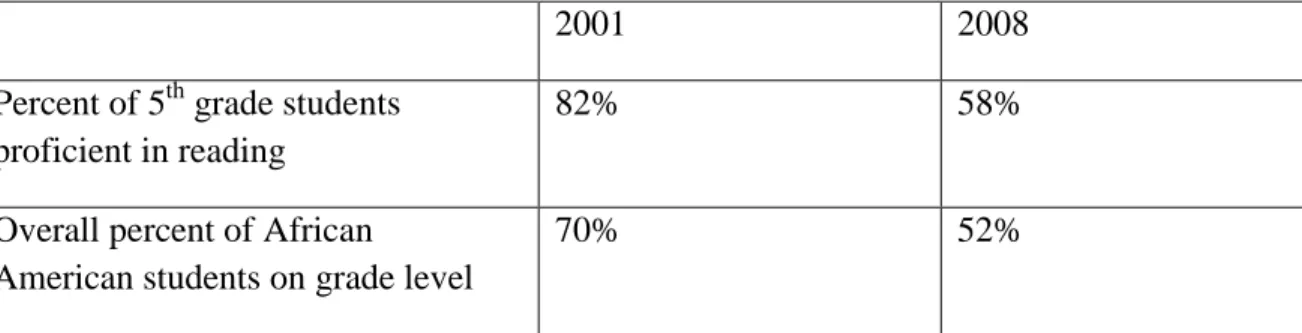
While the court case was pending, the school system was showing impressive gains in student achievement. The Council of the Great Urban Schools recognized the district as one of four urban school systems making significant gains in reading and math scores and closing the achievement gap. In the state's accountability program, the district had no low performing schools. Test scores continued to rise with 82% of all fifth grade students on grade level in reading. From 1995 to 2001, the number of African American students on grade level in reading more than doubled, increasing from 35% to 70%9 (CCS, 2007).
The court case continued to threaten the current integrated status of Bloomsberg school system. In the spring of 2002, the Supreme Court refused to hear the case, thus the original decision stood, and the system moved forward ending raced based placements (CCS, 2007). In August 2002, the new student choice assignment plan went into effect. The assignment plan divided the county into six feeder zones. Students were allowed to choose among the schools within their feeder zones, with students guaranteed space at their ―neighborhood‖ school and with other choices being available if space allowed: the Bloomsberg County Schools returned to neighborhood schools, undoing much of the integration efforts that had been successfully implemented over the past 30 years. The
9 It is important to remember that states create their own standards for proficiency, and those standards and
38
system continued to grow with substantial increases in the northern and southern suburbs of Bloomsberg.
The 21st Century
In early 2001, Robert Putnam, a Harvard professor, conducted a study of 46 communities across the United States (Putnam, 2001). Putnam‘s overarching research interest is social capital, and he examined many different areas of community life relating to this, including interracial trust. Bloomsberg participated in the study and was surprised to learn that in terms of interracial trust, it ranked 39th of the 46 communities in the study. The low ranking concerned area business leaders who were trying to preserve
Bloomsberg as a new south city (participant interview). Business leaders saw low interracial trust as reflecting negatively on the image they were trying to maintain as a ―new south‖ city. As a result of these findings, a grant was secured creating an organization whose purpose was to improve interracial trust10 across the broader
community. The Across Bloomsberg group11 is comprised of over 20 local organizations, all of which participate in projects aimed at ―building trust by creating access, inclusion and equity‖ in the area (Cross Town City, 2010, p. 2). Bloomsberg University and the school system are both participating organizations.
Currently, the Bloomsberg County School System has over 133,604 students enrolled, operates 178 schools, is the largest school district in the state, and is among the
10 Interracial trust is defined as how much one racial group trusts another racial group or even members of
their own racial group. Putnam found more interracial trust in less diverse areas, compared to areas with more diversity.
11
39
25 largest districts in the nation. The district‘s ethnic makeup is currently 36.2% White12 , 42.4% African American, 13.6% Hispanic, 4.3% Asian and 3.5% American
Indian/multiracial (CCS, 2007). Since the adoption of the choice plan, many schools have returned to being racially segregated because of the persistent residential segregation found in Bloomsberg (Godwin, Leland, Baxter, & Southworth, 2006). While the
Bloomsberg County School system is still recognized as a top performing urban system, the scores reported in 2008 show a decline in achievement from those scores reported in 2001 (see Table 1). When discussing the success of the school system, one of the
participants in the study noted that the success of the system rides on the fact that it is a city-county district. Most districts recognized as urban serve only city schools. The Bloomsberg County School System serves many suburban schools as well. Several schools in the northern and southern areas of Bloomsberg boast test scores at almost 100% proficiency, in contrast to the majority minority schools in the inner city of Bloomsberg which struggle to reach over 60% proficiency (participant interview).
Table 1: Achievement Scores
2001 2008
Percent of 5th grade students proficient in reading
82% 58%
Overall percent of African American students on grade level
70% 52%
~2008 scores from http://www.greatschools.org/cgi-bin/nc/district-profile/133#eog_subgroup
12 The demographics of the school system do not mirror that of the city, fifty-five percent of the citizens are
40
As a result of the size of the bureaucracy and the tumultuous history surrounding race relations in the Bloomsberg County School System, rarely is the discrepancy between suburban and urban schools reported. The school system is known for
monitoring what is released to the general public and is also known across the state as being difficult to work with. There is a tremendous interest in conducting research in the system. In order to maintain control over what knowledge is released, the school system has implemented its own Institutional Review Board (IRB). When submitting a research request to the IRB, all researchers must pay a $100 application fee (Bloomsberg-County Schools, 2010).
In 2001, Bloomsberg University moved from a comprehensive university to a doctoral research intensive university (City University, 2008). Currently, it is the fourth largest of the sixteen institutions within the state university system and the largest institution in the region. Bloomsberg University has seven professional colleges, and the 2008 fall enrollment exceeded 24,000 students. Student demographics include 63% white, 24.6% black, 4.6% Asian, and 2.6% Hispanic (City University, 2008). Of all of the universities in the state system, Bloomsberg University has the largest potential for growth because it owns an abundance of undeveloped land. Estimates of projected growth indicate that Bloomsberg University could accommodate over 35,000 students, which would make it the largest university in the state.
41
City area and never see the campus. The university is seen by some to live in the shadow of other research universities in the state which have much longer and richer histories. One research university in the state is particularly popular, Cutler University13. Many of the participants in the study mentioned that the local Bloomsberg newspaper includes more stories about Cutler University, located several hours away, than their own university down the street. In order to counteract this phenomenon, Bloomsberg University began a marketing and branding campaign to increase recognition in Bloomsberg in 2009.
The College of Education has also changed dramatically since its inception in 1977. Beyond the name change to ―College of Education,‖ several changes took place, particularly in the areas of faculty group membership and growth. In 2000, there were fewer than five minority14 faculty members in the entire College of Education; now, as a result of directed efforts and recruitment, the faculty is composed of 30% minorities. In terms of growth, in 2005, the College of Education moved into a brand new 112,431 square foot building on campus. Also in 2005, a new doctoral program was added in Curriculum and Instruction with a focus on urban education. The College of Education serves over 3,000 students in 13 programs (City University Office of Public Relations, 2009).
The College of Education is comprised of five academic departments each focused on educating and certifying students within its respective department.
Departments are a common feature of most colleges at universities, each with its own
13 This is a pseudonym for the oldest research extensive college in this state.
14
42
unique focus or niche. Typically this niche is directly related to the career with which the department is associated. However, some departments have adopted a unique focus. For example at Bloomsberg University the Counseling Department is known for a focus on multicultural counseling. Prior to the endeavor of becoming urban, the entire College of Education had not concentrated on the development of a universal focus across all
departments. As the College grows and develops, the goal is to become known, across the state and beyond, for urban education.
Today the population of Bloomsberg is over 750,000, with the greater area boasting a population of over 1.5 million, making it the 20th largest urbanized area15 in the United States (Kratt, 2009). The demographics for the city of Bloomsberg include 55.5% white, 33.5% black, 4.1% Asian, and 11.2% Hispanic. Projections indicate that by 2029, the city of Bloomsberg will reach a population of over 1 million while the greater metropolitan area will reach 2.5 million.
Bloomsberg, the Bloomsberg County School System, and Bloomsberg University have all experienced tremendous growth over the last six decades. This growth is
predicted to continue in the future. While growing, all three entities are changing and expanding their services as they meet new demands, challenges, and increasing
populations. These entities are also predicted to overlap and connect in new and different ways. Plans for the future include connecting the university with center city Bloomsberg via light rail. A plan to connect the university and center city is significant to the issues of
15 An urbanized area is defined as an area consisting of a central place and adjacent territory with a general
43
this study. Also, plans are under way to build a public school on the campus of the
CHAPTER THREE: METHODOLOGY
This is a qualitative case study examining a College of Education as it began the process of becoming an urban focused organization within an urban institution. This research took place in a specific context during a specific period of time. The entities explored through this research are influenced by the histories and contexts in which they are operating. While the main focus of this study is the College of Education at
Bloomsberg University, this College is operating within the broader university, community, and with the Bloomsberg County School System. This study specifically explored teacher educators‘ conceptions of urban education and the tensions that
appeared to influence the process of change. The questions investigated were as follows:
What tensions influence a College of Education going through the process of institutional change with a focus towards becoming an urban organization within an urban institution?
Urban education is the term that many colleges of education have adopted to represent their programs in the last two decades. Within the constellation of meanings associated with the term ―urban,‖ what meanings does it have in these programs?
45
research study took place in a particular setting and focused both on the context as well as the participants‘ frame of reference.
Case Study
A case study was used because it relies on multiple sources of evidence to add depth to data collection, as well as to bring a wealth of data together to formulate an understanding through triangulation and to contribute to the validity of the research (Yin, 2009). The unique strength of this approach is the ability to combine a variety of
information sources including documentation, interviews, and observations. As I was investigating a phenomenon within a specific context, a case study design was an appropriate strategy (Yin, 2009). The case, or unit of analysis, was the beginning processes of an organization within an institution becoming urban. The process of
becoming urban was considered the activity when employing Cultural-Historical Activity Theory (CHAT). This theory will be detailed below.
Site Selection
46 Participants
The participants in this study included faculty, administrators, and university representatives at the College of Education at Bloomsberg University. IRB required I extend an invitation to the entire faculty to participate in the study. I created a spreadsheet with all of the faculty members indicating their department, affiliation with my project, and contact information. I sent an initial email to ninety faculty members, including my consent letter as an attachment soliciting participation. The email explained the study and my intent to follow up within a week with a phone call or email. After eight initial
participants volunteered, a follow-up email was sent to all faculty members who had not responded. An additional seven participants agreed after the second email. After having fifteen participants agree, I began to target specific individuals, such as committee members, book club members, and administrators. This was done to help have a varied sample. Table 3 below identifies the research group affiliations of the 28 participants I interviewed. Appendix A provides list of each participant‘s pseudonym, gender, years at the university, and representative group. Of the 28 participants, 11 were female, 17 were male, and seven were racial minorities. Years at the university ranged from nine months to 33 years (See Table 4). All departments within the College of Education were
represented (See Table 5), and three interviews were conducted with individuals outside the College of Education who represented leadership in the entire university
47
College of Education. . The university representatives were targeted specifically after faculty members suggested I speak with them.
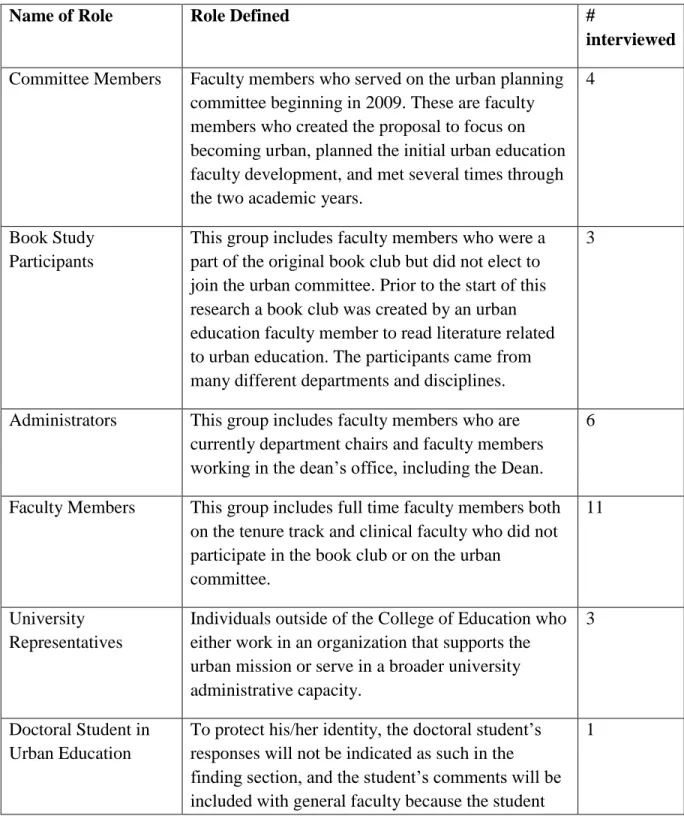
Table 2: Participants
Name of Role Role Defined #
interviewed
Committee Members Faculty members who served on the urban planning committee beginning in 2009. These are faculty members who created the proposal to focus on becoming urban, planned the initial urban education faculty development, and met several times through the two academic years.
4
Book Study Participants
This group includes faculty members who were a part of the original book club but did not elect to join the urban committee. Prior to the start of this research a book club was created by an urban education faculty member to read literature related to urban education. The participants came from many different departments and disciplines.
3
Administrators This group includes faculty members who are currently department chairs and faculty members working in the dean‘s office, including the Dean.
6
Faculty Members This group includes full time faculty members both on the tenure track and clinical faculty who did not participate in the book club or on the urban
committee.
11
University Representatives
Individuals outside of the College of Education who either work in an organization that supports the urban mission or serve in a broader university administrative capacity.
3
Doctoral Student in Urban Education
To protect his/her identity, the doctoral student‘s responses will not be indicated as such in the finding section, and the student‘s comments will be included with general faculty because the student
48 teaches courses.
Total 28
Table 3: Participant Years of Service
Table 4: Department Representation
Department # of Participants
Counseling 3
Educational leadership 1
Middle and Secondary Education 5 Reading and Elementary Education16 9
Special Education 3
Data Sources
This study used several data collection methods: documentation review, interviews, and observations. Four meetings of the urban education committee were attended; two faculty development offerings were observed in the College of Education; one week long diversity workshop offered to the entire campus was attended; and 28
16
49
interviews were conducted with faculty members, administrators, and university representatives.
In addition, publically available documents on the BU‘s website were reviewed. These included mission statements of both the university and the College of Education, blog entries from a faculty blog working towards writing the College of Education‘s Strategic Plan (2010-2015), and faculty work samples from a faculty development offering. These documents were used to examine the institution‘s commitment to urban education, their future goals, and how urban was conceptualized within the available documents. The Dean of the College of Education sends a weekly newsletter that is archived on the College of Education website. Reviewing this information provided insight into how faculty development opportunities were framed and publicized, as well as what other opportunities faculty were provided to engage with the process of change. Each program within the College of Education describes its program. These descriptions were examined to see how programs were promoted and if there was mention of urban education or urban populations. Participants were not asked whether these descriptions were representative of the actual programs they were implementing.
50
Since interviews are important data sources for case studies (Yin, 2009), I conducted one-hour long semi-structured individual interviews with faculty members including administrators, committee members, book club members, faculty members, a doctoral student, and other university representatives.. A semi-structured interview protocol was used with all participants, but additional questions emerged during the interviews (See Appendix B). Each interview was audio-recorded with the permission of the participant.
Data recording and management
All field notes, documents, and interview transcripts were kept on a password protected computer drive. Field notes were written for each meeting observed. All interviews were audio-recorded with a digital recording device. The recording was transferred to a computer file, and then each interview was transcribed. As the
researcher, I transcribed each interview myself. This allowed for a deeper understanding of the research material. A master file was created to record what documents were reviewed, who had been interviewed, and what events were observed. Two months after data collection ended all interviews were transcribed and documents reviewed. The first lens used to analyze the data directly related to the theoretical framework I employed. Cultural Historical Activity Theory was used both as a theoretical framework and as a tool for analysis.
Cultural Historical Activity Theory
51
something that surrounds an activity but instead acts in conjunction with the activity; the context is woven throughout (Cole, 2005). CHAT provides a framework that connects change to the context provided by the institution and to the cultural-historical forces that influence the process.
CHAT is ―designed to be used to understand human activity situated in a collective context‖ (Yamagata-Lynch, 2007, p. 453). This is a part of the social
constructivism paradigm derived from the work of Vygotsky (Worthen, 2004). Through the examination of the six parts of subject, object, mediating artifacts, rules, community, and division of labor, tensions are exposed that impact the outcome (Ogawa, et al., 2008). CHAT is an appropriate tool to use because this research is situated in an institution where these factors are consistently at play. Activity theory has been used to analyze ―successes, failures and contradictions in complex situations without reductionist simplifications‖ (Engeström, Miettinen, & Punamäki-Gitai, 1999).
The six parts of an activity system are not isolated but interact together. It is important to note that while a triangle design is used to represent the theory, there is not a hierarchal relationship among the entities; they are all dynamic and always interact. While the dynamics within an activity system are important to explore in order to
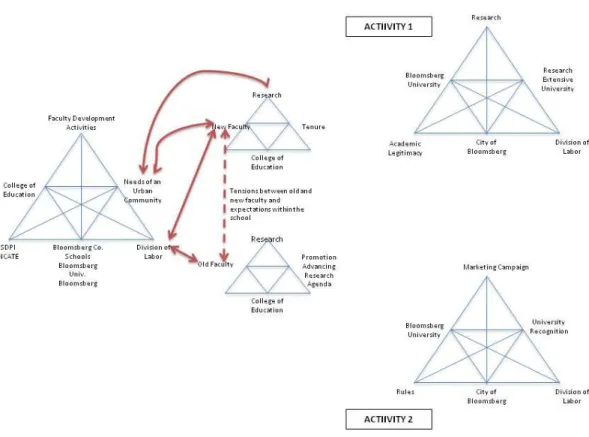
understand the phenomenon being studied, most activity systems are better understood as nested activities, all of which could be considered separate activity systems. In the case of this phenomenon, BU‘s College of Education‘s working to ―become urban,‖ there are several nested activity systems which influence the process and create additional
52
efforts to shift to a research extensive university17, and Bloomsberg University‘s work to be recognized in the greater Bloomberg community. Each of these activity systems interacts with the College of Education as it works to ―become urban.‖ These interactions will be explored in detail in Chapter Five.
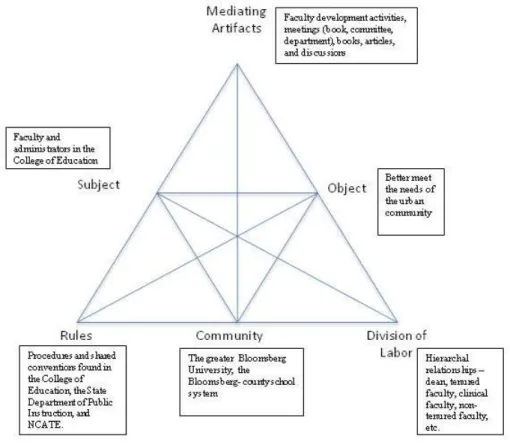
Activity theory examines how participants transform the system and how the different components mediate change. The system is understood through examining its internal contradictions (Engeström, et al., 1999; Leont‘ev, 1978). These contradictions can be considered tensions between and among the six parts of the activity system. Barab, Barnett, Yamagata-Lynch, Squire & Keating (2002) discussed these tensions as a system of dualities. Dualities are defined as the tension between two opposing forces which becomes a driving force for change and creativity. It is essentially the tensions within and among activity systems that create the force for change. Below is a figure showing the complex interactions among the six components. The table (6) following the figure presents a detailed explanation of each part. The activity system highlighted is the College of Education‘s transformation to becoming an urban organization in an urban institution.
17 Currently Bloomsberg University is considered a research intensive university and is working towards
53 Figure 2: Cultural Historical Activity Theory
Table 5: CHAT components
54 Analysis of analysis.
Intended Outcome
The organization‘s stated goal of the change effort. For the College of Education at Bloomsberg, the stated goal is better meeting the needs of the urban community, particularly K-12 students.
Object The purpose behind the activity, which evolves during the activity. Since the College of Education at Bloomsberg is in the beginning stages of change, the object still is not fully evolved. Typically, colleges of
education focusing on urban education develop a culturally critical lens or focus on diversity. Objects of activity systems are based on societally important new meanings and patterns of interaction (Engeström, et al., 1999).
Subject A person or group of people working toward an object. The subjects in this study were administrators and faculty members. Subjects are considered to have agency, yet the form of agency is culturally and historically specific and dependent on social structure (Ogawa, et al., 2008).
Mediating Artifacts
The artifacts that mediate relationships between subjects and objects. Mediating artifacts are considered tools which connect subjects to their contexts, thus mediating social interactions, communications, action, and eventually activity (Artiles, Trent, Hoffman-Kipp, & Lopez-Torres, 2000). Material artifacts can be both physical instruments such as books and symbolic artifacts and nonmaterial tools such as language. The mediating artifacts are professional development activities, readings, developed mission statements, and group discussions. Non-material artifacts include thoughts and language associated with the change process; in this case understandings of urban would also be considered mediating artifacts.
Community The social basis of the activity. Communities are constant over time and repeatedly reenact ideologies and histories. The communities involved in this change process are the broader Bloomsberg University, the
Bloomsberg county school system, and the city of Bloomsberg.
Rules The procedures, norms, and shared conventions found in the community. Rules influence the artifacts that are emphasized during activity. In colleges of education, there are many rules governing teacher licensure, including the state licensing agency and the national norms such as INTASC standards and NCATE.
Division of Labor
55
CHAT is focused on the elements of an activity system that promote or resist change; institutional theory is based on these ideas while providing an explanation for the stability found in institutions and organizations. Both foundations work together to explain transformation while examining activities in the context of formal organizations. The inclusion of institutional theory expands the idea of CHAT by ―accounting for the mechanisms by which institutions sustain and legitimate some assumptions, values, and practices over others, and how they work across larger units of social interactions and longer timescales‖ (Ogawa, et al., 2008, p. 90). These theoretical understandings provide the groundwork for the examination of the tensions found with the College of Education at Bloomsberg University.
Data Analysis
The two research questions were: What tensions influence a College of Education going through the process of institutional change with a focus towards becoming an urban organization within an urban institution? And Within the constellation of meanings associated with the term ―urban,‖ what meanings does it have in these programs? Each question required a different approach to data analysis. However for both approaches, data analysis began during data collection. Throughout the research, new pieces of information added to the knowledge base and led me to refine my questions, begin to develop hypotheses, and start to consider patterns as they developed. This form of analysis is considered interim analysis (Miles & Huberman, 1994) and is a common practice in qualitative research. The practice is almost inevitable because the nature of
56
research in the field; it would be hard as a researcher not to begin to think about the data as it is collected. The process also helps to identify data that does not fit or runs counter to other already developed hypotheses.
The theoretical frame influenced the ways in which data was analyzed for the first research question which targeted tensions. The factors involved in CHAT were the initial points of analysis. Codes for each of the different factors provided the starting point for analysis. For example, data related to rules, community, hierarchy, and mediating artifacts were coded as such. Beyond the initial themes within the theoretical model, other themes and data points were also coded as they emerged. Sub codes were created to better group and combine data sets. Coding was only the first steps in analysis (Coffey & Atkinson, 1996). Coding is understood to be more than just piecing together the research in common chunks; it is conceptualizing the data, raising questions, considering answers and relationships to questions, and discovering the data. While the analysis began as a deductive approach, the broad codes allowed for multiple patterns and themes to develop within these codes. After using the broad codes, the analysis of interview transcripts and field notes was based on an inductive approach. ―Inductive analysis means that the patterns, themes, and categories of analysis come from the data; they emerge out of the data rather than being imposed on them prior to data collection and analysis‖ (Patton, 2002, p. 56).
57
many of the events that were mentioned, so that I had a context from which to draw and to follow up with participants.
The second research question, which focused on understandings of urban, required a different approach to analysis. This approach was purely an inductive approach and required the use of the constant comparative method (Glaser, 1978). The constant comparative method required line by line, sentence by sentence, and paragraph by paragraph segments of interviews to be reviewed closely in order to create codes that fit the concepts suggested by the data. The codes were continually revised and reviewed to add or remove data points. Each code was repeatedly compared with the other codes to identify similarities, look for differences, and develop patterns. For this particular
question, the interviews were the most important data point and were given more weight than were the observations and the documents. A qualitative data analysis program was used to support the process.