ANTIBIOTIC RESISTANT STAPHYLOCCUS AUREUS DISSEMINATION FROM HOG FARMS: A SYSTEMATIC REVIEW
Chien-Hsiu Weng
A thesis submitted to the faculty at the University of North Carolina at Chapel Hill in partial fulfillment of the requirements for the degree of Master of Science in the Department of Environmental Sciences and Engineering in the Gillings School of Global Public Health.
Chapel Hill 2016
Approved by:
Jacqueline MacDonald Gibson
iii
ABSTRACT
Chien-Hsiu Weng: Antibiotic resistant Staphylococcus aureus dissemination from hog farms: a systematic review
(Under the direction of Jacqueline MacDonald Gibson)
Research has identified antibiotic-resistant livestock-associated Staphylococcus aureus (LA-SA) in humans, suggesting that animal husbandry is contributing to the global spread of
antibiotic resistance. However, the prevalence of antibiotic-resistant LA-SA organisms and the factors contributing to their spread are poorly understood. This review (1) summarizes the prevalence of antibiotic-resistant LA-SA in humans, hogs, and pork products and (2) identifies factors contributing to LA-SA spread. A systematic literature review identified 78 relevant
v
TABLE OF CONTENTS
LIST OF TABLES ... vii
LIST OF FIGURES ... viii
LIST OF ABBRRVIATIONS... ix
CHAPTER 1: INTRODUCTION ... 1
CHAPTER 2: METHODS ... 4
2.1 Research questions and review protocol ... 4
2.2 Search strategy and data abstraction ... 4
2.3 Data management and chart creation ... 5
CHAPTER 3: RESULTS ... 8
3.1 Hog farms ... 9
3.2 P Environmental factors ... 17
3.3 Hog slaughter/processing plants ... 19
3.4 Household members ... 24
3.5 Community and visitors ... 27
3.6 Food chain ... 30
3.7 Prevalence in hospital patients... 33
CHAPTER 4: DISCUSSION ... 36
CHAPTER 5: CONCLUSION ... 38
APPENDIX: TABLE OF COMBINATION OF SEARCH TERMS ... 39
vii
LIST OF TABLES
Table 1. Inclusion and exclusion criteria. ... 6
Table 2. Risk factors for LA-MRSA and LA-MDRSA, by source location... 9
Table 3. Summary of hog farm studies, by category of risk factor and exposure groups ... 12
Table 4. Summary of hog farm studies, by category of risk factor and exposure groups ... 18
Table 5. Summary of the hog slaughter/processing plant studies, by exposure group ... 21
Table 6. Summary of studies on household prevalence, by exposure focus... 25
Table 7. Summary of the studies on community and visitors, by type of exposure ... 28
Table 8. Summary of the food chain studies... 31
LIST OF FIGURES
Figure 1. Flowchart of the literature search and screening process ... 7
Figure 2. Summary of LA-MRSA prevalence in farm hogs and farm workers. ... 16
Figure 3. - Summary of LA-MRSA prevalence in slaughterhouse hog and slaughterhouse workers ... 23
Figure 4. Summary of LA-MRSA prevalence in household members ... 26
Figure 5. Summary of LA-MRSA prevalence in veterinarians ... 29
Figure 6. Summary of LA-MRSA prevalence in pork products. ... 32
ix
LISTS OF ABBREVIATIONS
AFLO Antibiotic-free livestock operation CI Confidence interval
FDA Food and Drug Administration ILO Industrial livestock operation
PRISMA Preferred Reporting Items for Systematic Reviews and Meta-Analyses
MDRSA Multidrug-resistant Staphylococcus aureus
MLVA Multiple-locus variable-number tandem-repeat assays
MRSA Methicillin-resistant Staphylococcus aureus
n.c. not computable OR Odd ratio
PR Prevalence ratio
CHAPTER 1: INTRODUCTION
Antibiotic resistance is a growing public health issue across the globe. Bacterial
resistance to antibiotics can occur naturally, or can result from antibiotic use in human or veterinary medicine. In both human and veterinary medicine, up to 50% of the antibiotics used
are not optimally prescribed, and are often prescribed unnecessarily, at incorrect doses or for an incorrect treatment duration [1]. Antibiotics are also commonly used in food animals to prevent, control, and treat disease, and to promote the growth of food-producing animals[2]. Despite the
fact that (according to a new report by the FDA) approximately 80 percent of all antibiotics used in the United States are fed to farm animals[1], the number of studies on how antibiotic
resistance in food animals spreads to human is relatively small compared to the number of studies on antibiotics use in humans.
Methicillin-resistant Staphylococcus aureus (MRSA) infections with strains circulating in
hospitals (HA-MRSA) and communities (CA-MRSA) can be very serious and the number of infections is among the highest of all antibiotic-resistant threats in the United States, according to
a Centers for Disease Control and Prevention (USCDC) report in 2013. MRSA is transmitted most frequently by direct skin-to-skin contact[3]. The USCDC estimates 80,461 invasive MRSA infections and 11,285 related deaths occurred in 2011. Although the early MRSA clones were
hospital-associated MRSA (HA-MRSA), beginning in the late 1990s community-associated MRSA (CA-MRSA) clones emerged worldwide[4]. There is new evidence that antibiotic
2
(LA-MRSA) strains originated from humans [5, 6]. Price et al.’s work indicates that a type of livestock-associated MRSA known as CC398 originated in humans before spreading to hogs and
back to humans [6]. LA-MRSA strains have been found in food animals such as pigs, veal calves, turkeys, and chickens in countries throughout Europe, North America, and Asia[7-11].
However the ecology and virulence of these strains are not well understood. Both LA-MRSA and LA-MDRSA (where multidrug resistance is defined as intermediate or complete resistance to 3 or more antibiotic classes) have been documented in association with food animal
production.
The first human LA-MRSA incident was reported in the Netherlands in 2004 and prompted
studies on the prevalence of LA-MRSA and LA-MDRSA in food animals, meat products, farm workers, and other sample types. Several researchers have reported that MRSA and LA-MDRSA are widespread in Europe and other regions. There appears to be an elevated exposure
risk among farm workers and perhaps their household and community members, but infection risks are not clear. A study of 450 hospitals in Europe in 2006-2007 identified 12 cases of
infections from MRSA ST398 (one of the MRSA strains frequently isolated from livestock) but none of these were caused by methicillin-resistant MRSA strains [12]. Studies of causalities of HA-MRSA or CA-MRSA are abundant, whereas the causality of transferring LA-MRSA and
MDRSA from hogs to humans is still poorly understood. Also, potential MRSA and LA-MDRSA transmission routes and transmission factors are not fully developed in the literature
[13], although reports suggest that air, water, and food may be among the transmission routes. Most previous systematic reviews have focused separately on occupational direct exposures, environmental factors, or food contaminations, but these reviews are not comprehensive enough
The diversity of LA-MRSA and LA-MDRSA and the transferability of antibiotic-resistance genes complicate any examination of LA-MRSA and LA-MDRSA arising from hog farms. My
objectives in this review are to: 1) identify the potential methods of LA-MRSA and LA-MDRSA transport or transmission and risk factors contributing to LA-MRSA and LA-MDRSA presence;
4
CHAPTER 2: METHODS
2.1 Research questions and review protocol
My research objectives are focused on the topic of the prevalence of MRSA and LA-MDRSA in humans and animals and intended to identify the potential transmission routes and
related factors influencing transmission. My review adheres to the principles established in the Preferred Reporting Items for Systematic Reviews and Meta Analyses (PRISMA) protocol (http://www.prisma-statement.org/).
2.2 Search strategy and data abstraction
I used the PubMed (http://www.ncbi.nlm.nih.gov/pubmed) database for my research. I included papers published up to January 2016. To assemble the most comprehensive set of
relevant papers, I used 24 different advanced search approaches, combining the following terms in all relevant fields: (livestock associated MRSA, MRSA, MDRSA, antibiotic AND resistant
AND staphylococcus AND livestock) AND (community, pig, swine, worker, pork chain, risk). I also used the following algorithm in PubMed to ensure I obtained all relevant articles:
((("livestock"[MeSH Terms] OR "livestock"[All Fields]) AND associated [All Fields] AND
("methicillin-resistant staphylococcus aureus"[MeSH Terms] OR ("methicillin-resistant"[All Fields] AND "staphylococcus"[All Fields] AND "aureus"[All Fields]) OR "methicillin-resistant
staphylococcus aureus"[All Fields] OR "mrsa"[All Fields])) AND ("residence
characteristics"[MeSH Terms] OR ("residence"[All Fields] AND "characteristics"[All Fields]) OR "residence characteristics"[All Fields] OR "community"[All Fields])) AND ("risk"[MeSH
minimize the risk of missing (updates to) relevant studies, I subscribed to the “Create Alert” feature of the PubMed database until January 2016.
2.3 Data management and chart creation
I screened the titles and abstracts of possibly relevant articles using six inclusion criteria and
six exclusion criteria (Table 1). I excluded papers that focused on only MRSA or HA-MDRSA or CA-MRSA or CA-HA-MDRSA. Since my research question concerned livestock-associated antibiotic-resistant Staphylococcus aureus in humans and livestock, I focused on studies relevant to the following factors: hog and hog production facilities, MRSA or LA-MDRSA tests on hog farms, farm workers and their household members, veterinarians,
slaughterhouses, slaughterhouse workers, patients in hospitals, pork products, and environment samples from hog farms. I excluded lab studies to maintain a focus on real world transmission factors, and I excluded case reports because they only reported an outbreak or a new strain
finding, not an investigation of routine farm operating conditions.
I compared PubMed IDs to identify and remove duplicated papers from different searches in
the initial pool of papers. I imported citations identified via the search into Endnote X7 and used an extraction form in Microsoft Excel (2003 edition)
(http://libguides.sph.uth.tmc.edu/excel_SR_workbook) to summarize the screening process.
Relevant papers cited in the papers I found by my search were also included.
I extracted from articles in the final set of papers the prevalence of MRSA or
LA-MDRSA in pig-related populations, herds, environments, and products. I summarized the data using Microsoft Excel’s (2011 edition) descriptive table and frequency chart tools; I used the
descriptive table tool to create the summaries of the papers presented in Tables 2 to 9. If a given
6
members, veterinarians, pork products, and patients in hospitals) of prevalence data had more than three source papers, I calculated a pooled prevalence for the category using MetaXL (an
add-in tool in Microsoft Excel).
Table 1. Inclusion and exclusion criteria
Inclusion criteria Exclusion criteria
Language: English Language: any language other than English
Included non hospital-associated MRSA or MDRSA or community-associated MRSA or MDRSA study
Hospital-associated MRSA or MDRSA only or community-associated MRSA or MDRSA study only Population or target: LA-MRSA or MDRSA tests on
hog farms workers and household members, veterinarians, slaughterhouse workers, patients in hospital, pork products, environment samples from hog farms (air, dust, and water) are conducted
Population or target: LA-MRSA or MDRSA tests on hog farms workers and household members,
veterinarians, slaughterhouse workers, patients in hospital, pork products, environment samples from hog farms (air, dust, and water) are NOT conducted
Not lab experiments Lab experiments
Original report or reviews associated with hog-MRSA or MDRSA
Non-original report, editorial, and comment
8
CHAPTER 3: RESULTS
The 24 combination searches resulted in an initial set of 785 papers; applying the inclusion
and exclusion criteria yielded a final set of 78 relevant papers (Figure 1). My goals in this paper were to identify the LA-MRSA and LA-MDRSA hog-to-human transport factors and routes and
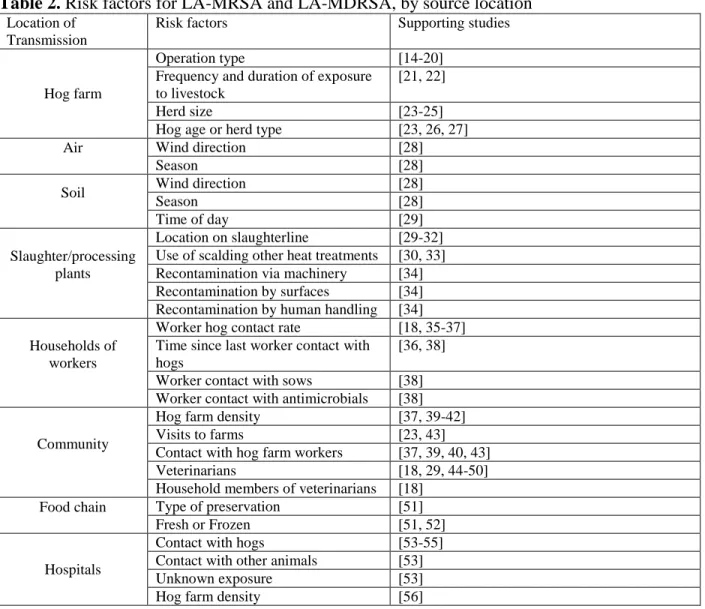
Table 2. Risk factors for LA-MRSA and LA-MDRSA, by source location Location of
Transmission
Risk factors Supporting studies
Hog farm
Operation type [14-20]
Frequency and duration of exposure to livestock
[21, 22]
Herd size [23-25]
Hog age or herd type [23, 26, 27]
Air Wind direction [28]
Season [28]
Soil Wind direction [28]
Season [28]
Time of day [29]
Slaughter/processing plants
Location on slaughterline [29-32]
Use of scalding other heat treatments [30, 33]
Recontamination via machinery [34]
Recontamination by surfaces [34]
Recontamination by human handling [34]
Households of workers
Worker hog contact rate [18, 35-37]
Time since last worker contact with hogs
[36, 38]
Worker contact with sows [38]
Worker contact with antimicrobials [38]
Community
Hog farm density [37, 39-42]
Visits to farms [23, 43]
Contact with hog farm workers [37, 39, 40, 43]
Veterinarians [18, 29, 44-50]
Household members of veterinarians [18]
Food chain Type of preservation [51]
Fresh or Frozen [51, 52]
Hospitals
Contact with hogs [53-55]
Contact with other animals [53]
Unknown exposure [53]
Hog farm density [56]
3.1 Hog farms
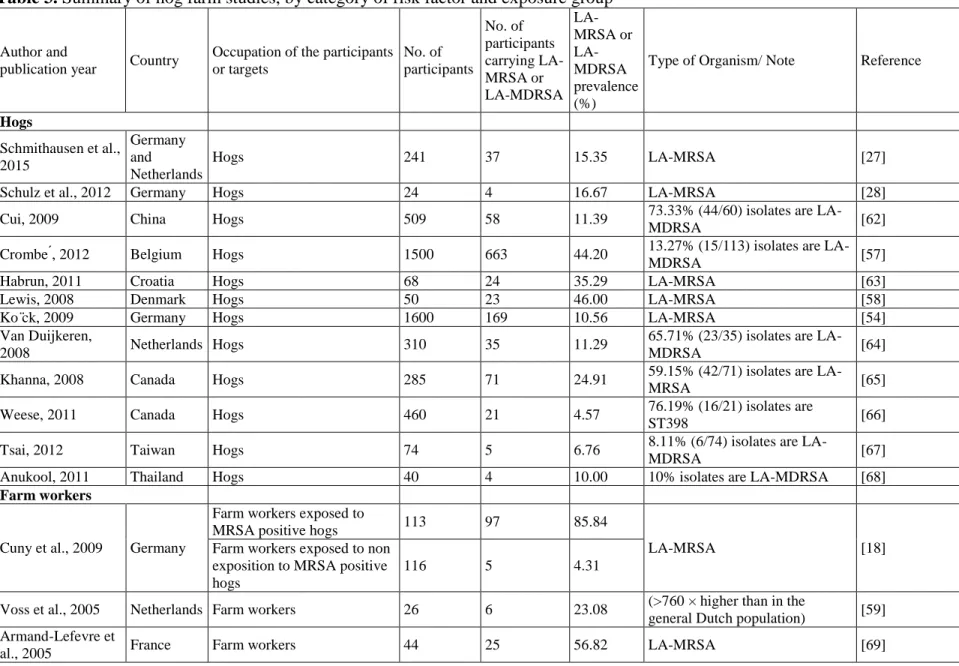
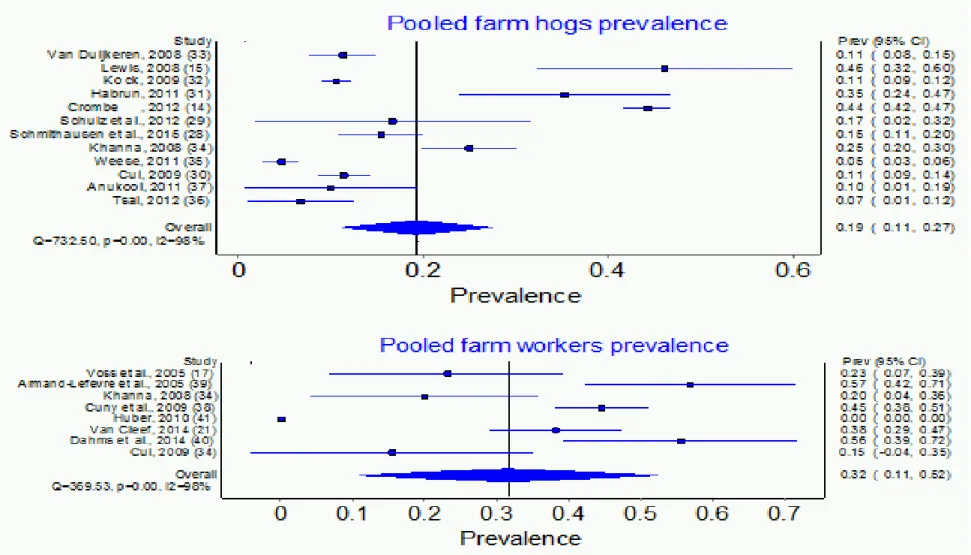
The prevalence and isolate type of LA-MRSA or LA-MDRSA among hog farms vary (Figure 2 and Table 3). The prevalence of LA-MRSA or LA-MDRSA may be greater than 45% [57, 58].
ST398 (sequence type) predominates in Europe and North America whereas ST9 is more common in Asia (Table 3). The pooled prevalence for farm hogs was 19% (95% CI: 11%-27%) and the pooled prevalence for farm workers was 32% (95% CI: 11%-52%).
10
for both hogs and workers. Rinsky et al. showed that in North Carolina, MRSA and LA-MDRSA prevalences in hogs are higher in industrial hog farms using antibiotics than in
antibiotic-free farms [14]. Other studies have found that, farm workers are at higher risk of carrying MRSA than non-farmers[7, 59]. The presence of MRSA in farmers was strongly related
to duration of animal contact and was strongly reduced in periods without animal contact (26% vs. 11%) in Graveland’s study[21]. Van Cleef et al. showed a strong association between hogs
and farm workers for MRSA (88% shared the same MLVA [multiple-locus variable-number
tandem-repeat assays]-type or a single-locus variant) and reported the following occupational influencing factors: working in stables more than 40 hours/week (prevalence ratio [PR]: 1.89,
95% CI: 1.19–3.0, p=0.01), giving birth assistance to sows in the last 7 days (PR: 2.26, 95% CI: 1.10–4.67, p=0.03), removing the manure of finisher pigs in the last 7 days (PR: 0.48, 95% CI: 0.26–0.87, p=0.02), and continuously wearing a facemask when working in the stables (PR:
0.13, 95% CI: 0.02–0.76, p=0.02) [22].
Studies also have shown that hog herd size is a significant risk factor for MRSA prevalence among pigs and workers as well. Although the definition of a “large-scale” herd varies by study,
the MRSA carriage rate for hogs in large-scale herds has been shown to be significantly higher than that in small-scale herds, and the carriage rate for hog farm workers in large-scale farms
was significantly higher than that in small-scale farms. For example, a German study showed odds ratio (OR) of MSRA of 5.4 (95% CI: 2.7-11.2, p < 0.05) for large-scale farms compared to
small-scale operations, and an Italian study showed a similar OR of 3.67 (95% CI: 1.04– 112.91%)[23-25].
Other risk factors for MRSA carriage identified in prior studies include hog age and herd
was significantly higher than for older hogs (25.38% vs. 5.84%, p<0.001)[23].Friese and colleagues found that hogs from fattening farms had a significantly higher MRSA prevalence
than those from breeding farms due to higher hog exchange and hogs from different suppliers being housed together (99.4% vs. 69.2%, p<0.01)[26].
With regard to routes of transmission, within-pen transmission (compared to between-pen transmission and transmission through environmental exposure) was associated with increased transmission rates [60]. MRSA may also spread to other species (e.g., chickens and cattle) in the
12
Table 3. Summary of hog farm studies, by category of risk factor and exposure group
Author and
publication year Country
Occupation of the participants or targets No. of participants No. of participants carrying LA-MRSA or LA-MDRSA LA-MRSA or LA-MDRSA prevalence (%)
Type of Organism/ Note Reference
Hogs
Schmithausen et al., 2015
Germany and
Netherlands
Hogs 241 37 15.35 LA-MRSA [27]
Schulz et al., 2012 Germany Hogs 24 4 16.67 LA-MRSA [28]
Cui, 2009 China Hogs 509 58 11.39 73.33% (44/60) isolates are
LA-MDRSA [62]
Crombe ́, 2012 Belgium Hogs 1500 663 44.20 13.27% (15/113) isolates are
LA-MDRSA [57]
Habrun, 2011 Croatia Hogs 68 24 35.29 LA-MRSA [63]
Lewis, 2008 Denmark Hogs 50 23 46.00 LA-MRSA [58]
Ko ̈ck, 2009 Germany Hogs 1600 169 10.56 LA-MRSA [54]
Van Duijkeren,
2008 Netherlands Hogs 310 35 11.29
65.71% (23/35) isolates are
LA-MDRSA [64]
Khanna, 2008 Canada Hogs 285 71 24.91 59.15% (42/71) isolates are
LA-MRSA [65]
Weese, 2011 Canada Hogs 460 21 4.57 76.19% (16/21) isolates are
ST398 [66]
Tsai, 2012 Taiwan Hogs 74 5 6.76 8.11% (6/74) isolates are
LA-MDRSA [67]
Anukool, 2011 Thailand Hogs 40 4 10.00 10% isolates are LA-MDRSA [68]
Farm workers
Cuny et al., 2009 Germany
Farm workers exposed to
MRSA positive hogs 113 97 85.84
LA-MRSA [18]
Farm workers exposed to non exposition to MRSA positive hogs
116 5 4.31
Voss et al., 2005 Netherlands Farm workers 26 6 23.08 (>760 × higher than in the
general Dutch population) [59]
Armand-Lefevre et
13
Author and
publication year Country
Occupation of the participants or targets No. of participants No. of participants carrying LA-MRSA or LA-MDRSA LA-MRSA or LA-MDRSA prevalence (%)
Type of Organism/ Note Reference
Liu et al., 2015 China Farm workers 18.2 [47]
Dahms et al., 2014 Germany Farm workers 36 20 55.56 MRSA; 15/20 are
LA-MDRSA [70]
Khanna, 2008 Canada Farm workers 25 5 20.00 LA-MRSA [65]
Cui, 2009 China Farm workers 13 2 15.38 LA-MDRSA [62]
Huber, 2010 Switzerland Farm workers 460 0 0 [50]
Van Cleef, 2014 Netherlands Farm workers 110 42 38.18 LA-MRSA [22]
Livestock operation type
Rinsky et al., 2013 USA Farm workers and household
members
41 3 7.32 LA-MRSA, ILO*
[14]
42 3 7.14 LA-MRSA, AFLO1
41 15 36.59 LA-MDRSA, ILO2
42 8 19.05 LA-MDRSA, AFLO
Smith et al., 2013 USA Hogs in ILO
(1) 588 50 8.50
LA-MRSA [15]
Hogs in AFLO (2) 497 0 0
Smith et al., 2009 USA Hogs 299 147 49.16 LA-MRSA, conventional farm [16]
Farm workers 20 9 45.00
Osadebe et al.,
2013 USA
Non-conventional hog farms 35 1 2.86 1/5 is LA-MRSA
[17] Farm workers in
non-conventional farms 9 2 22.22 0/2 is LA-MRSA (HA-MRSA)
Cuny et al., 2009 Germany Conventional farms 57 45 78.95 LA-MRSA [18]
Cuny et al., 2012 Germany Hogs in alternative farms3 178 0 0 [19]
1 ILO, industrial livestock operation
2 AFLO, antibiotic-free livestock operation
14
Author and
publication year Country
Occupation of the participants or targets No. of participants No. of participants carrying LA-MRSA or LA-MDRSA LA-MRSA or LA-MDRSA prevalence (%)
Type of Organism/ Note Reference
Farm worker in alternative
farms 89 1 1.12 LA-MRSA
Van de Vijver et
al., 2014 Netherlands Hogs in organic farms 240 8 3.33 LA-MRSA [20]
Hog age
Schmithausen et al.,
2015 Germany
Young farrowing piglet
/newly weaned piglet 75 12 16.00
LA-MRSA [27]
Farrowing/nursery 75 20 26.67
Early finisher 205 64 31.22
Finisher 205 19 9.27
Fang et al., 2014 Taiwan Age<3 months 264 67 25.38 LA-MRSA [23]
Age>3 months 377 22 5.84
Friese et al., 2012 Germany
Pooled nasal swabs among hogs in fattening farms Pooled nasal swabs among hogs in Breeding farms
180 120
179 83
99.40
69.20 17/22 isolates are LA-MRSA [26]
Hog farm size
Alt, K. et al., 2011 Germany Large-scale herd (>1000)
Small-scale herd (<500)
116 83 63 30 54.31 36.14 LA-MRSA/ [24]
Fang et al., 2014 Taiwan
Large-scale herd (>=10000) 181 62 34.25
83/89 isolates are LA-MRSA
[23]
Small-scale herd (<10000) 355 25 7.04
Farm worker in large-scale
herd 19 7 36.84
99/102 isolates are LA-MRSA Farm worker in small-scale
herd 33 3 9.09
Battisti et al., 2010 Italy Hog Holding 118 33 27.97
Larger herd size (>9000) is more likely MRSA positive than small her size (<9000). OR: 3.67, 95% CI: 1.04–112.91%
[25]
Other animals in farms
15
Author and
publication year Country
Occupation of the participants or targets
No. of participants
No. of participants carrying LA-MRSA or LA-MDRSA
LA-MRSA or LA-MDRSA prevalence (%)
Type of Organism/ Note Reference
2013 and
Denmark
Cat 13 3 23.08
16
3.2 Environmental factors
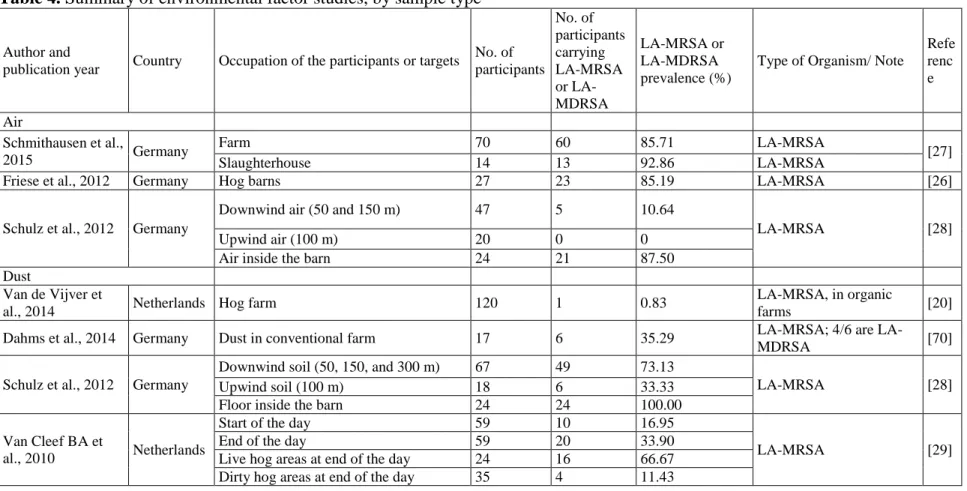
According to Dahms et al., environmental transmission routes for LA-MRSA and LD-MRSA include air, dust, soil, and farm wastewater [70]. Table 4 summarizes associations between these transmission routes and the prevalence of LA-MRSA or LA-MDRSA. The airborne transmission of LA-MRSA within hog herds suggests that it may also act to contaminate the barn environment [26] as well as the vicinity of LA-MRSA-positive hog barns [71]— the former was indirectly confirmed by Bos et al., who showed that exposure to ST398 MRSA in barn air is an important risk factor for nasal carriage, especially in those who worked over 20 hours per week in LA-MRSA positive air in barns (pooled OR: 2.25, 95% CI: 1.57-3.22)[72]. Reports indicate that airborne LA-MRSA transmission and
18
Table 4. Summary of environmental factor studies, by sample type
Author and
publication year Country Occupation of the participants or targets
No. of participants No. of participants carrying LA-MRSA or LA-MDRSA LA-MRSA or LA-MDRSA prevalence (%)
Type of Organism/ Note Refe renc e
Air
Schmithausen et al.,
2015 Germany
Farm 70 60 85.71 LA-MRSA
[27]
Slaughterhouse 14 13 92.86 LA-MRSA
Friese et al., 2012 Germany Hog barns 27 23 85.19 LA-MRSA [26]
Schulz et al., 2012 Germany
Downwind air (50 and 150 m) 47 5 10.64
LA-MRSA [28]
Upwind air (100 m) 20 0 0
Air inside the barn 24 21 87.50
Dust
Van de Vijver et
al., 2014 Netherlands Hog farm 120 1 0.83
LA-MRSA, in organic
farms [20]
Dahms et al., 2014 Germany Dust in conventional farm 17 6 35.29 MRSA; 4/6 are
LA-MDRSA [70]
Schulz et al., 2012 Germany
Downwind soil (50, 150, and 300 m) 67 49 73.13
LA-MRSA [28]
Upwind soil (100 m) 18 6 33.33
Floor inside the barn 24 24 100.00
Van Cleef BA et
al., 2010 Netherlands
Start of the day 59 10 16.95
LA-MRSA [29]
End of the day 59 20 33.90
Live hog areas at end of the day 24 16 66.67
3.3 Hog slaughter/processing plants
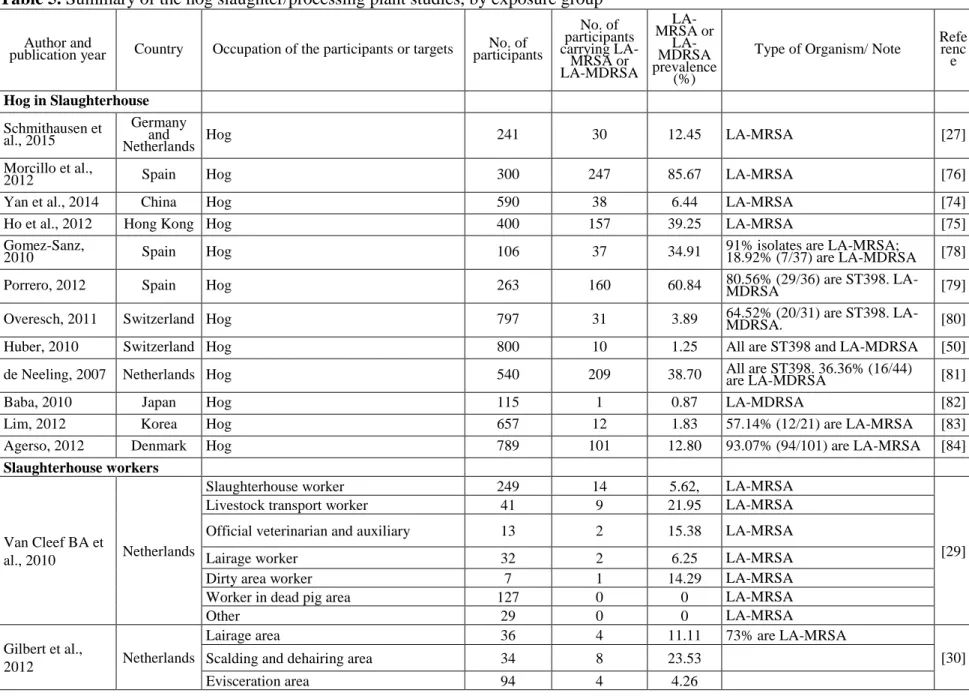
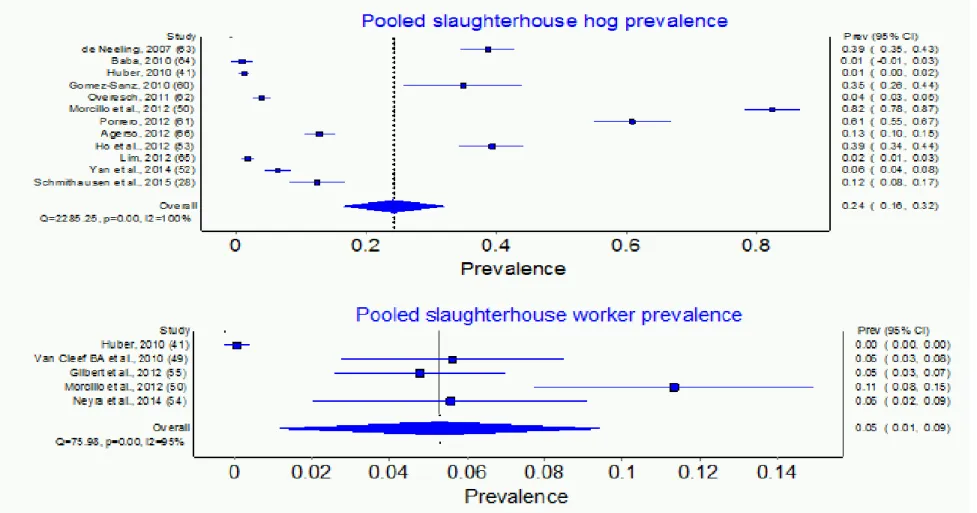
Hog slaughter facilities are another potential LA-MRSA transmission route. Table 5 and
Figure 3 show the prevalence of LA-MRSA and LA-MDRSA in hogs and workers in hog slaughter/processing plants. The pooled prevalence of MRSA in slaughterhouse hogs was 24%
(95% CI: 0.16-0.32). The pooled prevalence of MRSA in slaughterhouse workers was 5% (95% CI: 0.01-0.09).
Broens and colleagues suggested that MRSA prevalence in hogs was higher in
slaughterhouses than in farms due to the transmission of MRSA during transport—they found that the prevalence was 0% at hog loading but increased to 10.26% on hog arrival [31]. The
prevalence of MRSA in slaughter hogs in slaughter facilities varied: Yan et al. reported a prevalence of 6.44% (38/590)[74], but Ho et al. indicated a prevalence of 39.3% (157/400)[75]. The prevalence of nasal MRSA carriage in employees of hog slaughterhouses also varied, from
5.6% (14/249)[29] to 11.3% (34/300)[76]. Neyra et al. found that slaughterhouse workers had a higher prevalence of LA-MDRSA (OR: 1.96, 95% CI: 0.71-5.45) and a higher average number
of antibiotic classes to which S. aureus isolates responded than community residents (1.96 times)[41].
Although MRSA positive environmental samples have been found throughout the slaughter
process, studies have shown that occupational exposure to MRSA decreases along the slaughterline. In one study, MRSA-positive workers identified as nasal MRSA carriers were
predominantly found at the start of the slaughter process (11.11% among workers in lairage area and 23.52% among workers in scalding and dehairing area)[30]. Narvaez-Bravo et al.
corroborated this finding and reported that the initial steps of slaughter and processing showed a
20
at the end of the slaughterline)[33]. However, although heat treatments such as scalding and flaming during the slaughter process can significantly reduce the burden of MRSA on the
carcasses, studies have shown that MRSA recontamination can recur via surface treating machinery, as a result of fecal contamination at evisceration, or via increased human handling
during meat processing [34]. Beneke et al. demonstrated that MRSA could be introduced to final pork products in the slaughterhouse by carcass surfaces or staff members even though no MRSA was found in the processing areas [32]. In addition, wastewater from hog slaughterhouses can be
21
Table 5. Summary of the hog slaughter/processing plant studies, by exposure group
Author and
publication year Country Occupation of the participants or targets participants No. of
No. of participants carrying LA-MRSA or LA-MDRSA LA-MRSA or LA-MDRSA prevalence (%)
Type of Organism/ Note Referenc
e
Hog in Slaughterhouse
Schmithausen et al., 2015
Germany and
Netherlands Hog 241 30 12.45 LA-MRSA [27]
Morcillo et al.,
2012 Spain Hog 300 247 85.67 LA-MRSA [76]
Yan et al., 2014 China Hog 590 38 6.44 LA-MRSA [74]
Ho et al., 2012 Hong Kong Hog 400 157 39.25 LA-MRSA [75]
Gomez-Sanz,
2010 Spain Hog 106 37 34.91 91% isolates are LA-MRSA; 18.92% (7/37) are LA-MDRSA [78]
Porrero, 2012 Spain Hog 263 160 60.84 80.56% (29/36) are ST398. LA-MDRSA [79]
Overesch, 2011 Switzerland Hog 797 31 3.89 64.52% (20/31) are ST398. LA-MDRSA. [80]
Huber, 2010 Switzerland Hog 800 10 1.25 All are ST398 and LA-MDRSA [50]
de Neeling, 2007 Netherlands Hog 540 209 38.70 All are ST398. 36.36% (16/44) are LA-MDRSA [81]
Baba, 2010 Japan Hog 115 1 0.87 LA-MDRSA [82]
Lim, 2012 Korea Hog 657 12 1.83 57.14% (12/21) are LA-MRSA [83]
Agerso, 2012 Denmark Hog 789 101 12.80 93.07% (94/101) are LA-MRSA [84]
Slaughterhouse workers
Van Cleef BA et
al., 2010 Netherlands
Slaughterhouse worker 249 14 5.62, LA-MRSA
[29]
Livestock transport worker 41 9 21.95 LA-MRSA
Official veterinarian and auxiliary 13 2 15.38 LA-MRSA
Lairage worker 32 2 6.25 LA-MRSA
Dirty area worker 7 1 14.29 LA-MRSA
Worker in dead pig area 127 0 0 LA-MRSA
Other 29 0 0 LA-MRSA
Gilbert et al.,
Netherlands
Lairage area 36 4 11.11 73% are LA-MRSA
[30]
22
Author and
publication year Country Occupation of the participants or targets participants No. of
No. of participants carrying LA-MRSA or LA-MDRSA LA-MRSA or LA-MDRSA prevalence (%)
Type of Organism/ Note Referenc
e
Intestine cleaning 22 0 0 n.c4.
Cutting area 109 0 0 n.c.
Technical service 15 1 6.67
Other 46 0 0 n.c.
Morcillo et al.,
2012 Spain Slaughterhouse workers 300 34 11.33 LA-MRSA [76]
Neyra et al., 2014 USA Slaughterhouse workers 162 9 5.56 LA-MRSA [41]
162 13 8.02 LA-MDRSA
Huber, 2010 Switzerland Slaughterhouse workers 179 0 0 [50]
Hog in slaughterline
Broens et al.,
2011 Netherlands
Hog at loading (transportation) 117 0 0
LA-MRSA [31]
Hog on arrival 117 12 10.26
Hog at stunning 117 70 59.83
Beneke et al.,
2011 Germany
Hog at stunning 133 86 64.66
LA-MRSA [32]
Slaughterline environment 50 6 12.00
Carcasses at slaughterline 150 9 6.00
Processing area environment 44 0 0
Meat at processing 144 6 4.17
Final pork products 71 2 2.82
Narvaez-Bravo et
al., 2015 Canada
Nasal swab samples after bleeding 662 410 61.93
LA-MRSA [33]
Nasal swabs after scalding or skinning 658 187 28.42
Carcass swabs after pasteurization or
washing 660 50 7.58
Retail pork (final products) 660 8 1.21
23
24
3.4 Household members
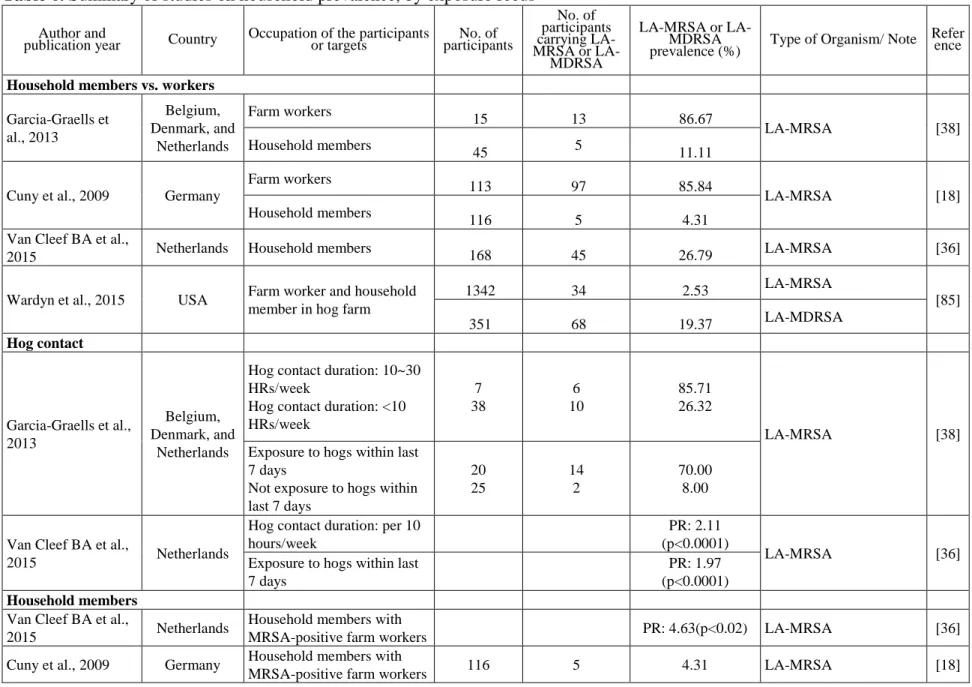
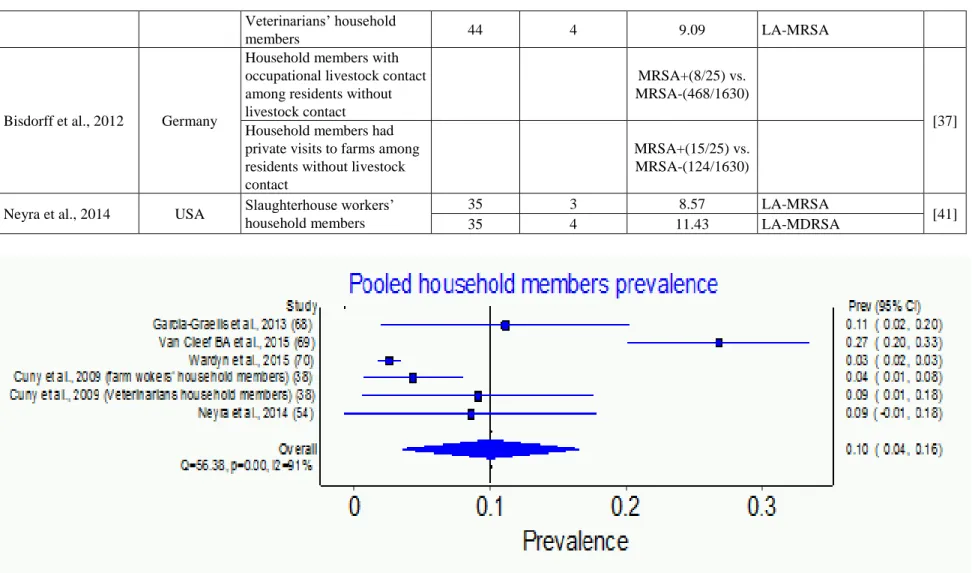
Several studies indicate that MRSA could be transmitted to hog farm workers’ household
members. Table 6 and Figure 4 show the prevalence for household members of hog farm
workers, by type of exposure. The pooled prevalence among household members was 10% (95%
CI: 4%-16%)(Figure 4).
Nadimpalli et al. showed that the nasal carriage of LA-MRSA and LA-MDRSA could persist among industrial hog operation workers over a two-week period, even in the workers off duty for
more than 96 hours [35]. Although the proportion of persistent carriers was significantly higher among farmers than among household members (87% vs. 11%, p<0.0001) [38], Garcia-Graells
et al. pointed out that the risk factors of MRSA acquisition also applied to MRSA carriage among household members, including pig contact rate (prevalence: 85.71% with 10-30 hours per week duration vs. 26.32% with <10 hours per week duration), exposure to hogs within the last 7
days (prevalence: 70% vs. 8% no exposure to hogs within the last 7 days), contact with sows (p<0.04), and handling antimicrobial drugs for hogs (p<0.03). However, even in both livestock
25
Table 6. Summary of studies on household prevalence, by exposure focus Author and
publication year Country Occupation of the participants or targets participants No. of
No. of participants carrying MRSA or
LA-MDRSA
MRSA or LA-MDRSA
prevalence (%) Type of Organism/ Note Reference
Household members vs. workers
Garcia-Graells et al., 2013
Belgium, Denmark, and
Netherlands
Farm workers 15 13 86.67
LA-MRSA [38]
Household members
45 5 11.11
Cuny et al., 2009 Germany
Farm workers
113 97 85.84
LA-MRSA [18]
Household members 116 5 4.31
Van Cleef BA et al.,
2015 Netherlands Household members 168 45 26.79 LA-MRSA [36]
Wardyn et al., 2015 USA Farm worker and household
member in hog farm
1342 34 2.53 LA-MRSA
[85]
351 68 19.37 LA-MDRSA
Hog contact
Garcia-Graells et al., 2013
Belgium, Denmark, and
Netherlands
Hog contact duration: 10~30 HRs/week
Hog contact duration: <10 HRs/week 7 38 6 10 85.71 26.32
LA-MRSA [38]
Exposure to hogs within last 7 days
Not exposure to hogs within last 7 days
20 25 14 2 70.00 8.00
Van Cleef BA et al.,
2015 Netherlands
Hog contact duration: per 10 hours/week
PR: 2.11 (p<0.0001)
LA-MRSA [36]
Exposure to hogs within last 7 days
PR: 1.97 (p<0.0001)
Household members
Van Cleef BA et al.,
2015 Netherlands
Household members with
MRSA-positive farm workers PR: 4.63(p<0.02) LA-MRSA [36]
26
Veterinarians’ household
members 44 4 9.09 LA-MRSA
Bisdorff et al., 2012 Germany
Household members with occupational livestock contact among residents without livestock contact
MRSA+(8/25) vs. MRSA-(468/1630)
[37] Household members had
private visits to farms among residents without livestock contact
MRSA+(15/25) vs. MRSA-(124/1630)
Neyra et al., 2014 USA Slaughterhouse workers’
household members
35 3 8.57 LA-MRSA
[41]
35 4 11.43 LA-MDRSA
3.5 Community and visitors
At the community level, a greater hog density on a farm is a potential risk factor for MRSA
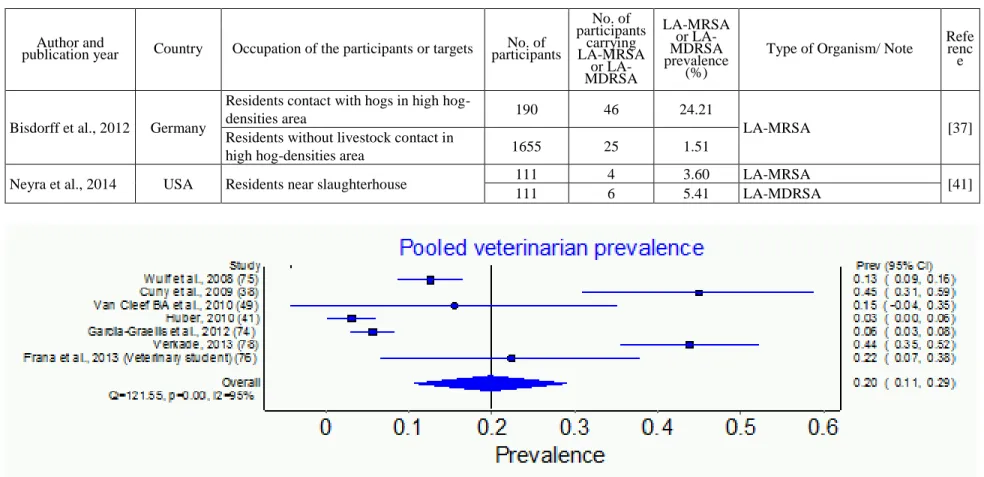
acquisition for neighboring residents. Table 7 and Figure 5 show the prevalence of MRSA for local communities, non-veterinary visitors, and visiting veterinarians (the pooled prevalence of
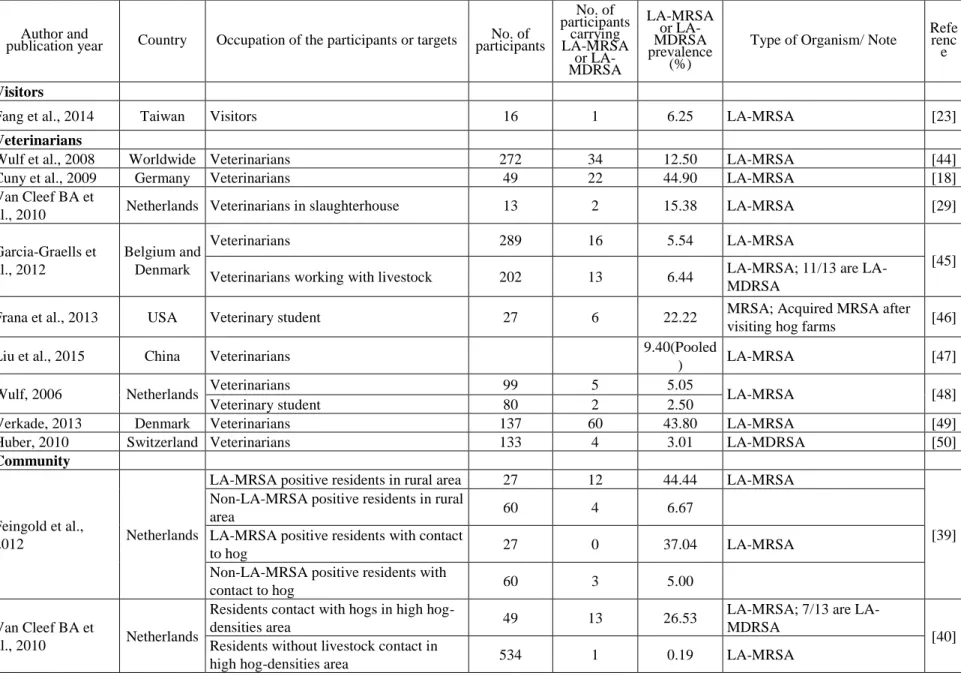
MRSA in veterinarians was 20% [95% CI: 11%-29%]). Residents in medium-density hog farming areas (1-149 hogs per square mile) had a greater risk for MRSA acquisition (OR: 4.76, 95% CI: 1.36-16.69)[42]. Private farm visits (OR: 3.2, 95% CI: 1.4–7.4) or contact with persons
who are directly exposed to livestock (OR: 3.8, 95% CI: 1.5–9.3) may also increase the risk for LA-MRSA acquisition[43]. Garcia-Graells et al. reported a strong direct association (OR: 12.1,
95% CI: 1.6-548.5, p=0.01) between exposure to live hogs and LA-MRSA acquisition for visitors such as veterinarians [45]. Wulf et al. suggested that the average world-wide MRSA prevalence among veterinarians is 12.5% [44]. Cuny et al. found a relatively high prevalence
among veterinarians’ household members even though they did not have direct contact with livestock [18]. Frana et al. demonstrated that MRSA can be recovered from persons with only
28
Table 7. Summary of the studies on community and visitors, by type of exposure
Author and
publication year Country Occupation of the participants or targets participants No. of
No. of participants carrying LA-MRSA or LA-MDRSA LA-MRSA or LA-MDRSA prevalence (%)
Type of Organism/ Note Referenc
e
Visitors
Fang et al., 2014 Taiwan Visitors 16 1 6.25 LA-MRSA [23]
Veterinarians
Wulf et al., 2008 Worldwide Veterinarians 272 34 12.50 LA-MRSA [44]
Cuny et al., 2009 Germany Veterinarians 49 22 44.90 LA-MRSA [18]
Van Cleef BA et
al., 2010 Netherlands Veterinarians in slaughterhouse 13 2 15.38 LA-MRSA [29]
Garcia-Graells et al., 2012
Belgium and Denmark
Veterinarians 289 16 5.54 LA-MRSA
[45]
Veterinarians working with livestock 202 13 6.44 MRSA; 11/13 are
LA-MDRSA
Frana et al., 2013 USA Veterinary student 27 6 22.22 MRSA; Acquired MRSA after
visiting hog farms [46]
Liu et al., 2015 China Veterinarians 9.40(Pooled
) LA-MRSA [47]
Wulf, 2006 Netherlands Veterinarians 99 5 5.05 LA-MRSA [48]
Veterinary student 80 2 2.50
Verkade, 2013 Denmark Veterinarians 137 60 43.80 LA-MRSA [49]
Huber, 2010 Switzerland Veterinarians 133 4 3.01 LA-MDRSA [50]
Community
Feingold et al.,
2012 Netherlands
LA-MRSA positive residents in rural area 27 12 44.44 LA-MRSA
[39] Non-LA-MRSA positive residents in rural
area 60 4 6.67
LA-MRSA positive residents with contact
to hog 27 0 37.04 LA-MRSA
Non-LA-MRSA positive residents with
contact to hog 60 3 5.00
Van Cleef BA et
al., 2010 Netherlands
Residents contact with hogs in high
hog-densities area 49 13 26.53
MRSA; 7/13 are LA-MDRSA
[40] Residents without livestock contact in
29
Author and
publication year Country Occupation of the participants or targets participants No. of
No. of participants
carrying LA-MRSA
or LA-MDRSA
LA-MRSA or LA-MDRSA prevalence
(%)
Type of Organism/ Note Referenc
e
Bisdorff et al., 2012 Germany
Residents contact with hogs in high
hog-densities area 190 46 24.21
LA-MRSA [37]
Residents without livestock contact in
high hog-densities area 1655 25 1.51
Neyra et al., 2014 USA Residents near slaughterhouse 111 4 3.60 LA-MRSA [41]
111 6 5.41 LA-MDRSA
30
3.6 Food chain
Table 8 and Figure 6 show the LA-MRSA and LA-MDRSA prevalence in the food chain. The
pooled prevalence of LA-MRSA in the food chain was 7% (95% CI: 5%-9%).
The food chain is a known LA-MRSA transmission route, but the prevalence and strains are
product-dependent and vary with the region of production. Verhegghe et al. suggested that the observed genetic diversity of the isolates is an indication that MRSA can be transmitted to the human population through cross-contaminated meat [86]; this was corroborated by Wang et al.,
who found LA-MRSA and LA-MDRSA from both animal and human origin in pork products [87].
Table 8 also shows that the prevalence of LA-MDRSA in pork products varies with the type of preservation and the form of the pork products; fresh pork tends to have a higher prevalence (46.67%, per Boost et al.) but that of frozen pork was much lower (0.56%, from the same study)
[52], and the prevalence of MRSA in raw pork (37.5%, per Costa et al.) was higher than that in pork products (6.7%, from the same study) [51]. The similar MRSA prevalence in conventional pork and alternative pork (labeled ‘‘raised without antibiotics’’ or ‘‘raised without antibiotic growth promoters’’) suggests that cross-contamination could occur in the processing facilities
[88], which is at least partly corroborated by the work of Buyukcangaz et al., who demonstrated
that meat could be contaminated in the meat production chain by documenting the presence of LA-MRSA and LA-MDRSA and comparing the genetic similarity between strains of porcine
31
Table 8. Summary of the food chain studies
Author and
publication year Country
Occupation of the participants or targets No. of participants No. of participant s carrying LA-MRSA or LA-MDRSA LA-MRSA or LA-MDRSA prevalence (%)
Type of Organism/ Note Reference
Pork products
Verhegghe et al., 2016 Belgium
Pork 137 98 71.53
97% (143/147) isolates are LA-MRSA [86]
Ear 23 23 100.00
Forelimb 24 21 87.50
Rib 24 20 83.33
Minced meat 18 11 61.11
Bacon 24 12 50.00
Chop 24 1 4.17
Wang et al., 2014 China Pork 160 1 0.63 2 isolates are LA-MDRSA [87]
Boost et al., 2013 Hong Kong
Pork 355 78 21.97
LA-MDRSA [52]
Fresh pork 165 77 46.67
Chilled pork 10 0 0
Frozen pork 180 1 0.56
Costa et al., 2015 Brazil
Raw pork 24 9 37.50
LA-MRSA [51]
Prepared pork
product 15 1 6.67
Hanson et al., 2011 USA Pork 55 2 3.64 LA-MRSA [90]
O’Brien et al.,
2012 USA
Conventional pork 300 19 6.63 LA-MRSA
[88]
Alternative pork5 95 7 7.37 LA-MRSA
Hiroi et al., 2012 Japan Raw pork 100 4 4.00 LA-MRSA [91]
Buyukcangaz et al.,
2013 USA Raw pork 71 5 7.04 4/5 are LA-MDRSA [89]
Agerso, 2012 Denmark Pork 153 7 4.58 LA-MRSA [84]
Lozano, 2009 Spain Pork 55 1 1.82 LA-MDRSA [92]
de Boer, 2009 Netherlands Pork 309 33 10.68 96.68% (32/33) are LA-MRSA [93]
Weese, 2010 Canada Pork 230 0 0 Neither LA-MRSA nor LA-MDRSA was detected [94]
Weese, 2010 Canada Pork 402 10 2.48 32.26% (10/31) are LA-MRSA [95]
Waters, 2011 USA Pork 26 7 26.92 7/11 are LA-MDRSA [96]
Pu, 2009 USA Pork 90 0 0 Neither LA-MRSA nor LA-MDRSA was detected [97]
32
Lim, 2010 Korea Pork 56 0 0 Neither LA-MRSA nor LA-MDRSA was detected [98]
3.7 Prevalence in hospital patients
Table 9 and Figure 7 show the prevalence of MRSA in hospital patients. The pooled
prevalence of LA-MRSA in hospital patients was 12% (95% CI: 9%-15%).
Several researchers have documented the transmissibility of LA-MRSA in hospitals [55, 99,
100]. Van de Sande-Bruinsma et al. suggested that the major risk factor categories in LA-MRSA-positive patients were contact with hogs, contact with other animals, and unknown source [53].Kock et al. conducted a case-control study of LA-MRSA positive patients and found
that contact with hogs was a crucial risk factor for LA-MRSA carriage (OR: 20.455, 95% CI: 7.831-64.386, p<0.001)[54]. Carrel et al. found that living near a high-density hog operation area
34
Table 9. Summary of the studies on hospital patients Author and
publication year Country Occupation of the participants or targets participants No. of
No. of participants carrying MRSA or
LA-MDRSA
LA-MRSA or LA-MDRSA prevalence (%)
Type of Organism/ Note
Refe renc e
Köck et al., 2013 Germany Patients
14036 2771 19.74 LA-MRSA
[101 ]
14036 2603 18.57 CC398
14036 1 0.01 CC30
14036 142 1.01 CC5
14036 1 0.01 CC97
14036 20 0.14 CC9
Van de Sande-Bruinsma et al., 2015
Netherlands Patients 3856 292 7.57 LA-MRSA [53]
Benito et al., 2014 Spain Patient with livestock contact history 25 19 76.00 LA-MDRSA [55]
Patient without livestock contact history 42 21 50.00 LA-MDRSA
Köck et al., 2011 Germany
MRSA CC398 positive patients 834 149 17.87
LA-MRSA [100
]
MRSA non-CC398 positive patients 834 442 53.00
Köck et al., 2010 Netherlands MRSA carriage among inpatients 19458 18 0.09 Almost 40% are
LA-MRSA
[102 ]
MRSA infection among inpatients 19458 4 0.02
Köck et al., 2009
Netherlands and Germany
MRSA positive patients 25540 390 1.53 18.71(73/390) are
LA-MRSA
35
36
CHAPTER 4: DISCUSSION
In this literature review, I have presented the prevalence of LA-MRSA and of LA-MDRSA,
as reported by 78 eligible studies in humans, livestock, and livestock production facilities, together with pooled prevalence estimates where applicable. My findings are consistent with
other reviews with regard to the populations at direct risk (farm hogs, farm workers, and veterinarians [104] [105]) and the major risk factors for LA-MRSA transmission to humans (contact with livestock, exposure frequency and duration [106-108]). I also identified other risk
factors for LA-MRSA or LA-MDRSA transmission, including the hog farm operation type (industrial rather than antibiotic-free operation), herd size (large-scale herd size), hog age, and
hog type.
4.1 Study Limitation
I may have underestimated the frequencies of multidrug resistant Staphylococcusaureus
strains if the eligible papers presented only results for the major antibiotics resistance tests or the resistance frequency of each antibiotic. If a paper did not explicitly mention terms such as “pig,”
“LA-MRSA” or “MDRSA”, my database searches would not have found it; however, I
attempted to minimize such omissions by reviewing the reference lists in the included papers and reviews.
Misclassification bias may have also occurred, resulting in underestimates of the prevalence of LA-MRSA and LA-MDRSA, due to category inconsistency in the eligible studies,
although I attempted to minimize the impact of misclassification through the use of the
sizes or if an LA-MRSA investigation did not test for resistance to additional antibiotics. Lastly, because much of the LA-MDRSA data comes from studies on LA-MRSA, HA-MDRSA or
38
CHAPTER 5: CONCLUSION
In this review, I have documented multiple LA-MRSA and LA-MDRSA transmission routes
and risk factors. LA-MRSA and LA-MDRSA can be transmitted from hog farms to other locations and populations via hogs, workers, air, water, and pork products. I have also
summarized the prevalence of LA-MRSA and LA-MDRSA in different populations and transmission vectors. Although direct contact with livestock is the greatest risk factor for acquiring LA-MRSA or LA-MDRSA, contamination can occur via air (greater concentrations
were found downwind of hog farms), water, soil (where MRSA may linger), and human activity (MRSA present at slaughter may be carried to other locations). I determined that there were other
transmission factors within the hog farm environment, including the hog farm operation type, contact with livestock (exposure frequency and duration), large-scale herd size, and hog age. I also found that seasonality (summer) also had a role in airborne LA-MRSA. Lastly, I
documented that high-density hog farming is a risk factor for LA-MRSA carriage in household members of farm workers and farm visitors, at the community level and in hospital patients. My
findings provide the sources of prevalence datasets needed to estimate the risk of hog-to-human transmission and thus may be useful in the construction of LA-MRSA and LA-MDRSA
APPENDIX: TABLE OF COMBINATION OF SEARCH TERMS
Term 1 Term 2 Term 3
livestock associated mrsa community risk
livestock associated mrsa pig risk
MRSA swine
livestock associated mrsa community pig
livestock associated mrsa worker risk
livestock associated mrsa pork chain
livestock associated mrsa review
livestock associated mrsa risk
MDRSA community risk
MDRSA pig risk
MDRSA swine
MDRSA community pig
MDRSA worker risk
MDRSA pork chain
MDRSA review
MDRSA risk
antibiotic AND resistant AND staphylococcus AND livestock community risk antibiotic AND resistant AND staphylococcus AND livestock pig risk antibiotic AND resistant AND staphylococcus AND livestock swine
antibiotic AND resistant AND staphylococcus AND livestock community pig antibiotic AND resistant AND staphylococcus AND livestock worker risk antibiotic AND resistant AND staphylococcus AND livestock pork chain
40
REFERENCES
1. Frieden, T., Antibiotic resistance threats in the United States, 2013. CDC, 2013.
2. Landers, T.F., Cohen, B., Wittum, T. E., & Larson, E. L. , A review of antibiotic use in food animals: perspective, policy, and potential. . Public Health Reports, 2012. 127(1): p. 4-22. 3. NYDOH, Health Advisory: Prevention and Control of Methicillin-resistant Staphylococcus
aureus (MRSA) Infections in the Camp Setting. 2008.
4. Deurenberg, R.H. and E.E. Stobberingh, The evolution of Staphylococcus aureus. Infect Genet Evol, 2008. 8(6): p. 747-63.
5. Sobral, D., et al., High throughput multiple locus variable number of tandem repeat analysis (MLVA) of Staphylococcus aureus from human, animal and food sources. PLoS One, 2012. 7(5): p. e33967.
6. Price, L.B., et al., Staphylococcus aureus CC398: host adaptation and emergence of methicillin resistance in livestock. MBio, 2012. 3(1).
7. Armand-Lefevre, R.R., A Andremont Clonal comparison of Staphylococcus aureus isolates healthy pig farmers, human controls, and pigs. Emerg Infect Dis, 2005. 11: p. 711–714. 8. T Khanna, R.F., C Dewey, JS Weese Methicillin resistant Staphylococcus aureus
colonization in pigs and pig farm workers Vet Microbiol, 2008. 128: p. 298–303. 9. TC Smith, M.M., AL Harper, et al. , Methicillin-resistant Staphylococcus aureus strain
ST398 is present in midwestern US swine and swine workers PLoS ONE, 2008. 4: p. e4258. 10. V Neela, A.M.Z., NS Mariana, A van Belkum, YK Liew, EG Rad Prevalence of ST9
methicillin-resistant Staphylococcus aureus among pigs and pig handlers in Malaysia. J Clin Microbiol, 2009. 47: p. 4138–4140.
11. S Cui, J.L., C Hu, et al. , Isolation and characterization of methicillin-resistant
Staphylococcus aureus from swine and workers in China J Antimicrob Chemother, 2009.
64: p. 680–683.
12. Grundmann, H., et al., Geographic distribution of Staphylococcus aureus causing invasive infections in Europe: a molecular-epidemiological analysis. PLoS Med, 2010. 7(1): p. e1000215.
13. McCarthy, A.J., et al., The distribution of mobile genetic elements (MGEs) in MRSA CC398 is associated with both host and country. Genome Biol Evol, 2011. 3: p. 1164-74.
Carolina. PLoS One, 2013. 8(7): p. e67641.
15. Smith, T.C., et al., Methicillin-resistant Staphylococcus aureus in pigs and farm workers on conventional and antibiotic-free swine farms in the USA. PLoS One, 2013. 8(5): p. e63704. 16. Smith, T.C., et al., Methicillin-resistant Staphylococcus aureus (MRSA) strain ST398 is
present in midwestern U.S. swine and swine workers. PLoS One, 2009. 4(1): p. e4258. 17. Osadebe, L.U., et al., Prevalence and characteristics of Staphylococcus aureus in
Connecticut swine and swine farmers. Zoonoses Public Health, 2013. 60(3): p. 234-43. 18. Cuny, C., et al., Nasal colonization of humans with methicillin-resistant Staphylococcus
aureus (MRSA) CC398 with and without exposure to pigs. PLoS One, 2009. 4(8): p. e6800. 19. Cuny, C., A.W. Friedrich, and W. Witte, Absence of livestock-associated
methicillin-resistant staphylococcus aureus clonal complex CC398 as a nasal colonizer of pigs raised in an alternative system. Appl Environ Microbiol, 2012. 78(4): p. 1296-7.
20. van de Vijver, L.P., et al., Prevalence and molecular characteristics of methicillin-resistant Staphylococcus aureus (MRSA) in organic pig herds in The Netherlands. Zoonoses Public Health, 2014. 61(5): p. 338-45.
21. Graveland, H., et al., Persistence of livestock associated MRSA CC398 in humans is dependent on intensity of animal contact. PLoS One, 2011. 6(2): p. e16830.
22. van Cleef, B.A., et al., Dynamics of methicillin-resistant Staphylococcus aureus and
methicillin-susceptible Staphylococcus aureus carriage in pig farmers: a prospective cohort study. Clin Microbiol Infect, 2014. 20(10): p. O764-71.
23. Fang, H.W., P.H. Chiang, and Y.C. Huang, Livestock-associated methicillin-resistant Staphylococcus aureus ST9 in pigs and related personnel in Taiwan. PLoS One, 2014. 9(2): p. e88826.
24. Alt, K., et al., Factors associated with the occurrence of MRSA CC398 in herds of fattening pigs in Germany. BMC Vet Res, 2011. 7: p. 69.
25. Battisti, A., et al., Heterogeneity among methicillin-resistant Staphylococcus aureus from Italian pig finishing holdings. Vet Microbiol, 2010. 142(3-4): p. 361-6.
26. Friese, A., et al., Occurrence of MRSA in air and housing environment of pig barns. Vet Microbiol, 2012. 158(1-2): p. 129-35.
27. Schmithausen, R.M., et al., Analysis of Transmission of MRSA and ESBL-E among Pigs and Farm Personnel. PLoS One, 2015. 10(9): p. e0138173.
42
vicinity of pig barns by livestock-associated methicillin-resistant Staphylococcus aureus.
Appl Environ Microbiol, 2012. 78(16): p. 5666-71.
29. Van Cleef, B.A., et al., High prevalence of nasal MRSA carriage in slaughterhouse workers in contact with live pigs in The Netherlands. Epidemiol Infect, 2010. 138(5): p. 756-63. 30. Gilbert, M.J., et al., Livestock-associated MRSA ST398 carriage in pig slaughterhouse
workers related to quantitative environmental exposure. Occup Environ Med, 2012. 69(7): p. 472-8.
31. Broens, E.M., et al., Transmission of methicillin resistant Staphylococcus aureus among pigs during transportation from farm to abattoir. Vet J, 2011. 189(3): p. 302-5.
32. Beneke, B., et al., Prevalence of methicillin-resistant Staphylococcus aureus in a fresh meat pork production chain. J Food Prot, 2011. 74(1): p. 126-9.
33. Narvaez-Bravo, C., et al., Prevalence of methicillin-resistant Staphylococcus aureus in Canadian commercial pork processing plants. J Appl Microbiol, 2016. 120(3): p. 770-80. 34. Lassok, B. and B.A. Tenhagen, From pig to pork: methicillin-resistant Staphylococcus
aureus in the pork production chain. J Food Prot, 2013. 76(6): p. 1095-108. 35. Nadimpalli, M., et al., Persistence of livestock-associated antibiotic-resistant
Staphylococcus aureus among industrial hog operation workers in North Carolina over 14 days. Occup Environ Med, 2015. 72(2): p. 90-9.
36. van Cleef, B.A., et al., Livestock-associated MRSA in household members of pig farmers: transmission and dynamics of carriage, a prospective cohort study. PLoS One, 2015. 10(5): p. e0127190.
37. Bisdorff, B., et al., MRSA-ST398 in livestock farmers and neighbouring residents in a rural area in Germany. Epidemiol Infect, 2012. 140(10): p. 1800-8.
38. Garcia-Graells, C., et al., Dynamic of livestock-associated methicillin-resistant
Staphylococcus aureus CC398 in pig farm households: a pilot study. PLoS One, 2013. 8(5): p. e65512.
39. Feingold, B.J., et al., Livestock density as risk factor for livestock-associated methicillin-resistant Staphylococcus aureus, the Netherlands. Emerg Infect Dis, 2012. 18(11): p. 1841-9.
40. van Cleef, B.A., et al., Prevalence of livestock-associated MRSA in communities with high pig-densities in The Netherlands. PLoS One, 2010. 5(2): p. e9385.
Carolina (USA). Environ Health Perspect, 2014. 122(5): p. 471-7.
42. Schinasi, L., et al., A case control study of environmental and occupational exposures associated with methicillin resistant Staphylococcus aureus nasal carriage in patients admitted to a rural tertiary care hospital in a high density swine region. Environ Health, 2014. 13(1): p. 54.
43. Bisdorff, B., et al., MRSA-ST398 in livestock farmers and neighbouring residents in a rural area in Germany. BMC Proceedings, 2011. 5(Suppl 6): p. P169.
44. Wulf, M.W., et al., Prevalence of methicillin-resistant Staphylococcus aureus among veterinarians: an international study. Clin Microbiol Infect, 2008. 14(1): p. 29-34. 45. Garcia-Graells, C., et al., Livestock veterinarians at high risk of acquiring
methicillin-resistant Staphylococcus aureus ST398. Epidemiol Infect, 2012. 140(3): p. 383-9. 46. Frana, T.S., et al., Isolation and characterization of methicillin-resistant Staphylococcus
aureus from pork farms and visiting veterinary students. PLoS One, 2013. 8(1): p. e53738. 47. Liu, W., et al., The prevalence and influencing factors of methicillin-resistant
Staphylococcus aureus carriage in people in contact with livestock: A systematic review.
Am J Infect Control, 2015. 43(5): p. 469-75.
48. Wulf, M., et al., Methicillin-resistant Staphylococcus aureus in veterinary doctors and students, the Netherlands. Emerg Infect Dis, 2006. 12(12): p. 1939-41.
49. Verkade, E., et al., Dynamics and determinants of Staphylococcus aureus carriage in livestock veterinarians: a prospective cohort study. Clin Infect Dis, 2013. 57(2): p. e11-7. 50. H Huber, S.K., N Giezendanner, R Stephan, C Zweifel, Prevalence and characteristics of
meticillin-resistant Staphylococcus aureus in humans in contact with farm animals, in livestock, and in food of animal origin, Switzerland, 2009. Euro Surveill., 2010 15(16). 51. Costa, W.L., et al., Methicillin-resistant Staphylococcus aureus in raw meats and prepared
foods in public hospitals in salvador, Bahia, Brazil. J Food Sci, 2015. 80(1): p. M147-50. 52. Boost, M.V., et al., Isolation of methicillin-resistant Staphylococcus aureus (MRSA) from
retail meats in Hong Kong. Foodborne Pathog Dis, 2013. 10(8): p. 705-10.
53. van de Sande-Bruinsma, N., et al., Impact of livestock-associated MRSA in a hospital setting. Antimicrob Resist Infect Control, 2015. 4: p. 11.
44
55. Benito, D., et al., Characterization of tetracycline and methicillin resistant Staphylococcus aureus strains in a Spanish hospital: is livestock-contact a risk factor in infections caused by MRSA CC398? Int J Med Microbiol, 2014. 304(8): p. 1226-32.
56. Carrel, M., et al., Residential proximity to large numbers of swine in feeding operations is associated with increased risk of methicillin-resistant Staphylococcus aureus colonization at time of hospital admission in rural Iowa veterans. Infect Control Hosp Epidemiol, 2014.
35(2): p. 190-3.
57. Crombe, F., et al., Prevalence and antimicrobial susceptibility of methicillin-resistant Staphylococcus aureus among pigs in Belgium. Microb Drug Resist, 2012. 18(2): p. 125-31. 58. Lewis, H.C., et al., Pigs as source of methicillin-resistant Staphylococcus aureus CC398
infections in humans, Denmark. Emerg Infect Dis, 2008. 14(9): p. 1383-9.
59. Voss, A., Loeffen, F., Bakker, J., Klaassen, C., & Wulf, M, Methicillin - resistant Staphylococcus aureus in pig farming. . Emerging Infectious Diseases, 2005. 11(12): p. 1965 – 1966.
60. Broens, E.M., et al., Longitudinal study on transmission of MRSA CC398 within pig herds.
BMC Vet Res, 2012. 8: p. 58.
61. Pletinckx, L.J., et al., Evidence of possible methicillin-resistant Staphylococcus aureus ST398 spread between pigs and other animals and people residing on the same farm. Prev Vet Med, 2013. 109(3-4): p. 293-303.
62. Cui, S., et al., Isolation and characterization of methicillin-resistant Staphylococcus aureus from swine and workers in China. J Antimicrob Chemother, 2009. 64(4): p. 680-3.
63. Habrun, B., et al., The presence of methicillin-resistant Staphylococcus aureus on large pig breeding farms in Croatia. Acta Vet Hung, 2011. 59(4): p. 419-25.
64. van Duijkeren, E., et al., Transmission of methicillin-resistant Staphylococcus aureus strains between different kinds of pig farms. Vet Microbiol, 2008. 126(4): p. 383-9.
65. Khanna, T., et al., Methicillin resistant Staphylococcus aureus colonization in pigs and pig farmers. Vet Microbiol, 2008. 128(3-4): p. 298-303.
66. Weese, J.S., et al., Clostridium difficile and methicillin-resistant Staphylococcus aureus shedding by slaughter-age pigs. BMC Vet Res, 2011. 7: p. 41.
67. Tsai, H.Y., et al., Isolation of meticillin-resistant Staphylococcus aureus sequence type 9 in pigs in Taiwan. Int J Antimicrob Agents, 2012. 39(5): p. 449-51.
69. Armand-Lefevre, L., R. Ruimy, and A. Andremont, Clonal comparison of Staphylococcus aureus isolates from healthy pig farmers, human controls, and pigs. Emerg Infect Dis, 2005. 11(5): p. 711-4.
70. Dahms, C., et al., Occurrence of methicillin-resistant Staphylococcus aureus in farm
workers and the livestock environment in Mecklenburg-Western Pomerania, Germany. Acta Vet Scand, 2014. 56: p. 53.
71. Green, C.F., et al., Bacterial Plume Emanating from the Air Surrounding Swine
Confinement Operations. Journal of Occupational and Environmental Hygiene, 2006. 3(1): p. 9-15.
72. Bos, M.E., et al., Transmission through air as a possible route of exposure for MRSA. J Expo Sci Environ Epidemiol, 2016. 26(3): p. 263-9.
73. J, E., European Food Safety Authority: Analysis of the baseline survey on the prevalence of methicillin resistant Staphylococcus aureus (MRSA) in holding with breeding pigs, in the EU, 2008, Part A: MRSA prevalence estimates. . 2009. 7: p. 1376.
74. Yan, X., et al., Staphylococcus aureus ST398 from slaughter pigs in northeast China. Int J Med Microbiol, 2014. 304(3-4): p. 379-83.
75. Ho, J., et al., Characterization of Methicillin-Resistant Staphylococcus aureus Isolates from Pig Carcasses in Hong Kong. Zoonoses and Public Health, 2012. 59(6): p. 416-423.
76. Morcillo, A., et al., Prevalence and characteristics of methicillin-resistant Staphylococcus aureus in pigs and pig workers in Tenerife, Spain. Foodborne Pathog Dis, 2012. 9(3): p. 207-10.
77. Wan, M.T. and C.C. Chou, Spreading of beta-lactam resistance gene (mecA) and
methicillin-resistant Staphylococcus aureus through municipal and swine slaughterhouse wastewaters. Water Res, 2014. 64: p. 288-95.
78. Gomez-Sanz, E., et al., Detection, molecular characterization, and clonal diversity of methicillin-resistant Staphylococcus aureus CC398 and CC97 in Spanish slaughter pigs of different age groups. Foodborne Pathog Dis, 2010. 7(10): p. 1269-77.
79. Porrero, M.C., et al., Detection of methicillin-resistant Staphylococcus aureus in Iberian pigs. Lett Appl Microbiol, 2012. 54(4): p. 280-5.
80. Overesch, G., et al., The increase of methicillin-resistant Staphylococcus aureus (MRSA) and the presence of an unusual sequence type ST49 in slaughter pigs in Switzerland. BMC Vet Res, 2011. 7: p. 30.
46
pigs. Vet Microbiol, 2007. 122(3-4): p. 366-72.
82. Baba, K., et al., Isolation of meticillin-resistant Staphylococcus aureus (MRSA) from swine in Japan. Int J Antimicrob Agents, 2010. 36(4): p. 352-4.
83. Lim, S.K., et al., The first detection of methicillin-resistant Staphylococcus aureus ST398 in pigs in Korea. Vet Microbiol, 2012. 155(1): p. 88-92.
84. Agerso, Y., et al., Study of methicillin resistant Staphylococcus aureus (MRSA) in Danish pigs at slaughter and in imported retail meat reveals a novel MRSA type in slaughter pigs.
Vet Microbiol, 2012. 157(1-2): p. 246-50.
85. Wardyn, S.E., et al., Swine Farming Is a Risk Factor for Infection With and High Prevalence of Carriage of Multidrug-Resistant Staphylococcus aureus. Clin Infect Dis, 2015. 61(1): p. 59-66.
86. Verhegghe, M., et al., Prevalence and Genetic Diversity of Livestock-Associated
Methicillin-Resistant Staphylococcus aureus on Belgian Pork. J Food Prot, 2016. 79(1): p. 82-9.
87. Wang, X., et al., Antimicrobial susceptibility and molecular typing of methicillin-resistant staphylococcus aureus in retail foods in Shaanxi, China. Foodborne Pathog Dis, 2014.
11(4): p. 281-6.
88. O'Brien, A.M., et al., MRSA in conventional and alternative retail pork products. PLoS One, 2012. 7(1): p. e30092.
89. Buyukcangaz, E., et al., Molecular typing of Staphylococcus aureus and methicillin-resistant S. aureus (MRSA) isolated from animals and retail meat in North Dakota, United States. Foodborne Pathog Dis, 2013. 10(7): p. 608-17.
90. Hanson, B.M., et al., Prevalence of Staphylococcus aureus and methicillin-resistant
Staphylococcus aureus (MRSA) on retail meat in Iowa. J Infect Public Health, 2011. 4(4): p. 169-74.
91. Hiroi, M., et al., Antibiotic resistance in bacterial pathogens from retail raw meats and food-producing animals in Japan. J Food Prot, 2012. 75(10): p. 1774-82.
92. Lozano, C., et al., Detection of methicillin-resistant Staphylococcus aureus ST398 in food samples of animal origin in Spain. J Antimicrob Chemother, 2009. 64(6): p. 1325-6. 93. de Boer, E., et al., Prevalence of methicillin-resistant Staphylococcus aureus in meat. Int J
Food Microbiol, 2009. 134(1-2): p. 52-6.
Microbiol, 2010. 51(3): p. 338-42.
95. Weese JS, R.-S.R., Rousseau J, Avery B. , Methicillin-resistant Staphylococcus aureus (MRSA) contamination of retail pork. The Canadian Veterinary Journal., 2010. 51(7): p. 749-752.
96. Waters, A.E., et al., Multidrug-Resistant Staphylococcus aureus in US Meat and Poultry.
Clin Infect Dis, 2011. 52(10): p. 1227-30.
97. Pu, S., F. Han, and B. Ge, Isolation and characterization of methicillin-resistant
Staphylococcus aureus strains from Louisiana retail meats. Appl Environ Microbiol, 2009.
75(1): p. 265-7.
98. Lim SK, N.H., Park HJ , Lee HS , Choi MJ , Jung SC , Lee JY , Kim YC , Song SW , Wee SH, Prevalence and Characterization of Methicillin-Resistant Staphylococcus aureus in Raw Meat in Korea. J. Microbiol. Biotechnol, 2010. 20(4): p. 775-778.
99. Wassenberg, M.W., et al., Transmissibility of livestock-associated methicillin-resistant Staphylococcus aureus (ST398) in Dutch hospitals. Clin Microbiol Infect, 2011. 17(2): p. 316-9.
100. Kock, R., et al., Characteristics of hospital patients colonized with livestock-associated meticillin-resistant Staphylococcus aureus (MRSA) CC398 versus other MRSA clones. J Hosp Infect, 2011. 79(4): p. 292-6.
101. Kock, R., et al., Livestock-associated methicillin-resistant Staphylococcus aureus (MRSA) as causes of human infection and colonization in Germany. PLoS One, 2013. 8(2): p. e55040.
102. Kaiser, A.M., et al., Prevalence of methicillin-resistant Staphylococcus aureus and risk factors for carriage in Dutch hospitals. Infect Control Hosp Epidemiol, 2010. 31(11): p. 1188-90.
103. Kock, R., et al., Cross-border comparison of the admission prevalence and clonal structure of meticillin-resistant Staphylococcus aureus. J Hosp Infect, 2009. 71(4): p. 320-6.
104. Johnson, A.P., Methicillin-resistant Staphylococcus aureus: the European landscape. J Antimicrob Chemother, 2011. 66 Suppl 4: p. iv43-iv48.
105. Cuny, C., R. Kock, and W. Witte, Livestock associated MRSA (LA-MRSA) and its relevance for humans in Germany. Int J Med Microbiol, 2013. 303(6-7): p. 331-7.
106. Graveland, H., et al., Livestock-associated methicillin-resistant Staphylococcus aureus in animals and humans. Int J Med Microbiol, 2011. 301(8): p. 630-4.
48
changing patterns of risks, effects of interventions and the way forward. Philos Trans R Soc Lond B Biol Sci, 2015. 370(1670): p. 20140085.
108. Chen, C.J. and Y.C. Huang, New epidemiology of Staphylococcus aureus infection in Asia.