arXiv:0807.2611v2 [math.PR] 30 May 2009
Quenched large deviation principle for words in a letter sequence
Matthias Birkner 1 Andreas Greven 2 Frank den Hollander 3 4
13th May 2009
Abstract
When we cut an i.i.d. sequence of letters into words according to an independent renewal process, we obtain an i.i.d. sequence of words. In theannealed large deviation principle (LDP) for the empirical process of words, the rate function is the specific relative entropy of the observed law of words w.r.t. the reference law of words. In the present paper we consider the quenched LDP, i.e., we condition on a typical letter sequence. We focus on the case where the renewal process has analgebraic tail. The rate function turns out to be a sum of two terms, one being the annealed rate function, the other being proportional to the specific relative entropy of the observed law of letters w.r.t. the reference law of letters, with the former being obtained by concatenating the words and randomising the location of the origin. The proportionality constant equals the tail exponent of the renewal process. Earlier work by Birkner considered the case where the renewal process has an exponential tail, in which case the rate function turns out to be the first term on the set where the second term vanishes and to be infinite elsewhere. In a companion paper the annealed and the quenched LDP are applied to the collision local time of transient random walks, and the existence of an intermediate phase for a class of interacting stochastic systems is established.
Key words: Letters and words, renewal process, empirical process, annealed vs. quenched, large deviation principle, rate function, specific relative entropy.
MSC 2000: 60F10, 60G10.
Acknowledgement: This work was supported in part by DFG and NWO through the Dutch-German Bilateral Research Group “Mathematics of Random Spatial Models from Physics and Biology”. MB and AG are grateful for hospitality at EURANDOM. We also thank an anonymous referee for her/his careful reading and helpful comments.
1Department Biologie II, Abteilung Evolutionsbiologie, University of Munich (LMU),
Grosshaderner Str. 2, 82152 Planegg-Martinsried, Germany
2Mathematisches Institut, Universit¨at Erlangen-N¨urnberg, Bismarckstrasse 11 2, 91054
Erlangen, Germany
3Mathematical Institute, Leiden University, P.O. Box 9512, 2300 RA Leiden, The
Netherlands
1
Introduction and main results
1.1 Problem setting
Let E be a finite set of letters. Let Ee = ∪n∈NEn be the set of finite words drawn from E. Both
E and Ee are Polish spaces under the discrete topology. Let P(EN
) and P(EeN
) denote the set of probability measures on sequences drawn from E, respectively, Ee, equipped with the topology of weak convergence. Write θ and θe for the left-shift acting on EN
, respectively, EeN
. Write
Pinv(EN
),Perg(EN
) and Pinv(EeN
),Perg(EeN
) for the set of probability measures that are invariant and ergodic underθ, respectively, θe.
For ν ∈ P(E), let X= (Xi)i∈N be i.i.d. with law ν. Without loss of generality we will assume that supp(ν) =E (otherwise we replace E by supp(ν)). Forρ∈ P(N), letτ = (τi)i∈N be i.i.d. with law ρhaving infinite support and satisfying the algebraic tail property
lim
n→∞
ρ(n)>0
logρ(n)
logn =:−α, α∈(1,∞). (1.1)
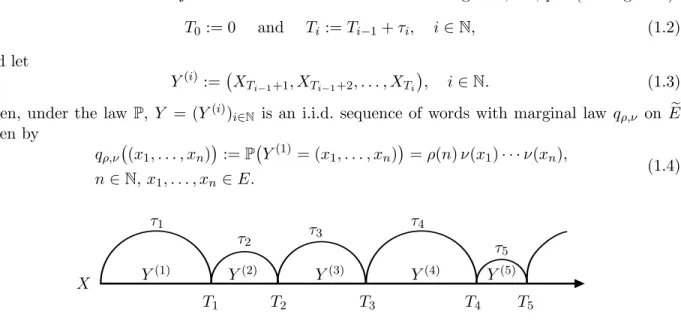
(No regularity assumption will be necessary for supp(ρ).) Assume that X and τ are independent and write Pto denote their joint law. Cut words out ofX according toτ, i.e., put (see Figure 1)
T0 := 0 and Ti :=Ti−1+τi, i∈N, (1.2) and let
Y(i):= XTi−1+1, XTi−1+2, . . . , XTi
, i∈N. (1.3)
Then, under the law P, Y = (Y(i))i∈N is an i.i.d. sequence of words with marginal law qρ,ν on Ee given by
qρ,ν (x1, . . . , xn):=P Y(1) = (x1, . . . , xn)=ρ(n)ν(x1)· · ·ν(xn),
n∈N, x1, . . . , xn∈E. (1.4)
τ1
τ2 τ3
τ4
τ5
T1 T2 T3 T4 T5
Y(1) Y(2) Y(3) Y(4) Y(5)
X
Figure 1: Cutting words from a letter sequence according to a renewal process.
For N ∈ N, let (Y(1), . . . , Y(N))per stand for the periodic extension of (Y(1), . . . , Y(N)) to an
element ofEeN
, and define
RN :=
1
N NX−1
i=0
δθei(Y(1),...,Y(N))per ∈ Pinv(Ee
N
), (1.5)
theempirical process of N-tuples of words. By the ergodic theorem, we have
w−lim
N→∞RN =q
⊗N
ρ,ν P–a.s., (1.6)
with w−lim denoting the weak limit. The following large deviation principle (LDP) is standard (see e.g. Dembo and Zeitouni [5], Corollaries 6.5.15 and 6.5.17). For Q∈ Pinv(EeN
) let
H(Q|qρ,ν⊗N) := lim
N→∞
1
N h
Q|FN |(q ⊗N
ρ,ν)|FN
be thespecific relative entropy ofQw.r.t. q⊗N
ρ,ν, whereFN =σ(Y(1), . . . , Y(N)) is the sigma-algebra
generated by the first N words, Q|F
N is the restriction of Q to
FN, and h(· | ·) denotes relative
entropy. (For general properties of entropy, see Walters [13], Chapter 4.)
Theorem 1.1. [Annealed LDP] The family of probability distributions P(RN ∈ ·), N ∈ N, satisfies the LDP on Pinv(EeN
) with rate N and with rate function Iann: Pinv(EeN
) →[0,∞] given by
Iann(Q) =H(Q|q⊗N
ρ,ν). (1.8)
This rate function is lower semi-continuous, has compact level sets, has a unique zero atQ=q⊗N
ρ,ν, and is affine.
The LDP for RN arises from the LDP for N-tuples via a projective limit theorem. The ratio under the limit in (1.7) is the rate function forN-tuples according to Sanov’s theorem (see e.g. den Hollander [8], Section II.5), and is non-decreasing inN.
1.2 Main theorems
Our aim in the present paper is to derive the LDP for P(RN ∈ · |X), N ∈N. To state our result,
we need some more notation. Let κ:EeN
→EN
denote theconcatenation map that glues a sequence of words into a sequence of letters. For Q∈ Pinv(EeN
) such that
mQ:=EQ[τ1]<∞, (1.9) define ΨQ∈ Pinv(EN) as
ΨQ(·) :=
1
mQ
EQ "τ1−1
X
k=0
δθkκ(Y)(·)
#
. (1.10)
Think of ΨQ asthe shift-invariant version of the concatenation ofY under the law Qobtained after randomising the location of the origin.
For tr∈N, let [·]tr: Ee→[Ee]tr :=∪trn=1En denote the word length truncation map defined by
y= (x1, . . . , xn)7→[y]tr:= (x1, . . . , xn∧tr), n∈N, x1, . . . , xn∈E. (1.11)
Extend this to a map from EeN
to [Ee]N tr via
(y(1), y(2), . . .)tr := [y(1)]tr,[y(2)]tr, . . . (1.12)
and to a map from Pinv(EeN
) to Pinv([Ee]N tr) via [Q]tr(A) :=Q({z∈Ee
N
: [z]tr∈A}), A⊂[Ee] N
tr measurable. (1.13) Note that ifQ∈ Pinv(EeN
), then [Q]tr is an element of the set
Pinv,fin(EeN) ={Q∈ Pinv(EeN) : mQ<∞}. (1.14)
Theorem 1.2. [Quenched LDP]Assume(1.1). Then, for ν⊗N
–a.s. allX, the family of (regular) conditional probability distributions P(RN ∈ · | X), N ∈ N, satisfies the LDP on Pinv(EeN) with
rate N and with deterministic rate function Ique: Pinv(EeN
)→[0,∞]given by
Ique(Q) :=
Ifin(Q), ifQ∈ Pinv,fin(EeN ),
lim tr→∞I
fin [Q]
tr, otherwise,
(1.15)
where
Theorem 1.3. The rate function Ique is lower semi-continuous, has compact level sets, has a unique zero atQ=q⊗N
ρ,ν, and is affine. Moreover, it is equal to the lower semi-continuous extension of Ifin from Pinv,fin(EeN
) to Pinv(EeN ).
Theorem 1.2 will be proved in Sections 3–5, Theorem 1.3 in Section 6.
A remarkable aspect of (1.16) in relation to (1.8) is that it quantifies the difference between the quenched and the annealed rate function. Note the appearance of the tail exponent α. We have not been able to find a simple formula for Ique(Q) when mQ = ∞. In Appendix A we will show
that the annealed and the quenched rate function are continuous under truncation of word lengths, i.e.,
Iann(Q) = lim tr→∞I
ann([Q]
tr), Ique(Q) = lim tr→∞I
que([Q]
tr), Q∈ Pinv(EeN). (1.17)
Theorem 1.2 is an extension of Birkner [2], Theorem 1. In that paper, the quenched LDP is derived under the assumption that the law ρ satisfies theexponential tail property
∃C <∞, λ >0 : ρ(n)≤Ce−λn ∀n∈N (1.18)
(which includes the case where supp(ρ) is finite). The rate function governing the LDP is given by
Ique(Q) :=
H(Q|q⊗N
ρ,ν), ifQ∈Rν,
∞, ifQ /∈Rν, (1.19)
where
Rν :=
Q∈ Pinv(EeN
) : w−lim
L→∞
1
L LX−1
k=0
δθkκ(Y) =ν⊗N Q−a.s.
. (1.20)
Think of Rν as the set of those Q’s for which the concatenation of words has the same statistical
properties as the letter sequence X. This set is not closed in the weak topology: its closure is
Pinv(EeN ).
We can include the cases whereρ satisfies (1.1) withα= 1 or α=∞.
Theorem 1.4. (a)If α= 1, then the quenched LDP holds with Ique =Iann given by (1.8). (b) If α=∞, then the quenched LDP holds with rate function
Ique(Q) =
(
H(Q|q⊗N
ρ,ν) if tr→∞lim m[Q]trH(Ψ[Q]tr|ν
⊗N ) = 0,
∞ otherwise. (1.21)
Theorem 1.4 will be proved in Section 7. Part (a) says that the quenched and the annealed rate function are identical when α= 1. Part (b) says that (1.19) can be viewed as the limiting case of (1.16) asα→ ∞. Indeed, it was shown in Birkner [2], Lemma 2, that onPinv,fin(EeN
):
ΨQ=ν⊗N if and only if Q∈Rν. (1.22)
Hence, (1.21) and (1.19) agree on Pinv,fin(EeN
), and the rate function (1.21) is the lower semicon-tinuous extension of (1.19) to Pinv(EeN
). By Birkner [2], Lemma 7, the expressions in (1.21) and (1.19) are identical if ρ has exponentially decaying tails. In this sense, Part (b) generalises the result in Birkner [2], Theorem 1, to arbitraryρ with a tail that decays faster than algebraic.
Corollary 1.5. Under the assumptions of Theorem1.2, forν⊗N
–a.s. all X, the family of (regular) conditional probability distributions P(π1RN ∈ · |X), N ∈N, satisfies the LDP on P(Ee) with rate N and with deterministic rate function I1que: P(Ee)→[0,∞]given by
I1que(q) := infIque(Q) : Q∈ Pinv(EeN
), π1Q=q . (1.23)
This rate function is lower semi-continuous, has compact levels sets, has a unique zero atq =qρ,ν, and is convex.
Corollary 1.5 shows that the rate function in Birkner [1], Theorem 6, must be replaced by (1.23). It does not appear possible to evaluate the infimum in (1.23) explicitly in general. For a q∈ P(Ee) with finite mean length and Ψq⊗N =ν⊗
N
, we have I1que(q) =h(q|qρ,ν).
By taking projective limits, it is possible to extend Theorems 1.2–1.3 to more general letter spaces. See, e.g., Deuschel and Stroock [6], Section 4.4, or Dembo and Zeitouni [5], Section 6.5, for background on (specific) relative entropy in general spaces. The following corollary will be proved in Section 8.
Corollary 1.6. The quenched LDP also holds whenEis a Polish space, with the same rate function as in (1.15–1.16).
In the companion paper [3] the annealed and quenched LDP are applied to the collision local time of transient random walks, and the existence of an intermediate phase for a class of interacting stochastic systems is established.
1.3 Heuristic explanation of main theorems
To explain the background of Theorem 1.2, we begin by recalling a few properties of entropy. Let
H(Q) denote the specific entropy of Q∈ Pinv(EeN
) defined by
H(Q) := lim
N→∞
1
N h Q|FN
∈[0,∞], (1.24)
where h(·) denotes entropy. The sequence under the limit in (1.24) is non-increasing in N. Since
q⊗N
ρ,ν is a product measure, we have the identity (recall (1.2–1.4))
H(Q|q⊗N
ρ,ν) =−H(Q)−EQ[logqρ,ν(Y1)] =−H(Q)−EQ[logρ(τ1)]−mQEΨ
Q[logν(X1)].
(1.25)
Similarly,
H(ΨQ|ν⊗
N
) =−H(ΨQ)−EΨQ[logν(X1)]. (1.26)
Below, for a discrete random variable Z with a law Q on a state space Z we will write Q(Z) for the random variable f(Z) with f(z) =Q(Z =z),z∈ Z. Abbreviate
K(N):=κ(Y(1), . . . , Y(N)) and K(∞) :=κ(Y). (1.27)
In analogy with (1.14), define
Perg,fin(EeN
) :=nQ∈ Perg(EeN
) : mQ<∞
o
Lemma 1.7. [Birkner [2], Lemmas 3 and 4]
Suppose that Q∈ Perg,fin(EeN
) and H(Q)<∞. Then, Q-a.s.,
lim
N→∞
1
N logQ(K
(N)) =−m
QH(ΨQ),
lim
N→∞
1
N logQ τ1, . . . , τN |K
(N)=:−H
τ|K(Q),
lim
N→∞
1
N logQ Y
(1), . . . , Y(N)=−H(Q),
(1.29)
with
mQH(ΨQ) +Hτ|K(Q) =H(Q). (1.30)
Equation (1.30), which follows from (1.29) and the identity
Q(K(N))Q(τ1, . . . , τN |K(N)) =Q(Y(1), . . . , Y(N)), (1.31)
identifiesHτ|K(Q). Think ofHτ|K(Q) as theconditional specific entropy of word lengths under the law Q given the concatenation. Combining (1.25–1.26) and (1.30), we have
H(Q|qρ,ν⊗N) =mQH(ΨQ|ν⊗
N
)−Hτ|K(Q)−EQ[logρ(τ1)]. (1.32)
The term−Hτ|K(Q)−EQ[logρ(τ1)] in (1.32) can be interpreted as the conditional specific relative entropy of word lengths under the law Q w.r.t. ρ⊗N
given the concatenation.
Note that mQ <∞ and H(Q) <∞ imply that H(ΨQ)<∞, as can be seen from (1.30). Also
note that −EΨ
Q[logν(X1)]<∞ because E is finite, and−EQ[logρ(τ1)]<∞ because of (1.1) and
mQ <∞, implying that (1.25–1.26) are proper.
We are now ready to give a heuristic explanation of Theorem 1.2. Let
RNj1,...,jN(X), 0< j1 <· · ·< jN <∞, (1.33)
denote the empirical process of N-tuples of words when X is cut at the points j1, . . . , jN (i.e.,
when Ti = ji for i = 1, . . . , N; see (3.16–3.17) for a precise definition). Fix Q ∈ Perg,fin(EeN).
The probability P(RN ≈Q|X) is a sum over all N-tuples j1, . . . , jN such that RN
j1,...,jN(X) ≈Q,
weighted byQNi=1ρ(ji−ji−1) (withj0 = 0). The fact thatRjN1,...,jN(X)≈Qhas three consequences:
(1) The j1, . . . , jN must cut≈N substrings out ofX of total length ≈N mQ that look like the concatenation of words that are Q-typical, i.e., that look as if generated by ΨQ (possibly
with gaps in between). This means that most of the cut-points must hit atypical pieces of
X. We expect to have to shift X by ≈ exp[N mQH(ΨQ | ν⊗N)] in order to find the first
contiguous substring of length N mQ whose empirical shifts lie in a small neighbourhood of
ΨQ. By (1.1), the probability for the single increment j1−j0 to have the size of this shift is
≈exp[−N α mQH(ΨQ|ν⊗N)].
(2) The combinatorial factor exp[N Hτ|K(Q)] counts how many “local perturbations” ofj1, . . . , jN
preserve the property thatRN
j1,...,jN(X)≈Q.
The contributions from (1)–(3), together with the identity in (1.32), explain the formula in (1.16) onPerg,fin(EeN
). Considerable work is needed to extend (1)–(3) fromPerg,fin(EeN
) toPinv(EeN ). This is explained in Section 3.5.
In (1), instead of having a single large increment preceding a single contiguous substring of length
N mQ, it is possible to have several large increments preceding several contiguous substrings, which
together have length N mQ. The latter gives rise to the same contribution, and so there is some
entropy associated with the choice of the large increments. Lemma 2.1 in Section 2.1 is needed to control this entropy, and shows that it is negligible.
1.4 Outline
Section 2 collects some preparatory facts that are needed for the proofs of the main theorems, including a lemma that controls the entropy associated with the locations of the large increments in the renewal process. In Section 3 and 4 we prove the large deviation upper, respectively, lower bound. The proof of the former is long (taking up about half of the paper) and requires a somewhat lengthy construction with combinatorial, functional analytic and ergodic theoretic ingredients. In particular, extending the lower bound from ergodic to non-ergodic probability measures is tech-nically involved. The proofs of Theorems 1.2–1.4 are in Sections 5–7, that of Corollary 1.6 is in Section 8. Appendix A contains a proof that the annealed and the quenched rate function are continuous under the truncation of the word length approximation.
2
Preparatory facts
Section 2.1 proves a core lemma that is needed to control the entropy of large increments in the renewal process. Section 2.2 shows that the tail property of ρ is preserved under convolutions.
2.1 A core lemma
As announced at the end of Section 1.3, we need to account for the entropy that is associated with the locations of the large increments in the renewal process. This requires the following combinatorial lemma.
Lemma 2.1. Let ω = (ωl)l∈N be i.i.d. with P(ω1 = 1) = 1−P(ω1 = 0) = p ∈ (0,1), and let
α∈(1,∞). For N ∈N, let
SN(ω) :=
X
0<j1<···<jN <∞
ωj1=···=ωjN=1
N
Y
i=1
(ji−ji−1)−α (j0 = 0) (2.1)
and put
lim sup
N→∞
1
N logSN(ω) =:−φ(α, p) ω−a.s. (2.2)
(the limit being ω-a.s. constant by tail triviality). Then
lim
p↓0
φ(α, p)
αlog(1/p) = 1. (2.3)
Proof. Let τN := min{l ∈ N: ωl = ωl+1 = · · · = ωl+N−1}. In (2.1), choosing j1 = τN and ji=ji−1+ 1 for i= 2, . . . , N, we see thatSN(ω)≥τN−α. Since
lim
N→∞
1
we have
φ(α, p)≤αlog(1/p) ∀p∈(0,1). (2.5)
To show that this bound is sharp in the limit asp↓0, we estimate fractional moments of SN(ω).
For any β∈(1/α,1], using that (u+v)β ≤uβ+vβ,u, v ≥0, we get
EhSN(ω)βi≤ X
0<j1<···<jN<∞
Eh1
{ωj1=···=ωjN=1}
N
Y
i=1
(ji−ji−1)−αβ
i
= X
0<j1<···<jN<∞
pN N
Y
i=1
(ji−ji−1)−αβ
=p ζ(αβ)N,
(2.6)
whereζ(s) =Pn∈Nn−s,s >1, is Riemann’sζ-function. Hence, for anyε >0, Markov’s inequality yields
P 1
N logSN(ω)≥
1
β
logp+ logζ(αβ) +ε
=PSN(ω)β ≥eεNp ζ(αβ)N≤e−εNp ζ(αβ)−NEhSN(ω)βi≤e−εN.
(2.7)
Thus, by the first Borel-Cantelli Lemma,
−φ(α, p) = lim sup
N→∞
1
N logSN(ω)≤
1
β
logp+ logζ(αβ) a.s. (2.8)
Now let p↓0, followed byβ ↓1/αto obtain the claim.
Remark 2.2. Note that E[SN(ω)] = (pζ(α))N, while typically SN(ω) ≈ pαN. In the above
computation, this is verified by bounding suitable non-integer moments ofSN(ω)/pαN. Estimating
non-integer moments in situations when the mean is inconclusive is a useful technique in a variety of different probabilistic contexts. See, e.g., Holley and Liggett [9] and Toninelli [12]. The proof of Lemma 2.1 above is similar to that of Toninelli [12], Theorem 2.1.
2.2 Convolution preserves polynomial tail
The following lemma will be needed in Sections 3.3 and 3.5. For m∈N, letρ∗m denote them-fold
convolution ofρ.
Lemma 2.3. Suppose thatρ satisfies ρ(n)≤Cρn−α, n∈N, for someCρ<∞. Then
ρ∗m(n)≤(Cρ∨1)mα+1n−α ∀m, n∈N. (2.9)
Proof. If n≤m, then the right-hand side of (2.9) is ≥1. So, let us assume that n > m. Then
ρ∗m(n) = X
x1,...,xm≥1
x1+···+xm=n
m
Y
i=1
ρ(xi)≤ m
X
j=1
X
x1,...,xm≥1
x1+···+xm=n
xj=x1∨···∨xm
ρ(xj) m
Y
i6=j ρ(xi)
≤m Cρ⌈n/m⌉−α
X
x1,...,xm−1≥1
mY−1
i=1
ρ(xi)
=m Cρ⌈n/m⌉−α ≤Cρmα+1n−α.
3
Upper bound
The following upper bound will be used in Section 5 to derive the upper bound in the definition of the LDP.
Proposition 3.1. For any Q ∈ Pinv,fin(EeN
) and any ε > 0, there is an open neighbourhood
O(Q)⊂ Pinv(EeN
) of Q such that
lim sup
N→∞
1
N logP RN ∈ O(Q)|X
≤ −Ifin(Q) +ε X−a.s. (3.1)
We remark that since |E|<∞ we automatically haveIfin(Q)∈[0,∞) for all Q∈ Pinv,fin(EeN ), so the right-hand side of (3.1) is finite.
Proof. It suffices to consider the case ΨQ6=ν⊗N. The case ΨQ =ν⊗N, for whichIfin(Q) =H(Q| q⊗N
ρ,ν) as is seen from (1.16), is contained in the upper bound in Birkner [2], Lemma 8. Alternatively,
by lower semicontinuity ofQ′ 7→H(Q′ |q⊗N
ρ,ν), there is a neighbourhoodO(Q) such that
inf
Q′∈O(Q)H(Q ′|q⊗N
ρ,ν)≥H(Q|q⊗
N
ρ,ν)−ε=Ifin(Q)−ε, (3.2)
where O(Q) denotes the closure of O(Q) (in the weak topology), and we can use the annealed bound.
In Sections 3.1–3.5 we first prove Proposition 3.1 under the assumption that there exist α ∈
(1,∞), Cρ<∞ such that
ρ(n)≤Cρn−α, n∈N, (3.3)
which is needed in Lemma 2.3. In Section 3.6 we show that this can be replaced by (1.1). In Sections 3.1–3.4, we first consider Q ∈ Perg,fin(EeN
) (recall (1.28)). Here, we turn the heuristics from Section 1.3 into a rigorous proof. In Section 3.5 we remove the ergodicity restriction. The proof is long and technical (taking up more than half of the paper).
3.1 Step 1: Consequences of ergodicity
We will use the ergodic theorem to construct specific neighborhoods of Q∈ Perg,fin(EeN
) that are well adapted to formalize the strategy of proof outlined in our heuristic explanation of the main theorem in Section 1.3.
Fix ε1, δ1 >0. By the ergodicity ofQ and Lemma 1.7, the event (recall (1.9) and (1.27))
1
M|K
(M)| ∈mQ+ [−ε 1, ε1]
∩
− 1
M logQ(K
(M))∈m
QH(ΨQ) + [−ε1, ε1]
∩
− 1
M logQ(Y
(1), . . . , Y(M))∈H(Q) + [−ε 1, ε1]
∩
1
M
|K(M)| X
k=1
logν((K(M))k)∈mQEΨQ
logν(X1)+ [−ε1, ε1]
∩
(
1
M M
X
i=1
logρ(τi)∈EQlogρ(τ1)+ [−ε1, ε1]
)
has Q-probability at least 1−δ1/4 for M large enough (depending on Q), where |K(M)| is the length of the string of letters K(M). Hence, there is a finite number A of sentences of length M, denoted by
(za)a=1,...,A withza:= (y(a,1), . . . , y(a,M))∈EeM, (3.5)
such that fora= 1, . . . , A,
|κ(za)| ∈
h
M(mQ−ε1), M(mQ+ε1)
i
,
Q(K(M)=κ(za))∈
h
exp[−M(mQH(ΨQ) +ε1)],exp[−M(mQH(ΨQ)−ε1)]
i
,
Q (Y(1), . . . , Y(M)) =za∈
h
exp[−M(H(Q) +ε1)],exp[−M(H(Q)−ε1)]
i
,
|κX(za)|
k=1
logν((κ(za))k)∈
h
M(mQEΨQ[logν(X1)]−ε1), M(mQEΨQ[logν(X1)] +ε1)
i
,
M
X
i=1
logρ(|y(a,i)|)∈hM(EQ[logρ(τ1)]−ε1), M(EQ[logρ(τ1)] +ε1)i,
(3.6)
and
A
X
a=1
Q(Y(1), . . . , Y(M)) =za
≥1−δ1
2. (3.7)
Note that (3.7) and the third line of (3.6) imply that
A∈h 1−δ1
2
expM(H(Q)−ε1),expM(H(Q) +ε1)i. (3.8)
Abbreviate
A :={za, a= 1, . . . , A}. (3.9)
Let
B:=ζ(b), b= 1, . . . , B =κ(za), a= 1, . . . , A (3.10)
be the set of strings of letters arising from concatenations of the individual za’s, and let
Ib :=
1≤a≤A: κ(za) =ζ(b) , b= 1, . . . , B, (3.11)
so that |Ib|is the number of sentences inA giving a particular string inB. By the second line of
(3.6), we can boundB as
B ≤expM(mQH(ΨQ) +ε1), (3.12) because PBb=1Q(K(M) = ζ(b)) ≤ 1 and each summand is at least exp[−M(mQH(ΨQ) +ε1)]. Furthermore, we have
|Ib| ≤expM(Hτ|K(Q) + 2ε1), b= 1, . . . , B, (3.13)
since
exp−M(mQH(ΨQ)−ε1)≥Q κ(Y(1), . . . , Y(M)) =ζ(b)
≥X
a∈Ib
Q (Y(1), . . . , Y(M)) =za≥ |Ib|exp−M(H(Q) +ε1),
3.2 Step 2: Good sentences in open neighbourhoods
Define the following open neighbourhood ofQ(recall (3.9))
O:=nQ′∈ Pinv(EeN ) : Q′|F
M(
A)>1−δ1o. (3.15)
Here, Q(z) is shorthand for Q((Y(1), . . . , Y(M)) = z). For x ∈ EN
and for a vector of cut-points (j1, . . . , jN)∈NN with 0< j1 <· · ·< jN <∞and N > M, let
ξN := (ξ(i))i=1,...,N = x|(0,j1], x|(j1,j2], . . . , x|(jN−1,jN]
∈EeN (3.16)
(with (0, j1] shorthand notation for (0, j1]∩N, etc.) be the sequence of words obtained by cutting
x at the positionsji, and let
RNj1,...,jN(x) := 1
N NX−1
i=0
δe
θi(ξN)per (3.17)
be the corresponding empirical process. By (3.15),
RjN1,...,jN(x)∈ O =⇒
#n1≤i≤N−M: x|(ji−1,ji], . . . , x|(ji+M−1,ji+M]
∈Ao≥N(1−δ1)−M.
(3.18)
Note that (3.18) implies that the sentence ξN contains at least
C :=⌊(1−δ1)N/M⌋ −1 (3.19)
disjoint subsentences from the set A, i.e., there are 1 ≤i1, . . . , iC ≤ N −M with ic−ic−1 ≥M
forc= 1, . . . , C such that
ξ(ic), ξ(ic+1), . . . , ξ(ic+M−1)∈A (3.20)
(we implicitly assume thatN is large enough so thatC >1). Indeed, we can e.g. construct theic’s
iteratively as
i0 =−M,
ic = min
n
k≥ic−1+M: a sentence fromA starts at positionkinξN
o
,
c= 1, . . . , C,
(3.21)
and we can continue the iteration as long as cM +δ1N ≤N. But (3.20) in turn implies that the
jic’s cut out ofx at leastC disjoint subwords fromB, i.e.,
x|(jic,jic+M]∈B, c= 1, . . . , C. (3.22)
3.3 Step 3: Estimate of the large deviation probability
Using Steps 1 and 2, we estimate (recall (3.15))
P RN ∈ O |X= X
0<j1<···<jN<∞
1O R N
j1,...,jN(X)
YN
i=1
ρ(ji−ji−1) (3.23)
filling subsentences
good subsentences medium ≈ΨQ X
Figure 2: Looking for good subsentences and filling subsentences (see below (3.25)).
into a sentence ofN words. By (3.22), at least C (recall 3.19) of the jc’s must be cut-points where a word fromB is written onX, and theseC subwords must be disjoint. As words inB arise from
concatenations of sentences from A, this means we can find
ℓ1 <· · ·< ℓC, {ℓ1, . . . , ℓC} ⊂ {0, j1, . . . , jN} and ζ1, . . . , ζC ∈A (3.24)
such that
X|(ℓc,ℓc+|κ(ζc)|]=κ(ζc) =:η
(c) ∈B and ℓ
c ≥ℓc−1+|κ(ζc−1)|, c= 1, . . . , C−1. (3.25)
We callζ1, . . . , ζC thegood subsentences.
Note that once we fix the ℓc’s and the ζc’s, this determines C+ 1filling subsentences (some of
which may be empty) consisting of the words between the good subsentences. See Figure 2 for an illustration. In particular, this determines numbersm1, . . . , mC+1 ∈Nsuch thatm1+· · ·+mC+1=
N −CM, where mc is the number of words we cut between the (c −1)-st and the c-th good subsentence (and mC+1 is the number of words after theC-th good subsentence).
Next, let us fix good ℓ1<· · ·< ℓC and η(1), . . . , η(C)∈B, satisfying
X|(ℓc,ℓc+|η(c)|]=η(c), ℓc ≥ℓc−1+|η(c−1)|, c= 1, . . . , C. (3.26)
To estimate how many different choices of (j1, . . . , jN) may lead to this particular ((ℓc),(η(c))), we
proceed as follows. There are at most
2M ε1C expM Hτ|K(Q) + 2ε1C ≤expN Hτ|K(Q) +δ2 (3.27)
possible choices for the word lengths inside these good subsentences. Indeed, by the first line of (3.6), at most 2M ε1 different elements ofB can start at any given positionℓc and, by (3.13), each
of them can be cut in at most expM(Hτ|K(Q) + 2ε1)
different ways to obtain an element of A.
In (3.27), δ2 = δ2(ε1, δ1, M) can be made arbitrarily small by choosing M large and ε1, δ1 small. Furthermore, there are at most
N −C(M −1)
C
≤exp[δ3N] (3.28)
Next, we estimate the value of QNi=1ρ(ji −ji−1) for any (j1, . . . , jN) leading to the given
((ℓc),(η(c))). In view of the fifth line of (3.6), we have N
Y
i=1
ρ(ji−ji−1)
1{the
i-th word falls inside theC good subsentences}
≤expCM EQ[logρ(τ1)] +ε1
≤expN EQ[logρ(τ1)] +δ4,
(3.29)
where δ4 =δ4(ε1, δ1, M) can be made arbitrarily small by choosing M large andε1, δ1 small. The filling subsentences have to exactly fill up the gaps between the good subsentences and so, for a given choice of (ℓc), (η(c)) and (mc), the contribution to QNi=1ρ(ji−ji−1) from the filling subsentences is
QC
c=1ρ∗mc(ℓc−ℓc−1− |η(c−1)|) (the term forc= 1 is to be interpreted as ρ∗m1(ℓ1), andρ∗0 asδ0). By Lemma 2.3, using (3.3),
C
Y
c=1
ρ∗mc ℓ
c−ℓc−1− |η(c−1)|
≤(Cρ∨1)C C
Y
c=1
mαc+1
! C Y
c=1
(ℓc−ℓc−1− |η(c−1)|)∨1−α
≤(Cρ∨1)CN −CM
C
(α+1)CYC
c=1
(ℓc−ℓc−1− |η(c−1)|)∨1−α
≤exp[N δ5]
C
Y
c=1
(ℓc−ℓc−1− |η(c−1)|)∨1−α,
(3.30)
where δ5 = δ(δ1, M) can be made arbitrarily small by choosing M large and δ1 small. For the second inequality, we have used the fact that the product QCc=1mαc+1 is maximal when all factors are equal.
Combining (3.23–3.30), we obtain
P RN ∈ O |X≤exphNHτ|K(Q) +EQ[logρ(τ1)] +δ2+δ3+δ4+δ5i
× X
(ℓc), (η(c)) good
C
Y
c=1
(ℓc−ℓc−1− |η(c−1)|)∨1−α.
(3.31)
Combining (3.31) with Lemma 3.2 below, and recalling the identity in (1.32), we obtain the result in Proposition 3.1 for ρ satisfying (3.3), with O defined in (3.15) and ε= δ2+δ3+δ4+δ5+δ6. Note thatεcan be made arbitrarily small by choosing ε1, δ1 small andM large.
3.4 Step 4: Cost of finding good sentences
Lemma 3.2. For ε1, δ1 >0 and M ∈N,
lim sup
N→∞
1
N log
X
(ℓc),(η
(c)) good
C
Y
c=1
(ℓc−ℓc−1− |η(c−1)|)∨1−α
≤ −α mQH(ΨQ|ν⊗N) +δ6 a.s.,
(3.32)
Proof. Note that, by the fourth line of (3.6), for any η∈B (recall (3.10)) and k∈N,
P ηstarts at positionkinX≤expM mQEΨ
Q[logν(X1)] +ε1
. (3.33)
Combining this with (3.12), we get
P some element ofB starts at positionkinX
≤expM mQEΨQ[logν(X1)] +ε1
×expM mQH(ΨQ) +ε1
= exp−M mQH(ΨQ|ν⊗
N
)−2ε1,
(3.34)
where we use (1.26).
Next, we coarse-grain the sequenceX into blocks of length
L:=⌊M(mQ−ε1)⌋, (3.35)
and compare the coarse-grained sequence with alow-density Bernoulli sequence. To this end, define a {0,1}-valued sequence (Al)l∈N inductively as follows. Put A0 := 0, and, for l ∈ N given that
A0, A1, . . . , Al−1 have been assigned values, define Al by distinguishing the following two cases:
(1) IfAl−1 = 0, then
Al:=
1, if inX there is a word η∈Bstarting in ((l−1)L, lL],
0, otherwise.
(3.36)
(2) IfAl−1 = 1, then
Al:=
1, if inX there are words η, η
′ ∈B starting in ((l−2)L,(l−1)L], respectively, ((l−1)L, lL] and occurring disjointly,
0, otherwise.
(3.37)
Put
p:=L exp−M mQH(ΨQ|ν⊗
N
)−2ε1. (3.38)
Then we claim
P(A1=a1, . . . , An=an)≤pa1+···+an, n∈N, a
1, . . . , an∈ {0,1}. (3.39) In order to verify (3.39), fix a1, . . . , an ∈ {0,1} with a1+· · ·+an =m. By construction, for the
event in the left-hand side of (3.39) to occur there must be m non-overlapping elements of B at
certain positions inX. By (3.34), the occurrence of any mfixed starting positions has probability at most
exp−mM mQH(ΨQ |ν⊗
N )−2ε1
, (3.40)
while the choice of the al’s dictates that there are at most Lm possibilities for the starting points
of the m words.
By (3.39), we can couple the sequence (Al)l∈N with an i.i.d. Bernoulli(p)-sequence (ωl)l∈N such that
Al≤ωl ∀l∈N a.s. (3.41)
coordinates is dense in the set of continuous increasing functions on{0,1}N
, and use the results in Strassen [11].)
Each admissible choice of ℓ1, . . . , ℓC in (3.32) leads to a C-tuple i1 < · · · < iC such that Ai1 = · · · = AiC = 1 (since it cuts out non-overlapping words, which is compatible with (3.36–
3.37)), and for any such (i1, . . . , iC) there are at most LC different admissible choices of the ℓc’s.
Thus, we have
X
(ℓc), (η(c)) good
C
Y
c=1
(ℓc−ℓc−1− |η(c−1)|)∨1−α≤LCL−α
X
0<i1<···<iC <∞
Ai1=···=Ai
C=1
C
Y
c=1
(ic−ic−1)−α. (3.42)
Using (3.19) and recalling the definition of φ(α, p) in (2.2), we have
lim sup
N→∞
1
N log [ r.h.s. (3.42) ]≤
1−δ1
M
log M mQ
−φ(α, p) (ω, A)−a.s. (3.43)
From (3.38) we know that log(1/p) ∼M(mQH(ΨQ|ν⊗N)−2ε1) asM → ∞and so, by Lemma 2.1, we have
r.h.s. (3.43)≤ −(1−ε2)α mQH(ΨQ |ν⊗N)−2ε1 (3.44) for anyε2 ∈(0,1), providedM is large enough. This completes the proof of Lemma 3.2, and hence of Proposition 3.1 forQ∈ Perg,fin(EeN
).
3.5 Step 5: Removing the assumption of ergodicity
Sections 3.1–3.4 contain the main ideas behind the proof of Proposition 3.1. In the present section we extend the bound from Perg,fin(EeN
) to Pinv,fin(EeN
). This requires setting up a variant of the argument in Sections 3.1–3.4 in which the ergodic components of Q are “approximated with a common length scale on the letter level”. This turns out to be technically involved and to fall apart into 6 substeps.
Let Q∈ Pinv,fin(EeN
) have a non-trivial ergodic decomposition
Q=
Z
Perg(EeN)
Q′WQ(dQ′), (3.45)
where WQ is a probability measure on Perg(EeN) (Georgii [7], Proposition 7.22). We may assume
w.l.o.g. that H(Q|q⊗N
ρ,ν)<∞, otherwise we can simply employ the annealed bound. Thus,WQ is
in fact supported onPerg,fin(EeN
)∩ {Q′: H(Q′|q⊗N
ρ,ν)<∞}.
Fixε >0. In the following steps, we will construct an open neighbourhoodO(Q)⊂ Pinv(EeN ) of
Qsatisfying (3.1) (for technical reasons withεreplaced by someε′=ε′(ε) that becomes arbitrarily small as ε↓0).
3.5.1 Preliminaries
Observing that
mQ =
Z
Perg(EeN)
mQ′WQ(dQ′)<∞, H(Q|q⊗ρ,νN) =
Z
Perg(EeN)
H(Q′|qρ,ν⊗N)WQ(dQ′)<∞, (3.46)
we can findK0, K1, m∗>0 and a compact set
C ⊂ Pinv(EeN)∩supp(WQ)∩ {Q: H(·|q⊗N
such that
sup{H(ΨP |ν⊗N) : P ∈C} ≤K1, (3.48)
sup{mP: P ∈C} ≤m∗, (3.49)
the family{LP(τ1) : P ∈C}is uniformly integrable, (3.50)
WQ(C)≥1−ε/2, (3.51)
Z
C
H(Q′|q⊗ρ,νN)WQ(dQ′)≥H(Q|q⊗
N
ρ,ν)−ε/2, (3.52)
Z
C
mQ′H(ΨQ′|ν⊗N)WQ(dQ′)≥mQH(ΨQ|ν⊗N)−ε/2. (3.53)
In order to check (3.50), observe that EQ[τ1] < ∞ implies that there is a sequence (cn) with
limn→∞cn=∞such that
EQτ11{τ
1≥cn}
≤ 6
π2n3
ε
6, n∈N. (3.54)
Put
b
An:={Q′ ∈ Pinv(EeN) : EQ′τ11{τ
1≥cn}
>1/n} (3.55)
and A:=∩n∈N(Anb )c. EachAnb is open, henceA is closed, and by the Markov inequality we have
WQQ′: EQ′τ11
{τ1≥cn}
>1/n ≤nEQτ11
{τ1≥cn}
≤ 6
π2n2
ε
6. (3.56)
Thus,
WQ(Ac) =WQ ∪n∈NAbn
≤ ε
6
X
n∈N 6
π2n2 =
ε
6. (3.57)
This implies that the mapping
Q′ 7→mQ′H(ΨQ′|ν⊗N) is lower semicontinuous on C. (3.58) Indeed, if w−limn→∞Q′n = Q′′ and (Q′n) ⊂ C, then limn→∞EQ′
n[τ1] = limn→∞mQ′n = mQ′′ =
EQ′′[τ1] and w−limn→∞ΨQ′
n = ΨQ′′ by uniform integrability (see Birkner [2], Remark 7).
Furthermore, we can find N0, L0 ∈ N with L0 ≤N0 and a finite set Wf ⊂ EeN0 such that the following holds. Let
W :=nπL0(θ
iκ(ζ)) : ζ = (ζ(1), . . . , ζ(N0))∈fW ,0≤i <|ζ(1)|o (3.59)
be the set of words of lengthL0 obtained by concatenating sentences from fW, possibly shifting the “origin” inside the first word and restricting to the firstL0 letters. Then, denoting byD the set of all P ∈ Pinv,fin(EeN
)∩C that satisfy
X
ζ∈fW
P(ζ)≥1− ε
3c⌈3/ε⌉, ∀ξ∈W : ΨP(ξ)≤
1 +ε/2
mP
EPh1f
W(πN0Y)
τX1−1
i=0
1
{ξ}(πL0θ
iκ(Y))i (3.60)
H(P |qρ,ν⊗N) +ε/4≥ 1
N0
X
ζ∈fW
P(ζ) log P(ζ)
q⊗N0
ρ,ν (ζ)
≥H(P |qρ,ν⊗N)−ε/4, (3.61)
mPH(ΨP |ν⊗
N
) +ε/4≥ mP
L0
X
w∈W
ΨP(w) log
ΨP(w)
ν⊗L0(w) ≥mPH(ΨP |ν
⊗N
we can choose N0,L0 and fW so large that the following inequalities hold:
WQ(D) ≥ 1−3ε/4, (3.63)
Z
D
H(P |q⊗N
ρ,ν)WQ(dP) ≥ H(Q|qρ,ν⊗N)−3ε/4, (3.64)
Z
D
mPH(ΨP|ν⊗N)WQ(dP) ≥ mQH(ΨQ |ν⊗N)−3ε/4. (3.65)
We may choose the setWf in such a way that
δfW := min{q⊗N0
ρ,ν (ζ) :ζ ∈Wf} ·
min{ν⊗L0(ξ) : ξ ∈W}
max{|ζ(1)|: ζ ∈Wf} · 1
|fW|>0. (3.66)
3.5.2 Approximating with a given length scale on the letter level
ForP ∈ Pinv,fin(EeN
), we put
δP,fW :=δfW ·minP(ζ) : ζ ∈W , Pf (ζ)>0 ∧minΨP(ξ) : ξ∈W,ΨP(ξ)>0 . (3.67)
Forδ >0 andL∈N, we say thatP ∈ Pinv,fin(EeN
) can be (δ, L)-approximatedif there exists a finite subsetAP ⊂Ee⌈L/mP⌉ of “P-typical” sentences, each consisting of ≈L/mP words (we assume that
L > N0mP), such that
P|F
⌈L/mP⌉(
AP)>1−1
2δ·δP,Wf (3.68)
and, for allz= (y(1), . . . , y(⌈L/mP⌉))∈AP,
P(z)∈hexp− ⌈L/mP⌉(H(Q) +δ),exp− ⌈L/mP⌉(H(Q)−δ)i,
|κ(z)| ∈[L(1−δ), L(1 +δ)],
P K(⌈L/mP⌉) =z∈hexp−L(H(Ψ
Q) +δ),exp[−L(H(ΨQ)−δ)i,
|κ(z)|
X
k=1
logν(κ(z)k)∈[L(1−δ), L(1 +δ)]EΨP
logν(X1),
⌈L/mXP⌉
i=1
logρ(|y(i)|)∈[(L/mP)(1−δ),(L/mP)(1 +δ)]EPlogρ(τ1),
|{z′ ∈AP: κ(z) =κ(z′)}| ≤exp(L/mP)(Hτ|K(P) +δ).
(3.69)
By the third and the fourth line of (3.69) we have, using (1.26),
P Xstarts with some element ofκ(AP)≤exph−L(1−2δ)H ΨQ |ν⊗Ni. (3.70)
ForP that can be (δ, L)-approximated, define an open neighbourhood ofP via
U(δ,L)(P) :=
P′ ∈ Pinv(EeN) : P ′(z)
P(z) ∈(1−δ·δP,Wf,1 +δ·δP,fW) ∀z∈AP
, (3.71)
where AP =AP(δ, L) is the set from (3.68–3.69). By the results of Section 3.1 and the above, for
given P ∈ Perg,fin(EeN
)∩C and δ0 >0 there existδ′ ∈(0, δ0) andL′ such that
Assume that a given P ∈D can be (δ, L)-approximated for some L such that ⌈L/mP⌉ ≥N0.
We claim that then for any P′ ∈D∩ U
(δ,L)(P),
P′(Ee⌈L/mP⌉\A
P)≤ 2δ·δP,fW, (3.73)
∀ζ∈Wf: P′(ζ)≤
(
(1 + 3δ)P(ζ) ifP(ζ)>0,
2δ·δP,fW (≤2δ·min{q⊗N0
ρ,ν (ζ′) : ζ′ ∈Wf}) otherwise,
(3.74)
∀ξ ∈W: mP′ΨP′(ξ)≤
(
(1 +ε/2)(1 + 3δ)mPΨP(ξ) if ΨP(ξ)>0,
(1 +ε/2)2δmin{ν⊗L0(ξ′) : ξ′∈W} otherwise, (3.75)
mP′ ≥(1−3δ)(mP −ε) (≥(1−3δ−ε)mP). (3.76)
(3.73) follows from (3.68) and (3.71). To verify (3.74), note that, forζ ∈fW,
P′(ζ)≤ X
z∈AP: πN0(z)=ζ
P′(z) + X
z∈Ee⌈L/mP⌉\AP: πN 0(z)=ζ
P′(z)
≤(1 +δ) X
z∈AP:πN 0(z)=ζ
P(z) +P′ Ee⌈L/mP⌉\A
P
(3.77)
and use (3.73) on the last term in the second line, observing that δP,Wf ≤ P(ζ) whenever ζ ∈Wf
and P(ζ)>0. To verify (3.75), observe that, for ξ ∈W (recall the definition of ΨP′ from (1.10)), using (3.60),
(1 +ε/2)−1mP′ΨP′(ξ)≤
X
ζ∈Wf P′(ζ)
|ζ(1)|−1 X
i=0
1{ξ} πL
0(θ
iκ(ζ))
≤(1 +δ)mPΨP(ξ) +
X
ζ∈fW: P(ζ)=0
|ζ(1)|P′(ζ)
(3.78)
and that the sum in the second line above is bounded by |Wf| ·max{|ζ(1)| : ζ ∈ fW} ·2δ ·δ
P,Wf,
which is not more than 2δmPΨP(ξ) if ΨP(ξ) > 0 and not more than 2δmin{ν⊗L0(ξ′) : ξ′ ∈ W}
otherwise. Lastly, to verify (3.76), note that
P′(ζ)≥(1−3δ)P(ζ) ∀ζ ∈Wf (3.79)
(which can be proved in the same way as (3.74)), so that
mP′ =
X
y∈Ee
|y|P′(y)≥ X
ζ∈Wf
|ζ(1)|P′(ζ)≥(1−3δ) X
ζ∈Wf
|ζ(1)|P(ζ). (3.80)
Furthermore,
mP ≤
X
ζ∈Wf
|ζ(1)|P(ζ) +c⌈3/ε⌉P EeN0\Wf+ X
y∈Ee: |y|>c⌈3/ε⌉
|y|P(y). (3.81)
Observing that the second and the third term on the right-hand side are each at mostε/3, we find that (3.80–3.81) imply (3.76).
Finally, observe that (3.74–3.76) imply that there exists δ0(= δ0(ε)) > 0 with the following property: For anyP, P′ ∈Dsuch thatP can be (δ, L)-approximated for someLwith⌈L/mP⌉ ≥N0
and δ≤δ0 and P′ ∈ U(δ,L)(P), we have
H(P′ |q⊗ρ,νN) ≤ (1 +ε)H(P |q⊗ρ,νN) +ε and (3.82)
mP′H(ΨP′ |ν⊗N) ≤ (1 +ε)
mPH(ΨP |ν⊗N) +ε
Here, (3.82) follows from the observation
H(P′ |q⊗ρ,νN)−ε
4
≤ 1
N0
X
ζ∈fW
P′(ζ) log P ′(ζ)
q⊗N0
ρ,ν (ζ)
≤ 1 + 3δ
N0
X
ζ∈fW
P(ζ) log(1 + 3δ)P(ζ)
q⊗N0
ρ,ν (ζ)
+ 1
N0
X
ζ∈fW:P(ζ)=0
P′(ζ) logmin{q ⊗N0
ρ,ν (ζ′) :ζ′∈fW} q⊗N0
ρ,ν (ζ)
≤(1 + 3δ)H(P |q⊗N
ρ,ν) + ε
4
+ 1 + 3δ
N0
log(1 + 3δ).
(3.84)
Similarly, observing that
mP′
X
ξ∈W
ΨP′(ξ) log mP
′ΨP′(ξ)
mP′ν⊗L0(ξ)
≤1 +ε 2
(1 + 3δ)mP
X
ξ∈W
ΨP(ξ) log
(1 +ε/2)(1 + 3δ)mPΨP(ξ)
(1−3δ−ε)mPν⊗L0(ξ)
+mP′
X
ξ∈W: ΨP(ξ)=0
ΨP′(ξ) log(1 +ε/2)2δmin{ν
⊗L0(ξ′) : ξ′∈W}
ν⊗L0(ξ)
≤1 +ε 2
(1 + 3δ)L0mPH(ΨP |ν⊗N) +ε/2 +m∗log(1 + 3δ)(1 +ε/2)
1−3δ−ε
(3.85)
we obtain (3.83) in view of (3.62).
3.5.3 Approximating the ergodic decomposition
In the previous subsection, we have approximated a givenP ∈ Perg,fin(EeN
), i.e., we have constructed a certain neighbourhood of P w.r.t. the weak topology, which requires only conditions on the frequencies of sentences whose concatenations are ≈ L letters long. While the required L will in general vary with P, we now want to construct a compact C′ ⊂C such that WQ(C′) is still close
to 1 and allP ∈C′ can be approximated on the same scaleL (on the letter level). To this end, let Dε′,L′ :=P ∈D: P can be (ε′, L′)-approximated . (3.86) By (3.72), we have
[
ε′∈(0,ε/2)
L′∈N
Dε′,L′ =Perg,fin(EeN)∩C, (3.87)
so, in view of (3.51–3.53), we can choose
0< ε1<
ε
2m∗(1∨K1) ∧
δ0
2 (3.88)
and L∈Nsuch that
WQ(Dε1,L) ≥ 1−ε, (3.89) Z
Dε 1,L
H(Q′ |qρ,ν⊗N)WQ(dQ′) ≥ H(Q|q⊗
N
ρ,ν)−ε, (3.90)
Z
Dε 1,L
ForP ∈Dε
1,L, let
U′(P) :=
P′ ∈ Pinv(EeN) : P ′(z)
P(z) ∈
1−ε1
2 δP,Wf,1 + ε1
2δP,Wf
∀z∈AP
, (3.92)
where AP is the set from (3.68–3.69) that appears in the definition of U(ε
1,L)(P) and δP,fW is
defined in (3.67). Note that U′(P) ⊂ U(ε1,L)(P). Indeed, infP∈Dε1,Ldist(U
′(P),U
(ε1,L)(P)
c) >0 if
we metrize the weak topology. Consequently,
C′ :=C ∩ ∪P∈D
ε1,LU′(P) ⊃Dε1,L
(3.93)
is compact and satisfies WQ(C′)≥1−ε, and
C′⊂ [
P∈Dε 1,L
U(ε1,L)(P) (3.94)
is an open cover. By compactness there exist R ∈ N and (pairwise different) Q1, . . . , QR ∈
Perg,fin(EeN
)∩C such that
U(ε1,L)(Q1)∪ · · · ∪ U(ε1,L)(QR)⊃C
′, (3.95)
whereU(ε1,L)(Qr) is of the type (3.71) with a set Ar⊂Ee
Mr satisfying (3.68–3.69) withP replaced
by Qr, and Mr =⌈L/mQr⌉.
For z ∈ ∪n∈NEen consider the probability measure on [0,1] given by µQ,z(B) := WQ({Q′ ∈
Perg,fin(EeN
) : Q′(z)∈B}), B ⊂[0,1] measurable. Observing that
R
[
r=1
[
z∈Ar
u∈[0,1] : u is an atom of µQ,z (3.96)
is at most countable, we can findε2 ∈[ε1, ε1+ε12) (note that still ε2 <2ε1) and eδ >0 such that
WQ
Q
′ ∈ Perg,fin(EeN ) :
Q′(z)/Qr(z)∈[1−(ε2+eδ)δQr,Wf,1−(ε2−δe)δQr,fW] or
Q′(z)/Qr(z)∈[1 + (ε2−eδ)δQr,fW,1 + (ε2+δe)δQr,Wf]
for somer∈ {1, . . . , R} and z∈Ar
≤ ε
1∨K0∨m∗K1
.
(3.97)
Define “disjointified” versions of theU(ε,L)(Qr) as follows. For r= 1, . . . , R, put iteratively
e
Ur:=
Q
′ ∈ Pinv(EeN ) :
Q′(z)∈Qr(z)(1−ε2δQr,fW,1 +ε2δQr,Wf) for allz∈
Ar
and for each r′ < rthere is z′ ∈Ar′ such that
Q′(z′)6∈Q
r′(z′)[1−(ε2+δe)δ
Qr′,fW,1 + (ε2+eδ)δQr′,fW]
. (3.98)
It may happen that some of the Uer are empty or satisfy WQ(Uer) = 0. We then (silently) remove
these and re-number the remaining ones. Note that each Uer is an open subset of Pinv(EeN) and
WQ ∪Rr=1Uer= R
X
r=1
WQ(Uer)≥1−2ε, (3.99)
For r= 1, . . . , R, we have, using (3.82–3.83) and the choice ofε2(≤2ε1 ≤δ0),
WQ(Uer∩D)
H(Qr |qρ,ν⊗N) +ε
≥ 1
1 +ε
Z
e Ur∩D
H(Q′ |q⊗N
ρ,ν)WQ(dQ′), (3.100)
WQ(Uer∩D)
mQrH(ΨQr |ν
⊗N
) +ε ≥ 1
1 +ε
Z
e Ur∩D
mQ′H(ΨQ′ |ν⊗N)WQ(dQ′),(3.101)
so that altogether, using (3.90–3.91),
R
X
r=1
WQ(Uer)
n
H(Qr |q⊗
N
ρ,ν) + (α−1)mQrH(ΨQr |ν
⊗N )o
≥ 1
1 +ε
H(Q|q⊗N
ρ,ν) + (α−1)mQH(ΨQ|ν⊗N)
−2αε.
(3.102)
3.5.4 More layers: long sentences with the right pattern frequencies
Forz∈ ∪n∈NEen and ξ= (ξ(1), . . . , ξ(Mf))∈EeM (with M >|z|), let
freqz(ξ) = 1
M
{1≤i≤M − |z|+ 1 : (ξ(i), . . . , ξ(i+|z|−1)) =z} (3.103)
be the empirical frequency of z inξ. Note that, for anyP ∈ Perg,fin(EeN
), z∈ ∪n∈NEen and ε′ >0, we have
lim
M→∞P
ξ ∈EeM: freqz(ξ)∈P(z)(1−ε′,1 +ε′) = 1 (3.104)
and
lim
M→∞P
ξ ∈EeM: |κ(ξ)| ∈M(mP −ε′, mP +ε′) = 1. (3.105)
ForMf∈Nand r ∈ {1, . . . , R}, put
Vr,Mf:=
ξ∈EeMf:
|κ(ξ)| ∈Mf(mQr −ε2, mQr+ε2),
freqz(ξ)∈Qr(z)(1−ε2δQr,Wf,1 +ε2δQr,fW) for all z∈
Ar,
and for eachr′ < r there is a z′ ∈Ar′ such that freqz′(ξ)6∈Qr′(z′)[1−(ε2+eδ)δ
Qr′,Wf,1 + (ε2+eδ)δQr′,fW]
. (3.106)
Note that when|E|<∞, also|Vr,Mf|<∞. Furthermore,Vr,Mf∩Vr′,Mf=∅forr=6 r′. For ξ∈Vr,Mf,
we have
n1≤i≤Mf−Mr+ 1 : ξ(i), ξ(i+1), . . . , ξ(i+Mr−1)∈Aro≥Mf(1−2ε2), (3.107)
in particular, there are at leastKr:=⌊Mf(1−3ε2)/Mr⌋elements z1, . . . , zKr ∈Ar (not necessarily
distinct) appearing in this order as disjoint subwords ofξ. Thezk’s can for example be constructed
in a “greedy” way, parsing ξ from left to right as in Section 3.2 (see, in particular, (3.21)). This implies, in particular, that
f
M
Y
i=1
ρ(|ξ(i)|)≤
Kr
Y
k=1
Y
winzk
ρ(|w|)≤exp(1−ε2)MrfEQr[logρ(τ1)]Kr
≤exph(1−4ε2)MfEQr[logρ(τ1)] i
≤exphMfEQr[logρ(τ1)] +M εcf ′ρ
ifMfis large enough, where c′ρ:= supk∈supp(ρ){−log(ρ(k))/k}(<∞) and we use that ε2m∗≤εby definition. Furthermore, for eachr ∈ {1, . . . , R}and η∈Vr,Mf, we have
ζ ∈Vr,Mf: κ(ζ) =κ(η) ≤exphMf(Hτ|K(Qr) +δ1)
i
, (3.109)
where δ1 can be made arbitrarily small by choosing ε small. (Note that the quantity on the left-hand side is the number of ways in whichκ(η) can be “re-cut” to obtain another element ofVr,Mf.) In order to check (3.109), we note that anyζ ∈Vr,Mfmust contain at leastKr disjoint subsentences from Ar, and eachz∈Ar⊂EeMr satisfies|κ(z)| ≥L. Hence there are at most
fM(mQr+ε2)−Kr(L−1)
Kr
≤24ε2M mf Qr ≤24ε2m∗Mf (3.110)
choices for the positions in the letter sequence κ(η) where the concatenations of the disjoint sub-sentences fromAr can begin, and there are at most
fM−Kr(Mr−1) Kr
≤23ε2Mf (3.111)
choices for the positions in the word sequence ζ where the subsentences from Ar can begin.
By construction (recall the last line of (3.69)), each z ∈ Ar can be “re-cut” in not more than
exp[(L/mQr)(Hτ|K(Qr) +ε2)] many ways. Combining these observations with the fact that
exp(L/mQr)(Hτ|K(Qr) +ε2)
Kr
≤exph fM
Mr
Mr(Hτ|K(Qr) +ε2)
i
, (3.112)
we get (3.109) withδ1 :=ε2+ 3ε2log 2 + 4ε2m∗log 2.
We see from (3.104–3.105) and the definitions ofUer and Vr,Mfthat, for any ε′ >0
[
f
M∈N
n
P ∈Uer: P(Vr,Mf)>1−ε ′o=Ue
r. (3.113)
Putε3:=ε2minr=1,...,RWQ(Uer) (≤ε2). We can chooseMfso large that
WQnP ∈Uer: P(Vr,Mf)>1−
ε3 4
o
> WQ(Uer)
1−ε2
2
, r = 1, . . . , R. (3.114)
For M′ >Mf andr = 1, . . . , R, put
Wr,M′ :=ζ ∈EeM ′
: freqV
r,Mf(ζ)>1−ε3/2 . (3.115)
Note that for r 6=r′ (because Vr,Mf∩Vr′,Mf=∅) there cannot be much overlap between ζ ∈Wr,M′ and η∈Wr′,M′:
max{k: k-suffix ofζ =k-prefix of η} ≤ε3M′ (3.116) (here, thek-prefix ofη∈Een,k < n, consists of the firstkwords, thek-suffix of the lastkwords). To
see this, note that any subsequence of length kof ζ must contain at least (k−ε3M′/2)+ positions where a sentence from Vr,Mf starts, and any subsequence of length k of η must contain at least (k−ε3M′/2)+ positions where a sentence from Vr′,Mf starts, so any k appearing in (3.116) must satisfy 2(k−ε3M′/2)+≤k, which enforces k≤ε3M′.
Observe that (3.115) implies that we may choose M′ so large that for r= 1, . . . , R,
eachζ ∈Wr,M′ contains at least (1−ε3)M ′
f
For P ∈ Perg,fin(EeN
) withP(Vr,Mf)>1−ε3/3 we have
lim
M′→∞P(Wr,M′) = 1, (3.118)
and hence
[
M′>Mf
n
P ∈Uer: P(Wr,M′)>1−ε2
o
⊃nP ∈Uer: P(Vr,Mf)>1−ε3/3
o
, (3.119)
and so we can choose M′ so large that
WQP ∈Uer: P(Wr,M′)>1−ε2 > WQ(Uer)(1−ε2), r= 1, . . . , R. (3.120)
Now define
O(Q) :=nQ′ ∈ Pinv(EeN) : Q′(Wr,M′)> WQ(Uer)(1−2ε2), r= 1, . . . , R
o
. (3.121)
Note thatO(Q) is open in the weak topology onPinv(EeN
), since it is defined in terms of requirements on certain finite marginals ofQ′, and that for r= 1, . . . , R,
Q(Wr,M′) =
Z
Perg(EeN)
Q′(Wr,M′)WQ(dQ′)≥
Z
e Ur
Q′(Wr,M′)WQ(dQ′)≥ 1−ε22WQ(Uer) (3.122)
by (3.120), so that in fact Q∈ O(Q).
3.5.5 Estimating the large deviation probability: good loops and filling loops
Consider a choice of “cut-points” j1 <· · · < jN as appearing in the sum in (3.23). Note that, by
the definition of O(Q) (recall (3.16–3.17)),
RNj1,...,jN(X) ∈ O(Q) (3.123)
enforces
1≤i≤N−M′: (X|(ji−1,ji], . . . , X|(ji+M′ −1,ji+M′])∈Wr,M′ ≥N WQ(Uer)(1−3ε2), r= 1, . . . , R, (3.124) when N is large enough. This fact, together with (3.116), enables us to pick at least
J :=
R
X
r=1
⌈(1−4ε2)N/M′⌉WQ(Uer) (3.125)
subsentencesζ1, . . . , ζJ occurring as disjoint subsentences in this order on ξN such that
1≤j≤J: ζj ∈Wr,M′ >(1−4ε2)WQ(Uer) N
M′, r= 1, . . . , R, (3.126)
where we note thatJ ≥(1−4ε2)(1−2ε)(N/M′) (≥(1−8ε)(N/M′)) by (3.99). Indeed, we can for example construct these ζj’s iteratively in a “greedy” way, parsing through ξN from left to right
and always picking the next possible subsentence from one of the R types whose count does not yet exceed (1−4ε2)WQ(Uer) (N/M′), as follows. Let ks,r be total number of subsentences of type r we have chosen after the s-th step (k0,1 = · · · =k0,R = 0). If in the s-th step we have picked ζs= (ξN(p), . . . , ξN(p+M′−1)) at positionp, then let
where Us := {r: kr,s < (1 −4ε2)WQ(Uer) (N/M′)}, pick the next subsentence ζs+1 starting at position p′ (say, of type u) and increase the corresponding k
s+1,u. Repeat this until ks,r ≥ (1−
4ε2)WQ(Uer) (N/M′) for r= 1, . . . , R.
In order to verify that this algorithm does not get stuck, let rem(s, r) be the “remaining” number of positions (to the right of the position where the word was picked in thes-th step) where a subsentence fromWr,M′ begins onξN. By (3.124), we have
rem(0, r)≥N WQ(Uer)(1−3ε2). (3.128)
If in thes-th step a subsentence of typer is picked, then we have rem(s+ 1, r) ≥rem(s, r)−M′, and for r′6=r we have rem(s+ 1, r′)≥rem(s, r′)−ε3M′ by (3.116). Thus,
rem(s, r)≥rem(0, r)−ks,rM′−(s−ks,r)ε3M′ = rem(0, r)−ks,r(1−ε3)M′−sε3M′,
(3.129)
which is>0 as long as ks,r <(1−4ε2)WQ(Uer) (N/M′) and s < J.
A. Combinatorial consequences. By (3.117) and (3.126),RNj1,...,jN(X)∈ O(Q) implies that ξN
contains at least
C:=
R
X
r=1
(1−4ε2)WQ(Uer) N M′
(1−ε2)M ′
f
M ≥(1−5ε2)(1−2ε) N
f
M
(3.130)
disjoint subsentencesη1, . . . , ηC (appearing in this order in ξN) such that at least N
f
M(1−6ε2)WQ(Uer) of the ηc’s are from Vr,Mf, r= 1, . . . , R. (3.131)
Let k1, . . . , kC (kc+1≥kc+Mf, 1 ≤c < C) be the indices where the disjoint subsentences ηc start
inξN, i.e.,
ηc =
ξ(kc)
N , ξ
(kc+1)
N , . . . , ξ
(kc+Mf−1)
N
∈Vr
c,Mf, i=c, . . . , C, (3.132)
and therc’s must respect the frequencies dictated by theWQ(Uer)’s as in (3.131). Thus, each choice
(j1, . . . , jN) yielding a non-zero summand in (3.23) leads to a triple
(ℓ1, . . . , ℓC),(r1, . . . , rC),(η1, . . . , ηC) (3.133)
such thatηc ∈κ(Vr
c,Mf),ℓc+1≥ℓc+|ηc|, the rc’s respect the frequencies as in (3.131), and
the wordηc starts at positionℓc inX forc= 1, . . . , C. (3.134)
As in Section 3.3, we call such triples good, the loops inside the subsentences ηi good loops, the
othersfilling loops.
Fix a good triple for the moment. In order to count how many choices of j1 < · · · < jN can
lead to this particular triple and to estimate their contribution, observe the following:
1. There are at most
N −C(Mf−1)
C
≤exp(δ′1N) (3.135)