POPULATION LEVEL AND BEHAVIORAL INVESTIGATIONS OF GEOMAGNETIC IMPRINTING AND NATAL HOMING IN SEA TURTLES
John Roger Brothers
A Dissertation submitted to the faculty at the University of North Carolina at Chapel Hill in partial fulfillment of the requirements for the degree of Doctor of Philosophy in the
Department of Biology.
Chapel Hill 2018
Approved by:
ABSTRACT
John Roger Brothers: Population Level and Behavioral Investigations of Geomagnetic Imprinting and Natal Homing in Sea Turtles
(Under the direction of Kenneth J. Lohmann)
Diverse animals migrate long distances before returning as adults to reproduce in the same location where they began life. This phenomenon, called natal homing, is exemplified by sea turtles. Turtles travel immense distances through seemingly featureless open ocean and sometimes cross entire ocean basins before laying eggs on the same stretch of coastline where they themselves hatched. Although natal homing is widespread among sea turtles, how it is accomplished has remained a long-standing mystery of animal behavior.
One idea, called the geomagnetic imprinting hypothesis notes that Earth’s magnetic field varies across the globe; as a result different geographic areas are characterized by different magnetic fields. Therefore, animals that derive navigational information from Earth’s field might learn the magnetic signature that marks their natal area when they are young and use this information to return as adults. This hypothesis carries with it two central tenets: Firstly, it proposes that adult animals use magnetic navigation to guide reproductive migrations to the natal area. Secondly, it suggests that young animals learn the local magnetic field of the natal location prior to leaving.
beach. Additional findings examine the ecological implications of geomagnetic imprinting; as predicted by the hypothesis, population level analyses revealed that natural changes in Earth’s field result in detectable shifts in where sea turtles choose to nest. Moreover, spatial variation in Earth’s field is strongly related to genetic differentiation between nesting beaches suggesting that magnetic navigation can play a role in shaping population genetic structure. Finally, evidence indicates that sea turtle embryos orient non-randomly inside the egg and might use Earth’s magnetic field to do so.
To my grandfather Don Dee Brothers who introduced me to sea turtles. He was a scientist himself, and always knew that I would be as well. He died in 2017 when I was in the field.
ACKNOWLEDGEMENTS
I cannot overstate my gratitude for everyone who has supported me. Ken Lohmann, has unconditionally enabled me to explore my interests and pursue my goals. He has inspired creativity, critical thinking, and clarity, and for this, I cannot thank him enough. I am
TABLE OF CONTENTS
LIST OF TABLES……….………..………. x
LIST OF FIGURES………....….… xi
CHAPTER 1: INTRODUCTION………..……... 1
Figures………..………. 8
References………..………... 9
CHAPTER 2: EVIDENCE FOR MAGNETIC NAVIGATION IN THE NATAL HOMING OF MASS NESTING SEA TURTLES………..……… 13
Summary………...… 13
Introduction………..………... 14
Methods………..…………. 15
Results………...………..…. 19
Discussion………...………..……….…. 19
Acknowledgements………...….. 21
Figures……...………..……… 22
References………..……….… 24
CHAPTER 3: EVIDENCE FOR GEOMAGNETIC IMPRINTING AND MAGNETIC NAVIGATION IN THE NATAL HOMING OF SEA TURTLES……….……….… 27
Summary………. 27
Results and Discussion………...……… 28
Acknowledgements……….…… 36
Figures……….……… 37
Tables……….…………. 43
References……….….. 45
CHAPTER 4: EVIDENCE THAT MAGNETIC NAVIGATION AND GEOMAGNETIC IMPRINTING SHAPE SPATIAL GENETIC VARIATION IN SEA TURTLES………...…... 49
Summary……….……… 49
Results and Discussion………... 50
Method Details……… 56
Quantification and Statistical Analysis………...…… 58
Data and Software Availability……….…….. 59
Acknowledgements………. 59
Figures………...…….. 61
Tables……….. 64
References……….……….. 67
CHAPTER 5: ALIGNMENT BEHAHIOR OF LOGGERHEAD SEA TURTLE EMBRYOS………..………...… 72
Introduction……….… 72
Methods……….….. 73
Results………..………77
Discussion……….……….. 78
Acknowledgements………...……….. 81
CHAPTER 6: EVIDENCE FOR ORIENTATION OF IN VIVO OLIVE
RIDLEY SEA TURTLE EMBRYOS….………...……….… 86
Introduction………. 86
Methods……….….. 87
Results……….……… 90
Discussion………..…. 92
Acknowledgements……….… 94
Figures………. 95
Tables……….. 97
References……….…….. 98
CHAPTER 7: CONCLUSIONS………...99
LIST OF TABLES
Table 3.1 — Regression statistics for the relationship between isoline
movement and the change in nesting density ……….………..…………. 43 Table 3.2 — Regression statistics for the relationship between isoline
movement and the change in nesting density for individual counties……… 44 Table 4.1 — Environmental variables that comprise environmental distance
and the database from which each was extracted………...…… 64 Table 4.2 — Results from the full model using magnetic, geographic, and
environmental distance together to predict genetic differentiation………. 64 Table 4.3 — Summary statistics for all seven possible MMRR analyses when
each possible combination of distance metrics is used by itself to predict
genetic differentiation……….………… 65 Table 4.4 — Variation in genetic differentiation explained by the full model
LIST OF FIGURES
Figure 1.1 — Earth’s magnetic field……….……… 8 Figure 2.1 — A map showing isolines of magnetic inclination angle near
Central America... 22 Figure 2.2 — Orientation of mass-nesting adult turtles in response to a uniform
Magnetic field near El Salvador and a non-uniform artificial magnetic field………...……. 23 Figure 3.1 — Map showing inclination isolines near Florida and diagrams
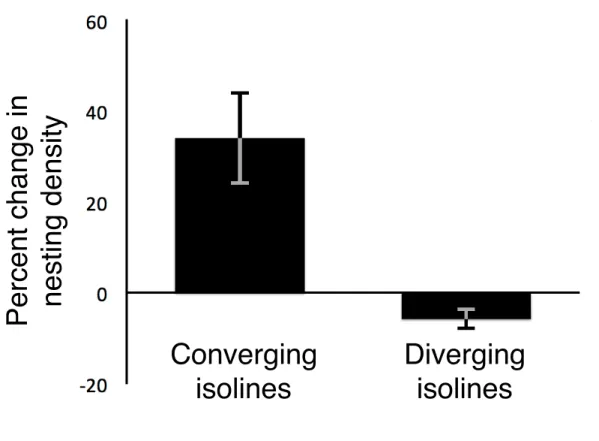
Showing predicted effects of isoline movement on nesting density………..…. 37 Figure 3.2 — Changes in nesting density for coastal areas with converging
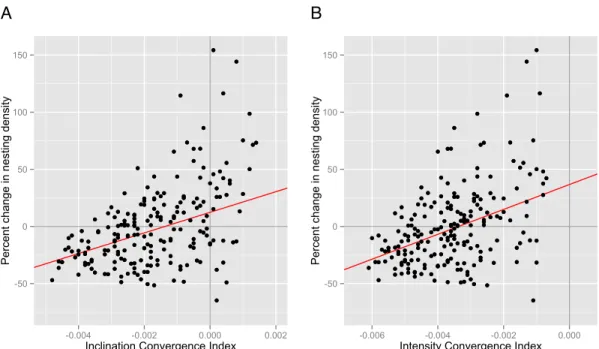
And diverging inclination isolines……….………. 38 Figure 3.3 — Relationship between isoline movement and change in
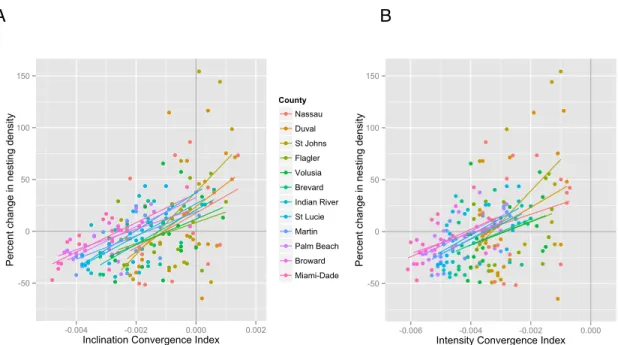
nesting density……… 39 Figure 3.4 — Relationship between isoline movement and change in
nesting density for individual counties………...……… 40 Figure 3.5 — A map of the Florida coastline showing the line along which
Distance was calculated and a table indicating the position of each county
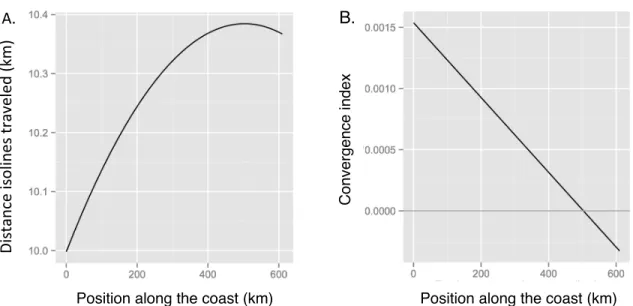
along the line………..…. 41 Figure 3.6 — Sample curves showing how convergence index is calculated……… 42 Figure 4.1 — A map showing isolines of magnetic inclination angle along the
southeastern US coastline and the locations of the 20 nesting beaches included
in the analyses………..………..……. 61 Figure 4.2 — Regression analyses showing the relationship between FST and
the magnetic distance, the geographic distance, and the environmental distance………….. 62 Figure 4.3 — Regression analyses showing the relationship between FST and
the difference in intensity, and the difference in inclination………..…… 63 Figure 5.1 — Orientation of in situ loggerhead embryos from Florida, USA……….82
Figure 5.2 — The headings of embryos (relative to magnetic north) from two independent laboratory experiments during which some embryos developed in the ambient geomagnetic field (green dots) and others
Figure 6.1 — Olive ridley embryo headings from the three different clutches
that were visualized on incubation day 36, and 41……….……… 95 Figure 6.2 — Orientation of olive ridley embryos visualized on incubation
days 37-41………..…. 96 Figure 6.3 — Olive ridley embryo orientation during a three-treatment
CHAPTER 1: INTRODUCTION
Natal homing refers to a pattern of behavior during which animals migrate away from their geographic area of origin when they are young before returning as adults to reproduce in the same location where they began life [1–4]. Although first observed more than a century ago in birds [5], there is now widespread evidence for natal homing in diverse
animals, including certain fishes [3, 6, 7], birds [8, 9], reptiles [1, 4, 10], amphibians [11, 12], and mammals [13].
In some instances natal homing has clear benefits, especially in cases where birth (or oviposition and hatching) take place at the same location as mating. For example, the
migratory range of elephant seals spans thousands of kilometers in the Pacific Ocean, but reproduction is terrestrial and limited to specific stretches of beach within a considerably smaller range [14]. Each year males and females return to their natal beach where females give birth to young from the previous season before mating again. During the non-breeding season, however, males and females favor different foraging grounds; males feed on benthic organisms along the continental shelf and females feed on pelagic prey in the open ocean [15]. Although sexual segregation is common during foraging, both sexes can ensure reliable access to potential mates by returning to their natal beach. As a result, for elephant seals natal homing facilitates mate finding and large mating aggregations form on natal beaches during the breeding season.
ocean as juveniles and adults. Only at the very end of their lives do adult salmon return to spawn in their natal stream before dying. This impressive migration consists of two stages; the first involves open-sea homing to the same river mouth where the fish first entered the ocean, and the second involves swimming upriver, against flow, until the fish reaches its natal stream and spawns. Similar to the case of elephant seals, natal homing in salmon facilitates access to mates but for salmon it also ensures an appropriate environment for successful spawning and incubation. For example, developing embryos require a freshwater stream with an appropriate gravel substrate and flow, both of which are difficult to assess from downstream [2]. In addition, both egg size and male body size tend to be locally adapted to a population’s natal stream [6, 17]; females tend to produce eggs that are sized appropriately for the grain size of the gravel substrate in their natal stream and larger males are less likely to spawn successfully in shallow streams due to higher rates of predation [6, 17]. Therefore, returning to the natal stream increases the likelihood that an adult will find a location that is favorable for both successful spawning and incubation [2].
In sea turtles, however, the benefits of natal homing might be less evident in that mating is thought to often occur away from the nesting beach and there is little evidence for local adaptation to the natal beach. Yet, sea turtles provide an iconic example of natal homing and females return as adults to nest on the same stretch of beach where they themselves hatched [4, 18, 19]. In fact, during nesting migrations turtles regularly bypass countless suitable nesting beaches, on which other individuals of the same species nest successfully [1].
are difficult to assess from afar and are not geographically widespread [1, 20]. Specifically, nesting females require a sandy beach that is favorable for nest construction and has a relatively shallow slope so that they can emerge from the sea. Moreover, the beach must be free of egg predators, wide enough that embryos are not drowned by high tides, and have sand characteristics (e.g. temperature, grain size, etc.) that are conducive to successful incubation [1, 2]. Finally, even if conditions on the beach are appropriate for nesting and incubation, certain coastal areas are more favorable than others for hatchling survival because of their proximity to major ocean currents, which can facilitate transport of young turtles to developmental habitats [21, 22].
All of the characteristics described above are likely to be difficult to assess from the sea and impossible from the open ocean. Therefore, because suitable reproduction requires a coastal area with an uncommon suite of environmental characteristics that is difficult to evaluate, it seems reasonable that natural selection would favor turtles that return to nest on their natal beach, a location that is almost certain to be appropriate [1]. In other words, the simple fact that a nesting female is alive provides evidence that her natal beach has
conditions that are favorable for reproduction.
Although all species of sea turtle accomplish natal homing, this dissertation will focus on two extreme cases: 1) Loggerhead sea turtles (Caretta caretta), which traverse entire ocean basins before returning to nest [19, 23, 24]. 2) Olive ridley sea turtles (Lepidochelys olivacea), which sometimes nest in groups of hundreds of thousands on remarkably small
lengths of coastline [25].
undertake an immense trans-oceanic migration and can circumnavigate the entire north Atlantic ocean basin before taking up residency in foraging areas in the western Atlantic [10, 26]. As adults, females return to nest on the same stretch of coastline where they themselves hatched more than a decade earlier [27, 28].
Although most sea turtles nest on their own, as do the loggerheads described above, olive ridley turtles (Lepidochelys olivacea) sometimes nest en masse. During mass nesting events, tens and sometimes hundreds of thousands of turtles emerge to nest in synchrony [25, 29, 30]. The nesting females travel thousands of kilometers through the open ocean and bypass countless suitable nesting beaches in search of specific stretches of coastline that in some places span no more than 5 kilometers. The density of turtles on the beach is so great that nesting females regularly dig up each others eggs and crawl over one another when heading back to sea.
Although it is clear that natal homing exists in diverse animals, including all species of sea turtle, we still know relatively little about how it is accomplished. A large body of evidence indicates that salmon complete the final freshwater stages of their spawning migration through olfactory imprinting and returning to tributaries that have the same chemical composition as their natal stream [31]. How long-distance marine migrants accomplish natal homing in the open sea, however, remains less clear.
notes that disparate geographic areas are often characterized by different magnetic fields [2]. Therefore, animals that detect magnetic fields, such as sea turtles [36, 37], might learn the magnetic signature of their natal area before leaving and use this information to return years later as adults.
The main dipole magnetic field of the Earth approximates that of a large bar magnet, with field lines leaving the southern hemisphere of the planet, wrapping around the globe and re-entering the planet in the northern hemisphere (Figure 1.1A). At any given location
Earth’s magnetic field can be described by two main parameters, the geomagnetic inclination angle (angle at which magnetic field lines intersect the surface of the planet) and the total geomagnetic intensity or strength (Figure 1.1B). Both of these parameters vary across the globe; there are relatively shallow inclination angles and weak intensities near the equator and relatively steep inclination angles and strong intensities near the poles. Because Earth’s magnetic field varies predictably with latitude, magnetic isolines (i.e. lines along which either inclination or intensity are constant) typically trend from east to west. In addition, most major sea turtle rookeries worldwide typically occur on continental coastlines that trend form north to south [1]. As a result, most coastal areas along continental coastlines, and therefore most sea turtle nesting beaches, are marked by different inclination angles and different intensities [1, 2, 32].
Alternatively, the turtle could locate the coastline and then swim north or south along it until she encounters the correct magnetic signature [1, 2, 32]. Evidence from a behavioral
experiment indicates that juvenile sea turtles use Earth’s magnetic field in a similar way to determine their position relative to a goal along a coastline [39]. Turtles were captured in coastal feeding grounds and subjected to magnetic fields that exist at far away locations. Turtles that were exposed to a magnetic field that exists north of the foraging area responded by swimming overwhelmingly to the south; by contrast, turtles exposed to a field that exists in the south responded by swimming to the north.
In recent years, findings consistent with geomagnetic imprinting have accumulated [32–35, 41]. Several studies have investigated natural changes in Earth’s magnetic field, called secular variation, and shown that typical rates of field change are compatible with geomagnetic imprinting and natal homing [2, 32, 35]. In addition, within the context of secular variation both sea turtles and salmon appear to alter their reproductive migrations in ways that the geomagnetic imprinting hypothesis predicts [32, 33]. Subtle but natural changes in Earth’s field seem to influence both where sea turtles return to nest [32], and the route that salmon choose to take during the final stage of their open sea migration to the spawning river [33, 41].
In my dissertation I have expanded on these results and the findings presented hereafter provide strong evidence that sea turtles use Earth’s magnetic field to accomplish natal homing. I have used an interdisciplinary approach to investigate both whether sea turtles use Earth’s magnetic field to guide their nesting migrations, and the ecological
time of its publication, Chapter Three represented the first evidence for geomagnetic
imprinting in sea turtles and the results indicate that geomagnetic imprinting combined with subtle changes in earth’s magnetic field can elicit detectable population level shifts in sea turtle nesting distributions. The findings presented in Chapter Four suggest that geomagnetic imprinting can have a profound effect on the genetic structure of a population; spatial
variation in Earth’s magnetic field is strongly related to genetic differentiation between sea turtle nesting beaches even after accounting for geographic distance and environmental similarities. Finally, Chapter Five begins to examine whether sea turtle embryos detect Earth’s magnetic field, as is required for turtles to learn the magnetic signature of their natal beach prior to hatching. The results provide evidence from two species of sea turtle that embryos orient non-randomly during the later stages of development and that they might use Earth’s magnetic field to do so.
8 Figures
Figure 1.1: Earth’s magnetic field [2]
A diagram of the Earth (A) showing how magnetic field lines (represented by arrows) leave the southern hemisphere of the planet, wrap around the globe and enter into the northern hemisphere of the planet. The inclination angle (the angle at which magnetic field lines intersect the surface of the planet) varies predictably with latitude. At the magnetic equator, represented by the curved line across the Earth, field lines are parallel to the planet and the inclination angle is 0º. As latitude increases the magnetic field lines become progressively steeper until they are perpendicular to the planet at the poles where inclination angle is 90º. Although it is not shown, geomagnetic intensity varies in a similar way, with weaker
magnetic fields near the equator and stronger magnetic fields near the poles. (B) At any given location the geomagnetic field can be described as a vector and has both an inclination angle and total field intensity (magnitude of the vector). Additionally, the total field intensity can be resolved into two vector components, the horizontal intensity and the vertical intensity.
across large expanses of ocean into the general vicinity of the target area, at which point the second supplants the first and guides the animals more precisely to the final goal.
For salmon, olfactory cues are of primary importance in guiding the fish to their spawning grounds once they arrive in the vicinity of their target rivers and begin to migrate upstream (16–20). That salmon imprint on the chemical cues of their natal rivers and streams has been demonstrated through experiments in which young fish were exposed to specific chemicals during a critical period of development and subsequently released to undergo their normal migrations; these artificially imprinted salmon returned as adults to breed in streams that had been scented with the same chemical (e.g., 18–20).
Under favorable conditions (for example, in fjords or other sheltered areas with limited vertical mixing), chemical cues from rivers might extend a considerable distance from a river mouth (17). However, such cues cannot persist and extend across more than a thousand kilometers of ocean, the distance over which some populations of salmon are known to migrate (2, 18). For this reason, salmon navigation in the open sea is thought to involve a different set of mechanisms that are not olfactory (e.g., 4, 18, 21). How salmon navigate from the open ocean into the vicinity of the correct river mouth, however, has never been explained.
For sea turtles, the situation that exists in salmon is essentially reversed, in that little is known about the local cues used by turtles to pinpoint nesting areas once they have drawn near. Directed movements over long distances and into the vicinity of nesting areas, however, can plausibly be explained by the known ability of turtles to exploit variations in the Earth’s magnetic field as a kind of magnetic positioning system or ‘‘magnetic map’’ (22, 23). To explore the implications of magnetic navigation for natal homing, we will begin by briefly summarizing important aspects of the Earth’s magnetic field.
Positional Information in the Earth’s Field
The Earth’s magnetic field resembles the dipole field of a giant bar magnet (Fig. 1). Field lines leave the southern hemisphere and curve around the globe before reentering the planet in the northern hemisphere. Several geomagnetic elements vary pre-dictably across the surface of the Earth (Fig. 1). For example, at each location on the globe, the magnetic field lines intersect the Earth’s surface at a specific angle of inclination. At the magnetic equator, the field lines are parallel to the ground and the inclination angle is said to be 0°. The field lines become progressively steeper as one moves toward the magnetic poles; at the poles themselves, the field lines are perpendicular to the Earth’s surface. Thus, inclination angle varies predictably with latitude, and an animal able to detect this field element may be able to determine whether it is north or south of a particular area.
In addition to inclination angle, three other magnetic field elements related to intensity (i.e., the intensity of the total field, horizontal field, and vertical field) vary across the Earth’s surface in ways that make them suitable for use in position-finding (3, 24) (Fig. 1). For animals that can perceive the direction of true geographic north (for example, by using star patterns to determine the axis of Earth’s rotation), additional magnetic parameters such as declination (the difference between true north and magnetic north) are also potential cues.
Magnetic Cues as Markers of Coastal Regions
The rivers that serve as major spawning grounds for salmon meet the sea along continental coastlines or along the coasts of large islands such as those of Japan. Similarly, most major sea turtle
open-sea navigational task that most salmon and sea turtles confront is to travel to a distant coastal area, close enough to the target that other local cues can be used to pinpoint the final destination.
How, then, might an animal in the open ocean arrive reliably at a particular region of coastline from a considerable distance away? An interesting possibility is that geomagnetic parameters can be used to identify particular coastal areas. The west coast of North America illustrates the basic principle (Fig. 2). The coastline is aligned approximately north-south, whereas the isolines of inclination trend east-west. As a consequence, every area of coastline is marked by a different inclination angle (Fig.
2A). Similarly, isolines of total field intensity run approximately
east-west in this geographic area and different coastal locations
are thus marked by different intensities (Fig. 2B). In effect,
different coastal areas have unique ‘‘magnetic signatures’’ that might, in principle, be used to identify a natal region and distinguish it from all other locations along the same coast. The same is true along the east coast of North America and, indeed, along most continental coastlines worldwide.
Geomagnetic Imprinting Hypothesis
Given that different areas along continental coastlines are marked by distinctive magnetic fields, one possibility is that both salmon and sea turtles imprint on the magnetic signatures of their natal areas and use this information years later to direct natal homing. Although many variants of the hypothesis are possible, the simplest involves imprinting on a single element of the field (e.g., either inclination angle or intensity). To locate the area later in life, the animal would need only to find the coastline, and then swim north or south along it to reach the target region. For example, if salmon imprint on the magnetic inclination angle that exists at a river mouth when they first enter the ocean, then a fish seeking its natal river several years later could hypothetically find the coastline and swim along it until the
Fig. 1. The Earth’s magnetic field. (A) Diagram illustrating how field lines (represented by arrows) intersect the Earth’s surface and how inclination angle (the angle formed between the field lines and the Earth) varies with latitude. At the magnetic equator (the curving line across the Earth), field lines are parallel to the Earth’s surface. The field lines become progressively steeper as one travels north toward the magnetic pole, where the field lines are directed straight down into the Earth and the inclination angle is 90°. (B) Diagram illustrating four elements of geomagnetic field vectors that might, in principle, provide turtles with positional information. The field present at each location on Earth can be described in terms of total field intensity and inclination angle. The total intensity of the field can be resolved into two vector components, the horizontal field intensity and the vertical field intensity. (Whether animals can resolve the total
field into vector components is not known.) ECOLOGY
SPECIAL
REFERENCES
1. Lohmann, K., Lohmann, C., Brothers, Jr., and Putman, N. (2013). Natal homing and imprinting in sea turtles. Biol. Sea Turtles, Vol. III, 59–78.
2. Lohmann, K. J., Putman, N. F., and Lohmann, C. M. F. (2008). Geomagnetic imprinting: A unifying hypothesis of long-distance natal homing in salmon and sea turtles. Proc. Natl. Acad. Sci. U. S. A. 105, 19096–19101.
3. Rooker, J. R., Secor, D. H., De Metrio, G., Schloesser, R., Block, B. A., and Neilson, J. D. (2008). Natal homing and connectivity in Atlantic bluefin tuna populations. Science 322, 742–744.
4. Meylan, A. B., Bowen, B. W., and Avise, J. C. (1990). A genetic test of the natal homing versus social facilitation models for green turtle migration. Science 248, 724– 727.
5. Audubon, J. J. (1840). Pewee flycatcher. In The Birds of America, Volume 1 (E.G. Dorsey), pp. 223–230.
6. Dittman, a, and Quinn, T. (1996). Homing in Pacific salmon: mechanisms and ecological basis. J. Exp. Biol. 199, 83–91.
7. Feldheim, K. A., Gruber, S. H., Dibattista, J. D., Babcock, E. A., Kessel, S. T., Hendry, A. P., Pikitch, E. K., Ashley, M. V., and Chapman, D. D. (2014). Two decades of genetic profiling yields first evidence of natal philopatry and long-term fidelity to parturition sites in sharks. Mol. Ecol. 23, 110–117.
8. Welch, A. J., Fleischer, R. C., James, H. F., Wiley, A. E., Ostrom, P. H., Adams, J., Duvall, F., Holmes, N., Hu, D., Penniman, J., et al. (2012). Population divergence and gene flow in an endangered and highly mobile seabird. Heredity (Edinb). 109, 19–28. 9. Wheelwright, N. T., and Mauck, R. A. (1998). Philopatry, natal dispersal, and
inbreeding avoidance in an island population of Savannah Sparrows. Ecology 79, 755– 767.
10. Bowen, B. W., Bass, A. L., Chow, S. M., Bostrom, M., Bjorndal, K. A., Bolten, A. B., Okuyama, T., Bolker, B. M., Epperly, S., Lacasella, E., et al. (2004). Natal homing in juvenile loggerhead turtles (Caretta caretta). Mol. Ecol. 13, 3797–3808.
11. Phillips, J. B. (1987). Laboratory studies of homing orientation in the eastern red-spotted newt, Notophthalmus viridescens. J. Exp. Biol. 131, 215–29.
Newts Notophthalmus Viridescens (Rafinesque). Ecology 60, 800.
13. Baker, C. S., Steel, D., Calambokidis, J., Falcone, E., González-Peral, U., Barlow, J., Burdin, A. M., Clapham, P. J., Ford, J. K. B., Gabriele, C. M., et al. (2013). Strong maternal fidelity and natal philopatry shape genetic structure in North Pacific humpback whales. Mar. Ecol. Prog. Ser. 494, 291–306.
14. Stewart, B. S., and DeLong, R. L. (1995). Double migrations of the northern elephant seal, Mirounga angustirostris. J. Mammal. 76, 196–205.
15. Le Boeuf, B. J., Crocker, D. E., Costa, D. P., Blackwell, S. B., Webb, P. M., and Houser, D. S. (2000). Foraging ecology of northern elephant seals. Ecol. Monogr. 70, 353–382.
16. Quinn, T. P., Stewart, I. J., and Boatright, C. P. (2006). Experimental evidence of homing to site of incubation by mature sockeye salmon, Oncorhynchus nerka. Anim. Behav. 72, 941–949.
17. Quinn, T. P., Hendry, A. P., and Wetzel, L. A. (1995). The influence of life history trade-offs and the size of incubation gravels on egg size variation in sockeye salmon (Oncorhynchus nerka). Oikos 74, 425–438.
18. Bowen, B. W., and Karl, S. A. (2007). Population genetics and phylogeography of sea turtles. Mol. Ecol. 16, 4886–4907.
19. Shamblin, B. M., Dodd, M. G., Bagley, D. a., Ehrhart, L. M., Tucker, A. D., Johnson, C., Carthy, R. R., Scarpino, R. a., McMichael, E., Addison, D. S., et al. (2011). Genetic structure of the southeastern United States loggerhead turtle nesting
aggregation: Evidence of additional structure within the peninsular Florida recovery unit. Mar. Biol. 158, 571–587.
20. Lohmann, K. J., Hester, J. T., and Lohmann, C. M. F. (1999). Long-distance navigation in sea turtles. Ethol. Ecol. Evol. 11, 1–23.
21. Putman, N. F., Shay, T. J., and Lohmann, K. J. (2010). Is the geographic distribution of nesting in the Kemp’s Ridley turtle shaped by the migratory needs of offspring? In Integrative and Comparative Biology, pp. 305–314.
22. Putman, N. F., Bane, J. M., and Lohmann, K. J. (2010). Sea turtle nesting distributions and oceanographic constraints on hatchling migration. Proc. Biol. Sci. 277, 3631– 3637.
Ferl, R. J. (1995). Trans-Pacific migrations of the loggerhead turtle (Caretta caretta) demonstrated with mitochondrial DNA markers. Proc. Natl. Acad. Sci. U. S. A. 92, 3731–3734.
25. Valverde, R. A., Orrego, C. M., Tordoir, M. T., Gómez, F. M., Solís, D. S.,
Hernández, R. A., Gómez, G. B., Brenes, L. S., Baltodano, J. P., Fonseca, L. G., et al. (2012). Olive Ridley Mass Nesting Ecology and Egg Harvest at Ostional Beach, Costa Rica. Chelonian Conserv. Biol. 11, 1–11.
26. Putman, N. F., Verley, P., Shay, T. J., and Lohmann, K. J. (2012). Simulating
transoceanic migrations of young loggerhead sea turtles: merging magnetic navigation behavior with an ocean circulation model. J. Exp. Biol. 215, 1863–1870.
27. Encalada, S. E., Bjorndal, K. a, Bolten, a B., Zurita, J. C., Schroeder, B., Possardt, E., Sears, C. J., and Bowen, B. W. (1998). Population structure of loggerhead turtle (Caretta caretta) nesting colonies in the Atlantic and Mediterranean as inferred from mitochondrial DNA control region sequences. Mar. Biol. 130, 567–575.
28. Reis, E. C., Soares, L. S., Vargas, S. M., Santos, F. R., Young, R. J., Bjorndal, K. A., Bolten, A. B., and Lôbo-Hajdu, G. (2010). Genetic composition, population structure and phylogeography of the loggerhead sea turtle: Colonization hypothesis for the Brazilian rookeries. Conserv. Genet. 11, 1467–1477.
29. Bowen, B. W., Clark, a M., Abreu-Grobois, F. a, Chaves, a, Reichart, H. a, and Ferl, R. J. (1998). Global phylogeography of the ridley sea turtles (Lepidochelys spp.) as inferred from mitochondrial DNA sequences. Genetica 101, 179–189.
30. Shanker, K., Ramadevi, J., Choudhury, B. C., Singh, L., and Aggarwal, R. K. (2004). Phylogeography of olive ridley turtles (Lepidochelys olivacea) on the east coast of India: Implications for conservation theory. Mol. Ecol. 13, 1899–1909.
31. Hasler, A. D., Scholz, A. T., and Horrall, R. M. (1978). Olfactory imprinting and homing in salmon. Am. Sci. 66, 347–355.
32. Brothers, J. R., and Lohmann, K. J. (2015). Evidence for geomagnetic imprinting and magnetic navigation in the natal homing of sea turtles. Curr. Biol. 25, 392–396. 33. Putman, N. F., Lohmann, K. J., Putman, E. M., Quinn, T. P., Klimley, A. P., and
Noakes, D. L. G. (2013). Evidence for geomagnetic imprinting as a homing mechanism in Pacific salmon. Curr. Biol. 23, 312–316.
35. Putman, N. F., and Lohmann, K. J. (2008). Compatibility of magnetic imprinting and secular variation. Curr. Biol. 18, 596–597.
36. Lohmann, K. J., and Lohmann, C. M. F. (1996). Detection of magnetic field intensity by sea turtles. Nature 380, 59–61.
37. Lohmann, K. J., and Lohmann, C. M. F. (1994). Detection of magnetic inclination angle by sea turtles: a possible mechanism for determining latitude. J. Exp. Biol. 194, 23–32.
38. Lohmann, K. J., Putman, N. F., and Lohmann, C. M. F. (2012). The magnetic map of hatchling loggerhead sea turtles. Curr. Opin. Neurobiol. 22, 336–342.
39. Lohmann, K. J., Lohmann, C. M. F., Ehrhart, L. M., Bagley, D. A., and Swing, T. (2004). Geomagnetic map used in sea-turtle navigation. Nature 428, 909–910. 40. Lohmann, K. J., Lohmann, C. M. F., and Putman, N. F. (2007). Magnetic maps in
animals: nature’s GPS. J. Exp. Biol. 210, 3697–3705.
CHAPTER 2: EVIDENCE FOR MAGNETIC NAVIGATION IN THE NATAL HOMING OF MASS NESTING SEA TURTLES
Summary
Natal homing refers to a pattern of behavior in which animals migrate away from
their area of origin when young, before returning to reproduce in the same location where they began life [1–3]. An extreme example exists in sea turtles, which travel immense
distances through open ocean to nest on the same stretch of coastline where they themselves hatched [4–7]. Although natal homing is widespread among diverse taxa [2, 3, 8–10], little is known about how it is accomplished [7]. One idea is that animals return as adults by seeking
out the unique magnetic signature that marks the natal area [1]. Although recent evidence consistent with this hypothesis has been acquired [11–13], experimental corroboration has
remained elusive [7]. Here we report direct behavioral evidence that adult sea turtles use earth’s magnetic field to guide their nesting migrations and return to the natal beach. When exposed to the uniform magnetic field that exists 500km northwest of their nesting beach
olive ridley sea turtles (Lepidochelys olivacea) responded by swimming southeast, a direction that would take them back to the nesting beach had they actually been displaced
geographically. By contrast, when strong magnets were placed around the tank, eliminating any reliable geomagnetic information, turtles swam in random directions. These findings suggest that sea turtles can use magnetic information alone to determine their position
magnetic navigation underlies natal homing and are likely applicable to diverse long-distance
migrants [2, 3, 8–10].
Introduction
At a few specific locations around the world olive ridley sea turtles (Lepidochelys
olivacea) participate in mass nesting events, during which hundreds of thousands of turtles
nest in synchrony on remarkably small lengths of coastline [14–16]. During these events,
which can last up to 10 days, the density of nesting females is so great that turtles regularly dig up each other’s eggs and crawl over one another while heading back to sea. Before
converging on the nesting beach, which in some cases spans no more than five kilometers of coastline, turtles travel through thousands of kilometers of open ocean and bypass countless other suitable nesting beaches. Although this impressive homing represents one of the
greatest displays of animal navigation, how turtles arrive at such precise locations has remained enigmatic.
Recent evidence suggests that sea turtles and other animals accomplish natal homing through magnetic navigation [11–13, 17, 18]. Earth’s magnetic field varies predictably across the globe [1], and as a result, each area of coastline is typically marked by a unique magnetic
signature (Figure 2.1) [1, 7, 11]. In addition, sea turtles and other animals detect two of the geomagnetic parameters that vary, the total field intensity and the inclination angle (the angle
at which magnetic field lines intersect Earth’s surface) [19, 20]. Therefore, for a turtle, identifying a specific stretch of coastline and returning to the natal beach might be relatively simple: a turtle might need only locate the coast and swim along it until she encounters the
turtles accomplish natal homing through magnetic navigation [11–13], evidence from
behavioral experiments is lacking.
To directly test if adult turtles use Earth’s magnetic field to return to the natal beach
we conducted a behavioral experiment with nesting females. We captured turtles as they crawled out of the water but before they began to nest, placed them in a water-filled arena and observed their swimming direction in response to a simulated magnetic displacement.
Some of the turtles swam in the magnetic field that exists 500km northwest of the nesting beach (Figure 2.1), a location within their normal migratory range [21, 22], and other turtles
swam in an irregular artificial magnetic field produced by a series of magnets placed outside the tank.
Methods
Animals
We conducted our experiment in Costa Rica at the Ostional National Wildlife Refuge
(latitude 9.99º N, longitude 85.70º W). This area has regular mass nesting events during which hundreds of thousands of olive ridley sea turtles (Lepidochelys olivacea) emerge from the Pacific Ocean to nest in synchrony [14]. Each night during three mass-nesting events we
captured female turtles (n=65) after they crawled out of the water but before they began to nest. Although the age of the animals cannot be determined all were mature, adult females
and ranged in curved carapace length from 57.4 cm to 72.5 cm. Each turtle was carried by hand from the nesting beach to the test site (less than 300m away) and some were
temporarily held in a non-magnetic wooden pen prior to testing (never more than one hour).
carapace immediately anterior to the rear flippers. The harness was fastened with
non-magnetic carabiners and care was taken so that flipper movement was not obstructed.
Orientation Trials
Each turtle was tethered to a non-magnetic swivel at the center of a circular water-filled arena (1.5m diameter) so that she could swim comfortably in all directions but not make forward progress towards the side of the tank. An observer who was unaware of the
treatment group used an infrared camera to remotely monitor the turtle for a five-minute acclimation period. If the turtle was swimming consistently and naturally it was allowed to
swim for an additional ten-minute trial period. At the end of the trial each turtle was marked with zinc oxide and released back onto the nesting beach in the general vicinity of where it was captured. We did not collect any data from those few turtles that did not swim naturally
during the acclimation period.
Magnetic Manipulation
The arena was positioned at the center of a magnetic coil system that measured 3.42 meters on each side and was used to precisely control the magnetic field inside the arena [23]. The coil was calibrated to produce the exact magnetic field that exists 500 km
northwest of the nesting beach at a location near El Salvador (latitude 13.17º N, longitude 88.96º W), a location within the normal migratory range of turtles that nest at Ostional [21,
22]. The magnetic field used to simulate the conditions at this location had an inclination angle of 40.3º and an intensity of 36.9µT calculated as the mean of four independent measurements with a MEDA FVM-400 three-axis fluxgate magnetometer. The deviation
were able to produce the magnetic field necessary for our experiment by modifying only the
vertical component of the local magnetic field.
Although some turtles swam in the uniform magnetic field that exists at a faraway
location (as described above), other turtles swam in a highly irregular magnetic field
produced by eight strong neodymium magnets that were evenly spaced around the outside of the tank. To ensure that the uniformity of the magnetic field inside the arena was sufficiently
disrupted the north pole of every other magnet was directed towards the center of the arena. This resulted both in strong gradients for the inclination and intensity inside the tank, as well
as drastic variations in the direction of magnetic north throughout the arena.
Rather than replicating a magnetic field that exists southeast of the nesting beach for a second treatment we used magnets to disrupt the field uniformity for two reasons. Firstly,
because of the nature of the geomagnetic field in this part of the world there is no relevant magnetic signature that exists unmistakably south of Ostional. Instead, the magnetic isolines
in the region curve slightly north and west in the Pacific Ocean (Figure 2.1). As a result, the magnetic signatures that mark coastal locations south of Ostional are ambiguous and also exist to the west or even slightly north of the nesting beach. Secondly, although tracking
studies have revealed that the migratory range of turtles that nest at Ostional spans well north of the nesting beach, it remains unclear whether turtles migrate south of Ostional, and if so,
how far they might go [21, 22].
The trials took place during three separate mass-nesting events between November 2016 and August 2017. The majority of trials took place in a single mass-nesting event and
used a duplicate setup to increase our sample size in the magnet treatment group by
conducting additional trials (n=6) at the same time that El Salvador trials were being conducted in the primary arena. We found no evidence of a difference across mass nesting
events or the two setups so the data were combined.
Quantification and Statistical Analysis
We used infrared illuminators placed in each of the four cardinal directions in
combination with a custom infrared GoPro to monitor the swimming direction of each turtle. Because infrared does not penetrate water very effectively we measured the turtle’s heading
each time she came to the surface to breathe. An observer who was unaware of each turtle’s treatment group watched each video to evaluate swimming behavior and used ImageJ to measure the turtle’s direction relative to north at each breath. If a turtle did not swim
comfortably or steadily during the ten-minute trial period she was excluded from analyses; all decisions were made by an observer who was unaware of the turtles treatment group.
Some examples of unacceptable swimming behavior include extended periods of inactivity, frantic struggling with the harness, or excessive interaction with the side of the tank.
All statistical analyses were done using R Version 3.3.2 [24]. We used the Rayleigh
test to determine if the turtles in each treatment showed significant orientation as a group. The Watson two-sample test was used to determine if the two groups were significantly
Results
We found a significant difference in the orientation of turtles exposed to a uniform magnetic field and the orientation of turtles exposed to a highly irregular magnetic field
produced by magnets (p<0.05, Watson test). Turtles subjected to the magnetic field that exists 500km northwest of the nesting beach responded by swimming significantly to the southeast (145º, r=0.365, p=0.006, n=38; Rayleigh test, Figure 2.2A). By contrast, turtles that
experienced a distorted magnetic field produced by magnets placed outside of the tank swam in directions that were statistically indistinguishable from random (r=0.17, p=0.462, n=27;
Rayleigh test, Figure 2.2B).
Discussion
These results provide strong evidence that sea turtles use geomagnetic cues to guide their nesting migrations and accomplish natal homing. Additionally, the findings suggest that
adult turtles can determine their position relative to the nesting beach using the geomagnetic field alone. Turtles swimming in a distorted magnetic field did not orient significantly in any particular direction, but turtles subjected to a simulated magnetic displacement responded by
swimming in an appropriate direction that would bring them back to the nesting beach had they actually been geographically displaced.
Our results do not, however, indicate that turtles rely exclusively on Earth’s magnetic field during natal homing. Rather, in certain situations turtles, like salmon, might find the nesting beach through multimodal navigation using geomagnetic cues to travel
finding and mass-nesting events during which nesting is consistently limited to only a few
kilometers.
Similarly, multimodal navigation that combines geomagnetic cues with local ones
(e.g. chemical, visual, etc.) might mitigate potential navigational errors due to natural changes in Earth’s magnetic field [26]. Although these changes, known as secular variation, can cause the magnetic signatures that mark natal locations to drift along the coast, numerous
studies have indicated that the typical rates of field change are compatible with magnetic navigation and natal homing [1, 11, 17].
In addition, although our findings provide strong evidence that sea turtles use geomagnetic cues to guide their nesting migrations, they do not reveal the resolution of the magnetic map. Because of the extensive evidence for magnetic maps in hatchling sea turtles
[27], and because juveniles have been shown to use Earth’s magnetic field to determine their position along a coastline [28], we favor the hypothesis that adult turtles use geomagnetic
positional information throughout the nesting migration to determine their precise location relative to the natal beach. In the specific case of mass nesting olive ridley turtles in Costa Rica, however, turtles might be able to achieve precise homing through a relatively simple
navigational mechanism. Southeastern swimming at any latitude higher than the nesting beach might be sufficient to return if turtles subsequently encounter a local cue that
differentiates the nesting beach from other locations. Therefore, our data alone cannot dismiss the hypothetical possibility that turtles might return to Ostional using a combination of a magnetic compass and local cues at the nesting beach. With the context of previous
our results suggest that adult turtles also derive positional information from Earth’s magnetic
field.
It is also not yet possible to determine which geomagnetic parameter(s) turtles use
during natal homing. The most likely candidates appear to be intensity, inclination, or both together. Because we manipulated the two simultaneously, however, our results cannot identify which magnetic parameter, if either, is of primary importance.
Regardless of these considerations, our results provide strong evidence that sea turtles can use Earth’s magnetic field alone to determine their position relative to the nesting beach.
In addition, the findings provide behavioral and experimental corroboration that adult sea turtles use magnetic navigation to accomplish natal homing and are likely applicable to diverse long distance migrants including certain fishes [9, 12], reptiles [2, 7], birds [10], and
mammals [8].
Acknowledgements
I thank Ken Lohmann, Cathy Lohmann, Vanessa Bézy, Dave Ernst, and Dave Steinberg for their help conceptualizing and designing the experiment. Kayla GoForth, Amanda Lohmann, Susannah Lohmann, Lewis Nasibett-Jones, Lein Soltan, Matt Babb,
Jazmin Young, and EmmaLi Tsai were all instrumental to data collection and data analysis. This work was supported by National Science Foundation grant IOS-1022005 and Air Force
Figures
Figure 2.1: A map showing isolines of magnetic inclination angle near Central America.
In this map each black line represents an isoline of inclination angle (i.e. a line along which inclination angle is constant). Adjacent isolines represent increments of 1º. Because the coastline trends north-south and the magnetic isolines trend east-west, each area on the Pacific coast has a different inclination angle and thus a different magnetic signature.
Intensity isolines are not shown, but the pattern is similar to that of inclination isolines with a different intensity marking each location along the Pacific coast. The black dot indicates the location of the nesting beach in Ostional, Costa Rica where the experiment was conducted. The blue dot near El Salvador indicates the location of the simulated magnetic field that exists 500km northwest of the nesting beach. The magnetic field used to simulate the conditions at this location had an inclination of 40.3º and an intensity of 36.9µT; the
A. B.
Figure 2.2: Orientation of mass-nesting adult turtles in response to a uniform magnetic field near El Salvador (A) and a non-uniform artificial magnetic field (B).
Each dot represents the average swimming direction of one turtle during a ten-minute
orientation trial. The arrow depicts the mean angle of the group and the length of the arrow is proportional to the magnitude of the mean vector (r) with the radius of the circle
corresponding to r=1. The dotted lines indicate bootstrap 95% confidence intervals for the mean angle. Turtles tested in a uniform magnetic field that exists 500km northwest of the nesting beach (A) were significantly oriented southeast (145º, r=0.365, p=0.006, n=38; Rayleigh test). By contrast, turtles tested in a non-uniform magnetic field that had been disrupted by magnets placed around the tank (B) swam in directions that were statistically indistinguishable from random (r=0.17, p=0.462, n=27; Rayleigh test). The two groups were significantly different from each other (p<0.05, Watson test).
ElSalv
N
E
S
W
+ ●REFERENCES
1. Lohmann, K. J., Putman, N. F., and Lohmann, C. M. F. (2008). Geomagnetic imprinting: A unifying hypothesis of long-distance natal homing in salmon and sea turtles. Proc. Natl. Acad. Sci. U. S. A. 105, 19096–19101.
2. Meylan, A. B., Bowen, B. W., and Avise, J. C. (1990). A genetic test of the natal homing versus social facilitation models for green turtle migration. Science 248, 724– 727.
3. Rooker, J. R., Secor, D. H., De Metrio, G., Schloesser, R., Block, B. A., and Neilson, J. D. (2008). Natal homing and connectivity in Atlantic bluefin tuna populations. Science 322, 742–744.
4. Nichols, W., and Resendiz, A. (2000). Transpacific migration of a loggerhead turtle monitored by satellite telemetry. Bull. Mar. Sci. 67, 937–947.
5. Bowen, B. W., Abreu-Grobois, F. a, Balazs, G. H., Kamezaki, N., Limpus, C. J., and Ferl, R. J. (1995). Trans-Pacific migrations of the loggerhead turtle (Caretta caretta) demonstrated with mitochondrial DNA markers. Proc. Natl. Acad. Sci. U. S. A. 92, 3731–3734.
6. Bowen, B. W., and Karl, S. A. (2007). Population genetics and phylogeography of sea turtles. Mol. Ecol. 16, 4886–4907.
7. Lohmann, K. J., Lohmann, C. M. F., Brothers, J. R., and Putman, N. F. (2013). Natal homing and imprinting in sea turtles. Biol. Sea Turtles, Vol. III, 59–78.
8. Baker, C. S., Steel, D., Calambokidis, J., Falcone, E., González-Peral, U., Barlow, J., Burdin, A. M., Clapham, P. J., Ford, J. K. B., Gabriele, C. M., et al. (2013). Strong maternal fidelity and natal philopatry shape genetic structure in North Pacific humpback whales. Mar. Ecol. Prog. Ser. 494, 291–306.
9. Feldheim, K. A., Gruber, S. H., Dibattista, J. D., Babcock, E. A., Kessel, S. T., Hendry, A. P., Pikitch, E. K., Ashley, M. V., and Chapman, D. D. (2014). Two decades of genetic profiling yields first evidence of natal philopatry and long-term fidelity to parturition sites in sharks. Mol. Ecol. 23, 110–117.
10. Wheelwright, N. T., and Mauck, R. A. (1998). Philopatry, natal dispersal, and
inbreeding avoidance in an island population of Savannah Sparrows. Ecology 79, 755– 767.
Noakes, D. L. G. (2013). Evidence for geomagnetic imprinting as a homing mechanism in Pacific salmon. Curr. Biol. 23, 312–316.
13. Luschi, P., Benhamou, S., Girard, C., Ciccione, S., Roos, D., Sudre, J., and Benvenuti, S. (2007). Marine Turtles Use Geomagnetic Cues during Open-Sea Homing. Curr. Biol. 17, 126–133.
14. Valverde, R. A., Orrego, C. M., Tordoir, M. T., Gómez, F. M., Solís, D. S.,
Hernández, R. A., Gómez, G. B., Brenes, L. S., Baltodano, J. P., Fonseca, L. G., et al. (2012). Olive Ridley Mass Nesting Ecology and Egg Harvest at Ostional Beach, Costa Rica. Chelonian Conserv. Biol. 11, 1–11.
15. Bowen, B. W., Clark, a M., Abreu-Grobois, F. a, Chaves, a, Reichart, H. a, and Ferl, R. J. (1998). Global phylogeography of the ridley sea turtles (Lepidochelys spp.) as inferred from mitochondrial DNA sequences. Genetica 101, 179–189.
16. Shanker, K., Ramadevi, J., Choudhury, B. C., Singh, L., and Aggarwal, R. K. (2004). Phylogeography of olive ridley turtles (Lepidochelys olivacea) on the east coast of India: Implications for conservation theory. Mol. Ecol. 13, 1899–1909.
17. Putman, N. F., and Lohmann, K. J. (2008). Compatibility of magnetic imprinting and secular variation. Curr. Biol. 18, 596–597.
18. Putman, N. F., Jenkins, E. S., Michielsens, C. G. J., and Noakes, D. L. G. (2014). Geomagnetic imprinting predicts spatio-temporal variation in homing migration of pink and sockeye salmon. J. R. Soc. Interface 11, 20140542–20140542.
19. Lohmann, K. J., and Lohmann, C. M. F. (1996). Detection of magnetic field intensity by sea turtles. Nature 380, 59–61.
20. Lohmann, K. J., and Lohmann, C. M. F. (1994). Detection of magnetic inclination angle by sea turtles: a possible mechanism for determining latitude. J. Exp. Biol. 194, 23–32.
21. Plotkin, P. T., Byles, R. A., Rostal, D. C., and Owens, D. W. (1995). Independent versus socially facilitated oceanic migrations of the olive ridley, Lepidochelys olivacea. Mar. Biol. 122, 137–143.
22. Plotkin, P. T. (2010). Nomadic behaviour of the highly migratory olive ridley sea turtle Lepidochelys olivacea in the eastern tropical Pacific Ocean. Endanger. Species Res. 13, 33–40.
23. Merritt, R. (1983). Uniform magnetic field produced by three, four, and five square coils. Rev. Sci. Instrum. 54, 879.
55, 275–286.
25. Lohmann, K. J., Luschi, P., and Hays, G. C. (2008). Goal navigation and island-finding in sea turtles. J. Exp. Mar. Bio. Ecol. 356, 83–95.
26. Endres, C. S., Putman, N. F., Ernst, D. A., Kurth, J. A., Lohmann, C. M. F., and Lohmann, K. J. (2016). Multi-Modal Homing in Sea Turtles: Modeling Dual Use of Geomagnetic and Chemical Cues in Island-Finding. Front. Behav. Neurosci. 10. 27. Lohmann, K. J., Putman, N. F., and Lohmann, C. M. F. (2012). The magnetic map of
hatchling loggerhead sea turtles. Curr. Opin. Neurobiol. 22, 336–342.
CHAPTER 3: EVIDENCE FOR GEOMAGNETIC IMPRINTING AND MAGNETIC NAVIGATION IN THE NATAL HOMING OF SEA TURTLES1
Summary
Natal homing is a pattern of behavior in which animals migrate away from their
geographic area of origin and then return to reproduce in the same location where they began
life [1-3]. Although diverse long-distance migrants accomplish natal homing [1-8], little is
known about how they do so. The enigma is epitomized by loggerhead sea turtles (Caretta
caretta), which leave their home beaches as hatchlings and migrate across entire ocean basins
before returning to nest in the same coastal area where they originated [9,10]. One hypothesis
is that turtles imprint on the unique geomagnetic signature of their natal area and use this
information to return [1]. Because Earth’s field changes over time, geomagnetic imprinting
should cause turtles to change their nesting locations as magnetic signatures drift slightly
along coastlines. To investigate, we analyzed a 19-year database of loggerhead nesting in the
largest sea turtle rookery in North America. Here we report a strong association between the
spatial distribution of turtle nests and subtle changes in Earth’s magnetic field. Nesting
density increased significantly in coastal areas where magnetic signatures of adjacent beach
locations converged over time, whereas nesting density decreased in places where magnetic
signatures diverged. These findings confirm central predictions of the geomagnetic
imprinting hypothesis and provide strong evidence that such imprinting plays an important
1This chapter was previously published as:
role in the natal homing in sea turtles. The results give credence to initial reports of
geomagnetic imprinting in salmon [11,12] and suggest that similar mechanisms might
underlie long-distance natal homing in diverse animals.
Results and Discussion
Ever since John James Audubon tied silver threads to the legs of young songbirds and
observed their return the following year [13], evidence has accumulated that many animals
return to their natal areas after migrating to distant locations [1-8]. An extreme example
exists in loggerhead sea turtles, which leave their natal beaches as hatchlings and traverse
entire ocean basins before returning to nest, at regular intervals, on the same stretch of
coastline where they themselves hatched [9, 10, 14]. How sea turtles accomplish natal
homing has remained an enduring mystery of animal behavior [1, 14-16].
Turtles derive long-distance navigational information from the geomagnetic field by
detecting the intensity and inclination angle (the angle at which field lines intersect Earth’s
surface) [17-20]. These parameters vary predictably across the globe [21-22]. As a result,
each area of coastline is typically marked by a different isoline of inclination and a different
isoline of intensity (Figure 3.1A), and thus has a unique magnetic signature [1]. In principle,
if turtles were to imprint on the inclination angle and/or intensity of their natal beach, then
returning might be relatively simple; a turtle might need only to locate the coast and then
swim north or south until it encounters the correct magnetic signature (Figure 3.1A). No
evidence presently exists, however, to support or refute this hypothesis.
An important consideration for the geomagnetic imprinting hypothesis is that Earth’s
magnetic field changes slowly over time. Because of this field change, known as secular
while turtles are gone [1, 24]. Thus, if an adult female selects her nesting sites by seeking out
the magnetic signature on which she imprinted as a hatchling, then she will inevitably change
her nesting location in accordance with secular variation [25, 26]. Such individual changes
might result in detectable population-level shifts in nesting distributions, providing a unique
opportunity to test the geomagnetic imprinting hypothesis.
Specifically, the hypothesis predicts that when isolines of inclination or isolines of
intensity converge along the coast, the magnetic signatures marking natal locations between
those isolines will also converge (Figure 3.1). Thus, returning turtles will nest on a shorter
length of coastline, and the number of nests per kilometer should increase (Figures 3.1B and
3.1C). By contrast, when isolines diverge, magnetic signatures also diverge, so returning
turtles will nest over a longer length of coastline and the concentration of nests should
decrease (Figures 3.1B and 3.1C). Until now, this possibility has never been investigated.
We analyzed a 19-year (1993-2011) database of loggerhead nesting for each of the 12
counties on the east coast of Florida, USA [27], an area comprising the largest sea turtle
rookery in North America. To evaluate secular variation, we developed an objective metric
(convergence index) that quantifies the degree of isoline movement along the coast within
each county during 17 two-year time steps (see methods). A positive convergence index
indicates that isolines within a particular coastal area moved closer together, with higher
values indicating greater convergence. A negative convergence index indicates that isolines
moved apart, with more negative values indicating greater divergence. For each county and
time step combination, we calculated two different convergence indices, one based on the
We then analyzed the relationship between each convergence index and changes in nesting
density.
Analyses confirmed the predictions of the geomagnetic imprinting hypothesis. For
inclination, regardless of year or location, isoline convergence was associated with increased
nesting density, whereas isoline divergence was associated with decreased nesting density
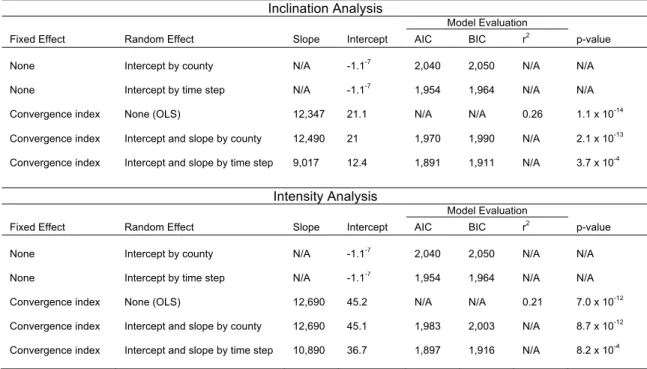
(p=5.34 x 10⁻⁴) (Figure 3.2). Moreover, a linear mixed-effects model revealed a highly
significant relationship between the magnitude of isoline movements and the magnitude of
changes in nesting density (p=3.67 x 10⁻⁴) (Figure 3.3, Table 1); the highest convergence
indices were associated with the greatest increases in nesting density, and the lowest
convergence indices were associated with the greatest decreases in nesting density. This
trend persisted within each of the 12 counties on Florida’s Atlantic coast (Figure 3.4, Table
2).
For intensity, there were no areas along the coast where isolines converged; thus, all
convergence indices were negative. In all other regards, however, the results of the analysis
were qualitatively identical to those of the inclination analysis. A linear mixed-effects model
revealed a strong positive relationship between convergence index and changes in nesting
density (p=8.2 x 10⁻⁴) (Figure 3.3, Table 1); as convergence index increased, so did the
percent change in nesting density. This trend persisted within all 12 counties on Florida’s
Atlantic coast (Figure 3.4, Table 2).
These results provide strong evidence that nesting sea turtles use Earth’s magnetic field
to locate their natal beaches. Although the exact geomagnetic component(s) exploited by
hypothesis that nest site selection depends at least partly on magnetic signatures comprised of
inclination angle, field intensity, or a combination of the two.
In a previous study, the migratory route of salmon approaching their natal river was
shown to vary with subtle changes in the Earth’s field [11]. Whereas the endpoint of the
salmon spawning migration was presumably the same regardless of route, our findings
demonstrate for the first time a relationship between changes in Earth’s magnetic field and
the locations where long-distance migrants return to reproduce.
Sea turtles are long-lived and females undertake reproductive migrations periodically
throughout their adult lives [28]. Thus, the population of turtles that migrates to a given
beach to nest each year is comprised of two subsets: a group of first-time nesters, and
another, typically larger group of older ‘re-migrants’ that have nested in the area during
previous years. Genetic analyses indicate that both groups display natal homing [3, 5, 9, 14].
An unresolved question, however, is whether both reach the natal region by using the same
navigational strategy and sensory cues [25].
At least two possibilities are compatible with the data. One is that hatchling turtles
imprint on the magnetic signature of the natal beach and retain this information into
adulthood [1]. Alternatively, nesting females might somehow reach the natal beach the first
time without relying on magnetic information (e.g., by following an experienced nester or by
using non-magnetic cues), then learn the magnetic signature of the beach and use it to return
during subsequent nesting migrations. Although neither possibility can be excluded, we
presently favor the first because ‘socially facilitated’ migration has never been observed in
sea turtles [3, 30] and because no non-magnetic cue has been identified that can provide the
first return to the natal region is accomplished, turtles might periodically update their
knowledge of the magnetic field at the nesting area each time they visit so as to minimize
navigational errors that might otherwise accrue due to secular variation [24, 25].
Given the strong relationship between subtle changes in Earth’s magnetic field and
sea turtle nesting density, one possibility is that turtles are highly sensitive to small
differences in magnetic fields. Alternatively, however, the same relationship can be
explained if, in a typical nesting area, numerous error-prone individuals seek out a magnetic
signature but miss the target by varying distances. Such imperfect navigation might, through
a process resembling a ‘wisdom of the crowd’ phenomenon [31, 32], give rise to a nesting
distribution centered on the magnetic signature and, in effect, coupled to it. Thus, when
Earth’s field changes slightly and magnetic signatures move, the population-level nesting
distribution might change even if individual turtles have relatively low magnetic sensitivity
and make considerable navigational errors.
Our findings do not imply that turtles reflexively nest at a particular magnetic signature
regardless of other environmental conditions, or that nesting distributions will track the
steady movement of isolines along a coast no matter what. Successful nesting requires
deposition of eggs in a location suitable for incubation. Factors such as beach erosion, sand
quality, visual cues, and predation are known to influence where turtles nest on a local scale
[1, 25]. Because these and other environmental conditions also affect the likelihood that a
nest will yield viable hatchlings [25, 33], natural selection is likely to act against turtles that
choose nesting locations by relying on magnetic cues to the exclusion of all else. Moreover,
sensory cues other than geomagnetism are likely to help guide natal homing, especially once
Given that geomagnetic cues appear to play an important role in natal homing, an
intriguing speculation is that, over evolutionary time, turtles might have had difficulty
locating their natal beaches during brief periods of rapid field change, as are thought to have
occurred during some magnetic polarity reversals [34]. During these intervals, turtles might
have had a tendency to stray into new nesting areas, which subsequent generations could then
locate reliably as the field stabilized and geomagnetic imprinting once more became an
effective strategy for natal homing [1].
Because sea turtles nest in different environmental settings worldwide, it is possible
that different nesting populations exploit geomagnetic cues in different ways during natal
homing [1, 16, 35]. Our analysis suggests that turtles use geomagnetic cues to locate natal
areas along continental coastlines, the most common setting for large sea turtle rookeries
worldwide [16]. In other settings, such as on small islands, turtles must nest in specific,
restricted areas because no alternative exists. In such situations, a clear relationship between
field changes and nesting sites is unlikely because, over time, magnetic signatures that once
marked the natal site drift offshore where nesting is impossible[1, 25]. In these cases turtles
might use magnetic cues to navigate into the vicinity of the island and then use odorants or
other supplemental, local cues to locate the nesting beach [16, 35, 36].
Regardless of these considerations, our results provide the strongest evidence to date
that sea turtles find their nesting areas, at least in part, by navigating to unique magnetic
signatures along the coast. In addition, the results are consistent with the hypothesis that
turtles accomplish natal homing largely on the basis of magnetic navigation and geomagnetic
![Figure 1.1: Earth’s magnetic field [2]](https://thumb-us.123doks.com/thumbv2/123dok_us/8294230.2196459/20.918.211.739.200.509/figure-earth-s-magnetic-field.webp)