Original Articles
Racial Differences in Outcomes of an Advance
Care Planning Intervention for Dialysis
Patients and Their Surrogates
Mi-Kyung Song, PhD, RN, FAAN,1Sandra E. Ward, PhD, RN, FAAN,2 Feng-Chang Lin, PhD,3Jill B. Hamilton, PhD, RN, FAAN,4
Laura C. Hanson, MD, MPH,5 Gerald A. Hladik, MD,6and Jason P. Fine, ScD3
Abstract
Background:
African Americans’ beliefs about end-of-life care may differ from those of whites, but racial
differences in advance care planning (ACP) outcomes are unknown.
Objective:
The aim of this study was to compare the efficacy of an ACP intervention on preparation for end-of-life
decision making and post-bereavement outcomes for African Americans and whites on dialysis.
Method:
A secondary analysis of data from a randomized trial comparing an ACP intervention (Sharing Patient’s
Illness Representations to Increase Trust [SPIRIT]) with usual care was conducted. There were 420 participants,
210 patient-surrogate dyads (67.4% African Americans), recruited from 20 dialysis centers in North Carolina. The
outcomes of preparation for end-of-life decision making included dyad congruence on goals of care, surrogate
decision-making confidence, a composite of the two, and patient decisional conflict assessed at 2, 6, and 12
months post-intervention. Surrogate bereavement outcomes included anxiety, depression, and post-traumatic
distress symptoms assessed at 2 weeks, and at 3 and 6 months after the patient’s death.
Results:
SPIRIT was superior to usual care in improving dyad congruence (odds ration [OR]
=
2.31,
p
=
0.018),
surrogate decision-making confidence (
b
=
0.18,
p
=
0.021), and the composite (OR
=
2.19,
p
=
0.028) 2 months
post-intervention, but only for African Americans. SPIRIT reduced patient decisional conflict at 6 months for
whites and at 12 months for African Americans. Finally, SPIRIT was superior to usual care in reducing
surrogates’ bereavement depressive symptoms for African Americans but not for whites (
b
= -
3.49,
p
=
0.003).
Conclusion:
SPIRIT was effective in improving preparation for end-of-life decision-making and
post-bereavement outcomes in African Americans.
Introduction
E
nd-stage renal disease (ESRD) currently affects640,000 people in the United States.1 Despite the ad-vances in dialysis, adjusted all-cause mortality rates are 6 to 8 times greater for dialysis patients than for individuals in the general age-matched Medicare population.1The importance of advance care planning (ACP) in dialysis care is well rec-ognized by stakeholders, including patients, families, and dialysis care providers.2–6However, few studies have dem-onstrated the beneficial impact of an ACP intervention in dialysis patients.7
African Americans, comprising approximately 31% of the ESRD population, are thought to prefer more aggressive treatment at the end of life,8to be less likely to have a do not resuscitate (DNR) order,9 and to be less amenable to using advance directives (ADs) compared with whites.10,11 Such differences might be associated with health and illness expe-riences that differ between African Americans and whites as these experiences are influenced by socioeconomic status, marriage, family experiences, and other cumulative life situ-ations.12African Americans are more likely than other racial/ ethnic groups in the United States to be religiously affiliated and to adhere to ideologies that may influence decision making
1Nell Hodgson School of Nursing, Emory University, Atlanta, Georgia. 3
School of Public Health, Department of Biostatistics,5School of Medicine, University of North Carolina at Chapel Hill, Chapel Hill, North Carolina.
2
School of Nursing, University of Wisconsin-Madison, Madison, Wisconsin. 4
School of Nursing, Johns Hopkins University, Baltimore, Maryland. 6
UNC Kidney Center, Chapel Hill, North Carolina. Accepted August 7, 2015.
JOURNAL OF PALLIATIVE MEDICINE Volume 19, Number 2, 2016
ªMary Ann Liebert, Inc. DOI: 10.1089/jpm.2015.0232
about issues such as discontinuation of life-sustaining treat-ments.13 However, despite knowledge that such beliefs are important in end-of-life decision making, little has been done to develop and test an ACP intervention for African Americans that takes such beliefs into consideration.14–16
To address these gaps, we tested the long-term effects of an ACP intervention entitled SPIRIT (Sharing Patient’s Illness Representations to Increase Trust) on preparation for end-of-life decision making for dialysis patients and surrogates and on bereavement outcomes for surrogates. SPIRIT was based on the Representational Approach to Patient Education17,18and designed to help patients and surrogates understand the pa-tient’s illness and implications for end-of-life decision making. An intervention that uses the Representational Approach first establishes an understanding of the cognitive, emotional, and spiritual or religious aspects of the patient’s representation (beliefs or understandings) of his or her illness. These under-standings serve as a foundation for the interventionist to pro-vide individualized health care information.19Results of the intention-to-treat analysis, reported elsewhere, revealed SPIRIT was superior to usual care in improving preparation for end-of-life decision making and bereavement outcomes.20 Here, as a planned analysis, we examined whether the effects of SPIRIT differ between African Americans and whites on preparation for end-of-life decision making for patients and surrogates and on bereavement outcomes for surrogates.
Methods
Study design
The original study was a two-group randomized controlled trial with measures of patient and surrogate preparedness at baseline and 2, 6, and 12 months later, and measures of sur-rogate bereavement outcomes at baseline, 2 weeks, and 3 and 6 months after the patient’s death. Dyads were randomized to SPIRIT or usual care with stratification by race (African American versus white), dialysis center type (university-affiliated versus non-(university-affiliated), and dialysis modality (hemo-dialysis versus peritoneal).The University of North Carolina at Chapel Hill Institutional Review Board (IRB) approved the study. The clinicaltrials.gov Identifier is NCT01259011 (A Representational Intervention to Promote Preparation for End-of-Life Decision Making).
Setting and participants
Patients recruited from 20 free-standing outpatient dialysis centers in eight counties in North Carolina were age 18 years or older; self-identified African American or white, had been on dialysis for at least 6 months prior to enrollment, had a Charlson Comorbidity Index (CCI)21,22score‡6 or CCI=5 and were hospitalized in the last 6 months, were English-speaking, had no hearing impairment, had<3 errors on the Short Portable Mental Status Questionnaire,23 and had an English-speaking surrogate over age 18 who could partici-pate. We randomized 210 dyads:141 African American dy-ads and 69 white dydy-ads.
Interventions
Usual care. As required by the Centers for Medicare and Medicaid Services (CMS),24written information on ADs was provided to every patient on the first day of dialysis, and a
social worker encouraged patients to complete an AD and addressed questions about life-sustaining treatments. A ne-phrologist (or physician assistant or nurse practitioner) re-viewed resuscitation statements with the patient to determine whether the patient wanted a DNR order at the dialysis center. If completed, the AD and DNR were placed in the medical record. If there was no DNR order in the record, a full code was presumed.
Intervention. Dyads randomized to intervention re-ceived usual care plus SPIRIT. SPIRIT was conducted by one of three nurse interventionists using an intervention guide. The interventionists had at least 2 years of clinical experience and had completed a competency-based training program.
SPIRIT included two sessions. During the first session at the dialysis center, the interventionist assessed cognitive, emotional, and spiritual/religious aspects of the dyad’s rep-resentations of (beliefs and understanding about) the patient’s illness, prognosis, and end-of-life care. This assessment allowed the interventionist to then provide individualized information about topics such as the effectiveness of life-sustaining treatment for people with ESRD, and to assist the patient in examining his/her values about life-sustaining treatment at the end of life. The interventionist actively in-volved the surrogate in the discussion and helped the surro-gate prepare for being a decision-maker and for the emotional burden of end-of-life decision making.
A goals-of-care document was completed at the end of the session to indicate the patient’s preferences. A brief second session was delivered 2 weeks later at the patient’s home (to reduce the burden of travel to the center). During the session, the patient’s goals-of-care document and resuscitation pref-erences were reviewed again. The interventionist explored potential family conflicts and encouraged the dyad to talk with other family members and to complete a health care power of attorney. The interventionist then created a written summary of information about the patient’s end-of-life preferences, communicated those preferences to dialysis staff, and placed the summary in the medical record.
Of the dyads randomized to SPIRIT, 36 white dyads (97.3%) and 71 African American dyads (98.6%) received Session I; of those, 33 (91.7%) whites and 67 (94.4%) Afri-can AmeriAfri-cans received Session II. Session I averaged 85 minutes for whites and 81 minutes for African Americans. Session II averaged 21 minutes for whites and 20 minutes for African Americans.
Measurement
my comfort and peace, and thus I do not want life-sustaining treatment, including dialysis,’’ and ‘‘I am not sure.’’ Patient and surrogate responses to these scenarios were compared to determine dyad congruence—either congruent in both sce-narios or incongruent. If both members of the dyad endorsed ‘‘I am not sure,’’ they were considered incongruent.
Patient decisional conflict was measured using the 13-item Decisional Conflict Scale (DCS)25; higher scores indicate greater difficulty in decision making (score range 1–5). Surrogate decision-making confidence was measured using the 5-item Decision Making Confidence (DMC) scale15,26in which higher scores reflect greater comfort in performing as a surrogate (score range 0–4). A composite outcome was cre-ated to differentiate surrogates who understand the patient’s wishes and feel confident in their role from those who do not (i.e., understand the wishes but lack confidence, misunder-stand the wishes but feel confident, or neither undermisunder-stand the patient’s wishes nor feel confident);15,26dyads were grouped as congruent in both scenarios and surrogate DMC score‡3 (‘‘Confident’’ to ‘‘Very Confident’’), or not.
Bereavement outcomes. Surrogates’ symptoms of anx-iety and depression were measured using the Hospital Anxanx-iety and Depression Scale27; subscale scores range from 0 to 21 with higher scores indicating greater symptom severity. The intensity of post-traumatic distress symptoms was assessed using the Post-Traumatic Symptoms Scale-10 (PTSS-10).28 Higher scores indicate more intense symptoms (range 10–70). Patients completed the 12-item Functional Assessment of Chronic Illness Therapy (FACIT-Sp),29a reliable and vali-dated scale that measures the extent to which individuals have experienced spiritual well-being in the past week on a 5-point scale from 0 (Not at All) to 4 (Very Much).30FACIT-Sp has three subscales (4 items each): meaning (e.g., ‘‘I feel a sense of purpose in life’’), peace (‘‘I feel peaceful’’), and faith (‘‘My illness has strengthened my faith or spiritual beliefs’’). A higher score indicates greater spiritual well-being.
Statistical analysis
Descriptive statistics were used to summarize participants’ characteristics.v2tests andttests or analysis of variance were performed as appropriate to compare group difference within race and to compare African Americans with whites in baseline characteristics.
Most missing data on preparedness outcomes were due to deaths of patients (n=30). Because the study was not pow-ered for formal testing of the interaction between SPIRIT and race, we examined intervention effects within each race using generalized estimating equation (GEE) methods.31 For preparation for end-of-life decision-making outcomes, a group indicator, time, the baseline value, and the interaction between SPIRIT and time were included in GEE models for each racial group. For bereavement outcomes, SPIRIT-time interaction was not included in the models due to the small sample size (n=45).
To identify potential covariates associated with the study outcomes within each race, the baseline characteristics (e.g., age) were examined using GEE models adjusting for inter-vention, time, and the baseline value of each outcome. Then, we entered the covariates that were significantly associated with any of the study outcomes into a GEE model to examine
the effect of the covariate on the outcome within race after adjusting for intervention, time, the interaction between SPIRIT and time, and the baseline value of the outcome. All analyses were conducted using SAS software version 9.3 (SAS Institute Inc., Cary, NC).
Results
Sample description
African Americans comprised 67.1% (n=141) of the sample. Compared with whites, African American patients were more likely to be women (66.7% versus 37.7%,
v2=15.9,p<0.001), younger (mean [M] =60.6 versus 65.2, t=2.9, p=0.005), on dialysis for a longer time (M=4.9 versus 3.1, t=3.6,p=0.003), have less education (M=12.5 versus 13.4, t=2.1,p=0.04), have lower incomes (M=3.1 versus 4.1, t=4.5,p<0.001), rate the importance of spiritu-ality more highly (M=3.4 versus 2.9, t=5.1,p<0.001), and have a higher total spiritual well-being (FACIT-Sp) score (M=39.0 versus 33.3, t=5.1,p<0.001) and subscale scores (allps<0.01), and be less likely to have an advance directive (11.3% versus 33.3%,v2=14.8,p<0.001).
African American and white surrogates were similar in baseline characteristics except that African American surro-gates were more likely to rate the importance of spirituality in life higher compared with whites (M=3.5 versus 3.1, t=3.2, p=0.002). The SPIRIT and control groups within race were similar in baseline characteristics. Table 1 presents baseline characteristics of participants by racial group.
The mean age of the 45 patients who died during the study was 64.6 (standard deviation [SD]=12.6). Mean (SD) survival months after randomization for the 21 deceased whites was 11.5 (9.2), and for the 24 African Americans was 13.6 (10.8). Within race, survival months between the SPIRIT and control groups were similar. Patients who died and their surrogate’s sociodemographic characteristics were similar between SPIR-IT and control groups within race. Five whites and five African American patients died suddenly requiring no surrogate deci-sion making; 16 white surrogates and 19 African American surrogates were involved in end-of-life decision making.
Intervention effects on outcomes by race
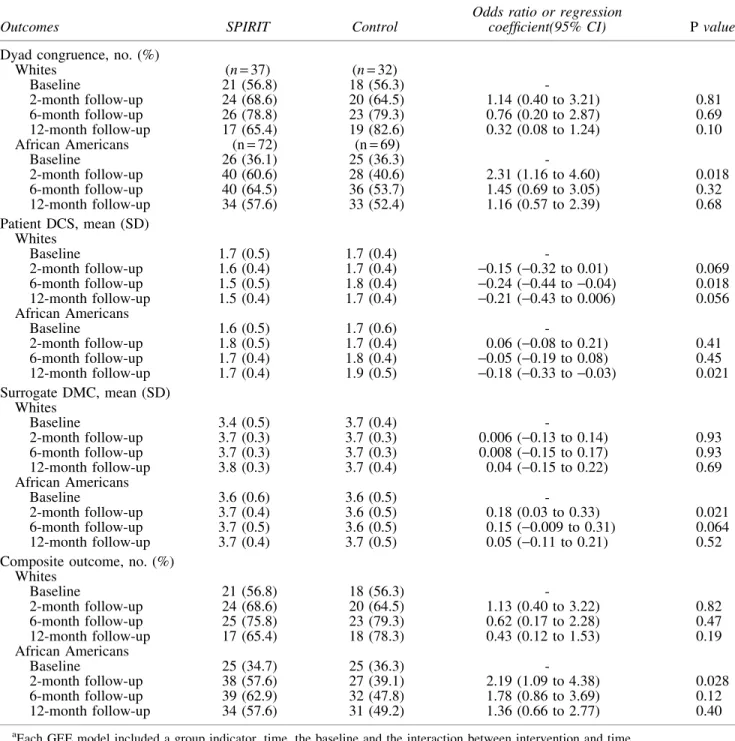
Preparedness. The effect of SPIRIT on dyad congru-ence was not significant for whites at any time point (Table 2), whereas for African Americans, the number of dyads con-gruent in goals of care was significantly higher in SPIRIT than in control at 2 months (OR=2.31 [95% confidence in-terval (CI), 1.16 to 4.60]; p=0.018). SPIRIT significantly reduced patient decisional conflict at 6 months for whites (b= -0.24 [95% CI, -0.44 to -0.04]; p=0.018) and at 12 months for African Americans (b= -0.18 [95% CI,-0.33 to -0.03]; p=0.021). SPIRIT did not improve surrogate decision-making confidence for whites but did so at 2 months for African Americans (b=0.18 [95% CI, 0.03 to 0.33]; p=0.021). There was no difference between SPIRIT and controls in the composite outcome for whites; but African Americans in SPIRIT fared better at 2 months (OR=2.19 [95% CI, 1.09 to 4.38];p=0.028) than did controls.
Bereavement. Figure 1 presents the intervention effects on anxiety and depressive symptoms and post-traumatic
Characteristics
Participants, no. (%)
Whites (n=69) African Americans (n=141)
SPIRIT (n=37)
Control (n=32)
SPIRIT (n=72)
Control (n=69)
Patient, sociodemographic
Age, mean (SD), years 63.8 (12.5) 66.8 (11.0) 59.6 (10.6) 61.5 (10.8)
Women 14 (37.8) 12 (37.5) 51 (70.8) 43 (62.3)
Marital status
Married/living with partner 22 (59.5) 16 (50.0) 34 (47.2) 27 (39.1)
Divorced/separated/widowed 12 (32.4) 15 (46.9) 28 (38.9) 34 (49.3)
Never married 3 (8.1) 1 (3.1) 10 (13.9) 8 (11.6)
Formal education completed, mean (SD), years 13.7 (3.4) 13.0 (3.2) 12.8 (2.7) 12.2 (2.6)
Extent of following religious customs
Never/sometimes 14 (37.8) 15 (46.9) 17 (23.6) 25 (36.2)
Frequently/always 23 (63.1) 17 (53.1) 55 (76.4) 44 (63.8)
Importance of spirituality in life
Not at all/somewhat important 13 (35.1) 10 (31.3) 5 (6.9) 4 (5.8)
Very/extremely important 24 (73.0) 22 (68.8) 67 (93.1) 65 (94.2)
Annual income
<$20,000 13 (35.1) 12 (37.5) 40 (55.6) 41 (59.4)
$20,000–$50,000 18 (48.6) 12 (37.5) 22 (30.6) 21 (30.4)
>$50,000 6 (16.2) 7 (21.9) 8 (11.1) 6 (8.7)
Refused to answer 0 1 (3.1) 2 (2.8) 2 (2.9)
Previously lost a close family member or a friend 37 (100) 31 (98.9) 71 (98.6) 67 (97.1)
Involved in tough medical decisions for the lost family member or friend
14 (37.8) 7 (21.9) 22 (30.6) 18 (26.1)
FACIT-Sp spiritual well-being total, mean (SD)a 32.8 (8.1) 33.9 (8.1) 39.1 (7.2) 39.0 (7.6)
FACIT-meaning subscale 11.7 (3.2) 11.8 (2.7) 13.0 (2.7) 13.2 (2.9)
FACIT-peace 10.0 (3.5) 10.5 (3.0) 11.9 (3.1) 11.9 (3.5)
FACIT-faith 11.2 (3.8) 11.6 (4.2) 14.1 (2.5) 14.1 (2.5)
Patient, clinical
Hemodialysis 33 (89.2) 28 (87.5) 72 (100) 68 (98.6)
Years on dialysis
Median (IQR) 2.3 (1.1 – 4.5) 2.0 (1.1–4.3) 4.6 (2.3–6.9) 2.6 (1.4–5.3)
Mean (SD) 3.2 (3.0) 2.9 (2.3) 5.1 (3.5) 4.7 (5.6)
CCI illness severity, mean (SD) 8.4 (1.9) 8.3 (2.2) 8.1 (1.8) 8.1 (1.6)
Has an advance directive 13 (35.1) 10 (31.3) 8 (11.1) 8 (11.6)
Do not resuscitate order at the center 4 (10.8) 1 (3.1) 2 (2.8) 1 (1.4)
Surrogate, sociodemographic Relationship to patient
Spouse/partner 19 (51.4) 14 (43.8) 25 (34.7) 23 (33.3)
Parent 7 (18.9) 14 (43.8) 20 (27.8) 24 (34.8)
Sibling 3 (8.1) 1 (3.1) 13 (18.1) 10 (14.5)
Child 3 (8.1) 1 (3.1) 5 (6.9) 3 (4.3)
Friend 5 (13.5) 1 (3.1) 1 (1.4) 3 (4.3)
Other(e.g., other relatives, in-laws) 0 1 (3.1) 8 (11.1) 6 (8.7)
Age, mean (SD), years 56.2 (13.5) 56.6 (14.6) 53.1 (12.9) 52.9 (14.0)
Women 27 (73.0) 28 (87.5) 48 (66.7) 49 (71.0)
Marital status
Married/living with partner 29 (78.4) 25 (78.2) 44 (61.1) 38 (55.1)
Divorced/separated/widowed 5 (13.5) 6 (18.7) 14 (19.4) 16 (23.2)
Never married 1 3 (8.1) 1 (3.1) 14 (19.4) 15 (21.7)
Formal education completed, mean (SD), years 13.6 (2.9) 13.8 (1.7) 13.5 (2.4) 13.1 (2.1)
Extent of following religious customs
Never/sometimes 8 (21.6) 7 (21.9) 19 (26.4) 13 (18.8)
Frequently/always 29 (78.3) 25 (78.1) 53 (73.6) 56 (81.2)
Importance of spirituality in life
Not at all/somewhat important 4 (10.8) 10 (31.3) 4 (5.6) 4 (5.8)
Very/extremely important 33 (89.2) 22 (68.8) 68 (94.5) 65 (94.2)
Annual income
<$20,000 8 (21.6) 7 (21.9) 20 (27.8) 21 (30.4)
$20,000–$50,000 19 (51.4) 12 (37.5) 32 (44.4) 31 (44.9)
>$50,000 9 (24.3) 12 (37.5) 17 (23.6) 13 (18.8)
Refused to answer 1 (2.7) 1 (3.1) 3 (4.2) 4 (5.8)
Previously lost a close family member or a friend 34 (91.9) 31 (96.9) 69 (95.8) 67 (97.1)
Involved in tough medical decisions for the lost family member or friend
16 (43.2) 9 (28.1) 23 (31.9) 26 (37.7)
a
Peterman et al.29FACIT-Sp total scores range from 0 to 48, with a higher score indicating greater spiritual well-being. Due to rounding up, percentages may not add up to 100.
CCI, Charlson Comorbidity Index; FACIT, Functional Assessment of Chronic Illness Therapy; IRQ, interquartile range; SD, standard deviation; SPIRIT, Sharing Patient’s Illness Representations to Increase Trust.
symptom scores by race after adjusting for time and the baseline value. At 2 weeks post-death, both SPIRIT and control groups for both races had a slight increase in these symptoms. After adjusting for time and the baseline value, there was a significant intervention effect on reducing de-pressive symptoms for African Americans (b= -3.49 [95% CI,-5.82 to-1.17];p=0.003).
Potential covariates associated with outcomes
We examined the bivariate relationships between the baseline characteristics that differed between African
Americans and whites (described above) and study outcomes. Only spiritual well-being (FACIT-Sp) and comorbidity (CCI) were significantly associated with preparation for end-of-life decision making. No surrogate baseline characteristics were associated with surrogates’ post-death bereavement outcomes.
Table 3 presents the relationships of FACIT subscales and CCI with preparation for end-of-life decision making after adjusting for intervention group, time, the interaction be-tween intervention group and time, and the baseline value of each outcome. One spiritual well-being subscale, FACIT-meaning, was inversely associated with dyad congruence
Table2. Intervention Effects on the Preparedness Outcomes by Racea
Outcomes SPIRIT Control
Odds ratio or regression
coefficient(95% CI) Pvalue
Dyad congruence, no. (%)
Whites (n=37) (n=32)
Baseline 21 (56.8) 18 (56.3)
-2-month follow-up 24 (68.6) 20 (64.5) 1.14 (0.40 to 3.21) 0.81
6-month follow-up 26 (78.8) 23 (79.3) 0.76 (0.20 to 2.87) 0.69
12-month follow-up 17 (65.4) 19 (82.6) 0.32 (0.08 to 1.24) 0.10
African Americans (n=72) (n=69)
Baseline 26 (36.1) 25 (36.3)
-2-month follow-up 40 (60.6) 28 (40.6) 2.31 (1.16 to 4.60) 0.018
6-month follow-up 40 (64.5) 36 (53.7) 1.45 (0.69 to 3.05) 0.32
12-month follow-up 34 (57.6) 33 (52.4) 1.16 (0.57 to 2.39) 0.68
Patient DCS, mean (SD) Whites
Baseline 1.7 (0.5) 1.7 (0.4)
-2-month follow-up 1.6 (0.4) 1.7 (0.4) -0.15 (-0.32 to 0.01) 0.069 6-month follow-up 1.5 (0.5) 1.8 (0.4) -0.24 (-0.44 to-0.04) 0.018 12-month follow-up 1.5 (0.4) 1.7 (0.4) -0.21 (-0.43 to 0.006) 0.056 African Americans
Baseline 1.6 (0.5) 1.7 (0.6)
-2-month follow-up 1.8 (0.5) 1.7 (0.4) 0.06 (-0.08 to 0.21) 0.41
6-month follow-up 1.7 (0.4) 1.8 (0.4) -0.05 (-0.19 to 0.08) 0.45 12-month follow-up 1.7 (0.4) 1.9 (0.5) -0.18 (-0.33 to-0.03) 0.021 Surrogate DMC, mean (SD)
Whites
Baseline 3.4 (0.5) 3.7 (0.4)
-2-month follow-up 3.7 (0.3) 3.7 (0.3) 0.006 (-0.13 to 0.14) 0.93
6-month follow-up 3.7 (0.3) 3.7 (0.3) 0.008 (-0.15 to 0.17) 0.93
12-month follow-up 3.8 (0.3) 3.7 (0.4) 0.04 (-0.15 to 0.22) 0.69
African Americans
Baseline 3.6 (0.6) 3.6 (0.5)
-2-month follow-up 3.7 (0.4) 3.6 (0.5) 0.18 (0.03 to 0.33) 0.021
6-month follow-up 3.7 (0.5) 3.6 (0.5) 0.15 (-0.009 to 0.31) 0.064
12-month follow-up 3.7 (0.4) 3.7 (0.5) 0.05 (-0.11 to 0.21) 0.52
Composite outcome, no. (%) Whites
Baseline 21 (56.8) 18 (56.3)
-2-month follow-up 24 (68.6) 20 (64.5) 1.13 (0.40 to 3.22) 0.82
6-month follow-up 25 (75.8) 23 (79.3) 0.62 (0.17 to 2.28) 0.47
12-month follow-up 17 (65.4) 18 (78.3) 0.43 (0.12 to 1.53) 0.19
African Americans
Baseline 25 (34.7) 25 (36.3)
-2-month follow-up 38 (57.6) 27 (39.1) 2.19 (1.09 to 4.38) 0.028
6-month follow-up 39 (62.9) 32 (47.8) 1.78 (0.86 to 3.69) 0.12
12-month follow-up 34 (57.6) 31 (49.2) 1.36 (0.66 to 2.77) 0.40
a
Each GEE model included a group indicator, time, the baseline and the interaction between intervention and time.
CI, confidence interval; DCS, Decisional Conflict Scale; DMC, Decision-Making Confidence; SD, standard deviation; SPIRIT, Sharing Patient’s Illness Representations to Increase Trust.
and the composite, but only for African Americans; a 1 SD (=2.8) increase in this score was associated with 25% re-duction in the odds of the dyad being congruent and 34% reduction in the odds of having a better composite outcome. CCI was positively associated with dyad congruence, surro-gate decision-making confidence (b=0.04 [95% CI, 0.01 to 0.08]; p=0.026), and the composite, but only for African Americans; a 1 SD (=1.7) increase in CCI was associated with 36% increase in the odds of the dyad being congruent and 46% increase in the odds of a better composite outcome.
Discussion
SPIRIT was effective in improving preparation for end-of-life decision making and post-bereavement outcomes in African Americans. SPIRIT reduced patient decisional con-flict at 6 months for whites and at 12 months for African Americans. Finally, SPIRIT reduced surrogates’ bereave-ment depressive symptoms for African Americans. However, we did not find such effects in whites.
Data on differential effects of psychosocial and educa-tional interventions between African Americans and whites are rare and inconsistent mainly because only a small pro-portion of African Americans are included in most studies.32 However, in a study of peer mentoring on AD completion and psychosocial outcomes in 208 dialysis patients (37% to 39% African Americans) a greater percentage of patients
receiv-ing peer mentorreceiv-ing completed an AD compared with those in the control groups,14an effect that was significant for African Americans but not for whites. Furthermore, the intervention showed a significant increase in subjective well-being in African Americans but not in whites. These two interven-tions, SPIRIT and peer mentoring, might align with African Americans’ culture and familial, religious, and communal frame of reference33by including a family member in the intervention (SPIRIT) or by using a peer-led intervention.
Our study revealed that whites in the control group im-proved in dyad congruence over time as they simply were asked to think about the scenarios in the goals-of-care doc-ument and answer thought-provoking questions repeatedly. This phenomenon, known as assessment effects,34–36 ap-peared to be as effective as SPIRIT for whites. However, for African Americans, controls did not benefit from assessment effects as much; rather, SPIRIT was needed to improve dyad congruence.
share with the surrogate. This lack of visibility and lack of sharing might in turn lead the surrogate to misunderstand the patient’s end-of-life preferences contributing to dyad incon-gruence. The literature consistently suggests the importance of spirituality in end-of-life decision making for many African Americans.9,37–46Our study may offer additional data on the relationships between spiritual well-being and outcomes of ACP for African Americans, but further research is warranted. Studies of bereaved family members of dialysis patients are rare, making it difficult to interpret why African American surrogates benefited from SPIRIT to a greater extent than did white surrogates. Although racial differences in depressive symptomatology have been reported,47,48 literature on racial differences in depression following the death of a loved one is limited, and no studies have compared African Americans with whites with respect to the impact of an ACP interven-tion on bereaved family members. One study has shown that African American caregivers of relatives with Alzheimer’s disease reported greater perceived loss than did whites when a relative died.49Similarly, our control group data reveal that depressive symptom scores in African American surrogates increased post-bereavement, supporting the adverse impact of the death of a loved one on African American surrogates. In contrast, in the SPIRIT group depressive symptom scores in African American surrogates decreased.
Although we found significant effects of SPIRIT in Afri-can AmeriAfri-cans but not in whites, the original study was not powered to formally test the interaction between SPIRIT and race and to estimate racial effects. Thus, our analytic ap-proach was exploratory. We used the self-identified race/ ethnicity category for the analysis, which may be limited to capture the complex ethnic identity. Also, the original study was conducted in a single region in the United States and the data may not be generalizable to other regions or other in-dividuals with similar characteristics. Nonetheless, our findings suggest that SPIRIT, an ACP intervention, is effec-tive in improving preparation for end-of-life decision making and post-bereavement outcomes in African Americans.
Acknowledgments
This study was supported by a grant from the National Institutes of Health (R01NR011464) to M.S. The content is solely the responsibility of the authors and does not neces-sarily represent the official views of the National Institutes of Health.
Author Disclosure Statement
No competing financial interests exist.
References
1. U.S. Renal Data System. USRDS 2014 Annual Data Re-port: Epidemiology of Kidney Disease in the United States. National Institutes of Health, National Institute of Diabetes and Digestive and Kidney Diseases, Bethesda, MD, 2014. 2. Goff SL, Eneanya ND, Feinberg R, et al.: Advance care
planning: A qualitative study of dialysis patients and fam-ilies.Clin J Am Soc Nephrol2015;10:390–400.
3. Davison SN: Facilitating advance care planning for patients with end-stage renal disease: The patient perspectives.Clin J Am Soc Nephrol2006;1:1023–1028.
Table 3. Effects of Patient Spiritual Well-Being and Comorbidity on Dyad Congruence, Patient Decisional Conflict, Surrogate Decision-Making Confidence, and Composite Outcome a Dyad congruence b Patient DCS Surrogate DMC Composite outcome b OR (95% CI) Regression coefficient (95% CI) Regression coefficient (95% CI) OR (95% CI) Whites African Americans Whites African Americans Whites African Americans Whites African Americans FACIT-meaning 1.02 (0.92–1.13) 0.91* (0.82–1.00) 0.004 ( -0.02–0.03) 0.01 ( -0.01–0.03) -1.02 (0.92–1.13) 0.88* (0.80–0.97) FACIT-peace 1.05 (0.95–1.15) 0.95 (0.87–1.03) -0.02 ( -0.03–0.002) 0.003 ( -0.01–0.02) -1.04 (0.95–1.14) 0.92 (0.85–1.01) FACIT-faith 0.99 (0.88–1.12) 0.93 (0.84–1.04) -0.01 ( -0.03–0.01) -0.01 ( -0.03–0.01) -1.04 (0.95–1.14) 0.93 (0.84–1.04) CCI 0.95 (0.78–1.16) 1.21* (1.04–1.42) -0.01 ( -0.05–0.02) 0.001 ( -0.03–0.04) -0.01 ( -0.04–0.02) 0.04* (0.01–0.08) 0.97 (0.79–1.18) 1.27** (1.08–1.48) * p < 0.05; ** p < 0.01. a Each generalized estimating equation (GEE) model included int ervention, time, the interaction between intervention and time, the baseline, and th e covariate. b Reference for dyad congruence = dyads not congruent in both scenarios; reference for composite outcome = dyads not congr uent and/o r surrogate DMC score < 3. CCI, Charlson Comorbidity Index; CI, confidence interval; DCS, Decisional Conflict Scale; DMC, Decision-Making Confidence; FACIT, Functional Asses sment of Chronic Illness Therapy (completed by patients only); OR, odds ratio.
4. Davison SN, Jhangri GS, Holley JL, Moss AH: Ne-phrologists’ reported preparedness for end-of-life decision-making.Clin J Am Soc Nephrol2006;1:1256–1262. 5. Renal Physicians Association: Shared Decision-making in
the Appropriate Initiation of and Withdrawal from Dialysis: Clinical Practice Guideline, 2e. Renal Physicians Associa-tion, Rockville, MD, 2010.
6. Schell JO, Green JA, Tulsky JA, Arnold RM: Commu-nication skills training for dialysis decision-making and end-of-life care in nephrology. Clin J Am Soc Nephrol 2013;8:675–680.
7. Luckett T, Sellars M, Tieman J, et al.: Advance care plan-ning for adults with CKD: A systematic integrative review. Am J Kidney Dis2014;63:761–770.
8. Hopp FP, Duffy SA: Racial variations in end-of-life care.J Am Geriatr Soc2000;48:658–663.
9. Karches KE, Chung GS, Arora V, Meltzer DO, et al.: Re-ligiosity, spirituality, and end-of-life planning: A single-site survey of medical inpatients. J Pain Symptom Manage 2012;44:843–851.
10. Kwak J, Haley WE: Current Research Findings on End-of-Life Decision Making Among Racially or Ethnically Diverse Groups.Gerontologist2005;45:634–641.
11. Pew Research Center: Views on end-of-life medical treat-ments. 2013. www.pewforum.org/2013/11/21/views-on-end-of-life-medical-treatments/ (Last accessedJune 15, 2015). 12. Critical Perspectives on Racial and Ethnic Differences in
Health in Late Life. Anderson NB, Bulatao RA, Cohen B (eds). National Academies Press, Washington, D.C., 2004. 13. Pew Forum: A religious portrit of African Americans. Pew
Forum on Religion & Public Life 2007;2015.
14. Perry E, Swartz J, Brown S, et al.: Peer mentoring: A culturally sensitive approach to end-of-life planning for long-term dialysis patients. Am J Kidney Dis 2005;46: 111–119.
15. Song MK, Ward SE, Happ MB, et al. Randomized con-trolled trial of SPIRIT: An effective approach to preparing African American dialysis patients and families for end-of-life.Res Nurs Health2009;32:260–273.
16. Song MK, Donovan HD, Piraino B, et al. Effects of an intervention to improve communication about end-of-life care among African Americans with chronic kidney dis-ease.Appl Nurs Res2010;23:65–72.
17. Donovan HS, Ward S. A representational approach to pa-tient education.J Nurs Scholarsh2001;33:211–216. 18. Donovan HS, Ward SE, Song MK, et al.: An update on the
representational approach to patient education. J Nurs Scholarsh2007;39:259–265.
19. Song MK, Ward SE: Making visible a theory-guided ad-vance care planning intervention.J Nurs Scholarsh2015;47: 389–396.
20. Song MK, Ward SE, Fine JP, et al.: Advance care planning and end-of-life decision-making in dialysis: A randomized controlled trial targeting patients and their surrogates.Am J Kidney Dis2015;65 813–822.
21. Charlson M, Szatrowski TP, Peterson J, Gold J: Validation of a combined comorbidity index. J Clin Epidemiol 1994;47:1245–1251.
22. Fried L, Bernardini J, Piraino B: Charlson comorbidity index as a predictor of outcomes in incident peritoneal dialysis patients.Am J Kidney Dis2001;37:337–342.
23. Pfeiffer E: A short portable mental status questionnaire for the assessment of organic brain deficit in elderly patients. J Am Geriatr Soc1975;23:433–441.
24. Centers for Medicare and Medicaid Services: Medicare and Medicaid Programs; Conditions for Coverage for End-Stage Renal Disease Facilities; Final Rule. In: Services DoHaH, ed; April 15, 2008.
25. Song MK, Kirchhoff KT, Douglas J, Ward S, et al.: A randomized, controlled trial to improve advance care planning among patients undergoing cardiac surgery.Med Care2005;43:1049–1053.
26. Song MK, Ward SE, Lin FC: End-of-life decision-making confidence in surrogates of African-American dialysis pa-tients is overly optimistic.J Palliat Med2012;15:412–417. 27. Zigmond AS, Snaith RP: The hospital anxiety and
de-pression scale.Acta Psychiatr Scand1983;67:361–370. 28. Eid J, Thayer JF, Johnsen BH: Measuring post-traumatic
stress: a psychometric evaluation of symptom—and coping questionnaires based on a Norwegian sample. Scand J Psychol1999;40:101–108.
29. Peterman AH, Fitchett G, Brady MJ, Hernandez L, et al.: Measuring spiritual well-being in people with cancer: The functional assessment of chronic illness therapy—Spiritual Well-being Scale (FACIT-Sp). Ann Behav Med2002;24: 49–58.
30. Bredle JM, Salsman JM, Debb SM, Arnold BJ, et al.: Spiritual well-being as a component of health-related quality of life: The Funactional Assessment of Chronic Illness Therapy-Spiritual Well-Being Scale (FACIT-Sp). Religions2011;2:77–94.
31. Yan J, Fine J: Estimating equations for association struc-tures. Stat Med 2004;23:859–874.
32. Thompson-Brenner H, Franko DL, Thompson DR, et al.: Race/ethnicity, education, and treatment parameters as moderators and predictors of outcome in binge eating dis-order.J Consult Clin Psychol2013;81:710–721.
33. Baker M: Cultural differences in the use of advance di-rectives: A review of the literature. Afr Am Res Perspect 2000;8:1–15.
34. Song MK, Ward SE: Assessment effects in educational and psychosocial intervention trials: An important but often-overlooked problem. Res Nurs Health 2015;38: 241–247.
35. McCambridge J, Butor-Bhavsar K, Witton J, Elbourne D: Can research assessments themselves cause bias in behav-iour change trials? A systematic review of evidence from solomon 4-group studies.PLoS ONE2011;6:e25223. 36. McCambridge J, Kypri K: Can simply answering research
questions change behaviour? Systematic review and meta analyses of brief alcohol intervention trials. PLoS ONE 2011;6:e23748.
37. Kagawa-Singer M, Blackhall LJ: Negotiating cross-cultural issues at the end of life: ‘‘You got to go where he lives.’’ JAMA2001;286:2993–3001.
38. Koffman J, Higginson IJ: Accounts of carers’ satisfaction with health care at the end of life: A comparison of first generation black Caribbeans and white patients with ad-vanced disease.Palliat Med2001;15:337–345.
39. Dawson G: African Americans and end of life care: yes to appropriate end of life supportive care, no to assisted sui-cide or euthanasia.J Natl Med Assoc2002;94:40–43. 40. Phipps E, True G, Harris D, et al.: Approaching the end of
life: Attitudes, preferences, and behaviors of African-American and white patients and their family caregivers.J Clin Oncol2003;21:549–554.
of African Americans: A review of the literature. J Am Geriatr Soc2005;53:711–719.
42. Mor V, Papandonatos G, Miller SC: End-of-life hospitali-zation for African American and non-Latino white nursing home residents: Variation by race and a facility’s racial composition.J Palliat Med2005;8:58–68.
43. Torke AM, Garas NS, Sexson W, Branch WT: Medical care at the end of life: Views of African American patients in an urban hospital.J Palliat Med2005;8:593–602. 44. True G, Phipps EJ, Braitman LE, et al.: Treatment
prefer-ences and advance care planning at end of life: The role of ethnicity and spiritual coping in cancer patients.Ann Behav Med2005;30:174–179.
45. Wicher CP, Meeker MA: What influences African Ameri-can end-of-life preferences? J Health Care Poor Under-served 2012;23:28–58.
46. Branch WT, Jr., Torke A, Brown-Haithco RC: The im-portance of spirituality in African-Americans’ end-of-life experience.J Gen Intern Med2006;21:1203–1205.
47. Gonzalez HM, Tarraf W, Whitfield KE, Vega WA: The epidemiology of major depression and ethnicity in the United States.J Psychiatr Res2010;44:1043–1051. 48. Williams DR, Yan Y, Jackson JS, Anderson NB: Racial
dif-ferences in physical and mental health: Socio-economic status, stress and discrimination.J Health Psychol1997;2:335–351. 49. Owen JE, Goode KT, Haley WE: End of life care and
reactions to death in African-American and white family caregivers of relatives with Alzheimer’s disease. Omega (Westport)2001;43:349–61.
Address correspondence to: Mi-Kyung Song, PhD, RN, FAAN Nell Hodgson Woodruff School of Nursing Emory University 1520 Clifton Road NE Atlanta, GA 30300
E-mail:[email protected]