
INVESTIGATIONS INTO PT-C MULTIPLE BONDS WITH SPECTATOR SCORPIONATE LIGANDS
Katherine D. Lavoie
A dissertation submitted to the faculty of the University of North Carolina at Chapel Hill in partial fulfillment of the requirements for the degree of Doctor of Philosophy in the
Department of Chemistry.
Chapel Hill 2016
Approved by:
ABSTRACT
Katherine D Lavoie: Investigations into Pt-C Multiple Bonds With Spectator Scorpionate Ligands
(Under the direction of Joseph L. Templeton)
After an overview of Pt organometallic chemistry with an emphasis on Pt(IV) complexes formed through C-H activation, the introduction discusses platinum-carbene complexes. The platinum complexes described here are anchored by scorpionate ligands.
Previous investigations into TpʹPtLnXm complexes [Tpʹ =
hydridotris(3,5-dimethylpyrazolyl)borate] revealed the importance of hemilability as the Tpʹ ligand
facilitates Pt(II/IV) interconversions. In this thesis the synthesis and metalation of a series of asymmetric scorpionate ligands bearing two pyrazolyl rings and one triazolyl ring are
presented. A comparison of octahedral structures of Pt(IV) complexes with P=O and C-H and B-H caps at the pole of the facial tridentate umbrella is included. A series of Pt(IV) carbene
complexes of the form [(Tpʹ)Pt(=C(X)(Y))(Me)2]+ was synthesized. Methylating
Pt-carboxamido precursors allowed isolation of [(Tpʹ)Pt(=C(OMe)NHR)Me2][OTf]. The
method for generating these rare Pt(IV) carbenes was extended to synthesize a methoxy stabilized Pt carbene complex, [TpʹPt(=C(OCH3)CH3)Me2][OTf]. Low temperature
precursor to a Pt-vinylidene complex. The isolation of a Pt(IV) acetylide complex, (Tpʹ)PtMe2(C≡CPh) followed by protonation of the acetylide moiety resulted in the
ACKNOWLEDGEMENTS
The moment I met Joe I knew I wanted to work in his lab. I have tremendous respect for Joe, both as a chemist and as a person. He always prioritized his graduate students, no matter how busy his jobs on campus kept him. He didn’t just want us to be good chemists but rather good people, ready to handle whatever the world will throw at us. I’m so grateful for the time spent in his lab and getting to know Joe throughout my time at UNC. His character and priorities were displayed throughout our lab—leaving it to be a welcoming environment, where we developed friendships inside and out of lab.
I would like to thank professors Maurice Brookhart and Alex Miller for all their help throughout the last five years. Whenever I had a question, their doors were always open and they would send me away with insight, and normally a list of seven new experiments to try. Their helpfulness extended to their labs—sharing glassware, chemicals, and most
importantly, knowledge. Jill Dempsey’s was a great source for personal help. Whenever I had a problem, Jill was there to talk to and help me through it. I would like to acknowledge Cindy Schauer, Matt Lockett, and David Lawrence for serving on my committee at various times throughout the five years. Finally, I would like to thank Peter White and Marc ter Horst for their assistance and guidance with crystallography and nuclear magnetic spectroscopy, respectively.
Dedicated to
TABLE OF CONTENTS
LIST OF TABLES ... xxii
LIST OF FIGURES ... xxiv
LIST OF SCHEMES ... xxvi
LIST OF ABBREVIATIONS AND SYMBOLS ... xxvii
CHAPTER 1 INTRODUCTION TO ORGANOMETALLIC PLATINUM CHEMISTRY 1.1 Introduction ... 1
1.2 Isolation and Investigations of Pt(IV) complexes ... 3
1.3 Pt-Carbene Complexes ... 8
1.4 References ... 12
CHAPTER 2 INVESTIGATIONS INTO A BISPYRAZOLYL MONOTRIAZOLYL HETEROSCORPIONATE PLATINUM(IV) SYSTEM 2.1 Introduction ... 16
2.2 Results and discussion ... 19
2.3 Conclusion ... 31
2.4 Experimental Section ... 31
CHAPTER 3 CATIONIC PT(IV) TP′ CARBENES
3.1 Introduction ... 54
3.2 Results and Discussion ... 57
3.3 Conclusions ... 80
3.4 Experimental Section ... 80
3.5 References ... 89
CHAPTER 4 INVESTIGATIONS OF TP′PT VINYLEDENE COMPLEXES 4.1 Introduction ... 103
4.2 Results and Discussion ... 106
4.3 Conclusion ... 114
4.4 Experimental Section ... 114
4.5 References ... 118
CHAPTER 5 SYNTHESES OF CATIONIC PLATINUM(IV) COMPLEXES INCLUDING AN UNUSUAL PT-CH2CH2-PT BRIDGE 5.1 Introduction ... 120
5.2 Results and Discussion ... 123
5.2.1 Electrophilic Addition: Isomer Preferences for d8 Pt(II) and d6 Pt(IV) ... 123
5.2.2 Pt(II) Reactions with Alkyl Chloride Solvents ... 123
5.3 Conclusion ... 136
5.4 Experimental Section ... 137
Appendix 2-1 Representative NMR Data for Ch 2 ... 154 Appendix 2-2 Atomic coordinates and isotropic displacement parameters
for [bpztzCyPtMe3][I] (5-L2) ... 190 Appendix 2-3 Atomic coordinates and isotropic displacement parameters
for [bpztzC6F5PtMe3][I] (5-L3) ... 193 Appendix 2-4 Atomic coordinates and isotropic displacement parameters
for [POPz3PtMe3][OTf] (7) ... 196 Appendix 2-5 Atomic coordinates and isotropic displacement parameters
for [TpmPtMe3][OTf] (8) ... 200 Appendix 3-1 Representative NMR Data for Ch 3 ... 207 Appendix 3-2 Atomic coordinates and isotropic displacement parameters
for [TpʹPt(=C(OMe)NHCH2Ph)(CH3)2][OTf](4d) ... 232 Appendix 3-3 Atomic coordinates and isotropic displacement parameters
for [TpʹPt(=C(OMe)CH3)(Me)2][OTf](6) ... 236 Appendix 3-4 Atomic coordinates and isotropic displacement parameters
for TpʹPt(C(OCH3)=CH2)(Me)2 (7) ... 239 Appendix 3-5 Atomic coordinates and isotropic displacement parameters
for TpʹPt(CH=CH2)(Me)2 (9) ... 242 Appendix 3-6 Atomic coordinates and isotropic displacement parameters
for [κ2(Tpʹ(NH))Pt(η2 CH2=CHCH3)(Me)][B(ArF)4] (10) ... 245 Appendix 3-7 Atomic coordinates and isotropic displacement parameters
for [κ2(Tpʹ(NH))Pt(O=C(H)(CH3))(Me)][B(ArF)4] (12) ... 252 Appendix 4-1 Representative NMR Data for Ch 4 ... 259 Appendix 5-1 Representative NMR Data for Ch 5 ... 265 Appendix 5-2 Atomic coordinates and isotropic displacement parameters
for [bpztzPhPtMe2C(O)CH3][OTf] (2) ... 280 Appendix 5-3 Atomic coordinates and isotropic displacement parameters
for [bpztzPhPtMe2CH2Cl][BF4] (4) ... 287 Appendix 5-5 Atomic coordinates and isotropic displacement parameters
LIST OF TABLES
Table 2-1 Selected bond lengths and angles for complex 5-L2 ... 23
Table 2-2 Selected bond lengths and angles for complex 5-L3 ... 25
Table 2-3 Selected bond lengths and angles for complex 7 ... 28
Table 2-4 Selected bond lengths and angles for complex 8 ... 30
Table 2-5 Crystal data and structural refinement parameters for complex [bpztzCyPtMe3][I] (5-L2) ... 46
Table 2-6 Crystal data and structural refinement parameters for complex [bpztzC6F5PtMe3][I] (5-L3) ... 48
Table 2-7 Crystal data and structural refinement parameters for complex [POPz3PtMe3][OTf] (7) ... 50
Table 2-8 Crystal data and structural refinement parameters for complex [TpmPtMe3][OTf] (8) ... 52
Table 3-1 Selected bond distances and angles for complex 4d ... 59
Table 3-2 Selected bond distances and angles for complex 6 ... 64
Table 3-3 Selected bond distances and angles for complex 7 ... 66
Table 3-4 Selected bond distances and angles for complex 9 ... 70
Table 3-5 Selected bond distances and angles for complex 10 ... 72
Table 3-6 Selected bond distances and angles for complex 12 ... 79
Table 3-7 Crystal data and structural refinement parameters for complex [TpʹPt(=C(OMe)NHCH2Ph)(CH3)2][OTf] (4d) ... 91
Table 3-8 Crystal data and structural refinement parameters for complex [TpʹPt(=C(OMe)CH3)(Me)2][OTf] (6) ... 93
Table 3-9 Crystal data and structural refinement parameters for complex [TpʹPt(C(OCH3)=CH2)(Me)2] (7) ... 95
Table 3-11 Crystal data and structural refinement parameters for complex
[κ2(Tpʹ(NH))Pt(η2 CH2=CHCH3)(Me)][B(ArF)4] (10) ... 99
Table 3-12 Crystal data and structural refinement parameters for complex [κ2(Tpʹ(NH))Pt(O=C(H)(CH3))(Me)][B(ArF)4] (12) ... 101
Table 5-1 Selected bond distances and angles for one monomer of complex 2 ... 126
Table 5-2 Selected bond distances and angles for complex 3 ... 128
Table 5-3 Selected bond distances and angles for complex 4 ... 130
Table 5-4 Selected bond distances and angles for complex 5 ... 132
Table 5-5 Crystal data and structural refinement parameters for complex [bpztzPhPtMe2C(O)CH3][OTf] (2). ... 146
Table 5-6 Crystal data and structural refinement parameters for complex [TpmPtMe2C(O)CH3][OTf] (3) ... 148
Table 5-7 Crystal data and structural refinement parameters for complex [bpztzPhPtMe2CH2Cl][BF4] (4) ... 150
LIST OF FIGURES
Figure 1-1 Isolation and reactivity of five-coordinate Pt(IV) complexes ... 5
Figure 1-2 The products in two attempts at isolating five-coordiante Pt(IV) complexes demonstrating the importance of steric hinderance ... 5
Figure 1-3 Different classifications of carbene ligands in organometallic chemistry ... 9
Figure 2-1 Hemilabile representations in bidentate (a) and tridentate (b) ligands ... 16
Figure 2-2 Homo and heteroscorpionate ligands ... 22
Figure 2-3 X-ray structure of [bpztzCyPtMe3][I] 5-L2 ... 23
Figure 2-4 X-ray structure of [bpztzC6F5PtMe3][I] 5-L3 ... 25
Figure 2-5 X-ray structure of [POPz3PtMe3][OTf] 7 ... 28
Figure 2-6 X-ray structure of [TpmPtMe3][OTf] 8 ... 30
Figure 3-1 X-ray structure of [TpʹPt(=C(OMe)NHCH2Ph)(Me)2][OTf] 4d ... 59
Figure 3-2 Variable temperature 1H NMR of the methoxy methyl signal in complex 6 ... 62
Figure 3-3 X-ray structure of [TpʹPt(=C(OCH3)CH3)Me2][OTf] 6 ... 63
Figure 3-4 X-ray structure of TpʹPt(C(OCH3)=CH2)Me2 7 ... 66
Figure 3-5 1H NMR spectrum for [TpʹPt(C*(OCH3)(H)CH3)Me2], complex 8, in CD2Cl2 ... 68
Figure 3-6 X-ray structure of TpʹPt(CH=CH2)Me2 9 ... 69
Figure 3-7 X-ray structure of [κ2(Tpʹ(NH))Pt(η2 CH2=CHCH3)(Me)][B(ArF)4] 10 ... 71
Figure 3-8 X-ray structure of [κ2(Tpʹ(NH))Pt(O=C(H)(CH3))(Me)][B(ArF)4] 12 ... 79
Figure 4-1 Proposed mechanism for formation of complex 3 ... 108
Figure 5-1 X-ray structure of [bpztzPhPtMe2C(O)CH3][OTf] 2 ... 126
Figure 5-3 X-ray structure of [bpztzPhPtMe2(CH2Cl)][BF4] 4 ... 130 Figure 5-4 X-ray structure of [TpmPtMe2(CH2Cl)][Cl] 5 ... 132 Figure 5-5 Observed and simulated spectra of the bridging
LIST OF SCHEMES
Scheme 1-1 Shilov methanol production system ... 3
Scheme 1-2 Reactivity accessible from TpʹPtMe2H ... 7
Scheme 3-1 Various synthetic methods toward Pt(IV) carbenes ... 56
Scheme 3-2 Proposed mechanistic pathways for formation of 10 ... 74
Scheme 3-3 Proposed mechanism for formation of 12 ... 78
Scheme 4-1 Mechanism for the isomerization of M-acetylene to M-vinylidene complexes ... 104
Scheme 4-2 Proposed mechanistic pathways after formation of 6 ... 114
Scheme 5-1 Mechanisms for electrophiles adding to d8 platinum centers ... 121
LIST OF ABBREVIATIONS AND SYMBOLS
° degree(s)
α Greek alpha: crystallographic angle
β Greek beta: crystallographic angle
γ Greek gamma: crystallographic angle
δ Greek delta: denotes chemical shift reference scale
η Greek eta: ligand hapticity
κ Greek kappa: denotes coordination to metal by x atoms
ν Greek mu: IR absorption band frequency
π Greek pi: denotes bond
θ Greek theta: general angle
σ Greek sigma: denotes coordination to a metal via a single atom
νXY Greek nu: denotes infrared absorbance band corresponding to the stretching of the bond between atoms X and Y
Δ Greek capital delta: denotes separation between values or applied heat
µL microliter
a,b,c crystallographic unit cell parameters
ACN acetonitrile
Ar general aromatic
ax axial
B(ArF)4 tetrakis(3,5-trifluoromethylphenyl)borate
br broad
C Celsius
C-C carbon-carbon bond
cm-1 wavenumber
COSY correlation spectroscopy
d doublet
ΔG° standard Gibbs energy
ΔG‡ Gibbs energy of activation
eq equatorial (NMR data)
eq equation
eq equivalents
ESI ElectroSpray Ionization
EXSY exchange spectroscopy
G Gibbs Free Energy
h hour(s)
HMQC Heteronuclear Multiple Quantum Coherence
HRMS high resolution mass spectroscopy
Hz Hertz
IR infrared
xJYZ magnetic coupling between atoms X and Y through a distance of x bonds
K Kelvin
kcal kilocalorie
L general ligand, usually 2 e- donor
M general metal atom
m multiplet
m meta
Me methyl, -CH3
mg milligram
ml milliliter
mmol millimole
mol mole
MS mass spectroscopy
nBu n-butyl, -C4H9
NHC N-heterocyclic carbenes
NMR nuclear magnetic resonance
o ortho
ORTEP Oak Ridge Thermal Ellipsoid Plot
OTf triflate, trifluoromethane sulfonate: CF3SO3-
p para
Ph phenyl, -C6H5
ppm parts per million
py pyridine
q quartet
R general alkyl group
rt room temperature
s singlet (NMR data)
s second
t triplet
tBu tertiary butyl, -C(CH3)3
THF tetrahydrofuran
TMS trimethylsilyl, -Si(CH3)3
Tp hydridotrispyrazolylborate
Tpm tris(3,5-dimethylpyrazolyl)methane
Tp' hydridotris(3,5-dimethylpyrazolyl)borate
X general halogen atom
1H NMR proton nuclear magnetic resonance spectroscopy
2-D NMR two-dimensional nuclear magnetic resonance
CHAPTER ONE
Introduction to Organometallic Platinum Chemistry
1.1 Introduction
Platinum was first discovered and named in 1736 in present day Colombia, making it the eighth identified metal.1 Due to its high melting point and brittle nature, it was a challenge to work with platinum. Finding ways to isolate and purify platinum required forcing conditions, including boiling in strong acid and then dissolving in aqua regia.2 This process proved worthwhile, and platinum has become an integral part of various aspects of our life today since it is found in catalytic converters for cars, electronics, dentistry, and jewellery.
In addition to every day life, platinum has been widely used in chemistry. Platinum crucibles helped lay the foundations of classical analytical chemistry.1 Initial investigations into incandescent lamps and thermionic valves utilized platinum before switching to cheaper metals.3 To date, 10% of the platinum produced annually is used to catalyze hydrogenation and dehydrogenation reactions.4
inorganic chemistry in this instance, was awarded for the insight between bonding in atoms and molecules, opening up the field of inorganic chemistry and pointing toward organometallic chemistry. It was not until the 1950s that organometallic chemistry became recognized as an independent field. Henry Taube reported on substitution reactions and the distinction between inner and outer sphere electron transfer reactions, studying complexes from the both p- and d-block metals.6 The discovery and
identification of ferrocene by Wilkinson and Woodward pushed the field of organometallic chemistry to the forefront, leading to many sandwich structures.7
With the field of organometallic chemistry expanding, the “golden age” of
catalysis developed.3 Metal clusters, fluxional complexes, and metal carbon double bonds were all reported in the 1960s. Catalysis blossomed as evident in olefin metathesis,8,9 enantioselective hydrogenation,10 and epoxidation of alcohols11 that produced chemicals on an industrial scale. The following decades led to improved catalysis and new
transformations were targeted. Catalytic systems and improvements are continually being introduced including C-H bond activation12,13 and polymerization.14 Currently,
organometallic complexes catalyze 10 of the top 30 reactions being implemented on an industrial scale.3
activated, forming a Pt-methyl complex. Oxidation to form a d6 platinum complex
followed by ligand dissociation gives a highly reactive five-coordinate Pt(IV) species that reductively eliminates methanol and re-establishes the d8 starting material. While the Shilov system shows the promise of converting methane to methanol, it is not plausible on an industrial scale since it uses a stoichiometric amount of Pt(IV) as a sacrificial oxidant (scheme 1). Despite this fatal flaw, the process highlights the potential for Group 10 metals to help mediate important catalytic cycles. 19-23
Scheme 1 Shilov methanol production system
1.2 Isolation and Investigation of Pt(IV) complexes
The reactivity of platinum complexes extends beyond this example of methane C-H activation. Platinum is known for its chemical behaviour, namely its high catalytic activity, which is often easy to probe due to its chemical robustness. More specifically,
Pt
L L
L Cl
Pt
L L
L Cl Pt
L L
L CH3
Pt
L L
L Cl
CH3
Cl CH3
+ CH4
+ [PtCl6] 2-- Cl
-- [PtCl4] - HCl + H2O
allowing it to catalyze a wide variety of transformations, often involving C-H activation. Bercaw et al. reported the KIE associated with C-H activation using platinum as a way to better understand the mechanism by which the reaction occurs.24 A surprisingly large KIE was reported, believed to be due to quantum tunnelling, alternatively an inverse KIE is indicative of protonation of a Pt-C bond to go from Pt(II) to Pt(IV). The insight gained can be used to make more reactive catalysts. Goldberg has published work on O2
insertion into Pt-C bonds, since oxygen is a cheap and readily available oxidizing source, forming Pt(IV) peroxides and facilitating metal-ligand cooperation.25 Puddephatt and coworkers have explored oxidation of Pt(II) to Pt(IV) to better probe proton coupled electron transfer and activate C-H bonds at high oxidation state platinum centers.26 Our group has been particularly interested in high oxidation state, d6 Pt complexes formed from C-H activation.
It was believed that reductive elimination from Pt(IV) is promoted by dissociation of a ligand from the Pt(IV) state generating a highly reactive, five-coordinate
N,N-chelating ligands which controlled the ability to isolate a five-coordiante Pt(IV) rather than an octahedral d6 Pt (Figure 2).28
Figure 1 Isolation and reacitvity of five-coordinate Pt(IV) complexes
Figure 2 The products in two attempts at isolating five-coordiante Pt(IV) complexes demonstrating the importance of steric hiderance
In the past few decades the use of tridentate ligands for investigations into organometallic transformations has increased. Tridentate ligands help stabilize Pt(IV) complexes by minimizing the formation of five-coordinate species that result in reductive elimination. With a myriad of meridionally and facially coordinating ligands available,
Pt N N Me Me R R R R Me
R = iPr
- C2H6
Pt N N Me R R R R Pt N N Me R R R H Pt N N R R R Pt N N H R R R - CH4
ligand design. Since 1960 when Trofimenko first reported the synthesis of Tp (Tp = hydridotrispyrazolyl borate), scorpionate ligands have grown in popularity.29-32
Scorpionate ligands typically contain three strongly donating nitrogen arms and allow a wide variety of steric and electronic tunability. These ligands allow isolation of five- and six-coordinate Pt(IV) complexes and also provide a platform for investigations into Pt(II)/Pt(IV) transformations. Our group found we could isolate a five-coordinate d6 Pt complex which was stabilized by a tridentate ligand (eq 1).33 Repeating similar chemistry with a bidentate ligand resulted in a less stable five-coordinate intermediate seen at low temperatures. In the presence of phosphalkynes, the five-coordinate Pt complex facilitates C-C bond formation and generates a new tridentate ligand (eq 2).
Pt H H B N N N Me H
HBAr4' HSiEt3 Pt H
H B N N NH H Pt H Solvent B N N NH
H BAr4'
SiEt3
BAr4'
Pt N Ar Ar
N H HSiPh3
-C5H10 N Pt Ar Ar N H H SiPh3 Pt N Ar Ar N H SiPh3 H P H R P R (1) (2) Tpʹ N N N N N N B CH3 CH3 CH3 CH3 H
H3C
H3C
In 1996 our lab reported the synthesis of the first stable Pt(IV) alkyl hydride
complex, TpʹPtMe2H (Tpʹ = hydridotris(3,5-dimethylpyrazolyl)borate), which has served
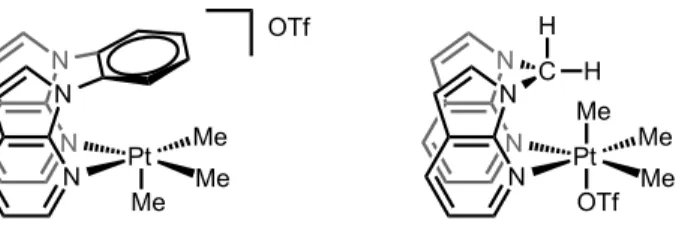
as a starting point for extensive additional studies thereafter (Scheme 2).34 We found we could induce methane reductive elimination either with the addition of an acid or by thermolysis. Both pathways follow a similar mechanism; one arm of the scorpionate ligand dissociates to form a five-coordinate intermediate, which promotes reductive elimination to form a d8 Pt complex. The newly formed Pt(II) complex has demonstrated a multitude of reactivity patterns.35-42 Most of the research reported to date has focused on C-H oxidative activations leading to neutral Pt(IV) complexes.
Scheme 2 Reactivity accessible from TpʹPtMe2H
While our lab primarily focused on TpʹPt complexes, we recently reported a
system utilizing tris(1-R-1H-1,2,3-triazol-4-yl)- phosphine oxide (TtR, R = cyclohexyl,
phenyl). 43,44 To mimic chemistry observed with the Tpʹ ligand, [TtRPtMe2H]+ was
synthesized and heated in the presence of CO to release methane and form [TtRPtMe(CO)]+. However, while Tp
the C group of the Pt-CO ligand, attempting the same reactivity with [TtRPtMe(CO)]+ resulted in loss of the tridentate ligand and led to formation of Pt black. We hypothesized that forming a heteroscorpionate ligand consisting of two tightly binding pyrazolyl
groups and a more weakly binding triazolyl arm would allow for easier Pt(II) oxidation to Pt(IV) without complete ligand loss from the metal center. Chapter 2 discusses the
synthesis of a new ligand series and metalation to generate Pt(IV) complexes while Chapter 5 focuses on the oxidative addition of various substrates with scorpionate ligands bound to Pt(II) and subsequent addition of an electrophile.
1.3 Pt-Carbene Complexes
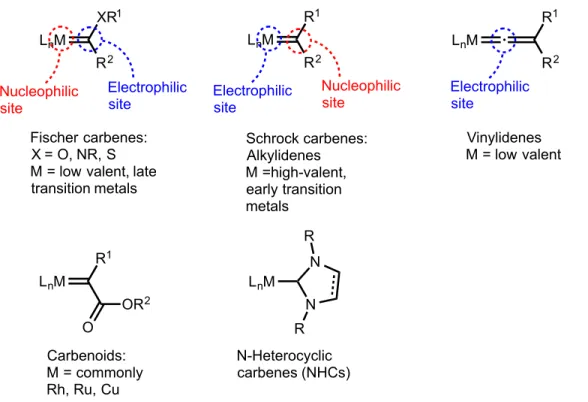
Since the first carbene complex was discovered in the 1960s by E.O. Fischer, investigations into carbenes in catalytic and organometallic chemistry have grown exponentially.45 Carbenes can be categorized into five classes: Fischer, Schrock, vinylidene, carbenoid, and N-Heterocyclic (NHCs) (Figure 3). Fischer and Schrock carbenes are the two most common classifications, as they refer to early descriptions of the classic M-C double bond moiety. 8,45 Vinylidenes are heterocumulene structures with a metal bound at one end. The singlet state of free vinylidenes is 42 kcal/mol more stable than the triplet state, causing it to react in ways similar to reactivity displayed by a
Fischer carbene.46 Carbenoid complexes, also referred to as acceptor substituted carbenes, contain a carbonyl moiety bound to the carbene carbon. While this subcategory is
weak π-acceptors. The NHC moiety consists of two nitrogens bound to the carbene carbon and these donate electron density from their lone pairs to help stabilize the central carbon.50 NHCs are sufficiently stable to withstand numerous reagents unscathed while promoting reactivity at ancillary ligands bound to the metal center.51
Figure 3 Different classifications of carbene ligands in organometallic chemistry
While Fischer and Schrock carbenes both exhibit M-C double bond and are the ends of a continuum of reactivity. Fischer carbenes are often bound to a low oxidation state, late transition metal.4 The carbene carbons are considered singlet donors, the carbon is bound as a σ-donor to an empty metal d-orbital and the metal is π-backbonding.
Another common characteristic of Fischer carbenes is the presence of a heteroatom
LnM LnM
LnM
LnM
LnM XR1
R2 R2
R1 R1 OR2 O R2 R1 N N R R Fischer carbenes:
X = O, NR, S M = low valent, late transition metals Schrock carbenes: Alkylidenes M =high-valent, early transition metals Vinylidenes M = low valent
Carbenoids: M = commonly Rh, Ru, Cu
N-Heterocyclic carbenes (NHCs) Nucleophilic
site
Electrophilic
site Electrophilicsite
Nucleophilic
carbenes are typically bound to high oxidation state metals in early transition metal complexes. The bonding can be pictured as between a triplet carbene carbon and triplet state metal electrons and orbitals. Since the carbene carbon is bound to hydrogen or alkyl substituents, these complexes are often called alkylidenes.
The difference in binding of carbene complexes brings up the importance of electron counting. Schrock carbenes, binding in the triplet state, are often considered doubly anionic ligands when counted in the ionic formalism. Alternatively, Fischer carbenes are considered neutral, 2 e- donor ligands. While we will count carbenes in this thesis using the neutral 2 e- donor formalisms, it is important to remember that the oxidation state assigned to the metal center is a strict formalism. To quote Puddephatt “there is no obligatory association between formal oxidation state and electron density at the metal center”.52
The differences in the electrophilic atom in Fischer and Schrock carbenes controls the chemistry that is observed. Fischer carbenes have an electrophilic carbon; these complexes often react with nucleophiles to displace substituents on the carbene carbon53,54 or insert and form cyclopropene complexes. 55-57 Schrock carbenes, with electrophilic metal centers, are known intermediates for olefin metathesis, which is a process that breaks C-C bonds, shuffles them, and generates new C-C bonds. 58,59 We were interested in exploring reactivity patterns as we attempted to generate Pt(IV) carbene complexes.
report our findings on the synthesis and reactivity on cationic Pt(IV) carbene complexes.
These complexes vary from classic Fischer carbenes, with a nitrogen and oxygen moiety
bound to the carbene carbon, to a Pt(IV) alkylidene. In chapter 4 we report our attempts
REFERENCES
(1) Greenwood, N. N.; Earnshaw, A. Chemistry of the Elements, 2nd ed.; Elsevier Ltd: Oxford, 2005; pp 1144–1172.
(2) Normandeau, G. Technical Aspects of Platinum Refining; 2006; p 38.
(3) Rayner-Canham, G.; Overton, T. Descriptive Inorganic Chemistry, 4 ed.; Craig Bleyer: New York, 2006.
(4) Crabtree, R. H. The Organometallic Chemistry of the Transition Metals, 2nd ed.; Wiley: New York, 1994.
(5) Werner, A. The Nobel Foundation. Amersterdam.
(6) Taube, H. Chem. Rev. 1952, 50, 69.
(7) Wilkinson, G.; Rosenblum, M.; Whiting, M. C. J. Am. Chem. Soc. 1952, 74, 2125.
(8) Schrock, R. R. J. Am. Chem. Soc. 1974, 96, 6796.
(9) Schrock, R. R. Acc. Chem. Res. 1986, 19, 342.
(10) Kellie, A. E.; Smith, E. R. Nature 1956, 178, 323.
(11) Henbest, H. B.; Wilson, R. J. Chem. Soc. 1957, 1958.
(12) Chatt, J.; Davidson, J. M. J. Chem. Soc. 1965, 843.
(13) Fujiwara, Y.; Noritani, I.; Danno, S.; Asano, R. J. Am. Chem. Soc. 1969, 91, 7166.
(14) DuPont. Patent US 178,184 A. 1974.
(15) Larminie, J.; Dicks, A. Fuel Cell Systems Explained, Second. John Wiley & Sons: West Sussex, 2005; pp 1–433.
(16) Olah, G. A. Angew. Chem. Int. Ed. 2005, 44, 2636.
(17) Huber, G. W.; Iborra, S.; Corma, A. Chem. Rev. 2006, 106, 4044.
(18) Goldshle, N. F.; Shteinma, A. A.; Shilov, A. E.; Eskova, V. V. Russian Journal of Physical Chemistry,Ussr 1972, 46, 785.
(20) Dyker, G. Angew. Chem. Int. Ed. 1999, 38, 1699.
(21) Stahl, S. S.; Labinger, J. A.; Bercaw, J. E. Angew. Chem. Int. Ed. 1998, 37, 2181.
(22) Periana, R. A.; Taube, D. J.; Gamble, S.; Taube, H.; Satoh, T.; Fujii, H. Science 1998, 280, 560.
(23) Periana, R. A.; Mironov, O.; Taube, D.; Bhalla, G.; Jones, C. J. Science 2003, 301, 814.
(24) Bercaw, J. E.; Chen, G. S.; Labinger, J. A.; Lin, B.-L. J. Am. Chem. Soc. 2008, 130, 17654.
(25) Scheuermann, M. L.; Goldberg, K. I. Chem. Eur. J. 2014, 20, 14556.
(26) Moustafa, M. E.; Boyle, P. D.; Puddephatt, R. J. Chem. Commun. 2015, 51, 10334.
(27) Luedtke, A. T.; Goldberg, K. I. Inorg. Chem. 2007, 46, 8496.
(28) Zhao, S.-B.; Wu, G.; Wang, S. Organometallics 2008, 27, 1030.
(29) Trofimenko, S. J. Am. Chem. Soc. 1966, 88, 1842.
(30) Trofimenko, S. J. Am. Chem. Soc. 1967, 89, 3170.
(31) Trofimenko, S. J. Am. Chem. Soc. 1967, 89, 6288.
(32) Trofiemenko, S. J. Am. Chem. Soc. 1970, 92, 5118.
(33) Reinartz, S.; White, P. S.; Brookhart, M.; Templeton, J. L. J. Am. Chem. Soc. 2001, 123, 6425.
(34) OReilly, S. A.; White, P. S.; Templeton, J. L. J. Am. Chem. Soc. 1996, 118, 5684.
(35) MacDonald, M. G.; Kostelansky, C. N.; White, P. S.; Templeton, J. L. Organometallics 2006, 25, 4560.
(36) Engelman, K. L.; White, P. S.; Templeton, J. L. Organometallics 2010, 29, 4943.
(37) Reinartz, S.; White, P. S.; Brookhart, M.; Templeton, J. L. Organometallics 2000, 19, 3854.
(39) Reinartz, S.; Baik, M. H.; White, P. S.; Brookhart, M. Inorg. Chem. 2001, 40, 4726.
(40) West, N. M.; Reinartz, S.; White, P. S.; Templeton, J. L. J. Am. Chem. Soc. 2006, 128, 2059.
(41) Frauhiger, B. E.; Ondisco, M. T.; White, P. S.; Templeton, J. L. J. Am. Chem. Soc. 2012, 134, 8902.
(42) West, N. M.; Templeton, J. L. Can. J. Chem. 2009, 87, 288.
(43) Frauhiger, B. E.; White, P. S.; Templeton, J. L. Organometallics 2011, 31, 225. (44) Frauhiger, B. E.; Templeton, J. L. Organometallics 2012, 31, 2770.
(45) Fischer, E. O.; Maasböl, A. Angew. Chem. Int. Ed. Engl. 1964, 3, 580. (46) Bruce, M. I. Chem. Rev. 1991, 91, 197.
(47) Doyle, M. P. Chem. Rev. 1986, 86, 919.
(48) Doyle, M. P.; Forbes, D. C. Chem. Rev. 1998, 98, 911.
(49) Davies, H. M. L.; Beckwith, R. E. J. Chem. Rev. 2003, 103 (8), 2861.
(50) Arduengo, A. J.; Krafczyk, R.; Schmutzler, R.; Craig, H. A.; Goerlich, J. R.; Marshall, W. J.; Unverzagt, M. Tetrahedron 1999, 55, 14523.
(51) Canac, Y.; Soleilhavoup, M.; Conejero, S.; Bertrand, G. J. Organomet. Chem. 2004, 689, 3857.
(52) Rendina, L. M.; Puddephatt, R. J. Chem. Rev. 1997, 97, 1735.
(53) de Meijere, A.; Schirmer, H.; Duetsch, M. Angew. Chem. 2000, 112, 4124. (54) Barluenga, J.; Fernández-Rodrı́guez, M. A.; Aguilar, E. J. Organomet. Chem.
2005, 690, 539.
(55) Brookhart, M.; Studabaker, W. B. Chem. Rev. 1987, 87, 411. (56) Merino, I.; Hegedus, L. S. Organometallics 1995, 14, 2522. (57) Harvey, D. F.; Lund, K. P. J. Am. Chem. Soc. 1991, 113, 8916.
CHAPTER TWO
Investigations into a Bispyrazolyl Monotriazolyl Heteroscorpionate Platinum(IV) System1
2.1 Introduction
Hemilabile ligands containing both strong and weak donor arms have been
employed in a wide range of metal-mediated processes.1,2 Such ligands provide the
benefit of opening a coordination site on the metal while preventing complete ligand loss.
Bidentate and tridentate hemilabile representations are sketched in Figure 1, where a
strong donor ligand (X) remains bound to the metal center while a weaker donor (Y) can
bind reversibly, thus creating a vacant coordination site.
Figure 1 Hemilabile representations in bidentate (a) and tridentate (b) ligands
A plethora of metal-ligand systems have been developed that display reversible
binding of one arm, and pincer ligands are an important class of hemilabile ligands.
Milstein and co-workers have reported a Ru PNN pincer system that converts alcohols to
esters, and the mechanism is believed to involve reversible coordination of a tethered
amine.3 Goldberg et al. have synthesized a PCO tridentate ligand that can adopt ĸ1, ĸ2, and ĸ3 coordination modes.4 Van der Vlugt and co-workers have reported a simple synthetic route that generates PNN chelates that reversibly bind to Rh and Ir metal
centers.5 A hemilabile bidentate ligand with an oxygen donor arm bound to Rh(I)
developed by Dunbar has been utilized for the reversible uptake of small molecules.6,7 A hemilabile Ru(II) system reported by Wolf displays reversible uptake of SMe2, DMSO,
and acetonitrile.8 Recently, Miller has synthesized a NCP pincer-crown ether complex that can reversibly bind oxygen from the crown ether to help stabilize the metal center.9
The past decade has seen significant progress in the development of asymmetrical
hemilabile tridentate facial chelates, including contributions from Rominger10 (NCO, PCO), Zargarian11 (PCN), Szabó12 (PCS), and Song13 (PCP). The initial syntheses of asymmetric facially-coordinating ligands suffered from poor yields, especially for
tris(3,5-dimethylpyrazolyl)methane (Tpm) derivatives.14-17 Canty and co-workers developed a significantly improved synthetic route to asymmetrical Tpm-derived
heteroscorpionates containing two pyrazolyl rings and a third, unique donor arm using a
cobalt-catalyzed condensation. 18-23 Deprotonation of free pyrazole followed by the addition of phosgene results in a bispyrazolyl ketone intermediate. Reger et al. advanced
relevant synthetic methodology by using a bispyrazolyl sulfoxide intermediate that was
prepared by employing thionyl chloride in place of phosgene, noteworthy since the
With a goal of facilitating interconversions between Pt(II) and Pt(IV), our lab published the synthesis and reactivity of tris(1-R-1H-1,2,3-triazol-4-yl)phosphine oxide (R = phenyl, cyclohexyl) (TtR).28,29 The TtR ligand was completely displaced from the Pt(II) center when nucleophilic reagents were introduced to the solution in attempts to attack the carbonyl ligand in the Pt-CO unit at the carbon atom. The inability to add nucleophilic reagents to ligands, like CO, without displacing the chelate ligand motivated us to synthesize a mixed pyrazolyl/triazolyl ligand. As observed with the Tp'Pt system (Tp' = hydridotris(3,5-dimethylpyrazolyl)borate), strong donation from the pyrazolyl nitrogen donors keeps the ligand bound while still allowing the ĸ2/ĸ3 interconversion.30-32
Utilizing Reger’s improved method for generating mixed donor ligands, we prepared similar heteroscorpionates with a C-H backbone that incorporates the triazolyl functionality. We hypothesized that a mixed pyrazolyl/triazolyl donor ligand would tolerate the introduction of nucleophilic reagents for attack on the carbon of a platinum carbonyl, without causing complete ligand loss. Herein, we report the synthesis and metalation of ligands that contain two pyrazolyl rings and one triazolyl ring as well as investigations into their reactivity. Structural data from four monomeric platinum d6 complexes that exhibit octahedral geometries are included here.
N NH
1) 2 NaH 2) SOCl2 THF, 0 oC
2 S
O N N
N N
12 mol% CoCl2 THF, reflux
N N
N N C
N O
N
2.2 Results and Discussion
In the synthetic route to heteroscorpionate ligands reported by Reger,24 the final
condensation step requires a carbonyl functionality attached to the heterocycle that will
ultimately be the unique donor arm of the heteroscorpionate. We synthesized a
1,2,3-triazole with an aldehyde at the 4-position. Employing the same conditions as for the
copper-catalyzed azide-alkyne cycloaddition “click” reaction that was used to generate
TtR,29,33,34 phenyl azide and propargyl alcohol were combined to produce (1-phenyl-1H
-1,2,3-triazol-4-yl)methanol 1-L1 in 66% yield (step 1 in eq 2). The analogous
cyclohexyl (cy) derivative (1-L2) was generated in 69% yield using cyclohexyl azide.
Stahl et al. recently reported selective oxidation of primary alcohols to the corresponding
aldehyde using an aerobic Cu(I) triflate/TEMPO system.35 Applying similar conditions to
1-L1 produced 1-phenyl-1H-1,2,3-triazole-4-carbaldehyde 2-L1 in 72% yield (69% yield for 2-L2).
With the aldehyde compounds in hand, a heteroscorpionate ligand containing two
3,5-dimethyl pyrazolyl donors and a 1,2,3-triazole ring was targeted. Treating a THF
solution of 3,5-dimethyl pyrazole with sodium hydride resulted in deprotonation of the
pyrazole NH and evolution of hydrogen gas. The addition of thionyl chloride presumably
(2) OH
RN3 +
1 mol% CuSO4 sodium ascorbate
1:1 H2O: tBuOH N NN OH
R
5 mol% Cu(I)OTf 5 mol% TEMPO
5 mol% bpy 10 mol% NMI
CH3CN N NN H
R O
R = Ph Cy C6F5
1-L1 1-L2 1-L3
R = Ph Cy C6F5
generated the bispyrazolyl sulfonyl intermediate, 3. Treating 3 with 1,2,3-triazole
aldehyde 2-L1 and a catalytic amount of cobalt chloride while refluxing overnight
produced 4-(bis(3,5-dimethyl-1H-pyrazol-1-yl)methyl)-1-phenyl-1H-1,2,3-triazole 4-L1
in 87% yield, which we will abbreviate as bpztzPh (eq 3). The analogous bpztzCy ligand
4-L2 was produced in 56% yield. Discussion of the fluorinated ligand 4-L3 is included later
in this section.
Metalation of the bpztzR ligands was achieved by sequentially treating two equiv
of 4 with one equiv of [PtMe2(SMe2)]2 and then an excess of methyl iodide was added in
dichloromethane and the solution was stirred at room temperature for 30 min (eq 4).
Removal of the solvent and triturating with pentane produced the air- and moisture-stable
Pt(IV) cation [bpztzRPtMe3][I] 5 as a pale yellow solid in quantitative yield (eq 4). In the
1H NMR spectrum of 5-L1, two Pt-Me resonances appear in a 2:1 ratio at 1.4 and 1.3
ppm (2JPt-H= 71 Hz and 73 Hz), respectively, reflecting the presence of a mirror plane and Cs symmetry. The chemical shift values and coupling constants for these Pt-Me
signals are compatible with other reported Pt(IV)-Me complexes.36-39 The triazolyl proton
in 5-L1 shifts significantly downfield (to 10.7 ppm) when the triazole ring binds to the
metal center. Although the chemical shift for this proton usually moves downfield in 1H N
NH H3C
H3C
1) 2 NaH 2) SOCl2 THF, 0oC 2 S O N N N N
H3C
H3C
CH3
CH3
N NN H
R O
12 mol% CoCl2 THF, reflux N N N N N N N C CH3 CH3 CH3 CH3 H R bpztzR R = Ph 4-L1 Cy 4-L2 C6F5 4-L3 3
NMR spectra of TtR platinum complexes, 29,33 the triazolyl signal in 5-L1 moves over 2
ppm, an unusually large shift. In the C-13 NMR spectrum, the one-bond platinum carbon coupling values for the two Pt-Me resonances are 688 Hz (trans to pyrazole) and 701 Hz (trans to triazole) for 5-L1. These one-bond coupling constants are not good indicators of
bond strength; that correlation works well when hydrogen is involved, but for other NMR active nuclei the correlation is far more complex. Coupling constants for Pt-C bonds in
5-L2 are comparable.
As a point of departure before looking at Pt-N bond lengths we note that the pKa for pyrazole is 19.8 whereas the triazole proton is far more acidic with a pKa of 13.9 in DMSO.40 While binding to the metal center in fact occurs at an alternative nitrogen, it’s
reasonable to keep the proton dissociation properties of pyrazoles and triazoles in mind as we look at structures of Pt(IV) compounds.
5 S Pt S Pt Me Me Me Me Me Me Me Me
2 equiv bpztzR
xs MeI
CH2Cl2, 30 min
I -Pt Me Me C (pz)N (pz)N
N(tzR)
Me H
N N H
N N
+ H+
N N H N N N N
+ H+
pKa = 19.8
pKa = 13.9
(4)
(5)
Figure 2a. hydridotris(3,5-dimethylpyrazolyl)borate. b. tris(3,5-dimethylpyrazolyl)
phosphine oxide. c. tris(3,5-dimethylpyrazolyl)methane. d.
tris(1-R-1H-1,2,3-triazol-4-yl) phosphine oxide (R = phenyl, cyclohextris(1-R-1H-1,2,3-triazol-4-yl). e. 4-(bis(3,5-dimethyl-1H
-pyrazol-1-yl)methyl)-1-R-1H-1,2,3-triazole (R = phenyl, cyclohexyl, pentafluorophenyl).
Slow diffusion of hexanes into a dichloromethane solution of 5-L2 produced clear,
orange-red hexagonal crystals that were suitable for X-ray crystallography. Figure 3
shows the x-ray structure of 5-L2 and selected bond distances and angles are presented in
Table 1. As in the related symmetric [TtRPtMe3]+ complex,29 the metal center adopts an
octahedral geometry with a ĸ3 coordination mode for the chelating ligand. The Pt-N bond
distance to the triazolyl donor (2.135 Å) is the shortest of the three Pt-N bond lengths.
The two pyrazolyl donors, with Pt-N distances of 2.18 and 2.19 Å, appear to be weaker
donors to the Pt(IV) than the triazole ring. The PtMe3 unit assures that identical trans
N N N N N N P CH3 CH3 CH3 CH3 O
H3C
H3C
b. POPz3 6 N N N N N N N C CH3 CH3 CH3 CH3 H R
R = Ph Cy C6F5
e. bpztzR
N N N N N N C CH3 CH3 CH3 CH3 H
H3C
H3C
c. Tpm
N N N N N N B CH3 CH3 CH3 CH3 H
H3C
H3C
N N N N N N N N N P O R R R a. Tp'
d. TtR
R = Ph
Cy 4-L14-L2
influences will impact the three Pt-N bond lengths. The contrast between the pKa
indicators and the observed Pt-N bond distances is striking.
Figure 3 X-ray structure of [bpztzCyPtMe3][I] 5-L2. Ellipsoids are drawn at the 50% probability level. Hydrogen atoms and counterion are omitted for clarity.
Table 1 Selected bond lengths (Å) and angles (deg) for complex 5-L2.
Comparing the new mixed ligand to the TtR ligand, it’s conceivable that the
difference in binding strength of the triazole arm arises from differences in tips of the Bond Lengths
Pt-N1 2.135(4) Pt-C1 2.061(5) Pt-N4 2.178(4) Pt-C2 2.042(5) Pt-N6 2.193(4) Pt-C3 2.054(4)
Bond Angles
umbrella skeletons. The average Pt-N bond length for the TtR ligand in TtRPtMe3 was
2.18 Å, similar to the bound pyrazole arms in our new bpztzRPtMe3+ complexes.29 It
seemed reasonable that the electron withdrawing backbone in the TtR ligands (P=O)
played an important role in modulating the donor strength of the triazolyl nitrogen. We
hypothesized that the synthesis of a bpztz derivative containing an electron-withdrawing
group as a substituent on the triazolyl ring would make the triazolyl bind less tightly.
Repeating the ligand synthesis using pentafluorophenyl azide produced the
pentafluorophenyl derivative bpztzC6F5 4-L3 (eq 3). Using the same conditions for the
generation of 5-L1 and 5-L2, [bpztzC6F5PtMe3][I](5-L3) was produced in quantitative
conversion as observed by 1H NMR spectroscopy. Like 5-L1 and 5-L2, complex 5-L3
also displays Cs symmetry with a 2:1 ratio evident in Pt-Me signals (2JPt-H = 72 Hz for
each). The F-19 NMR spectrum exhibits the expected doublet and two triplets for the
ortho and meta/para fluorine atoms. The one-bond platinum-carbon coupling values of
the two Pt-Me resonances are 685 Hz (trans to pyrazole) and 706 Hz (trans to triazole),
similar to 5-L1 and 5-L2.
Slow diffusion of hexanes into a dichloromethane solution of 5-L3 produced clear,
orange/red hexagonal crystals that were suitable for X-ray crystallography. Figure 4
shows the x-ray structure of 5-L2 and selected bond distances and angles are presented in
Table 2. The N(triazole) bond distance of 2.138 Å is again shorter than the two
Pt-N(pyrazole) distances, both 2.19 Å, reflecting stronger binding from the triazolyl ring
compared to the two pyrazoles. Comparing the Pt-N(triazole) distance to the analogous
[bpztzCyPtMe3]+ structure reveals that the addition of the pentafluorophenyl substituent
by bond distance measurements. The bond angles about platinum (84-95°) hover near the
ideal 90°, with the three nitrogens of the tridentate ligand slightly pinched, similar to the
angles in 5-L2.
Figure 4 X-ray structure of [bpztzC6F5PtMe3][I] 5-L3. Ellipsoids are drawn at the 50% probability level. Hydrogen atoms and the iodide counterion are omitted for clarity.
Table 2. Selected bond lengths (Å) and angles (deg) for complex 5-L3.
Bond Lengths
Pt-N1 2.138(3) Pt-C20 2.042(4)
Pt-N4 2.188(3) Pt-C21 2.050(4)
Pt-N6 2.188(3) Pt-C22 2.058(4)
Bond Angles
N1-Pt-N4 84.95(12) C20-Pt-C21 89.67(18)
While the two bpztzRPtMe3+ structures were in good agreement with one another,
the triazole to platinum bond distances were shorter than in the analogous TtR complex
with three triazole arms for the scorpionate ligand. The average Pt-N bond length for the
TtR ligand in the TtRPtMe3+ comp complex29 was 2.18 Å, longer than the Pt-N bond to
the triazole in 5-L2 and 5-L3.
Since the pentafluorophenyl group on the triazolyl arm had no significant impact
on the Pt-N bond length, we turned to an investigation of the influence of the phosphine
oxide spine in the TtR system. Comparing the new mixed ligand to the triazole based TtR
ligand with a P=O spine, it’s conceivable that the difference in the binding strength of the
triazole arm arises from differences in the spine of the umbrella skeletons. Deprotonation
of 3,5-dimethylpyrazole with sodium hydride followed by addition of phosphoryl
chloride resulted in the desired tris(3,5-dimethylpyrazolyl)phosphine oxide (POPz3) 6, in
96% yield. Conditions used for the preparation of complex 5-L1 proved insufficient to
push the metalation of 6 to completion. Switching from MeI to a stronger methylating
reagent, methyl trifluoromethansulfonate (MeOTf), and extending reaction times allowed
for generation and isolation of the desired cationic Pt(IV) complex, [POPz3PtMe3][OTf],
7, in quantitative yields (eq 7). Complex 7 displayed C3v symmetry in the 1H NMR
spectrum as evident by a single Pt-CH3 peak. The pyrazolyl proton showed a small
P O
N N
N N
N
N N
N N
P
CH3
CH3 CH3
CH3 O
H3C
H3C =
POPz3
coupling to phosphorus (1 Hz) while the P-31 NMR signal at -18.26 ppm exhibited 3-bond coupling to platinum (9 Hz).
Slow diffusion of benzene into a solution of 7 in dichloromethane produced clear crystals suitable for X-ray crystallography. Figure 5 shows the x-ray structure of 7 and selected bond distances and angles are presented in Table 3. Complex 7 crystallized in a chiral space group. The three pyrazolyl Pt-N bond distances of ca. 2.20 Å are slightly elongated from those of the analogous trimethylPt(IV)Tp' complex, which are near 2.19 Å.41 The Pt-N distances for these pyrazolyl donors are also close to the bond lengths observed for the triazole based TtR ligand (2.17-2.19 Å).29
Pt Me N
N Me
Me N P O
2eq POPz3
xs MeOTf
CH2Cl2, 2 hrs
OTf
7
S Pt
S Pt
Me Me
Me Me
Me
Me Me
Me
Figure 5 X-ray structure of [POPz3PtMe3][OTf] 7. Ellipsoids are drawn at the 50% probability level. Hydrogen atoms, trifluoromethansulfonate counterion, and benzene molecule are omitted for clarity.
Table 3 Selected bond lengths (Å) and angles (deg) for complex 7.
C H
N N
N N
N
N N
N N
C
CH3
CH3
CH3
CH3
H H3C
H3C =
Tpm Bond Lengths
Pt-N1 2.201(4) Pt-C1 2.041(6)
Pt-N3 2.199(4) Pt-C2 2.047(5)
Pt-N5 2.185(5) Pt-C3 2.052(4)
Bond Angles
N1-Pt-N3 88.2(2) C2-Pt-C1 89.0(2)
The phosphine oxide backbone did not significantly change the Pt-N bond length
so we turned to the C-H backbone in the well-known Tpm ligand, just as the C-H moiety
is present in the mixed bpztzR set of ligands. Employing Tpm24 under the same conditions
as for the preparation of POPz3 complex 7 generated the desired cationic Pt(IV) complex,
[TpmPtMe3][OTf], 8, eq 8.
Slow diffusion of pentane into a solution of 8 in dichloromethane produced clear
crystals suitable for X-ray crystallography. Complex 8 crystallized with three
independent molecules in the unit cell. Figure 6 shows the x-ray structure of one of the
three independent molecules and selected bond distances and angles are presented in
Table 4. Complex 8 shows nearly octahedral geometry, with bond angles around
platinum between 84-93° with the three nitrogens slightly pinched together, generating a
slightly opened N-Pt-C angle. The Pt-N bond distances in this Tpm complex average 2.18
Å, slightly shorter than those observed in trimethyl Pt(IV) complexes with the other
neutral ligands, namely TtR and POPz3, presumably due to the more electron donating
C-H backbone. The anionic Tp' ligand leads to a neutral Pt(IV) complex while all the other
complexes reported here are cationic Pt(IV) compounds. Despite the slightly shorter bond
lengths of the TpmPt complex compared to the mixed ligand system, the Pt-N bonds
found in Tpm complex 8 were about 0.02 Å longer than the Pt-N distances for the triazole
arm in the bpztzR hybrid ligand system. S
Pt S
Pt Me Me
Me
Me
Me
Me
Me Me
2 equiv Tpm xs MeOTf
CH2Cl2, 30 min
OTf
Pt Me Me C
N N
N
Me H
8
Figure 6 X-ray structure of [TpmPtMe3][OTf] 8. Ellipsoids are drawn at the 50% probability level. Hydrogen atoms and trifluoromethansulfonate counterion are omitted for clarity.
Table 4 Selected bond lengths (Å) and angles (deg) for one of the three independent molecules of complex 8.
Bond Lengths
Pt-N29 2.187(6) Pt-C26 2.044(7) Pt-N36 2.189(6) Pt-C27 2.072(8) Pt-N43 2.162(6) Pt-C28 2.049(8)
Bond Angles
2.3 Conclusion
A series of asymmetrical scorpionate ligands bearing two pyrazolyl rings and one
triazolyl ring has been synthesized using a cobalt-catalyzed condensation reaction.
Metalation of these ligands to generate neutral Pt(II) complexes followed by subsequent
methylation results in stable Pt(IV) cations. Solid-state structural data reveal that the
nitrogen distance to the triazolyl moiety is shorter than the two
platinum-nitrogen pyrazolyl distances, indicating that the triazolyl ring is a stronger donor to Pt(IV).
The addition of an electron withdrawing substituent on the triazole arm does not
influence the ligand donor strength as assessed by Pt-N distances. While the backbone of
the scorpionate ligand plays an integral part in binding to platinum, there is no evidence
for why the triazole arm of the heteroscorpionate ligand binds more tightly to the Pt
center.
2.4 Experimental Section
Materials and Methods. All reactions were performed under an atmosphere of
dry nitrogen using standard Schlenk and drybox techniques. Nitrogen was purified by
passage through columns of BASF R3-11 catalyst and 4 Å molecule sieves.
Dichloromethane, dimethyl ether, tetrahydrofuran (THF), and pentane were purified
under an argon atmosphere and passed through a column packed with activated alumina.
All other chemicals were used as received without further purification. Silica column
chromatography was conducted with 230-400 mesh silica gel and alumina column
1H, 19F, 31P, and 13C NMR spectra were recorded on Bruker DRX400,
AVANCE500, or ULTRA SHIELD CRYOQNP600 spectrometers. 1H NMR and 13C
NMR chemical shifts were referenced to residual 1H and 13C signals of the deuterated
solvents. Elemental analyses were performed by Robertson Microlit Laboratories of
Madison, NJ. High-resolution mass spectra were recorded on a Bruker BioTOF II
ESI-TOF mass spectrometer. Mass spectral data are reported for the most abundant platinum
isotope.
(1-phenyl-1H-1,2,3-triazol-4-yl)methanol 1-L1. To a 250-mL Schlenk flask
was added phenyl azide (7.8 g, 65.5 mmol) and propargylic alcohol (3.78 mL, 68.0
mmol). The flask was purged with nitrogen and 60 mL of a 1:1 mixture of tert-butanol
and water was added through the septum. The solution was treated with 3.9 mL (3.9
mmol) of a 1 M aqueous sodium ascorbate solution and 1.54 mL (0.58 mmol) of a 0.37
M aqueous copper sulfate solution. The cloudy yellow solution was allowed to stir for 2
d at room temperature at which point the solution had become clear. The product was
extracted into CH2Cl2 and dried over MgSO4. The mixture was then passed through a
Celite plug, the solvent was evaporated, and the resulting oil was triturated with pentane
to produce 7.5 g (43.5 mmol) of 1-L1 in 66% yield. 1H NMR (δ, CD2Cl2, 298 K): 7.74 (s,
1H, tz), 7.72 (d, 2H, o-Ph), 7.53 (t, 2H, m-Ph), 7.45 (t, 1H, p-Ph), 4.84 (s, 2H, CH2), 3.13
(br s, 1H, OH). 13C NMR (δ, CD
2Cl2, 298 K): 148.9 (tz 4-position), 137.5 (ipso-Ph),
130.1 (o-Ph), 129.1 (p-Ph), 120.9 (m-Ph), 120.5 (tz 5-position), 56.6 (CH2). Anal Calcd
for C9H9N3O: C, 61.70; H, 5.18; N, 23.99. Found: C, 61.71; H, 5.46; N, 23.94.
(1-cyclohexyl-1H-1,2,3-triazol-4-yl)methanol 1-L2. To a 250-mL Schlenk flask
mmol). The flask was purged with nitrogen and a 1:1 mixture (60 mL) of tert-butanol
and water was added through the septum. The solution was treated with 4.3 mL (4.3
mmol) of a 1 M aqueous sodium ascorbate solution and 2.15 mL (0.80 mmol) of a 0.37
M aqueous copper sulfate solution. The cloudy yellow mixture was allowed to stir for 2
d at room temperature at which point the solution became clear. The product was
extracted with CH2Cl2 and dried over MgSO4. The mixture was then passed through a
Celite plug, the solvent was evaporated, and the resulting solid was triturated with
pentane to produce 7.06 g (39.7 mmol) of 1-L2 in 69% yield. 1H NMR (δ, CD2Cl2, 298
K): 7.60 (s, 1H, tz), 4.69 (s, 2H, CH2), 4.40 (tt, 1H, CA-H), 4.31 (s, 1H, OH), 2.17-1.21
(m, 11 H, cyclohexyl). 13C NMR (δ, CD2Cl2, 298 K): 147.9 (tz 4-position), 120.1 (tz
5-position), 60.4 (CA), 56.2 (CH2), 33.8 (CB), 25.5 (CC), 25.4 (CD). Anal Calcd for
C9H15N3O: C, 59.64; H, 8.34; N, 23.19. Found: C, 59.78; H, 8.13; N, 23.18.
(1-pentafluorophenyl-1H-1,2,3-triazol-4-yl)methanol 1-L3. To a 250-mL
Schlenk flask was added pentafluorophenyl azide (1.18 g, 5.65 mmol) and propargylic
alcohol (0.32 mL, 5.62 mmol). The flask was purged with nitrogen and a 1:1 mixture (60
mL) of tert-butanol and water was added through the septum. The solution was treated
with 0.33 mL (0.33 mmol) of a 1 M aqueous sodium ascorbate solution and 0.20 mL
(0.07 mmol) of a 0.37 M aqueous copper sulfate solution. The cloudy yellow mixture
was allowed to stir overnight at room temperature. The product was extracted with
CH2Cl2 and dried over MgSO4. The mixture was then passed through a Celite plug, the
solvent was evaporated, and the resulting solid was triturated with pentane to produce
1.02 g (3.84 mmol) of 1-L3 in 68% yield. 1H NMR (δ, CD2Cl2, 298 K): 7.85 (s, 1H, tz),
-149.9 (t, p-F), -159.5 (t, m-F). 13C NMR (δ, CD2Cl2, 298 K): 148.2 (tz 4-position), 142.4
(m, o-ArF and p-ArF, 1JC,F = 264 Hz), 138.0 (m, m-ArF, 1JC,F = 261 Hz), 124.4 (tz
5-position), 112.8 (m, ipso-ArF). Anal Calcd for C9H4N3OF5: C, 40.77; H, 1.52; N, 15.85.
Found: C, 40.98; H, 1.57; N, 15.50.
1-phenyl-1H-1,2,3-triazole-4-carbaldehyde 2-L1. A modified version of
Stahl’s procedure was performed.35 A 250-mL Schlenk flask was charged with 7.5 g
(43.4 mmol) of 1-L1. Acetonitrile (100 mL) was added and the mixture was stirred until
all of 1-L1 dissolved. The solution was treated with tetrakisacetonitrile copper(I) triflate
(0.780 g, 2.07 mmol), bipyridine (0.331 g, 2.12 mmol), TEMPO (0.331 g, 2.12 mmol),
and N-methyl imidazole (0.31 mL, 4.14 mmol) and the resulting dark red solution was
stirred open to air overnight at which point it became emerald green. Diethyl ether (40
mL) and pentane (40 mL) were added and the solution was filtered through a silica plug.
The solvent was removed by rotary evaporation and pentane (50 mL) was added to
remove excess TEMPO. The pink supernatant was decanted off to afford 5.38 g (31.5
mmol) of 1-L2 as a white crystalline solid in 72% yield. 1H NMR (δ, CD2Cl2, 298 K):
10.19 (s, 1H, C(O)H), 8.57 (s, 1H, tz), 7.79 (d, 2H, o-Ph), 7.60 (t, 2H, m-Ph), 7.55 (t, 1H,
p-Ph). 13C NMR (δ, CD2Cl2, 298 K): 184.8 (C(O)H), 148.1 (tz 4-position), 136.2 (ipso
-Ph), 130.0 (o-Ph), 129.7 (p-Ph), 123.9 (tz 5-position), 120.9 (m-Ph). IR(CH2Cl2): νC=O =
1703 cm-1. Anal Calcd for C
9H7N3O: C, 62.42; H, 4.07; N, 24.27. Found: C, 62.65; H,
3.93; N, 24.22.
1-cyclohexyl-1H-1,2,3-triazole-4-carbaldehyde 2-L2. A 250-mL Schlenk flask
was charged with 6.29 g (35.3 mmol) of 1-L2. Acetonitrile (100 mL) was added and the
tetrakisacetonitrile copper(I) triflate (0.658 g, 1.74 mmol), bipyridine (0.280 g, 1.67
mmol), TEMPO (0.280 g, 1.67 mmol), and N-methyl imidazole (0.28 g, 3.27 mmol) and
the dark red solution was stirred open to air overnight at which point it became emerald
green. Diethyl ether (40 mL) and pentane (40 mL) were added and the solution was
filtered through a silica plug. The solvent was removed by rotary evaporation and
pentane (50 mL) was added to remove excess TEMPO. The pink supernatant was
decanted off to afford 4.27 g (24.3 mmol) of 2-L2 as a white crystalline solid in 69%
yield. 1H NMR (δ, CD2Cl2, 298 K): 10.08 (s, 1H, C(O)H), 8.14 (s, 1H, tz), 4.51 (tt, 1H,
CA-H), 2.25-1.28 (m, 11 H, cyclohexyl). 13C NMR (δ, CD2Cl2, 298 K): 185.3 (C(O)H),
147.7 (tz 4-position), 123.6 (tz 5-position), 60.9 (CA), 33.7 (CB), 25.3 (CC), 25.3 (CD).
IR(CH2Cl2): νC=O = 1698 cm-1. Anal Calcd for C9H13N3O: C, 60.32; H, 7.31; N, 23.45.
Found: C, 60.26; H, 7.35; N, 23.31.
1-pentafluorophenyl-1H-1,2,3-triazole-4-carbaldehyde 2-L3. A 250-mL
Schlenk flask was charged with 1.25 g (4.72 mmol) of 1-L3. Acetonitrile (30 mL) was
added and the mixture was stirred until all of 1-L3 dissolved. The solution was treated
with tetrakisacetonitrile copper(I) triflate (0.087 g, 0.23 mmol), bipyridine (0.036 g, 0.24
mmol), TEMPO (0.036 g, 0.24 mmol), and N-methyl imidazole (0.037 g, 0.48 mmol) and
the dark red solution was stirred open for 2 d at which point it became emerald green.
Diethyl ether (40 mL) and pentane (40 mL) were added and the solution was filtered
through a silica plug. The solvent was removed by rotary evaporation and pentane (50
mL) was added to remove excess TEMPO. The pink supernatant was decanted off to
afford 0.80 g (3.04 mmol) of 2-L3 as a white crystalline solid in 64% yield. 1H NMR (δ,
-145.9 (d, o-F), -149.3 (t, p-F), -159.6 (t, m-F). 13C NMR (δ, CD2Cl2, 298 K): 184.1
(C(O)H), 147.8 (tz 4-position), 143.0 (m, p-ArF, 1JC,F = 260 Hz), 142.5 (m, o-ArF, 1JC,F
= 261 Hz), 138.4 (m, m-ArF, 1JC,F = 258 Hz), 129.0 (tz 5-position), 112.3 (m, ipso-ArF).
IR(CH2Cl2): νC=O = 1709 cm-1. Anal Calcd for C9H3N3OF5: C, 41.08; H, 0.77; N, 15.97.
Found: C, 41.46; H, 0.77; N, 15.94.
4-(bis(3,5-dimethyl-1H-pyrazol-1-yl)methyl)-1-phenyl-1H-1,2,3-triazole
(bpztzPh) 4-L1. A modified version of Reger’s procedure was performed.24 A 250-mL
Schlenk flask was charged with 0.278 g (11.58 mmol) of sodium hydride. THF (40 mL)
was added through the septum and the cloudy white solution was cooled to 0°C in an ice
bath. 3,5-dimethyl pyrazole (1.098 g, 11.55 mmol) was slowly added to the mixture and
hydrogen gas evolved. The solution was stirred for 30 min at 0°C and became clear and
colorless. Thionyl chloride (0.42 mL, 5.78 mmol) was added through the septum and the
solution was stirred at 0°C. After 45 min, 2-L1 (0.500 g, 2.92 mmol) and a catalytic
amount of CoCl2 (0.018 g, 0.14 mmol) were added. The sea green solution was refluxed
overnight then cooled to room temperature. Diethyl ether (40 mL) and water (40 mL)
were added and stirred for 30 min to quench the cobalt catalyst. The organic layer was
extracted and dried over MgSO4. After filtration, the solvent was removed by rotary
evaporation and the yellow oil was triturated three times with pentane to afford 0.880 g
(2.53 mmol) of 4-L1 as a yellow solid in 87% yield. 1H NMR (δ, CD2Cl2, 298 K): 8.32
(s, 1H, tz H), 7.78 (d, 2H, o-Ph), 7.69 (s, 1H, HC(pz)2(tz)), 7.55 (t, 2H, m-Ph), 7.47 (t, 1H,
p-Ph), 5.88 (s, 2H, pz H), 2.32, 2.19 (s, 3H each, pz CH3). 13C NMR (δ, CD2Cl2, 298 K):
149.0, 140.6 (pz C-CH3), 144.7 (tz 4-position), 137.3 (ipso-Ph), 130.0, (m-Ph), 129.2 (p
CH3). Anal Calcd for C19H21N7: C, 65.69; H, 6.09; N, 28.22. Found: C, 65.55; H, 5.86; N,
27.57.
4-(bis(3,5-dimethyl-1H-pyrazol-1-yl)methyl)-1-cyclohexyl-1H-1,2,3-triazole (bpztzCy) 4-L2. A 250-mL Schlenk flask was charged with 0.556 g (23.2 mmol) of
sodium hydride. THF (40 mL) was added through the septum and the cloudy white
solution was cooled to 0°C in an ice bath. 3,5-dimethyl pyrazole (2.196 g, 23.1 mmol)
was slowly added to the mixture and hydrogen gas evolved. The solution was stirred for
30 min at 0°C and became clear and colorless. Thionyl chloride (0.84 mL, 11.6 mmol)
was added through the septum and the solution was stirred at 0°C. After 45 min, 2-L2
(1.03 g, 5.85 mmol) and a catalytic amount of CoCl2 (0.036 g, 0.28 mmol) were added.
The sea green solution was refluxed overnight then cooled to room temperature. Diethyl
ether (40 mL) and water (40 mL) were added and stirred for 30 min to quench the cobalt
catalyst. The organic layer was extracted and dried over MgSO4. After filtration, the
solvent was removed by rotary evaporation and the yellow oil was triturated five times
with pentane to afford 1.15 g (3.26 mmol) of 4-L2 as an orange solid in 56% yield. 1H
NMR (δ, CD2Cl2, 298 K): 7.91 (s, 1H, tz H), 7.68 (HC(pz)2(tz)), 5.89 (s, 2H, pz H), 4.47
(tt, 1H, CA-H), 2.33, 2.23 (s, 3H each, pz CH3), 2.33-1.32 (11H, cyclohexyl). 13C NMR
(δ, CD2Cl2, 298 K): 148.6, 140.4 (pz C-CH3), 143.4 (tz 4-position), 123.0 (tz 5-position),
106.1 (pz CH), 67.4 (HC(pz)2(tz)), 60.6 (CA), 33.7 (CB), 25.4 (CC and CD), 13.6, 11.4 (pz
CH3). Anal Calcd for C19H26N7: C, 64.56; H, 7.70; N, 27.74. Found: C, 64.31; H, 7.77; N,
27.22.
mmol) of sodium hydride. THF (40 mL) was added through the septum and the cloudy
white solution was cooled to 0°C in an ice bath. 3,5-dimethyl pyrazole (1.16 g, 16.3
mmol) was slowly added to the mixture and hydrogen gas evolved. The solution was
stirred for 30 min at 0°C and became clear and colorless. Thionyl chloride (0.45 mL,
6.21 mmol) was added through the septum and the solution was stirred at 0°C. After 45
min, 2-L3 (0.80 g, 3.04 mmol) and a catalytic amount of CoCl2 (0.019 g, 0.15 mmol)
were added. The sea green solution was refluxed overnight then cooled to room
temperature. Diethyl ether (40 mL) and water (40 mL) were added and stirred for 30 min
to quench the cobalt catalyst. The organic layer was extracted and dried over MgSO4.
After filtration, the solvent was removed by rotary evaporation and the yellow oil was
triturated five times with pentane to afford 0.85 g (2.19 mmol) of 4-L3 as an orange solid
in 72% yield. 1H NMR (δ, CD2Cl2, 298 K): 8.28 (s, 1H, tz H), 7.71 (HC(pz)2(tz)), 5.87 (s,
2H, pz H), 2.32, 2.18 (s, 3H each, pz CH3). 19F NMR (δ, CD2Cl2, 298 K): -146.1 (d, o-F),
-150.7 (t, p-F), -160.4 (m, m-F). 13C NMR (δ, CD
2Cl2, 298 K): 149.2, 140.7 (pz C-CH3),
144.7 (tz 4-position), 142.8 (m, o-ArF and p-ArF, 1JC,F = 249 Hz), 138.5 (m, m-ArF, 1JC,F
= 255 Hz), 128.3 (tz 5-position), 113.2 (m, ipso-ArF), 107.2 (pz CH), 67.0 (HC(pz)2(tz)),
13.7, 11.4 (pz CH3). Anal Calcd for C19H21N7F5: C, 52.18; H, 3.69; N, 22.42. Found: C,
52.13; H, 3.60; N, 22.16.
[bpztzPhPtMe
3][I] 5-L1. A 50-mL Schlenk was charged with 0.030 g (0.05
mmol) of [PtMe2(SMe2)]2 and 0.036 g (0.10 mmol) of 4-L1. The flask was purged with
nitrogen and CH2Cl2 (10 mL) was added through the septum. The yellow solution was
treated with 20 uL (0.30 mmol) of methyl iodide and stirred for 30 min at room
triturated with pentane to afford 5-L1 as a pale yellow solid in quantitative yield. 1H
NMR (δ, CD2Cl2, 298 K): 10.67 (s, 1H, tz H), 8.85 (s, 1H, HC(pz)2(tz)), 7.84 (d, 2H,
o-Ph), 7.55 (m, 3H, m-Ph and p-o-Ph), 6.00 (s, 2H, pz H), 2.83, 2.32 (s, 3H each, pz CH3),
1.42 (s, 6H, 2J
Pt-H = 71 Hz, Pt-CH3), 1.32 (s, 3H, 2JPt-H = 73 Hz, Pt-CH3) . 13C NMR (δ,
CD2Cl2, 298 K): 152.8, 142.8 (pz C-CH3), 139.4 (tz 4-position), 136.4 (ipso-Ph), 130.5,
(p-Ph), 130.4 (m-Ph), 126.2 (tz 5-position), 121.1 (o-Ph), 108.8 (pz CH), 61.4
(HC(pz)2(tz)), 13.2, 13.1 (pz CH3), -8.0 (1JPt-C = 688 Hz, Pt-CH3), -10.7 (1JPt-C = 701 Hz,
Pt-CH3). Anal Calcd for C22H30N7IPt: C, 36.82; H, 4.23; N, 13.72. Found: C, 35.97; H,
4.50; N, 13.39.
[bpztzCyPtMe3][I] 5-L2. A 50-mL Schlenk was charged with 0.030 g (0.05 mmol) of [PtMe2(SMe2)]2 and 0.037 g (0.10 mmol) of 4-L2. The flask was purged with
nitrogen and CH2Cl2 (10 mL) was added through the septum. The yellow solution was
treated with 20 µL (0.30 mmol) of methyl iodide and stirred for 30 min at room
temperature. The solvent was removed via rotary evaporation and the resulting oil was
triturated with pentane to afford 5-L1 as a pale yellow solid in quantitative yield. 1H
NMR (δ, CD2Cl2, 298 K): 10.10 (s, 1H, tz H), 8.73 (HC(pz)2(tz)), 5.98 (s, 2H, pz H), 4.50
(tt, 1H, CA-H), 2.83, 2.29 (s, 3H each, pz CH3), 2.33-1.25 (11H, cyclohexyl), 1.34 (s, 6H, 2J
Pt-H = 72 Hz, Pt-CH3), 1.25 (s, 3H, 2JPt-H = 70 Hz, Pt-CH3). 13C NMR (δ, CD2Cl2, 298
K): 152.7, 142.6 (pz C-CH3), 138.6 (tz 4-position), 126.2 (tz 5-position), 108.7 (pz CH),
62.6 (CA), 61.7 (HC(pz)2(tz)), 33.4 (CB), 25.2 (CC and CD), 13.4, 13.2 (pz CH3), -8.3
(1JPt-C = 690 Hz, Pt-CH3), -11.1 (1JPt-C = 703 Hz, Pt-CH3). Anal Calcd for C22H35N7IPt: C,

![Figure 3 X-ray structure of [bpztz Cy PtMe 3 ][I] 5-L2. Ellipsoids are drawn at the 50%](https://thumb-us.123doks.com/thumbv2/123dok_us/8318723.2204499/44.918.152.703.195.600/figure-ray-structure-bpztz-cy-ptme-ellipsoids-drawn.webp)
![Figure 4 X-ray structure of [bpztz C6F5 PtMe 3 ][I] 5-L3. Ellipsoids are drawn at the 50%](https://thumb-us.123doks.com/thumbv2/123dok_us/8318723.2204499/46.918.149.738.232.621/figure-x-ray-structure-bpztz-ptme-ellipsoids-drawn.webp)
![Figure 5 X-ray structure of [POPz 3 PtMe 3 ][OTf] 7. Ellipsoids are drawn at the 50%](https://thumb-us.123doks.com/thumbv2/123dok_us/8318723.2204499/49.918.148.510.112.496/figure-ray-structure-popz-ptme-otf-ellipsoids-drawn.webp)
![Figure 6 X-ray structure of [TpmPtMe 3 ][OTf] 8. Ellipsoids are drawn at the 50%](https://thumb-us.123doks.com/thumbv2/123dok_us/8318723.2204499/51.918.142.547.149.559/figure-x-ray-structure-tpmptme-otf-ellipsoids-drawn.webp)
![Figure 3 X-ray structure of [TpʹPt(=C(OCH 3 )CH 3 )Me 2 ][OTf] 6. Ellipsoids are drawn at the 50% probability level](https://thumb-us.123doks.com/thumbv2/123dok_us/8318723.2204499/84.918.146.470.530.929/figure-structure-tpʹpt-och-ellipsoids-drawn-probability-level.webp)
