OBSERVING ACTION RESEARCH PROCESSES IN PRACTICE
Adina O. Davidson
A dissertation submitted to the faculty of The University of North Carolina at Chapel Hill in partial fulfillment of the requirements for the degree of Doctor of Philosophy in
the School of Education
Chapel Hill 2009
iii ABSTRACT Adina O. Davidson
OBSERVING ACTION RESEARCH PROCESSES IN PRACTICE (Under the direction of Jocelyn Glazier)
The purpose of the current study was to observe how teachers integrate action research processes into their instructional practice. While action research is often presented to teachers as a methodology, the processes used in the pursuit of research questions may provide a way of conceptualizing effective teaching practice. The two participants in this study were observed in their school environments and interviewed prior to and following the observational period. Qualitative methods included participant observation, interviews, and document review. Multiple methods were employed for the purpose of triangulating the observed action research processes in practice. In this collective case study data were collected, coded, and analyzed to interpret and describe how action research processes were employed in practice.
Participants in this study employed action research processes without a fixed order and informally in practice. Each case illustrated different ways in which action research processes were integrated into practice. One participant was observed to
iv
as planning time available to participants, class structure, student age, years of teaching experience, and curriculum requirements appeared to influence, in part, how processes were employed in practice. Overall participants demonstrated a broader application of action research processes that transcended the use of action research solely as a research methodology. Through observation of their practice, it was evident that participants, to varying degrees, adopted an action research stance with regard to their teaching.
Teachers who adopt an action research teaching stance systematically and
v
ACKNOWLEDGMENTS
I would like to express heartfelt appreciation and gratitude to all of those who saw me through this process.
Thank you to the teachers, administrators, and schools who welcomed me to collect data for the current study.
To my dissertation committee chair and advisor, Jocelyn Glazier, thank you for providing me with an extraordinary amount of your time, effort, guidance, and support. I feel so fortunate to have worked with you.
To my dissertation committee: Jocelyn Glazier; Dwight Rogers; George Noblit; Mollie Lloyd; Cheryl Bolick; and Amy Anderson, your time and insightful feedback throughout the dissertation process enhanced my work and were truly appreciated.
To my writing group: Evelyn Gordon; Steve Amendum; Karren Timmermans; Kelley Mayer; Jennifer Jones; and Karyl Askew, for your humor, straightforwardness, critique, and unending support, I am more grateful than words can express.
To my sister, Jennie, thank you for the late night reference runs, spontaneous childcare, and just being a constant source for support.
To my mother, Carol, thank you for your encouragement throughout my time at UNC.
vi
vii
TABLE OF CONTENTS
LIST OF TABLES ... xii
LIST OF FIGURES ... xiii
CHAPTER1: INTRODUCTION ... 1
Rationale ... 4
Introduction to Action Research ... 4
How Does This Study Contribute to the Current Literature on Action Research? ... 7
Study Focus ... 9
Role of the Researcher ... 10
CHAPTER 2: LITERATURE REVIEW ... 14
Brief History of Action Research ... 14
Definitions of Action Research from the Literature ... 16
Processes of Action Research ... 19
Reflection ... 19
Developing Open-Ended Research Questions ... 21
Reviewing the Literature... 21
Data Collection ... 22
Data Analysis and Interpretation ... 23
viii
Related Dispositions ... 24
Results of Using Action Research in Practice ... 25
Engaging in critical reflection ... 26
Questioning Ways of Knowing ... 27
Fostering new Understandings of Teaching ... 27
Qualities of Effective Teaching ... 29
The Incorporation of Action Research into Teacher Education Programs ... 33
CHAPTER 3: METHODOLOGY ... 41
Participants ... 42
Setting ... 44
Processes Observed in Practice ... 45
Observation Procedures ... 47
Data Collection ... 51
Participant Observation ... 51
Document Review ... 53
Interviews ... 54
Data Analysis ... 55
Trustworthiness ... 57
CHAPTER 4: ANALYSIS ... 59
Introduction ... 59
Overview of Jennifer and Rebecca’s Practice ... 60
Jennifer ... 60
ix
Findings... 67
Reflection ... 69
Investigating Practice ... 78
Consulting Other Sources ... 81
Identifying and Gathering Data ... 86
Reviewing and Interpreting Data ... 90
Sharing Knowledge with Others ... 94
Application of new Knowledge in Practice ... 98
Disposition Categories Observed during the Employment of Action Research Processes ... 102
Flexibility in Practice ... 103
Empowerment ... 107
Taking Risks in Practice ... 109
Openness to Critique ... 112
Views Learning about Teaching as an Ongoing Process ... 115
CHAPTER 5: DISCUSSION AND CONCLUSIONS ... 118
Action Research as Effective Teaching ... 118
The Systematic and Connected Nature of Action Research ... 120
Influences on Practice ... 122
Reflection ... 123
Qualitative Differences in Reflection ... 124
Using Data ... 125
x
Dispositions about Teaching through the Integration of Action Research ... 128
The Nature of Observing Action Research Processes ... 131
Conclusions ... 134
Why Consider Action Research as a Framework for Effective teaching? ... 135
Embedding Action Research Processes in Practice as a Framework for Effective Teaching ... 137
Implications for Teacher Education ... 137
Implications for Teachers ... 140
Areas for Future Research ... 143
Concluding Remarks ... 144
APPENDIX A ... 146
Initial Interview Questions ... 146
Final Interview Questions ... 146
APPENDIX B ... 149
Description of the Action Research Course ... 149
Objective 1 ... 151
Objective 2. ... 151
Objective 3 ... 152
Objective 4 ... 153
Objective 5 ... 153
Objective 6 ... 154
Objective 7 ... 154
xi
xii
LIST OF TABLES
Table Page
Table 1 Cruickshank & Haefel (2001) Variations of Good Teaching ... 31
Table 2 Reclassification of Action Research Processes ... 46
Table 3 Sample Observation Note Page ... 53
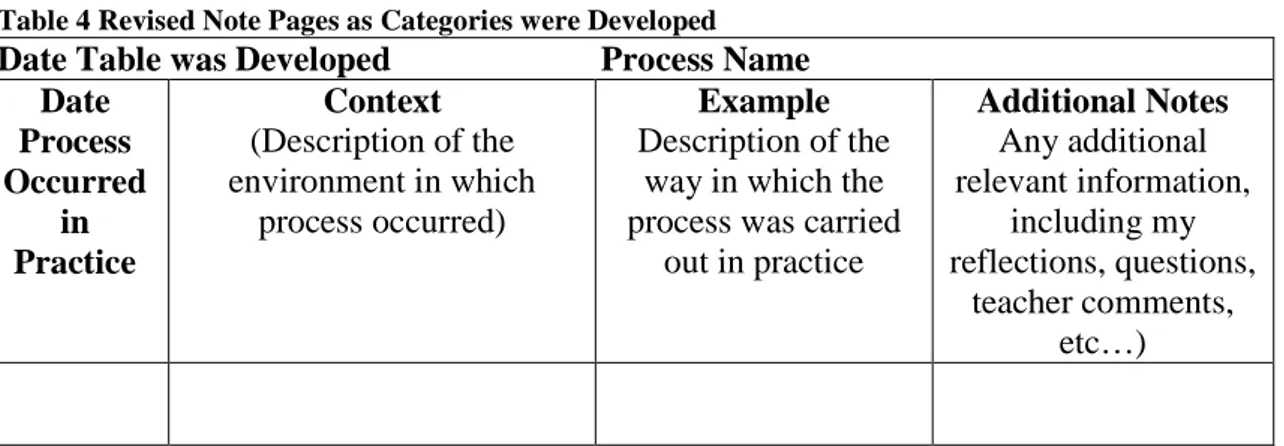
Table 4 Revised Note Pages as Categories were Developed ... 53
Table 5 # of Instances of Reflection Reported and Observed ... 71
Table 6 # of Instances of Investigating Practice Reported and Observed ... 79
Table 7 # of Instances of Consulting Other Sources Reported and Observed ... 82
Table 8 # of Instances of Identifying and Gathering Data Reported and Observed ... 86
Table 9 # of Instances of Reviewing and Interpreting Data Reported and Observed ... 90
Table 10 # of Instances of Sharing Knowledge with Others Reported and Observed .... 94
Table 11 # of Instances of the Application of New Knowledge Reported and Observed 98 Table 12 # of Instances of Flexibility in Practice Reported and Observed ... 103
Table 13 # of Instances of Empowerment Reported and Observed ... 107
Table 14 # of Instances of Taking Risks in Practice Reported and Observed ... 110
Table 15 # of Instances of Openness to Critique Reported and Observed ... 112
xiii
LIST OF FIGURES
Figure Page
CHAPTER1: INTRODUCTION
The research question guiding the present study is: How do in-service teachers demonstrate action research processes in their instructional practice?
As a teacher educator it is my belief that an effective teacher is one who routinely reflects upon her practice, takes risks, is open to critique, seeks to develop new
understandings about teaching and learning, and applies what is learned to her practice. For this teacher, such actions are carried out with the goal of being more effective in meeting the learning needs of her students. Each of these characteristics can be linked to elements of action research.
Action research is typically introduced to teachers as a research methodology in teacher education programs. Often teachers are engaged in the practice of teaching while enrolled in action research courses. Generally these courses are project based; teachers are required to develop a question about their teaching practice and systematically engage in the processes of action research for the duration of the course as they investigate their practice related question. Throughout the course a teacher’s focus remains mostly on the action research project itself, not her teaching practice more broadly. Teachers enrolled in these courses come to know action research as a method for conducting research in their teacher education programs but what might these action research processes look like embedded within a teacher’s practice?
The literature on action research suggests that there are several benefits to
2
of project based action research studies1. In other words, research of this sort is often conducted in classrooms in which teachers are engaging in action research projects as such. In considering the known benefits of incorporating action research in practice within the confines of project based contexts, I came to the following question: What if action research was applied more broadly to teaching practice? Could action research processes provide a framework for effective teaching more generally?
There is an extensive body of literature regarding what characteristics make for an effective or good teacher (Harris, 1998; Porter & Brophy, 1988; Walberg, 1986, 1990). Research on effective teaching focuses on specific teaching philosophies, teaching models, teacher management styles, specific teacher behaviors, and methods of conveying content to students (Harris, 1998; Porter & Brophy, 1988; Walberg, 1986, 1990). There is consensus in the literature suggesting that an effective teacher is one who is equipped with knowledge and skills from a variety of these areas. The effective teacher evaluates the learning needs of her students and content to be taught to determine which of methods described above are likely to be effective and then applies her
pedagogical knowledge and skills accordingly (Harris, 1998).
A common element present across the literature regarding effective teaching is the notion that such teachers are reflective in their practice and continue to develop their knowledge about teaching (Harris, 1998; Porter & Brophy, 1988). These teachers are thoughtful about their practice and take time to engage in self-evaluation. They embrace the responsibility of fostering student learning (Porter & Brophy, 1988). “Good teachers reflect on the feedback that they get on the effects of their instruction. This reflection in
1 See for example the volume (June 2006) of Teacher Education Quarterly devoted to such action research
3
turn enhances their professional knowledge and affects their future instructional planning” (Porter & Brophy, 1988, p. 75).
These elements of effective teaching practice are reflected in the action research literature, though in a fairly limited sense in that they are identified relative to a teacher’s work on a particular research project. If the application of action research practices were extended more broadly in practice, these practices could provide a framework for
effective teaching. Viewing teaching through the lens of action research practices might facilitate a more systematic approach to effective teaching. Currently, there is no single consensus as to what constitutes effective teaching, and often the definition of effective teaching is perceived to be context, grade level, or even subject specific. Using action research processes as a framework for teaching may enable us to consider what effective teaching looks like across traditional boundaries. Further, it might require that teacher educators reconsider how they teach action research so that it becomes a systematic approach to effective teaching to be applied to everyday practices which is embedded throughout teacher education programs rather than introduced solely as a research methodology. In order to consider the notion of action research as a framework for effective teaching, it is necessary to investigate how action research practices are carried out in practice, not simply as one works to complete an action research project.
4 Rationale
In this section I provide an overview and rationale for this research. The section includes (a) an introduction to action research, (b) the definition of action research
guiding this study, (c) a discussion of how this study adds to the current literature relating to action research, (d) a brief description of the study focus, and (e) the role of the
researcher.
Introduction to Action Research
A teacher’s ultimate goal is to support student learning and development.
Teachers routinely encounter a variety of practice-related questions and often informally pursue related solutions, alternative perspectives, and new ways of understanding pedagogy. To more effectively meet the needs of their students, it is necessary for teachers to identify areas in their practice that require modification and further
development, specifically with regard to their knowledge and underlying beliefs about teaching. These areas should inform their quest for resources that serve to foster further development of their understandings about teaching. To more effectively support student learning and development, information garnered from these resources and through the processes of identifying, gathering, and interpreting data, should then be integrated into practice. Teachers do not typically examine their knowledge about teaching or question their underlying beliefs about teaching in these ways (Cochran-Smith & Lytle, 1992; Cohen, 1995; Little, 1990). Action research is a mechanism for teachers to pursue the endeavor of becoming more effective in practice.
5
2005; Noffke & Stevenson, 1995). This type of research occurs in authentic settings (with students in classrooms), and in context-specific environments (e.g., in a classroom during literacy block) (Hopkins, 2002; McLean, 2005). Its focus is determined by issues that occur locally or within one’s own practice (Johnson, 2005; McLean, 2005).
Systematic evaluation of reflection and observations is ongoing throughout the action research process and promotes the continuous questioning of the implications of one’s practice (McLean, 2005; Noffke & Stevenson, 1995; Schmuck, 2006). It is an
empowering method for examining practice that may result in warranted action (Noffke & Stevenson, 1995; Schmuck, 2006). Understandings garnered from systematic
evaluation of one’s own practice are then applied to student achievement and various issues within the school environment (Costello, 2003; Hopkins, 2002; McLean, 2005; Noffke & Stevenson, 1995).
Engaging in action research allows for investigation into issues related to one’s own practice. The process is systematic and takes place within the context in which practice related issues occur. This enables informed decisions about practice. Action research facilitates the notion that teachers can create new knowledge about teaching rather than relying solely on prior or others’ knowledge about teaching. Teachers regain (or perhaps gain for the first time) a sense of autonomy as they integrate research in practice. They begin to view themselves as “more than mere technicians who merely apply initiatives handed to them by others” (Kraft, 2002, p. 175). Engaging in action research can encourage teachers to move beyond common understandings of effective practice to practice that is based on empirical data (Merino & Holmes, 2006).
6
practice, developing open ended questions, reviewing the literature, engaging in data collection and analysis, and sharing knowledge with others) encourages teachers to evaluate their practice in new ways.
While there is substantial evidence in the literature suggesting that action research is a powerful means for teachers to redefine their notions about teaching and its
employment is likely to result in teachers who demonstrate characteristics of more effective teaching, action research continues to be introduced to teachers in isolation and often in only one course (Henderson, Hunt, & Wester, 1999; Radencich, 1998).
Specifically, action research processes are introduced and carried out as part of a research methodology and the focus of this work remains confined to specific practice-related questions (Radencich, 1998). Yet, when applied more broadly in practice these processes can be viewed as characteristically similar to those that facilitate student learning.
When teachers redefine their own relationships to knowledge about teaching and learning, they reconstruct their classrooms and begin to offer different invitations to their students to learn and know. A view of teaching as research is connected to a view of learning as constructive, meaning centered, and social (Cochran-Smith & Lytle, 1992, p. 317).
There are no claims made in the literature that these processes do not transfer more broadly into practice, but there is a lack of evidence regarding how these processes are employed beyond a confined set of practice-related questions into everyday teaching practice.
7
to practice are the same as those needed to examine student learning (Falk, 2004). Teachers who embrace this problem solving approach are able to effectively provide verified learning experiences to their students in a variety of teaching contexts (Falk, 2004).
Students’ individual learning needs are likely to be fostered more effectively when teachers identify and focus on what students know and more importantly how they come to know it. This extends beyond identifying a student's current level of
understanding to addressing the student's individual learning methods and style preferences. Effective teaching occurs when a teacher pinpoints a student’s areas of understanding, areas in which there is room for growth, and understands how the student comes to know what she knows. With specific knowledge regarding how learning occurs for each student, a teacher is better equipped to determine how to convey course content. Her methodological decisions can then be based on what she knows about her student's ways of understanding, and discernment of which methods are likely to be effective in relaying the relevant content to her student. Application of the skills acquired through the use of action research processes in practice often yield insights about student learning such as those described above.
How Does This Study Contribute to the Current Literature on Action Research?
8
about teaching, demonstrate flexibility in practice, take risks, apply newly acquired knowledge about teaching to their practice, empowered, and view themselves as agents of change. A majority of the current literature related to how action research informs
instructional practice relies heavily on teacher perception and self-reporting. These studies address issues such as how participating in action research courses influences teachers in their understandings of teaching (Falk, 2004; Merino & Holmes, 2006; Zambo & Zambo, 2006), their view of their roles as teachers (Capobianco, Lincoln, Canuel-Browne, & Trimarchi, 2006; Falk, 2004; Merino & Holmes, 2006), and prompts teachers to question their ways of knowing (Snow-Gerono, 2005). The results of these studies are informed by the analysis of interview data, reflective notes, self-report, coursework, and survey data, but minimal classroom observation (Capobianco, Lincoln, Canuel-Browne, & Trimarchi, 2006; Falk, 2004; Merino & Holmes; 2006; Snow-Gerono, 2005; Zambo & Zambo, 2006).
Findings from the aforementioned studies suggest that action research is a valuable vehicle for developing further knowledge and understandings about teaching. Participating in action research enables teachers to better make connections between theory and practice, engage in problem solving, and remain focused on student learning (Falk, 2004; Merino & Holmes, 2006). Engaging in collaborative action research in particular helps teachers develop an awareness of their underlying beliefs and
9
themselves as educational change agents (Merino & Holmes, 2006; Snow-Gerono, 2005). As these studies suggest, engaging in action research is an important aspect of teaching. The known benefits of integrating action research into practice described above warrant further investigation into how these processes are demonstrated in everyday practice.
This study builds on the current literature regarding how action research informs instructional practice. It moves beyond teacher perception and reporting and includes a focus on direct classroom observation of how action research processes are integrated into instructional practice. This study also adds to the literature in so far as it provides a description of how teachers integrate these processes in ways that extend beyond the application of each of the action research processes as components of a research methodology. It provides insight into how these processes are reflected in aspects of teachers’ everyday practices.
Study Focus
10
symbiotic manner as one examines an aspect of practice over time. Using these
processes connectedly also entails pulling through a specific practice related focus across action research processes and simultaneously making related overarching links to that aspect of practice. Another goal of this study is to describe the ways in which
incorporating action research processes in practice fosters effective teaching.
Participants were two teachers who had an understanding of action research and its processes2. To increase the likelihood that I would witness and be able to describe how elements of action research were integrated into practice during the observational period, I selected teachers who had demonstrated significant knowledge about action research as indicated in part by their successful completion of a course in action research and by their interest in the practices of action research. I followed these teachers into their classrooms a year and a half after they successfully completed an action research course, of which I was the instructor, to observe how action research processes were
demonstrated in practice. The specific processes observed in teachers’ instructional practice were derived from the extant literature related to action research as described in chapter 2.
Role of the Researcher
The researcher is the primary research instrument in qualitative research (Marshall & Rossman, 1999). Cresswell (2007) suggests that it is important for a researcher to position herself in her research through incorporating a discussion of her role, including herself in the text, or including a reflection of her questions about the study itself. A researcher’s work is shaped by her experiences, gender, culture, and
2
11
history. These aspects of who she is shape how she comes to her research questions and collects, interprets, and presents data (Cresswell, 2007). I chronicle some of my relevant experiences below with the intent of depicting the lens through which I approach my work.
A majority of the students at the high school I attended were from families of middle to high socioeconomic status. In most cases their parents and guardians were well educated and ensured that there were many educational resources available to their children outside of school. Many of these students, myself included, succeeded with minimal individual support from their teachers. During my high school years I was not motivated to work beyond what was required in any of my academic courses. I found myself frustrated and bored when a few students in my classes had difficulty
understanding concepts and my teachers’ solution always seemed to be to continue to explain it exactly the same way over and over again, hoping each time that it would be the one that would make the students understand the material; it never was. Why didn’t my teachers try to convey the concepts using a different approach? To me it seemed like the only logical thing to do, but I was only a high school student, not a teacher.
12
their methodology when what they were doing was not effective in conveying the course material.
My early college experience was similar to my high school experience. I was often bored in class and my teachers failed to capture my interest. My boredom spurred poor class attendance which eventually resulted in my failing out of school. It was not until I re-enrolled and identified a major in college that I began to identify ways to link my interests to the content on my own. It was my interest in providing students with schooling experiences that were different from mine and so many of my peers that drove me to return to school. I chose Special Education as my major because it was my belief that an effective teacher, to some extent, must provide individualized instruction to each of her students. I assumed that I would learn how to tailor curriculum to meet individual students’ needs as part of the curriculum for Special Education majors. Unfortunately, the program mostly addressed scripted curriculum, and direct instruction of that curriculum. Upon completion of the program I allegedly was prepared to teach kindergarten through fifth grade students with varying exceptionalities in all content areas. I was not prepared. As an example of how unprepared I was, I had only been required to take one reading course. The course addressed how to teach reading and did not cover any information regarding literacy development which would have provided me with a conceptual understanding of why something should be taught in a particular way. After graduation, I still felt like I needed a better understanding of how students learn and how to effectively meet their needs as individual learners.
13
prepare teachers. This brought me to focus on Literacy and Teacher Education in a doctoral program at UNC. Because my interest was in developing more effective teacher education, I wanted to learn about pedagogy and develop my content area knowledge to make sense of its application. I selected literacy as an area of focus because I view literacy to be a foundation for access to most content areas and thought it was broader in scope when compared to other content areas. While enrolled at UNC, I have both taken and taught several courses on Action Research. Prior to these courses I could not identify action research by its formal name, however it is clear to me as I look retrospectively that even in my high school years I recognized its processes as aspects of effective teaching.
CHAPTER 2: LITERATURE REVIEW
The research question guiding the present study is: How do in-service teachers demonstrate action research processes in their professional practice?
The literature to be reviewed for this study will include: (a) an overview of the history of action research; (b) definitions of action research; (c) processes involved in engaging in action research in practice; (d) the results of using action research in practice on teacher instructional practices, knowledge about teaching, knowledge about their students; (e) qualities of effective teaching; and (f) the integration of action research into teacher education programs.
Brief History of Action Research
15
more efficient and productive. More generally, the application of action research during this time often centered about a quest for understanding democratic behavior (Noffke & Stevenson, 1995).
Similar to its current procedures, the foci of action research studies were
influenced by the needs and contexts within which the studies themselves occurred. The action research processes were implemented without a fixed order, cyclically, and included developing a plan, enactment of the plan, observation, and reflection regarding changes in social situations (Noffke & Stevenson, 1995). “Action research was and continues to be used to explore the role of social science in initiating changes not only in education, but in, for example, industry, community development, and the military” (Noffke & Stevenson, 1995, p. 5).
16
a wider representation of meanings associated with the term itself. Over the last three decades action research has often been executed amidst social change and to varying degrees, the work in this area has centered about the development of: professionalization of teaching, social justice agendas, personal knowledge, and professional knowledge in education (Noffke & Stevenson, 1995).
Definitions of Action Research from the Literature
Action research is represented by a multitude of terms in the literature: action research, teacher research, research in practice, practical research, practitioner research, and practical action research. Although some authors discuss minor differences that distinguish these terms, a review of the definitions reveals that they can be used
interchangeably. For the purpose of this research study, action research is the term that will be used. Action research is frequently depicted as a practical (Bell, 1999; Costello, 2003; Schmuck, 2006), cyclical (Noffke & Stevenson 1995), and ongoing (McLean, 2005; Noffke & Stevenson, 1995) process. Action researchers engage in deliberate (Schmuck, 2006) and systematic (Costello, 2003; Johnson, 2005; McLean, 2005; McNiff, 2007) inquiry.
Most definitions of action research incorporate the following components: (a) who participates in the process and where the process takes place, (b) what happens during the process, and (c) the purpose for engaging in the process. Often different terms are used across action research definitions to describe similar concepts. For example one
17
(Costello, 2003; McLean, 2005; Mills, 2007), administrators (McLean, 2005), and professionals (Costello, 2003; McLean, 2005; Mills, 2007) working in authentic settings (the where) such as real school environments (Johnson, 2005; Frost, 2002; McNiff & Whitehead, 2006) and classrooms (Johnson, 2005; Frost, 2002). Components of the action research process—or what happens—often incorporate identifying a practice related problem (Costello, 2003), gathering and interpreting data (Hopkins, 2002; Schmuck, 2006), attempting to gain an understanding of the data (Dick, 2002; Hopkins, 2002), problem solving (Bell, 1999; Costello, 2003), and reflecting (Costello, 2003; Dick, 1997; Frost, 2002; Noffke & Stevenson, 1995) within an authentic setting. Purposes for engaging in action research include: a means to improve the quality of practice (Bassey, 2005; Costello, 2003; Johnson, 2005; McLean, 2005; Mills, 2007; Noffke & Stevenson, 1995), a way to change practice (Costello, 2003; Frost, 2002), to recognize the
constraints on practice (Costello, 2003; Noffke & Stevenson, 1995), and to have new knowledge to share with others (Johnson, 2005; Koshy, 2005).
Some authors include purposes for action research that go beyond understanding and improving practice. These additional elements present action research as a means to: political action, social justice, and empowerment. Noffke and Stevenson (1995) describe action research as a way for teachers to “locate spaces for ethically defensible, politically strategic action” (p. 4) and “improve the rationality and justice of their own social or educational practices” (Noffke & Stevenson, 1995, p, 4). Action research can be
18
The definition of action research for this study was derived from the literature cited in the preceding paragraphs. Action research is defined as a cyclical process of systematically reflecting on, evaluating, and making modifications to one’s own practice (Costello, 2003; McLean, 2005; Noffke & Stevenson, 1995). This type of research occurs in authentic settings (with students in classrooms), and in context-specific
environments (e.g., in a classroom during literacy block) (Hopkins 2002; McLean, 2005). Its focus is determined by issues that occur locally or within one’s own practice (Johnson, 2005; McLean, 2005). Systematic evaluation of reflection and observations is ongoing throughout the action research process and promotes the continuous questioning of the implications of one’s practice (McLean, 2005; Noffke & Stevenson, 1995; Schmuck, 2006). It can be an empowering method for examining practice that may result in warranted action (Noffke & Stevenson, 1995; Schmuck, 2006). Understandings garnered from systematic evaluation of one’s own practice are then applied to student achievement and various issues within the school environment (Costello, 2003; Hopkins, 2002;
McLean, 2005; Noffke & Stevenson, 1995).
It is important to distinguish between conducting an action research study and employing action research processes more broadly in practice. Conducting an action research study involves a focused investigation related to an identified practice related question or questions. How does student reflective journaling impact their
comprehension of non-fiction text is an example of such a question. The skills garnered
19
reflection routinely as a means to better understand her notions about teaching and learning, or a teacher regularly reviewing practice-related literature in order to continue to refine her pedagogical understandings. Teachers’ ongoing examination of their own practices and development of new knowledge about teaching often occur in congruence with employing action research processes in everyday practice. This study focuses on the application of action research processes in context and as a foundation for effective teaching.
Processes of Action Research
There are several processes involved in conducting action research: reflection,
developing open-ended research questions, reviewing the literature, data collection, data analysis, and sharing of knowledge with others. Most of these processes are ongoing as action research is integrated into practice. A review of the literature addressing each of these processes along with the definition for each process guiding this study will be included in the subsequent paragraphs.
Reflection
“The action research process begins with systematic, critical reflection”
(Hendricks, 2009, p. 30). Engaging in reflection enables the researcher to identify areas for investigation in her practice and is ongoing throughout the research process
20
happening (Hendricks, 2009; Schon, 1996). Reflection-on-action is the retrospective process of thinking about thoughts and actions (Hendricks, 2009; Schon, 1996). Reflection-for-action involves thinking about thoughts and actions in order to plan for future actions (Henricks, 2009). Beyond thinking about one’s own thoughts and actions, reflection includes “sharing your own ideas, listening and reacting to someone else’s ideas, listening to colleagues’ reactions to your ideas, and trying to integrate these into your thinking” (Zeichner and Liston, 1996 as cited in Tabachnick and Zeichner 1998, p. 310).
Reflection is defined as a conscious thoughtful inquiry into one’s own practice. This includes deliberate discussion, documentation, observation, and questioning of one’s own practice. Reflection can be oral or written and take place as instruction is taking place or afterwards. Reflection during instructional practice allows for an immediate evaluation and critique of practices that have become intuitive and are often left
21
understandings about teaching and learning, and seeking out new information related to discoveries uncovered during reflection and then applying what is learned.
Developing Open-Ended Research Questions
Identifying an area of focus by reflecting on practice is in an important first step in developing an open-ended research question (Hendricks, 2009; Mills, 2007).
Pinpointing an area of focus involves developing a general statement which is one that “links an idea to an action and refers to a situation one wishes to change and improve on” (Mills, 2007, p. 25). Mills (2007) suggests four criteria that should be considered when identifying the area of focus: it should (a) relate to teaching and learning and be rooted in one’s own practice; (b) be accessible; (c) be something one cares about; and (d) be something one would like to change or improve. After an area of focus has been identified, the next step is developing a research question. To arrive at an appropriately phrased research question Koshy (2005) suggests considering the goals of the intended research study. Available resources, experience, and interest should also be considered when framing a research question (Koshy, 2005). Questions should be focused and manageable (McNiff & Whitehead, 2006), and be derived from reflection and a review of the literature related to the research area of interest (Henricks, 2009). Examples of such questions include: “how does teaching students in small heterogeneous groups influence
student achievement in third grade mathematics?”, or “how does using reader’s theatre
with fifth grade students influence their comprehension of a story?”
Reviewing the Literature
22
includes literature relevant to any of the following: research area, methodology, theoretical frameworks, and analysis. Conducting a review of the literature for the purpose of action research enables the researcher to gain a richer understanding of the identified research topic. A review of the literature allows the reader to identify which areas related to the research topic have already been addressed, where there are gaps, and how to situate one’s work within the extant literature (Koshy, 2005). Review of the literature may provide new ways of looking at the problem and various methodologies to approach the identified research question (Mills, 2007). Literature reviews include (a) searching for related literature to the research area of focus, (b) determining whether the literature is relevant to the research question, (c) evaluating if it is well executed research that is being described, (d) reading and summarizing the literature as it relates to the research topic, and (e) synthesizing across the literature (Hendricks, 2009; Mills, 2007; Koshy, 2005).
Data Collection
Data Collection is defined as a systematic method of gathering data. Prior to data collection the type of data one intends to collect and the purpose for collecting that data must be identified and should be determined by the nature of the problem posed
23
should be employed (Mills, 2007). It may become apparent partway through the data collection process that additional data sources are necessary to address the research question(s). As data sources are identified, careful consideration should be given to the relevancy of the data to the intended research question in order keep data collection focused and manageable.
Data Analysis and Interpretation
Data analysis is the process of summarizing data accurately (Mills, 2007). The process includes organizing and evaluating collected data so that its meaning,
relationships, and structure can be better understood. The type of data collected will determine the data analysis techniques one uses (Hendricks, 2009; Mills, 2007). There are several different methods of data analysis including coding, developing categorization tables, organizing and reorganizing data, and using data analysis software. Data analysis should be an ongoing process that begins simultaneously with data collection and
continues after data collection is complete. It is important to frequently revisit the question(s) guiding the research study while proceeding with data analysis in order to remain focused throughout the process (Koshy, 2005).
24
Sharing of Knowledge with Others
Sharing of knowledge with others is defined as disseminating knowledge garnered from implementing the action research processes, with others. This can be done verbally or in writing. Knowledge can be shared directly (through workshops, conferences, and presentations) or indirectly (through articles, books, and pamphlets). Sharing experiences and findings resulting from conducting action research can lead to new insights about teaching. “The act of sharing and celebrating the findings of action research is a critical component of the professional disposition of teaching that will ultimately revitalize the culture of teaching and move us from a craft culture to a reflective practitioner focused profession” (Mills, 2007, p. 191). Research experiences and results can be shared with a variety of audiences including colleagues, other professionals in the field, and more global audiences and in a variety of formats such as written reports, oral presentations, and electronic communication (Hendricks, 2009; McNiff & Whitehead, 2006).
Related Dispositions
The literature on action research addresses several dispositions that often accompany the employment of action research process in practice. They include empowerment, flexibility in practice, openness to critique, risk taking, and viewing learning about teaching as ongoing (Cochran-Smith & Lytle, 1993; Falk, 2004; Noffke & Stevenson, 1995; Schmuck, 2006). These dispositions are often described in the
literature as outgrowths of employing action research in practice however their definitions are often omitted, perhaps because they seem self explanatory. Also it is difficult to capture the qualities of each of these dispositions in a single definition3.
3 These dispositions are introduced again in chapter 4. In chapter 4 I develop a loose description of these
25
While most of these processes and dispositions are studied within the context of a teacher-researcher’s action research study, in the current study I investigate how each of these processes is reflected in the everyday practice of a teacher. The integration of action research processes in practice may extend beyond when an action researcher is conducting research and pervade throughout everyday aspects of instructional practice. A rich description of the context within which these processes occurs is included in a later chapter. Teachers’ ways of thinking, how, and why they incorporate these processes into their practice will also be discussed.
Results of Using Action Research in Practice
26
research processes in their teaching: engage in critical reflection, question ways of knowing, and foster new understandings about teaching.
Engaging in critical reflection
Teachers who engage in critical reflection question their own beliefs, values, and current understandings of teaching (Capobianco et al., 2006; Kraft, 2002). Through this process teachers begin to identify existing tensions in their own perspectives and practice. Kraft (2002) found that as teachers engaged in a dialogue about action research, critiqued multiple case studies that presented various perspectives of action research, and
conducted action research projects they began to realize that students are often
27
Questioning Ways of Knowing
Those who engage in action research often find themselves questioning their current ways of knowing (Capobianco et. al, 2006, Merino & Holmes 2006; Kraft, 2002; Snow-Gerono, 2005). They are open to critiquing and modifying their current ways of knowing as they engage in reflection, encounter new ideas and perspectives, and identify contradictory evidence (Kraft, 2002).
Snow-Gerono (2005) found that as teachers proceeded to engage in inquiry, they began to recognize that various aspects of inquiry occur in an interactive nature rather than on a hierarchical continuum. For example, engaging in reflection during data analysis informs the analysis process. Similarly, engaging in the data analysis process while reflecting on a practice-related issue informs both reflection and practice; it is a cyclical process. Awareness of the symbiotic relationship of the action research processes fosters a new level of understanding that is a more conceptual, rather than procedural, understanding of teacher inquiry. The shift in understanding that occurs when engaging in action research may provide teachers with further insight into how knowledge about teaching is generated, how to become knowledge creators, and how to embrace their roles as individuals who can effect educational change (Snow-Gerono, 2005).
Fostering new Understandings of Teaching
As teachers engage in action research they begin to develop new understandings about teaching and modify their current conceptions of their roles as teachers (Falk, 2004; Merino & Holmes, 2006) which has the potential to be an ongoing process. Action
28
researchers contemplate their reflections, they are often made aware of their underlying assumptions about teaching and learning. They ask questions regarding their own instructional choices, and look for ways to more effectively meet the needs of their students. This becomes a cyclical process. As action researchers pursue these questions, additional areas of inquiry to pursue arise and the cycle continues. Those who participate in action research gain new insights from conducting their own investigations, and this can be empowering to them (Falk, 2004). With newfound confidence in their ability to conduct research, teachers tend to “shift their attitude about themselves and their own learning” (Falk, 2004, p.80). Initially teachers feel ill-equipped to independently seek solutions to practice related problems but subsequently feel empowered to do so. This shift is often followed by a change in how they approach their work (Falk, 2004, p.80). Action research in practice has been shown to be a productive way to approach and understand obstacles in teaching. As teachers experience a transformation of meaning perspective (Snow-Gerono, 2005) they
become more comfortable with the continual posing of questions about their teaching and its impact on learners. Teachers with this conceptual understanding of inquiry do not wait for problems to arise before questioning what they do. They view these questions as opportunities to learn, and they tolerate the
ambiguity of temporarily not knowing the answer; but they are not content to stay in that position. They follow the evidence they identify and make changes based on their findings (p. 93)
29
of good teaching within those of others involved in the educative process” (Noffke & Stevenson, 1995, p.5). This leads to ongoing tensions within the educational process. This tension encourages teachers to move regularly between theory and practice as they continually revisit practice related issues, recognizing that their understanding of teaching is partially correct and in constant need of revision (Noffke & Stevenson, 1995).
Engaging in inquiry and research aids in the development of: pedagogical
understandings, making connections from theory to practice, and the ability to engage in and solve practice related problems, while remaining focused on students’ needs (Falk, 2004).
Action research is a powerful mechanism for teachers to develop understandings about teaching. Studies examining how using action research in practice impacts teachers’ ways of thinking about teaching support the notion that introducing teachers to action research methodology is beneficial to their practice (see above literature). The current study focuses on how teachers carry out the processes—and not simply the act-- of action research in practice. A deeper understanding of how teachers utilize these processes in practice may provide further insight into how to more effectively support teachers’ understanding and use of these processes prior to and throughout their teaching careers, not simply when they engage in action research.
Qualities of Effective Teaching
What makes for an effective teacher is a topic that appears frequently in
30
& Burke, 1993). It is often focused on specific teaching philosophies, content knowledge, teaching models, teacher management styles, specific teacher behaviors, and methods of conveying content to students (Harris, 1998; Porter & Brophy, 1988; Walberg, 1986, 1990). Shulman (1987) suggests that “the key to distinguishing the knowledge base of teaching lies at the intersection of content and pedagogy, in the capacity of a teacher to transform the content knowledge he or she possesses into forms that are pedagogically powerful and yet adaptive to the variations in ability and background presented by the students” (p. 15).
Many suggest that an effective teacher is one who is equipped with knowledge and skills from a variety of these areas and uses her pedagogical knowledge and skills to address the specific learning needs of her students while considering the nuances of the content to be taught (Cruickshank & Haefele, 2001; Harris, 1998; Porter & Brophy, 1988; Walberg, 1986, 1990). Brophy and Good (1986) emphasize that many of the findings stemming from literature on effective teaching must be qualified by specific grade level, student characteristics, and teaching objectives, and so conclude that “effective
instruction involves selecting (from a larger repertoire) and orchestrating those teaching behaviors that are appropriate to the context and to the teacher’s goals, rather than mastering and consistently applying a few generic teaching skills” (p. 360). Employing action research processes systematically and connectedly over time in everyday practice transcends the limitations of effective teaching practices that are confined to specific grade levels, teacher’s goals, and context specific settings.
31
of effective teaching over the last several decades. They describe a series of
classifications representative of the various characteristics discussed in the effective teaching literature (see table1).
Table 1 Cruickshank & Haefel (2001) Variations of Good Teaching Variations of a Good Teacher
IDEAL teachers meet standards by school principals, supervisors, and educator professionals
ANALYTIC teachers use observation techniques to record how well they are meeting instructional intentions
EFFECTIVE teachers bring about higher student achievement DUTIFUL teachers perform assigned teaching duties well COMPETENT teachers pass tests that they possess requisite teacher attributes
EXPERT teachers have extensive and accessible knowledge and can do more in less time
REFLECTIVE teachers examine the art and science of teaching to become more thoughtful practitioners
SATISFYING teachers please students, parents or caregivers, colleagues, supervisors, and administrators DIVERSITY-RESPONSIVE teachers are sensitive to all students
RESPECTED teachers possess and demonstrate qualities regarded as virtues.
(Cruickshank & Haefele, 2001, p. 29) While I recognize the need to critique this framework, a task I take on in Chapter 5, I believe it is a useful template against which to look at action research.
32
interpret data in practice. Teachers who do so are analytic, in that they use observation methods to record how well they are meeting their instructional intentions; and reflective as they examine their teaching to become more thoughtful practitioners. Those who employ action research in their practice are more effective in meeting the learning needs of their students. They are systematic and purposeful in their practice. When these teachers identify areas in their practice that need modification and development they consult other sources to become more informed. Such teachers are dutiful, in that they are likely to perform teaching duties well; they are expert, in that they have extensive and accessible knowledge and can do more in less time. As teachers engage in action research processes they apply what they have learned to their practice exemplifying characteristics of expert, reflective, respected teachers. Furthermore, a fundamental element of effective teaching presented throughout the literature is the notion that such teachers are reflective in their practice and continue to develop their knowledge about teaching (Cruickshank & Haefele, 2001; Harris, 1998; Porter & Brophy, 1988). They are thoughtful about their practice and routinely evaluate their work. They welcome the responsibility of fostering student learning (Porter & Brophy, 1988). Through reflection they consider the effectiveness of their instruction which aids in developing their
knowledge about teaching and informs the way they plan for future instruction (Porter & Brophy, 1988).
33
This study begins to explore the idea that perhaps the systematic connected embedment of action research processes broadly in everyday aspects of teaching practice could serve as a concrete set of criteria for effective teaching. Cruickshank and Haefele (2001) put forth the following questions: “what should be the standard for teachers within each vision of good teaching? How can we prepare teachers and help them become good by some criteria? How can teachers document what kind of good teachers they are? How can we reward good teachers?” (p. 29). Perhaps employing action research processes
systematically and connectedly in all aspects in everyday practice addresses the questions raised by Cruickshank and Haefele.
The Incorporation of Action Research into Teacher Education Programs Though action research has been practiced in classrooms for many years, it is only within the last twenty years that teacher education programs have begun to incorporate various forms of action research into their curriculum (Grossman, 2005). There is little consensus across teacher education programs regarding standards of practice that address the integration of action research into program curriculum. While true, there are
numerous benefits to introducing teachers to action research in teacher education programs.
Reasons for incorporating action research into teacher education programs addressed in the literature include: it has been shown to be a powerful form of
34
Teacher educators who have argued for the introduction of action research into the preservice teacher education curriculum, have stressed the importance of establishing habits of “self-monitoring” during initial training so that teachers can enter the profession with the dispositions and skills that will enable them to continue to learn from experience and become better at teaching throughout their careers (Gore & Zeichner 1990, p. 51).
Teachers who engage in inquiry in their own practices are able to identify
incongruities between theory and practice, and “between their ongoing assumptions about what is going on in their classrooms and in their more distanced and retrospective
interpretations. Inquiry stimulates, intensifies, and illuminates changes in practice” (Cochran-Smith & Lytle, 1993, p. 51-52). The introduction of action research in teacher education programs fosters the development of teachers who perceive learning about teaching to be a life-long process (Auger & Wildman, 2000).
Action research has been integrated into teacher education programs “to address the relative ineffectiveness of traditional approaches to professional development in terms of affecting teaching practice” (Bierly & Berliner, 1982 as cited in Auger and Wildman, 2000, p. 121). The introduction of action research to pre-service teachers fosters
professional development through theory and practice connections, reflection, and practice related inquiry (Kitchen & Stevens, 2008). Inclusion of action research as a pedagogy in teacher education programs is indicative of an understanding that the nature of teaching is—or should be—centered around inquiry (Grossman, 2005). Action research enables pre-service teachers to take responsibility early on for their own
35
understandings and the development of linking theory to practice (Auger & Wildman, 2000).
“When teachers learn they are capable of transforming student learning by researching their own practice, their conceptual understanding of teaching and learning changes. The connection between teacher-growth and student-growth becomes explicit” (Kitchen & Stevens, 2008, p. 26). Results such as these demonstrate the benefits of integrating action research into teacher education programs, at both the pre-service and in-service levels (Kitchen & Stevens, 2008). Teachers who can address their students’ individual needs through observation and interaction are able to provide opportunities for authentic and meaningful learning with curriculum expectations situated in richer
contexts (Auger & Wildman, 2000). Continued support for reflective practice and practice related inquiry into the early years of teaching from members of the educational community, linking pre-service and in-service teaching, will lead to educational
communities that focus on positive educational change (Kitchen & Stevens, 2008). It is important for pre-service teachers to understand that learning about teaching is a process that occurs over the course of one’s career (Auger & Wildman, 2000). “A teacher’s ability to improvise, adapt and respond in different ways to different
36
teachers recognize that there is often little value placed on teacher research in the academic community, due to its perceived lack of rigor. This does not have to be the case. Teacher educators must work to support beginning teachers’ research endeavors and help them develop a sense of ownership regarding research. Engaging in action research enables practitioners to develop case studies and provide descriptions of the work they do with their students which results in valuable contributions to the field of education (Auger & Wildman, 2000). The research efforts, both individual and collaborative, of practitioners and academics must be valued in teacher education programs (Auger & Wildman, 2000).
Furthermore, it is important for teachers to view action research as a set of
37
processes in their everyday classroom practice provides unique insight through concrete observation of how these processes manifest in practice. Such information may provide further understanding of how these processes influence actual classroom practice.
In her work Feinman-Nemser (2008) discusses the processes surrounding learning to teach. She presents a thematic framework comprised of four themes as a way of conceptualizing the process of learning to teach: learning to think like a teacher, learning to know like a teacher, learning to feel like a teacher, and learning to act like a teacher (p. 698). As illustrated by the above literature, engaging in action research fosters growth in aspects of each of the four broad themes presented. For example: growth in the four areas presented by Feinman-Nemser (2008) can be seen in teachers who employ action
research processes as they learn to identify areas of their own practice that need
improvement (learning to think like a teacher), develop new understandings of teaching through seeking out resources and testing out hypotheses (learning to know like a teacher), modify their practices to more effectively meet the needs of their students (learning to act like a teacher), and become more confident in their roles as knowledge seekers and creators (learn to feel like a teacher). This fact coupled with the knowledge that engaging action research is a way to foster the development of teachers who continue to reflect upon, question, critique, and modify their practice across content areas
(Capobianco et. al, 2006; Falk, 2004; Merino & Holmes, 2006; Kraft, 2002; Snow-Gerono, 2005), suggests that it is important to consider how teachers are introduced to and supported while engaging in action research.
38
useful application of these processes, framing the relevance of action research in this way in a sense limits the potential impact of action research on teaching more broadly. Auger and Wildman (2000) suggest a clear and specific set of action research standards of practice for teacher education programs which would require beginning teachers to:
(a) Identify reflection as an essential component of their own professional
practice, (b) Frame workable questions about their own teaching and learning, (c) Plan improvement of their own practice through action-research-based inquiry, (d) Work with critical friends/mentors to plan and implement their own studies, (e) Use systematic collection and analysis of data to assess the effectiveness of their own practice, (f) Use a variety of data including observations and
interactions with children as well as results of various assessments during student learning, (g) Apply ethical requirements to their own classroom, (h) Identify significant patterns and draw conclusions based on the data to assess the impact of changes in practice they have made, (i) Compare the results of their action
research with related literature, (j) Record their own action research studies in writing and be able to share what they have learned, and (k) Use the results of their own studies to identify future professional growth needs ( p.125-126). Standards such as these may perpetuate the notion of action research as a research methodology when embedded solely in one or two action research courses4. Such notions have the potential to confine teachers’ understandings of action research
processes and their application to isolated instances of practice. Viewing action research in this way might hinder the potential influence action research could have if applied more broadly to aspects of everyday practice.
How action research is introduced to teachers, both conceptually and
procedurally, and how teachers are supported as they engage in action research is likely to affect whether or not they will be able to successfully employ action research--and action research processes in practice. If the benefits of engaging in action research are so powerful, then the application of action research processes should not be confined by the
4
39
parameters of its utility as a research method for approaching a practice related issue. Action research processes should be viewed as a framework for effective teaching practices to be embedded throughout everyday aspects of practice.
The continued use of action research processes in practice demonstrates knowledge about teaching that transfers across specific content areas and contexts and therefore helps to address Feinman-Nemser’s (2008) quest for the development of “adaptive expertise in teaching” (p. 703). In the current study, teachers’ use of action research processes in various content areas within practice is observed and described in detail and relevant contextual information is provided. Participants in this study
demonstrated the ability to be adaptive in their practice as they employed action research processes. As they reflected on their practice, participants were flexible in their practice, willing to take risks, and made modifications when they perceived their methods to be ineffective. These results suggest that encouraging the use of action research processes in everyday practice may foster the development of teachers who demonstrate an adaptive expertise in teaching.
40
as they: view learning about teaching as an ongoing process, question their practice, revisit (or consider for the first time) their underlying beliefs about teaching, consider alternative practices, take risks and feel empowered in their practice, welcome critique, and value the uncertainties in teaching.
This study begins to explore the notion of action research as a framework for effective teaching by observing these processes directly and providing a rich description of how these processes are carried out in practice. In order to foster more effective practice, it is also important to have a clear understanding of how action research processes are integrated in practice when evaluating the ways in which we introduce teachers to action research. Addressed in this study is the idea that moving beyond
employing action research as a project-based research methodology to the employment of action research processes systematically and connectedly over time may provide a
CHAPTER 3: METHODOLOGY
This is a qualitative study. Qualitative methods were selected to encourage detailed analysis of observations, interviews, and data collection in hopes of better understanding how action research processes appear in practice. Results are not intended to produce generalizations. Qualitative inquiry is a situated activity that occurs within a natural setting (Denzin & Lincoln, 2003). It is an interpretive process in which the researcher attempts to understand phenomena and “the meanings people bring to them” (Denzin & Lincoln, 2003, p. 4). Qualitative researchers convey their observations with a series of representations such as interviews, anecdotal notes, photography, and video and audio recordings. They often use various methods of observation and representation that allow the researcher to observe and report on multiple aspects of a particular
phenomenon (Denzin & Lincoln, 2003).
42
An exploration of a “bounded system” or a case (or multiple cases) over time through detailed, in depth data collection involving multiple sources of
information rich in context. This bounded system is bounded by time and place, and it is the case being studied- a program, an event, activities, or individuals (p. 61)
The research question guiding this study calls for an in depth look at how action research processes are transferred to practice and required considerable time observing and analyzing each case in the field to be addressed adequately.
Teachers were observed in their classrooms three semesters after they completed an action research course. I am the principal researcher and was the course instructor. As the course instructor, I developed a relationship and established trust with the
teachers, which facilitated access to their classrooms and their participation in this study. In this chapter I discuss the following: (a) participants; (b) setting; (c) observation procedures; (d) data collection procedures; (e) methods of data analysis; and (e) trustworthiness.
Participants
The nine teachers enrolled in the course5 were in-service teachers then working in K-12 classrooms in various content areas, literacy specialists, university professors, curriculum coordinators, or resource teachers. Participants completed the action research course in May of 2007. Data collection took place during October and November of 2008. The teachers had a wide range of teaching experience. The participants selected for this study were female due to the fact that all students enrolled in the course were female. Participant selection was purposeful and focused on providing detailed information (Patton, 1990) related to action research processes in practice. Teachers were selected based on (a) demonstration of an understanding of the action research
43
processes and successful completion of the action research course (received a passing grade), (b) current status as a K-12 teacher, and (c) willingness to participate in the study as demonstrated by informed consent.
Demonstration of an understanding of the action research process was selected as criteria for participant selection to ensure that teachers had at least a general
understanding of what action research was in order to be able to implement it in practice. I reviewed each teacher’s weekly reflection summaries, end of the semester teacher-reflective essay, and final course project to determine her understanding of action research. The artifacts were examined for clear descriptions of the action research processes, reflections related to the action research processes, and connections between the action research processes and practice. The following example was considered a demonstration of a general understanding of action research:
After reading various articles on integrating the language arts, I put some of the ideas to the test in my own classroom and to expand on others. I began to see real results when I assigned students to write a formal letter to the upcoming freshmen on which character trait would be most beneficial to their high school careers. Prior to this, I had tried “dipping my toe” into the waters, having students select and analyze sentences in literary selections that we were reading and then attempting to mimic the structure or the tense of the sentences. However, giving students something significant and long-term to sink their teeth into also gave me a way to measure their growth and an anchor around which to float the various strategies that I wanted to attempt (Rebecca, Final Research Paper).
In the above example Rebecca described the employment of several action research processes (Consulting other Sources, Identifying and Gathering ata, Reviewing
and Interpreting Data, and the Application of new Knowledge in Practice) in her