ASSESSING THE COGNITIVE FUNCTIONING OF STUDENTS WITH INTELLECTUAL DISABILITIES: PRACTICES AND PERCEPTIONS OF SCHOOL PSYCHOLOGISTS
Ashley Nicole Costner
A dissertation submitted to the faculty of the University of North Carolina at Chapel Hill in partial fulfillment of the requirements for the degree of Doctorate of School Psychology in the
School of Education.
Chapel Hill 2015
Approved by: Rune J. Simeonsson Harriet Able
© 2015
ABSTRACT
ASHLEY NICOLE COSTNER: Assessing the Cognitive Functioning of Students with Intellectual Disabilities: Practices and Perceptions of School Psychologists
(Under the direction of Rune J. Simeonsson, Ph.D.)
ACKNOWLEDGEMENTS
I would like acknowledge several individuals who played important roles throughout the
TABLE OF CONTENTS
LIST OF TABLES ... viii
Introduction ... 1
Literature Review ... 2
Evolving Terminology ...2
Classification Systems, Definitions, and Diagnosis ...3
AAIDD ...3
ICD-10 ...4
DSM-5 ...5
United States Department of Education ...6
North Carolina Regulations ...7
Characteristics of Individuals with ID ...9
Functional skills and outcomes ...10
Etiology ...11
Genetic origins ...11
Acquired ID ...11
Assessing Intellectual Disabilities ... 12
Implications for Assessment ...12
Proxy assessment ...22
Developmental approach ...23
Functional approach ...24
School-Based Assessment in North Carolina ...26
Diagnosis versus eligibility for special education ...26
Statement of the Problem ... 29
Limited Training ...29
Federal and State Support for Standardized Approaches ...30
The Present Study ... 30
Rationale ...30
Research Questions ...31
Method ... 33
Participants ...33
Procedure ...38
Measure ...39
Ethical Review ...41
Analysis...41
Results ... 42
Status and Range of Previous Training Related to ID ...42
Nature of Current Practices Related to Students with ID ...47
School Psychologists’ Perceptions Related to Working with Students with ID ...55
Status and Range of Previous Training Related to ID ...63
Nature of Current Practices Related to Students with ID ...64
School Psychologists’ Perceptions Related to Working with Students with ID ...67
Limitations ...68
Conclusions ...69
Appendix A: Introduction to Survey ... 73
Appendix B: North Carolina School-Based School Psychologists Assessment Practices Survey ... 74
LIST OF TABLES
Table
1. NCDPI Regions Where Participants were Employed ...35
2. Respondents’ Years of Work Experience ...36
3. Respondent Credentials and Memberships ...37
4. Student Populations Primarily Served by Participants ...38
5. Training Experiences of School Psychologists with Reference to Student Level of ID ...45
6. Number of Students with ID with Whom Respondents Worked in 2014-2015 ...48
7. List of Cognitive Assessment Tools Preferred by School Psychologists ...51
8. Relationship Between Number of Students Served and Previous Training Experience ...58
9. Relationship Between Involvement in IEP Goal Development and Previous Training Experience ...59
Introduction
School psychologists are uniquely qualified to provide direct comprehensive services to meet the educational, behavioral, social-emotional, and mental health needs of students. Trained in both psychology and education, school psychologists offer support to teachers, administrators, students, and families with a shared goal of achieving student growth and success. One of the numerous tasks of school psychologists involves conducting evaluations and analyzing the resulting data to assist in determining students’ eligibility for special education services. This often equates to administering a cognitive or IQ assessment, among other assessments, to gain information about a student’s skills or abilities. Although this may be a straightforward task for school psychologists working with children of average to above average intellectual functioning, it is far from simple and becomes increasingly challenging as students’ needs become more complex.
This study aimed to clarify one of the many challenging aspects of a school psychologist’s role: selecting the most appropriate tools to assess students’ abilities,
particularly the cognitive functioning of students who have an intellectual disability living in the state of North Carolina. The following literature review begins with an overview of intellectual disabilities and the most common approaches to assessment. A focused summary of the assessment process in North Carolina public schools is provided, in addition to
Literature Review
Evolving Terminology
Mental retardation, to some degree, was first described in Thebes, Greece in as early as 1500 B.C. (American Association on Mental Deficiency [AAMD], 1983). The concept of mental retardation was used to describe individuals who exhibited deformities in their skulls associated with retarded behavior, those with differing levels of mental acuity, and even those who were considered mentally ill. Beginning in the late 18th century, investigations took place that examined specific characteristics distinguishing those who were deemed mentally ill from those who were said to be mentally retarded (AAMD, 1983). Terms such as idiocy, feeble-mindedness, and imbecility were used scientifically for mental retardation around this time (Glidden, 2006). Down syndrome, a well-known genetic syndrome associated with cognitive deficits today, was first described in 1866 by British doctor John Langdon Down (AAMD, 1983). The development of intelligence tests in the early 1900s also introduced the idea of differentiating individuals with the disability behaviorally, rather than just medically (AAMD, 1983).
the term mental retardation for medical, educational, policy, administrative, and legislative purposes, and is considered to be the term in common use by the lay public and advocacy groups (APA, 2013; Salvador-Carulla et al., 2011).
Classification Systems, Definitions, and Diagnosis
Accurate estimates of prevalence rates of ID are important for the planning and provision of services, including educational support services (Goharpey, Crewther, &
Crewther, 2010). However, prevalence rates can vary depending on the classification system used. One of the most common discrepancies among classification systems is whether the individual’s IQ score or their level of adaptive functioning should be the central defining characteristic of the disability (Goharpey et al., 2010).
AAIDD. The American Association on Intellectual and Developmental Disabilities
(AAIDD), previously called the American Association on Mental Deficiency (AAMD) and the American Associationfor Mental Retardation (AAMR), is the oldest professional organization committed to the study and assistance of individuals with impaired intellectual and adaptive functioning (Weis, 2014). The AAIDD has a comprehensive definition, classification, and system of supports, which mainly focus on functioning, adaptive skills, and supports needed (Salvador-Carulla et al., 2011). The AAIDD’s definition is consistent with the conceptual model proposed by the International Classification of Functioning, Disability and Health (ICF).
individuals by the level of intellectual impairment (e.g., mild, moderate), the AAIDD
recommends that professionals describe individuals’ needed supports across various areas of functioning (i.e., home living, community living, lifelong learning, employment, health and safety, social activities, and protection and advocacy) (Weis, 2014). Levels of support progress from intermittent, to limited, then extensive, and lastly, pervasive (Carr & O’Reilly, 2007). For example, an individual may be described as needing extensive educational support, but intermittent social support (Weis, 2014). Activities are ranked according to frequency, amount, and type of support needed (Weis, 2014).
The AAIDD (2010) provides five assumptions that are considered essential to the application of the organization’s definition: 1) Functional limitations must be considered within the context of community environments typical of the individual’s peers and culture; 2) Cultural and linguistic diversity, as well as differences in communication, sensory, motor, and behavioral factors, should be considered for a valid assessment; 3) Limitations often coexist with strengths within individuals; 4) Development of a profile of needed supports is an important purpose of describing limitations; and 5) The life functioning of an individual with ID will generally improve with appropriate supports provided over a sustained period. Three criteria must be met in order for assessment to serve its purposes for diagnosis, classification by disability aspects, and to plan for individualized supports: the assessment tools and process should match the assessment purpose, the findings should be as valid as possible, and the results should be useful and purposefully applied (AAIDD, 2010).
ICD-10. The World Health Organization’s International Classification of Diseases is
disease), impaired bodily functions and structures, limitations in activities, restrictions for participation, barriers and hindrances in the environment, and personal or demographic factors (Carr & O’Reilly, 2007). Currently, the ICD-10, which still uses the term mental retardation, requires that there is a reduced level of intellectual functioning that results in a diminished ability to adapt to the daily demands of the normal social environment for a diagnosis. There are four intellectual levels: mild, moderate, severe, and profound. Standardized assessments are recommended, but it is noted that intellectual abilities and social adaptation may change over time, and, however poor, may improve as a result of training and rehabilitation. Furthermore, diagnosis should be based on one’s current levels of functioning (Carr & O’Reilly, 2007).
In working toward a new definition for the ICD-11, the current working group for ID has proposed replacing the term mental retardation with intellectual developmental disorders, which would be defined as “a group of developmental conditions characterized by significant impairment of cognitive functions, which are associated with limitations of learning, adaptive behavior, and skills” (Salvador-Carulla et al., 2011, p. 177). Moreover, it is proposed that this new definition should fall under the larger grouping of neurodevelopmental disorders, that the subcategories of clinical severity be continued, and that problematic behaviors be changed to associated features (Salvador-Carulla et al., 2011).
DSM-5. The Diagnostic and Statistical Manual of Mental Disorders, Fifth Edition
compared to others who are matched based on age, gender, and sociocultural status (APA, 2013). Onset must be during the developmental period and a diagnosis must be based both on clinical assessment and standardized testing of intellectual and adaptive functioning. A standardized score of 70 or lower on a test of intellectual functioning plus or minus five points for measurement error is necessary (APA, 2013).
There are four degrees of severity recognized: mild, moderate, severe, and profound (APA, 2013). ID also now falls under the heading of neurodevelopmental disorders, which are conditions with onsets during the developmental period (APA, 2013). The recent changes in the fifth edition better align with the proposed ICD-11 and current AAIDD terminology and definitions, as well as the Department of Education’s definition.
Historically, the DSM recommended categorizing individuals into one of four subtypes (i.e., levels of severity) based on their standardized IQ score (Weis, 2014). The DSM-5 now gives equal importance to IQ and adaptive functioning (Weis, 2014). Specifiers of mild, moderate, severe, or profound are assigned on the basis of one’s adaptive
functioning across the conceptual, social, and practical domains, rather than one’s IQ score as previously practiced, because it is adaptive functioning that determines the level of supports required and IQ measures are considered less valid at the lower end of the IQ range (APA, 2013). Based on these criteria, the overall prevalence is estimated to be approximately one percent of the general population, with severe ID (i.e., requiring extensive support and supervision at all times) occurring in approximately 6 per 1000 individuals (APA, 2013).
United States Department of Education. Although students are not diagnosed, per
se, in the schools, Part B of the most recent reauthorization of the Individuals with
between the ages of 3 and 21 can be identified. A definition for each of the 14 areas is explicitly stated, along with additional factors and requirements that must be considered when determining eligibility for special education and related services. One of the 14 areas identified by this federal legislation is ID, which changed from the term mental retardation in 2010 under Rosa’s Law (Weis, 2014).
According to IDEA, ID is defined as “significantly subaverage general intellectual functioning, existing concurrently with deficits in adaptive behavior and manifested during the developmental period, that adversely affects a child’s educational performance” (IDEA, 2004). Each state must adopt its own criteria for ID that aligns with this federal definition and meet the additional evaluation requirements for eligibility outlined in federal law (e.g., the public school agency must “draw upon information from a variety of sources”) (IDEA, 2004). Additionally, the following factors must also be considered to be eligible for special education services: the child must not be determined to be a child with a disability if the determinant factor for eligibility is: 1) lack of appropriate instruction in reading, 2) lack of appropriate instruction in math, or 3) limited English proficiency (IDEA, 2004). The specific services provided under this category of eligibility vary depending on each individual
student’s needs and are described in each eligible student’s Individualized Education Program (IEP).
North Carolina Regulations. In North Carolina, the educational definition of ID
remains the same as the federal educational definition; though, it is stated that the child must demonstrate “both intellectual functioning well below the mean on an individually
one-half standard deviations below the mean in two or more domains” (North Carolina Department of Public Instruction [NCDPI], 2014, p. 69). Furthermore, the NCDPI Policies outline cutoffs for three severity levels of ID: mild (i.e., two standard deviations below the mean), moderate (i.e., three standard deviations below the mean), and severe (i.e., four or more standard deviations below the mean). The standard error of measure should also be considered when following these cutoff scores. Lastly, “the disability must have an adverse effect on educational performance and require specially designed instruction” (NCDPI, 2014, p. 69).
Based on 2012-2013 school year data, 7 percent of the students receiving special education services in public schools qualified for services under the category of ID in the United States (US Department of Education, 2013). Specific data was not reported
specifying the individual severity level for these students (i.e., mild, moderate, or severe). As of April 1, 2015 in North Carolina, approximately 8.4 percent, or 16,943, of the students receiving Exceptional Children services fall under the category of ID (NCDPI, 2015a). Of those, 70 percent are in the mild range, 25 percent are in the moderate range, and 5 percent are in the severe range. While the federal IDEA legislation and North Carolina Policies’ definitions of and criteria for ID again draw attention to standardized scores of IQ and adaptive skills, the educational perspective differs from those of the other organizations and codes described previously (e.g., ICD-10 and DSM-5), because the ID must impact the individual’s educational performance in order for the individual to receive services. There is still much debate among practitioners regarding the most appropriate
disability, others insist on more of a dimensional view of human functioning that places an increased emphasis on a variety of functional aspects, such as the variations in the nature and rate of learning, in defining this phenomenon (Simeonsson, Granlund, & Bjorck-Akesson, 2006). The current classification systems have varying emphases ranging from standardized scores of intelligence and adaptive functioning, limitations and restrictions, levels of supports needed, and influences on one’s learning. These differing views can be confusing for
practitioners as the classification system carries different weight depending on the setting in which the practitioner is working and evaluating an individual. This is likely especially puzzling for school-based practitioners as a child could technically have a formal diagnosis, but still not be eligible for services. The reader is encouraged to keep these views in mind as this paper moves into a discussion of characteristics of individuals with ID and how those characteristics are assessed.
Characteristics of Individuals with ID
neurological, physical, and other limitations increases as the level of ID becomes more severe.
Functional skills and outcomes. These similar characteristics and frequently
occurring comorbid disorders often impact individuals’ functional skills and outcomes. Limitations in both general mental abilities and adaptive functioning can lead to problems perceiving and processing new information, learning quickly and efficiently, applying knowledge and skills to solve novel problems, thinking creatively and flexibly, responding rapidly and accurately, and meeting day-to-day demands in an age-appropriate manner (Weis, 2014). Since comorbidity increases as the severity level of ID increases, one can expect functional skills to generally be commensurate with the level of impairment. Thus, typically, the more impaired an individual is, the more limited their functional skills. It is important to note that, throughout one’s lifespan, an individual with ID is still able to learn and improve many of their functional skills. While early intervention services, especially individualized therapeutic services, are one of the best predictors of higher functional skills, the period for learning and working on skills does not end at any particular age.
Etiology
Another important factor to consider is etiology, as it could suggest a specific cognitive profile for the individual (Harris, 2006). Knowing why an individual is experiencing challenges can assist in the evaluation process and could explain certain characteristics or limitations (e.g., has the individual always experienced these challenges or did a particular event occur that caused impairment or regression of skills). While some cases of ID can be traced back to a genetic source of origin, other cases may be the result of some other event.
Genetic origins. There are more than 500 to 750 different genetic causes of ID, the
most common of which is Down syndrome (Goharpey et al., 2010; Harris, 2006). Other ID conditions that have a genetic origin include Fragile X syndrome, Prader-Willi syndrome, Angelman syndrome, Williams syndrome, and neurofibromatosis (Goharpey et al., 2010; Hurley, Levitas, Lecavalier, & Pary, 2007). While the DSM-5 indicates that males are overall more likely than females to be diagnosed with both mild and severe ID, gender ratios vary drastically across studies, especially those investigating sex-linked genetic factors (APA, 2013). For example, according to Goharpey et al. (2010) at least 95 conditions have been linked to the X chromosome, which is said to explain a prevalence ratio of 4:1 (males to females) with ID. Metabolic disorders, such as phenylketonuria, are caused by genes inherited from one’s parents and are another genetic cause of ID (Weis, 2014).
Acquired ID. In about 30 to 50 percent of ID cases, a genetic etiology has not been
substances that can cause maldevelopment in a fetus, are another cause of ID. Examples include viruses acquired by a mother during pregnancy (e.g., rubella, syphilis, human immunodeficiency virus [HIV]) and toxic chemical substances, such as heroin, cocaine, and alcohol. A variety of complications during pregnancy and delivery can also be associated with ID. Anoxia (i.e., a fetus’s inability to obtain oxygen for an extended period of time) is frequently associated with delivery complications and can lead to central nervous system damage and ID. The two childhood illnesses most often associated with acquired ID are encephalitis and meningitis; however, other injuries, such as traumatic brain injuries and lead toxicity, are also recurring causes (Weis, 2014).
Assessing Intellectual Disabilities
Implications for Assessment
Many classification systems, including educational policies, for individuals with ID rely solely on standardized measures of IQ and/or adaptive behavior functioning (Zucker & Polloway, 2004). Since this is the case, most would presume that IQ measures provide valid and reliable estimates of intelligence. Regrettably, some researchers say IQ scores are questionable for individuals with ID, particularly those functioning within the moderate to profound range, due to psychometric issues, such as floor effects.
As recently as the early 2000s, the Stanford-Binet, Wechsler Intelligence Scale for Children, and Kaufman Assessment Battery for Children were the most commonly
administered assessments used to measure intellectual abilities (Zucker & Polloway, 2004). The AAMD Adaptive Behavior Scales, Vineland Adaptive Behavior Scales, and
measures are among the highly preferred today, there are several scholars in the field who encourage the use of and argue the need and importance for more functionally- and behaviorally-based assessment measures, as they would likely better inform intervention services, especially in the school setting (Drew & Hardman, 2007; Zucker & Polloway, 2004).
The most significant implication for using invalid or unreliable measures to determine the IQ of individuals with ID is the limited amount of information many of these assessment tools provide. Adequate assessment approaches provide the examiner with useful
information that can inform interventions. Appropriate assessments enable the examiner to note personal strengths and interests of the individual, such as what the individual finds motivating and engaging, as well as which tasks he or she is able to complete independently with success. Strategies that engage and maintain the individual’s attention are likely to provide the best opportunity for learning, and will yield more valid results (Goharpey et al., 2010).
before beginning an evaluation, the school psychologist should determine which types of information he or she needs before the most appropriate tool or measure is chosen.
It is known that as the level of severity increases, the prevalence of co-occurring limitations increases. This creates one of the challenges frequently encountered when assessing individuals with severe ID: characteristics specific to the individual (e.g., physical or sensory limitations) impact his or her performance. In addition, both the examiner’s level of competence and experience in the assessment of individuals with significant limitations, as well as potential psychometric problems with measures being used for unintended purposes, are concerns (Simeonsson, Bailey, Smith, & Buysse, 1995).
Approaches to Assessment
Based on the various definitions of ID, assessment, at a minimum, should include both a psychometric measure of intelligence (i.e., one that provides a standardized IQ score) and a measure of one’s adaptive abilities. The particular approach, or combination of approaches, that an examiner chooses can vary. Some of the common approaches include standardized, proxy, developmental, and functional.
Standardized measures. The term standardized indicates that the measure was
The majority of the standardized intelligence tests used today are based on CHC theory, including the Stanford-Binet 5 (SB-5), Kaufman Assessment Battery for Children - Second Edition (KABC-II), Woodcock-Johnson Tests of Cognitive Abilities - Fourth Edition (WJ-IV), Differential Ability Scales - Second Edition (DAS-II), and Wechsler Intelligence Scale for Children - Fifth Edition (WISC-V) (Flanagan et al., 2008). This theory, which is a combination of two prominent theoretical models, is one of the most recognized and
influential psychometric theories of the structure of human intelligence (Flanagan et al., 2008; McGrew, 2009). In general, CHC theory suggests that there are three stratums of cognitive abilities and one’s overall intelligence (stratum iii) can be explained by broad (stratum ii) and narrow (stratum i) abilities (Flanagan et al., 2008; McGrew, 2009). Thus, in addition to crystallized and fluid intelligence, there are several other abilities that are typically assessed by tools based on CHC theory including, but not limited to, short-term memory, visual processing, auditory processing, long-term storage and retrieval, and processing speed (Flanagan et al., 2008; McGrew, 2009; O’Reilly & Carr, 2007).
Some specific issues that should be considered when evaluating an obtained score on a standardized assessment include measurement error, test fairness or bias, the Flynn Effect, and practice effects (APA, 2013; Brock, 2012). No cognitive assessment is completely reliable, because it is impossible to rule out the influence of all possible variables that could impact one’s performance. It is the administrator’s responsibility to consider the
Test differences should also be considered, as significantly different results can be obtained depending on the specific assessment administered (Brock, 2012). For example, construct validity refers to whether a test actually measures what it intends to measure. Additional consideration should be given to which specific aspects of intelligence an assessment claims to measure and whether the examinee presents with any limitations that could impact his or her performance (AAIDD, 2010; Brock, 2012). Fairness of
consequences of test use involves an appraisal of the outcomes or consequences of using a test with a particular group (Jacob, Decker, & Hartshorne, 2011). An example would be requiring a verbal response from an individual who has significantly limited verbal abilities (Brock, 2012).
A test is considered biased if there is evidence that it is not equally valid when used with children from differing ethnic or racial backgrounds (Jacob et al., 2011). Furthermore, if the use of a test results in a particular group being placed in inferior educational programs, it is considered biased and unfair (Jacob et al., 2011). This is one reason why standardized assessments have been at the root of some controversial court cases throughout history.
students was 1.33 for the area of ID. It has been hypothesized that this could be due to the fact that there is more reliance on “clinical or professional judgment” when determining eligibility for these categories and school personnel may be unintentionally influenced by cultural misconceptions (Harry & Klingner, 2014; Sullivan, 2010). Although further discussion of this topic is beyond the scope of this study, these numbers further illustrate why, when selecting a standardized tool, several considerations are important, such as personal biases and professional competence as it relates to working with students from culturally- and linguistically-diverse backgrounds (Sullivan, 2010).
The Flynn Effect refers to research that shows IQ scores have been increasing from one generation to the next by about 0.33 points per year (Brock, 2012; O’Reilly & Carr, 2007). It is suggested that obtained IQ scores be adjusted by about 0.3 points for each year the test was administered after standardization (AAIDD, 2010; Brock, 2012). If this is not taken into consideration, overly high scores due to out-of-date test norms could result (APA, 2013). Another factor to consider is the practice effect. This can be observed when an individual is re-administered the same test within a short period of time leading to an
artificial increase in his or her score (AAIDD, 2012; Brock, 2012). For this reason, it is best practice to not re-administer an assessment within a year of the previous administration (Brock, 2012).
environments, communication skills, attention, and physical abilities (APA, 2013). These limitations and impairments, which could significantly impact how the individual is able to perform on standardized tasks, should be given attention to ensure that individuals are not penalized because of them (APA, 2013; Sattler, 2008).
Limiting the influence of certain access skills (i.e., skills that are irrelevant to
intelligence, but that could influence one’s performance on a test of intelligence because they interfere with one’s ability to access the test) is encouraged (Kranzler & Floyd, 2013). It is recommended that examiners adjust testing administration in order to accommodate
examinees with disabilities to ensure their resulting scores are valid estimates of their abilities (Crepeau-Hobson & Vujeva, 2012a). For example, if an individual is limited visually due to some degree of visual impairment or blindness, some components may be inappropriate to administer according to recommended standardization guidelines.
Additionally, if an individual has a motor impairment in their dominant hand, writing tasks will be difficult and an overall performance score could be skewed if the individual needs additional time to complete tasks. There has been little research that examines the impact of accommodations or modifications on test reliability and validity, thus results should be interpreted with caution, as the tool is not being administered in the way in which it was standardized (Crepeau-Hobson & Vujeva, 2012a). This practice of providing
In general, most standardized cognitive assessments are not appropriate for truly gauging the cognitive strengths and weaknesses of many children with ID who are in the mild range, and even more are inappropriate for assessing children with a moderate to
profound ID (Crepeau-Hobson & Vujeva, 2012b). Individuals with more severe impairments are unable to be comprehensively assessed using some of the more popular standardized assessment measures (Crepeau-Hobson & Vujeva, 2012a).
The majority of the popular cognitive assessments used today still do not include a sufficient number of children with ID in their norming samples. Although norms are often limited for disability groups, some assessment publishers include special population studies that reference disability groups; however, this does not guarantee valid and reliable results when evaluating individuals from these groups. Having an insufficient number of children with ID in these assessment norming samples increases susceptibility to floor effects (Crepeau-Hobson & Vujeva, 2012b; Harris, 2006). That is, these assessment tools were originally designed for, and largely normed on, a nondisabled population (Colmar et al., 2006).
Floor effects refer to limits being set on the minimum IQ level that can be calculated for an individual. For example, if an assessment tool has a floor of 40, it is impossible to determine an accurate score for individuals functioning at that level or below (i.e., someone who likely has a severe or profound intellectual disability) (Colmar et al., 2006). This, along with the non-standardized use of tests leading to invalid results, could equate to a significant number of individuals’ abilities being underestimated by standardized assessments
Furthermore, Bergeron and Floyd (2013) recommend that practitioners use caution when comparing student score profiles to those often presented in assessment technical manuals for ID population groups. While these manuals often suggest that individuals with ID will have a relatively flat score profile, Bergeron and Floyd (2013) argue that it is not uncommon for individuals with ID to have some elevated scores; practitioners should be careful to not rule out an ID diagnosis or eligibility for special education services when
analyzing profiles, particularly if all other information suggests otherwise. In these situations, global IQ scores (i.e., the Full Scale IQ), rather than part scores (e.g., specific index or cluster scores), should be the score emphasized in decision-making situations (Bergeron & Floyd, 2013).
Fortunately, test developers are increasingly taking these issues into consideration. Formerly, the SB-5 and the DAS-II were regarded as two of the better tools for this
population because of their improved norming samples and lower limits of measurement (Crepeau-Hobson & Vujeva, 2012b; Sattler, 2008). With the newest 2014 revisions of the WJ-IV and WISC-V, there may be potentially more promise for better assessment of the mild to moderate ID population. While the WJ-IV examiner’s manual and interpretive manual provide little to no information about individuals with ID, there are recommendations for accommodations that can be used with physically impaired individuals (Mather & Wendling, 2014).
corresponding matched control groups. Results from these comparisons suggest evidence that the WISC-V produces scores that are useful in the assessment of ID within the mild to moderate range (Wechsler, 2014).
The Comprehensive Test of Nonverbal Intelligence - Second Edition (CTONI-2) and the Bayley Scales of Infant and Toddler Development - Third Edition (Bayley-III) have also been noted as measures that could be useful for children with ID who have coexisting severe verbal or motor impairments or with younger children, respectively (Crepeau-Hobson & Vujeva, 2012b). The Intelligence Test for Visually Impaired Children (ITVIC) and the Cognitive Test for the Blind (CTB) have been found to have adequate reliability and validity for children with blindness or visual impairment (Crepeau-Hobson & Vujeva, 2012a). With specific regard to children who are deaf or hard of hearing, the DAS-II, KABC-II, and SB-5 provide information on clinical studies conducted with this population.
Goharpey et al. (2010) suggest that the nonverbal visual matching Raven’s Progressive Matrices (RPM) should replace the frequently used WISC-IV measure of intelligence, because it is a better measure of the reasoning abilities of children with ID who invariably have verbal deficits. These authors note that deficits in working memory are likely the root of the cause for the difficulties that children experience on RPM because working memory could affect their problem solving abilities. More specifically, children with low functioning autism, Down syndrome, and idiopathic ID use different problem-solving strategies compared to typically developing children (Goharpey et al., 2010).
According to a large survey conducted in the late 1990s by Riccio, Houston, and Harrison (1998), school psychologists use standardized, norm-referenced measures at all grade/age levels. Up to 40 percent of those surveyed reported using alternative methods; however, these were most commonly employed at the preschool level. Kranzler and Floyd (2013) developed a useful checklist tool that has questions practitioners should consider when conducting assessments to determine a diagnosis of ID or eligibility. Key components of the checklist include questions related to test validity and reliability of assessment tools used and consideration of other issues, such as comorbid diagnoses that could explain one’s symptoms of ID (Kranzler & Floyd, 2013). There is some controversy in the literature regarding the use of norm-referenced assessment tools, particularly in the absence of other information, such as naturalistic observations (Riccio et al., 1998).
Proxy assessment. Another popular assessment approach used with individuals with
related to the individual’s ability to independently complete daily living activities and other functional tasks. Interviews range from very structured to somewhat informal, depending on whether a specific assessment tool is used to guide the interview or if the examiner is simply attempting to gain background information on the individual. The Developmental Profile - Third Edition (DP-3), Adaptive Behavior Assessment System - Third Edition (ABAS-3), and Vineland Adaptive Behavior Scales - Second Edition (Vineland-II) are examples.
It is not uncommon for multiple informants to be used in the assessment, such as parents, teachers, or service providers, to enable the examiner to have a global or
comprehensive understanding of the individual’s abilities across settings. This is an
especially routine practice in the school setting, as students are often asked to perform very different tasks at school and may respond to different levels of support from service
providers in that setting. Unfortunately, one important limitation with proxy assessment involves considerations of factors that may influence ratings and lead to possibly invalid or unreliable results, such as how well the rater knows the individual, how impaired the
individual is due to their disability, and subjectivity among raters (Milasinovic & Buchanan, 2013). Parent or caregiver report measures, nonetheless, can provide valuable information, especially regarding how the individual performs across varied conditions.
Developmental approach. Use of a developmental model enables an examiner to
gathering observational information. For example, an individual may be presented with tasks that require him or her to visually track an object, grasp an object using a specific type of grasp, or sort a series of objects.
These developmental assessments are ordinary practice for those working with young children below the age of five. Oftentimes, examiners will administer these assessments, which are intended for younger children, in order to address the floor problems mentioned earlier that could result from standardized norm-referenced measures (Riccio et al., 1998). Developmental approaches are especially useful for individuals of any age within the moderate to profound range, as specific age equivalents can be obtained. Information gathered from the assessment can be used to develop individualized, developmentally-appropriate interventions focusing on a variety of developmental goals related to tasks such as feeding, toileting, talking, walking, and more. Unfortunately, this is not always
psychometrically appropriate, as these tools usually have not been normed with individuals above the preschool age. Yet, research has shown that this approach is the most common in determining special education eligibility for those with severe ID within the school setting (Riccio et al., 1998).
Functional approach. Examiners often appreciate the utility of a functional
functional skills of individuals, others may choose to utilize a non-standardized approach, such as by observing the performance of an individual across structured and unstructured situations.
One example of the latter could include a clinical observation of how an individual behaves during snack time (e.g., does the individual feed him or herself, is he or she able to use utensils functionally, is he or she able to indicate that he or she would like more of something or that he or she does not like something). These skills give the examiner insight into the individual’s level of communication and motor functioning. Another example could involve placing a child in an unstructured play situation and noting how he or she
manipulates items, such as books, cause and effect toys, and other objects. Results obtained solely from observations in only one setting could be less reliable due to variables such as possible anxiety experienced by the individual or poor rapport established with the examiner during the evaluation (Kasari et al., 2013).
There are a variety of measures that assess domains of functional skills, such as the ABILITIES Index (Simeonsson et al., 1995). The ABILITIES Index is based on the conceptual framework of the ICD supported by the World Health Organization and focuses on the domains of audition, behavioral/social skills, intellectual functioning, limbs,
Another example is the Supports Intensity Scale (SIS), which is a standardized instrument that is used to evaluate individuals’ needed supports across seven life activity domains, in addition to medical and behavioral supports that may be needed (AAIDD, 2010). This tool, which is published by the AAIDD, emphasizes individuals’ needs for supports and data can lead directly to individualized goals for intervention (AAIDD, 2010). Rather than simply identifying the fact that a student meets criteria for ID eligibility, as with traditional assessment approaches, a functional approach is typically individually-focused and allows for more tailored interventions that take advantage of an individual’s strengths in order to address his or her needs.
There are pros and cons for each of the approaches discussed. It is up to the examiner to select the best approach, or combination of approaches, to address the purpose of the assessment. While some tools may be necessary because they provide a standardized score, it is important that the examiner considers whether that approach is useful. If not, a different tool may provide more meaningful data for goals and intervention planning. Additionally, other considerations, such as the individual’s level of functioning, may help to determine the usefulness of one tool over another.
School-Based Assessment in North Carolina
Diagnosis versus eligibility for special education. As previously discussed,
prove to be quite challenging for some individuals. Use of a variety of approaches to
assessment is likely the most appropriate strategy. At the very least, the data obtained could be used as supplemental information to provide evidential support for conclusions drawn about the individual’s abilities and functioning and offer guidance for IEP goals,
interventions, and transition planning.
Federal guidelines explicitly state several evaluation procedures regarding specific assessment practices. For example, public agencies must “use a variety of assessment tools and strategies to gather relevant functional, developmental, and academic information about the child…” when determining eligibility (IDEA, 2004). In addition, public agencies must “not use any single measure or assessment as the sole criterion for determining whether a child is a child with a disability and for determining an appropriate educational program for the child” (IDEA, 2004). Federal guidelines also indicate that the assessment tools utilized should be valid and reliable; should assess specific areas of educational need, rather than just providing a general intelligence quotient; and should ensure that if an individual has
impairments, the assessment results accurately reflect the factors the test purports to measure, rather than reflecting the child’s impairments (IDEA, 2004).
those related to communication, motor, and adaptive skills (Riccio et al., 1998). Assessment information can also inform behavioral interventions for students with ID who exhibit challenging behaviors. This additional information about strengths and weaknesses can be obtained by using developmental and functional tools in conjunction with standardized, norm-referenced measures.
Fortunately, it is an increasingly traditional practice in schools to utilize a student-centered approach to evaluation among members of the IEP team, which promotes more transdisciplinary collaboration among team members. A holistic, person-centered approach, such as this, is especially recommended with individuals functioning in the profound
intellectual disability range (Carnaby, 2007).
With specific regard to summarizing results, Nalven (2004) stated that school psychologists’ reports should discuss patterns of assets and/or deficits that teachers may use to design instruction. The school psychologist’s report should discuss areas of strength and weakness for the student in the areas of intellectual, adaptive, social and emotional, and educational functioning. Assessments that go beyond the sole purpose of classification and emphasize an individual’s needs immediately open up the possibility for specific intervention and support strategies (Colmar et al., 2006). Unfortunately, Nalven (2004) added that
recommendations can only be as valid as the assessments and observations upon which they are based. It is best practice for a student’s teacher to meet one-on-one with the school psychologist to discuss the student’s performance and ideas for individualized interventions. Finally, Nalven (2004) indicated that one additional step involves periodic follow-up
Statement of the Problem
As the previous review suggests, the evaluation of students with ID is no easy task for school psychologists. Training in the area of ID and understanding of the importance of an appropriate assessment is essential. To add to the challenge, there is not a consensus in the field regarding the definition of ID and assessment approaches vary in their validity and reliability, thus practicing school psychologists may have difficulty when evaluating the appropriateness of assessment tools for students with ID.
Limited Training
Although all school psychology graduate students are thoroughly trained in theories of intelligence and assessment practices, specific training opportunities with individuals with ID are often scarce in training programs. Graduate students are likely exposed to cases involving students or clients with ID while serving as practicum students or interns; however, depending on the setting and hours of experience, useful practical experience may be limited with individuals with low incidence disabilities. Additionally, discussion of case examples that involve additional complexities, such as students being evaluated for ID eligibility who are from culturally- or linguistically-diverse backgrounds, is another area that is easily missed in training (Jasper & Bouck, 2013). In many programs, more emphasis is currently on other topics within the field of school psychology, such as multi-tier systems of supports for students who may have a learning disability, behavior modification or counseling
graduate school psychology training programs. Addressing best practices in this area is essential because graduate students planning to work in the public school system, and most other settings, will likely work with individuals with ID at some point in their careers. Federal and State Support for Standardized Approaches
According to current federal education law (i.e., IDEA) and NCDPI policies, subaverage intellectual functioning and adaptive behavior deficits must be documented for special education eligibility. Thus, a standardized assessment approach is the most preferred (i.e., one that will yield a standard score). Although this is the most preferred approach, it does not mean it is also the most useful for determining which types of goals and services (i.e., interventions) the individual needs. In other words, solely using standardized, norm-referenced measures tends to provide limited meaningful information that can be used for educational and treatment planning and programming for individuals with ID (Crepeau-Hobson & Vujeva, 2012a). Use of a combination of assessment approaches is necessary to effectively evaluate the abilities of individuals with ID (Colmar et al., 2006). Once a valid and reliable assessment is completed, appropriate goals can be developed to meet the individual’s needs.
The Present Study
Rationale
The mission of the Exceptional Children (EC) Division of NCDPI is “to ensure that students with disabilities develop intellectually, physically, emotionally, and vocationally through the provision of an appropriate individualized education program in the least
student’s family to determine eligibility for EC services, and if needed, to develop an appropriate IEP for the student.
While the prevalence of students with ID, particularly at the moderate to profound level, is somewhat small compared to the prevalence of other disability areas in the schools, it is still imperative that school psychologists are well-trained to conduct appropriate
evaluations that will meet the complex needs of these students. Relying solely on standardized, norm-referenced assessment data may limit the identification of individual student strengths and weaknesses that can be utilized in the development and implementation of appropriate interventions (Riccio et al., 1998).
Research Questions
The overall aim of the present study was to investigate trends in current assessment practices of school-based school psychologists who work with students with ID in the state of North Carolina. The identification of trends in practice also yielded a description of areas of strength and need for school psychologists in this area of assessment. As this was the first known study to date investigating the assessment practices of school psychologists in North Carolina with regard to the population of students with ID, analyses were descriptive and exploratory in nature.
This study involved the dissemination of a survey to school-based school
psychologists currently practicing across the state of North Carolina to answer three research questions: 1) What is the status and range of school psychologists’ previous training specific to the ID student population, 2) What is the nature of current school-based school
The first research question was designed to include information related to whether or not school psychologists reported that they had received training specific to students with mild, moderate, and/or severe ID, and if so, what type of training they received.
The second question investigated how many students with ID the school
psychologists worked with and how frequently the school psychologists were involved in IEP meetings for students with ID. In addition, a number of questions were asked concerning assessments administered to the students. Respondents were asked to indicate which type of assessment approach best aligned with the way they believed students with ID should be assessed, as well as the three most common accommodations used while testing students with ID. Across a series of questions, respondents were asked to indicate their top three preferred cognitive assessment tools with regard to usefulness, confidence administering, and
confidence interpreting with the mild, moderate, and severe ID student populations. These questions also allowed for an investigation of the extent to which the school psychologists’ assessment practices with the ID population informed the different components of the evaluation process. More specifically, school psychologists were asked about the evaluation process components of pre-assessment collaboration with other professionals, report writing, IEP goal/intervention recommendations, post-assessment collaboration, and communication and/or involvement with community resources.
rate how prepared they felt when engaging in assessment activities with students with ID. Specific assessment activities included collecting assessment data from multiple sources, conducting comprehensive assessments, using data to develop and/or recommend
interventions, collaborating with others about the student, and using current research to develop IEP goals. Furthermore, self-ratings were evaluated to determine whether they differed as the severity level of the student’s ID increased. Finally, relationships were examined between the variables in these three questions, such as, “Is there a link between these different variables and whether or not the school psychologist had received specific training in the area of ID?”
Method
Participants
= 186), 5 percent African American (n = 10), 1.5 percent multi-ethnic (n = 3), 1 percent Hispanic (n = 2), and 0.5 percent Asian (n = 1).
Table 1
NCDPI Regions Where Participants were Employed
NCDPI Region
Total of Sample (n = 202)
(n) Percentage of Sample (%) Actual Percentage Employed by NCDPI (%)
Region One 10 5% 4.3%
Region Two 16 7.9% 9.0%
Region Three 51 25.2% 27.4%
Region Four 25 12.4% 6.5%
Region Five 23 11.4% 17.2%
Region Six 36 17.8% 22.5%
Region Seven 20 9.9% 5.3%
Region Eight 21 10.4% 7.8%
Almost half of the respondents indicated 10 or less years of experience, with just over one-fourth of the participants reporting having worked for 5 or less years and slightly less than one-fourth reporting 6 to 10 years of experience. Additionally, less than 35 percent of the participants reported greater than 15 years of work experience. Table 2 presents a
Table 2
Respondents’ Years of Work Experience
Years of Experience
Total of Sample (n = 201)
(n)
Percentage of Sample (%)
5 or less 53 26.4%
6 to 10 47 23.4%
11 to 15 31 15.4%
16 to 20 24 11.9%
21 to 25 22 10.9%
26 to 30 16 8%
Over 30 8 4%
and membership status of participating school psychologists. Note that percentage sums may total more than 100 percent because respondents could choose more than one response. Table 3
Respondent Credentials and Memberships
Credentials/Memberships
Total of Sample (n = 209)
(n)
Percentage of Sample (%)
NCDPI School Psychology License 184 88%
NASP Member 99 47%
NCSPA Member 97 46%
National Certification 90 43%
NCDPI Approved Provider 34 16%
Licensed Psychological Associate 24 11.5%
Health Services Provider 19 9%
Licensed Psychologist 9 4%
NCDPI Teaching License 8 4%
NCDPI School Counselor License 4 2%
Board Certified Behavior Analyst 2 1%
NCDPI Special Education Certification
1 <1%
The majority of those surveyed (86 percent) primarily served elementary school students (i.e., 6 to 11 years of age). Additionally, slightly over half of those surveyed (54 percent) served middle school or immediate school students (i.e., 12 to 14 years of age). Seventy-four percent of those who responded indicated that they served more than one age group during the 2014-2015 school year. Table 4 presents a detailed description of student populations served by participants. Note that percentage sums may total more than 100 percent in that respondents could indicate that they served more than one group. Table 4
Student Populations Primarily Served by Participants
Student Population
Total of Sample (n = 209)
(n)
Percentage of Sample (%)
Pre-kindergarten (birth to 5
years) 64 31%
Elementary (6 to 11 years) 180 86%
Middle/Intermediate (12 to 14
years) 113 54%
High School or Transition 84 40%
Procedure
voluntary participation in the study (Appendix A). Information in the introduction included the purpose of the study, details about protection of anonymity, and contact information for the researcher. A statement notifying participants about the opportunity to enter their names into a raffle for one of six $25 Visa gift cards was also included in the introduction as an incentive for participation in the study.
Measure
The survey was created using Qualtrics, an online survey platform, and contained both close-ended and open-ended questions. The first section yielded demographic variables for analysis, including gender status, ethnicity status, type of work setting, employment status, work region, level of highest degree earned, licensees and credentials held, years of experience, and typical age group(s) served. In addition, variables related to work practices were generated, such as the amount of time spent performing different activities, frequency of professional development participation, and organization membership.
The second section consisted of questions related to general assessment practices, including the types of assessment measures the school psychologists completed most of the time and the test attributes that most often factored into administration decisions. Section three consisted of questions measuring participants’ understanding of and familiarity with students with ID. Additional items included questions related to previous training
The fourth section of the survey consisted of questions that specifically related to assessment practices with students with ID. Questions in the form of self-ratings assessed how knowledgeable, comfortable, and effective the school psychologists felt when assessing students with ID. Other items focused on which assessment approach of those presented best aligned with the school psychologists’ understanding of how students with ID should be assessed and which cognitive tools the school psychologists felt: 1) were the most useful, 2) the most confident administering, and 3) the most confident interpreting across the different severity levels of ID. Section four also included questions regarding the three most common accommodations or modifications used by school psychologists when testing students with ID. At the end of this section, there were questions investigating the extent to which assessment practices with students with ID informed various aspects of evaluation, and the extent to which school psychologists felt prepared to engage in various assessment activities with students with ID.
data were automatically exported into an SPSS data file and kept confidential in a password-protected file utilized only by the study investigator. Data from the survey were analyzed using the PASW Statistics 18 software program.
Ethical Review
The study was submitted to the University of North Carolina at Chapel Hill Institutional Review Board for approval prior to being conducted.
Analysis
In that the purpose of the study was to investigate the assessment practices of school psychologists in North Carolina with regard to the ID population, analyses took the form of descriptive and associational statistics. Preliminary analyses included descriptive statistics, such as frequency counts describing demographic information provided (i.e., gender,
ethnicity, work setting, employment status, work region, highest degree earned, licensees and credentials held, years of experience, and typical age group(s) served). Additional
descriptive statistics were used to describe participant practices, including generic practices (e.g., amount of time spent performing different activities, frequency of professional
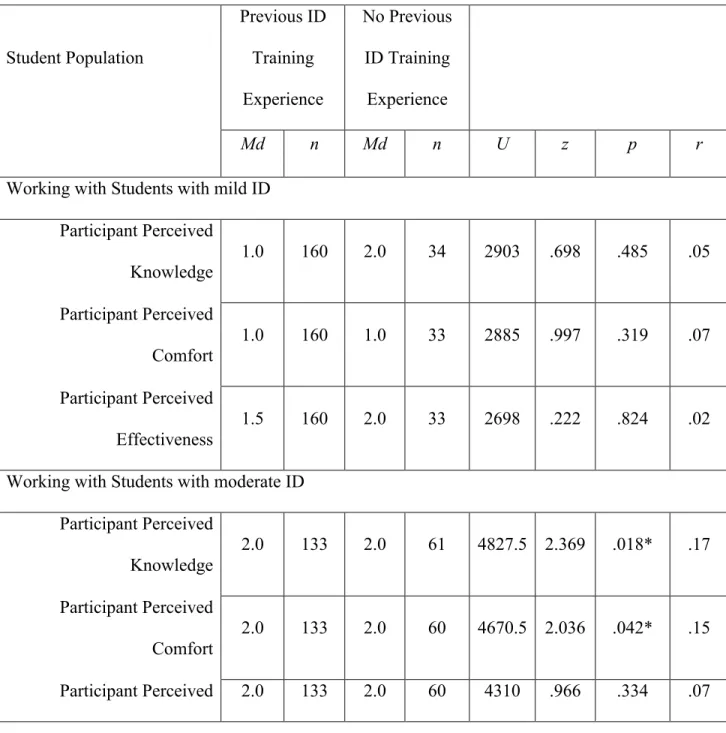
Correlational analyses were also conducted to examine relationships between respondents’ self-rated knowledge, comfort level, and effectiveness as they related to assessing students with ID. Multiple non-parametric, Mann-Whitney U tests were run to investigate differences between respondents who reported that they had received specific training related to ID and those who reported that they had not received specific training. Specific differences in the number of students with ID with whom respondents had worked, how frequently respondents’ self-reported involvement in the development of IEP goals for students with ID, and in respondents’ perceptions (i.e., how knowledgeable, comfortable, and effective they felt) when assessing students with ID were investigated.
Results
This study posed three main questions investigating the characteristics, practices, and perceptions of school psychologists in North Carolina serving students with ID. The first question focused on the status and range of school psychologists’ previous training specific to the ID student population. The second question examined the nature of current school-based school psychologists’ practices as they related to working with students with ID. The third question addressed school psychologists’ self-rated perceptions when working with this population of students. Examination of the questions was based on the analysis of data gathered using the web-based survey described earlier.
Status and Range of Previous Training Related to ID
the purpose of keeping up with assessment practices. Other common reasons for
participation included meeting licensure continuing education requirements (81 percent, n = 170), keeping up with intervention practices (80 percent, n = 167), meeting NCDPI
requirements (74 percent, n = 154), keeping up with state policies and procedures (69
percent, n = 144), and meeting district or school system requirements (54 percent, n = 112). With regard to previous training specific to students with ID, 77 percent of
respondents indicated that they had received training for mild ID, while 16 percent (n = 34) indicated no previous training for this student population. With regard to moderate ID, 64 percent of participating school psychologists indicated previous training, while 29 percent (n = 61) indicated no training. Lastly, 54 percent reported having received training specific to students with severe ID, while 40 percent (n = 83) indicated no previous training for this population. Just below seven percent of the respondents (n = 14) chose not to respond to any questions about previous training experience specific to students with ID.
Participants were asked to identify all previous training experiences related to their preparation to serve students with different levels of ID. The majority of the training
experiences reported by school psychologists working with students with mild ID were in the form of one or more graduate school course (69 percent) or conference presentations or sessions (42 percent). Of those who indicated previous training for students with mild ID, 64 percent reported participating in more than one type of training (e.g., graduate course and a specialized practicum/internship experience).
moderate ID indicated more than one training experience. Reported training experiences related to the assessment of students with severe ID most often consisted of a graduate course. Slightly over half (i.e., 51 percent) of those who received previous training for severe ID participated in more than one type of training experience. Table 5 presents a description of the nature and distribution of previous training experience of school
Table 5
Training Experiences of School Psychologists with Reference to Student Level of ID
Type of Training
Total of Sample (n = 195)
(n)
Percentage of Sample
(%)
Previous Training for Mild ID 161 77%
Graduate school course(s) 145 69%
Conference presentation or session
88 42%
Previous Training for Moderate
ID 134 64%
Graduate school course(s) 113 54%
Conference presentation or
session 51 24%
Previous Training for Severe ID 112 54%
Graduate school course(s) 89 43%
Conference presentation or session
31 15%
Local district training 31 15%
In that some school psychologists worked with students at more than one severity level of ID, follow-up cross tabulations were carried out to examine summary values across groups. The results revealed that slightly over half of the respondents (51 percent, n = 107) indicated previous training for all severity levels of ID (i.e., mild, moderate, and severe). Thirteen percent of the respondents (n = 28) indicated training for students with mild ID only, while an additional 11 percent of the respondents (n = 24) reported training with mild and moderate ID only. Furthermore, 14 percent of the respondents (n = 30) reported no previous training with any severity level of ID.
When asked if they were interested in accessing and/or utilizing resources specific to the practice of assessing students with ID in the schools, 92 percent of respondents indicated interest in one or more resource. Almost half (48 percent, n = 100) preferred a webinar discussing recommended practices, 40 percent (n = 84) were interested in attending a presentation at an NCSPA conference, and another 40 percent (n = 84) indicated interest in an executive summary or abstract of the current study upon its completion. Only eight percent (n = 17) indicated that they were not interested in additional resources related to assessing students with ID.
In summary, the results indicate that while most of the participants reported
participating in continuing education only “some of the time,” one of the main purposes of participating was to keep up with assessment practices. The training experiences of
participants were found to be indirectly related to the severity level of ID of students; that is, specific training in the area of severe ID was much less common among participants
they had attended a conference presentation or session to gain knowledge about the ID student population. However, participants indicated that they were generally interested in furthering their knowledge in this area by attending a webinar or conference presentation or by reading an executive summary or an abstract that outlined results.
Nature of Current Practices Related to Students with ID
With reference to current practices of school psychologists, most of those surveyed (72 percent) indicated that they spent the majority of their time during the 2014-2015 school year conducting assessments or testing. Consulting with staff and parents was ranked as the second most common activity during the 2014-2015 school year by 68 percent of
respondents (n = 143). Forty-two percent (n = 88) of the respondents indicated that
counseling students came in third, and leading professional development was ranked as the fourth most common activity.
When asked to rank types of assessment according to the amount of time spent on each during the 2014-2015 school year, most respondents (56 percent, n = 117) ranked cognitive assessments as the most time consuming. Educational/achievement assessments were ranked as the second most time consuming (35 percent, n = 73) and adaptive and social/emotional assessments were ranked as the third and fourth most time consuming (45 percent, n = 94; 35 percent, n = 73, respectively). Curriculum-based assessments were ranked as the least time consuming (65 percent, n = 135).
Respondents were asked to rank the factors most important to them when considering which particular assessment to administer. Response choices included psychometric
most important factor. The normative group of the assessment tool was ranked as the second most important factor by 36 percent of respondents (n = 75), while convenience of
administration was ranked as the third most important factor by 39 percent of respondents (n = 81).
To quantify the number of students with ID with whom respondents had worked during the 2014-2015 school year, they were asked to select a category of numbers from a pull-down menu for each severity level. Most school psychologists (i.e., 59 percent)
indicated working with five or less students with mild ID during the 2014-2015 school year. With regard to students with moderate ID, 42 percent of school psychologists reported working with only one or two students. In terms of the number of students with severe ID with whom they worked, 51 percent of respondents reported zero students for the 2014-2015 school year. Table 6 provides a detailed description of the number of students with ID with whom respondents worked during the 2014-2015 academic year.
Table 6
Number of Students with ID with Whom Respondents Worked in 2014-2015
Number of Students
Total of Sample (n = 193)
(n)
Percentage of Sample
(%)
Mild ID
Did not work with any students 7 3.3%
Worked with 1 to 2 students 36 17.2%
6 to 10 students 35 16.7%
11 or more students 28 13.4%
No response 16 7.7%
Moderate ID
Did not work with any students 43 20.6%
Worked with 1 to 2 students 88 42.1%
3 to 5 students 41 19.6%
6 to 10 students 14 6.8%
11 or more students 7 3.3%
No response 16 7.7%
Severe ID
Did not work with any students 106 50.7%
Worked with 1 to 2 students 59 28.2%
3 to 5 students 23 13.9%
6 to 10 students 2 1%
11 or more students 3 1.4%
No response 16 7.7%
School psychologists were asked about several specific assessment-specific practices. With regard to school psychologists’ involvement in the development of IEP goals for
students with ID, 41 percent (n = 86) of the participants reported that they were