A Study of the Dynamic Relationships between Depression,
Treatment, and Work Behavior
by
M. Katherine Cloud
A dissertation submitted to the faculty of the University of North Carolina at Chapel Hill in partial fulfillment of the requirements for the degree of Doctor of Philosophy in the Department of Economics.
Chapel Hill 2010
Approved by:
Donna B. Gilleskie, Advisor
David Guilkey, Reader
John S. Akin, Reader
David Blau, Reader
ABSTRACT
M. KATHERINE CLOUD: A Study of the Dynamic Relationships between Depression, Treatment, and Work Behavior
(Under the direction of Donna B. Gilleskie)
It has been shown in the literature that depression has a significant negative correlation
with employment outcomes as measured by labor force participation, earnings, work
atten-dance and job performance. I expand the understanding of this relationship by exploring
the effect of depression on employment choices as well as treatment choices over time rather
than simply examining correlations at a point in time. Other health related outcomes and
the relationship between choices and mental health will be examined. My analysis follows
initially depressed individuals for nine months and examines the dynamic relationship
be-tween health status and function, treatment decisions and employment outcomes. I consider
a dynamic model of individual decisions over time where lagged endogenous behavior is
al-lowed to influence current behavior or health outcomes. Results indicate that depression
does have a significant effect on labor productivity. Individuals who were the most depressed
at the baseline interview saw the largest improvements in productivity following treatment.
However, the estimates imply that depression is not a significant determinant of the worker’s
attendance at work.
DEDICATION
This dissertation is dedicated to the loving memory of my grandfather Dr. Alvin Hugh
ACKNOWLEDGMENTS
I would like to thank Dr. Donna Gilleskie for all of her hard work and dedication to her
students. Her advice and support has been invaluable. Additional thanks go to Eli Lilly for
the use of the ARTIST trial data and Rebecca Robinson for her help with questions on these
data.
TABLE OF CONTENTS
DEDICATION iv
LIST OF TABLES ix
LIST OF FIGURES xii
LIST OF ABBREVIATIONS xiii
1 Introduction 1
2 Background 5
3 Data Description 9
3.1 ARTIST trial . . . 9
3.2 Health Variables and Scales . . . 11
3.3 Labor Variables . . . 18
3.4 Treatment Variables . . . 21
3.5 Exogenous Variables . . . 23
4.1 Overview of Decision Making Process . . . 26
4.2 Decision Variables . . . 26
4.3 Health Production . . . 29
4.4 Optimization . . . 29
5 Empirical Model 31 6 Results 40 6.1 GMM Results . . . 41
6.1.1 Productivity . . . 41
6.1.2 Absenteeism . . . 46
7 Conclusion 52
A Sample Characteristics by Participation Pattern 53
B Questions from the 36-item Short-form Health Survey (SF-36) 56
C Productivity Questions from the Work Limitations Questionnaire 58
D Zipcode Tabulation Areas 59
E The Work Limitations Questionnaire: Estimated Productivity Impact of
Health-Related Work Limitations Based on WLQ Index Score 61
F The GMM Estimator 62
G Additional Information on Variables 64
LIST OF TABLES
3.1 Number of Patients at each interview . . . 11
3.2 Individual Participation Patterns over the 5 interviews . . . 12
3.3 Summary of Depression using HSCL-20 Score . . . 14
3.4 Variation in HSCL-20 Mental Health Variable . . . 15
3.5 Summary of Depression using SF-12 Score . . . 17
3.6 Variation in SF-12 Mental Health Variable . . . 17
3.7 Baseline Health Characteristics of Sample . . . 18
3.8 Variation in Labor Variables . . . 20
3.9 Variation in Productivity Measure . . . 20
3.10 Summary of Labor Variables by HSCL-20 Mental Health Category . . . 21
3.11 Treatment Variables . . . 22
3.12 Summary of Baseline Individual Exogenous Characteristics . . . 23
3.13 Represented States . . . 24
6.1 Estimation Results for Productivity using OLS and WG and the HSCL-20 mental health measure . . . 42
6.2 Estimation Results for Productivity using GMM and the HSCL-20 mental health measure . . . 43
6.3 Estimation Results for Productivity using OLS and WG and the SF-12 mental health measure . . . 45
6.4 Estimation Results for Productivity using GMM and the
SF-12 mental health measure . . . 45
6.5 Estimation Results for Productivity using GMM and the
HSCL-20 mental health measure for the most depressed sample at
baseline . . . 47
6.6 Estimation Results for Productivity using GMM and the
HSCL-20 mental health measure for the least depressed sample at
baseline . . . 47
6.7 Estimation Results for Attendance using OLS and WG and
the HSCL-20 mental health measure . . . 48
6.8 Estimation Results for Attendance using GMM and the
HSCL-20 mental health measure . . . 49
6.9 Estimation Results for Attendance using OLS, WG and the
SF-12 mental health measure . . . 50
6.10 Estimation Results for Attendance using GMM and the SF-12
mental health measure . . . 50
6.11 Estimation Results for Attendance using GMM and the SF-12
mental health measure for the most depressed sample at baseline . . . 51
6.12 GMM estimates for Attendance and Mental Health using the
SF-12 mental health measure for the least depressed sample at baseline . . . 51
A.1 Health Characteristics by Participation Pattern . . . 54
E.1 The Work Limitations Questionnaire: Estimated Productivity
Impact of Health-Related Work Limitations Based on WLQ
Index Score . . . 61
G.1 Constant Explanatory Variables- Definitions . . . 64
G.2 Summary of First-Differenced Characteristics of Sample . . . 64
LIST OF FIGURES
4.1 Timing of per-period Employment and Treatment Decisions
LIST OF ABBREVIATIONS
ARTIST A Randomized Trial Investigating SSRI Treatment
CDS Chronic Disease Score
CPS Current Population Study
DALYs Disability Adjusted Life Years
DDI Depression Diagnosis Interview
DPCRC Duke Primary Care Research Consortium
DSM-IV Diagnostic and Statistical Manual, fourth edition
ECA Epidemiological Catchment Area
FD First Difference
FE Fixed Effects
FOD Forward Orthogonal Deviations
GBD Global Burden of Disease
GMM Generalized Method of Moments
HERO Health Enhancement Research Organization
HSCL Hopkins Symptoms Checklist
HSCL-20 Hopkins Symptoms Checklist-20
IID Independent and identially distributed
IV Instrumental Variables
LPT Lost Productive Time
MOS Medical Outcomes Study
NCS National Comorbidity Study
NIMH National Institutes for Mental Health
OLS Ordinary Least Squares
PCN Primary Care Network
PCP Primary Care Provider
PCS-12 Physical Component Score
PHQ-9 9-item Patient Health Questionnaire
PSS Physical Symptoms Scale
QALY Quality Adjusted Life Year
SF-12 12-item Short-form Health Survey
SF-36 36-item Short-form Health Survey
SSRI Selective Serotonin Reuptake Inhibitors
USPS United States Postal Service
WG Within-Groups
WLQ Work Limitations Questionnaire
YLD Years Lived with Disability
Chapter 1
Introduction
The impact of mental health on the labor market is a topic of increasing interest to
em-ployers, policy makers, and to both labor and health economists. Following the findings of
the Harvard School of Public Health in its 1996 (updated in 2003) study “Global Burden
of Disease (GBD),” theGlobal Business and Economic Roundtable on Addiction and Mental
Health was formed in 1998. The Roundtable consists of business and health leaders who
have proposed that mental health is a business and economic issue.1 They highlight the fact
that mental health problems are driving disability rates within the North American labor
force representing significant social and business costs and leading to lower productivity. The
global information economy is, by definition, dependent on mental performance. Therefore,
mental health among the labor force is a significant determinant of output much like physical
health was in the industrial economy. Mental health is also closely tied to a depressed
individ-ual’s physical health, notably, heart disease and fatigue. In the public sector, congressional
lawmakers and mental health experts are discussing ways to meet the goals laid out in The
President’s New Freedom Commission on Mental Health.2
The term mental illness includes a vast array of diseases causing varying levels of
lim-itations. Major depressive disorder, also known as major depression, unipolar depression,
clinical depression or simply depression, is a common mental disorder characterized by a
per-vasive low mood, loss of interest in a person’s usual activities, diminished ability to experience
1They base this proposal on four facts drawn from the Harvard and other studies. 2
pleasure, feelings of guilt or low self-worth, disturbed sleep or appetite, low energy and poor
concentration. It is the most widespread of all psychiatric disorders and one of the most
com-mon medical conditions in the United States. It has been estimated that depression affects
18.8 million Americans each year, afflicting between 10 and 25 percent of American women
and between five and 12 percent of men in their lifetime (Kessler et al., 2005).
The Harvard Study reports that in 2000, depression was estimated to be the fourth leading
contributor to the global burden of disease, and today, depression is already the second
cause of Disability Adjusted Life Years (DALYs) in the age category 15-44 years for both
sexes combined.3 The same study estimated that by 2020, only ischemic heart disease will
contribute a larger worldwide economic burden in DALYs calculated for all ages, both sexes.
These projections show that with the aging of the world population and the conquest of
infectious diseases, psychiatric and neurological conditions could increase their share of the
total global disease burden by almost half, from 10.50% of the total burden to almost 15.00%
in 2020.
This burden results from both direct health care costs and indirect costs including effects
in the labor market, high correlation with poor physical health, suicide and disability costs.
Greenberg et al. (2003) estimated that the United States spent $83.10 billion in 2000 for costs
associated with depression, an increase from $77.40 billion in 1990. The direct treatment costs
were estimated to account for 31.40% of the total costs for depression, with workplace costs
making up 62.00% of the economic costs of depression (Greenberg et al., 2003). Multiple
studies have shown people with depression also have higher total healthcare utilization rates
when compared to individuals without depression. The Health Enhancement Research
Or-ganization (HERO) analyzed employee medical costs for 46,000 employed persons and found
that of the health risk factors studied (smoking, sedentary lifestyle, high cholesterol levels,
hypertension, poor diet, being overweight, excessive alcohol consumption, high blood glucose
3
levels, high stress and depression), depression predicted the largest increase in medical costs.
The HERO study estimated that depression predicted a 70.00% increase in medical costs
compared to medical costs for those without depression. Another study noted that depressed
employees use, on average, more than $4000 per year in medical services compared to less
than $1000 per year for those without depression indicating that depression is a significant
element in rising healthcare costs (Sipkoff, 2006). Both direct and indirect costs will vary
based on the severity of the depression.
In the labor market, depressed individuals are less likely to be employed, more likely to be
absent if employed and have lower productivity while at work. Compounding the effect, many
affected individuals are in the prime of their working lives, unlike other disabling conditions
that often occur later in life. The GBD study estimated that major depression is the single
most burdensome illness in the middle life years.
The costs related to depression often come in the form of lower productivity (due to
reduced cognitive abilities or impaired concentration) while at work, called presenteeism, and
a higher number of missed days of work, termed absenteeism. Data from the Epidemiological
Catchment Area (ECA) and the National Comorbidity Study (NCS) provide estimates of the
annual total cost of depression at $43.70 billion in 1990. Employment effects were substantial:
$11.70 billion for work absenteeism and $12 billion for reduced productivity. A 1996 reestimate
of the losses totaled $53 billion (Swindle et al., 2001). Other estimates have been as high as
$51.50 billion a year in lost productivity (Lerner et al., 2004).
Many studies address issues concerning either mental health or depression and labor
out-comes. These studies are primarily static, considering only one time period or using repeated
cross sections, despite the fact that depression is a recurring disease for the individual. It is
estimated that of individuals who have had a single major depressive episode, 50%-60% may
develop a second episode within 10 years of the initial episode. About 90% of those who have
had two episodes may have a third. The relapse rate is estimated to be 40% within 15 weeks
among persons who have had at least three lifetime episodes and a relapse rate of 65% within
the first year, if left untreated, for these individuals (Bloom, 2004).
A few studies use panel data but can only report an association between depression and
work outcomes. They do not account for treatment decisions and efficacy or they do not
address individual unobserved heterogeneity that may affect the individual’s decisions and
outcomes.
The ideal data set would detail the health, labor and demographic characteristics of a
nationally representative sample of individuals followed over time. In reviewing the literature,
there were not any studies that use data with all of these characteristics. I use the ARTIST
(A Randomized Trial Investigating SSRI 4 Treatment) trial data which has the advantages
of including many health measures (both physical and mental) and labor questions asked
together with a substantial amount of geographic variation. It is in the form of a panel and
follows 573 individuals for 9 months. Disadvantages include the fact that these data are
based on self report, the data only cover a nine-month period and all of the individuals are
depressed at baseline causing selection bias issues. The purpose of the trial was to investigate
the efficacy of specific SSRI treatments on depressed primary care patients.
The contributions of this dissertation follow: This study extends the models estimated
with panel data by allowing for potential dynamic relationships between depression and
em-ployment over time, considering the role of treatment in affecting both health transitions as
well as observed employment outcomes, using the time series element of the data to address
instrumentation and using multiple measures of depression and labor outcomes.
The remainder of this dissertation is organized in the following chapters. Chapter 2
contains a literature review. Chapter 3 describes the data. Chapter 4 presents a theoretical
model. The empirical model is found in Chapter 5. Chapter 6 discusses results. Chapter 7
concludes, discussing implications for policy formulation and further research.
4
Chapter 2
Background
The literature confirms an association between depression and employment probabilities,
presenteeism and absenteeism. It further suggests that there are substantial employer costs
associated with the employment of depressed individuals.
Using data from the National Comorbidity Survey (NCS)1 to identify the importance of
depression in the labor force, Marcotte et al. (1999) find that rates of depression are similar
in and out of the labor force. However, they report that within the labor force, depression
is strongly associated with unemployment, with a particularly strong relationship for middle
age workers. Using an instrumental variables approach, Ettner et al. (1997) find a decrease
in the employment probability for both women and men with major depression. Mullahy and
Sindelar (1990) show that mental health was a significant determinant of the probability of
full-time work for New Haven adults. Broadhead et al. (1990) find similar results and report
that persons with minor depression were more likely to be unemployed. In more recent work,
Lerner et al. (2004) report that all forms of depression lead to significant increases in job
turnover. Specifically focusing on employed individuals with depression, they report that at
the six-month follow-up, unemployment rates had increased by 12% for the participants in the
major depression group, compared with 2% for individuals in the control group and 3% for
those affected by rheumatoid arthritis. The same study reports that “among participants who
were still employed, those with depression had significantly more job turnover, presenteeism
1The NCS is a nationally representative sample. It is longitudinal and cross-sectional and only compares
and absenteeism.”
Depite higher unemployment rates for depressed individuals, it has been estimated that
more than 70 percent of people diagnosed with depression are employed (Lerner et al., 2004).
Estimates have varied with respect to whether depression impacts productivity costs
predom-inantly through absenteeism or presenteeism.
Kessler et al. (2001) find that employed patients with psychiatric disorders (including
depression) had significantly greater mean monthly number of work loss days (0.25) and work
cutback days (1.09) compared to people with no disorders. Druss et al. (2001), using data
from three major American companies, report that those who displayed chronic symptoms of
depression were twice as likely to miss work due to health reasons, and seven times as likely
to report missed work days at the time of the follow up survey. Bill Wilkerson2 reports in
his speech “Mental Health: The Ultimate Productivity Weapon in the Post- September 11th
economy” that the average number of workdays lost to one case of depression is about forty or
$10,000 per absent employee for wage replacements and the company’s share of drug therapies
with a group health benefit plan. In more recent studies, Kessler et al. (2006) studied work
impairment due to chronic conditions including major depression. They report estimates that
major depressive disorder was associated with 27.20 lost workdays per ill worker per year.
The indirect costs of depression continue to increase when considering lowered productivity
(due to reduced cognitive abilities or impaired concentration) while at work, or presenteeism.
Brouwer et al. (2002) report that presenteeism can occur before and after absence from
work. Berndt et al. (1998) find that perceived work performance is inversely related to the
severity of depression and that a reduction in depression severity is associated with a rapid
improvement in perceived work performance. In their study to explain depression’s effect on
work productivity, they use panel data with three interviews per individual over a 12-week
period. They do not address the issue of unobserved heterogeneity and explain much of the
change in outcomes as regression to the mean. Von Korff et al. (1992) evaluated untreated
depressed patients who frequently used health care in a Health Maintenance Organization
2
over a period of 12 months. Respondents whose depression did not improve over the period
reported very high levels of work impairment that did not change significantly. In comparison,
respondents with depression rated as severe at baseline whose depression did improve over
the follow-up reported a 36% reduction in work impairment days. The study does use panel
data. However, these results do not prove that the reduced productivity is a consequence of
the depression. Another possibility is that some other unmeasured variable (e.g., difficulty in
getting along with a work supervisor) increases both depression and work impairment. The
purpose of the Von Korff et al. (1992) study was primarily medical and the results are based
on associations between depressive episode improvement and work impairment. Stewart et al.
(2003) use data from theAmerican Productivity Audit in 2001-2002. They find that depressed
individuals had 5.6 hours per week more lost productive time than non-depressed workers.
They conclude that 81% of the lost productive time was due to presenteeism. In this study,
excess lost productive time (LPT) costs from depression were derived as the difference in LPT
for depressed individuals minus the expected LPT for non-depressed individuals projected to
the US labor force. Again, they do not account for individual differences or treatment decisions
and outcomes. Using data from 16,651 employees, Burton et al. (2004) demonstrated that
depression was highly associated with work limitations that predict a worker’s productivity
while on the job, including limitations in time management, interpersonal/mental functioning,
and overall output.
It is important to address the treatment decision in any study of depression. Between
80 and 90 percent of individuals suffering from a major depressive disorder can be treated
successfully, yet the National Institute of Mental Health estimates that only one in three
with the illness ever seek treatment. Among a depressed sample, absenteeism is reduced
and productivity improves regardless of treatment choice3 (Mintz et al. 1992, Simon et al.
1998). In 1992, Mintz et al. (1992) looked at different studies that evaluated the effects of
antidepressants and psychotherapy on work impairment. Work outcomes were generally good
when the treatment choice was effective. Relapse was found to be a consistent predictor of
3
In this research, treatment choices are of short-term medications, psychotherapy lasting 10 to 16 weeks, and maintenance therapy over 6 to 9 months.
long-term work impairment. When considering treatment, Claxton et al. (1999) showed that
absenteeism increased prior to antidepressant use, and decreased after treatment began.
Many aspects of the relationships between depression, labor outcomes, and treatment
decisions have been addressed in the existing literature. Most studies are found in medical
or policy literature and fail to control for many factors. Many separate their sample into
two groups, a treatment and a control group. Or, they just look at the changes in outcome
variables without controlling for any characteristics, either observable or unobservable, other
than depression.
In the economics literature, the majority of studies are based on cross section data and
do not investigate the role of permanent unobserved heterogeneity on these outcomes.
Longi-tudinal studies are rare, but do exist. However, they rarely incorporate treatment decisions.
I will extend this previous research by focusing on the relationships between depressive
disorders, treatment decisions and multiple labor outcomes. The specific goals of the study
are to: (i) estimate the impact of depression on labor outcomes while accounting for
perma-nent unobserved heterogeneity in order to get unbiased estimates of depression’s effects on
labor outcomes, (ii) to incorporate treatment decisions into a model that uses different labor
outcomes and varying measures of depression (including continuous, binary and categorical
scales) and (iii) to use The Generalized Methods of Moments estimator and lags of endogenous
Chapter 3
Data Description
3.1
ARTIST trial
Much effort was made to find a data set with varying health and employment measures
that followed individuals over time in order to capture the effect of a potentially changing
(ei-ther improving or worsening) depressive state on work behavior. Through special agreement
with the pharmaceutical manufacturer Eli Lilly, I have obtained access to the ARTIST (A
Randomized Trial Investigating SSRI Treatment) trial data. These data were collected over
a 9-month period with enrollment occurring between April and November 1999. The
partic-ipants were recruited from 37 clinical practices in two primary care research networks: the
Primary Care Network (PCN)1and the Duke Primary Care Research Consortium (DPCRC).2
Overall, 77 practitioners participated in the ARTIST trial, 51 from the PCN and 26 from the
DPCRC. To be eligible to participate in the study, individuals had to be at least 18 years
of age, receive their primary care from a physician participating in the PCN or DPCRC,
have access to a home telephone, and be diagnosed with a depressive disorder. There were
also exclusionary restrictions. Restrictions included: being actively suicidal, cognitive
impair-ment, terminal illness, nursing home residence, taking an SSRI currently or within the last
two months, taking a non- SSRI antidepressant at more than low doses, history of bipolar
disorder, active cocaine or opiate user, and pregnant or breast feeding. The purpose of the
1
The PCN is a not-for-profit voluntary organization and nationwide network of primary care practitioners whose goal is to optimize the care they provide by continuing education.
2The DPCRC is an academic site management organization that operates within the Duke Health Care
trial was to investigate the efficacy of specific SSRI treatments on depression. As such, the
participants were randomly assigned particular drug treatments and followed over time. The
data set has the unique feature that it follows individuals over time. The decision to begin
antidepressant therapy was based solely on the primary care provider’s (PCP) judgment that
the patient’s depression warranted antidepressant therapy.3 Once the individual qualified for
the study, a touch tone telephone procedure was used to randomly assign the patient to a
spe-cific antidepressant.4 Both patients and PCP’s were aware of the SSRI assignment. Decisions
regarding treatment changes, including SSRI type, dosage, and discontinuation were allowed
and jointly made by the patient and the PCP.5 Patients received a pharmacy benefits card
covering the costs for the SSRI and any non-SSRI antidepressant that the PCP prescribed
during the study.6 Study patients also received payments as reimbursement for their time.
Participants received $20 for each completed telephone interview, with additional payments
of $20 for 4 completed interviews and $30 for 5 completed interviews. A participant of all 5
interviews received a maximum of $150.
Computer assisted telephone interviews were used to assess outcomes. Interviewers did
not divert from the interview format and were required to use preselected response options.
Certain follow-up interviews were not complete. In order to get complete data, in the cases
where individuals were difficult to reach, a prioritized list of questions was used, with the
main outcome being asked first. The participants were considered still participating even if
the interview was incomplete. They may have also been included in a later wave even if they
were missing from a previous wave.
3
The trial was set up to resemble real world practice and the practitioners did not receive additional training that could potentially change typical treatment patterns.
4The possible antidepressants were either 20 of mg paroxetine (Paxil), 20 mg of fluoxetine hydrochloride
(Prozac), or 50 mg of sertraline (Zoloft).
5It is important to note that the decision to begin antidepressant therapy was based solely on the PCP’s
judgement that the patient’s depression warranted antidepressant therapy. Using HSCL categories, approxi-mately 6.67% of the sample individuals are categorized in the ‘depression in remission’ group at baseline.
6
These data have the limitation of following only those initially diagnosed as depressed,
making selection an issue. Additional limitations include the patient self-reporting on therapy
compliance and the fact that the treating physicians were not privileged to outcome
infor-mation from the telephone interviews.7 601 patients provided informed consent and were
randomized to treatment. 573 of these individuals completed the baseline telephone
assess-ment. The survey consists of a baseline interview and 4 follow-up interviews in varying time
intervals. Follow-up phone interviews were successfully completed for 79% of the participants
at 9 months. Table 3.1 below details participation and follow-up of the original sample.
Table 3.1: Number of Patients at each interview
Baseline Interview 573 patients
At least 1 follow up interview 546 patients
1 month interview 538 patients
3 month interview 504 patients
6 month interview 483 patients
9 month interview 455 patients
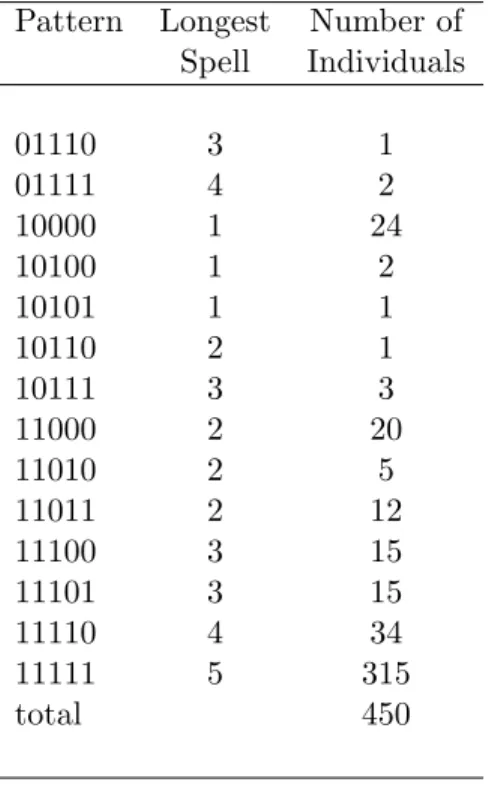
Table 3.2 details availability of data in each interview, where 10111, for example, indicates
that the participant missed the second interview. Note that I drop individuals aged 65 and
older due to retirement possibilities, those with ages 18-22 due to schooling possibilities and
one individual with no age information from the sample. Other individuals with missing
employment information were also dropped from the sample. Statistics reported from here
on are based on the 315 individuals with complete information for all interviews. These data
provide 1575 observations for analysis.
3.2
Health Variables and Scales
It is important to consider different issues in the measurement of mental illness. In the
mental health and labor literature, different strategies are used. One common approach is the
7
This was to resemble real work practice.
Table 3.2: Individual Participation Patterns over the 5 interviews
Pattern Longest Number of Spell Individuals
01110 3 1
01111 4 2
10000 1 24
10100 1 2
10101 1 1
10110 2 1
10111 3 3
11000 2 20
11010 2 5
11011 2 12
11100 3 15
11101 3 15
11110 4 34
11111 5 315
total 450
utilization-based approach (Frank and Gertler, 1991). With this method, the individuals are
asked if they have ever been treated for a mental disorder. If they answer yes, they are asked
to identify the diagnosed disorder. With another approach, individuals are asked varying
questions about their mental health status. They characterize each element as excellent,
good, fair or poor. A more recent approach utilizes symptoms and clinical algorithms to
determine diagnoses. Individuals respond to questionnaires that identify clinical symptoms.
These symptoms either directly indicate a mental health problem or are used in algorithms
to determine a diagnosis. Specifically, the diagnosis of major depressive disorder is based on
the patient’s self-reported experiences, behavior reported by relatives or friends, and a mental
status exam. There is no laboratory test for major depression.
The ARTIST trial consists of multiple scales that can be used to measure depression
and/or physical health: The Depression Diagnosis Interview Questions (DDI), The Hopkins
Symptom Checklist (HSCL), The Physical Symptoms Scale (PSS), The 9-item Patient Health
Short-Form Health Survey (SF-12).8 Each scale has specific benefits and shortcomings. There
is an SF-12 score for each interview. SF-36 is only used at baseline and in months 3 and 9. The
DDI questions are also only asked at baseline, and in months 3 and 9. Depression outcome
is assessed with two measures of core depressive symptoms, the HSCL-209 and SF-12 mental
health component scores. I use both the HSCL-20 mental health component score and SF-12
mental health component scores as measures of depression in this paper. Both are validated
measures of depression severity.
Depression severity is often defined as mild, moderate or severe. The levels are described
in terms of the extent to which the patient’s everyday life is affected: mild depression causes
only minor impairment of the patient’s work, social life and relationships with others. Major
depression, as defined in the DSM-IV, can be of mild severity. Moderate depression is
as-sociated with more obvious symptoms and is more likely to be noticeable to others. Severe
depression is characterized by affecting the patient so badly that he or she may be unable to
work or to relate socially to others. Full remission is defined as the absence of symptoms for
at least two months. For partial remission, full criteria for a major depressive episode are no
longer met, or there are no substantial symptoms, but two months have not yet passed. In
this study, I do not distinguish between full and partial remission.
HCSL-20
The Hopkins Symptom Checklist (HSCL) is a self report symptom inventory originally
comprised of 58 items representing symptoms commonly observed in outpatients. There
are five underlying symptom dimensions: somatization, obsessive-compulsive, interpersonal
sensitivity, anxiety and depression. The original 58-item symptom inventory expanded to
incorporate 32 additional items in four symptom dimensions: hostility, phobic anxiety,
para-noid ideation and psychoticism. The HSCL-20 is a 20-item modified subscale of the 90-item
Hopkins Symptom Checklist. The scores range from 0-4 with a higher score indicating a more
8
SF-36 and SF-12 are versions of the same scale.
9
The HSCL-20 is a 20-item modified subscale of the 90-item Hopkins Symptom Checklist. The 20-item scale includes the full 13-item depression subscale of these longer instruments plus 7 additional items that allow for an assessment of all Diagnostic and Statistical Manual, fourth edition (DSM-IV) items. Using these scales, an HSCL-20 mean score is calculated for each individual in each time period.
serious depressive episode. This continuous variable will be used in all estimations. To serve
as a frame of reference, the scores are divided into 4 categories, each representing a different
degree of depression.
HSCLt =
1 depression in remission: 0.00≤HSCLt<0.75
2 mild depression: 0.75≤HSCLt<1.50
3 moderate depression: 1.50≤HSCLt<2.00
4 severe depression: 2.00≤HSCLt≤4.00
(3.1)
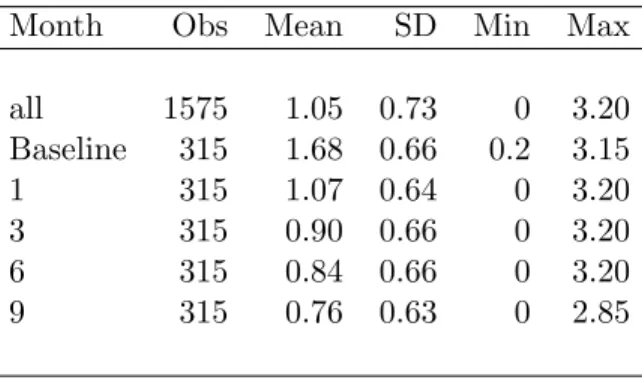
Table 3.3: Summary of Depression using HSCL-20 Score
Month Obs Mean SD Min Max
all 1575 1.05 0.73 0 3.20
Baseline 315 1.68 0.66 0.2 3.15
1 315 1.07 0.64 0 3.20
3 315 0.90 0.66 0 3.20
6 315 0.84 0.66 0 3.20
9 315 0.76 0.63 0 2.85
As seen in Table 3.3, the HSCL-20 mean measure continues to decrease throughout the
ARTIST trial, meaning that the patients’ general depression levels continuously improve. It
decreases at a decreasing rate until the last period with the largest improvement occurring in
the first period with a 36.30% change.
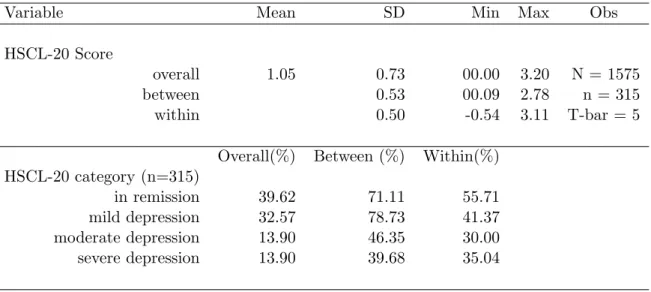
The trial follows individuals over time, and it is important to consider the breakdown of
the variation in the depression score into between-individual variation and within-individual
variation. I report similar statistics for the remainder of the outcome variables. Refer to
Table 3.4. Overall, 39.62% of the person-year observations are considered to be in remission
and 13.90% are categorized as having severe depression. Taking patients individually, 71.11%
of the individuals are in remission at some point, with 39.68% considered to be severely
depressed at least once; thus some individuals are characterized as having severe depressive
is considered to have major depression at least once, 35.04% of her observations fall into the
severe depression category. Similarly, if the patient is ever categorized to be in remission,
55.71% of her observations are considered to be in remission. If an individual’s depressive
status never varied over time in these data, the within individual variation percentages would
all be equal to 100. With a continuous variable, the mean and decomposed standard deviation
are reported. The standard deviation is decomposed into between and within components. If
the within standard deviation is equal to 0, all of the variation is between individuals. The
0.50 for the within variation confirms that there is variation within the individual.
Table 3.4: Variation in HSCL-20 Mental Health Variable
Variable Mean SD Min Max Obs
HSCL-20 Score
overall 1.05 0.73 00.00 3.20 N = 1575
between 0.53 00.09 2.78 n = 315
within 0.50 -0.54 3.11 T-bar = 5
Overall(%) Between (%) Within(%) HSCL-20 category (n=315)
in remission 39.62 71.11 55.71
mild depression 32.57 78.73 41.37
moderate depression 13.90 46.35 30.00
severe depression 13.90 39.68 35.04
SF-36 and SF-12
The 36-item Short-form Health Survey (SF-36) measures health-related quality of life
in eight domains, including physical functioning, social functioning, mental health, general
health perception, pain, vitality, and physical and emotional role functioning. Selected
mea-sures from the Medical Outcomes Study (MOS) are also used to assess social functioning,
concentration, positive well-being, hopefulness, sleep, and sexual function. Anxiety and
al-cohol disorder items are taken from the PHQ-9. Additionally, questionnaires were used to
evaluate quality of close relationships and disposition.
The 36-item short form was constructed to survey health status in the Medical Outcomes
Study (MOS), which was a part of the phone interviews at baseline, in month 3 and in
month 9. The SF-36 was designed for use in clinical practice and research, health policy
evaluations, and general population surveys. It includes one multi-item scale that assesses
aspects of both the individual’s physical and mental health: limitations in physical activities
because of health problems, limitations in social activities because of physical or emotional
problems, limitations in usual role activities because of physical health problems, bodily pain,
general mental health (psychological distress and well being), limitations in usual role activity
because of emotional problems, vitality (energy and fatigue), and general health perceptions.
Since this study is primarily concerned with questions surrounding mental health issues, I
will describe the questions that pertain to mental health. The 14 questions, out of 36 total
questions, affecting mental health fall into one of four scales (Vitality, Social Functioning,
Role- Emotional, Mental Health). The questions, scales and response alternatives that affect
the SF-36 score are found in Appendix A. The scores range from 0 to 100, with higher scores
indicating better mental health. As summarized in The SF-36 physical and mental health
summary scales: A user’s manual the best cut off for defining depression using the SF-36
mental health component score is at a score of 42.00 or below. This score minimizes the
possibility of either a false negative or a false positive. The false positive rate using this
SF-36 mental component scale cutpoint is 19.40% and the false negative rate is 26.30%.
The SF-12 was developed to be a much shorter, yet useful, alternative to the SF-36.
Only one to two questions are asked for each of the four scales (Vitality, Role Emotional,
Social Functioning, and Mental Health) rather than the three to four questions in the
SF-36. The choice between the 36-item or 12-item versions is largely practical and each has
advantages. The SF-12 is much shorter while reproducing the SF-36 summary scales very
well. It has the advantage of maximizing participant retention. The SF-36 profile has the
advantage of providing more information about the nature of differences in physical and
mental health outcomes. The SF-12 also uses a composite score of 42.0 as the cutoff score for
defining depression. The SF-12 interview is calculated in each month of the ARTIST trial.
In months 1 and 6, only twelve questions are asked so there is only a SF-12 score for each
individual interviewed in these months. The SF-12 scores will be used to divide the sample
into nondepressed and depressed individuals.
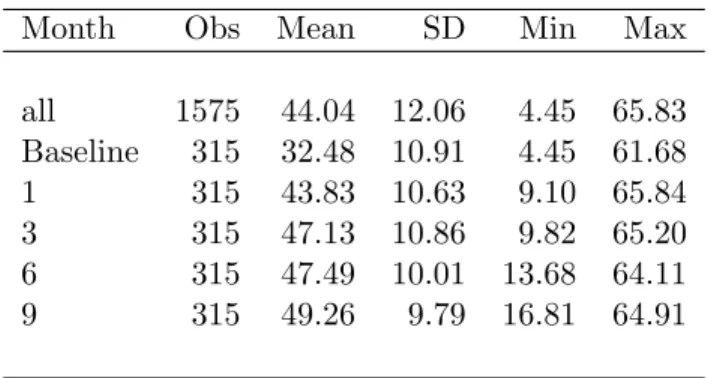
Table 3.5: Summary of Depression using SF-12 Score
Month Obs Mean SD Min Max
all 1575 44.04 12.06 4.45 65.83
Baseline 315 32.48 10.91 4.45 61.68
1 315 43.83 10.63 9.10 65.84
3 315 47.13 10.86 9.82 65.20
6 315 47.49 10.01 13.68 64.11
9 315 49.26 9.79 16.81 64.91
Similarly to when using the HSCL-20 component score, the SF-12 measure of mental
health continuously improves throughout the ARTIST trial as reported in Table 3.5, with a
higher score indicating better mental health. Patients experienced improvement each period,
with the largest improvement occurring in the first period with a 34.94% change. In Table 3.6,
it can be seen that there is within-individual variation for the SF-12 mental health measure
variation (SD=8.98).
Table 3.6: Variation in SF-12 Mental Health Variable
Variable Mean SD Min Max Obs
SF-12 Score
overall 44.04 12.06 4.45 65.83 N = 1575
between 8.06 15.26 61.78 n = 315
within 8.98 9.60 72.64 T-bar = 5
The SF-12 also includes questions related to physical health. The Physical Symptoms
Scale (PCS-12) is a scale consisting questions regarding the patient’s physical health. The
scores range from 0 to 100, with higher scores indicating better physical health. These
questions are asked at each interview. See Appendix B for the list of questions.
It can be assumed that any chronic condition will affect all decisions and outcomes in the
model. As a measure of medical comorbidity, I will use the Chronic Disease Score (CDS)
which is calculated at baseline for each patient. The CDS score increases with the number
of different chronic diseases as inferred from the subject’s medication profile. At baseline,
each patient is asked to list up to 14 prescription medications she is currently taking. With
these responses, the CDS score is calculated and used as a comorbidity index.10 Scores
have been shown to predict mortality and health care resource utilization after controlling
for demographics and previous resource utilization.11 As a measure of chronic depression,
at baseline, participants are asked if they had ever been treated for depression prior to the
ARTIST study. 34.60% of the individuals had experienced a depressive episode prior to the
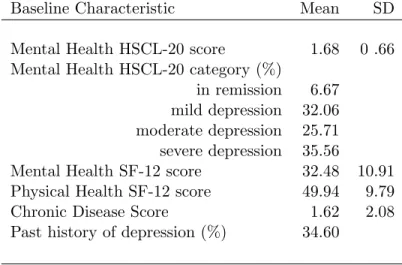
ARTIST study. Baseline characteristics of these individuals are provided in Table 3.7.
Table 3.7: Baseline Health Characteristics of Sample
Baseline Characteristic Mean SD
Mental Health HSCL-20 score 1.68 0 .66
Mental Health HSCL-20 category (%)
in remission 6.67 mild depression 32.06 moderate depression 25.71 severe depression 35.56
Mental Health SF-12 score 32.48 10.91
Physical Health SF-12 score 49.94 9.79
Chronic Disease Score 1.62 2.08
Past history of depression (%) 34.60
3.3
Labor Variables
The indirect costs related to depression can come in the form of presenteeism or
absen-teeism. The probability of being employed is also affected. This study uses three categories
of labor variables: participation variables (whether or not the individual is employed);
absen-10Specific medications are assigned to medication classes, which are then mapped to different chronic diseases. 11
teeism variables (conditional on being employed, how often the worker is absent from work);
and presenteeism variables (conditional on employment, the worker’s productivity while at
work).
Work Limitations Questionnaire-Presenteeism and Absenteeism Variables
The Work Limitations Questionnaire (WLQ) labor variables are only used if the individual
answers yes to the following question: In the past two weeks did you work at anytime at a
job or business not counting work around the house?12
The objective of the WLQ was to develop a psychometrically sound questionnaire for
measuring the impact of chronic health problems and/or treatment on different job aspects of
employed workers. The WLQ is a self-reported instrument for measuring the degree to which
chronic health problems interfere with a workers’ ability to perform job roles with four
dis-tinct dimensions: handling time, physical, mental-interpersonal, and output demands. With
25 items, and a 2-week reporting period, the Work Limitations Questionnaire demonstrates
high reliability and validity. Unlike other questionnaires it addresses aspects of the job through
a demand-level methodology. In comparison to other questionnaires, the WLQ Output
De-mands scale, which I use to measure presenteeism, has superior performance for predicting
productivity. The Mental Interpersonal Demands and the SF-36 Role Limitation scales, which
are not used in this study, have moderate validity.13 A full listing of the questions can be
found in Appendix C.
Tables 3.8 and 3.9 report between-individual and within-individual variation for the labor
variables. In Table 3.8 it can be seen that there is within-individual variation in both the
employment probability measure and the ability to meet the required number of work hours.
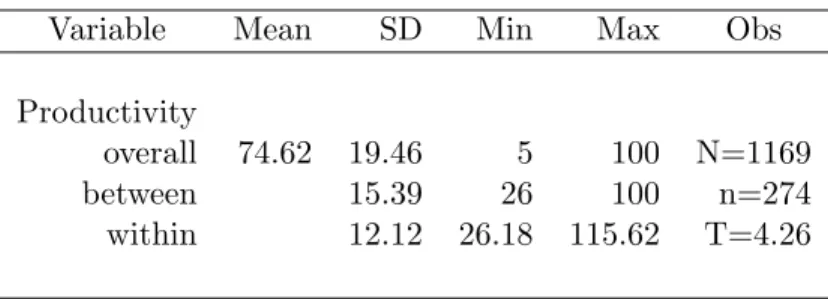
Table 3.9 reports means and standard deviations of the productivity measure for the overall
sample, between-individual and within-individual. The within statistics show the variation
of the ability to meet output demands within person around the global mean 74.62. The
within-individual SD shows that there is also within- individual variation in the productivity
12The wording of this question limits its use as an indicator of employment. An individual may still be
employed if he/she has not worked in the last two weeks due to vacation, maternity leave, or an illness.
13For a full discussion of validity tests, see Lerner et al., 2002.
measure.
Table 3.8: Variation in Labor Variables
Overall(%) Between (%) Within(%)
Employment Probability (n=315)
does work 74.22 86.98 85.33
does not work 25.78 46.98 54.86
Ability to Meet Required Work Hours (n=274)
All of the time 56.29 86.50 62.91
Most of the time 20.19 54.38 35.33
Some of the time 16.42 44.53 34.85
A slight bit of the time 6.07 19.34 30.74
None of the time 1.03 4.38 24.00
Table 3.9: Variation in Productivity Measure
Variable Mean SD Min Max Obs
Productivity
overall 74.62 19.46 5 100 N=1169
between 15.39 26 100 n=274
within 12.12 26.18 115.62 T=4.26
Table 3.10 presents descriptives statistics for each labor outcome by depressive state.
As expected the less depressed samples perform better for all labor variables. Employment
probabilities and depression levels show an inverse relationship, with 74.22% of the remission
sample being employed and only 67.00% of the sample categorized as having severe depression
working outside of the home. As depression levels decrease, the probability of working
con-tinuously increases. Less depressed workers are also better able to work the required number
of work hours. Again we see that the largest difference can be found between the depression
in remission sample and the mild depression group. The productivity measure also shows
productivity between the remission sample and those classified as having major depression is
larger than when comparing the sample’s employment probabilities and absenteeism.
Table 3.10: Summary of Labor Variables by HSCL-20 Mental Health Category
Variable n Mean SD Min Max
Employment Probability
full sample 1575 0.74 0.43 0 1
severe depression 219 0.67 0.47 0 1
moderate depression 219 0.72 0.44 0 1
mild depression 513 0.73 0.44 0 1
in remission 624 0.78 0.41 0 1
Ability to Meet Required Hours at Work
full sample 1169 4.24 1.00 1 5
severe depression 147 3.26 1.14 1 5
moderate depression 159 3.74 1.05 1 5
mild depression 376 4.22 0.92 1 5
in remission 487 4.72 0.61 1 5
Productivity
full sample 1169 74.62 19.46 5 100
severe depression 147 51.79 19.11 5 100
moderate depression 159 62.62 18.32 10 100
mild depression 376 73.11 16.25 5 100
in remission 487 86.60 11.73 35 100
3.4
Treatment Variables
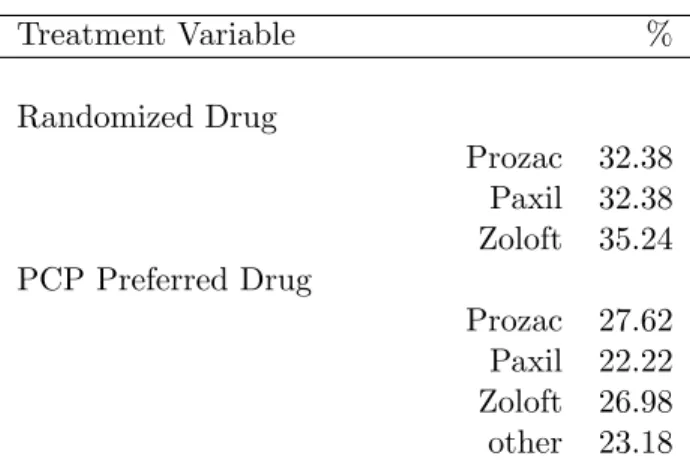
At baseline, a touch tone telephone procedure was used to randomly assign the patient to a
specific antidepressant: either Prozac, Zoloft or Paxil. A variable to indicate initial assignment
is created for each individual. Prior to randomization, the PCP is asked what antidepressant
he would prescribe in the absence of randomization. Responses included Celexa, Paxil, Prozac,
Wellbutrin, Zoloft or NA.14 These variables are summarized in Table 3.11.
A variable indicating if the same drug the PCP would have prescribed was randomized
14
N/A indicates that the PCP’s response was not Celexa, Paxil, Prozac, Wellbutrin or Zoloft.
to the patient at baseline is defined for each individual.15 Both patients and PCP’s were
aware of the baseline SSRI assignment. Decisions regarding treatment changes, including
SSRI type, dosage, and discontinuation were allowed and jointly made by the patient and
the PCP. At each interview, the individual is asked about her treatment decisions. She may
choose between continuing on the current drug, immediately switching to a new drug or
discontinuing use of the current drug without switching to an alternate medication. If she
chooses to change medication type, she is asked what type of SSRI she is currently taking.
At the next interview, she is asked about her treatment decisions with respect to the new
drug. 61% of the patients remain on the randomized drug throughout the trial. 20% of the
sample eventually stops the randomly assigned medication and does not immediately switch
to a new drug within the survey period, while 19% change SSRI medication and immediately
switch to a different SSRI at least once.
Table 3.11: Treatment Variables
Treatment Variable %
Randomized Drug
Prozac 32.38 Paxil 32.38 Zoloft 35.24 PCP Preferred Drug
Prozac 27.62 Paxil 22.22 Zoloft 26.98 other 23.18
Same Drug Randomized & Prescribed 33.33
15
3.5
Exogenous Variables
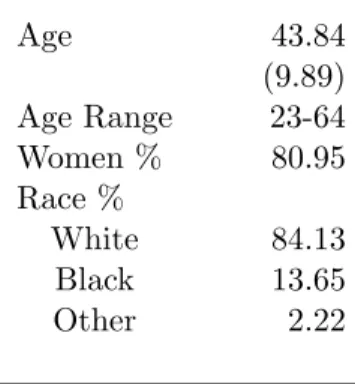
Exogenous variables include the individual’s age, gender and race. Baseline characteristics
of the sample are found in Table 3.12. Additional time-varying information that may affect
outcomes exogenously are available from other data sources. Although participants report five
digit zip code information at each interview, Zip Code Tabulation Areas (ZCTAs) are used for
extracting Census 2000 and Current Population Study (CPS) information on a geographic
area from the reported zip code.16 Monthly state unemployment rates from the Current
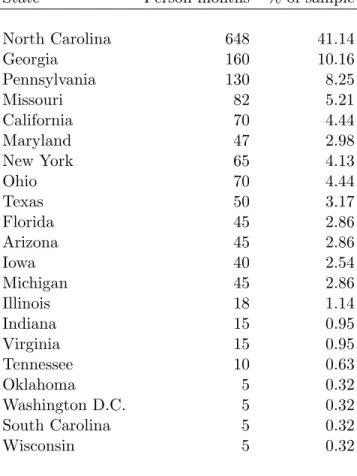
Population Study (CPS) are also used in the estimations. 21 states and Washington D.C.
are represented in the study. Table 3.13 describes the sample by state distribution. Current
local economic conditions facing the individual are likely to affect all employment decisions.
Therefore, they will be included in all labor equations.
Table 3.12: Summary of Baseline Individual Exogenous Characteristics
Baseline Characteristic
Age 43.84
(9.89)
Age Range 23-64
Women % 80.95
Race %
White 84.13
Black 13.65
Other 2.22
The month of the year is also included as a time-varying explanatory variable. The
calendar month of the year may affect both labor and health outcomes. Individuals may
experience more mental and physical health problems during the winter months. It is also
possible that labor outcomes may differ during specific times of the year. For example, a
worker may be more likely to take vacation during the summer months or during the winter
holiday time. Productivity may also be affected during specific times of the year depending
on the worker’s industry. Individuals enrolled in the study and completed baseline interviews
16
See Appendix E for discussion of ZCTAs.
Table 3.13: Represented States
State Person-months % of sample
North Carolina 648 41.14
Georgia 160 10.16
Pennsylvania 130 8.25
Missouri 82 5.21
California 70 4.44
Maryland 47 2.98
New York 65 4.13
Ohio 70 4.44
Texas 50 3.17
Florida 45 2.86
Arizona 45 2.86
Iowa 40 2.54
Michigan 45 2.86
Illinois 18 1.14
Indiana 15 0.95
Virginia 15 0.95
Tennessee 10 0.63
Oklahoma 5 0.32
Washington D.C. 5 0.32
South Carolina 5 0.32
during different months. On the interview date I create indicator variables=1 for each of the
twelve months.
Chapter 4
Theoretical Motivation
This section includes the theoretical background to the paper. In Section 5, I describe an
empirical approximation to the theoretical model that follows.
4.1
Overview of Decision Making Process
The individual enters a decision making periodtknowing her employment history, current
health status and her mental and physical health history. Future mental and physical health
are uncertain. With this knowledge, she decides whether or not to work in period t. By
accepting employment, she contracts for a certain number of hours of required work hours
(full time or part time). The required work hours are unobserved by the econometrician.
Conditional on working, the individual then decides the number of these required hours to
work and how productive to be for the duration of periodt. The individual must also decide
whether to continue her current medication, switch to another medication or discontinue
medication treatment entirely. The individual then realizes her health status at the end of
each period t. The per-period timing of decisions and realizations of health are depicted
below.
4.2
Decision Variables
Each period, individuals make optimal decisions with respect to employment and mental
beginning of t
et
employment decision
ot, at
productivity, attendance decisions Dt treatment decision
ht+1, bt+1
health production
beginning oft+ 1
St= (et−1, ot−1, at−1, Dt−1, ht, bt Xt,Zt)
-St+1 = (et, ot, at, Dt, ht+1, bt+1
Xt+1,Zt+1)
-Figure 4.1: Timing of per-period Employment and Treatment Decisions and Health Produc-tion
work outside of the home (et) where
et =
0 if individual does not work
1 if individual works.
If she decides to accept outside employment, she chooses her level of productivity for the
remainder of the period (ot) and attendance (at). The productivity measure (ot), a self
reported ability to meet output demands, takes the value 0 to 100, with 100 indicating
the highest productivity. With regard to absenteeism, the respondents answer the following
question: “Conditional on working, how much of the time during the past two weeks did your
physical health or emotional problems make it difficult for you to work the required number
of hours?” Attendance (at) takes on the values (with a higher score indicating less limitation):
at =
1 All of the time
2 Most of the time
3 Some of the time
4 A slight bit of the time
5 None of the time
The individual makes the medication treatment decision (Dt). Treatment options include:
Dt =
0 if patient continues on the same drug
1 if patient immediately switches from the current drug to another drug
2 if patient stops current drug, does not immediately switch to new drug
When making decisions in period t, the individual may consider her employment status
(et−1), her productivity (ot−1), and her attendance at work (at−1) in the previous period.
She also considers her wage offer which depends on the worker’s employment history and past
performance. The wage offer is unobserved by the researcher.
Decisions may also be influenced by the individual’s health history including her treatment
decisions in the previous period (Dt−1), mental health state entering the current period (ht)1
where
ht =
1 if depression in remission
2 if mildly depressed
3 if moderately depressed
4 if severe depression
and physical health entering the current period (bt) where bt scores range from 0 to 100 with
higher scores indicating better physical health.
Current economic conditions such as median income by zipcode and monthly state
un-employment rates may also influence labor decisions and are denoted by the vectorZt. All
decisions are influenced by observed personal characteristics,Xt, including gender, race, and
age. The individual’s information, or state vector(St), entering period tis:
St= (et−1, ot−1, at−1, Dt−1, ht, bt, Zt, Xt). (4.1)
4.3
Health Production
An important part of this study is understanding how mental health evolves. The mental
health production function, or probability of a health transition from ht=h to ht+1=h0, is
modeled as
πhht+10 = P r(ht+1=h0 |ht=h) ∀t
= exp{π0h0+π1h0ht+π2h0St+1} P4
h00=1exp{π0h 00+π
1h00ht+π2h00St+1}
. (4.2)
Particular components of St+1, namely (et, ot, at, Dt, bt+1, Xt+1), may influence depression.
Physical health (bt) also develops based on decisions and observed characteristics where
bt+1 =b(bt, ht, St+1). (4.3)
4.4
Optimization
An individual’s per period utility is a function of consumption (Ct), mental health status
(ht), labor choices (et,at,ot) and treatment decisions (Dt). LetJ equal the set of combinations
of the et, at, ot and Dt alternatives available to an individual. Each unique combination is
denoted j, j=1,2,3...J. Health status is assumed to have both direct effects (i.e., healthier
individuals derive more utility in all activities) and indirect effects (through its effect on
labor and treatment decisions) on utility. Treatment decisions affect utility through the
medication’s effects on physical health (side effects) and have productive effects on mental
health status. The individual’s per-period alternative-specific utility function is given by
Utj =U(j, Ct, ht, bt, Xt, εjt) (4.4)
where εjt represents alternate-specific and time-specific unobserved utility preferences and
consumption (Ct) is constrained by her budget. Sources of income include employment income
(Yt) if employed (et= 1) and unearned income (Wt) such that
Ct=et∗Yt+Wt. (4.5)
Employment income, Yt = Y(Xt, et−1, at−1, ot−1), is a function of personal characteristics,
and her employment history, days present at work and productivity in periodt−1. Ifet= 0,
consumption is constrained by unearned income. Treatment for depression is costless in these
data in pecuniary terms but may cause disutility through side effects, discomfort or stigma.
An individual is assumed to make decisions that will maximize her expected lifetime
utility. This includes the current utility of each alternative plus the discounted present value
of expected future utility where health and future utility shocks are uncertain. Her lifetime
value of each employment and treatment alternative is:
Vj(St, t) =Utj+
4 X
h0=1
πhht+10Et
max
k∈J Vk(St+1, k t+1)|j
∀j ∀t (4.6)
where β is the discount factor. Since this research focuses on mental health and its effects
on labor market outcomes, physical health transitions are not modeled explicitly in the value
function. While physical health develops overtime, the value function assumes as written that
Chapter 5
Empirical Model
In measuring the effect of mental health on labor outcomes, many studies use the human
capital framework (Becker 1967, Grossman 1972) and assume people value good health for
both its direct effect on utility and its effect on human capital formulation. This paper focuses
on the relationship between depression and different labor market outcomes. Underlying the
analysis is the idea that for a group of depressed individuals, changes in depression levels lead
to changes in labor market outcomes. Additionally, treatment decisions affect health status.
In measuring the effects of depression on productivity and attendance for a group of initially
depressed individuals, there are multiple sources of bias that must be addressed in order to
obtain consistent estimates.
Two sources of endogeneity can lead to biased estimates of depression’s effect on labor
market outcomes. Structural endogeneity results from possible reverse causality. In this case,
the onset of depression may occur due to labor market outcomes. Statistical endogeneity
comes from potential unobserved factors causing depression that may also affect labor market
outcomes independent of depression. For example, unobserved personal characteristics, such
as excessive motivation or employment in high stress occupations may increase the risk of
depression and can lead to different labor outcomes. Including treatment decisions variables
explaining mental health transitions introduces additional potential bias in the measured
effect. Potential endogeneity results from permanent unobserved characteristics that affect
both the individual’s mental health status and treatment decisions.
workot and attendanceat, (Lit= [oit, ait]) if employed. The relationship is dynamic because
an individual’s labor outcomes depend on lagged endogenous variables. Let
eit =
1 if individual works in period t
0 if individual does not work in period t.
The work productivity (oit) and work attendance (ait) measures are only observed if the
individual works in period t (eit = 1). This dynamic model of labor outcomes includes a
lagged dependent variable as a regressor as follows:
Lit=δLi,t−1+αTi+βXit+εit ifeit= 1. (5.1)
An individual’s labor outcomeLit is related to time-invariant personal characteristics Ti1, a
vector of time-varying observables for the individual, Xit, and a disturbance term, εit. The
error component εit is decomposed as
εit=µi+νit (5.2)
where µi represents unobserved time invariant personal characteristics that will affect labor
outcomes (such as genetics) and νit accounts for random individual disturbances (such as
time-varying work demands). The vector of disturbances νit is assumed to be independent
and identically distributed (IID) IID(0, σ2ν) and µi is distributed IID(0, σµ2). Substituting
equation (5.2) into equation (5.1),
Lit =δLi,t−1+αTi+βXit+µi+νit ifeit= 1. (5.3)
The binary choice selection model explaining whether an individual is working is described
by
e∗it=ωΓit+ηi+ζit. (5.4)
1
Ti is not included in the theoretical model in the previous section. I separate this to clearly show the
where
eit =
1 ife∗it>0
0 ife∗it≤0
Γit is a vector of explanatory variables that may share elements with Xit, ηi is an
un-observable time-invariant individual-specific effect and ζit represents unobserved individual
time-specific disturbances. It is assumed that the error components in the two equations have
a joint normal distribution. This selection equation must be estimated jointly with the labor
outcomes in order to eliminate selection bias.
Dynamic panel bias and selection bias are additional sources of potential bias. Introducing
a lagged dependent variable complicates estimation when compared to a static model because
labor outcomes in past periods may also be correlated with unobserved permanent individual
heterogeneity,E(Li,t−1, µi)6= 0. Sample selection bias refers to problems where the dependent
variable is observed only for a restricted, nonrandom sample. In this case, the individuals
productivity in periodtis only observed if the individual is employed in that period. Similarly
to the productivity equation (the equation of interest), the employment equation (the selection
equation) may contain individual specific effects that are correlated with the explanatory
variables. To obtain consistent estimates, all potential sources of bias must be addressed.
In this study, the employment of an individual depends on unobserved time-invariant
char-acteristics of the individual such as motivation, ability or education level,E(eitµi)6= 0. These
characteristics are correlated with the unobserved individual effects from the productivity and
attendance equations.
If the potential sources of bias are due to time-invariant characteristics, a researcher can
time difference the data then use instrumental variables (IV) in a Generalized Method of
Moments (GMM) framework. The First-Differenced (FD) equation is:
(Lit−Li,t−1) =δ(Li,t−1−Li,t−2) +β(Xit−Xi,t−1) +νit−νi,t−1. (5.5)
This is equivalent to
∆Lit=δ∆Li,t−1+β∆Xit+ ∆νit. (5.6)
If the selection process is time constant, removing the fixed effect from productivity or
at-tendance equations eliminates any potential selection problem operating through µi. Now,
selection into employment is random when unrelated to the idiosyncratic errors νit, (i.e.,
E(eitνit) = 0). Since T = 5 and the entire panel covers 9 months, this is a realistic
assump-tion. For consistency, it is required that
E[∆νit|Xit, Xis, eit=eis = 1] = 0 ∀ s < t. (5.7)
First-differencing has the advantage that it eliminates the individual specific effects that are
correlated with both the explanatory variables in the labor equation and the selection
equa-tion. However, it does have an important weakness when an individual is not employed in
period t, eit 6= 1 ∀ t, since there is a gap in the panel.2 In these instances, there are no
productivity measures for these observations and withT = 5, many needed observations are
lost. A second transformation that will eliminate fixed effects without losing as many
obser-vations is called forward orthogonal deviations (FOD) (Arellano and Bover, 1995). Rather
than taking first-differences as in equation (5.5), it subtracts the average of all future available
observations of a variable. Therefore, despite the number of gaps, it can be computed for all
observations of Lit and explanatory variables except for t = 5. The orthogonal deviations
transform for any variablew is:
wi,t+1≡cit
wit−
1
Tit
X
s>t
wis
(5.8)
whereTit is the number of all future available observations. The scale factor to equalize the
variance of the transformed error, cit, equals
p
Tit/(Tit+ 1). With this transformation, the
disturbance term becomes
νi,t∗+1 ≡cit
νit−
1
Tit
X
s>t
νis
. (5.9)
2