EXPLAINING JUDICIAL INDEPENDENCE IN THE EAST ASIAN
DEVELOPMENTAL STATES:
THE CASE OF TAIWAN
David Kar Wor Ma
A thesis submitted to the faculty at the University of North Carolina at Chapel Hill in partial
fulfillment of the requirements for the degree of Doctor of Philosophy in the Department of
Political Science of the College of Arts & Sciences.
Chapel Hill
2015
Approved by:
Evelyne Huber
Georg Vanberg
ABSTRACT
David Kar Wor Ma: Explaining Judicial Independence in The East Asian Developmental States:
The Case of Taiwan
(Under the direction of Evelyne Huber)
Taiwan presents an intriguing case regarding the emergence of judicial independence in new
democracies since it cannot be conveniently explained by the existing theories. In this paper, I offer a
model of judicial independence to resolve the puzzle, highlighting the role of private corporations having
close ties with the government that is characteristic of the East Asian countries. Within this framework,
despite single party dominance the ruling party is motivated to grant unconditional judicial independence
to the court, allowing it to effectively check against the growing power of the corporations. It is also
predicted that the dominant party would pursue strategies that can promote unconditional judicial
independence by overcoming the credible commitment problem arisen from its unique relation with the
corporate sector. This would include a three-part solution that involves formal rules, communications
ACKNOWLEDGEMENTS
I would like to offer my sincere gratitude to my advisor Professor Evelyne Huber for her
guidance and suggestions throughout my research project, as well as spending time reading through the
multiple incomplete versions of my thesis. I would also like to thank my committee members Professor
Georg Vanberg and Professor Graeme Robertson for their encouragement and many useful advices and
comments. Special thanks to Professor Wang Chin-Shou from National Cheng Kung University in
Taiwan for pointing me to many very useful primary documents as well as offering valuable insights into
the Taiwan judicial system. Thanks also to Professor Chang Wen-Chen from National Taiwan University
and Professor Veronica Grembi from Copenhagen Business School for providing details of their own
TABLE OF CONTENTS
LIST OF TABLES ... vii
LIST OF FIGURES ... viii
I. Literature Review ... 2
I.a. The Developmental State ... 2
I.b.i. Theories of Judicial Independence ... 3
I.b.ii. The Role of Formal Institutional Rules ... 8
II. A Credible Commitment Theory of Judicial Independence ... 12
II.a. Judicial Independence -- Desirability ... 16
II.b. Unconditional Judicial Independence – Feasibility ... 19
II.c. Judicial Independence – Endgame ... 22
III. The Case of Taiwan: Empirical Evidence ... 24
III.a.i. Single Party Dominance ... 24
III.a.ii. State-Corporate Power Diffusion ... 28
III.a.iii. Dedicated Senior Judiciary Leadership ... 34
III.b. Unconditional Independence in the Ordinary Courts ... 35
III.c. Public Reputation of the Judiciary ... 44
III.d. Constitutional Court Independence ... 50
IV. Conclusion ... 56
APPENDIX: COMMENTS ON SELECTED INTERPRETATIONS OF THE COUNCIL OF GRAND JUSTICES ... 57
LIST OF TABLES
Table 1: Expected Payoffs of Dominant Party’s Decisions on Unconditional Judicial Independence ... 18
Table 2: Party Performances in Major Elections in Taiwan, 1989-2001 ... 25
Table 3: Government Expenditures as % of National Income (1985-1998) ... 33
Table 4: Presidents of the Judicial Yuan since 1987 ... 45
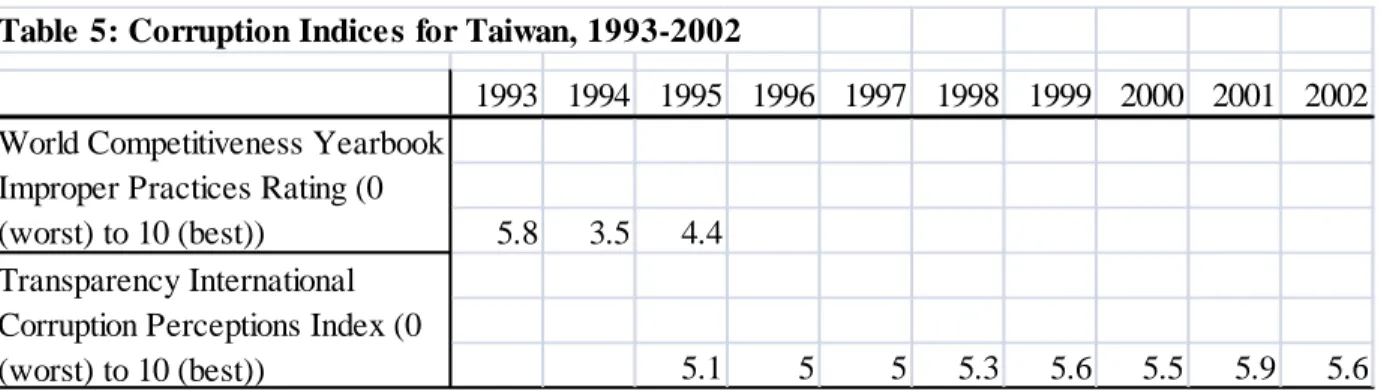
Table 5: Corruption Indices for Taiwan, 1994-2003 ... 48
LIST OF FIGURE
The rule of law with an independent judiciary is universally recognized as a cornerstone of
modern democratic societies. In particular, in constitutional democracies, the constitutional document,
designed to protect basic human rights as well as to define and limit the powers of the government, must
be upheld by justices who answer to no political masters. As such, constitutional courts whose role is to
conduct constitutional reviews play an important part in democratic development. Yet, the challenge of
explaining how the court, which Alexander Hamilton had characterized as having ‘no influence over
either the sword or the purse’, may actually achieve independence from power-holders remains an
intriguing question to many political scientists who participated in the ‘judicialization of politics’ research
agenda during the past decade or so. A lot has been achieved, but still much is yet to be uncovered.
This paper aims at contributing to the ongoing effort in specifying the conditions and causal
mechanisms for judicial independence pertaining to constitutional courts in the context of new
democracies in East Asia, and in particular Taiwan. East Asian countries have so far been very
understudied regarding this research topic, with the rare exception of Ginsburg who applies the ‘insurance
theory’ to explain the variation in constitutional court independence in Taiwan, Mongolia, and South
Korea.1 Moreover, Japan’s poor record of constitutional court independence2 can also be conveniently
explained by the insurance theory. Nevertheless, Ginsburg’s presentation of the Taiwanese case has been
subjected to sound criticisms that the empirical evidences do not support his argument that Taiwan’s
judicial independence has anything to do with power diffusion among its political parties. This paper
attempts to present an alternative ‘credible commitment theory’ that addresses this outlier case, and finds
empirical support for the theory.
1 Tom Ginsburg, Judicial Review in NewDemocracies: Constitutional Courts in Asian Cases (Cambridge, UK: Cambridge
University Press, 2003).
2 Percy R. Luney, Jr., “The Judiciary: Its Organization and Status in the Parliamentary System,” Law and Contemporary
I. Literature Review
I.a. The Developmental StateThis section mainly covers the literature on judicial independence, although a brief mentioning of
the developmental state literature first would be helpful. The definitive works in this area3 describe the
developmental state as an autonomous state that, for reasons such as ‘systemic vulnerability’,4 is
incentivized to promote economic development. Typically, it spearheads an export-oriented economic
developmental program for the country, characterized by anti-neoliberal industrial policies, by forming a
close partnership with domestic business groups, buying time for strategic industries to incubate
internationally competitive firms. The state is instrumental in offering subsidies, policy loans, political
suppression of labor, protection from international competition, stabilizing the macroeconomic
environment, and various forms of assistance. According to Peter Evans’ seminal study, there are only
three archetype developmental states that truly meet the demands – Japan, Taiwan, and South Korea.
During their respective developmental stages, each of these countries was governed by a state that had
enough capacity to effectively administer and communicate its policies, as well as the needed autonomy
to act independently from their corporate partners. The S. Korea state, in particular, enforced a strict and
internally competitive environment, one often harsher than what normal market pressure may impose, in
order to continually upgrade corporate performance. For example, in the ‘60s it was not uncommon for
those Korean chaebols surviving the market but failing to meet performance targets to be dismantled by
the state and having their assets claimed by other better-performing chaebols.
3 Chalmer Johnson, MITI and the Japanese Miracle: The Growth of Industrial Policy, 1925-1975 (Stanford, CA: Stanford
University Press, 1982). Alice H. Amsden, Asia's Next Giant: South Korea and Late Industrialization (New York: Oxford University Press, 1989). Peter B. Evans, Embedded Autonomy: States and Industrial Transformation (Princeton, NJ: Princeton University Press, 1995). Robert Wade, Governing the Market: Economic Theory and the Role of Government in East Asian Industrialization (Princeton, NJ: Princeton University Press, 1990).
4 Richard F. Doner, Bryan K. Ritchie, and Dan Slater, "Systemic Vulnerability and the Origins of Developmental States:
One key implication of the developmental state literature that is relevant to the present study is
that business-government relationship may sour when the developmental state matures.5 A successful
developmental state eventually breeds a corporate sector that is increasingly powerful economically, less
dependent upon protections from international competition, and can solicit funding conveniently from
international capital markets. The corporate sector may have both the incentive and the clout to fight for
freeing itself from the discipline imposed by the state, to bargain for a bigger piece of the pie in their
numerous profitable joint projects, or even to capture the state regarding policies and regulations. For
example, merger and acquisition activities in S. Korea in the early ‘80s frequently ignored the Fair Trade
and Anti-Monopoly Act enacted in 1981 that was designed to contain the power of the chaebols.6 In
Taiwan from the late ‘80s onwards, businessmen-turned-lawmakers at both the national and the provincial
levels received enormous profits from obtaining ‘sweetheart’ contracts in numerous large-scale public
construction projects.’7
I.b.i. Theories of Judicial Independence
Following the framework delineated by Vanberg8, the literature on theories explaining judicial
independence in democratic contexts can be categorized into endogenous incentive models and
exogenous costs models. The first category assumes that power-holders can undermine judicial
independence without incurring much cost, but choose not to do so because they, on balance, receive
direct or indirect benefits by allowing the judiciary to remain independent. The direct benefits include
information benefits, shifting blame (to the court), or help maintaining the separations of powers. The
indirect benefit models are exemplified by the ‘insurance theory’9, which assumes risk-averse political
5 Eun Mee Kim, Big Business, Strong State: Collusion and Conflict in South Korean Development, 1960-1990 (Albany, NY:
State University of New York Press, 1997).
6 Kim, Big Business, Strong State, 195.
7 Ming-Chang Tsai, "Dependency, the State and Class in the Neoliberal Transition of Taiwan," Third World Quarterly 22, no. 3:
370.
8 Georg Vanberg, "Constitutional Courts in Comparative Perspective: A Theoretical Assessment,"(Forthcoming).
9 Mark J. Ramseyer, "The Puzzling (In)Dependence of Courts: A Comparative Approach," The Journal of Legal Studies 23, no. 2
parties seeking political hedges. The theory asserts that, when there is long-term expected power diffusion
among major political parties (meaning that they are expected to alternate in office), it can be beneficial,
under certain conditions, for all parties to cooperate in mutual concessions in terms of their policy
positions. In other words, a party agreeing not to over abuse its power against its opponents when it is in
office, given that its opponents agree to do the same, would be a win-win deal given that each has a
considerable chance of losing office from time to time. But since the boundary values of such
arrangement are often unclear, an independent arbiter, i.e. the Court, is needed to enforce this equilibrium
by calling the boundaries.
It should be explained that the ‘on balance’ benefits mentioned above means that the maintenance
of judiciary independence is an all-or-nothing ‘package deal’, which is largely assumed by the literature.
The power-holders cannot surgically resist only those judicial decisions they dislike while allowing
independence to prevail in other judicial decisions. They can either grant full judicial independence or not
at all, and they find the former ‘on balance’ more appealing. To be specific, however, the exact scope to
which the ‘package deal’ assumption applies may cover just a certain type of court, e.g. the constitutional
court, the administrative court, or the ordinary courts, etc., instead of the entire judiciary. In any case, the
point of the literature is that case-by-case intervention would be difficult.
The insurance theory is frequently the starting point in models addressing judicial independence
in newly democratized countries, but these models also adjust the theory to fit the new context. For
example, Popova subscribes to the central role of power diffusion but argues that the insurance theory
neglects the immediate benefits of enforcing a subservient judiciary in newly democratized countries
where typically higher benefits and lower costs associated with attempting to control the court prevail.10
In particular, a subservient judiciary can help the incumbent government proactively maximize its chance
of re-election, by imprisoning or disqualifying the rival candidates, or declaring their financing activities
10 Maria Popova, "Political Competition as an Obstacle to Judicial Independence: Evidence from Russia and Ukraine,"
illegal. Aydin presents a similar argument, albeit identifying slightly different cost and benefit factors.11
They back up their claim with case examples addressing Pakistan and Russia in the 2000s as well as
Ukraine in the late 1990s. Unlike the insurance theory, these models assume myopic leaders and deny an
exogenous chance of electoral success based on power diffusion alone; and it is precisely when the parties
are equally competitive that a subservient judiciary, by tipping the balance, becomes the most effective.
This conclusion is at odds with the insurance theory proponents, who see intensive political competition
as a catalyst to judicial independence. In fact, in a separate subsection titled ‘Insurance in New
Democracies’, Ginsburg suggests that ‘other things being equal, [greater] uncertainty [in new
democracies] increases demand for the political insurance that judicial review provides.’12 More recently,
Epperly13 argues that the more undemocratic a regime, the higher the cost associated with losing office;
thus, provided that there is electoral competition, it would be of greater salience and therefore there would
be a greater incentive to insure.
The key idea of the insurance theory can be generalized into the following: when the incumbent
political leadership is faced with a powerful opponent who may threaten to exert influence over the
judiciary when assuming political power, then it may find it preferable to allow judicial independence.
The essential element here is power diffusion, not insurance. The act of insurance is, as demonstrated by
Popova and Aydin, only one of the possible outcomes in response to power diffusion, under certain
assumptions such as the absence of myopia. Another one of such assumptions that both sides of the
debate adopt is that the powerful opponent must be a rival political party, which actually should not be
taken for granted. Here is where the developmental state literature may prove relevant – a power diffusion
between the state and the private corporate sector does not engender an expectation of alternation in office,
and thus leaves no demand for rational hedging (insurance); yet the powerful private corporate sector may
11 Aylin Aydın, "Judicial Independence across Democratic Regimes: Understanding the Varying Impact of Political
Competition," Law & Society Review 47, no. 1 (2013): 105-34.
12 Ginsburg, Judicial Review, 30.
exert influence over the judiciary to its own advantage vis-à-vis the state via its close connections with the
state. In this situation, the state may find it beneficial to grant independence to the judiciary.
The second category, i.e. exogenous cost models, asserts that judicial independence is possible
because attacking the judiciary is costly to the power-holders, regardless of whether they see an
independent judiciary as beneficial or not. In this paper, this is referred to as unconditional independence,
as opposed to conditional independence achieved in the endogenous incentive models. The source of this
costliness is most commonly the public support for the judiciary (although foreign sources can also be a
possibility), which can be explained either as a result of the court proving to be more aligned with the
people’s interests than the power-holders in an imperfect system of democratic representation,14 or as a
need for a coordinator of spontaneous citizen understandings and actions against otherwise ambiguous
constitutional infringements.15 This latter argument presents the court decision as a focal point around
which the public establishes the consensus that counter-action towards the power holders is clearly
needed; and since the public treasures this function of the judiciary, it will protect its independence that is
necessary in ensuring its proper functioning. However, both arguments require the judiciary to have a
good public reputation that normally takes time and effort to accumulate (and this is especially true in
newly democratized countries). As such, most exogenous costs models take into account the strategic
interactions between the court and other players in order to meet this requirement. For example, Epstein,
Knight, & Shvetsova16 posit that constitutional courts strategically make decisions that rationally remain
within the tolerance intervals of various power-holders. The relevance of this behavioral pattern to the
emergence of judicial independence is that doing so skillfully would, in the longer term, expand these
intervals, thus allowing the constitutional court a greater autonomy. The ‘building up [of] a reservoir of
goodwill among political actors and the public alike’ is a function of repeatedly remaining within the
14 Matthew C. Stephenson, "Court of Public Opinion: Government Accountability and Judicial Independence," Journal of Law,
Economics, & Organization 20, no. 2 (2004): 379-99.
15 Georg Vanberg, "Substance Vs. Procedure: Constitutional Enforcement and Constitutional Choice," Journal of Economic
Behavior & Organization 80, no. 2 (2011): 309-18.
16 Lee Epstein, Jack Knight, and Olga Shvetsova, "The Role of Constitutional Courts in the Establishment and Maintenance of
tolerance level itself as well as accepting ‘safe’ cases only, e.g. civil rights cases instead of those related
to separation of powers matters.17
The theoretical significance of endogenous cost models, and the proactive role of the judiciary in
general, can hardly be underrated in the literature. However, the exact way the judiciary, and in particular
the constitutional court, may build up its reputation is far from clear. Although the principle of having the
constitutional court making decisions that offend neither the public nor the power-holders is likely
indisputable, the practice of handling ‘safe’ cases only, i.e. civil rights cases, as suggested by Epstein,
Knight, & Shvetsova, does not seem to effectively work towards this goal at least within our present
context. Many civil rights such as self-defense, privacy right, freedom of speech and association, etc., are
politically sensitive, involving the limitation of the power of the police and other government departments.
If the constitutional court decides to act within the tolerance level of the power holders in these cases, it
may further harm its own reputation and thus receives even less public support.
Aside from reputation, the role of public relations in organizing public support is emphasized by
both Vanberg18 and Staton.19 If the power holders are wary of the potential of a public backlash, then the
expectation of sufficient media coverage of the constitutional court’s decisions would induce the court to
act more independently. Moreover, Staton also pays attention to the possibility that the court itself is
equipped with the resources to economically promote its own case decisions, which is particularly
relevant when the public’s accurate understanding of its jurisprudential rationale is crucial to generating
the needed public support. Under this theoretical framework, media coverage is a necessary but not
sufficient condition for unconditional judicial independence.
Finally, the role of internal politics is being increasingly recognized. The case of the Russian
constitutional court elaborated in Epstein, Knight, & Shvetsova, detailing the internal conflicts among the
17 Epstein, Knight, and Shvetsova, “Role of Constitutional Courts”, 152.
18 Georg Vanberg, "Legislative-Judicial Relations: A Game-Theoretic Approach to Constitutional Review," American Journal of
Political Science 45, no. 2 (2001): 346-61.
19 Jeffrey K. Staton, "Constitutional Review and the Selective Promotion of Case Results," American Journal of Political Science
justices within the Court, highlights the importance of the internal politics within a judiciary that often
cannot be assumed a unitary actor. In addition, Lax20 demonstrates examples of studying court legal
policy determination that address the collegiality and hierarchy within the judicial system. Although these
are inspiring works that contribute to the development of a relatively new area in judicial politics research,
not much has been done that directly connects the internal politics of the judiciary to explaining its
independence.
I.b.ii. The Role of Formal Institutional Rules
One particularly important and controversial issue found within the literature concerns the role of
micro-level formal institutional rules that supposedly enforce judicial independence, e.g. rules that
specifies the appointment procedures of judges, the length of their terms and whether renewal is an option,
etc. It is noteworthy that within all the theories that have been covered by the previous subsection, these
formal rules play a minimal role. They are not at all the focus of those theoretical frameworks, in the
sense that the scholars are not trying to look into what political interactions would give rise to the needed
formal rules that in turn ensure judicial independence. For example, the insurance theory implicitly asserts
that as long as there is power diffusion among political parties, and that agents are risk-averse and not
myopic, then with certain utility functions assumed there would be judicial independence regardless of
whether the appropriate formal rules are in place.
Nonetheless, earlier accounts of the debate see some keen attention paid to emphasizing the
contributive role of formal rules. In his introductory chapter of ‘Judicial Independence in the Age of
Democracy’, Russell asserts that ‘the focus of any practical endeavors to secure judicial independence
must be on institutional arrangements designed to protect independence’, and that ‘it is only through
consideration of the full range of pressures and forces impinging on judges… that a comprehensive theory
20 Jeffrey R. Lax, "Political Constraints on Legal Doctrine: How Hierarchy Shapes the Law," The Journal of Politics 74 (2012):
of judicial independence can be built.’21 Regarding the ‘full range of pressures and forces’ Russell is not
referring to anything in the likes of public backlash, but instead a full range of institutional rules related to
appointment, removal, remuneration, case administration, personnel, etc. plus the possibilities of physical
threats and bribery.22
Yet, during the past decade or so, it seems that the academic community have gradually reached
the consensus that the study of judicial independence is not about the study of formal rules. This is
brought about by the accumulation of empirical studies that do not support a positive correlation between
de jure judicial independence (as defined by formal rules) and de facto judicial independence. For
example, in his paper on judicial reform and independence in Brazil and Argentina, Brinks writes that
‘most scholars acknowledge that formal institutional arrangements (secure tenure, salary protection, etc.)
correlate poorly (indeed, often negatively) with actual independent behavior on the part of the courts’.23
He highlights Shaw’s analysis of Latin American countries in which Uruguay and Costa Rica is placed
‘dead last’ in terms of formal rules; but this ranking, if used as a predictor of de facto judicial
independence, would ‘surprise most scholars of the region’.24 Even more relevant to this present study is
the quantitative testing performed by Garoupa, Grembi, & Lin on the Taiwanese judiciary. Despite the
fact that the formal rules for the appointment process of Taiwan’s grand justices accorded disproportional
influence to the ruling parties during 1988-2008, they don’t find it a significant factor in explaining the
grand justices’ decision making.25 As such, scholarly attention diverted away from formal rules towards
the underlying political dynamics between the judiciary and the power holders. Hilbink writes
conclusively that ‘although there may be practical advantages to limiting scholarly inquiry to the formal
21 Peter H Russell, "Toward A General Theory of Judicial Independence, " in Judicial Independence in the Age of Democracy:
Critical Perspectives from around the World, ed. Peter H Russell and David M. O'Brien (Charlottesville: University Press of Virginia, 2001), 8.
22 Russell, "Toward A General Theory", 13-21.
23 Daniel Brinks, "Judicial Reform and Independence in Brazil and Argentina: The Beginning of a New Millennium?" Texas
International Law Journal 40, no. 3 (2005): 597.
24 Brinks, "Judicial Reform and Independence", 597.
25 Nuno Garoupa, Veronica Grembi, and Shirley Ching-ping Lin, "Explaining Constitutional Review in New Democracies: The
type of judicial independence [(referring to the formal rules)], ultimately it is positive independence that
many scholars seek to explain.’26 Stephenson also writes that ‘formal protections are not sufficient to
evaluate the true independence of the judiciary.’27 Even more to the point, Brinks concludes that ‘unless
the goal is explaining institutional design per se… the concept of formal independence is singularly
unhelpful.’28
However, in a very recent paper, Melton and Ginsburg argue that although it is true that even the
most well-designed formal institutional rules do not automatically translate into de facto judicial
independence, they do matter. Regarding this, Melton and Ginsburg offer two highlights. First, they adopt
the focal point argument in the exogenous cost literature pioneered by Weingast29 and apply it in the
context of formal rules. It is aforementioned that the public has the incentive to protect judicial
independence due to the judiciary’s role in facilitating collective actions against constitutional
infringements by offering a focal point through its rulings. However, whether the power holders are
indeed obstructing judicial independence can itself be an ambiguous issue, creating a secondary collective
action problem. This is where formal rules come into play. Specifically, when a formal rule protecting de
jure judicial independence is introduced into the constitution, in case it is breached it provides a focal
point that contributes to organizing a collective action that protects the judiciary.30 This theory assumes
that the formal rules are sufficiently clear and specific31 so that any breach is self-evident, without calling
for another court ruling (so a formal rule that merely states that the judiciary should be independent would
not be good enough). The second highlight that Melton and Ginsburg make is their emphasis on
26 Lisa Hilbink, "The Origins of Positive Judicial Independence," World Politics 64, no. 4 (2012): 588.
27 Matthew C. Stephenson, “Judicial Independence: What It Is, How It Can Be Measured, Why It Occurs,” Harvard University,
n.d., 2.
28 Brinks, "Judicial Reform and Independence", 597.
29 Barry R. Weingast, "The Political Foundations of Democracy and the Rule of Law," The American Political Science Review 91,
no. 2 (1997): 245-63.
30 James Melton and Tom Ginsburg, "Does De Jure Judicial Independence Really Matter?: A Reevaluation of Explanations for
Judicial Independence," Journal of Law and Courts 2, no. 2 (2014): 192.
introducing formal rules conjunctively. In order to make these rules effective, it is important that several
of them coexist so that the various means of attacking the court are well covered, as ‘those who wish to
interfere with courts need only find one hole in the judicial armor’.32 Although Melton and Ginsburg,
based on their statistical analysis, particularly favors the combination of formal rules pertaining to the
appointment as well as removal of the justices, what constitutes a good combination may vary from
country to country depending on their larger institutional environments.
II. A Credible Commitment Theory of Judicial Independence
This section develops a theory of judicial independence that attempts to achieve three objectives.
First, it aims at incorporating the concepts of power diffusion (present in many endogenous incentive
models) and public support (present in the exogenous cost models) into a single causal mechanism.
Second, it interprets the concept of power diffusion flexibly such that it does not necessarily entails
competitiveness among political parties. Specifically, it addresses a situation in which despite single
(political) party dominance, power diffusion is achieved due to the presence of a powerful private
corporate sector (the ‘corporate’ hereon), as exemplified by the Taiwanese developmental state at its
mature stage. Third, the theory aims at demonstrating how granting unconditional judicial independence
can actually be difficult for the dominant party, and proceeds to explain how the difficulty can be
overcome by credible commitment strategies. The theory identifies the independence of the constitutional
court as the ultimate dependent variable, but involves the independence of the ordinary court judges as an
intermediate one.
The theory acknowledges the insurance theory as an adequate explanation of judicial
independence when there is power diffusion among political parties. Among the East Asian
developmental states, S. Korea experienced such power diffusion immediately after democratization
while Japanese politics had been dominated by a single party for over forty years since its
democratization after WWII. Their respective high and low degrees of constitutional court independence
are therefore consistent with the prediction of the insurance theory. However, Taiwan also experienced
single party dominance, yet its constitutional court made some remarkable progress in terms of its
independence from the dominant party. This calls for an alternative theory that can better explain the
outcome observed in Taiwan, namely how judicial independence may nonetheless emerge under single
A few conceptual clarifications need to be made. First, in this paper, Fiss’ characterization of
judicial independence is adopted, including three dimensions: party detachment, individual autonomy,
and political insularity of the judges.33 In the political context of single party dominance, this
characterization mainly refers to a court independent from the dominant party. Second, the state is
basically controlled by the dominant party (‘state’ or ‘party-state’ hereon). A powerful corporate sector
can join the dominant party as members but it is not assumed to be part of the party leadership, so it does
not directly control the party. The corporate leaders can also join the ranks of the legislators, and on a
bill-by-bill basis it may be able to form ad hoc alliances and have the legislature pass the bills it favors. The
corporate does not join the executive and does not directly influence the judiciary, but through the
developmental partnership it can exert indirect influences: threatening to play non-cooperative in the joint
projects, so as to force members of the dominant party or the party-state to pressure the court to act in
accordance with its preferences. The dominant party and the corporate are the only powerful players in
the political arena, which is almost always the case in a developmental state.
The theory holds the following assumptions. Their necessity would be apparent later in this
section when the model is further elaborated.
A1: The judiciary is headed by the judiciary leadership, a person who exercises strong control over all
regulations internal to the judiciary.
A2: The formal rules governing the operation of the judiciary, i.e. those pertaining to the appointment,
tenure, and removal of the constitutional court justices and those pertaining to case administration and
personnel issues (following Russell’s categorization) that apply to ordinary court judges, can exist in
the form of legislations, constitutional provisions, and regulations internal to the judiciary. The
judiciary leadership exercises strong internal control regarding the regulations internal to the judiciary.
33 Owen M. Fiss, "The Limits of Judicial Independence," The University of Miami Inter-American Law Review 25, no. 1 (1993):
A3: In newly democratized countries, the judiciary, which has typically acted as an instrument of the
previous authoritarian regime (a la Popova and Aydin), is endowed with poor reputation in the
beginning.
A4: The constitutional court is unable to build public support by making decisions within the dominant
party leadership’s tolerance intervals, or selectively accepting ‘safe’ cases only. In newly
democratized countries (and especially when the incumbent dominant party continues to be in office)
the office-holders are far from perfect representatives of the people, therefore acting within their
tolerance intervals may avoid attacks but would not contribute to judicial reputation.
A5: The public does not distinguish between the constitutional court and the ordinary courts (or any
other component members of the court system) when it comes to its support for the judiciary. To the
public, it is just ‘the court’ in general.
A6: There exists a group of reformist judges at the lower echelon of the judicial system (typically at
the district courts), whose history traces back to the authoritarian regime before democratization.
These people seek integrity, impartiality, and independence, and are typically suppressed by the
regime (and therefore remain at the lower echelon), but regain their activism after democratization.
There exists another group of conservative judges at the higher echelon of the system (typically at the
higher courts or the higher levels of the district courts), who have close ties with the dominant party
leadership (‘party leadership’ hereon).
A7: The party leadership is much more concerned with court cases involving the corporate than other
cases handled by the ordinary courts, because there is no other interest group (opposition party, labor
union, etc.) powerful enough, or expected to be powerful enough, to challenge the dominant party. The
party leadership is also concerned with constitutional court cases, in which its policies made via the
executive or the legislative branch can potentially be struck down.
As aforementioned, a developmental state at its mature stage may encounter a great challenge
political influence. The powerful corporate and the dominant party thus form a kind of power diffusion:
the latter remains the senior partner of the two, but can no longer so freely ‘arm twist’ the former as it
used to. However, the effect of this power diffusion cannot be captured by the logic of either the
insurance theory or the ‘separation-of-powers’ thesis,34 because the dominant party and the corporate
neither are expected to alternate in office or power, nor seek to operate independently. The party-state’s
success on one hand depends upon a tight cooperation with the corporate, but on the other hand hinges on
its own autonomy from excessive external influence. When the corporate grows powerful, it becomes
increasingly difficult to impose this discipline without jeopardizing the cooperation.35
The credible commitment theory perceives this challenge as the context in which the dominant
party leadership makes its decision regarding judicial independence. The party leadership may find it
beneficial to allow judicial independence for two reasons. First, an independent court can discipline the
corporate in accordance with the law and thus contributes to restraining its growing power, while a court
subservient to the dominant party would fail to do so since the party-state itself is subject to the influence
of the powerful corporate through their cooperative economic relationship. Second, an independent court
allows the party-state to freely express a position supportive of the corporate which is important to
maintaining their cooperative relationship, knowing that this has no effect upon the court’s decision. On
the other hand, from time to time an independent court’s ruling may contradict the party leadership’s
preferred outcome, and as such there is a tradeoff. The relevant court at issue here refers to the ordinary
courts of the judiciary system, which typically handle cases related to the corporate.
However, it should be noted that if it is at all desirable for the party leadership to grant judicial
independence, this independence must be unconditional. In the generic scenario associated with
conditional judicial independence in which the party leadership finds it beneficial to allow the judiciary to
act independently, all it has to do is not to attack the court, but is otherwise not obliged to commit to any
34 Vanberg, “Constitutional Courts”, 9.
35This will be less of an issue if the dominant party or the state owns most of the corporate. However, this was not the case in S.
specific actions or policies. However, in the case of the maturing developmental state, the resultant
conditional judicial independence would not be sustainable since the powerful corporate would find ways
to pressure the party leadership to reverse its decision. Therefore, although endogenous benefits explain
the party leadership’s initial motivation (if one exists) to allow judicial independence, it must then turn
the resultant independence into an unconditional one if it is to be sustainable, i.e. to make it a credible
commitment so that it becomes very costly to reverse the policy and therefore the corporate finds it not
worthwhile to apply pressure. In summary, the party leadership faces two issues regarding its decision on
judicial independence: whether it is desirable and whether it is feasible. The first is attended to below,
while the second would be addressed in the next subsection.
II.a. Judicial Independence -- Desirability
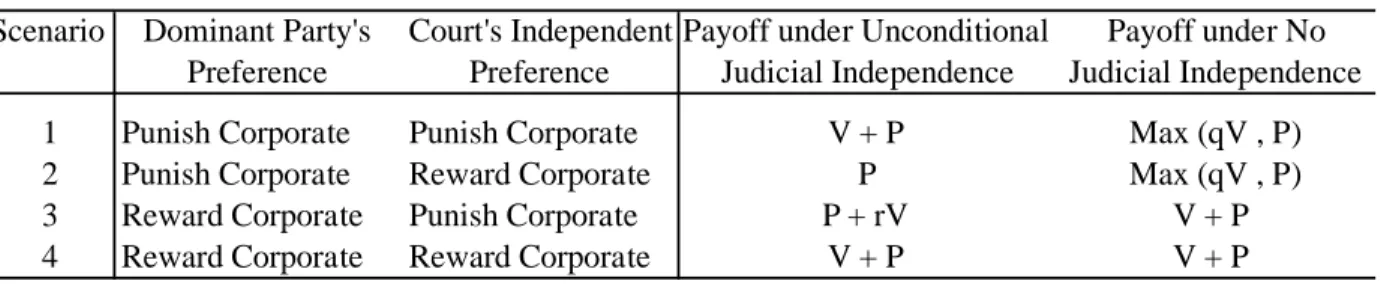
Table 1 displays the expected payoffs of the party leadership regarding its decision on
unconditional judicial independence under four possible scenarios. At times, the dominant party
leadership desires to reward or punish the corporate via the court as a means to discipline it. The court’s
(true) preferences regarding the cases when they arise can differ from the dominant party leadership’s, but
this is relevant only if there is unconditional judicial independence. Together they form the four mutually
exclusive and collectively exhaustive scenarios.
The dominant party leadership encounters two types of expected payoffs in accordance with the
previous discussion.36 The first type is the relative payoff associated with having the court’s final decision
matching the party leadership’s preference (V). If unconditional judicial independence is granted, then
this matching is just coincidental (scenarios 1 and 4). If it is not granted, then this payoff is assured only
when the dominant party leadership wants to reward the corporate anyway, i.e. scenarios 3 and 4. Even
though the party-controlled court always issues decisions matching the dominant party leadership’s
preference, yet when the decision speaks against the corporate, the corporate would retaliate through
various means of non-cooperation such that the party leadership may back off. This is the case in
scenarios 1 and 2, in which there is only a certain probability of success attached to this negative decision
(q; q<1), and therefore the payoff component equals qV in these two scenarios. On the other hand, when
there is unconditional judicial independence any retaliation is deemed ineffective in nullifying the
decision, because it would be too costly for the party leadership to yield to the retaliation and reverse the
judicial independence. Therefore the value of this payoff component in scenario 1 under conditional
judicial independence is V instead of qV. The second type is the relative payoff derived from
position-taking (P). With unconditional judicial independence, the party leadership can always express support for
the corporate, knowing that this support has no effect on the judicial outcome. This supportive official
stance is contributive to maintaining the cooperative relationship between the party-state and the
corporate in pursuit of their developmental projects. In the absence of judicial independence, however,
this relative payoff component is assuredly present only when the dominant party leadership wants to
reward the corporate anyway (scenarios 3 and 4). When it doesn’t (scenarios 1 and 2), the party
leadership will rule against the corporate via the court if qV>P, or will give up doing so and instead opts
for expressing support if qV<P, resulting in a payoff of max(qV,P) for both scenarios. The dominant party
leadership cannot capture both qV and P because its judicial action against the corporate would
immediately discredit its supposedly supportive position. Finally, in scenario 3 under unconditional
judicial independence, even though the court rules against the corporate, practically speaking the party
leadership should be able to quite conveniently compensate the corporate through other means, even
though such compensation may not be a perfect substitute for a favorable ruling. Therefore, an additional
payoff component rV is introduced, where r<1 but not much smaller. The same logic does not apply to
scenario 2, however. Under unconditional judicial independence, if the court rules in favor of the
corporate, it is not reasonable to assume that the dominant party leadership can conveniently punish the
corporate through other means, both because of the relative shortage of such means and because doing so
The decision of the party leadership is such that it will favor unconditional judicial independence
if the overall expected payoff under this arrangement is greater than that without it, taking into account
some probability distribution over the four scenarios. When the corporate grows in power, q decreases
because it is more likely that the corporate can have its way, P increases because it is increasingly
important for the party leadership to express support if it wants to maintain the cooperative relationship,
and the probability distribution biases towards scenarios 1 and 2 because the party leadership feels a
greater urgency to discipline the corporate. In particular, among cases in which the corporate actually
violates the law (scenarios 1 and 3), the party leadership desires less to protect the corporate, meaning that
the probability of scenario 1 increases vis-à-vis scenario 3. Other variables are not affected. As a result,
the dominant party leadership is always indifferent in scenario 4, and converges towards indifference in
scenario 2 (with q decreasing and P increasing), rendering them insignificant in the overall decision. It
always prefers unconditional judicial independence in scenario 1 and no judicial independence in scenario
3. However, since the probability distribution biases towards scenario 1 and away from scenario 3 as the
corporate becomes increasingly powerful, and moreover the incremental gain of unconditional
independence in scenario 1 (which converges towards V) is much larger than its incremental loss in
scenario 3, i.e. (1-r)V, the overall effect of a maturing developmental state is to promote unconditional
judicial independence as the dominant party leadership’s desirable choice.
Table 1: Expected Payoffs of Dominant Party's Decisions on Unconditional Judicial Independence
Scenario Dominant Party's Court's Independent Payoff under Unconditional Payoff under No
Preference Preference Judicial Independence Judicial Independence
1 Punish Corporate Punish Corporate V + P Max (qV , P)
2 Punish Corporate Reward Corporate P Max (qV , P)
3 Reward Corporate Punish Corporate P + rV V + P
II.b. Unconditional Judicial Independence – Feasibility
When the dominant party leadership decides to grant unconditional independence to the
judiciary’s ordinary courts, there inevitably arises a credible commitment problem that needs to be
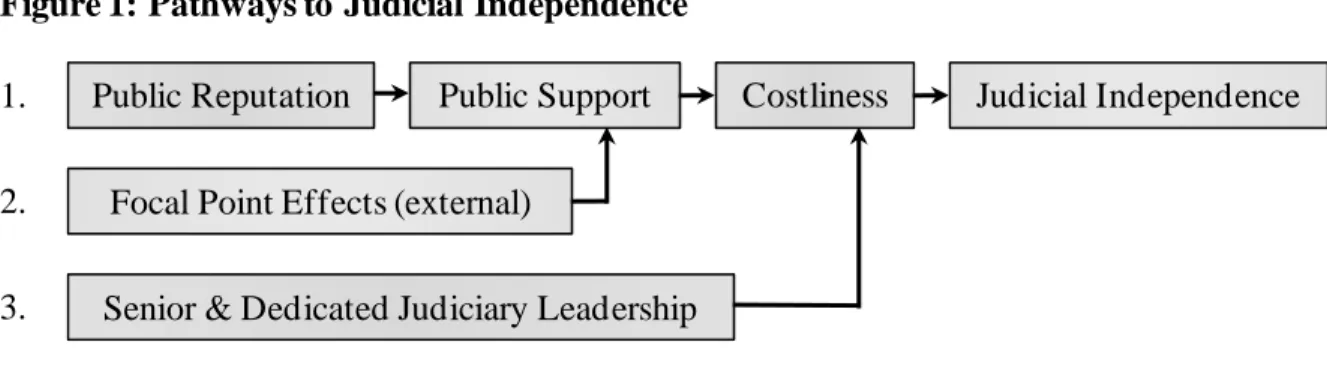
resolved. The theory here offers a three-part solution to the problem.
The first part of the solution makes use of formal rules as a commitment device, based on the
rationale first laid out by Weingast and applied by Melton and Ginsburg. In this case the party leadership
would introduce a collection of clear and specific formal rules intended to conjunctively protect the
independence of the ordinary court judges. Although the presence of these formal rules per se does not
carry with it the authority to ensure compliance, they generate a focal point effect that contributes to the
organization of public backlash whenever they are breached or reversed. However, this focal point effect
against breach and reversal can be fruitful only if the judiciary enjoys good public reputation. If the
judiciary hasn’t accumulated enough public reputation, then even if everyone is aware of the breach and
everyone agree that it is a breach, the public backlash would fail to take place because people do not think
that the judiciary adequately serves citizens’ interests in the first place. Based on A3 and A4, therefore,
the first part of the solution by itself is insufficient.
The second part of the solution attempts to modify upon the theory above. The idea is that formal
rules matter in two ways, not just one – both the message (the rules) and the medium (their
communications process) are important. The significance of communications has been emphasized by
Vanberg and Staton, but here it takes on a different role. Instead of the court, it is the party leadership
who invests in a promotional campaign surrounding the ratification of the formal rules so as to credibly
commit to unconditional judicial independence. For example, they can be ratified after a prestigious
international organization has been hired to look into the matter, with a high profile press conference held
to introduce them to the public, during which high-ranking officials make speeches emphasizing their
importance. If the rules are breached or reversed thereafter, this will bring about a public (electoral)
backlash since the action signals inconsistency and untrustworthiness on the part of the power holders. In
independence, thereby turning it unconditional. There are three noteworthy features here. First, it is the
communications process of the formal rules, and not the formal rules alone, that generates a focal point
effect that brings the public’s attention to the power holders’ inconsistent actions. Second, this focal point
effect against inconsistency and untrustworthiness would contribute to organizing a public backlash
regardless of the judiciary’s public reputation, since the public’s evaluation of the power holders’ quality
as reflected by their actions is independent of its perception about the judiciary. Third, this focal point
effect should be most pronounced in the short run, i.e. when the formal rules are breached or reversed not
long after their ratification. As such, it works well in conjunction with the first part of the solution. In the
short run, unconditional judicial independence is supported by the second focal point effect, enabling the
ordinary courts to begin building their public reputation. In the longer run, when the reputation has
sufficiently improved, the first focal point effect of the formal rules kicks in as well, further reinforcing
the court’s unconditional independence.
The third part of the solution involves the unique role of the judiciary leadership. In order to
credibly commit, the party leadership can appoint what may be called a ‘dedicated and senior’ judicial
leadership to carry out various policies that promote judicial independence. A ‘dedicated’ person is
defined as someone having the self-interest to empower the judiciary via unconditional independence.
This person regards the judiciary as her own power base, and aims at acquiring power by empowering the
judiciary. She is likely to have a legal background, and plans to spend the rest of her political career
within the judiciary. A ‘senior’ person is defined to be someone high-ranking and powerful within the
dominant party. Once appointed, the senior judiciary leadership is assumed to enjoy considerable
autonomy and thus not just a pawn of the party. Her appointment is more a negotiated outcome between
her and the (rest of the) party leadership. The office is more earned than assigned, and is one of the
positions prized by the top leaders of the dominant party. Due to her dedication, the judiciary leadership
will pursue judicial independence via formal rules internal to the judiciary, mixing in the focal point
effects of the first two parts of the solution. To be sure, means to achieve judicial independence other than
additional benefit of the focal point effects, especially when formal rules are not an option. Essentially,
the dedicated judiciary leadership acts on behalf of the party leadership, but it is at the same time in her
own interest to do so. Importantly, due to her seniority, the judiciary leadership is autonomous enough to
resist requests of reversing the judicial independence. In other words, it would be very costly for the
dominant party leadership to effectively renege, because it is difficult to overcome the judiciary
leadership’s power and it is very costly for the judiciary leadership to comply.
The role of the dedicated and senior judiciary leadership as either a credible commitment strategy
or a condition to the theory needs to be clarified, and so is the probabilistic relation between judiciary
leadership and judicial independence. The following three scenarios all assume single party dominance.
In the first scenario, the party leadership does not consider corporate power as a threat and does not
support judicial independence, while the judiciary leadership is senior and dedicated. In this case
theoretically the judiciary leadership can still pursue judicial independence alone because she has the
power to do so, but doing so against the party leadership’s will can be costly,37 and so the probability of
this happening is positive but small. In the second scenario, the party leadership considers corporate
power a threat and wants to grant judicial independence, while judiciary leadership is senior and
dedicated. In this case judiciary leadership’s pursuit of judicial independence is assured. In both cases the
dedicated and senior judiciary leadership is a condition to the theory and it has already been fulfilled. In
the third scenario, the party leadership wants to grant judicial independence but the judiciary leadership is
either not dedicated or not senior, or both. In this case the condition to the theory is instead an opening
through which the judiciary leadership can be replaced, e.g. retirement or voluntary resignation, upon
which the party leadership may appoint a dedicated and senior judiciary leadership in order to credibly
commit. Before this opportunity emerges, this judiciary leadership may still idiosyncratically welcome
and pursue judicial independence; but since the major attraction or feasibility of unconditional judicial
independence loses its relevance under this scenario, it is again not very likely to happen.
37 Note that this is different from the scenario under which the party leadership reneges, because here the judiciary leadership has
II.c. Judicial Independence – Endgame
The context of the newly democratized country offers both an opportunity and a challenge to the
judiciary leadership regarding the constitutional court. When a country democratizes, public support
begins to matter as potentially a major cost to anyone trying to attack the constitutional court, because the
collective action problem associated with coordinating an effective public backlash diminishes when
people can conveniently vote and elections are meaningful.38 Therefore the dedicated judiciary leadership
has an incentive to achieve unconditional judicial independence through gradually accumulating public
support. However, the initial condition of the judiciary she is endowed with enjoys no public support at
all in accordance with A3, without which the constitutional court must play within the tolerance intervals
of the party leadership in order to avoid attacks. But according to A4, this continual obedience does not in
turn accumulate public reputation, leading to a stable and undesirable equilibrium in which the judiciary
leadership finds it difficult to make any progress.
The desire of the dominant party leadership to grant unconditional independence to the ordinary
courts offers a breakthrough to this dilemma. When the credible commitment problem is resolved by the
aforementioned three-part solution, the ordinary courts’ reformist judges as depicted by A6 would be free
to act impartially and with integrity upon cases, especially those involving corporate corruptions and
unfair practices. These cases, close to the public and attracting considerable media attention, would
gradually earn reputation and accumulate pubic support for the court. This result is in the interest of the
dedicated judiciary leadership, and it is therefore costly for the judiciary leadership to fulfill any request
of reversing the judicial independence granted to the ordinary court judges. Moreover, in accordance with
A5, such pubic support would then spill over to the constitutional court and therefore in the longer term,
the constitutional court too can achieve unconditional judicial independence. Once the constitutional court
can act outside of the party leadership’s tolerance intervals, demonstrating impartiality and integrity,
without being attacked by the dominant party, this act itself would earn further public support, leading to
a self-reinforcing equilibrium, which is again in the interest of the judicial leadership. This completes the
mechanism that explains how the constitutional court gains unconditional independence under
III. The Case of Taiwan: Empirical Evidence
In a nutshell, the credible commitment theory presented in the previous section posits that if three
conditions are fulfilled in the developmental state, i.e. single party dominance, power diffusion between
the state and the corporate, and an opportunity to appoint a dedicated and senior judiciary leadership, then
ordinary court unconditional independence would first be granted, followed by an improvement in the
judiciary’s public reputation, and finally the unconditional independence of the constitutional court would
be achieved. This section of the paper seeks to empirically verify the theory for the case of Taiwan. The
first subsection investigates whether the three conditions were indeed fulfilled in Taiwan and the timing
of these fulfillments. The following subsections then investigate the three milestones of the causal
mechanism implied by the theory, each as a hypothesis to be tested. Again, the timing of these events,
namely the second must take place after the first and the third must take place either immediately or
shortly after the second, is crucial in offering support for the theory.
III.a.i. Single Party Dominance
Taiwan’s fulfillment of the ‘single party dominance’ condition as a newly democratized country
is not apparent at the outset. Although it is difficult to pinpoint when democratization first took place in
Taiwan, the formation of the opposition Democratic Progressive Party (DPP) in 1986 (which was against
the law but was tolerated by the regime) arguably marked the beginning of a new era. In 2000, DPP
candidate Chen Shui-bian won the presidential election. It is therefore convenient to assume that DPP
gradually ascended to power during this fourteen-year period, and as such it would be dubious at best to
describe the incumbent party Kuomintang (KMT) as ‘dominant’ during the 1990s.
However, this was not the case. Tsai, in his paper tracing the roots of Taiwan’s neoliberal
KMT.’39 When responding to the insurance theory, Chang also expresses that ‘the reasons that the
Council of Grand Justices [i.e. the Constitutional Court] was invested with strong powers during the early
years of democratization were in no way due to competitive power politics or political diffusion. During
those years, the KMT was strong and it remained its great strength…’40
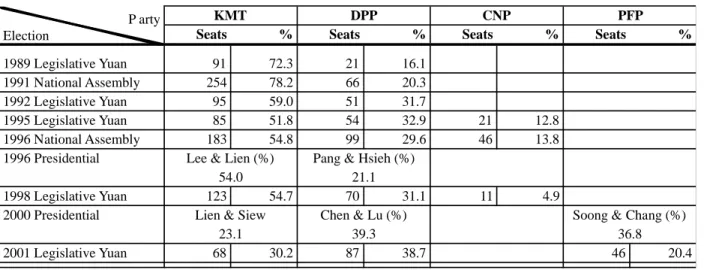
These comments are not without empirical support. Table 2 presents the results of the most
important elections in Taiwan between 1989 and 2001 in terms of party performance, which include the
presidential elections, the legislative elections, and the National Assembly elections.41 The percentage
votes each presidential candidate received and the percentage seats each party was able to secure are
reasonably good indicators of each party’s respective relative political power.
The objective here is to determine at which point in time power diffusion could be reasonably
expected in Taiwan. Note that it is the expectation of sustained power diffusion and not power diffusion
per se (especially if it is temporary) that is most relevant to both the insurance theory and the present
39 Tsai, "Dependency", 363.
40 Tom Ginsburg et al., "Judicial Review in New Democracies: Constitutional Courts in Asian Cases," National Taiwan
University Law Review 3, no. 2 (2008): 169.
41 In Taiwan, the National Assembly was the original legislature of the Republic of China (ROC) founded in 1912. Until 1992, its
members were those elected in 1948 before the ROC was forced to move to Taiwan, and re-election was not supposed to take place until KMT reclaims the mainland. In the 1990s however, Taiwan underwent a series of Constitutional amendments to gradually shift the responsibilities of the National Assembly to the Legislative Yuan (Taiwan’s new legislature which existed before the 1990s but only assumed limited responsibilities), while in the meantime the two entities co-existed and each held their own elections. The National Assembly became effectively defunct by 2000 and was formally dissolved in 2005.
Table 2: Party Performances in Major Elections in Taiwan, 1989-2001
KMT DPP CNP PFP
Seats % Seats % Seats % Seats %
1989 Legislative Yuan 91 72.3 21 16.1
1991 National Assembly 254 78.2 66 20.3
1992 Legislative Yuan 95 59.0 51 31.7
1995 Legislative Yuan 85 51.8 54 32.9 21 12.8
1996 National Assembly 183 54.8 99 29.6 46 13.8
1996 Presidential Lee & Lien (%) Pang & Hsieh (%)
54.0 21.1
1998 Legislative Yuan 123 54.7 70 31.1 11 4.9
2000 Presidential Lien & Siew Chen & Lu (%) Soong & Chang (%)
23.1 39.3 36.8
2001 Legislative Yuan 68 30.2 87 38.7 46 20.4
Source: Wikipedia, Chinese Wikipedia
study. One of the potential justifications for reasonably expecting power diffusion is the continual rise of
DPP’s popularity. It can be observed from the Table that DPP rose quickly in power during its first few
years of electoral participation. While in the 1989 election it only received 16.1% votes, this increased
sharply to 31.7% in the 1992 election. At that point however, despite the advancement it had achieved, it
was hardly in any position to challenge KMT, which secured 59.1% votes in the 1992 election, almost
doubling DPP’s. In other words, DPP’s upward trend must continue beyond 1992 for it to remain a
potential justification for reasonably expecting power diffusion. This did not happen. The percentage
votes DPP received in the four subsequent elections in 1995, 1996, 1996, and 1998 generally settled at
around 30% (with the exception of the 1996 presidential election, which was 21.1%), which means that
DPP did not manage to make any progress within a lengthy six-year period. The results of the 1998
election confirm that at that point KMT was still far more powerful than DPP, a situation not much
different from that in 1992.
Yet in the 2000 presidential election, KMT, which had so far never failed to secure majority votes
in any major elections, received a stunningly poor 23.1% support rate. DPP’s Chen and Lu won the
election with 39.1% votes, while independent candidates Soong and Chang finished in a close second
place and founded the People First Party (PFP) afterwards.42 In order to explain this outcome, attention
should turn away from DPP towards KMT itself, and in particular the history and significance of KMT
factionalization after democratization, as a potential justification for reasonably expecting power diffusion.
After the death of Chiang Ching-Kuo and his handpicked successor Lee Teng-hui became ROC’s
president as well as KMT chairman in 1988, the balance of power between the mainlander group and the
local Taiwanese group within KMT began to tilt in favor of the latter, which had long been politically
suppressed. Lee, a local himself, immediately formed a 31-member Central Committee of which 16
members were locals. He also pushed policies regarding mainland China, democratic reforms, and party
restructuring that he and his more reform-minded coalition hold a very different stance from the
42 For the ease of illustration, Soong and Chang are placed under the ‘PFP’ column in Table 2, but actually the party was founded
conservative mainlanders. At the forefront of the conflict were the plan to substitute the Legislative Yuan
for the National Assembly and the debate over the criteria and procedure for selecting KMT chairman and
vice-chairman. Lee emerged as the winner subsequently but at the heavy expense of party unity. During
the 14th Party Congress in 1993, KMT leadership was so divided that six legislators and some old guard
members ended up quitting the party and formed a separate Chinese New Party (CNP). Other old guards
who chose not to leave KMT formed a wide variety of political factions within the party, aiming at
claiming some degree of political autonomy from the Lee-presided central leadership.43
The impact of KMT’s internal struggles and that of CNP formation was significant but
nevertheless not overwhelming at the time. The disunity within KMT often opened up opportunities for
the minority DPP to form ad hoc voting alliances with some of its political factions within the legislature
on a bill-by-bill basis.44 This allowed DPP considerable legislative success especially in areas concerning
social welfare and environmental policies as well as corruption,45 but not so much in more politically
salient and sensitive issues that may potentially alter the overall power structure among the parties. Also,
since only a handful of mainlanders quitted KMT to form CNP, the latter remained to be a relatively
small political force as reflected by the 13%-14% support level it was able to solicit in the 1995 and 1996
elections. Moreover, as conservative old guards of an earlier era, CNP leadership were even further from
DPP along the political spectrum than KMT under Lee, and thus an alliance between CNP and DPP was
extremely unlikely.46 As such this wave of factionalization, which lasted till 1998 (when CNP popularity
began to fade), failed to result in power diffusion -- KMT still emerged as the dominant party in the 1998
legislative election.
In 1999, in anticipation of the 2000 presidential election, it became increasingly apparent that the
KMT veteran and popular mayor of Taipei City, James Soong, would emerge as the favorite KMT
43 Michael Ying-Mao Kau, "The Power Structure in Taiwan's Political Economy," Asian Survey 36, no. 3 (1996): 294.
44 Kau, "Power Structure", 300.
45 Kau, "Power Structure", 301.
candidate. In a surprising turn of events, however, Lee insisted that KMT must nominate the much less
popular Lien Chen as the party’s presidential candidate, and the subsequent effort by Lien to secure
Soong as his running partner also failed. Soong then decided to run for presidency as an independent,
resulting in his expulsion from the party. This highly publicized series of messy happenings naturally
turned away many voters, yet even with the split of KMT votes between the two presidential candidates
Soong only lost the race by 2.5% to DPP’s Chen. It can be conjectured that in the absence of this internal
fight KMT would have won the presidential race by a landslide.
Therefore, the critical factor that determined the expectation of power diffusion among political
parties in Taiwan throughout the time period was the nature and degree of factional disputes within KMT.
In the mid-90s, the CNT and the old guards within KMT did not make a great-enough impact, but by the
turn of the century the exodus of Soong almost halved the political power of KMT by splitting it into two
bitterly antagonistic parties each of which had a substantial base of popular support. Having said that, it is
still doubtful that by the completion of the 2000 presidential election, power diffusion had indeed become
a reasonable expectation, because the political power of Soong and his faction as a new party (instead of
Soong himself as a presidential candidate) likely remained a considerable uncertainty. It is arguably not
until, at best, the 2001 legislative election, in which the PFP obtained a third-ranked but substantial 20.4%
votes, that the expectation of a longer-term and relatively stable power balance between DPP and KMT
reasonably emerged, despite the fact that it turned out incorrect.47 In conclusion, single party dominance
in Taiwan lasted until 2000, and power diffusion between the two major political parties could be
expected by 2001.
III.a.ii. State-Corporate Power Diffusion
One of the major ideas presented in this study is the alternative conception of power diffusion,
not among political parties but between the single-party controlled state and the corporate sector, which
may nonetheless contribute to judicial independence. However, unlike power diffusion among political
47 In 2008, DPP lost the presidential race as well as the legislative election, in which DPP won a mere 27 seats versus KMT’s 70,