Review article
Clinical and public health implications of acute and
early HIV detection and treatment: a scoping review
Sarah E. Rutstein
1,2§, Jintanat Ananworanich
3,4, Sarah Fidler
5, Cheryl Johnson
6,7, Eduard J. Sanders
8,9,10,
Omar Sued
11, Asier Saez-Cirion
12, Christopher D. Pilcher
13, Christophe Fraser
14, Myron S. Cohen
2,15,
Marco Vitoria
6, Meg Doherty
6and Joseph D. Tucker
2,15,16§Corresponding author: Sarah E Rutstein, Department of Health Policy and Management, University of North Carolina at Chapel Hill, CB #7411, Chapel Hill, NC
27599-7411, USA. Tel: +1 919 537-9648. ([email protected])
Abstract
Introduction
: The unchanged global HIV incidence may be related to ignoring acute HIV infection (AHI). This scoping review
examines diagnostic, clinical, and public health implications of identifying and treating persons with AHI.
Methods
: We searched PubMed, in addition to hand-review of key journals identifying research pertaining to AHI detection
and treatment. We focused on the relative contribution of AHI to transmission and the diagnostic, clinical, and public health
implications. We prioritized research from low- and middle-income countries (LMICs) published in the last fifteen years.
Results and Discussion
: Extensive AHI research and limited routine AHI detection and treatment have begun in LMIC.
Diagnostic challenges include ease-of-use, suitability for application and distribution in LMIC, and throughput for high-volume
testing. Risk score algorithms have been used in LMIC to screen for AHI among individuals with behavioural and clinical
characteristics more often associated with AHI. However, algorithms have not been implemented outside research settings.
From a clinical perspective, there are substantial immunological and virological benefits to identifying and treating persons
with AHI
–
evading the irreversible damage to host immune systems and seeding of viral reservoirs that occurs during
untreated acute infection. The therapeutic benefits require rapid initiation of antiretrovirals, a logistical challenge in the
absence of point-of-care testing. From a public health perspective, AHI diagnosis and treatment is critical to: decrease
transmission via viral load reduction and behavioural interventions; improve pre-exposure prophylaxis outcomes by avoiding
treatment initiation for HIV-seronegative persons with AHI; and, enhance partner services via notification for persons
recently exposed or likely transmitting.
Conclusions
: There are undeniable clinical and public health benefits to AHI detection and treatment, but also substantial
diagnostic and logistical barriers to implementation and scale-up. Effective early ART initiation may be critical for HIV
eradication efforts, but widespread use in LMIC requires simple and accurate diagnostic tools. Implementation research is
critical to facilitate sustainable integration of AHI detection and treatment into existing health systems and will be essential
for prospective evaluation of testing algorithms, point-of-care diagnostics, and efficacious and effective first-line regimens.
Keywords:
acute HIV infection; antiretroviral therapy; diagnostics; early HIV; guidelines; low- and middle-income countries;
primary HIV
Received10 August 2016;Accepted29 May 2017;Published28 June 2017
Copyright:© 2017 Rutstein ER et al; licensee International AIDS Society. This is an Open Access article distributed under the terms of the Creative Commons Attribution 3.0 Unported (CC BY 3.0) License (http://creativecommons.org/licenses/by/3.0/), which permits unrestricted use, distribution, and reproduction in any medium, provided the original work is properly cited.
Introduction
Despite comprehensive HIV interventions and scaled-up
antiretroviral therapy (ART) services in many regions,
there are still two million new adult HIV cases each year
[
1
]. Failure of existing prevention initiatives, in which many
persons with HIV are not on ART nor virally suppressed,
may explain some of the ongoing transmission events.
However, the largely unchanged HIV incidence must in
part be the result of current programmes failing to detect
and treat acute HIV infection [
2
]. According to the original
Fiebig classification [
3
], acute infection is defined as
the period between viral acquisition and emergence of
HIV-specific antibodies, generally accompanied by a burst
of viremia [
4
]. By comparison, early infection, inclusive of
the acute phase, represents an approximately 6-month
period of increased transmission efficiency [
5
–
9
].People
with acute or early infection (hereafter referred to as AHI)
likely play a disproportionate role in HIV transmission [
6
,
7
];
heightened efforts to identify and manage persons with AHI
are critical to decrease incidence.
AIDS Society and the World Health Organization
’
s (WHO)
most recent guidelines support scale-up of testing and
immediate treatment for all people diagnosed with HIV,
there is no specific recommendation regarding diagnostic
strategies or ART for persons with AHI [
13
–
16
]. From a public
health standpoint, undiagnosed AHI could interfere with the
extent to which comprehensive strategies such as
Treat All
could effectively achieve desired population health benefits.
Undiagnosed AHI may also compromise the effectiveness of
pre-exposure prophylaxis (PrEP), increasing the risk of
resis-tant virus if PrEP is initiated [
15
,
17
]. Early treatment
initia-tion is required to avert irreversible damage to the immune
system [
18
], and to shrink the latent reservoir that renders
HIV incurable [
19
,
20
]
A public health approach to AHI is necessary, especially in
resource-constrained low- and middle-income countries
(LMICs). The case for prioritizing resources to detect and
treat persons with AHI demands a thorough evaluation of
the state of knowledge and projected impact of AHI on new
and established HIV epidemics. Previous AHI reviews have
focused on basic science [
19
,
21
], concentrated epidemics in
high-income countries [
22
–
25
], and programmatic
consid-erations [
26
,
27
]. The purpose of this scoping review is to
examine the diagnostic, clinical, and public health
implica-tions of identifying and treating persons with AHI,
espe-cially in LMIC settings.
Methods
We conducted a scoping review [
28
] synthesizing the most
recent literature on clinical and public health implications
of widespread AHI detection and treatment. This review
includes clinical trials, observational studies, systematic and
non-systematic reviews, mathematical modelling, and best
practice guidelines. Scoping reviews are distinct from
sys-tematic reviews in the absence of a priori article criteria;
although we emphasized research published in the last
15 years, there were no explicit inclusion nor exclusion
criteria for articles. Instead, this included papers that map
the current state of research, identifying gaps in knowledge
[
29
]. We examined a broad range of literature and topics
relevant to the clinical and public health effects of
under-diagnosed and under-treated AHI. Based on the scoping
review, we summarize key policy implications and areas
for research priorities.
We identified studies using keyword searches in PubMed
(last searched 8 October 2016), expert opinion, and current
regional and international HIV testing and treatment
guide-lines. For database searches, we used phrases and
synon-ymous variations of the following terms: acute HIV, primary
HIV, early HIV, treatment, and diagnosis. We also identified
studies based on searches of reference lists, hand-searching
key journals identified from initial database inquiries, and
unpublished conference abstracts. We prioritized inclusion
of LMIC research. Our search included studies that provided
empirical data on AHI published in the last fifteen years.
We included studies that had the following elements: (1)
focus on AHI detection, treatment, or public health features
(i.e., algorithms to detect AHI, implications of AHI on PrEP);
(2) provide empirical data on AHI testing or treatment
out-comes; (3) evaluate natural history of AHI as it relates to
morbidity and transmission; or (4) model the impact or role
of AHI in emerging or established epidemics.
Results and discussion
Impact of AHI on secondary transmission
Data from clinical studies, phylogenetic research, and
mod-elling support the importance of AHI in HIV transmission in
LMIC as well as wealthy nations among both MSM and
heterosexually-dominated
epidemics.
Highly
infectious
founder viruses [
30
] coupled with 10-fold higher viral
loads [
3
,
5
–
8
,
31
,
32
] suggest there is a greater likelihood of
transmission during AHI.
Empirical data estimating HIV transmission rates are
sparse. The Rakai study is one of the largest prospective
cohort studies to investigate transmission rates, enrolling
greater than 15,000 adults from the Rakai district in Uganda
and identifying over 400 serodiscordant couples for
assess-ment of transmission events and the associated risk of
transmission by stage of infection of the index participant
[
33
]. Rakai data have been evaluated three separate times
with widely different estimates for the extent to which AHI
accounts for onward transmission among heterosexual
ser-odiscordant couples (
Table 1
) [
34
–
36
]. These differences
can be ascribed to adjustments in estimated duration of
infectious stages; assumptions regarding determination of
transmission hazards (i.e. reliance on self-reported coital
frequency, as a function of time, or using predicted viral
load trajectories); accounting for diversity in both
infec-tiousness and susceptibility; and modification to the initial
analyses
’
couple exclusion criteria. Importantly, the
propor-tion of transmissions attributable to AHI is likely to change
with increased ART coverage
–
with more HIV-infected
persons virally suppressed on ART, and thus less likely to
transmit, persons with AHI may become an increasingly
important population to target to reduce incidence.
Modelling AHI
’
s role in epidemics
Phylogenetic research has demonstrated the importance of
AHI in HIV epidemics. Phylogenetic studies show that
per-sons with recent infection drive transmission clusters;
how-ever, estimates are highly variable, identifying persons with
AHI as source infection for between 10% and 50% of all
transmissions [
22
,
37
–
47
]. Discrepancies are due to
differ-ences in epidemic stage, definitions of AHI, and variation in
risk behaviours (i.e., anal vs. vaginal intercourse) by region
and population [
48
]. For example, partner-change patterns
are likely variable across regions and sub-populations, thus
estimates derived from European men who have sex with
men (MSM) may not be generalizable to heterosexual
transmission in sub-Saharan Africa.
among MSM [
54
]. However, models populated using data
from elsewhere in sub-Saharan Africa predict
AHI-attribu-table transmissions <20% [
55
], or as low as 3% [
56
]. Similar
to the discrepancies across phylogenetic studies,
differ-ences in mathematical model estimates can be traced to
variation in model design and input assumptions. Ongoing
population-based
studies,
including PopART [
57
] and
SEARCH [
58
], will help to better parameterize models.
Diagnosing AHI
AHI diagnostics
Diagnosing AHI is complicated by its brief duration and
absence of detectable antibodies. Third-generation HIV
rapid diagnostic tests (RDTs), the backbone of testing in
most LMICs [
14
], only detect HIV-specific antibodies,
miss-ing the earliest pre-antibody phase (
Table 2
).
Fourth-gen-eration
antigen-antibody
combination
enzyme
immunoassays (EIA) shorten the seroconversion detection
window, detecting both HIV-1/2 antibodies and p24
anti-gens [
59
–
64
], and detects the majority of persons with AHI
when applied after a negative 3rd generation test [
65
].
Fourth-generation tests are now standard in Europe, the
USA, and parts of Latin America [
66
,
67
], but scale up may
be more difficult in other LMIC where the majority of
testing takes place in lower-tier health facilities. Although
experience with 4th generation EIAs in LMICs has been
largely restricted to research study settings, results are
encouraging [
68
]. Nonetheless, compared to RNA testing,
4th generation assays miss patients in the earliest stages of
AHI (prior to detectable p24 antigen [
69
])
–
precisely the
group that some studies suggest may benefit most from
immediate treatment [
19
]. Fourth-generation tests may
also be falsely negative in the setting of early treatment
of AHI: one Thai study found that 17% of patients retested
with 4
thgeneration assays after treatment during AHI
either failed to convert or reverted to nonreactivity,
com-pared with 4% for 3
rdgeneration tests [
70
]. Pilot testing of
4
thgeneration EIAs and NAT such as the ongoing RV254/
SEARCH010 cohort study [
71
] will be critical to better
understand more widespread use of this technology.
The effectiveness of AHI diagnostics will depend on
laboratory complexity, costs, and a range of
implementa-tion consideraimplementa-tions. Ideal AHI diagnostics will provide
reli-able and rapid, preferably same visit results and would be
easy to use by lay providers requiring minimal additional
training for those versed in 3
rdgeneration RDT. Use of
more sensitive tests that shorten the window period are
essential to confirm HIV-negative status prior to initiating
PrEP as false-negative results risk development of drug
resistance [
17
,
73
–
76
].
Diagnostic algorithms for AHI
Optimal algorithms must balance the consequences of
missed diagnoses, false-positive results, and algorithm
ease-of-use. Many updated HIV testing algorithms combine
3
rdand/or 4
thgeneration assays with more sensitive nucleic
acid testing (NAT) technologies [
12
,
67
]. NAT has been used
successfully for AHI screening in LMICs, even using finger
stick specimens [
32
,
69
,
77
–
85
]. However, in large part due
to the resource and logistical limitations, there have been
Table 1.
Variability in estimated 1 transmission risk during AHI vs. chronic infection as evaluated using Rakai-based
HIV-discordant couple cohort
Author, year
AHI
definition
(months) Analytic methods Assumptions
Outcomes: Increased
infectiousness, AHI
vs. chronic infection
Wawer et al.
[34]
0–5 Estimated per coital transmission rates by
index partner infection stage
●
Relied on self-reported coital frequency●
Stages of infectivity defined by 10-month interval observation periods12-fold
Per coital act:
0.0082 vs. 0.0007
Hollingsworth
et al.[35]
0–3 Probabilistic model estimated transmission
hazards by infection stage
●
Adjusted duration of infectious stages based on predicted infectiousness●
Transmission hazard as a function of time since partnership formed (i.e. not transmissions/reported coital acts)26-fold
Transmission
hazard/100
person-years:
276 vs. 10.6
Bellan et al.
[36]
0–1.7 Simulated cohort model, fitting
Rakai-population transmission events based on
transmission hazard and AHI duration using
Bayesian methods
●
Used observed VL trajectories and predicted VL-infectivity relationship to estimate infectiousness●
Adjusted for heterogeneity of infec-tiousness and susceptibility●
Modified original analyses’exclusion criteria to include previously cen-sored couplesa5-fold
Median
transmission
hazard/year: 0.62
vs. 0.12
aOriginal cohort censorship of serodiscordant couples based on single study visits prior to (a) being lost to follow-up, (b) couple dissolution,
or (c) study termination.
no NAT or 4
thgeneration assay programmes integrated as
routine practice in LMICs.
In some populations (e.g., STI patients, MSM), screening
for AHI with NAT is cost-effective [
80
,
86
–
88
]. Among MSM in
the US, 3
rdgeneration testing followed by NAT was cost
saving compared to alternative algorithms [
23
], and NAT
testing alone may be cost-effective [
89
]. Combining multiple
samples for pooled NAT may be a cost-effective alternative
compared to testing individual specimens [
77
,
90
–
92
]. In
Thailand, the addition of pooled NAT following 4
thgenera-tion testing improved AHI detecgenera-tion rates, increasing AHI
diagnosis by nearly 40% [
68
,
93
]. Importantly, pooling
strate-gies also increased screening costs by 22% [
68
]. These
out-comes
emphasize
that
ideal
testing
algorithms
vary
according to AHI prevalence, laboratory capacity, and
screen-ing volume. Some programmes have elected to recommend
repeat testing for higher-risk, seronegative persons, though
this approach fundamentally misses AHI diagnoses.
Point-of-care testing pipeline for AHI
Both NAT and 4
thgeneration EIAs necessitate relatively
sophisticated
laboratory
infrastructure,
venipuncture
whole blood, and patient follow-up. Although centralized
laboratory testing has been implemented for other
diag-nostic and monitoring strategies in LMICs, including
early-infant diagnosis and VL monitoring, centralized testing
interferes with the rapid turnaround time preferred for
AHI diagnosis and intervention. The Alere® Determine
HIV-1/2 Ag/
Ab
“
Combo
”
device is one of the most studied
4
thgeneration point-of care (POC) technology on the
mar-ket, and has recently received WHO prequalification status
[
94
]. However, extensive field testing in both the UK and
sub-Saharan Africa has demonstrated poor p24 detection
rates and frequent false-positive results [
95
]. A pooled
analysis of Determine Combo p24 antigen data from
17,000 participants showed poor sensitivity and high
speci-ficity [
96
–
100
]. Although newer versions of the Combo
Table 2.
HIV diagnostics in the context of AHI
Test Advantages Disadvantages
Cost(per test,
USD)b
3rdgeneration
antibody (POC)
●
ASSURED criteria: Affordable, sensitive, specific, user-friendly, rapid & robust, equipment free, delivered●
Misses earliest phase of infection●
1.54thgeneration
antibody/antigen
(EIA)
●
Detects infection earlier with p24anti-gen sensitivity
●
Requires skilled personnel for specimen collection/ laboratory processing
●
Does not discriminate between antigen and anti-body assay targets (i.e., acute and established HIV) without modified signal-to-cutoff ratiosŦ[72]●
Delayed result delivery increases risk of loss-to-follow-up●
Misses pre-p24“eclipse”period●
May be prohibitively expensive for LMIC●
54thgeneration (POC)
●
ASSURED criteria: Affordable, sensitive, specific, user-friendly, rapid & robust, equipment free, delivered●
Narrows window period for AHI diag-nosis vs. 3rdgeneration●
Poor field-performance to-date●
Misses pre-p24“eclipse”period●
Not available
Nucleic acid
amplification
testing (NAT)
technologiesa
●
Highly sensitive, capable of diagnosing shortly after acquisition●
Pooling may decrease per-test costs in appropriate ratios●
Requires skilled personnel for specimen collection/ laboratory processing●
May be prohibitively expensive for LMIC; trade-off of increasing complexity with decreasing cost for pooling strategies●
Delayed result delivery increases risk of loss-to-follow-up●
8–10NAT technology
(POC)
●
ASSURED criteria: Affordable, sensitive, specific, user-friendly, rapid & robust, equipment free, delivered●
Highly sensitive, capable of diagnosing shortly after acquisition●
Early in development–in need of additional field testing●
Concern for throughput feasibility with current technologies●
Unknown cost●
17–25awith and without pooling;
ŦRamos et al. propose a modified testing algorithm through which reduced signal-to-cutoff ratios would trigger confirmatory Multispot and
NAT testing to increase sensitivity of 4thgeneration testing in detecting AHI. This ratio is determined using the signal strength of a sample compared to the signal strength of an internal cutoff with ratios≥1.0 defined as positive by the manufacturer; LMIC–low- and middle-income countries; NAT–nucleic acid amplification testing; POC–point-of-care.
assay suggest improved p24 detection on stored specimens,
field testing will be critical to confirm performance [
101
].
The Bio-Rad Geenius
™
HIV 1/2 supplemental assay, an
immunochromatographic rapid test, measures multiple
antibodies and antigens and may simultaneously confirm
infection and diagnose early post-antibody conversion
acute infections, thus lengthening the diagnostic window
for AHI [
102
]. Other promising POC NAT devices include the
Alere Q® [
103
] (now with WHO prequalification status and
validated for RNA detection among infants and children
[
104
]), the SAMBA® semi-quantitative assay [
105
], the
Liat® HIV Quant VL assay [
106
], and the Xpert® HIV-1
Qual assay [
107
,
108
]. Designed to run on the GeneXpert®
platform, the dual HIV and TB-disease identification
capa-city of the Xpert® make it especially appealing given
GeneXpert® existing and expanding presence in
sub-Saharan Africa, and may be more sensitive and specific
for diagnosing AHI compared to other diagnostics under
evaluation [
108
]. Although none designed specifically for
AHI screening, the various platforms
’
capacity to detect HIV
RNA suggests potential for future screening applications
[
71
]. Ultimately, effective and affordable POC tests are
needed for effective widespread AHI screening.
Clinical and symptom-driven risk-scores for AHI screening
Approximately 29
–
69% of persons with AHI may seek
healthcare for symptoms immediately following HIV
acqui-sition [
109
,
110
]. International guidelines have not
estab-lished a diagnostic strategy for detecting persons with AHI
[
15
]. In LMIC, prioritizing patients presenting with
nonspe-cific symptoms related to acute retroviral illness, such as
fever or gastrointestinal distress, may be one approach to
optimize screening [
110
–
113
]. Unfortunately, AHI can be
confused with malaria in many regions of Africa. In surveys
of healthcare seeking febrile adults in Uganda [
78
] and
Kenya [
114
], the prevalence of AHI was greater than 1%
and in some clinics was similar to that of malaria [
114
].
Symptoms
–
including fever, rash, or diarrhoea
–
generally
emerge approximately 2 weeks following HIV infection
[
32
,
115
]. Among those presenting with symptoms, the
number of symptoms correlates with higher
pre-serocon-version peak plasma VL [
116
], and symptoms tend to
clus-ter immediately preceding or during the period of peak
viremia [
32
]. Although many patients with AHI do not
develop symptoms [
32
], symptomatic patients who seek
care during AHI present an opportunity for detection and
immediate treatment initiation [
117
], and may identify
persons with higher peak VL [
116
], and higher VL set
point [
32
,
118
].
Risk-score
algorithms
concentrate
scarce
testing
resources with substantial potential cost savings [
82
,
119
–
121
]. Screening patients who meet predefined algorithm
thresholds (5
–
50% of all patients) may identify the majority
(>80%) of persons with AHI [
119
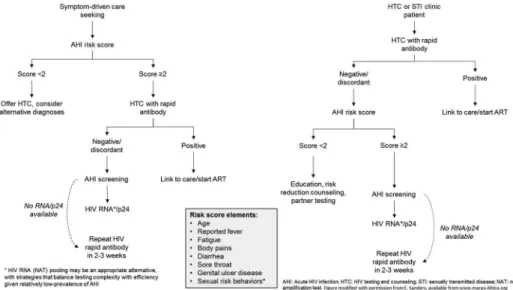
]. However, performance of
risk scores vary according to the prevalence of illness
pre-senting with similar symptoms (e.g., malaria), the clinical
setting (e.g., STI clinic), and the accuracy of reported
symp-toms or behaviours (
Figure 1
) [
24
].
Treating persons with AHI
Updated WHO guidelines recommend all HIV-infected
per-sons receive ART, but make no recommendation about
optimal regimens for those with AHI [
15
]. Treatment
dur-ing AHI reduces viral reservoir seeddur-ing, limits viral
diver-sity, preserves immune responses, and decreases chronic
residual inflammation (
Figure 2
). The early interference
with establishment of viral reservoirs may also have
important
implications
for
viral
eradication
efforts.
Interruption of therapy initiated early during AHI may
result in temporarily lower VL set point, delayed need
for restarting ART [
122
], and, in some cases, sustained
virological remission off therapy [
123
,
124
]. However,
rea-lizing these benefits requires very early ART initiation and
may necessitate therapeutic regimens not currently widely
available in LMIC.
Inflammatory and immune benefits of ART initiated during
AHI
ART initiated during AHI may drastically change the course of
infection. The seeding of viral reservoirs occurs soon after
infection and poses a major barrier to cure efforts [
125
].
Viral reservoirs are a collection of cells harbouring virus
despite suppressive therapy. ART initiated during the first
two weeks of infection is the most effective strategy for
limit-ing size of latent reservoirs [
20
,
126
–
130
]. Early ART reduces
overall level of proviruses, and thus the number of intact,
potentially transmissible, proviruses [
131
], preserves mucosal
CD4 T-cell counts, and reverses inflammation in major
anato-mical reservoirs including gut and lymph nodes [
132
,
133
].
Early ART also reduces the number of infected cells, lowering
cell-associated HIV DNA levels [
130
] and, in doing so, reducing
the viral set point [
134
]. Conversely, ART initiated during
chronic infection results in larger reservoirs, and contributes
to rapid viral rebound with ART interruption [
135
–
137
].
ART initiation during AHI also results in improved
HIV-specific immune responses, potentially slowing disease
progression [
124
]. CD4 T-cell depletion begins shortly
after infection and delaying ART compromises immune
system recovery [
138
–
141
]. CD4 cell counts and CD4/CD8
ratios
predict
long-term
morbidity
and
mortality
[
142
,
143
]; CD4, CD8, and CD4/CD8 ratios are more likely
to normalize with treatment started during AHI
com-pared to delayed treatment [
141
,
144
–
147
], with CD4
cell counts normalizing within one year [
148
]. Very
early ART (within 40 days of the estimated date of
infection) is associated with a significant increase in the
CD4/CD8 ratio compared to delayed ART [
149
]. ART
initiated during AHI is associated with lower T-cell
activa-tion levels at 48 months compared to ART initiated
dur-ing chronic infection, improvdur-ing immune-system recovery
and potentially decreasing mortality [
138
]. Lifetime
dur-ability of these responses is unknown, although
retro-spective analyses suggest sustained reactions for up to
five years [
141
].
Ideal ART regimens for AHI
In the era of expanded ART options, another consideration
is what regimen is appropriate to start during AHI.
Observational and randomized studies comparing standard
ART to
“
intensified
”
regimens that include integrase or
entry inhibitors consistently demonstrate similar
effective-ness in raising CD4 T-cell counts, and lowering markers of
immune activation and cell-associated DNA [
150
–
153
].
Although intensified regimens may not be necessary to
reap virological or immunological benefits, intensified
regi-mens result in a more rapid VL decline in blood and genital
secretions [
154
]. Rapid VL reduction during AHI is critical to
interrupt transmission, and is best facilitated by use of
integrase inhibitors [
155
,
156
]. Other factors to consider in
regimen selection include tolerability (i.e., toxicity),
resis-tance (both transmitted and genetic barriers to acquiring
mutations), and financial implications. Importantly, current
WHO treatment guidelines do not include the newer entry
inhibitors. Ultimately, in the setting of safe and potent ART
options, the health consequences of not treating persons
with AHI likely outweigh the risks inherent to withholding
treatment.
Public health implications of AHI diagnosis and treatment
AHI accounts for a small, but nontrivial portion, of all new
HIV diagnoses
–
identifying an additional two to 10% of HIV
above antibody-only testing depending on risk profile of
screened patient population (i.e. STI clinic vs. general
out-patient setting) [
79
,
83
,
84
,
90
,
157
–
161
]. Insufficient
atten-tion to AHI-centric public health intervenatten-tions could
partially explain the stagnant global HIV incidence trends:
primarily driven by LMIC in sub-Saharan Africa, and with
significant heterogeneity by region, stable incidence despite
increases in treatment coverage towards UN 90
–
90
–
90
treatment goals over the past five years reinforce
inade-quacy of current screening strategies [
162
–
164
].
PrEP in context of undiagnosed AHI
Missing persons with AHI could also have substantial
con-sequences for PrEP programmes. WHO guidelines
recom-mend PrEP for HIV-negative persons at substantial risk of
HIV infection [
15
]. There is likely substantial overlap in the
population that would be eligible for PrEP and those who
are at greatest risk of AHI [
165
]. Given that PrEP
formula-tions and WHO-recommended first-line therapy share a
common tenofovir-containing backbone, induced resistance
selected for by PrEP administration to persons with
unrec-ognized AHI could have significant public health
implica-tions. Although induced resistance may decay following
therapy interruption [
166
], these mutations must be
accounted for in future ART selections. However,
mandat-ing complex AHI testmandat-ing algorithms prior to PrEP initiation
could impede PrEP implementation.
Public health interventions targeting AHI partners and
behaviours
AHI screening enables partner notification services and
behavioural interventions. AHI screening has proved
feasi-ble in several low-income [
77
,
79
,
84
], middle-income [
32
],
and high-income settings [
24
,
65
,
90
]. Despite limited data
regarding feasibility of AHI screening outside of clinical
research settings, studies suggest that testing is both
accep-table and effective. Implementation research is critical to
tease out setting specific implementation barriers to more
widespread AHI detection and treatment.
Assisted
partner
notification,
including
provider-initiated partner notification, is a proven, safe, and
cost-effective intervention for identifying persons with
undiagnosed infection [
167
–
172
], although programmes
are rarely implemented in LMIC. AHI diagnosis may
facil-itate more effective partner services. Persons with AHI
name twice as many sex partners in the three months
preceding diagnosis compared to persons newly
diag-nosed with chronic infection [
173
,
174
]. In the context
of more recent infection, named partners are also more
likely to be infected with HIV [
173
,
175
], although many
of these source partners may have been previously
diag-nosed [
176
].
AHI is often diagnosed during a period of increased
sexual risk, suggesting the importance of rapid
beha-vioural interventions [
177
–
179
]. Given that persons with
AHI can name more recent sex partners who are
respec-tively at greater risk of HIV, this provides an opportunity
for behavioural interventions among serodiscordant
cou-ples [
180
] or serosorting [
181
]. The feasibility of
beha-vioural interventions is complicated by the need for
programmes to rapidly change behaviour in the setting
of increased sexual risk activities, anxiety, depression,
and
substance
abuse
[
181
–
184
].
Despite
perceived
changes in behaviour, many with AHI are unable to
abstain from sex or use condoms, particularly with
long-term partners [
185
]. Incident sexually transmitted
infec-tions after diagnosis suggests ongoing risk behaviours
despite risk reduction counselling and retention in care
[
186
]. The appropriate duration and intensity of
beha-vioural interventions is unknown, although it seems that
modified post-test counselling can adequately convey
messages of increased infectiousness and possibly
facil-itate behaviour change in the short term [
177
,
178
].
Unique challenges and opportunities in treating AHI
Along with appropriate counselling, early ART initiation
dur-ing AHI is critical to limit the spread of HIV attributable to
persons with AHI [
9
,
187
]. High viral loads are a modifiable
risk factor for HIV transmission [
3
]. Same-day ART initiation
for persons with AHI, in line with current
Treat All
initiatives,
results in more rapid viral suppression compared to
non-same day initiation [
188
]. ART in AHI is highly effective and
viral failure is uncommon [
189
]. While virological response
for persons with chronic infection is characterized by
sup-pression 6 months after ART initiation, the most effective
means of reducing transmission during AHI requires regimens
that rapidly reduce viral burden in genital fluids. Among Thai
MSM with AHI, comparing a 3-drug regimen (2 NRTI + 1
NNRTI) to that same regimen intensified with entry and
integrase inhibitors (5 drug regimen, including raltegravir),
persons on the 5-drug regimen achieved viral suppression in
seminal fluid faster compared to standard regimen (13 vs.
24 days); this period of sustained viremia may represent a
critical window of ongoing transmission [
154
]. Although not
currently included in most first-line schedules in LMIC, the
more rapid viral load decline with inclusion of an integrase
inhibitor agent make this an important regimen modification
to reap potential transmission benefits of early ART during
AHI. Ultimately, data demonstrating the feasibility and
effec-tiveness of early ART in suppressing viremia and interrupting
transmission suggest that appropriately-implemented
treat-ment-based interventions may change the course of the
global epidemic.
Viral response depends on regimen and patients
’
adher-ence behaviours. For example, the 24-week failure rate
among a Thai cohort (1.1%) was significantly lower than
the 10% failure rate among a Boston-based cohort also
receiving early-ART [
190
]. The difference may be related
to the differences in regimen selection, with the Boston
study demanding a higher pill burden. Despite the potential
suppression benefits of more potent regimens, compared
to three-drug combinations, adherence to the intensified
five-drug regimen is generally worse [
150
,
151
], likely
related to the necessary twice-daily dosing and more
fre-quent adverse effects. Although more complex regimens
may be preferred for rapid reduction of VL, the adverse
effects, risk of sub-standard adherence, and drug costs
could prohibit widespread use.
System-wide barriers to AHI diagnosis and treatment scale
up
and thus may not be ready for scale up. Point-of-care tests
are critical for expansion of AHI screening, and there are
promising alternative platforms under development and in
early field implementation. However, cost, ease-of-use,
adequate sensitivity for screening objectives, and efficient
throughput for high-volume screening are still under
inves-tigation. In the absence of widely available diagnostics
capable of detecting AHI, one strategy includes encouraging
retesting 2
–
4 weeks after negative or inconclusive antibody
results for persons with acute retroviral symptoms at time
of presentation. Unfortunately, over 40% of participants
failed to return for follow-up testing even after enhanced
appointment reminders using SMS or in-person cues [
192
].
Barriers to diagnosis and treatment are intimately
inter-twined. Therapy initiated within two weeks of infection
may be most beneficial for reduced transmission and
improved immune response. However, this narrow window
requires extremely sensitive diagnostic assays and system
capacity to start ART almost immediately after a positive
result. Although rapid and reliable diagnosis is the critical
first step for AHI intervention, comprehensive management
will also require appropriate provider messaging, patient
education, and possibly AHI-specific treatment strategies.
Conclusions
AHI detection and treatment has important diagnostic,
clin-ical, and public health implications [
193
]. Treatment is
beneficial for the infected individual, with likely long-term
immune-virological benefits with early treatment initiation,
and extensive research has demonstrated advantages of
early ART, regardless of regimen. Immediate ART is also
advantageous to uninfected sex partners, reducing the risk
of acquisition in the setting of suppressed viremia.
Furthermore, immediate ART during AHI has profound
implications for HIV cure efforts; by eliminating or limiting
establishment of latent reservoirs and preserving immune
responses, early ART during AHI may be the key to ongoing
eradication strategies [
194
]. Although, currently, treatment
interruption is an unfavourable approach for AHI
manage-ment, the development of predictive algorithms with HIV
eradication objectives, particularly in LMIC, will need to
take into consideration parameters that may influence
con-trol of infection [
195
,
196
], such as route of infection,
eth-nicity, and hormonally driven gender-based differences
[
197
,
198
], including evidence of lower rates of inducible
virus among women on suppressive ART [
199
]
We identified several research priorities. First, we need
prospective assessment of appropriate testing strategies
and algorithms for AHI diagnosis, including evaluation of
risk score performance for screening in LMIC using
same-day POC tests. This is important for implementation and
policies related to scaling up AHI detection and treatment
as well as PrEP implementation in LMIC. Second, further
diagnostic research on POC assays to detect early and
acute infection is key. Third, we need investigations into
the feasibility, cost-effectiveness and implications for
treatment switch algorithms associated with
incorporat-ing
integrase
inhibitors
into
first-line
regimen
recommendations. Use of integrase inhibitors will be
especially important among certain high-risk groups for
whom rapid reduction in viral load is critical, such as
pregnant women. Finally, implementation research in
the context of expanded testing and treatment goals
will become increasingly important to understand how
to incorporate routine AHI detection and treatment into
existing health systems.
The outlined research agenda is essential for guiding policy
change. Nonetheless, we propose that LMIC with AHI testing
capacity should immediately implement AHI screening among
high-risk populations. Targeted screening utilizing risk score
algorithms may help identify persons with AHI and focus
limited resources without confining screening to specific
clinics. Additional approaches include social and sexual partner
recruitment and notification to help increase screening yields.
Scaling up testing requires extensive personnel training and
patient education and should be pursued in settings in which
immediate ART as recommended through the
Treat All
policy
can be offered.
This scoping review addresses the broad topic of clinical
and public health implications of AHI. As a scoping review,
we did not define inclusion nor exclusion criteria and, as
such, we cannot assess the quality of published articles that
are included in the review in a standardized fashion. Unlike
systematic reviews, scoping reviews such as this do not
synthesize evidence in a manner that allows relative weight
of alternative research findings or interventions, offering
instead a narrative from which future systematic reviews
may be motivated. Despite these limitations, the scoping
review provides flexibility and breadth in study design and
publication inclusion on a fast-changing and, specifically in
LMIC, under-researched topic.
Unchanged HIV incidence rates despite ART scale-up
suggest the importance of targeting diagnostic and
treat-ment interventions to groups responsible for a
dispropor-tionate share of new infections, including persons with
AHI. Although current WHO guidelines recommend a
Treat All
approach, explicit guidance regarding AHI
test-ing and treatment approaches are urgently needed.
Further AHI research and policy development can help
to fill this gap.
Authors’affiliations
1Department of Health Policy and Management, University of North Carolina
at Chapel Hill, Chapel Hill, NC, USA; 2Division of Infectious Diseases,
University of North Carolina at Chapel Hill, Chapel Hill, NC, USA; 3U.S.
Military HIV Research Program, Walter Reed Army Institute of Research, Silver Spring, MD, USA; 4Henry M. Jackson Foundation for the
Advancement of Military Medicine, Bethesda, MD, USA; 5Department of
Medicine, Imperial College London, London, UK;6HIV Department, World
Health Organization, Geneva, Switzerland;7Department of Clinical Research, London School of Hygiene and Tropical Medicine, London, UK;8Department
of Global Health, University of Amsterdam, Amsterdam, The Netherlands;
9Kenya Medical Research Institute-Wellcome Trust Research Programme,
Kilifi, Kenya; 10Nuffield Department of Medicine, University of Oxford, Oxford, UK; 11Fundación Huésped, Buenos Aires, Argentina; 12Institut
Pasteur, HIV Inflammation and Persistance Unit, Paris, France;13HIV/AIDS
Division, University of California San Francisco, San Francisco, CA, USA;14Big
Data Institute, Nuffield Department of Medicine, University of Oxford, Oxford, UK;15Department of Epidemiology, University of North Carolina at
Health and Infectious Diseases, University of North Carolina at Chapel Hill, Chapel Hill, NC, USA
Competing interests
MSC receives advisory board honorariums and/or travel reimbursement from Janssen Global Services, Roche Molecular Systems, and Merck Research outside the submitted manuscript. AS-C has received advisory board honorarium and/or speaker honorarium from ViiV healthcare, Gilead, Merck Sharp and Dohme and BMS and research grant from Merck Sharp and Dohme outside the submitted manuscript.
Authors’contributions
All authors meet criteria for authorship as recommended by the International Committee of Medical Journal Editors. SER, MV, MD, MSC, and JDT contributed to the conception, design, and literature review. SER and JDT drafted the initial manuscript. JA, SF, CJ, EJS, OS, ASC, CDP, CF, MSC, MV, MD, and JDT provided substantive edits to the manuscript. All authors have read and approved the final manuscript.
Acknowledgements
EJS is supported by Wellcome Trust and the KWTRP at the Centre for Geographical Medicine Research-Kilifi (supported by core funding from the Wellcome Trust (#077092)), with support from the International AIDS Vaccine Initiative. JDT is supported by NIAID R21AI20549. SF is supported by NIHR BRC. SER was supported by R01 AI114320, F30 MH098731 and T32 GM008719. The views expressed are those of the authors and should not be construed to represent the positions of the U.S. Army or the Department of Defense or other institutions listed.
Funding
EJS is supported by Wellcome Trust and the KWTRP at the Centre for Geographical Medicine Research-Kilifi (supported by core funding from the Wellcome Trust (#203077/Z/16/Z)), with support from the International AIDS Vaccine Initiative. JDT is supported by NIAID R21AI20549. SF is supported by NIHR BRC. SER was supported by National Institutes of Health [R01 AI114320], [F30 MH098731] and [T32 GM008719].
References
[1] UNAIDS. Prevention gap report.2016. Available from:http://www.unaids. org/sites/default/files/media_asset/2016-prevention-gap-report_en.pdf [2] Dehne KL, Dallabetta G, Wilson D, Garnett GP, Laga M, Benomar E, et al. HIV prevention 2020: a framework for delivery and a call for action. Lancet HIV.2016;3(7):e323–32.
[3] Fiebig EW, Wright DJ, Rawal BD, Garrett PE, Schumacher RT, Peddada L, et al. Dynamics of HIV viremia and antibody seroconversion in plasma donors: implications for diagnosis and staging of primary HIV infection. Aids.2003;17(13):1871–79.
[4] DHHS. Panel on antiretroviral guidelines for adults and adolescents. Washington (DC).2015. p. 133–39. Available from:http://www.aidsinfo.nih. gov/ContentFiles/AdultandAdolescentGL.pdf
[5] Pilcher CD, Joaki G, Hoffman IF, Martinson FE, Mapanje C, Stewart PW, et al. Amplified transmission of HIV-1: comparison of HIV-1 concentrations in semen and blood during acute and chronic infection. Aids.2007;21(13):1723–30. [6] Pilcher CD, Shugars DC, Fiscus SA, Miller WC, Menezes P, Giner J, et al. HIV in body fluids during primary HIV infection: implications for pathogen-esis, treatment and public health. Aids.2001;15(7):837–45.
[7] Pilcher CD, Tien HC, Eron JJ Jr., Vernazza PL, Leu SY, Stewart PW, et al. Brief but efficient: acute HIV infection and the sexual transmission of HIV. J Infect Dis.2004;189(10):1785–92.
[8] Morrison CS, Demers K, Kwok C, Bulime S, Rinaldi A, Munjoma M, et al. Plasma and cervical viral loads among Ugandan and Zimbabwean women during acute and early HIV-1 infection. Aids.2010;24(4):573–82.
[9] Powers KA, Ghani AC, Miller WC, Hoffman IF, Pettifor AE, Kamanga G, et al. The role of acute and early HIV infection in the spread of HIV and implications for transmission prevention strategies in Lilongwe, Malawi: a modelling study. Lancet.2011;378(9787):256–68.
[10] Battegay M, Lundgren JD, Ryom L, editors. European AIDS clinical society Brussels, Belgium: EACS; 2017.
[11] Panel on Antiretroviral Guidelines for Adults and Adolescents. Guidelines for the use of antiretroviral agents in HIV-1-infected adults and adolescents. Washington DC, USA: Department of Health and Human Services;2015.
[12] Gokengin D, Geretti AM, Begovac J, Palfreeman A, Stevanovic M, Tarasenko O, et al. European guideline on HIV testing. Int J STD AIDS. 2014;25(10):695–704.
[13] IAS-USA. Antiretroviral treatment of adult HIV infection: 2014 recom-mendations of the international antiviral society-USA panel. San Francisco, CA: IAS-USA;2014.
[14] WHO. Consolidated guidelines on HIV prevention, diagnosis, treatment, and care for key populations. Geneva: WHO;2013.
[15] WHO. Consolidated guidelines on the use of antiretroviral drugs for treating and preventing HIV infection: recommendations for a public health approach. 2nd ed. Geneva: World Health Organization;2016Sep. [16] WHO. Consolidated guidelines on HIV testing services. Geneva (Switzerland): WHO;2015July.
[17] Fonner VA, Dalglish SL, Kennedy CE, Baggaley R, O’Reilly KR, Koechlin FM, et al. Effectiveness and safety of oral HIV preexposure prophylaxis for all populations. Aids.2016;30(12):1973–83.
[18] Li JZ, Etemad B, Ahmed H, Aga E, Bosch RJ, Mellors JW, et al. The size of the expressed HIV reservoir predicts timing of viral rebound after treatment interruption. Aids.2016;30(3):343–53.
[19] Ananworanich J, Dube K, Chomont N. How does the timing of antire-troviral therapy initiation in acute infection affect HIV reservoirs? Curr Opin HIV AIDS.2015;10(1):18–28.
[20] Archin NM, Vaidya NK, Kuruc JD, Liberty AL, Wiegand A, Kearney MF, et al. Immediate antiviral therapy appears to restrict resting CD4+ cell HIV-1 infection without accelerating the decay of latent infection. PNAS.2012;109(24):9523–28. [21] Krebs SJ, Ananworanich J. Immune activation during acute HIV infection and the impact of early antiretroviral therapy. Curr Opin HIV AIDS.2016;11 (2):163–72.
[22] Fisher M, Pao D, Brown AE, Sudarshi D, Gill ON, Cane P, et al. Determinants of HIV-1 transmission in men who have sex with men: a combined clinical, epidemiological and phylogenetic approach. Aids.2010;24 (11):1739–47.
[23] Hoenigl M, Graff-Zivin J, Little SJ. Costs per diagnosis of acute HIV infection in community-based screening strategies: a comparative analysis of four screening algorithms. Clin Infect Dis.2016;62(4):501–11.
[24] Kuruc JD, Cope AB, Sampson LA, Gay CL, Ashby RM, Foust EM, et al. Ten years of screening and testing for acute HIV infection in North Carolina. J Acquir Immune Defic Syndr.2016;71(1):111–19.
[25] White PJ, Fox J, Weber J, Fidler S, Ward H. How many HIV infections may be averted by targeting primary infection in men who have sex with men? Quantification of changes in transmission-risk behavior, using an individual-based model. J Infect Dis.2014;210 Suppl 2:S594–9.
[26] Phanuphak P, Lo YR. Implementing early diagnosis and treatment: programmatic considerations. Curr Opin HIV AIDS.2015;10(1):69–75. [27] Suthar AB, Granich RM, Kato M, Nsanzimana S, Montaner JS, Williams BG. Programmatic implications of acute and early HIV infection. J Infect Dis. 2015;212(9):1351–60.
[28] Arksey H, O’Malley L. Scoping studies: towards a methodological frame-work. Int J Soc Res Methodol.2005;8(1):19–32.
[29] Mays N, Roberts E, Popay J. Synthesising research evidence. In: Fulop N, Allen P, Clarke A, Black N, editors. Studying the organisation and delivery of health services: research methods. London: Routledge;2001. p. 188–220. [30] Carlson JM, Schaefer M, Monaco DC, Batorsky R, Claiborne DT, Prince J, et al. HIV transmission. Selection bias at the heterosexual HIV-1 transmission bottleneck. Science.2014;345(6193):1254031.
[31] Quinn TC, Brookmeyer R, Kline R, Shepherd M, Paranjape R, Mehendale S, et al. Feasibility of pooling sera for HIV-1 viral RNA to diagnose acute primary HIV-1 infection and estimate HIV incidence. Aids. 2000;14(17):2751–57.
[32] Robb ML, Eller LA, Kibuuka H, Rono K, Maganga L, Nitayaphan S, et al. Prospective study of acute HIV-1 infection in adults in East Africa and Thailand. N Engl J Med.2016;374:2120–30.
[34] Wawer MJ, Gray RH, Sewankambo NK, Serwadda D, Li X, Laeyendecker O, et al. Rates of HIV-1 transmission per coital act, by stage of HIV-1 infection, in Rakai, Uganda. J Infect Dis.2005;191(9):1403–09.
[35] Hollingsworth TD, Anderson RM, Fraser C. HIV-1 transmission, by stage of infection. J Infect Dis.2008;198(5):687–93.
[36] Bellan SE, Dushoff J, Galvani AP, Meyers LA. Reassessment of HIV-1 acute phase infectivity: accounting for heterogeneity and study design with simulated cohorts. Plos Med.2015;12(3):e1001801.
[37] Bezemer D, Van Sighem A, Lukashov VV, Van Der Hoek L, Back N, Schuurman R, et al. Transmission networks of HIV-1 among men having sex with men in the Netherlands. Aids.2010;24(2):271–82.
[38] English S, Katzourakis A, Bonsall D, Flanagan P, Duda A, Fidler S, et al. Phylogenetic analysis consistent with a clinical history of sexual transmission of HIV-1 from a single donor reveals transmission of highly distinct variants. Retrovirology.2011;8:54.
[39] Hollingsworth TD, Pilcher CD, Hecht FM, Deeks SG, Fraser C. High Transmissibility During early HIV infection among men who have sex with men-San Francisco, California. J Infect Dis.2015;211(11):1757–60. [40] Kouyos RD, Von Wyl V, Yerly S, Boni J, Taffe P, Shah C, et al. Molecular epidemiology reveals long-term changes in HIV type 1 subtype B transmis-sion in Switzerland. J Infect Dis.2010;201(10):1488–97.
[41] Pao D, Fisher M, Hue S, Dean G, Murphy G, Cane PA, et al. Transmission of HIV-1 during primary infection: relationship to sexual risk and sexually transmitted infections. Aids.2005;19(1):85–90.
[42] Brenner BG, Roger M, Stephens D, Moisi D, Hardy I, Weinberg J, et al. Transmission clustering drives the onward spread of the HIV epidemic among men who have sex with men in Quebec. J Infect Dis. 2011;204 (7):1115–19.
[43] Brown AE, Gifford RJ, Clewley JP, Kucherer C, Masquelier B, Porter K, et al. Phylogenetic reconstruction of transmission events from individuals with acute HIV infection: toward more-rigorous epidemiological definitions. J Infect Dis.2009;199(3):427–31.
[44] Chibo D, Kaye M, Birch C. HIV transmissions during seroconversion contribute significantly to new infections in men who have sex with men in Australia. AIDS Res Hum Retroviruses.2012;28(5):460–64.
[45] Frange P, Meyer L, Deveau C, Tran L, Goujard C, Ghosn J, et al. Recent HIV-1 infection contributes to the viral diffusion over the French territory with a recent increasing frequency. Plos One.2012;7(2):e31695.
[46] Brenner BG, Roger M, Routy JP, Moisi D, Ntemgwa M, Matte C, et al. High rates of forward transmission events after acute/early HIV-1 infection. J Infect Dis.2007;195(7):951–59.
[47] Ratmann O, Van Sighem A, Bezemer D, Gavryushkina A, Jurriaans S, Wensing A, et al. Sources of HIV infection among men having sex with men and implications for prevention. Sci Transl Med.2016;8(320):320ra2. [48] Dennis AM, Herbeck JT, Brown AL, Kellam P, De Oliveira T, Pillay D, et al. Phylogenetic studies of transmission dynamics in generalized HIV epidemics: an essential tool where the burden is greatest? J Acquir Immune Defic Syndr. 2014;67(2):181–95.
[49] Miller WC, Rosenberg NE, Rutstein SE, Powers KA. Role of acute and early HIV infection in the sexual transmission of HIV. Curr Opin HIV AIDS. 2010;5(4):277–82.
[50] Pinkerton SD. How many sexually-acquired HIV infections in the USA are due to acute-phase HIV transmission? Aids.2007;21(12):1625–29. [51] Prabhu VS, Hutchinson AB, Farnham PG, Sansom SL. Sexually acquired HIV infections in the USA due to acute-phase HIV transmission: an update. Aids.2009;23(13):1792–94.
[52] Xiridou M, Geskus R, De Wit J, Coutinho R, Kretzschmar M. Primary HIV infection as source of HIV transmission within steady and casual partnerships among homosexual men. Aids.2004;18(9):1311–20.
[53] Cohen MS, Shaw GM, McMichael AJ, Haynes BF. Acute HIV-1 infection. N Engl J Med.2011;364(20):1943–54.
[54] Volz EM, Ionides E, Romero-Severson EO, Brandt MG, Mokotoff E, Koopman JS. HIV-1 transmission during early infection in men who have sex with men: a phylodynamic analysis. Plos Med.2013;10(12):e1001568;discussion e. [55] Abu-Raddad LJ, Longini IM Jr. No HIV stage is dominant in driving the HIV epidemic in sub-Saharan Africa. Aids.2008;22(9):1055–61.
[56] Williams BG, Granich R, Dye C. Role of acute infection in HIV transmis-sion. Lancet.2011;378(9807):1913;author reply 4-5.
[57] PopART. Clinicaltrials.gov [Identifier: NCT01900977]. 2016. Available from:https://clinicaltrials.gov/ct2/show/NCT01900977
[58] SEARCH. Clinicaltrials.gov [Identifier: NCT01864603]. 2016. Available from:https://clinicaltrials.gov/ct2/show/NCT01864603
[59] Kfutwah A, Lemee V, Ngono HV, De Oliveira F, Njouom R, Plantier JC. Field evaluation of the Abbott ARCHITECT HIV Ag/Ab Combo immunoassay. J Clin Virol.2013;58 Suppl 1:e70–5.
[60] Haukoos JS, Lyons MS, White DA, Hsieh YH, Rothman RE. Acute HIV infection and implications of fourth-generation HIV screening in emergency departments. Ann Emerg Med.2014;64(5):547–51.
[61] Patel P, Bennett B, Sullivan T, Parker MM, Heffelfinger JD, Sullivan PS. Rapid HIV screening: missed opportunities for HIV diagnosis and prevention. J Clin Virol.2012;54(1):42–47.
[62] Piwowar-Manning E, Fogel JM, Richardson P, Wolf S, Clarke W, Marzinke MA, et al. Performance of the fourth-generation Bio-Rad GS HIV Combo Ag/ Ab enzyme immunoassay for diagnosis of HIV infection in Southern Africa. J Clin Virol.2015;62:75–79.
[63] Geren KI, Lovecchio F, Knight J, Fromm R, Moore E, Tomlinson C, et al. Identification of acute HIV infection using fourth-generation testing in an opt-out emergency department screening program. Ann Emerg Med. 2014;64(5):537–46.
[64] Ly TD, Ebel A, Faucher V, Fihman V, Laperche S. Could the new HIV combined p24 antigen and antibody assays replace p24 antigen specific assays? J Virol Methods.2007;143(1):86–94.
[65] Peters PJ, Westheimer E, Cohen S, Hightow-Weidman LB, Moss N, Tsoi B, et al. Screening yield of HIV antigen/antibody combination and pooled HIV RNA testing for acute HIV infection in a high-prevalence population. Jama. 2016;315(7):682–90.
[66] Jurriaans S, Back NK, Wolthers KC. Ten years of HIV testing with fourth generation assays: the Amsterdam experience. J Clin Virol.2011;52 Suppl 1: S67–9.
[67] Centers for Disease Control and Prevention (CDC). Laboratory testing for the diagnosis of HIV infection: updated recommendations. Atlanta (GA); 2014June 27.
[68] De Souza M, Phanuphak N, Pinyakorn S, Trichavaroj R, Pattanachaiwit S, Chomchey N, et al. Impact of nucleic acid testing relative to antigen/anti-body combination immunoassay on the detection of acute HIV infection. Aids.2015;29:793–800.
[69] Krajden M, Cook D, Mak A, Chu K, Chahil N, Steinberg M, et al. Pooled nucleic acid testing increases the diagnostic yield of acute HIV infections in a high-risk population compared to 3rd and 4th generation HIV enzyme immunoassays. J Clin Virol.2014;61(1):132–37.
[70] De Souza MS, Pinyakorn S, Akapirat S, Pattanachaiwit S, Fletcher JL, Chomchey N, et al. Initiation of antiretroviral therapy during acute HIV-1 infection leads to a high rate of nonreactive HIV serology. Clin Infect Dis. 2016;63:555–61.
[71] RV254/SEARCH010. Clinicaltrials.gov [Identifier: NCT00796146]. 2016 [cited 2016 Aug 25]. Available from:https://clinicaltrials.gov/ct2/show/ NCT00796146
[72] Ramos EM, Harb S, Dragavon J, Swenson P, Stekler JD, Coombs RW. Performance of an alternative HIV diagnostic algorithm using the ARCHITECT HIV Ag/Ab Combo assay and potential utility of sample-to-cutoff ratio to discriminate primary from established infection. J Clin Virol. 2013;58 Suppl 1:e38–43.
[73] Thigpen MC, Kebaabetswe PM, Paxton LA, Smith DK, Rose CE, Segolodi TM, et al. Antiretroviral preexposure prophylaxis for heterosexual HIV trans-mission in Botswana. N Engl J Med.2012;367(5):423–34.
[74] Baeten JM, Donnell D, Ndase P, Mugo NR, Campbell JD, Wangisi J, et al. Antiretroviral prophylaxis for HIV prevention in heterosexual men and women. N Engl J Med.2012;367(5):399–410.
[75] Grant RM, Lama JR, Anderson PL, McMahan V, Liu AY, Vargas L, et al. Preexposure chemoprophylaxis for HIV prevention in men who have sex with men. N Engl J Med.2010;363(27):2587–99.
[76] Van Damme L, Corneli A, Ahmed K, Agot K, Lombaard J, Kapiga S, et al. Preexposure prophylaxis for HIV infection among African women. N Engl J Med.2012;367(5):411–22.
[77] Bassett IV, Chetty S, Giddy J, Reddy S, Bishop K, Lu Z, et al. Screening for acute HIV infection in South Africa: finding acute and chronic disease. HIV Med.2011;12(1):46–53.