Mathematical and Software Engineering, vol. 4, no. 1, 12-17, 2018. Varεpsilon Ltd. http://varepsilon.com/index.php/mse/
Applied Software for Managing a Small
Business
Krasimir Kordov and Deniz Eminov
Department of Computer Informatics Faculty of Mathematics and
Informatics Konstantin Preslavski University of Shumen, 9712 Shumen,
Bulgaria
Abstract
In this paper we present software solution for managing a small business with fixed number of products, prices and quantities. The presented software application is developed on a dot NET platform using programming language C# and it is designed for the most used operating system - Windows. The software application provides different functions for different types of uses.
Keywords: Applied software; Software application; Software
1
Introduction
The development of application software requires deep knowledge in the software industry to determine the current modern trends in software implementation. Designing process of a software product precedes the actual realization and needs to correspond with the needs and activities of the company for which it is intended. It is mandatory to be defined variety of important indicators such as software platform, programming language, operating system for working with the software, database management system, network connection, etc. The choice of these factors depends entirely on the company activity, in order to effectively manage company business itself.
2
Types of software
2.1
Company template software (Universal software)
This type of software is used by companies with the same or similar business. There is a variety of this type of software for different activities such as hotel management, sales management, storage inventory management etc. This software is known as universal software and has template structure, so it can be used by as many as possible companies. This can bring the developers large profit guaranteeing large number of sold copies, even if the price is not high.
Advantages:
• Low cost - determined by the circulation • Suitable for wide use
• User friendly interface
• User manual is provided with the software
• In most cases there is option for software updates Disadvantages:
• It does not fully meet the requirements of each company
• There may be unnecessary functions and missing functions that are important to the business
• The user is fully responsible for its proper use.
2.2
Custom-made software
Custom made software is specific software developed for certain persons or companies. This software is designed for concrete company needs directly focused on managing all the company activities. This goal cannot be achieved by universal software. The most common factor for this type of software is the high cost.
Advantages:
• Fully developed for the company needs
• Includes all the functionality needed for managing the company business • Specific user friendly interface
• User manual is provided with the software
• In most cases the software developer provides a warranty period for maintenance • The company is able to make certain requirements such as specific user interface,
operating system etc. Disadvantages:
• High cost
• There is no upgrade option
3
Applied software for managing a small business
Considering the advantages and disadvantages of the types of software, we designed ap-plied software for a small business management, which aims to overcome one of the disad-vantages of the custom made software - the high price. The presented software is designed for sample company with fixed number of products and the purpose of the software is managing the sales and the company’s turnover. We used MS Visual Studio 2015 [11], dot NET 4.6.1 [6,10] and programming language C# [1,4] for making the software which makes the software usable on the most popular operating system Windows, allowing ad-ditional reduction of the expenses for the company.
3.1
Product assortment
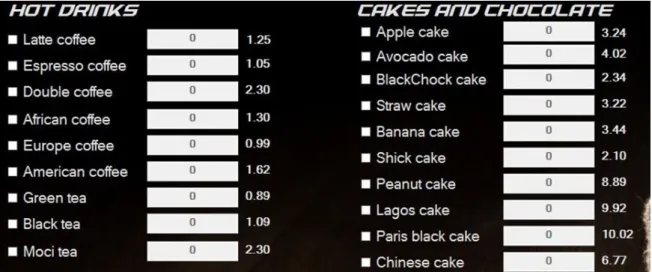
The products offered for sale are a fixed number, their names and prices have been deter-mined and provided by the company and the implementation of the software is consistent with the set product assortment. Figure 1 shows the view of the software application depicting the sample product assortment and product prices, divided into two main cat-egories - Hot Beverages and Confectionery.
Figure 1: Sample product range
3.2
Access rights according to the role of users
3.3
Identification
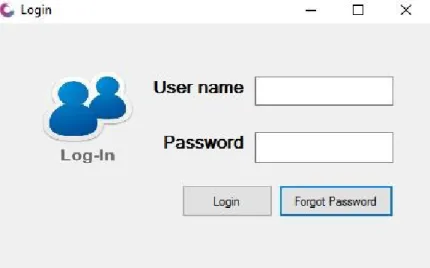
The process of identifying a person is called identification. The presented software requires entering a user name and password to log in to the system. Figure 2 illustrates a form for logging into the system.
Figure 2: Identification
An invalid username or password make the access to the system impossible. The need only for employees to work with the software comes from the importance of financial transactions that reflect sales and are directly related to the business of the company. The applied software has an option to recover a forgotten password, and for this purpose it is necessary to answer a secret question previously entered by the user himself.
After successful identification, the software automatically recognizes the type of user and provides the user with the software capabilities provided for that type of user.
Some security definition and constructions of basic cryptographic primitives can be found in the work of [2], [7], [8], and [9],
3.4
Standard user
The first type of users who work with the applied software are employees, managing the sales. Their options for working with the system are:
• Products selection - marking the products selected by the customer and their quan-tities.
• Calculation of the final amount - determines the amount due to the customer for the selected products.
• Reseting of values - used for correction of selected products, quantities or order cancellation.
3.5
Administrators
The second type of users who work with the applied software are the administrators who are responsible for the company’s management. Their options for working with the system are:
• Administrators have all the capabilities available to standard users. • Add users - used to add new users to work with the software.
• Delete user - used to remove users no longer needed to work with the software. • View reports - an overview of the monthly turnover of products sold, quantities and
sales of specific users.
• Access to Control Panel - the administrator can change some simple settings of the applied software.
4
Conclusion
Every company uses the benefits of computer technology in its business, as in most cases it is mandatory for successful business. For start-ups companies, the estimated software costs are often small, and in some cases, no such software costs are anticipated at all. In these cases, universal software is possible solutions, but they do not cover all the specific requirements of each particular company. The most suitable option is the individual approach to the creation of applied software, which is fully consistent with the company’s activities.
This article provides applied software for managing a small business of a sample com-pany. The modelling of the software was done after an analysis of the types of software for business management and specific company needs and activities (such as product as-sortment, types of users, customer service, etc.). The implementation of the software is made on dot NET, and the application can be used on all Windows-based computers that occupy the largest market share in the world. The application does not require additional software and license costs, which is an important factor in determining the cost of small business.
Acknowledgement
This work is partially supported by the Scientific research fund of Konstantin Preslavski University of Shumen under the grant No. RD-08-122/06.02.2018.
References
[1] T. Archer, A. Whitechapel, Inside C#, Second Edition, ISBN 0-7356-1648-5. [2] K. Kordov, K., B. Stoyanov (2017) Least Significant Bit Steganography using
[3] P. Laplante, What Every Engineer Should Know about Software Engineering. Boca Raton, CRC, 2007.
[4] Microsoft Corporation, Microsoft Visual C# .NET Deluxe Learning Edition, ISBN 0-7356-1633-7.
[5] J. Morris, Software industry accounting, John Wiley & Sons, 2001.
[6] J. Richter,Applied Microsoft .NET Framework Programming, ISBN 0-7356-1422-9. [7] S. Stanev, B. Stoyanov (2016) Challenges of Steganography to Information Security
and Training of Specialists. Annual of Konstantin Preslavsky University of Shumen, Faculty of Mathematics and Computer Science, XVII C, 89-111. http://info.fmi. shu-bg.net/skin/pfiles/godishnik-2016-fmi-89-111.pdf.
[8] B. Stoyanov (2014) Pseudo-random Bit Generation Algorithm Based on Chebyshev Polynomial and Tinkerbell Map. Applied Mathematical Sciences, 8(125), 6205-6210. http://dx.doi.org/10.12988/ams.2014.48676.
[9] B. Stoyanov, K. Szczypiorski, and K. Kordov (2017) Yet Another Pseudorandom Number Generator. International Journal of Electronics and Telecommunications, 63(2), 195-199. https://doi.org/10.1515/eletel-2017-0026.
[10] URL: https://msdn.microsoft.com/en-us/library/mt472912(v=vs.110).aspx - MSDN Library - .NET Framework Class Library (30.05.2018).
[11] URL: https://msdn.microsoft.com/en-us/library/bb165114(v=vs.140).aspx - MSDN Library - Visual Studio Extensibility Architecture (30.05.2018).
Copyright c 2018 Krasimir Kordov and Deniz Eminov. This is an open access article distributed
under the Creative Commons Attribution License, which permits unrestricted use, distribution, and