Journal of Algebra Combinatorics Discrete Structures and Applications
A generalization of the Mignotte’s scheme over
Euclidean domains and applications to secret image
sharing
∗
Research Article
Ibrahim Ozbek,
Fatih Temiz
,
Irfan Siap
Abstract: Secret sharing scheme is an efficient method to hide secret key or secret image by partitioning it into parts such that some predetermined subsets of partitions can recover the secret but remaining subsets cannot. In 1979, the pioneer construction on this area was given by Shamir and Blakley independently. After these initial studies, Asmuth-Bloom and Mignotte have proposed a different
(k, n) threshold modular secret sharing scheme by using the Chinese remainder theorem. In this study, we explore the generalization of Mignotte’s scheme to Euclidean domains for which we obtain some promising results. Next, we propose new algorithms to construct threshold secret image sharing schemes by using Mignotte’s scheme over polynomial rings. Finally, we compare our proposed scheme to the existing ones and we show that this new method is more efficient and it has higher security.
2010 MSC:11K31, 94A08, 94A62, 13F07
Keywords: Mignotte sequences, Secret image sharing, Secret sharing scheme, Euclidean domain
1.
Introduction
The rapid improvement of technology and the increase of the usage of the internet day by day intro-duces some new challenges. One of the most important challenge is the security of data (message/image). There are several techniques in literature for keeping the data secure. One of them is applying a secret sharing scheme (a.k.a. key safeguarding scheme). Secret sharing schemes play an important role in cryp-tography especially where the secret key is supposed to be distributed in parts to shareholders so that
∗
This research was partially supported by The Scientific and Technological Research Council of Turkey, Project No: 114F388.
Ibrahim Ozbek; Yildiz Technical University, Graduate School of Science and Engineering, Department of Math-ematics, Istanbul, Turkey (email: [email protected]).
Fatih Temiz (Corresponding Author); Istanbul Gelisim University, Department of Management Information Systems, Istanbul, Turkey (email: [email protected]).
some of predetermined shares can recover the key. In order to construct such schemes many methods have been developed over the last 30 years [14]. The first secret sharing scheme is introduced by Blakley and Shamir independently [2, 12]. They propose a(k, n)threshold secret sharing scheme, i.e. anykout ofnparticipants can reconstruct the secret key but anyk−1or fewer participants cannot reconstruct it.
In [1, 9], Asmuth-Bloom and Mignotte propose a different (k, n)threshold modular secret sharing scheme by using Chinese remainder theorem. These two methods depend on a particular choice of the ordering and the selection of positive integers that are used as module. Mignotte’s method is over integers, on the other hand Asmuth-Bloom’s modular approach is applicable to not only integers but also to Euclidean domains in general. In [5], Mignotte’s construction is further generalized to not necessarily relatively coprime integers which are called generalized Mignotte sequences and an application to e-voting is presented.
Also, another generalization of Mignotte’s construction over polynomial rings is given in [16].
In [10], Naor and Shamir propose an interesting method for encrypting visual data which is called visual cryptography. In this method, there is no cryptographic computation to recover secret image, that is, decoding process of the method is based solely on human visual system. After this pioneer construction, to overcome memory space problem, Thien and Lin propose threshold secret image sharing scheme by using Shamir’s scheme [17]. In this scheme, they consider each k pixels of a secret image S as coefficients of polynomials and compute the values of these polynomials to generate then shadow images. Since the scheme’s reconstruction is based on Lagrange interpolation, any k out of n shadow images can reconstruct the secret image Sbut anyk−1or fewer shadow images cannot reconstruct the secret image. By taking advantage of Huffman encoding, Wang and Su come up with a new secret image sharing scheme that uses smaller shadow images [19]. In [8], Meher and Patra design a new scheme which is not a threshold by taking advantage of Chinese remainder theorem. Unlike the previous work, the shadow images of this scheme may have distinct sizes. In [13], Shyu and Chen give another threshold scheme which is based on Mignotte’s secret sharing scheme.
In this study, we give a generalization of Mignotte’s scheme over Euclidean domains. We also construct threshold secret image sharing schemes based on generalization of Mignotte’s scheme over polynomial rings. We organize this paper as follows: In Section 2, we give basics of secret sharing schemes and recall the construction of Mignotte’s scheme. The generalization of Mignotte’s scheme over Euclidean domains is given in Section 3. In Section4, we propose new algorithms to construct threshold secret image sharing schemes and an experimental result is presented in Section 5. In section 6, the security analysis of algorithms is also analyzed. In Section 7, our proposed secret image sharing scheme is compared with the state of the art methods. Finally, conclusions and comparisons to the existing methods are summarized in Section8.
2.
Preliminaries
A secret sharing scheme is a method of sharing a secretSamongnparticipantsP ={P1, P2, . . . , Pn}
by using a distribution rule F={f|f :V →P} such that some predetermined subsets of2P can
recon-struct the secretS, whereV is the set of shares (shadows). The subsets that can construct the secretS are called access structures and the set of such subsets is denoted byΓ, and any subset of participants that is not inΓcannot reconstruct the secretS. If everykout ofnparticipants can determine the secret S and any out ofk−1or fewer participants cannot determine the secretS, then this scheme is called a
(k, n)threshold scheme and the access structure of this scheme is Γ ={A| |A| ≥k, A⊆2P} [12]. Also,
ifk−1or fewer participants cannot obtain any helpful information about the secret S, i.e. do not have any advantage in order to reconstruct the key, then this is called a perfect secret sharing scheme [14].
There are various kinds of generalizations of Chinese remainder theorem (CRT) in literature, we give some of them which are necessary for our constructions in the following sections. The following is called Chinese remainder theorem for commutative rings [4].
for all i6=j. Then, there exists a ring isomorphism
ϕ:R/I1I2· · ·In→R/I1×R/I2× · · · ×R/In
x7→xmodI1, xmodI2, . . . , xmodIn.
Conversely, given the module values of x, then x is uniquely determined up to congruence modulo the ideal
I=I1I2· · ·In=I1∩I2∩ · · · ∩In.
The version of this theorem can be given in a similar way for integers and polynomial rings (also Euclidean domains) [3, 6]. Next, we give a more general version of CRT developed by Ore such that q1, q2, . . . , qn do not have to be pairwise relatively prime [11].
Theorem 2.2. [11] Letq1, q2, . . . , qn≥2 be a collection of positive integers. For any set of elementsai
the system of simultaneous congruences
x≡a1modq1
x≡a2modq2
.. .
x≡anmodqn
has a solution if and only if ai ≡ ajmod (qi, qj) for all i =6 j, 1 ≤ i, j ≤ n , where (qi, qj) is
the greatest common divisor of qi and qj. Moreover, the system has a unique solution in modulo q = lcm(q1, q2, . . . , qn), where q is the least common multiple of q1, q2, . . . , qn and it can be computed
as follows
x≡a1
q q1
b1+a2
q q2
b2+· · ·+an q qn
bn
where bi are integers such that b1qq1 +b2qq2 +· · ·+bnqqn = 1.
If q1, q2, . . . , qn are relatively prime, then we obtain the standard version of CRT. Furthermore, a
general version of CRT can be applied to polynomial rings [16].
The Chinese remainder theorem has many applications in literature [3]. One of them is on secret sharing. There are two different pioneer constructions to recover the secretSwith CRT given by Asmuth-Bloom and Mignotte [1,9]. Next, we recall the construction of Mignotte’s scheme.
Mignotte’s Construction
Mignotte introduced a (k, n) threshold secret sharing scheme using a special subset of coprime numbers which are called Mignotte’s sequences [9]. The trick of this construction is the choice of the secret S in a particular range. Now, let us recall the construction given by Mignotte based on CRT.
The system is composed by a dealer andnparticipants. The dealer constructs the system and gives the shares to the participants as follows:
1. Dealer chooses positive integersq1< q2<· · ·< qn such that(qi, qj) = 1for all1≤i < j≤nand
n
Y
i=n−k+2
qi < k
Y
i=1
qi.
2. The secretS is a randomly chosen integer in the following interval
n
Y
i=n−k+2
qi < S < k
Y
i=1
3. The shadowsvi are computed as:
v1≡S modq1
.. .
vn≡Smodqn
and distributed to the participantsPi= (vi, qi)for all1≤i≤n.
4. Given k out of n distinct participants {Pi1, Pi2, . . . , Pik}, the secret S is recovered uniquely in
moduloq=qi1qi2· · ·qik using the standart CRT as follows:
S ≡vi1ri1
q qi1
+· · ·+vikrik
q qik
modq
whererij
q
qij ≡1 modqij for all1≤j≤k.
Example 2.3. Let us consider a (2,4) threshold scheme and choose pairwise coprime numbers q1 =
11, q2= 15, q3= 17,andq4= 26.The secret can be chosen inside the interval26< S <165.LetS= 124
and the corresponding shadows be v1 = 3, v2 = 4, v3 = 5, v4 = 20. Each participant in a system has
a pair of information (vi, qi). Suppose that P1 and P2 want to find the secret S by using their shadows
{(3,11),(4,15)}. First, r1= 3, r2 = 11is found and the secret can be computed uniquely modulo 165 as
follows:
S ≡(3·3·15 + 4·11·11) mod165≡124.
In this example, we see that any two out of four participants can recover the secret by putting their partial information together.
3.
Generalization of Mignotte’s scheme over Euclidean domains
In this section, we generalize the threshold secret sharing scheme given by Mignotte [9] to Euclidean domains. Let us first recall the definition of Euclidean domains.
Definition 3.1. Let Dbe an integral domain andR=Z+∪ {0}be the set of nonnegative integers. D is
called Euclidean domain if there is a norm function N :D\ {0} →Rwith the following two properties:
1. For anya, b ∈D\ {0},N(a)≤N(ab),
2. For all a, b ∈ D with b 6= 0 we can write a = qb+r for some q, r ∈ D such that r = 0 or
N(r)< N(b).
Now, we construct a(k, n)-threshold scheme over a Euclidean domain. LetDbe a Euclidean domain. Choose the elementsq1, . . . , qn∈D such that (qi, qj) = 1fori, j∈ {1, . . . , n},i6=j andN(qi)< N(qj)
for alli < j, whereN is a suitable degree function defined on Euclidean domain. Dealer chooses a secret S ∈D/hq1· · ·qnisatisfying the following conditions:
1. N(α) =N(qn−k+2)N(qn−k+3)· · ·N(qn)< N(S)and
The Dealer now determines the shares v1, . . . , vn to be distributed to the n participants in the
following way:
v1≡Smodq1
v2≡Smodq2
.. .
vn≡Smodqn.
SinceD/hqj1qj2. . . qjki ∼=D/hqj1i ×D/hqj2i × · · · ×D/hqjkiwhereqj1, qj2, . . . , qjk ∈ {q1, q2, . . . , qn},
any kout ofn participants can reconstruct the secretS by using CRT over Euclidean domains [6]. For instance, first kparticipants can reconstruct the secretS in the following way:
1. For 1≤j≤k, defineµj = k
Q
i=1
i6=j
qi andηj=µ−j1 (modqj)whereηj < qj.
2. Then, the secret can be computed by
S≡v1µ1η1+v2µ2η2+· · ·+vkµkηk (modq1q2· · ·qk). (1)
Theorem 3.2. For the given construction above, anyk−1or fewer participants cannot reconstruct the secret S.
Proof. Assume that any k−1 out of n participants come together to reconstruct the secretS. Let these participants Pj1, Pj2, . . . , Pjk−1 reconstruct r as a secret with their own shares. It is easily seen
that N(r)< N(S) andS =r+δqj1qj2. . . qjk−1 for some δ ∈D. This means that any k−1 or fewer
participants cannot reconstruct the secretS.
It is easily seen that the best probability of finding the secret S is
N(qj1qj2· · ·qjk−1)
N(β)−N(α) .
If the range of norm is large enough, it will be an infeasible problem to determine the secretS.
Example 3.3. Let us construct a (2,3) threshold secret sharing scheme based on a specific Euclidean domain, i.e. Gaussian integersZ[i]. We choose three coprime Gaussian numbers,11+8i, −3−13i, 7+4i
and compute their norms185,178,65(N(a+bi) =a2+b2) respectively. Dealer chooses the norm of the
secret inside the following interval185< S <11570. Suppose that dealer chooses the norm of the secret as
424 and a Gaussian integer18−10i. After choosing the secret, dealer computes the shares of participants as follows:
18−10i ≡ −1−7i (mod 11 + 8i)⇒v1=−1−7i,
18−10i ≡ 5−7i (mod −3−13i)⇒v2= 5−7i,
18−10i ≡ 3 (mod 7 + 4i)⇒v3= 3.
Hence a (2,3) threshold secret sharing scheme is designed such that any 2 out of 3 participants can reconstruct the secret. We pick P1 andP3 and compute the secret in the following way:
Z[i]/(11 + 8i)×Z[i]/(7 + 4i)→Z[i]/(45 + 100i)
(−1−7i)(7 + 4i)[(7 + 4i)−1 (mod 11 + 8i)] + 3(11 + 8i)[(11 + 8i)−1 (mod 7 + 4i)]
After computing the inverse of Gaussian integers, (7 + 4i)−1 (mod 11 + 8i)≡ −12 + 2i and(11 + 8i)−1
(mod 7 + 4i)≡7−2i, we substitute the values and the secret is computed as follows
S= (−1−7i)(7 + 4i)(−12 + 2i) + (3)(11 + 8i)(7−2i) (mod 45 + 100i)≡18−10i.
4.
A new algorithm for secret image sharing
In this section, we present a new (k, n)threshold secret image sharing scheme such that anyk out of n shadow images can reconstruct the secret image S but anyk−1 or fewer shadow images cannot reconstruct S. The idea behind this construction is a generalization of Mignotte’s scheme [16] over polynomial rings. A recent study on Secret Sharing Scheme over polynomial rings is presented in [16]. The difference between our scheme and the method introduced in [16] is that the irreducible polynomials in [16] are chosen of the same degrees (Remark 3.1, [16]). Here in our method we do not impose such a restriction hence this gives us flexibility on construction which leads to a faster applicability and better security.
Since the gray value of a pixel is between 0 and 255 this fact forces us to consider algorithms for distinct prime numbers p= 251 and p= 257, which are the closest prime numbers smaller and larger than p= 255, or the finite field extensionGF(28). For the first algorithm, we must reduce all the gray
values between251−255to 250. In the second algorithm, we can encounter invalid gray value, i.e. 256. To overcome this problem, we must increase the size of shadow images (see Algorithm 2, Step 3 and Step 5). In the third algorithm, since the gray values range from0 to 255, each gray value has a2-adic representation a0+a12 +· · ·+a727 for someai ∈Z2, hence there is a mapZ256→Z2[x]/hf(x)i, a→
(a0, . . . , a7)wheref(x)is an irreducible polynomial of degree8over Z2. Since GF 28
∼
=Z2[x]/hf(x)i
andGF 28×
=hαi, we have a one-to-one and onto map
φ:Z256→GF 28
a→
0, if a= 0
αia, if a6= 0
where αia=a
0+a1α+· · ·+a7α7. Because of the above mapφ, unlike the other two algorithms, there
is no truncation and invalid gray value in the last algorithm.
Suppose that we intend to construct a(k, n)threshold secret image sharing for anm×rsecret image S. We first choose npolynomials q1, q2, . . . , qn such that(qi, qj) = 1 for alli, j ∈ {1, . . . , n}, i6=j and α= deg (qn−k+2×qn−k+3× · · · ×qn)< β= deg (q1×q2× · · · ×qk). We suppose that the secret image is
divided into 1×srow vectors such thatsdividesr. The crucial part of the algorithm is choosing s−1
degree polynomials si(x) = gi,0+gi,1x+· · ·+gi,s−1xs−1, called secret polynomials corresponding the
ithpartition ofS, such thatα <deg (s(x))< β, whereg
i,0, gi,1, . . . , gi,s−1are thesordered pixels ofith
partition. For the ithpartition of S, theithpartition of nshadow imagesS
1, S2, . . . , Sn are obtained in
the following way:
vi,1≡si(x) modq1
vi,2≡si(x) modq2
.. .
vi,n≡si(x) modqn
(2)
where the polynomials vi,j are called shadow polynomials. The steps of algorithms for this secret image
sharing schemes are illustrated as follows.
4.1.
Algorithm 1 for
p
= 251
The Share Construction
2. Choose n polynomials q1, q2, . . . , qn such that (qi, qj) = 1 for all i, j ∈ {1, . . . , n}, i 6= j and α= deg(qn−k+2×qn−k+3× · · · ×qn)< β= deg(q1×q2× · · · ×qk).
3. The secret polynomials si(x) corresponding to ith partition of the secret image are obtained by
letting the scoefficients be the gray values of spixels of ithpartition such that α <deg(s i(x)) = s−1< β.
4. Using the secret polynomial si(x) for ith partition, generate n shadow polynomials vi,j for all
1≤j≤nby using Equation2 and setli= deg(qi)for1≤i≤n.
5. For all partitions of the secret image, apply Steps3and 4.
Remark: The degrees ofnpolynomialsq1, q2, . . . , qn can be chosen arbitrarily as long as the
condi-tiondeg(qn−k+2×qn−k+3× · · · ×qn)<deg(q1×q2× · · · ×qk)is satisfied. If at least one of the polynomials q1, q2, . . . , qnhave different degree than the others, then the size of one ofS1, S2, . . . , Sn may be different
from each other. In order to correctly reconstruct the image, we must give the information of number of pixels in partitions for each shadow images to the participants. This means that the shares of participants are(Si, qi, li)for all1≤i≤n, whereli is the number of pixels in each partition.
The Reconstruction Phase
1. For all1≤i≤n, generatekshadow polynomials using firstli pixels ofkshadow images.
2. Usingkshadow polynomialsv1,i1, v1,i2, . . . , v1,ik and Equation1, one can obtain the secret
polyno-mials1(x), i.e. we first getspixels of the secret image.
3. For all other pixels ofk shadow images, apply Step1and2.
4.2.
Algorithm 2 for
p
= 257
The Share Construction
1. Choose n polynomials q1, q2, . . . , qn such that (qi, qj) = 1 for all i, j ∈ {1, . . . , n}, i 6= j and α= deg (qn−k+2×qn−k+3× · · · ×qn)< β= deg (q1×q2× · · · ×qk).
2. Find the secret polynomialsi(x)for theithpartition of the secret image such thatα <deg (si(x)) = s−1< β.
3. By using Equation 2, find the shadow polynomials vi,j for all 1 ≤j ≤nand apply the following
steps.
(a) If the coefficients ofvi,j’s are not equal to255 or256, theith partition ofSj is generated by
using the coefficients ofvi,j.
(b) If a coefficientvi,jk ofvi,j is equal to255, then consider255as a couple255 and0 and write 255xk−1+ 0xk as the polynomialv
i,j.
(c) If a coefficientvi,jk ofvi,j is equal to256, then consider256as a couple255 and1 and write 255xk−1+ 1xk as the polynomialvi,j.
4. For all other pixels of the secret image, apply Steps2and3.
5. Extend the shadow images to a rectangular array by padding with redundant pixels such that if the gray value of the last pixel of non-extended shadow image ism then all the redundant pixels are of gray valuem+ 1.
1. For givenkshadow images, find the last pixel value which is different than the consecutive one and reduce them by deleting the redundancy.
2. Take the firstli pixels of anykshadow images and apply the following steps:
(a) If any gray value of the first partition ofSj is not255, the shadow polynomialvi,jis obtained
by using firstli pixels ofSj.
(b) If the gray valuea1,l of the first partition ofSj is equal to255, then the pixelsa1,l anda1,l+1
are converted to(a1,l+a1,l+1)xl−1in the polynomial v1,j.
3. Using thek shadow polynomialsv1,i1, v1,i2, . . . , v1,ik and Equation1, we obtain secret polynomial
s1(x), i.e. we get firstspixels of the secret image.
4. To all pixels of kshadow images, apply Step1and2.
4.3.
Algorithm 3 for
GF
(2
8)
The Share Construction
1. Find the field elements corresponding to the gray values in the secret image with using the mapφ.
2. Choosenpolynomialsq1, q2, . . . , qninGF(28) [x]such that(qi, qj) = 1for alli, j∈ {1, . . . , n},i6=j
andα= deg (qn−k+2×qn−k+3× · · · ×qn)< β= deg (q1×q2× · · · ×qk).
3. The secret polynomials si(x) corresponding toith partition of the secret image are obtained by
letting thes coefficients be as theφ-image of the gray values of spixels of ithpartition such that α <deg (si(x)) =s−1< β.
4. Using the secret polynomial si(x) for ith partition, generate n shadow polynomials vi,j for all
1≤j≤nby using Equation2 and setli= deg (qi)for1≤i≤n.
5. For 1≤j ≤n, calculatingφ−1-image of the coefficients of the shadow polynomialsv
i,j, construct ithpartition of shadow images.
6. For all partitions of the secret image, apply Steps3,4and5.
Remark: For this construction, all operations are performed over the finite field extensionGF(28).
Reconstruction Phase
1. For all1≤i≤n, generatekshadow polynomials using firstli pixels ofkshadow images.
2. Calculate φ-image of the coefficients of the shadow polynomials v1,i1, v1,i2, . . . , v1,ik. For these k
polynomials over GF(28), applying an Equation 1, determine the secret polynomial s1(x) over
GF(28).
3. Calculatingφ−1-image of the coefficients of the secret polynomialss
1(x), construct firstspixels of
secret images.
5.
An experimental result
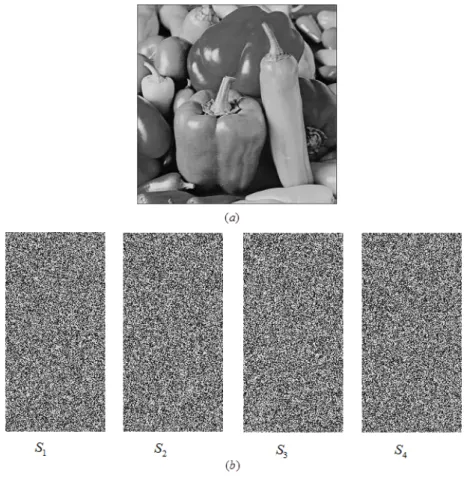
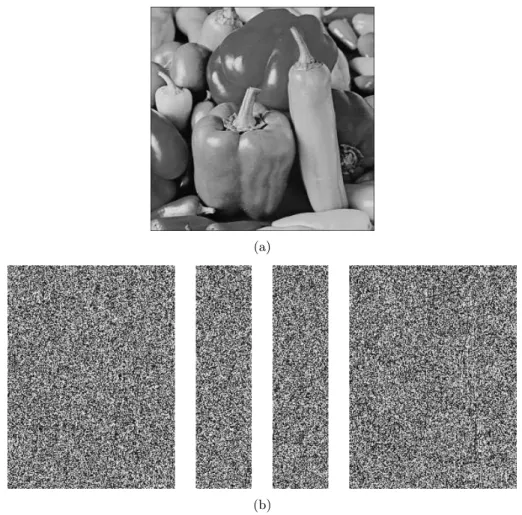
To illustrate Algorithm 1, we design a(2,4)threshold secret image sharing scheme. The secret image S is chosen as a256×256pixels Pepper image shown in Figure1 (a). To construct the shadow images, we choose relatively prime four polynomialsq1=x4+ 85x2+ 4x+ 23,q2=x4+ 54x3+ 99x2+ 27x+ 105,
q3 = 23x4+ 81x3+ 201x2+ 153x+ 83, q4=x4+x3+ 81x2+ 103 where the conditionα= 4< β = 8
is satisfied. We take s= 8so that the size of the shadow images are1/2 of the size of the secret image since division of each si(x)corresponding to 8 pixels, byqj(x)gives us a remainder polynomial of degree
3, corresponding to 4 pixels. The shadow images S1, S2, S3, S4 with respect to the secret image S are
illustrated in Figure 1 (b).
Figure 1: (a)256×256Secret ImageS; (b)128×256Shadow ImagesS1, S2, S3, S4
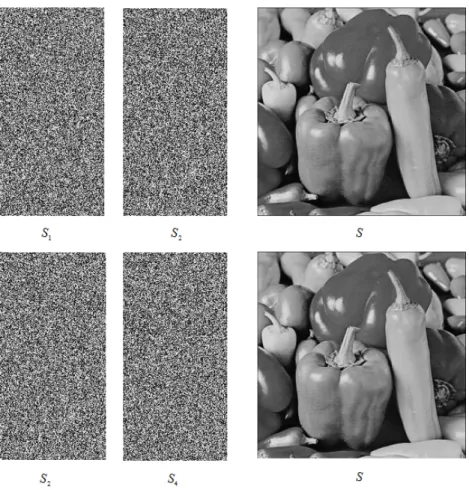
To recover the secret image, a combination of any2participants having shadow images is sufficient. This reconstruction is illustrated in Figure 2.
Note that, for (k, n) threshold secret image sharing, if we take the degrees of each polynomial qi
as m and degree of secret polynomial km−1, the size of each shadow image is one-kth of the size of secret image as the construction of Thien and Lin [17]. Further, recently an image sharing method that avoids permutation is introduced in [18]. Our method also differs and presents a more applicable nature compared to [18]. In [18], the shares distributed to the holders are each of sizes256×256. In our method, the sizes are128×256which gives a storage advantage.
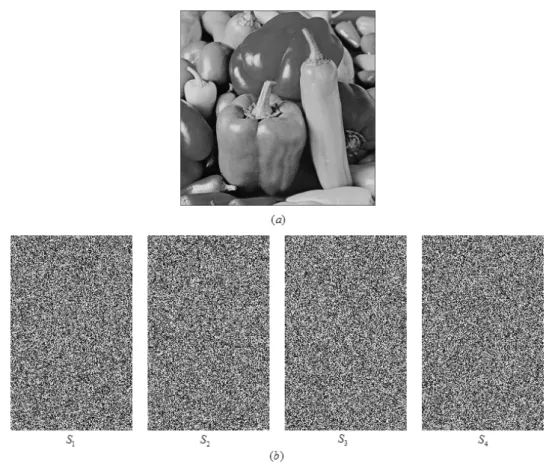
We present another illustrative example to show how we can control the size of shares using the same
Figure 2: Some Examples of Reconstruction
117x2+ 114x+ 11, q
3=x5+ 151x4+ 175x3+ 21x2+ 173x+ 39, q4=x5+ 151x4+ 48x3+ 13x2+ 164x+ 145,
we obtain the shadow images of size160×256(Figure3). Also, the size of the shadow images would be
196×256if the irreducible polynomials were chosen of degree 6.
6.
Security analysis
In this section, we show that anyk−1or fewer shadow images cannot reconstructm×rsecret image S. Without loss of generality, suppose that lastk−1participants come together to reconstruct the secret imageS and that assuming they know how to read the pixels of shadow images. Assume that they want to reconstruct the first partition of the secret image, without loss of generality, they first generate the shadow polynomials v1,n−k+2, v1,n−k+3, . . . , v1,n by using the first partitions of the shadow images and
the secret polynomialr1(x)corresponding to these shadow polynomials is computed by using CRT such
thatdeg (r1(x))< αwhereα= deg (qn−k+2qn−k+3. . . qn). Assume thatr1(x)has the maximum degree,
i.e., deg (r1(x)) =α−1and secret polynomial of the first partition of secret images1(x)has minimum
degree, i.e., deg (s1(x)) = α+ 1. It is easily seen that s1(x) = r1(x) +γ1(x) (qn−k+2qn−k+3· · ·qn)
(mod p) for some γ1(x)∈ GF(p), wherep is either 251, 256 or 257. This means that the probability
of finding the right polynomial is 1/p2 at the best. Since, the secret image S has m×r/s partitions,
the probability of reconstruction the right image is 1/p2m×r/s at the best. For the given example, the
probability of obtaining the right image is 25114 256×32
≈ 1 2
261212
Figure 3: (a)256×256Secret ImageS; (b)160×256Shadow ImagesS1, S2, S3, S4
person who wants to reconstruct the secret image knows the size of partition of shadow images and secret image. If an unauthorized person does not hold into this information, then the problem becomes more infeasible to solve.
It is clear that, as a special case of our construction, if we choose the degrees of polynomialsqiasm
and the secret polynomial km−1, then our construction and [17] have the same security level.
We present some results of another example where the secret image S is chosen as a 512×512
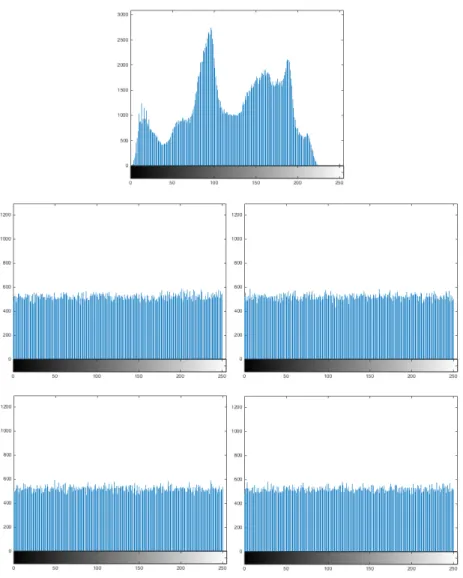
pixels Pepper image. The histograms of the original picture and the shares are provided in Figure 4. It is observed that the shares have a very uniform histograms. We would like to point out that getting uniformly distributed encrypted images is a problem by itself and some other techniques besides are used in order to be successful ([7, 15]). Here, we do not employ additional tools in order to get this achievement.
Also we have computed the entropy of the original image and the sharesS1,S2,S3andS4as 7.5937,
Figure 4: Histogram of512×512 Original Image (OI); Histograms of256×512 Shadow Images S1, S2, S3, S4respectively
Share Images SSIM
S1andS2 −2.6959×10−04
S1andS3 −3.2801×10−04
S1andS4 −7.0751×10−05
S2andS3 2.7211×10−04
S2andS4 5.2297×10−04
S3andS4 5.2318×10−04
Table 1: SSIM of shares and the original image.
Figure 5: Elapsed time of secret sharing process over the various fields
Table 2: Comparison of Secret Image Sharing Methods
SIS Entropy Size Needing
S1 S2 S3 S4
SC 7.8942 7.8942 7.8942 7.8942 256×512PRN Padding TL 7.9080 7.9655 7.9624 7.9696 256×512 Permutation OTS 7.9700 7.9700 7.9701 7.970 256×512 No Need
other two prime fields and algorithms are faster compared to the extension fieldGF(256).
7.
A comparison with other schemes
We show the efficiency of our scheme (OTS) by comparing it with the threshold secret image sharing (SIS) schemes introduced in [13] (SC) and [17] (TL). The entropies and sizes of shadow images are given in Table2. The entropies of shadow images constructed by our scheme are closer to8which indicates the reliable security of the system, despite our scheme does not need any permutation or random numbers padding. Without applying a permutation, the original image is still perceptible by naked eye after (2,4) secret image sharing using the scheme of [17]. We also derive the same security level with [17] without using a permutation which is also required to be shared as a secret. The sizes of the shadow images are all half of the size of the original image for given applications. However, as distinct from others, the sizes of the shadow images can differ in our scheme. Further, by waiving the scheme to be threshold, we can improve the flexibility of the system and discriminate the participants for authorization as shown in the next illustrative example. By choosing four irreducible polynomialsq1=x6+10x5+75x4+23x3+64x+3,
q2= 5x2+ 3,q3= 215x2+ 157andq4=x6+ 101x5+ 250x4+ 123x3+ 99x+ 231, we obtain the shadow
images of sizes 196×256, 64×256, 64×256 and 196×256 respectively (Figure 6). Also, a shadow image would be of size160×256for an irreducible polynomial of degree 5 or96×256for an irreducible polynomial of degree3. The shadow imagesS2andS3cannot reconstruct the secret imageS, for instance.
On the other hand, the scheme given in [13] is not as flexible as our scheme. For instance,512×512
pixels gray color image forces us to choosedas a power of 2 and henceqis which are smaller than255as
(a)
(b)
Figure 6: Secret ImageS (a) and Shadow ImagesS1of size 196×256,S2 of size64×256,S3 of size
64×256andS4of size 196×256 respectively (b)
so independent for a secret image sharing since the pixel values of an image are determined in a fixed spectrum. Further, the histograms of shadow images may give an information about qis.
8.
Conclusion
of such polynomials to be applied. Here, we do not impose such a restriction which makes the scheme more practical and secure. We finally realize our proposed method over an example which illustrates the new algorithm.
References
[1] C. Asmuth, J. Bloom, A modular approach to key safeguarding, IEEE Trans. Inform. Theory 29(2) (1983) 208–210.
[2] G. R. Blakley, Safeguarding cryptographic keys, Proc. Am. Federation of Information Processing Soc. (AFIPS’79) National Computer Conf. 48 (1979) 313–317.
[3] P. Dingyi, S. Arto, D. Cunsheng, Chinese Remainder Theorem: Applications in Computing, Cod-ing,Cryptography, World Scientific, 1996.
[4] T. Hungerford, Abstract Algebra: An Introduction, Cengage Learning, Boston, 2012.
[5] S. Iftene, General secret sharing based on the Chinese Remainder Theorem with applications in E–Voting, Electronic Notes in Theoretical Computer Science 186 (2007) 67–84.
[6] E. V. Krishnamurthy, Error–Free Polynomial Matrix Computations, Springer Science and Business Media, New York, 2012.
[7] J. B. Lima, R. M. Campello de Souza, Histogram uniformization for digital image encryption, 25th SIBGRAPI Conference on Graphics, Patterns and Images (2012) 55–62.
[8] P. K. Meher, J. C. Patra, A new approach to secure distributed storage, sharing and dissemination of digital image, IEEE International Symposium on Circuits and Systems (2006) 373-376.
[9] M. Mignotte, How to share a secret,In: Cryptography, EUROCRYPT 1982, Lecture Notes in Com-puter Science 149 (1983) 371–375.
[10] M. Naor, A. Shamir, Visual cryptography, In: Advances in Cryptology–EUROCRYPT 1994, Lecture Notes in Computer Science 950 (1994) 1–12.
[11] O. Ore, The general Chinese remainder theorem, The American Mathematical Monthly 59(6) (1952) 365–370.
[12] A. Shamir, How to share a secret, Comm. ACM 22(11) (1979) 612–613.
[13] S. J. Shyu, Y. R. Chen, Threshold secret image sharing by Chinese remainder theorem,IEEE Asia– Pacific Services Computing Conference (2008) 1332–1337.
[14] D. R. Stinson, An explication of secret sharing schemes, Des. Codes Cryptogr. 2(4) (1992) 357–390.
[15] S. Somaraj, M. A. Hussain, Performance and Security Analysis for Image Encryption using Key Image, Indian Journal of Science and Technology 8(35) (2015).
[16] G. Tatyana, M. Genadii, Generalized Mignotte’s sequences over polynomial rings, Electronic Notes in Theoretical Computer Science 186 (2007) 43–48.
[17] C. C. Thien, J. C. Lin, Secret image sharing, Comput. Graph. 26(5) (2002) 765–770.
[18] G. Ulutas, M. Ulutas, V. Nabiyev, Secret sharing scheme based on Mignotte’s scheme, 2011 IEEE 19th Signal Processing and Communications Applications Conference (2011) 291–294.
[19] R. Z. Wang, C. H. Su, Secret image sharing with smaller shadow images,Pattern Recognition Lett. 27(6) (2006) 551–555.