Mrs. Jiji Bapu Yelam et al JMSCR Volume 08 Issue 02 February 2020 Page 907
Original Article
Study to Assess the Effectiveness of Video Assisted Teaching Programme on
Knowledge and Practice Regarding Kangaroo Mother Care among Primi
Postnatal Mothers
Authors
Mrs. Jiji Bapu Yelam M.Sc.(Nursing)
1, Dr Bapu Yelam,M.D.
2*,
Mrs. Wincy.C,MSc.(Nursing)
3, Mrs. Tresa Thomas Francis, M.Sc.(Nursing)
4,
Mrs. Shincy Jenson, M.Sc.(Nursing)
51
Tutor, Kuwar Tilak Singh General Hospital, Nursing College, Gondia, Maharashtra, India
2
Assistant Professor, Dept of Paediatrics, Govt Medical College, Nagpur, Maharashtra, India 440003
3
Associate Professor, Dept of Child Health Nursing, RITEE College Of Nursing Raipur (C.G)India
4
Nursing Educator, Wokhard Hospital, Nagpur, Maharashtra, India
5
Infection Control Nurse (ICN),Orange City Hospital, Nagpur, Maharashtra, India. *Corresponding Author
Dr Bapu Yelam, M.D
Assistant Professor, Dept of Paediatrics, Govt medical college, Nagpur, Maharashtra, India 440003
Abstract
Introduction: Around 70% neonatal deaths occur in low birth weight and preterm babies. Most studies demonstrated kangaroo mother care to be more effective than incubator care for these neonates but there are limited studies and practices in India. Therefore, the main aim of the study was to assess the acceptability, knowledge, attitude and practice of kangaroo mother care in public health.
Objectives of the Study: To assess the Pre and post test knowledge and practice level of experimental group Primi postnatal mothers regarding kangaroo mother care. To evaluate the effectiveness of video assisted teaching programme on knowledge and practice regarding kangaroo mother care.
Methodology: The conceptual frame work adopted this studies based on Kurt Lewin’s theory. A quasi experimental non randomized control group design was adopted for this study. A quantitative research approach is used. The tool was valid and reliable. Pilot and main study was conducted by using knowledge questionnaire and observation checklist for assessing the practice .the sample size was 30 primi postnatal mothers, the data was collected before and after administration of video assisted teaching programme related to Kangaroo Mother Care . The tool used for data collection consisted of self structured multiple choice questionnaire. Data collection was analyzed by using descriptive and inferential statistics, significance of association was calculated by chi-square test and difference of mean knowledge score was calculated by Paired t- test.
Result: The study reveals that the video assisted teaching Programme is highly effective in improving the Knowledge and practice regarding Kangaroo Mother Care among Primi postnatal Mothers. The mean post test knowledge score was 25.8 was higher than mean pretest knowledge score 14.3,and the mean post test practice score was 18.7 which was higher than the mean post test practice score16.7.The calculated
http://jmscr.igmpublication.org/home/ ISSN (e)-2347-176x ISSN (p) 2455-0450
Mrs. Jiji Bapu Yelam et al JMSCR Volume 08 Issue 02 February 2020 Page 908
‘p’ value for knowledge is 19.82 and for practice is 4.6 which is greater than tabulated value at (p>0.05) level. So it is found to be significant at (p=0.05) level. This indicates that the video assisted teaching Programme was highly effective in increasing the level of knowledge and practice in post test on KMC among Primi mothers in selected hospitals at Raipur.
Conclusion: The present study to assess the effectiveness of video assisted teaching Programme on knowledge and practice regarding Kangaroo Mother Care among Primi Mothers. The result of the study concluded that the video assisted teaching Programme was effective in improving the knowledge and practice of Kangaroo Mother Care among primi postnatal mothers.
Keyword: Knowledge, Practice, Video Assisted Teaching Programme, Kangaroo Mother Care.
Introduction
Kangaroo mother care has often been used as a treatment for premature or preterm babies. As the 21st century is in the threshold of challenging preventive healthy interventions, the evidence based practice of newborn care must be efficiently adopted for applying in the operational milieu of rural care facilities and the awareness on KMC should be taught , among the expected mothers in all country wide, perinatal-neonatal care units[1,2]. In 1979, Dr. Martinoz and Rey of the maternal and child institute in Bogota, Colombia developed a simple method for care of Low Birth Weight infants called “The Kangaroo Mother Care (KMC)” to overcome the inadequacies of the neonatal care in developing countries[3]. Kangaroo mother care (KMC) is an evidence-based approach to reducing mortality and morbidity in preterm infants. It is a method of care of preterm and low birth weight infants. It is defined as a method of holding a small nappy neonate in skin-to skin contact (STS), prone and upright on the maternal chest. The neonate is enclosed in maternal clothing in order to maintain temperature stability (Charpak, Ruiz, Zupan, Cattaneo, Figueroa, et al. 2005)[4]. Although it was initially developed for use with preterm and low birth weight babies, it is beneficial for all babies as constant contact with their mothers and her warmth, breast milk, love and protection are the entire basic requirement needed for their wellbeing and survival (W.H.O, 2003)[5]. There is evidence that Kangaroo Mother Care (KMC), when compared to conventional neonatal care in resource-limited settings, significantly reduces the risk of mortality in infants weighing less than
2000g. KMC also reduces the risk of hypothermia, severe illness, nosocomial infection and length of hospital stay (Lawn, 2010)[6]. Low birth weight and prematurity are strongly associated with neonatal morbidities and mortality (UNICEF 2017) [7]. Many Mothers in India does not know how to practice Kangaroo Mother Care on their low birth weight babies and hence they do not practice also.
Objectives
To assess the pre and post test knowledge and practice level of control group Primi postnatal mothers regarding kangaroo mother care.
To assess the Pre and post test knowledge and practice level of experimental group Primi postnatal mothers regarding kangaroo mother care.
To evaluate the effectiveness of video assisted teaching programme on knowledge and practice regarding kangaroo mother care.
Hypothesis
There is a significant enhancement in the post test knowledge and practice level of experimental group Primi Post Natal Mothers regarding kangaroo mother care.
Mrs. Jiji Bapu Yelam et al JMSCR Volume 08 Issue 02 February 2020 Page 909
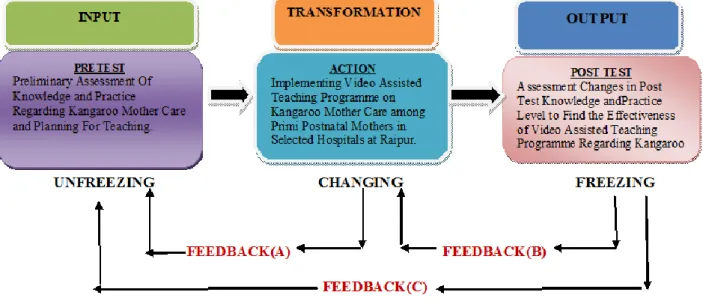
Figure No: 1 Kurt Lewins Procee Of Change Through Action Model(1958)
Mrs. Jiji Bapu Yelam et al JMSCR Volume 08 Issue 02 February 2020 Page 910
Sampling Criteria
In sampling criteria the researcher specifies the characteristic of the population under the study by dealing the inclusive and exclusive criteria are characteristics that each sample elements must possess to be including in the sample.
Inclusion Criteria
Primi postnatal Mothers from selected hospitals of Raipur.
Primi postnatal Mothers those who have low birth weight newborn babies.
Primi postnatal Mothers between the age group of 20-40 years
Exclusion Criteria
Multi Mothers of the Hospitals
Primi Postnatal mothers not admitted in the selected hospitals at present.
Primi Postnatal Mothers those who are not willing to participate.
Description of the Tool
Self structure questionnaire was developed to assess the effectiveness of Video Assisted Teaching Programme on Kangaroo Mother Care among Primi Postnatal Mothers.
Self- structured questionnaire consist of two sections-
Section I: It consists of sample characteristics (Demographic Variables.)
Section II: It consists of structured knowledge questionnaire regarding Kangaroo Mother Care among Primi Postnatal Mothers.
Section III: It consists of structured Practice questionnaire regarding Kangaroo Mother Care among Primi Postnatal Mothers.
Section-I: This section consisted of 09 items obtaining information regarding subjects age in years, occupation, religion, education status, types of family, marital status, no. of children, monthly income, and sources of information.
Section-II: This section consist of 28 multiple choice questions covering of introduction, definition, Indication, aim, benefits for mother and child and importance of Kangaroo Mother care to assess the knowledge of Primi Postnatal Mothers with a maximum score of 28 and the entire question has 4 options where as one will be the correct answer and other three will be the wrong answers. Each correct answer score ‘1’ mark and incorrect answer scores ‘0’ mark
Section-III: This section consist of 22 closed ended questions covering practice regarding Kangaroo Mother Care, with a maximum score of 22 and the entire question has 2 options where as one will be the correct answer and other three will be the wrong answers. Each correct answer score ‘1’ mark and incorrect answer scores ‘0’ mark.
Criterion Measures: The multiple choice question were used to assess the knowledge and practice of Primi Postnatal Mothers regarding Kangaroo Mother Care, the assessment of knowledge and practice will be identified through following scale
-According to arbitrary manner scoring for all knowledge questionnaire have done,
Score interpretation Total 28 Minimum Score: 0, Maximum Score:
Criterion Measures of Knowledge Score
LEVEL OF KNOWLEDGE KNOWLEDGE % KNOWLEDGE SCORE
POOR <_35% 0-10
AVERAGE 36%-60% 11 to 17
GOOD 61%-75% 18 to 21
EXCELLENT 76%-100% 22 to 28
Criterion Measures of Practice Score
Score interpretation Total 22 Minimum Score: 0, Maximum Score: 1
LEVEL OF KNOWLEDGE PRACTICE % PRACTICE SCORE
POOR <_35% 0- 8
AVERAGE 36%-60% 9 to 13
GOOD 61%-75% 14 to 17
Mrs. Jiji Bapu Yelam et al JMSCR Volume 08 Issue 02 February 2020 Page 911
Data Analysis, Interpretation: Analysis and interpretation was done as per the objectives of the study and the hypothesis formulated. Descriptive and inferential statistics were used for
the analysis of the data. The data and finding have been organized and presented under the following sections.
Table 1: Percentage and Frequency distribution of Primi Postnatal Mothers according to socio demographic variables N=60(30+30)
S.NO DEMOGRAPHIC
VARIABLE
EXPERIMENTAL GROUP CONTROL GROUP
FREQUENCY PERCENTAGE FREQUENCY PERCENTAGE
1 AGE
20-25 10 33.3 12 40
26-30 16 53.3 12 40
31-35 3 10.0 3 10
36-40 1 3.3 3 10
2 RELIGION
HINDU 13 43.3 11 36.6
CHRISTIAN 5 16.7 5 16.6
MUSLIM 6 20.0 8 26.6
OTHER 6 20.0 6 20
3 EDUCATION
PRIMARY 5 16.7 7 23.3
SECONDARY 14 46.7 11 36.6
GRADUATE 7 23.3 8 26.6
POST-GRAD 4 13.3 4 13.3
4 OCCUPATION
HOUSE WIFE 19 63.3 17 56.6
SELF EMPLOYEE 4 13.3 4 13.3
PRIVATE EMPLOYEE 5 16.7 7 23.3
GOVT.EMPLOYEE 2 6.7 2 6.6
5 AREA OF RESIDENCE
URBAN 16 53.3 18 60
RURAL 14 46.7 12 40
6 MONTHLY INCOME
LESS THAN5000 4 13.3 2 6.6
5000-7000 4 13.3 2 6.6
7000-9000 6 20.0 10 33.3
ABOVE 9000 16 53.3 16 53.3
7 TYPE OF FAMILY
JOIN 11 36.7 10 33.3
NUCLEAR 15 50.0 17 56.6
EXTENDED 4 13.3 3 10
8
MARITAL DURATION INYEARS
1to2 12 40.0 19 63.3
3 to 4 10 33.3 8 26.6
5 to6 5 16.7 3 10
ABOVE 6 3 10.0 0 0
9
SPECIFY SOURCE OF INFORMATION
FAMILY MEMBERS 6 20.0 4 13.3
FRIENDS 7 23.3 9 30
HEALTH PERSONNEL 11 36.7 12 40
MASS MEDIA 6 20.0 5 16.6
Table 1:Shows the demographic information of Primi Postnatal Mothers.
Section I
Objective: 1(a). Analysis of the overall pretest and post test knowledge and practice level regarding Kangaroo mother Care among Primi
Mrs. Jiji Bapu Yelam et al JMSCR Volume 08 Issue 02 February 2020 Page 912
Table-2 Frequency and percentage distribution of pre and post test knowledge of experimental g r o u p .
N=30
CATEGORY PRETEST POST TEST
Frequency Percentage Frequency Percentage
EXCELLENT 1 3% 30 100%
GOOD 3 10% 0 0%
AVERAGE 23 77% 0 0%
POOR 3 10% 0 0%
Table-3 Frequency and percentage distribution of overall pre and post test practice of experimental group.
N =30
S.NO CATEGARY PRETEST POST TEST
Frequency Percentage Frequency Percentage
1 EXCELLENT 0 0% 17 57%
2 GOOD 24 80% 11 37%
3 AVERAGE 6 20% 1 3%
4 POOR 0 0% 1 3%
a) Analysis of overall pretest post test knowledge of control group regarding Kangaroo Mother Care.
Table No 4 Difference in Pretest & Post test knowledge score of Control Group regarding Kangaroo Mother
Care among Primi Postnatal Mothers. N=30
S.NO CATEGARY PRETEST POST TEST
Frequency Percentage Frequency Percentage
1 EXCELLENT 1 3% 1 3%
2 GOOD 1 3% 1 3%
3 AVERAGE 21 70% 21 70%
4 POOR 7 24% 7 24%
b)Analysis of overall pretest post test practice of control group regarding Kangaroo Mother Care.
Table No 5 Difference in Pretest & Post test practice score of Control Group regarding Kangaroo Mother Care among Postnatal Primi Mothers N = 30
S.NO Practice level PRETEST POST TEST
Frequency Percentage Frequency Percentage
1 EXCELLENT 1 3% 1 3%
2 GOOD 10 33% 10 33%
3 AVERAGE 17 57% 17 57%
4 POOR 2 7% 2 7%
Section-II
Analysis of difference in the pre and post test knowledge and practice level of control and experimental group Primi Postnsatal Mothers regarding Kangaroo Mother Care.
Table No. 6 Mean score, mean score percentage, and Standard deviation of knowledge level.
N= 60
GROUP KNOWL EDGE SCORE
Mean score
Mean percentage
Mean difference
Standard deviation
Paired t value
Inference
CONTROL Pretest 12.8 42.8%
4.34%
3.39
4.83
P<0.05 Not significant Post-test 13.2 47.14% 0.91
EXPERIMENT AL
Pretest 14.3 51.07%
41.07%
3.23
1.93
Mrs. Jiji Bapu Yelam et al JMSCR Volume 08 Issue 02 February 2020 Page 913
Table No 7 Mean score, mean score percentage, and Standard deviation of practice level
Group PRACTIC
E SCORE Mean score Mean percentage Mean difference Standard deviation Paired t value Inference
Control Pretest 12.57 57.13%
0.27% 2.41 4.35 P<0.05 Not significant
Post-test 12.63 57.40% 1.99
Experimental Pretest 16.7 75.90%
23.1%
2.23
-0.18
p>0.05 significant
Post-test 22.7 99% 2.00
Section III
Analysis of effectiveness of video assisted teaching programme in improving knowledge and practice regarding Kangaroo Mother Care among Primi Postnatal Mothers.
Table no 8. Paired t test value shows theEffectiveness of video assisted teaching programme in improving post test knowledge level of experimental group.
Post Test Knowledge Level Mean score Mean percentage Mean difference Standard deviation Paired t’ value Inference
Control Group 13.2 47.14%
45%
0.91
1.05
p>0.05 significant
Experimental Group 25.8 92.14% 1.61
Table no 9 Effectiveness of video assisted teaching programme in improving post test practice level of experimental group.
Post Test Practice
Level Mean score Mean percentage Mean difference Standard deviation Paired ‘t’Value Inference
Control Group 12.63 57.40%
42%
1.99
1.80
p>0.05 significant
Experimental Group 22.7 99% 2.00
Results and Discussion
Not many studies reported the video assisted teaching programme on knowledge and practice regarding Kangaroo Mother Care among Primi Postnatal Mothers. Occurrence of neonatal problems in new born can be avoided if the mothers who are handling the babies need to have adequate knowledge and practice regarding Kangaroo Mother Care. Table 1 shows that percentage and frequency distribution of primi postnatal mothers according to sociodemographic variables such as age, religion, education, occupation, area of residence, monthly income, type of family, marital duration in years and source of information. Table 2 shows that frequency and percentage distribution of pre and post test knowledge of experimental group was average (77%) in pretest as compared to excellent in (100%) post test group. Table 3 shows that frequency and percentage distribution of overall pre and post test practice of experimental group was excellent in (57%) in post test as compared to only (80%) in pretest mothers were good but
Mrs. Jiji Bapu Yelam et al JMSCR Volume 08 Issue 02 February 2020 Page 914 effectiveness of Kangaroo mother care among
mothers of hospitalized new born in Chennai, India. Showed that, 80.0% had inadequate knowledge about KMC. In another study by Abdel (2012) in the rural centre of India revealed that, 65% of mothers had inadequate knowledge on KMC. Another research conducted by Herdberg (2011) [10] in Sweden among mothers by staff in the neonatal unit showed positive impact of Kangaroo Mother Care in the management of prematurity and low birth weight infants with 62% effectiveness.
Findings revealed that mean post test knowledge score 25.08 was significantly higher than pre Test knowledge score 14.3, and the mean post test practice score 18.7 was significantly higher than pre test practice 16.7thus the finding reveals there has been significance enhancement in Knowledge and Practice of Primi Mothers, regarding Kangaroo Mother Care, after administrating video assisted teaching Programme of Kangaroo Mother Care in Primi Post natal mothers.
Conclusion
The present study to Assess The Effectiveness Of Video Assisted Teaching Programme On Knowledge And Practice Regarding Kangaroo Mother Care Among Primi Mothers. The result of the study concluded that the video assisted teaching Programme was effective in improving the knowledge and practice of Kangaroo Mother Care among primi postnatal mothers.
Funding: No funding sources.
Conflict of interest: None declared.
Ethical approval: The study was approved by the Institutional Ethical Committee.
References
1. Meharban Sing.Care of the newborn.6th edition sagar publications, New Delhi, 2004,146-193.
2. Huckleberry. Nursing care of infants and children.7th edition, Elsevier Publications, New Delhi, 2003,362-368.s
3. WHO. Kangaroo mother care:A practical guide,Geneva;2003.
4. Charpak N, Ruizm JG, Zupan J, Cattaneo A, Figueroa Z, et al. Kangaroo mother care: 25 years after. Acta paediatr. 2005; 94:514-522.
5. WHO Kangaroo mother care: A practical guide, Geneva, Switzerlan, 2003.
6. Lawn JE, Mwansa K, Barros FC, Horta BL, Causena S. Kangaroo mother care to prevent neonatal death due to pretern birth complications. International J Epidemiol. 2010; 39:1144-1154.
7. UNICEF. World Data Atlas.
https://knoema.com
/atlas/Nigeria/Neonatal-mortality-rate, 2017.
8. Solomon N, Rosant C. Knowledge and attitudes of nursing staff and mothers towards kangaroo mother care services in Mlawi. MCHIP, 2012.
9. Geetha S, Hemavalthy V. Effectiveness of Kangaroo mother care among the mothers of hospitalized newborn, 2015.