English Education: Jurnal Tadris Bahasa Inggris, 11 (1), 2018, 128
IMPROVING THE STUDENTS’ DESCRIPTIVE TEXT
WRITING ABILITY THROUGH
THE IMPLEMENTATION OF CLUSTERING
TECHNIQUE AT THE TENTH GRADE OF MAN 1
METRO
Dian Reftya Wati
Lecturer of English Education Department at STKIP PGRI Metro
Abstract. The aim of teaching foreign language is defined in terms of four
skills, there are listening, speaking, reading, and writing. It clearly shows that the purpose of teaching English is enabling the students to master the four skills. Writing as one of four skill is often ignored, this may be do to a number of factors, such as time consuming of correcting, low motivation, limited time to study writing and lack of teaching technique used. These factors make the English teacher mostly neglect to teach writing. The objective of this research were to know whether clustering technique develops students descriptive text writing ability, teacher’s performance, and students’ participation during teaching learning process at the tenth grade of MAN 1 Metro. To see the teacher’s performance and students’ participation (learning process), the qualitative data was used (questionnaire and observation sheet). Meanwhile, quantitative data (students’ score) was used to know students ability in writing descriptive text (learning product). This research was conducted at MAN 1 Metro. The subject of the research was students of class X.B in academic year 2010/2011. This classroom action research (CAR) was done in three cycles. Each cycle consisted of plan, action, observation, and reflection. The indicators of this research success are if the teacher got minimum 65% from the observation sheet result, 100% students were active during teaching learning process, and 80% students gain score 65 or more. Referring to the research, it can be said that clustering technique can increase students’ descriptive text writing ability, teacher’s performance, and students’ participation during teaching learning process.
A. INTRODUCTION
Writing is a productive skill in the written mode. It is more complicated than it
seems at first, and often seems to be the hardest of the skills, even for native
speakers of a language. This happens because writing involves not just graphic
representation of speech, but the development and presentation of thoughts in a
structured way. Murcia (2000:161) states that writing skill is often perceived as
the most difficult skill since it requires a higher level of productive language
control than other skills. It is no wonder that EFL students think that writing is a
difficult skill to be mastered because it requires many aspects of language in this
production such as organization, content, language use, mechanic and vocabulary.
Moreover, writing is a complex process and commonly difficult for most people.
In fact, this object is very hard to achieve. Most of the students’ skill are far a way
from their laerning target, because the students know or have the ideas what they
are going to write but they do not know how to put them into words. They cannot
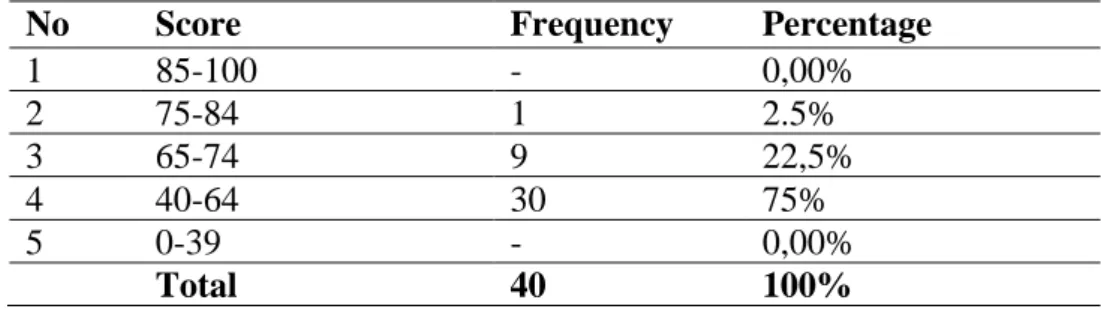
build a good sentence. The following is students’ test result of descriptive text at
class X.A MAN 1 Metro.
Table 1: Students’ Writing Score of Descriptive Text
Based on the experience and the result of descriptive text writing test, during
teaching learning process happened at the tenth grade students of MAN 1 Metro,
the researcher who is also the english teacher of the class, show that many
students could not express their ideas in written form althrough they might know
No Score Frequency Percentage
1 85-100 - 0,00%
2 75-84 1 2.5%
3 65-74 9 22,5%
4 40-64 30 75%
5 0-39 - 0,00%
English Education: Jurnal Tadris Bahasa Inggris, 11 (1), 2018, 130
what would be written. They still could not understand or create a descriptive text
althrough the teacher had explained it. They were still found some grammar
mistakes or inappropriate vocabulary use. Most of students were not able to
construct sentence in present form. Furthermore, they were not active during
teaching learning process.
Considering to the importance of descriptive text for the students to master, it is
very important for the teacher to apply the best way to make the students aware on
the use of the text in their daily lives. Based on the reason above, the researcher
conducted classroom action research with clustering technique to improve the
students’ descriptive text writing ability. Clustering is a type of prewriting that
allows you to explore many ideas as soon as they occur to you. Like
brainstorming or free associating, clustering allows you to begin without clear
ideas.
In reference to the background of the problem above, the writer tries to state the
problem raise of this research as follow: “Can writing using clustering technique
improves teacher performance, students’ ability, and students’ participation in
writing descriptive text at tenth grade of MAN 1 Metro?”
Concept of Writing
According to Siahaan (2008:214) states that language is a set of rules that is used
by native speakers as the tool of their communication. It means that language is
very important role in human’s life for communication. This happens because
writing involves not just graphic representation of speech, but the development
and presentation of thoughts in a structured way.
Start that writing is a language skill that is used for indirect communication. The
students can communicate their ideals and thought to others through a written
form such as letter, massage, or invitation for communication. It is also important
that communication will be successful if the reader understands what the massage
language in order that people can understand it. Writing is sometimes used as a
production mode for learning, reinforcing, or testing grammatical concepts.
(Brown, 2001:344).
In short, writing is an activity of using language in written consisting of a
sentence or clause or even only a phrase to express thoughts to the reader in a
written form so that it will be easily understood by the reader.
Components of Writing
To assess and evaluate students writing, there are many scoring rubrics that
proposed by many experts one of the most widely used analytical scales for ESL
writing is the composition profile in Testing ESL Writing (Jacobs in Reid).
According to Smith in Reid (1993: 246) there are some criteria for good writing
namely: (1) content, (2) organization (3) style (4) correctness. In line with Jacobs
scoring rubric, Harris (1995:68-69) said there are five general components in
writing, such as content, organization, vocabulary, grammar, and mechanic.
Teaching Writing
According to Graves (1996:120) states that writing reinforces listening and
speaking, and very commonly. However Teaching writing is not similar with
teaching speaking because both of the activities are different. In speaking, the
speaker can express their mind orally and the result can be evaluated directly by
the reader. While in writing, the writer might have enough time to express the idea
in written form.
Furthermore, there is certain particular consideration that needs to be taken into
account, such as sentence organization, paragraph, arrangement, and coherence.
Teaching writing means that teaching language ability and organization of ideas.
More specifically it is said that teaching writing requires the elements of writing
including grammar, sentence, organization, vocabulary, and mechanic in order
words, teaching writing guides the students not only to write sentence in text but
English Education: Jurnal Tadris Bahasa Inggris, 11 (1), 2018, 132
Descriptive Text
The subject being described is explained as clearly as possible to make the readers
or listeners able to see or imagine the subject in their mind clearly as the author
sees in his/hers. For instance, a student wants to describe his sister to his new
friend. In his mind, he has a very clear picture of his sister, including the pointed
nose and the happy chuckle of her laugh. His friend however has no past image of
his sister. He or she must rely on his words. His goal, then, is to use enough
carefully chosen, specific details in his description so that his friend could pick his
sister out of a group of people.
Social function or communicative approach of descriptive text is to describe a
particular person, place, or thing in detail or clearly. To achieve the purpose, the
descriptive text will move through a different set of stages:
Identification : mention the special participant
Description : mention the part, quality, and characteristics of subject being
Described.
Clustering Technique
As the study of language teaching method and procedure, they are some different
ways between an approach, a method, and technique. An approach is a set of
correlative assumptions dealing with the nature of language teaching and learning.
Ma’mur (2003:116) defines a method is an overall plan for the orderly
presentation of language material. A technique is implementation that when
actually takes place in classroom. It means that approach is the level at which
assumption and beliefs about language teaching, method is the level procedural, a
technique is implementation many method in classroom. Within one approach,
there can be many methods, and the technique must be consistent with a method.
Speech has complex sentences with simple words, while writing has complex
language, due to memory limitations and our predisposition for “chunking’ or
clustering and break down speech into smaller groups of words.
Clustering is a type of prewriting that allows you to explore many ideas as soon as
they occur to you. Like brainstorming or free associating, clustering allows you to
begin without clear ideas.
The writing levels are broken into three more general levels: beginning,
intermediate, and advanced. All levels are encouraged to use prewriting
techniques (such as brainstorming, clustering, outlining, pre discussion of topic,
pre reading, analysis of models), to determine audience and purpose in writing, to
revise and to incorporate the use of dialogue journals (Reid, 1993:102).
Pre-writing, “pre” means before: pre-writing means the work done by the
writer before the paragraph is actually written. It means there are several steps
in pre-writing, include: choose the subject or the topic, choose an audience,
decide on a purpose.
Writing / Drafting: in addition to meeting the requirements for the beginning
level student
Post-writing: the student will be able to identify and mark written errors in
sentences and paragraphs.
B. RESEARCH METHOD
1. Classroom action research
The research uses the classroom action research because the researcher is the
teacher in the class. Therefore, the action research can be done exactly. According
to Thomas A Angelo, classroom action research is the patient, systematic study of
students learning by disciplinary faculty in their classrooms. It is aimed at the
producing insights and understanding that can improve teaching and learning
(Suratinah, 2007:2.3). Depend on David Hopkins; classroom action research is a
English Education: Jurnal Tadris Bahasa Inggris, 11 (1), 2018, 134
for the purpose of improving their teaching and quality of education in their
school.
2. The steps in the research
Implementation of Action
Observing / Data Collecting Method I C Y C L E 1 Reflection
Using observasion sheet
u
n
s
u
c
c
e
s
s
f
u
l
CYCLE IIIdentification of the problems from the result of reflection 1
Planning
Prepare plane in the second cycle, materi, evaluation, fprmat observation
by clustering technique.
Pelaksanaan Tindakan
Observing / Data Collecting Method II
S U C C E E D R E S U L T Action activities: Pre-writing:
1.greeting, prays, absent the students 2.choose one topic idea
3.explane how to make descriptive text use clusetring technique
Writing/ drafting:
1.interaction between the students snd teacher in the topic
2. teacher asks the students to make descriptive text about the topic individually
3. techer moves among the students to control their activities
Post-writing:
1.teacher ask the students to revise / rewrite to get the better result
2.teacher collects students work
3.teacher asks students about the topic they have learned that day.
Action activities:
Pre-writing:
1.greeting, pray, absent the students. 2.choose the topic idea.
3.explain how to make descriptive text use clustering Technique
Writing/ drafting :
1.interaction between the students and teacher in the topic
2. teacher asks the students to make descriptive text about the topic individually
3.teacher moves among the students to control their activities.
Post- writing
1.teacher asks the students to revise/ rewrite to get the better result
2.teacher collects students work
3.teacher asks the students about the topic they have learned that day.
Identification of the problems
Implementation of Action
Planning
Data Collecting Instruments
1. Writing Test
The post test will be done after the treatments. After the treatment, the student will
have a post test. The form and the procedure of the post text are the same as
pretest.
2. Observation
Suharsimi (2007:127) states that the purpose of the observation is to explain the
situation being investigated: activities, people, or individuals are involved in an
activity and the relationship among them. Observation is a monitoring and
recording systematically to the phenomeonon that is investigates. It means that
observation is a data collection strategy in which the activities of subjects are
visually examined
3. Documentation
Kusnadi (202:102) defines documentation as the method which is used to get
information from the written source or documentation, (for example: book,
magazine, note, and other). It means that documentation is note of information in
the form of documentation. Succeed
Result
Reflection II
English Education: Jurnal Tadris Bahasa Inggris, 11 (1), 2018, 136
C. FINDINGS AND DISCUSSION
Result of Observation, Interpretation, and Analysis Cycle 1
After the teaching learning process, the teacher and the rater discussed everything
that happened in the teaching learning process. The students’ participation, teacher’s performance, and the result of students’ work were includes in the
process teaching learning. They can be explanation as follows.
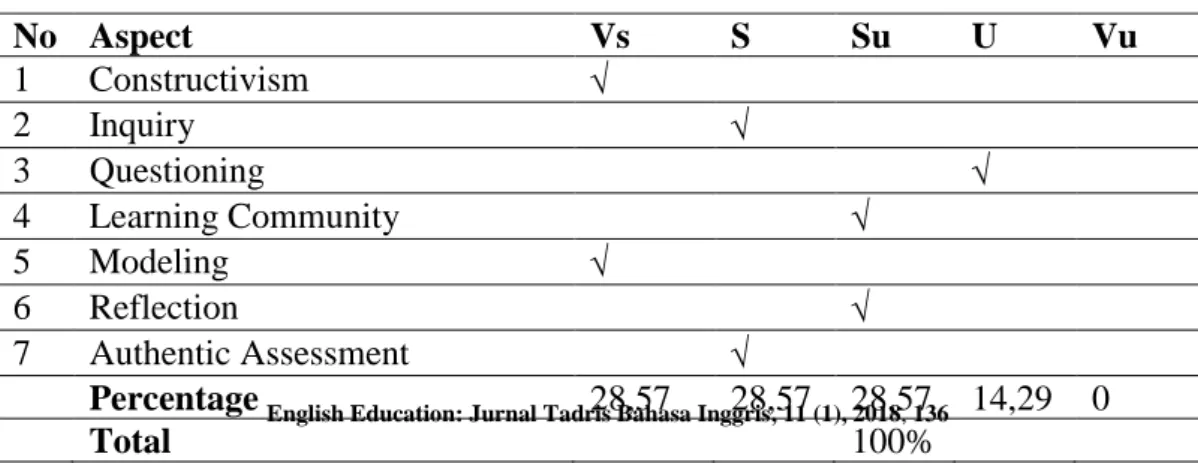
a. Learning process Table 1: observation Sheet Result Cycle
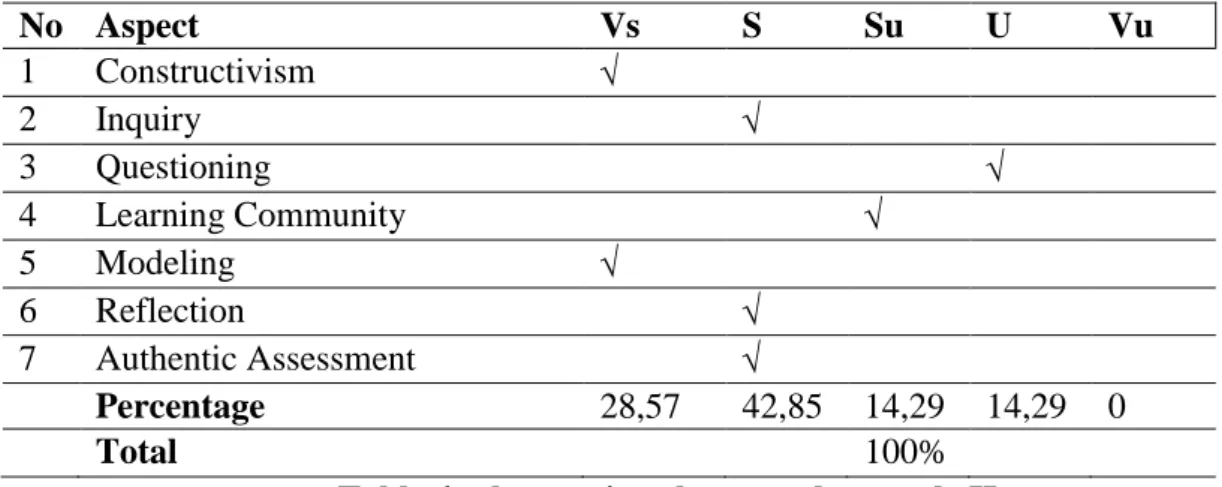
Note:
Vs : very satisfactory ; the teacher achieved 95% result of target
S : satisfactory ; the teacher achieved 80% result of target
Su : sufficient ; the teacher achieved 70% result of target
U : unsatisfactory ; the teacher achieved 50% result of target
Vu : very unsatisfactory ; the teacher achieved 30% result of target
b. Learning Product
At the first cycle in teaching writing descriptive text using clustering technique,
the average score of the students 65, 75 with student’s pass 62,5 %. to know
comparison before and after cycle I. It is illustrated a table below:
Table 2: the result treatment in cycle I
After looking at the table, we know there is progress average score from 58, 67 to
No Aspect Vs S Su U Vu
1 Constructivism
2 Inquiry
3 Questioning
4 Learning Community
5 Modeling
6 Reflection
7 Authentic Assessment
Percentage 28,57 28,57 28,57 14,29 0
Total 100%
Note Before Treatment Cycle I
Highest Score 80 85
Lowest Score 40 45
Average Score 58,67 65,75
65, 75. There is an increase 7, 08 points. KKM (Material Mastery Criteria) is ≥ 65
and score 65 have not reach pass yet.
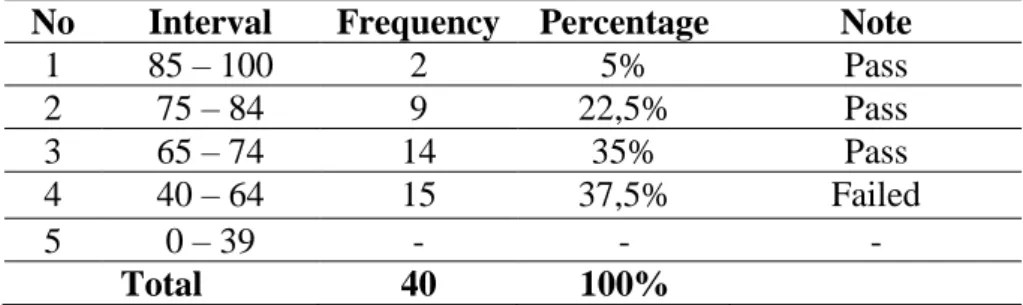
Table 3: Score distribution of cycle I
In reference to the data at cycle I above, there were only 25 students who
scored 65 or more. It means that the result in the first cycle had not fulfilled the
indicator yet, that was 65% of the students score 65 or more. Therefore, the
teacher should apply the second cycle
c. Reflection
Based on the result, it can be said that clustering technique has positive effect to
the students in teaching learning process. It can be seen from the result at the first
cycle. Although the students who got score more than 65 only a few, there is
increase in it.
Although there is increasing of the result from the first cycle, but the teaching
learning process by using clustering technique has achieved minimal competence
standard of the research yet. This failure can be seen that students who got score
more than 65 less than 30 students.
Result of Observation, Interpretation, and Analysis Cycle II
After the teaching learning process, the teacher and the rater discussed everything
that happened in the teaching learning process. The students’ participation, teacher’s performance, and the result of students’ work were includes in the
process teaching learning. They can be explanation as follows.
No Interval Frequency Percentage Note
1 85 – 100 2 5% Pass
2 75 – 84 9 22,5% Pass
3 65 – 74 14 35% Pass
4 40 – 64 15 37,5% Failed
5 0 – 39 - - -
English Education: Jurnal Tadris Bahasa Inggris, 11 (1), 2018, 138
a. Learning process
Table 4: observation sheet result at cycle II
b. Learning Product
At the second cycle in teaching writing descriptive text using clustering technique,
the average score of the students 70, 72 with student’s pass 70%. It is illustrated a
table at cycle II:
Table 5: the result treatment in cycle II
Note Siklus II
Highest Score 89
Lowest Score 50
Average Score 70,72
Student’s Pass 70%
After looking at the table, the highest score at cycle II 89, the lowest sore 50, and
the average score of the students 70, 72 with students pass 70%. The score
distribution of cycle II can be seeing at table 10.
No Aspect Vs S Su U Vu
1 Constructivism
2 Inquiry
3 Questioning
4 Learning Community
5 Modeling
6 Reflection
7 Authentic Assessment
Percentage 28,57 42,85 14,29 14,29 0
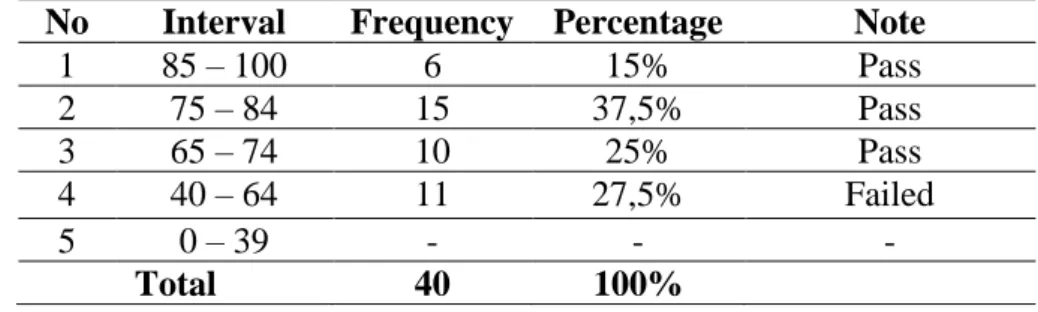
Table 6: score distribution of cycle II
c. Reflection
After analyzing the result of learning product, the researcher did reflection on the
research. She and the teacher discussed each activity that happened during
teaching learning process to know the weakness on this cycle. The weaknesses
that happened in the learning process and learning product were as follows
Students’ participation. In reference the result of questionnaires, it could be notice
that most of the students were active during teaching learning process although
they felt that the explanation given by the teacher was still not clear. They did not
get experience from the technique used by the teacher still could not make them
easier to make descriptive text.
Those problems happened because they did not like learning English. Based on
the informal interview with some students outside of class, many students thought
that English was difficult. Therefore, the teacher had to provide or create situation
that made them have curiosity. She should encourage them to make question
related to the lesson since there were some students who still felt shy to ask
question to their friends/ teacher when they did not know about something.
Teacher’s performance. In line with the result of teacher’s assessment observation
sheet. It could be seen that many students were reluctant to ask question related to
the teacher explanation. Therefore, the teacher should create situation that could
make them have curiosity.
No Interval Frequency Percentage Note
1 85 – 100 6 15% Pass
2 75 – 84 15 37,5% Pass
3 65 – 74 10 25% Pass
4 40 – 64 11 27,5% Failed
5 0 – 39 - - -
English Education: Jurnal Tadris Bahasa Inggris, 11 (1), 2018, 140
Result of Observation, Interpretation, and Analysis Cycle III
After the teaching learning process, the teacher and the rater discussed
everything that happened in the teaching learning process. The students’ participation, teacher’s performance, and the result of students’ work were
includes in the process teaching learning. They can be explanation as follows.
a. Learning process
Table 7: observation sheet result at cycle III
b. Learning Product
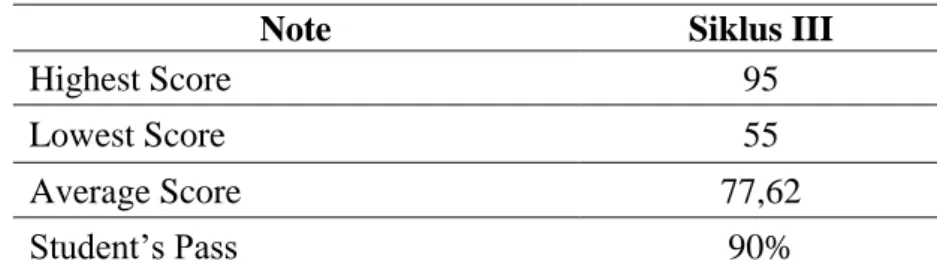
At the third cycle in teaching writing descriptive text using clustering technique,
the average score of the students 77,62 with student’s pass 90%. It is illustrated a
table at cycle III:
Table 8: the result treatment in cycle III
Note Siklus III
Highest Score 95
Lowest Score 55
Average Score 77,62
Student’s Pass 90%
No Aspect Vs S Su U Vu
1 Constructivism
2 Inquiry
3 Questioning
4 Learning Community
5 Modeling
6 Reflection
7 Authentic Assessment
Percentage 71,42 28,58 0 0 0
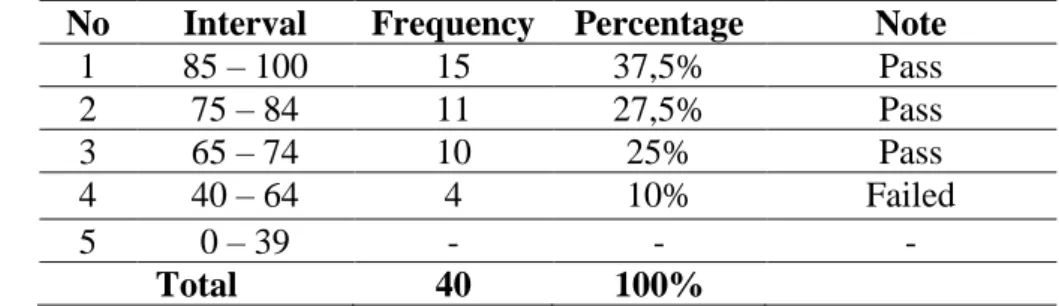
After looking at the table, After looking at the table, the highest score at cycle III
95, the lowest sore 55, and the average score of the students 77,62 with students
pass 90 %. The score distribution of cycle III can be seeing at table 14.
Table : score distribution of cycle III
c. Reflection
Most of the students were active during teaching learning process. They had been
more excited in learning English since the teacher could motivate them. They
followed the lesson in learning seriously and asked question or give comments to
the teacher if they found something outlandish.
In reference to the result of teacher’s assessment observation sheet in cycle II, it
could be seen that the teacher had been already able to use clustering technique
during teaching learning
Furthermore the increasing score in each cycle can be seen in the graph below.
0 20 40 60 80 100
Cycle I Cycle II Cycle III
Average Score
Student's pass
CONCLUSION AND SUGGESTION
No Interval Frequency Percentage Note
1 85 – 100 15 37,5% Pass
2 75 – 84 11 27,5% Pass
3 65 – 74 10 25% Pass
4 40 – 64 4 10% Failed
5 0 – 39 - - -
English Education: Jurnal Tadris Bahasa Inggris, 11 (1), 2018, 142
Conclusion
Referring to the discussion of the research findings on the previous chapter,
the researcher come to these following conclusions.
1. Clustering technique can increase students’ descriptive text writing ability.
Clustering can create situation of the class alive. The students are involved in the
teaching learning process since the material given has correlated to their daily
activities. It makes them easier to understand the material.
2. Clustering technique can improve teacher’s performance. Clustering helps
teacher develop aspects that are needed in the process of teaching such as pre
writing, drafting writing, and revising writing.
3. Clustering technique can improve students’ participation. It is approved by the
result of questionnaires that 90-100 % students were achieving during teaching
learning process. Clustering technique applies learning community that makes
students more active.
B. Suggestion.
Referring to the data in the previous chapter and the conclusions, some
suggestion are recommended
1. Considering the advantages of clustering technique, it is suggested that the
English teacher of the class apply clustering technique as an alternative way in
teaching descriptive text. It is supported by the result finding that clustering
technique not only help teacher improve the students’ descriptive text writing ability but also teacher’s performance and students’ participation.
2. The teacher should reinforce the students about correct grammar especially
present tense. She should reinforce them to do more frequently practice in using
present tense, especially in writing descriptive text.
3. The teacher is expected to be motivate the students in order to be exited in
learning English since many students regard English subject is difficult to learn.
many students said that they did not like learning English because it was difficult
to understand.
4. The last but not least, the teacher should monitor the students well while do
their works since there is a chance for those who lazy to cheat their friends’ work.
REFERENCES
Brown, Steven. Journeys Writing 3. Prentice Hall ELT. Singapore. 1999
Brown, H. Douglas. 2001. Teaching by Principle. San Fransisco: San Fransisco State UnIversity.
Departerment AgamaRI, Al Jumanatul Ali Al Quran dan Terjemahannya, J-ART,
Jakarta, 2005
Edi Kusnadi, Methodology Penelitian, Bandar Lampung: Gunung Pesagi, 2002 Furaidah, dkk. Advanced Writing. Universitas Terbuka. Jakarta. 2007
Floris, Flora Debora. Success in Academic English. Graham ilmu. Yogyakarta. 2007
Graves, Kathleen. Teaching as Course Developers. Cambridge University. United State of American. 1996.
Mamur, IIzanudin. An Anthologhy of TEFL. The State Academy for Islamic Students. Serang-Banten. 2002
Pedoman Penulisan Karya Ilmiah, STAIN Jurai Siwo Metro, 2010
Rein, Joy. M. The Process of Paragraph Writing. Prentice Hall Regents. United State of American, Second Edition.1993.
__________ 1993. Teaching ESL Writing. Prentice Hall Regents. United State of American. 1993.
Richards, Jack C. Approaches and Method in Language Teaching. Camberidge University Perss. United State of American. 2001