The three main causes of evolutionary
change are
natural selection,
genetic drift, and
13.12 Natural selection, genetic drift, and gene flow can
cause microevolution
1. Natural selection
• If individuals differ in their survival and reproductive success, natural selection will alter allele frequencies.
• Consider the imaginary iguana population. Individuals with webbed feet (genotype ww) might survive better and produce more offspring because they are more efficient at swimming and catching food than individuals that lack webbed feet.
13.12 Natural selection, genetic drift, and gene flow can
cause microevolution
2.
Genetic drift
• In a process called genetic drift, chance events can cause allele
frequencies to fluctuate unpredictably from one generation to the next.
13.12 Natural selection, genetic drift, and gene flow can
cause microevolution
• Catastrophes such as hurricanes, floods, or fires may kill large
numbers of individuals, leaving a small surviving population that is unlikely to have the same genetic makeup as the original population.
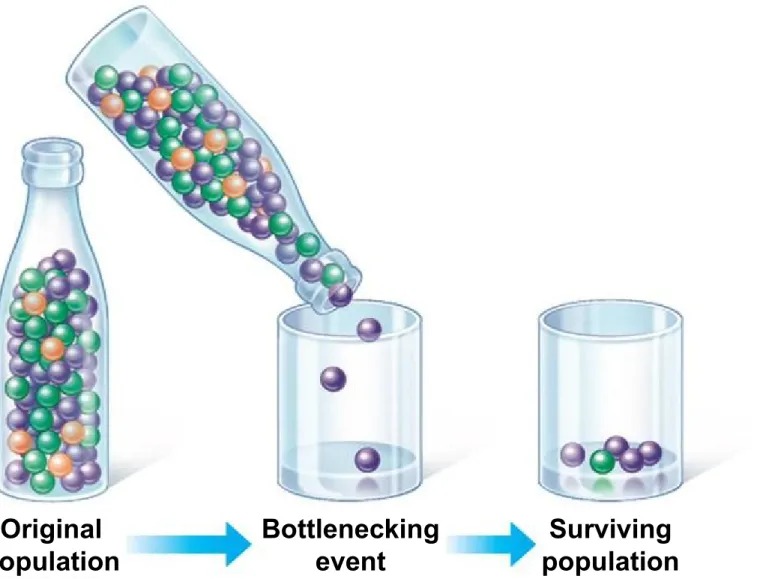
• The bottleneck effect leads to a loss of genetic diversity when a
13.12 Natural selection, genetic drift, and gene flow can
cause microevolution
• Analogous to shaking just a few marbles through a bottleneck, certain alleles may be present at higher frequency in the surviving population than in the original population, others may be present at lower
frequency, and some (orange marbles) may not be present at all.
• After a population is drastically reduced, genetic drift may continue for many generations until the population is again large enough for
Figure 13.12a-1
Figure 13.12a-2
Original population
Figure 13.12a-3
Original population
Bottlenecking event
13.12 Natural selection, genetic drift, and gene flow can
cause microevolution
• One reason it is important to understand the bottleneck effect is that human activities such as overhunting and habitat destruction may create severe bottlenecks for other species.
13.12 Natural selection, genetic drift, and gene flow can
cause microevolution
• Genetic drift is also likely when a few individuals colonize an island or other new habitat, producing what is called the founder effect.
• The smaller the group, the less likely the genetic makeup of the
colonists will represent the gene pool of the larger population they left.
13.12 Natural selection, genetic drift, and gene flow can
cause microevolution
3.
Gene flow
• Allele frequencies in a population can also change as a result of gene flow, where a population may gain or lose alleles when fertile
individuals move into or out of a population or when gametes (such as plant pollen) are transferred between populations.
13.12 Natural selection, genetic drift, and gene flow can
cause microevolution
• To counteract the lack of genetic diversity in the remaining Illinois
greater prairie chickens, researchers added 271 birds from neighboring states to the Illinois populations, which successfully introduced new
alleles.
13.13 Natural selection is the only mechanism that
consistently leads to adaptive evolution
• Genetic drift, gene flow, and mutations could each result in
microevolution, but only by chance could these events improve a population’s fit to its environment.
• In natural selection, only the genetic variation produced by mutation and sexual reproduction results from random events.
• The process of natural selection, in which some individuals are more likely than others to survive and reproduce, is not random.
13.13 Natural selection is the only mechanism that
consistently leads to adaptive evolution
• The adaptations of organisms include many striking examples.
• Consider some of the features that make the blue-footed booby suited to its home on the Galapagos Islands.
• The bird’s large, webbed feet make great flippers, propelling the bird through the water at high speeds.
• Its body and bill are streamlined, minimizing friction as it dives from heights up to 24 m (over 75 feet) into the shallow water below.
13.13 Natural selection is the only mechanism that
consistently leads to adaptive evolution
•
Let’s take a closer look at natural selection.
•
The commonly used phrases “struggle for existence” and “survival of
the fittest” are misleading if we take them to mean direct competition
between individuals. Reproductive success is generally more subtle
and passive.
•
Relative fitness
is the contribution an individual makes to the gene
13.14 Natural selection can alter variation in a population in
three ways
•
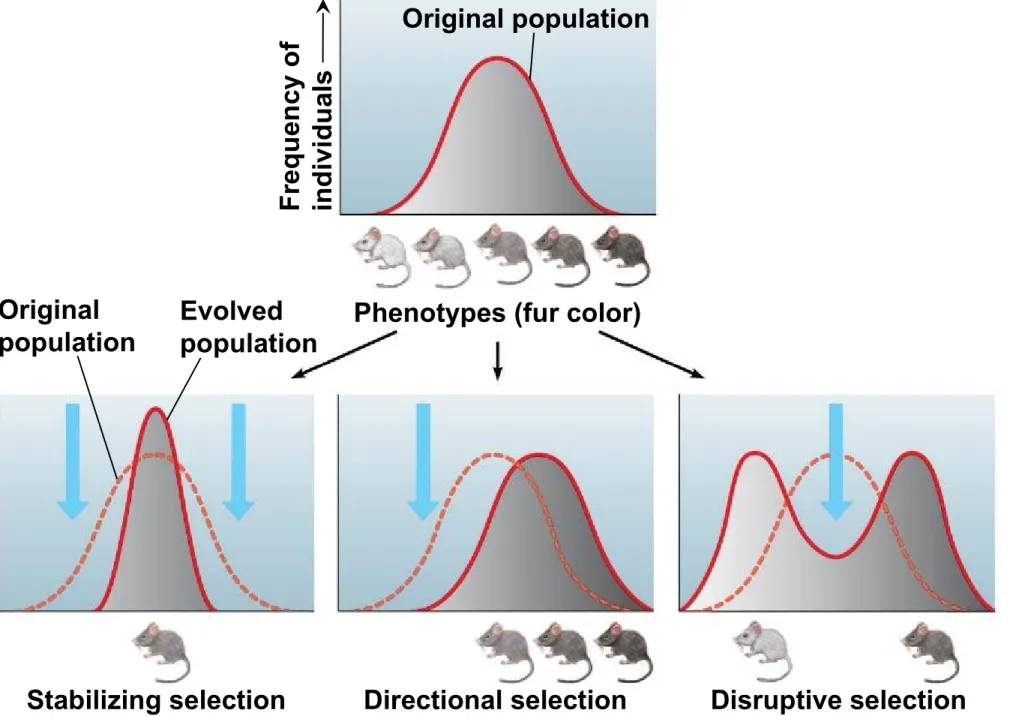
Natural selection can affect the distribution of phenotypes in a
population.
• Stabilizing selection favors intermediate phenotypes.
• Directional selection shifts the overall makeup of the population by
acting against individuals at one of the phenotypic extremes.
• Disruptive selection typically occurs when environmental conditions
Figure 13.14 Original population Original population F re q u en cy o f in d iv id u al s Evolved