Address for correspondence
Dr. Suchibrata Das, Assistant Professor
Department of Dermatology, Venereology and Leprosy,
NRS Medical College,
138 AJC Bose Road, Kolkata 700014, West Bengal, India.
E mail: [email protected]
Original Article
Auto-wart inoculation: An easy and effective
treatment of multiple, recalcitrant and genital warts
Introduction
Viral warts are common, benign lesions that are caused by different strains of human papilloma virus (HPV), and involve epithelium of the skin and mucus membrane. The common clinical manifestations are verruca vulgaris, verruca plana, verruca palmaris and plantaris, and genital warts (condyloma acuminata).1 There is considerable social stigma associated with warts
on the face and hands, and they can be painful when on the soles of the feet and around the nails.
Extensive and recalcitrant warts cause physical embarrassment and psychological distress to the patients, as well as, a therapeutic challenge for the treating dermatologist.2 Studies have shown that warts resolve spontaneously in 40% and the rest need some kind of medical or surgical intervention.2
In spite of various therapeutic modalities being available, no single therapy has been found to be universally efficacious and cosmetically acceptable.3,4 An ideal treatment for warts should be effective, safe, with low morbidity and no Suchibrata Das, Sudip Das, Joyeeta Chowdhury, Sangita Patra*, Loknath Ghoshal, Saikat Banerjee
Department of Dermatology and Venereology, NRS Medical College, 138 AJC Bose Road, Kolkata700014, West Bengal, India
* Department of Gynaecology and Obstetrics, Medical College and Hospital, Kolkata, 88 College Street, Kolkata 700012,West Bengal, India
Abstract Objective To determine if auto-immunotherapy is simple and effective for management of viral
warts, and whether it prevents recurrence.
Methods Inoculum was collected by paring a wart after antiseptic dressing and by pressing it in between two sterile glass slides a thin film like material prepared. After making a subcutaneous pocket on dorsal surface in non-dominant forearm, the inoculum was introduced in the subcutaneous pocket with a fine curved forceps and dressed. The procedure was done monthly for consecutive three months. Results were documented and analyzed.
Results Eighty-three patients were included. At 16 weeks of therapy 57 (69.5%) patients recovered completely and more than 75% improvement occurred in another 7 (8.5%) patients. No significant complication was documented. There was no recurrence with in study period.
Conclusion Autoinoculation is simple and effective in management of different types of viral warts including genital wart. It also prevents recurrence.
Keywords
recurrence. Specific stimulation of immune system against the causative virus can serve this purpose well. Autowart inoculation by means of homologous autoimplantation helping to induce specific cell-mediated immunity has been proposed as a treatment option for recalcitrant, extensive and genital.5
We conducted the present study to find if auto-immunotherapy is effective in the treatment of viral warts, and whether it is effective in preventing recurrence. We had simplified the previous methods so that it might be used in daily practice.
Methods
It was an experimental study carried out between September 2012 and February 2013 at a tertiary care hospital in Eastern India. Clearance from the institutional ethics committee was obtained before starting the study. All consecutive patients of either sex who attended the dermatology outpatient department with warts not responding to usual treatment were included. This included patients with multiple verruca vulgaris (more than 5 lesions), recurrent palmoplantar warts, verruca plana mainly on face or other exposed part of body, subungual warts and genital warts. Patients below 5 years and above 60 years, pregnant and lactating mothers, and those with history of immunosuppressive therapy, vaccination, any severe systemic disorder or immunosuppressive disease were not included in the study.
Patients were enrolled based on inclusion and exclusion criteria at the first visit. Informed consent was obtained from the patient or the guardian. All patients were thoroughly examined and the patient particulars including the wart count were recorded in a standard record form. Routine investigations performed included hemogram, postprandial blood glucose, serum
urea, creatinine, liver function tests and screening for HIV. Intramuscular tetanus toxoid (0.5 ml) was administered to patients with unknown immunization status
The procedure was performed at Dermatology OT where emergency resuscitative drugs and oxygen were kept ready at hand. A well developed lesion from most accessible part of body was cleaned with povidone-iodine solution and pared with number 11 scalpel blade without injuring the deeper part of skin. This was placed on a glass slide and crushed with another glass slide to make a thin film. Then with a wide bore needle (18G) a narrow slit on the ventral aspect on non-dominant forearm was made to form a small subcutaneous pocket. The collected blood was squeezed out by firm pressure. With fine curved forceps the processed material was placed inside the pocket and the wound were dressed tightly.
After first inoculation, all patients were advised to return after 1 week for change of dressing and to note any adverse effects. From next autoinoculation onwards patients were advised for self-removal of dressing and application of antibiotic cream. All patients were advised to attend for follow-up on 4th week of each autoinoculation for three episodes and after three month of third follow-up visit. Lesions were counted numerically in each follow-up visit. Improvement was defined as mild, moderate, significant and complete with subsidence of 0-25%, 26-50%, 51-75% and 76-100%, respectively of pretreatment status.
Results
Total 83 patients were initially enrolled for study. Baseline patient profile is represented in Table 1.
Many patients had multiple areas of involvement. Both extremity and face were involved in 13 (15.7%) patients and 9 (10.8%) patients had subungual lesions in addition to lesions on extremity.
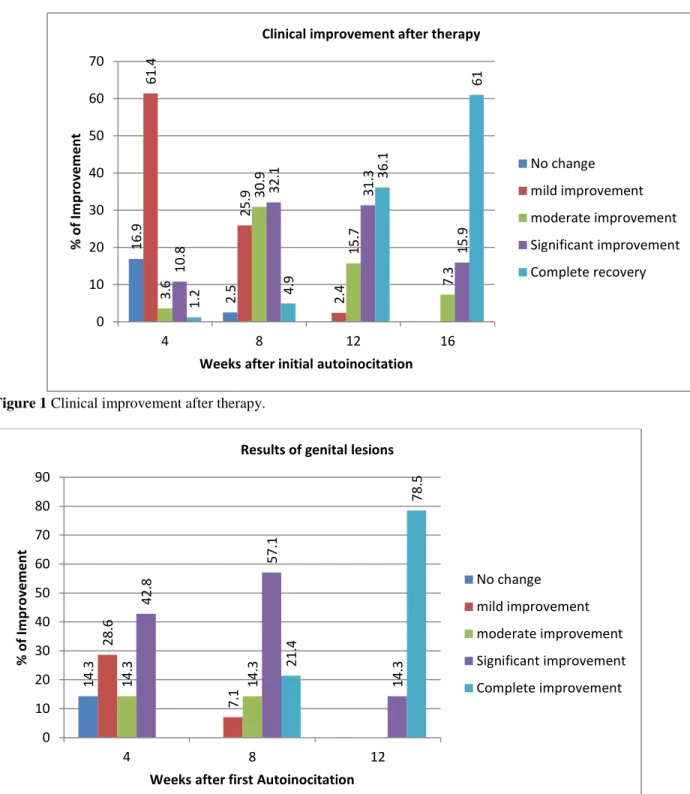
At 4 weeks after first inoculation, some improvement had occurred in 64 (77%) patients. One patient (1.2%) had already achieved complete recovery. Thirteen (15.6%) patients had more than 50% improvement.
After 12 weeks, more than 50% improvement occurred in 69 (83.1%) of patients, of whom complete resolution was seen in 30 (36.1%) patients and 26 (31.3%) patients had 75% improvement.
At 16 weeks of therapy 57(69.5%) patients recovered completely and more than 75% improvement occurred in another 7(8.5%) patients (Figure 1).
Duration of disease did not correlate with improvement. More than 50% improvement occurred in 77.8% patients with 1 year duration of disease versus 80.8% patients with older lesions (P = 0.9512).
Ten (12%) were lost in subsequent follow-up, majority of them (7 out of 10) were males and lesions were mainly on the face and extremities. Type of lesions were mainly verruca vulgaris (6/10) and verruca plana (4/10). None had had improvement in lesions after 4 weeks of start of treatment.
There were 14 patients with genital warts. Mean age was 28±8.7 years. Majority were male (57.1%), average duration of disease was 5.57 months; average number of lesions was 17.2±8.9. Improvement was early and 92.9% (13/14) patients achieved more than 50%/75% improvement within 8 weeks (Figure 2). Complete remission of all lesions occurred in 78.5% (11/14) patients after 12 weeks (Figure 3). None of the cured patients had recurrence during the scheduled observation period.
Majority of patients i.e. 65 (78.3%) had no complication. Pruritus, postinflammatory pigmentation and vaginal discharge occurred in 1 (1.2%) patient each. Two (2.4%) patients had infection on inoculation site, of which one had inoculum taken from genital lesion.
Table 1 Patient profile and characteristics at baseline of study population (n=83).
Characteristics N (%)
Sex
Male 48(57.8%)
Female 35(42.2%)
Age (years)
10 -19 20 (24.1%)
20 -29 33 (39.8%)
30 - 39 14 (16.8%)
40 - 49 11 (13.3%)
≥ 50 5 (6%)
Duration of disease (months)
0 -12 51 (61.4%)
13-24 17 (20.5%)
25 - 36 3(3.6%)
≥ 37 11( 13.3%)
Distribution of lesions
Extremities 53 (63.9%)
Sole 5 (6.0%)
Genital 14 (16.9%)
Face 11(13.3%)
Types of warts
Verruca vulgaris 53 (63.8%) Condyloma acuminata 14 (16.8%)
Verruca plana 9 (10.8%)
Figure 1 Clinical improvement after therapy.
Figure 2 Clinical improvement of genital warts after therapy.
16.9
2.5
61.4
25.9
2.4
3.6
30
.9
15.7
7.3
10.8
32.1 31.3
15.9
1.2 4.9
36.1
61
0 10 20 30 40 50 60 70
4 8 12 16
%
o
f
Im
p
ro
ve
m
e
n
t
Weeks after initial autoinocitation
Clinical improvement after therapy
No change
mild improvement
moderate improvement
Significant improvement
Complete recovery
14.3
28.6
7.1
14.3 14.3
42.8
57.1
14.3
21.4
78.5
0 10 20 30 40 50 60 70 80 90
4 8 12
%
o
f Im
p
ro
ve
m
e
n
t
Weeks after first Autoinocitation Results of genital lesions
No change
mild improvement
moderate improvement
Significant improvement
Figure 3 Picture of clinical improvement
Discussion
In spite of various therapeutic modalities being available, no single therapy has been found to be efficacious and cosmetically acceptable in majority of the patients.3,4 Aims of treatment for multiple, recalcitrant warts should be removal of the warts, without recurrence, without any posttreatment morbidity. The procedure also should be easy to perform in resource poor setup.
In previous studies 62.5 to 74.1% patients5,6,7 had complete clearance in 12 weeks. Our study had similar clearance rate (69.5%) in 16 weeks. However, our sample size was more than the former studies. In our study improvement was noticed from very first follow-up, as in previous studies.5,6 In none of previous studies, results on genital lesions were highlighted. We had good numbers of patients with genital warts (14 patients), with an average age of 28±8.5 years of age (active reproductive age group). Significantly, very high percentage (92.9%) patients achieved more than 50% improvement in early period (8 weeks) and complete
remission of all lesions occurred in 78.5% (11/14) patients after 12 weeks. This result is quite impressive in an embarrassing and anxiety provoking condition like genital warts.
Complications are minimal in this procedure. These include postinflammatory hyperpigmentation, inflammatory nodules at inoculums site.5,6 Inflammatory nodule may be most likely due to failure in maintaining procedure sterility, as in one of our patients who had genital lesion. Some suggested that this could be due to intense inflammation caused by implanted keratinous material which acts as foreign body in the dermis and subcutis.6 Patients who had complete clearance did not have recurrence in 3 months follow-up, a finding which agrees with that of previous investigators.5,6,7
Limitation of our study is that patients, who responded completely, should be followed up for longer duration.
Conclusion
Auto-wart inoculation is a safe, simple and efficacious technique that can be performed in a very simple set-up with minimal trauma and complication. It is effective in recalcitrant, palmoplantar, subungual and genital warts, irrespective of duration of suffering.
Also, future series should be undertaken with even larger numbers of patients so as to establish this as a standard and first line method of treatment of all troublesome warts.
Acknowledgement
Guidance of Prof. Alok Kr. Roy, Head of the Department and assistance of Dr. Aritra Sarkar PGT of our Department influenced and helped our work.
References
1. Plasencia JM. Cutaneous warts: Diagnosis and treatment. Prim Care. 2000;27:423-34. 2. Sterling JC, Handfield-Jones S, Hudson
PM. Guidelines for the management of cutaneous warts. Br J Dermatol. 2001;144:4-11.
3. Kuykendall-Ivy TD, Johnson SM. Evidence-based review of management of nongenital cutaneous warts. Cutis. 2003;71:213-22.
4. Gibbs S, Harvey I, Sterling J, Stark R. Local treatments for cutaneous warts: Systematic review. BMJ. 2002;325:461. 5. Shivakumar V, Okade R, Rajkumar V.
Autoimplantation therapy for multiple warts. Indian J Dermatol Venereol Leprol. 2009;7:593-5.
6. Nischal KC, Sowmya CS, Swaroop MR, Agrawal DP, Basavaraj HB, Sathyanarayana BD. A novel modification of the autoimplantation therapy for the treatment of multiple, recurrent and palmoplantar warts. J Cutan Aesthet Surg. 2012;5:28-9