CELLULAR & MOLECULAR BIOLOGY LETTERS http://www.cmbl.org.pl
Received: 16 August 2009 Volume 15 (2010) pp 311-341 Final form accepted: 01 March 2010 DOI:10.2478/s11658-010-0010-8 Published online: 19 March 2010 © 2010 by the University of Wrocław, Poland
* Author for correspondence: e-mail: [email protected], tel.: +44 (0)20 7942 5315, fax: +44 (0)20 7942 5054
Abbreviations used: actB – β-actin; AIC – Akaike information criterion; BI – Bayesian inference; BIC – Bayesian information criterion; cob – cytochrome b; cox1 – cytochrome c oxidase subunit 1; DNA – deoxyribonucleic acid; GTR – General Time-Reversible; HIV – human immunodeficiency virus; HKY – Hasegawa Kishino Yano; hLRT – hierarchical likelihood ratio tests; JTT – Jones Taylor Thornton; LBA – long-branch attraction; LRT – likelihood ratio test; MCMC – Markov chain Monte Carlo; ME – minimum evolution; ML – maximum likelihood; MP – maximum parsimony; mtREV – mitochondrial reversible; NJ – neighbour-joining; PCR – polymerase chain reaction; rag1 – recombination activating gene 1; rRNA – ribosomal ribonucleic acid
Review
MOLECULAR SYSTEMATICS: A SYNTHESIS OF THE COMMON METHODS AND THE STATE OF KNOWLEDGE
DIEGO SAN MAURO1* and AINHOA AGORRETA1, 2
1 Department of Zoology, The Natural History Museum, Cromwell Road,
London SW7 5BD, United Kingdom, 2 Department of Zoology and Ecology,
University of Navarra, Irunlarrea s/n, 31008 Pamplona, Spain
methodologies that are most widely used in the field of molecular systematics today, as well as indications of future trends and state-of-the-art approaches.
Key words: Molecular systematics, Phylogenetic inference, Molecular evolution, Phylogeny, Evolutionary analysis, Evolutionary hypothesis, Divergence time.
INTRODUCTION
20 in the case of amino acids), which may entail a high probability of homoplasy (similarity in character states for reasons other than common ancestry, such as convergence, parallelism, and reversal) due to the saturation of the substitution process (e.g. two sequences might have the same character state at a given position just by chance and not due to common ancestry) [1]. In practice, this problem is particularly important for some methods of phylogenetic inference, such as parsimony. Furthermore, gene phylogenies do not necessarily match those of the organisms due to several evolutionary processes such as horizontal gene transfer, gene duplication and loss, and deep coalescence [9]. Homologous genes that were separated by a speciation event (when a species diverges into two separate species) are termed orthologous, whereas homologous genes that were separated by a gene duplication event and occupy two different positions in the same genome are termed paralogous. One might expect a total match between the gene tree and species tree if the genes used to reconstruct the phylogeny are orthologous, but in practice, different sets of orthologous genes may yield different phylogenies [10] because of analytical limitations [11-13] and differences in the phylogenetic signal:noise ratio due to the unequal action of natural selection or genetic drift [14]. In some cases, molecular data is irretrievable, such as in ancient fossil taxa, although some data has been obtained for ‘recently’ extinct organisms [15] and in other exceptional cases [16]. Another important problem of molecular data is that it cannot as yet be used on its own to describe new species; however, see [17-19].
Molecular and morphological data is useful and necessary in systematics. These two types of data constitute independent and complementary sources of information for cross-validating hypotheses about evolutionary patterns and processes at different levels of biological organization.
MODELLING SEQUENCE EVOLUTION
amino acid in the case of protein sequences). Furthermore, substitution rates usually vary across the sites of the DNA or amino acid sequence due to unequal selective pressure, biochemical factors, and/or genetic code constraints [25, 26]. This variation is modelled using among-site rate variation parameters. One of these parameters leaves a proportion of sites incapable of undergoing substitutions (the ‘proportion of invariable sites’, I), with the remaining positions varying at the same rate [27, 28]. The other parameter uses a gamma distribution (Γ) for modelling rate heterogeneity across sequence sites [29]. The gamma distribution has a shape parameter α, and its mean and variance are 1 and 1/α, respectively. As α increases, the rate distribution tends to an equal-rates model. The gamma is a continuous distribution, but it is usually implemented in a discrete manner using several categories (commonly four or eight) of equal probability to approximate it [30].
In the last four decades, many models of increasing complexity have been described, both for nucleotide and amino acid sequences [31]. In general, models of sequence evolution are built following two main approaches [21], either using properties calculated through the comparison of large numbers of observed sequences (empirically), or on the basis of the chemical or biological properties of DNA or amino acids (parametrically). Empirical models result in fixed parameter values that are estimated only once and then assumed to be applicable to all datasets. The modelling of amino acid replacement, such as mtREV [32] and JTT [33], has concentrated on this empirical approach. By contrast, parametric models allow the parameter models to be derived from the dataset in each particular analysis. The modelling of nucleotide replacement, such as HKY [28] and GTR [34], has concentrated on this parametric approach. More complex models of sequence evolution have also been described, such as codon-based models that take the genetic code into account when calculating the probability of a change at a site across a branch [35], models attempting to accommodate structural elements of the analyzed molecules [36], or models allowing site-specific rate variation across lineages [37, 38].
criteria are in wide use, recent studies suggest that the latter are more adequate because they are able to simultaneously compare multiple nested or non-nested models (hLRT can only compare nested models, and the order of tests can influence which model is ultimately chosen), and permit the assessment of model selection uncertainty [47].
ASSEMBLING A SEQUENCE DATA MATRIX
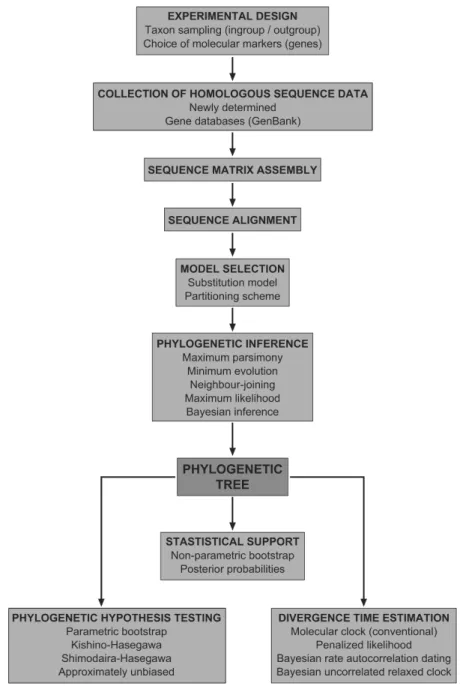
Given a particular group of organisms, the process of phylogenetic estimation (Fig. 1) starts with the collection of homologous sequence data. This sequence data can be obtained anew (using molecular biology techniques), but some can be retrieved from the many gene databases available, such as GenBank [48]. Typically, a few outgroup sequences are included to root the tree, indicating which nodes in the tree are the oldest, and providing clues about ancestral sequence states or ancestral descendent relationships [49]. In general, outgroups are added as a single sister clade (preferably the closest) to the ingroup. The choice of outgroup can strongly affect the chances of obtaining the correct tree, because both topology and unequal rates of molecular evolution between the ingroup and the outgroup affect the ability of tree-building algorithms to find the correct tree [50].
The next step is to align the sequences, because as they diverge from each other,
length mutations (insertions and deletions, collectively referred to as indels)
accumulate [1], and gaps need to be inserted into sequences to increase their similarity. The alignment is an arrangement of the sequences into a matrix so that the character states at each given position (column of the matrix) are related to each other by descent from a common ancestral residue, i.e. there is positional homology. The character states can be either nucleotides or amino acids. The alignment step is critical as the rest of the phylogenetic inference process relies on it [51-53], and many algorithms have been developed for multiple-sequence alignment [54, 55]. In most cases, these algorithms attempt to minimise the total cost of all the possible changes (the combination of length and substitution mutations) in pairwise sequence comparisons [56]. They usually work in a progressive manner (a set of N sequences are aligned by performing N-1 pairwise alignments of pairs of sequences or pairs of intermediate alignments [57]) guided by a phylogenetic tree connecting the sequences (progressive tree alignment). The main problem of multiple alignments is that the costs are difficult to define and interpret biologically [58]. Ambiguously aligned positions are usually excluded from the dataset before analysis.
analysis of genomic data [61], and the simultaneous co-estimation of sequence alignments and phylogenetic trees in a probabilistic framework [62, 63].
In addition to the sequence data, a model of sequence evolution must be chosen, as the methods used in molecular phylogenetics are based on a series of assumptions about how the substitution process works (see above). These assumptions can be implicit, as in parsimony methods, or explicit, as in likelihood-based methods [43].
METHODS OF PHYLOGENETIC INFERENCE
Of the various methods developed to reconstruct phylogenetic relationships [see reviews in 20, 21, 31 and 42], there are four that have dominated molecular systematic studies: maximum parsimony, neighbour-joining, maximum likelihood, and Bayesian inference.
Maximum parsimony
Maximum parsimony is one of the earliest inference methods [64, 65] that arose from Hennig’s phylogenetic systematics [66]. Unlike distance methods, it directly uses character states, and is based on an optimality criterion, which is a rule to decide which of the alternative trees is the best: it selects the tree or trees requiring the fewest character state changes, thus attempting to minimize homoplasy. The length of an unrooted tree can be directly calculated using Fitch’s algorithm [64], which moves along the tree assigning one or more states to each of the internal nodes. In this method, the tree space (the theoretically possible tree topologies for a given number of taxa) is usually searched using heuristic searches or, when the number of sequences is small (<12), exact searches [31]. Exact searches are those that evaluate all possible trees (exhaustive searches) or parts thereof (in a way that ensures that the optimal tree will not be missed from the evaluation, such as ‘branch and bound’ searches), and thus guarantee that the tree found is optimal. Heuristic searches are those that do not evaluate all the possible trees and cannot guarantee that the tree found is the optimal one. To maximize the chances of success, several independent searches are performed starting from different regions of the tree space, giving a good, albeit not definitive indication that the optimal tree has been found if all the searches find the same tree.
reversed, or superimposed changes) when markedly divergent sequences are analysed. In such a case, parsimony analyses can be weighted through the use of step matrices to incorporate prior assumptions about the costs of character state change (e.g. transitions and transversions) [20].
Neighbour-joining and minimum evolution
These are pairwise distance methods [70, 71] based on the assumption that dissimilarity between two sequences is directly related to their phylogenetic relationship. Such dissimilarity arises from the number of changes that have occurred along the branches, i.e. the evolutionary distance. Distance methods comprise both clustering methods such as neighbour-joining, and optimality methods such as minimum evolution. Clustering methods were originally developed to detect similarities rather than to estimate evolutionary relationships [72]. In neighbour-joining [73], the DNA or amino acid sequences are first converted into a distance matrix that is then used to reconstruct a phylogenetic tree. Optimality methods calculate the score of a tree based on the squared deviation of the pairwise observed distances between each pair of taxa, estimated from the data matrix, and the distance separating those taxa on the tree [71]. In minimum evolution [74], the optimality criterion is the sum of branch lengths optimized according to the least-squares criterion above (the minimum evolution score).
The main advantage of distance methods is that they are relatively rapid compared to all the other methods available, and they perform well when the divergence between the sequences is low. The disadvantages of distance methods include the loss of information when the sequences are converted to distances, and the difficulty in obtaining reliable estimates of pairwise distances for highly divergent sequences. Both neighbour-joining and minimum evolution can incorporate models of evolution to correct pairwise genetic distances for multiple substitutions at the same site [75].
Maximum likelihood
This method is one of the standard tools of statistics [76], and was first applied to phylogenetics several decades ago [22, 77, 78]. In the context of molecular systematics, the likelihood of a phylogenetic tree is the probability of observing the data (the set of sequences being analyzed) given the tree and the model of evolution. This is also an optimality method: the best tree is the one that renders the observed sequences most likely to have evolved under the assumed evolutionary model. The likelihood of a site is the probability of the observed states at that site given all the possible combinations of states at the internal nodes of the tree (ancestral states). The likelihood of a tree is the product of the likelihoods for each site of the alignment. Because likelihood values are often
very small, they are usually expressed as log likelihoods, ln L (which are
computationally easier to handle).
phylogenetic trees using complex models of sequence evolution, including the ability to estimate model parameters, thus allowing simultaneous inference of patterns and processes of molecular evolution, and provides a powerful statistical framework for hypotheses testing (see below). The models of sequence evolution can be implemented for the whole sequence dataset [79], and for different partitions (subsets treated independently) of it, such as the different codon positions of a protein-coding gene [80-82]. The strong statistical foundations of likelihood-based methods probably make them the most robust way for estimating molecular phylogenies and understanding sequence evolution [21]. However, there are also criticisms of this method related to the fact that the result may be especially dependent on the correctness of the employed model of sequence evolution [21, 42; but see also 83]. Another criticism is that maximum likelihood can be prohibitively slow and computationally demanding, particularly when there is a large number of sequences (terminal taxa) to be analyzed. However, the exponential increase in computer power and the development of faster algorithms [81, 84] have largely solved this problem.
Bayesian inference
accepted. These steps constitute an MCMC generation. Sequential values (new states) are simulated from the chain until it converges (i.e. the simulated variables stay on values with high probability in the stationary chain), and then the states (tree and model parameters) are sampled at intervals from the chain, thus constituting independent samples from the stationary distribution. As the number of generations increases, the process does an approximation of the landscape of possible states (tree and parameters); the longer the MCMC runs, the closer the approximation becomes. Current Bayesian phylogenetic procedures use a variant of MCMC called Metropolis-coupled MCMC, which is less prone to entrapment in local optima. This MCMC variant involves running several independent chains simultaneously (typically four). Each generation, every chain proposes and accepts/rejects moves independently, and a swap of the states is attempted between two randomly chosen chains. States are only sampled from one of the chains, designated as the ‘cold’ chain (the rest are ‘heated’ chains). If the cold chain gets stuck in local optima (a low probability hill in the posterior density landscape), it has a chance to escape by swapping with another chain that may be on a higher hill.
Bayesian inference has the advantage of a strong connection with the likelihood framework and its powerful statistical foundations. Moreover, as a result of the MCMC process, there is a posterior probability associated to each node on the inferred Bayesian tree (the fraction of times a clade occurs among the sampled trees) that can be used as a measure of support for that node. The disadvantages of Bayesian methods stem from the fact that prior distributions for parameters must be specified, and that it can be difficult to determine if the MCMC approximation has run for a sufficient number of cycles, meaning that the chains have converged [42], and thus if the tree space has been adequately searched. Long Bayesian runs (millions of generations, and starting from different initial states) are typically required to reach convergence and ensure an adequate search of the tree space [91]. There is a myth that the Bayesian MCMC is faster and computationally less demanding than maximum likelihood using equally (or even more) complex models of sequence evolution. However, each procedure is trying to do rather different things: the Bayesian approach explores the entire posterior distribution of the tree and all the parameters, while maximum likelihood just searches for a single tree and set of parameters that maximise the likelihood. The amount of computation in each case can vary greatly.
STATISTICAL SUPPORT OF PHYLOGENETIC TREES
first applied to phylogenetics by Felsenstein [93]. This is a statistical resampling technique by which distributions that are difficult to calculate exactly can be estimated by the repeated creation and analysis of artificial datasets. To assess node support in phylogenetics, non-parametric bootstrapping is used: new datasets are created by sampling randomly and with replacement from the original data (these new bootstrap datasets are of the same size as the original); a desired quantity of bootstrap datasets is computed (typically between 500 and 2000 [94, 95]); and the resulting distribution is used to estimate the variation that would be expected if the same number of new independent datasets had been collected. The exact interpretation of the statistical significance of bootstrap proportions is elusive, but several authors [95, 96] have proposed that they are conservative measures of support, so a value of 70% or greater might indicate substantial confidence for a group. In Bayesian inference, some criticisms are related to the putative overconfidence of posterior probability measures of node support [97], and the general recommendation is that posterior probabilities should only be considered reliable (strong support) if greater than 0.95 [98-100]. In general, these misleadingly high posteriors are associated with arbitrary resolutions of hard polytomies [101], inappropriate prior choice, and failure to allow convergence [91].
HYPOTHESIS TESTING IN PHYLOGENETICS
One of the most appealing topics in molecular systematics is the availability of methods for the statistical testing of competing phylogenetic hypotheses. These methods are available almost exclusively within the likelihood framework, although some tests have also been developed for other frameworks, such as parsimony [102]. They allow assessment of which model provides the best fit for a given dataset, and the degree of confidence we have in any given topology being the true topology.
One of the methods to compare two competing hypothesis is the likelihood ratio test (LRT) [22, 44, 103], which has been extensively used for selecting competing best-fit models of sequence evolution for a given dataset, and for testing deviations from clock-like evolution (the global molecular clock hypothesis). Competing hypotheses are compared using a statistic, 2δ (calculated as the ratio of the likelihood scores of the alternative hypothesis to the null hypothesis), which measures how much better an explanation of the data the alternative hypothesis gives. In order to perform a significance test, the distribution of 2δ values expected under the simpler hypothesis is required. If the two competing hypotheses are nested (i.e. the null hypothesis is a special case of the alternative hypothesis), then the 2δ distribution is asymptotically distributed
as χ2 with the number of degrees of freedom equal to the difference in the
number of parameters between the two models.
When the hypotheses being compared are not nested, the χ2 approximation may
approximated by parametric bootstrapping [104-106]. Unlike the non-parametric bootstrap (where datasets are generated by resampling from the original data), the parametric bootstrap uses Monte Carlo simulation to generate the data. Replicate datasets of the same size as the original (usually 200-1000) are simulated according to the null hypothesis being tested. For each replicate dataset, the likelihoods according to both the null and alternative hypotheses are estimated, and the LRT statistic is calculated. These simulated 2δ values form the null distribution of the LRT statistic, allowing implementation of a significance test. The main disadvantage of parametric bootstrapping is that it is computationally demanding, and even unfeasible when large datasets are considered.
Apart from parametric bootstrapping, there are several non-parametric likelihood-based tests. These tests intend to determine whether the difference in fit of two or more alternative tree topologies (always non-nested hypotheses) to the data is significantly greater than expected under the null hypothesis of random sampling error. Of the various methods of this kind, the most widely used are the Kishino-Hasegawa [107], the Shimodaira-Hasegawa [108], and the approximately unbiased [109] tests. They all are based on the estimation of LRT statistics, and use different non-parametric bootstrapping procedures to assess their variance and obtain an estimation of their distribution, thus permitting significance tests. The Kishino-Hasegawa test is valid in the case that the competing hypotheses, each consisting of specific tree topologies, are chosen
a priori, so that they are not derived from the same data, but this constraint is
usually overlooked [92]. The Shimodaira-Hasegawa test can be used to evaluate
multiple trees chosen a posteriori, allowing a proper multiple comparison even
sequence evolution to construct the null distribution [92, 110, 114]. There is no easy way to overcome this conflict, but the trend is to perform both parametric and non-parametric tests, and use the resulting significances to assign ‘credibility ranks’ for each alternative phylogenetic hypothesis, depending on the concordance or disparity of the two types of test.
ESTIMATION OF DIVERGENCE TIMES
A key feature of molecular phylogenies is that not only can relationships be reconstructed, but divergence events can also be dated using various models of the expected rate of accumulation of substitutions in the sequences over time. The idea of dating evolutionary divergences using calibrated sequence distances was first proposed by Zuckerkandl and Pauling [115], who postulated that the amount of difference between the DNA molecules of two species is a function of the time since their evolutionary separation. This was termed a ‘molecular clock’ and was shown by comparing amino acid substitution rates with ages estimated from fossils. The central assumption of the molecular clock is that all branches of a phylogenetic tree evolve at the same global substitution rate, i.e. there is rate constancy. A clock-like tree is ultrametric (i.e. the total distance between the root and every tip is constant), so nodal depths can be easily dated if the divergence time for at least one node is known (calibration point). The global rate of substitution can be calculated and, based on it, divergence times for all nodes are estimated by linear regression of the molecular distances [116, 117]. If several calibration points are used, then a regression line is built, the slope of which is an estimate of the global substitution rate, and the divergence times for the unknown nodes are interpolated (or extrapolated). The molecular clock hypothesis is in perfect agreement with the neutral theory of evolution that postulates that the majority of substitutions in genes are the result of the random fixation of selectively neutral mutations [118, 119].
a function describing the behaviour of rates throughout the tree; this function can be an algorithm to minimize the rate changes between adjacent branches, or an explicit model of rate variation in which substitution rates can change along branches [128]. Many of these methods are based on the idea of rate autocorrelation: the assumption that evolutionary rates among closely related lineages are similar. Simulations indicate that rate autocorrelation methods are less prone to overestimation than conventional molecular clocks [129]. The most widely-used relaxed clock methods are: penalized likelihood [130, 131], Bayesian rate autocorrelation dating [132-134], and Bayesian uncorrelated relaxed clock [135, 136].
Penalized likelihood is a semi-parametric technique that attempts to simultaneously estimate unknown divergence times and smooth the rapidity of change along lineages. To smooth rate variation, a nonparametric function is used that penalizes rates that change too fast from branch to neighbouring branch, thus reflecting an idea of autocorrelation of rates. Because the penalty function includes unknown times, an optimality criterion based on this penalty permits an estimation of the divergence times [131]. The use of a likelihood framework permits the specification of the relative contribution of the rate smoothing and the data-fitting parts of the estimation procedure. The optimal level of smoothing can be estimated by running a cross-validation procedure [130]. Penalized likelihood provides confidence intervals on the estimated parameters by calculating an age distribution based on chronograms generated from bootstrapped datasets, and allows multiple calibration constraints to permit scaling of rates and times to real units [137].
The Bayesian dating methods use a fully probabilistic and high parametric model to describe the change in evolutionary rate over time, and use MCMC approximation to derive the posterior distribution of rates and times from a prior distribution. In Bayesian rate autocorrelation dating, rates are drawn from a log normal distribution and assigned to different branches in the tree, and a parameter called the Brownian motion constant describes the amount of autocorrelation [132-134]. In order to scale rates and times, the prospective age
of the root node must be specified a priori. This method provides Bayesian
credibility intervals for estimated divergence times and substitution rates, and allows multiple calibration constraints on nodes, specified as prior age intervals. Other approaches of the Bayesian autocorrelated model have also been described [138]. In contrast to penalized likelihood, the Bayesian rate autocorrelation dating method is able to account for multiple genes/loci, or dataset partitions in general, with different evolutionary behaviours. This simultaneous analysis of multiple genes may yield more accurate estimates of divergence times [134]. More recently, the Bayesian uncorrelated relaxed clock method has been developed [135, 136]. This method, which is also highly parametric, assumes no
a priori correlation of the rates on adjacent branches of the phylogenetic tree,
demanding, this uncorrelated dating method is able to co-estimate phylogeny and divergence times, and it allows the implementation of several models of rate change for the analysis depending on the user’s assumptions about how rates change over time.
Even when using similar input topologies and calibration constraints, the results of the penalized likelihood and Bayesian dating methods may look quite different, and this is related to their different assumptions about rate change, their different implementations of models of sequence evolution, branch length estimation, the use of prior information, and the different ways in which confidence intervals are calculated [130, 132, 134, 135]. An important issue in molecular dating is the choice of appropriate calibrations [139-142]. In a conventional molecular clock, they were merely points used for linear interpolation, but the relaxed clock methods have introduced more sophisticated approaches of incorporating calibrations (see [143] for a recent comparison of the various calibration techniques): minimum and/or maximum hard bounds on the age of internal nodes (implemented in penalized likelihood and Bayesian rate autocorrelation dating), soft bounds [144], and prior age distributions for selected nodes in the tree (implemented in the Bayesian uncorrelated relaxed clock method). In recent years, Bayesian methods, particularly the Bayesian uncorrelated relaxed clock method, have been attracting more attention because of their relative novelty compared to penalized likelihood, and because their highly parametric framework, albeit not necessarily more parametric than maximum likelihood methods, is often interpreted as a grade of sophistication that permits the extraction of more information about the evolutionary processes that generated the observed variation.
MOLECULAR MARKERS
In general, the use of ‘favourite’ genes or genomic regions in phylogenetic studies is more commonly related to the technical ease with which their sequences can be determined, and their ‘success’ in previous similar-level studies (see [147] for a review). Over the years, ribosomal genes (particularly mitochondrial ones) have been used in animal phylogenetic studies at various
taxonomic levels. Also, some mitochondrial protein-coding genes, such as cob
and cox1, have become particularly popular. The growth in popularity of all of
these genes was often due to the early availability of ‘universal’ PCR primers for them [159, 160], but in most cases, only short partial fragments of 300-600 base pairs (bp) of these genes are sequenced. Most of the ‘favourite’ genes are encoded by mitochondrial DNA, because some of its features (lack of introns, maternal inheritance, practical absence of recombination, and haploidy) have made it particularly suitable for estimating animal molecular phylogenies [145, 161]. Several studies have demonstrated the need to establish high-level phylogenetic inferences based on rather large sequence datasets in order to achieve statistical confidence [11, 162, 163], and in recent years, there has been a growing trend to sequence large genomic regions (or even complete genomes) to tackle phylogenetic problems [10, 164, 165]. In addition, recent studies have
also indicated that some orthologous nuclear protein-coding genes, such as rag1
and actB, may outperform mitochondrial sequences in reconstructing ancient
phylogenetic relationships [166, 167].
MOLECULAR SYSTEMATICS FOR THE FUTURE
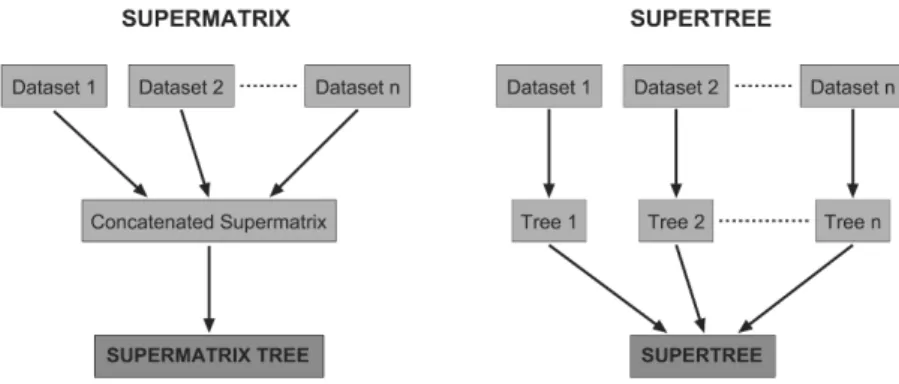
identify the most informative marker(s) for a particular phylogenetic question, and to predict the impact of additional data in the form of new chararcters and/or taxa. The simultaneous analysis of vast amounts of molecular data together with morphological, ecological, and behavioural traits, and even characteristics from extinct taxa, is becoming feasible, particularly using Bayesian approaches or parsimony-based methods intended to deal with the potential mismatch between gene trees and species trees (due to e.g. hybridization, horizontal gene transfer, or paralogy) [178, 179]. This has been called the ‘supermatrix’ or ‘total evidence’ approach (Fig. 2) [180]. Despite its potential, it still has to deal with the problem of extensive missing data in the concatenated super-matrices and its elusive effect for phylogenetic reconstruction algorithms [150, 181-183]. A parsimony-based variant of the supermatrix approach is the ‘direct-optimization’ method [184, 185], which involves the simultaneous alignment and analysis of sequence characters from multiple genes that can be analysed with other non-sequence data. A sound criticism of this approach is that primary homology is compromised because the alignments are influenced by congruence with other data [186].
Fig. 2. Schematics of the supermatrix (left) and supertree (right) approaches.
‘divide-and-conquer’ strategy [191, 192] to explore the huge tree space derived from the analysis of thousands or even millions of taxa. Other approaches that are essentially variants of the supermatrix approach are also being developed [193, 194], but only time will tell if they become essential tools for the new era of molecular systematics.
PHYLOGENETIC SOFTWARE
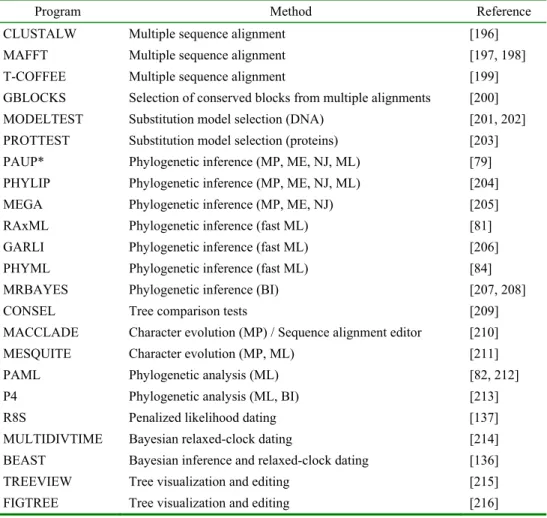
The number of computer programs available for phylogenetic analysis has greatly increased in recent years, but the reader can find an excellent, comprehensive, well-organized, and up-to-date compilation of most (if not all) of the available programs at Joseph Felsenstein’s website [195]. Tab. 1 shows a selection of these programs, implementing most of the methods described in this review.
Tab. 1. An overview of the commonly used programs implementing most of the methods described in this review.
Program Method Reference
CLUSTALW Multiple sequence alignment [196]
MAFFT Multiple sequence alignment [197, 198]
T-COFFEE Multiple sequence alignment [199]
GBLOCKS Selection of conserved blocks from multiple alignments [200] MODELTEST Substitution model selection (DNA) [201, 202] PROTTEST Substitution model selection (proteins) [203] PAUP* Phylogenetic inference (MP, ME, NJ, ML) [79] PHYLIP Phylogenetic inference (MP, ME, NJ, ML) [204] MEGA Phylogenetic inference (MP, ME, NJ) [205] RAxML Phylogenetic inference (fast ML) [81] GARLI Phylogenetic inference (fast ML) [206] PHYML Phylogenetic inference (fast ML) [84] MRBAYES Phylogenetic inference (BI) [207, 208]
CONSEL Tree comparison tests [209]
MACCLADE Character evolution (MP) / Sequence alignment editor [210] MESQUITE Character evolution (MP, ML) [211]
PAML Phylogenetic analysis (ML) [82, 212]
P4 Phylogenetic analysis (ML, BI) [213]
R8S Penalized likelihood dating [137]
Acknowledgements. We would like to thank three anonymous reviewers for their insightful comments on an earlier version of this manuscript. Diego San Mauro and Ainhoa Agorreta were respectively supported by a post-doctoral (MEC/Fulbright 2007-0448) and a pre-doctoral (FPU AP2006-00608) fellowship of the Ministry of Science and Innovation of Spain.
REFERENCES
1. Page, R.D.M. and Holmes, E.C. Molecular evolution: a phylogenetic
approach, Blackwell Science, Oxford, 1998.
2. Korber, B., Muldoon, M., Theiler, J., Gao, F., Gupta, R., Lapedes, A., Hahn, B.H., Wolinsky, S. and Bhattacharya, T. Timing the Ancestor of the HIV-1
Pandemic Strains. Science 288 (2000) 1789-1796.
3. Smith, G.J.D., Vijaykrishna, D., Bahl, J., Lycett, S.J., Worobey, M., Pybus, O.G., Ma, S.K., Cheung, C.L., Raghwani, J., Bhatt, S., Peiris, J.S.M., Guan, Y. and Rambaut, A. Origins and evolutionary genomics of the 2009
swine-origin H1N1 influenza A epidemic. Nature 459 (2009) 1122-1125.
4. Rokas, A. and Holland, P.W.H. Rare genomic changes as a tool for
phylogenetics. Trends Ecol. Evol. 15 (2000) 454-459.
5. Hillis, D.M., Moritz, C. and Mable, B.K., Eds. Molecular systematics.
Sinauer Associates, Inc., Sunderland, MA, 1996.
6. Hillis, D.M. and Wiens, J.J. Molecules versus morphology in systematics:
conflicts, artifacts, and misconceptions. in: Phylogenetic analysis of
morphological data (Wiens, J.J., Ed.), Smithsonian Institution Press, Washington, DC, 2000, 1-19.
7. Maley, L.E. and Marshall, C.R. The coming of age of molecular systematics. Science 279 (1998) 505-506.
8. Stevens, J.R. and Schofield, C.J. Phylogenetics and sequence analysis -
some problems for the unwary. Trends Parasitol. 19 (2003) 582-588.
9. Doyle, J.J. Gene trees and species trees: molecular systematics as
one-character taxonomy. Syst. Bot. 17 (1992) 144-163.
10. Rokas, A., Williams, B.L., King, N. and Carroll, S.B. Genome-scale
approaches to resolving incongruence in molecular phylogenies. Nature 425
(2003) 798-804.
11. Cummings, M.P., Otto, S.P. and Wakeley, J. Sampling properties of DNA
sequence data in phylogenetic analysis. Mol. Biol. Evol. 12 (1995) 814-822.
12. Graybeal, A. Is it better to add taxa or characters to a difficult phylogenetic
problem? Syst. Biol. 47 (1998) 9-17.
13. Huelsenbeck, J.P. Performance of phylogenetic methods in simulation. . Syst. Biol. 44 (1995) 17-48.
14. Maddison, W.P. Gene trees in species trees. Syst. Biol. 46 (1997) 523–536.
15. Pääbo, S., Poinar, H., Serre, D., Jaenicke-Despres, V., Hebler, J., Rohland, N., Kuch, M., Krause, J., Vigilant, L. and Hofreiter, M. Genetic analyses
16. Organ, C.L., Schweitzer, M.H., Zheng, W., Freimark, L.M., Cantley, L.C.
and Asara, J.M. Molecular phylogenetics of mastodon and Tyrannosaurus
rex. Science 320 (2008) 499.
17. Tautz, D., Arctander, P., Minelli, A., Thomas, R.H. and Vogler, A.P. A plea
for DNA taxonomy. Trends Ecol. Evol. 18 (2003) 70-74.
18. Pons, J., Barraclough, T.G., Gomez-Zurita, J., Cardoso, A., Duran, D.P., Hazell, S., Kamoun, S., Sumlin, W.D. and Vogler, A.P. Sequence-based
species delimitation for the DNA taxonomy of undescribed insects. Syst.
Biol. 55 (2006) 595-609.
19. Hebert, P.D.N., Cywinska, A., Ball, S.L. and deWaard, J.R. Biological
identifications through DNA barcodes. Proc. R. Soc. Lond. B 270 (2003)
313-321.
20. Swofford, D.L., Olse, G.J., Waddell, P.J. and Hillis, D.M. Phylogenetic
inference. in: Molecular systematics (Hillis, D.M., Moritz, C. and Mable,
B.K., Eds.), Sinnauer Associates, Sunderland, MA, 1996, 407-514.
21. Whelan, S., Liò, P. and Goldman, N. Molecular phylogentics:
state-of-the-art methods for looking into the past. Trends Genet. 17 (2001) 262-272.
22. Felsenstein, J. Evolutionary trees from DNA sequences: a maximum
likelihood approach. J. Mol. Evol. 17 (1981) 368-376.
23. Posada, D. Selecting models of evolution. in: The phylogenetic handbook
(Salemi, M. and Vandamme, A.-M., Eds.), Cambridge University Press, Cambridge, 2003, 256-282.
24. Yang, Z. Estimating the pattern of of nucleotide substitution. J. Mol. Evol.
39 (1994) 105-111.
25. Fitch, W.M. and Margoliash, E. A method for estimating the number of invariant amino acid coding positions in a gene, using cytochrome c as
a model case. Biochem. Genet. 1 (1967) 65-71.
26. Wakeley, J. Substitution rate variation among sites in hypervariable region 1
of human mitochondrial DNA. J. Mol. Evol. 37 (1993) 613-623.
27. Reeves, J.H. Heterogeneity in the substitution process of amino acid sites of
proteins coded for by mitochondrial DNA. J. Mol. Evol. 35 (1992) 17-31.
28. Hasegawa, M., Kishino, H. and Yano, T. Dating of the human-ape splitting
by a molecular clock of mitochondrial DNA. J. Mol. Evol. 22 (1985) 160-174.
29. Yang, Z. Maximum likelihood estimation of phylogeny from DNA
sequences when substitution rates differ over sites. Mol. Biol. Evol. 10
(1993) 1396-1401.
30. Yang, Z. Maximum likelihood phylogenetic estimation from DNA
sequences with variable rates over sites: approximate methods. J. Mol. Evol.
39 (1994) 306-314.
31. Felsenstein, J. Inferring phylogenies. Sinauer Associates, Inc., Sunderland,
MA, 2004.
32. Adachi, J. and Hasegawa, M. Model of amino acid substitution in proteins
33. Jones, D.T., Taylor, W.R. and Thornton, J.M. The rapid generation of
mutation data matrices from protein sequences. Comp. Appl. Biosci. 8
(1992) 275-282.
34. Rodríguez, F., Oliver, J.F., Marín, A. and Medina, J.R. The general stochastic model of nucleotide substitution. J. Theor. Biol. 142 (1990) 485-501. 35. Ren, F., Tanaka, H. and Yang, Z. An empirical examination of the utility of
codon-substitution models in phylogeny reconstruction. Syst. Biol. 54
(2005) 808-818.
36. Tavaré, S., Adams, D.C., Fedrigo, O. and Naylor, G.J.P. A model for
phylogenetic inference using structural and chemical covariates. in: Pacific
Symposium on Biocomputing (Altman, R.B., Dunker, A.K., Hunter, L., Lauderdale, K. and Klein, T.E., Eds.), World Scientific, Singapore, 2001, 215-225.
37. Galtier, N. Maximum-likelihood phylogenetic analysis under a covarion-like
model. Mol. Biol. Evol. 18 (2001) 866-873.
38. Huelsenbeck, J.P. Testing a covariotide model of DNA substitution. Mol.
Biol. Evol. 19 (2002) 698-707.
39. Cunningham, C.W., Zhu, H. and Hillis, D.M. Best-fit maximum-likelihood models for phylogenetic inference: empirical tests with known phylogenies. Evolution 52 (1998) 978-987.
40. Bruno, W.J. and Halpern, A.L. Topological bias and inconsistency of
maximum likelihood using wrong models. Mol. Biol. Evol. 16 (1999) 564-566.
41. Huelsenbeck, J.P. and Hillis, D.M. Success of phylogenetic methods in the
four-taxon case. Syst. Biol. 42 (1993) 247-264.
42. Holder, M. and Lewis, P.O. Phylogeny estimation: traditional and Bayesian
approaches. Nat. Rev. Genet. 4 (2003) 275-284.
43. Posada, D. and Crandall, K.A. Selecting the best-fit model of nucleotide
substitution. Syst. Biol. 50 (2001) 580-601.
44. Huelsenbeck, J.P. and Crandall, K.A. Phylogeny estimation and hypothesis
testing using maximum likelihood. Ann. Rev. Ecol. Syst. 28 (1997) 437-466.
45. Akaike, H. Information theory as an extension of the maximum likelihood
principle. in: Second international symposium of information theory
(Petrov, B.N. and Csaki, F., Eds.), Akademiai Kiado, Budapest, Hungary, 1973.
46. Schwarz, G. Estimating the dimensions of a model. Ann. Stat. 6 (1978)
461-464.
47. Posada, D. and Buckley, T.R. Model selection and model averaging in phylogenetics: Advantages of Akaike information criterion and Bayesian
approaches over likelihood ratio tests. Syst. Biol. 53 (2004) 793-808.
48. Benson, D.A., Karsch-Mizrachi, I., Lipman, D.J., Ostell, J. and Wheeler,
D.L. GenBank. Nucleic Acids Res. 35 (2007) D21-D25.
49. Kitching, I.L., Forey, P.L., Humphries, C.J. and Williams, D.M. Cladistics.
50. Smith, A.B. Rooting molecular trees: problems and strategies. Biol. J. Linn.
Soc. 51 (1994) 279-292.
51. Phillips, A., Janies, D. and Wheeler, W. Multiple sequence alignment in
phylogenetic analysis. Mol. Phylogenet. Evol. 16 (2000) 317-330.
52. Goldman, N. Effects of sequence alignment procedures on estimates of
phylogeny. BioEssays 20 (1998) 287-290.
53. Ogden, T.H. and Rosenberg, M.S. Multiple sequence alignment accuracy
and phylogenetic inference. Syst. Biol. 55 (2006) 314-328.
54. Edgar, R.C. and Batzoglou, S. Multiple sequence alignment. Curr. Opin.
Struct. Biol. 16 (2006) 368-373.
55. Notredame, C. Recent evolutions of multiple sequence alignment
algorithms. PLoS Comput. Biol. 3 (2007) e123.
56. Thompson, J.D., Plewniak, F. and Poch, O. A comprehensive comparison of
multiple sequence alignment programs. Nucleic Acids Res. 7 (1999) 2682-2690.
57. Feng, D.F. and Doolittle, R.F. Progressive sequence alignment as a
prerequisite to correct phylogenetic trees. J. Mol. Evol. 25 (1987) 351-361.
58. Morrison, D.A. Why would phylogeneticists ignore computerized sequence
alignment? Syst. Biol. 58 (2009) 150-158.
59. Hickson, R.E., Simon, C. and Perrey, S.W. The performance of several multiple-sequence alignment programs in relation to secondary-structure
features for an rRNA sequence. Mol. Biol. Evol. 17 (2000) 530-539.
60. Hofacker, I.L. Vienna RNA secondary structure server. Nucleic Acids Res.
31 (2003) 3429-3431.
61. Wong, K.M., Suchard, M.A. and Huelsenbeck, J.P. Alignment uncertainty
and genomic analysis. Science 319 (2008) 473-476.
62. Löytynoja, A. and Goldman, N. Phylogeny-aware gap placement prevents
errors in sequence alignment and evolutionary analysis. Science 320 (2008)
1632-1635.
63. Thorne, J.L., Kishino, H. and Felsenstein, J. An evolutionary model for
maximum likelihood alignment of DNA sequences. J. Mol. Evol. 33 (1991)
114-124.
64. Fitch, W.M. Toward defining the course of evolution: minimal change for
a specific tree topology. Syst. Zool. 20 (1971) 406-416.
65. Farris, J.S. The logical basis of phylogenetic systematics. in: Advances in
Cladistics (Platnick, N.I. and Funk, V.A., Eds.), Columbia University Press, New York, 1983, 7-36.
66. Hennig, W. Grundzüge einer theorie der phylogenetischen systematik,
Deutsche Zentral Verlag, Berlin, 1950.
67. Felsenstein, J. Cases in which parsimony or compatibility methods will be
positively misleading. Syst. Zool. 27 (1978) 401-410.
68. Huelsenbeck, J.P. Is Felsenstein zone a fly trap? Syst. Biol. 46 (1997) 69-74.
69. Goldman, N. Maximum likelihood inference of phylogenetic trees, with special reference to a Poisson process model of DNA substitution and to
70. Cavalli-Sforza, L.L. and Edwards, A.W.F. Phylogenetic analysis: Models
and estimation procedures. Evolution 21 (1967) 550-570.
71. Fitch, W.M. and Margoliash, E. Construction of phylogenetic trees. Science
155 (1967) 279-284.
72. Sneath, P.H.A. and Sokal, R.R. Numerical taxonomy, W.H. Freeman, San
Francisco, 1973.
73. Saitou, N. and Nei, M. The neighbor-joining method: A new method for
reconstructing phylogenetic trees. Mol. Biol. Evol. 4 (1987) 406-425.
74. Rzhetsky, A. and Nei, M. A simple method for estimating and testing
minimum-evolution trees. Mol. Biol. Evol. 9 (1992) 945-967.
75. Nei, M. and Kumar, S. Molecular evolution and phylogenetics, Oxford
University Press, Oxford, 2000.
76. Edwards, A.W.F. Likelihood, Cambridge University Press, Cambridge, 1972.
77. Edwards, A.W.F. and Cavalli-Sforza, L.L. Reconstruction of evolutionary
trees. in: Phenetic and phylogenetic classification (Heywood, V.H. and
McNeill, J., Eds.), Systematics Association Publ. No. 6, London, 1964, 67-76. 78. Neyman, J. Molecular studies of evolution: a source of novel statistical
problems. in: Statistical decision theory and related topics (Gupta, S.S.
and Yackel, J., Eds.), Academic Press, New York, 1971, 1-27.
79. Swofford, D.L. PAUP*: phylogenetic analysis using parsimony (*and
other methods), version 4.0, Sinauer Associates, Inc., Sunderland, MA, USA, 1998.
80. Kosakovsky Pond, S.L., Frost, S.D.W. and Muse, S.V. HyPhy: hypothesis
testing using phylogenies. Bioinformatics 21 (2005) 676-679.
81. Stamatakis, A. RAxML-VI-HPC: Maximum likelihood-based phylogenetic
analyses with thousands of taxa and mixed models. Bioinformatics 22
(2006) 2688-2690.
82. Yang, Z. PAML 4: phylogenetic analysis by maximum likelihood. Mol.
Biol. Evol. 24 (2007) 1586-1591.
83. Yang, Z. How often do wrong models produce better phylogenies? Mol.
Biol. Evol. 14 (1997) 105-108.
84. Guindon, S. and Gascuel, O. A simple, fast, and accurate algorithm to
estimate large phylogenies by maximum likelihood. Syst. Biol. 52 (2003)
696-704.
85. Huelsenbeck, J.P., Ronquist, F.R., Nielsen, R. and Bollback, J.P. Bayesian
inference of phylogeny and its impact on evolutionary biology. Science 294
(2001) 2310-2314.
86. Rannala, B. and Yang, Z. Probability distribution of molecular evolutionary trees: a new method of phylogenetic inference. J. Mol. Evol. 43 (1996) 304-311. 87. Larget, B. and Simon, D.L. Markov chain Monet Carlo algorithms for the
Bayesian analysis of phylogenetic trees. Mol. Biol. Evol. 16 (1999) 750-759.
88. Gilks, W.R., Richardson, S. and Spiegelhalter, D.J., Eds. Markov Chain
89. Hastings, W.K. Monte Carlo sampling methods using Markov chains and
their applications. Biometrika 57 (1970) 97-109.
90. Metropolis, N., Rosenbluth, A.W., Teller, A.H. and Teller, E. Equations of
state calculations by fast computing machines. J. Chem. Phys. 21 (1953)
1087-1091.
91. Nylander, J.A.A., Wilgenbusch, J.C., Warren, D.L. and Swofford, D.L. AWTY (are we there yet?): a system for graphical exploration of MCMC
convergence in Bayesian phylogenetics. Bioinformatics 24 (2008) 581-583.
92. Goldman, N., Anderson, J.P. and Rodrigo, A.G. Likelihood-based tests of
topologies in phylogenetics. Syst. Biol. 49 (2000) 652-670.
93. Felsenstein, J. Confidence limits on phylogenies: an approach using the
bootstrap. Evolution 39 (1985) 783-791.
94. Hedges, S.B. The number of replications needed for accurate estimation of the bootstrap P value in phylogenetic studies. Mol. Biol. Evol. 9 (1992) 366-369. 95. Zharkikh, A. and Li, W.-H. Statistical properties of bootstrap estimation of
phylogenetic variability from nucleotide sequences. II. Four taxa without
a molecular clock. J. Mol. Evol. 35 (1992) 356-366.
96. Hillis, D.M. and Bull, J.J. An empirical test of bootstrapping as a method for
assessing confidence in phylogenetic analysis. Syst. Biol. 42 (1993) 182-192.
97. Suzuki, Y., Glazko, G.V. and Nei, M. Overcredibility of molecular
phylogenies obtained by Bayesian phylogenetics. Proc. Natl. Acad. Sci.
USA 99 (2002) 16138-16143.
98. Huelsenbeck, J.P. and Rannala, B. Frequentist properties of Bayesian posterior probabilities of phylogenetic trees under simple and complex
substitution models. Syst. Biol. 53 (2004) 904-913.
99. Erixon, P., Svennblad, B., Britton, T. and Oxelman, B. Reliability of Bayesian posterior probabilities and bootstrap frequencies in phylogenetics. Syst. Biol. 52 (2003) 665-673.
100. Alfaro, M.E., Zoller, S. and Lutzoni, F. Bayes or bootstrap? A simulation study comparing the performance of Bayesian Markov chain Monte Carlo
sampling and bootstrapping in assessing phylogenetic confidence. Mol.
Biol. Evol. 20 (2003) 255-256.
101. Lewis, P.O., Holder, M.T. and Holsinger, K.E. Polytomies and Bayesian
phylogenetic inference. Syst. Biol. 54 (2005) 241-253.
102. Templeton, A.R. Phylogenetic inference from restriction endonuclease cleavage site maps with particular reference to the evolution of human and
the apes. Evolution 37 (1983) 221-244.
103. Wilks, S.S. The large-sample distribution of the likelihood ratio for testing
composite hypotheses. Ann. Math. Statist. 9 (1938) 60-62.
104. Huelsenbeck, J.P., Hillis, D.M. and Jones, R. Parametric bootstrapping in
molecular phylogenetics: Applications and performance. in: Molecular
105. Goldman, N. Statistical tests of models of DNA substitution. J. Mol. Evol. 36 (1993) 182-198.
106. Efron, B. Bootstrap confidence intervals for a class of parametric problems. Biometrika 72 (1985) 45-58.
107. Kishino, H. and Hasegawa, M. Evaluation of the maximum likelihood estimate of the evolutionary tree topologies from DNA sequence data, and
the branching order in Hominoidea. J. Mol. Evol. 29 (1989) 170-179.
108. Shimodaira, H. and Hasegawa, M. Multiple comparisons of Log-likelihoods
with applications to phylogenetic inference. Mol. Biol. Evol. 16 (1999)
1114-1116.
109. Shimodaira, H. An approximately unbiased test of phylogenetic tree
selection. Syst. Biol. 51 (2002) 492-508.
110. Buckley, T.R. Model misspecification and probabilistic tests of topology:
evidence from empirical data sets. Syst. Biol. 51 (2002) 509-523.
111. Aris-Brosou, S. Least and most powerful tests to elucidate the origin of seed
plants in the presence of conflicting signals under misspecified models. Syst.
Biol. 52 (2003) 781-793.
112. Gissi, C., San Mauro, D., Pesole, G. and Zardoya, R. Mitochondrial phylogeny of Anura (Amphibia): A case study of congruent phylogenetic
reconstruction using amino acid and nucleotide characters. Gene 366 (2006)
228-237.
113. San Mauro, D., Gower, D.J., Oommen, O.V., Wilkinson, M. and Zardoya, R. Phylogeny of caecilian amphibians (Gymnophiona) based on complete
mitochondrial genomes and nuclear RAG1. Mol. Phylogenet. Evol. 33
(2004) 413-427.
114. Strimmer, K. and Rambaut, A. Inferring confidence sets of possible
misspecified gene trees. Proc. R. Soc. London B 269 (2001) 137-142.
115. Zuckerkandl, E. and Pauling, L. Evolutionary divergence and convergence
in proteins. in: Evolving genes and proteins (Bryson, V. and Vogel, H.,
Eds.), Academic Press, New York, 1965, 97-166.
116. Li, W.-H. and Graur, D. Fundamentals of Molecular Evolution, Sinauer,
Sunderland, MA., 1991.
117. Nei, M. Molecular evolutionary genetics, Columbia University Press, New
York, 1987.
118. Kimura, M. The neutral theory of molecular evolution, Cambridge
University Press, Cambridge, 1983.
119. Kimura, M. Evolutionary rate at the molecular level. Nature 217 (1968)
624-626.
120. Benton, M.J. and Ayala, F.J. Dating the tree of life. Science 300 (2003)
1698-1700.
121. Rodríguez-Trelles, F., Tarrío, R. and Ayala, F.J. A methodological bias
toward overstimation of molecular evolutionary time scales. Proc. Natl.
122. Bromham, L. and Penny, D. The modern molecular clock. Nat. Rev. Genet. 4 (2003) 216-224.
123. Wu, C.I. and Li, W.H. Evidence for higher rates of nucleotide substitution in
rodents than in man. Proc. Natl. Acad. Sci. USA 82 (1985) 1741-1745.
124. Ohta, T. Near-neutrality in evolution of genes and in gene regulation. Proc.
Natl. Acad. Sci. USA 99 (2002) 16134-16137.
125. Martin, A.P. and Palumbi, S.R. Body size, metabolic rate, generation time
and the molecular clock. Proc. Natl. Acad. Sci. USA 90 (1993) 4087-4091.
126. Ota, R. and Penny, D. Estimating changes in mutational mechanisms of
evolution. J. Mol. Evol. 57 (2003) S233-S240.
127. Welch, J.J. and Bromham, L. Molecular dating when rates vary. Trends
Ecol. Evol. 20 (2005) 320-327.
128. Ho, S.Y.W. An examination of phylogenetic models of substitution rate
variation among lineages. Biol. Lett. 5 (2009) 421-424.
129. Douzery, E.J.P., Snell, E.A., Baptese, E., Delsuc, F. and Philippe, H. The timing of eukaryotic evolution: Does a realxed molecular clock reconcile
proteins and fossils? Proc. Natl. Acad. Sci. USA 101 (2004) 15386-15391.
130. Sanderson, M.J. Estimating absolute rates of molecular evolution and
divergence times: a penalized likelihood approach. Mol. Biol. Evol. 19
(2002) 101-109.
131. Sanderson, M.J. A nonparametric approach to estimating divergence times
in the absence of rate constancy. Mol. Biol. Evol. 14 (1997) 1218-1231.
132. Kishino, H., Thorne, J.L. and Bruno, W.J. Performance of a divergence time
estimation method under a probabilistic model of rate evolution. Mol. Biol.
Evol. 18 (2001) 352-361.
133. Thorne, J.L., Kishino, H. and Painter, I.S. Estimating the rate of evolution of
the rate of molecular evolution. Mol. Biol. Evol. 15 (1998) 1647-1657.
134. Thorne, J.L. and Kishino, H. Divergence time and evolutionary rate
estimation with multilocus data. Syst. Biol. 51 (2002) 689-702.
135. Drummond, A.J., Ho, S.Y.W., Phillips, M.J. and Rambaut, A. Relaxed
phylogenetics and dating with confidence. PLoS Biology 4 (2006) 699-710.
136. Drummond, A.J. and Rambaut, A. BEAST: Bayesian evolutionary analysis
by sampling trees. BMC Evol. Biol. 7 (2007) 214.
137. Sanderson, M.J. R8S: inferring absolute rates of molecular evolution and
divergence times in the absence of a molecular clock. Bioinformatics 19
(2003) 301-302.
138. Lepage, T., Bryant, D., Philippe, H. and Lartillot, N. A general comparison
of relaxed molecular clock models. Mol. Biol. Evol. 24 (2007) 2669-2680.
139. Donoghue, P.C. and Benton, M.J. Rocks and clocks: calibrating the Tree of
Life using fossils and molecules. Trends Ecol. Evol. 22 (2007) 424-431.
140. Graur, D. and Martin, W. Reading the entrails of chickens: molecular
timescales of evolution and the illusion of precision. Trends Genet. 20
141. Hedges, S.B. and Kumar, S. Precision of molecular time estimates. Trends Genet. 20 (2004) 242-247.
142. Ho, S.Y.W. Calibrating molecular estimates of substitution rates and
divergence times in birds. J. Avian Biol. 38 (2007) 409-414.
143. Ho, S.Y.W. and Phillips, M.J. Accounting for calibration uncertainty in
phylogenetic estimation of evolutionary divergence times. Syst. Biol.
DOI:10.1093/sysbio/syp035 (2009).
144. Yang, Z. and Rannala, B. Bayesian estimation of species divergence times under a molecular clock using multiple fossil calibrations with soft bounds. Mol. Biol. Evol. 23 (2006) 212-226.
145. Avise, J.C. Molecular Markers, Natural History and Evolution,
Chapman & Hall, New York, 1994.
146. Saiki, R.K., Gelfand, D.H., Stoffel, S., Scharf, S., Higuchi, R., Horn, G.T., Mullis, K.B. and Erlich, H.A. Primer-directed enzymatic amplification of
DNA with a thermostable DNA polymerase. Science 239 (1988) 487-491.
147. Cummings, M.P. and Meyer, A. Magic bullets and golden rules: data
sampling in molecular phylogenetics. Zoology 108 (2005) 329-336.
148. Rokas, A. and Carroll, S.B. More genes or more taxa? The relative contribution of gene number and taxon number to phylogenetic accuracy. Mol. Biol. Evol. 22 (2005) 1337-1344.
149. Wiens, J.J. Missing data, incomplete taxa, and phylogenetic accuracy. Syst.
Biol. 52 (2003) 528-538.
150. Wiens, J.J. Missing data and the design of phylogenetic analyses. J. Biomed. Inform. 39 (2006) 34-42.
151. Hillis, D.M. Taxonomic sampling, phylogenetic accuracy, and investigatior bias. Syst. Biol. 47 (1998) 3-8.
152. Poe, S. and Swofford, D.L. Taxon sampling revisited. Nature 398 (1999)
299-300.
153. Pollock, D.D. and Bruno, W.J. Assessing an unknown evolutionary process:
effect of increasing site-specific knowledge through taxon addition. Mol.
Biol. Evol. 17 (2000) 1854-1858.
154. Pollock, D.D., Zwickl, D.J., McGuire, J.A. and Hillis, D.M. Increased taxon
sampling is advantageous for phylogenetic inference. Syst. Biol. 51 (2002)
664-671.
155. Rannala, B., Huelsenbeck, J.P., Yang, Z. and Nielsen, R. Taxon sampling
and the accuracy of large phylogenies. Syst. Biol. 47 (1998) 702-710.
156. Zwickl, D.J. and Hillis, D.M. Increased taxon sampling greatly reduces
phylogenetic error. Syst. Biol. 51 (2002) 588-598.
157. Kim, J. Large-scale phylogenies and measuring the performance of
phylogenetic estimators. Syst. Biol. 47 (1998) 43-60.
158. Rosenberg, M.S. and Kumar, S. Incomplete taxon sampling is not a problem
for phylogenetic inference. Proc. Natl. Acad. Sci. USA 98 (2001)
159. Palumbi, S.R., Martin, A., Romano, S., Owen MacMillan, W., Stice, L. and
Grabowski, G. The simple fool's guide to PCR, Department of Zoology,
University of Hawaii, Honolulu, 1991.
160. Kocher, T.D., Thomas, W.K., Meyer, A., Edwards, S.V., Pääbo, S., Villablanca, F.X. and Wilson, A.C. Dynamics of mitochondrial DNA evolution in animals: amplification and sequencing with conserved primers. Proc. Natl. Acad. Sci. USA 86 (1989) 6196-6200.
161. Ballard, J.W.O. and Rand, D.M. The population biology of mitochondrial
DNA and its phylogenetics implications. Annu. Rev. Ecol. Evol. Syst. 36
(2005) 621-642.
162. Russo, C.A.M., Takezaki, N. and Nei, M. Efficiencies of different genes and different tree-building methods in recovering a known vertebrate phylogeny. Mol. Biol. Evol. 13 (1996) 525-536.
163. Zardoya, R. and Meyer, A. Phylogenetic performance of mitochondrial
protein-coding genes in resolving relationships among vertebrates. Mol.
Biol. Evol. 13 (1996) 933-942.
164. Delsuc, F., Brinkmann, H. and Philippe, H. Phylogenomics and the
reconstruction of the tree of life. Nat. Rev. Genet. 6 (2005) 361-375.
165. Philippe, H., Delsuc, F., Brinkmann, H. and Lartillot, N. Phylogenomics. Annu. Rev. Ecol. Evol. Syst. 36 (2005) 541-562.
166. Springer, M.S., DeBry, R.W., Douady, C.J., Amrine, H.M., Madsen, O., deJong, W.W. and Stanhope, M.J. Mitochondrial versus nuclear gene
sequences in deep-level mammalian phylogeny reconstruction. Mol. Biol.
Evol. 18 (2001) 132-143.
167. Groth, J.G. and Barrowclough, G.F. Basal divergences in birds and the
phylogenetic utility of the nuclear RAG-1 gene. Mol. Phylogenet. Evol. 12
(1999) 115-123.
168. Liolios, K., Tavernarakis, N., Hugenholtz, P. and Kyrpides, N.C. The Genomes On Line Database (GOLD) v.2: a monitor of genome projects
worldwide. Nucl. Acids. Res. 34 (2006) D332-D334.
169. AToL initiative. (Assembling the Tree of Life). http://atol.sdsc.edu/.
170. Boore, J.L. The use of genome-level characters for phylogenetic
reconstruction. Trends Ecol. Evol. 21 (2006) 439-446.
171. Rannala, B. and Yang, Z. Phylogenetic inference using whole genomes. Annu. Rev. Genomics Hum. Genet. 9 (2008) 217-231.
172. Sanderson, M.J., Boss, D., Chen, D., Cranston, K.A. and Wehe, A. The PhyLoTA Browser: processing GenBank for molecular phylogenetics
research. Syst. Biol. 57 (2008) 335-346.
173. Beaumont, M.A. and Rannala, B. The Bayesian revolution in genetics. Nat.
Rev. Genet. 5 (2004) 251-261.
174. Cyberinfrastructure for Phylogenetic Research (CIPRES). Available at http://www.phylo.org/.
175. Goldman, N. Phylogenetic information and experimental design in
176. Geuten, K., Massingham, T., Darius, P., Smets, E. and Goldman, N.
Experimental design criteria in phylogenetics: where to add taxa. Syst. Biol.
56 (2007) 609-622.
177. San Mauro, D., Gower, D.J., Massingham, T., Wilkinson, M., Zardoya, R. and Cotton, J.A. Experimental design in caecilian systematics: phylogenetic
information of mitochondrial genomes and nuclear rag1. Syst. Biol. 58
(2009) 425-438.
178. Cotton, J.A. and Page, R.D.M. Tangled trees from molecular markers: reconciling conflict between phylogenies to build molecular supertrees. in: Phylogenetic supertrees: combining information to reveal the Tree of
Life (Bininda-Emonds, O.R.P., Ed.), Kluwer Academic, Dordrecht, the
Netherlands, 2004, 107-125.
179. Maddison, W.P. and Knowles, L.L. Inferring phylogeny despite incomplete lineage sorting. Syst. Biol. 55 (2006) 21-30.
180. de Queiroz, A. and Gatesy, J. The supermatrix approach to systematics. Trends Ecol. Evol. 22 (2007) 34-41.
181. Kearney, M. Fragmentary taxa, missing data, and ambiguity: mistaken
assumptions and conclusions. Syst. Biol. 51 (2002) 369–381.
182. Campbell, V. and Lapointe, F.-J. The use and validity of composite taxa in
phylogenetic analysis. Syst. Biol. 58 (2009) 560-572.
183. Hartmann, S. and Vision, T.J. Using ESTs for phylogenomics: can one
accurately infer a phylogenetic tree from a gappy alignment? BMC Evol.
Biol. 8 (2008) 95.
184. Wheeler, W.C. Search-based optimization. Cladistics 19 (2003) 348-355.
185. Wheeler, W.C. Homology and the optimization of DNA sequence data. Cladistics 17 (2001) S3-S11.
186. Simmons, M.P. Independence of alignment and tree search. Mol.
Phylogenet. Evol. 31 (2004) 874-879.
187. Bininda-Emonds, O.R.P. The evolution of supertrees. Trends Ecol. Evol. 19
(2004) 315-322.
188. Sanderson, M.J., Purvis, A. and Henze, C. Phylogenetic supertrees:
assembling the trees of life. Trends Ecol. Evol. 13 (1998) 105-109.
189. Gatesy, J., Matthee, C., DeSalle, R. and Hayashi, C. Resolution of
a supertree/supermatrix paradox. Syst. Biol. 51 (2002) 652-664.
190. Wilkinson, M., Cotton, J.A., Creevey, C., Eulenstein, O., Harris, S.R., Lapointe, F.-J., Levasseur, C., McInerney, J.O., Pisani, D. and Thorley, J.L. The shape of supertrees to come: tree shape related properties of fourteen
supertree methods. Syst. Biol. 54 (2005) 419-431.
191. Roshan, U., Moret, B.M.E., Williams, T.L. and Warnow, T. Performance of
supertree methods on various data set decompositions. in: Phylogenetic
192. Wilkinson, M. and Cotton, J.A. Supertree methods for building the Tree of Life: Divide-and-conquer approaches to large phylogenetic problems. in: Reconstructing the Tree of Life. Taxonomy and systematics of species rich taxa (Hodkinson, T.R. and Parnell, J.A.N., Eds.), The Systematics Association and CRC Press, London, 2007, 61-75.
193. Ren, F., Tanaka, H. and Yang, Z. A likelihood look at the supermatrix–
supertree controversy. Gene 441 (2009) 119-125.
194. Smith, S.A., Beaulieu, J.M. and Donoghue, M.J. Mega-phylogeny approach for comparative biology: an alternative to supertree and supermatrix
approaches. BMC Evol. Biol. 9 (2009) 37.
195. http://evolution.gs.washington.edu/phylip/software.html.
196. Thompson, J.D., Higgins, D.G. and Gibson, T.J. CLUSTAL W: improving the sensitivity of progressive multiple sequence alignment through sequence
weighting, position specific gap penalties and weight matrix choice. Nucleic
Acids Res. 22 (1994) 4673-4680.
197. Katoh, K., Kuma, K., Toh, H. and Miyata, T. MAFFT version 5:
improvement in accuracy of multiple sequence alignment. Nucleic Acids
Res. 33 (2005) 511-518.
198. Katoh, K., Misawa, K., Kuma, K. and Miyata, T. MAFFT: a novel method for rapid multiple sequence alignment based on fast Fourier transform. Nucleic Acids Res. 30 (2002) 3059-3066.
199. Notredame, C., Higgins, D.G. and Heringa, J. T-Coffee: a novel method for
fast and accurate multiple sequence alignment. J. Mol. Biol. 302 (2000)
205-217.
200. Castresana, J. Selection of conserved blocks from multiple alignments for
their use in phylogenetic analysis. Mol. Biol. Evol. 17 (2000) 540-552.
201. Posada, D. and Crandall, K.A. MODELTEST: testing the model of DNA
substitution. Bioinformatics 14 (1998) 817-818.
202. Posada, D. jModelTest: phylogenetic model averaging. Mol. Biol. Evol. 25
(2008) 1253-1256.
203. Abascal, F., Zardoya, R. and Posada, D. ProtTest: Selection of best-fit
models of protein evolution. Bioinformatics 21 (2005) 2104-2105.
204. Felsenstein, J. PHYLIP - Phylogeny inference package (Version 3.2.). Cladistics 5 (1989) 164-166.
205. Tamura, K., Dudley, J., Nei, M. and Kumar, S. MEGA4: Molecular
Evolutionary Genetics Analysis (MEGA) software version 4.0. Mol. Biol.
Evol. 24 (2007) 1596-1599.
206. Zwickl, D.J. (2006) Garli. Available from the author at
http://www.bio.utexas.edu/faculty/antisense/garli/Garli.html.
207. Ronquist, F. and Huelsenbeck, J.P. MRBAYES 3: Bayesian phylogenetic
inference under mixed models. Bioinformatics 19 (2003) 1572-1574.
208. Huelsenbeck, J.P. and Ronquist, F.R. MRBAYES: Bayesian inference of
209. Shimodaira, H. and Hasegawa, M. CONSEL: for assessing the confidence of
phylogenetic tree selection. Bioinformatics 17 (2001) 1246-1247.
210. Maddison, W.P. and Maddison, D.R. MacClade: analysis of phylogeny
and character evolution, Sinauer Associates Inc., Sunderland, Massachusetts, USA, 1992.
211. Maddison, W.P. and Maddison, D.R. (2009) Mesquite: a modular system for evolutionary analysis. Available from the authors at http://mesquiteproject.org.
212. Yang, Z. PAML: a program package for phylogenetic analysis by maximum
likelihood. Comput. Appl. Biosci. 13 (1997) 555-556.
213. Foster, P.G. (2009) P4. Available from the author at
http://www.bmnh.org/~pf/p4.html.
214. Thorne, J.L. and Kishino, H. (2003) Multidivtime. Available from the authors at http://statgen.ncsu.edu/thorne/multidivtime.html.
215. Page, R.D.M. TREEVIEW: An application to display phylogenetic trees on
personal computers. Comp. Appl. Biosci. 12 (1996) 357-358.
216. Rambaut, A. (2006) FigTree. Available from the author at