The Influence of Topic Management on the Speaking Ability of Iranian Intermediate
EFL Learners
Sepideh Shiri1, Hassan Abdilah2* 1University of Mazandaran, Iran
2Faculty of Education, Monash University, Australia
Corresponding Author: Hassan Abdilah, E-mail: [email protected]
ABSTRACT
In English as a Foreign Language (EFL) settings where English is not the spoken language,
Topic Management has been recognised as one of the factors that influence the speaking ability of learners (Du-Babcock, 1999). In Iran, many intermediate EFL learners find it very difficult to manage the speech aspect of the English language. The present study examines the influence of Topic Management on the speaking ability of Iranian intermediate EFL learners. It provides useful insights on teaching speaking skills through Topic Management to improve the speaking ability of learners. In this study, quasi-experimental design was used. 40 intermediate learners were selected and divided into two groups, the Control Group and the Experimental Group. Three tests were administered to obtain data from the participants. These were a proficiency test to check the English proficiency level of the participants, a speaking pre-test to check their speaking ability before the treatment, and a speaking post-test to check their speaking ability after the treatment. The results indicate that Topic Management has an influence on the speaking ability of Iranian EFL learners. That is, the more the student is confident in managing the topic the more he/she is able to sustain the conversation. The study concludes that Topic Management can be a facilitative approach to improving Iranian intermediate EFL learners’ speaking ability.
Key words: Topic Management, EFL Learners, Speaking Ability, TOEFL
INTRODUCTION
Of all four key language skills, speaking is deemed to be the
most important in learning a second or foreign language as it includes all other skills of knowing a language (Ur, 1996). It is an interaction process of constructing meaning that
in-volves producing, receiving and processing of information (Brown, 1994; Burns & Joyce, 1997). Its form and meaning are dependent on the context in which it occurs including the participants themselves, their purpose for speaking and col
-lective experiences (Burns & Joyce, 1997). Riverse (1987) believes that language teachers should provide learners with opportunities for meaningful communicative behavior about relevant topics by using learners in interaction as a key to
the teaching of language for communication, because
com-munication derives essentially from interaction. According to Richard (1990) teachers and textbooks make use of a variety
of approaches, ranging from direct approaches focusing on
specific features of speaking (e.g., topic management, turn taking, and questioning strategies) to indirect approaches that
create condition for oral interaction through group work, and
other strategies. Researchers assume that power relation(s) somehow exist and determine the course of actual encoun
-ters, by focusing on the management of talk-in interaction.
Published by Australian International Academic Centre PTY.LTD.
Copyright (c) the author(s). This is an open access article under CC BY license (https://creativecommons.org/licenses/by/4.0/)
http://dx.doi.org/10.7575/aiac.ijalel.v.9n.3p.62
This power may be viewed in terms of different distributions of lengthy resources. These lengthy resources enable certain participants to reach interactional effects that are not available to all, or are differentially available to others in the setting, (Yieke, 2007). Topic Management and topic control within the turn taking process are examples of discursive resourc
-es that may place constraints on the discourse options that are available to speakers in a discourse situation. The more
powerful speakers in a workplace situation in terms of
pro-fessional status may employ the use of topic management and control, which may suppress or oppress their less powerful
interlocutors. With this in mind, Topic Management has been
a field of inquiry for so many years considering the relation
-ship between the learners’ speaking practice and their control over their topic’s selection. In Iran, and despite the long-time of learning and practicing English language, the majority of students still face difficulties in their speaking practice. To the best of the writer’s knowledge, few studies have been con
-ducted to investigate the influence of Topic Management on Iranian EFL learners’ speaking ability, the present study at
-tempts to focus on the influence of Topic Management on the Iranian EFL learners’ speaking ability. It tries to answer the question: To what extent does Topic Management affect the Iranian EFL learners’ speaking ability?
ARTICLE INFO
Article history
Received: February 01, 2020 Accepted: April 24, 2020 Published: May 31, 2020 Volume: 9 Issue: 3 Advance access: May 2020
TOPIC MANAGEMENT AND L2 LEARNERS’ SPEAKING ABILITY
English language has four basic skills, which are divided into productive and receptive skills. Productive skills seem
to be more complicated. Speaking and Writing skills are
considered as the productive skills. Speaking is defined as
a process of building and sharing meaning through the use
of verbal and oral form (Chaney, 1998; Gebhard, 1996). As Nunan (2003) puts it, speaking includes the process of producing systematic verbal utterances to convey meaning. many L2 learners see Speaking as the hardest skill among the other three skills, Writing, Reading, and Listening to be acquired when learning another language. Unlike Reading
and Writing, Speaking happens in a real situation where the speaker produces a discourse that he/she cannot edit or
re-vise what he/she says (Van Lier, 1995).
Speaking is considered as a skill by which people are judged while their first impression is being shaped, accord
-ing to Hedge (2000). Tak-ing this in consideration, speak-ing skill deserves more attention in language learning because as it reflects the learners’ personalities, ideas, feelings, and
thoughts. Furthermore, Speaking can aid L2 learners to
develop their vocabulary, grammar and then improve their writing skill. Baker and Westrup (2003) state that learners who can speak English appropriately would have greater chance for further education, finding employment, gaining promotion, and have a good communication in social com -munities. Since speaking happens in real time and most of the times it has not been planned before, it can be called
one of the most difficult aspects for learners to master. So, it requires the simultaneous use of a number of abilities, which often develop at different rates.
Topic in conversation is an ambiguous concept, and it is a complex term to be defined (Brown & Yule, 1983; Bedrosian, 1993). According to Brown topic is usually the thing and the situation what is being talked about. Cook (1990) further adds that topic is information that carry a message in a con
-versation. Another meaning states that topic is a set of prop
-ositions, which a speaker either wants to give information about or seeks, and information (Keenan, 1976. Topic plays a very important role in practicing the speaking skill in any
learned language because one cannot control a communica-tion without managing the related topic. Topic introduccommunica-tion,
shifting, and maintenance are essential elements for provid
-ing conversational coherence and continuity (Mentis, 1994). Learners have to be able to manage the topics in their com
-munication, in order to manage longer turns in their conver
-sations. Managing topics in speaking requires the language
learners to be able to initiate a topic, continue with the topic after it has been initiated, shift a topic to another topic if
necessary, and conclude the topic when it comes to its end. A brief summary of each element is briefly explained based on Wong and Waring (2010) criterion.
Mentis (1994) conducted a research on topic shading. The results of his study showed that topic shading seems to be a clear way of shifting topics requires more complicated lan -guage skills than the initiation of new topics. Therefore,
top-ic shading has affected the speaking ability much more than
topic initiation. According to Erber (1996) topic maintenance
and/or development do not create any complicated difficulties in the speaking ability of the students. He adds that the results
are not that surprising since maintaining a topic is not that
complicated and does not need new information. Moreover, he says that topic management generally in the class will have a positive effect on the speaking ability of the students.
Du-Babcock (1999) conducted a research on the differ-ence of topic management and turn taking strategies in a
pro-fessional communication. The results of his study showed that using the topic management strategies have influenced the speaking ability of students, which their mother tongue was Thai, more than turn taking strategies. Caissie (2002)
designed a research on changing topics and communication
breakdowns. He investigated the effect of conversational top
-ic shifting by partners on the occurrence of commun-ication breakdowns in people with hearing loss. This study inves
-tigated the communication breakdowns following conver
-sational topic changes by normally hearing partners during communicative interactions with people with a hearing loss. Eleven adults with an acquired hearing loss were video
-taped engaged in 15-minute conversation. In each conver
-sation, teacher coded the partner’s speaking turns into four topic activities: topic initiation, topic shading, topic mainte -nance, and topic termination. The results indicated that few communication breakdowns happened when partners used
speaking turns that continued or increased conversation
-al topics. However, there was an increase in the number of
communication breakdowns, and in the number of speaking turns attempted to repairing the breakdowns, when partners shifted topics, either through topic shading or topic
initia-tion. Moreover, when topics were shifted through shading, breakdowns were more likely to occur than through the initi
-ation of a brand-new topic. The results of this study suggest
-ed some clinical solutions for by considering topic changes for people with hearing loss. A recent study by Jones (2008) showed that controlling over Topic Management can have a positive and effective influence not only on the speaking ability of the students, but also on their self-esteem when they are talking into another language
RESEARCH METHOD Design
The current study adopted the quasi-experimental design in terms of using an Experimental and Control Groups. One Experimental Group and one Control Group were employed in this study. These groups were chosen randomly from in
-termediate level at the Shokouh English language institute in Iran. The Experimental Group was taught using the top
-ic management designed by the researcher and the Control Group was taught using the conventional method of teaching used by the EFL teachers at the institute.
Participants
The overall participants of this study were 60 English
“American English file”, intermediate level, at Shokouh English language institute. The students aged from 14 to 17 years old. All of them were females. The text-book used in this course is one of the Pearson Longman series’, which have been designed for young and adult English learners in five books from beginner to intermediate. A proficiency
pre-test was administered to select the students who meet the
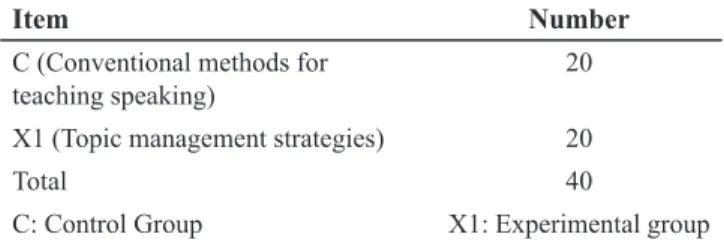
intermediate level measures. Based on the test results, only 40 students were found to be at the intermediate level and chosen to be part of the study. The students were then divid
-ed into two groups, Control Group and Experimental Group (20 students per group). See Table 1 below.
Instruments Proficiency test
As discussed earlier, this study is an experimental one. In order to fulfill the requirements of an experimental study, all the subjects of the study must be homogenous. A pre-test, namely a TOEFL test (Appendix A) is administered before the beginning of the study. This test was taken from the book Longman Preparation Course for the TOEFL Test: The Paper Test (Philips, 2004). All the students have to achieve the re
-quired score to participate in this study. This test includes three parts, listening, vocabulary, and grammar. PBT TOEFL test is divided into three sections: Section 1 - Listening com
-prehension (40 minutes - 50 items), Section 2 - Structure and written expression (25 minutes - 40 items) and Section 3 - Vocabulary and reading comprehension (45 minutes - 60 items). TOEFL scores for each section are reported on a scale that can range from 31 to 68. The scores are then scaled to give the total score. TOEFL total scores are reported on a scale that can range from 310 – 677. The following Table 2
shows the TOFEL scale ranking.
Speaking pre-test
The Speaking test is 16 minutes long and consists of three parts. The standard test format is two candidates and two
examiners. One examiner (the interlocutor) conducts the test, providing the student with the necessary materials and
explaining what the student has to do. The other examin -er (the assessor) will be introduced to the student, but then
takes no further part in the interaction (Cambridge, 2013). Part 1 (2 minutes) - The interlocutor first asks you and your partner a few questions, which focus on informa
-tion about yourselves.
Part 2 (4 minutes) - In this part of the test you and your
partner are asked to talk together. The interlocutor plac-es a set of picturplac-es on the table in front of you. There may be only one picture in the set or as many as seven pictures. This stimulus provides the basis for a discus
-sion. The interlocutor first asks an introductory question
which focuses on two of the pictures (or in the case of a single picture, on aspects of the picture). After about 1
minute, the interlocutor gives you both a decision-mak -ing task based on the same set of pictures.
Part 3 (10 minutes) -the students are each given the opportunity to talk for 2 minutes, to comment after his
partner has spoken and to take part in a more general discussion.
The interlocutor gives the student a card with a question
written on it and asks him to talk about it for 2 minutes. After the student has spoken, the interlocutor asks them both
an-other question related to the topic on the card, addressing the partner first. This procedure is repeated, so that his partner receives a card and speaks for 2 minutes and a follow-up question is asked. Finally, the interlocutor asks some further questions, which leads to a discussion on a general theme related to the subjects already covered in Part 3.
Treatment
Topic Management Strategies were applied to the
Experimental Group to explore the influence of Topic Management on the speaking ability of the learners while the other group (Control Group) received no treatment (tradition -al methods of speaking teaching were applied). The
partici-pants in the Experimental Group received training on Topic management Strategies over 10 sessions. The treatment in
-cluded teaching speaking skill using ordinary teaching mate -rials in speaking as well as topic managing skills. The learners
in the Control Group, on the other hand were taught normal speaking lessons over the same period (10 sessions) but with no treatment. At the end of the 10 weeks, both groups took a
speaking post-test, the same speaking test that was applied
to them before they start the 10 weeks learning. There was
a pattern used to conduct the research, which is as follows.
G 1 (Experimental Group) O1 X O2 G 2 (Control Group) O3 O4
In this formula O1 and O3 are the tests before applying the treatment for the experimental and control groups re
-spectively, and O2 and O4 are the tests after manipulating the variable again for experimental and control groups re
-spectively, and X is the treatment.
Speaking post-test
This test was administered to all 40 students at the end of the 10 weeks learning period. The only difference between Table 2.TOEFL scoring scale
Level Score
Elementary 380
Intermediate 450
Working Proficiency at 550
Advanced Level at 630
Table 1. Division of students to two groups
Item Number
C (Conventional methods for
teaching speaking) 20
X1 (Topic management strategies) 20
Total 40
the two groups in regard to the test is that the Experimental Group took the test after they received the treatment on Topic management while the Control Group took it with no treat -ment. The format and structure of the post-test is the same of the pre-test that was administered to the students at the begging of the course. This is to see whether the treatment
has any effects on the students’ speaking ability.
Data Collection and Analysis
The Control Group (20 students) received normal speak
-ing teach-ing for 10 weeks, twice a week, one hour and a quarter each session. They received conventional classroom
instruction and met in a regular classroom the entire time.
The lessons used for the conventional classroom speaking instruction were originally compiled by the teaching staff of Shokouh institute and have been used for years. The second group, which is the Experimental Group, included 20 stu
-dents. To uncover the influence of Topic Management on the speaking ability of the students, topic managing strategies
were taught in addition to the normal speaking teaching to
the students over the same period (10 weeks). During inter
-vention, which lasted 10 sessions, the students of this group
were taught different kinds of Topic Management strate-gies such as topic shift, topic initiation, topic termination, and turn taking. All the instructions and interactions during
the treatment time (10 weeks) were in English and the stu
-dents were exposed to different types of Topic Management
Strategies and taught skills on how to manage the topic when
speaking L2. After 10 sessions of training, the post-test was
administered. Two groups of scores were obtained from the learners, the pre-test scores before the treatment and the post-test scores after the treatment. In order to answer the
research question, these two groups of scores were analyzed by the SPSS software version 22th. Two paired sample t-tests and an independent sample t-test were used to analyze the obtained scores. The purpose behind this was to unveil the effect of the independent variable “using Topic Management in conversations” on the dependent variable “speaking abili
-ty” of the Iranian intermediate EFL learners.
FINDINGS
Evaluation of Overall Foreign Language Proficiency (TOEFL) Test for the Sampling Purpose
The first thing a researcher should pay attention to before applying any treatment to his research participants, is to be sure about their homogeneity (Field, 2009). To check the ho
-mogeneity of the research participants, a TOEFL proficien
-cy test was administered to 60 students. This test was used not only to show the homogeneity of the students, but also to determine the students who meet the intermediate level’s criteria. The results of the test were analyzed using a descrip
-tive statistics.
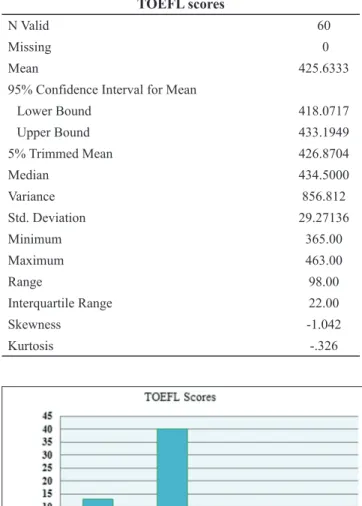
Table 3 shows the numerical statistics of the TOEFL proficiency test for the 60 students studying English at
Shoukoh English institute. This test was administered to
find the homogeneity of the students. Therefore, measures
of dispersion (the variance, the range, and the standard de
-viation), central tendency measures (the mean, the median, and the mode), measures of stability or the standard error, and measures of variability (maximum, minimum, and range of values) have been checked and shown in the above-men -tioned table. Moreover, measures of the shape of distribution namely Kurtosis and Skewness were measured, respectively. The Kurtosis value of +/- 1 is considered as a good point of normality for a test, since the Kurtosis level of the scores is – 0.326 it can be said that the population is normal based on the level of Kurtosis. The acceptable value for the Skewness mea
-sure is (+/- 1 to +/- 2), the Skewness value of these 60 students is – 1.042. Although this value is not so positive, the normality
of this test is acceptable based on the Skewness measure.
As the study focuses on the intermediate level, students above or under the intermediate level measures have been ex
-cluded. 40 students who score from 380 to 450 were consid
-ered in the intermediate level. 7 students scored more than 450 and 13 other scored lower than 380 points were excluded be
-cause they did not meet the intermediate level measures (380 to 450 points). That is, only 40 students who were at the inter
-mediate level were selected to take part in the study (Figure 1).
Table 3. Statistics for the results of TOEFL test TOEFL scores
N Valid 60
Missing 0
Mean 425.6333
95% Confidence Interval for Mean
Lower Bound 418.0717
Upper Bound 433.1949
5% Trimmed Mean 426.8704
Median 434.5000
Variance 856.812
Std. Deviation 29.27136
Minimum 365.00
Maximum 463.00
Range 98.00
Interquartile Range 22.00
Skewness -1.042
Kurtosis -.326
Examining the Normality Assumption of the Parametric Tests Applied for the Research Question
Before applying this test on the scores of the students, the normality assumption of the tests must have been checked. There are some tests to examine the normality assumption of the data namely, Kolmogorov-Smirnov test, Lilliefors corrects
K-S test, Shapiro-Wilk test, Anderson-Darling test, and so on.
The researcher decided to investigate the normality assump
-tion of the students based on the Kolmogorov-Smirnov test.
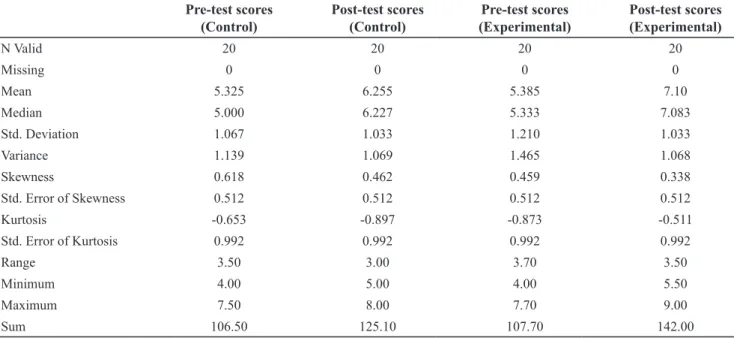
Table 4 shows the statistics of the pre-test and post-test of both groups (Control and Experimental). These statistics show
that the distribution was normal, based on the obtained data
of Skewness and Kurtosis values. The results of Skewness, which was obtained by dividing the results of Skewness by its standard error showed that the assumption of normality was
met in the pre and post-tests of both groups. The Skewness of
the pre-test of the control group was 0.618, and it was 0.462
for the post of the same group. The Skewness result of the
pre-test of the Experimental Group was 0.459, and the result was 0.338 for the post-test of the same group. All the result fall between -2 to +2, therefore it can be said that the data met the normality assumption based on the Skewness test. The
Kurtosis of the pre-test of the Control Group was -0.653, and it was -0.897 for the post-test of the Control Group.
The kurtosis results for the Experimental Group pre-test were -0.873, and -0.511 for the post-pre-test. Although, the above-mentioned statistics shows the normality of the assumption, a one-sample Kolmogorov-Smirnov test was applied in order to approve the normality assumption of the scores more accurately. The following table shows the
ob-tained data for one sample Kolmogorov-Smirnov test (ab
-breviated as K-S test).
Table 5 shows the normality assumption of the 40 partic -ipants speaking scores. The obtained data for all groups are
higher than 0.05, which shows that they have a normal dis -tribution. As the parameters of all four distributions assume,
the normality assumption has been met. Table 4. Statistics for the pre-test and post-test scores of the control and experimental groups
Pre-test scores
(Control) Post-test scores(Control) (Experimental)Pre-test scores Post-test scores(Experimental)
N Valid 20 20 20 20
Missing 0 0 0 0
Mean 5.325 6.255 5.385 7.10
Median 5.000 6.227 5.333 7.083
Std. Deviation 1.067 1.033 1.210 1.033
Variance 1.139 1.069 1.465 1.068
Skewness 0.618 0.462 0.459 0.338
Std. Error of Skewness 0.512 0.512 0.512 0.512
Kurtosis -0.653 -0.897 -0.873 -0.511
Std. Error of Kurtosis 0.992 0.992 0.992 0.992
Range 3.50 3.00 3.70 3.50
Minimum 4.00 5.00 4.00 5.50
Maximum 7.50 8.00 7.70 9.00
Sum 106.50 125.10 107.70 142.00
Table 5. One-sample Kolmogorov-Smirnov Test for Pre/Post-test of the control and experimental groups Pre-test
(Control) (Control)Post-test (Experimental)Pre-test (Experimental) Post-test
N 20 20 20 20
Normal parameters a,b Mean 5.3250 6.2550 5.3850 7.1000
Std. Deviation 1.06715 1.03389 1.21017 1.03364
Most extreme differences Absolute .220 .167 .168 .139
Positive .220 .167 .168 .139
Negative -.107 -.112 -.126 -.081
Test Statistic .220 .167 .168 .139
Asymp. Sig. (2-tailed) .112c .144c .142c .200c,d
a. Test distribution is Normal., b. Calculated from data.,c. Lilliefors Significance Correction.md. This is a lower bound of the true significance
Table 6. Group statistics of speaking ability pretest for experimental and control group
Groups N Mean Std.
Deviation Std. Error Mean Scores Control 20 5.3250 1.06715 .23862
Performance of the Participants on Speaking Skill Pre-test
The scores of both groups were analyzed using SPSS ver -sion 22th. The results of the independent sample t-test for
analyzing the pre-test scores of the students are shown in the
following tables.
Table 6 illustrates the statistics of both groups clearly. The first row of the table indicates the data related to the con
-trol group. As it is obvious, both groups include 20 students. The total score of the test was 10 based on the speaking score scale. The mean score of the Control Group was 5.325, and the mean score of the Experimental Group was 5.385 as it is shown in Table 4. Although, the Experimental Group got the higher mean score, the significance of the groups is not as much different as it seems. The significance of these groups are displayed in Table 7, Figure 2 shows the statics of the table 4.4 more clearly.
Table 7 shows the p value is 0.869, and F = 0.313. Since the significance of this test is 0.869 and it is obviously higher than 0.05 that is to say (p = 0.869 > 0.05), consequently it indicates that there is no significant difference between these two groups in terms of their speaking ability. That is to say, both groups are homogenous, and they can go through the requirements of this study, in other terms these groups are comparable and ready to receive the treatments.
DISCUSSION OF THE FINDINGS
The research question of this study deals with the effects of Topic Management Strategies on the speaking ability of the
Iranian intermediate EFL learners. An independent sample
t-test was used, to analyze the scores of post-test of both
groups. The following tables clearly illustrate the results.
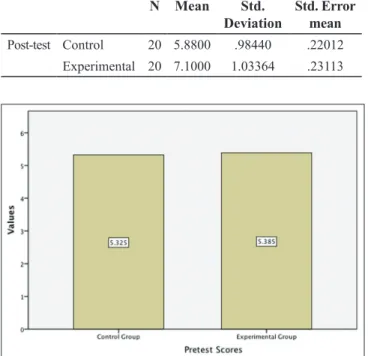
As it is shown in Table 8, the speaking skill post-tests
of the two groups have been compared since homogene
-ity was proved at the beginning of the study. In the table,
the mean score of the experimental group is 7.100, and the mean score of the control group is 5.880, respectively.
As it was mentioned in Table 4.4, the pre-tests’ mean score of the Experimental Group was 5.385, and the mean score of the Control Group was 5.325. It should not be ignored that both groups had 20 participants, and the experimental group received Topic Management Strategies training as part of the study. Obviously, the mean score of both groups have improved. The researcher analyzed both groups mean
scores to see which factor has the better effect on speaking
ability of the Iranian intermediate EFL learners. Since the
Table 8. Statistics of the post-test of control and
experimental group
N Mean Std.
Deviation Std. Error mean Post-test Control 20 5.8800 .98440 .22012
Experimental 20 7.1000 1.03364 .23113 Table 7. Independent samples t-test of speaking ability pre-test of control and experimental group
Levene’s Test for equality of variances . F Sig t df Sig.
(2-tailed) differenceMean Std. Error difference 95% Confidence interval of the difference
Lower Upper
Speaking
Pretest Equal variances assumed .313 .579 -.166 38 .869 -.06000 .36078 -.79037 .67037
Equal variances
not assumed -.166 37.41 .869 -.06000 .36078 -.79075 .67075
Experimental Group got the higher mean score, it seems
that Topic Management Strategies had a better effect on the
speaking ability of these participants. Therefore, it can be said that the null hypothesis of the study is rejected. However, to prove this result more accurately the p and t value should be
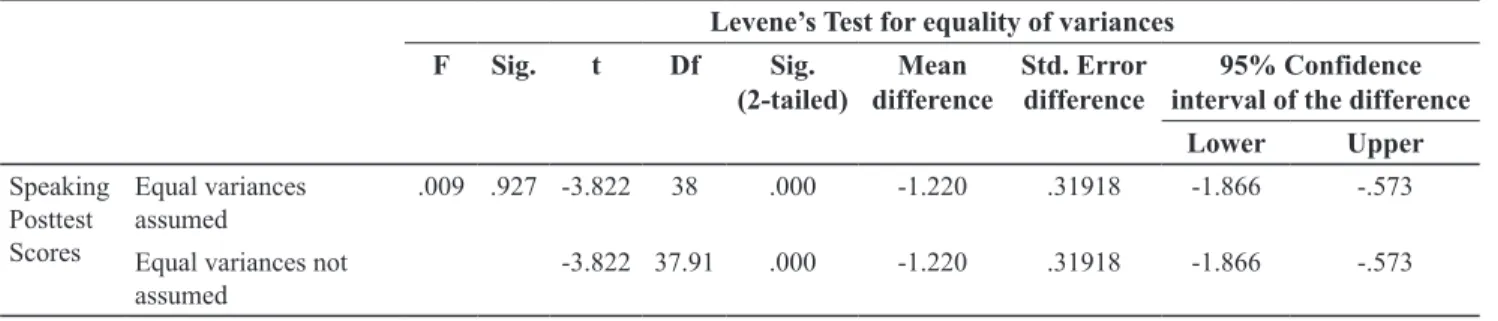
checked as well, which is mentioned in the following table. Table 9 explains the independent samples t-test of the speaking ability post-test of both groups. The level of sig
-nificance (that is 0.927) is clearly bigger than 0.05, so it obviously shows that the variances are equal. Besides, the significance level is 0.000, which is smaller than 0.05 (that is = p value 0.000 < 0.05). In the column of 95% confidence interval of the difference, zero is not included (that is -0.573 and -1.866). So, these groups do not have similar effects on speaking ability of Iranian intermediate EFL learners, and
there is a meaningful difference between the populations.
Based of this, it could be said that the null hypothesis of the current study is not proved, and that topic management strat
-egies have a great influence on speaking ability of the Iranian
intermediate EFL learners.
Figure 3 shows the difference between the mean score of
Table 9. Independent sample t-test of experimental and control groups
Levene’s Test for equality of variances
F Sig. t Df Sig.
(2-tailed) differenceMean Std. Error difference interval of the difference95% Confidence Lower Upper Speaking
Posttest Scores
Equal variances
assumed .009 .927 -3.822 38 .000 -1.220 .31918 -1.866 -.573
Equal variances not
assumed -3.822 37.91 .000 -1.220 .31918 -1.866 -.573
the mean score of the Experimental Group is higher than the mean score of Control Group. This means that Topic Management Strategies have a noticeable influence on the speaking ability of tested participants.
CONCLUDING REMARKS
To conclude, this study aimed to explore the effect of Topic Management on the speaking ability of Iranian intermedi
-ate EFL learners. The results show that both the Control and Experimental groups have (to some extent) improved their speaking abilities after the treatment. Nevertheless, the participants of the Experimental Group who underwent the treatment achieved more scores in their speaking post-test compared to the Control Group. (Figure 3 clearly explains
the difference between the mean score of the speaking post-test of both groups.)
These findings are in line with Sacks (1992) and Herman’s (1998) argument that Topic Management has a remarkable influence on the speaking ability of learners. Herman (1998) argues that students with a high proficiency level are more successful in using Topic Management. The findings support this argument and further add that inter
-mediate level learners can also handle Topic Management Strategies successfully in their conversation to improve their speaking ability.
Erber (1996) posts that Topic Maintenance helps
speak-ers handle convspeak-ersations smoothly and successfully and that Topic Management Strategies have positive effects on the speaking ability of learners. According to him, Topic
Maintenance is deemed to be more effective since it does not need new information. The findings of this study sup -port this argument and further add that Topic Management
Strategies not only improve the speaking ability of students, but they also improve other learning skills such as writing
and listening.
The findings of this study also support the contentions of Jones (2008) and Schegloff (1992) stating that Topic Management is a social behavior that helps learners build their self-esteem. It (the study) found that controlling over Topic Management as a skill can effectively influence not only on the speaking ability of learners, but also increase their confidence when they practise speaking in the foreign
language.
Finally, due to the scope and size of the study, the re
-sults obtained cannot be generalized to large populations and hence, further detailed investigation into the topic is advised.
REFERENCES
Bedrosian, J. L. (1993). Making minds meet: Assessment of conversational topic in adults with mild to moderate
mental retardation. Topics in Language Disorders, 13 (3), 36-46.
Brown, G., & Yule, G. (1982). Teaching the spoken Language: An Approach based on the analysis of con-fersational English. Cambridge: Cambridge University
Press.
Brown, H., (1994). Teaching by Principles: An Interactive Approach to Language Pedagogy. Englewood Cliffs, NJ: Prentice-Hall Regents.
Burns, A., & Joyce, H. (1997). Focus on Speaking. National Centre for English Language Teaching and Research.
Sydney, Australia: Macquarie University press.
Weir, C. J., Vidaković, I., & Galaczi, E. D. (2013). Measured
constructs: A history of Cambridge English
examina-tions. Cambridge: Cambridge University Press.
Caissie, R. (2000). Conversational topic shifting and its ef
-fects on communication breakdowns for individuals
with hearing loss. The Volta Review, 102, 45-65. Chaney, A. L., & Burk, T. L. (1998). Teaching Oral
Communication in Grades K-8. USA, LA: Allyn and
Bacon.
Cook, V. (1989). Reciprocal language teaching: Another alternative. Modern English Teacher, 16(3/4), 48-53.
Du-Babcock, B. (1999). Topic management and turn taking in professional communication:
First-versus second-language strategies. Management Communication Quarterly, 12(4), 544-574.
Erber, N. P. (1996). Communication therapy for adults with sensory loss. Melbourne, Australia: Clavis Publishing. Hedge, T. (2001). Teaching and learning in the language
classroom. Oxford, England: Oxford university press. Culpeper, J., Short, M., & Verdonk, P. (2002). Exploring
the language of drama: from text to context. London: Routledge.
Ochs Keenan, E. (1976). The universality of conversational
postulates. Language in Society, 5(1), 67-80.
Nunan, D. (2003). Practical English. Language Teaching.
New York: Mc Graw Hill.
Philips, D. (2004). Longman Introductory Course for the TOEFL Test: The Paper Test. New York: Pearson
Longman
Richard.P. (1990). Topic Continuity in the Kenyan Press: A Case for Swahili and English,”. Ghent, Belgium:
Academia Press.
Rivers, W. M. (2018). Teaching Foreign Language Skills.
USA, Chicago: University of Chicago Press.
Sacks, H. (1992). An analysis of the course of a joke’s tell-ing in conversation Explorations. In Bauman, R., & Sherzer, J. (Eds.), The ethnography of speaking (pp. 67-85). Cambridge: Cambridge University Press.
Schegloff, E. A. (2000). Overlapping talk and the organiza
-tion of turn-taking for conversa-tion. Language in
soci-ety, 29 (1), 1-63.
Ur, P. (1996). A course in language teaching: Practice &
Theory. In Baker, J., & Westrup, H. Essential speaking skill (pp. 184-187). Britain: Continuum.
Wong, J., & Waring, H. Z. (2010). Conversation analysis
and second language pedagogy: A guide for ESL/EFL
teachers. London: Routledge.
Yieke, F. A. (2007). Gender and topic management in dis
-course: The glass ceiling as a reality for women in cor