R E S E A R C H
Open Access
Automated identification of sensitive data
from implicit user specification
Ziqi Yang and Zhenkai Liang
*Abstract
The sensitivity of information is dependent on the context of application and user preference. Protecting sensitive data in the cloud era requires identifying them in the first place. It typically needs intensive manual efforts. More importantly, users may specify sensitive information only through an implicit manner. Existing research efforts on identifying sensitive data from its descriptive texts focus on keyword/phrase searching. These approaches can have high false positives/negatives as they do not consider the semantics of the descriptions. In this paper, we propose S3, an automated approach to identify sensitive data based on users’ implicit specifications. Our approach considers semantic, syntactic and lexical information comprehensively, aiming to identify sensitive data by the semantics of its descriptive texts. We introduce the notionconcept spaceto represent the user’s notion of privacy, by which our approach can support flexible user requirements in defining sensitive data. Our approach is able to learn users’ preferences from readable concepts initially provided by users, and automatically identify related sensitive data. We evaluate our approach on over 18,000 top popular applications from Google Play Store. S3 achieves an average precision of 89.2%, and average recall 95.8% in identifying sensitive data.
Introduction
In the cloud era, cloud-based application vendors often collect a large variety of information about users to pro-vide customized service and enhanced experience. Pro-tecting users’ sensitive data from being leaked is one of the major challenges in such applications. Recent security incidents of cloud-based services have shown that the pri-vacy of hundreds of millions of users can be easily affected (Yahoo! data breaches; USA Today: Driver’s license) in compromised cloud services .
Protecting sensitive user data requires identifying them in the first place, which is the basis of providing stronger but more expensive mechanisms to ensure sensitive data security against a powerful adversary. There are many existing research efforts (Enck et al.2010; Lu et al.2015; Rastogi et al. 2013; Zhou and Jiang 2013; Mannan and van Oorschot2007; Zhou and Evans2011; Budianto et al. 2014) on protecting sensitive data both on client applica-tions and the cloud platforms. Researchers also develop solutions that utilize trusted environments (Bursztein et al.2012; Roalter et al.2013; Oprea et al.2004; Sharp et al. 2008), such as secure mobile devices, to protect the
*Correspondence:[email protected]
School of Computing, National University of Singapore, Singapore, Singapore
security of sensitive data from being compromised. Other solutions (Li et al.2014; Enck et al.2010; Lu et al.2015; Rastogi et al.2013) perform taint analysis based on user-specified sensitive data sources in the mobile platforms to study the data flow of these sources.
However, the sensitivity of data is often subjective. Deciding whether a piece of data is sensitive subjects to users’ preference and the application context. User’s privacy preference may also change overtime. Identify-ing sensitive data typically needs intensive manual efforts (Nan et al.2015), which can hardly guarantee accuracy and cannot support large-scale analysis of sensitive data. Therefore, we need a way that can automatically identify sensitive data based on users’ subjective requirements.
In this work, we propose a technique to identify sensi-tive data from implicit user specifications. We focus on mobile applications, but the solutions we develop can be more generally applicable in other scenarios of protect-ing user privacy in the cloud environment, which we will discuss at the end of the paper. Sensitive data is hardly distinguishable from insensitive data in their technical representations. For example, in an mobile application, the element displaying a user’s bank balance is technically represented as the same type of text element displaying
the bank name. However, it’s easy for the user to know that her bank balance is more sensitive than the bank name, because she understands the meaning of the data or its surrounding descriptive text. Therefore, instead of analyz-ing source code of applications, it is more accurate and efficient to identify sensitive data from the user interface (UI), and understand the semantic meaning of data or its surrounding descriptive text.
Several solutions have been proposed to identify sen-sitive data using the descriptive text in mobile appli-cations. Supor (Huang et al. 2015) identifies sensitive input data of Android applications by keyword based searching on descriptive texts. UIPicker (Nan et al.2015) utilizes SVM (Support Vector Machine) to learn sensi-tive descripsensi-tive texts with sensisensi-tive keywords as features. AutoCog (Qu et al. 2014) identifies the real permis-sions an Android application requires from its descrip-tions on Google Play, by analyzing the semantic meaning of noun phrases, verb phrases and possessives. Why-per (Pandita et al. 2013) considers both actions and noun phrases to further increase the accuracy. How-ever, all the existing approaches are based on only key word/phrase/counterpart searching, with no complete semantic information considered. For instance, all of them incorrectly classify the sentence “Facebook will not save your password” as sensitive because of the detec-tion of a sensitive phrase “save your password”, though it is only a normal claim message. Moreover, none of the prior work takes into account the flexible user requirements.
In this paper, we propose a novel technique, S31, to identify sensitive data. S3 aims to understand users’ pref-erences by extracting the semantic concepts from a set of user-provided texts, and identifies unseen sensitive data with a learning-based approach. Instead of out-putting a Boolean result in prior work, S3 produces a reference probability of a text being sensitive to make the measurement controllable by setting a threshold in different strictness levels. Besides, S3 classifies sensitive data as multiple categories such as credential data, pro-file data and financial data, in a more fine-grained way, so that users and developers are able to choose differ-ent categories of sensitive data on demand for further protection.
Contributions.
– To the best of our knowledge, S3 is the first automated approach to precisely identify sensitive data by analyz-ing its semantic meananalyz-ing on a large scale. S3 reduces much manual effort of identifying sensitive data for further protection and research on it.
– S3 supports flexible user requirements in defining sensitive data. It enables users to define sensitive data on demand by providing initial concepts. Then S3 is
able to automatically identify unseen sensitive data by learning from the concepts.
– We conduct a series of evaluation, and compare S3 with existing approaches. Evaluation results show that S3 is able to identify sensitive data with high precision and recall, and can correctly identify instances which are not handled in existing approaches.
Overview
In this section, we introduce our motivation, and ana-lyze the challenges faced by sensitive data identification. We then introduce techniques used in natural language processing (NLP) as a background.
Motivation
Many existing research efforts (Enck et al.2010; Lu et al. 2015; Rastogi et al.2013; Zhou and Jiang2013; Mannan and van Oorschot2007; Zhou and Evans2011; Bursztein et al.2012; Roalter et al.2013; Oprea et al.2004; Sharp et al.2008) have been proposed on sensitive data protection and taint analysis in mobile and web applications. In par-ticular, many existing work (Li et al.2014; Enck et al.2010; Lu et al.2015; Rastogi et al.2013) studies the security top-ics on predefined sensitive data sources. For example, one can track the privacy disclosures of sensitive user inputs to different sinks with proper static or dynamic taint anal-ysis. With static program analysis, one can also find the vulnerabilities in mobile applications that may disclosure sensitive user inputs to public or attacker controlled out-put. Secure display and input (Li et al. 2014) provides an end-to-end channel that ensures sensitive display and input can never be accessed by untrusted Android drivers. However, identifying these sensitive data in existing work requires much manual effort. Furthermore, manual identification of sensitive data cannot guarantee the accu-racy and large-scale deployment. Therefore, a systematic automated approach to identify sensitive data is important and required to deploy existing research work on sensitive data protection efficiently on a large scale. It is necessary to automatically identify sensitive data for further protec-tion or analysis of existing work. Hence, it helps reduce the burden of manual identification, and increases the accuracy as well.
users’ preferences could either bring about users’ addi-tional efforts to handle unimportant data, or expose user’s real sensitive information unprotected. Therefore, it is important to identify sensitive data in a more flexible and on-demand way.
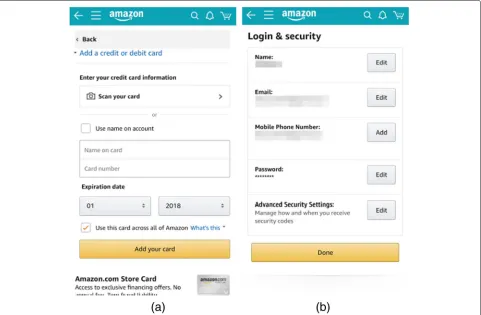
Sensitive data (e.g., login input box, shopping history, and profile data) in a UI widget is usually surrounded or embedded with a descriptive text (Huang et al.2015; Nan et al. 2015), indicating its functionality. Figure 1 shows two mobile screens that contain some critical sensitive data in the Amazon Shopping application (Amazon shop-ping application). Figure1arequires the user to input the credit card information to accomplish the payment pro-cess. Both input boxes are associated with descriptive text
“Name on card” and “Card number”. In Fig. 1b, user’s login profile data is listed on the screen with correspond-ing descriptive text as well. Such descriptive text in mobile applications is usually short, and well-spelled. By under-standing such descriptive text, one is able to identify the sensitive data for further protection or analysis. Supor (Huang et al.2015) proposes an effective solution to locate the sensitive data based on the location of corresponding descriptive text. However, it only performs simple key-word based searching on identifying the descriptive text
which limits its capability of handling unseen text. There-fore, the core part in identifying sensitive data is to under-stand the semantic meaning of surrounding descriptive text, which motivates our work.
Challenges in Sensitive Data Identification.
Semantic Understanding. The data sensitiveness is highly dependent on its semantic meaning. For instance, the sentence “Facebook will not save your password.” does not indicate sensitive data, because it is just a declaration text showing Facebook will not violate users’ privacy. Prior work (Huang et al.2015; Nan et al.2015; Qu et al.2014; Pandita et al.2013) incorrectly identifies this text as sen-sitive because of the detection of a key phrase “save your password”. Consider two sentences, “Register account” and “Account registered”. The former one describes a sensitive operationrequesting information, and the latter one is a hint textconfirmingthat the account has already been reg-istered. Existing work cannot distinguish the sensitiveness of the two sentences, because they are composed of same sensitive keywords “register” and “account”. Another rep-resentative example is “Log in” and “Logged in”. The first one describes a sensitive operation but the second one is a normal message indicating the user has already logged
in. Both of them have the same words, regardless of their forms, but their sensitiveness are significantly different, because of the different part of speech of “log”. Therefore, to give a more accurate measurement of the sensitiveness, we have to learn its semantic meaning.
Implicit Specification. Sensitive data are subjective to users’ preferences and application contexts. It is prefer-able to identify sensitive data in a more flexible way, by allowing users to customize the classification of sensitive data they are really cared about. However, it is some-times intractable for users to explicitly describe/define what data are sensitive based on their implicit preferences. For example, one may want to protect his private profile information (e.g., Fig.1b), and he may have some notions of it such as first/last name, home address, and phone number. Nonetheless, these notions are far from sufficient to define profile data. It is challenging to understand the implicit meaning of users’ preferences from these notions, and further infer more related sensitive data belonging to the same “category”. For example, by understanding the semantic meaning of the user’s preference on “profile data”, it is possible to further automatically classify his age and gender as sensitive.
NLP Background
The semantic meaning of texts is critical for correctly identifying sensitive data. To understand the semantics of a text, we need NLP techniques to process it. With advance of existing NLP techniques, the grammatical structure of a natural language sentence can be parsed accurately. We next briefly introduce the key NLP tech-niques used in our work.
Parts Of Speech (POS) Tagging(Toutanova et al.2003; Klein and Manning2002). It is also called “word tagging”, “grammatical tagging” and “word-category disambigua-tion”. POS tagging is able to identify the part of speech (such as nouns and verbs) a particular word in a sentence
belongs to. Current state-of-the-art approaches have been shown to achieve 97% (Manning et al.2014) accuracy in classifying POS tags for well-written news articles.
Named Entity Recognition (Finkel et al. 2005). It is also known as “entity identification” and “entity extrac-tion”, and works as a subtask of information extraction. These techniques are able to classify words in a sentence into predefined categories such as names, quantities, and expressions of time.
Phrase and Clause Parsing. It is also known as “chunking”. This technique divides a sentence into a con-stituent set of words (or phrases) that logically belong together (such as a Noun Phrase and Verb Phrase) to analyze the syntax of the sentence. Current state-of-the-art approaches can achieve around 90% (Manning et al. 2014) accuracy in classifying phrases and clauses over well-written news articles.
Syntactic Parsing(Jurafsky and Martin 2000). It gen-erates a parse tree of a sentence showing the hierarchical view of the syntax structure for the sentence. By traversing the parse tree, we are able to identify target phrases (such as noun phrases and verb phrases) and POS tags.
S3 Design
In this section, we present the design of S3. We first give an overview. We then introduce the core components. They analyze the topic of a preprocessed text, and decides its sensitiveness.
Approach Overview
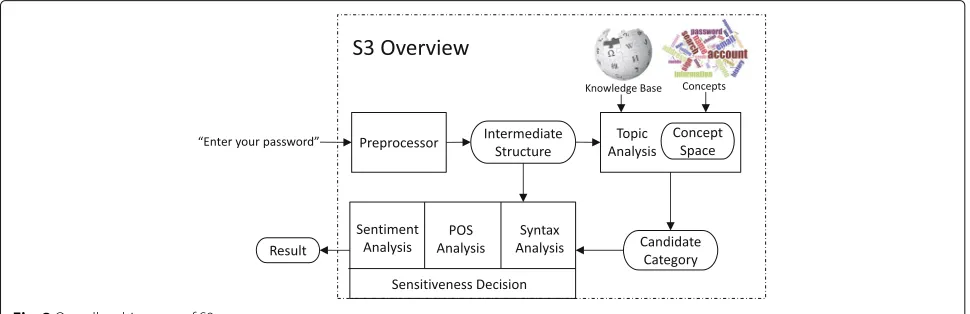
The overall architecture of S3 is illustrated in Fig.2. S3 takes a raw text as input.Preprocessorprocesses this text to generate an intermediate structure. The intermedi-ate structure is a data structure holding all the required information for further analysis. It contains the syntax information and other information such as noun phrases, verb phrases, POS tags, etc. Then S3 analyzes its topic by
extracting its semantic meaning, and produces a candidate sensitive category. Finally, S3 decides its sensitiveness by analyzing its syntax, POS, and sentiment information.
Each sensitive category is represented as a set of vectors, called concept space in the following, constructed from concept words/phrases provided by users. The knowledge base is a large corpus of texts, from which S3 is able to identify the semantic relation of unseen texts and the concept space, and thus determines its topic.
Preprocessing
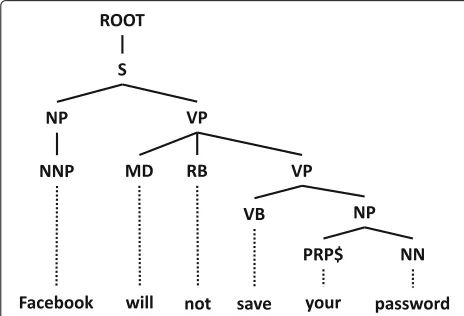
The NLP techniques we have discussed above are used as a preprocessor in S3 to accept the raw natural-language sentences as input and produces an intermediate struc-ture for further analysis. It uses standard NLP techniques to perform text splitting, stopword removal, phrase collec-tion, modifier extraccollec-tion, lemma recovery, part of speech tagging, and syntactic parsing. Figure3gives an illustrat-ing example of partial preprocessillustrat-ing result. The sentence node is labeled asS. It is the child of the root node. The interior nodes of the tree are labeled by non-terminal tags (e.g., verb phrases VP and noun phrases NP). The leaf nodes are labeled by terminal tags (e.g., pronouns
PRP$ and nouns NN). In summary, Table 1 lists the members of the intermediate structure of a text after preprocessing.
Text Splition. A piece of text could consist of one or more sentences. In our approach, we use Stanford Parser (Manning et al.2014) to split a piece of text into mupltiple sentences if any. We empirically observe that the descrip-tive texts of sensidescrip-tive data in widgets of mobile UI are short and are usually composed of a single sentence/phrase. For example, A noun phrase “Your password” and a sen-tence “Enter your password” describe a password input box. Therefore, a text containing multiple sentences is not likely to be the descriptive text of sensitive data. In our approach, for a coming text, preprocessor will return
Fig. 3Preprocessing of a sample sentence
Table 1Members of the intermediate structure
Item Description
Noun Phrase List Reflect the content of the data it describes
Verb Phrase List Reflect the operation it guides users to perform
Modifiers Adjectives of nouns in noun phrases
Lemma List Mapping of original word to its lemma form
POS Tag List Mapping of a word to its pos tag
Parse Tree Hierarchical view of the syntax structure for the sentence
identification result of insensitive text if it contains more than one sentence.
Stopword Removal. Stopwords are some of the most common words like “the”, “these”, “a”. Preprocessor removes stopwords because they offer no meaningful help in further analysis.
Named Entity Removal. Sometimes a sequence of words correspond to the name of entities that have a spe-cific meaning collectively (Pandita et al.2013). For exam-ple, the words/phrases “Google”, “Facebook” and “Google Play” are the names of companies/services. Further anal-ysis of such phrases would not bring any semantic value. Therefore, we identify such phrases and annotate them as single lexical units. We achieve so using Stanford Parser (Manning et al.2014).
Phrase Collection. For a single sentence/phrase, pre-processor extracts required information to construct an intermediate structure for further analysis. We have observed that the descriptive texts of input and output data have regular features that help users understand the purpose of the description. They can be summarized as follows.
1. Descriptive texts reveal the content of surround-ing data. For example, the sentence “Your password ” describes a password input box. The sentence “First Name” describes a first name input box or a field displaying a user’s first name.
2. Descriptive texts guide users to do some oper-ation. For example, Texts “Log in”, “Sign up” and “Register an account” describe operation buttons which conduct users to login, signup and register an account.
We observe that descriptive texts represent the con-tent of surrounding data as noun phrases, and use verb phrases to represent actions/operations. Based on the observation, preprocessor collects all the noun phrases and verb phrases of a sentence into the intermediate struc-ture using phrase and clause parsing as described in “NLP Background” section.
to affect the sensitiveness of a sentence. For example, A noun phrase “Email address” describes sensitive informa-tion (email address) while another noun phrase “Invalid email address” is just a hint sentence showing that the user has typed an invalid email address. In this instance, the modifier “Invalid” reduces the sensitiveness of the sen-tence. Based on this observation, preprocessor extracts adjectives from the noun phrases and save them in the intermediate structure.
Lemma Recovery. This process is for recovering inflected (or sometimes derived) words to their lemma, base or root form. Lemma recovery makes words such as “accounts” match to the single common lemma “account”. Lemma recovery can greatly improve the results of seman-tic analysis because it transforms the same meaning words to the same word and thus eliminates deviation. Prepro-cessor gets the lemma form of each word in a sentence using Stanford Parser (Manning et al.2014) and stores the (word, lemma) pairs in the intermediate structure.
Part of Speech Tagging. The part of speech of a word indicates the role it plays in a sentence. We observe that POS information also effects the sensitiveness of a sen-tence especially for verb phrases. For example, The verb phrases “Log in” describes a sensitive operation but the verb phrase “Logged in” is just a hint sentence showing that the user has already logged in. Even though the two verbs have the same lemma form “log”, different parts of speech effect the sensitiveness siginificantly. Preprocessor tags each word in a sentence with part of speech and stores the (word, pos) pairs in the intermediate structure.
Syntactic Parsing. Preprocessor generates a parse-tree structure for a sentence based on its grammar structure. The parse tree of a sentence shows the hierarchical view of the syntax structure for the sentence. For example, the parse tree of sentence “Facebook will not save your pass-word” is illustrated in Fig.3. The sentence node is labeled asS. It is the child of the root node. The interior nodes of the tree are labeled by non-terminal tags (e.g., verb phrases VP and noun phrases NP). The leaf nodes are labeled by terminal tags (e.g.,pronounsPRP$and nouns
NN). Preprocessor saves the parse tree in the intermediate structure for further analysis.
Topic Analysis
In this part, S3 analyzes the semantic information of a text to produce a candidate category of sensitive data.
Descriptive texts describe the content of surrounding data or some operation/action they guide users to do. Such content and opertions/actions are noted astopicsin this paper. The topic of a sentence can help S3 classify it to a more specific category of sensitive data. As discussed “Preprocessing” section, noun phrases in a sentence relate to the content of surrounding data and verb phrases relate to actions. Therefore they are used to analyze the topic
of a sentence. Both noun phrases and verb phrases in a sentence are extracted by preprocessor in the intermedi-ate structure. The topic of a sentence is reflected by the semantic meaning of noun phrases and verb phrases (e.g.,
the noun phrase “Your password” describes credential related input box and the verb phrase “Sign up” describes account related action). In S3, the semantic meaning of both phrases is obtained by measuring the semantic dis-tance between the target phrase and each sensitive cate-gory in a vector space, where each catecate-gory has its own cluster, referred to asconcept space. The closest sensitive category is chosen to classify its sensitiveness.
Concept Space. We use vector representations of words (Mikolov et al.2013) to create a domain of sensitive cate-gory to representconcept spacein our approach. The intu-ition is to cluster closely related sensitive words/phrases in the vector space, so that we are able to classify unseen texts based on the clusters. Such words and phrases in the clusters are calledconcepts, provided by users or develop-ers. For example, one may create a category “Credentials” by feeding concepts of “username”, “password” and “pin code”. S3 then constructs a concept space based on them for this category. Vector representation of words takes as its input a large corpus of text as knowledge base and produces a vector space, typically of several hundred dimensions, with each unique word in the corpus being assigned a corresponding vector in the space. Word vec-tors are positioned in the vector space such that words that share common contexts in the corpus are located in close proximity to one another in the space. However, vec-tor representation of words can only encode a single word to a vector, and thus is not applicable to phrases (mul-tiple words). In our approach, we encode a phrase using the mean of each word vector, thus treating each word identically important in a phrase.
An unseen word/phrase is classified to a sensitive cat-egory based on K-Nearest Neighbors (KNN) algorithm (Cunningham and Delany 2007). It first transforms the word/phrase to its vector representation, and then calcu-latesK nearest vectors under a predefined threshold of similarity distance in the concept space of each category. A word/phrase is classified to thei-thsensitive category ifKiis maximum, and assigned with the maximum
In total, for each category, we define concept space of noun phrases, of actions (verbs), and of single actions. Noun phrases in a descriptive text indicate the content of the surrounding data. They can also be dominated by actions, and such actions could affect the sensitiveness significantly. For example, in the sentence “Enter your password”, the noun phrase “your password” is dominated by an action “Enter”, and it describes sensitive data—a password input box. Nonetheless, in the sentence “Forgot your password”, the noun phrase “your password” is also dominated by an action “Forgot”, but it does not describe any sensitive data. Therefore, it is necessary to classify the sensitiveness by taking actions into consideration. There are also sentences containing only a single action in the descriptive texts, for example, “Log in”. Some sentences are composed of an action and a named entity, but the entity is removed in the preprocessing phase, and thus only a sin-gle action is left. For example, in the sentence “Pay with Paypal”, the noun phrase “Paypal” is a named entity and thus removed, but its dominant action “Pay” is sensitive. We also define concept of single actions to handle such cases. With the three types of concept space, S3 is able to identify the topic of a sentence.
Modifier Analysis. The semantic meaning of concepts are affected by the words modifying it. Specifically, a noun phrase often contains adjectives that can affect its sensitiveness. For instance, the sentence “Email address” describes sensitive profile information but the sentence “Invalid email address” is a normal hint message. There-fore it is necessary to analyze the sentiment of the adjec-tives to improve the accuracy. In our approach, we use SentiWordNet (Baccianella et al.2010) to give a sentiment score of an adjective. A negative adjective is assigned a negative value. The more negative the word is, the larger the absolute value of its sentiment score is. S3 first collects adjectives in a noun phrase using POS information in the intermediate structure. Then it adds the sentiment score
to its probability of being sensitive if the sentiment score is negative and thus reduces its probability.
Sensitiveness Decision
Topic analysis, giving only candidate sensitive category, is not sufficient to determine the sensitiveness. For instance, the sentence “Register account” describes a sensitive action but the sentence “Account registered” is an insen-sitive message showing that the account has already been registered. However they are both classified as the same sensitive category because they consist of same words in lemma form. The sentence “Log in” describes a sensi-tive action while the sentence “Logged in” is insensitive although it includes sensitive word “log”. In the sentence “Login failed”, the negative sentiment of this sentence makes it insensitive although it has sensitive action “login”. Therefore, despite topic analysis, S3 also performs syn-tax, lexical and sentiment analysis to finally determine the sensitiveness.
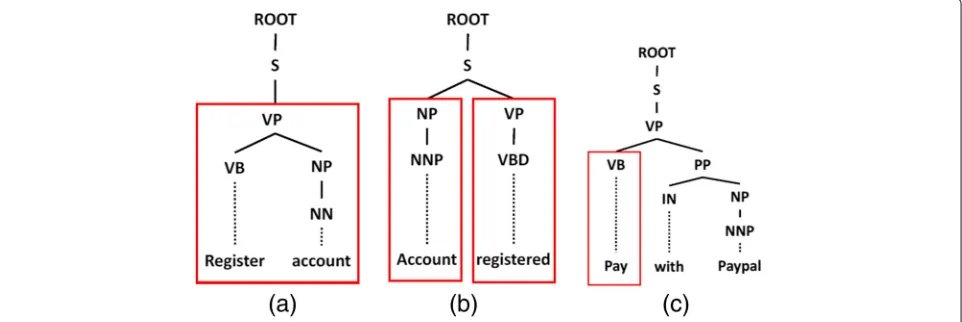
Syntax Analysis. Empirically, we observe noun phrases and verb phrases in sensitive descriptive texts usually have fixed syntactic patterns, and we note such nodes a Candi-date Block(CB) in the parsing tree. We summarize three syntactic patterns withCBnotations of a descriptive text as follows:
– Noun phrase only(CBNP). The noun phrase directly
indicates the content of the surrounding data. For instance, “Your password ” indicates a password input box.
– Verb only (CBA). The action (verb) indicates some
operation. For instance, “Log in” and “Register” describe sensitive account operations. “Pay with Pay-pal ” is also aCBA, as shown in Fig.4c, where “Paypal”
is removed as a name of entity.
– Verb phrase (verb+noun phrase) (CBANP). In the
parsing tree of a sentence, if a noun phrase node has
an ancestor verb phrase node (VP ), we say the noun phrase is dominated by the action in the VP. For instance, in “Register account”, the noun phrase node “account” has a fatherVP node of action “Register” as shown in Fig.4a, then the noun phrase is dominated by the action.
In the case ofCBAandCBNP co-existing in a text
with-out forming aCBANP, we empirically defines the priority
ofCBNP is higher than that ofCBA. For example, in the
case of “Account registered” as shown in Fig.4b, the noun phrase “account” is the emphasis of the sentence, and the action “registered” modifies it.
After S3 collects all the CBs, it checks if their ances-tor nodes or sibling nodes contain verb phrases. If verb phrases are found, the sentence is identified as insensitive. This is because the surrounding verb phrases can reduce the sensitiveness of aCBsignificantly. In Fig.4b, theCBNP
“Account” has a sibling verb phrase “registered”. Therefore the meaning of this sentence is to state the noun phrase is operated by the action and thus the sensitiveness of the noun phrase is reduced to insensitive by the action. In Fig.4a, theCBANPhas no surrounding nodes containing
verb phrases, so the whole sentence is sensitive.
POS Analysis. For sentences containing only aCBA ,
e.g.,“Log in”and “Logged in”, POS affects the sensitiveness of theCBAsignificantly. In our approach, we assume only
the base form (noted as VBin the parse tree) and non-3rd person singular present (noted asVBPin parse tree) of a verb remain the sensitiveness. Other forms of a verb will reduce the sensitiveness of theCBAto insensitive. For
example, the word “Logged” is tagged asVBN(past par-ticiple) in the sentence “Logged in”. The sensitiveness of this sentences is reduced to insensitive. S3 checks POS of the action in aCBAof a sentence to revise its sensitiveness.
Sentiment Analysis. We observe that negative sen-timent of descriptive texts makes it insensitive (e.g.,
“Login failed”). We have tried Stanford Sentiment Analysis (Socher et al. 2013) but it does not produce satisfac-tory results of identifying the sentiment of texts in our problem domain. We have observed that most of the neg-ative descriptive texts include some common keywords like “fail”, “no”, “error”, etc. In our approach, we make a list of such negative words. S3 performs a keyword-based searching in a sentence to analyze its sentiment. A sentence is negative if it contains any of the negative keywords.
Implementation
In this section, we describe the details of our implemen-tation of S3, including the frameworks and tools we built upon.
We implemented the preprocessor based on Stanford CoreNLP (Manning et al.2014) to generate the intermedi-ate structure, which is a stintermedi-ate-of-the-art suit of core NLP
tools including Stanford Parser from Stanford. It can give the base forms of words, their parts of speech, whether they are names of entities, mark up the structure of sen-tences in terms of phrases and word dependencies. It has multiple annotators to indicate different NLP tools. We use annotators in the order of “tokenize, cleanxml, ssplit, parse, pos, lemma, ner” to remove XML tokens from a document, split sentences, tokenize a sentence, give the lemma form and part of speech of a token, label named entities, and generate the parse tree. We make a list of stopwords to help preprocessor remove stopwords in a sentence.
To map words to the concept space, we implemented Stanford GloVe (Pennington et al.2014) for vector repre-sentation of words. GloVe is the state-of-art unsupervised learning algorithm for obtaining vector representations for words. Training is performed on aggregated global word-word co-occurrence statistics from a corpus, and the resulting representations showcase interesting linear substructures of the word vector space. We use English Wikipedia 2014 (Wikipedia) and Gigaword version 5 (LDC: English gigaword fifth edition) as the base corpus. Each word is represented as a vector of 300 dimensions.
To analyze the sentiment of a sentence, we make a list of negative keywords to detect negative sentences. The list we use in this paper is “fail”, “error”, “wrongly”, “wrong”, “invalid”, “incorrect”, “miss”, “no”, “not”.
Excluding the underlying libraries, our prototype of S3 consists of 1156 lines of code in Java.
Evaluation
In this section, we present the evaluation of S3. Given a piece of text, S3 classifies it to some sensitive category with a probability. We first introduce the experiment setup of evaluation. Then we analyze the results of evaluation, and compare S3 with related work. Finally we analyze the causes of producing false positives and false negatives.
Evaluation Setup
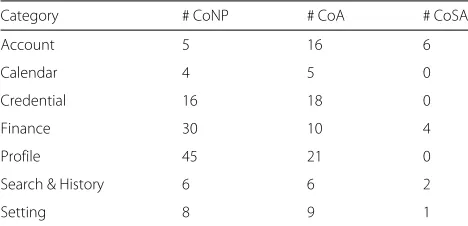
category, we define concepts for noun phrases, actions and single actions respectively. Information of the 7 cate-gories is illustrated in Table2.
We first manually annotate the top 5152 frequent texts using the listed categories. In our evaluation, we invite five volunteers to annotate these texts independently. A text is annotated as one category only if at least three volunteers label the text as the same category. Then S3 is applied on these texts to output results under different thresholds of similarity distance from 0.5 to 1.0 with 0.05 as interval. For each threshold, we measure the number oftrue posi-tives (TP),false positives (FP),true negatives (TN)andfalse negatives (FN), which are illustrated as follows:
– TP: A text which S3 correctly identifies as sensitive (category).
– FP: A text which S3 incorrectly identifies as sensitive (category).
– TN: A text which S3 correctly identifies as not sensi-tive (category).
– FN: A text which S3 incorrectly identifies as not sensitive (category).
In statistical classification (Olson and Delen2008), Pre-cision is defined as the ratio of the number of true positives to the total number of items reported to be true, and Recall is defined as the ratio of the number of true positives to the total number of items that are true.F-scoreis defined as the weighted harmonic mean of Precision and Recall.Accuracy is defined as the ratio of sum of true positives and true negatives to the total number of items. Higher values of precision, recall, F-Score, and accuracy indicate higher quality of S3 to iden-tify sensitive data. Based on the total number of TPs, FPs, TNs, and FNs, we compute the precision, recall, F-score, and accuracy of S3 in identifying sensitive texts as follows:
Precision= TP
TP+FP (1)
Table 2Categories of sensitive data
Category # CoNP # CoA # CoSA
Account 5 16 6
Calendar 4 5 0
Credential 16 18 0
Finance 30 10 4
Profile 45 21 0
Search & History 6 6 2
Setting 8 9 1
#CoNP: Number of noun phrases; #CoA: Number of actions; #CoSA: Number of single actions
Recall= TP
TP+FN (2)
F–score= 2·Precision·Recall
Precision+Recall (3)
Accuracy= TP+TN
TP+FP+TN+FN (4)
Results
In this section, we describe the evaluation results and compare S3 with related work. We first measure the effectiveness of S3 under different thresholds in identi-fying sensitive texts to find the optimal threshold. Then we analyze in detail the effectiveness under the optimal threshold. Finally, we compare S3 with other approaches.
Threshold Setting
Errors of S3 come from false positives and false negatives. S3 seeks to achieve higher performance than prior work by reducing false positives and false negatives. However, to choose the optimal threshold in the trade-off of false pos-itives and false negatives, we seek less false negatives than false positives. This is because false positives identify nor-mal data as sensitive, and thus cause over protection, while false negatives leave sensitive data unprotected, and cause more serious consequences, e.g., data exposed to attack-ers. In statistics,Recall can reflect the measure of false negatives andPrecisionreflects false positives. Therefore we seek higher recall value than precision value in this paper.
Fig. 5Evaluation results under different thresholds
(95.8%) gets its maximum value and both F-score (92.2%) and accuracy (99.7%) get the maximum value as well.
Effectiveness Analysis
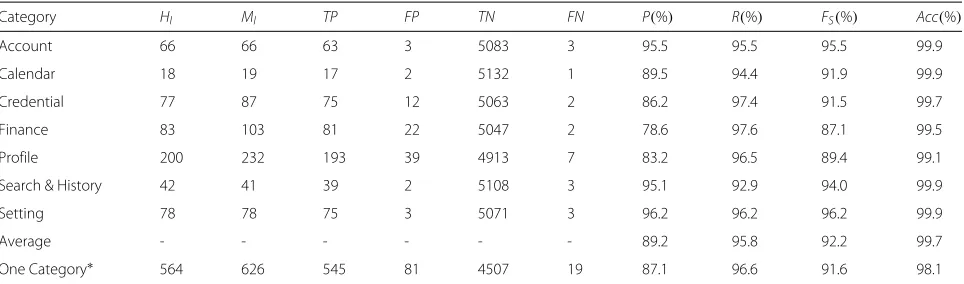
In this section, we evaluate the effectiveness of S3 in iden-tifying sensitive texts. We take the optimal threshold 0.7 as an example to describe the evaluation results. Table3 shows the evaluation results under threshold 0.7. Col-umn “Category” lists names of the 7 predefined categories of sensitive data. Column “HI” lists the number of texts
identified as corresponding category of sensitive data by human users. Column “MI” lists the number of texts
iden-tified as corresponding category of sensitive data by S3. Columns “TP”, “FP”, “TN” and “FN” list the number of
true positives,false positives,true negativesandfalse neg-atives respectively. Columns “P(%)”, “R(%)”, “FS(%)” and
“Acc(%)” list the percentage of Precision, Recall, F-score
and Accuracy respectively. The evaluation results show that S3 effectively identifies and classifies sensitive texts out of top 5152 frequent texts with average precision, recall, F-score, and accuracy of 89.2%, 95.8%, 92.2% and
99.7% respectively. If we treat sensitive data as one cate-gory, S3 achieves precision, recall, F-score, and accuracy of 87.1%, 96.6%, 91.6%, and 98.1% respectively. Evalua-tion results show that S3 produces less false negatives than false positives in most categories which is in line with our expectations. We will discuss the reasons of producing false positives and false negatives in “FP/FN Analysis” section.
Comparison with related work
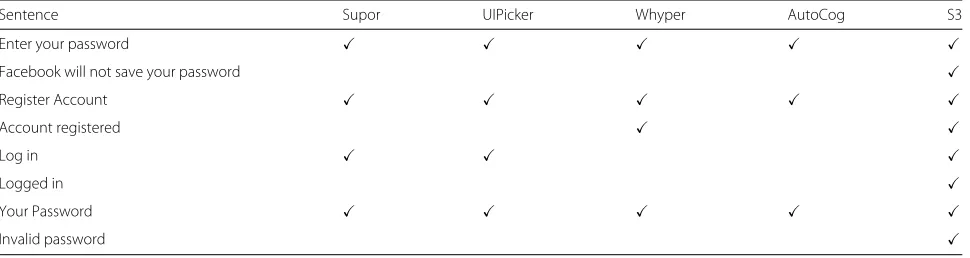
In this section, we compare S3 with related approaches in identifying sensitive texts. Table4shows the comparison results among different approaches in identifying sensi-tive texts. We select eight typical instances to present the comparison process.
For the sentence “Enter your password”, it describes an input box receiving user’s password. It contains sensi-tive keywords “Enter” (an action) and “password” (a noun phrase). All the approaches are able to correctly iden-tify this sentence as sensitive. Moreover, S3 can classify it as category “Credential”. The second sentence “Facebook will not save your password” also contains sensitive key-words “save” (an action) and “password” (a noun phrase). However it is only a normal hint sentence and describes no sensitive data. Both Supor and UIPicker incorrectly identify it as sensitive because it contains sensitive key-words. Whyper also fails because the sentence contains a sensitive noun phrase “your password” with dominant action “save”. AutoCog fails as well because the sentence has a sensitive verb phrase “save your password”, a sensi-tive noun phrase “your password”. However even though the sentence has a sensitive noun phrase with dominant action (make up aCBANP), it does not guarantee that it is
the point of the sentence. S3 correctly identifies it because it finds that theCBANP is dominated by “Facebook will”
(has an ancestor node of verb phrase) so that theCBANPis
not the point of the sentence and thus the whole sentence is not sensitive.
Table 3Evaluation results under threshold 0.7
Category HI MI TP FP TN FN P(%) R(%) FS(%) Acc(%)
Account 66 66 63 3 5083 3 95.5 95.5 95.5 99.9
Calendar 18 19 17 2 5132 1 89.5 94.4 91.9 99.9
Credential 77 87 75 12 5063 2 86.2 97.4 91.5 99.7
Finance 83 103 81 22 5047 2 78.6 97.6 87.1 99.5
Profile 200 232 193 39 4913 7 83.2 96.5 89.4 99.1
Search & History 42 41 39 2 5108 3 95.1 92.9 94.0 99.9
Setting 78 78 75 3 5071 3 96.2 96.2 96.2 99.9
Average - - - 89.2 95.8 92.2 99.7
One Category∗ 564 626 545 81 4507 19 87.1 96.6 91.6 98.1
Another comparison example is sentences “Register Account” and “Account registered”. Both of the two sen-tences have sensitive keywords “Register” and “Account”, but the meanings of them are significantly differ-ent. The former one describes an account registration manner but the latter one is a hint message saying that the account is already registered. All the related approaches can correctly identify the former sentence but fail for the latter sentence. As we are not sure if an action check is compulsory or not in Whyper, we here assume it is not compulsory so that Whyper cor-rectly identifies the sentence. S3 first identifies the sen-sitive noun phrase “Account” which makes up a CBNP.
It then analyses that the CBNP has a sibling action
(verb phrase) “registered” which does not dominate the noun phrase. As a result, S3 correctly identifies it as insensitive.
The part of speech of a word is able to affect the sensi-tiveness of a text. Take two sentences “Log in” and “Logged in” as an example. Both contain sensitive keyword “log” (assuming all the approaches can transform the original token to its lemma form correctly). Supor and UIPicker can correctly identify “Log in”. Whyper and AutoCog fail because they are not able to identify single actions. How-ever all the related approaches fail in identifying “Logged in”. Even though it contains sensitive keyword, it is a hint text showing the user has already logged in. They fail because the part of speech of tokens is not considered in the related approaches. S3 can correctly identify such texts.
Sentiment also affects the sensitiveness of a text. For instance, the sentence “Your Password” describes an input box receiving user’s password but “Invalid password” is a hint text showing the user has typed a wrong pass-word even though it contains the sensitive keypass-word “password”. Such negative text reduces its sensitiveness. All the related approaches do not consider the senti-ment of a text, so all fail. S3 correctly identify such text.
FP/FN Analysis
In this section, we analyze the causes of false positives and false negatives under threshold 0.7. Here we select representative examples to discuss the causes.
First we present why S3 incorrectly identifies a text as some category of sensitive data, which produces false positives.
– Inaccurate underlying NLP infrastructure. One major source of false positives is the incorrect syn-tactic parsing of texts by the underlying NLP infras-tructure. Take the text “Send Email” as an instance. It is not labeled as sensitive data by our volunteers. However, the underlying Stanford Parser is not able to correctly parse its syntax in original form. It annotates the whole text as a noun phrase. S3 then analyzes its topic and finally classifies it as category “Profile” with maximum probability 85.3% as it has three neigh-bors “email”, “e-mail” and “email address” while zero neighbors in other categories. However, it correctly parses the syntax in lowercase form: an action “send” followed by a noun phrase “email”. The noun phrase “email” is classified as category “Profile” but the dom-inant action “send” has no neighbors within thresh-old in category “Profile”. Therefore, S3 classifies the text as insensitive in the lowercase form. Due to the classification priority, S3 chooses the category with the higher probability among original and lowercase form, such text is eventually identified as category “Profile”. We observe that a majority of false positives result from incorrect syntactic parsing. Such cases can be addressed with the advancement in underlying NLP infrastructure.
– Inaccurate threshold control. Take the text “Prod-uct ID:” as an example, S3 successfully identifies it as a noun phrase “Product ID”/“product id” (in origi-nal and lowercase form respectively) with a following colon. This text matches the pattern that only con-tains a noun phrase. In topic analysis, S3 classifies
Table 4Comparison of S3 and related work
Sentence Supor UIPicker Whyper AutoCog S3
Enter your password
Facebook will not save your password
Register Account
Account registered
Log in
Logged in
Your Password
Invalid password
the text using 7 concept spaces. It finds 2 neighbors “id” and “user id” within the threshold with max-imum probability 80.1% in category “Profile” while zero neighbors in other categories. Then the text is incorrectly identified as category “Profile”, but actu-ally it is a normal text describing a product. Such false positives result from inaccurate threshold control and can be addressed by increasing the threshold.
Next we present why S3 incorrectly identifies a text as insensitive, which produces false negatives.
– Inaccurate underlying NLP infrastructure. Con-sider the text “Zip Code”. It is labeled as category “Profile” by volunteers, but S3 identifies it as insensi-tive. S3 correctly parses the text as a noun phrase in the original form. However, both the token “Zip” and “Code” are identified as names of entities and then removed. In the lowercase form, the text is incor-rectly parsed as an action “zip” followed by a noun phrase “code”. Although the noun phrase “code” has neighbors in category “Profile”, the dominant action “zip” has zero neighbors in any categories so the text is identified as insensitive. In this instance, the syn-tax is parsed correctly in the original form but the underlying named entity analysis is incorrect. Such instances can be addressed with the improvement of underlying named entity parser. In “Change Pass-code” of the original form, S3 incorrectly parses its syntax as a noun phrase and in the lowercase form it parses its syntax as an action “change” followed by an adjective “passcode”. It is easy to know the cor-rect syntax should be an action “change” followed by a noun phrase “passcode”. Such instances can be addressed with the advancement of the underlying NLP infrastructure.
– Incomplete knowledge base. For instance, the word “logout” is not found in the top frequent words of our base corpus English Wikipedia 2014 and Gigaword version 5. It causes S3 to incorrectly identify the text “logout” as insensitive. Such issues can be addressed by collecting more words from the knowledge base corpus.
– Incomplete concept space. There are a few false negatives caused by the incomplete concept space. For example, the text “Use street address” is parsed correctly as an action “use” followed by a noun phrase “street address”. However, the dominant action “use” has zero neighbors of the concept spaces of actions in any categories. Therefore S3 incorrectly identifies it as insensitive. This case can be addressed by extending concept spaces or decreasing the threshold.
– CBpriority. A small source of false negatives results from the priority issue in processingCB. For instance,
the sentence “Allow Ad to create a calendar event? ” describes a “Setting” manner, but S3 identifies it as insensitive. S3 correctly parses its syntax as an action “Allow” followed by a noun phrase “Ad” and an action “create” followed by a noun phrase “a calendar event”. S3 first identifies the sensitive candidate noun phrase “a calendar event” because it has three neighbors in category “Calendar” while noun phrase “Ad” has no neighbors in any categories. Then S3 identifies the noun phrase “a calendar event” is dominated by an action “create”. This action also has neighbors in con-cept space of actions in category “Calendar”. Then the noun phrase “a calendar event” and its dominant action “create” make up a CBANP. Since the noun
phrase “Ad” is insensitive but its dominant action “Allow” has neighbors in category “Setting”, the action “Allow” makes up a CBA. Because the CBANP has
higher priority thanCBA, S3 identifies the
sensitive-ness of the text based on theCBANP“create a calendar
event”. However the syntax check fails because the
CBANP is dominated by another action “Allow” (the
ancestor node is a verb phrase). Such issue can be addressed by processing theCB sequentially until it reaches a sensitive category rather than only process-ing the top priorityCB.
– CB definition. Rare false negatives result from the issue in defining CB in cases that the noun phrase and its dominant action belonging to different cat-egories. Take the text “Search by location” as an instance. It describes a “Search” manner, but S3 iden-tifies it as insensitive. S3 correctly parses its syntax as an action “Search” followed by a noun phrase “loca-tion”. The noun phrase “location” has neighbors in category “Profile”, but its dominant action “Search” has no neighbors in category “Profile”. Therefore the noun phrase and its dominant action cannot form a CBANP, and is thus classified as insensitive.
Such issue can be addressed by forming two sep-arate CB s for the noun phrase and its dominant action.
Performance
Discussion
The techniques of S3 has broader applications beyond sensitive data detection in web and mobile applications. It can also be applied to protect users’ data privacy from unwitting leakage in the context of social network shar-ing. For example, when one shares her article, email, chat history, or even a photo to a friend, she may want her personal data (e.g., home address, school name, medical records) safely protected from leakage. However, careful manual check before each sharing is both inefficient and incomplete. Moreover, the user may even have no explicit definition of her privacy data. She can simply provide S3 with some conceptual descriptions that she cares about, and S3 is able to automatically scan the texts/images (leveraging image recognition if necessary) before she shares, and warns her if any potential privacy leakage is detected. We leave this as future work.
The potential advancement of S3 could be to auto-mate the process of providing the conceptual descriptions by users. For instance, the user can select several arti-cles and images that she thinks contain sensitive data but are hard to explicitly elaborate. For example, some paragraphs may contain her profile information, or some part of the image has her car number. S3 can hopefully learn the implicit specifications of sensitive data from such sample articles and images using machine learn-ing techniques, and thus can automatically identify sim-ilar sensitive data in unseen articles and images without involving users to manually provide conceptual descrip-tions. We leave a further investigation into it as future work.
Related Work
To the best of our knowledge, S3 is the first systemat-ical tool to automatsystemat-ically identify sensitive data includ-ing input data and output data from descriptive texts in mobile applications. Our approach utilizes NLP and learn-ing based methods to analyze descriptive texts. Related research efforts using NLP and/or learning based meth-ods to analyze texts/documents mainly are: 1) Sensitive input data identification in Android applications (Nan et al. 2015; Huang et al. 2015); 2) Detecting mismatches between Android UIs and program behaviors (Avdiienko et al. 2017); 3) Description/Review-to-Behavior fidelity analysis in Android applications (Pandita et al.2013; Qu et al.2014; Yu et al.2016; Kong et al.2015); and 4) Auto-matic discovery of Indicators of Compromise (IOC) (Liao et al.2016).
Sensitive input data identification in Android appli-cations. Supor (Huang et al.2015) analyzes the descriptive texts of input boxes to analyze their sensitiveness. It first locates all the input boxes of a UI and then searches for their descriptive text. It uses keyword based search-ing to analyze such texts, and thus could cause many
FP and FN because no semantic and syntactic infor-mation are considered. Moreover, the process of gen-erating keywords needs much manual effort and also lacks flexibility of involving new sensitive data categories. UIPicker (Nan et al. 2015) utilizes SVM (Support Vec-tor Machine) to learn the descriptive texts. The features are a set of sensitive keywords. The accuracy tends to increase as the size of training set increases. However it is also the limitation of this approach, because it causes much manual effort to prepare a well-labeled training set. The features are also limited by the size of sensi-tive keywords, so that it cannot handle unknown words. Compared with such approaches, S3 considers complete semantic and syntactic information to give accurate sensi-tiveness of a descriptive text. Besides, S3 does not require much manual effort to prepare massive keywords or training set.
Detecting mismatches between Android UIs and program behaviors. BackStage (Avdiienko et al. 2017) checks the advertised functionality of Android UI ele-ments (e.g., buttons) against their implemented func-tionality to detect such mismatches. To get the advised functionality, it analyzes the descriptive texts of these ele-ments. It collects all the verbs and nouns from their appli-cation dataset and then clusters them into 250 classes. It gets the advertised functionality by testing the member-ship of a target UI element among the 250 clusters. The approach of BackStage is similar to the topic analysis of S3, but it does not consider syntactic information. Therefore, BackStage is able to get only the approximate meaning of a descriptive text, and is thus not applicable to identifying sensitiveness.
of a text in our problem domain. AUTOREB (Kong et al. 2015) analyses Review-to-Behavior fidelity. The approach of AUTOREG is similar to UIPicker. It also uses a machine learning method and the features of the classifier are keywords as well. The difference is that AUTOREB uti-lizes the “relevance feedback” technique (Xu and Croft 1996) to add relevant words to the keyword list. Syntactic information is not considered in AUTOREG either.
Automatic discovery of Indicators of Compromise (IOC). IOC is an artifact observed on a network or in an operating system that with high confidence indi-cates a computer intrusion. It can be converted into a machine-readable OpenIOC format for automatically analysis. iACE (Liao et al.2016) is proposed to discover IOC data in online pages (e.g., blogs, forums) and cre-ates IOC in OpenIOC format. It first identifies IOC sentences in a document by searching IOC tokens and context terms. It identifies IOC tokens with regrexes and uses keyword based searching to identify context terms. Then it checks the relation between IOC tokens and con-text terms by graph mining. Finally, it creates IOC if the relation passes the check. Though iACE considers rel-atively complete syntactic information, regrex matching of identifying IOC tokens and keyword based search-ing of identifysearch-ing context terms could cause many FPs and FNs.
In our problem domain, it is intractable to standardize sensitive data because different users may care about dif-ferent sensitive data. Therefore it requires an approach that allows users to specify sensitive data on demand. This is the key technique of S3. It proposes the notion of con-cept spaceto represent a category of sensitive data. None of the related approaches have such flexibility to define a category on demand. S3 also performs syntax, POS and sentiment analysis to further enhance the identification result while prior work does not consider the complete semantic meaning of sensitive data.
Conclusion
Users’ privacy preference is often implicit, and the defi-nition of sensitive data is subjective and flexible. In this paper, we propose S3, a novel approach to identify sensi-tive data from implicit user requirements. S3 takes seman-tic, syntactic and lexical analysis into account to under-stand the semantic meaning of sensitive data and then decides its sensitiveness. We propose the notionconcept space, which is constructed by initial readable concepts provided by users. S3 is able to learn users’ preferences from the concept space, and automatically identify related sensitive data. We evaluate S3 using more than 18,000 applications from top 500 free applications in 34 cate-gories of Google Play. We classify sensitive data into seven categories. S3 achieves an average precision of 89.2%, and average recall 95.8% in identifying sensitive data.
Acknowledgments
We thank for the reviewers for their valuable comments.
Funding
This research is supported by the National Research Foundation, Prime Ministers Office, Singapore under its National Cybersecurity R&D Programme (Grant No. NRF2015NCR-NCR002-001).
Availability of data and material
The dataset supporting the conclusions of this article is available in the Dropbox repositoryhttps://www.dropbox.com/s/00hjztyw2zw35i3/s3.zip?dl=0.
Authors’ contributions
The authors have contributed jointly to the manuscript. Both authors have read and approved the final manuscript.
Competing interests
We confirm that we have read SpringerOpen’s guidance on competing interests. None of the authors have any competing interests in the manuscript.
Publisher’s Note
Springer Nature remains neutral with regard to jurisdictional claims in published maps and institutional affiliations.
Received: 25 May 2018 Accepted: 14 August 2018
References
Amazon shopping application.https://goo.gl/aHNvpy
Avdiienko V, Kuznetsov K, Rommelfanger I, Rau A, Gorla A, Zeller A (2017) Detecting behavior anomalies in graphical user interfaces. In: 2017 IEEE/ACM 39th International Conference on Software Engineering Companion (ICSE-C), Buenos Aires. pp 201–203.https://doi.org/10.1109/ ICSE-C.2017.130
Baccianella S, Esuli A, Sebastiani F (2010) Sentiwordnet 3.0: An enhanced lexical resource for sentiment analysis and opinion mining. In: Chair NCC, Choukri K, Maegaard B, Mariani J, Odijk J, Piperidis S, Rosner M, Tapias D (eds). Proceedings of the Seventh International Conference on Language Resources and Evaluation (LREC’10). European Language Resources Association (ELRA)
Budianto E, Jia Y, Dong X, Saxena P, Liang Z (2014) You can’t be me: Enabling trusted paths and user sub-origins in web browsers. In: Stavrou A, Bos H, Portokalidis G (eds). Research in Attacks, Intrusions and Defenses. Springer International Publishing, Cham. pp 150–171
Bursztein E, Soman C, Boneh D, Mitchell JC (2012) Sessionjuggler: Secure web login from an untrusted terminal using session hijacking. In: Proceedings of the 21st International Conference on World Wide Web. WWW ’12, ACM, New York. pp 321–330.http://doi.acm.org/10.1145/2187836.2187880 Cunningham P, Delany SJ (2007) K-nearest neighbour classifiers. Mult Classifier
Syst 34:1–17
Enck W, Gilbert P, Chun BG, Cox LP, Jung J, McDaniel P, Sheth AN (2010) Taintdroid: An information-flow tracking system for realtime privacy monitoring on smartphones. In: Proceedings of the 9th USENIX Conference on Operating Systems Design and Implementation. OSDI’10, USENIX Association, Berkeley. pp 393–407.http://dl.acm.org/citation.cfm? id=1924943.1924971
Finkel JR, Grenager T, Manning C (2005) Incorporating non-local information into information extraction systems by gibbs sampling. In: Proceedings of the 43rd Annual Meeting on Association for Computational Linguistics. ACL ’05, Association for Computational Linguistics. pp 363–370.https:// doi.org/10.3115/1219840.1219885
Gabrilovich E, Markovitch S (2007) Computing semantic relatedness using wikipedia-based explicit semantic analysis. In: Proceedings of the 20th International Joint Conference on Artifical Intelligence. IJCAI’07, Morgan Kaufmann Publishers Inc. pp 1606–1611.https://dl.acm.org/citation.cfm? id=1625275.1625535
pp 977–992.https://www.usenix.org/conference/usenixsecurity15/ technical-sessions/presentation/huang
Jurafsky D, Martin JH (2000) Speech and Language Processing: An Introduction to Natural Language Processing, Computational Linguistics, and Speech Recognition. (1st ed.). Prentice Hall PTR
Klein D, Manning CD (2002) Fast exact inference with a factored model for natural language parsing. In: Proceedings of the 15th International Conference on Neural Information Processing Systems. NIPS’02, MIT Press, Cambridge. pp 3–10.http://dl.acm.org/citation.cfm?id=2968618.2968619 Kong D, Cen L, Jin H (2015) Autoreb: Automatically understanding the
review-to-behavior fidelity in android applications. In: Proceedings of the 22Nd ACM SIGSAC Conference on Computer and Communications Security. CCS ’15, ACM, New York. pp 530–541.https://doi.acm.org/10. 1145/2810103.2813689
LDC: English gigaword fifth edition.https://catalog.ldc.upenn.edu/ LDC2011T07
Li X, Hu H, Bai G, Jia Y, Liang Z, Saxena P (2014) Droidvault: A trusted data vault for android devices. In: 2014 19th International Conference on Engineering of Complex Computer Systems. pp 29–38.https://doi.org/10.1109/ICECCS. 2014.13
Liao X, Yuan K, Wang X, Li Z, Xing L, Beyah R (2016) Acing the ioc game: Toward automatic discovery and analysis of open-source cyber threat intelligence. In: Proceedings of the 2016 ACM SIGSAC Conference on Computer and Communications Security. CCS ’16, ACM, New York. pp 755–766.http://doi.acm.org/10.1145/2976749.2978315 Lu K, Li Z, Kemerlis VP, Wu Z, Lu L, Zheng C, Qian Z, Lee W, Jiang G (2015)
Checking more and alerting less: Detecting privacy leakages via enhanced data-flow analysis and peer voting. In: Proceedings of the Network and Distributed System Security Symposium (NDSS)
Mannan M, van Oorschot PC (2007) Using a personal device to strengthen password authentication from an untrusted computer. In: Financial Cryptography and Data Security. Springer. pp 88–103
Manning C, Surdeanu M, Bauer J, Finkel J, Bethard S, McClosky D (2014) The stanford corenlp natural language processing toolkit. In: Proceedings of 52nd Annual Meeting of the Association for Computational Linguistics: System Demonstrations. Association for Computational Linguistics. pp 55–60.https://doi.org/10.3115/v1/P14-5010,http://www.aclweb.org/ anthology/P14-5010
Mikolov T, Sutskever I, Chen K, Corrado G, Dean J (2013) Distributed representations of words and phrases and their compositionality. In: Proceedings of the 26th International Conference on Neural Information Processing Systems - Volume 2. NIPS’13, Curran Associates Inc. pp 3111–3119.http://dl.acm.org/citation.cfm?id=2999792.2999959 Nan Y, Yang M, Yang Z, Zhou S, Gu G, Wang X (2015) Uipicker: User-input
privacy identification in mobile applications. In: 24th USENIX Security Symposium (USENIX Security 15). USENIX Association. pp 993–1008. https://www.usenix.org/conference/usenixsecurity15/technical-sessions/ presentation/nan
Olson DL, Delen D (2008) Advanced data mining techniques. Springer Science & Business Media
Oprea A, Balfanz D, Durfee G, Smetters DK (2004) Securing a remote terminal application with a mobile trusted device. In: 20th Annual Computer Security Applications Conference. pp 438–447.https://doi.org/10.1109/ CSAC.2004.33
Pandita R, Xiao X, Yang W, Enck W, Xie T (2013) WHYPER: Towards automating risk assessment of mobile applications. In: Presented as part of the 22nd USENIX Security Symposium (USENIX Security 13). USENIX. pp 527–542. https://www.usenix.org/conference/usenixsecurity13/technical-sessions/ presentation/pandita
Pennington J, Socher R, Manning C (2014) Glove: Global vectors for word representation. In: Proceedings of the 2014 Conference on Empirical Methods in Natural Language Processing (EMNLP). Association for Computational Linguistics. pp 1532–1543.https://doi.org/10.3115/v1/ D14-1162,http://www.aclweb.org/anthology/D14-1162
Qu Z, Rastogi V, Zhang X, Chen Y, Zhu T, Chen Z (2014) Autocog: Measuring the description-to-permission fidelity in android applications. In: Proceedings of the 2014 ACM SIGSAC Conference on Computer and Communications Security. CCS ’14, ACM, New York. pp 1354–1365.http:// doi.acm.org/10.1145/2660267.2660287
Rastogi V, Chen Y, Enck W (2013) Appsplayground: Automatic security analysis of smartphone applications. In: Proceedings of the Third ACM Conference
on Data and Application Security and Privacy. CODASPY ’13, ACM, New York. pp 209–220.http://doi.acm.org/10.1145/2435349.2435379 Roalter L, Kranz M, Diewald S, Möller A, Synnes K (2013) The smartphone as
mobile authorization proxy. In: Proceedings of the 14th International Conference on Computer Aided Systems Theory (EUROCAST). Springer. pp 306–307
Sharp R, Madhavapeddy A, Want R, Pering T (2008) Enhancing web browsing security on public terminals using mobile composition. In: Proceedings of the 6th International Conference on Mobile Systems, Applications, and Services. MobiSys ’08, ACM, New York. pp 94–105.http://doi.acm.org/10. 1145/1378600.1378612
Socher R, Perelygin A, Wu J, Chuang J, Manning CD, Ng A, Potts C (2013) Recursive deep models for semantic compositionality over a sentiment treebank. In: Proceedings of the 2013 Conference on Empirical Methods in Natural Language Processing. Association for Computational Linguistics. pp 1631–1642.http://www.aclweb.org/anthology/D13-1170
Steinbach M, Karypis G, Kumar V, et al (2000) A comparison of document clustering techniques. In: KDD Workshop on Text Mining. ACM, Boston Vol. 400. pp 525–526
Toutanova K, Klein D, Manning CD, Singer Y (2003) Feature-rich part-of-speech tagging with a cyclic dependency network. In: Proceedings of the 2003 Conference of the North American Chapter of the Association for Computational Linguistics on Human Language Technology - Volume 1. 0NAACL ’03, Association for Computational Linguistics. pp 173–180. https://doi.org/10.3115/1073445.1073478
USA Today: Driver’s license
creditcardnumbers:Theequifaxhackiswayworsethanconsumersknew. https://www.usatoday.com/story/tech/2018/02/10/equifax-hack-put-more-info-risk-than-consumers-knew/326260002/
Wikipedia.https://wikipedia.org
Xu J, Croft WB (1996) Query expansion using local and global document analysis. In: Proceedings of the 19th Annual International ACM SIGIR Conference on Research and Development in Information Retrieval. SIGIR ’96, ACM, New York. pp 4–11.http://doi.acm.org/10.1145/243199.243202 Yahoo! data breaches.https://en.wikipedia.org/wiki/Yahoo!_data_breaches Yu L, Luo X, Qian C, Wang S (2016) Revisiting the description-to-behavior
fidelity in android applications. In: 2016 IEEE 23rd International Conference on Software Analysis, Evolution, and Reengineering (SANER) Vol. 1. pp 415–426. https://doi.org/10.1109/SANER.2016.67
Zhou Y, Jiang X (2013) Detecting passive content leaks and pollution in android applications. In: Proceedings of the 20th Network and Distributed System Security Symposium (NDSS)