International Journal of Applied Linguistics & English Literature ISSN 2200-3592 (Print), ISSN 2200-3452 (Online) Vol. 4 No. 2; March 2015
Copyright © Australian International Academic Centre, Australia
Creativity in Writing: A Study of EFL Learners’
Locus of Control
Hooshang Khoshsima
Department of English Language, Chabahar Maritime University, Chabahar, Iran E-mail: [email protected]
Mehri Izadi (Corresponding author)
PhD Candidate of TEFL, Department of English Language, Chabahar Maritime University, Chabahar, Iran E-mail: [email protected]
Received: 23-07-2014 Accepted: 01-10-2014 Published: 01-03-2015 doi:10.7575/aiac.ijalel.v.4n.2p.81 URL: http://dx.doi.org/10.7575/aiac.ijalel.v.4n.2p.81
Abstract
The present study aims at providing a clear picture of Julian Rotter’s (1966) locus of control and learners’ creative thinking. Specifically, the study seeks to determine the differences between internal and external orientation in creative writing. In this respect, 20 MA students were asked to complete the Internal Control Index questionnaire and write four writings on the provided topics. The results of the study reveal that internally perceived learners particularly opt more to contemplate and explore cases inasmuch as they believe that they have the control of their environment. However, being in direct opposition, externalizers believe that environment is not under their control and their success and failures are out of their hands. The study concludes that the higher the internal locus of control, the more creative learners are. The research findings may add to our understanding of the learners and learning concerning Attribution Theory.
Keywords: Locus of control, reinforcement, attribution, creative thinking, creative writing
1. Introduction
Creativity and creative thinking are not new concepts. A plethora of research has explored and stressed the contributing role played by creativity in solving complex individual and social problems (Wang, 2012; Beghetto, 2005, Amabile, 1996). Guilford (1967) defines creativity as fluent, flexible and original thoughts. Fluency refers to the quantity of created responses, flexibility reflects variety of created responses and originality is uniqueness and cleverness of created responses. Drevdahl (1956) refers to it as an individual’s capacity to create new and firsthand ideas, opinions and products. It can be inferred that creative thinkers sensitive to insufficiency and gaps in knowledge explore the possible solutions and integrate divergent ideas to bring something into existence that does not exist before.
What is worth highlighting is the role of creative thinking in language learning. According to Piaget (1959) and Vygotsky (1986, 1978) language improvement is strictly associated with thinking skill. Wang (2012) goes further and asserts that creativity has a special connection with writing skill. As Vygotsky (1978) opines that
An intrinsic need should be aroused in them, writing should be incorporated into a task that is necessary and relevant for life. Only then can we be certain that it will develop not as a matter of hand and finger habits but as a really new and complex form of speech (p. 118).
It is similarities of needed abilities which creative thinking and writing are so closely related (Wang, 2012; McVey, 2008; Sak, 2004). According to McVey (2008), learners’ difficulty in writing could not always be defined in terms of grammar or spelling but in terms of the ways to construct an argument, support it and transform it to a new form. Autonomy and the skill to communicate opinions (Beghetto, 2005), self-discovery (Amabile, 1996) and attention to the self (Harrington, Block, & Block, 1987) are required characteristics in nurturing writing and creativity. Beghetto (2005) points out that “students must use their evaluative thinking skills, check the appropriateness and social validity of their efforts, persevere in the face of difficulty, and follow through by completing their project and publishing their work” (p. 257). Wang (2007) assessed the relationship between creative thinking and gain scores of different subjects and reported that “the creative ability of elaboration significantly and positively correlated with English reading and writing scores” (cited in Wang, 2012, p. 39). It can be inferred that creativity and writing go hand in hand.
Lefcourt, 1982). A plethora of research has pointed out the effects of locus of control on problem solving (Wang, 1983), self-esteem and persistence (Basgall & Snyder, 1988; Bender, 1995; Kernis, 1984; Lonky & Reihman, 1980), anxiety (Biaggio, 1985; Carden, Bryant & Moss, 2004), language achievement (Ghonsooly & Elahi, 2010) and reading and writing (Ghonsooly & Elahi, 2011; Knowles & Kerkman, 2007). It seems that creativity and reflectivity in doing tasks have been neglected in the literature on locus of control.
What we are interested in is the orientation of internally and externally perceived learners to creativity. Hence, the study aimed at investigating whether learners’ creativity in writing might differ according to their locus of control type. Moreover, internal and external learners’ nature of creativity in writing was studied. The importance of this study lies in its attempt to examine how learners with two different orientations toward their successes and failures face complex issues, evaluate cases, and formulate novel and original principles.
2. Literature Review
It was in the seventeenth century that the word creativity first appeared (Dawson, 2005). Generating novel things, unique expressions of self and unconventional changes are the essence of creative thinking. It is a purposeful process in making something better, valuable and more meaningful (Starko, 2005). As far as education is concerned, the enhancement of thinking and creative thoughts is among the first-hand necessities inasmuch as creativity is the notable centerpiece of all learning efforts. Through examining ideas, raising possibilities and searching for different options instead of one, learners can become aware of how one’s mind works (Almajali, 2005) and upon that have a successful learning.
Creativity can noteworthy be traced in writing. According to Wang (2012), “writing practices such as thinking, remembering, reasoning, feeling curious, exploring, and freedom of expression” (p. 40) play the same significant role in bringing something new into existence.'' Divergent and convergent stages of thinking creatively what learners undertake in writing from brainstorming and forming freely as many ideas as possible to evaluating and communicating outcome (Beghetto, 2005). The connectivity of creative thinking and writing can be studied in works of Wang (2007, 2012), McVey (2008), Sak (2004), Pearson and Tierney (1984), Beghetto (2005), Harrington et al. (1987) and Sharples (1999). Pearson and Tierney (1984) have pointed that an individual in writing a text contemplates the inner reader and outer reader and “continually reacts to what the writer has written, is writing, and is about to write” (p. 6).
In his analysis of the role of creativity in reading and writing practices, Wang (2012) argued that the ability of elaboration was the most marked variation in creative performances and it continuously appeared as the most prominent link between reading and writing. Sak (2004) investigated a teacher’s experiences, Martha, over 20 years on creativity. Martha argued that through applying real life matters, personal narratives and poetries, she effectively got students involved in creative writing. In a joint work of creative writing and peer collaborative practices, Vass (2007, p. 115) pointed out “the successful sharing, joint exploration and expression of emotional experiences” in productive writings of learners. This shared talk optimizing creativity drives learners to cooperative, original and brainstorming writing. To be a creative writer, learners are deemed to apply imagination, reflection, description, intrinsic motivation and persistence through their generation of ideas (Barbot, Tan, Randi, Santa-Donato & Grigorenko, 2012). According to Barbot et al. (2012), learners’ quality of writing and originality can be enhanced through creative instruction. It might, indeed, be true to state that the creative act of writing entails forming connections, meaning and communication. The real issue lies in the cultural, educational and individual impacts which differentiate creative performances and the way learners apply information to generate original things. According to Baghaei and Riasati (2013), teachers’ creativity significantly predicates learners’ effectiveness and performances. Teachers can easily make differences in how learners regard learning tasks and approach them. As an illustration, learner’s context of learning, smart board or traditional one, worked for students’ creativity in mathematics (Behzadi & Manuchehri, 2013). From affective aspect, anxiety (Rubinstein, 2008; Tabrizi, Talib & Yaacob, 2011), autonomy and self-discovery (Amabile, 1996; Beghetto, 2005), from personality aspect, self-confidence, tolerance of ambiguity and openness to new experiences (Beghetto, 2005, Torrance, 1992; Von Eschenbach & Noland, 1981) and from social and cultural aspect, family, school, support and society (Straus & Straus, 1968; Niu & Sternberg, 2003; Kockar & Gencoz, 2004; Khouzam, 2009) have demonstrated significant impact on learners’ performances leading to creative outcomes. In this respect, this study aimed at exploring learners’ creative writings from personality aspect, in particular locus of control.
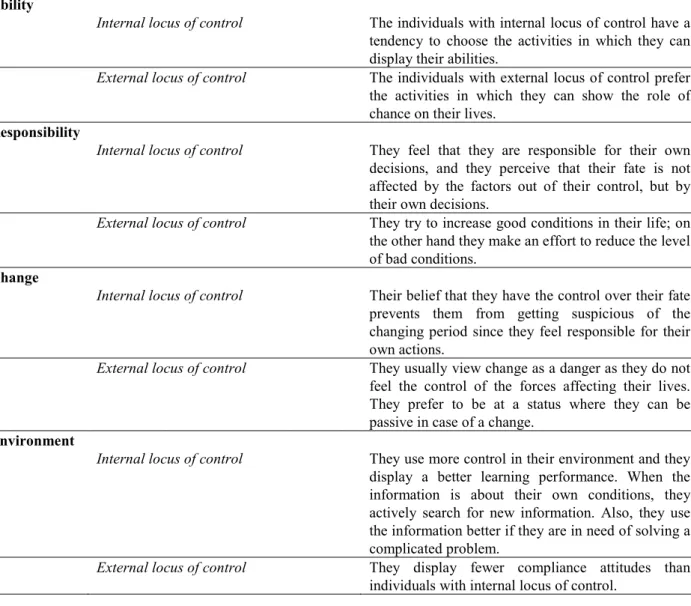
Table 1. Internal and external learners’ characteristics
Ability
Internal locus of control The individuals with internal locus of control have a tendency to choose the activities in which they can display their abilities.
External locus of control The individuals with external locus of control prefer the activities in which they can show the role of chance on their lives.
Responsibility
Internal locus of control They feel that they are responsible for their own decisions, and they perceive that their fate is not affected by the factors out of their control, but by their own decisions.
External locus of control They try to increase good conditions in their life; on the other hand they make an effort to reduce the level of bad conditions.
Change
Internal locus of control Their belief that they have the control over their fate prevents them from getting suspicious of the changing period since they feel responsible for their own actions.
External locus of control They usually view change as a danger as they do not feel the control of the forces affecting their lives. They prefer to be at a status where they can be passive in case of a change.
Environment
Internal locus of control They use more control in their environment and they display a better learning performance. When the information is about their own conditions, they actively search for new information. Also, they use the information better if they are in need of solving a complicated problem.
External locus of control They display fewer compliance attitudes than individuals with internal locus of control.
Joo, Lim and Kim (2013) explored learners’ satisfaction, achievement and persistence in an online course and argued that locus of control significantly predicate learners’ satisfaction and indirectly impact their persistence. Internal learners having more responsibility for learning highly valued the online courses and were more satisfied with it than external ones. Hrbáčková et al. (2012) argued that internally oriented learners showed greater improvement in the academic achievement and metacognition while it was not the case for external locus of control, “if students believe that academic success (mastering specific skills in a specific context) depends on themselves they may achieve a higher level of metacognition” (p. 1809). Quantitatively assessing and interviewing learners, Ghonsooly and Elahi (2011) reported significant role for locus of control in learners’ reading and writing skills. The more externals attribute their outcomes to outside sources, the lower scores they get in reading and writing test as opposed to internals.
Studies have shown that internal learners are more apt for low level of stress (Chen & Silverthorne, 2008) and reflective thinking (Norton, 1994), use logical decision, apply more strategies and less hesitation (Coban & Hamamci, 2006), are more proactive and effective (Ozen Kutanis, Mesci & Ovdur, 2011), more successful in self-instructed language learning and employ affective strategies (Bown, 2006), and are easier to learn new skills and have positive attitudes (Mamlin, Harris & Case, 2001). On the one hand, external learners are reported to have low self-esteem and self-worth (Mamlin, Harris & Case, 2001) but more tendencies to group decision (Selart, 2005), have lower expectations but are more optimistic (Simons, Irwin & Drinnins, 1987; Adas, 1999) and ignore skill improvement and persistence in doing a task (Mamlin et al, 2001; Adas, 1999) but have more work content (Patten, 2005).
3. Method 3.1 participants
The subjects of this study were 26 Iranian EFL learners who were postgraduate male and female students at Chabahar Maritime University. The learners were between 24 and 27 years of age, with the mean of 25. The sampling method was availability non-random sampling as they were those the researchers had access to. Applying the instruments and going through phases of the study, six learners were dropped off from the study due to personal reasons or incomplete writings. Furthermore, prior to the study, learners were asked to write an essay on a topic from IELTS Academic Writing Task 2. Their writings were analyzed and assessed by two university teachers of English based on IELTS Task 2 Writing assessment criteria which were adopted from British Council website in order to check the homogeneity of learners. The learners’ band scores ranged from 7 to 8 which revealed similar writing proficiency.
3.2 Instrumentation and Procedure
To collect data, Internal Control Index (ICI) scale was applied to check learners’ locus of learning. The ICI scale developed by Duttweiler (1984) consists of 28 incomplete statements. It characterizes learners in terms of internal attributers or external ones. Learners were required to read each item and complete it from 5-point Likert scale ranging from “rarely: less than 10% of the time” to “usually, more than 90% of the time”. The scale produces a possible range from 28 indicating higher external locus of control to 140 indicating higher internal locus of control. According to Duttweiler (1984), the cronbach alpha of the scale is .84 and .85 in two field tests of the ICI.
After indicating the level of locus of control of learners, they were informed that they would go through four phases of writing. In four weeks, learners were provided with four different topics, one topic for each week, and were asked to express their view on it. The topics were from IELTS Academic Writing Task 1 and 2 chosen from Cambridge Practice Tests for IELTS Series considering the fact that they are standardized model of writing assessment. The topics were selected because they allowed the learners to think, synthesize, react and propose innovation. Four writings were collected from each of the twenty learners in order to be analyzed from a creativity point of view.
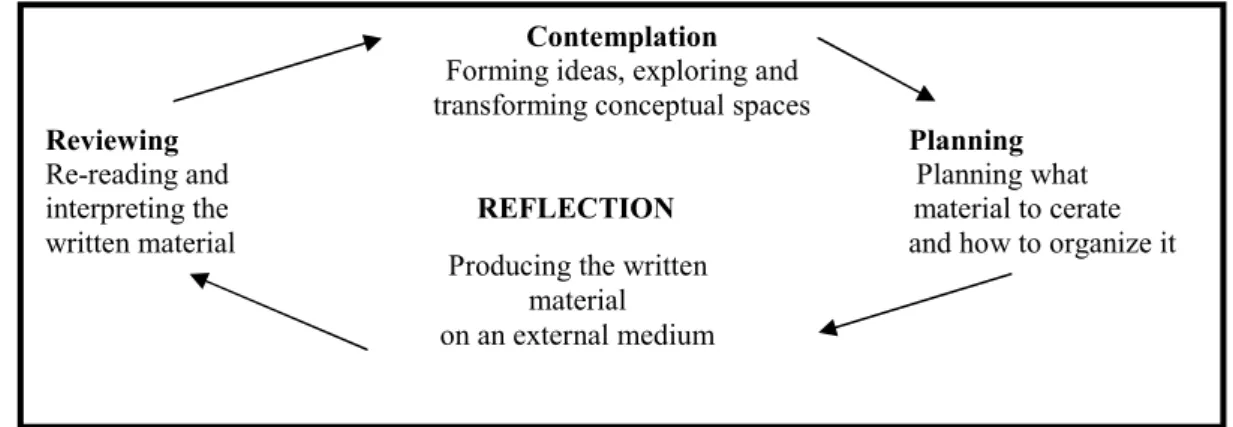
The students’ writings were analyzed based on Sharples’ (1999, 1996) model of writing as creative design. Sharples’ (1999, p. 144) model is presented below:
ENGAGEMENT
Figure 1. Sharples’ Model of Creative Writing
According to Sharples (1999), creative writing incorporates reflection and engagement. Reflection, “an amalgam of mental processes” (p. 144), interacts with contemplation, planning and reviewing. Contemplation reflects “high focus thinking of deliberate knowledge exploration and transformation of conceptual spaces” (p. 144). Planning stage applies the results of contemplation to set goal for both macro and micro planning. In reviewing, learners evaluate the generated content and modify the writing. The engagement part involves the “full attention to creating a chain of associated ideas and turning them into text” (p. 144). Being a matter of transcribing, the engagement part was not reflected in the analysis section.
Accordingly, learners’ writing was assessed on how they conceptualize new ideas, plan and review their opinions. For example, regarding a topic ‘internet benefits learners more than books’ whole learners’ writing were read and any part of the text that discusses new ideas and explores the case were marked as contemplation
· It is self-sufficient that Internet is the breakthrough of this era which has made impossible possible.
Similar to the contemplation analysis, the whole learners’ writing were marked for planning and reviewing sentences.
· By the help of books, instructors can create friendlier environment for learners (planning).
· Following the mentioned educational values, it can be taken for granted that books benefit learning process specifically children’s (reviewing).
In the second stage of the analysis, the parts of writings that were marked e.g. planning were compared between internal and external learners to find out how each group plan their opinions. Moreover, learners who only have a single approach in solving problems are considered as least creative and learners who reflect, seek out risky directions,
Contemplation
Forming ideas, exploring and transforming conceptual spaces
Reviewing Planning
Re-reading and Planning what
interpreting the REFLECTION material to cerate
written material and how to organize it
recognize consequences and extend a novel format are assigned as the most creative learners. To be reliable in analysis, writings of learners were analyzed by three university lecturer as well as the researchers themselves to get inter-rater reliability on each writings.
4. Results
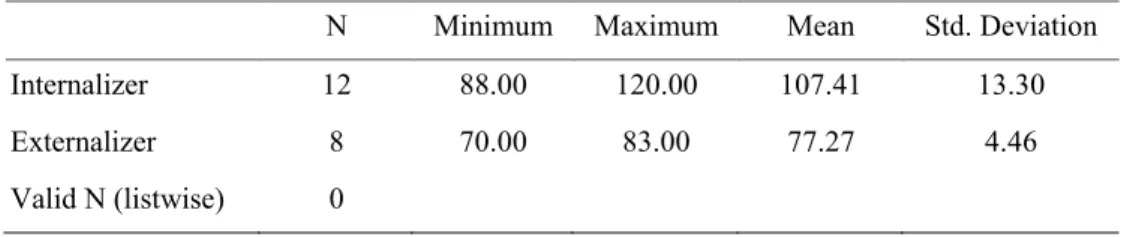
To explore the purposes of the study, firstly learners’ responses to LOC scale were analyzed. Based on the analysis, out of 20 learners, 12 learners belonged to the internalizer group and the others were regarded as externalizer (see Table 2). Findings denote that in our sample learners’ mind their successes and failures, tend to control their performances and are active and assertive in problem solving tasks.
Table 2. Descriptive statistics of internalizers and externalizers
N Minimum Maximum Mean Std. Deviation
Internalizer 12 88.00 120.00 107.41 13.30
Externalizer 8 70.00 83.00 77.27 4.46
Valid N (listwise) 0
Task 1
In the first phase of the study, the researchers asked learners to express their view on “Too much emphasis is placed on testing these days. The need to prepare for tests examinations is a restriction on teachers and also exerts unnecessary pressure on young learners, What are your views?”. Writings of learners were analyzed in light of contemplation, planning and reviewing. Internalizers wrote that they are more concerned and attentive to the way they are assessed and the way that they can show their abilities. One of the students (student AI) wrote that “the process of learning is more important than its product”. Similarly another internalizer (student BI) argued that “I think it’s necessary to determine the appropriate place of students in many instructional frameworks and their progress through instructional program like competency-based language teaching”. It can be implied that internals tend to be more success-oriented and actively search for new information specifically if they are in need of solving a problem (better assessment in this case). Student AI expressed her new ideas as “alternative assessment of different type” transforming that she believes in
individuality of performances. For her, it can be a new way substituted the previous impractical one. Concerning contemplation by externalizers, student AE wrote that “from my point of view taking exam per se is not a problem, even sometimes it’s the only solution for evaluating the learner”. Analyzing another extrenalizer similarly revealed that they did not let their line of thoughts be expanded and go beyond boundaries compared to internalizers, it can be detected in writings of student BE as shebegan her writing with “A merit of thetest is that test activates mental activities which are very important in students’ progress of learning”.
Regarding the second creative factor, planning, internalizers wrote “the teachers should provide opportunities before, during and after any kind of activities to motivate learners” (student CI). Another internal learner considered learning
and testing as “when students’ needs, skills, talents, wants … are considered as the core points of a course, it would encourage learners to take responsibility of their own learning and try hard to overcome their difficulties” (student DI).
As the last sentence denotes, try hard to overcome their difficulties, internally perceived learners notice that their performances are not affected by the factors out of their control, but by their own decisions and attempt to plan and organize them. Externalizers said that “to be honest, test causes learners to schedule their learning to become prepared for it” (student CE).
In reviewing their thoughts, student EI of internalizers expressed “as an assessment tool testing can be regarded as one of the means but not the sole one”. She even goes furthers and argues that “testing … makes learners less creative and competent in learning”. From the words less creative and competent, it can be highlighted that internally perceived learners put much stress on their own potential and are open to new experiences. However, one externalizer (student DE) expressed that “as long as questions are standard, one can hope s/he can be evaluated fairly”; standardization
seems to be the best criteria in order to be evaluated fairly.
Task 2
In the second phase of the study, learners wrote an essay on “As computers are being used more and more in education, there will be no role for teachers in the classroom. Discuss this view and give your opinions”. To begin with internal locus of control, student FI asserted that “it is unanimously believed that computers have facilitated all facets of human’ life including educational practice”. She furthers continued that “teachers, considered as the second parent of students, play a vital role in disciplining children”. It seems that the student try to clarify and express a better view and understanding of the case. To a lesser extent, student EE said that “it is undeniable that learning information has become easier with computers”.
of them. External locus of control indicated that “the necessity of the presence of instructors or computers for teaching and learning in each course should be determined by curriculum developers” (student FE). She, moreover, argued that
“there are courses for which we couldn’t determine the efficacy of instructors or computers”. To be led seems to be better than to think, organize and decide about learning.
Finally in reviewing their discussion, internalaizers state that “although education, likely to say, is the one which takes the most advantages out of this computerized era, it needs teachers to complete the supplementary role of computers in students’ learning” (student HI). On the other hand, externally-oriented learner restating her opening sentence put
forward that “the role of instructors in education has remained necessary and no machine could replace them” (student GE).
Task 3
Following the previous writings, in their third writing participants were asked to analyze a graph taken from task 1 of IELTS samples (see Appendix). For internally perceived learners, differences in women and men’s employment denote that “women not preferring physical jobs look more for positions in which they can communicate with the public as opposed to men opting for either position” (student II). Externally perceived learners claimed that “the disparity between women and men in manufacturing and financing reveals that they are not the jobs that women are interested in or successful in them” (student HE).
Task 4
In the last phase of the study, the learner discussed another case as “Universities should accept equal numbers of men and women in every subject. What is your suggestion?”. To our surprise, student JI in the beginning of her writing
stated that “on my reckoning, it is not the question of equal number but competent gender”. It can be identified that it is learners’ abilities that determine the status of each learner in educational system. It is also detectable in “being right-hemisphere dominant, females are more successful in language and artistic activities. Teaching can be one of the domains which suit them perfectly” (student KI). Student LI concluded that “admission process could not be based on gender to merely avoid discrimination; the aptitude, nonetheless, is an uncontroversial requirement”.
From the point of view of externalizers, “fundamentally, one can continue his interest however, situations determine how we continue this interest” (student DE). It seems that the case is even unresolvable, “it is up to universities to consider whether the demanded jobs in the society are men or women oriented and apply the men and women for each major” (student GE).
5. Discussion
Results of the study indicated that internally oriented learners form the largest part of our sample. Internal locus of control is, moreover, interrelated with creative thoughts. When you think about and explore things, you are bringing something new into existence and when you think you can change it; this reveals an internal locus of reinforcement. This is similar to the way one of the students said “… it would encourage learners to take responsibility of their own learning and try hard to overcome their difficulties”. In line of present findings, we can imply and may claim that internalizers look for reasons and reflect on their actions. Therefore, the characteristics of internally oriented learners benefit them to be more creative. Similarly, Hrbáčková et al, (2012) and Ghonsooly and Elahi (2010) reported that most learners tend to be internalizers and this internal locus of control significantly affects their academic achievements. On the other hand, externalizers think that things occur as they just occur. It will be outside of their authorities to think, explore and create changes, they are simply external forces. There would be no reason on which externalizers would be inclined to explore. Furthermore, the analysis of writing revealed that internalizers opt more to investigate and understand the functions and worth of writing. As opposed to externals whose writings mostly followed two dimensional points, merits or demerits and agree or disagree, internals noteworthy engaged themselves in the topic, generative selective ideas, take risk, go beyond the limits of the writing and bring about novel thoughts and designs. According to Barbot et al. (2012), originating new patterns of meaning, being expressive on a subject and creating a structure for the writing are often regarded as the essence of creativity.
Regarding tables, charts and numerical understanding, we provided learners with one figure and evaluated internals and externals’ perception and implication toward the task. Although writings provided clear picture of the numbers, they were not much satisfactory for creative analysis. One reason was the shortness of writings. Generally speaking, however, internals more attended to interpret the task and some, to our surprise, proposed recommendations toward the case under discussion.
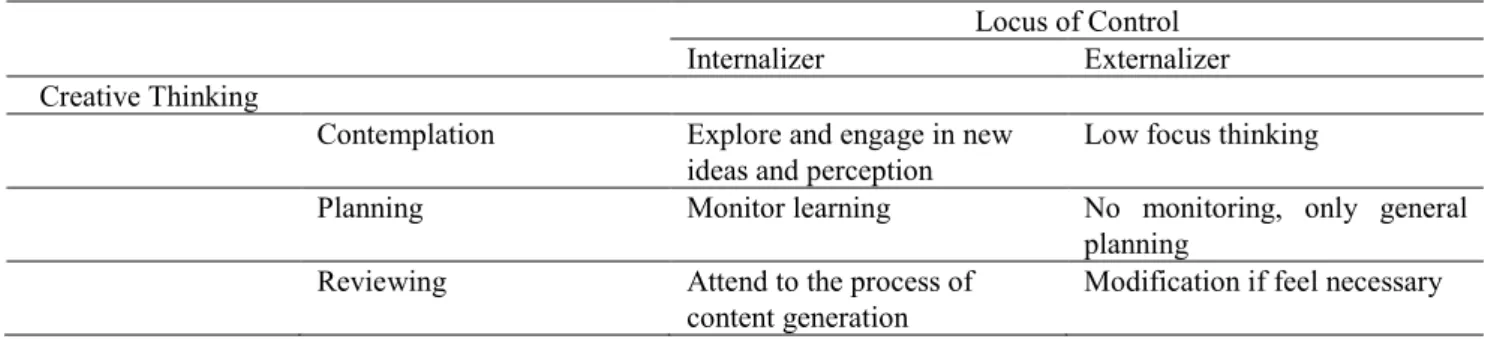
thinking are strong predicators of reflective thinking. As it is mentioned and reported, it may be concluded that locus of control, specifically internal, plays a significant role in learners’ learning and creativity. The study can summarize the features of creative thinking with regard to locus of control as below
Table 3. Features of Creative Writing and Locus of Control
Locus of Control
Internalizer Externalizer
Creative Thinking
Contemplation Explore and engage in new
ideas and perception
Low focus thinking
Planning Monitor learning No monitoring, only general
planning
Reviewing Attend to the process of
content generation
Modification if feel necessary
6. Conclusion
The purpose of this study was to explore locus of reinforcement, as a psychological variable, with regard to learners’ creativity. Furthermore, the nature of creative writing was compared between internal and external locus of control. Based on the findings, the higher the internal locus of control, the more creative learners are. Internalizers opt more to search and contemplate cases so as to find or provide a solution to the underlined problems. To the same extent, they are more concerned with their performances and progresses inasmuch as they believe that reinforcements lie in their own abilities. Internally perceived learners believe that the reactions that they receive from surroundings are the causes of their attitudes. It is in direct opposition to externalizers who believe that their outcomes are not predictable. The analysis of writings by external revealed that they apply mostly a neutral position toward problems intending to be less critical and creative in their thoughts.
Overall, the present study is a new step in its own type, analyzing creativity in writings of internal and external oriented learners. Regarding the limitation of the study, the findings consider only the given context and the addressed learners and it is very specific because the learners organize a small proportion of EFL learners. Moreover, the subjective analysis of learners’ writings has its own shortcomings as subjectivity reflects personal interpretation of researcher. In this regard, it is worthy of further investigation by researchers, theorists and practitioners with a concern for proving and providing more results on the orientation of internal and external learners toward creativity.
References
Adas, A. (1999). Educational psychology. Amman, Jordan: Alfikr House.
Almajali, H.K. (2005). The influence of family upbringing style and locus of control on the creative thinking of preparatory school learners in the united arab emirates. Unpublished Doctoral Dissertation, University of South Africa.
Amabile, T.M. (1996). Creativity in context. Boulder, CO: Westview Press.
Baghaei, S., & Riasati, M.J. (2013). An investigation into the relationship between teachers' creativity and students' academic achievement: A case study of iran efl context. Middle East Journal of Scientific Research, 14(12), 1576-1580. http://DOI: 10.5829/idosi.mejsr.2013.14.12.803.
Barbot, B., Tan, M., Randi, J., Santa-Donato, G., & Grigorenko, E.L. (2012). Essential skills for creative writing:
Integrating multiple domain-specific perspectives. Thinking Skills and Creativity, 7(3), 209-223.
http://dx.doi.org/10.1016/j.tsc.2012.04.006.
Basgall, J.A., & Snyder, C. (1988). Excuses in waiting: External locus of control and reactions to success-failure feedback. Journal of Personality and Social Psychology, 54(4), 656-662.
Beghetto, R.A. (2005). Does assessment kill student creativity? The Educational Forum, 69(3), 254-263.
Behzadi, M.-H., & Manuchehri, M. (2013). Examining creativity of students through smart board in learning
mathematics. Mathematics Education Trends and Research, 2013, 1-7. http:// doi:10.5899/2013/metr-00008.
Bender, W.N. (1995). Learning disabilities: Characteristics, identification, and teaching strategies. Needham Heights, Mass: Allyn & Bacon.
Biaggio, A.M. (1985). Relationships between state-trait anxiety and locus of control-experimental studies with adults and children. International Journal of Behavioral Development, 8(2), 153-166.
Bown, J. (2006). Locus of learning and affective strategy use: Two factors affecting success in self‐instructed language learning. Foreign Language Annals, 39(4), 640-659.
Chen, J.-C., & Silverthorne, C. (2008). The impact of locus of control on job stress, job performance and job satisfaction in taiwan. Leadership & Organization Development Journal, 29(7), 572-582.
Coban, A.E., & Hamamci, Z. (2006). Investigation of focal points in terms of different strategies for the locus of control adolescents decsion. Kastamonu Education Journal, 14(2), 393-402.
Dawson, P. (2005). Creative writing and the new humanities. Routledge.
Demirkan, S. (2006). Self-perceptions of interpersonal relations, conflict resolution approaches in locus of control and their effects on the structure of personality: A study in applied. Unpublished Master Thesis, Ankara University.
Drevdahl, J.E. (1956). Factors of importance for creativity. Journal of Clinical Psychology, 12(1), 21-26.
Duttweiler, P.C. (1984). The internal control index: A newly developed measure of locus of control. Educational and
Psychological Measurement, 44(2), 209-221.
Ghonsooly, B., & Elahi, M. (2010). Validating locus of control questionnaire and examining its relation to general
english (ge) achievement. Journal of Teaching Language Skills (JTLS) (Journal of Social Aciences and Humannities),
2(1), 117-143.
Ghonsooly, B., &, Elahi, M. (2011). On the relation of locus of control and l2 reading and writing achievement. English Language Teaching, 4(4), 234-244, http://dx.doi.org/10.5539/elt.v4n4p234.
Grainger, T., Goouch, K., & Lambirth, A. (2005). Creativity and writing: Developing voice and verve in the classroom: Routledge.
Guilford, J.P. (1967). The nature of human intelligence. New York, NY: McGraw-Hill.
Harrington, D.M., Block, J.H., & Block, J. (1987). Testing aspects of carl rogers's theory of creative environments: Child-rearing antecedents of creative potential in young adolescents. Journal of Personality and Social Psychology, 52(4), 851-856.
Hrbáčková, K., Hladík, J., & Vávrová, S. (2012). The relationship between locus of control, metacognition, and academic success. Procedia-Social and Behavioral Sciences, 69, 1805-1811, http:// doi: 10.1016/j.sbspro.2012.12.130. Joo, Y.J., Lim, K.Y., & Kim, J. (2013). Locus of control, self-efficacy, and task value as predictors of learning outcome
in an online university context. Computers & Education, 62, 149-158.
http://dx.doi.org/10.1016/j.compedu.2012.10.027.
Kernis, M.H. (1984). Internal versus external attributions are important determinants of subsequent performance. ERIC Document Reproduction Service No. ED 195326
Kesici, S., Sahin, I., & Akturk, A.O. (2009). Analysis of cognitive learning strategies and computer attitudes, according to college students’ gender and locus of control. Computers in Human Behavior, 25(2), 529-534.
Khouzam, H.R. (2009). Anxiety disorders: Guidelines for effective primary care. Part 1: Diagnosis. Consultant, 49(3), 1-3.
Knowles, E., & Kerkman, D. (2007). An investigation of students attitude and motivation toward online learning.
InSight: A Collection of Faculty Scholarship, 2, 70-80.
Koçkar, A.I., & Gençöz, T. (2004). Personality, social support, and anxiety among adolescents preparing for university entrance examinations in turkey. Current Psychology, 23(2), 138-146.
Lefcourt, H.M. (1982). Locus of control: Current trends in theory and research. Hillsdale, NJ: Lawrence Erlbaum Associates.
Lonky, E., & Reihman, J. (1980). Cognitive evaluation theory, locus of control and positive verbal feedback. ERIC Document Service No. ED 195 324.
Mamlin, N., Harris, K.R., & Case, L.P. (2001). A methodological analysis of research on locus of control and learning disabilities rethinking a common assumption. The Journal of Special Education, 34(4), 214-225.
Martinez, M. (2003). High attrition rates in e-learning: Challenges, predictors and solutions. The E-Learning Developers’ Journal, 14, 1-8.
McVey, D. (2008). Why all writing is creative writing. Innovations in Education and Teaching International, 45(3), 289-294.
Niu, W., & Sternberg, R.J. (2003). Societal and school influences on student creativity: The case of china. Psychology in the Schools, 40(1), 103-114. http:// DOI: 10.1002/pits.10072.
Norton, J.L. (1994). Creative thinking and locus of control as predictors of reflective thinking in preservice teachers.
ERIC Document Reproduction Service No. ED 366579.
ÖZen Kutanİs, R., Mescİ, M., & Övdür, Z. (2011). The effects of locus of control on learning performance: A case of an academic organization. Journal of Economic & Social Studies (JECOSS), 1(2), 113-136.
Patten, D.M. (2005). An analysis of the impact of locus-of-control on internal auditor job performance and satisfaction.
Pearson, P.D., & Tierney, R.J. (1984). On becoming a thoughtful reader: Learning to read like a writer. In A. C. Purves & O. S. Niles (Eds.), Becoming readers in a complex society (pp. 144–173). Chicago, IL: National Society of the Study of Education.
Piaget, J. (1959). The language and thought of the child. Psychology Press.
Rotter, J.B. (1966). Generalized expectancies for internal versus external control of reinforcement. Psychological monographs: General and applied, 80(1), 1-28.
Rotter, J.B. (1990). Internal versus external control of reinforcement: A case history of a variable. American psychologist, 45(4), 489-493.
Sak, U. (2004). About creativity, giftedness, and teaching the creatively gifted in the classroom. Roeper Review, 26(4), 216-222.
Selart, M. (2005). Understanding the role of locus of control in consultative decision-making: A case study.
Management Decision, 43(3), 397-412. http:// DOI 10.1108/00251740510589779.
Sharples, M. (1996). An account of writing as creative design. In I. C. M. Levy & S. Ransdell (Eds.), The science of writing:Theories, methods, individual differences and applications (pp. 127-148). Mahwah, NJ:Erlbaum.
Sharples, M. (1999). How we write: Writing as creative design. Routledge.
Simons, J.A., Irwin, D.B., & Drinnin, B.A. (1987). Psychology: The search for understanding: West Publishing Company New York City, NY.
Starko, A.J. (2005). Creativity in the classroom: Schools of curious delight. Routledge.
Straus, J.H., & Straus, M.A. (1968). Family roles and sex differences in creativity of children in bombay and minneapolis. Journal of Marriage and the Family, 30(1), 46-53.
Tabrizi, E.A., & Yaacob, S.N. (2011). Relationship between creative thinking and anxiety among adolescent boys and girls in tehran, iran. International Journal of Humanities and Social Science, 1(19), 60-66.
Torrance, E.P. (1992). A national climate for creativity and invention. Gifted Child Today (GCT), 15(1), 10-14. Vass, E. (2007). Exploring processes of collaborative creativity—the role of emotions in children's joint creative writing. Thinking Skills and Creativity, 2(2), 107-117. http:// doi:10.1016/j.tsc.2007.06.001.
Von Eschenbach, J., & Noland, R. (1981). Changes in student teachers’ perception of the creative pupil. The Creative Child and Adult Quarterly, 8, 169-177.
Vygotsky, L.S. (1978). Mind in society: The development of higher psychological functions. Harvard, Cambridge, MA.
Vygotsky, L.S. (1986). Thought and language (rev. Ed.). Cambridge, MA: MIT Press.
Wang, A.Y. (2007). Contexts of creative thinking: Teaching, learning, and creativity in taiwan and the united states. Ann Arbor, MI: ProQuest. (UMI No. 3268262)
Wang, A.Y. (2012). Exploring the relationship of creative thinking to reading and writing. Thinking Skills and Creativity, 7(1), 38-47. http:// doi:10.1016/j.tsc.2011.09.001.
Weiner, B. (1979). A theory of motivation for some classroom experiences. Journal of educational psychology, 71(1),
3-25.
White, C. (1999). Expectations and emergent beliefs of self-instructed language learners. System, 27(4), 443-457.
Appendix A
Internal Control Index (ICI)
Please read each statement. Where there is a blank, decide what your normal or usual attitude, feeling, or behavior would be:
A = Rarely (less than 10%) of the time) B = Occasionally (about 30% of the time) C = Sometimes (about half the time) D = Frequently (about 70% of the time) E = Usually (more than 90% of the time)
1. When faced with a problem I _____ try to forget.
2. I _______ need frequent encouragement from others for me to keep working at a difficult task. 3. I _______ like jobs where I can make decisions and be responsible for my own work.
4. I _______ change my opinion when someone I admire disagrees with me. 5. If I want something I______ work hard to get it.
6. I ______prefer to learn the facts about something from someone else rather than having to dig them out for myself. 7. I _______will accept jobs that require me to supervise others.
8. I _______have a hard time saying “no” when someone tries to sell me something. 9. I _______ like to have a say in any decisions made by any group I’m in.
10. I _______consider the different sides of an issue before making any decisions. 11. What other people think _______has a great influence on my behavior. 12. Whenever something good happens to me I _______ feel it is because I’ve earned it.
13. I _______ enjoy being in a position of leadership.
14. I _______ need someone else to praise my work before I am satisfied with what I’ve done. 15. I _______ am sure enough of my opinions to try and influence others.
16. When something is going to affect me I _______learn as much about it as I can. 17. I _______ decide to do things on the spur of the moment.
18. For me, knowing I’ve done something well is _______ more important than being praised by some else. 19. I _______ let other peoples’ demands keep me from doing things I want to do.
20. I _______ stick to my opinions when someone disagrees with me.
21. I _______ do what I feel like doing not what other people think I ought to do.
22. I _______ get discouraged when doing something that takes a long time to achieve results. 23. When part of a group I _______ prefer to let other people make all the decisions.
24. When I have a problem I _______follow the advice of friends or relatives.
25. I _______ enjoy trying to do difficult tasks more than I enjoy trying to do easy tasks.
26. I _______ prefer situations where I can depend on someone else’s ability rather than just my own.
27. Having someone important tell me I did a good job is _______ more important to me than feeling I’ve done a good job.
28. When I’m involved in something I _______ try to find out all I can about what is going on even when someone else is in charge.
Appendix B