R E S E A R C H A R T I C L E
Open Access
jCompoundMapper: An open source Java library
and command-line tool for chemical fingerprints
Georg Hinselmann
*, Lars Rosenbaum, Andreas Jahn, Nikolas Fechner, Andreas Zell
Abstract
Background:The decomposition of a chemical graph is a convenient approach to encode information of the corresponding organic compound. While several commercial toolkits exist to encode molecules as so-called fingerprints, only a few open source implementations are available. The aim of this work is to introduce a library for exactly defined molecular decompositions, with a strong focus on the application of these features in machine learning and data mining. It provides several options such as search depth, distance cut-offs, atom- and
pharmacophore typing. Furthermore, it provides the functionality to combine, to compare, or to export the fingerprints into several formats.
Results:We provide a Java 1.6 library for the decomposition of chemical graphs based on the open source Chemistry Development Kit toolkit. We reimplemented popular fingerprinting algorithms such as depth-first search fingerprints, extended connectivity fingerprints, autocorrelation fingerprints (e.g. CATS2D), radial fingerprints (e.g. Molprint2D), geometrical Molprint, atom pairs, and pharmacophore fingerprints. We also implemented custom fingerprints such as the all-shortest path fingerprint that only includes the subset of shortest paths from the full set of paths of the depth-first search fingerprint. As an application of jCompoundMapper, we provide a command-line executable binary. We measured the conversion speed and number of features for each encoding and described the composition of the features in detail. The quality of the encodings was tested using the default parametrizations in combination with a support vector machine on the Sutherland QSAR data sets. Additionally, we benchmarked the fingerprint encodings on the large-scale Ames toxicity benchmark using a large-scale linear support vector machine. The results were promising and could often compete with literature results. On the large Ames benchmark, for example, we obtained an AUC ROC performance of 0.87 with a reimplementation of the extended connectivity fingerprint. This result is comparable to the performance achieved by a non-linear support vector machine using state-of-the-art descriptors. On the Sutherland QSAR data set, the best fingerprint encodings showed a comparable or better performance on 5 of the 8 benchmarks when compared against the results of the best descriptors published in the paper of Sutherland et al.
Conclusions:jCompoundMapper is a library for chemical graph fingerprints with several tweaking possibilities and exporting options for open source data mining toolkits. The quality of the data mining results, the conversion speed, the LPGL software license, the command-line interface, and the exporters should be useful for many applications in cheminformatics like benchmarks against literature methods, comparison of data mining algorithms, similarity searching, and similarity-based data mining.
Background
The decomposition of a chemical graph into a list of features is a convenient way to assess the similarity between chemical compounds by comparing the result-ing lists of features. Such representations are also called
chemical fingerprints [1]. These encodings are important for data mining applications like similarity-based machine learning approaches or similarity searches [2].
The goal of this work is to introduce an open source molecular fingerprinting library for data mining purposes which provides exact definitions of its fingerprinting algorithms. The algorithms can be parametrized with various options to adapt the encodings, for example, by
* Correspondence: [email protected]
University of Tübingen, Center for Bioinformatics Tübingen (ZBIT), Sand 1, 72076 Tübingen, Germany
applying a custom labeling function or by altering the search depth parameter. Additionally, the library can be used as a basis for new implementations. It is based on the Chemistry Development Kit [3], which also provides several fingerprints in its API. However, there are several differences. The first aim of jCompoundMapper is to focus on the exact definition of its encodings, which is crucial to describe the features in data mining experi-ments. The second aim is to provide the functionality to export the fingerprints or pairwise similarity matrices to formats of popular machine learning toolboxes. A label or property of an input compound to be trained by a machine learning algorithm can be included.
Most fingerprint algorithms rely on either the geo-metrical or the topological distance between the atoms of a structure. The topological information is stored in the all-shortest path matrix, which encodes the mini-mum topological distance between two atoms (ver-tices) by the shortest path using the bonds (edges). Organic compounds are usually weakly connected because the number of covalent bonds (vertex degree) of an organic molecule is limited. In contrast, the geo-metry of a structure can be interpreted as a fully con-nected graph. The complexity of both approaches can reduced by limiting the search depth for topological fingerprints or by introducing a distance cut-off for geometrical fingerprints.
jCompoundMapper offers a variety of topological (e. g. radial atom environments [4], extended connectivity fingerprints [5], depth-first search fingerprints [6], or auto-correlation vectors [7]) and geometrical (e.g. two-point and three-two-point encodings [8,9] or geometrical atom environments [10]) fingerprints. If applicable, it allows for a parameterization of an encoding, such as the search depth, the distance cut-off, the geometrical scaling factor, the atom typing scheme, or the hash space.
After the feature generation step, the list of features can be mapped to a vectorial format. One possibility is to encode a set of features as a hashed fingerprint. Here, a unique identifier of a feature is used to initia-lize a pseudo random number generator which pro-duces numbers in [ , ]0 h ∈+, whereh is the maximum size of the hash space. Thus, the dimensionality of the original feature space can be considerably reduced. For example, the Fingal fingerprint [11], uses the cyclic redundancy check algorithm to generate seeds for the hashing of chemical graph patterns. For an introduc-tion into hashed fingerprints, please refer to the review by Brown [1]. Another strategy reserves fixed bit posi-tions in a vector for specific feature types, like patterns obtained at a certain parameter (such as depth or dis-tance) with a limited number of possible combinations.
The definition of the CATS2D [7] vector is an example for this approach.
jCompoundMapper supports native formats of common open source machine learning libraries. The exporters can be used to write feature maps to comma-separated format, LIBSVM [12] format (sparse and matrix), and WEKA ARFF [13]. Therefore, various data mining libraries can be directly applied on the output files. Furthermore, the library provides efficient data structures to compare sets of features in the case that the computation of a similarity matrix is required.
The quality of the encodings was compared on QSAR and toxicity benchmark problems in the results section. First, we conducted experiments using the support vec-tor regression of LIBSVM on the well-known Sutherland QSAR benchmark set [14]. Second, we used a large Ames toxicity classification benchmark [15] and LIB-LINEAR [16] to evaluate the performance using binary hashed sparse fingerprints. On the Sutherland data sets, the averaged squared correlation of the all-shortest-path and the atom triplet fingerprint was at least 5% better on ACHE than the best encoding given by Sutherland et al. On BZR and DHFR, the all-shortest path finger-print achieved a squared correlation of 0.57 and 0.76 respectively. The performance was comparable on two data sets. On the remaining three data sets, the best encoding was more than 5% worse than the results of the best encoding published by Sutherland et al. On the Ames toxicity data set, the implementation of the extended connectivity fingerprint achieved an AUC ROC performance of 0.87, which is comparable to the performance by a non-linear support vector machine trained on state-of-the-art descriptors. Nevertheless, the goal was not an exhaustive comparison but to show that the implementations are able to obtain similar results when compared against literature results. jCompound-Mapper features a command-line interface but can also be used as a Java API. It depends solely on open source libraries and is licensed under the LPGL. The source code and an executable is available at Sourceforge.
The library originated from various implementations of literature fingerprints and descriptors used in com-parison studies. The encodings were employed either as part of a new approach or as a reference method [17-21].
Methods Prerequisites
Notation
The binned geometrical distance matrixGijencodes the spatial distances between two heavy atoms. The topolo-gical distance matrixTijencodes the shortest topological distance between atoms i andj. The labeling function
l a( )i →a^i types an atom according to a specific
label-ing scheme. The maximum distance allowed between two atoms (geometrical or topological)ddefines a dis-tance cut-off for features, all features withgij>dortij> d are omitted. A labeled pathpis a sequence of atoms
connected by bonds p a b a b b a
d d
=(^0, 0,^1, 1,…, −1,^ ),
where bondbi connects aˆi with aˆi+1.pijdenotes a path connecting theith atom with the jth atom. The depthd for topological patterns is the maximum number of bonds allowed for connecting the first atom with the last atom. Analogously to the definition of topological paths, a geometrical pattern must consist of different atoms, i.e. for two atomsai,ajit holds thati≠j. Finally,
a⊕b is defined as the concatenation of alphanumerical string symbols separated by an unique delimiter. In the following, we assume a hydrogen-depleted molecular graphCwithnatoms.
An encoding algorithmFhas the form
F C( )→ X=
{
f1, f2,…,fm}
(1)where an encoding algorithmFmaps some compound Cto a set of featuresX. mdepends, with the exception of fixed-vector fingerprints, on C. A feature fhas an unique id∈ and a string representation f.nom. f.id does not necessarily depend onf.nom. However, in most cases it is convenient to use a hash code of the string representation of a feature.
Fundamental Matrices
The geometrical distance matrixGijis computed as the matrix of binned Euclidean distances in Ångstrom between the three-dimensional coordinates of all atom coordinatesai.cÎℝ3, multiplied by a scaling factor sÎ ℝ+
. The scaling factors influences the resolution of the geometry and should be chosen according to the size of the compounds. The entryi,j(gij) in the matrix is cal-culated as follows
gij =|( .a ci −a c sj. ) |.⋅ (2)
The computation time for the geometrical distance matrix is quadratic. The binning of the real-valued geo-metrical distance is important to produce discrete fea-turesfx,fy, which can be compared by the Dirac function
( , ) , .
,
fx fy : if fx fy else
=⎧⎨ =
⎩ 1
0 (3)
The topological distance matrix is defined asTij. The element i, jcontains the shortest path between the ith and the jth atom (tij). tij is computed by the Floyd-Warshall algorithm. Therefore, the computation time for the matrix isO(n3).
Feature Extraction
The molecular similarity is based on the numerical iden-tifiersfx.idof a featurex. Two features are regarded as equal iffx.id=fy.id. In all implementations the features of a compound C are distinguishable by recurrence, which means that we include a feature if the id of a fea-ture is different from the previously extracted feafea-tures. If a feature with the same id is generated again, the count for the feature is incremented. All atom pair encodings are extracted by regarding the upper half of the distance matrix only. For each atom pair, the string representation is generated in both reading directions. Only the version with the greater hash code is included in the final set of descriptors.
The modified depth-first search applied in this library generates all possible paths originating from a root atom. Therefore, the feature space can be approximated by an m-ary tree and is therefore O(nmd), wheren is the number of heavy atoms and mthe number of chil-dren in an m-ary tree, d is the depth of the tree. In organic compounds, every atom has at most 4 neighbors (m = 4 - 1 because one of the neighboring bonds has already been visited). Thus, the hypothetical worst case has a complexity ofO(n3d) at a search depth ofd. If we assume an average branching factora, which is slightly above 1 for organic compounds [6], the depth-first search has a complexity of O(nad). The average branch-ing factor depends on the average degree of a vertex, which is about 2 in organic molecules. We define DFS(ai, d) as the set of all possible paths originating from a root atomaiwith a depth up tod.
For some of the definitions, we defined acanfunction that maps a set of features to a single canonical pattern. In an implementation this function can be realized by first sorting the patterns, which is possible if a natural order can be defined on the features. Then, the list of sorted patterns can be merged to a single canonical representation.
Atom Types and Pharmacophore Types
jCompoundMapper applies the standard atom types and ring detection algorithms implemented in the CDK. There are various typing schemes for small drug-like compounds described in the literature. In the current version, jCompoundMapper features the following
typ-ing schemes as labeltyp-ing function l a a
i i
( )→ ^ :
1. Element symbol (e.g. C, O, N, ...)
3. Element plus the number of neighboring heavy atoms (e.g. C.2, O.1, N.2, ...)
4. Element plus ring type plus the number of neigh-boring heavy atoms (e.g. C.r.2, C.a.2, O.1, N.2, ...) where r is an arbitrary ring, and a is an aromatic system. If aiis not contained in a ring, no ring type is set. The precedence is a>r.
5. Daylight-Invariants (plus optional ring flag) have the following properties, separated by a dot: Atomic number, number of heavy atom neighbors, valency minus the number of connected hydrogens, atomic mass, atomic charge, number of connected hydro-gens, and a flag if the atom is member of at least one ring. (e.g. 6.2.3.12.0.1.1 for a carbon in a benzole ring)
The following listing of potential pharmacophore points (PPPs) was published by Renner et al. [7] for the CATS autocorrelation descriptors. If PPP atom types are needed, this list is parsed and matched with the struc-ture using the CDK SMARTS matcher or specially implemented graph searches.
1. Hydrogen-bond donor (D): [#6H] oxygen atom of an OH-group; [#7 H,#7H2] nitrogen atom of an NH or NH2group
2. Hydrogen-bond acceptor (A): oxygen atom [#6]; [#7H0] nitrogen atom not adjacent to a hydrogen atom
3. Positive (P): [*+] atom with a positive charge; [#7H2] nitrogen atom of an NH2group
4. Negative (N): [*-] atom with a negative charge; [C&$(C(= O)#8H1), P&$(P(= O)O), S&$(S(= O)O)] carbon, sulfur or phosphorus atom of a COOH, SOOH, or POOH group (SMARTS replaced by a direct graph search)
5. Lipophilic (L): [Cl, Br, I] chlorine, bromine, or iodine atom; [S;D2;$(S(C)(C))] sulfur; atom adjacent to exactly two carbon atoms; sulfur atom adjacent to only carbon atoms (SMARTS replaced by a direct graph search)
Encodings
Topological Fingerprints
All encodings described in the following section rely on thedparameter which constrains the maximum topolo-gical distance allowed between two atoms ai, aj in a feature.
All-Path Encoding (DFS)All-path encodings are paths generated by a graph traversal with a modified depth-first search as proposed by Ralaivola et al. [6]. The linear fragments are obtained by iterating over all atoms in a molecular graph and performing an exhaustive search up to a predefined depth d. To generate an unique representation for each path, a temporary path object is
generated and mapped to two alphanumerical string representations by generating the original and reverse string representation of the corresponding path object. The version with the higher lexicographical order is stored.
F C DFS a d
i n
i ( )=
( , )^(4)
All-Shortest Path Encoding (ASP) The ASP encoding equals the DFS encoding with the exception that only the paths from an atom are stored that have shortest distances from the root atom to the last atom contained in the path, which leads to a sparser representation. During the depth-first search, all paths are removed from the temporary set of depth-first search paths that do not fulfill this constraint. To incorporate this infor-mation theTijmatrix is required. Let |pij| be the length (number of bonds between theith and the jth atom in a path) of a path between atomsi, j, then the set of fea-turesFencoding a compoundCis
F C DFS a di pij tij i
n
( )=
{
( , ),|^ |=}
.(5)
Thus, the all-shortest path encoding is a subset of the paths contained in the DFS fingerprint. It is similar to topological atom pair approaches [8] with the exception that all-shortest paths between two atoms are explicitly stored. Borgwardt et al. proposed a graph kernel based on the set of all-shortest paths [22], however, only the vertex pairs and their shortest-path distances were included in this work. The explicit generation of paths is necessary because the Floyd-Warshall algorithm com-putes only the shortest distances between two vertices. Topological Atom Pairs (AP2D) This encoding con-tains atom types and the shortest path distance informa-tion between all pairs of atoms. It can be directly extracted from Tij by converting the pattern
ˆ ˆ
ai⊕tij⊕aj where i ≠ j to a string feature. The
fea-tures are canonicalized by generating the patterns from both reading directions and storing the version with the higher lexicographical order.
F C ai t a
i j n
ij j
( ) ^ ^
,
=
⊕ ⊕ (6)For 2-point patterns this can be easily conducted by regarding the upper half of the distance matrixTijonly (i.e.i>j). O(n2) is needed for the generation of features and O(n3) for the computation ofTij.
Topological Atom Triplets (AT2D) This encoding extends the AP2D encoding by a further atom. The set of patterns consists of atom triplets and the topolo-gical distance to the next atom in the feature
ˆ ˆ ˆ
ai⊕tij⊕aj⊕tjk⊕ak⊕tki wherei≠j≠kandtij, tjk,
tki≤ d. The total computation time for the features is cubic because all possible combinations of heavy atoms ai,aj, akhave to be considered in the worst case.
F C ai t a t a t
i j k n
ij j jk k ki
( ) ^ ^ ^
, ,
=
⊕ ⊕ ⊕ ⊕ ⊕ (7)Topological Autocorrelation Keys (CATS2D) The CATS2D descriptors encode the pairwise topological relationships of PPP patterns in a molecular graph by a vector of fixed size. The approach was described by Schneider et al. [23], a list of PPP patterns was pre-sented by Renner et al. [7]. The PPPs are defined in the subsection (“Atom Types and Pharmacophore Types”). The combination of all points leads to 15 possible pairs. The pairs are mapped to a key with a fixed dimensional-ity. The position of a feature in the key is determined by the index for the corresponding pattern pair of PPPs plus the topological distance. For example, this means the bit 76 in the CATS vector withd= 9 belongs to the PPP pair DN, and contains the number of pairs with distance 6. In the original publication of the topological CATS descriptors,d = 9 was used as the distance cut-off for the topological search, resulting in a vector with 150 dimensions. In our implementation, the search depth can be adjusted by altering thedparameter. The resulting vector has (d+ 1) · 15 dimensions. The com-plete list of possible PPP pairs in the vector (block index in parentheses) is: AA (0), AD (1), AL (2), AN (3), AP (4); DD (5); DL (6); DN (7); DP (8); LL (9), LN (10), LP (11), NN (12), NP (13), PP (14). Let F (C) =X be a decomposition into all valid PPP pairs. Then, the CATS2D vector is
x d x p d p p X
D
∈ · =
( ) ( ) ( ) 15
2
where offset + (8)
where offset(p) returns the predefined start index for the patternp, d2D(p) returns the topological distance between two atoms in the PPP pair, andp(X) counts the number of occurrences of a patternpinX.
Pharmacophore Pair and Triplet Encodings (PHAP2PT2D, PHAP3PT2D)The PHAP2PT2D encod-ing is computed similarly to the AP2D. However, instead of atom types, the information of all PPPs of an atom is used to generate the fingerprint. Thus, we have to iterate over all PPPs of an atom. Analogously, the PHAP3PT2D encoding is computed, which uses three
points. To keep the notation simple, let Pi denote the set of valid PPPs for theith atom. Then, the set of valid 2-point pharmacophores is
F C Pi t P t
i j n
ij j ji ( )
,
=
⊕ ⊕ ⊕ (9)and the set of valid 3-point pharmacophores is defined as
F C Pi t P t P t
i j k n
ij j jk k ki ( )
, ,
=
⊕ ⊕ ⊕ ⊕ ⊕ (10)where tij, tjk, tki ≤ d. Actually, there are three addi-tional inner loops over all valid pharmacophore points at atoms i, j, k. The complexity of these inner loops is theoretically 53 because the cardinality of the set of PPPs is 5. However, this complexity is further reduced because the meaning of some PPP definitions is contra-dicting for some combinations, such as“atom is posi-tively charged” and “atom is negatively charged”. The overall complexity isO(n3) because of the constant com-putation time of the inner loops.
SHED Key (SHED) The SHED Keys are closely related to the pharmacophore atom pair based encodings, with the following major differences: First, the number of dimensions is fixed, second the entries do not describe a count but the entropy of the respective atom pair descriptor [24]. The implementation differs slightly from the original implementation because it utilizes the PPP definitions as described by Renner et al. [7]. The distri-bution is analyzed for all possible combinations of PPPs. From that distribution of pairwise features the Shannon entropy is calculated as the descriptor in the corre-sponding PPP pair dimension of the SHED Key. The Shannon entropy of a PPP pair PPPiis defined as
x xi H i p l p l
l d
i b i
where = PPP = − (PPP( )) PPP
=
∑
( ) log ( ( ))
1
(11)
where PPPi(l) denotes the ith PPP pair that is sepa-rated by a topological distancel. If pattern i was not found, the value of theith dimension is set to 0. The distribution of a PPP pair is calculated by regarding the different distances 1, 2, ...,l, ..., d. The resulting vector has 15 real-valued entries.
throughout a defined number of iterations (search depth). For each round, the current extended version of the feature is added to the final set of features. In con-trast to other radial fingerprints, the bonding informa-tion is included. Therefore, a feature can be extracted, for example, as canonical SMILES.
The current implementation of the ECFP in jCom-poundMapper differs slightly from the original imple-mentation. In the original algorithm, the identifiers of the alpha atoms of a center atom are used to calculate an updated identifier for the center atom. The algorithm only includes the alpha atoms of a center atom in each iteration and thus the connectivity information is com-pletely discarded between the layers. However, the iden-tifier of a center atom implicitly contains information from further and further away of the center atom in each iteration because the atom identifiers of the pre-vious iteration are used. We explicitly model the grow-ing substructure by usgrow-ing the initial atom identifiers in each iteration and keeping the connectivity information between the layers. After an iteration, new possible attachment points for a specific circular substructure are kept in memory and those attachment points are extended in the next iteration.
Topological Molprint-like fingerprints (RAD2D)This encoding was proposed by Bender et al. [4,25] and describes the radial environment by the atoms with the topological distance 1, 2, ..., l, ..., drather than the full paths containing bonds. A shell s(ai)lin our implemen-tation contains the canonically sorted set of topological neighbors of atom aiat a distance tij=l. Additionally, we include the concatenation of all shells≤1, 2, ...,l, ..., d as additional features. Therefore, a resulting set of fea-tures containsn · d features.
F C can s a
d i n
i d
( )= ( )^
( )
(12)Local Path Environments (LSTAR)This fingerprint is a radial fingerprint similar to RAD2D. The major differ-ence is that all paths up to depth dare stored in a shell. First, the tree of all paths originating from an atomaiis generated. Then, all paths of a certain length are assigned to a shells(ai)dcontaining the paths originating from root atomaiof lengthd. This is equal to a canoni-cal representation ofDFS(ai, d) in a single canonical
fea-ture. The paths in a shell are sorted in lexicographical order to be comparable. The resulting fingerprint con-tains all shells ≤1, 2, ...,l, ...,d. The major difference to the Molprint-like fingerprints is that the bond informa-tion is still included.
F C can DFS a di d
i n
( )= ( , )^
( )
(13)Geometrical Fingerprints
All geometrical encodings support the d parameter which defines the distance cut-off between two atoms. Another important parameter is the scaling factors, as described at the beginning of this section.
Geometrical Atom Pairs and Atom Triplets (AP3D, AT3D)These encodings are implemented similarly as their topological pendants AP2D and AT2D. The only difference is that Gij is used for the distance informa-tion. Thus, the geometrical two-point atom pair encod-ing (AP2D) is defined as
F C ai g a
i j n
ij j
( ) ^ ^
,
=
⊕ ⊕ (14)wherei≠jandgij≤d.
For the three-point relationships AT3D, we have
F C ai g a g a g
i j k n
ij j ik k ki
( ) ^ ^ ^
, ,
=
⊕ ⊕ ⊕ ⊕ ⊕ (15)wherei≠j≠kandgij, gjk, gki≤d.
This is a standard encoding implemented in several toolkits; a kernel based on such patterns was published by Mahé et al [9].
Geometrical CATS fingerprints (CATS3D)Our imple-mentation differs from the description of the original CATS3D [7], which uses the Molecular Operating Environment (MOE, Chemical Computing Group, http://www.chemcomp.com/) patterns to depict surface features of a molecule. The version implemented in jCompoundMapper uses the PPP definitions which were also used in the implementation of the CATS2D vector. Again, letF(C) =X be the set of all valid PPP pairs and
φp(X) a function which counts a pattern p Î X. Then the CATS3D vector is
x
dx
p d p pX
D
∈
· +=
( )
( )
153
where
offset( )
(16)whered3D(p) returns the geometrical distance of the two atoms, which equalsgijbetween any atomsi,j con-tained in a feature.
Geometrical pharmacophore fingerprints (PHAP2PT3 D, PHAP3PT3D)These fingerprints are derived from their topological variants PHAP2PT2D and PHAP3PT2D by replacing theTijmatrix byGij. LetPidenote the set of valid PPP for theith atom thenPi ⊕gij ⊕Pjis a valid two-point pharmacophores andPi⊕gij ⊕Pj⊕gjk⊕Pk
⊕gkiis a valid three-point pharmacophore, wheregij,gjk,
The set of valid 2-point pharmacophores is defined as
F C Pi g P
i j n
ij j ( )
,
=
⊕ ⊕ (17)and the set of valid 3-point pharmacophores is defined as
F C Pi g P g P g
i j k n
ij j ik k ki
( ) .
, ,
=
⊕ ⊕ ⊕ ⊕ ⊕ (18)Again, Pi denotes the set of valid PPPs for the ith atom.
Geometrical Molprint-like fingerprints (RAD3D) These encodings are the geometrical pendant of the topological RAD2D encoding. Similar to the RAD2D encoding, the atoms withgij =lat a binned geometrical distance are added to a shell descriptor. For each value in 1, 2, ..., l, ..., da pattern containing all shells up to distancelin a canonical order is created. Therefore, the encoding containsn·dentries.
F C can s ai d d
i n
( )= ( )^
( )
(19)Example of encodings
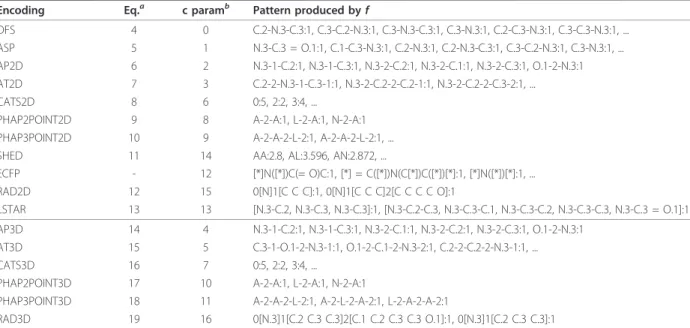
Comparison Table 1 gives a direct tabular comparison of the features extracted by the encodings together with their count or value. The features are generated from the compound presented in Figure 1.
Implementation Third-party libraries
The underlying chemical expert system is the Chemistry Development Kit (CDK) [3,26] in its current develop-ment version 1.35. It provides the basic functionality for parsing, typing, and graph algorithms for molecular data. For the command-line interface we employed the Apache Commons command-line parser 1.2 http://com-mons.apache.org/cli/. The access via the API or the bin-ary using the command-line interface enables the user to utilize the library for batch processing. The language level is Java 1.6.
Additional functionality
Import and Export of Data
The valid input format is MDL SD format with attached hydrogens for the command-line tool. The CDK mole-cule objects can be processed using the API.
There are exporters for various formats of popular machine learning toolboxes. The ARFF format is the native WEKA [13] format, the support vector machine
libraries LIBSVM and LIBLINEAR are supported by their sparse hashed format and precomputed matrix for-mat. Alternatively, there are several comma-separated formats which support hashed or string features, which can be imported into toolboxes like R or MATLAB.
jCompoundMapper includes a buffered random access reader for parsing the input files. Thus, it can read files of the maximum size supported by the Java runtime environment. The memory requirements are low if the encodings are exported sequentially (such as the sparse LIBSVM format) because only a single encoding has to be stored at a time. If the computation of a similarity matrix is required, all encodings are kept in memory to ensure a fast computation of similarities. For this reason, a matrix computation requires additional memory for large data sets.
The label or class for learning tasks is read from the SD property and is integrated into the specific output format. As for the ARFF format, a nominal or numeric class label is created, depending on the distribution of labels in the input format. The user may overwrite the default threshold for the number of classes (currently, this is set to five).
Hashing
All decomposition algorithmsF(C) return the full list of features (the encoding). A featurefhas an integer iden-tifierf.idÎ{0, 1, .... 232} which allows the efficient use in hash based collections. Therefore, it is possible to oper-ate on the full set of descriptors and to generoper-ate hashed fingerprints. Hashing is useful to generate binary vectors of a fixed size. The hash functionH
H F C ( )→h2
is used to project the set of features to a binary vector of the dimension h. The size depends on the expected number of features (see Table 1). H generates the hashed bit of a pattern depending on the numerical seed f.id assigned to each feature. In most cases, the seed equals a hash code of the string representation. The hashing step is also useful to obtain nominal tures for fast comparisons. A nominal feature is a fea-ture f with a finite set of possible values like fÎ{red, green, blue} or, convenient for chemical graphs,fÎ {pat-tern included, pat{pat-tern not included}.
Similarity Matrices
The MinMax similarity is defined as
MinMax(A B)
A B
A B
p p
p X
p p
p X , :
min( ( ), ( ))
max ( ), ( ) . =
(
)
∈ ∈
∑
∑
The Tanimoto similarity can be used instead if only the occurrence of a pattern is taken into account
Tanimoto( , ) : | |
| |.
A B A B
A B
= ∩
∪
The feature maps permit to compute similarity matrices with jCompoundMapper on the full set of fea-tures of a compound C, without introducing noise by hashing. Nevertheless, it is also possible to generate hashed binary fingerprint objects of any of the encodings.
Table 1 Examples of Encodings
Encoding Eq.a c paramb Pattern produced byf
DFS 4 0 C.2-N.3-C.3:1, C.3-C.2-N.3:1, C.3-N.3-C.3:1, C.3-N.3:1, C.2-C.3-N.3:1, C.3-C.3-N.3:1, ... ASP 5 1 N.3-C.3 = O.1:1, C.1-C.3-N.3:1, C.2-N.3:1, C.2-N.3-C.3:1, C.3-C.2-N.3:1, C.3-N.3:1, ... AP2D 6 2 N.3-1-C.2:1, N.3-1-C.3:1, N.3-2-C.2:1, N.3-2-C.1:1, N.3-2-C.3:1, O.1-2-N.3:1 AT2D 7 3 C.2-2-N.3-1-C.3-1:1, N.3-2-C.2-2-C.2-1:1, N.3-2-C.2-2-C.3-2:1, ... CATS2D 8 6 0:5, 2:2, 3:4, ...
PHAP2POINT2D 9 8 A-2-A:1, L-2-A:1, N-2-A:1 PHAP3POINT2D 10 9 A-2-A-2-L-2:1, A-2-A-2-L-2:1, ... SHED 11 14 AA:2.8, AL:3.596, AN:2.872, ...
ECFP - 12 [*]N([*])C(= O)C:1, [*] = C([*])N(C[*])C([*])[*]:1, [*]N([*])[*]:1, ... RAD2D 12 15 0[N]1[C C C]:1, 0[N]1[C C C]2[C C C C O]:1
LSTAR 13 13 [N.3-C.2, N.3-C.3, N.3-C.3]:1, [N.3-C.2-C.3, N.3-C.3-C.1, N.3-C.3-C.2, N.3-C.3-C.3, N.3-C.3 = O.1]:1
AP3D 14 4 N.3-1-C.2:1, N.3-1-C.3:1, N.3-2-C.1:1, N.3-2-C.2:1, N.3-2-C.3:1, O.1-2-N.3:1 AT3D 15 5 C.3-1-O.1-2-N.3-1:1, O.1-2-C.1-2-N.3-2:1, C.2-2-C.2-2-N.3-1:1, ... CATS3D 16 7 0:5, 2:2, 3:4, ...
PHAP2POINT3D 17 10 A-2-A:1, L-2-A:1, N-2-A:1
PHAP3POINT3D 18 11 A-2-A-2-L-2:1, A-2-L-2-A-2:1, L-2-A-2-A-2:1
RAD3D 19 16 0[N.3]1[C.2 C.3 C.3]2[C.1 C.2 C.3 C.3 O.1]:1, 0[N.3]1[C.2 C.3 C.3]:1
Examples and numeric values (counts, or, in the case of SHED, entropies) for the string representations for the different encodings of Oxaceprol (Figure 1) with
d= 2, default element atom typing and delimiter symbol“-”. The patterns are extracted around the nitrogen atom. For some of the encodings, only a subset of the features is shown.
aEquation numberbParameter for command-line interface.
Results and Discussion Computation Times Benchmarks
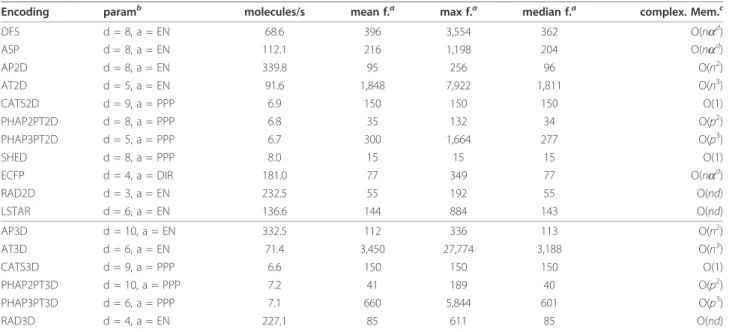
Table 2 presents the performance of the different encodings as implemented in jCompoundMapper. The computation time for the atom-based approaches varies from the atom pair encodings which can be computed with 332-339 molecules per second to the depth- first search based encodings which have a performance of 68-136 molecules per second. The encodings relying on the typing using the PPP SMARTS definitions are signif-icantly slower with about 7-8 processed molecules per second. The conversion time includes reading, typing, and feature map creation. As benchmark data set, we chose the publicly available ChemDB random back-ground data set published in the virtual screening study by Nasr et al. [28]. This data set comprises 175,000 ran-dom compounds from ChemDB [29].
Machine Learning Performance
A major application of molecular encodings are struc-ture-based machine learning and data mining methods. The aim of such applications is either the prediction of molecular properties or the ranking of compounds according to a trained model. In the following experi-ments, we wanted to assess the quality of the encodings implemented in jCompoundMapper for several estab-lished regression and classification benchmark problems. The encodings were used with the default parameters as given in Table 2. The compounds were prepared using
CORINA [30] for initial coordinates and were refined using Schrödinger MacroModel [31] with the OPLS 2005 force field.
QSAR Regression Problems with LIBSVM
LIBSVM [12] is a library for support vector machines. For the experiments on the regression benchmarks, we decided to train -support vector regression on the benchmark compilation of eight pIC50 QSAR problems published by Sutherland et al. [14]. The Gram matrices were precomputed by the MinMax similarity, which is also a valid kernel function. We conducted these experi-ments to find out whether there are significant differ-ences between the performances of the different encodings.
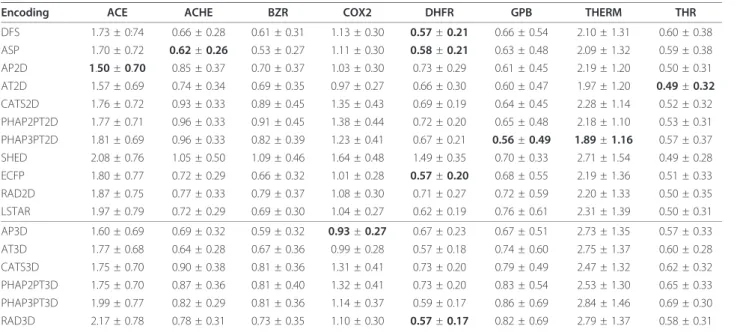
We evaluated the nested cross-validation performance of the different encodings and compared the outcome of the experiments against results from the literature. The parameters Candof the support vector machine were selected in a nested cross-validation. In the experiments, a 10-fold cross-validation was repeated 20 times using an initial seed value. Therefore, the values represent the mean and the standard deviation, computed over 200 models. Based on these statistics, the corrected resampled t-test of Bouckaert and Frank [32] can be applied. The results are summarized in Table 3. With the exception of THERM and THR, the performance of the best encodings was at least comparable to the mean squared error values for a sophisticated graph kernel given by Fechner et al. [33] on the same benchmarks.
Table 2 Conversion Time
Encoding paramb molecules/s mean f.a max f.a median f.a complex. Mem.c
DFS d = 8, a = EN 68.6 396 3,554 362 O(nad)
ASP d = 8, a = EN 112.1 216 1,198 204 O(nad)
AP2D d = 8, a = EN 339.8 95 256 96 O(n2)
AT2D d = 5, a = EN 91.6 1,848 7,922 1,811 O(n3)
CATS2D d = 9, a = PPP 6.9 150 150 150 O(1)
PHAP2PT2D d = 8, a = PPP 6.8 35 132 34 O(p2)
PHAP3PT2D d = 5, a = PPP 6.7 300 1,664 277 O(p3)
SHED d = 8, a = PPP 8.0 15 15 15 O(1)
ECFP d = 4, a = DIR 181.0 77 349 77 O(nad)
RAD2D d = 3, a = EN 232.5 55 192 55 O(nd)
LSTAR d = 6, a = EN 136.6 144 884 143 O(nd)
AP3D d = 10, a = EN 332.5 112 336 113 O(n2)
AT3D d = 6, a = EN 71.4 3,450 27,774 3,188 O(n3)
CATS3D d = 9, a = PPP 6.6 150 150 150 O(1)
PHAP2PT3D d = 10, a = PPP 7.2 41 189 40 O(p2)
PHAP3PT3D d = 6, a = PPP 7.1 660 5,844 601 O(p3)
RAD3D d = 4, a = EN 227.1 85 611 85 O(nd)
Computation time on a random ChemDB [29] background data set consisting of about 175,000 compounds. This includes reading, typing, and generation of the feature map objects. Empirical computation time was obtained on a dual core AMD Opteron(tm) Processor 280, 2.4 GHz, 2 GByte RAM, Java Runtime
Environment 1.6, Linux kernel 2.6.18, using a single core.
aunique features, EN: element neighbor, PPP: possible pharmacophore points, DIR: Daylight Invariants plus ring flagbstandard parameters of the implemented
An analogue setup was used to compute nested leave-one-out cross-validation results to compare the predic-tive performance of the support vector machine in com-bination with the jCompoundMapper encodings to literature results. Again, we optimized the parametersC and (we used a 10-fold cross-validation repeated 2 times to select the best parameter combination in the inner loop) and trained a model for each of then leave-one-out sets and predicted the external sample for each model.
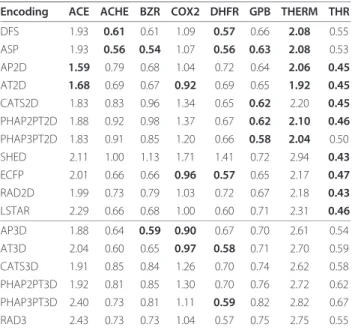
Table 4 and 5 summarize the results of the nested leave-one out cross-validation according to the mean squared error and Pearson’s correlation coefficient. Sutherland et al. used several descriptor-based approaches to model the activity of the benchmark set (presented in Table 4 and 5) using partial least squares (PLS) [14]. Compared against the results (squared corre-lation coefficient) given for the best descriptor approach presented in this study, the jCompoundMapper encod-ings are competitive. The findencod-ings are summarized in Table 6 which shows a similar performance in two cases, a better performance in three cases, and a worse performance in three cases.
Classification of Toxic Compounds with LIBLINEAR
Another increasingly important task is to build models on large data sets of chemicals. A machine that can cope with such a setup is LIBLINEAR [16], a linear large-scale support vector machine. The large Ames data set was published by Hansen et al. [15] and con-tains 6512 compounds and their measured toxicity in an Ames test. We skipped the encodings based on the PPP
typer because several compounds do not have any phar-macophore point according to the PPP definition. The results were obtained by tuning theCparameter in log2
Î {-8, -7, ..., 2} within a 2-fold cross-validation on the training set and evaluating the model performance on five defined splits as described in [15].
Table 7 shows the AUC ROC results for the large Ames toxicity benchmark set. The ECFP and LSTAR encodings achieved the best results, comparable to the results of several supervised classifiers presented by Hansen et al. [15] using dragonX [34] descriptors. Hansen et al. applied k-nearest neighbor, support vec-tor machines with a radial basis function, Gaussian processes, and random decision forests to build models on dragonX descriptors for this problem. The approaches were evaluated on the same defined splits. The performance of LIBLINEAR with the best encod-ings is comparable to the best approaches Gaussian processes and support vector machines. Even the worst performing encodings (AP2D, AP3D, and DFS) were competitive to thek-nearest neighbor classifier on dra-gonX descriptors.
Java API and Command-line Interface
Java API Usage Example
The core of the library is a Java API. The API enables to process chemical information from an abstract level, similar to a workflow tool. The example given in Appendix 1 reads an MDL SD file, converts the com-pounds to feature maps and calculates all pairwise similarities.
Table 3 Nested Cross-validation MSE Performance on the Sutherland Data Sets
Encoding ACE ACHE BZR COX2 DHFR GPB THERM THR
DFS 1.73 ± 0:74 0.66 ± 0.28 0.61 ± 0.31 1.13 ± 0.30 0.57±0.21 0.66 ± 0.54 2.10 ± 1.31 0.60 ± 0.38 ASP 1.70 ± 0.72 0.62±0.26 0.53 ± 0.27 1.11 ± 0.30 0.58±0.21 0.63 ± 0.48 2.09 ± 1.32 0.59 ± 0.38 AP2D 1.50±0.70 0.85 ± 0.37 0.70 ± 0.37 1.03 ± 0.30 0.73 ± 0.29 0.61 ± 0.45 2.19 ± 1.20 0.50 ± 0.31 AT2D 1.57 ± 0.69 0.74 ± 0.34 0.69 ± 0.35 0.97 ± 0.27 0.66 ± 0.30 0.60 ± 0.47 1.97 ± 1.20 0.49±0.32
CATS2D 1.76 ± 0.72 0.93 ± 0.33 0.89 ± 0.45 1.35 ± 0.43 0.69 ± 0.19 0.64 ± 0.45 2.28 ± 1.14 0.52 ± 0.32 PHAP2PT2D 1.77 ± 0.71 0.96 ± 0.33 0.91 ± 0.45 1.38 ± 0.44 0.72 ± 0.20 0.65 ± 0.48 2.18 ± 1.10 0.53 ± 0.31 PHAP3PT2D 1.81 ± 0.69 0.96 ± 0.33 0.82 ± 0.39 1.23 ± 0.41 0.67 ± 0.21 0.56±0.49 1.89±1.16 0.57 ± 0.37 SHED 2.08 ± 0.76 1.05 ± 0.50 1.09 ± 0.46 1.64 ± 0.48 1.49 ± 0.35 0.70 ± 0.33 2.71 ± 1.54 0.49 ± 0.28 ECFP 1.80 ± 0.77 0.72 ± 0.29 0.66 ± 0.32 1.01 ± 0.28 0.57±0.20 0.68 ± 0.55 2.19 ± 1.36 0.51 ± 0.33 RAD2D 1.87 ± 0.75 0.77 ± 0.33 0.79 ± 0.37 1.08 ± 0.30 0.71 ± 0.27 0.72 ± 0.59 2.20 ± 1.33 0.50 ± 0.35 LSTAR 1.97 ± 0.79 0.72 ± 0.29 0.69 ± 0.30 1.04 ± 0.27 0.62 ± 0.19 0.76 ± 0.61 2.31 ± 1.39 0.50 ± 0.31
Command-Line Interface Example
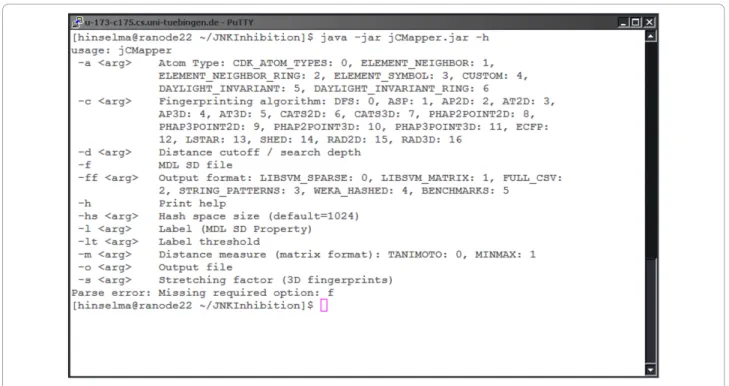
The following section gives an example of using the bin-ary executable version of jCompoundMapper. As a case in point, this version can be used in shell scripts. Calling the command-line tool using -h gives an overview of possible parameters (see Figure 2).
Using the defaults (or via -ff 0), jCompoundMapper generates a hashed LIBSVM output format using the depth-first search encoding with element plus neighbor count atom types.
In the following, we process the training and the known test set from the environmental toxicity chal-lenge http://www.cadaster.eu/node/65) which were
Table 4 Nested Leave-one-out MSE Performance on Sutherland Data Sets
Encoding ACE ACHE BZR COX2 DHFR GPB THERM THR
DFS 1.93 0.61 0.61 1.09 0.57 0.66 2.08 0.55 ASP 1.93 0.56 0.54 1.07 0.56 0.63 2.08 0.53 AP2D 1.59 0.79 0.68 1.04 0.72 0.64 2.06 0.45
AT2D 1.68 0.69 0.67 0.92 0.69 0.65 1.92 0.45
CATS2D 1.83 0.83 0.96 1.34 0.65 0.62 2.20 0.45
PHAP2PT2D 1.88 0.92 0.98 1.37 0.67 0.62 2.10 0.46
PHAP3PT2D 1.83 0.91 0.85 1.20 0.66 0.58 2.04 0.50 SHED 2.11 1.00 1.13 1.71 1.41 0.72 2.94 0.43
ECFP 2.01 0.66 0.66 0.96 0.57 0.65 2.17 0.47
RAD2D 1.99 0.73 0.79 1.03 0.72 0.67 2.18 0.43
LSTAR 2.29 0.66 0.68 1.00 0.60 0.71 2.31 0.46
AP3D 1.88 0.64 0.59 0.90 0.67 0.70 2.61 0.54 AT3D 2.04 0.60 0.65 0.97 0.58 0.71 2.70 0.59 CATS3D 1.91 0.85 0.84 1.26 0.70 0.74 2.62 0.58 PHAP2PT3D 1.92 0.81 0.85 1.30 0.70 0.76 2.72 0.62 PHAP3PT3D 2.40 0.73 0.81 1.11 0.59 0.82 2.82 0.67 RAD3 2.43 0.73 0.73 1.04 0.57 0.75 2.75 0.55
Overview ofsupport vector regression performance on the Sutherland data set using the MinMax kernel function. The performance was evaluated using a nested leave-one-out cross-validation with a parameter optimization using 10-fold cross-validation repeated 2 times. Bold values indicate performances not worse than 10% of the best performing encoding.
Table 5 Nested Leave-one-out Correlation Performance on Sutherland Data Sets
Encoding ACE ACHE BZR COX2 DHFR GPB THERM THR
DFS 0.79 0.78 0.71 0.68 0.86 0.69 0.70 0.68 ASP 0.79 0.80 0.75 0.69 0.87 0.71 0.70 0.69 AP2D 0.83 0.70 0.67 0.71 0.82 0.71 0.70 0.75
AT2D 0.82 0.74 0.67 0.74 0.83 0.70 0.73 0.75
CATS2D 0.81 0.68 0.49 0.60 0.84 0.72 0.68 0.75
PHAP2PT2D 0.80 0.64 0.48 0.59 0.83 0.72 0.70 0.74
PHAP3PT2D 0.80 0.64 0.56 0.65 0.84 0.73 0.71 0.71 SHED 0.78 0.61 0.34 0.46 0.61 0.66 0.57 0.76
ECFP 0.78 0.76 0.68 0.73 0.86 0.70 0.68 0.74
RAD2D 0.78 0.73 0.59 0.70 0.82 0.68 0.68 0.76
LSTAR 0.75 0.77 0.68 0.72 0.86 0.66 0.66 0.74
AP3D 0.80 0.77 0.72 0.74 0.83 0.67 0.60 0.68 AT3D 0.78 0.80 0.68 0.72 0.86 0.66 0.58 0.65 CATS3D 0.79 0.67 0.57 0.63 0.83 0.64 0.60 0.66 PHAP2PT3D 0.79 0.69 0.56 0.62 0.83 0.63 0.58 0.62 PHAP3PT3D 0.73 0.73 0.58 0.68 0.86 0.59 0.55 0.58 RAD3 0.73 0.73 0.63 0.70 0.86 0.63 0.57 0.69 Overview ofsupport vector regression Pearson’s correlation coefficient performance on the Sutherland data set using the MinMax kernel function. The performance was evaluated using a nested leave-one-out cross-validation with a parameter optimization using 10-fold cross-validation repeated 2 times. Bold values indicate performances not worse than 5% of the best performing encoding.
Table 7 Comparison with Literature Results on the Ames Toxicity Benchmark
Encoding AUC ROCa
ECFP 0.87 ± 0.01
LSTAR 0.86 ± 0.01
SVM-dragonXb 0:86 ± 0.01
RAD2D 0.85 ± 0.02
RAD3D 0.85 ± 0.01
ASP 0.85 ± 0.02
GP-dragonXb 0.84 ± 0.01
AT2D 0.83 ± 0.01
RF-dragonXb 0.83 ± 0.01
AT3D 0.81 ± 0.01
kNN-dragonXb 0.79 ± 0.01
DFS 0.78 ± 0.01
AP2D 0.78 ± 0.03
AP3D 0.76 ± 0.02
Benchmarks for the large Ames toxicity benchmark using LIBLINEAR (nested 5-fold cross-validation on defined splits). The features were hashed to 214bit sparse binary fingerprints.
aArea under the ROC curvebReference classifier from the study of Hansen
et al. using dragonX 1.2, SVM: support vector machine, GP: Gaussian processes, RF: random decision forest,kNN:k-nearest neighbor.
Table 6 Comparison with Literature Results on Sutherland Data Sets
Data set Best Encoding Q
loo
2 Sutherland Q
loo2
ACE AP2D 0.69 HQSAR 0.72
ACHE ASP, AT3D 0.57 CoMSIA 0.49
BZR ASP 0.56 CoMSIA 0.45
COX2 AT2D 0.55 CoMSIA 0.57
DHFR ASP 0.76 CoMSIA 0.69
GPB PHAP3PT2D 0.53 HQSAR 0.66
THERM AT3D 0.53 2.5D 0.66
THR RAD2 D, RAD3D 0.58 CoMSIA 0.72
converted to MDL SD format. The label (MDL prop-erty) to be learned is log(IGC50-1). Using these settings, the structures of the training set were mapped to hashed fingerprints with the default settings.
java -jar jCMapperCLI.jar -f challenge_ train.sdf -l“log(IGC50-1)”
After the computation, an overall statistic is plotted showing e.g. the average number of features in the fin-gerprints. In the next step, we map the test file to the same representation. Bits in the test file were set in exactly the same positions in the vector because the ran-dom numbers are generated by using the seed value defined by the features.
java -jar jCMapperCLI.jar -f challenge_-test_known.sdf -l“log(IGC50-1)”
In the next step, a cross-validation is conducted by using the precompiled binary distribution of LIBSVM that can be downloaded from the LIBSVM homepage. The parameters are set as follows: -t 0 sets the linear kernel (dot product), -s 3 sets Î regression, and -c 2 sets the error weight to 2. The file for training was pro-duced in the previous step.
svmtrain -t 0 -s 3 -v 10 -c 2 challenge_-train.DFS.LIBSVM_SPARSE
LIBSVM produces no model in cross-validation mode. However, the LIBSVM cross-validations statistics showed that the model has an MSE of 0.32 and anQ2 of 0.71, indicating a reasonable parametrization.
Cross Validation Mean squared error = 0.324891
Cross Validation Squared correlation coefficient = 0.712412
Finally, the model is trained by omitting the cross-validation flag -v.
svmtrain -t 0 -s 3 -c 2 challenge_train. DFS.LIBSVM_SPARSE
This step produces a separate model file, which can be used to predict the external test set that was generated during the second step. This is conducted by calling svmpredict.
svmpredict challenge_test_known.DFS. LIBSVM_SPARSE challenge_train.DFS. LIBSVM_SPARSE.model result
The results are printed by LIBSVM highlighting that the performance on the external test set is MSE= 0.29 and R2 = 0.74. The result on the known test of the environmental toxicity prediction challenge would be in the top ranks of the competition. The prediction values can be obtained by opening the LIBSVMoutput file resultin an editor.
Mean squared error = 0.291011 (regression) Squared correlation coefficient = 0.742283 (regression)
Conclusions
application in scripts. The architecture provides the functionality to derive fingerprints from existing ones or to integrate own encodings. In contrast to closed source fingerprinting toolkits, a scientist knows exactly how the fingerprint is computed (like the labeling function, dis-tance cut-offs) and can even inspect the source code of the generation routine. We compared the performance using linear and non-linear support vector machines on standard machine learning benchmarks in the research field. The results show that the machine learning perfor-mance using the encodings with default parameters is already close to more sophisticated state-of-the-art descriptors. The binary version provides a command-line interface allowing for the generation of models from the shell with open source software such as LIBSVM or WEKA in reasonable time on average desk-top computers. The library itself uses only functionality of open source software licensed under the LGPL. Therefore, the library can be used in any project compa-tible with the CDK. Further projects with the library, such as a KNIME node wrapping jCompoundMapper, are planned.
Availability
The following files are available for download from http://jcompoundmapper.sourceforge.net/
1. External library, which can be integrated as Java jar library file
2. External library, including sources
3. Binary command-line tool (requires a Java run-time environment) and a short tutorial with a pre-pared data set
Appendix
Appendix 1 - Usage of the API
Example of using the API: Read molecules, map the com-pounds to encodings, and compute a similarity matrix.
1 // read sd file
2 RandomAccessMDLReader reader =new Ran-domAccessMDLReader(newFile (”molecules . sdf“) );
3
4 // convert all compounds in the data set to feature maps
5 final ArrayList <FeatureMap> feature-Maps =newArrayList <FeatureMap >( );
6 final FingerPrinter finger printer =
newEncoding2DAllShortestPaths ( ) ;
7 for (int i = 0; i < reader. getSize ( ); i++) {
8 ArrayList <IFeature > rawFeatures = finger printer . getFingerprint (reader. getMol (i));
9 featureMaps . add (new FeatureMap (rawFeatures ) ) ;
10 } 11
12 //compute all pairwise distances by feature maps
13 final int dim = featureMaps . size ( ) ; double [ ] [ ] matrix = new double [ dim ] [ dim ] ;
14 IDistanceMeasure similarity =new Dis-tanceTanimoto ( ) ;
15 for( int i = 0; i < dim; i++) { 16 for( int j = i ; j < dim ; j++) { 17 matrix [ i ] [ j ] = similarity . getSimilarity (featureMaps . get ( i ), featureMaps . get ( j ));
18 } 19 }
Authors’contributions
GH wrote most of the code and the manuscript. LR implemented the Molprint-like fingerprints and the extended connectivity fingerprint, helped to design the library, and participated in writing the manuscript. AJ implemented an initial version of the pharmacophore typer and the CATS2D descriptors. NF tested some of the encodings in experiments and helped to develop the atom typing schemes. AZ supervised the study and participated in the discussion of the results. All authors read and approved the final manuscript.
Competing interests
The authors declare that they have no competing interests.
Received: 7 October 2010 Accepted: 10 January 2011 Published: 10 January 2011
References
1. Brown N:Chemoinformatics - An Introduction for Computer Scientists.
ACM Comput Surv2009,41:8:1-8:38.
2. Willett P, Barnard JM, Downs GM:Chemical Similarity Searching.J Chem Inf Comput Sci1998,38(6):983-996.
3. Steinbeck C, Han Y, Kuhn S, Horlacher O, Luttmann E, Willighagen E:
The Chemistry Development Kit (CDK): an open-source Java library for Chemo- and Bioinformatics.J Chem Inf Comput Sci2003,
43(2):493-500.
4. Bender A, Mussa HY, Glen RC, Reiling S:Similarity Searching of Chemical Databases Using Atom Environment Descriptors (MOLPRINT 2D): Evaluation of Performance.J Chem Inf Comput Sci2004,44(5):1708-1718. 5. Rogers D, Hahn M:Extended-connectivity fingerprints.J Chem Inf Model
2010,50(5):742-754.
6. Ralaivola L, Swamidass SJ, Saigo H, Baldi P:Graph kernels for chemical informatics.Neural Networks2005,18(8):1093-1110.
7. Renner S, Fechner U, Schneider G:Alignment-free Pharmacophore Patterns - A Correlation Vector Approach.InPharmacophores and Pharmacophore Searches, Pharmacophores and Pharmacophore Searches.
Edited by: Langer T, Hoffmann R. Weinheim: Wiley-VCH; 2006:49-79. 8. Carhart RE, Smith DH, Venkataraghavan R:Atom Pairs as Features in
Structure-Activity Studies: Definition and Applications.J Chem Inf Comput Sci1985,25:64-73.
9. Mahé P, Ralaivola L, Stoven V, Vert JP:The Pharmacophore Kernel for Virtual Screening with Support Vector Machines.J Chem Inf Model2006,
46(5):2003-2014.
11. Brown N, McKay B, Gasteiger J:Fingal: A Novel Approach to Geometric Fingerprinting and a Comparative Study of Its Application to 3D-QSAR Modelling.QSAR Comb Sci2005,24:480-484.
12. Chang CC, Lin CJ:LIBSVM: A Library for Support Vector Machines2001 [http://www.csie.ntu.edu.tw/~cjlin/libsvm].
13. Hall M, Frank E, Holmes G, Pfahringer B, Reutemann P, Witten IH:The WEKA Data Mining Software: An Update.SIGKDD Explorations2009,
11:10-18.
14. Sutherland JJ, O’Brien LA, Weaver DF:A Comparison of Methods for Modeling Quantitative Structure-Activity Relationships.J Med Chem2004,
47(22):5541-5554.
15. Hansen K, Mika S, Schroeter T, Sutter A, ter Laak A, Steger-Hartmann T, Heinrich N, Müller KR:Benchmark Data Set for in Silico Prediction of Ames Mutagenicity.J Chem Inf Model2009,49(9):2077-2081. 16. Fan RE, Chang KW, Hsieh CJ, Wang XR, Lin CJ:LIBLINEAR: A Library for
Large Linear Classification.J Mach Learn Res2008,9:1871-1874. 17. Fechner N, Jahn A, Hinselmann G, Zell A:Estimation of the applicability
domain of kernel-based machine learning models for virtual screening.
J Cheminf2010,2:2.
18. Hinselmann G, Fechner N, Jahn A, Eckert M, Zell A:Graph kernels for chemical compounds using topological and three-dimensional local atom pair environments.Neurocomputing2010,74:219-229.
19. Hinselmann G, Jahn A, Fechner N, Zell A:Chronic Rat Toxicity Prediction of Chemical Compounds Using Kernel Machines.InEvolutionary Computation, Machine Learning and Data Mining in Bioinformatics: 7th European Conference (EvoBio 2009). Volume 5483.Tübingen, Germany: Springer; 2009:25-36.
20. Jahn A, Hinselmann G, Fechner N, Zell A:Optimal Assignment Methods for Ligand-Based Virtual Screening.J Cheminf2009,1:14.
21. Jahn A, Hinselmann G, Fechner N, Henneges C, Zell A:Probabilistic Modeling of Conformational Space for 3D Machine Learning Approaches.Molecular Informatics2010,29(5):441-455.
22. Borgwardt KM, Ong CS, Schönauer S, Vishwanathan SVN, Smola AJ, Kriegel HP:Protein function prediction via graph kernels.Bioinformatics
2005,21:47-56.
23. Schneider G, Neidhart W, Giller T, Schmid G:Scaffold-Hopping by Topological Pharmacophore Search: A Contribution to Virtual Screening.
Angew Chem., Int Ed1999,38(19):2894-2896.
24. Gregori-Puigjané E, Mestres J:SHED: Shannon Entropy Descriptors from Topological Feature Distributions.J Chem Inf Model2006,46(4):1615-1622. 25. Bender A, Mussa HY, Glen RC:Screening for Dihydrofolate Reductase
Inhibitors Using MOLPRINT 2D, a Fast Fragment-Based Method Employing the Naive Bayesian Classifier: Limitations of the Descriptor and the Importance of Balanced Chemistry in Training and Test Sets.
J Biomol Screen2005,10(7):658-666.
26. Steinbeck C, Hoppe C, Kuhn S, Floris M, Guha R, Willighagen E:Recent developments of the chemistry development kit (CDK) - an open-source java library for chemo- and bioinformatics.Curr Pharm Des2006,
12(17):2111-2120.
27. Swamidass SJ, Chen J, Bruand J, Phung P, Ralaivola L, Baldi P:Kernels for small molecules and the prediction of mutagenicity, toxicity and anti-cancer activity.Bioinformatics2005,21:359-368.
28. Nasr R, Swamidass SJ, Baldi P:Large scale study of multiple-molecule queries.J Cheminf2009,1:7.
29. Chen J, Swamidass SJ, Dou Y, Baldi P:ChemDB: a public database of small molecules and related chemoinformatics resources.Bioinformatics2005,
21:4133-4139.
30. Gasteiger J, Rudolph C, Sadowski J:Automatic Generation of 3D-Atomic Coordinates for Organic Molecules.Tetrahedron Comput Methodol1992,
3:537-547.
31. Schrödinger LLC:Schrödinger MacroModel 9.6Schrödinger, LLC, New York, NY; 2008.
32. Bouckaert RR, Frank E:Evaluating the Replicability of Significance Tests for Comparing Learning Algorithms.InAdvances in Knowledge Discovery and Data Mining - Proceedings of 8th Pacific-Asia Conference, PAKDD 2004. Volume 3056.Edited by: Dai H, Srikant R, Zhang C. Springer; 2004:3-12.
33. Fechner N, Jahn A, Hinselmann G, Zell A:Atomic Local Neighborhood Flexibility Incorporation into a Structured Similarity Measure for QSAR.
J Chem Inf Model2009,49(3):549-560.
34. Talete srl, Milano, Italy:dragonX 1.4 for Linux (Molecular Descriptor Calculation Software)[http://www.talete.mi.it/].
doi:10.1186/1758-2946-3-3
Cite this article as:Hinselmannet al.:jCompoundMapper: An open source Java library and command-line tool for chemical fingerprints. Journal of Cheminformatics20113:3.
Open access provides opportunities to our colleagues in other parts of the globe, by allowing
anyone to view the content free of charge.
Publish with
Chemistry
Central and every
scientist can read your work free of charge
W. Jeffery Hurst, The Hershey Company.
available free of charge to the entire scientific community peer reviewed and published immediately upon acceptance cited in PubMed and archived on PubMed Central yours you keep the copyright
Submit your manuscript here: