Address for correspondence Dr. Madiha Sanai
Senior Registrar
Department of Dermatology, Unit-II KEMU/ Mayo Hospital, Lahore. Email: [email protected]
Original Article
Efficacy and safety of spironolactone in moderate to
severe acne in females
Introduction
Acne vulgaris is a fairly common skin problem
involving the pilosebaceous unit (hair follicle & sebaceous glands).1 85% of the young people in the age group of 12-24 years are commonly affected.2 Females are affected more than males (9.8% versus 9.0% ).3 It occurs typically on the face and to a lesser extent, on the neck, back and chest.4 The pathogenesis of acne is multifactorial including excess sebum (oil) production by
Madiha Sanai, Shehla Shaukat, Ayesha Ghias, Aneela Asghar, Muhammad Nadeem, Tahir Jamil Ahmad
Department of Dermatology Unit-II, King Edward Medical University/ Mayo Hospital, Lahore
Abstract Background Acne vulgaris is one of the commonest, chronic conditions of skin. Its estimated mean prevalence in Asian women is 30%. Androgens have a key role in the development of this disease so hormonal therapy like spironolactone is an innovative approach in the treatment of acne with successful results.
Objective To determine the efficacy and safety of spironolactone in moderate to severe acne in females.
Material and Methods In this longitudinal interventional study, 50 unmarried females of 18 to 45 years, suffering from moderate to severe acne according to Acne Grading Scale of American Academy of Dermatology, presenting to the outpatient of Dermatology Department Unit-II, KEMU/ Mayo Hospital, Lahore, with or without raised testosterone levels were enrolled. Pre-treatment, lesions were counted and Acne Severity Index (ASI) was also calculated. Oral spironolactone 100mg/ day was given for 3 months. Monthly follow-up was done during treatment and for another three months after treatment. Serum testosterone and serum potassium levels were done at baseline, 3rd month and at 6th month. During follow-up visits, ASI and blood pressure were recorded. Photographs were taken at baseline and at every follow-up visit. Percentage reduction of ASI was calculated at the end of therapy.
Results 50 patients completed the study with mean age of 21 years. Spironolactone was well tolerated and proved efficacious in 94% of cases (p-value ≤ 0.001). ASI score at the end of study showed 73% improvement (p-value ≤ 0.001) with decrease in the severity of acne after treatment. Patients experienced different side effects during the treatment. Maximum number of patients who had menstrual irregularities was 12, postural hypotension in 4, hyperkalaemia in 2 patients, 2 had polyuria and 8 had other side effects such as headache, weakness and vertigo. All the side effects recovered significantly at the completion of study (p-value ˂ 0.001).
Conclusion Spironolactone is effective and safe medication for females with moderate to severe acne.
Key words
androgen-mediated activation of sebaceous glands, abnormal keratinization of hair follicles which can lead to plugging & comedone formation, accumulation of pilosebaceous units
by Propionibacterium acnes, thus causing
perifollicular inflammation.1,4
With the onset of puberty, the human body starts producing hormones called androgens.5 These hormones (testosterone, androstenedione and dehydroepiandrosterone sulphate) have a vital role in the development of acne resulting in sebum production and follicular keratosis.4,6 Main androgens that act on the androgen receptors are testosterone and dihydrotestosterone (DHT).5 Raised levels of androgens have been found in women with acne and it has also been proved in many studies.4,5 Serum testosterone level estimation is a very simple and cost-effective laboratory test that provides a useful information of the disease status. If the levels are found to be elevated, specific anti-androgen therapy can be highly successful for the proper and satisfying treatment of this disease.4
Standard systemic therapeutic agents used for acne treatment include oral antimicrobials, isotretinoin and hormonal agents.7 Despite advances in acne therapy in recent years, treatment failures and high relapse rates after isotretinoin are seen very commonly, in adult women.8 Hormonal therapy is an important part of the arsenal of acne treatments commonly available to the doctors. Women with acne, even those without raised serum androgen levels, may also benefit from hormonal therapy.8 The mainstay of hormonal treatment include: oral contraceptives and anti-androgens like spironolactone, cyproterone acetate or flutamide.8
Spironolactone is a synthetic agent having steroidal and anti-mineralocorticoid activity with
additional anti-androgen and weak progestogen properties. Initially it was used as a diuretic and antihypertensive drug but afterwards it also served the purpose of reducing raised or unwanted androgen levels in the body.9 The anti-androgenic effects are: 1) competitive inhibition of testosterone and DHT on androgen receptors; 2) inhibiting androstenedione conversion to testosterone; 3) inhibition of 5α-reductase; and 4) increasing sex hormone binding globulin (SHBG) levels. The end result is the reduction of testosterone levels and decreased androgen-stimulated sebum production.1,6,10
Spironolactone has been given successfully to women with acne, those with and without raised androgen levels.10,11 This has been demonstrated in many studies e.g. Katsujiro et al.10 used oral spironolactone 200mg/ day for acne vulgaris in sixty-four Japanese females and exhibited marked clinical improvement, with 34 patients (53%) evaluated as excellent and 30 patients (46.9%) assessed as good. Those who had high (total & free) testosterone levels showed reduction in these levels after treatment. Yemisci
et al.11 determined the beneficial effects and the adverse effects of oral spironolactone 100mg/ day in thirty five adult females having acne, for 3 months. Clinically significant improvement (85.71%) was noted in 24 patients. The present study was planned to find out a safe and effective treatment for acne in women with or without hormonal imbalance in our community as no study of this kind has been done previously in our country.
Patients and Methods
according to Acne Grading Scale of American Academy of Dermatology, with or without raised testosterone levels were enrolled. Pregnant or lactating women were excluded. Women using topical medications such as antibiotics, benzoyl peroxide, tretinoin, adapalene & tazarotene within one month prior to the study and females using systemic antiboitics and oral retinoids within three months prior to the study were omitted from the study. Females with the history of systemic disease such as liver disorders, acid peptic disease, oesophageal varices, gastrointestinal bleed, renal failure and females with the history of postural hypotension were also excluded. Other exclusion criteria were women suffering from polycystic ovarian syndrome (PCOS), congenital adrenal hyperplasia (CAH) and adrenal/ ovarian tumor, women on medication known to affect androgen action or metabolism e.g. estrogens, oral contraceptive pills, cimetidine, corticosteroids, spironolactone, finesteride, flutamide & cyproterone acetate. Females using potassium supplements or high potassium diet were also not included.
Data Collection
After approval from the hospital ethical committee, fifty unmarried female patients, 18-45 years, with a diagnosis of moderate to severe acne, presenting to the outpatient Department of Dermatology Unit-II, Mayo Hospital, Lahore, were included in the study. Data were collected on a pre-designed proforma. Informed written consent was taken from the patients. History, clinical examination and routine investigations i.e. complete blood count (CBC), liver function tests (LFTs) & renal function tests (RFTs) were recorded on the first visit. Acne vulgaris was diagnosed clinically by comedones, papules, pustules, nodules/ cysts and scarring. The disease was graded according to the Consensus Conference on Acne Classification convened by
the American Academy of Dermatology in 1990 as mild, moderate and severe acne.12
Lesions were counted before starting the therapy, at each follow-up visit during & after treatment and the photographs were taken. In order to determine the effect of treatment on acne severity, the Acne Severity Index (ASI)13 was used. The ASI was calculated as:
ASI score = 0.25 x no. of comedones + 1 x no. of papules + 2 x no of pustules.
Serum luteinizing hormone (LH) & serum follicle stimulating hormone (FSH) were measured and abdominal ultrasound (USG) was done at first visit to rule out PCOs and CAH. Serum total testosterone levels and serum potassium levels were measured thrice i.e. at baseline, after 3 months of therapy and at the end of 6th month. Serum samples were drawn with all aseptic measures at 13th day of the menstrual cycle. Measurements were made by radioimmunoassay method in the Centre for Nuclear Medicine (CENUM) Department, Mayo Hospital, Lahore.
Oral spironolactone, 100 mg/ day in divided doses was given to the patients. Treatment was given for three months. The patients were followed up at monthly intervals during the treatment and for another three months after the treatment. Blood pressure was recorded before starting treatment and at each follow-up visit.
and percentages. Repeated measurement ANOVA test was used to compare ASI score and hormone levels at monthly follow-ups and McNemar test was used to compare the side effects in patients during and after treatment. A
p-value <0.05 was accepted as statistically significant.
Results
In this study, 50 unmarried female patients were enrolled. All the patients completed the study. The mean age of patients was 20.90± 2.17 years with minimum 18 and maximum 24 years.
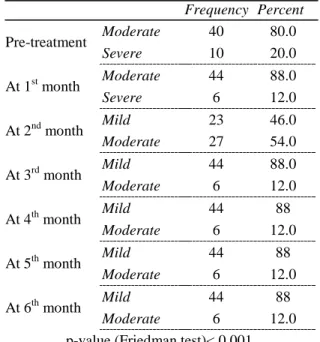
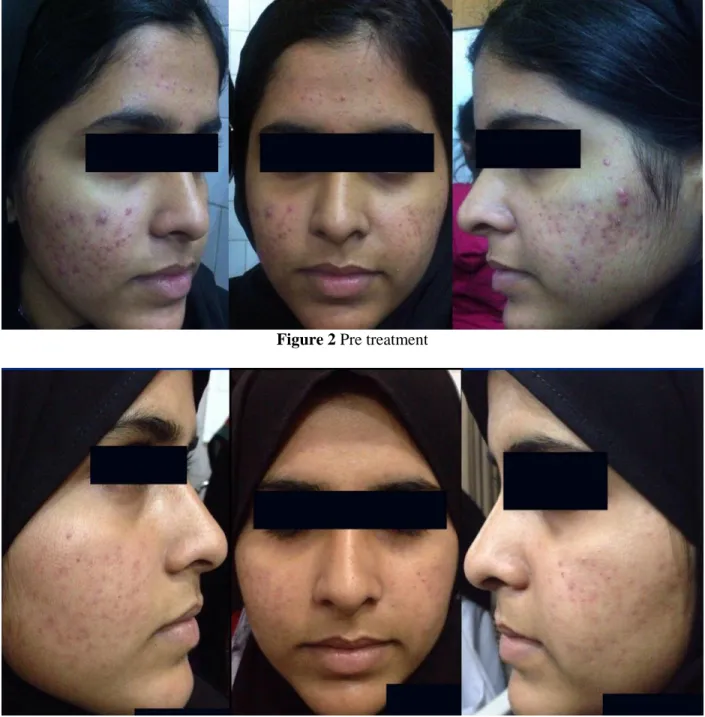
Before treatment, 40 (80%) females had moderate and 10 (20%) patients had severe acne. At 1st month follow up, moderate and severe acne was diagnosed in 44 (88%) and 6 (12%) patients respectively. At 2nd month, mild acne was seen in 23 (46%) while moderate acne was seen in 27 (54%) patients. At 3rd month, 44 (88%) patients had mild and only 6 (12%) patients had moderate acne (Figures 2 & 3). However, from 3rd month to 6th month, grading scale remained the same. On applying Friedman test, we found significant reduction in severity,
p-value ≤ 0.001 (Table 1).
Before treatment, mean ASI score was 41.03±9.73, at 1st month it reduced to 37.39±9.53, at 2nd month it was 21.68±9.25, at 3rd month 12.21±5.01, at 4th month mean ASI score was 10.91±3.75, at 5th month 10.47±3.63 and at 6th month mean ASI score was 9.85±3.20. Mean reduction from baseline to 6th month was statistically significant, p-value < 0.001. Mean percentage reduction in ASI score (baseline to 6th month) was 73.07±18.17%.
On applying repeated measurement ANOVA test, significant reduction in ASI score from baseline (41.03±9.73) to 6th month (9.85±3.20) was observed, p-value ≤ 0.001.
Table 1 Descriptive statistics and comparison of acne grading scale
Frequency Percent Pre-treatment Moderate 40 80.0
Severe 10 20.0
At 1st month Moderate 44 88.0
Severe 6 12.0
At 2nd month Mild 23 46.0
Moderate 27 54.0
At 3rd month Mild 44 88.0
Moderate 6 12.0
At 4th month Mild 44 88
Moderate 6 12.0
At 5th month Mild 44 88
Moderate 6 12.0
At 6th month Mild 44 88
Moderate 6 12.0
p-value (Friedman test)< 0.001
Table 2 Reduction in ASI score
Frequency Percent Cumulative Percent
Fair 5 10.0 10.0
Good 21 42.0 52.0
Excellent 24 48.0 100.0
Total 50 100.0
According to reduction of ASI, 5 (10%) had fair, 21 (42%) had good while 24 (48%) cases had excellent reduction in ASI score (Table 2).
Efficacy of treatment [improvement ≥ 50% in ASI score] was seen in 47 (94%) and not in 3 (6%) patients.
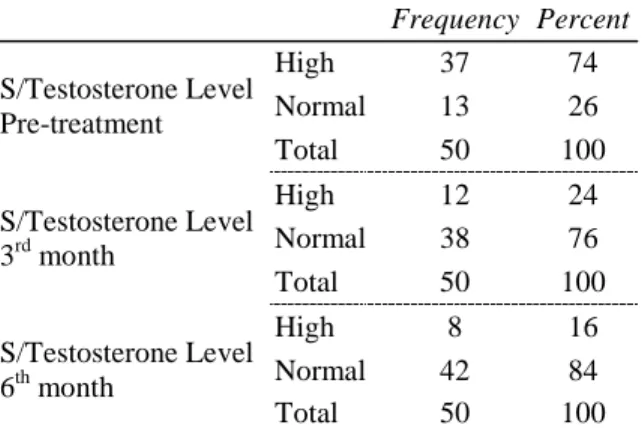
Table 3 Comparison of level of S/ testosterone over different follow UPS
Frequency Percent S/Testosterone Level
Pre-treatment
High 37 74
Normal 13 26
Total 50 100
S/Testosterone Level 3rd month
High 12 24
Normal 38 76
Total 50 100
S/Testosterone Level 6th month
High 8 16
Normal 42 84
Total 50 100
Table 4 Descriptive statistics and comparison of Serum K+ level at different follow ups
S/ K+ Level Mean S.D. Range Min Max
Pre-treatment 4.005 0.76 5.80 3.30 9.10 3rd month 4.07 0.24 0.86 3.50 4.41 6th month 4.23 0.21 0.91 3.70 4.61
Table 5 Frequency distribution of side effects over different follow UPS
Side Effects No. of patients (%) Menstrual Irregularities 1st month 6 (12)
Menstrual Irregularities 2nd month 12 (24) Menstrual Irregularities 3rd month 6 (12) Postural Hypotension >10mmHg
1st month 2 (4)
Postural Hypotension >10mmHg
3rd month 4 (8)
Hyperkalaemia>4.5mmol/ L 3rd
month 2 (4)
Polyuria 3rd month 2 (4)
Others (weakness, headache,
vertigo) 2nd month 2 (4)
Others (weakness, headache,
vertigo) 3rd month 8 (16)
The mean serum potassium levels of all the patients before starting treatment was 4.005±0.76. After three months of treatment, it came to 4.07±0.24 and at 6th month it was 4.23±0.21. Thus, there was no significant
Figure 1 No. of side effects at different follow ups
change in serum potassium levels before and after treatment (Table 4).
Menstrual irregularities were reported by 6 (12%) patients at 1st month, 12 (24%) at 2nd month and 6 (12%) at 3rd month of treatment, while from 4th–6th month none of the patients reported irregular menses. Postural hypotension at 1st and 3rd month was reported by 2 (4%) and 4(8%) patients. Hyperkalaemia and polyuria was seen in 2(4%) each at 3rd month of follow up. Other side effects were reported by 2(4%) and 8(16%) patients at 2ndand 3rd month respectively. All these side effects were transient and disappeared after completion of therapy, p-value < 0.001 (Table 5).
Figure 2 Pre treatment
Figure 3 Post treatment
Discussion
Acne is often considered as a teenage disease but it can occur in preteens and after adolescence. It has a very strong impact on quality of life causing psychological trauma to the patients.10 Failure of standard therapies including oral isotretinoin in treating acne has been noted especially in females.10 So, hormonal
treatment was introduced and spironolactone was selected as a best possible option in the treatment of acne in women.10 The present study was conducted to evaluate the effect of spironolactone in females with moderate/ severe acne and its possible side effects.
Yemisci et al.11 in which the mean age of female patients was 21 years. This is in accordance with the results of other studies as well that acne is more prevalent in females in their early twenties.2,14,15
In our study, a total of 50 female patients were included, in which 40 (80%) had moderate while 10 (20%) patients had severe acne according to acne grading scale. Significant clinical improvement was seen at the end of treatment, with 44 (88%) patients having mild and only 6 (12%) patients with moderate acne. Yemisci et al.11 determined the effects of spironolactone 100 mg/ day in twenty-eight women with acne for 3 months. Out of them, one (3.57%) patient had mild, 18 (64.29%) had moderate and 9(32.14%) patients had severe acne before the treatment. After 3 months of therapy with spironolactone, 24 patients showed significant clinical improvement (85.71%). These results concur with our study.
Krunic et al.16 showed that spironolactone is effective as 85% of subjects were totally free from acne lesions or had significant improvement.
For response of treatment, ASI score was used in this study and the mean percentage reduction in ASI score from baseline to six month, was statistically significant 73.07% (p-value≤0.001). Excellent response was seen in 48% patients, good response in 42% whereas only 10% patients were assessed as having a fair response. Katsujiro et al.14 used oral spironolactone 200mg/ day for acne vulgaris. Sixty four females who completed 20 weeks of treatment, exhibited marked clinical improvement, with 53% patients evaluated as excellent and 46.9% patients assessed as good. The mild difference noted in both studies could be due to the use of a separate scoring system for assessment of acne severity
by Katsujiro et al.14 and difference in total number of patients enrolled.
Effect of treatment on serum testosterone and serum potassium levels were also noted. In the present study, serum testosterone levels were high in 37 patients and normal in 13 patients at baseline. After three months of therapy, only 12 patients had high and 38 patients had normal values showing marked reduction in serum testosterone levels, p-value ≤ 0.001. Similarly, Katsujiro et al.14 noted that 6 patients had high total or free testosterone levels before treatment and all these cases exhibited decreased total or free testosterone levels after treatment. However, Yemisci et al.11 obsereved no change in total testosterone levels before and after treatment because in all patients, pre-treatment serum testosterone levels were within normal limits.
Our study revealed that the mean serum potassium level of all the patients before starting treatment was 4. After 6th month, it became 4.23. Thus, the change was not significant. This result is also comparable to the study of Yemisci et al.11, where potassium levels before and after treatment were within normal limits.
red papules and edema in lower extremities. Some other side effects such as headache, lethargy and dizziness were not observed by Katsujiro et al.14 These results are almost similar to our study in which menstrual irregularity was the commonest side effect.
In the study by Yemisci et al.11 menstrual irregularity was the most common side effect which settled after stopping the treatment. These results also concur with our study.
Shaw JC et al.17 also reported that spironolactone was well tolerated, with 57.5% patients reporting no adverse effects.
In another study by Shaw JC et al.18 diuresis and menstrual irregularities were observed as the common side effects, with diuresis reported more (29%) as compared to our study (4%). The difference could be due to the long term use of spironolactone by Shaw JC et al.18
Conclusion
The present study showed that spironolactone is effective and safe for the treatment of moderate to severe acne in females, and can be a good option for improving the quality of life of acne patients in our community. May be, further studies with increased number of cases, need to be carried out for a more evidence-based conclusion.
References
1. Tobechi LE, Emily LA, Diane B. Hormonal treatment of acne in women. J Clin Aesthet Dermatol 2009; 2(12): 16–22.
2. Zaenglein AL, Thiboutot DM. Acne Vulgaris. In: Bolognia JL, Jorizzo JL, Rapini RP, eds. Dermatology, 2nd edn. London, U.K.: Mosby 2008; 37: 495-508. 3. Vos T, Flaxman AD, Naghavi M, Lozano R,
Michaud C, Ezzati M et al. Years lived with disability (YLDs) for 1160 sequelae of 289 diseases and injuries 1990–2010: a
systematic analysis for the Global Burden of Disease Study 2010. The Lancet 2013; 380(9859): 2163-96.
4. Rahman MM, Khondker L, Hazra SC, Khan MSI. Association of serum testosterone with acne vulgaris in women-A case control study. J Pak Assoc Dermatol 2012; 22: 105-11.
5. Mufeed JE, Khawla AS, Kadhum JH. The correlation of some hormones with acne vulgaris. Int J Sci Nat 2011; 2(4): 713-7. 6. Zouboulis CC, Rabe T. Hormonal
anti-androgens in acne treatment. J Dtsch Dermatol Ges 2010; 8: 60-74.
7. Katsambas A, Dessinioti C. Hormonal therapy for acne: why not as first line therapy? facts and controversies. Clin Dermatol 2010; 28(1): 17-23.
8. George R, Clarke S, Thiboutot D. Hormonal therapy for acne. Semin Cutan Med Surg 2008; 27(3): 188-96.
9. Spironolactone. [Internet] online Wikipedia, the free encyclopedia. Available from: URL: http://en.wikipedia.org/wiki/spironolactone 10. Grace KK, James DR. Oral spironolactone
in post-teenage female patients with acne vulgaris. J Clin Aesthet Dermatol 2012; 5(3): 37–50.
11. Yemisci A, Gorgulu A, Piskin S. Effects and side effects of spironolactone therapy in women with acne. J Eur Acad Dermatol Venereol 2005; 19: 163–6.
12. Would my acne be considered mild, moderate or severe? Available from: http://customercare.proactive.com/app/answ ers/detail/a_id/16.
13. Faghihi G, Vali A, Asilian A, Mohammad Reza Radan, Esteki H, Elahidoost M et al. Comparative efficacy of filtered blue light (emitted from sunlight) and topical erythromycin solution in acne treatment: a randomized controlled clinical trial. J Pak Assoc Dermatol 2011; 21(3): 179-84. 14. Katsujiro S, Daisuke M, Fumiko L, Emiko
A, Asami W, Hirotaka S et al. Anti-androgenic therapy using oral spironolactone for acne vulgaris in Asians. Aesth Plast Surg 2006; 30: 689-94.
15. Chiu A, Chon Y, Kimball B. Changes in the Severity of Acne Vulgaris as affected by Examination Stress. Arch Dermatol 2003; 139: 897-900.
contraceptive containing drospirenone. J Am Acad Dermatol 2008; 58(1): 60.
17. Shaw JC. Low-dose adjunctive spironolactone in the treatment of acne in women: a retrospective analysis of 85 consecutively treated patients. J Am Acad Dermatol 2000; 43(3): 498-502.