
ORIGINAL ARTICLE
The Lip-Cheek Groove
A New Analysis With Treatment Options
Naznin Karsan, BSc, MSc, MD, FRCSC; David A. F. Ellis, MD, FRCSC
Objective: To present a clinical classification of the lip-cheek groove.
Design: The clinical classification, which is based on years of analysis, will provide optimal man-agement options for achieving the greatest degree of correction and rejuvenation of the lip-cheek groove.
Results:The use of the clinical classification of the lip-cheek groove will guide the surgeon to the management option(s) that will attain the best aesthetic outcome. Conclusion:The classification of the lip-cheek groove enables the surgeon to choose the optimal approach for improvement of the groove.
Arch Facial Plast Surg. 2006;8:324-328
M
UCH HAS BEEN PUB-lished on the lip-cheek fold with respect to anatomy and treat-ment options. How-ever, we believe that the termlip-cheek fold ormelolabial foldis somewhat of a misno-mer, as the wordfolddoes not correctly de-fine the abnormality in the aging face.
Ac-cording to Webster’s Dictionary, 1986
edition, a fold is a “doubling of something upon itself.” A groove, on the other hand, is a “furrow or long hollow” that has side-walls. A more accurate use of terms is not only a matter of semantics, it also provides an avenue for correct preoperative assess-ment of the constituent parts of the lip-cheek groove so that appropriate treat-ment can subsequently be provided. We will therefore use the termgroove.
The anatomy of the lip-cheek groove has been well described in the recent lit-erature. At the level of the crease, per se, the skin closely adheres to the muscle layer.1,2Medial to the crease, in the upper
lip, a dense fascial layer is found close to orbicularis oris, with a minimum of sub-dermal fat layer.1,2Therefore, because the
skin of the upper lip is very adherent to the underlining structure, it is resistant to sagging due to the aging process. Lateral to the lip-cheek groove, the lateral cheek mound has an abundance of fat in the sub-dermal layer.1,2The lateral wall of the
lip-cheek groove is very mobile, resulting in more progressive sagging changes with ag-ing. Therefore, with aging, the lateral wall of the groove is gradually displaced infe-riorly and medially.
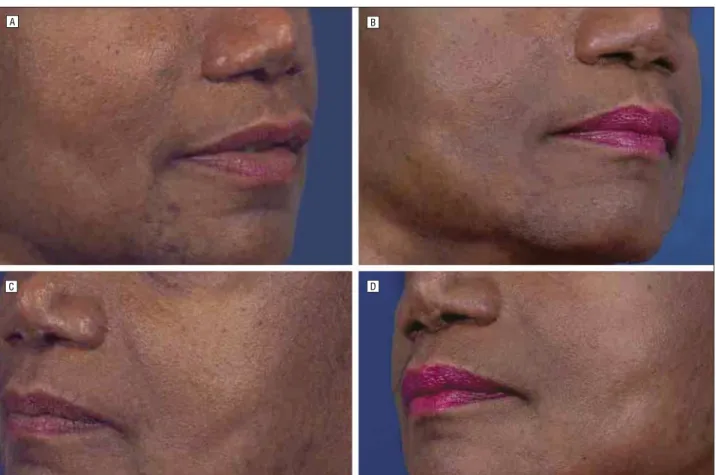
CLASSIFICATION SYSTEM There are 5 main components involved in the classification of the lip-cheek groove: (1) type of groove (UorV); (2) depth of valley (mild, moderate, or severe); (3) width (mild, moderate, or severe); (4) double groove; and (5) skin crease (mild, moder-ate, or severe). Each patient’s lip-cheek groove has a unique composition, and an analysis of each of these 5 components will allow a better preoperative assessment to accurately define which areas require cor-rection. Also, if each of the components is managed appropriately, the results will be excellent. When the lip-cheek or melola-bial groove is assessed, it should be viewed separately from the skin crease, which is lo-cated at the bottom of the groove and is an intradermal problem. The type, width, and depth of the groove should be assessed with the patient in repose and while smiling (Figure 1).
The shape at the bottom of the groove can be characterized as either aUor aVif it is viewed in the plane perpendicular to the lip-cheek groove (Figure 2). Be-cause of its wide base, a U-shaped groove looks like the letterUon cross-sectional analysis perpendicular to the lip-cheek groove. A groove that looks like aVon as-sessment perpendicular to the plane of the groove has a narrow base. In the more common V-shaped groove, the intrader-mal crease occurs earlier in life, espe-cially in women who have thinner skin.
The lip-cheek groove can further be conceptualized as a “valley” with a “hill” laterally, representing the cheek mound. The depth of the groove, or valley, is
Author Affiliations:Art of Facial Surgery (Drs Karsan and Ellis) and Department of Otolaryngology–Head and Neck Surgery, University of Toronto (Dr Ellis), Toronto, Ontario. Dr Karsan is now with Age-Less Facial Plastic Surgery and Skin Care Clinic, Richmond Hill, Ontario.
assessed and classified as mild, moderate, or deep (Figure 3). The deeper the groove, the larger the lat-eral wall or cheek mound (Figure 4). Some grooves are narrow, or “stiletto” style. Narrow grooves can be diffi-cult to treat. Rarely, there is a double groove, where there are 2 grooves on 1 side. The 2 grooves are narrow and not very deep (Figure 5). The depth or absence of an
intradermal crease at the bottom of the groove com-pletes the preoperative assessment of the lip-cheek groove.
MANAGEMENT
Treatment of the lip-cheek groove can be divided into 3 categories: procedures that address (1) the groove, D
C
Figure 1.Different styles of the “valley,” or lip-cheek groove, with the patient in repose (A and C) and while smiling (B and D).
B A
(2) the lateral sidewall, and (3) the intradermal crease. Depending on the patient’s anatomy, 1 technique or a combination of techniques may be required to manage each of the components for adequate rejuvenation. On physical examination, the height of the hill or lateral side-wall should be evaluated by lifting the lateral side-wall later-ally and upward. If there is a minimal lateral sidewall and no improvement of the lip-cheek groove when the lat-eral sidewall is physically lifted, then the groove itself re-quires correction. If there is marked improvement when the lateral sidewall is lifted superolaterally on physical examination, however, then the lateral sidewall will re-quire treatment. If there is some improvement when the lateral sidewall is shifted superolaterally, but a rela-tively wide U-shaped groove is still present, then the groove, in addition to the lateral sidewall, requires treat-ment. If a crease still persists after the groove, or valley, and the lateral sidewall are addressed, then the skin re-quires attention. A deficiency in the soft tissue or bony anatomy of the midface may require augmentation. The decision as to choice of technique will be made by the patient and the surgeon.
If filling of the groove is selected, then either tempo-rary or permanent treatment options are available. Tem-porary treatment includes temTem-porary absorbable inject-able fillers. The permanent treatment alternative is to use a permanent filler (such as Artecoll or Dermalive) or an expanded polytetrafluoroethylene (ePTFE) implant. (Per-manent injectable fillers are not yet available in the United States.) Fillers make the groove less deep.
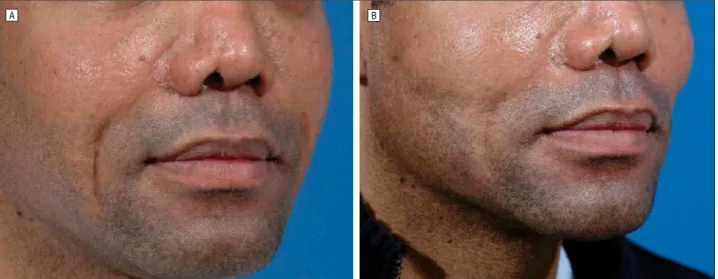
To achieve an optimal result by filling the groove as a sole modality of treatment, there must be minimal lateral wall involvement. If the groove is wide, we recommend the use of a commercially available ePTFE implant (Advanta; Atrium Medical Corp, Hudson, NH) (Figure 6) that we have found to be soft and reliable. Our technique is a slightly modified version of the technique of Lassus.3The
proce-dure can be performed with the patient under local anes-thesia, with or without sedation. The lip-cheek groove is marked medial to the lip-cheek crease as there is a ten-dency for the implant to lateralize. A 3- to 5-mm-diameter oval ribbon of ePTFE measuring the length of the lip-cheek groove is fashioned. A stab incision is made at the lateral nasal skin vestibule anterior to the inferior turbi-nates. Scissors are inserted subdermally down the medial aspect of the lip-cheek groove close to the inside of the mid-line of the groove, creating a tunnel. A long, straight 7.6-cm Keith needle is secured to the distal end of the ribbon, with a gap of 3 cm between the end of the needle and the ePTFE implant. The needle is passed down the tunnel and out through the skin, allowing the ePTFE to enter the tunnel and fill the groove. Once the implant is in place and at least 1 cm below the incision, the suture can be removed. The incision is then closed with a 4-0 chromic suture.
A narrow, or V-shaped, lip-cheek groove is a condi-tion that cannot be adequately dealt with using an im-plant, because the implant is difficult to place exactly un-der the groove. This type of groove is best managed with an injectable filler. Depending on the groove, the filler B
A C
Figure 3.Depth of the lip-cheek groove: mild (A), moderate (B), and deep (C). The lateral wall contributes to the depth; as the lateral wall increases, the depth of the groove increases.
Figure 4.Significant lateral cheek mound contributes to the groove. An implant alone will not address the problem.
can be placed subdermally and/or intradermally. Tem-porary fillers (eg, Perlane, which is not available in the United States, or Restylane) can be injected initially or
on a continuous basis according to the patient’s prefer-ence. If the surgeon and the patient are satisfied with the result of the temporary filler, the patient may choose to
Figure 6.Preoperative (A) and postoperative (B) views of a lip-cheek groove in a patient in whom an expanded polytetrafluoroethylene implant was used to treat the wide groove.
B
D A
C
have a permanent filler (eg, Artecoll or Dermalive) in-jected. However, 4 to 6 syringes of permanent filler may be required over several months so that the permanent filler is placed exactly at the bottom of the groove and not in the lateral wall of the groove. The last alternative for the management of the narrow, or V-shaped, groove is to excise the groove and the lateral sidewall, suturing the medial and lateral components together. With this technique, the incision must be lateral to the groove so that the inward curve of the groove is removed.
If the lateral cheek mound fullness is moderate to se-vere, the cheek mound should be elevated superolater-ally. Many techniques have been described to accomplish this, including Gore-Tex insertion,3subperiosteal
midface-lift,4,5deep plane lift,6extended superficial
musculoapo-neurotic system (SMAS) face-lift,7malar fat pad
eleva-tion,8direct excision with liposuction of the lateral cheek
mound,9,10midface sling,11and, most recently, the thread
lift. The malar fat pad elevation as described by Keller et al8is the most substantial way of moving the lateral wall
upward and backward, making the lip-cheek groove less deep (Figure 7). The newest technique involves the use of threads, which are 2-0 polypropylene sutures with uni-lateral cogs at 1 end. Each thread has a long 17.8-cm straight needle at 1 end, with the cogs or barbs pointing away from that end; there is a curved needle at the other end. Two to 4 threads are passed subcutaneously down to the lateral wall of the lip-cheek groove through a 1-cm incision in the hairline just superior to the attachment of the helical rim. Usually the 2 sutures are sewn together and fixed to the deep temporal fascia, and the threads are pulled inferiorly to bury the knot. The skin is then contoured or massaged superiorly and posteriorly, making the lateral wall of the groove less deep. The use of these “contour threads” has been available in Canada for 1 year and in the United States since the late summer of 2005. However, early results sug-gest that they are lasting (Figure 8).
Finally, the intradermal crease at the depth of the groove requires skin treatment. Temporary fillers that can be injected into the dermis (such as Restylane) are ideal for patients who wish no downtime. Laser resurfacing is a more permanent treatment option to manage the skin
crease; however, it carries the risk of pigmentation changes and cannot be used in every patient.
CONCLUSIONS
The termfoldis a misnomer. We recommend using the termlip-cheek grooveand present a classification system that can help both the patient and the surgeon to choose the best management options. By understanding the com-ponents of the lip-cheek groove, including the shape of the groove and the lateral wall, an improvement in the management and treatment of this area can be achieved, along with superior cosmetic results.
Accepted for Publication:March 1, 2006.
Correspondence:Naznin Karsan, BSc, MSc, MD, FRCSC, Age-Less Facial Plastic Surgery and Skin Care Clinic, 13311 Yonge St, Suite 114, Richmond Hill, Ontario, Canada L4E3L6 ([email protected]).
REFERENCE
1. Millard DR Jr, Yuan RTW, Devine JW Jr. A challenge to the undefeated nasola-bial folds.Plast Reconstr Surg. 1987;80:37-46.
2. Yousif NJ, Gosain A, Matloub HS, Sanger JR, Madiedo G, Larson DL. The na-solabial fold: an anatomic and histologic reappraisal.Plast Reconstr Surg. 1994; 93:60-69.
3. Lassus C. A surgical solution to the deep nasolabial fold.Plast Reconstr Surg. 1996;97:1473-1478.
4. Mendelson BC. Correction of the nasolabial fold: extended SMAS dissection with periosteal fixation.Plast Reconst Surg. 1992;89:822-833.
5. Anderson RD, Lo MW. Endoscopic malar/midface suspension procedure.Plast Reconstr Surg. 1998;102:2196-2208.
6. Hamra ST. A study of the long-term effect of malar fat repositioning in face lift surgery: short-term success but long-term failure.Plast Reconstr Surg. 2002; 110:940-951.
7. Barton FE Jr. Rhytidectomy and the nasolabial fold.Plast Reconstr Surg. 1992; 90:601-607.
8. Keller GS, Namzie A, Blackwell K, Rawnsley J, Khan S. Elevation of the malar fat pad with a percutaneous technique.Arch Facial Plast Surg. 2002;4:20-25. 9. Guyuron B, Michelow B. The nasolabial fold: a challenge, a solution.Plast
Re-constr Surg. 1994;93:522-529.
10. Millard DR, Mullin WR, Hunsaker RH. Evaluation of a technique designed to cor-rect nasolabial folds.Plast Reconstr Surg. 1992;89:356-365.
11. Yousif NJ, Matloub H, Summers AN. The midface sling: a new technique to re-juvenate the midface.Plast Reconstr Surg. 2002;110:1541-1553.
B A


![ANCIENT INDIAN HISTORY OPTIONAL IAS MAINS QUESTION PAPERS [ ]](data:image/gif;base64,R0lGODlhAQABAIAAAP///wAAACH5BAEAAAAALAAAAAABAAEAAAICRAEAOw==)