Service Exchange@Cloud
Low Investment, Non-linear Revenue Growth Engine for
Everyone!
Bhavin Raichura, Ashutosh Agarwal
Abstract
Service Exchange @ Cloud is a platform, where the Service Publishers and Service Subscribers can do business online for mutual benefits. It is not new from the business idea perspective; there are several players: Seekda!, webservicesX, Zuora. The current trends around cloud computing and SaaS has significant impact on the traditional offerings in this area. The concept of Service Exchange @ Cloud can be extended as an enabler for Enterprise SOA implementation in “private cloud” scenario. It can also act as a catalyst for IT consolidation & lean IT transformation for large Enterprise & Government IT landscape. In this paper, we will articulate the value proposition of cloud computing in Service Exchange scenario and how it creates win-win situation for each stakeholder!
For more information, contact [email protected]
Introduction
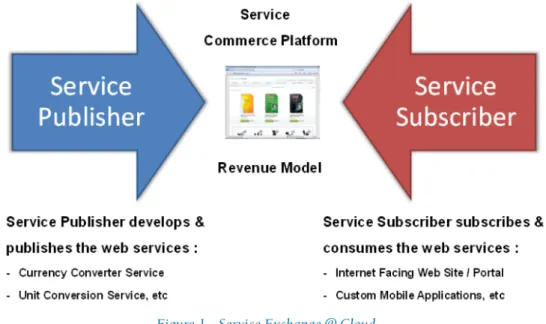
Service Exchange @ Cloud provides a platform to publish web services, search pre-existing web services and subscribe & consume the published web services. Figure 1 illustrates the service exchange concept.
The Service Publishers could be anyone – it could be an individual developer, small or large ISV or a system integrator. Similarly, the Service Subscriber could be an individual, a corporate or an enterprise consuming these services over internet or across mobile devices.
Figure 1 - Service Exchange @ Cloud
The traditional web service exchanges such as Seekda! and webservicesX also provide a similar transactional platform for service publishers and service subscribers. The Zuora provides value-added billing, payment and subscription management platform for such an exchange driven by publish-subscribe model, refer [4, 5, 6].
In the following section we will articulate the key use cases for such a platform implementation and how cloud computing can add value to the traditional web service exchanges.
Service Exchange Use Cases
The use cases identified for Service Exchange are simplified for understanding purpose in this paper. The actual
implementation will be much more comprehensive, complex and extended. The Figure 2 identifies key uses cases for Service Exchange implementation.
Infosys – White Paper | 3
Register
The publishers and subscribers need to register to avail the services from Service Exchange. There will be separate registration processes for publishers and subscribers. The registration process will capture the required information, enroll the users and provide a mechanism security in terms of authentication & authorization. It will also capture the information related to payments and accounts for monetary transactions. The monetary transactions and related subscription management can also be facilitated through external service providers like Zuora.
Publish
After registration, the publishers can be presented with a user interface; where-in they can upload the service binaries and configuration and can avail the web URL that can be used to consume the services.
The Publish use case will present an Publisher Admin Console with more comprehensive options to configure, modify, delete or suspend the service and setting-up the data feeds for the service. The service will also be configured to provide security for restricting the unauthorized access.
2.3. Search
The Search use case will provide a basic interface to subscribers to search and identify the service they want to subscribe. The subscribers will be able to search for the existing services through basic key word search or by using more advanced search capabilities.
The advanced search option will include the search by service providers, technology platform and many other meta-data information. The search results will present the list of service providers which can offer the required service. It can also further help subscribers with rating of the service provider, rating of the service and various other service evaluation parameters along with detailed service documentation.
Further, from revenue model perspective, it offers an opportunity for Ad revenue channel through service sponsorship.
Subscribe
The subscribe use case would facilitate the subscribers to create, manage and configure services subscriptions. It will present a Subscriber Admin Console to view, modify, configure, delete or suspend existing subscriptions. It will help subscribers to configure the security required to access and consume the services subscribed. It will also present a history view of the transactions related to the subscriptions.
Pay
The Pay use case addresses the monetary aspects of the service realization. It will be consumed by all, Publishers, Subscribers and the Service Exchange host. It will present the information & alerts related to payments, consolidated & comprehensive reports for financial transactions. It will also have interface with external systems for payment realization.
Cloud Computing Value Proposition
The Service Exchange @ Cloud has a great potential to become another success story similar to App Store, eBay or YouTube. From technology perspective, cloud computing technology brings the following value:
• Dynamically scalable infrastructure (on-demand)
• Guaranteed quality-of-service in terms of performance, scalability and availability of hosted services
From business perspective, cloud computing brings attractive pricing models for individuals, start-ups or enterprises:
• Lower initial investment in terms of capital expenditure (CapEx)
• Flexible pricing and IT service models (OpEx)
Service Exchange is comparatively an innovative business idea; and there will be constraints on the budget to experiment. At the same time, huge infrastructure support is required to manage scale and quality-of-service.
Also, the business offering need to consider various customer segments like – individuals, ISVs & Enterprises and need to demonstrate huge flexibility in terms of the pricing and service models.
The problem for the key decision makers to realize the business of Service Exchange is to balance the investment with potential growth and also having support for flexible pricing models - cloud computing simplifies this problem.
These value propositions from cloud computing facilitates and makes decision makers comfortable with the initial investment required to start an innovating offering and scale-up the infrastructure on-demand as the business grows using pay-as-you-grow pricing models.
Although, the benefits sound interesting and promising, there are multiple challenges in realizing it:
• Lack of standardization across large players
• Lack of maturity of existing solution & service offerings
• Lack of appropriate business case and success stories to convince C-level executives and
• Lack of clarity on security, data and IP ownership in cloud based deployment scenarios
Enterprise SOA & IT Consolidation
The Service Exchange @ Cloud concept can be further extended to large enterprises and government IT landscape having vision to implement “private cloud”. The Service Exchange can act as a key enabler for the Enterprise SOA. It will also act as a catalyst for lean IT transformation & consolidation to reduce total cost of ownership (TCO).
In the Enterprise SOA scenario, the Service Exchange can act like a Service Registry with support for UDDI Service Discovery. The service discovery intelligence can be further extended using semantic technologies for automatic service discovery, [1, 2]. For the large Enterprises or Government IT landscape it might make business case to consolidate the entire IT landscape on “private cloud” and enable collaboration across application. It will help simplify the deployment architecture and also add value in terms of reducing the total cost of ownership (TCO) by consolidating IT infrastructure, refer [3].
At a broader level, the Enterprise SOA implementation for large Enterprises and Government IT landscape can help
• Reduce the total cost of ownership through IT consolidation
• Improve profitability through flexible IT service models, pay-per-use models and enabling enterprise reuse
• Guarantee quality of service (QoS) through underlying cloud infrastructure and
• Achieve higher business agility through better business & IT alignment
Infosys – White Paper | 5
Stakeholder Benefits
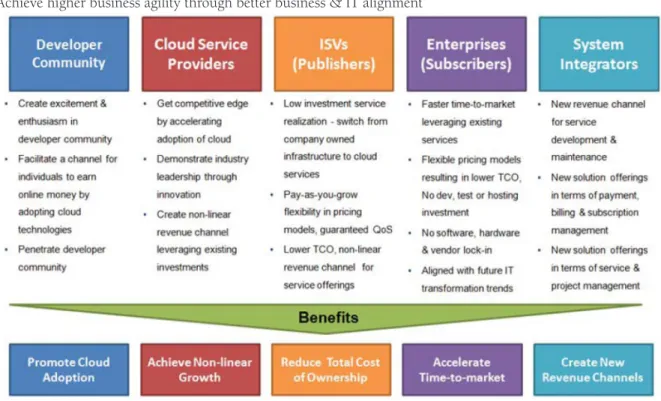
The Service Exchange @ Cloud has something for everyone in the value-chain; Figure 3 articulates the value proposition of the cloud computing technology and benefits to key stakeholders. The Service Exchange realization can happen in multiple deployment scenarios: over internet, over private clouds or over extranet (partner network). We will articulate benefits to each stakeholder in different business scenario.
Developer Community
Service Exchange @ Cloud over the internet scenario provides opportunity to individual developers to develop and deploy services to earn online money. It gives a great opportunity to talented freelancers to earn money online.
Cloud Service Provider
The cloud service providers such as Microsoft, Amazon, and Google can achieve competitive edge by promoting cloud adoption by driving developer community & enterprise to the proprietary Service Exchange.
The Service Exchange product offering suitable to enterprises or government for private cloud offering can open a new revenue channel for non-liner growth.
Publisher
The publishers get a low investment platform with high QoS services that can be consumed by enterprises in production scenarios. It creates a non-linear revenue channel for small & medium ISVs to sell their services to a large Service Exchange Marketplace.
The Service Exchange also provides flexible pricing models to attract more business and offer competitive pricing. It also offers flexible investment models to facilitate pay-more-as-you-grow and start with low CapEx.
Subscriber
The subscribers get ready-to-use services from Service Exchange that can significantly influence the time-to-market new services from subscriber’s perspective. It helps promoting the enterprise reuse in private cloud scenario that helps reducing TCO.
The subscribers (enterprises, corporate, individuals) can multiple options of service providers, the payment & pricing models and service models to choose from and select the best-aligned for reuse. Also, all this comes without any software, hardware, vendor or investment “lock-in” that gives tremendous business agility for the decision makers.
System Integrator
The Service Exchange opens-up new traditional application development & maintenance (ADM) opportunities around service development, deployment, maintenance, management, monitoring and configuration.
The innovative solution and service offering around billing, payment & subscription management can create non-linear revenue channel for system integrators for enterprise, government and other private cloud or Enterprise SOA scenarios.
Large Enterprises
The large enterprises having vision to implement Enterprise SOA can benefit from enterprise wide reuse of the services through Service Exchange. It presents significant cost saving opportunities for capital expenditure as well as operational expenditure. It will act as a key enabler for Enterprise SOA implementation.
Government
For the Government IT landscape, Service Exchange can act as a catalyst for lean IT transformation and IT consolidation for significant cost savings and reducing TCO through private cloud realization.
Conclusion
The Service Exchange @ Cloud is a highly scalable monetizing platform. The cloud service providers can promote the adoption of the cloud offerings. The ISVs can offer various software features as services. The enterprises can accelerate
time-to-market new services. The system integrators can create new business and revenue channels. Individuals can make online money. The success of such a business model is also well tested and proven as Apple App Store is to promote iPhone. Also, the large Enterprises and Government can conceptualize the Service Exchange in the “private cloud” scenario to implement Enterprise SOA while consolidating IT infrastructure to reduce TCO.
References
1. Raichura, Bhavin and Kumar, Rajat, “Semantic SOA – IT Catalyst for Business Transformation”, AMCIS 2007 Proceedings, AIS Electronic Library, Colorado - USA, 2007-11, Paper 26.
2. Raichura, Bhavin and Bharti, Shaurabh, “Achieve Dynamic Integration & Runtime Process Optimization using Semantic SOA”, ICSD 2007, Document Research & Training Centre (DRTC), Bangalore - India, 2007-02, pp. 113-143.
3. Raichura, Bhavin and Rao, Vijay, “Lean IT Transformation”, ebizQ.net, 2009-03 http://www.ebizq.net/topics/saas/features/11121.html
4. Seekda! http://seekda.com/
5. webservicesx.NET http://www.webservicex.net/WCF/default.aspx
6. Zuora: Z-Commerce Platform http://www.zuora.com/products/zcommerce/
About the Authors
Bhavin Raichura is associated with Infosys Ltd. (NASDAQ:INFY), has around 12 years of IT experience. He is a certified TOGAF 8 Practitioner; LZA certified SOA Architect and certified MCSD.Net professional. He is actively contributing articles & papers related to latest business & technology trends on various websites & conferences including ebizQ, AMCIS 2007, ICSD 2007, and CISTM 2007.
Ashutosh Agarwal is associated with Infosys Ltd. (NASDAQ:INFY), has around 12 years of IT experience. He closely works with Manufacturing clients in definition, conceptualization and implementation of technology focused business solutions aligned with latest business and technology trends.