Refraction of Light
Can You Measure the Sugar Content of a Liquid Using a Laser Pointer?Ashton Authement
Table of Contents:
Project Abstract …... pg. 2 Question/Problem & Hypothesis ……….… pg. 3 Background Research ………... pg. 3 Experiment Materials & Procedures……… pg. 6 Variables……….……….……….……….... pg. 8 Data Collection ……….………pg. 8 Data Tables ………..………..……...…pg. 10 Analysis……….……….……….. pg. 11 Analysis Graphs/Charts………..……….. pg.12 Conclusion………….………... pg.13 Biblical Principle………... pg.16 Appendix (Photos, Data Forms, etc.)………..…...…... pg.17 Bibliography………pg.28
Abstract:
Objective/Goals:
Determine if the sugar content of a liquid can be measuredusing a laser pointer.
Methods/Materials:
A laser pointer, a triangular prism (made out ofmicroscope slides), pencil, paper, and Snell’s Law of refraction were used to measure, record, and determine the sugar content of different liquids. Snell’s Law was used to calculate the index of refraction and find the link to sugar content.
Results:
The index of refraction was plotted against the percentage of sugarconcentration. The graph showed a straight line, which concludes that there is a relationship between sugar concentration and the index of refraction.
Conclusion:
The sugar content of a liquid can be measured using a laserpointer. Index of refraction increases when the sugar concentration increases. The data collected in the experiment supported the hypothesis.
Question/Problem & Hypothesis:
Can the sugar content of different liquids be measured with a laser pointer? Will the refraction be different for different sugar concentrations of liquid? Can the different refractions be measured to determine a link to sugar concentration?
This experiment will determine whether sugar concentration in a liquid can be measured by the index of refraction using a laser pointer. If the sugar
concentrations of liquids are increased, then the index of refraction will increase.
Background Research:
Research was focused on the refraction of light to understand the basic concepts of this experiment. The Law of Refraction and Snell’s Law are very important in explaining how light travels and how different types of medium can affect the path of the light. These concepts will be helpful in completing this project.
Everyone has seen the “bending” effect when there is a straw or pencil in a glass of water. The water refracts the light, so the straw looks like it is bending at an angle where water and air meet. Also the term “refraction” means “broken back.” When light passes from one medium (air) to another that is denser
(water), the denser medium slows down the speed of the light. It also causes a “bending” or refraction of the light. The change in speed and refraction depends on how dense the medium is. This concept explains why the light will “bend” more in sugar-water concentrations than in plain water. The index of refraction, n, of a medium is described as how fast a light wave travels through that
medium. It describes the ratio between the speed of light in a vacuum and the speed of light in that particular medium. As an example, the index of refraction of air is 1.00028, so that means that light travels 1.00028 times faster in a vacuum than in air.
Snell’s Law was named after Dutch mathematician and physicist Willebrord Snell, but the Arab scientist Ibn Sahl was the first to describe this refraction using mathematics. Snell’s Law is an equation that is used to calculate the index of refraction as light enters one medium to another. It tells us that the higher the index of refraction, the more the light will bend. The index of refraction of a liquid depends on how dense the liquid is. Since sugar water is denser than plain water, the index of refraction for sugar water will be higher than plain water. Snell’s equation is n2/n1=(sin θ1)/(sin θ2), with n=index of refraction of a given medium, θ1=angle of incidence, and θ2=angle of refraction.
Figure (1) - Understanding Snell’s Law
The angle of incidence and the angle of refraction are measured based on where there are from the surface normal. The surface normal is also just called the “normal.” The normal is a straight line that is a right angle to the area where the two mediums meet. The angle the light makes from the normal as it leaves the first medium is the angle of incidence. The angle between the light and the normal as it enters the second medium is the angle of refraction (See Figure (1)). By using Snell’s Law, the index of refraction can be calculated.
For this project, the law of refraction will be used to measure the sugar concentration of a liquid using a laser pointer and triangular prism. A prism makes it easy to see the refracted light and determine the angle of the laser beam after it passes through the prism. With no liquid in the prism, the laser will beam right through the prism and look like a straight line. There is some
refraction as it passes through the prism but the prism walls are so thin that the refraction is hard to see. When the prism has liquid in it, the laser enters the
prism and makes a refracted beam. The laser beam refracts again when it
leaves the prism. This angle that the beam makes as it leaves the prism is called the angle of minimum deviation. It will be calculated using distances measured of the straight and refracted beam. With the index of refraction for the different sugar waters, a link can be made between sugar concentration and index of refraction.
Experiment:
Materials:
• 4 microscope slides, 1x3 inches. • Epoxy glue
• Tape • Ruler
• Laser pointer • Calculator
• 9 pieces of Graph Paper • Pencil
• 60 grams of Sugar • 400 mL of Water
• 400 mL of Gatorade (Clear, Red, Purple, Green) • 100 mL of Sierra Mist
Procedures:
1. Make a hollow, rectangular prism from the microscope slides. 2. Cover a wall with a piece of graph paper for each liquid.
3. Set up the laser pointer so that the laser beam is vertical to the wall. 4. Aim the laser pointer through the empty prism and mark where the beam
hits the wall.
5. Pour liquid into the prism (0% sugar solution).
6. Shoot the laser beam through the prism filled with water.
7. The beam will hit the wall at some distance from the first mark. Mark the spot.
8. Measure the distance between the two marks, Distance x. 9. Measure the distance from the prism to the wall, Distance L. 10. Calculate the ratio of Distance x over Distance L (x/L). 11. Repeat steps 1-10 and take the average of the x/L ratio.
12. Calculate the angle at which the laser beam hit the wall (angle of minimum deviation), using the x/L ratio.
13. Using Snell’s Law, calculate the index of refraction of the liquid. 14. Repeat for other sugar density solutions (10%, 20% and 30%), to
determine the indexes of refraction.
15. Measure the index of refraction for solutions with unknown sugar concentration (i.e., Various colors of Gatorade and Sierra Mist).
16. With the data from the other known sugar solutions, the sugar concentration of the Gatorade and Sierra Mist can be calculated.
Variables:
DEPENDENT/RESPONDING: Refraction of light
INDEPENDENT/MANIPULATED: The sugar content of a liquid CONSTANTS: Amount of liquid in the prism, amount of light
Data Collection:
The bending of light as it passes from one medium to another is called refraction. The angle at which the light enters a substance and the density of that substance determines how much the light is refracted (See Figure (2)).
To perform the experiment, a laser pointer was shined it into a prism filled with several different 100 mL sugar density solutions (0%, 10%, 20% and 30%). The experiment was also performed using Gatorade and Sierra Mist with
unknown sugar densities. The prism was positioned to make sure the path of the refracted light was parallel to the base of the prism (See Figure (3)). A mark was made where the light entered and exited the prism and hit the board (See Figure (4)). The lengths (X) and (L) were measured and the X/L ratios were calculated using these measurements.
Figure (3) – Experiment Setup Figure (4) – Data Calculations
Snell’s law, along with a calculator, was used to determine the angle of minimum deviation (θmd) and index of refraction (n) for each known sugar solution. A graph was made from the data collected on the known sugar solutions. The index of refraction for the Gatorade and Sierra Mist was calculated based on the equation of the trend line of the graph.
SNELL’S LAW: n = 2.00056 × sin [0.5 (θmd + 60°)]
n = index of refraction of solution
Data Tables: Refraction of Light in Different Density Solutions
Table 1: Known Sugar SolutionsSolution
(100 ml) Trial (CM)X (CM)L X/L Ratio
X/L Ratio Average
Angle of Minimum Deviation
θmd= tan-1(X/L)
Index of Refraction
n = 2.00056 × sin [0.5 (θmd + 60°)]) 0% Sugar Trial A 5.2 12.5 0.416 0.411 22.3 1.317 Trial B 4.8 11.8 0.407 10% Sugar Trial A 4.6 10.8 0.426 0.435 23.4 1.331 Trial B 5.5 12.4 0.444 20% Sugar Trial A 5.9 13.2 0.447 0.451 24.2 1.342 Trial B 6.1 13.4 0.455 30% Sugar Trial A 6.3 13.2 0.477 0.476 25.4 1.356 Trial B 6.5 13.7 0.474
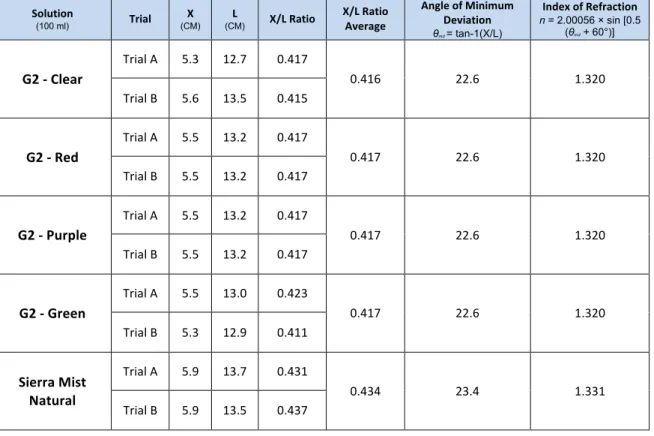
Table 2: Unknown Sugar Solutions
Solution
(100 ml) Trial (CM)X (CM)L X/L Ratio
X/L Ratio Average
Angle of Minimum Deviation
θmd= tan-1(X/L)
Index of Refraction
n = 2.00056 × sin [0.5 (θmd + 60°)]) G2 -‐ Clear Trial A 5.3 12.7 0.417 0.416 22.6 1.320 Trial B 5.6 13.5 0.415 G2 -‐ Red Trial A 5.5 13.2 0.417 0.417 22.6 1.320 Trial B 5.5 13.2 0.417 G2 -‐ Purple Trial A 5.5 13.2 0.417 0.417 22.6 1.320 Trial B 5.5 13.2 0.417 G2 -‐ Green Trial A 5.5 13.0 0.423 0.417 22.6 1.320 Trial B 5.3 12.9 0.411 Sierra Mist Natural Trial A 5.9 13.7 0.431 0.434 23.4 1.331 Trial B 5.9 13.5 0.437
Analysis:
The solutions that were most dense (i.e., had the highest sugar content) refracted the most. It was also observed that care had to be taken when switching solutions. If the prism was not properly cleaned between tests, data was not what was expected. Properly cleaning the prism improved the expected results.
Based on the data collected, the sugar content and the index of refraction were graphed in Excel and a relationship was determined. Excel was used to get a trend line and the equation of that line (y = 0.0013 x + 1.3173); where y = the index of refraction and x = the sugar content (See Figure (5)). The sugar content (x) for the Gatorades and Sierra Mist were calculated using this equation:
Sugar Content (x) = y - 1.3173 0.0013
The calculated index of refraction for all Gatorade colors was 1.320. Solving for the sugar content (x) the Gatorades were calculated to have a sugar content of 2.077g/100 mL. The calculated index of refraction for Sierra Mist was 1.351. Solving for the sugar content (x), the Sierra Mist was calculated to have a sugar content of 10.538 g/100 mL. Comparing the calculated experimental values with the nutritional facts located on the bottles proved the results were similar. Figure (6) shows a comparison of the experimental and actual values.
Analysis Graphs/Charts:
Figure (5) – Index of Refraction for Known Sugar Solutions
Figure (6) – Comparison of Results – Experimental vs Actual 1.317 1.331 1.342 1.356 y = 0.0013x + 1.3173 R² = 0.99781 1.31 1.315 1.32 1.325 1.33 1.335 1.34 1.345 1.35 1.355 1.36 0 5 10 15 20 25 30 35 Re fr ac Lv e In de x % Sugar
Index of RefracLon for Known Sugar SoluLons (%)
10.538 2.077 2.077 2.077 2.077 10.417 1.972 1.972 1.972 1.972 0 2 4 6 8 10 12
Sierra Mist G2-‐clear G2-‐red G2-‐purple G2-‐green
Su
gar (
g/100mL)
Data Comparison
Sugar Content of Drink Samples -‐ Experimental Results vs Actuals
Conclusion:
The hypothesis states that the index of refraction will increase as the amount of sugar in the liquid increases. Yes, the data supported this hypothesis. Different concentration of liquids were use to test the hypothesis. Four different 100 mL sugar density solutions, 0%, 10%, 20%, and 30%, were used in the experiment. It was determined that the index of refraction increased as sugar density increased in the liquid. This means that the added sugar in the liquid increased the density of the liquid, causing the speed of light to slow down. The denser the solution, the more the light will bend. A relationship was determined between the index of refraction and sugar concentration of the known solutions. Various colored Gatorades and Sierra Mist Natural (made with real sugar) with unknown sugar densities were also tested. Using the data collected and the relationship determined, the sugar concentration of both Gatorade and Sierra Mist was calculated.
The results were not affected by the different colors of Gatorade. As shown in Figure (6) the Gatorades were similar to each other. However, the difference between the experimental and actual values had a slight difference. This may have happened from the other tiny nutrients or ingredients in the
Gatorade that could have made the slightest change to the refraction. The Sierra Mist Natural was found to have more sugar than Gatorade. Like the Gatorade, the experimental and actual values were slightly different. This shows that other
ingredients in Sierra Mist Natural also may be affecting the refraction. This data would allow for calculating sugar content determination of other unknown sugar solutions. The data supported my project hypothesis that the sugar content of a liquid could be measured with a laser pointer.
During this experiment the laser pointer did have some trouble going through the Gatorade solution (G2 red). This made it hard to see where the laser came out of the prism. The reason is because the laser used during the
experiment was green and the G2 red absorbed the color of the laser pointer. Referring to the color wheel, red and green are opposite from each other (See Figure (7)). This means that green absorbs red and red absorbs green.
Figure (7) – The Color Wheel
There were other problems in the experiment that resulted in errors in the data that was collected and forced a change in the procedure. This showed that a science experiment is not always perfect. One change resulted from initially trying to use orange juice. Because the orange juice was thick and dense, the
(Sierra Mist). An error that occurred in the experiment was noted when the refraction of two sugar liquids was noted to be the same. This happened
because of the failure to clean the prism or the beaker containing the sugar liquid before using it on the next sugar solution. The prism and beaker were
contaminated with sugar from the previous liquid. After rinsing the prism and beaker, the expected data and results could be determined.
More research can be done with this experiment. Do other dissolved liquid contents impact the refraction of the Gatorade or Sierra Mist? What if salt instead of sugar was used to perform the experiment? These are all questions to be answered by future researchers, who crave to answer something new.
Biblical Principle:
"Trust in the Lord with all your heart and lean not on your own
understanding; in all your ways acknowledge Him, and He will make your paths straight." - Proverbs 3:5-6.
If you shine the laser in the prism with nothing in it, the light would go straight through the prism. If sugar were in it the light would refract in another direction. This is what the bible verse is telling us. If you live a life that pleases God by reading and following his word, and praying and listening to him every day, He will lead you to His path (straight). If something (disobeying God) is blocking your way, your direction will be “refracted” and you will not be following God’s path.
Appendix:
Pictures and Data Forms
Experiment Procedure:
Laser Refraction:
Data Forms:
Raw Data – Refraction Angle for 0% Sugar Solution – Trial A
Raw Data – Refraction Angle for 10% Sugar Solution – Trial A
Raw Data – Refraction Angle for 20% Sugar Solution – Trial A
Raw Data – Refraction Angle for 30% Sugar Solution – Trial A
Raw Data – Refraction Angle for Gatorade G2 Clear – Trial A
Raw Data – Refraction Angle for Gatorade G2 Red – Trial A
Raw Data – Refraction Angle for Gatorade G2 Purple – Trial A
Raw Data – Refraction Angle for Gatorade G2 Green – Trial A
Raw Data – Refraction Angle for Sierra Mist Natural – Trial A
Bibliography:
Curran, Greg. Physics. Franklin Lakes: The Career Press Inc., 2005. Print. Hann, Judith. How Science Works. London: Dorling Kindersley Limited, 1991.
Print.
Levine, Shar and Leslie Johnstone. The Optics Book. New York: Sterling Publishing Company Inc., 1998. Print.
“Refraction of Light.” WW2010 University of Illinois. N.p., n.d. Web. 25 September 2012. <www.ww2010.atmos.uiuc.edu>
Richards, J.D. “Class Projects with Light Prisms.” eHow. Demand Media Inc., 1999. Web. 25 September 2012. <www.ehow.com>
Rogers, Kirsteen. Light, Sound, & Electricity. London: Usborne Publishing Ltd, 2001. Print.
Stille, Darlene R. Maniplating Light. Minneapolis: Compass Point Books, 2006. Print.