Games for Learning and Learning from Games
Maja Pivec
Information Design, FH JOANNEUM, University of Applied Sciences, Graz, Austria E-mail: [email protected], http://mpivec.radical.ac.nz
Paul Kearney
Deakin University, Australia/UNITEC School of Information Technology, Auckland, New Zealand
E-mail: [email protected], http://pkearney.radical.ac.nz
Keywords: game-based learning, recursive loops of learning, games for learning
Received: June 12, 2007
Abstract: This paper details a model of game-based learning and suggests how this can be applied to both the playing of computer games and learning within the classroom environment. The authors document the results from a University level course, created in the form of a role-play for designing educational games, and highlight the student’s attitudes and beliefs towards game design as a career. They also suggest that educational games can be used successfully for the transference of knowledge to domains outside the world of computer games, and highlights several case studies in the area of health and medicine.
Povzetek: V prispevku je predstavljen model učenja na osnovi iger in možnosti uporabe modela v različnih okoljih: pri igranju iger kakor tudi pri uporabi iger za učenje v razredu.
1
Background and introduction to
game-based learning.
Over last few years an emerging trend of games in the area of e-learning has been observed. From early isolated reports on conferences and books reflecting about possible application of digital games for learning (Gee, 2003), more and more practitioners and researchers embraced the idea, including the e-learning community. In 2006 one of the biggest European e-learning conferences, Online Educa in Berlin, introduced a special game track. The two-day session hosted an open discussion between academics, teachers and industry practitioners, focusing on the potential of game-based learning in Universities and lifelong learning institutions and possible software solutions.
The discussions are primarily focused on Pros and Cons of the application of games for learning, trying to find answers to Why don’t we use games more often in classrooms? Often it is pointed at the difficulty to find games that cover the curricular topics, the low tolerance of the environment towards the games where the games are often perceived as unserious activity, with some lecturers fearing that the learning objectives wouldn’t be reached, and others might encounter difficulties with technical resources that schools don’t have. Another important factor is the quality aspect of the games for learning where games should have an explicit learning purpose and can be used, adapted and adopted for supporting, improving and fostering learning processes (SIG-GLUE).
Kasvi (2000) lists the seven requirements suggested by Norman (1993) for an effective learning environment to be to:
1. Provide a high intensity of interaction and feedback; 2. Have specific goals and established procedures; 3. Be motivational;
4. Provide a continual feeling of challenge, not too difficult to be neither frustrating nor too easy to create boredom;
5. Provide a sense of direct engagement on the task involved;
6. Provide the appropriate tools that fit the task; and 7. Avoid distractions and disruptions that destroy the
subjective experience.
Kasvi (2000) suggests that computer games fulfill all of these requirements and believes that they “satisfy them better than most other learning mediums” (p.6). However, it is very difficult to find a game that includes a learning curriculum that is appropriate for different schooling levels. Popular games like ‘Maths Blaster’ from Vivendi Universal, has captivated children but only targets ages 8 to 9 years. Even if the game were upgraded to include a higher level of mathematics, it would be doubtful that today’s 14-year-old student would play this type of game. But take a constructivists point of view and ask the same student to design an educational game, and the response would be quite different, as described in section 3.
those needed to create one, players exhibit the same addictive nature seen in a person that is driven to succeed. A computer game can take anywhere between 3 months and 3 years to create. From the initial concept, the design, the coding, testing and error correction, through to the artwork, the music, packaging, promotion, and distribution, developers must stay focused and committed to the project throughout this entire time, often doing tedious tasks but always learning new and innovative techniques to do their craft. These people are usually young adults and have been avid game players themselves. They learn in a different way from earlier generations and are often motivated by instant feedback and reward of success.
Game-based learning can be applied as additional option to classroom lecturing. The intention of game-based learning is to address new ways of ICT game-based instructional design and at the same time to provide learners the possibility to acquire skills and competencies later required in the business world. By means of digital games and especially of digital educational games learners should be able to apply factual knowledge, learn on demand, gain experiences in the virtual world that can later shape their behavioral patterns and directly influence their reflection, etc.
2
Recursive loops of Game-Based
Learning.
Let us consider, based on the example of an educational adventure game, how and when learning occurs when learners interact e.g. play a game. The main characteristic of an educational game is the fact that instructional content is blurred with game characteristics. The game should be motivating, so that the learner repeats cycles within a game context. While repeating e.g. playing a game, the learner is expected to elicit desirable behaviors based on emotional or cognitive reactions which result from interaction with and feedback from game play.
The purpose of an adventure game is entertainment or edutainment. In adventure games there are very complex environments i.e. microworlds, with no deterministic problem representation. An examples of typical edutainment game is Chemicus (by Heureka-Klett publisher; or TIVOLA for the US market), a puzzle-adventure game for self directed learning of chemistry. Similar to Chemicus one can find an entire series of titles e.g. Physicus, Hystorion, Informaticus, etc. by the same publishers built upon the same game concept.
Adventure games use intrinsic motivation of the player to explore the game world. Intrinsically motivating games incorporate learning activities in this game world. To increase immersion of the player, the game offers an extensive story at the beginning, often related to some murder or mystery. Game characters have to solve the mystery by solving a number of interrelated problems. In each case the problems are part of the game and players are motivated to seek for knowledge to provide a solution in order to continue with the game. In the described game, enjoyment is strongly
related to the learning activity, which can be viewed as a desirable outcome.
Commercial computer games are known for creating social environments and cult followings surrounding the gameplay, the character attributes, and player’s abilities, and this is where affective learning occurs (Kearney and Pivec, 2007). Garris et al., (2002) describes affective learning as including “feelings of confidence, self-efficacy, attitudes, preferences, and dispositions” (p.457). The skill-based learning appears to comfortably fit within the micro game cycle (figure 1), or levels within the game. For example, Rosser et al., (2007) found that the playing of commercial action games improved the surgical skills of laparoscopic physicians and decreased their error rate. There was no documented debriefing session for Rosser’s study and it is assumed that the development of technical or motor skills occurs within the game itself.
Figure 1 also shows how player ability and experience affects the challenge element and the level of learning (Zone of Proximal Development), and how the level of cognitive challenge can be appropriate for the learner’s current abilities. The model shows the inclusion of instructional design and game characteristics as critical elements of a game to enable the achievement of the learning outcomes, as well as the additional factor of player abilities. Defining learning as the acquisition of knowledge or skills, suggests that Game-Based Learning is the vehicle that fosters the acquisition of the learning outcomes. The model includes a time element to allow the player to progress through the game increasing their knowledge and acquiring new levels of ability. This suggests that knowledge, declarative, procedural, and strategic is acquired over time and abilities or skills are incremented through experience.
This model can also be applied to role-play within the classroom. As the student’s abilities are added to, through tuition or guided instruction, their knowledge and skill level is incremented and they move to the next level, or next phase of the project. The role-play course on game design detailed in the next section, was scaffolded in such a way that the students added to their game design concept as their knowledge and skill increased.
3
Game about the game design:
role-play in classroom.
This section documents an educational game design course created by authors and taught to 75 information design students at the University of Applied Sciences Joanneum in Austria, where we wanted to introduce this topic to the coming generation of potential game designers and make them aware of this new discipline along with its specifics. The challenge for students was to create a concept proposal for a publisher of educational games. Based on the course work and results, we analysed how students perceived the area of educational games for the use of teaching and as a career path.
The class was a role-play itself i.e. game about designing a game, where students had to work in teams, create a game design company and take a specific role and responsibilities within the team e.g. game producer, game developer, programmer, etc. to contribute to the task accomplishment. The progress of the work along with the problems they encounted were documented within the company blogs (see as an example http://legalaliengames.blogspot.com/, blog of “the best in show” group)
The course covered topics including the process of commercial game design, taking into consideration the pedagogical design required to achieve the desired learning outcomes. When we design games for learning both the target audience and the learning outcomes have to be considered at the initial conception of the game. In this way teachers can easily recognise the value of this resource and the possibilities to include such games in the curriculum. Aspects of educational game design are tackled more in detail in (Pivec, Koubek & Dondi, 2004).
Figure 2: Student Designs
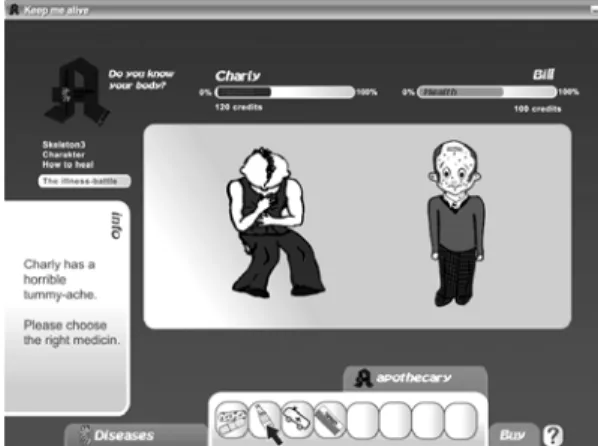
The game concepts differ in excellence from the innovative use of technology to their possible market potential. The class finished with the presentation with the Golden Pineapple awarded concepts (Golden Pineapple Award, 2006). Two of the awarded concepts were focused on the medical content (Figure 2 & 3). Anaphylactic from Dudary Entertainment is a real time strategy game introducing the principles of immune system of human body. Keep Me Alive from Stardust Enterprises is an ICQ game focusing on various infectious diseases and how to prevent and treat them. It also has the potential to include real pharmaceutical products as well as relevant medical advice.
Students were surveyed both, before and after the completing the course on their opinion on games in general and regarding the potential of application of games for learning. We also inquired the motivational momentum of designing a game in terms if they were more motivated and achieved better learning results. Based on this survey we also wanted to assess if they saw educational game development as a possible career path.
Figure 3: Student Designs
On the post survey, 66% of the students agreed that designing educational games was a highly motivational topic and suggested that they now felt competent enough to write a professional educational game concept document. They also agreed the designing educational gems could provide future career opportunities, however only 35% of them would consider this for their own career. The majority of the students found the course to be successful with 70% of the students enjoying the topic despite not considering themselves to be game players. Those who did play computer games, only did so for recreation and had not involved games with any of their schooling. However, upon completion of the course, 60% of the students suggested a preference for using games to learn.
4
The Application of Game-Based
Learning.
some known and documented cases of application of game-based learning targeting various user groups are presented. The cases vary from an educational game created for interdisciplinary learning, to context based environments supporting the application of isolated knowledge for medical and veterinarian students, and the application of commercial-off-the-shelf games (cots) to improve the laparoscopic performance, embedded in the curricula.
Suzanne de Castell and Jennifer Jenson from Canada created Contagion, a role-playing adventure game fostering interdisciplinary learning and targeted at children aged 10 – 15 (de Castell and Jenson, 2006). The game is based on traditional school subjects and related subject fields like technology, biology and medical sciences, as well as human and social sciences. The goal of the game is twofold. On one hand, the game should introduce health related topics and educate players by means of “serious play” about diseases, such as Severe Acute Respiratory Syndrome (SARS), West Nile Virus (WNV), Avian Flu, and Acquired Immune Deficiency Syndrome (AIDS), and possible preventive behaviours. On the other hand, the game also provides a career preparation environment; where players can learn about and role-play various occupation of interest e.g. community health officer, physician, or a medical researcher. The player entering the game world chooses one of these roles that effect the development of the game play and the point of the view on the situation throughout the game. In the game the player is confronted with the situation of medical and humanitarian crisis, and acts out the situation differently based on the respective role. The majority of the learning is based on active exploration.
At the University of Edinburgh, students interact with virtual patients from their first year of study until completion. The virtual patients are related to various curricular topics blurred with narrative elements thus creating a realistic context (Begg et al., 2006). Each student interacts with the same virtual patients, e.g. George, for several times throughout their study. His condition gets more complicated as they progress in their studies. The aim of George is to provide an opportunity to apply concepts learned in isolation e.g. social and cultural factors of health and communication skills. By interacting with these virtual patients students are role playing “to be a doctor”, until the end of their education when they become doctors. Labyrinth is similar application based on the virtual patients and realistic scenarios that has been created for the College of Medicine and Veterinary Medicine’s Learning Technology Section at the University of Edinburgh. The scenarios are focused on decision-making i.e. the students decisions and courses of action influence further development of the scenario. At the beginning the student is placed in the role of being in charge of an admissions unit at the start of the night shift. The student is confronted with the situation based on a short descriptive text and asked what to do next. They are offered a set of choices; some of them are more appropriate than others. Based on the development of the
scenario they get feedback on their reflection and choices made. Technology i.e. virtual scenarios, have the advantage of being able to restart the session and try out the “what if” reflections repeatedly.
Newly published research suggests that video games may be a teaching tool for training of laparoscopic skills (Rosser et al., 2007). The study involved thirty three male and female surgeons of various specialities and was centred at Rosser Top Gun Laparoscopic Skills and Suturing Program where the goal is to build skill sets that enable surgeons to function effectively in the video-endoscopic surgical environment. One part of the study included playing three cots video games. At the end of the study the results of laparoscopic performance were grouped in the categories based on the gaming experience i.e. past players, current players and demonstrated skills in the games a part of the study and then compared to the laparoscopic results of non-players. The published results showed that current video game players made 32% fewer errors (P=0.04), performed 24% faster (P=0.04), and scored 26% better overall (time and errors) (P=0.005) than their non-paying colleagues (Rosser et al., 2007). Based on the carried out research Rosser argues that video games “may help thin the technical interface between surgeons and screen-mediated applications” thus contributing to better performance in laparoscopic surgery in terms of faster completion and fewer errors.
5
Conclusions.
In many cases, the application of serious games and simulations for learning provides an opportunity for learners to apply acquired knowledge and to experiment, get feedback in form of consequences thus getting the experiences in the “safe virtual world”. There are specific educational domains where game-based learning concepts and approaches have a high learning value. These domains are interdisciplinary topics where skills such as critical thinking, group communication, debate and decision making are of high importance. Such subjects, if learned in isolation, often cannot be applied in real world contexts.
Games can provide the motivation to learn, increasing the likelihood that the desired learning outcomes will be achieved. Learning is defined as the acquisition of knowledge or skills through experience or practice, and what better way to learn than through a game.
Acknowledgments.
Many thanks go to the students of FH JOANNEUM, Department of Information Design, IND04 and IND05 for their willingness in participation at the pre and post survey as well as for their work during the courses.
References.
and game play. In Burmester M., Gerhard D. & Thissen F. (Eds.).Digital Game Based Learning, Proc. of the 4th International Symp. For Information Design, Stuttgart Media University., pp. 101 - 113
[2] de Castell, S. & Jenson, J. (2006). How Content Matters: Rethinking Educational Games. In Pearson E., & Bohman P. (Eds.). Proc. of ED-MEDIA’06, Orlando, Florida, USA, 2006, pp. 1802-1808 [3] Garris, R., Ahlers, R. & Driskell, J. E. (2002).
Games, motivation, and learning: A research and practice model. Simulation & Gaming, 33(4), 441-467.
[4] Gee J.P. (2003). What video games have to teach us about learning and literacy. New York, Palgrave Macmillan.
[5] Golden Pineapple Award (2006). Lehrgang Game-based Learning: Abschlusspräsentationen. Available from 06. 04. 2007 from
http://informations-design.fh-joanneum.at/log-logbucheintrag.php?id=192 (06. 04. 2007)
[6] Kasvi J. (2000) Not Just Fun and Games - Internet Games as a Training Medium. Cosiga - Learning with Computerised Simulation Games. pp.23-34.
Available from http://www.knowledge.hut.fi/people/jkasvi/NJFAG.
PDF (27 June 2003)
[7] Kearney, P. & Pivec, M. (2007). Recursive loops of game based learning. In Montgomerie C., & Seale J. (Eds.). Proc. of ED-MEDIA’07, Vancouver BC, Canada, 2007, pp. 2546 – 2553.
[8] Norman, D. (1993). Things that make us smarter: Defending Human attributes in the age of the machine. New York, Addison -Wesley
[9] Pivec M. (Ed.) (2006). Affective and emotional aspects of human-computer interaction; Game-Based and Innovative Learning Approaches. Vol.1: The Future of Learning (IOS Press, 2006), ISBN 1-58603-572-x
[10] Pivec, M., Koubek, A. & Dondi C. (Eds.) (2004). Guidelines on Game-Based Learning. Pabst Vrlg., ISBN: 3899671937
[11] Rosser J.C., Lynch P.J., Cuddihy L. & Gentile D.A. (2007) The Impact of Video Games on Training Surgeons in the 21st Century. Arch Surg. 142 (Feb. 2007);181-186 (www.archsurg.com).