A Generic C++ Library for
Solving Path Problems
Matko Botin
can
ˇ
Department of Mathematics, University of Zagreb, Croatia
Path problems are a family of frequently encountered optimization and enumeration problems. Although they are specific each for itself, theory provides a mathe-matical framework for treatment of path problems in a general way. In this paper we describe a generic C++ library based on algebraic approach for solving path problems. The classes and functions in the library are very compact and written with the intention to be extensively combined. In this way, many different concrete path problems can be solved by using the same set of programming components.
Keywords: path problems, algebraic approach, semi-rings, generic programming, C++ programming lan-guage.
1. Introduction
Path problems, in a broad sense, can be seen as a general name for various kinds of problems originating from different fields. They are usu-ally connected to areas of operational research and computer science where determination and evaluation of paths in directed graphs is a com-monly encountered problem.
Probably the best known example is the short-est path problem where, in a directed graph with assigned lengths of arcs, the task is to determine the shortest path between two given nodes. A similar kind of problem is to find the longest path, the most reliable path or, alterna-tively, a path with maximum capacity. There are also examples of enumeration problems such as checking the existence of a path between two given nodes or listing all possible paths. Prob-lems from other areas, such as determination of language accepted by a finite automaton, flow
analysis of computer programs or some graph-theoretic problems, can also be treated as in-stances of path problems.
Single instance of a path problem can be solved by dedicated algorithms, but separately from other path problems. Our aim is to present a general framework for dealing with all path problems simultaneously, enabling in that way application of general algorithms. As it will be shown in the next section, with the use of algebraic approach to path problems, we shall accomplish specified goals.
Algebraic approach can seem very attractive from the theoretical point of view as it enables abstraction of problem specific details and treats the core of the path problems in a unifying way. Although there are many interesting theoretical issues concerning algebraic approach, in this paper we shall point out usefulness of practical application of such method.
Algebraic approach will be used as a basis for design and implementation of a small, but very flexible and applicable generic C++library of
classes and functions for dealing with path prob-lems. Use of such library will provide program-ming environment for elegant treatment of path problems and solving them in a general way. The paper is organized as follows. Section 2 reviews the theory from 1] and 4] and gives
a quick overview of the algebraic approach to path problems. At the end of the section some examples will also be shown. Section 3 describes design and implementation of C++
presents implementation of basic iterative al-gorithms for solving path problems that are designed to work with implemented algebraic framework. In the final Section 5 concluding remarks will be given.
2. Algebraic Approach
Several approaches for solving general path problems can be found in literature. We use algebraic approach developed in4], which treats
given path problem as a system of equations de-fined in a suitable chosen algebraic structure. In that sense, finding a solution to a path problem will actually mean finding a solution to a system of equations.
The algebraic structure which has been reco-gnized as fundamental in path problems is a
semiring (S ) — a set S with two binary
operations (addition or join) and (
multi-plication)with the following properties: (S )
is a commutative additive monoid with zero element : x y = y x (x y) z =
x (y z) x =x;(S )is a
multiplica-tive monoid with unit element and absorbing element : (xy)z=x(yz) x =
x =x x = x = ; operationis
left and right distributive over : (x y)z =
(xz) (yz) x(y z)=(xy) (xz):
For example,(Rf1 ;1g min +)semiring
presents the underlying algebraic structure for shortest path problem in directed graphs: de-notes min,denotes+, denotes1and
de-notes 0. Another example is boolean semiring
(f0 1g max min)that arises in path existence
problem. It consists of the setf0 1gand max
and min as binary operations andhaving 0
as zero and 1 as unit element.
According to notation used in algebra, we shall designate the product of an element of S with itself by the power notation: xn =
Nn
k=1
x =
xx x (ntimes):Algebraic closure of the
elementxis denoted byx and is defined by in-finite sumx =
L 1
k=0
xk
= x x
2 x3
:
Semirings(S )in whichx exists for every
x in S are called closed semirings. Hereafter we shall assume that all observed semirings are closed.
A semiring(S )having partial order
rela-tion, which is monotone with respect to both
operations and, is called an ordered
semi-ring. All natural examples of ordered semirings that are found in applications are ordered by dif-ference relation(or naturally ordered): x yif
and only if there existz 2Ssuch thatx z=y.
It is often the case that semiring being observed is idempotent, i.e. idempotent law holds for :
x x =x. For this class of semirings operation
generates partial order onSby relation: x y
if and only ifx y =y:
LetMn(S)denote the set of allnn matrices
over semiring(S ): Mn(S) forms another
semiring if matrix addition and multiplication are defined just as usual in linear algebra in terms of “scalar” operations and . Zero
element is the zero matrix whose all entries are equal to , and the unity element is unit matrix
(denoted byI)having ’s on the main diagonal
and ’s elsewhere. Powers of the matrix are defined analogously as in the “scalar” case. It can be shown(4]) that one natural way to
define path problem in the semiring algebraic structure is by a system of equations being writ-ten in a matrix form as:
X =I AX (1)
where, for a given matrixA = aij], unknown
elements of the matrix X = xij] have to be
found. Depending on the chosen semiring, in-terpretation of the elements of matricesA and
X may vary. For example, in the case of the shortest path problem in directed graphs, ma-trix A usually represents adjacency matrix for a graph, whereas elements of matrixX are un-known lengths of the shortest path between two nodes in a graph.
It can easily be seen that the formal solution of equation (1) can always be found in terms
of the algebraic closure of the matrixA: A = L
1
k=0
Ak
= I A A
2 A3
: If this
sequence remains stable after a finite number of iterations (in such case we say the matrix
A is stable), the obtained sum actually
repre-sents a solution of(1). In all meaningful path
powers of A. Thus, in general, we shall denote the solution(or some solution)of(1)withA :
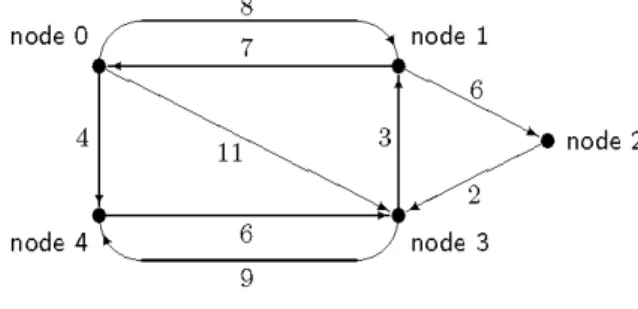
Fig. 1. A sample directed graph with given lengths of arcs.
To illustrate mentioned ideas, let us consider an example of a path problem for the directed graph shown in Figure 1. The task is to solve the shortest distance problem for the given graph, i.e. to determine the length of a shortest path between any two nodes in the graph. As it was mentioned, for this particular problem semiring
(Rf1 ;1g min +)will be chosen. As the
matrixAshould represent adjacency matrix for a given graph, its elementaijwill be weight of
the edge between nodesiandj(by defining the
weight to be 1 where the edge between two
nodes does not exist). In our example matrixA
looks as:
A =
2
6 6 6 4
1 8 1 11 4
7 1 6 1 1
1 1 1 2 1
1 3 1 1 9
1 1 1 6 1
3
7 7 7 5
The solution of the path problem equation(1)
(where in our case unknowns xij represent
lengths of the shortest paths between nodes i
andj)is the matrixA :
A =
2
6 6 6 4
0 8 14 10 4
7 0 6 8 11
12 5 0 2 11
10 3 9 0 9
16 9 15 6 0
3
7 7 7 5
The matrixA is obtained by computing a clo-sure of the matrixA. Note thatAis indeed stable since the corresponding graph does not contain a cycle of negative length.
As a second example of path problem for graphs, let us consider again the same graph from Fig-ure 1, but assume now that the task is to solve path existence problem, i.e. to determine which pairs of nodes are connected by a path and which are not. Now we can use much sim-pler algebraic structure — boolean semiring
(f0 1g max min). The corresponding
matri-cesAandA have the same structure regarding zero/nonzero elements as in the first example,
but any1is now replaced with 0 and all other
values with 1. The(i j)-th element of the
ma-trixAindicates the existence of an arc between nodesiandj, while the (i j)-th element of the
matrixA designate the existence of a path from nodeito nodej.
3. Implementation of Algebraic Structures
The main purpose of the C++library that is to
be described is to provide a generic program-ming framework for solving path problems in general way. Ideas of algebraic approach pre-sented in the previous section will be used as a guide for design and implementation of the library.
Algebraic approach consists of two basic steps — interpretation of a given path problem with a suitably chosen algebraic structure and solving obtained system of equations by a generally ap-plicable algorithm. In this section our goal is to show how to effectively and elegantly rep-resent these underlying algebraic structures by using some of syntactic advantages of the C++
programming language(5]).
Following the results from the preceding sec-tion, algebraic structure that is found to be fun-damental for solving path problems is semiring. From the programmer’s point of view, it is a type for which binary operations of addition and multiplication with adequate properties have to be defined. In that manner, we shall start de-scription of our C++library with classes which
represent respective binary operations.
function (ßapply()) for applying binary
oper-ation on elements of a given set and have static member variable (ßneutral) that provides
neu-tral element for implemented binary operation. In our library we provide several generic classes which implement commonly used binary ope-rations. For example, a class that represents a binary operation of using plus operator on ele-ments of some type looks as following:
template
<class
T
>class
PlusOp
fpublic
:
static
T neutral
static
T apply(
const
T& x,
const
T& y)
freturn x + y
g
g
Note that as
PlusOp
<T
>::neutral
is a staticmember of class
PlusOp
, we must define it somewhere outside the class. As the most com-mon neutral element for the plus operator is zero, a generic definition can be provided:template
<class
T
>T PlusOp
<T
>::neutral = 0
Another example is a class that represents bi-nary operation of taking minimum of two ele-ments:
template
<class
T
>class
MinOp
fpublic
:
static
T neutral
static
T apply(
const
T& x,
const
T& y)
freturn x
<y ? x : y
gg
As it was the case with
PlusOp
’s static member, we must give a definition ofMinOp
<T
>::neutral.
Unfortunately, it is hard to give generic def-inition because its defdef-inition differs even for built-in types. For real types such as
oat
ordouble
, that have representation of positive in-finity, we can define neutral element by us-ingnumeric limits
<T
>::innity()
from standardC++library:
template
<>double
MinOp
<double
>::neutral =
std::numeric limits
<double
>::
innity()
For integral types which do not have represen-tation of infinity, we can simulate the same by using a maximum finite value for a type. In the case of the type
int
, definition would look as following:template
<>int
MinOp
<int
>::neutral =
std::numeric limits
<int
>::
max()
Note that in this case we now have to special-ize generic definition of function
PlusOp
<T
>::
apply()
for typeint
in order to incorporate de-sired behavior regardingMinOp
<int
>’s chosenneutral element:
template
<>int
PlusOp
<int
>::apply(
const int
& x,
const int
& y)
fstatic int
INF =
std::numeric limits
<int
>::max()/2
if
(x
>= INF
jjy
>= INF)
return
INF
else
return
x + y
g
In general, when generic definitions of func-tions and classes proposed in the library are not satisfactory, a user can provide specialized ver-sions that will deal with particularities regarding an assigned type. We should mention that the presented binary operation classes are meant to be used just as function wrappers, thus they differ from the standard notion of C++
the type of the elements(i.e. underlying set for
semiring)and two template arguments through
which binary operations of addition and multi-plication are specified. The class provides over-loaded versions of arithmetic operators which will be used for invoking respective binary ope-rations. The most significant part of the class looks as following:
template
<class
T,
template
<class
>class
U,
template
<class
>class
V
>class
Element
fT val
public
:
typedef
U
<T
>Plus
typedef
V
<T
>Times
Element()
f gtemplate
<class
X
>Element(
const
X& x) : val(x)
f goperator
T()
freturn
val
g
Element
operator
+(
const
Element& x)
const
freturn
Plus::apply(val, x.val)
g
Element
operator
*(
const
Element& x)
const
freturn
Times::apply(val, x.val)
g
...
g
Definitions of the other overloaded arithmetic operators in the class
Element
are left out as they are implemented in the same way.As it can be seen from the definition of the class
Element
,sizeof
(Element
<T
>)==
sizeof
(T)
for every type
T
, there is no space overhead against typeT
. The cast operator to typeT
is also provided, in order to enable the use of in-stances ofElement
<T
>in almost all contextsas instances of
T
.4. Implementation of Algorithms
In this section it remains to show how to com-bine the developed programming elements with general algorithms for solving systems of equa-tions in order to solve the algebraic formula-tion of a given path problem. In our library we have implemented algorithms for solving two types of path problem: all-pairs problem, which refers to computing a solution of(1), and
single-source problem where the goal is to find only one row or one column of the unknown matrixX.
To find a solution of both types to path prob-lem, direct solution procedures(elimination
al-gorithms)can be used. They are based on
suc-cessive elimination of variables that are very similar to those used in linear algebra for solving ordinary systems of linear equations. Probably the most well-known algorithm using this kind of approach are Gauss-Jordan eliminations. Di-vide and conquer strategies can also be used, thus leading to recursive algorithms(i.e.
esca-lator method).
As it is the case in the classical numerical lin-ear algebra, another approach for computing a solution of a system of equations based on it-erative solution procedures can be used. When the matrix semiring is closed and idempotent, iterative algorithms are easy to write down, thus for the purpose of this paper, that case will be presented.
The basic iterative algorithm for solving all-pairs path problems is actually based on com-puting closure A of a given matrix A. The defining expression of matrix closure can be evaluated relatively quickly by successive squar-ing of the matrix. More precisely, the followsquar-ing sequence of matrices is computed:
C0 = I A
Ck = Ck
;1 Ck
;1
(k=1 2 :::)
Computation is terminated when for somek ma-trixCkbecomes equal to matrixCk;1
(note that
it will always happen since we assumed idem-potence of matrix semiring). It is easy to verify
We present implementation of a slight variation of this algorithm where the successive elements of matrix C in each iteration are always com-puted from its newest values (it can be shown
that in the case of idempotent semirings this modification preserves correctness of the algo-rithm).
template
<class
Elem,
class
Matrix1,
class
Matrix2
>void
Closure(
const
Matrix1& A,
int
n,
Matrix2& C)
fint
i, j, k
bool
ok =
true
Elem t
for
(i = 0 i
<n ++i)
for
(j = 0 j
<n ++j)
Ci]j] = Ai]j] + (i==j ?
Elem::Times::neutral :
Elem::Plus::neutral)
while
(ok)
fok =
false
for
(i = 0 i
<n ++i)
for
(j = 0 j
<n ++j)
ft = Ci]j]
for
(k = 0 k
<n ++k)
t += Ci]k]*Ck]j]
if
(!(t==Ci]j]))
fCi]j] = t
ok =
true
g
g
g
g
Analogously, for solving single-destination pro-blems, a version of Gauss-Seidel iterative algo-rithm can be used, having the following imple-mentation:
template
<class
Elem,
class
Matrix,
class
Vector
>void
GaussSeidel(
const
Matrix& A,
int
n,
int
k, Vector& y)
fint
i, j
bool
ok =
true
Elem t
for
(i = 0 i
<n ++i)
yi] = Ai]k] + (i==k ?
Elem::Times::neutral :
Elem::Plus::neutral)
while
(ok)
fok =
false
for
(i = 0 i
<n ++i)
ft = yi]
for
(j = 0 j
<n ++j)
t += Ai]j]*yj]
if
(!(t==yi]))
fyi] = t
ok =
true
g
g
g
g
To conclude the section, we shall give exam-ples of using the described C++ classes and
functions for solving two sample path problems presented in Section 2. In case of the shortest distance problem for a directed graph, we would define the elements to be of the following type:
typedef
Element
<double
, MinOp, PlusOp
>element
Assuming that
A
is a given adjacency matrix,C
is a matrix where the solution(closure ofA
)willbe stored and
n
is the dimension of both matri-ces, the functionClosure()
should be invoked as following:Closure
<element
>(A, n, C)
If we would like to compute single-destination problem for
A
, a call toGaussSeidel()
function will perform the desired task (herey
presentsa vector in which the computed solution will be stored and
k
indicates which column of the all-pairs problem is to be computed):GaussSeidel
<element
>(A, n, k, y)
In the case when the path existence problem needs to be solved, the whole procedure of call-ing functions
Closure()
orGaussSeidel()
remains essentially the same, only the type of the ele-ments has to be defined as:typedef
Element
<bool
, MaxOp, MinOp
>5. Conclusion
In this paper we have described a generic C++
library of classes and functions for solving path problems in a general way. The established programming framework is essentially based on using algebraic approach to path problems which exhibits much wider software engineer-ing principle of separation of algorithms and data and considerably increases reusability of the code.
Efficiency of the implemented algorithms is generally inferior to specialized algorithms used for solving particular path problems due to dif-ferences in their time complexities. Neverthe-less, the intention of described library is to be used as a support for fast prototyping, testing and experimentation. Moreover, since the fun-damental data structure behind all algorithms are matrices, possibility for easy and direct parallelization should also not be disregarded.
References
1] CARRE´ B.,Graphs and Networks, Oxford: Oxford University Press; 1979.
2] MANGERR., A library of subroutines for solving path problems, in: Hunjak T., Martic Lj., Neralic L., editors,Proceedings of the 6th International Con-ference on Operations Research (KOI’ 96); 1996 October 1–3; Rovinj, Croatia. Zagreb: Croatian Operational Research Society; 1996., p. 49–56.
3] MANGERR., Solving path problems on a network of computers,Informatica2002; 26:91–100.
4] ROTEG., Path problems in graphs,Computing
Sup-plement1990; 7:155–189.
5] STROUSTRUPB.,The C++ Programming Language, Third Edition, Addison-Wesley, 1998.
Received:June, 2004
Accepted:June, 2004
Contact address:
Matko Botincanˇ
Department of Mathematics University of Zagreb Bijenicka cesta 30ˇ
10000 Zagreb Croatia e-mail:[email protected]