Stopping Criteria for a Constrained Single-Objective Particle Swarm
Optimization Algorithm
Karin Zielinski and Rainer Laur
Institute for Electromagnetic Theory and Microelectronics, University of Bremen, Germany {zielinski,rlaur}@item.uni-bremen.de
Keywords: constrained single-objective optimization, evolutionary algorithms, particle swarm optimization, stopping criteria
Received:November 3, 2006
When using optimization algorithms the goal is usually clear: The global optimum should be found. How-ever, in general it is not clear when this goal is achieved, especially if real-world problems are optimized for which no knowledge about the global optimum is available. Therefore, it is not easy to decide when the execution of an optimization algorithm should be terminated. Although different mechanisms can be used for the detection of an appropriate time for ending an optimization run, only two of them are frequently used in the literature. Unfortunately, both methods have disadvantages, particularly for the optimization of real-world problems. Because especially for practical applications it is important when an optimization algorithm is terminated as they usually contain computationally expensive objective functions, the perfor-mance of several stopping criteria that react adaptively to the state of an optimization run is evaluated for a Particle Swarm Optimization algorithm in this work. The examination is done on the basis of a constrained single-objective power allocation problem. Suggestions from former work concerning stopping criteria for unconstrained optimization are verified and comparisons with results for Differential Evolution are made. Povzetek: Ovrednoteni so ustavitveni kriteriji za optimiranje z roji delcev (angl. particle swarm optimiza-tion) in rezultati primerjani z rezultati algoritma diferencialne evolucije.
1 Introduction
Evolutionary algorithms (EAs) are a class of population-based stochastic optimization algorithms that incorporate mechanisms from evolution for optimization processes. The most famous representatives from this class are pos-sibly Genetic Algorithms [5] but in the last years also e.g. Particle Swarm Optimization (PSO) [7] and Differential Evolution (DE) [9] had a lot of success.
For theoretical aspects of evolutionary algorithms stop-ping criteria are usually not important. However, for prac-tical applications the choice of stopping criteria can signif-icantly influence the duration of an optimization run. Due to different stopping criteria an optimization run might be terminated before the population has converged, or compu-tational resources might be wasted because the optimiza-tion run is terminated late. Real-world problems mostly contain computationally expensive objective functions that may result in optimization runs that take several days, thus wasting of computational resources has to be prevented.
In the literature mostly two stopping criteria are applied in single-objective optimization: Either an error measure in dependence on the known optimum is used or the number of function evaluations is limited tof emax. These criteria are perfectly suitable for e.g. comparing the performance of different algorithms but for solving real-world problems there are some drawbacks. The first mentioned method has the disadvantage that the optimum has to be known,
so it is generally not applicable to real-world problems be-cause the optimum is usually not known a priori. The sec-ond method is highly dependent on the objective function. Because generally no correlation can be seen between an optimization problem and the required number of function evaluations,f emaxhas to be determined by trial-and-error methods usually. Evolutionary algorithms include random-ness in the optimization process, thus the number of func-tion evaluafunc-tions that is needed for convergence is subject to fluctuations, so a safety margin for f emax is needed. The fluctuations can be significant as can be seen in [17] where a test suite of 24 functions has been examined, and the standard deviation of function evaluations for reaching a predefined error measure was up to 180,000. If a real-world problem with an unknown optimum would result in a similar standard deviation, it would be difficult to choose f emax.
As a result, it would be better to use stopping criteria that consider knowledge from the state of the optimization run. The time of termination would be determined adaptively, so function evaluations could be saved.
[20] the criteria have been adapted for constrained single-objective problems using DE because real-world problems normally include constraints. In this work it will be ex-amined if the suggestions regarding stopping criteria for PSO from [19] hold for the constrained real-world problem of optimizing a power allocation scheme. Additionally, a comparison with the results for DE in [20] will be done.
This work is organized as follows: In Section 2 related work is discussed. In Section 3 the Particle Swarm Op-timization algorithm is described and Section 4 provides a short introduction to Differential Evolution. In Section 5 the stopping criteria that are used in this work are reviewed. In Section 6 results are shown and Section 7 closes with conclusions.
2 Related Work
Every optimization algorithm includes a stopping rule but there are only few works concentrating explicitly on stop-ping criteria. In [16] convergence of a Particle Swarm Op-timization algorithm is detected by computing a maximum swarm radius, by doing a cluster analysis or by calculating the rate of change in the objective function. Most stop-ping criteria are applicable not only to PSO but also to other population-based optimization algorithms, e.g. in [1] the difference between maximum and minimum objective function value is used as stopping criterion for a Differ-ential Evolution algorithm. In [13] not only termination criteria for evolutionary algorithms but also for other opti-mization algorithms are discussed. Often criteria similar to the ones used in the work are also applied in hybrid algo-rithms to determine the moment when global search should be replaced by local search [4, 6, 15].
3 Particle Swarm Optimization
Particle Swarm Optimization is derived from the behavior of social groups like bird flocks or fish swarms. Although the “survival of the fittest” principle is not used in PSO, it is usually considered as an evolutionary algorithm. A thorough discussion of this topic can be found in [7]. Like in this work, PSO is mostly used for the optimization of continuous functions.
Optimization is achieved by giving each individual in the search space a memory for its previous successes, infor-mation about successes of a social group and providing a way to incorporate this knowledge into the movement of the individual. Therefore, each individual (called particle) is characterized by its position~xi, its velocity~vi, its per-sonal best position~pi and its neighborhood best position ~pg. Several neighborhood topologies have been developed [10]. In this work thevon-Neumanntopology is used as it showed promising results in the literature, e.g. in [8].
The dynamic behavior of PSO is generated by the update
equations for velocity and position of the particles:
~vi(t+ 1) = w·~vi(t) (1)
+c1r1[~pi(t)−~xi(t)]
+c2r2[~pg(t)−~xi(t)]
~xi(t+ 1) =~xi(t) +~vi(t+ 1) (2) Due to these equations the particles are drawn towards their personal best position and their neighborhood best posi-tion, and furthermore the velocity of the previous iteration is kept weighted with the inertia weightw. Other parame-ters arec1andc2which influence the impact of the
cogni-tive and social component, respeccogni-tively. To add a stochas-tic element to the movement of the parstochas-ticles, the numbers r1 andr2are chosen randomly from the interval [0,1] in
each iteration. Further parameters of PSO are the popula-tion sizeNP and the maximum velocityVmaxthat is used for preventing oscillations with increasing magnitude [7].
The control parameter settings for this examination are derived from a parameter study using the same opti-mization problem (yet unpublished): w= 0.6, c1= 0.4,
c2= 1.4,NP = 64,Vmax=12(Xmax−Xmin).
Constraint-handling is done by modifying the replace-ment procedure for personal and neighborhood best posi-tions [11]. In unconstrained single-objective optimization a personal or neighborhood best position is replaced if the current position has a lower objective function value (for minimization problems as in this work). For constrained single-objective optimization this rule is altered so that in a comparison of two solutions~aand~b,~ais preferred if
– both vectors are feasible and~ahas a better objective function value or
– both vectors are infeasible and~ahas the lower sum of constraint violation or
– ~ais feasible and~bis infeasible
where feasibility means that all constraints are satisfied. In contrast to several other constraint-handling techniques, no additional parameters are needed for this method [2]. For unconstrained problems the modified PSO algorithm is ex-actly the same as the original PSO.
4 Differential Evolution
is possible, the DE selection scheme is called greedy [14]. More specific information about the here mentioned DE al-gorithm can be found in [20].
5 Stopping Criteria
Stopping criteria are needed to terminate the execution of optimization algorithms. In contrast to using a maximum number of function evaluations as a stopping condition, other criteria have the advantage of reacting adaptively to the state of the optimization run, thus function evaluations can be saved. Unfortunately, it seems to be impossible to define a stopping criterion without introducing one or more parameters. The parameter settings generally depend on the given optimization problem. However, it should be in-vestigated if there are stopping criteria for which the pa-rameter settings are robust to changes or if papa-rameters can be set depending on certain aspects of the problem. It is assumed that the general behavior of different optimiza-tion problems to stopping criteria is similar. It should be kept in mind that limiting the number of function evalua-tions as a stopping criterion also incorporates the choice of a problem-dependent parameterf emax. Hence, it is favor-able to examine other possibilities for stopping that contain the advantage of reacting adaptively to the state of the op-timization run.
In the following the stopping criteria that incorporate in-formation about the state of the optimization run are re-viewed shortly. Note that there is a change compared to [19]: Instead of using the current positions~xifor the calcu-lation of stopping conditions, the personal best positions~pi are used here. The reason is that the current positions have many fluctuations whereas the development of the personal best positions is more smooth, so decisions about termina-tion of an optimizatermina-tion run should be easier.
Improvement-based criteria terminate an optimization run if only small improvement is made because usually in the beginning of an optimization run large improvements are achieved whereas in later stages the improvement be-comes small. Three different conditions are used here:
– ImpBest: The improvement of the best objective func-tion value is monitored. If it falls below a given thresholdt for a number of generations g, the opti-mization run is terminated.
– ImpAv: Similar toImpBest, but instead of observing the best objective function value, the average value computed from the whole population is checked.
– NoAcc: It is observed if any new~pi are accepted in a specified number of generationsg. For DE this cri-terion is slightly different because in DE there are no personal best positions (instead, the acceptance of new population members is considered).
For movement-based criterianot the improvement but the movement of individuals is regarded. Two variants of
movement-based criteria are considered that differ in the regarded space:
– MovObj: The movement of the individuals with respect to their objective function value (objective space) is examined if it is below a threshold t for a number of generations g. MovObj is different from
ImpAvonly if the regarded algorithm allows deteriora-tion of the individuals’ objective funcdeteriora-tion value. This is the case for PSO in contrast to DE, but as~piare con-sidered here instead of~xi,MovObj=ImpAvholds in this case also. Therefore, this criterion is not regarded further in this work.
– MovPar: The movement with respect to positions (pa-rameter space) is checked if it is below a thresholdt for a number of generationsg.
Thedistribution-based criteriaconsider the diversity in the population. If the diversity is low, the individuals are close to each other, so it is assumed that convergence has been obtained.
– StdDev: It is checked if the standard deviation of po-sitions is below a thresholdm.
– MaxDist: The distance from every population mem-ber to the best individual is observed. The optimiza-tion run is stopped if the maximum distance is below a thresholdm.
– MaxDistQuick: MaxDistQuick is a generalization of
MaxDist. Instead of using the whole population for the computation of the maximum distance to the best population member, a quicksort algorithm is em-ployed for sorting the individuals due to their ob-jective function value, and only the best p% of the individuals are regarded. The background for this criterion is that there are optimization runs where most of the population has converged to the optimum but because of the remaining individuals which are still searching, the optimization run is not stopped although they do not contribute any new informa-tion. Using MaxDistQuick an optimization run can be stopped earlier than usingMaxDist, so wasting of computational resources is avoided. However, the per-centagepmust not be set too low for a reliable detec-tion of convergence.
– ComCrit: This criterion is a combination of ImpAv
andMaxDist. Only if the condition ofImpAv is ful-filled,MaxDistis checked.
– Diff_MaxDistQuick: Diff is a criterion that is rather easy to check, but it fails with flat surfaces. Therefore, if its condition has been fulfilled, theMaxDistQuick
criterion is checked afterwards.
6 Results
As a basis for the examination a real-world problem was used that consists of optimizing a power allocation scheme for a Code Division Multiple Access (CDMA) system [20]. The overall power is minimized considering the powers of 16 individual users as parameters. Because multiple users send data simultaneously in a CDMA system, multi-user interference degrades the system performance. The appli-cation of a parallel interference cancellation technique al-lows estimation of the multi-user interference, so it can be subtracted from the received signal before detection, result-ing in improvement of the system performance. The con-vergence of the parallel interference cancellation technique has to be incorporated in the optimization problem as a con-straint.
In the following results are shown sorted according to the type of stopping criterion. The global optimum is considered to be reached if an objective function value of f(x)≤18.5 has been found [20]. As performance mea-sures the convergence rate and the success performance (mean number of function evaluations weighed with the total number of runs divided by the number of success-ful runs) are given. A high convergence rate and a small success performance indicate good performance. To allow easy comparisons, figures showing success performances are scaled to 20,000. A maximum number of generations Gmax= 1000is used to terminate the algorithm if the ex-amined stopping criteria do not lead to termination in ap-propriate time. If a run is not stopped before Gmax is reached, the run is considered as unsuccessful.
6.1 Improvement- and Movement-Based
Criteria
BecauseImpAv,ImpBestandMovParrely on similar mech-anisms, the convergence rate and success performance of these criteria are displayed together. Considering the con-vergence rate, almost no dependence on the number of gen-erationsgis observable (Figure 1(a)). For decreasing val-ues of the improvement threshold tgenerally the conver-gence rate increases, except forMovParthat was not able to terminate several runs before reachingGmaxfor small settings oft.
The success performance ofImpAv,ImpBestand Mov-Paris slightly increasing with growingg(see Figure 1(b)). The results regardingtare similar forImpAvandImpBest:
For high settings oftthe success performance is large be-cause of the small convergence rate. After a strong de-crease the success performance inde-creases again for smaller values oftbecause of the growing average number of func-tion evaluafunc-tions for convergence.
The smallest success performance ofMovParis in the same range as forImpAvandImpBest. The difference in the average number of function evaluations for different set-tings oftis larger forMovParthan forImpAvorImpBest, thus the success performance grows quickly for decreas-ing t. As a result the success performance is better for t= 10−2than fort= 10−4although the convergence rate
oft= 10−2is worse.
The success performance ofImpAvandMovParhas sim-ilar characteristics as for DE in [20]. ForImpBestthe re-sults are different: The success performance for g= 5is considerably better for PSO. Furthermore, the success per-formance is dependent ontand almost independent fromg whereas for DE it depends more ongthan ont. The reason for the different results is not clear yet.
The results forImpAvandImpBestare considerably bet-ter here than in [19] for unconstrained single-objective problems. ForImpAvthe reason might be that the personal best positions are regarded here instead of the current po-sitions, but criterionImpBestdid not change because only the global best result is regarded. In contrast, forMovPar
the results are worse, but it has to be kept in mind that the results are slightly dependent on the setting ofGmax be-cause it influences the convergence rate.
Unfortunately, suitable parameter settings forImpAvand
ImpBestcannot be derived from knowledge about the opti-mization problem. Besides, it is indicated in [19] that prob-lems arise for functions with a flat surface, but it is usually not known in advance if a function possesses this property. Therefore, it will be necessary to do examinations on pa-rameter settings for the application of these stopping cri-teria. Based on the examined problem parameter settings ofg≈10. . .15andt≈10−5. . .10−4are recommended.
However, these settings are dependent on the optimization problem and the desired accuracy. It has to be noted also that these criteria may not be as reliable as others because improvement often occurs irregularly in evolutionary algo-rithms.
CriterionNoAccshowed good results for DE in [20] but not a single run could be terminated before reachingGmax for PSO. Apparently, the personal best positions improve too often to allow a stopping criterion likeNoAcc.
6.2 Distribution-Based Criteria
ForMaxDistthe convergence rate does not get above80%
5 1015
20
10−6 10−4
10−2 0 20 40 60 80 100
g
t
convergence rate in %
ImpAv ImpBest MovPar
(a) Convergence rate
5 10
15 20
10−6 10−4
10−2 0 0.5 1 1.5 2
x 104
g
t
success performance
ImpAv ImpBest MovPar
(b) Success performance
Figure 1: Results for criteriaImpAv,ImpBestandMovPar
10−4 10−3
10−2 10−1
100 0 10 20 30 40 50 60 70 80 90 100
m
convergence rate in %
MaxDist StdDev
(a) Convergence rate
10−4 10−3
10−2 10−1
100 0 0.2 0.4 0.6 0.8 1 1.2 1.4 1.6 1.8
2x 10
4
m
success performance
MaxDist StdDev
(b) Success performance
Figure 2: Results for criteriaMaxDistandStdDev
ofm. However, it is connected to the desired accuracy of the result. Similar effects have been found in [20] for DE. The same settings of parametermyield the lowest success performances forMaxDistandStdDevfor PSO as for DE, respectively.
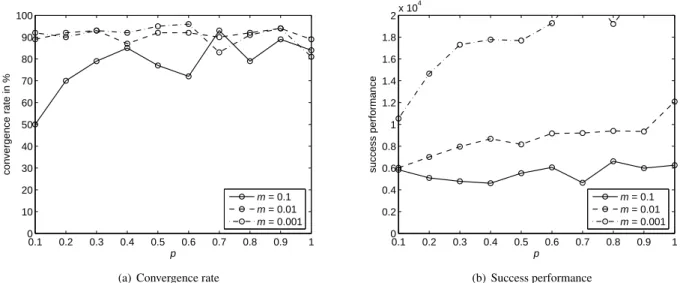
The convergence rate and success performance of Max-DistQuick is given for10−3≤m≤10−1 in Figures 3(a)
and 3(b). Other parameter settings are omitted because the success performance was above 20,000. The convergence rate is fluctuating form = 0.1 with different settings of p, indicating that the performance is not robust for this pa-rameter setting. Form={10−2,10−3}and varyingpthe
convergence rate is approximately constant but the success performance rises with increasingp. Hence, a similar result is obtained as in [19]: Because less function evaluations are needed for convergence if smaller values ofpare used and the convergence probability is not compromised, it is
recommended to use e.g.0.3≤p≤0.5. In spite of the in-creased computational effort for the incorporated quicksort algorithm [18],MaxDistQuickis considered to be superior toMaxDist andStdDevfor PSO, particularly because the increased computational effort is usually negligible when compared to computationally expensive objective function evaluations of real-world problems. For future work also a similar generalized criterion based on standard deviation instead of maximum distance should be evaluated.
For DE the success performance depends less on p [19, 20], soMaxDistQuickdoes not have advantages over
MaxDistfor DE. This behavior is supposed to be connected with the greediness of the DE selection scheme.
It may be confusing that the success performance for
MaxDistQuick with p= 1 is not equal to the results of
success-0.1 0.2 0.3 0.4 0.5 0.6 0.7 0.8 0.9 1 0
10 20 30 40 50 60 70 80 90 100
p
convergence rate in %
m = 0.1 m = 0.01 m = 0.001
(a) Convergence rate
0.1 0.2 0.3 0.4 0.5 0.6 0.7 0.8 0.9 1 0
0.2 0.4 0.6 0.8 1 1.2 1.4 1.6 1.8
2x 10
4
p
success performance
m = 0.1 m = 0.01 m = 0.001
(b) Success performance
Figure 3: Results for criterionMaxDistQuick
ful runs. If the average number of function evaluations is examined, the results fromMaxDistQuickwithp= 1and
MaxDistare similar (not shown here).
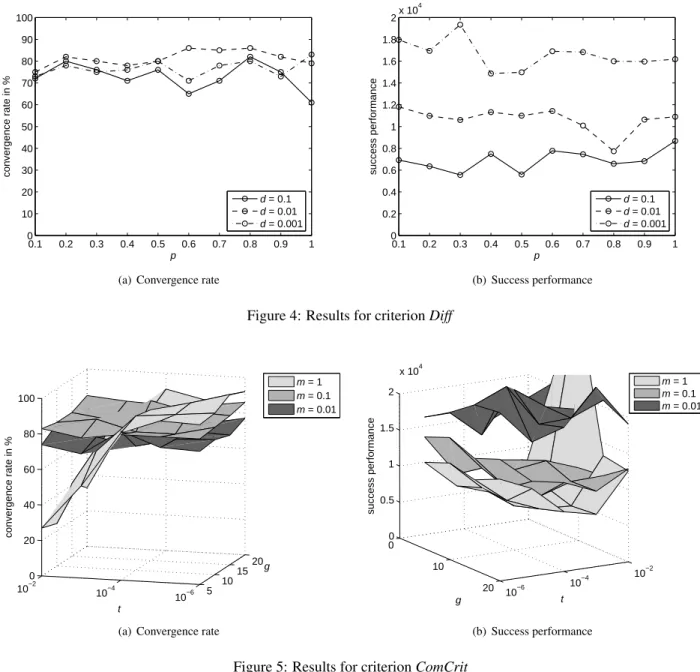
For criterionDiff no definite trend can be observed re-garding the demanded percentagepof feasible individuals in the population (Figures 4(a) and 4(b)) which is assumed to be due to the fact that all individuals get feasible quite fast here. Similar results were found for DE in [20]. As ex-pected, the success performance depends on the difference thresholdd. Like parameter mof the other distribution-based criteria, the setting of d is connected with the de-sired accuracy of the result. The highest convergence rate is achieved withd= 10−2 but althoughd= 10−1 results
in a worse convergence rate, the success performance is better.
Criterion Diff is advantageous in contrast to the distribution-based criteria in parameter space if several pa-rameter combinations yield the same objective function value. In this case the distribution-based criteria in param-eter space may waste computational resources while the al-gorithm tries to converge to one point in the search space, with no or only little improvement of the objective func-tion value. However,Diff is likely to produce bad results for functions with a flat surface [19].
6.3 Combined Criteria
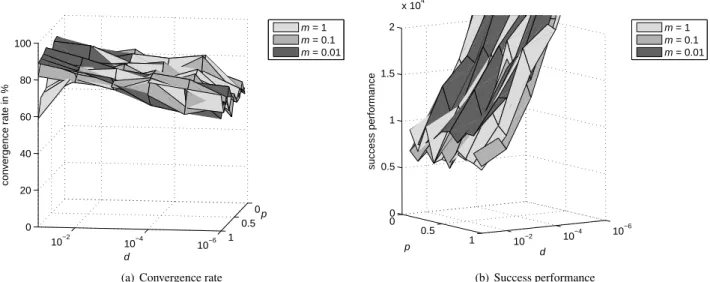
The convergence rate and success performance for both combined criteria are given form≥10−2because smaller
values of m lead to success performances larger than 20,000 (Figures 5(a), 5(b), 6(a) and 6(b)). The results are different than for DE as the success performance increases less with decreasing value of m. Especially forDiff_MaxDistQuickthe results are almost independent fromm. However, a strong dependence ondcan be seen, in particular for the success performance.
For the combined criteria generally more parameters
have to be set than for the individual criteria and further-more the dependence of parameter settings on the desired accuracy of the results cannot be seen anymore, so in gen-eral it might be easier to use the individual criteria.
6.4 Summary
Although the improvement-based criteria ImpAv and
ImpBestyielded good results in this work, they are consid-ered as rather unreliable because generally improvement occurs irregularly in evolutionary algorithms. To prevent early termination, parametergmust not be chosen too low when using these criteria. The movement-based criterion
MovPar has similar problems. The third improvement-based criterionNoAccwas not able to stop a single opti-mization run during the given maximum number of gener-ations, so it is classified as unsuitable for PSO although it showed a good performance for DE in [20].
Based on the considered optimization problem as well as results from [19] it can be concluded that it is beneficial to use the generalization MaxDistQuickinstead ofMaxDist. BecauseStdDevperformed better thanMaxDist, a general-ization ofStdDevshould be examined in future work. In general the distribution-based criteria in parameter space are classified as reliable means for detecting convergence. The distribution-based criterion in objective space (Diff) is also considered to be a reliable criterion with the exception of optimization problems that contain objective functions with a flat surface.
0.1 0.2 0.3 0.4 0.5 0.6 0.7 0.8 0.9 1 0
10 20 30 40 50 60 70 80 90 100
p
convergence rate in %
d = 0.1 d = 0.01 d = 0.001
(a) Convergence rate
0.1 0.2 0.3 0.4 0.5 0.6 0.7 0.8 0.9 1 0
0.2 0.4 0.6 0.8 1 1.2 1.4 1.6 1.8
2x 10
4
p
success performance
d = 0.1 d = 0.01 d = 0.001
(b) Success performance
Figure 4: Results for criterionDiff
5 10
15 20
10−6 10−4
10−2 0 20 40 60 80 100
g
t
convergence rate in %
m = 1 m = 0.1 m = 0.01
(a) Convergence rate
0
10
20 10−6 10
−4 10
−2
0 0.5 1 1.5 2
x 104
t g
success performance
m = 1 m = 0.1 m = 0.01
(b) Success performance
Figure 5: Results for criterionComCrit
7 Conclusions
In this work stopping criteria were studied that react adap-tively to the state of an optimization run based on improve-ment, movement or the distribution of individuals. In con-trast to other examinations, not the current positions but the personal best positions were used for the calculations. It was shown that the stopping criteria can be used for con-strained problems using PSO. A similar behavior as for DE could be found for several stopping criteria. It would be in-teresting to make comparisons with other evolutionary al-gorithms in future work.
Although parameter settings have to be determined in dependence on the used optimization problem, general statements could be derived. It was not possible to deter-mine one criterion that will be best for all problems, but because of their adaptive nature generally improved
per-formance for real-world problems is expected in contrast to termination after a limited number of function evaluations.
10−6 10−4
10−2
0 0.5 1 0
20 40 60 80 100
p
d
convergence rate in %
m = 1 m = 0.1 m = 0.01
(a) Convergence rate
10−2 10
−4 10−6 0
0.5 1 0
0.5 1 1.5 2
x 104
d p
success performance
m = 1 m = 0.1 m = 0.01
(b) Success performance
Figure 6: Results for criterionDiff_MaxDistQuick
References
[1] B. V. Babu and Rakesh Angira. New Strategies of Differential Evolution for Optimization of Extraction Process. InProceedings of International Symposium & 56th Annual Session of IIChE (CHEMCON 2003), Bhubaneswar, India, 2003.
[2] Carlos A. Coello Coello. Theoretical and Numeri-cal Constraint-Handling Techniques used with Evo-lutionary Algorithms: A Survey of the State of the Art. Computer Methods in Applied Mechanics and Engineering, 191(11-12):1245–1287, 2002.
[3] Kalyanmoy Deb.Multi-Objective Optimization using Evolutionary Algorithms. Wiley, 2001.
[4] Felipe P. Espinoza. A Self-Adaptive Hybrid Ge-netic Algorithm for Optimal Groundwater Remedia-tion Design. PhD thesis, University of Illinois, 2003.
[5] David E. Goldberg. Genetic Algorithms in Search, Optimization, and Machine Learning. Addison-Wesley, 1989.
[6] Wilfried Jakob.Eine neue Methode zur Erhöhung der Leistungsfähigkeit Evolutionärer Algorithmen durch die Integration lokaler Suchverfahren. PhD thesis, Universität Karlsruhe, 2004.
[7] James Kennedy and Russell C. Eberhart. Swarm In-telligence. Morgan Kaufmann Publishers, San Fran-cisco, 2001.
[8] James Kennedy and Rui Mendes. Population Struc-ture and Particle Swarm Performance. In David B. Fogel, Mohamed A. El-Sharkawi, Xin Yao, Garry Greenwood, Hitoshi Iba, Paul Marrow, and Mark Shackleton, editors,Proceedings of the Congress on
Evolutionary Computation (CEC 2002), pages 1671– 1676, Honolulu, HI, USA, 2002.
[9] Jouni Lampinen and Rainer Storn. Differential Evolu-tion. In Godfrey C. Onwubolu and B.V. Babu, editors,
New Optimization Techniques in Engineering, pages 123–166. Springer-Verlag, Berlin Heidelberg, 2004.
[10] Rui Mendes, James Kennedy, and José Neves. The Fully Informed Particle Swarm: Simpler, Maybe Bet-ter.IEEE Transactions on Evolutionary Computation, 8(3):204–210, 2004.
[11] Gregorio Toscano Pulido and Carlos A. Coello Coello. A Constraint-Handling Mechanism for Par-ticle Swarm Optimization. In Proceedings of the Congress on Evolutionary Computation (CEC 2004), volume 2, pages 1396–1403, Portland, OR, USA, 2004.
[12] Olga Rudenko and Marc Schoenauer. A Steady Performance Stopping Criterion for Pareto-based Evolutionary Algorithms. In Proceedings of the 6th International Multi-Objective Programming and Goal Programming Conference, Hammamet, Tunisia, 2004.
[13] Hans-Paul Schwefel. Evolution and Optimum Seek-ing. John Wiley and Sons, 1995.
[14] Rainer Storn and Kenneth Price. Differential Evolu-tion – A Simple and Efficient Heuristic for Global Op-timization over Continuous Spaces.Journal of Global Optimization, 11:341–359, 1997.
[16] Frans van den Bergh. An Analysis of Particle Swarm Optimizers. PhD thesis, University of Pretoria, 2001.
[17] Karin Zielinski and Rainer Laur. Constrained Single-Objective Optimization Using Particle Swarm Opti-mization. InProceedings of the IEEE Congress on Evolutionary Computation, pages 1550–1557, Van-couver, BC, Canada, 2006.
[18] Karin Zielinski, Dagmar Peters, and Rainer Laur. Run Time Analysis Regarding Stopping Criteria for Differential Evolution and Particle Swarm Op-timization. In Proceedings of the 1st Interna-tional Conference on Experiments/Process/System Modelling/Simulation/Optimization, Athens, Greece, 2005.
[19] Karin Zielinski, Dagmar Peters, and Rainer Laur. Stopping Criteria for Single-Objective Optimization. In Proceedings of the Third International Confer-ence on Computational IntelligConfer-ence, Robotics and Autonomous Systems, Singapore, 2005.