Identification of Quercetin and Rutin from Propolis
Ethanolic Extract (EEP) of Timis County
Ramona Cristina Heghedus–Mindru, Gabriel Heghedus–Mindru*, Ducu Sandu Stef
Banat's University of Agricultural Sciences and Veterinary Medicine „King Michael I of Romania” from Timisoara, Aradului Street No.119, RO – 300645, Timisoara, Romania,
Abstract
In this paper were studied the possibilities of identification of some flavonoides (quercetin and rutin) from propolis ethanolic extract (EEP), of the west part of Romania (Timis county), the obtained results were compared to those obtained for similar products in literature (Hungary, Czechia, China, Slovenia). Representative samples were collected from three different points of Timis county (Lugoj 1, Lugoj 2 and Faget). The identification of quercetin and rutin from propolis ethanolic extracts (EEP) was realized with high performance liquid chromatography (HPLC). For separation and quantification the ethanolic extracts of propolis (EEP), I used the high performance liquid chromatography. Quantification was performed on the basis of the calibration curve obtained for pure quercetine. We used HPLC Hewelett Packard apparatus Agilent 1100 type with UV detection, with the following characteristics: column: Nucleosil C18; 5µm dimension for stationary phase particles; column dimension: 150 x 4,6mm x mm; eluent acetonytrile:water = 1:1, eluent flow: 1 mL/min; wave length: 365 nm; temperature 30°C; injected volume: μL.
Keywords: high performance liquid chromatography (HPLC), propolis, propolis ethanolic extract (EEP), quercetin, rutin
1. Introduction
Propolis (bee glue) is a beehive product prepared by bees of the Apis mellifera species, using resinous substances collected from various plants. These substances are mixed with the β-glycosidase enzyme of their saliva, partially digested, and added to bee wax to form the final product. [1]
It is well known for its potential benefits to human health and for presenting valuable biological activities such as antioxidant, antibacterial, anticariogenic, anti-inflammatory, and anticancer properties. It has recently gained popularity as a healthy food supplement and has been extensively used in foods and beverages in different parts of
*Corresponding author: Gabriel Heghedus–Mindru, Tel. 0256277428, Fax 0256277326, Email: [email protected]
the world, where it is claimed to improve health and prevent ailments such as inflammation, heart diseases, diabetes, and even cancer. [2]
The intake of dietary flavonoids largely depends on the country. A daily intake of approximately 23 mg could be considered the average consumption, quercetin being the predominant compound with a daily dietary intake of 16 mg Argentinean propolis contains high levels of total flavonoid, showing significant correlation between flavonoid content and free radical scavenging activity [3]
to their structure, are taxonspeciffic (biochemical characters in vegetable systematic) [4, 5]
Quercetin is a flavonoid widely distributed in nature. The name has been used since 1857, and is derived from quercetum (oak forest), after Quercus. It is a naturally occurring polar auxin transport inhibitor. [6]
Based on the various chemical composition, the present study on propolis was aimed to analyze the identification of some flavonoides (quercetin and rutin) in propolis ethanolyc extracts from the western region of Romania, by high performance liquid chromatography (HPLC).
Rutin – quercetin rhamnoglucosid is an aldoreductase inhibitor that is hypoglicemiating and antidiabetes, antiaterogenic and capillary protective, acting especially on endothelia vascular walls, decreasing the capillary sensitiveness (anticataract, capillary protection, anti-glaucoma, haemostatic), miorelaxant, with a calming effect on brain, heart, nerves (stress). It is found in lemons, mandarins, oranges, pepper, apricots, caraway, propolis, jumper fruits, chamomile, wild roses elder tree – flowers, plums, sourcherryes [4,7]
2. Materials and methods
Quercetin (Figure 1), 99% purity was bought
from Merck&Co., Inc, New Jersey,, and the rutin
(Figure 2) was bought from Fluka ChemieAG. Propolis samples were collected from three different points of Timis county (Lugoj 1, Lugoj 2 and Faget).
50 g propolis were weighed with precision, purified, delicately crushed; after that 250 mL absolute ethanol are added, and is reflowed for an hour, in a two necked glass, equipped with a refrigerant. The heterogeneous system obtained, centrifuged (12000 rpm) is thickly filtered by a Nuce filter, vacuum connected afterwards a new centrifugation (10000 rpm), it is filtered through a law porosity surface vacuum connected, and it is carefully concentrated at 100°C, till 20%.
In order to identify and determine the EEP constituents a HPLC Hewlett Packard Agilent apparatus 1100 type with UV detection was used, with the following analysis conditions: Column: Nucleosil C18; stationary phase particles dimension 5 μm; column dimensions 150 x 4.6 mm x mm; Eluent: acetonitrile:water = 1:1; Eluent flow: 1 mL/min; Wavelength: 365 nm; Temperature: 30°C; Inject volume: 20 μL
The EEP samples were dissolved in ethanol (5 mg/mL), filtrated with 0,45 μm filter previously injecting a 20 μL in a HPLC system.
3. Results and discussion
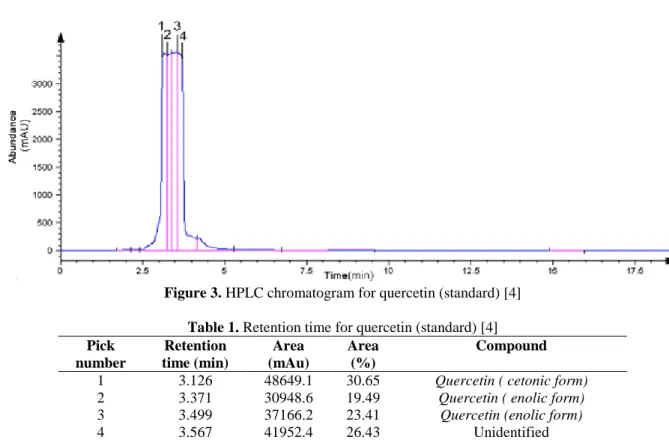
RP-HPLC evaluation [4, 8] HPLC analysis of quercetin indicated the appearance of two more important components, most probably due to 3-enolic and 3-cetonic limit structures, respectively, that are found in equilibrium in the quercetin ethanolic solution.
Figure 1. The chemical structure of quercetin
http://en.wikipedia.org/wiki/Quercetin#/media/File:Quercetin.svg
Figure 2. The chemical structure of rutin
Figure 3 represent the HPLC chromatogram for quercetin (standard) and table 1 the retention time
for quercetin (standard)
Figure 3. HPLC chromatogram for quercetin (standard) [4]
Table 1. Retention time for quercetin (standard) [4]
Pick number
Retention time (min)
Area (mAu)
Area (%)
Compound
1 3.126 48649.1 30.65 Quercetin ( cetonic form)
2 3.371 30948.6 19.49 Quercetin ( enolic form)
3 3.499 37166.2 23.41 Quercetin (enolic form)
4 3.567 41952.4 26.43 Unidentified
Figure 4 represent the HPLC chromatogram for rutin (standard) and table 2 the retention time for rutin (standard)
HPLC of rutin indicated the appearance of two more important components, (partially separated),
most probably due to partial hydrolysis of rutin to derhamnosyl rutin and quercetin, rhamnose and glucose, respectively, exactly during analysis.
Figure 4. HPLC chromatogram for standard rutin [4]
Table 2. Retention time for rutin (standard) [4]
Pick number
Retention time (min)
Area (mAu)
Area (%)
Compound
1 2.088 5623.7 89.24 Rutin
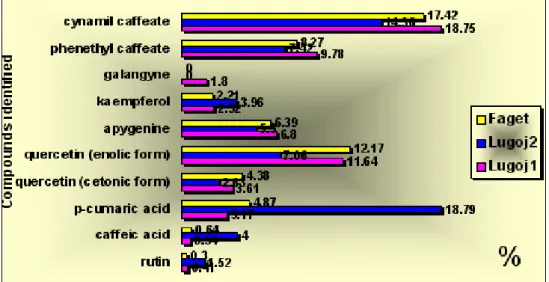
The major components from EEP samples (Lugoj and Faget) were identified by RP-HPLC analysis (Figure5)
Standard was used for quercetin, the other components (caffeic acid, p-cumaric acid, 3.4- dimetoxycinamic acid, apygenin, kaempferoul,
galangine, phenetil caffeate and cynamil caffeate) were identified by comparison between HPLC chromatographs obtained under the same conditions (correlated to rutin and quercetin standards) with those from literature.
Figure 5. Identification of some components determined in propolis ethanolic extract samples from Lugoj 1, Lugoj 2 and Faget
In propolis ethanolic extract (EEP) Lugoj 1 (Figure 5) 33 compounds were identified by comparison with the retention times of the used standards (rutin and quercetin), and comparison HPLC chromatograms from literature obtained the same conditions, respectively) [rutin (0.41%), caffeic acid (0.54%), p-cumaric acid (3.17%), quercetin (cetonic form) (3.61%), quercetin (enolic form) (11.64%, apygenine (6.80%), kaempferol (2.32%), galangyne (1.80%) phenethyl caffeate (9.78%) and cynamil (18.75%)].
In propolis ethanolic extract (EEP) Lugoj 2 (Figure 5), 38 compounds were identified [rutin (1.52%), caffeic acid (4%), p-cumaric acid (18.79%), quercetin (cetonic form) (2.63%), quercetin (enolic form) (7.06%), apygenin (5.3%), kaempferol (3.96%), phenethyl caffeate (7.42%) and cynamil (14.36%)].
In propolis ethanolic extract (EEP) Faget (Figure 5) 34 compounds were identified [rutin (0.30%), caffeic acid (0.64%), p-cumaric acid (4.87%), quercetin (cetonic form) 4.38%, quercetin (enolic form) (12.17%), apygenine (6.39%), kaempferol (2.21%), phenethyl caffeate (8.27%) and cynamil (17.42)].
Figure 7 presents the mirrored image of HPLC chromatograms of the Lugoj duplicated EEP, in order to check the extractive conditions and for a accurate quantification of the results. Practically, perfect identity is remarked.
4. Conclusions
HPLC analysis for quercetine showed the occurrence of two more important components, most probably due to 3-enolic and 3-cetonic structures, respectively, that are found in equilibrium in the quercetin ethanolic solution. HPLC analysis for rutin showed the occurrence of two more important components (partially separated), most probably due to partial hydrolysis of rutin to derhamnosylrutin and quercetin, respectively rhamnose and glucose, exactly during the analysis. Were used the standards for quercetin and rutin, the other components (caffeic acid, p-cumaric acid, 3.4-dimetoxycynamic acid,
kaempferoul, galangyne, phenetyl and cynamil caffeate) were identified by comparing HPLC chromatograms obtained under the same conditions (correlated to quercetin and rutin standards) with those from literature.
For the comparative evaluation of the experimental results (delayed by 10 minutes) the chromatograms for propolis ethanolic extracts (EEP), it can be observed that the occurrence of significant peaks, follows the retention time for each compound, but these concentrations in the extracts depends on the sample harvesting area.
References
1. Pascoal, A., Feas, X., Dias, T., Dias, L.G., Estevinho, L.M, The Role of Honey and Propolis in the Treatment of Infected Wounds. In: Microbiology for Surgical Infections, Chapter 13, pp 222, DOI: http://dx.doi.org/10.1016/B978-0-12-411629-0.00013-1 2. Oldoni, T.L.C., Cabral, I.S.R., Regitano d’Arce, M.A.B., Rosalen, P.L., Ikegaki, M., Nascimento, A.M., Alencar, S.M., Isolation and analysis of bioactive isoflavonoids and chalcone from a new type of Brazilian propolis, Separation and Purification Technology, 2011, 77, 208–213
3. Lima, B., Tapia, A., Luna, L., Fabani, M.P., Schmeda-Irschmann, G., Podio, N.S., Wunderlin, D.A., Feresin, G.E., Main Flavonoids, DPPH Activity, and Metal Content Allow Determination of the Geographical Origin of Propolis from the Province of San Juan (Argentina), J. Agric. Food Chem. 2009, 57, 2691–2698
4. Biron, R.C., Cercetări privind activitatea antioxidantă a extractelor de propolis din zona de vest a României, Universitatea de Ştiinţe Agricole şi Medicină Veterinară a Banatului, Timişoara, Facultatea de Tehnologia Produselor Agroalimentare, Teză de doctorat, 2006
5. Bodea, C., Tratat de biochimie generală, Fitochimie, 1964, vol I, Ed. Academiei
6. http://en.wikipedia.org/wiki/Quercetin
7. Ciulei, I., Grigorescu, E., Stănescu, U., Plante medicinale, fitochimie şi fitoterapie, 1993, vol. I, II, Ed. Medicală, Bucureşti,