Original Research Article
Study of thyroid dysfunction in patients with type 1 diabetes mellitus
Rajesh V. Gosavi
1*, Bhushan R. Mishal
2INTRODUCTION
Diabetes Mellitus is the commonest endocrine disorder in adults across the world. It is well known that diabetics have a higher prevalence of thyroid disorders.1 Further,
the association of autoimmune thyroid disease (ATD) with type 1 diabetes mellitus has been well documented across populations, with it being most prevalent immunological disease in patients with type 1 diabetes.2-7
Although most type 1 diabetics are clinically euthyroid, screening for autoimmune thyroid disease by measuring
anti-thyroid peroxidase (anti-TPO) antibody levels has been recommended.5,8
With insulin and thyroid hormones being intimately involved in cellular metabolism, excess or deficit of either of these hormones could result in functional derangement of the other.9 As such, the fact that insulin
and thyroid hormone influence each other’s actions assumes great significance. Thus, it becomes imperative to study interrelationship between the two entities. The aim of this study was to ascertain the association between type 1 diabetes and thyroid dysfunction in our set up clinically, biochemically and immunologically.
ABSTRACT
Background: The association of autoimmune thyroid disease with type 1 diabetes mellitus has been well documented across populations, with it being most prevalent immunological disease in patients with type 1 diabetes. The aim of this study was to ascertain the association between type 1 diabetes and thyroid dysfunction clinically, biochemically and immunologically.
Methods: Serum TSH, free T3 and free T4 values were compared between cases of type 1 diabetes mellitus and non-diabetic age and sex matched controls. Cases of type 1 diabetes mellitus were further divided in two groups, depending upon the presence or absence of antibodies against thyroid peroxidase (Anti-TPO antibodies). Mean serum TSH, free T3, free T4 levels were compared between these two groups to find or refute any association.
Results: Abnormal thyroid function was reported in total 6 (14.63%) cases. Comparison of TSH, T3 and T4 levels showed statistically insignificant differences (p<0.05) in TSH levels (µIU/ml) (Cases- 3.44±2.41, controls- 3.34±0.78); T3 levels (pg/ml) (cases- 3.31±1.06, controls- 3.36±0.52) and T4 levels (ng/dl) (cases- 0.92±0.31, controls- 0.95±0.23). Total of 6 cases (14.63%) cases of type 1 diabetes mellitus were positive for anti-TPO antibodies (4- females, 2- males).
Conclusions: Thyroid dysfunction is more common amongst type 1 diabetics, especially females. Estimation of anti-TPO antibodies is valuable in detecting thyroid dysfunction in type 1 diabetics.
Keywords: Thyroid dysfunction, Type 1 diabetes mellitus
1Department of Medicine, Government Medical College and Hospital, Nagpur, Maharashtra, India 2Department of Neurology, Sahayadri Speciality Hospital, Pune, Maharashtra, India
Received: 27 July 2017
Accepted: 02 August 2017
*Correspondence:
Dr. Rajesh V. Gosavi,
E-mail: [email protected]
Copyright: © the author(s), publisher and licensee Medip Academy. This is an open-access article distributed under the terms of the Creative Commons Attribution Non-Commercial License, which permits unrestricted non-commercial use, distribution, and reproduction in any medium, provided the original work is properly cited.
METHODS
Hospital based prevalence study conducted in diabetes out-patient clinics, Medicine OPD and wards, tertiary care government institute. Study period December 2010 to July 2012 (1.5 years).
Inclusion criteria
• Diagnosed cases of type 1 diabetes mellitus
• Age at the time of diagnosis <30 years
• Patients requiring insulin for glucose level control.
Exclusion criteria
• Patients with acute complications of diabetes, e.g. ketoacidosis or hypoglycemic episode
• Patients with diagnosed thyroid disorder and being on treatment for same
• Patients receiving any drug affecting thyroid function
• Patients refusing to give consent.
Patients fulfilling the above criteria were subjected to detailed history taking and clinical examination. All the eligible participants were evaluated clinically for signs and symptoms of diabetes mellitus and thyroid dysfunctions. Body weight, height was recorded and BMI calculated.
Following investigations were also conducted on all the participants
• Fasting venous blood glucose (12 hour overnight fasting sample)
• T3, T4, TSH
• Anti-TPO antibody levels
• Thyroid FNAC/biopsy, if required.
American diabetes association (ADA) criteria for diabetes10 were followed for diagnosing diabetes, i.e. fasting plasma glucose of >7.0 mmol/l (126 mg/dl).
Normal range for laboratory parameters for thyroid function tests were as follows:
• Free Serum T3- 2.4-4.2 pg/ml
• Free Serum T4- 0.1-1.24 ng/dl
• Serum TSH- 0.1-5.00 µIU/ml.
Various thyroid dysfunctions were defined as follows
• Hypothyroidism - Greater than normal levels of TSH and lesser than normal levels of free T4
• Subclinical Hypothyroidism - Greater than normal levels of TSH and normal levels of free T4
• Hyperthyroidism - Serum TSH levels lesser than normal
• Positive for anti - TPO antibody - Anti-TPO levels exceeding 40IU/ml.
Serum TSH, free T3 and free T4 values were compared between cases of type 1 diabetes mellitus and non-diabetic age and sex matched controls. Cases of type 1 diabetes mellitus were further divided in two groups, depending upon the presence or absence of antibodies against thyroid peroxidase (Anti-TPO antibodies). Mean serum TSH, free T3, free T4 levels were compared between these two groups to find or refute any association.
The data was analysed using SPSS (version 17); by applying chi-square, student’s unpaired t-test and logistic regression, wherever applicable.
Approval from Institutional Ethics Committee was obtained before start of the study. Informed written consent was obtained from each patient before participation in the study.
RESULTS
In the present study, a total of 41 type 1 diabetics were enrolled as per mentioned selection criteria. Out of the total 41 cases, 24 (58.5%) were females and 17 (41.5%) were males. The mean age of participants (cases and controls) was 24.53±6.06 years.
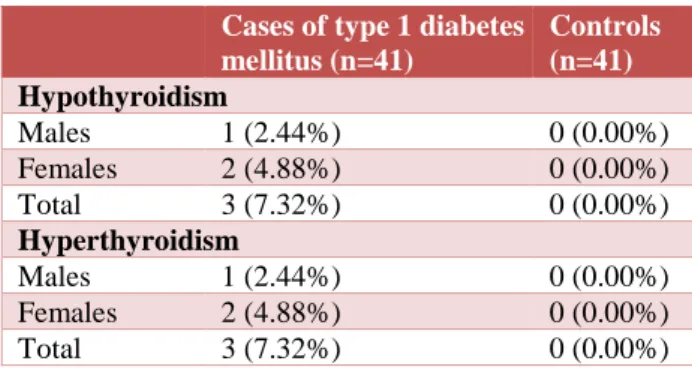
Table 1: Prevalence of hypothyroidism and hyperthyroidism in type 1 diabetes mellitus and
controls.
Cases of type 1 diabetes mellitus (n=41)
Controls (n=41)
Hypothyroidism
Males 1 (2.44%) 0 (0.00%) Females 2 (4.88%) 0 (0.00%) Total 3 (7.32%) 0 (0.00%)
Hyperthyroidism
Males 1 (2.44%) 0 (0.00%) Females 2 (4.88%) 0 (0.00%) Total 3 (7.32%) 0 (0.00%)
Hypothyroidism was present in 3 (one male and two female) type 1 diabetics; while subclinical hypothyroidism was not found in any of the cases. Hypothyroidism was not present in any participant in the control group. Similarly, hyperthyroidism was also reported in 3 (one male and two female) type 1 diabetics. Hyperthyroidism was also not present in any participant in the control group. Thus, abnormal thyroid function was reported in total 6 (14.63%) cases (Table 1).
Table 2: Comparison of mean TSH, T3 and T4 levels in type 1 diabetes mellitus and controls.
Parameter Cases of type 1
diabetes mellitus Controls P-value
TSH
(µIU/ml) 3.44+2.41 3.34+0.78 0.801 T3 (pg/ml) 3.31+1.06 3.36+0.52 0.787 T4 (ng/dl) 0.92+0.31 0.95+0.23 0.62
Total of 6 cases (14.63%) cases of type 1 diabetes mellitus was positive for anti-TPO antibodies. Of these, 4 were females and 2 were males. None of the participants
from the control group were positive for anti-TPO antibodies. The mean serum anti-TPO antibody level (IU/ml) was 36.14±35.02 among cases and 25.0±7.86 among controls; the difference being statistically significant.
When diabetic patients (cases) were divided into two groups according to presence of anti-TPO antibody, the mean age in cases with positive anti-TPO antibodies (n=6) was 25.16±5.81 and in those negative for anti-TPO antibodies (n=35) was 24.42±1.04, the difference being statistically significant (P<0.05).
Table 3: Comparison of Mean TSH, T3 and T4 levels in cases of type 1 diabetes mellitus with positive anti-TPO antibodies and those without positive anti-TPO antibodies.
Parameters Cases of type 1 diabetes mellitus with positive anti-TPO antibodies (n=6)
Cases of type 1 diabetes mellitus without
positive anti-TPO antibodies (n=35) P-value
TSH (µIU/ml) 5.22+5.81 3.13+1.09 P<0.05
T3 (pg/dl) 3.31+2.72 3.30+0.50 P>0.05
T4 (ng/dl) 0.72+0.31 0.96+0.17 P<0.05
Table 3 illustrates the comparison of thyroid profile parameters in the two groups divided with respect to anti-TPO antibodies. Mean levels of serum TSH (µIU/ml) was significantly higher (5.22±5.81) in cases of type 1 diabetes mellitus with positive anti-TPO antibodies (n=6) than in those without positive anti-TPO antibodies (3.13±1.09) (n=35). The mean T3 (pg/dl) was 3.31±2.72 in cases of type 1 diabetes mellitus with positive anti-TPO antibodies and 3.30±0.50 in those without positive anti-TPO antibodies, the difference being statistically insignificant (P<0.05). Mean levels of T4 (ng/dl) was significantly lower though, at 0.72±0.31, in comparison to those without anti-TPO antibodies (0.96±0.17) (P<0.05).
DISCUSSION
Diabetes mellitus and thyroid disorders are two of the most common endocrine disorders. The association of autoimmune thyroid disease with type 1 diabetes mellitus has been well documented across populations.2-7
Functional impairments of thyroid glands, especially hypothyroidism, have been promulgated to be more common amongst diabetes mellitus patients. In the present study, we studied the association between type 1 diabetes and thyroid dysfunction clinically, biochemically as well as immunologically.
The prevalence rate of thyroid dysfunction in diabetes mellitus reported across the globe varies widely. When considering type 2 diabetes patients, Pasupathi et al, found the prevalence of thyroid disorder to be as high as 45%.11 Hypothyroidism was present in 28% and
hyperthyroidism in 17% of patients. On the other hand;
Perros et al, reported an overall prevalence of 13.4% of thyroid diseases in diabetics; with the lowest prevalence in type 2 diabetics (6.9%) and highest prevalence in type 1 female diabetics (31.4%).12 Present study found the
prevalence of thyroid dysfunction in type 1 diabetics to be 14.63%; divided equally into hypo- and hyperthyroidism (7.32% each). A 2:1 ratio gender ratio was found in favour of females. Study findings sit well with what was reported by Shiva et al, who reported prevalence of thyroid disease in 12% of patients (8.6% in females and 3.4% in males).13
Study reported slight statistically insignificant rise in TSH in type 1 diabetics as compared to controls. Findings of various previous studies have been rather inconsistent with respect to this finding. Pasupathi et al, reported the TSH to be lower in diabetics than controls (1.98±1.01 versus 2.44±1.23); while Sahastrabuddhe et al, reported the TSH to be significantly higher (4.77±7.86) as compared to controls (1.43+0.89).14 De Greef et al,
explains the disparity with the theory that in diabetics both high and low levels thyroid hormones may be found depending on the glycemic status of the diabetics studied.15 They postulated that this may be due to
modified TRH Thyrotropin Releasing Hormone) synthesis and release. Failure to recognize the presence of abnormal thyroid hormone levels in diabetics may be one reason of poor management often encountered in some treated diabetics.
prevalence of thyroid dysfunction as discussed earlier. In cases of type 1 diabetes, female gender is reportedly more likely to develop another autoimmune disease; like autoimmune thyroiditis, multiple sclerosis and coeliac disease; with higher frequency.16-18 It could be interesting
to look for reasons behind this particular female preponderance towards coexisting autoimmune disorders and relevant future research is recommended.
In present study, we found anti-TPO antibodies to be positive in 6 (14.63%) type 1 diabetes cases out of total 41. The prevalence rate in our study is much lower than various studies from India (Sahastrabuddhe et al, - 24%, Goswami et al - 42.1% and Unnikrishnan et al - 28%).14,19,20 This difference may well be due to different
sensitivities of the various kits used for thyroid function tests.
Very high prevalence (100%) of hypothyroidism was seen among TPO positive patients with type 1 diabetes mellitus in our study, in contrast to the study done by Franzese et al, which reported the prevalence at 16%. Smaller sample size in our study may explain this.21
Patients of type 1 diabetes mellitus without anti-TPO antibodies did not have any thyroid dysfunction in our study. This is in accordance with findings observed by Sahastrabuddhe et al.14
Mean TSH levels were significantly higher in patients of type 1 diabetes mellitus with positive anti-TPO antibodies as compared to those without it. These findings sit well with that reported by Krishna CS et al, but not consistent with the findings by Ardestani SK et al.22,23
CONCLUSION
Study conclude that thyroid dysfunction to be more common amongst type 1 diabetics, especially females. Estimation of anti-TPO antibodies is valuable in detecting thyroid dysfunction in type 1 diabetics and may be useful for early intervention for its effective management. Our study was largely limited by relatively smaller sample size; hence the findings need to be corroborated by studies with larger sample size.
Funding: No funding sources Conflict of interest: None declared
Ethical approval: The study was approved by the institutional ethics committee
REFERENCES
1. Wang C, Crapo LM. The epidemiology of thyroid disease and implications for screening. Endocrinol Metab Clin North Am. 1997;26:189-218.
2. Bottazzo GF, Mann JI, Thorogood M, Baum JD, Donaich D. Autoimmunity in juvenile diabetes and their families. Br Med J. 1978:2:165-8.
3. Riley W, Maclaren N, Zlezotte D, Spiller R, Rosenbloom A. Thyroid autoimmunity in insulin-dependent diabetes mellitus: the case for routine screening. J Pediater. 1981;98:350-4.
4. Riley W, Winer A, Goldstein D. Coincident presence of thyroid gastric autoimmunity at onset of type 1 (insulin-dependent) diabetes. Diabetol. 1983;24:418-21.
5. Betterle C, Zanette F, Pedini B, Presetto F, Rapp LB, Monciotti CM, et al. Clinical and subclinical organ-specific autoimmune manifestations in type 1 (insulin-dependent) diabetes patients and their first-degree relatives. Diabetol. 1984;26:431-6.
6. Chikuba N, Akazawa S, Yamaguchi Y, Kawasaki E, Takino H, Takao Y, et al. Type 1 diabetes mellitus with coexisting autoimmune thyroid disease in Japan. Int Med. 1992;31:1076-80.
7. Tsai WY, Lee JS. Thyroid disease in Chinese children with type 1 diabetes mellitus. Diabet Care. 1993;16:1314-5.
8. Patricia WU. Thyroid diseases and diabetes. Clin Diabet. 2001;18(1):38.
9. Satish R, Mohan V. Diabetes and thyroid disease: a review. Int J Diab Dev Countries. 2003;23;120-3. 10. American Diabetes Association: Diagnosis and
classification of diabetes mellitus. Diabetes Care. 2010;33:562-9.
11. Pasupathi P, Bakthavatsalam G, Saravanan G, Sundarmoorthy R. Screening for thyroid dysfunction in diabetic/nondiabetic population. Thyroid Sci. 2008;3(8):1-6.
12. Perros P, McCrimmon RJ, Shaw G, Frier BM. Frequency of thyroid dysfunction in diabetic patients: value of annual screening. Diab Med. 1995;12:622-7.
13. Shiva S, Afshin G, Behbahan. Autoimmune thyroid disease in children and adolescents with type 1 diabetes mellitus in northwest Iran. Saudi Med J. 2009;30(5):673-76.
14. Sahasrabuddhe A, Pitale S, Sagdeo M, Gade S. Study of thyroid functions in patients with type-1 diabetes. Vid J Intern Med. 2011;11:21-6.
15. De Greef WJ, Rondeel JM, Van Haasteren GA, Klootwij KW, Visser TJ. Regulation of TRH production and release in rats. Acta Medica Austriaca. 1992;19(1):77-9.
16. Mccanalies E, O’Leary LA, Foley TP. Hashimoto’s thyroiditis and insulin dependent diabetes mellitus: differences among individuals with and without abnormal thyroid function. J Clin Endocrinol Metab. 1998;83:1548-51.
17. Dorman JS, Steenkiste AR, Burke JP. Type 1 diabetes and multiple sclerosis: together at last. Diabetes Care. 2003;26:3192-3.
19. Goswami R, Marwaha RK, Goswami D, Gupta N, Ray D, Tomar N. Pravalene of thyroid autoimmunity in sporadic idiopathic hypoparathyroidism in comparison to type 1 diabetes and premature ovarian failure. J Clin Endocrinol Metab. 2006;91:4256-9.
20. Unnikrishnan AG, Kumaravel V, Nair V, Rao A, Jayakumar RV, Kumar H, et al. TSH receptor antibodies in subjects with type 1 diabetes mellitus. Ann N Y Acad Sci. 2006;1079:220-5.
21. Franzese A, Buono P, Mascolo M. Thyroid autoimmunity starting during the course of type 1 diabetes denotes a subgroup of children with more severe diabetes. Diabetes Care. 2000;23:1201-12.
22. Krishna CS, Vibha C, Manohar CS, Anil Kumar GS, Nanda K, Sadanand G. Thyroid dysfunction in type 1 diabetes. IJBMS. 2011;2(4):212-8.
23. Ardestani SK. Thyroid disorder in Type 1 Diabetes mellitus in children. Iran J Pediatr. 2011;21(4):502-8.