VOLUME 18 ISSUE 3 (2020), Page 25 – 34
POST-CONSERVATION EVALUATION (PCE): FINANCIAL PERFORMANCE OF ADAPTIVE REUSE MUSEUMS IN GEORGE
TOWN, MALAYSIA
Muhammad Firzan Abdul Aziz
School of Housing, Building and Planning UNIVERSITI SAINS MALAYSIA
Abstract
Adaptive reuse of historic buildings has become a prominent trend in the scenario of built heritage conservation of Melaka and George Town, UNESCO World Heritage Sites of Malaysia. Such implementation however is questionable since there have been several dilemmas raised in relation to the local museum industry. Among them are stiff competition faced by museums as an attractive cultural product, not appealing to business funders, rarely favoured as a family holiday destination and being perceived as dull and old repositories by the younger generations. As adaptive reuse is known to revive the physical and functional facets of historic building which then contributes to its economic generation, this study attempts to understand the financial impact from such implementations. Post-conservation evaluation (PCE) focusing on financial performance was conducted on adaptive reuse museums in the Core Zone and Buffer Zone of George Town, involving Penang State Museum (PSM), Made in Penang Interactive Museum (MIPIM), Batik Painting Museum (BPM) and Dark Mansion-3D Glow in the Dark Museum (DM) which were shortlisted trough purposive sampling. Key informants’ survey was then carried by engaging key person identified to be resourceful and knowledgeable with the respective museums’ financial background and history. It is found that the adaptive reuse museums have yet to gain a stable return of investment, due to low-income generation from their ticketing sales in relation to higher operational and maintenance costs they require. By conducting PCE on the financial performance of adaptive reuse buildings that are of cultural and historical values, conservation stakeholders may be furnished with better information that aids better decision-making in the future.
INTRODUCTION
Apparently, many cities nowadays opted for adaptive reuse as a means of urban revitalisation and conservation. Conservation of built heritage, through adaptive reuse of historic buildings within heritage sites has been long associated with the agenda of sustainability. Such implementation is deemed vital in meeting sustainable development through the trifold environmental, social and economic dimensions (Feilden, 2000; Bullen P., 2007; Godwin, 2011). In Malaysia, Melaka and George Town have been inscribed in the UNESCO World Heritage Sites on 7th July 2008. Under the cultural heritage category, Melaka and George Town have been revered as the Historic Cities of the Straits of Malacca for their Outstanding Universal Values (OUVs) comprising both tangible and intangible heritage. One of the significant conservation trends apparent in Melaka and George Town is the act of converting old buildings to museums.
The scenario however raised a question on the financial impacts of adaptive reuse museums since there have been several dilemmas raised in relation to the local museum industry. Years before the inscription date, Rowley (1999) already found that museums face a stiff competition in attracting tourists, by having to compete with other leisure and touristic destination spots. Former general director of the Department of Museums Malaysia, Dato’ Dr Adi Taha meanwhile reported that Malaysian museums have always been unattractive by financial providers due to their poor capability in generating revenue to the nation (Taha, 2009). Later, another former general director, Datuk Ibrahim Ismail affirmed that Malaysian museums were rarely being listed as a favourable family destination trip compared to other holiday destinations (Abdul Razak, 2011). More recently, Datuk Seri Mohd Shafie Apdal, a local politician, observed that museums have been perceived as old and dull repositories which are not worth of attention for the younger generations (Mokhtar & Kasim, 2012).
RESEARCH BACKGROUND
Theoretically, adaptive reuse fosters rejuvenation and prolongation of physical and functional aspects of built heritage (Langston, Wong, Hui, & Shen, 2008; Bullen & Love, 2011; Kamal & Ab Wahab, 2014). The concept of adaptive reuse has been heavily linked with financial resiliency of historic buildings, as financial revenue is the by-product of the physical and functional revitalisation. Moreover, return of investment of historic building is an important indicator of conservation success, as indoctrinated in the local conservation philosophy comprising the twofold criteria of (Keromo, 2000):
● Safeguarding heritage; to retain the authenticity of materials (type, colour and texture), architecture (construction technique and workmanship) and original use (function or type).
● Developing heritage; to utilise and leverage heritage for economic gains without forsaking its preservation and conservation.
Imperatively, one of the components of sustainable development is economic factors. Hence, it is sensible that adaptive reuse aims to revitalise and sustain old buildings, by giving them a new life through their operational and economical facets (Langston, Wong, Hui, & Shen, 2008; Bullen & Love, 2011; Kamal & Ab Wahab, 2014). As generally discussed, the financial performance of a building arises from its physical and functional performances that includes the calculations of capital and recurrent (life-cycle) expenditures, depreciation, and efficiency of use etc. (Sapri & Pitt, 2005). In this regard, building performance can be evaluated by understanding how the building performs financially through its economic sense (value for money or return of investment) (Leaman, Stevenson, & Bordass, 2010). Acknowledging that efficiency refers to the extent of which activities or the desired effects are achieved with the lowest possible use of resources or inputs (National Centre of Sustainability, 2011), Abdul Aziz (2018) scrutinised on financial efficiency of conserved historic buildings in his post-conservation evaluation (PCE) studies.
Besides OER, an aspect of Contingency Valuation Method (CVM) commonly used to assess historic buildings known as willingness-to-pay (WTP), is also useful to assess the financial performance of conserved historic buildings. WTP is the theory used to understand the economic feasibility and sustainability of heritage sites. WTP is based on people’s evaluation of cultural heritage, and their consumerism preference (Kim, Kevin, & Cho, 2008; Choi, Ritchie, Papandrea, & Bennett, 2010; Dong, Zhang, Zhi, Zong, & Li, 2011; Noor Fazamimah, Anuar, & Yahaya, 2015). WTP is meaningful in informing the return of investment for cultural heritage goods, typically valued through their consumption via entrance fees gained and conservation funds received (Beltran & Rojas, 1996).
Apart from OER and WTP, consideration on building’s economic performance through its life-cycle costs (LCC) is essential to determine cost-effectiveness and later influence strategic, tactical and operational decisions (Dorasol, Mohammad, Mohammed, Hamadan, & Nik Lah, 2012). Blanchard, Verma and Peterson (1995) reported that 50% to 80% of the total LCC is spent during in-service life. In this sense, the building operation and maintenance phase of LCC is crucial and has a major impact on building performance. NIBS (2009) described cost-effective building as the one that renders the lowest operating and maintenance costs, has the longest lifespan, encourages productivity among users and offers the greatest return on investment. Dorasol, Mohammad, Mohammed, Hamadan and Nik Lah (2012) added specifically that an efficient building is one that uses energy and water efficiently.
METHODOLOGY
Figure 1: Screenshot preview of the key informants’ survey form used for acquiring financial performance data
ANALYSIS AND FINDINGS
Based on the purposive sampling with the two aforementioned criteria applied, 14 out of total 29 adaptive reuse museums were shortlisted. However, only four out of the 14 adaptive reuse museums were accessible (consent granted by their respective museum owners or managers) namely Penang State Museum (PSM), Made in Penang Interactive Museum (MIPIM), Batik Painting Museum (BPM) and Dark Mansion-3D Glow in the Dark Museum (DM). Table 1 shows the key informants involved during the data collection period:
Table 1: Key informants involved from the adaptive reuse museums of George Town
Museums Key Informants’ Position
PSM Museum assistant
MIPIM Museum co-owner and accounting staff
BPM Museum staff
DM Museum director
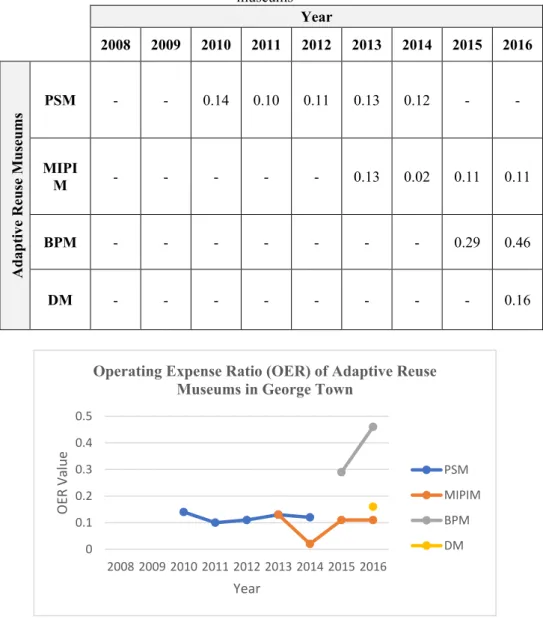
Table 2: Individual results on the Operating Expense Ratio (OER) of the adaptive reuse museums
Year
2008 2009 2010 2011 2012 2013 2014 2015 2016
Adapt
ive Reu
se M
useums
PSM - - 0.14 0.10 0.11 0.13 0.12 - -
MIPI
M - - - 0.13 0.02 0.11 0.11
BPM - - - 0.29 0.46
DM - - - 0.16
Figure 2: Annual trends on the Operating Expense Ratio (OER) of the adaptive reuse museums
Figure 2 depicts fluctuating OER trends for PSM and MIPIM, with an inclining OER trend for BPM. Implying from that, none of the four adaptive reuse
0 0.1 0.2 0.3 0.4 0.5
2008 2009 2010 2011 2012 2013 2014 2015 2016
OE
R
Value
Year
Operating Expense Ratio (OER) of Adaptive Reuse Museums in George Town
PSM
MIPIM
BPM
from their conversion to museums. They contradict the criterion of an efficient and profitable building which should have lesser coverage of revenue onto the operational and maintenance costs. Such scenarios can be associated with their low-income generation from ticketing sales in relation to the higher costs required for operating and maintaining the museum buildings. By forecast, the inclining OER trend of BPM signals that its investor may face financial loss for remaining the built property as a museum.
CONCLUSION
Summarily, the majority of the adaptive reuse museums have a steadily declining OER over the years. The trends generated however are deemed inadequate to conclude on the post-conservation impact of the adaptive reuse museums in George Town. This calls upon more comprehensive data on the museums’ financial performance that span further annually in order to yield comprehensive OER trends. Since this study was limited by confidentiality and data inadequacy factors, future researchers are encouraged to expand and improve this study by retrieving more comprehensive data on financial performance from museum agencies. By conducting PCE focusing on financial performance of adaptive reuse buildings that are of cultural and historical values, conservation stakeholders such as the local authorities, building owners and conservators alike may be furnished with better information that aids better decision-making in the future. In this regard, PCE on financial performance as demonstrated in this paper, can be integrated with other impact evaluations to foster a more sustainable conservation planning and endeavours in protecting the Outstanding Universal Values of UNESCO World Heritage Sites.
ACKNOWLEDGEMENT
The author would like to appreciate the School of Housing, Building and Planning, Universiti Sains Malaysia (USM) for providing the financial support in publishing this article.
REFERENCES
Abdul Aziz, M. (2018). Post-Conservation Evaluation (PCE) Framework for Adaptive
Reuse Museums: Case Studies of George Town, Malaysia (Doctoral dissertation). Kuala Lumpur, Malaysia: Universiti Malaya.
Abdul Razak, N. (2011). Cabaran 'hidupkan' muzium. Utusan Online. Retrieved from http://ww1.utusan.com.my/utusan/info.asp?y=2011&dt=0524&pub=Utusan_Mal aysia&sec=Keluarga&pg=ke_02.htm
Beltran, E., & Rojas, M. (1996). Diversified funding methods in Mexican archeology.
Annals of Tourism Research, 23(02), 463-478.
Blanchard, B., Verma, D., & Peterson, E. (1995). Maintainability: A key to effective serviceability and maintenance management. New York: Wiley.
25(1/2), 20-31.
Bullen, P., & Love, P. (2011). Adaptive reuse of heritage buildings: Sustaining an icon
or eyesore. COBRA 2011 Proceedings of RICS Construction and Property
Conference (pp. 1652-1662). University of Salford.
Choi, A., Ritchie, B., Papandrea, F., & Bennett, J. (2010). Economic valuation of cultural
heritage sites: A choice modeling approach. Tourism Management, 31, 213–220.
Dong, X., Zhang, J., Zhi, R., Zong, S., & Li, M. (2011). Measuring recreational value of World Heritage sites based on contingent valuation method: A case study of
Jiuzhaigou. Chinese Geographical Science, 21(01), 119-128.
Dorasol, N., Mohammad, I., Mohammed, A., Hamadan, N., & Nik Lah, N. (2012). Post occupancy evaluation performance criteria and parameters for hospital building in
Malaysia. The 3rd International Conference on Business and Economic Research
(ICBER), (pp. 2650-2667). Bandung, Indonesia.
DV. (2016). Financial ratio analysis. Retrieved from Demonstrating Value: https://www.demonstratingvalue.org/resources/financial-ratio-analysis
Feilden, B. (2000). Conservation of historic buildings. Oxford: Architectural Press.
Godwin, P. (2011). Building conservation and sustainability in the United Kingdom. Procedia Engineering, 20, 12–21.
Investopedia, LLC. (2014). Operating Expense Ratio - OER. Retrieved from Investopedia: http://www.investopedia.com/terms/o/operating-expense-ratio.asp Kamal, K., & Ab Wahab, L. (2014). Bangunan bersejarah: Kerosakan dan penyataan
kaedah kerja pemuliharaan. Shah Alam: Penerbit UiTM.
Kamaruzzaman, S., & Zulkifli, N. (2014). Measures for building lighting performance in
Malaysian historical buildings: A systematic review. Journal of Surveying,
Construction and Property (JSCP), 05(01), 1-15.
Keromo, P. (2000). Piawaian dan pelaksanaan konservasi monumen dan tapak tanah bersejarah. Bengkel Konservasi Monumen dan Tapak Tanah Bersejarah. Pulau Pinang.
Kim, S., Kevin, K., & Cho, M. (2008). Assessing the economic value of a World Heritage
site and willingness-to-pay determinants: A case of Changdeok Palace. Tourism
Management, 28(01), 317-322.
Langston, C., Wong, F., Hui, E., & Shen, L. (2008). Strategic assessment of building adaptive reuse opportunities in Hong Kong. Building and Environment, 43(10), 1709-1718.
Leaman, A., Stevenson, F., & Bordass, B. (2010). Building evaluation: Practice and
principles. Building Research and Information, 05, 564–577.
Mokhtar, M., & Kasim, A. (2012). Motivations for visiting and not visiting museums
among young adults: A case study on UUM students. Journal of Global
Management, 03(01), 43-58.
National Centre of Sustainability. (2011). A short guide to monitoring & evaluation.
Retrieved from Evaluation Toolbox:
http://www.evaluationtoolbox.net.au/index.php?option=com_rubberdoc&view=d oc&id=29&format=raw
sustainable historic urban development: Economic perceptions of stakeholders
(perceived value). Jurnal Teknologi, 75(09), 51-55.
Rowley, J. (1999). Measuring total customer experience in museums. International
Journal of Contemporary Hospitality Management, 11(06), 303-308.
Sapri, M., & Pitt, M. (2005). Performance measurement in facilities management; State of knowledge. In F. Khosrowshahi (Ed.), 21st Annual ARCOM Conference, 7-9 September. 01, pp. 431-440. SOAS, University of London: Association of Researchers in Construction Management.
Taha, A. (2009). Museums in Malaysia: Challenges and development. In L. Noi, & T.
Eng (Ed.), ASEAN Museum Directors’ Symposium, ASEAN Civilizations
Museum. Singapore.
Received: January 2020. Accepted: 14th May 2020
YUAN, L. J. (1987). THE MALAY HOUSE: REDISCOVERING MALAYSIA’S