A Paradigm for Object-oriented
Conceptual Modeling of
Optical Networks
*Sudip Misra
1, Subhas Chandra Misra
2and Isaac Woungang
3 1Department of Computer Science, Yale University, CT, USA2SuperNet Solutions, Toronto, ON, Canada
3School of Computer Science, Ryerson University, Toronto, ON, Canada
We present a conceptual framework for modeling optical networks and the solutions to its associated problems. The framework is targeted towards a large-scale initiative by us for developing a modeling language that can help with conceptual modeling of typical optical network design problems. While there are pieces of literature available that describe modeling languages for other application areas, there are no specific languages for use in networking problems in general. Our work is an important step forward to address this defficiency. Our proposed framework takes the already existing modeling language notations and extends them to support the modeling of optical networks.
Keywords: object-oriented design, conceptual model-ing, optical networks, distributed systems, UML-based profile.
1. Introduction
In this paper we present an UML-based frame-work to support modeling optical netframe-working problems. Our efforts are targeted towards a larger scale initiative for providing an UML Profile for modeling Optical Networks. The Profile is based on an extension of UML 1.5. Although UML is considered by many profes-sionals as ade factotool to aid in system model-ing, the current versions of UML do not specify methodologies, modeling elements and tools to address problems specific to networking. The UML Profile we are developing for use in opti-cal networks enables one to model fundamental concepts in network communications, optical
network hardware, structure of protocols and optical network component interactions. Other initiatives with UML Profiles address modeling issues associated with application do-mains such as Quality of Service in Distributed Systems[1,2], Business Modeling[4], Fault Tol-erance[5], CORBA[6], Testing[7]and Schedu-lability, Performance and Time[8] and Agent-oriented Software[9].
Although there have been UML Profiles devel-oped for use in other application areas, there are no UML-based profilesevenfor use in modeling the fundamental networking problems. Since optical networks are one of the most promising modern day communication technologies, we focused our work in this area.
In this paper, we illustrate some fundamental optical networking concepts [11, 12, 13]using our modeling approach, however the approach is extensible. At the outset we should disclaim that the work is not a robust approach to con-sider modeling all possible optical networking scenarios. However, we do believe that our pa-per can definitely help the reader in extending the concepts and methodologies we discuss in this paper for use in specific problems.
One of the important advantages of optical net-works is that they provide very high carrier fre-quency of light and minimum dispersion of sig-nal. Essentially, light is an ideal carrier for transfer of information because communication
∗A preliminary version of this paper appeared in the Proceedings of the 8th International Conference on Advanced
through light has an advantage of minimizing the interaction between light rays with different wavelengths. This allows having many inde-pendent light rays with different wavelengths that can pass through one fibre. This multi-plies the capacity of the fibre to the number of wavelengths which are used for communication purposes. Also, the advantage of optical data transmission is the ability to operate with light signal fully in the optical range, avoiding opti-cal to electric(OE)and electric to optical(EO)
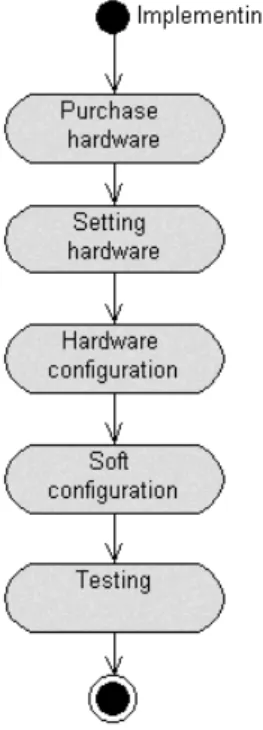
conversions, which may slow the transfer rate and overall capacity of optical networks. The simplest of the optical network hardware, which operates with the signal fully in the optical do-main, is coupler, which allows adding/dropping one wavelength to/from the optical signal. For constructing and modeling of optical net-works [10, 13], many factors usually should be taken into account. As the optical network hardware is quite expensive, economical con-siderations must be taken into account while building optical networks. A high-level view of actions required for the development of optical networks are shown in Figures 1-3.
Therefore, the following marketing manage-ment and technology managemanage-ment phases are used: an advantage assessment of results of in-troduction, an estimation of the market demands and forecasting, selecting network hardware and network software, customization, modeling and introduction. The following strategies can be taken into consideration while developing an optical network:
• Construct at once all network on available demand and forecasts, and
• Construct a backbone with extensions on de-mands.
Fig. 1.High-level actions for developing an optical network.
Fig. 2.Optical network planning actions.
The necessary quality of service QoS must be taken into account in the planning process. Thus choosing appropriate protection schemes such
as 1 : 1 or 1 : N must be considered while
modeling optical networks, depending on the appropriateQoS.
The main problems that need to be solved for modeling optical networks are the Physical Topo-logy Design, Virtual TopoTopo-logy Design and Dy-namic RWA Problem. Physical Topology De-sign is used after a choice of technologies and strategy of the development have been made. The physical topology greatly depends on the routing of lightpaths and wavelength assign-ment strategy[10].
2. Overall Design Rationale
The development of optical networks is quite complex, and its successful modeling requires thorough understanding of many components, definitions and technologies. We assume that the reader is familiar with the area of optical networks. But before presenting the details of our work, we just review some of the concepts that might help in the understanding of this pa-per.
Computer networks are designed to provide in-formation exchange between participants. A network acts as an “information mediator”. Ev-ery network can be considered as the mediator between an informationsourceand arecipient. Thus a network can be viewed as an interopera-tion of many informainteropera-tion mediators. In optical networks, the principal mediators are thefibres andOXCs. There is also specialized hardware meant for use in optical networks, but most of them serve as information mediators. Informa-tion in Optical Networks can be classified as either – “transfer information”, or “controlling information”.
The following terminology is used in the pro-file. Amodifier is an object which can change information. A mediator serves the role of an intermediate communicator. First it receives in-formation then it can change it, then it sends it to next recipient(s). So mediator is a recipient, a source and maybe even a modifier. Anetwork
objectis any object, which is a part of the
com-puter network. A network communicator is a
network object capable of sending and receiv-ing information. The rest of the terminology used in the profile is standard in Optical Com-munication literature and is not explained here in further detail.
3. The UML-based Modeling Framework: Towards an UML-profile
The Profile itself describes main purpose con-cepts and classes. The Profile was developed in the form of object-oriented analysis models of the optical networks data domain. Static mod-els show the main concepts used in optical net-works and their relations. Network protocols described in this profile are basically Internet protocols. So this profile shows how to model optical networks concepts from the IP from the optical networks point of view.
The structure of this profile is simple enough for use in real applications. As mentioned earlier, the approach can be extended and tailored to satisfy the needs of the specific problem being analyzed. We analyze the data domain first. Structure of the profile: The profile consists of the corresponding packages. Every package contains classes, which can be used in modeling of optical networks. They define and describe data domain of communications and optical net-works. All of them are model classes, except Fiber, which is a LinkObject stereotype. So this LinkObject association stereotype can provide connections between optical network hardware. The Profile consists of different packages. The top-level package is the MoON Profile package
(see Figure 4). The model elements of the file are stored in this package. The MoON Pro-file package contains the Communication and Optical Network packages, as shown in Figure 5.
Fig. 5.MoON Profile package.
Communication Package: The Communication Package contains the GeneralCommunication and NetworkCommunication packages as shown in Figure 6. Communication Package contains elements, which describe the general network communication roles and protocols.
Fig. 6.Communication Package.
General Communication Package: The Gen-eral Communication Package contains GenGen-eral- General-CommunicationRoles and GeneralProtocol Pack-ages, as shown in Figure 7. The detalis of the GeneralCommunicationRoles Package are ex-plained in Figures 8-10. The Network Commu-nication Package depends on the General Com-munication Package. This package describes the general communications that takes place in all IP networks.
Communicatorand informationare basic con-cepts of information exchange. The Figures 8-10 describing the different communication con-cepts in the GeneralCommunicationRoles Pack-age are self-explanatory. Communicator is an object that is capable of sending or receiving information. Basic concepts of information ex-change are the source, recipient and modifier. Source and recipient are communicators capa-ble of sending and receiving information. Mod-ifier can change information in some way. In-formation exchange can be unidirectional, bi-directional or multicast. Every mediator may consist of at least one recipient, and one source, and it can also contain modifier(s). Every
me-Fig. 7. GeneralCommunication Package.
diator can also be an owner of other mediators. Message is a special case of information or its part sent from source to recipient(s)as a single block of information.
Fig. 8.GeneralCommunicationRoles package. Main communication concepts and relations.
Fig. 9.GeneralCommunicationRoles package. Mediator.
Fig. 11. GeneralCommunication package. Unidirectional communication.
Fig. 12. GeneralCommunication package. Dual directional communication.
The sequence diagrams in Figures 11-12 show the general communication behaviour between communication objects. Figure 11 shows unidi-rectional communication through one mediator, whereas Figure 12 shows bi-directional com-munication through two mediators.
Communication protocols are used for the pur-pose of encoding and decoding of the informa-tion by specified set of communicainforma-tion rules. Protocol defines certain communication rules in such a way that communicators can understand each other.
Each communicator contains a protocol stack that contains protocol layers. Each protocol layer implements a specific protocol. Several protocol layers form a protocol stack. Layers in protocol stack can communicate with each other. Usually, the source of information passes
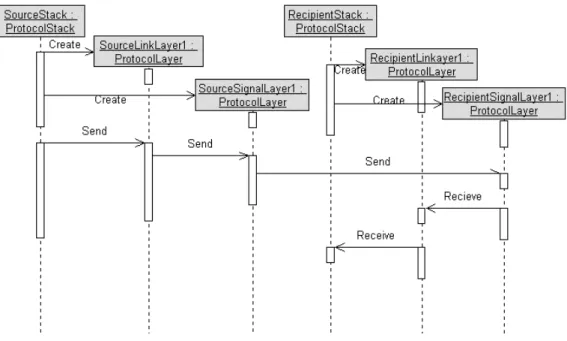
through sender’s protocol stack. In the proto-col stack, it passes through a stack of protoproto-col layers. Each layer formats or transforms in-formation using protocol rules. So the infor-mation could be sent through some medium or mediator. The recipient receives information and passes it through its protocol stack, but in reverse direction, so that the information can be transformed to its original state. Figure 13 shows the communicator protocol stack struc-ture in the GeneralProtocol Package, whereas Figure 14 shows an UML sequence diagram depicting the protocol layer interactions while sending information from source to recipient.
Fig. 13.GeneralProtocol Package. Communicator protocol stack structure.
Fig. 14. Protocol stack and protocol layer interactions while sending information from source to recipient.
Fig. 15. NetworkCommunication Package.
The NetworkCommunicationRoles Package is shown in Figures 16-17. As can be seen in these figures, the NetworkCommunicationRoles pack-age defines NetworkCommunicator that is a de-scendant of Communicator and NetworkObject. It also defines Client, Server and Peer classes, which are descendants of NetworkCommunica-tor classes. Network communicaNetworkCommunica-tor is a special case of a generic communicator – so it can
per-form communication with other communicators and is a network object. Therefore, it can be in-cluded in the network. Network communicator is a hardware or software that can send or re-ceive information to other communicators. Like every communicator, it implements a protocol stack. Specific instances of network communi-cators are Client, Server and Peer.
Fig. 17. NetworkCommunicationRoles package. Network definition.
A network can be implemented using one of two basic architectures: client-server or peer-to-peer. In client-server architecture, some net-work communicator(server)provides services to other network communicators (clients). In peer-to-peer architecture, every communicator has almost equal capabilities. Network com-municator implements computer network pro-tocol(s).
A network is a mediator. Therefore a network can be represented using a class, which must contain a minimum of two NetworkCommuni-cators. Then network consists of NetworkOb-jects. Network communicators and auxiliary network objects can group network objects. Network protocol package contains main defi-nitions of network protocols.
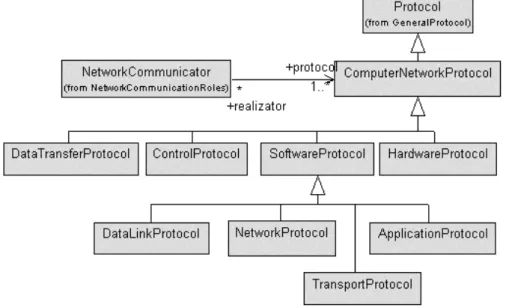
Figure 18 shows the conceptual class diagram showing the different network protocol types as classes. Computer network protocols can be classified either as control protocols or data transfer protocols. Control protocols are auxil-iary protocols that are used for network manage-ment purposes. Examples of control protocols are ARP, ICMP, IGMP and other. Data transfer protocols are used for direct transferring of the information.
Figure 19 shows the different class of Inter-net protocols classified as different packages. Network protocols can be divided by the items for which they specify communication rules. Hardware protocols specify rules of commu-nication at the hardware level, such as shape
Fig. 19.Internet protocol layers.
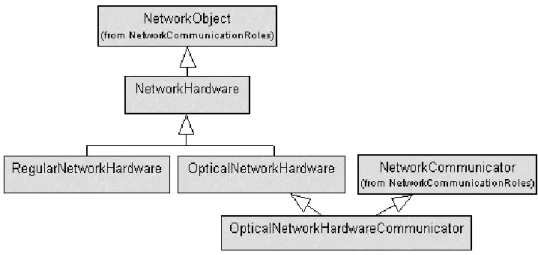
Fig. 20.Optical Network Hardware and Optical Network Hardware Communicator.
of the electrical signal, its amplitude and other characteristics of the signal. Software protocols specify communication rules at software level. Software level indicates the level of CPU code instructions, which are executed by CPU. Optical Network Package: The Optical Net-work Package contains the Optical Hardware Package. Figure 20 shows an UML class dia-gram depicting NetworkHardware, RegularNet-workHarware, OpticalNetworkHardware, and OpticalNetworkHardwareCommunicator. The class names indicate their roles/purpose and are self-explanatory.
Fiber stereotype (shown in Figure 21) allows linking of OpticalNetworkHardwareCommuni-cator classes. It simplifies designing of optical network models by using UML associations. It must have two ends of the links. It must inter-connect OpticalNetworkHardwareCommunica-tors. It has one String tag – modetype. Its value must be “single”, “multi” or “empty”. If its value is empty, then it is considered by default that the fiber is multimode.
Fig. 21.Fiber stereotype.
4. Conclusion
In this paper we provided an UML-based con-ceptual framework to aid in modeling optical networking systems and in solving their asso-ciated problems. The work is targeted towards developing an UML-based profile to aid in mod-eling optical networks. The work is a signifi-cant contribution to the networking community as the complexity of optical networks demands great efforts to analyze, model and standard-ize the solution approaches to various problems commonly occurring in the area of optical net-works.
References
[1] J. O. AAGEDAL ANDE. F. ECKLUNDJR., Modeling
QoS: Towards a UML Profile,Proceedings of UML 2002, Dresden, Germany, September 20 – October 4, 2002, LNCS 2460, pp. 275–289.
[2] J. O. AAGEDAL,Quality of Service Support in De-velopment of Distributed Systems, PhD Thesis, Department of Informatics, Faculty of Mathematics and Natural Sciences, University of Oslo, 2001. [3] D. AWDUCHE ET AL., Overview and Principles of
Internet Traffic Engineering, RFC 3272, IETF. [4] S. JOHNSTON, Rational UML Profile for Business
Modeling, June 2004,
http://www-106.ibm.com/developerworks /rational/library/5167.html?ca=dnp-327
[6] OMG,UML Profile for CORBA, Version 1.0, http://www.omg.org/docs/formal /02-04-01.pdf
[7] OMG, UML 2.0 Testing Profile Specification, September 2003,
http://www.omg.org/docs/ptc /04-04-02.pdf
[8] OMG,UML Profile for Schedulability, Performance and Time, Version 1.0, September 2003,
http://www.omg.org/docs/formal /03-09-01.pdf
[9] G. WAGNER, A UML Profile for Agent-oriented
Modeling, Technical Report, I&T Department, Eindhoven University of Technology, 2002, The Netherlands.
http://tmitwww.tm.tue.nl/staff/gwagner/
[10] G. N. ROUSKAS, H. G. PERROS, A Tutorial on
Op-tical Networks, Networking 2002 Tutorials, LNCS 2497, pp. 155–193, 2002.
[11] T. W. CHUNG,ET AL., Architectural and Engineering Issues for Building an Optical Internet, CANARIE Inc.
http://www.canarie.ca/∼
bstarn/optical-internet.html
[12] B. RAJAGOPALAN, J. LUCIANI, D. AWDUCHE,IP over
Optical Networks: A Framework, RFC 3717, March 2004.
[13] V. ALWAYN, Optical Network Design and
Imple-mentation, Cisco Press, 2004.
Received:October, 2005 Accepted:September, 2006
Contact addresses: Sudip Misra Department of Computer Science Yale University CT, USA
Subhas Chandra Misra SuperNet Solutions Toronto, ON Canada
Isaac Woungang School of Computer Science Ryerson University Toronto, ON Canada
SUDIPMISRAis a Visiting Scientist at the School of Electrical and Com-puter Engineering at Cornell University in Ithaca, New York, USA, and an Adjunct Professor at Ryerson University in Toronto, Canada. He re-ceived his doctoral degree from Carleton University in Ottawa, Canada. Prior to this, he received his Masters and Bachelors Degrees respectively from the University of New Brunswick in Fredericton, Canada, and the Indian Institute of Technology in Kharagpur, India. He has several years of experience working in academia, government, and private sectors. Dr. Misra has worked on several R&D projects in project management, architecture, software design, and product engineering roles at Nor-tel Networks(Ottawa, Canada), Atreus Systems Corporation(Ottawa, Canada), and the Government of Ontario(Toronto, Canada). His current research interests include network design and modeling and algorithm design and experimentation for performance, and high-speed telecommunication networks. His other research interests include computational learning and software engineering. He has published several research papers in journals and proceedings of international conferences, and has also received a few research awards.
SUBHASCHANDRAMISRAis a Senior Project Advisor in Super Net So-lutions, Scarborough, Ontario, Canada. Prior to this, he worked in the research wings of several reputed industries, such as Nortel Networks, Ottawa, Canada, and the Indian Telephone Industries, Mankapur, In-dia. He has several years of experience working on R&D projects in software engineering, project management, quality engineering, risk management, and project management. He has published 11 techni-cal papers in different international journals, and 16 papers in refereed conference proceedings. He has also offered several tutorials in the allied areas. Subhas received over 15 prestigious academic awards that include Best Paper Award for one of his published papers. He has been invited as Session Chairperson in various international conferences held in USA. He is also serving as the Program Committee Member of ICEIS 2006. He received his M.Tech. degree in Computer Science and Data Processing from the Indian Institute of Technology(IIT), Kharagpur, India, and M.S. degree in Computer Science from the University of New Brunswick, Fredericton, Canada. He is also completing his PhD studies in Information Systems at the Eric Sprott School of Business, Carleton University, Canada.