Volume 5, No. 5, May-June 2014
International Journal of Advanced Research in Computer Science
RESEARCH PAPER
Available Online at www.ijarcs.info
The Air Quality Prediction Using HYBRID Soft Computing Techniques
Niharika
CentreInformation Technology College of Engineering Studies University Of Petroleum and Energy Studies
Dehradun, India
Venkatadri M
Centre for Information Technology College of Engineering Studies University Of Petroleum and Energy Studies
Dehradun, India.
Padma S.Rao
Senior Principal Scientist and Head Air Pollution Control Division
CSIR, NEERI, Nagpur, India.
Abstract: The common feature of many developing countries like INDIA is the deficiency of Environmental data. In INDIA, air quality is beginning to be systematically monitored in some places of the country. To overcome these problems, the need for accurate estimates of air quality levels becomes ever more important. To achieve such prediction tasks, the use of hybrid soft computing technique is regarded as a cost effective technique superior to traditional statistical methods. In this paper, neuro-fuzzy modelling for air quality prediction is used to estimate the well known pollutant i.e. Respiratory Suspended Particulate Matter (RSPM), from readily observable local meteorological data. The results indicate that the neuro-fuzzy model predicted air pollutant concentration with good accuracy of approximately 98%.
Keywords: Air quality, Artificial Neural Network, Hybrid Soft Computing Technique, neuro-fuzzy modelling.
I. INTRODUCTION
The deficiency in the collection of the environmental data due to certain reasons, such as measuring device error, human error and many other factors that result in the missing values for the environmental parameters. Analytic computer codes are often used for the estimation of flow of energy and for the performance of systems [1]. The computer algorithms that are usually used are complicated enough because of the involvement of the solution of complex differential equations. These programs have one of the major drawbacks as they require a large computer power and require a large amount of time to give accurate predictions.
In order to predict the air quality, one of the approach is the use of the atmospheric diffusion model. But such models require a large data set of emitted pollutants and meteorological fields. Collet and Oduyemi [2] provide a detailed review of this particular type of model.
The next approach for air quality predictions are statistical models which helps in determining the underlying relationships between a set of input data and targets. One of the example for such type of modelling is Regression modelling, that has been applied to air quality modelling and prediction in a number of studies [3, 4]. One of the limitations imposed by linear regression models is that they will underperform when used to model nonlinear systems.
Instead of the use of old traditional mathematical, statistical methods for air quality prediction, soft computing techniques provide more appropriate and efficient techniques for air quality prediction. In this paper one of the most popular soft computing techniques i.e. Artificial Neural Networks and Fuzzy Logic.
The following section II provides basic overview of neuro-fuzzy modeling, section III discusses the algorithm designed for air quality prediction model, followed by section IV consisting of the results and discussions of these results and finally section V contains the conclusion of the complete research work.
II. NEURO-FUZZYMODELLING
The Hybrid models are considered to be more advantageous for air quality prediction. The combination of more than one soft computing techniques forms Hybrid soft computing technique. A number of hybrid soft computing techniques applied in assessment of air quality prediction efficiently. A hybrid soft computing technique with the combination of ANN along with Fuzzy logic or with HMM and even with other soft computing techniques can be very effective for air pollution prediction and time series analysis [5].
In this paper, we are proposing a hybrid model which is a combination of ANN and Fuzzy Logic. The use of these two soft computing techniques is basically due to following advantages of these techniques.
ANN is useful in the situations, where underlying processes/relationships may display chaotic properties. ANN does not require any prior knowledge of the system under consideration and are well suited to model dynamic systems on a real time basis. Such models can be called as neuro-fuzzy systems.
Fuzzy logic technique is necessary for analyzing complex systems, especially where the data structure is characterized by several linguistic parameters. Air being a highly complex system and fuzzy logic is highly suitable for analyzing the datasets pertaining to the atmospheric variables or occurrences.
fuzzy system which is trained by a learning algorithm derived from Neural Network theory [6]. The (heuristically) learning procedure operates on local information, and causes only local modifications in the underlying fuzzy system.
A neuro-fuzzy system can be viewed as a 3-layer feed forward neural network. The first layer represents input variables, the middle (hidden) layer represents fuzzy rules and the third layer represents output variables. Fuzzy sets are encoded as (fuzzy) connection weights. It is not necessary to represent a fuzzy system like this to apply a learning algorithm to it. However, it can be convenient, because it represents the data flow of input processing and learning within the model.
The hybrid neuro-fuzzy model comprises of two major blocks of operation i.e. ANN and fuzzy logic. The hybrid modelling can be performed by two different approaches are as follows:
a. Use the input parameters as the input neurons to ANN box and the output is compared with the rules in the Fuzzy Rule base comprising of rules dependent on the input parameters of ANN model. The decision will be made by the hybrid model for determining the output parameter index.
b. The second method of developing the hybrid model is design the Fuzzy Rule base and the output of Fuzzy model can be provided the input to the ANN black box model that helps in training the best and the optimized output.
In this paper, the first technique is selected for air quality prediction model. The proposed model designed based on following input parameters:
(a). Temperature. (b). Relative Humidity. (c). Average wind speed. (d). Mean Visibility.
The output parameter selected is one of the air pollutants i.e. RSPM (Respiratory Suspended Particulate Matter) because it is the pollutant that is affecting the living beings at a wide scale as compared to other pollutants.
The selection of metrological parameters for building the hybrid model for air quality because RSPM pollutant is directly or indirectly interdependent to these metrological parameters. Thus they are observed to be the better input parameters as compared to the other parameters.
The data for both the input and output parameter is so fluctuating in nature that it requires the pre-processing and post processing of data both at the input and the output of the model so that the model developed can be less prone to error.
There are large numbers of techniques for pre-processing of the data, but it depends upon the type of data and the variations in the data that are to be observed before pre-processing of the data. For the proposed model in this paper the data has to be normalized in the range [0 1], which helps in making an appropriate decision making for air quality prediction.
After the pre-processing of data the cleaning of data sometimes is also required which enables to remove the redundant data sets present. The reverse process is performed for the output i.e. post processing of the data in order to obtain the actual data for the output.
III. ALGORITHMFORHYBRIDNEURO-FUZZY MODELLINGFORAIRQUALITYPREDICTION
For designing the model for air quality prediction, certain step by step procedure i.e. an algorithm is designed for obtaining the best and the optimized model for air quality prediction. The algorithm for neuro-fuzzy model is stated below:
Step 1: Selection of the input parameters i.e. meteorological parameters (temperature, Average wind Speed, Relative Humidity, Mean Visibility) and the output parameters (respiratory Suspended Particulate Matter i.e. RSPM)
Step2: Preprocessing of the data using the following formula:
Y=(X-Xmax)/(Xmax-Xmin)
Step 3: Removal of the redundant data if any present. Step 4: The data is divided into training, testing and validation set in different ratio as
Step 5: Initially perform the training of the network. Step 6: Select the best and the optimized model with minimum error.
Step 7: Perform testing and validation of the model. Step8: Decide the linguistic variables for the model i.e. LOW, HIGH.
Step9:Prepare the if-then rules.
Step10: Selection of the membership functions and their values for all the parameters.
Step 11: Selection of the type of the model to be used i.e. mamdani or sugeno.
Step 12: Creating the Fuzzy Inference Engine (FIS). Step 13: Output for the RSPM index is provided by the model.
Step 14: Post Processsing of the output of the model. X=(Y-Ymax)/(Ymax-Ymin)
IV. RESULTSANDDISCUSSION
Air quality forecasting model is developed using Artificial Neural Network. Since the data of the parameters is time series data thus for developing the neural network for time series data. In this research, the input parameters are meteorological parameters and the output parameters are the air pollutants. Thus an external feature in the form of meteorological parameters is used in the network. For this reason, NARXNET (non-linear autoregressive network with exogenous input) is used for developing the model for predicting the air quality. Air Quality prediction model for RSPM was developed using Neural Network. MATLAB 2012a [7] software was used for ANN model development. The training parameters were changed for the best and optimized results; they were changed according to hit and trial method. During the training of the neural network different training functions were used and also the number of hidden layers along with the number of neurons was varied in order to get back the optimized model for the air quality prediction.
In this the results will be discussed for hybrid neuro-fuzzy model of air quality prediction. As we have seen above that there were certain limitations of ANN model for air quality, thus we have use neuro-fuzzy model for obtaining the better model.
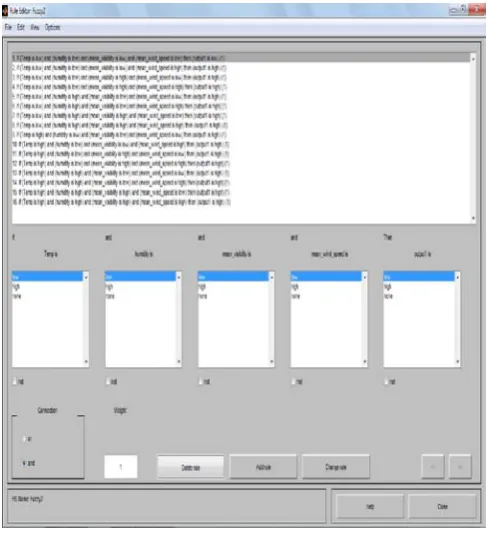
model. Initially the rules set are prepared comprising of the input and output parameters relationship. The rules are simple If-Then rules and the linguistic values for these rules are considered to be “LOW” and “HIGH”. The rules sets for hybrid neuro-fuzzy model are shown below:
Figure 6-10 Rules for hybrid model
[image:3.595.35.279.118.388.2]After creating the rules set, next step is deciding the type of membership function to be used and their respective values. In this model the membership function used is “trapezoidal” and the values for each parameter are shown in the figures below along with the membership function.
Figure 6-11 Membership function for Temperature.
[image:3.595.34.289.465.710.2]Figure 6-12 Membership Function for Humidity.
Figure 6-13 Membership Function for Mean Visibility.
[image:3.595.316.558.531.753.2]Figure 6-15 Membership Function for RSPM
[image:4.595.312.560.104.564.2] [image:4.595.314.562.126.334.2]Now after deciding all the membership function values, create the Fuzzy Inference Engine (FIS) as shown below
Figure 6-16 Fuzzy Inference system (FIS) of neuro-fuzzy model.
[image:4.595.36.283.322.521.2] [image:4.595.316.559.344.551.2]With the help of Rule Viewer, the effect of input parameters on the output parameter can be viewed easily. Figure 6-16 below shows the rule viewer.
Figure 6-17 Rules of FIS
The Surface Viewer has a special capability that is very helpful in cases with two (or more) inputs and one output: you can grab the axes, using the mouse and reposition them to get a different three-dimensional view on the data. Figure below shows different surface views between different parameters.
Figure 6-18 Surface View for humidity Vs Temperature.
Figure 6-19 Surface View of Temperature Vs Mean Visibility
[image:4.595.315.559.556.766.2] [image:4.595.35.280.581.764.2]V. CONCLUSION
In this paper, the results obtained for ANN and Hybrid Neuro-Fuzzy model for air quality prediction were discussed in detail. From this chapter, it can be concluded that the Hybrid model was superior in performance as compared to ANN model. The limitations of ANN model were overcome by Hybrid Model.
VI. REFRENCES
[1]. Hamdy K.Elminir, Hala Abdel- Galil, “Estimation of air pollutant concentrations from meterological parameters using Artificial Neural Networks”, 2006, Journal of Electrical Engineering.
[2]. COLLET, R.—ODUYEMI, K. : Air Quality Modelling: a Tech-nical Review of Mathematical Approaches. Meteorological Applications 4, 1997.
[3]. Ziomass, I.Melas, D.Zerfos, C.Bais, A. : Forecasting Peak Pollutant Levels from Meteorological Variables, 1995, Atmospheric Environment
[4]. Rumelhart, E. Hinton,G.Williams, Learning Internal Representation by Error Propagation, In: Parallel distributed processing,vol 1, 1986, Explorations in the Microstructure of Cognition, MIT Press, Cambridge, MA
[5]. Aparna soni,1Dr.ShailjaShukla, “Application of Neuro-Fuzzy in Prediction of Air Pollution in Urban Areas”. , Vol. 2(5), May. 2012 ,IOSR Journal of Engineering .
[6]. KKin Seng Lei, Feng Wan, “Adaptive Neuro-Fuzzy Approach to Air Pollution Prediction in Macau.”