*Corresponding author Javad Ivakpour
Email: [email protected] Tel: +98 21 4825 5038 Fax:+98 21 4473 9738
Article history
Received: August 23, 2012
Received in revised form: November 28, 2012 Accepted: August 07, 2013
Available online: March 10, 2014
Journal of Petroleum Science and Technology 2014, 4(1), 41-46 http://jpst.ripi.ir
DEVELOPING A NEW INITIALIZATION PROCEDURE FOR
DISTILLATION COLUMN SIMULATION
Javad Ivakpour1* and Norolah Kasiri2 1
Refining Division, Research Institute of Petroleum Industry, Tehran, Iran, P.O. Box: 14665-1998 2
Computer Aided Process Engineering Lab, School of Chemical Engineering, Iran University of Science and Technology
ABSTRACT
The simulation of distillation columns is an essential step in design, optimization, and rating. In this paper, a new procedure has been proposed for the initial estimation of column profiles based on modified Kremser’s group method for simple and/or complex columns. The effect of this initialization algorithm on simulation procedure has been studied through two examples. The results show significant improvement in convergence and considerable saving in execution time up to 30%. The proposed method can be used in problems which require numerous simulation runs to find the optimum conditions such as distillation column sequencing and the optimum design of distillation columns. The proposed method could also be used as an approximating simulation method for simple and complex distillation columns considering constant relative volatility and
constant molar overflow assumptions.
Keywords: Distillation, Simulation, Initialization, Column Profiles, Kremser’s Method
INTRODUCTION
Simulation is a key step in distillation column optimization problems. Accuracy, speed, and convergence properties are three important factors in the selection of a proper simulation method. Accuracy depends mainly on the distilla-tion column modeling assumpdistilla-tions followed by the termination criteria in simulation steps. Regarding the modeling assumptions, the simulation methods are divided into three main methods, namely approximated, equilibrium based, and rate-based methods. The equilibrium based methods are the most commonly used simulation methods and are based on the equilibrium assumption between leaving vapor and liquid flows for each stage. In
these methods, the columns modeling equations called MESH can be solved with different procedures. Based on the selected solving procedure, different equilibrium-based simulation methods have previously been proposed [1].
Journal of Petroleum Science and Technology 2014, 4(1), 41-46 http://jpst.ripi.ir shortcut design methods are implemented [2].
Shortcut methods are developed based on two main assumptions, namely constant molar over-flow and constant volatility. These assumptions are also made in the approximated simulation methods such as Kremser's group method used in this work. Because of lower computation time, shortcut methods are still used widely in optimization problems [3]. However, equilibrium based models like inside-out algorithm can be used for more accurate results if simulation time is acceptable [4,5]. Therefore, shorter simulation time is important in these problems.
The first critical step in distillation column simulation is the initial assumption of column profiles. More accurate assumptions can result in better convergence and shorter execution time. More importantly, poorer assumptions may result in the lack of convergence. This fact is more effective in complex columns with side-streams products and/or multiple feed side-streams. In this work, an initialization method has been proposed based on the approximated simulation method [5]. The proposed initialization algo-rithm has been implemented in the inside-out simulation method. This algorithm has been compared through two examples with the simple initialization algorithm frequently used in other works. Moreover, this algorithm has been combined with two different damping methods to make it possible to further analyze the proposed algorithm.
INITIALIZATION ALGORITHM AND DAMPING METHOD
Initialization Algorithm
To solve the MESH equations, the column profiles must initially be assumed. It is clear that the assumptions which are closer to the true values result in less computational effort in the solving procedure. One of the well-known initializetion algorithms (called simple method herein, because of its simplicity) is as follows:
1-Estimate the overall molar flow rates; the overall molar flow rates in the column can be easily computed by the constant molar overflow assumption [4].
2-Estimate the temperature profile; by com-bining the feed streams, the top and bottom temperatures can be assumed as the dew and bubble points of the combined feed respect-tively. The intermediate stage temperatures can be found by linear interpolation between these two points [4].
3-Composition and K-value profiles; by flashing the combined feed isothermally at the temp-erature of each stage, the composition and K-value profiles can be assumed through the columns.
The distillation column can be divided in a number of sections by the feed streams and side-stream products. Each section includes a number of stages and the entering and leaving vapor and liquid streams. Therefore, each sec-tion would have no feed or side-stream at its stages and can consequently be modeled by the Kremser’s group method. In these conditions, feed streams and side-stream products can only be allowed at the intermediate stages between two successive sections. Ivakpour and Kasiri proposed an approximated simulation method for these conditions [5]. This approximated simulation method can be modified to estimate the temperature and composition profiles through the column.
Journal of Petroleum Science and Technology 2014, 4(1), 41-46 http://jpst.ripi.ir can be used for resolving the approximated
method for more accurate results. Based on the approximated simulation algorithm, the initial-ization algorithm can be proposed as follows:
1-Estimate the overall flow rates; the overall molar flow in the column can be estimated by the constant molar overflow assumption as in the simple method.
2-Composition and K-value profiles solve the approximated simulation algorithm with the double modification of K-values. Having deter-mined the entering and leaving vapor and liquid component flow rates of each section, the component flow rates of each stage can be estimated by linear interpolation. After that, the K-value profile can be estimated by dividing the values of vapor composition to the correspond-ing liquid composition for each component.
3-Estimate the temperature profile: having determined the composition profile from the previous section, the temperature can be esti-mated at the dew point of the leaving vapor streams of each stage.
Damping Method
The damping factor in variables updating steps has a significant effect on the distillation column simulation results. In this work, the bounding method has been used for the determination of damping factor [6]. This procedure can consider-ably improve the convergence and speed of simulation procedures. Furthermore, the well known Broyden’s damping method has been implemented in the separate model for better analyzing the effects of proposed initialization algorithm on the simulation results [7].
RESULTS AND DISCUSSION
The effect of the proposed initialization method has been examined in this section through two examples. The specifications of the studied examples are shown in Tables 1 and 2. The Peng-Robinson equation of state has been used
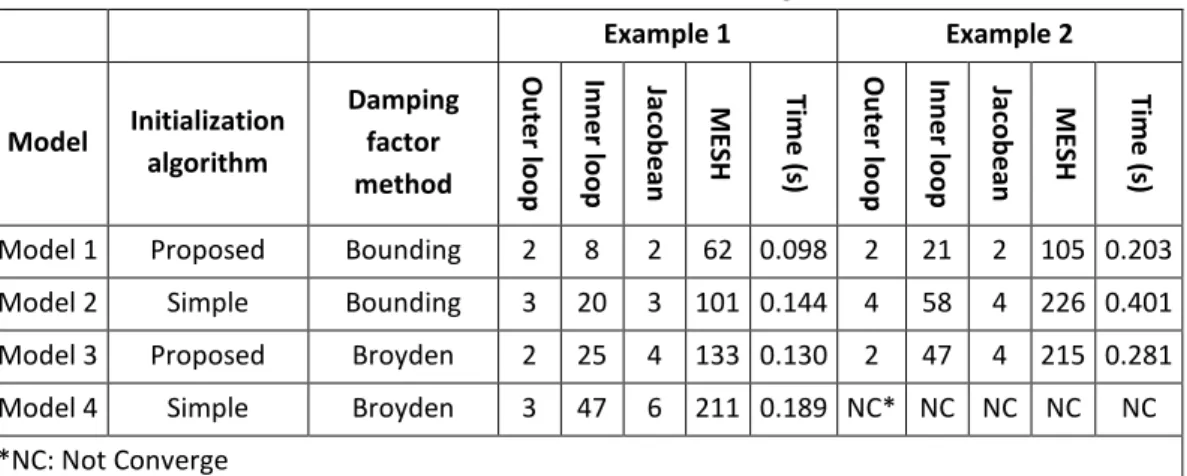
for predicting the equilibrium and enthalpy calculations, in the investigated examples. In these examples, columns have been simulated by four different models. The investigated models are similar in all the computational procedures except the damping and initialize-tion algorithms. In each specified model, one of the studied damping methods (i.e. Bounding or Broyden) and one of the described initialization algorithms (simple or proposed initialization algorithm) are used for the simulation. Table 3 tabulates the results of the simulations and the specification of each model. In this table, the execution times, the number of inner and outer loop calculations, the number of Jacobean ma-trix computation, and the number of MESH function evaluations are reported.
Table 1: Specifications of the investigated Example 1; Distillate rate=90.0 (kmol/s), Reflux ratio=1.2, and
Number of trays=24
Feed specs
Tray number
Flow rate (kmol/s)
Composition
n
-C
4H
1
0
n
-C
5H
1
2
n
-C
6H
1
4
n
-C
7H
1
6
Feed 1 7 200.0 0.40 0.30 0.20 0.10 Feed 2 16 200.0 0.05 0.25 0.30 0.40
Side product specs Tray number
Flow rate
(kmol/s) Phase Side product 1 11 90 Liquid Side product 2 18 110 Vapor The column pressures are constant at 1 atm; all the feeds are considered to be at bubble point temper-ature at 1 atm.
Journal of Petroleum Science and Technology 2014, 4(1), 41-46 http://jpst.ripi.ir Table 2: Specifications of the investigated Example 2;
Distillate rate=120.0 (kmol/s), Reflux ratio=4.0, and Number of trays=40
Feed specs
Tray number
Flow rate (kmol/s)
Composition
i-C
4H
1
0
n
-C
4H
1
0
i-C
5H
1
2
n
-C
5H
1
2
n
-C
6H
1
4
Feed 1 10 200.0 0.70 0.20 0.07 0.03 0.00 Feed 2 30 200.0 0.03 0.07 0.40 0.35 0.15
Side product specs Tray number
Flow rate
(kmol/s) Phase Side product 1 20 160.0 Vapor The column pressures are constant at 1 atm; all the feeds are considered to be at bubble point temper-ature at 1 atm.
In Figure 1, the estimated temperature and relative volatility (n-Butane to n-Pentane) profiles resulted from both the investigated initialization algorithms are compared with the final rigorous simulation results of inside-out algorithm. As can be seen in this figure, the proposed initialization method provides profiles closer to the rigorous results. This closer estimation will result in more accurately ap-proximated thermodynamic equations and therefore a fewer number of outer loop iterations. The estimated values are closer to the true values at the intermediate trays, because at these locations the variable values are directly calculated by the approximated simulation method. Thus dividing the column into a larger number of sections can improve the quality of the initial estimation of column profiles. However, this obviously results in further computations, which are not usually required because the estimated profiles are not necessary to be very accurate. However, when the number of stages in one section is very high, dividing it into a number of subsections can be beneficial and cause significant improvement in the estimation of column profiles.
Example 2 of Table 2 indicates a distillation column with two feed and three products. As
can be seen in Table 3, only three models can simulate this column and the model with simple initialization algorithm and Broyden damping method cannot successfully converge.
Figure 1: Comparison of estimated column profiles from the simple and proposed initialization methods with respect to the rigorous simulation results for Example 1
Figure 2 indicates the temperature profile estimations from two investigated initialization algorithms and compares them with the rigorous simulation results. In this example, the differences between the results of the simple initialization method and final rigorous results are more considerable. Therefore, very large changes are required in inner loop variables.
Broyden’s damping method chooses a damping factor to decrease the sum of MESH’s discrep-ancy functions regardless of the evaluated changes magnitude.
270 290 310 330 350 370
0 5 10 15 20 25
T
e
m
p
e
rat
u
re
(
K
)
Tray Number
Proposed Method
Simple Method
Rigorous Method
2.5 3 3.5 4 4.5
0 5 10 15 20 25
R
e
lat
iv
e
V
o
lat
il
it
y
(
C4
/C
5
)
Tray Number
Journal of Petroleum Science and Technology 2014, 4(1), 41-46 http://jpst.ripi.ir Table 3: Simulation results of the four investigated models
Example 1 Example 2
Model Initialization algorithm
Damping factor method
O
u
te
r l
o
o
p
In
n
e
r l
o
o
p
Ja
co
b
e
a
n
M
E
S
H
T
im
e
(s
)
O
u
te
r l
o
o
p
In
n
e
r l
o
o
p
Ja
co
b
e
a
n
M
E
S
H
T
im
e
(s
)
Model 1 Proposed Bounding 2 8 2 62 0.098 2 21 2 105 0.203 Model 2 Simple Bounding 3 20 3 101 0.144 4 58 4 226 0.401 Model 3 Proposed Broyden 2 25 4 133 0.130 2 47 4 215 0.281 Model 4 Simple Broyden 3 47 6 211 0.189 NC* NC NC NC NC *NC: Not Converge
When these calculated changes are very high, this damping procedure results in new inner loop variables that may be impossible in
distillation columns. In these situations,
bounding method chooses a damping factor that is restricted by the maximum allow-able changes in the inner loop variables and therefore results in new possible inner loop variables. This fact is the main reason for the convergence of Model 2 in this example.
Figure 2: Estimated temperature profiles from simple initialization, proposed initialization, and rigorous simulation for Example 2
When the initial estimates are closer to the true variables, smaller changes are consequently required. Therefore, the required changes to minimize the sum of discrepancy functions (computed by Broyden’s method) are in an acceptable range and the simulation model can eventually converge. The proposed initialization
algorithm can lead to convergence by
introducing these better estimating values.
Although the resulted time saving by the proposed initialization algorithm is not very important for single simulation problems, when a large number of simulation runs must be performed to find the optimum condition, it is a considerable value. Distillation column sequenc-ing, process synthesis problems, and the optimization of distillation column conditions are the well-known examples of these problems. Furthermore, the proposed algorithm can improve the convergence possibility, which is essential in all the simulation models.
Furthermore, Figures 1 and 2 show that the proposed method can be used as an approx-imating simulation method for deter-mining the product compositions of simple and complex distillation columns based on the main two assumptions, namely constant molar over-flow and constant relative volatility.
CONCLUSIONS
Convergence and speed are two important factors in distillation column simulations. The proposed initialization algorithm can signify-cantly improve both factors with estimating more accurate column profiles. This accuracy can be obtained with negligible computational effort based on the approximated simulation procedure. Therefore, it is convenient to replace the simple traditional initialization method with 260
275 290 305 320
0 10 20 30 40
T
e
m
p
e
rat
u
re
(K
)
Journal of Petroleum Science and Technology 2014, 4(1), 41-46 http://jpst.ripi.ir the proposed method.
NOMENCLATURE
Abbreviations
CPU Central processing unit
MESH Equations
Material balance (M)-Phase Equilibrium (E)-mole fraction Summation (S)-Energy balance (H) equations
REFERENCES
[1] Kister H. Z., Distillation Design, Chapter 4,
New York: McGraw-Hill, 1992, 135.
[2] Jaina S., Smitha, R., and Kim, J. K.,
“Synthesis of Heat-integrated Distillation
Sequence Systems,” Journal of the Taiwan
Institute of Chemical Engineers, 2012, 43,
525-534.
[3] Adiche Ch. and Vogelpohl, Al., “Shortcut
Methods for the Optimal Design of Simple
and Complex Distillation Columns,”
Chemical Engineering Research and
De-sign, 2011, 89, 1321-1332.
[4] Seader J. D. and Henley E. J., Separation
Process Principles, New York: John Wiley
and Sons, 1998, 569.
[5] Ivakpour J. and N. Kasiri, “Development of
a New Model for the Determination of Optimum Distillation Column Sequence
for Nonsharp Separations,” Ph.D. Thesis,
Iran University of Science and Technology,
Tehran, Iran, 2009.
[6] Ivakpour J. and N. Kasiri., “Improve Speed
and Convergence of Distillation Column
Simulation,” Hydrocarbon Process, 2008,
87, 10, 75-80.
[7] Broyden C. G., “A Class of Methods for
Solving Nonlinear Simultaneous
Equa-tions,” Mathematics of Computation,